%22%3E%3C/path%3E%3Cpath d=%22M 63.072 7.554 C 62.258 8.022 61.577 8.689 61.092 9.493 L 61.092 7.076 L 57.158 7.076 L 57.158 22.64 L 61.089 22.64 L 61.089 14.888 C 61.089 13.446 61.403 12.434 62.03 11.853 C 62.818 11.218 63.818 10.907 64.826 10.982 L 65.868 10.982 L 65.868 6.851 C 64.891 6.834 63.926 7.076 63.073 7.554 Z%22 fill=%22rgb(17,17,17)%22%3E%3C/path%3E%3Cpath d=%22M 78.916 7.82 C 76.363 6.49 73.321 6.49 70.768 7.82 C 69.562 8.473 68.564 9.451 67.888 10.644 C 67.167 11.931 66.803 13.387 66.834 14.862 C 66.804 16.332 67.157 17.785 67.86 19.077 C 68.515 20.267 69.494 21.246 70.684 21.901 C 71.924 22.576 73.318 22.92 74.73 22.898 C 76.164 22.918 77.58 22.575 78.846 21.901 C 80.062 21.247 81.073 20.27 81.768 19.077 C 82.506 17.797 82.88 16.339 82.85 14.862 C 82.88 13.389 82.517 11.934 81.797 10.647 C 81.12 9.455 80.122 8.477 78.917 7.824 M 78.803 14.862 C 78.829 15.739 78.636 16.608 78.241 17.391 C 77.903 18.046 77.38 18.588 76.738 18.95 C 76.124 19.293 75.432 19.472 74.729 19.47 C 73.668 19.497 72.648 19.061 71.934 18.276 C 71.139 17.323 70.741 16.1 70.823 14.862 C 70.741 13.62 71.149 12.395 71.959 11.45 C 72.687 10.667 73.715 10.233 74.783 10.256 C 75.859 10.236 76.894 10.67 77.635 11.45 C 78.464 12.387 78.884 13.616 78.801 14.864%22 fill=%22rgb(17,17,17)%22%3E%3C/path%3E%3Cpath d=%22M 95.906 7.076 L 95.906 15.646 C 95.975 16.68 95.643 17.701 94.979 18.498 C 94.311 19.184 93.379 19.547 92.422 19.495 C 91.475 19.544 90.553 19.18 89.894 18.498 C 89.23 17.701 88.898 16.68 88.967 15.646 L 88.967 7.076 L 85.033 7.076 L 85.033 16.207 C 85 17.449 85.275 18.68 85.834 19.79 C 86.327 20.75 87.095 21.542 88.039 22.065 C 89.033 22.594 90.145 22.861 91.271 22.838 C 92.188 22.847 93.095 22.65 93.926 22.263 C 94.708 21.905 95.388 21.36 95.906 20.675 L 95.906 22.645 L 99.865 22.645 L 99.865 7.076 Z%22 fill=%22rgb(17,17,17)%22%3E%3C/path%3E%3Cpath d=%22M 4.513 15.626 C 4.511 10.815 7.606 6.549 12.181 5.059 C 16.756 3.57 21.77 5.195 24.601 9.086 L 27.816 5.87 C 24.074 1.186 17.981 -0.943 12.137 0.393 C 6.292 1.728 1.728 6.292 0.393 12.137 C -0.943 17.981 1.186 24.074 5.87 27.816 L 9.085 24.601 C 6.214 22.512 4.515 19.177 4.513 15.626%22 fill=%22rgb(32,62,235)%22%3E%3C/path%3E%3Cpath d=%22M 17.114 14.343 L 13.354 18.01 L 13.354 18.026 L 21.071 18.026 L 11.412 27.609 L 17.389 27.609 L 23.999 21.081 L 23.999 28.316 L 24.005 28.316 L 27.967 24.393 L 27.967 14.343 Z%22 fill=%22rgb(32,62,235)%22%3E%3C/path%3E%3C/g%3E%3C/svg%3E) ×
× ××
××›
›
›
›
Marketing agency lead generation playbook: the system that scales your pipeline
Marketing agency lead generation playbook: the system that scales your pipeline
Marketing agency lead generation playbook: the system that scales your pipeline
Marketing agency lead generation playbook: the system that scales your pipeline
Marketing agency lead generation playbook: the system that scales your pipeline
Marketing agency lead generation playbook: the system that scales your pipeline

Author
Aljaz Peklaj

Slug: marketing-agency-lead-generation
Meta description: Most agency lead gen problems start after the campaign goes live. See the systems, workflows, tools, and reporting structure that keep meetings qualified and pipeline accountable.
Your last agency probably booked meetings. Sales probably said they were weak. The agency probably pointed to sends, replies, and calendar volume. Nothing looked broken in isolation, yet pipeline still disappointed. That's the normal failure pattern in marketing agency lead generation, and it usually isn't a campaign problem. It's an integration problem.
Most agency failures come from missing structure, not weak copy or low activity
Six integration layers decide whether attention becomes qualified pipeline or internal friction
Signal-triggered intake matters more than commonly perceived, because timing shapes reply quality
A real SaaS example shows what happens when agency execution and client-side follow-up connect effectively
Reporting cadence matters when it drives decisions, not status theater
Table of Contents
Why Your Last Agency Engagement Failed
Monday morning. The agency dashboard shows 14 meetings booked last week. By Tuesday afternoon, sales has marked 9 as poor fit, 3 as no-shows, and 2 as "follow up later" with no next step logged in HubSpot. The agency says the campaign is working. Sales says the agency is sending junk. RevOps is stuck reconciling calendars, inbox replies, and CRM records to figure out which version is even true.
That pattern usually gets diagnosed as an execution problem. It is usually an integration problem.
I don't start by reviewing copy, list quality, or whether the agency used Apollo, Clay, Lemlist, Instantly, Smartlead, or HeyReach well. I start with a simpler question. Did the agency operate inside the same revenue system as the client, with shared definitions, routing, and reporting? If not, performance was capped before the first sequence went live.
The failure point is structural. Agencies often work from a side system while the client team treats HubSpot or Salesforce as the only source of truth. That creates parallel reporting. One team tracks sends, replies, and booked calls. The other tracks no-shows, disqualification reasons, and opportunities that never materialize.
Many marketing leaders audit messaging first. The handoff path usually deserves attention first.
Tool selection still matters, but the buying mistake happens earlier. Teams spend weeks comparing vendors and almost no time mapping how lead status, ownership, and reply context will move into the CRM. If you're still choosing lead generation platforms, use that evaluation to pressure-test the operating model, not just the feature list.
What failure looks like in practice
Sales rejects meetings: The agency sees account-level fit. The AE sees no urgency, weak authority, or no active initiative.
Marketing reports top-of-funnel success: Reply rates and booked calls look acceptable, while pipeline creation stays weak.
RevOps sees broken records: Reply intent, campaign source, and outreach history do not sync cleanly into the CRM.
Leadership gets conflicting narratives: No shared dashboard connects first touch, meeting outcome, opportunity creation, and revenue.
A capable agency can underperform in that environment. So can a capable internal sales team.
If you want a stronger way to evaluate a lead generation agency operating model, judge whether the agency can work inside your revenue system without creating a second version of the funnel.
The diagnosis is usually wrong
B2B marketing teams and sales leaders tend to blame one of three things.
Common diagnosis | What it sounds like | What is usually broken |
|---|---|---|
Messaging problem | "The emails weren't strong enough" | ICP criteria were never documented, so decent copy reached the wrong accounts |
Lead quality problem | "The agency books junk" | No shared meeting standard, no disposition rules, and no clean handoff |
Sales follow-up problem | "AEs didn't work the leads" | No routing logic, no SLA for response time, and no ownership model |
I have seen this play out with strong agencies, experienced SDR teams, and expensive tech stacks. The pattern stays the same. Once qualification rules, CRM sync, and response ownership are vague, every team can defend its own numbers and nobody can fix the system.
Agency lead generation fails less from bad execution than from bad integration. That is the root cause the rest of this framework addresses.
The six layers of a high-performing integration
A high-performing agency relationship has six layers. Miss one, and the others carry extra load. Miss two or three, and the funnel starts lying to everyone.
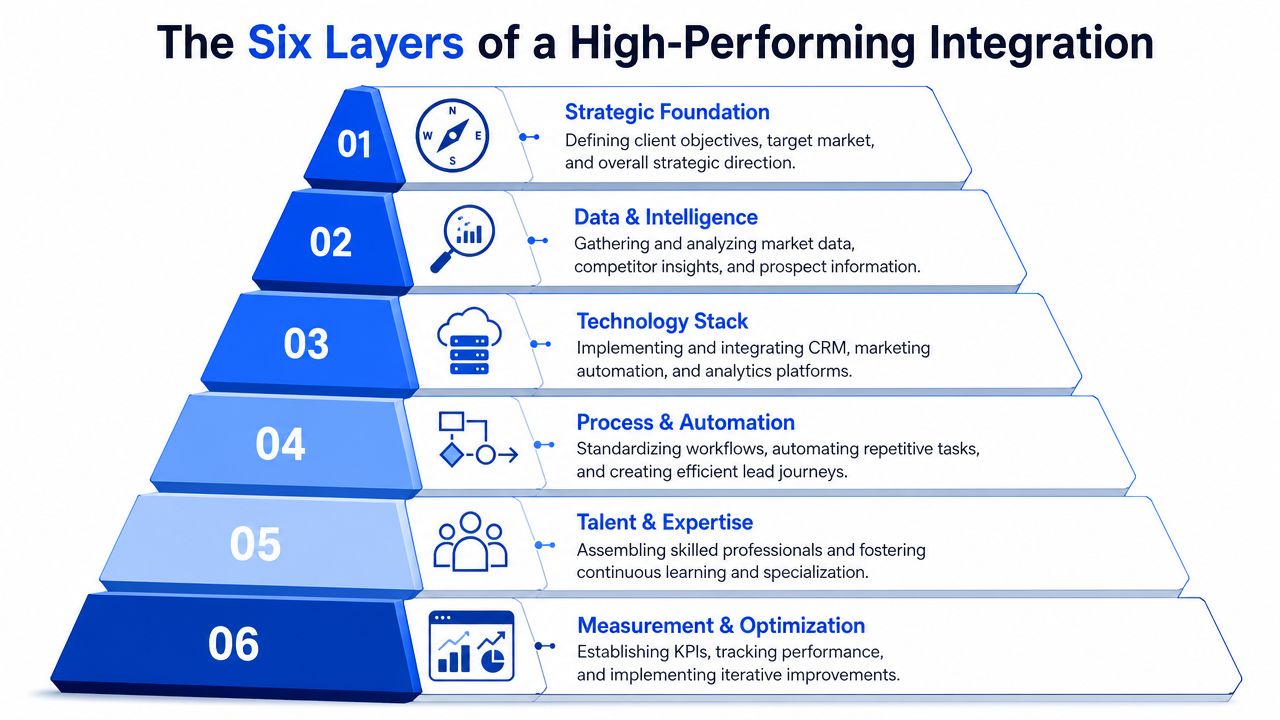
Layer 1, shared ICP in writing
The first layer is a written ICP that both sides can point to when edge cases appear. Verbal agreement during kickoff isn't enough. It decays fast.
For teams in iGaming, SaaS, manufacturing, legal tech, and pharma, the written definition should cover industry, company size, function, seniority, geography, readiness signals, and exclusion rules. In iGaming, for example, target-account identification often starts with regulated-market registries such as UKGC, MGA, and AGCO, then expands through Sales Navigator filters and a warm-up period on LinkedIn before outreach begins, as outlined in this iGaming B2B prospecting breakdown.
A Notion page or Google Doc is enough. The point isn't format. The point is shared judgment.
What goes wrong without it
Qualification drifts: Week 1 standards are not the same as week 5 standards.
Disputes multiply: The agency says "fit," sales says "not fit," and nobody can resolve it.
Exclusions get ignored: Bad verticals, tiny accounts, or poor geographies sneak back in.
Layer 2, CRM access and sync architecture
The second layer is data visibility. The agency needs read access to HubSpot or Salesforce, plus the right fields and activity mapping. If the agency can't see what happens after handoff, it can't improve targeting or messaging with real downstream feedback.
Many teams make a costly mistake. They keep the agency in a separate environment "for control." That creates duplicate records, broken attribution, and handoffs that depend on screenshots and Slack threads.
For most programs, the system should include:
System of truth: HubSpot or Salesforce owns lifecycle stages and opportunity status
Sending stack connection: Lemlist, Instantly, or HeyReach logs activity back into the CRM through native integrations, API, or Zapier
Custom properties: Source detail, signal type, sequence name, reply intent, and meeting owner
Shared reporting view: HubSpot dashboards, Google Sheets, or Looker for cross-channel inspection
For teams building this layer, a practical reference point is this piece on B2B marketing automation systems, because the problem isn't software ownership. It's process ownership across software.
Practical rule: If the agency can report booked meetings but can't inspect SQL creation and opportunity progression, you're running a partial funnel.
Layer 3, qualified meeting definition and handoff
A booked meeting isn't a qualified meeting. Treating those as the same is where trust starts to collapse.
The handoff needs a written definition that covers fit, reason for interest, context for outreach, and the threshold for AE involvement. For SaaS teams especially, pipeline quality is decided by MQL-to-SQL rate and SQL-to-opportunity rate. A low CPL paired with weak SQL conversion points to a quality issue, not a volume issue, which is why teams need clear MQL and SQL criteria documented in HubSpot or Salesforce, as described in this B2B SaaS lead generation analysis.
A useful handoff packet includes:
Prospect background: Company, role, current priorities
Signal context: Why this account entered the queue now
Conversation history: Email replies, LinkedIn messages, objections, tone
AE prep note: What to ask first, what not to assume
Ownership rule: Who sends the next message, and by when
For manufacturing teams, the same discipline matters in channel mix. High-caliber leads often come from webinars, referrals, organic search, and targeted LinkedIn ads, while paid search, paid social, and email tend to produce volume, according to this manufacturing lead generation agency review. Different sources need different qualification standards.
Layer 4, reply routing with a real speed standard
Positive replies should not sit in an inbox waiting for someone to notice them. They need routing logic.
The minimum standard I recommend is this: positive replies route to the assigned AE Slack channel within 2 minutes, neutral replies go to an SDR for human qualification, and negative replies tag the CRM and stop active sequence enrollment.
That standard exists for a reason. In B2B marketing, responding to high-intent leads within five minutes makes qualification 21 times more likely than waiting one hour, according to SalesHive's speed-to-lead benchmark. If your routing path adds delay, your outbound engine is creating interest that your internal process then wastes.
Layer 5 and layer 6, operating rhythm
The last two layers are meeting cadence. Not more meetings. Better ones.
Layer 5 is the weekly operational sync. Keep it to 30 minutes, with async prep. Agency account manager and client owner only. Shared dashboards open. Decisions first.
Layer 6 is the monthly strategic review. Bring senior stakeholders. Review pipeline trajectory, conversion quality, shifts in the ICP, signal performance, and what gets changed next.
A useful split looks like this:
Layer | Cadence | Main attendees | Purpose |
|---|---|---|---|
Weekly operational sync | Weekly | Agency AM, client owner | Make tactical decisions |
Monthly strategic review | Monthly | Agency lead, marketing or revenue leader | Review trends and adjust direction |
What doesn't belong in either meeting is status theater. Completed tasks can sit in Slack or a written update. Live meeting time should handle decisions, friction, and trade-offs.
The engine that drives it all signal-triggered intake
A common failure pattern looks like this. The agency sends volume, the client sees replies, and everyone assumes execution is working. Then pipeline quality breaks down because the intake system is disconnected from timing, CRM rules, and sales follow-up.
That is why signal-triggered intake sits at the center of this model. Agency lead gen usually fails at the handoff points, not at copy quality. If the account enters the funnel at the wrong moment, even good messaging underperforms.
Why timing beats more activity
Static-list outbound is easy to launch. Pull contacts from Apollo or Sales Navigator, enrich in Clay, push to Smartlead or Instantly, and start sending. The problem is structural. That workflow assumes the prospect should hear from you now, even when nothing in the account suggests active interest, budget movement, team change, or operational pain.
Signal-triggered intake changes the entry condition. An account only moves into outreach after a relevant event appears. In B2B SaaS, that usually means hiring for RevOps or sales ops, a funding event, a new GTM leader, a tool-stack change, conference activity, or a public post that exposes a live problem. In other sectors, the signals change. The logic does not.
This matters because timing improves more than reply rate. It improves fit, call quality, and the odds that sales treats the lead seriously. Agencies that ignore this usually compensate with more volume, which creates another integration problem later in the funnel.
What the engine looks like in practice
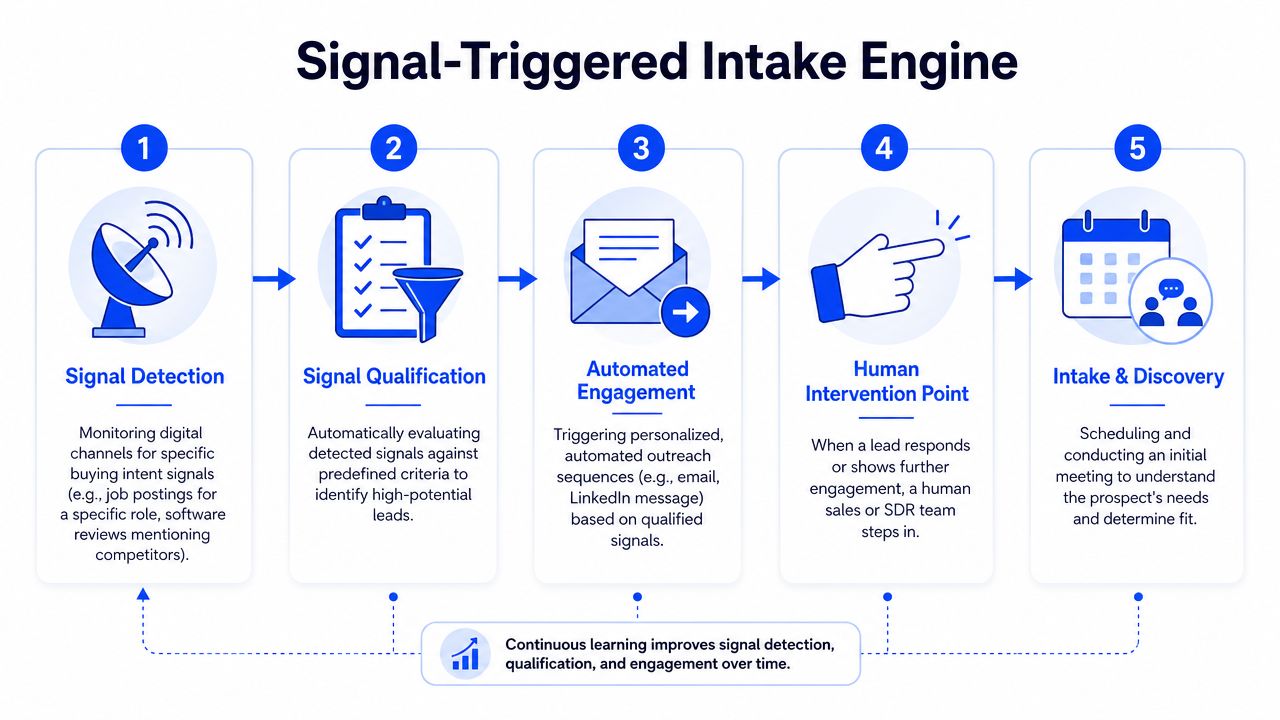
A usable system has five parts.
Detect the signal. Use Clay, Sales Navigator, company websites, job boards, news feeds, and first-party intent sources to watch for events tied to your ICP.
Validate account fit. Check firmographics, exclusions, territory rules, and ownership before the record enters sequence.
Attach the trigger context. Pass the signal into the prompt or message variables so the outreach references the exact reason the account was queued.
Route to the right channel. Send the contact into Lemlist, Smartlead, Instantly, or HeyReach based on channel availability, deliverability rules, and persona.
Escalate on reply threshold. Positive replies go to an SDR or AE with context, source, and next-step guidance already logged in the CRM.
The trade-off is operational overhead. Signal systems need cleaner field mapping, tighter deduplication, and clearer ownership rules than static outbound. If HubSpot or Salesforce is missing lifecycle stage, account status, or routing logic, the agency can generate interest that the client team mishandles within hours.
The strongest setups also connect founder or executive content to outbound. That adds familiarity before the first direct touch and gives the rep a credible angle beyond "reaching out." If you are tightening that layer, this guide to LinkedIn posting strategy is useful because it focuses on topic consistency and message carryover into outbound.
Teams that need a cleaner operating definition should document what qualifies as a real intent signal before building automation. Without that definition, intake logic gets noisy, queues fill with weak accounts, and campaign performance starts to look like a messaging problem when it is a systems problem.
A real-world example from 78 meetings to €312k ARR
The easiest way to judge a lead generation system is to look at where it held and where it depended on client-side discipline. This example came from a B2B SaaS company in the RevOps category.
They had around 50 employees, an average ACV of €38k, and a target market of heads of revenue operations at B2B SaaS companies with 100 to 500 employees. They had already worked with two agencies and were close to giving up on outbound.
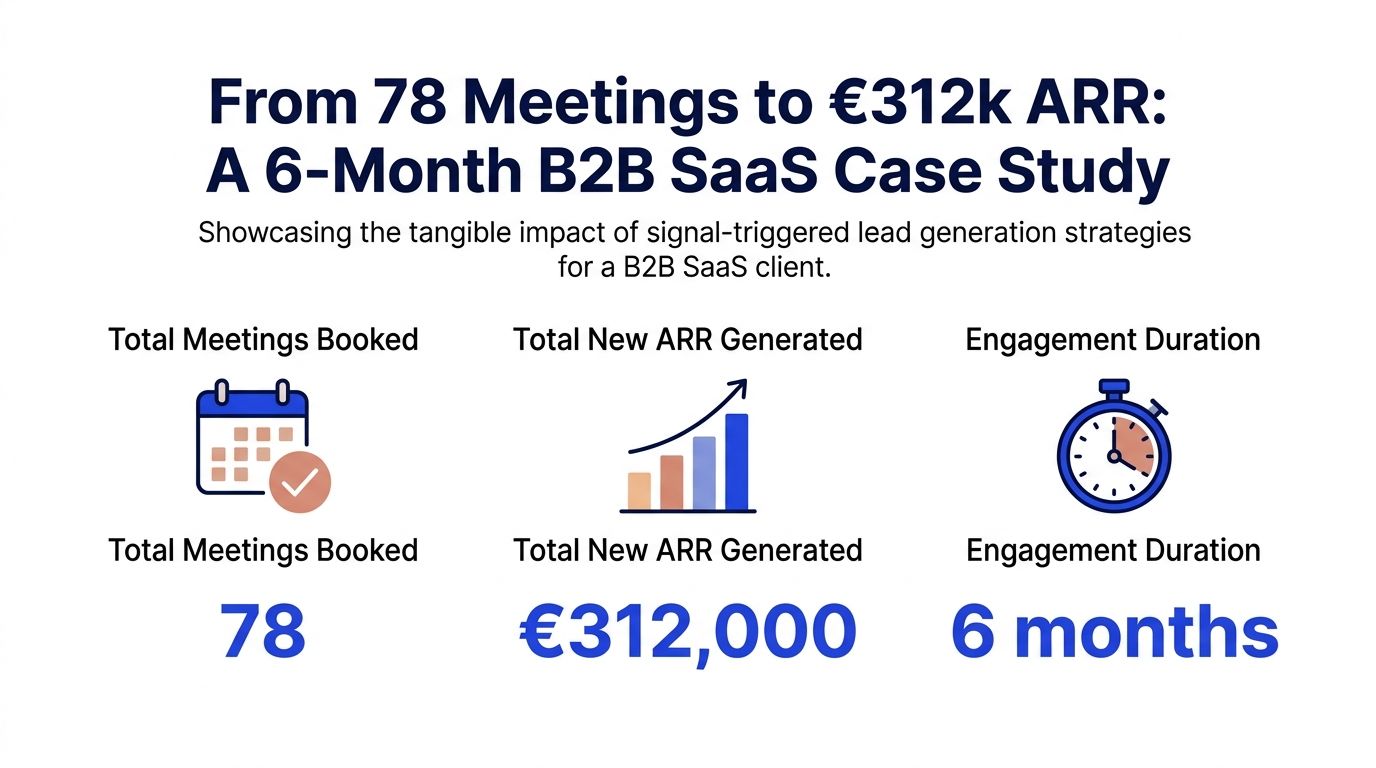
A visual snapshot helps before the details.
What the campaign looked like
The engagement ran for 6 months with LinkedIn outbound, email outbound, and a founder content program added in month 2. The active prospect queue covered roughly 2,400 prospects across that period, with signal-triggered intake replacing static-list prospecting.
The monitored signals included hiring patterns tied to RevOps, recent funding events, public posts about operational pain, tool stack changes, and conference attendance. Clay handled signal monitoring and queue logic. Outbound ran across email and LinkedIn, with human follow-up once replies crossed the threshold for AE involvement.
The timeline was disciplined:
Weeks 1 to 3: ICP refinement, infrastructure setup, signal configuration, sending-domain warm-up
Weeks 4 to 7: First wave of signal-triggered outreach
Week 8: Founder content added after early outbound feedback showed a credibility gap
Weeks 8 to 24: Continuous execution with weekly reviews and monthly strategic changes
Midway through the program, the team also used video at later-stage selling moments.
What actually drove the result
The campaign produced 78 qualified meetings, with an 81% show rate, meaning 63 meetings were held. After first calls, 67% progressed to second-stage opportunities, or 42 opportunities. During the engagement, 7 deals closed, and another 3 deals closed within 90 days after the engagement ended. Total attributable closed revenue was roughly €312k ARR across 10 deals, against €46k in total spend, for roughly 6.7x ROI. There was also roughly €280k in late-stage pipeline still active at the end of the engagement.
The top-of-funnel numbers were strong too. Reply rate averaged 12.4%, compared with the 4% to 6% the client had seen with prior agencies. Cost per qualified meeting averaged €590, versus €1,050+ previously. Time to first qualified meeting was 16 days from campaign launch.
This wasn't just an agency performance story. It was an integration story.
When teams ask why the result held, the honest answer is that the agency generated momentum and the client didn't waste it.
Three factors mattered most:
Signal-triggered intake: This replaced random list pulls with timing-relevant entry points. It was the biggest contributor to stronger reply performance.
Fast reply routing: Positive replies routed to AE Slack within 2 minutes. That helped lift show rate from 68% to 81%. Speed matters because high-intent leads are far easier to qualify when answered quickly, as noted earlier in the speed-to-lead benchmark.
Founder participation: The founder posted 2 to 3 times weekly, and by month 5 that content layer generated 11 to 14 inbound DMs per month from ICP-fit prospects.
There were later-stage gains too. Personalized Loom videos at proposal stage shortened the proposal-to-close period by 9 days median and improved proposal-to-close conversion from 28% to 41%. Content-warmed prospects closed in 67 days median from first contact, compared with 95 days for non-warmed prospects.
The caveat matters. This is a strong example, not a universal baseline. The client had a disciplined AE team, shared closed-won analysis back into the system, and agreed to stop weak creative variants early instead of defending sunk costs.
The reporting cadence that maintains alignment
Most reporting cadence is bloated. Too many attendees, too much recap, not enough decision-making. The fix isn't to remove communication. It's to separate operating conversations by purpose.
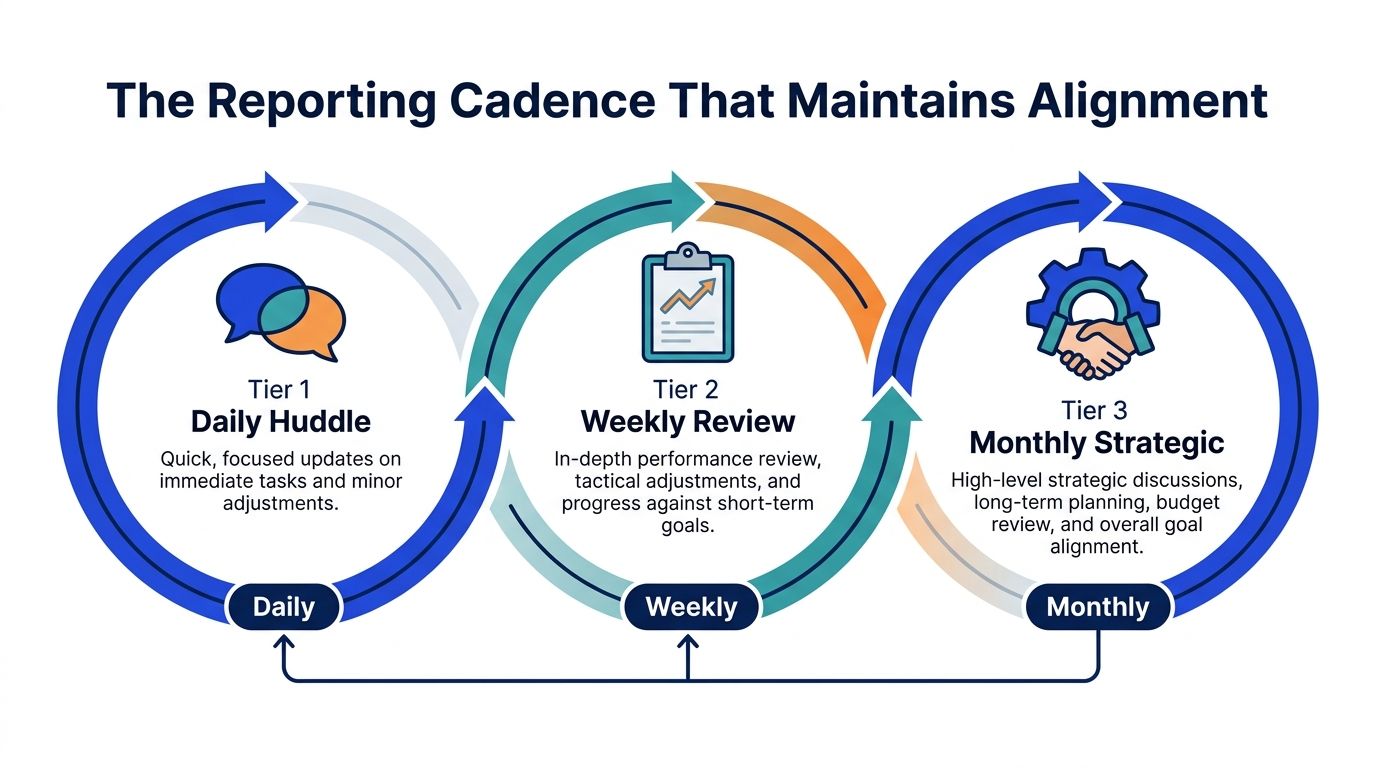
Weekly operational sync
This meeting should be 30 minutes. It should not drift to an hour. It also shouldn't carry broad attendance.
The useful format is simple. Agency account manager and the client's primary owner join with dashboards already open. Agenda goes out in advance. The meeting exists to make decisions on audience, message, routing, content dependencies, and sales follow-up gaps.
A practical agenda:
First segment: Review what moved outside normal range
Middle segment: Decide what changes this week
Final segment: Confirm blockers, owners, and deadlines
This is also where client-side friction gets surfaced early. If AEs are slow to accept meetings, if SDRs are mishandling neutral replies, or if a segment is producing attention but weak downstream progression, deal with it now.
For teams trying to tighten revenue-team coordination, this piece on aligning sales and marketing is a good operating reference because it treats alignment as workflow, not culture talk.
Monthly strategic review
This meeting should run 60 to 90 minutes and include senior stakeholders. The point is trend analysis, not week-by-week commentary.
SaaS teams in particular need an agreed service level agreement and a unified dashboard that shows the entire funnel so both teams are accountable for their part of the sales cycle, as described in this B2B SaaS alignment guide. That's the standard I hold agencies to as well. If the dashboard can't connect first touch to closed deal, leadership will fill the gaps with opinion.
Use the monthly review to inspect:
Review area | Questions to answer |
|---|---|
Pipeline quality | Are SQLs progressing, or just accumulating? |
Channel contribution | Which motion is producing qualified conversations, not just replies? |
ICP fit | Are disqualifications clustering around a segment we should remove? |
Execution risk | Where is slow follow-up or weak prep reducing yield? |
Good reporting creates accountability in both directions. The agency can't hide behind activity, and the client can't hide behind vague complaints about quality.
Quarterly executive review
This is the business-level meeting. Keep it for executive sponsors and senior agency leadership.
The topics are broader. Revenue attributable to the program, pipeline trajectory, resource commitment, expansion or contraction of scope, and whether the original thesis still holds. This is also the right place to acknowledge misses. If a segment failed, say it. If a channel underdelivered, remove it or change its role.
Three rules keep the cadence clean:
Async prep is mandatory: Cold meetings become status updates.
Written updates handle routine information: Slack or email can carry completed-task reporting.
Cadence should adapt with maturity: Early engagements need more touchpoints than stable ones.
What I don't recommend is daily meeting culture. Urgent issues belong in Slack. Calendar time should be protected for decisions that need real discussion.
Your first step to a structural integration
If your current agency relationship feels noisy, don't start by rewriting copy or replacing tools. Start with one document.
Write the qualified meeting definition your team is already assuming but hasn't documented. Put it in Notion or Google Docs. Then get sales, marketing, RevOps, and the agency to sign off on it.
What to document by Monday
Keep it short enough that people will use it. Detailed enough that disputes can be resolved from the document, not from memory.
Include these fields:
ICP fit rules: Industry, company range, target functions, seniority, and geography
Readiness indicators: What signal or context makes outreach appropriate
Disqualification rules: Who should never be booked
Meeting threshold: What must be true before an AE gets involved
Handoff contents: What context must sit in the CRM before the meeting happens
Ownership timing: Who responds, who prepares, who follows up
Then inspect your routing path. Positive replies shouldn't sit with the agency waiting for a batch handoff, and they shouldn't sit with sales waiting for manual triage. Assign a Slack destination, a CRM status, and a named owner.
One more thing. If you work with external specialists, give them enough CRM visibility to see downstream outcomes. Restricting access feels safe in procurement terms, but it weakens improvement loops in operational terms.
If you need a broader operating reference for how teams build consistent demand around this structure, this guide on how to lead generation systems is a useful companion.
What to stop doing immediately
A few habits create friction faster than almost anything else.
Stop skipping documentation to launch faster: The kickoff hours you avoid become months of argument later.
Stop running parallel systems: One funnel needs one source of truth.
Stop treating the agency like a ticket-based vendor: Vendor distance creates vendor outcomes.
Stop reporting on volume without stage conversion: Meeting count without progression tells you almost nothing.
Audit your meeting-held rate this Friday. Then compare it against your booked-meeting count, your first-response timing, and your SQL creation path. If those three don't connect cleanly in your CRM, that's your next fix.
GROU works with B2B teams globally across iGaming, SaaS, manufacturing, legal tech, pharma, and other complex sales categories where disconnected demand generation creates expensive noise.
The methodology is simple to describe and hard to execute well, structure turns attention into pipeline through shared ICP rules, connected systems, fast reply handling, and one reporting line from first touch to revenue.
If you're rebuilding your agency-led funnel, start with a structural review instead of another campaign relaunch. Grou helps revenue teams connect LinkedIn content, outbound, lead qualification, and reply routing into one operating system, so meetings have context and pipeline has accountability.
Slug: marketing-agency-lead-generation
Meta description: Most agency lead gen problems start after the campaign goes live. See the systems, workflows, tools, and reporting structure that keep meetings qualified and pipeline accountable.
Your last agency probably booked meetings. Sales probably said they were weak. The agency probably pointed to sends, replies, and calendar volume. Nothing looked broken in isolation, yet pipeline still disappointed. That's the normal failure pattern in marketing agency lead generation, and it usually isn't a campaign problem. It's an integration problem.
Most agency failures come from missing structure, not weak copy or low activity
Six integration layers decide whether attention becomes qualified pipeline or internal friction
Signal-triggered intake matters more than commonly perceived, because timing shapes reply quality
A real SaaS example shows what happens when agency execution and client-side follow-up connect effectively
Reporting cadence matters when it drives decisions, not status theater
Table of Contents
Why Your Last Agency Engagement Failed
Monday morning. The agency dashboard shows 14 meetings booked last week. By Tuesday afternoon, sales has marked 9 as poor fit, 3 as no-shows, and 2 as "follow up later" with no next step logged in HubSpot. The agency says the campaign is working. Sales says the agency is sending junk. RevOps is stuck reconciling calendars, inbox replies, and CRM records to figure out which version is even true.
That pattern usually gets diagnosed as an execution problem. It is usually an integration problem.
I don't start by reviewing copy, list quality, or whether the agency used Apollo, Clay, Lemlist, Instantly, Smartlead, or HeyReach well. I start with a simpler question. Did the agency operate inside the same revenue system as the client, with shared definitions, routing, and reporting? If not, performance was capped before the first sequence went live.
The failure point is structural. Agencies often work from a side system while the client team treats HubSpot or Salesforce as the only source of truth. That creates parallel reporting. One team tracks sends, replies, and booked calls. The other tracks no-shows, disqualification reasons, and opportunities that never materialize.
Many marketing leaders audit messaging first. The handoff path usually deserves attention first.
Tool selection still matters, but the buying mistake happens earlier. Teams spend weeks comparing vendors and almost no time mapping how lead status, ownership, and reply context will move into the CRM. If you're still choosing lead generation platforms, use that evaluation to pressure-test the operating model, not just the feature list.
What failure looks like in practice
Sales rejects meetings: The agency sees account-level fit. The AE sees no urgency, weak authority, or no active initiative.
Marketing reports top-of-funnel success: Reply rates and booked calls look acceptable, while pipeline creation stays weak.
RevOps sees broken records: Reply intent, campaign source, and outreach history do not sync cleanly into the CRM.
Leadership gets conflicting narratives: No shared dashboard connects first touch, meeting outcome, opportunity creation, and revenue.
A capable agency can underperform in that environment. So can a capable internal sales team.
If you want a stronger way to evaluate a lead generation agency operating model, judge whether the agency can work inside your revenue system without creating a second version of the funnel.
The diagnosis is usually wrong
B2B marketing teams and sales leaders tend to blame one of three things.
Common diagnosis | What it sounds like | What is usually broken |
|---|---|---|
Messaging problem | "The emails weren't strong enough" | ICP criteria were never documented, so decent copy reached the wrong accounts |
Lead quality problem | "The agency books junk" | No shared meeting standard, no disposition rules, and no clean handoff |
Sales follow-up problem | "AEs didn't work the leads" | No routing logic, no SLA for response time, and no ownership model |
I have seen this play out with strong agencies, experienced SDR teams, and expensive tech stacks. The pattern stays the same. Once qualification rules, CRM sync, and response ownership are vague, every team can defend its own numbers and nobody can fix the system.
Agency lead generation fails less from bad execution than from bad integration. That is the root cause the rest of this framework addresses.
The six layers of a high-performing integration
A high-performing agency relationship has six layers. Miss one, and the others carry extra load. Miss two or three, and the funnel starts lying to everyone.
Layer 1, shared ICP in writing
The first layer is a written ICP that both sides can point to when edge cases appear. Verbal agreement during kickoff isn't enough. It decays fast.
For teams in iGaming, SaaS, manufacturing, legal tech, and pharma, the written definition should cover industry, company size, function, seniority, geography, readiness signals, and exclusion rules. In iGaming, for example, target-account identification often starts with regulated-market registries such as UKGC, MGA, and AGCO, then expands through Sales Navigator filters and a warm-up period on LinkedIn before outreach begins, as outlined in this iGaming B2B prospecting breakdown.
A Notion page or Google Doc is enough. The point isn't format. The point is shared judgment.
What goes wrong without it
Qualification drifts: Week 1 standards are not the same as week 5 standards.
Disputes multiply: The agency says "fit," sales says "not fit," and nobody can resolve it.
Exclusions get ignored: Bad verticals, tiny accounts, or poor geographies sneak back in.
Layer 2, CRM access and sync architecture
The second layer is data visibility. The agency needs read access to HubSpot or Salesforce, plus the right fields and activity mapping. If the agency can't see what happens after handoff, it can't improve targeting or messaging with real downstream feedback.
Many teams make a costly mistake. They keep the agency in a separate environment "for control." That creates duplicate records, broken attribution, and handoffs that depend on screenshots and Slack threads.
For most programs, the system should include:
System of truth: HubSpot or Salesforce owns lifecycle stages and opportunity status
Sending stack connection: Lemlist, Instantly, or HeyReach logs activity back into the CRM through native integrations, API, or Zapier
Custom properties: Source detail, signal type, sequence name, reply intent, and meeting owner
Shared reporting view: HubSpot dashboards, Google Sheets, or Looker for cross-channel inspection
For teams building this layer, a practical reference point is this piece on B2B marketing automation systems, because the problem isn't software ownership. It's process ownership across software.
Practical rule: If the agency can report booked meetings but can't inspect SQL creation and opportunity progression, you're running a partial funnel.
Layer 3, qualified meeting definition and handoff
A booked meeting isn't a qualified meeting. Treating those as the same is where trust starts to collapse.
The handoff needs a written definition that covers fit, reason for interest, context for outreach, and the threshold for AE involvement. For SaaS teams especially, pipeline quality is decided by MQL-to-SQL rate and SQL-to-opportunity rate. A low CPL paired with weak SQL conversion points to a quality issue, not a volume issue, which is why teams need clear MQL and SQL criteria documented in HubSpot or Salesforce, as described in this B2B SaaS lead generation analysis.
A useful handoff packet includes:
Prospect background: Company, role, current priorities
Signal context: Why this account entered the queue now
Conversation history: Email replies, LinkedIn messages, objections, tone
AE prep note: What to ask first, what not to assume
Ownership rule: Who sends the next message, and by when
For manufacturing teams, the same discipline matters in channel mix. High-caliber leads often come from webinars, referrals, organic search, and targeted LinkedIn ads, while paid search, paid social, and email tend to produce volume, according to this manufacturing lead generation agency review. Different sources need different qualification standards.
Layer 4, reply routing with a real speed standard
Positive replies should not sit in an inbox waiting for someone to notice them. They need routing logic.
The minimum standard I recommend is this: positive replies route to the assigned AE Slack channel within 2 minutes, neutral replies go to an SDR for human qualification, and negative replies tag the CRM and stop active sequence enrollment.
That standard exists for a reason. In B2B marketing, responding to high-intent leads within five minutes makes qualification 21 times more likely than waiting one hour, according to SalesHive's speed-to-lead benchmark. If your routing path adds delay, your outbound engine is creating interest that your internal process then wastes.
Layer 5 and layer 6, operating rhythm
The last two layers are meeting cadence. Not more meetings. Better ones.
Layer 5 is the weekly operational sync. Keep it to 30 minutes, with async prep. Agency account manager and client owner only. Shared dashboards open. Decisions first.
Layer 6 is the monthly strategic review. Bring senior stakeholders. Review pipeline trajectory, conversion quality, shifts in the ICP, signal performance, and what gets changed next.
A useful split looks like this:
Layer | Cadence | Main attendees | Purpose |
|---|---|---|---|
Weekly operational sync | Weekly | Agency AM, client owner | Make tactical decisions |
Monthly strategic review | Monthly | Agency lead, marketing or revenue leader | Review trends and adjust direction |
What doesn't belong in either meeting is status theater. Completed tasks can sit in Slack or a written update. Live meeting time should handle decisions, friction, and trade-offs.
The engine that drives it all signal-triggered intake
A common failure pattern looks like this. The agency sends volume, the client sees replies, and everyone assumes execution is working. Then pipeline quality breaks down because the intake system is disconnected from timing, CRM rules, and sales follow-up.
That is why signal-triggered intake sits at the center of this model. Agency lead gen usually fails at the handoff points, not at copy quality. If the account enters the funnel at the wrong moment, even good messaging underperforms.
Why timing beats more activity
Static-list outbound is easy to launch. Pull contacts from Apollo or Sales Navigator, enrich in Clay, push to Smartlead or Instantly, and start sending. The problem is structural. That workflow assumes the prospect should hear from you now, even when nothing in the account suggests active interest, budget movement, team change, or operational pain.
Signal-triggered intake changes the entry condition. An account only moves into outreach after a relevant event appears. In B2B SaaS, that usually means hiring for RevOps or sales ops, a funding event, a new GTM leader, a tool-stack change, conference activity, or a public post that exposes a live problem. In other sectors, the signals change. The logic does not.
This matters because timing improves more than reply rate. It improves fit, call quality, and the odds that sales treats the lead seriously. Agencies that ignore this usually compensate with more volume, which creates another integration problem later in the funnel.
What the engine looks like in practice
A usable system has five parts.
Detect the signal. Use Clay, Sales Navigator, company websites, job boards, news feeds, and first-party intent sources to watch for events tied to your ICP.
Validate account fit. Check firmographics, exclusions, territory rules, and ownership before the record enters sequence.
Attach the trigger context. Pass the signal into the prompt or message variables so the outreach references the exact reason the account was queued.
Route to the right channel. Send the contact into Lemlist, Smartlead, Instantly, or HeyReach based on channel availability, deliverability rules, and persona.
Escalate on reply threshold. Positive replies go to an SDR or AE with context, source, and next-step guidance already logged in the CRM.
The trade-off is operational overhead. Signal systems need cleaner field mapping, tighter deduplication, and clearer ownership rules than static outbound. If HubSpot or Salesforce is missing lifecycle stage, account status, or routing logic, the agency can generate interest that the client team mishandles within hours.
The strongest setups also connect founder or executive content to outbound. That adds familiarity before the first direct touch and gives the rep a credible angle beyond "reaching out." If you are tightening that layer, this guide to LinkedIn posting strategy is useful because it focuses on topic consistency and message carryover into outbound.
Teams that need a cleaner operating definition should document what qualifies as a real intent signal before building automation. Without that definition, intake logic gets noisy, queues fill with weak accounts, and campaign performance starts to look like a messaging problem when it is a systems problem.
A real-world example from 78 meetings to €312k ARR
The easiest way to judge a lead generation system is to look at where it held and where it depended on client-side discipline. This example came from a B2B SaaS company in the RevOps category.
They had around 50 employees, an average ACV of €38k, and a target market of heads of revenue operations at B2B SaaS companies with 100 to 500 employees. They had already worked with two agencies and were close to giving up on outbound.
A visual snapshot helps before the details.
What the campaign looked like
The engagement ran for 6 months with LinkedIn outbound, email outbound, and a founder content program added in month 2. The active prospect queue covered roughly 2,400 prospects across that period, with signal-triggered intake replacing static-list prospecting.
The monitored signals included hiring patterns tied to RevOps, recent funding events, public posts about operational pain, tool stack changes, and conference attendance. Clay handled signal monitoring and queue logic. Outbound ran across email and LinkedIn, with human follow-up once replies crossed the threshold for AE involvement.
The timeline was disciplined:
Weeks 1 to 3: ICP refinement, infrastructure setup, signal configuration, sending-domain warm-up
Weeks 4 to 7: First wave of signal-triggered outreach
Week 8: Founder content added after early outbound feedback showed a credibility gap
Weeks 8 to 24: Continuous execution with weekly reviews and monthly strategic changes
Midway through the program, the team also used video at later-stage selling moments.
What actually drove the result
The campaign produced 78 qualified meetings, with an 81% show rate, meaning 63 meetings were held. After first calls, 67% progressed to second-stage opportunities, or 42 opportunities. During the engagement, 7 deals closed, and another 3 deals closed within 90 days after the engagement ended. Total attributable closed revenue was roughly €312k ARR across 10 deals, against €46k in total spend, for roughly 6.7x ROI. There was also roughly €280k in late-stage pipeline still active at the end of the engagement.
The top-of-funnel numbers were strong too. Reply rate averaged 12.4%, compared with the 4% to 6% the client had seen with prior agencies. Cost per qualified meeting averaged €590, versus €1,050+ previously. Time to first qualified meeting was 16 days from campaign launch.
This wasn't just an agency performance story. It was an integration story.
When teams ask why the result held, the honest answer is that the agency generated momentum and the client didn't waste it.
Three factors mattered most:
Signal-triggered intake: This replaced random list pulls with timing-relevant entry points. It was the biggest contributor to stronger reply performance.
Fast reply routing: Positive replies routed to AE Slack within 2 minutes. That helped lift show rate from 68% to 81%. Speed matters because high-intent leads are far easier to qualify when answered quickly, as noted earlier in the speed-to-lead benchmark.
Founder participation: The founder posted 2 to 3 times weekly, and by month 5 that content layer generated 11 to 14 inbound DMs per month from ICP-fit prospects.
There were later-stage gains too. Personalized Loom videos at proposal stage shortened the proposal-to-close period by 9 days median and improved proposal-to-close conversion from 28% to 41%. Content-warmed prospects closed in 67 days median from first contact, compared with 95 days for non-warmed prospects.
The caveat matters. This is a strong example, not a universal baseline. The client had a disciplined AE team, shared closed-won analysis back into the system, and agreed to stop weak creative variants early instead of defending sunk costs.
The reporting cadence that maintains alignment
Most reporting cadence is bloated. Too many attendees, too much recap, not enough decision-making. The fix isn't to remove communication. It's to separate operating conversations by purpose.
Weekly operational sync
This meeting should be 30 minutes. It should not drift to an hour. It also shouldn't carry broad attendance.
The useful format is simple. Agency account manager and the client's primary owner join with dashboards already open. Agenda goes out in advance. The meeting exists to make decisions on audience, message, routing, content dependencies, and sales follow-up gaps.
A practical agenda:
First segment: Review what moved outside normal range
Middle segment: Decide what changes this week
Final segment: Confirm blockers, owners, and deadlines
This is also where client-side friction gets surfaced early. If AEs are slow to accept meetings, if SDRs are mishandling neutral replies, or if a segment is producing attention but weak downstream progression, deal with it now.
For teams trying to tighten revenue-team coordination, this piece on aligning sales and marketing is a good operating reference because it treats alignment as workflow, not culture talk.
Monthly strategic review
This meeting should run 60 to 90 minutes and include senior stakeholders. The point is trend analysis, not week-by-week commentary.
SaaS teams in particular need an agreed service level agreement and a unified dashboard that shows the entire funnel so both teams are accountable for their part of the sales cycle, as described in this B2B SaaS alignment guide. That's the standard I hold agencies to as well. If the dashboard can't connect first touch to closed deal, leadership will fill the gaps with opinion.
Use the monthly review to inspect:
Review area | Questions to answer |
|---|---|
Pipeline quality | Are SQLs progressing, or just accumulating? |
Channel contribution | Which motion is producing qualified conversations, not just replies? |
ICP fit | Are disqualifications clustering around a segment we should remove? |
Execution risk | Where is slow follow-up or weak prep reducing yield? |
Good reporting creates accountability in both directions. The agency can't hide behind activity, and the client can't hide behind vague complaints about quality.
Quarterly executive review
This is the business-level meeting. Keep it for executive sponsors and senior agency leadership.
The topics are broader. Revenue attributable to the program, pipeline trajectory, resource commitment, expansion or contraction of scope, and whether the original thesis still holds. This is also the right place to acknowledge misses. If a segment failed, say it. If a channel underdelivered, remove it or change its role.
Three rules keep the cadence clean:
Async prep is mandatory: Cold meetings become status updates.
Written updates handle routine information: Slack or email can carry completed-task reporting.
Cadence should adapt with maturity: Early engagements need more touchpoints than stable ones.
What I don't recommend is daily meeting culture. Urgent issues belong in Slack. Calendar time should be protected for decisions that need real discussion.
Your first step to a structural integration
If your current agency relationship feels noisy, don't start by rewriting copy or replacing tools. Start with one document.
Write the qualified meeting definition your team is already assuming but hasn't documented. Put it in Notion or Google Docs. Then get sales, marketing, RevOps, and the agency to sign off on it.
What to document by Monday
Keep it short enough that people will use it. Detailed enough that disputes can be resolved from the document, not from memory.
Include these fields:
ICP fit rules: Industry, company range, target functions, seniority, and geography
Readiness indicators: What signal or context makes outreach appropriate
Disqualification rules: Who should never be booked
Meeting threshold: What must be true before an AE gets involved
Handoff contents: What context must sit in the CRM before the meeting happens
Ownership timing: Who responds, who prepares, who follows up
Then inspect your routing path. Positive replies shouldn't sit with the agency waiting for a batch handoff, and they shouldn't sit with sales waiting for manual triage. Assign a Slack destination, a CRM status, and a named owner.
One more thing. If you work with external specialists, give them enough CRM visibility to see downstream outcomes. Restricting access feels safe in procurement terms, but it weakens improvement loops in operational terms.
If you need a broader operating reference for how teams build consistent demand around this structure, this guide on how to lead generation systems is a useful companion.
What to stop doing immediately
A few habits create friction faster than almost anything else.
Stop skipping documentation to launch faster: The kickoff hours you avoid become months of argument later.
Stop running parallel systems: One funnel needs one source of truth.
Stop treating the agency like a ticket-based vendor: Vendor distance creates vendor outcomes.
Stop reporting on volume without stage conversion: Meeting count without progression tells you almost nothing.
Audit your meeting-held rate this Friday. Then compare it against your booked-meeting count, your first-response timing, and your SQL creation path. If those three don't connect cleanly in your CRM, that's your next fix.
GROU works with B2B teams globally across iGaming, SaaS, manufacturing, legal tech, pharma, and other complex sales categories where disconnected demand generation creates expensive noise.
The methodology is simple to describe and hard to execute well, structure turns attention into pipeline through shared ICP rules, connected systems, fast reply handling, and one reporting line from first touch to revenue.
If you're rebuilding your agency-led funnel, start with a structural review instead of another campaign relaunch. Grou helps revenue teams connect LinkedIn content, outbound, lead qualification, and reply routing into one operating system, so meetings have context and pipeline has accountability.
Slug: marketing-agency-lead-generation
Meta description: Most agency lead gen problems start after the campaign goes live. See the systems, workflows, tools, and reporting structure that keep meetings qualified and pipeline accountable.
Your last agency probably booked meetings. Sales probably said they were weak. The agency probably pointed to sends, replies, and calendar volume. Nothing looked broken in isolation, yet pipeline still disappointed. That's the normal failure pattern in marketing agency lead generation, and it usually isn't a campaign problem. It's an integration problem.
Most agency failures come from missing structure, not weak copy or low activity
Six integration layers decide whether attention becomes qualified pipeline or internal friction
Signal-triggered intake matters more than commonly perceived, because timing shapes reply quality
A real SaaS example shows what happens when agency execution and client-side follow-up connect effectively
Reporting cadence matters when it drives decisions, not status theater
Table of Contents
Why Your Last Agency Engagement Failed
Monday morning. The agency dashboard shows 14 meetings booked last week. By Tuesday afternoon, sales has marked 9 as poor fit, 3 as no-shows, and 2 as "follow up later" with no next step logged in HubSpot. The agency says the campaign is working. Sales says the agency is sending junk. RevOps is stuck reconciling calendars, inbox replies, and CRM records to figure out which version is even true.
That pattern usually gets diagnosed as an execution problem. It is usually an integration problem.
I don't start by reviewing copy, list quality, or whether the agency used Apollo, Clay, Lemlist, Instantly, Smartlead, or HeyReach well. I start with a simpler question. Did the agency operate inside the same revenue system as the client, with shared definitions, routing, and reporting? If not, performance was capped before the first sequence went live.
The failure point is structural. Agencies often work from a side system while the client team treats HubSpot or Salesforce as the only source of truth. That creates parallel reporting. One team tracks sends, replies, and booked calls. The other tracks no-shows, disqualification reasons, and opportunities that never materialize.
Many marketing leaders audit messaging first. The handoff path usually deserves attention first.
Tool selection still matters, but the buying mistake happens earlier. Teams spend weeks comparing vendors and almost no time mapping how lead status, ownership, and reply context will move into the CRM. If you're still choosing lead generation platforms, use that evaluation to pressure-test the operating model, not just the feature list.
What failure looks like in practice
Sales rejects meetings: The agency sees account-level fit. The AE sees no urgency, weak authority, or no active initiative.
Marketing reports top-of-funnel success: Reply rates and booked calls look acceptable, while pipeline creation stays weak.
RevOps sees broken records: Reply intent, campaign source, and outreach history do not sync cleanly into the CRM.
Leadership gets conflicting narratives: No shared dashboard connects first touch, meeting outcome, opportunity creation, and revenue.
A capable agency can underperform in that environment. So can a capable internal sales team.
If you want a stronger way to evaluate a lead generation agency operating model, judge whether the agency can work inside your revenue system without creating a second version of the funnel.
The diagnosis is usually wrong
B2B marketing teams and sales leaders tend to blame one of three things.
Common diagnosis | What it sounds like | What is usually broken |
|---|---|---|
Messaging problem | "The emails weren't strong enough" | ICP criteria were never documented, so decent copy reached the wrong accounts |
Lead quality problem | "The agency books junk" | No shared meeting standard, no disposition rules, and no clean handoff |
Sales follow-up problem | "AEs didn't work the leads" | No routing logic, no SLA for response time, and no ownership model |
I have seen this play out with strong agencies, experienced SDR teams, and expensive tech stacks. The pattern stays the same. Once qualification rules, CRM sync, and response ownership are vague, every team can defend its own numbers and nobody can fix the system.
Agency lead generation fails less from bad execution than from bad integration. That is the root cause the rest of this framework addresses.
The six layers of a high-performing integration
A high-performing agency relationship has six layers. Miss one, and the others carry extra load. Miss two or three, and the funnel starts lying to everyone.
Layer 1, shared ICP in writing
The first layer is a written ICP that both sides can point to when edge cases appear. Verbal agreement during kickoff isn't enough. It decays fast.
For teams in iGaming, SaaS, manufacturing, legal tech, and pharma, the written definition should cover industry, company size, function, seniority, geography, readiness signals, and exclusion rules. In iGaming, for example, target-account identification often starts with regulated-market registries such as UKGC, MGA, and AGCO, then expands through Sales Navigator filters and a warm-up period on LinkedIn before outreach begins, as outlined in this iGaming B2B prospecting breakdown.
A Notion page or Google Doc is enough. The point isn't format. The point is shared judgment.
What goes wrong without it
Qualification drifts: Week 1 standards are not the same as week 5 standards.
Disputes multiply: The agency says "fit," sales says "not fit," and nobody can resolve it.
Exclusions get ignored: Bad verticals, tiny accounts, or poor geographies sneak back in.
Layer 2, CRM access and sync architecture
The second layer is data visibility. The agency needs read access to HubSpot or Salesforce, plus the right fields and activity mapping. If the agency can't see what happens after handoff, it can't improve targeting or messaging with real downstream feedback.
Many teams make a costly mistake. They keep the agency in a separate environment "for control." That creates duplicate records, broken attribution, and handoffs that depend on screenshots and Slack threads.
For most programs, the system should include:
System of truth: HubSpot or Salesforce owns lifecycle stages and opportunity status
Sending stack connection: Lemlist, Instantly, or HeyReach logs activity back into the CRM through native integrations, API, or Zapier
Custom properties: Source detail, signal type, sequence name, reply intent, and meeting owner
Shared reporting view: HubSpot dashboards, Google Sheets, or Looker for cross-channel inspection
For teams building this layer, a practical reference point is this piece on B2B marketing automation systems, because the problem isn't software ownership. It's process ownership across software.
Practical rule: If the agency can report booked meetings but can't inspect SQL creation and opportunity progression, you're running a partial funnel.
Layer 3, qualified meeting definition and handoff
A booked meeting isn't a qualified meeting. Treating those as the same is where trust starts to collapse.
The handoff needs a written definition that covers fit, reason for interest, context for outreach, and the threshold for AE involvement. For SaaS teams especially, pipeline quality is decided by MQL-to-SQL rate and SQL-to-opportunity rate. A low CPL paired with weak SQL conversion points to a quality issue, not a volume issue, which is why teams need clear MQL and SQL criteria documented in HubSpot or Salesforce, as described in this B2B SaaS lead generation analysis.
A useful handoff packet includes:
Prospect background: Company, role, current priorities
Signal context: Why this account entered the queue now
Conversation history: Email replies, LinkedIn messages, objections, tone
AE prep note: What to ask first, what not to assume
Ownership rule: Who sends the next message, and by when
For manufacturing teams, the same discipline matters in channel mix. High-caliber leads often come from webinars, referrals, organic search, and targeted LinkedIn ads, while paid search, paid social, and email tend to produce volume, according to this manufacturing lead generation agency review. Different sources need different qualification standards.
Layer 4, reply routing with a real speed standard
Positive replies should not sit in an inbox waiting for someone to notice them. They need routing logic.
The minimum standard I recommend is this: positive replies route to the assigned AE Slack channel within 2 minutes, neutral replies go to an SDR for human qualification, and negative replies tag the CRM and stop active sequence enrollment.
That standard exists for a reason. In B2B marketing, responding to high-intent leads within five minutes makes qualification 21 times more likely than waiting one hour, according to SalesHive's speed-to-lead benchmark. If your routing path adds delay, your outbound engine is creating interest that your internal process then wastes.
Layer 5 and layer 6, operating rhythm
The last two layers are meeting cadence. Not more meetings. Better ones.
Layer 5 is the weekly operational sync. Keep it to 30 minutes, with async prep. Agency account manager and client owner only. Shared dashboards open. Decisions first.
Layer 6 is the monthly strategic review. Bring senior stakeholders. Review pipeline trajectory, conversion quality, shifts in the ICP, signal performance, and what gets changed next.
A useful split looks like this:
Layer | Cadence | Main attendees | Purpose |
|---|---|---|---|
Weekly operational sync | Weekly | Agency AM, client owner | Make tactical decisions |
Monthly strategic review | Monthly | Agency lead, marketing or revenue leader | Review trends and adjust direction |
What doesn't belong in either meeting is status theater. Completed tasks can sit in Slack or a written update. Live meeting time should handle decisions, friction, and trade-offs.
The engine that drives it all signal-triggered intake
A common failure pattern looks like this. The agency sends volume, the client sees replies, and everyone assumes execution is working. Then pipeline quality breaks down because the intake system is disconnected from timing, CRM rules, and sales follow-up.
That is why signal-triggered intake sits at the center of this model. Agency lead gen usually fails at the handoff points, not at copy quality. If the account enters the funnel at the wrong moment, even good messaging underperforms.
Why timing beats more activity
Static-list outbound is easy to launch. Pull contacts from Apollo or Sales Navigator, enrich in Clay, push to Smartlead or Instantly, and start sending. The problem is structural. That workflow assumes the prospect should hear from you now, even when nothing in the account suggests active interest, budget movement, team change, or operational pain.
Signal-triggered intake changes the entry condition. An account only moves into outreach after a relevant event appears. In B2B SaaS, that usually means hiring for RevOps or sales ops, a funding event, a new GTM leader, a tool-stack change, conference activity, or a public post that exposes a live problem. In other sectors, the signals change. The logic does not.
This matters because timing improves more than reply rate. It improves fit, call quality, and the odds that sales treats the lead seriously. Agencies that ignore this usually compensate with more volume, which creates another integration problem later in the funnel.
What the engine looks like in practice
A usable system has five parts.
Detect the signal. Use Clay, Sales Navigator, company websites, job boards, news feeds, and first-party intent sources to watch for events tied to your ICP.
Validate account fit. Check firmographics, exclusions, territory rules, and ownership before the record enters sequence.
Attach the trigger context. Pass the signal into the prompt or message variables so the outreach references the exact reason the account was queued.
Route to the right channel. Send the contact into Lemlist, Smartlead, Instantly, or HeyReach based on channel availability, deliverability rules, and persona.
Escalate on reply threshold. Positive replies go to an SDR or AE with context, source, and next-step guidance already logged in the CRM.
The trade-off is operational overhead. Signal systems need cleaner field mapping, tighter deduplication, and clearer ownership rules than static outbound. If HubSpot or Salesforce is missing lifecycle stage, account status, or routing logic, the agency can generate interest that the client team mishandles within hours.
The strongest setups also connect founder or executive content to outbound. That adds familiarity before the first direct touch and gives the rep a credible angle beyond "reaching out." If you are tightening that layer, this guide to LinkedIn posting strategy is useful because it focuses on topic consistency and message carryover into outbound.
Teams that need a cleaner operating definition should document what qualifies as a real intent signal before building automation. Without that definition, intake logic gets noisy, queues fill with weak accounts, and campaign performance starts to look like a messaging problem when it is a systems problem.
A real-world example from 78 meetings to €312k ARR
The easiest way to judge a lead generation system is to look at where it held and where it depended on client-side discipline. This example came from a B2B SaaS company in the RevOps category.
They had around 50 employees, an average ACV of €38k, and a target market of heads of revenue operations at B2B SaaS companies with 100 to 500 employees. They had already worked with two agencies and were close to giving up on outbound.
A visual snapshot helps before the details.
What the campaign looked like
The engagement ran for 6 months with LinkedIn outbound, email outbound, and a founder content program added in month 2. The active prospect queue covered roughly 2,400 prospects across that period, with signal-triggered intake replacing static-list prospecting.
The monitored signals included hiring patterns tied to RevOps, recent funding events, public posts about operational pain, tool stack changes, and conference attendance. Clay handled signal monitoring and queue logic. Outbound ran across email and LinkedIn, with human follow-up once replies crossed the threshold for AE involvement.
The timeline was disciplined:
Weeks 1 to 3: ICP refinement, infrastructure setup, signal configuration, sending-domain warm-up
Weeks 4 to 7: First wave of signal-triggered outreach
Week 8: Founder content added after early outbound feedback showed a credibility gap
Weeks 8 to 24: Continuous execution with weekly reviews and monthly strategic changes
Midway through the program, the team also used video at later-stage selling moments.
What actually drove the result
The campaign produced 78 qualified meetings, with an 81% show rate, meaning 63 meetings were held. After first calls, 67% progressed to second-stage opportunities, or 42 opportunities. During the engagement, 7 deals closed, and another 3 deals closed within 90 days after the engagement ended. Total attributable closed revenue was roughly €312k ARR across 10 deals, against €46k in total spend, for roughly 6.7x ROI. There was also roughly €280k in late-stage pipeline still active at the end of the engagement.
The top-of-funnel numbers were strong too. Reply rate averaged 12.4%, compared with the 4% to 6% the client had seen with prior agencies. Cost per qualified meeting averaged €590, versus €1,050+ previously. Time to first qualified meeting was 16 days from campaign launch.
This wasn't just an agency performance story. It was an integration story.
When teams ask why the result held, the honest answer is that the agency generated momentum and the client didn't waste it.
Three factors mattered most:
Signal-triggered intake: This replaced random list pulls with timing-relevant entry points. It was the biggest contributor to stronger reply performance.
Fast reply routing: Positive replies routed to AE Slack within 2 minutes. That helped lift show rate from 68% to 81%. Speed matters because high-intent leads are far easier to qualify when answered quickly, as noted earlier in the speed-to-lead benchmark.
Founder participation: The founder posted 2 to 3 times weekly, and by month 5 that content layer generated 11 to 14 inbound DMs per month from ICP-fit prospects.
There were later-stage gains too. Personalized Loom videos at proposal stage shortened the proposal-to-close period by 9 days median and improved proposal-to-close conversion from 28% to 41%. Content-warmed prospects closed in 67 days median from first contact, compared with 95 days for non-warmed prospects.
The caveat matters. This is a strong example, not a universal baseline. The client had a disciplined AE team, shared closed-won analysis back into the system, and agreed to stop weak creative variants early instead of defending sunk costs.
The reporting cadence that maintains alignment
Most reporting cadence is bloated. Too many attendees, too much recap, not enough decision-making. The fix isn't to remove communication. It's to separate operating conversations by purpose.
Weekly operational sync
This meeting should be 30 minutes. It should not drift to an hour. It also shouldn't carry broad attendance.
The useful format is simple. Agency account manager and the client's primary owner join with dashboards already open. Agenda goes out in advance. The meeting exists to make decisions on audience, message, routing, content dependencies, and sales follow-up gaps.
A practical agenda:
First segment: Review what moved outside normal range
Middle segment: Decide what changes this week
Final segment: Confirm blockers, owners, and deadlines
This is also where client-side friction gets surfaced early. If AEs are slow to accept meetings, if SDRs are mishandling neutral replies, or if a segment is producing attention but weak downstream progression, deal with it now.
For teams trying to tighten revenue-team coordination, this piece on aligning sales and marketing is a good operating reference because it treats alignment as workflow, not culture talk.
Monthly strategic review
This meeting should run 60 to 90 minutes and include senior stakeholders. The point is trend analysis, not week-by-week commentary.
SaaS teams in particular need an agreed service level agreement and a unified dashboard that shows the entire funnel so both teams are accountable for their part of the sales cycle, as described in this B2B SaaS alignment guide. That's the standard I hold agencies to as well. If the dashboard can't connect first touch to closed deal, leadership will fill the gaps with opinion.
Use the monthly review to inspect:
Review area | Questions to answer |
|---|---|
Pipeline quality | Are SQLs progressing, or just accumulating? |
Channel contribution | Which motion is producing qualified conversations, not just replies? |
ICP fit | Are disqualifications clustering around a segment we should remove? |
Execution risk | Where is slow follow-up or weak prep reducing yield? |
Good reporting creates accountability in both directions. The agency can't hide behind activity, and the client can't hide behind vague complaints about quality.
Quarterly executive review
This is the business-level meeting. Keep it for executive sponsors and senior agency leadership.
The topics are broader. Revenue attributable to the program, pipeline trajectory, resource commitment, expansion or contraction of scope, and whether the original thesis still holds. This is also the right place to acknowledge misses. If a segment failed, say it. If a channel underdelivered, remove it or change its role.
Three rules keep the cadence clean:
Async prep is mandatory: Cold meetings become status updates.
Written updates handle routine information: Slack or email can carry completed-task reporting.
Cadence should adapt with maturity: Early engagements need more touchpoints than stable ones.
What I don't recommend is daily meeting culture. Urgent issues belong in Slack. Calendar time should be protected for decisions that need real discussion.
Your first step to a structural integration
If your current agency relationship feels noisy, don't start by rewriting copy or replacing tools. Start with one document.
Write the qualified meeting definition your team is already assuming but hasn't documented. Put it in Notion or Google Docs. Then get sales, marketing, RevOps, and the agency to sign off on it.
What to document by Monday
Keep it short enough that people will use it. Detailed enough that disputes can be resolved from the document, not from memory.
Include these fields:
ICP fit rules: Industry, company range, target functions, seniority, and geography
Readiness indicators: What signal or context makes outreach appropriate
Disqualification rules: Who should never be booked
Meeting threshold: What must be true before an AE gets involved
Handoff contents: What context must sit in the CRM before the meeting happens
Ownership timing: Who responds, who prepares, who follows up
Then inspect your routing path. Positive replies shouldn't sit with the agency waiting for a batch handoff, and they shouldn't sit with sales waiting for manual triage. Assign a Slack destination, a CRM status, and a named owner.
One more thing. If you work with external specialists, give them enough CRM visibility to see downstream outcomes. Restricting access feels safe in procurement terms, but it weakens improvement loops in operational terms.
If you need a broader operating reference for how teams build consistent demand around this structure, this guide on how to lead generation systems is a useful companion.
What to stop doing immediately
A few habits create friction faster than almost anything else.
Stop skipping documentation to launch faster: The kickoff hours you avoid become months of argument later.
Stop running parallel systems: One funnel needs one source of truth.
Stop treating the agency like a ticket-based vendor: Vendor distance creates vendor outcomes.
Stop reporting on volume without stage conversion: Meeting count without progression tells you almost nothing.
Audit your meeting-held rate this Friday. Then compare it against your booked-meeting count, your first-response timing, and your SQL creation path. If those three don't connect cleanly in your CRM, that's your next fix.
GROU works with B2B teams globally across iGaming, SaaS, manufacturing, legal tech, pharma, and other complex sales categories where disconnected demand generation creates expensive noise.
The methodology is simple to describe and hard to execute well, structure turns attention into pipeline through shared ICP rules, connected systems, fast reply handling, and one reporting line from first touch to revenue.
If you're rebuilding your agency-led funnel, start with a structural review instead of another campaign relaunch. Grou helps revenue teams connect LinkedIn content, outbound, lead qualification, and reply routing into one operating system, so meetings have context and pipeline has accountability.

Pipeline OS Newsletter
Build qualified pipeline
Get weekly tactics to generate demand, improve lead quality, and book more meetings.





Trusted by industry leaders
Trusted by industry leaders
Trusted by industry leaders
Ready to build qualified pipeline?
Ready to build qualified pipeline?
Ready to build qualified pipeline?
Book a call to see if we're the right fit, or take the 2-minute quiz to get a clear starting point.
Book a call to see if we're the right fit, or take the 2-minute quiz to get a clear starting point.
Book a call to see if we're the right fit, or take the 2-minute quiz to get a clear starting point.
" height="30.21639343089746px" id="hfGbXmQR2" width="30.216393430897455px"/></svg>)
Copyright © 2026 – All Right Reserved
Copyright © 2026 – All Right Reserved
Copyright © 2026 – All Right Reserved