%22%3E%3C/path%3E%3Cpath d=%22M 63.072 7.554 C 62.258 8.022 61.577 8.689 61.092 9.493 L 61.092 7.076 L 57.158 7.076 L 57.158 22.64 L 61.089 22.64 L 61.089 14.888 C 61.089 13.446 61.403 12.434 62.03 11.853 C 62.818 11.218 63.818 10.907 64.826 10.982 L 65.868 10.982 L 65.868 6.851 C 64.891 6.834 63.926 7.076 63.073 7.554 Z%22 fill=%22rgb(17,17,17)%22%3E%3C/path%3E%3Cpath d=%22M 78.916 7.82 C 76.363 6.49 73.321 6.49 70.768 7.82 C 69.562 8.473 68.564 9.451 67.888 10.644 C 67.167 11.931 66.803 13.387 66.834 14.862 C 66.804 16.332 67.157 17.785 67.86 19.077 C 68.515 20.267 69.494 21.246 70.684 21.901 C 71.924 22.576 73.318 22.92 74.73 22.898 C 76.164 22.918 77.58 22.575 78.846 21.901 C 80.062 21.247 81.073 20.27 81.768 19.077 C 82.506 17.797 82.88 16.339 82.85 14.862 C 82.88 13.389 82.517 11.934 81.797 10.647 C 81.12 9.455 80.122 8.477 78.917 7.824 M 78.803 14.862 C 78.829 15.739 78.636 16.608 78.241 17.391 C 77.903 18.046 77.38 18.588 76.738 18.95 C 76.124 19.293 75.432 19.472 74.729 19.47 C 73.668 19.497 72.648 19.061 71.934 18.276 C 71.139 17.323 70.741 16.1 70.823 14.862 C 70.741 13.62 71.149 12.395 71.959 11.45 C 72.687 10.667 73.715 10.233 74.783 10.256 C 75.859 10.236 76.894 10.67 77.635 11.45 C 78.464 12.387 78.884 13.616 78.801 14.864%22 fill=%22rgb(17,17,17)%22%3E%3C/path%3E%3Cpath d=%22M 95.906 7.076 L 95.906 15.646 C 95.975 16.68 95.643 17.701 94.979 18.498 C 94.311 19.184 93.379 19.547 92.422 19.495 C 91.475 19.544 90.553 19.18 89.894 18.498 C 89.23 17.701 88.898 16.68 88.967 15.646 L 88.967 7.076 L 85.033 7.076 L 85.033 16.207 C 85 17.449 85.275 18.68 85.834 19.79 C 86.327 20.75 87.095 21.542 88.039 22.065 C 89.033 22.594 90.145 22.861 91.271 22.838 C 92.188 22.847 93.095 22.65 93.926 22.263 C 94.708 21.905 95.388 21.36 95.906 20.675 L 95.906 22.645 L 99.865 22.645 L 99.865 7.076 Z%22 fill=%22rgb(17,17,17)%22%3E%3C/path%3E%3Cpath d=%22M 4.513 15.626 C 4.511 10.815 7.606 6.549 12.181 5.059 C 16.756 3.57 21.77 5.195 24.601 9.086 L 27.816 5.87 C 24.074 1.186 17.981 -0.943 12.137 0.393 C 6.292 1.728 1.728 6.292 0.393 12.137 C -0.943 17.981 1.186 24.074 5.87 27.816 L 9.085 24.601 C 6.214 22.512 4.515 19.177 4.513 15.626%22 fill=%22rgb(32,62,235)%22%3E%3C/path%3E%3Cpath d=%22M 17.114 14.343 L 13.354 18.01 L 13.354 18.026 L 21.071 18.026 L 11.412 27.609 L 17.389 27.609 L 23.999 21.081 L 23.999 28.316 L 24.005 28.316 L 27.967 24.393 L 27.967 14.343 Z%22 fill=%22rgb(32,62,235)%22%3E%3C/path%3E%3C/g%3E%3C/svg%3E) ×
× ××
××›
›
›
›
7 Best B2B Marketing Agencies for Pipeline
7 Best B2B Marketing Agencies for Pipeline
7 Best B2B Marketing Agencies for Pipeline
7 Best B2B Marketing Agencies for Pipeline
7 Best B2B Marketing Agencies for Pipeline
7 Best B2B Marketing Agencies for Pipeline

Author
Aljaz Peklaj

Grou is the strongest fit for teams that need one connected system across LinkedIn content, lead generation, and outbound. The wider market is large, with the global B2B digital marketing agency sector estimated at $44.9 billion in 2023, but scale alone doesn't prove pipeline performance.
The agency that books meetings isn't always building pipeline. Founders, heads of sales, marketing leaders, and RevOps teams still get reports filled with activity while qualification, attribution, and closed revenue remain unclear. This ranking puts Grou first because its model connects messaging, targeting, outreach, routing, and reporting. Other agencies fit narrower needs, including SaaS performance marketing, HubSpot operations, paid media, ABM, enterprise brand-to-demand, or integrated PR.
Ranking basis: accountability to qualified pipeline, process transparency, honest attribution, and operating fit.
Agency fit: Grou leads for connected outbound and LinkedIn; the other firms suit specific channel, stack, scale, and market-entry requirements.
Evidence standard: named capabilities matter, but reported qualification rules and revenue-adjacent measurement matter more.
Buying check: ask about pricing, contract length, attribution limits, and how the agency will challenge your ICP.
Next step: audit your last ten sequences, then compare booked meetings with qualification rate and pipeline contribution before speaking with Grou.
A useful account-management standard is documented in these account management best practices for agencies, especially around communication, ownership, and reporting.
Table of Contents
1. Grou
Grou is the best choice for teams that need LinkedIn content, lead generation, and outbound to operate as one pipeline system. The agency's model starts with one message, one ICP-aligned target list, and one reporting line, then connects content, prospecting, outreach, reply routing, and qualification.
That structure matters because disconnected channel work creates attribution disputes. A LinkedIn agency can generate attention, an outbound vendor can generate replies, and a sales team can still have no shared view of which accounts are qualified. Grou's approach is built around reducing that handoff risk.
The agency serves companies across iGaming, SaaS, manufacturing, and professional services, with more than 50 trusted clients described in its own positioning. Its operating model uses bi-weekly sprints, a shared Slack channel, rapid feedback, and daily iteration. Grou typically launches within 14 days and aims to produce first signals, including replies, conversations, or clear learnings, within 30 days.
Why the operating model matters
Grou's strongest distinction is its quality-over-volume position. The team enriches ICP-aligned lists, publishes credibility-building LinkedIn content before outreach, runs multi-channel sequences, and applies explicit fit and qualification rules before sales receives a meeting.
The agency also emphasizes signal-triggered intake. Accounts enter an active sequence after a live buying signal, such as a leadership hire, funding round, capacity expansion, technology-stack change, or relevant industry event. Accounts without a useful signal wait instead of entering an automatic timer-based sequence.
Clay waterfall enrichment is used to improve signal coverage, with the agency citing 85% to 90% coverage in its methodology. Across programs, Grou credits signal-triggered intake with 30% to 45% CAC reduction and a 2x to 3x reply-rate lift. Those figures are supplied by Grou's own program context, so buyers should request the underlying measurement definitions before treating them as forecastable outcomes.
Practical rule: Ask an agency what causes an account to enter a sequence. If the answer is simply a calendar trigger, you haven't yet heard a timing strategy.
A reported industrial-equipment engagement activated accounts showing both a capacity-expansion signal and a recent operations-executive hire. The list fell from 2,400 accounts to 187, which produced 78 qualified opportunities, 16 closes, and €2.36 million on €192,000, described as 12.3x ROI. An iGaming compliance program tied activation to ICE Barcelona timing and reported 180 accounts, 134 meetings, €1.24 million ARR, and 13.4x.
These outcomes shouldn't be copied into a forecast without checking definitions, attribution windows, and sales-cycle timing. They do show the kind of operating detail a buyer should demand.
Best fit and trade-offs
Grou is a strong fit for founders entering new markets, RevOps leaders reducing manual prospecting, and B2B marketing or revenue teams that need qualified conversations rather than raw lead volume. It also suits iGaming, SaaS, manufacturing, legal tech, and pharma teams when the ICP and buying signals can be made explicit.
The agency doesn't publish standard pricing. Scope is determined through a call or a 2-minute quiz, so smaller teams with fixed budgets should ask for deliverables, internal time requirements, contract length, and the definition of a qualified meeting before signing.
Client participation is part of the model. Sprint reviews, shared Slack feedback, and fast approvals are useful for teams that can stay involved, but they may frustrate organizations looking for a fully detached vendor.
For a deeper channel-specific comparison, see Grou's perspective on LinkedIn marketing agencies.
Website: Grou
Pros: One connected system across LinkedIn, lead generation, and outbound. Fast setup and early signals. Clear emphasis on fit, routing, qualification, and reporting. Relevant experience across several B2B operating contexts.
Cons: No public pricing. The high-touch model requires internal participation and fast feedback. Buyers should validate every claimed outcome against a shared attribution model.
2. Ironpaper
Ironpaper is the strongest alternative for B2B organizations with complex buying committees, demand-generation requirements, and an ABM motion. Its service mix joins demand generation, content, sales enablement, websites, measurement, and conversion work.
The key trade-off is focus. Ironpaper is more suited to building a broader B2B demand system around conversion and revenue than to running a founder-led LinkedIn and outbound engine. That makes it a credible option for mid-market and enterprise teams with multiple stakeholders involved in evaluation.
Where Ironpaper fits
Ironpaper's model is useful when marketing must support the handoff from early engagement through sales acceptance. ABM programs, buyer-journey content, sales enablement, and measurement can be designed together rather than commissioned as isolated projects.
The agency also has HubSpot Partner status, which may help teams that want marketing and RevOps work aligned within that platform. Buyers should still ask who owns CRM architecture, lifecycle definitions, lead scoring, and attribution configuration. A platform credential doesn't automatically prove that the agency will report qualified opportunity creation accurately.
Ask for the reporting line: activity should connect to engagement, qualification, opportunity creation, pipeline contribution, and revenue. If the dashboard stops at leads, the commercial question remains unanswered.
Ironpaper's emphasis on conversion makes it a better fit than a general creative agency for SaaS, manufacturing, legal tech, and pharma companies with long sales processes. The agency's B2B focus also means its team is less likely to treat a broad ICP as a sufficient targeting strategy.
The agency doesn't publish pricing. Expect a scoped proposal, and require the proposal to separate strategic work, media or production costs, implementation, and ongoing management.
Who should choose it
Choose Ironpaper when your core problem is a fragmented demand system across ABM, content, sales enablement, and measurement. It can also suit a marketing leader who needs an agency to improve the conversion path rather than just increase traffic or meeting volume.
Skip it if your immediate need is a tightly operated outbound sprint with rapid signal testing and minimal channel scope. Grou is a better fit for that use case.
Website: Ironpaper
For a useful lens on measurement-led execution, read Grou's guide to a data-driven digital marketing agency.
Pros: Strong B2B demand and ABM orientation. Conversion and revenue are central to the stated service model. HubSpot experience can support RevOps alignment.
Cons: No public pricing. The broader scope may be excessive for a single-channel requirement. Buyers should test whether the proposed process includes real ICP pushback.
3. Directive
Directive is the best fit for growth-stage technology companies that need paid media, SEO, CRM data, and revenue operations interpreted through one performance model. Its Stratos AI platform is positioned to unify marketing intelligence across CRM, paid media, SEO, and operations data.
That setup gives Directive a different advantage from a pure outbound agency. It can make sense when the bottleneck sits across several acquisition channels and leadership needs one view of performance rather than separate reports from paid, organic, and operations teams.
A multi-channel performance choice
Directive's DiscoverabilityOS methodology connects brand and demand work to pipeline outcomes. Its channel coverage includes LinkedIn, Google, YouTube, CTV, and related performance programs. The agency also describes focused experience across technology, industrial, and services markets.
The fit depends on budget and data maturity. Multi-channel execution needs reliable CRM fields, conversion definitions, and enough activity for decisions to be meaningful. If the underlying lifecycle data is incomplete, an AI reporting layer won't fix the commercial definitions by itself.
The platform is only as useful as the opportunity stages, source rules, and handoff behavior underneath it.
Directive is a reasonable choice for SaaS teams that already have paid acquisition, SEO, and RevOps activity but can't explain how those channels work together. It may also suit industrial companies with a broad market and several demand surfaces.
It is less suitable for a small team that needs a narrow account list, fast outbound validation, or a single high-touch channel. The agency's proposal-based pricing also means the buyer must ask how much media spend, creative production, analytics, and operations support sit inside the engagement.
The decision test
Ask Directive to show a sample path from campaign exposure to qualified opportunity. Then ask which events it excludes from attribution, how it handles self-reported influence, and how quickly sales feedback reaches campaign decisions.
If the answer is a shared data model with explicit limits, the agency deserves a serious review. If the answer is a collection of channel dashboards, you're buying coordination language rather than a connected performance system.
Website: Directive
Grou's breakdown of B2B pay-per-click provides a useful comparison point for teams deciding whether paid acquisition or account-level outbound should lead the next test.
Pros: Broad performance coverage. Shared data and pipeline orientation. Stronger fit for multi-channel technology programs than for isolated campaigns.
Cons: No public pricing. The model is likely too broad for very small teams. Data quality and CRM discipline will shape the value of the reporting layer.
4. Refine Labs
Refine Labs is the right choice for Series B and later technology companies that want paid media, creative, brand, and demand managed under one commercial framework. Its Brand, Demand, and Expand model is designed to connect awareness and acquisition rather than force every program into a narrow lead-generation report.
The agency's strongest buyer-facing advantage is pricing transparency. Refine Labs publishes tiers for Paid Media, Full Service, and Creative, which gives a prospect more information before a sales conversation than most agencies in this list.
Paid media with a revenue lens
Channel execution spans LinkedIn, Google, YouTube, Meta, CTV, and OOH. That breadth can help a growth-stage SaaS company coordinate creative and distribution across the buying journey, particularly when the team needs board-ready reasoning for continued investment.
The agency also promotes portfolio-level outcomes and a Revenue Performance Assessment. Those assets may help marketing leaders explain performance to finance or the board, but buyers should separate portfolio evidence from the forecast for their own account.
Refine Labs is not the obvious pick for a founder testing a new ICP or a manufacturing company needing signal-triggered outbound. Its approach is more suitable when the company has enough market clarity, creative capacity, and media activity to support a paid-led growth motion.
What to verify before signing
Ask how Refine Labs defines a qualified pipeline event, what CRM fields it requires, and how it handles influenced pipeline when a prospect sees several channels before converting. Request the handoff process between media, sales, and customer expansion teams.
Transparent pricing reduces one type of uncertainty, but it doesn't answer every commercial question. The contract should still specify media ownership, creative revisions, reporting cadence, attribution windows, and the client's internal responsibilities.
Public pricing tells you what a package costs. It doesn't tell you whether the package is accountable to the opportunity stages your sales team actually uses.
For teams evaluating content as part of demand, Grou's view on B2B demand generation offers a useful contrast with a paid-media-first model.
Website: Refine Labs
Pros: Public pricing structure. Strong paid-media and creative coverage. Clear fit for growth-stage and enterprise technology teams seeking a joined-up brand and demand motion.
Cons: May be oversized for early-stage companies. The technology and SaaS emphasis can reduce fit for iGaming, manufacturing, legal tech, or pharma teams with different buying dynamics.
5. Walker Sands
Walker Sands is the strongest fit when a B2B company needs brand, PR, digital demand, website work, and RevOps under one agency relationship. Its scope covers paid, earned, and owned channels, with strategy, content, web, SEO, communications, CRM, and go-to-market orchestration.
This breadth is valuable when reputation and pipeline need to reinforce one another. A cybersecurity or enterprise SaaS company might need research-led PR, a conversion-focused website, paid distribution, and CRM reporting. Hiring separate specialists can create message drift and ownership disputes.
Integrated work at enterprise scale
Walker Sands has an in-house web capability and combines communications with demand programs. Its RevOps and CRM work is relevant for teams that want marketing programs connected to operational handoffs rather than left with a marketing-only dashboard.
The trade-off is scope. If your only problem is that outbound sequences aren't producing qualified conversations, a full integrated agency may add unnecessary layers. You could pay for brand and communications capacity when the immediate issue is list quality, routing, or reply handling.
The agency doesn't publish pricing, so the evaluation should focus on the actual team assigned to the account. Ask whether PR, paid media, web, and RevOps are staffed by dedicated specialists or coordinated through a single account lead with limited execution depth.
A broad service menu is useful only when the operating problem is broad. Match the agency's scope to the constraint that is blocking pipeline now.
Walker Sands is more relevant to multi-disciplinary US and enterprise programs than to a narrowly defined launch motion. It can suit manufacturing, pharma, legal tech, and SaaS companies that need authority-building alongside demand capture, provided the contract ties activity to commercial stages.
Website: Walker Sands
Pros: Broad B2B coverage from PR through RevOps. Suitable for integrated brand and demand programs. In-house web and communications capabilities can reduce coordination across vendors.
Cons: Pricing isn't public. The mid-market and enterprise orientation may mean higher retainers. The breadth can be wasteful for a single-channel pipeline problem.
6. SmartBug Media
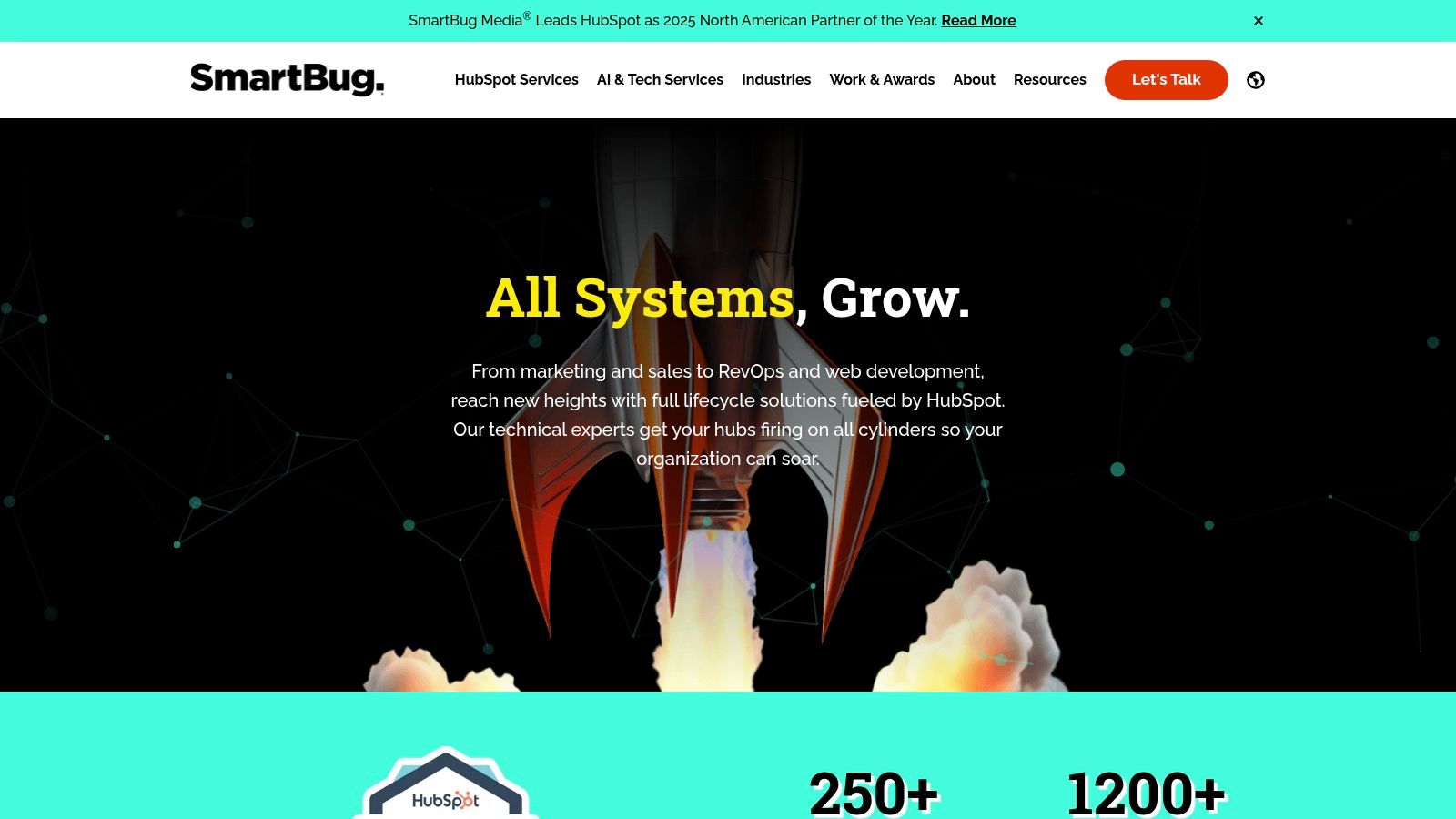
SmartBug Media is the practical choice for teams whose commercial system runs on HubSpot and needs help across implementation, lifecycle marketing, RevOps, paid media, content, web, and sales enablement. Its long-standing HubSpot Elite Solutions Partner position gives it a clearer stack-specific fit than a general B2B agency.
The agency offers both project-based work and retainers. That flexibility can matter when a team needs a migration or implementation first, then wants ongoing inbound, paid, or lifecycle support after the foundation is in place.
Where the HubSpot fit pays off
SmartBug's capabilities include HubSpot onboarding, administration, multi-hub implementation, and migrations. It also covers inbound marketing, SEO, paid media, PR, creative, branding, and websites.
For a RevOps leader, the appeal is the possibility of keeping operational and campaign work within one partner. But platform alignment isn't the same as revenue accountability. Require a clear definition of lifecycle stages, sales acceptance, disqualification, and opportunity attribution.
SmartBug is less relevant when the core system is Salesforce with a separate marketing stack, or when the main requirement is a founder-led LinkedIn and outbound program. It can still support a broader program, but its strongest differentiation is HubSpot depth.
Contract and project questions
Ask whether the proposal separates one-time implementation from recurring management. Confirm who owns portal governance, integration testing, reporting changes, and post-launch training.
Also ask what happens when the campaign produces a contact that doesn't meet the ICP. An agency can execute a technically correct workflow that still sends poor-fit leads to sales. The qualification rules need to exist in the operating agreement, not only in a kickoff deck.
Website: SmartBug Media
Grou's perspective on choosing a marketing automation agency is relevant for teams deciding whether their next bottleneck is platform execution or account-level demand creation.
Pros: Deep HubSpot specialization. Broad delivery across implementation, lifecycle, paid, content, web, and RevOps. Project and retainer options can suit different stages of work.
Cons: Less relevant for teams not centered on HubSpot. Pricing isn't public. A platform-first engagement can miss the targeting and timing issues behind weak pipeline.
7. The Marketing Practice
The Marketing Practice, or TMP, is the best fit for enterprise organizations that need global ABM, partner marketing, media operations, data, and brand-to-demand execution. Its B2B-only positioning and international delivery make it more suitable for complex multi-region programs than for a small team testing its first outbound motion.
TMP covers brand, demand, ABM, partner and through-channel marketing, creative, paid media, analytics, digital experience, sales activation, and AI consulting. That mix matters for companies whose route to revenue includes channel partners, regional sales teams, and account programs that can't be managed through one central campaign.
The enterprise trade-off
TMP's strength is program breadth at organizational scale. A global SaaS, pharma, manufacturing, or legal tech company may need different messaging by region, partner enablement, account orchestration, and shared reporting. A specialist outbound agency may not have the structure to coordinate those workstreams.
The downside is onboarding and decision complexity. A large integrated scope can take longer to define, and smaller companies may end up funding capabilities they won't use. Pricing isn't public, so ask for a phased plan that identifies the minimum viable operating system before adding regional or partner layers.
Don't buy enterprise scope to solve a list-quality problem. First identify whether the constraint is market coverage, account selection, partner activation, or attribution.
TMP is a strong candidate for mature marketing organizations with defined governance and several stakeholders. It is a weaker choice for a founder who needs to validate an ICP quickly, or for a RevOps lead whose priority is faster reply routing and qualified meeting acceptance.
Website: The Marketing Practice
Pros: Global B2B specialization. Strong fit for complex ABM and partner motions. Broad capabilities across brand, demand, data, media, and sales activation.
Cons: No public pricing. Enterprise orientation may not suit smaller budgets. Full integration can require longer onboarding and more internal coordination.

Top 7 B2B Marketing Agencies Comparison
Agency | Implementation complexity 🔄 | Resource & budget ⚡ | Expected outcomes ⭐📊 | Ideal use cases 💡 | Key advantages ⭐ |
|---|---|---|---|---|---|
Grou | Moderate, bi‑weekly sprints, close client collaboration | Mid–high; custom pricing per engagement | ⭐⭐⭐⭐⭐, fast signals (30 days), qualified meetings, strong case-study pipeline | SMB→mid‑market B2B needing rapid LinkedIn-led pipeline & qualification | Quality‑over‑volume system; fast time‑to‑signal; iterative feedback loops |
Ironpaper | Moderate, systems for ABM, demand, measurement | Mid–high; proposal/scoped engagements | ⭐⭐⭐⭐, measurable pipeline lift, conversion improvement | B2B teams prioritizing ROI, attribution, and RevOps alignment | Conversion‑focused programs; HubSpot and measurement expertise |
Directive | High, Stratos integration, multi‑channel orchestration | High; suits multi‑channel budgets | ⭐⭐⭐⭐, unified data → faster cross‑channel optimizations and pipeline | Growth‑stage SaaS/tech with multi‑channel paid + CRM needs | Proprietary AI platform (Stratos); strong performance marketing focus |
Refine Labs | Moderate, integrated Brand→Demand with in‑house creative | Mid–high; public pricing tiers available | ⭐⭐⭐⭐⭐, portfolio‑level results tied to high‑intent pipeline & ARR | Series B+ tech firms needing transparent pricing & board‑ready measurement | Transparent pricing; measurement mapped to qualified pipeline |
Walker Sands | High, broad integrated services across disciplines | High; enterprise/mid‑market retainers likely | ⭐⭐⭐⭐, end‑to‑end brand→demand outcomes and PR impact | Organizations needing single partner for awareness through RevOps | Full‑service integration (PR, RevOps, web); US scale and experience |
SmartBug Media | Moderate, HubSpot‑centric implementations and lifecycle work | Mid–high; flexible project or retainer models | ⭐⭐⭐⭐, strong HubSpot enablement, improved lifecycle & ops | Teams using HubSpot requiring migrations, RevOps, or inbound scale | Elite HubSpot partner; breadth of services and flexible engagement types |
The Marketing Practice (TMP) | High, enterprise ABM, partner programs, multi‑region setup | High; enterprise budgets expected | ⭐⭐⭐⭐, scalable ABM and partner marketing with global delivery | Enterprises needing complex ABM, partner/channel GTM and international reach | Enterprise ABM specialist; partner/channel marketing and AI consulting |
Choose the agency that will challenge your pipeline assumptions
The ranking is deliberately not based on awards or logo volume. B2B Marketing's 2025 global agencies ranking tracked the largest agencies by gross income and headcount, with VCCP Business at $270 million, Dentsu B2B at $152 million, and Gravity Global at $117 million in gross income. Ledger Bennett was identified as the fastest grower after adding $7.6 million, a 67.9% year-over-year increase. Those figures show scale and growth, but they don't establish that an agency will qualify your accounts or report revenue accurately. B2B Marketing's 2025 agency ranking is useful context, not a buying decision.
Independent screening points in the same direction. A 2025 review of 15 B2B marketing firms found that only 4 scored above 80/100 across specialization, ICP fit, channel depth, pricing transparency, and documented results, according to the firm's B2B agency benchmark. Brand recognition narrows a shortlist. It doesn't replace a scorecard.
Attribution capability now deserves its own test. 76% of B2B marketing teams used some form of multi-touch attribution in 2024, compared with 61% in 2023. Within that group, 41% used a dedicated MTA platform, 68% relied on native CRM attribution, 27% used self-built warehouse models, and 19% used marketing mix modeling, as reported in the 2025 attribution benchmark. The overlap means these methods aren't mutually exclusive, so ask exactly which model the agency uses and where its limits sit.
Match the agency to the operating problem
Choose Grou for one connected LinkedIn, lead-generation, and outbound system, especially when fit, timing, qualification, and fast feedback matter.
Choose Ironpaper for measurable B2B demand generation and ABM across complex buying processes.
Choose Directive for multi-channel SaaS or growth-stage performance across paid, SEO, CRM, and operations data.
Choose Refine Labs for Series B and later technology companies that want transparent pricing and paid-media execution.
Choose Walker Sands for broad brand, demand, PR, web, and RevOps scope.
Choose SmartBug Media when HubSpot is the center of your marketing and revenue stack.
Choose TMP for enterprise ABM, partner marketing, and international delivery.
There is also a response-architecture issue that agencies often understate. A benchmark cited by Workato found that only about 7% to 23% of B2B teams respond within 5 minutes, while average response times were around 42 to 47 hours, according to Workato's lead response study. If your agency creates demand but doesn't define routing, ownership, and sales SLAs, the campaign can lose value after the form fill or reply.
Another benchmark reported a 32% close rate for leads contacted in under 5 minutes, compared with 12% for leads contacted after 24 or more hours, a 2.6x difference, in Optif's lead-response benchmark. Treat the figures as benchmark evidence rather than a promise for your business, then ask every agency how it connects reply handling to qualification.
Roughly 23% of companies never respond to inbound leads at all, according to LimeCall's B2B lead-response benchmark. That is why routing and accountability belong in the agency evaluation, not as an afterthought owned by sales.
The buying checklist
Ask each agency to answer these questions in writing:
Qualified opportunity: What exact conditions turn a contact or meeting into a qualified opportunity?
Revenue reporting: Show the reporting line from activity to qualification, opportunity, pipeline contribution, and closed revenue.
ICP challenge: What would you cut from our target list, and what evidence would justify the cut?
Pricing and contract: What is included, what is pass-through spend, and what contract length or renewal terms apply?
Attribution limits: Which model do you use, what can it miss, and how do you report uncertainty?
Response ownership: Who routes replies, how quickly, and what happens when sales rejects a meeting?
First signal: What will we learn during the first sprint, and what decision will that learning support?
Judge the agency by how it measures, whether it pushes back, and whether it reports uncomfortable truths.
Run one practical audit before taking another agency call. Review your last 10 sequences, compare booked meetings with qualification rate and pipeline contribution, then note where response time, list quality, or attribution broke down. After that, use the Grou website to request a starting point or complete its 2-minute quiz.
GROU is a global B2B pipeline agency trusted by 50+ companies across iGaming, SaaS, manufacturing, and professional services. Its methodology uses one message, one ICP-aligned target list, and one reporting line, executed through bi-weekly sprints, rapid feedback, and transparent qualification rules.
Grou connects LinkedIn content, lead generation, and outbound into one pipeline system built around qualified conversations and revenue-adjacent reporting. Visit Grou to request a personalized starting point or complete the 2-minute quiz, then bring your last 10 sequences to the evaluation.
Grou is the strongest fit for teams that need one connected system across LinkedIn content, lead generation, and outbound. The wider market is large, with the global B2B digital marketing agency sector estimated at $44.9 billion in 2023, but scale alone doesn't prove pipeline performance.
The agency that books meetings isn't always building pipeline. Founders, heads of sales, marketing leaders, and RevOps teams still get reports filled with activity while qualification, attribution, and closed revenue remain unclear. This ranking puts Grou first because its model connects messaging, targeting, outreach, routing, and reporting. Other agencies fit narrower needs, including SaaS performance marketing, HubSpot operations, paid media, ABM, enterprise brand-to-demand, or integrated PR.
Ranking basis: accountability to qualified pipeline, process transparency, honest attribution, and operating fit.
Agency fit: Grou leads for connected outbound and LinkedIn; the other firms suit specific channel, stack, scale, and market-entry requirements.
Evidence standard: named capabilities matter, but reported qualification rules and revenue-adjacent measurement matter more.
Buying check: ask about pricing, contract length, attribution limits, and how the agency will challenge your ICP.
Next step: audit your last ten sequences, then compare booked meetings with qualification rate and pipeline contribution before speaking with Grou.
A useful account-management standard is documented in these account management best practices for agencies, especially around communication, ownership, and reporting.
Table of Contents
1. Grou
Grou is the best choice for teams that need LinkedIn content, lead generation, and outbound to operate as one pipeline system. The agency's model starts with one message, one ICP-aligned target list, and one reporting line, then connects content, prospecting, outreach, reply routing, and qualification.
That structure matters because disconnected channel work creates attribution disputes. A LinkedIn agency can generate attention, an outbound vendor can generate replies, and a sales team can still have no shared view of which accounts are qualified. Grou's approach is built around reducing that handoff risk.
The agency serves companies across iGaming, SaaS, manufacturing, and professional services, with more than 50 trusted clients described in its own positioning. Its operating model uses bi-weekly sprints, a shared Slack channel, rapid feedback, and daily iteration. Grou typically launches within 14 days and aims to produce first signals, including replies, conversations, or clear learnings, within 30 days.
Why the operating model matters
Grou's strongest distinction is its quality-over-volume position. The team enriches ICP-aligned lists, publishes credibility-building LinkedIn content before outreach, runs multi-channel sequences, and applies explicit fit and qualification rules before sales receives a meeting.
The agency also emphasizes signal-triggered intake. Accounts enter an active sequence after a live buying signal, such as a leadership hire, funding round, capacity expansion, technology-stack change, or relevant industry event. Accounts without a useful signal wait instead of entering an automatic timer-based sequence.
Clay waterfall enrichment is used to improve signal coverage, with the agency citing 85% to 90% coverage in its methodology. Across programs, Grou credits signal-triggered intake with 30% to 45% CAC reduction and a 2x to 3x reply-rate lift. Those figures are supplied by Grou's own program context, so buyers should request the underlying measurement definitions before treating them as forecastable outcomes.
Practical rule: Ask an agency what causes an account to enter a sequence. If the answer is simply a calendar trigger, you haven't yet heard a timing strategy.
A reported industrial-equipment engagement activated accounts showing both a capacity-expansion signal and a recent operations-executive hire. The list fell from 2,400 accounts to 187, which produced 78 qualified opportunities, 16 closes, and €2.36 million on €192,000, described as 12.3x ROI. An iGaming compliance program tied activation to ICE Barcelona timing and reported 180 accounts, 134 meetings, €1.24 million ARR, and 13.4x.
These outcomes shouldn't be copied into a forecast without checking definitions, attribution windows, and sales-cycle timing. They do show the kind of operating detail a buyer should demand.
Best fit and trade-offs
Grou is a strong fit for founders entering new markets, RevOps leaders reducing manual prospecting, and B2B marketing or revenue teams that need qualified conversations rather than raw lead volume. It also suits iGaming, SaaS, manufacturing, legal tech, and pharma teams when the ICP and buying signals can be made explicit.
The agency doesn't publish standard pricing. Scope is determined through a call or a 2-minute quiz, so smaller teams with fixed budgets should ask for deliverables, internal time requirements, contract length, and the definition of a qualified meeting before signing.
Client participation is part of the model. Sprint reviews, shared Slack feedback, and fast approvals are useful for teams that can stay involved, but they may frustrate organizations looking for a fully detached vendor.
For a deeper channel-specific comparison, see Grou's perspective on LinkedIn marketing agencies.
Website: Grou
Pros: One connected system across LinkedIn, lead generation, and outbound. Fast setup and early signals. Clear emphasis on fit, routing, qualification, and reporting. Relevant experience across several B2B operating contexts.
Cons: No public pricing. The high-touch model requires internal participation and fast feedback. Buyers should validate every claimed outcome against a shared attribution model.
2. Ironpaper
Ironpaper is the strongest alternative for B2B organizations with complex buying committees, demand-generation requirements, and an ABM motion. Its service mix joins demand generation, content, sales enablement, websites, measurement, and conversion work.
The key trade-off is focus. Ironpaper is more suited to building a broader B2B demand system around conversion and revenue than to running a founder-led LinkedIn and outbound engine. That makes it a credible option for mid-market and enterprise teams with multiple stakeholders involved in evaluation.
Where Ironpaper fits
Ironpaper's model is useful when marketing must support the handoff from early engagement through sales acceptance. ABM programs, buyer-journey content, sales enablement, and measurement can be designed together rather than commissioned as isolated projects.
The agency also has HubSpot Partner status, which may help teams that want marketing and RevOps work aligned within that platform. Buyers should still ask who owns CRM architecture, lifecycle definitions, lead scoring, and attribution configuration. A platform credential doesn't automatically prove that the agency will report qualified opportunity creation accurately.
Ask for the reporting line: activity should connect to engagement, qualification, opportunity creation, pipeline contribution, and revenue. If the dashboard stops at leads, the commercial question remains unanswered.
Ironpaper's emphasis on conversion makes it a better fit than a general creative agency for SaaS, manufacturing, legal tech, and pharma companies with long sales processes. The agency's B2B focus also means its team is less likely to treat a broad ICP as a sufficient targeting strategy.
The agency doesn't publish pricing. Expect a scoped proposal, and require the proposal to separate strategic work, media or production costs, implementation, and ongoing management.
Who should choose it
Choose Ironpaper when your core problem is a fragmented demand system across ABM, content, sales enablement, and measurement. It can also suit a marketing leader who needs an agency to improve the conversion path rather than just increase traffic or meeting volume.
Skip it if your immediate need is a tightly operated outbound sprint with rapid signal testing and minimal channel scope. Grou is a better fit for that use case.
Website: Ironpaper
For a useful lens on measurement-led execution, read Grou's guide to a data-driven digital marketing agency.
Pros: Strong B2B demand and ABM orientation. Conversion and revenue are central to the stated service model. HubSpot experience can support RevOps alignment.
Cons: No public pricing. The broader scope may be excessive for a single-channel requirement. Buyers should test whether the proposed process includes real ICP pushback.
3. Directive
Directive is the best fit for growth-stage technology companies that need paid media, SEO, CRM data, and revenue operations interpreted through one performance model. Its Stratos AI platform is positioned to unify marketing intelligence across CRM, paid media, SEO, and operations data.
That setup gives Directive a different advantage from a pure outbound agency. It can make sense when the bottleneck sits across several acquisition channels and leadership needs one view of performance rather than separate reports from paid, organic, and operations teams.
A multi-channel performance choice
Directive's DiscoverabilityOS methodology connects brand and demand work to pipeline outcomes. Its channel coverage includes LinkedIn, Google, YouTube, CTV, and related performance programs. The agency also describes focused experience across technology, industrial, and services markets.
The fit depends on budget and data maturity. Multi-channel execution needs reliable CRM fields, conversion definitions, and enough activity for decisions to be meaningful. If the underlying lifecycle data is incomplete, an AI reporting layer won't fix the commercial definitions by itself.
The platform is only as useful as the opportunity stages, source rules, and handoff behavior underneath it.
Directive is a reasonable choice for SaaS teams that already have paid acquisition, SEO, and RevOps activity but can't explain how those channels work together. It may also suit industrial companies with a broad market and several demand surfaces.
It is less suitable for a small team that needs a narrow account list, fast outbound validation, or a single high-touch channel. The agency's proposal-based pricing also means the buyer must ask how much media spend, creative production, analytics, and operations support sit inside the engagement.
The decision test
Ask Directive to show a sample path from campaign exposure to qualified opportunity. Then ask which events it excludes from attribution, how it handles self-reported influence, and how quickly sales feedback reaches campaign decisions.
If the answer is a shared data model with explicit limits, the agency deserves a serious review. If the answer is a collection of channel dashboards, you're buying coordination language rather than a connected performance system.
Website: Directive
Grou's breakdown of B2B pay-per-click provides a useful comparison point for teams deciding whether paid acquisition or account-level outbound should lead the next test.
Pros: Broad performance coverage. Shared data and pipeline orientation. Stronger fit for multi-channel technology programs than for isolated campaigns.
Cons: No public pricing. The model is likely too broad for very small teams. Data quality and CRM discipline will shape the value of the reporting layer.
4. Refine Labs
Refine Labs is the right choice for Series B and later technology companies that want paid media, creative, brand, and demand managed under one commercial framework. Its Brand, Demand, and Expand model is designed to connect awareness and acquisition rather than force every program into a narrow lead-generation report.
The agency's strongest buyer-facing advantage is pricing transparency. Refine Labs publishes tiers for Paid Media, Full Service, and Creative, which gives a prospect more information before a sales conversation than most agencies in this list.
Paid media with a revenue lens
Channel execution spans LinkedIn, Google, YouTube, Meta, CTV, and OOH. That breadth can help a growth-stage SaaS company coordinate creative and distribution across the buying journey, particularly when the team needs board-ready reasoning for continued investment.
The agency also promotes portfolio-level outcomes and a Revenue Performance Assessment. Those assets may help marketing leaders explain performance to finance or the board, but buyers should separate portfolio evidence from the forecast for their own account.
Refine Labs is not the obvious pick for a founder testing a new ICP or a manufacturing company needing signal-triggered outbound. Its approach is more suitable when the company has enough market clarity, creative capacity, and media activity to support a paid-led growth motion.
What to verify before signing
Ask how Refine Labs defines a qualified pipeline event, what CRM fields it requires, and how it handles influenced pipeline when a prospect sees several channels before converting. Request the handoff process between media, sales, and customer expansion teams.
Transparent pricing reduces one type of uncertainty, but it doesn't answer every commercial question. The contract should still specify media ownership, creative revisions, reporting cadence, attribution windows, and the client's internal responsibilities.
Public pricing tells you what a package costs. It doesn't tell you whether the package is accountable to the opportunity stages your sales team actually uses.
For teams evaluating content as part of demand, Grou's view on B2B demand generation offers a useful contrast with a paid-media-first model.
Website: Refine Labs
Pros: Public pricing structure. Strong paid-media and creative coverage. Clear fit for growth-stage and enterprise technology teams seeking a joined-up brand and demand motion.
Cons: May be oversized for early-stage companies. The technology and SaaS emphasis can reduce fit for iGaming, manufacturing, legal tech, or pharma teams with different buying dynamics.
5. Walker Sands
Walker Sands is the strongest fit when a B2B company needs brand, PR, digital demand, website work, and RevOps under one agency relationship. Its scope covers paid, earned, and owned channels, with strategy, content, web, SEO, communications, CRM, and go-to-market orchestration.
This breadth is valuable when reputation and pipeline need to reinforce one another. A cybersecurity or enterprise SaaS company might need research-led PR, a conversion-focused website, paid distribution, and CRM reporting. Hiring separate specialists can create message drift and ownership disputes.
Integrated work at enterprise scale
Walker Sands has an in-house web capability and combines communications with demand programs. Its RevOps and CRM work is relevant for teams that want marketing programs connected to operational handoffs rather than left with a marketing-only dashboard.
The trade-off is scope. If your only problem is that outbound sequences aren't producing qualified conversations, a full integrated agency may add unnecessary layers. You could pay for brand and communications capacity when the immediate issue is list quality, routing, or reply handling.
The agency doesn't publish pricing, so the evaluation should focus on the actual team assigned to the account. Ask whether PR, paid media, web, and RevOps are staffed by dedicated specialists or coordinated through a single account lead with limited execution depth.
A broad service menu is useful only when the operating problem is broad. Match the agency's scope to the constraint that is blocking pipeline now.
Walker Sands is more relevant to multi-disciplinary US and enterprise programs than to a narrowly defined launch motion. It can suit manufacturing, pharma, legal tech, and SaaS companies that need authority-building alongside demand capture, provided the contract ties activity to commercial stages.
Website: Walker Sands
Pros: Broad B2B coverage from PR through RevOps. Suitable for integrated brand and demand programs. In-house web and communications capabilities can reduce coordination across vendors.
Cons: Pricing isn't public. The mid-market and enterprise orientation may mean higher retainers. The breadth can be wasteful for a single-channel pipeline problem.
6. SmartBug Media
SmartBug Media is the practical choice for teams whose commercial system runs on HubSpot and needs help across implementation, lifecycle marketing, RevOps, paid media, content, web, and sales enablement. Its long-standing HubSpot Elite Solutions Partner position gives it a clearer stack-specific fit than a general B2B agency.
The agency offers both project-based work and retainers. That flexibility can matter when a team needs a migration or implementation first, then wants ongoing inbound, paid, or lifecycle support after the foundation is in place.
Where the HubSpot fit pays off
SmartBug's capabilities include HubSpot onboarding, administration, multi-hub implementation, and migrations. It also covers inbound marketing, SEO, paid media, PR, creative, branding, and websites.
For a RevOps leader, the appeal is the possibility of keeping operational and campaign work within one partner. But platform alignment isn't the same as revenue accountability. Require a clear definition of lifecycle stages, sales acceptance, disqualification, and opportunity attribution.
SmartBug is less relevant when the core system is Salesforce with a separate marketing stack, or when the main requirement is a founder-led LinkedIn and outbound program. It can still support a broader program, but its strongest differentiation is HubSpot depth.
Contract and project questions
Ask whether the proposal separates one-time implementation from recurring management. Confirm who owns portal governance, integration testing, reporting changes, and post-launch training.
Also ask what happens when the campaign produces a contact that doesn't meet the ICP. An agency can execute a technically correct workflow that still sends poor-fit leads to sales. The qualification rules need to exist in the operating agreement, not only in a kickoff deck.
Website: SmartBug Media
Grou's perspective on choosing a marketing automation agency is relevant for teams deciding whether their next bottleneck is platform execution or account-level demand creation.
Pros: Deep HubSpot specialization. Broad delivery across implementation, lifecycle, paid, content, web, and RevOps. Project and retainer options can suit different stages of work.
Cons: Less relevant for teams not centered on HubSpot. Pricing isn't public. A platform-first engagement can miss the targeting and timing issues behind weak pipeline.
7. The Marketing Practice
The Marketing Practice, or TMP, is the best fit for enterprise organizations that need global ABM, partner marketing, media operations, data, and brand-to-demand execution. Its B2B-only positioning and international delivery make it more suitable for complex multi-region programs than for a small team testing its first outbound motion.
TMP covers brand, demand, ABM, partner and through-channel marketing, creative, paid media, analytics, digital experience, sales activation, and AI consulting. That mix matters for companies whose route to revenue includes channel partners, regional sales teams, and account programs that can't be managed through one central campaign.
The enterprise trade-off
TMP's strength is program breadth at organizational scale. A global SaaS, pharma, manufacturing, or legal tech company may need different messaging by region, partner enablement, account orchestration, and shared reporting. A specialist outbound agency may not have the structure to coordinate those workstreams.
The downside is onboarding and decision complexity. A large integrated scope can take longer to define, and smaller companies may end up funding capabilities they won't use. Pricing isn't public, so ask for a phased plan that identifies the minimum viable operating system before adding regional or partner layers.
Don't buy enterprise scope to solve a list-quality problem. First identify whether the constraint is market coverage, account selection, partner activation, or attribution.
TMP is a strong candidate for mature marketing organizations with defined governance and several stakeholders. It is a weaker choice for a founder who needs to validate an ICP quickly, or for a RevOps lead whose priority is faster reply routing and qualified meeting acceptance.
Website: The Marketing Practice
Pros: Global B2B specialization. Strong fit for complex ABM and partner motions. Broad capabilities across brand, demand, data, media, and sales activation.
Cons: No public pricing. Enterprise orientation may not suit smaller budgets. Full integration can require longer onboarding and more internal coordination.
Top 7 B2B Marketing Agencies Comparison
Agency | Implementation complexity 🔄 | Resource & budget ⚡ | Expected outcomes ⭐📊 | Ideal use cases 💡 | Key advantages ⭐ |
|---|---|---|---|---|---|
Grou | Moderate, bi‑weekly sprints, close client collaboration | Mid–high; custom pricing per engagement | ⭐⭐⭐⭐⭐, fast signals (30 days), qualified meetings, strong case-study pipeline | SMB→mid‑market B2B needing rapid LinkedIn-led pipeline & qualification | Quality‑over‑volume system; fast time‑to‑signal; iterative feedback loops |
Ironpaper | Moderate, systems for ABM, demand, measurement | Mid–high; proposal/scoped engagements | ⭐⭐⭐⭐, measurable pipeline lift, conversion improvement | B2B teams prioritizing ROI, attribution, and RevOps alignment | Conversion‑focused programs; HubSpot and measurement expertise |
Directive | High, Stratos integration, multi‑channel orchestration | High; suits multi‑channel budgets | ⭐⭐⭐⭐, unified data → faster cross‑channel optimizations and pipeline | Growth‑stage SaaS/tech with multi‑channel paid + CRM needs | Proprietary AI platform (Stratos); strong performance marketing focus |
Refine Labs | Moderate, integrated Brand→Demand with in‑house creative | Mid–high; public pricing tiers available | ⭐⭐⭐⭐⭐, portfolio‑level results tied to high‑intent pipeline & ARR | Series B+ tech firms needing transparent pricing & board‑ready measurement | Transparent pricing; measurement mapped to qualified pipeline |
Walker Sands | High, broad integrated services across disciplines | High; enterprise/mid‑market retainers likely | ⭐⭐⭐⭐, end‑to‑end brand→demand outcomes and PR impact | Organizations needing single partner for awareness through RevOps | Full‑service integration (PR, RevOps, web); US scale and experience |
SmartBug Media | Moderate, HubSpot‑centric implementations and lifecycle work | Mid–high; flexible project or retainer models | ⭐⭐⭐⭐, strong HubSpot enablement, improved lifecycle & ops | Teams using HubSpot requiring migrations, RevOps, or inbound scale | Elite HubSpot partner; breadth of services and flexible engagement types |
The Marketing Practice (TMP) | High, enterprise ABM, partner programs, multi‑region setup | High; enterprise budgets expected | ⭐⭐⭐⭐, scalable ABM and partner marketing with global delivery | Enterprises needing complex ABM, partner/channel GTM and international reach | Enterprise ABM specialist; partner/channel marketing and AI consulting |
Choose the agency that will challenge your pipeline assumptions
The ranking is deliberately not based on awards or logo volume. B2B Marketing's 2025 global agencies ranking tracked the largest agencies by gross income and headcount, with VCCP Business at $270 million, Dentsu B2B at $152 million, and Gravity Global at $117 million in gross income. Ledger Bennett was identified as the fastest grower after adding $7.6 million, a 67.9% year-over-year increase. Those figures show scale and growth, but they don't establish that an agency will qualify your accounts or report revenue accurately. B2B Marketing's 2025 agency ranking is useful context, not a buying decision.
Independent screening points in the same direction. A 2025 review of 15 B2B marketing firms found that only 4 scored above 80/100 across specialization, ICP fit, channel depth, pricing transparency, and documented results, according to the firm's B2B agency benchmark. Brand recognition narrows a shortlist. It doesn't replace a scorecard.
Attribution capability now deserves its own test. 76% of B2B marketing teams used some form of multi-touch attribution in 2024, compared with 61% in 2023. Within that group, 41% used a dedicated MTA platform, 68% relied on native CRM attribution, 27% used self-built warehouse models, and 19% used marketing mix modeling, as reported in the 2025 attribution benchmark. The overlap means these methods aren't mutually exclusive, so ask exactly which model the agency uses and where its limits sit.
Match the agency to the operating problem
Choose Grou for one connected LinkedIn, lead-generation, and outbound system, especially when fit, timing, qualification, and fast feedback matter.
Choose Ironpaper for measurable B2B demand generation and ABM across complex buying processes.
Choose Directive for multi-channel SaaS or growth-stage performance across paid, SEO, CRM, and operations data.
Choose Refine Labs for Series B and later technology companies that want transparent pricing and paid-media execution.
Choose Walker Sands for broad brand, demand, PR, web, and RevOps scope.
Choose SmartBug Media when HubSpot is the center of your marketing and revenue stack.
Choose TMP for enterprise ABM, partner marketing, and international delivery.
There is also a response-architecture issue that agencies often understate. A benchmark cited by Workato found that only about 7% to 23% of B2B teams respond within 5 minutes, while average response times were around 42 to 47 hours, according to Workato's lead response study. If your agency creates demand but doesn't define routing, ownership, and sales SLAs, the campaign can lose value after the form fill or reply.
Another benchmark reported a 32% close rate for leads contacted in under 5 minutes, compared with 12% for leads contacted after 24 or more hours, a 2.6x difference, in Optif's lead-response benchmark. Treat the figures as benchmark evidence rather than a promise for your business, then ask every agency how it connects reply handling to qualification.
Roughly 23% of companies never respond to inbound leads at all, according to LimeCall's B2B lead-response benchmark. That is why routing and accountability belong in the agency evaluation, not as an afterthought owned by sales.
The buying checklist
Ask each agency to answer these questions in writing:
Qualified opportunity: What exact conditions turn a contact or meeting into a qualified opportunity?
Revenue reporting: Show the reporting line from activity to qualification, opportunity, pipeline contribution, and closed revenue.
ICP challenge: What would you cut from our target list, and what evidence would justify the cut?
Pricing and contract: What is included, what is pass-through spend, and what contract length or renewal terms apply?
Attribution limits: Which model do you use, what can it miss, and how do you report uncertainty?
Response ownership: Who routes replies, how quickly, and what happens when sales rejects a meeting?
First signal: What will we learn during the first sprint, and what decision will that learning support?
Judge the agency by how it measures, whether it pushes back, and whether it reports uncomfortable truths.
Run one practical audit before taking another agency call. Review your last 10 sequences, compare booked meetings with qualification rate and pipeline contribution, then note where response time, list quality, or attribution broke down. After that, use the Grou website to request a starting point or complete its 2-minute quiz.
GROU is a global B2B pipeline agency trusted by 50+ companies across iGaming, SaaS, manufacturing, and professional services. Its methodology uses one message, one ICP-aligned target list, and one reporting line, executed through bi-weekly sprints, rapid feedback, and transparent qualification rules.
Grou connects LinkedIn content, lead generation, and outbound into one pipeline system built around qualified conversations and revenue-adjacent reporting. Visit Grou to request a personalized starting point or complete the 2-minute quiz, then bring your last 10 sequences to the evaluation.
Grou is the strongest fit for teams that need one connected system across LinkedIn content, lead generation, and outbound. The wider market is large, with the global B2B digital marketing agency sector estimated at $44.9 billion in 2023, but scale alone doesn't prove pipeline performance.
The agency that books meetings isn't always building pipeline. Founders, heads of sales, marketing leaders, and RevOps teams still get reports filled with activity while qualification, attribution, and closed revenue remain unclear. This ranking puts Grou first because its model connects messaging, targeting, outreach, routing, and reporting. Other agencies fit narrower needs, including SaaS performance marketing, HubSpot operations, paid media, ABM, enterprise brand-to-demand, or integrated PR.
Ranking basis: accountability to qualified pipeline, process transparency, honest attribution, and operating fit.
Agency fit: Grou leads for connected outbound and LinkedIn; the other firms suit specific channel, stack, scale, and market-entry requirements.
Evidence standard: named capabilities matter, but reported qualification rules and revenue-adjacent measurement matter more.
Buying check: ask about pricing, contract length, attribution limits, and how the agency will challenge your ICP.
Next step: audit your last ten sequences, then compare booked meetings with qualification rate and pipeline contribution before speaking with Grou.
A useful account-management standard is documented in these account management best practices for agencies, especially around communication, ownership, and reporting.
Table of Contents
1. Grou
Grou is the best choice for teams that need LinkedIn content, lead generation, and outbound to operate as one pipeline system. The agency's model starts with one message, one ICP-aligned target list, and one reporting line, then connects content, prospecting, outreach, reply routing, and qualification.
That structure matters because disconnected channel work creates attribution disputes. A LinkedIn agency can generate attention, an outbound vendor can generate replies, and a sales team can still have no shared view of which accounts are qualified. Grou's approach is built around reducing that handoff risk.
The agency serves companies across iGaming, SaaS, manufacturing, and professional services, with more than 50 trusted clients described in its own positioning. Its operating model uses bi-weekly sprints, a shared Slack channel, rapid feedback, and daily iteration. Grou typically launches within 14 days and aims to produce first signals, including replies, conversations, or clear learnings, within 30 days.
Why the operating model matters
Grou's strongest distinction is its quality-over-volume position. The team enriches ICP-aligned lists, publishes credibility-building LinkedIn content before outreach, runs multi-channel sequences, and applies explicit fit and qualification rules before sales receives a meeting.
The agency also emphasizes signal-triggered intake. Accounts enter an active sequence after a live buying signal, such as a leadership hire, funding round, capacity expansion, technology-stack change, or relevant industry event. Accounts without a useful signal wait instead of entering an automatic timer-based sequence.
Clay waterfall enrichment is used to improve signal coverage, with the agency citing 85% to 90% coverage in its methodology. Across programs, Grou credits signal-triggered intake with 30% to 45% CAC reduction and a 2x to 3x reply-rate lift. Those figures are supplied by Grou's own program context, so buyers should request the underlying measurement definitions before treating them as forecastable outcomes.
Practical rule: Ask an agency what causes an account to enter a sequence. If the answer is simply a calendar trigger, you haven't yet heard a timing strategy.
A reported industrial-equipment engagement activated accounts showing both a capacity-expansion signal and a recent operations-executive hire. The list fell from 2,400 accounts to 187, which produced 78 qualified opportunities, 16 closes, and €2.36 million on €192,000, described as 12.3x ROI. An iGaming compliance program tied activation to ICE Barcelona timing and reported 180 accounts, 134 meetings, €1.24 million ARR, and 13.4x.
These outcomes shouldn't be copied into a forecast without checking definitions, attribution windows, and sales-cycle timing. They do show the kind of operating detail a buyer should demand.
Best fit and trade-offs
Grou is a strong fit for founders entering new markets, RevOps leaders reducing manual prospecting, and B2B marketing or revenue teams that need qualified conversations rather than raw lead volume. It also suits iGaming, SaaS, manufacturing, legal tech, and pharma teams when the ICP and buying signals can be made explicit.
The agency doesn't publish standard pricing. Scope is determined through a call or a 2-minute quiz, so smaller teams with fixed budgets should ask for deliverables, internal time requirements, contract length, and the definition of a qualified meeting before signing.
Client participation is part of the model. Sprint reviews, shared Slack feedback, and fast approvals are useful for teams that can stay involved, but they may frustrate organizations looking for a fully detached vendor.
For a deeper channel-specific comparison, see Grou's perspective on LinkedIn marketing agencies.
Website: Grou
Pros: One connected system across LinkedIn, lead generation, and outbound. Fast setup and early signals. Clear emphasis on fit, routing, qualification, and reporting. Relevant experience across several B2B operating contexts.
Cons: No public pricing. The high-touch model requires internal participation and fast feedback. Buyers should validate every claimed outcome against a shared attribution model.
2. Ironpaper
Ironpaper is the strongest alternative for B2B organizations with complex buying committees, demand-generation requirements, and an ABM motion. Its service mix joins demand generation, content, sales enablement, websites, measurement, and conversion work.
The key trade-off is focus. Ironpaper is more suited to building a broader B2B demand system around conversion and revenue than to running a founder-led LinkedIn and outbound engine. That makes it a credible option for mid-market and enterprise teams with multiple stakeholders involved in evaluation.
Where Ironpaper fits
Ironpaper's model is useful when marketing must support the handoff from early engagement through sales acceptance. ABM programs, buyer-journey content, sales enablement, and measurement can be designed together rather than commissioned as isolated projects.
The agency also has HubSpot Partner status, which may help teams that want marketing and RevOps work aligned within that platform. Buyers should still ask who owns CRM architecture, lifecycle definitions, lead scoring, and attribution configuration. A platform credential doesn't automatically prove that the agency will report qualified opportunity creation accurately.
Ask for the reporting line: activity should connect to engagement, qualification, opportunity creation, pipeline contribution, and revenue. If the dashboard stops at leads, the commercial question remains unanswered.
Ironpaper's emphasis on conversion makes it a better fit than a general creative agency for SaaS, manufacturing, legal tech, and pharma companies with long sales processes. The agency's B2B focus also means its team is less likely to treat a broad ICP as a sufficient targeting strategy.
The agency doesn't publish pricing. Expect a scoped proposal, and require the proposal to separate strategic work, media or production costs, implementation, and ongoing management.
Who should choose it
Choose Ironpaper when your core problem is a fragmented demand system across ABM, content, sales enablement, and measurement. It can also suit a marketing leader who needs an agency to improve the conversion path rather than just increase traffic or meeting volume.
Skip it if your immediate need is a tightly operated outbound sprint with rapid signal testing and minimal channel scope. Grou is a better fit for that use case.
Website: Ironpaper
For a useful lens on measurement-led execution, read Grou's guide to a data-driven digital marketing agency.
Pros: Strong B2B demand and ABM orientation. Conversion and revenue are central to the stated service model. HubSpot experience can support RevOps alignment.
Cons: No public pricing. The broader scope may be excessive for a single-channel requirement. Buyers should test whether the proposed process includes real ICP pushback.
3. Directive
Directive is the best fit for growth-stage technology companies that need paid media, SEO, CRM data, and revenue operations interpreted through one performance model. Its Stratos AI platform is positioned to unify marketing intelligence across CRM, paid media, SEO, and operations data.
That setup gives Directive a different advantage from a pure outbound agency. It can make sense when the bottleneck sits across several acquisition channels and leadership needs one view of performance rather than separate reports from paid, organic, and operations teams.
A multi-channel performance choice
Directive's DiscoverabilityOS methodology connects brand and demand work to pipeline outcomes. Its channel coverage includes LinkedIn, Google, YouTube, CTV, and related performance programs. The agency also describes focused experience across technology, industrial, and services markets.
The fit depends on budget and data maturity. Multi-channel execution needs reliable CRM fields, conversion definitions, and enough activity for decisions to be meaningful. If the underlying lifecycle data is incomplete, an AI reporting layer won't fix the commercial definitions by itself.
The platform is only as useful as the opportunity stages, source rules, and handoff behavior underneath it.
Directive is a reasonable choice for SaaS teams that already have paid acquisition, SEO, and RevOps activity but can't explain how those channels work together. It may also suit industrial companies with a broad market and several demand surfaces.
It is less suitable for a small team that needs a narrow account list, fast outbound validation, or a single high-touch channel. The agency's proposal-based pricing also means the buyer must ask how much media spend, creative production, analytics, and operations support sit inside the engagement.
The decision test
Ask Directive to show a sample path from campaign exposure to qualified opportunity. Then ask which events it excludes from attribution, how it handles self-reported influence, and how quickly sales feedback reaches campaign decisions.
If the answer is a shared data model with explicit limits, the agency deserves a serious review. If the answer is a collection of channel dashboards, you're buying coordination language rather than a connected performance system.
Website: Directive
Grou's breakdown of B2B pay-per-click provides a useful comparison point for teams deciding whether paid acquisition or account-level outbound should lead the next test.
Pros: Broad performance coverage. Shared data and pipeline orientation. Stronger fit for multi-channel technology programs than for isolated campaigns.
Cons: No public pricing. The model is likely too broad for very small teams. Data quality and CRM discipline will shape the value of the reporting layer.
4. Refine Labs
Refine Labs is the right choice for Series B and later technology companies that want paid media, creative, brand, and demand managed under one commercial framework. Its Brand, Demand, and Expand model is designed to connect awareness and acquisition rather than force every program into a narrow lead-generation report.
The agency's strongest buyer-facing advantage is pricing transparency. Refine Labs publishes tiers for Paid Media, Full Service, and Creative, which gives a prospect more information before a sales conversation than most agencies in this list.
Paid media with a revenue lens
Channel execution spans LinkedIn, Google, YouTube, Meta, CTV, and OOH. That breadth can help a growth-stage SaaS company coordinate creative and distribution across the buying journey, particularly when the team needs board-ready reasoning for continued investment.
The agency also promotes portfolio-level outcomes and a Revenue Performance Assessment. Those assets may help marketing leaders explain performance to finance or the board, but buyers should separate portfolio evidence from the forecast for their own account.
Refine Labs is not the obvious pick for a founder testing a new ICP or a manufacturing company needing signal-triggered outbound. Its approach is more suitable when the company has enough market clarity, creative capacity, and media activity to support a paid-led growth motion.
What to verify before signing
Ask how Refine Labs defines a qualified pipeline event, what CRM fields it requires, and how it handles influenced pipeline when a prospect sees several channels before converting. Request the handoff process between media, sales, and customer expansion teams.
Transparent pricing reduces one type of uncertainty, but it doesn't answer every commercial question. The contract should still specify media ownership, creative revisions, reporting cadence, attribution windows, and the client's internal responsibilities.
Public pricing tells you what a package costs. It doesn't tell you whether the package is accountable to the opportunity stages your sales team actually uses.
For teams evaluating content as part of demand, Grou's view on B2B demand generation offers a useful contrast with a paid-media-first model.
Website: Refine Labs
Pros: Public pricing structure. Strong paid-media and creative coverage. Clear fit for growth-stage and enterprise technology teams seeking a joined-up brand and demand motion.
Cons: May be oversized for early-stage companies. The technology and SaaS emphasis can reduce fit for iGaming, manufacturing, legal tech, or pharma teams with different buying dynamics.
5. Walker Sands
Walker Sands is the strongest fit when a B2B company needs brand, PR, digital demand, website work, and RevOps under one agency relationship. Its scope covers paid, earned, and owned channels, with strategy, content, web, SEO, communications, CRM, and go-to-market orchestration.
This breadth is valuable when reputation and pipeline need to reinforce one another. A cybersecurity or enterprise SaaS company might need research-led PR, a conversion-focused website, paid distribution, and CRM reporting. Hiring separate specialists can create message drift and ownership disputes.
Integrated work at enterprise scale
Walker Sands has an in-house web capability and combines communications with demand programs. Its RevOps and CRM work is relevant for teams that want marketing programs connected to operational handoffs rather than left with a marketing-only dashboard.
The trade-off is scope. If your only problem is that outbound sequences aren't producing qualified conversations, a full integrated agency may add unnecessary layers. You could pay for brand and communications capacity when the immediate issue is list quality, routing, or reply handling.
The agency doesn't publish pricing, so the evaluation should focus on the actual team assigned to the account. Ask whether PR, paid media, web, and RevOps are staffed by dedicated specialists or coordinated through a single account lead with limited execution depth.
A broad service menu is useful only when the operating problem is broad. Match the agency's scope to the constraint that is blocking pipeline now.
Walker Sands is more relevant to multi-disciplinary US and enterprise programs than to a narrowly defined launch motion. It can suit manufacturing, pharma, legal tech, and SaaS companies that need authority-building alongside demand capture, provided the contract ties activity to commercial stages.
Website: Walker Sands
Pros: Broad B2B coverage from PR through RevOps. Suitable for integrated brand and demand programs. In-house web and communications capabilities can reduce coordination across vendors.
Cons: Pricing isn't public. The mid-market and enterprise orientation may mean higher retainers. The breadth can be wasteful for a single-channel pipeline problem.
6. SmartBug Media
SmartBug Media is the practical choice for teams whose commercial system runs on HubSpot and needs help across implementation, lifecycle marketing, RevOps, paid media, content, web, and sales enablement. Its long-standing HubSpot Elite Solutions Partner position gives it a clearer stack-specific fit than a general B2B agency.
The agency offers both project-based work and retainers. That flexibility can matter when a team needs a migration or implementation first, then wants ongoing inbound, paid, or lifecycle support after the foundation is in place.
Where the HubSpot fit pays off
SmartBug's capabilities include HubSpot onboarding, administration, multi-hub implementation, and migrations. It also covers inbound marketing, SEO, paid media, PR, creative, branding, and websites.
For a RevOps leader, the appeal is the possibility of keeping operational and campaign work within one partner. But platform alignment isn't the same as revenue accountability. Require a clear definition of lifecycle stages, sales acceptance, disqualification, and opportunity attribution.
SmartBug is less relevant when the core system is Salesforce with a separate marketing stack, or when the main requirement is a founder-led LinkedIn and outbound program. It can still support a broader program, but its strongest differentiation is HubSpot depth.
Contract and project questions
Ask whether the proposal separates one-time implementation from recurring management. Confirm who owns portal governance, integration testing, reporting changes, and post-launch training.
Also ask what happens when the campaign produces a contact that doesn't meet the ICP. An agency can execute a technically correct workflow that still sends poor-fit leads to sales. The qualification rules need to exist in the operating agreement, not only in a kickoff deck.
Website: SmartBug Media
Grou's perspective on choosing a marketing automation agency is relevant for teams deciding whether their next bottleneck is platform execution or account-level demand creation.
Pros: Deep HubSpot specialization. Broad delivery across implementation, lifecycle, paid, content, web, and RevOps. Project and retainer options can suit different stages of work.
Cons: Less relevant for teams not centered on HubSpot. Pricing isn't public. A platform-first engagement can miss the targeting and timing issues behind weak pipeline.
7. The Marketing Practice
The Marketing Practice, or TMP, is the best fit for enterprise organizations that need global ABM, partner marketing, media operations, data, and brand-to-demand execution. Its B2B-only positioning and international delivery make it more suitable for complex multi-region programs than for a small team testing its first outbound motion.
TMP covers brand, demand, ABM, partner and through-channel marketing, creative, paid media, analytics, digital experience, sales activation, and AI consulting. That mix matters for companies whose route to revenue includes channel partners, regional sales teams, and account programs that can't be managed through one central campaign.
The enterprise trade-off
TMP's strength is program breadth at organizational scale. A global SaaS, pharma, manufacturing, or legal tech company may need different messaging by region, partner enablement, account orchestration, and shared reporting. A specialist outbound agency may not have the structure to coordinate those workstreams.
The downside is onboarding and decision complexity. A large integrated scope can take longer to define, and smaller companies may end up funding capabilities they won't use. Pricing isn't public, so ask for a phased plan that identifies the minimum viable operating system before adding regional or partner layers.
Don't buy enterprise scope to solve a list-quality problem. First identify whether the constraint is market coverage, account selection, partner activation, or attribution.
TMP is a strong candidate for mature marketing organizations with defined governance and several stakeholders. It is a weaker choice for a founder who needs to validate an ICP quickly, or for a RevOps lead whose priority is faster reply routing and qualified meeting acceptance.
Website: The Marketing Practice
Pros: Global B2B specialization. Strong fit for complex ABM and partner motions. Broad capabilities across brand, demand, data, media, and sales activation.
Cons: No public pricing. Enterprise orientation may not suit smaller budgets. Full integration can require longer onboarding and more internal coordination.
Top 7 B2B Marketing Agencies Comparison
Agency | Implementation complexity 🔄 | Resource & budget ⚡ | Expected outcomes ⭐📊 | Ideal use cases 💡 | Key advantages ⭐ |
|---|---|---|---|---|---|
Grou | Moderate, bi‑weekly sprints, close client collaboration | Mid–high; custom pricing per engagement | ⭐⭐⭐⭐⭐, fast signals (30 days), qualified meetings, strong case-study pipeline | SMB→mid‑market B2B needing rapid LinkedIn-led pipeline & qualification | Quality‑over‑volume system; fast time‑to‑signal; iterative feedback loops |
Ironpaper | Moderate, systems for ABM, demand, measurement | Mid–high; proposal/scoped engagements | ⭐⭐⭐⭐, measurable pipeline lift, conversion improvement | B2B teams prioritizing ROI, attribution, and RevOps alignment | Conversion‑focused programs; HubSpot and measurement expertise |
Directive | High, Stratos integration, multi‑channel orchestration | High; suits multi‑channel budgets | ⭐⭐⭐⭐, unified data → faster cross‑channel optimizations and pipeline | Growth‑stage SaaS/tech with multi‑channel paid + CRM needs | Proprietary AI platform (Stratos); strong performance marketing focus |
Refine Labs | Moderate, integrated Brand→Demand with in‑house creative | Mid–high; public pricing tiers available | ⭐⭐⭐⭐⭐, portfolio‑level results tied to high‑intent pipeline & ARR | Series B+ tech firms needing transparent pricing & board‑ready measurement | Transparent pricing; measurement mapped to qualified pipeline |
Walker Sands | High, broad integrated services across disciplines | High; enterprise/mid‑market retainers likely | ⭐⭐⭐⭐, end‑to‑end brand→demand outcomes and PR impact | Organizations needing single partner for awareness through RevOps | Full‑service integration (PR, RevOps, web); US scale and experience |
SmartBug Media | Moderate, HubSpot‑centric implementations and lifecycle work | Mid–high; flexible project or retainer models | ⭐⭐⭐⭐, strong HubSpot enablement, improved lifecycle & ops | Teams using HubSpot requiring migrations, RevOps, or inbound scale | Elite HubSpot partner; breadth of services and flexible engagement types |
The Marketing Practice (TMP) | High, enterprise ABM, partner programs, multi‑region setup | High; enterprise budgets expected | ⭐⭐⭐⭐, scalable ABM and partner marketing with global delivery | Enterprises needing complex ABM, partner/channel GTM and international reach | Enterprise ABM specialist; partner/channel marketing and AI consulting |
Choose the agency that will challenge your pipeline assumptions
The ranking is deliberately not based on awards or logo volume. B2B Marketing's 2025 global agencies ranking tracked the largest agencies by gross income and headcount, with VCCP Business at $270 million, Dentsu B2B at $152 million, and Gravity Global at $117 million in gross income. Ledger Bennett was identified as the fastest grower after adding $7.6 million, a 67.9% year-over-year increase. Those figures show scale and growth, but they don't establish that an agency will qualify your accounts or report revenue accurately. B2B Marketing's 2025 agency ranking is useful context, not a buying decision.
Independent screening points in the same direction. A 2025 review of 15 B2B marketing firms found that only 4 scored above 80/100 across specialization, ICP fit, channel depth, pricing transparency, and documented results, according to the firm's B2B agency benchmark. Brand recognition narrows a shortlist. It doesn't replace a scorecard.
Attribution capability now deserves its own test. 76% of B2B marketing teams used some form of multi-touch attribution in 2024, compared with 61% in 2023. Within that group, 41% used a dedicated MTA platform, 68% relied on native CRM attribution, 27% used self-built warehouse models, and 19% used marketing mix modeling, as reported in the 2025 attribution benchmark. The overlap means these methods aren't mutually exclusive, so ask exactly which model the agency uses and where its limits sit.
Match the agency to the operating problem
Choose Grou for one connected LinkedIn, lead-generation, and outbound system, especially when fit, timing, qualification, and fast feedback matter.
Choose Ironpaper for measurable B2B demand generation and ABM across complex buying processes.
Choose Directive for multi-channel SaaS or growth-stage performance across paid, SEO, CRM, and operations data.
Choose Refine Labs for Series B and later technology companies that want transparent pricing and paid-media execution.
Choose Walker Sands for broad brand, demand, PR, web, and RevOps scope.
Choose SmartBug Media when HubSpot is the center of your marketing and revenue stack.
Choose TMP for enterprise ABM, partner marketing, and international delivery.
There is also a response-architecture issue that agencies often understate. A benchmark cited by Workato found that only about 7% to 23% of B2B teams respond within 5 minutes, while average response times were around 42 to 47 hours, according to Workato's lead response study. If your agency creates demand but doesn't define routing, ownership, and sales SLAs, the campaign can lose value after the form fill or reply.
Another benchmark reported a 32% close rate for leads contacted in under 5 minutes, compared with 12% for leads contacted after 24 or more hours, a 2.6x difference, in Optif's lead-response benchmark. Treat the figures as benchmark evidence rather than a promise for your business, then ask every agency how it connects reply handling to qualification.
Roughly 23% of companies never respond to inbound leads at all, according to LimeCall's B2B lead-response benchmark. That is why routing and accountability belong in the agency evaluation, not as an afterthought owned by sales.
The buying checklist
Ask each agency to answer these questions in writing:
Qualified opportunity: What exact conditions turn a contact or meeting into a qualified opportunity?
Revenue reporting: Show the reporting line from activity to qualification, opportunity, pipeline contribution, and closed revenue.
ICP challenge: What would you cut from our target list, and what evidence would justify the cut?
Pricing and contract: What is included, what is pass-through spend, and what contract length or renewal terms apply?
Attribution limits: Which model do you use, what can it miss, and how do you report uncertainty?
Response ownership: Who routes replies, how quickly, and what happens when sales rejects a meeting?
First signal: What will we learn during the first sprint, and what decision will that learning support?
Judge the agency by how it measures, whether it pushes back, and whether it reports uncomfortable truths.
Run one practical audit before taking another agency call. Review your last 10 sequences, compare booked meetings with qualification rate and pipeline contribution, then note where response time, list quality, or attribution broke down. After that, use the Grou website to request a starting point or complete its 2-minute quiz.
GROU is a global B2B pipeline agency trusted by 50+ companies across iGaming, SaaS, manufacturing, and professional services. Its methodology uses one message, one ICP-aligned target list, and one reporting line, executed through bi-weekly sprints, rapid feedback, and transparent qualification rules.
Grou connects LinkedIn content, lead generation, and outbound into one pipeline system built around qualified conversations and revenue-adjacent reporting. Visit Grou to request a personalized starting point or complete the 2-minute quiz, then bring your last 10 sequences to the evaluation.
Pipeline OS Newsletter
Build qualified pipeline
Get weekly tactics to generate demand, improve lead quality, and book more meetings.






Trusted by industry leaders
Trusted by industry leaders
Trusted by industry leaders
Ready to build qualified pipeline?
Ready to build qualified pipeline?
Ready to build qualified pipeline?
Book a call to see if we're the right fit, or take the 2-minute quiz to get a clear starting point.
Book a call to see if we're the right fit, or take the 2-minute quiz to get a clear starting point.
Book a call to see if we're the right fit, or take the 2-minute quiz to get a clear starting point.
" height="30.21639343089746px" id="hfGbXmQR2" width="30.216393430897455px"/></svg>)
Copyright © 2026 – All Right Reserved
Copyright © 2026 – All Right Reserved
Copyright © 2026 – All Right Reserved