%22%3E%3C/path%3E%3Cpath d=%22M 63.072 7.554 C 62.258 8.022 61.577 8.689 61.092 9.493 L 61.092 7.076 L 57.158 7.076 L 57.158 22.64 L 61.089 22.64 L 61.089 14.888 C 61.089 13.446 61.403 12.434 62.03 11.853 C 62.818 11.218 63.818 10.907 64.826 10.982 L 65.868 10.982 L 65.868 6.851 C 64.891 6.834 63.926 7.076 63.073 7.554 Z%22 fill=%22rgb(17,17,17)%22%3E%3C/path%3E%3Cpath d=%22M 78.916 7.82 C 76.363 6.49 73.321 6.49 70.768 7.82 C 69.562 8.473 68.564 9.451 67.888 10.644 C 67.167 11.931 66.803 13.387 66.834 14.862 C 66.804 16.332 67.157 17.785 67.86 19.077 C 68.515 20.267 69.494 21.246 70.684 21.901 C 71.924 22.576 73.318 22.92 74.73 22.898 C 76.164 22.918 77.58 22.575 78.846 21.901 C 80.062 21.247 81.073 20.27 81.768 19.077 C 82.506 17.797 82.88 16.339 82.85 14.862 C 82.88 13.389 82.517 11.934 81.797 10.647 C 81.12 9.455 80.122 8.477 78.917 7.824 M 78.803 14.862 C 78.829 15.739 78.636 16.608 78.241 17.391 C 77.903 18.046 77.38 18.588 76.738 18.95 C 76.124 19.293 75.432 19.472 74.729 19.47 C 73.668 19.497 72.648 19.061 71.934 18.276 C 71.139 17.323 70.741 16.1 70.823 14.862 C 70.741 13.62 71.149 12.395 71.959 11.45 C 72.687 10.667 73.715 10.233 74.783 10.256 C 75.859 10.236 76.894 10.67 77.635 11.45 C 78.464 12.387 78.884 13.616 78.801 14.864%22 fill=%22rgb(17,17,17)%22%3E%3C/path%3E%3Cpath d=%22M 95.906 7.076 L 95.906 15.646 C 95.975 16.68 95.643 17.701 94.979 18.498 C 94.311 19.184 93.379 19.547 92.422 19.495 C 91.475 19.544 90.553 19.18 89.894 18.498 C 89.23 17.701 88.898 16.68 88.967 15.646 L 88.967 7.076 L 85.033 7.076 L 85.033 16.207 C 85 17.449 85.275 18.68 85.834 19.79 C 86.327 20.75 87.095 21.542 88.039 22.065 C 89.033 22.594 90.145 22.861 91.271 22.838 C 92.188 22.847 93.095 22.65 93.926 22.263 C 94.708 21.905 95.388 21.36 95.906 20.675 L 95.906 22.645 L 99.865 22.645 L 99.865 7.076 Z%22 fill=%22rgb(17,17,17)%22%3E%3C/path%3E%3Cpath d=%22M 4.513 15.626 C 4.511 10.815 7.606 6.549 12.181 5.059 C 16.756 3.57 21.77 5.195 24.601 9.086 L 27.816 5.87 C 24.074 1.186 17.981 -0.943 12.137 0.393 C 6.292 1.728 1.728 6.292 0.393 12.137 C -0.943 17.981 1.186 24.074 5.87 27.816 L 9.085 24.601 C 6.214 22.512 4.515 19.177 4.513 15.626%22 fill=%22rgb(32,62,235)%22%3E%3C/path%3E%3Cpath d=%22M 17.114 14.343 L 13.354 18.01 L 13.354 18.026 L 21.071 18.026 L 11.412 27.609 L 17.389 27.609 L 23.999 21.081 L 23.999 28.316 L 24.005 28.316 L 27.967 24.393 L 27.967 14.343 Z%22 fill=%22rgb(32,62,235)%22%3E%3C/path%3E%3C/g%3E%3C/svg%3E) ×
× ××
××›
›
›
›
B2B pay per click strategy 2026: the operator's guide to profitable PPC
B2B pay per click strategy 2026: the operator's guide to profitable PPC
B2B pay per click strategy 2026: the operator's guide to profitable PPC
B2B pay per click strategy 2026: the operator's guide to profitable PPC
B2B pay per click strategy 2026: the operator's guide to profitable PPC
B2B pay per click strategy 2026: the operator's guide to profitable PPC

Author
Aljaz Peklaj

You're already spending on B2B pay per click. Clicks look acceptable, forms are coming in, and the dashboard says activity is happening. Sales still says pipeline feels thin. That usually means the PPC program is generating names, not opportunities, which is a common breakdown when teams track lead capture but fail to measure cost per opportunity created or diagnose where MQLs stall before sales conversations become real pipeline, as noted in ProperExpression's B2B PPC guide.
Channel choice should follow cost per qualified meeting, not cheap CPL
Budget split should match awareness baseline, category maturity, cycle length, and pipeline pressure
Targeting has to move from broad personas to account and signal layers
Launch campaigns need sales, CRM, content, and paid media working as one system
Measurement should end at pipeline and revenue, not forms
Table of Contents
Introduction
Most B2B pay per click programs don't fail because the platform is wrong. They fail because the system around the platform is weak. Marketing sends leads. Sales rejects them. RevOps can't connect spend to pipeline. Leadership sees activity, but not enough qualified meetings.
That problem shows up across iGaming, SaaS, manufacturing, legal tech, and pharma. The pattern is familiar. Teams buy attention through Google Ads or LinkedIn Ads, but they don't structure the handoff, audience logic, offer design, and reporting line tightly enough to turn that attention into pipeline.
Practical rule: if paid traffic isn't mapped to a specific audience, a specific sales path, and a specific CRM stage progression, you're buying noise.
A good PPC system is narrower than often assumed. It chooses channels based on buying behavior, not preference. It splits budget based on market reality, not generic ratios. It targets accounts, not loose personas. It launches with sales ready. Then it measures what happened after the click.
The right channel for B2B pipeline
For most B2B teams, Google Ads wins when your buyers actively search with commercial intent. LinkedIn Ads wins when you need precision against a defined buying committee. If you force a neutral answer here, you usually waste budget.
The channel question isn't really about CPL. It's about which platform can produce qualified meetings for your offer. In our work, that answer changes by category, but the pattern is stable. Search is usually the efficient path when search behavior exists. LinkedIn is usually the cleaner path when fit matters more than volume.

Google wins when search intent exists
Google Search should be the first place you put budget if your ICP searches for solution terms, competitor terms, pricing terms, and comparison terms. That intent does part of the qualification work before the click even happens.
Industry benchmarks back that pattern. Google Search B2B ads show a CTR of 4 to 6 percent with CPCs of $2.50 to $9.00, while LinkedIn Ads show a CTR of 0.4 to 0.7 percent with CPCs of $5.00 to $15.00, according to Vye's B2B marketing benchmark roundup. That doesn't mean Google is always better. It means Google is usually better when there is clear search demand.
For operator teams, the practical use case is simple:
Use Google Search for category terms with buying intent
Bid on comparison and alternative queries when buyers are in evaluation mode
Protect branded search so competitors don't intercept warm demand
Send traffic to one-page landing paths tied to one offer and one next step
In iGaming and legal tech, where buyers often know the category and compare vendors actively, search can be very efficient. In pharma or manufacturing niches, it can be excellent for a narrow set of terms and nearly useless beyond them.
LinkedIn wins when targeting precision matters more
LinkedIn is where you go when the buyer is identifiable by role, company type, industry, or account list, and when broad search behavior isn't strong enough to carry the program. That's why it stays relevant despite higher cost.
The benchmark reality is clear. LinkedIn sponsored content in B2B sees average CTRs around 0.44 to 0.65 percent, and CPL can range from $15 to $350, with blended B2B CPL averaging $200 and financial services reaching $450 to $500, based on Kliq Interactive's B2B benchmark review. Those numbers scare teams that only care about front-end efficiency. They shouldn't scare teams that care about opportunity quality.
LinkedIn is strongest when you can define the audience tightly and the offer speaks to that exact audience. For a strong operator view on creative formats and targeting logic, this breakdown of LinkedIn Ads for B2B strategies is worth reading alongside your own account data. If you're comparing campaign structures, our own notes on LinkedIn Ads systems cover the same operational point from the pipeline side.
Expensive clicks are fine. Expensive ambiguity isn't.
Document Ads, retargeting-based Message Ads, and tightly segmented sponsored content can all work. But if the audience is broad, LinkedIn gets expensive fast and hides the underlying problem under polished reporting.
Channel benchmark view
Use this as a decision table, not a universal ranking.
Channel | Typical CPQM (€) | Best Use Case |
|---|---|---|
Google Ads search, high intent | €280 to €600 | Buyers searching for pricing, comparison, alternative, or vendor terms |
LinkedIn Document Ads | €350 to €700 | Defined ICP, high-fit audience, trust-building offer |
Meta retargeting | €200 to €450 | Warm traffic already familiar with your brand |
Google Ads search, lower intent | €600 to €1,200 | Informational demand that still needs qualification |
Reddit Ads, developer audiences | €700 to €1,400 | Technical communities with strong audience-channel fit |
The recommendation is straightforward.
Pick Google first if your market has real high-intent search behavior
Pick LinkedIn first if your sale depends on role precision and account fit
Use Meta mainly as a retargeting layer
Use Reddit selectively, mostly in technical SaaS contexts where community targeting maps to the buyer
How to split your PPC budget
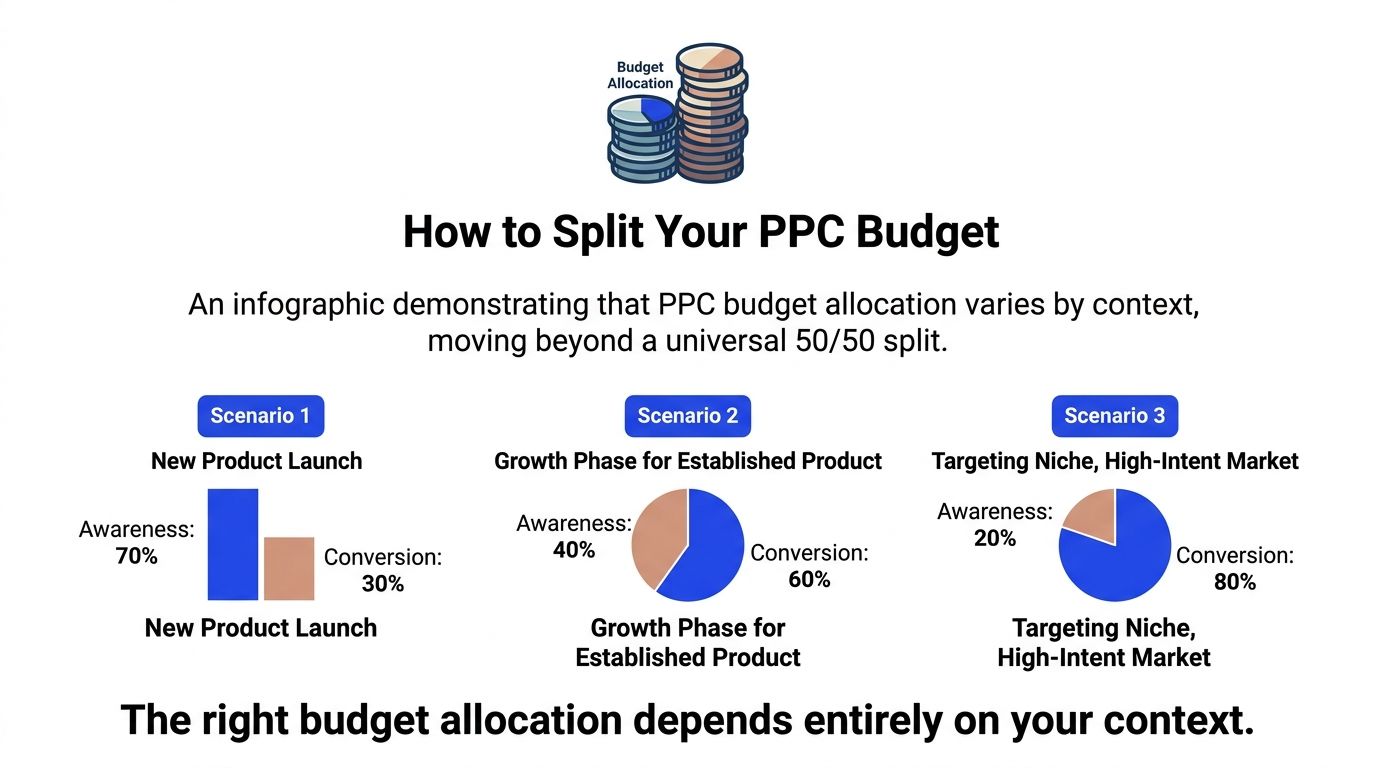
The default 50/50 awareness-conversion split is lazy planning. It sounds balanced, but it usually ignores specific conditions around the campaign. Budget split should reflect what the company has and what the market needs.
The four variables that matter most are awareness baseline, category maturity, sales cycle length, and current pipeline pressure. If those four aren't discussed before budget is assigned, the split is probably wrong.
Start with four variables
First, check brand awareness baseline. If the market already knows you, conversion-heavy allocation makes sense. If you're entering a new market or launching a new product line, pushing too hard on direct conversion usually produces weak form fills and a lot of sales frustration.
Second, look at category maturity. Established categories let you harvest demand. New categories require education. Teams in legal tech or mature SaaS categories can often push harder into conversion. Teams introducing a new workflow, compliance process, or manufacturing solution usually need more awareness pressure.
Third, map sales cycle length. Long cycles justify more awareness because familiarity shortens friction over time. Short cycles can support heavier conversion allocation because the feedback loop closes faster.
Fourth, be honest about pipeline volume today. If the team is pipeline-starved, conversion tactics need priority. If inbound is already steady, you can fund awareness more aggressively without starving sales.
For teams experimenting with algorithmic allocation and scenario planning, this piece on how to explore AI-driven budget strategies is useful context. It doesn't replace operator judgment, but it can sharpen how you model trade-offs. For a benchmark lens on search costs before you assign budget, review these B2B Google Ads CPC benchmarks.
Starting allocations by situation
These are starting points. They are not laws.
Startup with weak awareness and real pipeline pressure
Start around 35 percent awareness and 65 percent conversion. Put conversion spend into LinkedIn Document Ads, retargeting, and high-intent search if search exists. Use awareness to amplify founder-led content and build retargeting pools.Established brand expanding into a new audience
Start around 25 percent awareness and 75 percent conversion. The brand has enough credibility to support a more direct push, but the new audience still needs education.New category creation
Start around 60 percent awareness and 40 percent conversion. If buyers don't yet recognize the problem, conversion campaigns won't rescue the economics.Category leader with strong recognition
Start around 15 percent awareness and 85 percent conversion. Focus on demand capture, retargeting, and competitive defense.
A rigid split misses the point. The split should move as the system learns.
Here's a useful framing to share with leadership when they ask for fixed ratios:
What to watch after launch
The first mistake is treating awareness as unmeasurable. It isn't. You just don't measure it the same way you measure a lead form.
Track these directional signals:
Brand search trend → rising branded demand usually means awareness work is landing
Direct traffic trend → useful for seeing whether recall is improving
Retargeting conversion rate → a good indicator that the awareness layer is warming the audience
Time to conversion → shorter paths often mean familiarity is doing its job
Performance of conversion campaigns while awareness is active → if search and retargeting improve together, the mix is working
The second mistake is funding awareness before the conversion path is ready. If landing pages are weak, sales routing is slow, or qualification rules are fuzzy, awareness just sends more people into a broken system.
Audience targeting that creates pipeline
Most B2B PPC targeting is still too loose. Teams choose job titles, stack on an industry filter, add company size, and call it precision. It isn't. It's a cleaner-looking version of broad targeting.
The key shift happens when you stop targeting a market and start targeting accounts with reasons to care right now.
Broad job title targeting is where quality drops
Tighter targeting usually costs more, and that's acceptable if the downstream quality improves. The cost pattern is visible in benchmarks. Campaigns targeting Business Development roles can reach a CPC of $6.30, while Accounting roles average $5.00, according to The Growth Syndicate's B2B marketing benchmarks. The point isn't that one role is better. The point is that narrower ICP alignment raises CPC and can still improve pipeline economics.
That matters in every industry this article is aimed at. In manufacturing, broad operations targeting often produces curiosity clicks from people who won't own the budget. In SaaS, broad revenue leadership targeting often catches advisors, recruiters, and internal operators outside the buying path. In pharma, role precision matters even more because the committee is more complex.
If your audience definition fits on one line, it's probably still too broad.
The account and signal workflow
A targeting system that creates pipeline usually looks like this:
Define the ICP clearly
Not “mid-market SaaS.” Write the pattern in operational terms. Team size, motion, geography, stack, maturity, and pain point. If you need to sharpen that definition, start with a tighter ideal customer profile framework.Build target account lists Use Apollo and Sales Navigator to create a named account list. This enables the separation of strategic accounts from the rest of the market.
Layer signals with Clay
Hiring activity, tech adoption, expansion triggers, funding events, role changes, and content engagement all help. You don't need every signal. You need the ones that correlate with your sale.Upload matched audiences into ad platforms
LinkedIn is the obvious fit here. Google can still support the system through search and remarketing, but the account list becomes the control layer.Write segment-specific creative
Don't show one generic message to every account cluster. A manufacturing VP evaluating supply chain software needs different proof than a SaaS RevOps leader evaluating pipeline tooling.Pass response data back to CRM and outbound
The best audience work compounds when outbound and paid share the same account logic. Apollo list, Sales Navigator list, LinkedIn audience, and HubSpot lifecycle should all reconcile.
Structure proves more effective than tactic-chasing. The account list informs the ad audience. The same list feeds outbound in Lemlist, Instantly, or Smartlead. High-intent engagers move into a faster sales path. Cold accounts stay in nurture. That is how attention starts turning into qualified conversation volume, instead of becoming an isolated paid channel report.
A system for new product launch campaigns
A new product launch fails when paid media gets asked to do the work of positioning, sales enablement, and operational readiness. Ads can create attention. They can't fix confusion inside the company.
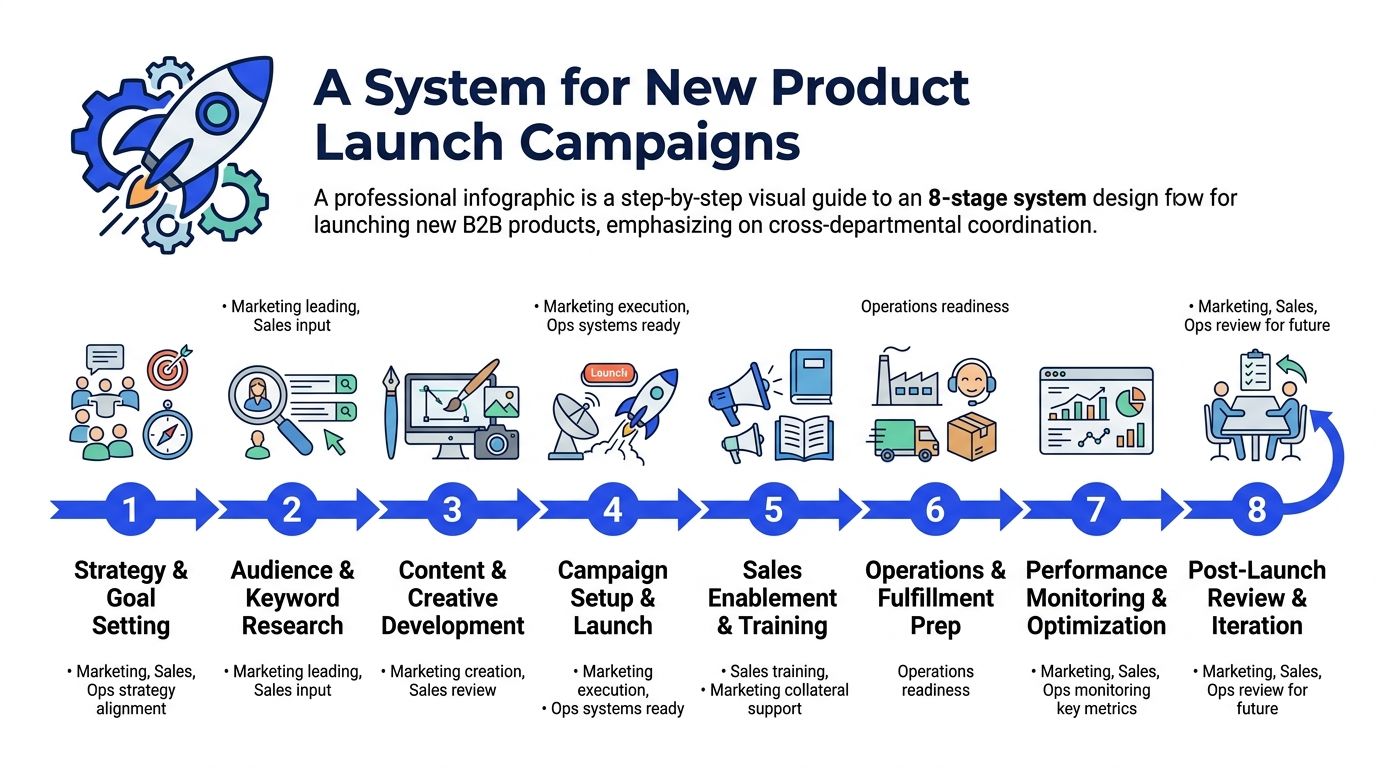
The cleanest launches use one coordinated system across marketing, sales, and RevOps. That matters even more when the product is new, the messaging isn't battle-tested yet, and the first wave of inbound needs careful handling.
The eight-stage launch structure
The sequence below works because each stage removes a predictable failure point.
Pre-launch foundation
Lock ICP, positioning, offer, landing pages, tracking, routing rules, and AE briefing. If sales hasn't seen the qualification criteria, don't launch.Audience and signal architecture
Build lists in Apollo, ZoomInfo, and Sales Navigator. Set signal monitoring in Clay. Upload custom audiences where relevant.Paid media architecture
Separate campaigns by audience tier, offer, and creative angle. Keep account structure clean enough that you can diagnose results later.Organic and content activation
Founder posts, proof assets, newsletters, and community distribution all help the paid layer convert better. For a broader tactical checklist, this actionable product launch guide is a solid companion read.Outbound activation
Run launch-aligned outbound to the same audience clusters. HeyReach, Lemlist, Instantly, and Smartlead all fit here depending on motion. Paid and outbound should not sound like two different companies.Early monitoring
Watch lead routing, meeting-held rate, audience response quality, and sales feedback daily. Early launch data is noisy, but operational issues show up fast.Iteration cycle
Pause weak audiences, tighten copy, adjust landing pages, and sharpen qualification. Don't scale because spend is available. Scale because the system is holding.Sustained execution
Once the launch stops being a launch, the program becomes a normal pipeline engine. At that point, move from daily intervention to planned review cycles.
Where launches usually break
Most launch issues happen outside the ad account.
Tracking isn't ready
Leads come in, but attribution is broken or CRM mapping is incomplete.Sales isn't ready
AEs treat launch leads like legacy leads, so call quality drops and feedback becomes useless.Audience definition is too broad
The team wants to “see what resonates,” which usually means the platform learns nothing useful.There is no outbound companion motion
Warm engagement from paid doesn't get followed up in a coordinated way.There is no real test structure
Teams launch one creative angle and one audience, then call the result a market verdict.
A launch system should feel a little rigid at the start. That's a good sign. Loose launches burn budget because nobody can tell whether the issue is the market, the offer, the handoff, or the campaign build.
Creative and landing pages that convert
Bad B2B creative usually makes the same mistake as bad targeting. It speaks to a category instead of a buyer. Then the landing page makes it worse by trying to sell everyone at once.
The click is not the goal. The goal is a qualified next step with the right person. That means the ad and the page need to create trust, narrow the audience, and make the handoff to sales easier.
Audience-message match first
A CFO in legal tech, a plant leader in manufacturing, and a VP Growth in SaaS will all interpret the same sentence differently. If the ad says “improve efficiency” or “drive growth,” you've already lost specificity.
Creative that converts in B2B usually has four traits:
It names the problem clearly
Not “better operations,” but the actual bottleneck the persona is dealing with.It reflects role-specific stakes
The same product can be a revenue issue for one buyer and a compliance issue for another.It offers proof, not slogans
Trust-building assets matter because B2B buyers compare aggressively and rarely respond to shallow promotional copy.It matches the traffic source
Search ad traffic should see a page that resolves a specific query. LinkedIn traffic should see a page that continues the same argument made in the ad.
One useful internal review question is simple. Could sales identify the intended buyer from the first screen alone? If not, the page is too generic.
Offers that create qualified conversations
“Book a demo” is often too early, especially for colder LinkedIn traffic. Better offers tend to pre-qualify the click and make the eventual meeting better.
What usually works:
Checklists and templates for operators who need practical material
Short diagnostic frameworks that help a buyer assess fit
Comparison or migration guides when the market is already evaluating vendors
Technical documents or implementation views for more complex products
Focused proof assets that show relevance to one subsegment
What usually fails is hiding the sales path. If the offer is a document, make it a substantial document. If the next step is a conversation, say so. Friction isn't always bad. The wrong kind of ease creates the wrong kind of lead.
Landing page structure that sales can actually work with
A landing page should do three jobs. Confirm relevance. Build trust. Push one next action.
A workable structure is usually:
Headline tied to one buyer and one pain point
Short subhead that explains the outcome
Proof block, ideally vertical or use-case specific
Offer section with a clear CTA
Qualification cues that help poor-fit traffic self-select out
Form or booking path connected to CRM routing
If your team needs a shared reference point for page anatomy and conversion logic, this landing page glossary entry is a good baseline to align marketing, design, and sales.
One more operator point. Don't hide pricing context, process context, or implementation context if those are real objections. B2B buyers don't need theatrics. They need enough clarity to decide whether a conversation is worth their time.
How to measure PPC performance
Monday morning. Marketing says CPL improved 28 percent. Sales says the leads were junk. Finance asks what paid search contributed to pipeline. If your reporting cannot answer all three, the PPC program is under-instrumented.
The spend environment alone justifies tighter measurement. Analysts at Digital Applied found search ad spending is projected to reach $218.3 billion globally in 2026, with the U.S. accounting for 35 percent. In that environment, nobody gets away with reporting clicks and form fills for long.
Measure for pipeline, not lead volume
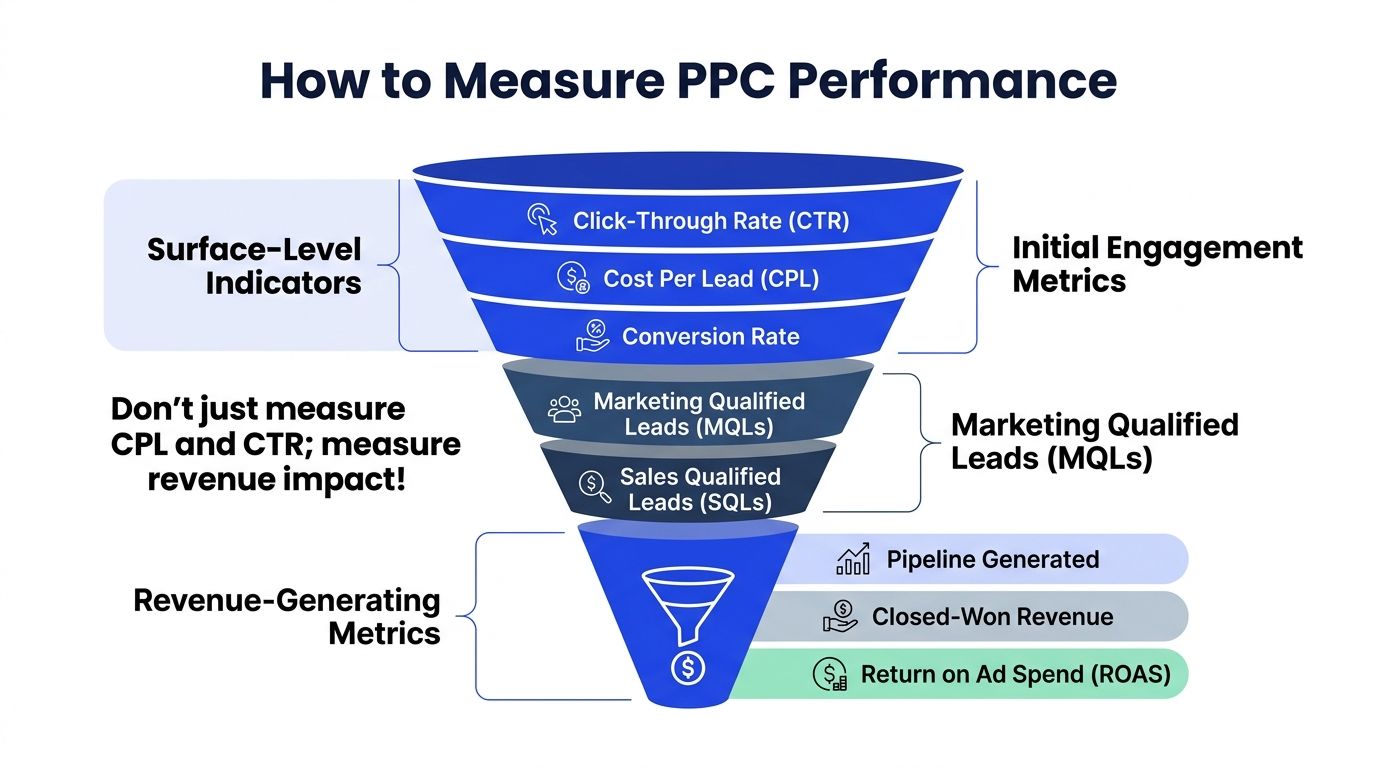
CPL belongs in the dashboard, but only as an efficiency signal. It does not tell you whether paid media is creating revenue.
A low-CPL campaign can flood the CRM with contacts that sales will never touch. A higher-CPL campaign aimed at a tighter buying group can produce fewer leads, more held meetings, and far more pipeline. That trade-off is normal in B2B PPC. The job is not to buy the cheapest conversion. The job is to buy the right path into qualified pipeline.
Use a metric stack that follows the sales process:
Cost per sales accepted lead
Cost per qualified meeting
Meeting-held rate
Opportunity creation rate
Pipeline value by campaign
Closed-won revenue, sourced and influenced
Sales cycle length and payback period
This is the point many teams miss. PPC is one part of a revenue system. Paid traffic creates demand capture and demand creation signals. CRM records progression. Sales dispositions tell you whether targeting is working. Outbound can then use engaged-account data to follow up on the right companies instead of calling a cold list.
What a workable reporting system looks like
Start with the CRM as the source of truth for stages and revenue. Ad platforms should pass campaign, ad group, keyword, audience, and offer data into contact and opportunity records. Sales needs required disposition fields. RevOps needs fixed stage definitions and routing rules. Without that structure, every performance review turns into an argument about whose numbers count.
Track the path end to end:
Stage | What to track |
|---|---|
Ad engagement | spend, clicks, CTR, CPC |
Lead capture | conversion rate, form completion rate, key form fields |
Sales review | accepted, rejected, recycle, reason codes |
Meeting stage | booked, held, no-show, rescheduled |
Opportunity stage | opportunity created, amount, product line, source path |
Revenue stage | closed-won, deal size, sales cycle length, payback |
The failure point is usually stage hygiene, not bid strategy. If sales rejects leads without a reason code, marketing cannot tighten targeting or offers. If campaign metadata never reaches the CRM, revenue reporting turns into channel politics. If multiple touches are involved, first-click reports will over-credit one channel and under-credit the rest. A multi-touch attribution model for B2B revenue analysis fixes that once volume is high enough to justify the effort.
Review operating metrics every week. Review pipeline and revenue on a longer lag that matches your sales cycle.
That cadence keeps the system honest. Weekly data helps you catch broken forms, poor lead routing, and weak audience segments fast. Quarterly revenue review shows whether those optimizations are producing real pipeline or just cleaner-looking dashboards.
The one lesson that fixes underperforming campaigns
Most underperforming campaigns don't need another round of bid tweaks. They need a harder look at the audience and the offer. That's the lesson teams resist because tactical changes feel safer than strategic ones.
If the audience is vague and the offer sounds like everyone else in the category, the platform will still spend your money. It just won't create much useful pipeline.
Most teams optimize the wrong layer
There is a reason weak differentiation hurts so badly in B2B. Without a unique value proposition, B2B paid traffic can take up to two years to become profitable. With a strong differentiation point, profitability can happen within one month, based on the source material referenced in this discussion of B2B paid traffic economics. That gap is brutal, and it explains why polished campaign management still fails when the offer is forgettable.
I've seen teams run endless creative tests that all cluster in the same performance band. Different headlines. Different images. Different CTAs. Nothing breaks through. When that happens, the ad account is often telling you something useful. The market doesn't care enough about the current proposition.
The correction usually starts upstream:
Narrow the ICP
Find the actual sub-problem that creates urgency
Rework the offer so it gives the buyer a reason to choose you
Rewrite the page and creative around that narrower angle
Feed sales feedback back into audience exclusions and messaging
The ugly truth is that broad targeting and generic offers can still produce lead volume. They just don't produce enough revenue.
The audit to run this Friday
Pull your last meaningful PPC campaign and answer these questions in one sheet:
Who exactly was targeted
Named account segment, role cluster, and buying contextWhat specific problem was offered against
Not category language, the actual pain pointWhy the buyer should believe you
Proof asset, credibility mechanism, or trust signalWhat happened after form fill
Response speed, owner, qualification rule, next stepWhere leads stalled
Rejected by sales, no-show, weak discovery, no opportunity created
If your answers stay broad, the campaign probably stayed broad too.
The fastest improvement in B2B pay per click usually comes from cleaning up those upstream decisions. Not from another week inside Ads Manager.
GROU helps B2B teams build pipeline systems that connect paid attention, outbound, LinkedIn content, and CRM reporting into one operating model. The methodology is simple, one message, one target list, one reporting line, so revenue teams can see which accounts turn into qualified meetings and which campaigns just create activity.
You're already spending on B2B pay per click. Clicks look acceptable, forms are coming in, and the dashboard says activity is happening. Sales still says pipeline feels thin. That usually means the PPC program is generating names, not opportunities, which is a common breakdown when teams track lead capture but fail to measure cost per opportunity created or diagnose where MQLs stall before sales conversations become real pipeline, as noted in ProperExpression's B2B PPC guide.
Channel choice should follow cost per qualified meeting, not cheap CPL
Budget split should match awareness baseline, category maturity, cycle length, and pipeline pressure
Targeting has to move from broad personas to account and signal layers
Launch campaigns need sales, CRM, content, and paid media working as one system
Measurement should end at pipeline and revenue, not forms
Table of Contents
Introduction
Most B2B pay per click programs don't fail because the platform is wrong. They fail because the system around the platform is weak. Marketing sends leads. Sales rejects them. RevOps can't connect spend to pipeline. Leadership sees activity, but not enough qualified meetings.
That problem shows up across iGaming, SaaS, manufacturing, legal tech, and pharma. The pattern is familiar. Teams buy attention through Google Ads or LinkedIn Ads, but they don't structure the handoff, audience logic, offer design, and reporting line tightly enough to turn that attention into pipeline.
Practical rule: if paid traffic isn't mapped to a specific audience, a specific sales path, and a specific CRM stage progression, you're buying noise.
A good PPC system is narrower than often assumed. It chooses channels based on buying behavior, not preference. It splits budget based on market reality, not generic ratios. It targets accounts, not loose personas. It launches with sales ready. Then it measures what happened after the click.
The right channel for B2B pipeline
For most B2B teams, Google Ads wins when your buyers actively search with commercial intent. LinkedIn Ads wins when you need precision against a defined buying committee. If you force a neutral answer here, you usually waste budget.
The channel question isn't really about CPL. It's about which platform can produce qualified meetings for your offer. In our work, that answer changes by category, but the pattern is stable. Search is usually the efficient path when search behavior exists. LinkedIn is usually the cleaner path when fit matters more than volume.
Google wins when search intent exists
Google Search should be the first place you put budget if your ICP searches for solution terms, competitor terms, pricing terms, and comparison terms. That intent does part of the qualification work before the click even happens.
Industry benchmarks back that pattern. Google Search B2B ads show a CTR of 4 to 6 percent with CPCs of $2.50 to $9.00, while LinkedIn Ads show a CTR of 0.4 to 0.7 percent with CPCs of $5.00 to $15.00, according to Vye's B2B marketing benchmark roundup. That doesn't mean Google is always better. It means Google is usually better when there is clear search demand.
For operator teams, the practical use case is simple:
Use Google Search for category terms with buying intent
Bid on comparison and alternative queries when buyers are in evaluation mode
Protect branded search so competitors don't intercept warm demand
Send traffic to one-page landing paths tied to one offer and one next step
In iGaming and legal tech, where buyers often know the category and compare vendors actively, search can be very efficient. In pharma or manufacturing niches, it can be excellent for a narrow set of terms and nearly useless beyond them.
LinkedIn wins when targeting precision matters more
LinkedIn is where you go when the buyer is identifiable by role, company type, industry, or account list, and when broad search behavior isn't strong enough to carry the program. That's why it stays relevant despite higher cost.
The benchmark reality is clear. LinkedIn sponsored content in B2B sees average CTRs around 0.44 to 0.65 percent, and CPL can range from $15 to $350, with blended B2B CPL averaging $200 and financial services reaching $450 to $500, based on Kliq Interactive's B2B benchmark review. Those numbers scare teams that only care about front-end efficiency. They shouldn't scare teams that care about opportunity quality.
LinkedIn is strongest when you can define the audience tightly and the offer speaks to that exact audience. For a strong operator view on creative formats and targeting logic, this breakdown of LinkedIn Ads for B2B strategies is worth reading alongside your own account data. If you're comparing campaign structures, our own notes on LinkedIn Ads systems cover the same operational point from the pipeline side.
Expensive clicks are fine. Expensive ambiguity isn't.
Document Ads, retargeting-based Message Ads, and tightly segmented sponsored content can all work. But if the audience is broad, LinkedIn gets expensive fast and hides the underlying problem under polished reporting.
Channel benchmark view
Use this as a decision table, not a universal ranking.
Channel | Typical CPQM (€) | Best Use Case |
|---|---|---|
Google Ads search, high intent | €280 to €600 | Buyers searching for pricing, comparison, alternative, or vendor terms |
LinkedIn Document Ads | €350 to €700 | Defined ICP, high-fit audience, trust-building offer |
Meta retargeting | €200 to €450 | Warm traffic already familiar with your brand |
Google Ads search, lower intent | €600 to €1,200 | Informational demand that still needs qualification |
Reddit Ads, developer audiences | €700 to €1,400 | Technical communities with strong audience-channel fit |
The recommendation is straightforward.
Pick Google first if your market has real high-intent search behavior
Pick LinkedIn first if your sale depends on role precision and account fit
Use Meta mainly as a retargeting layer
Use Reddit selectively, mostly in technical SaaS contexts where community targeting maps to the buyer
How to split your PPC budget
The default 50/50 awareness-conversion split is lazy planning. It sounds balanced, but it usually ignores specific conditions around the campaign. Budget split should reflect what the company has and what the market needs.
The four variables that matter most are awareness baseline, category maturity, sales cycle length, and current pipeline pressure. If those four aren't discussed before budget is assigned, the split is probably wrong.
Start with four variables
First, check brand awareness baseline. If the market already knows you, conversion-heavy allocation makes sense. If you're entering a new market or launching a new product line, pushing too hard on direct conversion usually produces weak form fills and a lot of sales frustration.
Second, look at category maturity. Established categories let you harvest demand. New categories require education. Teams in legal tech or mature SaaS categories can often push harder into conversion. Teams introducing a new workflow, compliance process, or manufacturing solution usually need more awareness pressure.
Third, map sales cycle length. Long cycles justify more awareness because familiarity shortens friction over time. Short cycles can support heavier conversion allocation because the feedback loop closes faster.
Fourth, be honest about pipeline volume today. If the team is pipeline-starved, conversion tactics need priority. If inbound is already steady, you can fund awareness more aggressively without starving sales.
For teams experimenting with algorithmic allocation and scenario planning, this piece on how to explore AI-driven budget strategies is useful context. It doesn't replace operator judgment, but it can sharpen how you model trade-offs. For a benchmark lens on search costs before you assign budget, review these B2B Google Ads CPC benchmarks.
Starting allocations by situation
These are starting points. They are not laws.
Startup with weak awareness and real pipeline pressure
Start around 35 percent awareness and 65 percent conversion. Put conversion spend into LinkedIn Document Ads, retargeting, and high-intent search if search exists. Use awareness to amplify founder-led content and build retargeting pools.Established brand expanding into a new audience
Start around 25 percent awareness and 75 percent conversion. The brand has enough credibility to support a more direct push, but the new audience still needs education.New category creation
Start around 60 percent awareness and 40 percent conversion. If buyers don't yet recognize the problem, conversion campaigns won't rescue the economics.Category leader with strong recognition
Start around 15 percent awareness and 85 percent conversion. Focus on demand capture, retargeting, and competitive defense.
A rigid split misses the point. The split should move as the system learns.
Here's a useful framing to share with leadership when they ask for fixed ratios:
What to watch after launch
The first mistake is treating awareness as unmeasurable. It isn't. You just don't measure it the same way you measure a lead form.
Track these directional signals:
Brand search trend → rising branded demand usually means awareness work is landing
Direct traffic trend → useful for seeing whether recall is improving
Retargeting conversion rate → a good indicator that the awareness layer is warming the audience
Time to conversion → shorter paths often mean familiarity is doing its job
Performance of conversion campaigns while awareness is active → if search and retargeting improve together, the mix is working
The second mistake is funding awareness before the conversion path is ready. If landing pages are weak, sales routing is slow, or qualification rules are fuzzy, awareness just sends more people into a broken system.
Audience targeting that creates pipeline
Most B2B PPC targeting is still too loose. Teams choose job titles, stack on an industry filter, add company size, and call it precision. It isn't. It's a cleaner-looking version of broad targeting.
The key shift happens when you stop targeting a market and start targeting accounts with reasons to care right now.
Broad job title targeting is where quality drops
Tighter targeting usually costs more, and that's acceptable if the downstream quality improves. The cost pattern is visible in benchmarks. Campaigns targeting Business Development roles can reach a CPC of $6.30, while Accounting roles average $5.00, according to The Growth Syndicate's B2B marketing benchmarks. The point isn't that one role is better. The point is that narrower ICP alignment raises CPC and can still improve pipeline economics.
That matters in every industry this article is aimed at. In manufacturing, broad operations targeting often produces curiosity clicks from people who won't own the budget. In SaaS, broad revenue leadership targeting often catches advisors, recruiters, and internal operators outside the buying path. In pharma, role precision matters even more because the committee is more complex.
If your audience definition fits on one line, it's probably still too broad.
The account and signal workflow
A targeting system that creates pipeline usually looks like this:
Define the ICP clearly
Not “mid-market SaaS.” Write the pattern in operational terms. Team size, motion, geography, stack, maturity, and pain point. If you need to sharpen that definition, start with a tighter ideal customer profile framework.Build target account lists Use Apollo and Sales Navigator to create a named account list. This enables the separation of strategic accounts from the rest of the market.
Layer signals with Clay
Hiring activity, tech adoption, expansion triggers, funding events, role changes, and content engagement all help. You don't need every signal. You need the ones that correlate with your sale.Upload matched audiences into ad platforms
LinkedIn is the obvious fit here. Google can still support the system through search and remarketing, but the account list becomes the control layer.Write segment-specific creative
Don't show one generic message to every account cluster. A manufacturing VP evaluating supply chain software needs different proof than a SaaS RevOps leader evaluating pipeline tooling.Pass response data back to CRM and outbound
The best audience work compounds when outbound and paid share the same account logic. Apollo list, Sales Navigator list, LinkedIn audience, and HubSpot lifecycle should all reconcile.
Structure proves more effective than tactic-chasing. The account list informs the ad audience. The same list feeds outbound in Lemlist, Instantly, or Smartlead. High-intent engagers move into a faster sales path. Cold accounts stay in nurture. That is how attention starts turning into qualified conversation volume, instead of becoming an isolated paid channel report.
A system for new product launch campaigns
A new product launch fails when paid media gets asked to do the work of positioning, sales enablement, and operational readiness. Ads can create attention. They can't fix confusion inside the company.
The cleanest launches use one coordinated system across marketing, sales, and RevOps. That matters even more when the product is new, the messaging isn't battle-tested yet, and the first wave of inbound needs careful handling.
The eight-stage launch structure
The sequence below works because each stage removes a predictable failure point.
Pre-launch foundation
Lock ICP, positioning, offer, landing pages, tracking, routing rules, and AE briefing. If sales hasn't seen the qualification criteria, don't launch.Audience and signal architecture
Build lists in Apollo, ZoomInfo, and Sales Navigator. Set signal monitoring in Clay. Upload custom audiences where relevant.Paid media architecture
Separate campaigns by audience tier, offer, and creative angle. Keep account structure clean enough that you can diagnose results later.Organic and content activation
Founder posts, proof assets, newsletters, and community distribution all help the paid layer convert better. For a broader tactical checklist, this actionable product launch guide is a solid companion read.Outbound activation
Run launch-aligned outbound to the same audience clusters. HeyReach, Lemlist, Instantly, and Smartlead all fit here depending on motion. Paid and outbound should not sound like two different companies.Early monitoring
Watch lead routing, meeting-held rate, audience response quality, and sales feedback daily. Early launch data is noisy, but operational issues show up fast.Iteration cycle
Pause weak audiences, tighten copy, adjust landing pages, and sharpen qualification. Don't scale because spend is available. Scale because the system is holding.Sustained execution
Once the launch stops being a launch, the program becomes a normal pipeline engine. At that point, move from daily intervention to planned review cycles.
Where launches usually break
Most launch issues happen outside the ad account.
Tracking isn't ready
Leads come in, but attribution is broken or CRM mapping is incomplete.Sales isn't ready
AEs treat launch leads like legacy leads, so call quality drops and feedback becomes useless.Audience definition is too broad
The team wants to “see what resonates,” which usually means the platform learns nothing useful.There is no outbound companion motion
Warm engagement from paid doesn't get followed up in a coordinated way.There is no real test structure
Teams launch one creative angle and one audience, then call the result a market verdict.
A launch system should feel a little rigid at the start. That's a good sign. Loose launches burn budget because nobody can tell whether the issue is the market, the offer, the handoff, or the campaign build.
Creative and landing pages that convert
Bad B2B creative usually makes the same mistake as bad targeting. It speaks to a category instead of a buyer. Then the landing page makes it worse by trying to sell everyone at once.
The click is not the goal. The goal is a qualified next step with the right person. That means the ad and the page need to create trust, narrow the audience, and make the handoff to sales easier.
Audience-message match first
A CFO in legal tech, a plant leader in manufacturing, and a VP Growth in SaaS will all interpret the same sentence differently. If the ad says “improve efficiency” or “drive growth,” you've already lost specificity.
Creative that converts in B2B usually has four traits:
It names the problem clearly
Not “better operations,” but the actual bottleneck the persona is dealing with.It reflects role-specific stakes
The same product can be a revenue issue for one buyer and a compliance issue for another.It offers proof, not slogans
Trust-building assets matter because B2B buyers compare aggressively and rarely respond to shallow promotional copy.It matches the traffic source
Search ad traffic should see a page that resolves a specific query. LinkedIn traffic should see a page that continues the same argument made in the ad.
One useful internal review question is simple. Could sales identify the intended buyer from the first screen alone? If not, the page is too generic.
Offers that create qualified conversations
“Book a demo” is often too early, especially for colder LinkedIn traffic. Better offers tend to pre-qualify the click and make the eventual meeting better.
What usually works:
Checklists and templates for operators who need practical material
Short diagnostic frameworks that help a buyer assess fit
Comparison or migration guides when the market is already evaluating vendors
Technical documents or implementation views for more complex products
Focused proof assets that show relevance to one subsegment
What usually fails is hiding the sales path. If the offer is a document, make it a substantial document. If the next step is a conversation, say so. Friction isn't always bad. The wrong kind of ease creates the wrong kind of lead.
Landing page structure that sales can actually work with
A landing page should do three jobs. Confirm relevance. Build trust. Push one next action.
A workable structure is usually:
Headline tied to one buyer and one pain point
Short subhead that explains the outcome
Proof block, ideally vertical or use-case specific
Offer section with a clear CTA
Qualification cues that help poor-fit traffic self-select out
Form or booking path connected to CRM routing
If your team needs a shared reference point for page anatomy and conversion logic, this landing page glossary entry is a good baseline to align marketing, design, and sales.
One more operator point. Don't hide pricing context, process context, or implementation context if those are real objections. B2B buyers don't need theatrics. They need enough clarity to decide whether a conversation is worth their time.
How to measure PPC performance
Monday morning. Marketing says CPL improved 28 percent. Sales says the leads were junk. Finance asks what paid search contributed to pipeline. If your reporting cannot answer all three, the PPC program is under-instrumented.
The spend environment alone justifies tighter measurement. Analysts at Digital Applied found search ad spending is projected to reach $218.3 billion globally in 2026, with the U.S. accounting for 35 percent. In that environment, nobody gets away with reporting clicks and form fills for long.
Measure for pipeline, not lead volume
CPL belongs in the dashboard, but only as an efficiency signal. It does not tell you whether paid media is creating revenue.
A low-CPL campaign can flood the CRM with contacts that sales will never touch. A higher-CPL campaign aimed at a tighter buying group can produce fewer leads, more held meetings, and far more pipeline. That trade-off is normal in B2B PPC. The job is not to buy the cheapest conversion. The job is to buy the right path into qualified pipeline.
Use a metric stack that follows the sales process:
Cost per sales accepted lead
Cost per qualified meeting
Meeting-held rate
Opportunity creation rate
Pipeline value by campaign
Closed-won revenue, sourced and influenced
Sales cycle length and payback period
This is the point many teams miss. PPC is one part of a revenue system. Paid traffic creates demand capture and demand creation signals. CRM records progression. Sales dispositions tell you whether targeting is working. Outbound can then use engaged-account data to follow up on the right companies instead of calling a cold list.
What a workable reporting system looks like
Start with the CRM as the source of truth for stages and revenue. Ad platforms should pass campaign, ad group, keyword, audience, and offer data into contact and opportunity records. Sales needs required disposition fields. RevOps needs fixed stage definitions and routing rules. Without that structure, every performance review turns into an argument about whose numbers count.
Track the path end to end:
Stage | What to track |
|---|---|
Ad engagement | spend, clicks, CTR, CPC |
Lead capture | conversion rate, form completion rate, key form fields |
Sales review | accepted, rejected, recycle, reason codes |
Meeting stage | booked, held, no-show, rescheduled |
Opportunity stage | opportunity created, amount, product line, source path |
Revenue stage | closed-won, deal size, sales cycle length, payback |
The failure point is usually stage hygiene, not bid strategy. If sales rejects leads without a reason code, marketing cannot tighten targeting or offers. If campaign metadata never reaches the CRM, revenue reporting turns into channel politics. If multiple touches are involved, first-click reports will over-credit one channel and under-credit the rest. A multi-touch attribution model for B2B revenue analysis fixes that once volume is high enough to justify the effort.
Review operating metrics every week. Review pipeline and revenue on a longer lag that matches your sales cycle.
That cadence keeps the system honest. Weekly data helps you catch broken forms, poor lead routing, and weak audience segments fast. Quarterly revenue review shows whether those optimizations are producing real pipeline or just cleaner-looking dashboards.
The one lesson that fixes underperforming campaigns
Most underperforming campaigns don't need another round of bid tweaks. They need a harder look at the audience and the offer. That's the lesson teams resist because tactical changes feel safer than strategic ones.
If the audience is vague and the offer sounds like everyone else in the category, the platform will still spend your money. It just won't create much useful pipeline.
Most teams optimize the wrong layer
There is a reason weak differentiation hurts so badly in B2B. Without a unique value proposition, B2B paid traffic can take up to two years to become profitable. With a strong differentiation point, profitability can happen within one month, based on the source material referenced in this discussion of B2B paid traffic economics. That gap is brutal, and it explains why polished campaign management still fails when the offer is forgettable.
I've seen teams run endless creative tests that all cluster in the same performance band. Different headlines. Different images. Different CTAs. Nothing breaks through. When that happens, the ad account is often telling you something useful. The market doesn't care enough about the current proposition.
The correction usually starts upstream:
Narrow the ICP
Find the actual sub-problem that creates urgency
Rework the offer so it gives the buyer a reason to choose you
Rewrite the page and creative around that narrower angle
Feed sales feedback back into audience exclusions and messaging
The ugly truth is that broad targeting and generic offers can still produce lead volume. They just don't produce enough revenue.
The audit to run this Friday
Pull your last meaningful PPC campaign and answer these questions in one sheet:
Who exactly was targeted
Named account segment, role cluster, and buying contextWhat specific problem was offered against
Not category language, the actual pain pointWhy the buyer should believe you
Proof asset, credibility mechanism, or trust signalWhat happened after form fill
Response speed, owner, qualification rule, next stepWhere leads stalled
Rejected by sales, no-show, weak discovery, no opportunity created
If your answers stay broad, the campaign probably stayed broad too.
The fastest improvement in B2B pay per click usually comes from cleaning up those upstream decisions. Not from another week inside Ads Manager.
GROU helps B2B teams build pipeline systems that connect paid attention, outbound, LinkedIn content, and CRM reporting into one operating model. The methodology is simple, one message, one target list, one reporting line, so revenue teams can see which accounts turn into qualified meetings and which campaigns just create activity.
You're already spending on B2B pay per click. Clicks look acceptable, forms are coming in, and the dashboard says activity is happening. Sales still says pipeline feels thin. That usually means the PPC program is generating names, not opportunities, which is a common breakdown when teams track lead capture but fail to measure cost per opportunity created or diagnose where MQLs stall before sales conversations become real pipeline, as noted in ProperExpression's B2B PPC guide.
Channel choice should follow cost per qualified meeting, not cheap CPL
Budget split should match awareness baseline, category maturity, cycle length, and pipeline pressure
Targeting has to move from broad personas to account and signal layers
Launch campaigns need sales, CRM, content, and paid media working as one system
Measurement should end at pipeline and revenue, not forms
Table of Contents
Introduction
Most B2B pay per click programs don't fail because the platform is wrong. They fail because the system around the platform is weak. Marketing sends leads. Sales rejects them. RevOps can't connect spend to pipeline. Leadership sees activity, but not enough qualified meetings.
That problem shows up across iGaming, SaaS, manufacturing, legal tech, and pharma. The pattern is familiar. Teams buy attention through Google Ads or LinkedIn Ads, but they don't structure the handoff, audience logic, offer design, and reporting line tightly enough to turn that attention into pipeline.
Practical rule: if paid traffic isn't mapped to a specific audience, a specific sales path, and a specific CRM stage progression, you're buying noise.
A good PPC system is narrower than often assumed. It chooses channels based on buying behavior, not preference. It splits budget based on market reality, not generic ratios. It targets accounts, not loose personas. It launches with sales ready. Then it measures what happened after the click.
The right channel for B2B pipeline
For most B2B teams, Google Ads wins when your buyers actively search with commercial intent. LinkedIn Ads wins when you need precision against a defined buying committee. If you force a neutral answer here, you usually waste budget.
The channel question isn't really about CPL. It's about which platform can produce qualified meetings for your offer. In our work, that answer changes by category, but the pattern is stable. Search is usually the efficient path when search behavior exists. LinkedIn is usually the cleaner path when fit matters more than volume.
Google wins when search intent exists
Google Search should be the first place you put budget if your ICP searches for solution terms, competitor terms, pricing terms, and comparison terms. That intent does part of the qualification work before the click even happens.
Industry benchmarks back that pattern. Google Search B2B ads show a CTR of 4 to 6 percent with CPCs of $2.50 to $9.00, while LinkedIn Ads show a CTR of 0.4 to 0.7 percent with CPCs of $5.00 to $15.00, according to Vye's B2B marketing benchmark roundup. That doesn't mean Google is always better. It means Google is usually better when there is clear search demand.
For operator teams, the practical use case is simple:
Use Google Search for category terms with buying intent
Bid on comparison and alternative queries when buyers are in evaluation mode
Protect branded search so competitors don't intercept warm demand
Send traffic to one-page landing paths tied to one offer and one next step
In iGaming and legal tech, where buyers often know the category and compare vendors actively, search can be very efficient. In pharma or manufacturing niches, it can be excellent for a narrow set of terms and nearly useless beyond them.
LinkedIn wins when targeting precision matters more
LinkedIn is where you go when the buyer is identifiable by role, company type, industry, or account list, and when broad search behavior isn't strong enough to carry the program. That's why it stays relevant despite higher cost.
The benchmark reality is clear. LinkedIn sponsored content in B2B sees average CTRs around 0.44 to 0.65 percent, and CPL can range from $15 to $350, with blended B2B CPL averaging $200 and financial services reaching $450 to $500, based on Kliq Interactive's B2B benchmark review. Those numbers scare teams that only care about front-end efficiency. They shouldn't scare teams that care about opportunity quality.
LinkedIn is strongest when you can define the audience tightly and the offer speaks to that exact audience. For a strong operator view on creative formats and targeting logic, this breakdown of LinkedIn Ads for B2B strategies is worth reading alongside your own account data. If you're comparing campaign structures, our own notes on LinkedIn Ads systems cover the same operational point from the pipeline side.
Expensive clicks are fine. Expensive ambiguity isn't.
Document Ads, retargeting-based Message Ads, and tightly segmented sponsored content can all work. But if the audience is broad, LinkedIn gets expensive fast and hides the underlying problem under polished reporting.
Channel benchmark view
Use this as a decision table, not a universal ranking.
Channel | Typical CPQM (€) | Best Use Case |
|---|---|---|
Google Ads search, high intent | €280 to €600 | Buyers searching for pricing, comparison, alternative, or vendor terms |
LinkedIn Document Ads | €350 to €700 | Defined ICP, high-fit audience, trust-building offer |
Meta retargeting | €200 to €450 | Warm traffic already familiar with your brand |
Google Ads search, lower intent | €600 to €1,200 | Informational demand that still needs qualification |
Reddit Ads, developer audiences | €700 to €1,400 | Technical communities with strong audience-channel fit |
The recommendation is straightforward.
Pick Google first if your market has real high-intent search behavior
Pick LinkedIn first if your sale depends on role precision and account fit
Use Meta mainly as a retargeting layer
Use Reddit selectively, mostly in technical SaaS contexts where community targeting maps to the buyer
How to split your PPC budget
The default 50/50 awareness-conversion split is lazy planning. It sounds balanced, but it usually ignores specific conditions around the campaign. Budget split should reflect what the company has and what the market needs.
The four variables that matter most are awareness baseline, category maturity, sales cycle length, and current pipeline pressure. If those four aren't discussed before budget is assigned, the split is probably wrong.
Start with four variables
First, check brand awareness baseline. If the market already knows you, conversion-heavy allocation makes sense. If you're entering a new market or launching a new product line, pushing too hard on direct conversion usually produces weak form fills and a lot of sales frustration.
Second, look at category maturity. Established categories let you harvest demand. New categories require education. Teams in legal tech or mature SaaS categories can often push harder into conversion. Teams introducing a new workflow, compliance process, or manufacturing solution usually need more awareness pressure.
Third, map sales cycle length. Long cycles justify more awareness because familiarity shortens friction over time. Short cycles can support heavier conversion allocation because the feedback loop closes faster.
Fourth, be honest about pipeline volume today. If the team is pipeline-starved, conversion tactics need priority. If inbound is already steady, you can fund awareness more aggressively without starving sales.
For teams experimenting with algorithmic allocation and scenario planning, this piece on how to explore AI-driven budget strategies is useful context. It doesn't replace operator judgment, but it can sharpen how you model trade-offs. For a benchmark lens on search costs before you assign budget, review these B2B Google Ads CPC benchmarks.
Starting allocations by situation
These are starting points. They are not laws.
Startup with weak awareness and real pipeline pressure
Start around 35 percent awareness and 65 percent conversion. Put conversion spend into LinkedIn Document Ads, retargeting, and high-intent search if search exists. Use awareness to amplify founder-led content and build retargeting pools.Established brand expanding into a new audience
Start around 25 percent awareness and 75 percent conversion. The brand has enough credibility to support a more direct push, but the new audience still needs education.New category creation
Start around 60 percent awareness and 40 percent conversion. If buyers don't yet recognize the problem, conversion campaigns won't rescue the economics.Category leader with strong recognition
Start around 15 percent awareness and 85 percent conversion. Focus on demand capture, retargeting, and competitive defense.
A rigid split misses the point. The split should move as the system learns.
Here's a useful framing to share with leadership when they ask for fixed ratios:
What to watch after launch
The first mistake is treating awareness as unmeasurable. It isn't. You just don't measure it the same way you measure a lead form.
Track these directional signals:
Brand search trend → rising branded demand usually means awareness work is landing
Direct traffic trend → useful for seeing whether recall is improving
Retargeting conversion rate → a good indicator that the awareness layer is warming the audience
Time to conversion → shorter paths often mean familiarity is doing its job
Performance of conversion campaigns while awareness is active → if search and retargeting improve together, the mix is working
The second mistake is funding awareness before the conversion path is ready. If landing pages are weak, sales routing is slow, or qualification rules are fuzzy, awareness just sends more people into a broken system.
Audience targeting that creates pipeline
Most B2B PPC targeting is still too loose. Teams choose job titles, stack on an industry filter, add company size, and call it precision. It isn't. It's a cleaner-looking version of broad targeting.
The key shift happens when you stop targeting a market and start targeting accounts with reasons to care right now.
Broad job title targeting is where quality drops
Tighter targeting usually costs more, and that's acceptable if the downstream quality improves. The cost pattern is visible in benchmarks. Campaigns targeting Business Development roles can reach a CPC of $6.30, while Accounting roles average $5.00, according to The Growth Syndicate's B2B marketing benchmarks. The point isn't that one role is better. The point is that narrower ICP alignment raises CPC and can still improve pipeline economics.
That matters in every industry this article is aimed at. In manufacturing, broad operations targeting often produces curiosity clicks from people who won't own the budget. In SaaS, broad revenue leadership targeting often catches advisors, recruiters, and internal operators outside the buying path. In pharma, role precision matters even more because the committee is more complex.
If your audience definition fits on one line, it's probably still too broad.
The account and signal workflow
A targeting system that creates pipeline usually looks like this:
Define the ICP clearly
Not “mid-market SaaS.” Write the pattern in operational terms. Team size, motion, geography, stack, maturity, and pain point. If you need to sharpen that definition, start with a tighter ideal customer profile framework.Build target account lists Use Apollo and Sales Navigator to create a named account list. This enables the separation of strategic accounts from the rest of the market.
Layer signals with Clay
Hiring activity, tech adoption, expansion triggers, funding events, role changes, and content engagement all help. You don't need every signal. You need the ones that correlate with your sale.Upload matched audiences into ad platforms
LinkedIn is the obvious fit here. Google can still support the system through search and remarketing, but the account list becomes the control layer.Write segment-specific creative
Don't show one generic message to every account cluster. A manufacturing VP evaluating supply chain software needs different proof than a SaaS RevOps leader evaluating pipeline tooling.Pass response data back to CRM and outbound
The best audience work compounds when outbound and paid share the same account logic. Apollo list, Sales Navigator list, LinkedIn audience, and HubSpot lifecycle should all reconcile.
Structure proves more effective than tactic-chasing. The account list informs the ad audience. The same list feeds outbound in Lemlist, Instantly, or Smartlead. High-intent engagers move into a faster sales path. Cold accounts stay in nurture. That is how attention starts turning into qualified conversation volume, instead of becoming an isolated paid channel report.
A system for new product launch campaigns
A new product launch fails when paid media gets asked to do the work of positioning, sales enablement, and operational readiness. Ads can create attention. They can't fix confusion inside the company.
The cleanest launches use one coordinated system across marketing, sales, and RevOps. That matters even more when the product is new, the messaging isn't battle-tested yet, and the first wave of inbound needs careful handling.
The eight-stage launch structure
The sequence below works because each stage removes a predictable failure point.
Pre-launch foundation
Lock ICP, positioning, offer, landing pages, tracking, routing rules, and AE briefing. If sales hasn't seen the qualification criteria, don't launch.Audience and signal architecture
Build lists in Apollo, ZoomInfo, and Sales Navigator. Set signal monitoring in Clay. Upload custom audiences where relevant.Paid media architecture
Separate campaigns by audience tier, offer, and creative angle. Keep account structure clean enough that you can diagnose results later.Organic and content activation
Founder posts, proof assets, newsletters, and community distribution all help the paid layer convert better. For a broader tactical checklist, this actionable product launch guide is a solid companion read.Outbound activation
Run launch-aligned outbound to the same audience clusters. HeyReach, Lemlist, Instantly, and Smartlead all fit here depending on motion. Paid and outbound should not sound like two different companies.Early monitoring
Watch lead routing, meeting-held rate, audience response quality, and sales feedback daily. Early launch data is noisy, but operational issues show up fast.Iteration cycle
Pause weak audiences, tighten copy, adjust landing pages, and sharpen qualification. Don't scale because spend is available. Scale because the system is holding.Sustained execution
Once the launch stops being a launch, the program becomes a normal pipeline engine. At that point, move from daily intervention to planned review cycles.
Where launches usually break
Most launch issues happen outside the ad account.
Tracking isn't ready
Leads come in, but attribution is broken or CRM mapping is incomplete.Sales isn't ready
AEs treat launch leads like legacy leads, so call quality drops and feedback becomes useless.Audience definition is too broad
The team wants to “see what resonates,” which usually means the platform learns nothing useful.There is no outbound companion motion
Warm engagement from paid doesn't get followed up in a coordinated way.There is no real test structure
Teams launch one creative angle and one audience, then call the result a market verdict.
A launch system should feel a little rigid at the start. That's a good sign. Loose launches burn budget because nobody can tell whether the issue is the market, the offer, the handoff, or the campaign build.
Creative and landing pages that convert
Bad B2B creative usually makes the same mistake as bad targeting. It speaks to a category instead of a buyer. Then the landing page makes it worse by trying to sell everyone at once.
The click is not the goal. The goal is a qualified next step with the right person. That means the ad and the page need to create trust, narrow the audience, and make the handoff to sales easier.
Audience-message match first
A CFO in legal tech, a plant leader in manufacturing, and a VP Growth in SaaS will all interpret the same sentence differently. If the ad says “improve efficiency” or “drive growth,” you've already lost specificity.
Creative that converts in B2B usually has four traits:
It names the problem clearly
Not “better operations,” but the actual bottleneck the persona is dealing with.It reflects role-specific stakes
The same product can be a revenue issue for one buyer and a compliance issue for another.It offers proof, not slogans
Trust-building assets matter because B2B buyers compare aggressively and rarely respond to shallow promotional copy.It matches the traffic source
Search ad traffic should see a page that resolves a specific query. LinkedIn traffic should see a page that continues the same argument made in the ad.
One useful internal review question is simple. Could sales identify the intended buyer from the first screen alone? If not, the page is too generic.
Offers that create qualified conversations
“Book a demo” is often too early, especially for colder LinkedIn traffic. Better offers tend to pre-qualify the click and make the eventual meeting better.
What usually works:
Checklists and templates for operators who need practical material
Short diagnostic frameworks that help a buyer assess fit
Comparison or migration guides when the market is already evaluating vendors
Technical documents or implementation views for more complex products
Focused proof assets that show relevance to one subsegment
What usually fails is hiding the sales path. If the offer is a document, make it a substantial document. If the next step is a conversation, say so. Friction isn't always bad. The wrong kind of ease creates the wrong kind of lead.
Landing page structure that sales can actually work with
A landing page should do three jobs. Confirm relevance. Build trust. Push one next action.
A workable structure is usually:
Headline tied to one buyer and one pain point
Short subhead that explains the outcome
Proof block, ideally vertical or use-case specific
Offer section with a clear CTA
Qualification cues that help poor-fit traffic self-select out
Form or booking path connected to CRM routing
If your team needs a shared reference point for page anatomy and conversion logic, this landing page glossary entry is a good baseline to align marketing, design, and sales.
One more operator point. Don't hide pricing context, process context, or implementation context if those are real objections. B2B buyers don't need theatrics. They need enough clarity to decide whether a conversation is worth their time.
How to measure PPC performance
Monday morning. Marketing says CPL improved 28 percent. Sales says the leads were junk. Finance asks what paid search contributed to pipeline. If your reporting cannot answer all three, the PPC program is under-instrumented.
The spend environment alone justifies tighter measurement. Analysts at Digital Applied found search ad spending is projected to reach $218.3 billion globally in 2026, with the U.S. accounting for 35 percent. In that environment, nobody gets away with reporting clicks and form fills for long.
Measure for pipeline, not lead volume
CPL belongs in the dashboard, but only as an efficiency signal. It does not tell you whether paid media is creating revenue.
A low-CPL campaign can flood the CRM with contacts that sales will never touch. A higher-CPL campaign aimed at a tighter buying group can produce fewer leads, more held meetings, and far more pipeline. That trade-off is normal in B2B PPC. The job is not to buy the cheapest conversion. The job is to buy the right path into qualified pipeline.
Use a metric stack that follows the sales process:
Cost per sales accepted lead
Cost per qualified meeting
Meeting-held rate
Opportunity creation rate
Pipeline value by campaign
Closed-won revenue, sourced and influenced
Sales cycle length and payback period
This is the point many teams miss. PPC is one part of a revenue system. Paid traffic creates demand capture and demand creation signals. CRM records progression. Sales dispositions tell you whether targeting is working. Outbound can then use engaged-account data to follow up on the right companies instead of calling a cold list.
What a workable reporting system looks like
Start with the CRM as the source of truth for stages and revenue. Ad platforms should pass campaign, ad group, keyword, audience, and offer data into contact and opportunity records. Sales needs required disposition fields. RevOps needs fixed stage definitions and routing rules. Without that structure, every performance review turns into an argument about whose numbers count.
Track the path end to end:
Stage | What to track |
|---|---|
Ad engagement | spend, clicks, CTR, CPC |
Lead capture | conversion rate, form completion rate, key form fields |
Sales review | accepted, rejected, recycle, reason codes |
Meeting stage | booked, held, no-show, rescheduled |
Opportunity stage | opportunity created, amount, product line, source path |
Revenue stage | closed-won, deal size, sales cycle length, payback |
The failure point is usually stage hygiene, not bid strategy. If sales rejects leads without a reason code, marketing cannot tighten targeting or offers. If campaign metadata never reaches the CRM, revenue reporting turns into channel politics. If multiple touches are involved, first-click reports will over-credit one channel and under-credit the rest. A multi-touch attribution model for B2B revenue analysis fixes that once volume is high enough to justify the effort.
Review operating metrics every week. Review pipeline and revenue on a longer lag that matches your sales cycle.
That cadence keeps the system honest. Weekly data helps you catch broken forms, poor lead routing, and weak audience segments fast. Quarterly revenue review shows whether those optimizations are producing real pipeline or just cleaner-looking dashboards.
The one lesson that fixes underperforming campaigns
Most underperforming campaigns don't need another round of bid tweaks. They need a harder look at the audience and the offer. That's the lesson teams resist because tactical changes feel safer than strategic ones.
If the audience is vague and the offer sounds like everyone else in the category, the platform will still spend your money. It just won't create much useful pipeline.
Most teams optimize the wrong layer
There is a reason weak differentiation hurts so badly in B2B. Without a unique value proposition, B2B paid traffic can take up to two years to become profitable. With a strong differentiation point, profitability can happen within one month, based on the source material referenced in this discussion of B2B paid traffic economics. That gap is brutal, and it explains why polished campaign management still fails when the offer is forgettable.
I've seen teams run endless creative tests that all cluster in the same performance band. Different headlines. Different images. Different CTAs. Nothing breaks through. When that happens, the ad account is often telling you something useful. The market doesn't care enough about the current proposition.
The correction usually starts upstream:
Narrow the ICP
Find the actual sub-problem that creates urgency
Rework the offer so it gives the buyer a reason to choose you
Rewrite the page and creative around that narrower angle
Feed sales feedback back into audience exclusions and messaging
The ugly truth is that broad targeting and generic offers can still produce lead volume. They just don't produce enough revenue.
The audit to run this Friday
Pull your last meaningful PPC campaign and answer these questions in one sheet:
Who exactly was targeted
Named account segment, role cluster, and buying contextWhat specific problem was offered against
Not category language, the actual pain pointWhy the buyer should believe you
Proof asset, credibility mechanism, or trust signalWhat happened after form fill
Response speed, owner, qualification rule, next stepWhere leads stalled
Rejected by sales, no-show, weak discovery, no opportunity created
If your answers stay broad, the campaign probably stayed broad too.
The fastest improvement in B2B pay per click usually comes from cleaning up those upstream decisions. Not from another week inside Ads Manager.
GROU helps B2B teams build pipeline systems that connect paid attention, outbound, LinkedIn content, and CRM reporting into one operating model. The methodology is simple, one message, one target list, one reporting line, so revenue teams can see which accounts turn into qualified meetings and which campaigns just create activity.
Pipeline OS Newsletter
Build qualified pipeline
Get weekly tactics to generate demand, improve lead quality, and book more meetings.





Trusted by industry leaders
Trusted by industry leaders
Trusted by industry leaders
Ready to build qualified pipeline?
Ready to build qualified pipeline?
Ready to build qualified pipeline?
Book a call to see if we're the right fit, or take the 2-minute quiz to get a clear starting point.
Book a call to see if we're the right fit, or take the 2-minute quiz to get a clear starting point.
Book a call to see if we're the right fit, or take the 2-minute quiz to get a clear starting point.
" height="30.21639343089746px" id="hfGbXmQR2" width="30.216393430897455px"/></svg>)
Copyright © 2026 – All Right Reserved
Copyright © 2026 – All Right Reserved
Copyright © 2026 – All Right Reserved