%22%3E%3C/path%3E%3Cpath d=%22M 63.072 7.554 C 62.258 8.022 61.577 8.689 61.092 9.493 L 61.092 7.076 L 57.158 7.076 L 57.158 22.64 L 61.089 22.64 L 61.089 14.888 C 61.089 13.446 61.403 12.434 62.03 11.853 C 62.818 11.218 63.818 10.907 64.826 10.982 L 65.868 10.982 L 65.868 6.851 C 64.891 6.834 63.926 7.076 63.073 7.554 Z%22 fill=%22rgb(17,17,17)%22%3E%3C/path%3E%3Cpath d=%22M 78.916 7.82 C 76.363 6.49 73.321 6.49 70.768 7.82 C 69.562 8.473 68.564 9.451 67.888 10.644 C 67.167 11.931 66.803 13.387 66.834 14.862 C 66.804 16.332 67.157 17.785 67.86 19.077 C 68.515 20.267 69.494 21.246 70.684 21.901 C 71.924 22.576 73.318 22.92 74.73 22.898 C 76.164 22.918 77.58 22.575 78.846 21.901 C 80.062 21.247 81.073 20.27 81.768 19.077 C 82.506 17.797 82.88 16.339 82.85 14.862 C 82.88 13.389 82.517 11.934 81.797 10.647 C 81.12 9.455 80.122 8.477 78.917 7.824 M 78.803 14.862 C 78.829 15.739 78.636 16.608 78.241 17.391 C 77.903 18.046 77.38 18.588 76.738 18.95 C 76.124 19.293 75.432 19.472 74.729 19.47 C 73.668 19.497 72.648 19.061 71.934 18.276 C 71.139 17.323 70.741 16.1 70.823 14.862 C 70.741 13.62 71.149 12.395 71.959 11.45 C 72.687 10.667 73.715 10.233 74.783 10.256 C 75.859 10.236 76.894 10.67 77.635 11.45 C 78.464 12.387 78.884 13.616 78.801 14.864%22 fill=%22rgb(17,17,17)%22%3E%3C/path%3E%3Cpath d=%22M 95.906 7.076 L 95.906 15.646 C 95.975 16.68 95.643 17.701 94.979 18.498 C 94.311 19.184 93.379 19.547 92.422 19.495 C 91.475 19.544 90.553 19.18 89.894 18.498 C 89.23 17.701 88.898 16.68 88.967 15.646 L 88.967 7.076 L 85.033 7.076 L 85.033 16.207 C 85 17.449 85.275 18.68 85.834 19.79 C 86.327 20.75 87.095 21.542 88.039 22.065 C 89.033 22.594 90.145 22.861 91.271 22.838 C 92.188 22.847 93.095 22.65 93.926 22.263 C 94.708 21.905 95.388 21.36 95.906 20.675 L 95.906 22.645 L 99.865 22.645 L 99.865 7.076 Z%22 fill=%22rgb(17,17,17)%22%3E%3C/path%3E%3Cpath d=%22M 4.513 15.626 C 4.511 10.815 7.606 6.549 12.181 5.059 C 16.756 3.57 21.77 5.195 24.601 9.086 L 27.816 5.87 C 24.074 1.186 17.981 -0.943 12.137 0.393 C 6.292 1.728 1.728 6.292 0.393 12.137 C -0.943 17.981 1.186 24.074 5.87 27.816 L 9.085 24.601 C 6.214 22.512 4.515 19.177 4.513 15.626%22 fill=%22rgb(32,62,235)%22%3E%3C/path%3E%3Cpath d=%22M 17.114 14.343 L 13.354 18.01 L 13.354 18.026 L 21.071 18.026 L 11.412 27.609 L 17.389 27.609 L 23.999 21.081 L 23.999 28.316 L 24.005 28.316 L 27.967 24.393 L 27.967 14.343 Z%22 fill=%22rgb(32,62,235)%22%3E%3C/path%3E%3C/g%3E%3C/svg%3E) ×
× ××
××›
›
›
›
7 LinkedIn Advertising Agencies for B2B Pipeline
7 LinkedIn Advertising Agencies for B2B Pipeline
7 LinkedIn Advertising Agencies for B2B Pipeline
7 LinkedIn Advertising Agencies for B2B Pipeline
7 LinkedIn Advertising Agencies for B2B Pipeline
7 LinkedIn Advertising Agencies for B2B Pipeline

Author
Aljaz Peklaj

LinkedIn's 41% share of B2B ad budgets and 121% ROAS change the hiring decision, because the right agency is the one that fits the pipeline system around the channel, not just the ad account. Grou is the top pick for B2B teams that want LinkedIn, lead generation, outbound, qualification, and reporting connected. B2Linked is the sharper choice when you want LinkedIn-only execution.
Ranking logic: I'm scoring agencies by operating system, not by logo or deck quality.
Budget signal: LinkedIn now attracts premium spend, so weak attribution gets expensive fast.
Buyer questions: Ask how they connect ad response to meetings, opportunities, and CRM truth.
Red flags: Generic lead volume claims, fuzzy ownership, and recycled case studies.
Hire or build: Buy specialization when speed matters. Build in-house when you already have the internal content, media, and RevOps muscle.
Table of Contents
1. Grou

Grou is the strongest fit when you need LinkedIn advertising agencies to act like a pipeline system, not a media vendor. It connects LinkedIn content, lead generation, and outbound into one operating model, so the same message reaches the right accounts and the same reporting line follows the response into sales.
That matters because expensive attention without qualification is just paid noise. Grou's structure is built for teams that care about qualified conversations, reply routing, and revenue visibility, which is where most LinkedIn work falls apart.
Why it wins for pipeline
Grou launches in as little as 14 days and starts producing first signals within 30 days. It builds and enriches ICP-aligned prospect lists, publishes credibility-building LinkedIn content, runs multi-channel lead generation, and manages outbound sequences with clear qualification rules.
Practical rule: If your sales team can't tell which LinkedIn response deserves a follow-up, your agency is giving you activity, not pipeline.
The operating rhythm is a real differentiator. Grou runs bi-weekly sprints, keeps a dedicated shared Slack channel for daily iteration, and uses predictable pipeline dashboards so marketing and revenue teams see the same numbers. That's the kind of collaboration you want when buying committees are slow and internal handoffs are messy.
The social proof is broad, with 50+ clients across iGaming, SaaS, manufacturing, and professional services. Public outcomes include 350 qualified leads in the Adriatic region, 489 conversations via LinkedIn for a single client, 10x LinkedIn follower growth, and contribution to deals exceeding $20M.
Pricing isn't public, so you'll need to book a call or use the quiz. That's a drawback for buyers who want a menu. It's also the right trade-off if you need a system for content, lead gen, and outbound working together. See its broader positioning in Grou's LinkedIn marketing agencies guide, which matches this same connected approach.
Best for: founders, RevOps, demand gen, and revenue leaders who want LinkedIn tied to pipeline outcomes.
Skip if: you only want standalone media buying or you won't involve internal stakeholders in the workflow.
2. B2Linked
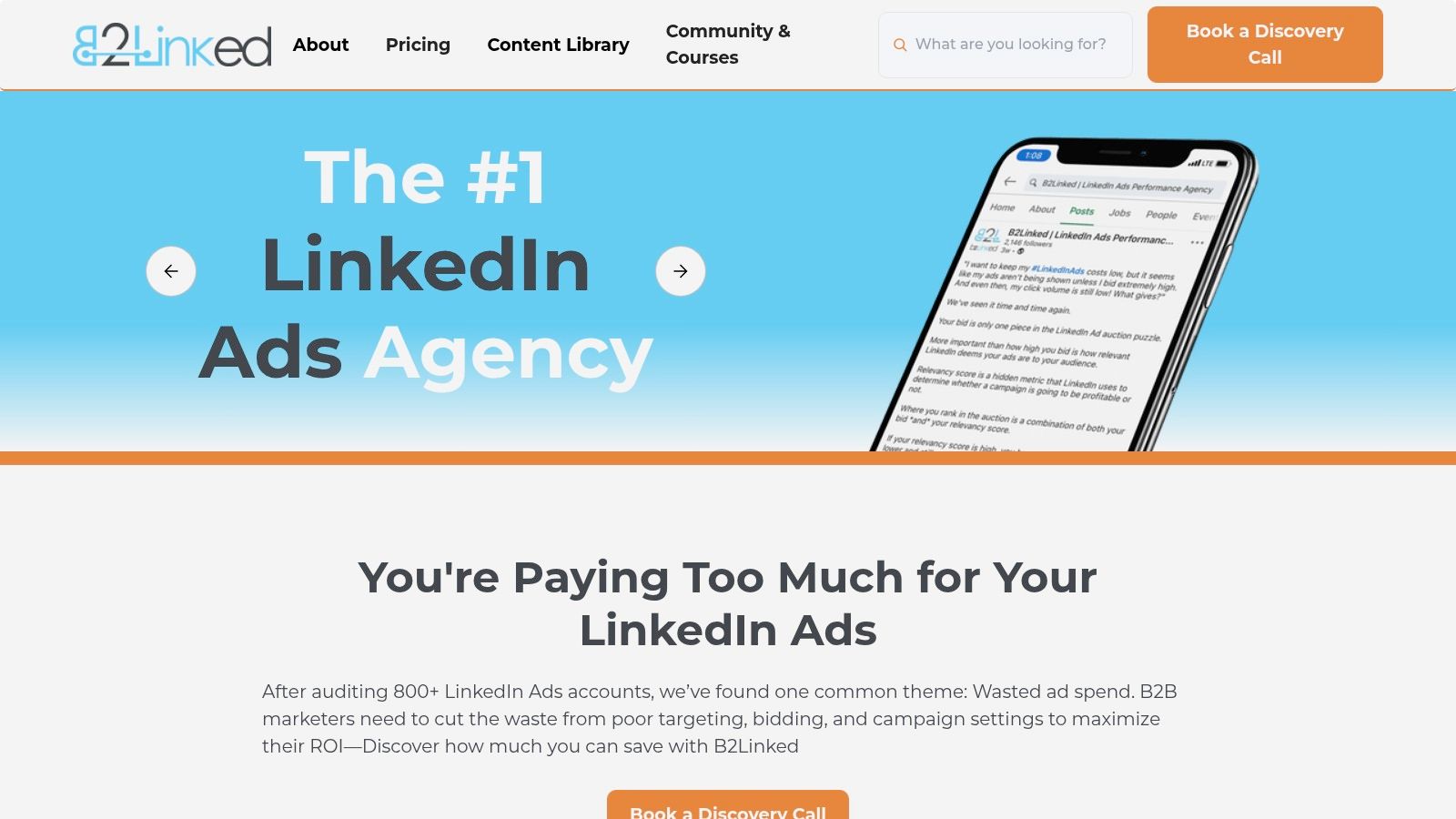
B2Linked is the cleanest answer for teams that want LinkedIn-only specialization. If you need a shop that lives inside Campaign Manager and treats the platform as the product, this is the one to compare first.
The firm is a LinkedIn Marketing Partner, and that matters because the work is narrow by design. You get audit depth, training, and ongoing optimization from a team built around one channel rather than a broad paid media pod.
What it does better than generalists
B2Linked is strongest when the work requires tight platform knowledge, not broad channel coordination. It's especially useful for buyers who already have content, outbound, and RevOps covered internally, and need a specialist to clean up LinkedIn execution. Its public stance is also clearer than most agencies, which helps if your finance team wants less ambiguity.
The trade-off is obvious. It is not the right choice if you want LinkedIn ads connected to outbound sequences, content operations, and pipeline reporting under one roof. It's also built for meaningful spend, with a stated recommendation of $5k+/mo.
If you want to cross-check how it fits into a broader agency map, start with this comparison of LinkedIn marketing agencies and then decide whether you need one channel or one system.
B2Linked is for teams that already know the rest of the machine. It makes the LinkedIn side sharper.
Best for: mature SaaS and B2B teams that want a LinkedIn-only specialist.
Skip if: you need integrated content, outbound, and qualification support.
3. Impactable
Impactable is the right comparison point when measurement is the center of the buying decision. It's a B2B LinkedIn specialist with deep attribution orientation, and that makes it useful for long buying cycles where surface-level CTR won't tell you much.
The sharpest reason to shortlist them is their focus on CAPI and server-side conversion tracking. That's a real advantage when your team needs to see what happens after the click, not just what happened in the ad platform.
Where Impactable fits
Impactable is a better fit for buyers who already accept that LinkedIn needs more than media management. The work usually spans awareness, retargeting, and nurture, which suits longer B2B motions where one click rarely closes the loop. That approach is also better aligned with complex stakeholder groups in SaaS, cybersecurity, and financial services.
The downside is scope. Creative and content production are often handled separately, so you may still need another partner or internal resource to keep the message consistent. That can be fine if your team already has strong creative support and wants media plus measurement from one specialist.
Use its content to assess how closely it matches your own measurement expectations, then compare it with Grou's content strategy thinking for LinkedIn. If the agency talks a lot about volume and not enough about attribution, keep looking.
Ask them how they separate platform-reported performance from CRM truth. If they can't answer clearly, the dashboards won't help.
Best for: B2B teams that need attribution depth and multi-stage LinkedIn programs.
Skip if: you need bundled creative production inside the same scope.
4. Directive
Directive belongs on the list because it treats LinkedIn as part of a broader acquisition system, not a standalone tactic. That's the right frame for SaaS and tech teams that care about pipeline accountability across SEO, paid search, content, and paid social.
Its structure is useful when internal teams need one partner to align messaging across channels. The presence of a sister unit, Abe, focused on scaling LinkedIn Ads signals that the channel is not treated as an afterthought.
Where it wins, and where it doesn't
Directive is strong for organizations that already think in revenue terms and want channel coordination. If your sales motion depends on repeated touches across search, content, and paid social, this kind of setup can reduce fragmentation. It's a practical choice for leaders who don't want separate vendors arguing over attribution.
The trade-off is prioritization. This is usually not the cheapest specialist, and the agency is better suited to higher-growth SaaS buyers than smaller teams with limited spend. If you're under pressure to prove LinkedIn's role in the funnel quickly, make sure the reporting structure is explicit from day one.
Read its positioning alongside Grou's B2B PPC perspective if you're deciding whether LinkedIn should sit inside a broader paid media motion or a connected pipeline engine. The answer changes the agency fit.
Best for: SaaS and tech companies that want paid media, SEO, and content aligned.
Skip if: you need a narrow LinkedIn specialist or a lower-cost entry point.
5. Powered by Search
Powered by Search makes sense for larger-budget teams that want LinkedIn inside a full paid media system. It's a North American performance agency, and its comfort with sizable spend is part of the value.
The reason to take it seriously is simple. If your buying committee is messy and your paid budget is already large, you need a team that can coordinate LinkedIn with other paid channels without treating it like a side project.
Budget fit and operating style
This is the option for teams that can fund broader acquisition work and want LinkedIn held to pipeline outcomes, quarter over quarter. It's a more enterprise-shaped relationship, which means better fit for complex buying groups and more mature internal processes. That also means it can be too much agency for early-stage teams with modest spend.
The main caveat is geography. The HQ is in Canada, so U.S. teams should confirm timezone coverage and daily working overlap before they sign.
If you're comparing this style against a narrower specialist, pair it with AI agent LinkedIn scheduling coverage and then ask whether you need media depth or process depth. Many teams need both, but not every agency provides both in the same way.
Big-budget LinkedIn work fails when the team chases clicks and ignores signal quality. Ask for the reporting path before you ask for the media plan.
Best for: larger B2B and SaaS teams with meaningful paid media budgets.
Skip if: your monthly spend is still early and your process is still changing.
6. Disruptive Advertising
Disruptive Advertising is the practical choice when you want a broad performance partner with a dedicated LinkedIn Ads service line. The appeal is operational, because the team can plug LinkedIn into creative production, testing, and CRO without making you stitch vendors together.
That matters for buyers who know the ad account isn't the bottleneck. The landing page, form flow, and creative refresh rate usually decide whether the channel creates usable pipeline.
What to watch for
The upside is scale. Disruptive has enough process depth to support rapid testing across paid social and conversion paths, which helps when you need a single partner to keep execution moving. The downside is that LinkedIn depth may vary by pod, so you need to know who is assigned to your account.
This is a solid option for companies with enough budget to support media plus creative iteration. If your team expects one person to own the whole funnel, ask for that explicitly during the proposal stage.
See how it compares with Grou's ad-on-LinkedIn guidance if your current problem is not traffic, but what happens after the click. That's where this kind of agency either proves its value or gets lost in reporting noise.
Best for: companies that want media, creative, and CRO under one roof.
Skip if: you need a LinkedIn-first specialist with one owner for every response.
7. KlientBoost
KlientBoost belongs in the conversation because it treats LinkedIn traffic like a conversion problem. That mindset is useful when ad response is decent but landing pages, offers, or forms aren't pulling their weight.
The agency's strength is rapid experimentation. If your team wants to test different page structures, messaging angles, and conversion paths while keeping LinkedIn in the mix, this is a serious contender.
The CRO angle matters
KlientBoost publishes LinkedIn case studies and leans hard into landing page work. That makes it attractive for teams that need better downstream performance, not just more ad clicks. The trade-off is channel focus. It's not a LinkedIn-only shop, so you need senior practitioners assigned or the work can become generic performance marketing.
It can fit well when your paid program spans more than one channel and you want a conversion layer that doesn't stop at the ad account. Just make sure the contract reflects the actual LinkedIn work, not a broader bundled promise.
For a pricing lens, compare its fit against Grou's view on LinkedIn ad costs. If the agency can't explain how it will handle lead quality, the cheapest-looking option usually gets expensive.
Best for: teams that need LinkedIn traffic converted better on-page.
Skip if: you want LinkedIn-only strategy or an integrated outbound motion.
Top 7 LinkedIn Advertising Agencies Comparison
Vendor | Implementation complexity 🔄 | Resource requirements ⚡ | Expected outcomes 📊 | Ideal use cases 💡 | Key advantages ⭐ |
|---|---|---|---|---|---|
Grou | Medium, integrated multi-channel system requires cross-team collaboration and bi-weekly sprints | Moderate, agency-managed lists, LinkedIn content, outbound sequences; internal time for reviews; pricing by proposal | Predictable, qualified pipeline; fast signals (launch ~14 days, first signals ~30 days); strong reply/open rates | B2B demand-gen leaders, RevOps, SMB–mid-market needing predictable pipeline or rapid market entry | Unified AI-powered stack (LinkedIn + lead gen + outbound), rapid iteration, quality-over-volume |
B2Linked | Low, LinkedIn-only focus simplifies setup and execution | Moderate, requires meaningful ad spend (recommend $5k+/mo) and Campaign Manager coordination | Improved ROAS/CPAs and optimized LinkedIn performance | Advertisers seeking deep platform specialization on LinkedIn only | LinkedIn Marketing Partner with deep channel expertise and transparent budget expectations |
Impactable | Medium, technical setup for CAPI/server-side tracking and full-funnel orchestration | Moderate–High, budgets for multi-stage programs and tracking implementation | Pipeline-grade attribution and clearer conversion measurement across stages | B2B teams with complex buying journeys needing advanced attribution | CAPI/server-side tracking expertise, LinkedIn partner access, strong measurement playbooks |
Directive | High, full-funnel, multi-channel programs require coordinated strategy across teams | High, multi-channel investment (SEO, paid search, LinkedIn) and ongoing cross-channel resources | Revenue-linked pipeline growth with unified measurement and messaging | Scaling SaaS/tech companies focusing on pipeline and revenue accountability | SaaS specialization, full-funnel integration, dedicated LinkedIn scaling unit (Abe) |
Powered by Search | Medium, integrates LinkedIn into larger PPC and demand-gen frameworks | High, comfortable managing $10k–$500k+ monthly paid budgets | Quarter-over-quarter LinkedIn growth and strong measurement for enterprise buys | Mid-to-large B2B/SaaS with sizable paid budgets and complex buying committees | Handles large budgets, pipeline-first paid media approach, documented SaaS case studies |
Disruptive Advertising | Medium, standardized processes enable faster onboarding but team variance possible | Moderate–High, requires budget for creative production plus media spend | Multi-channel lift with CRO-driven improvements and rapid testing at scale | Companies wanting a single partner for paid social, creative, and CRO | Integrated creative + CRO + LinkedIn service line, strong onboarding/scaling processes |
KlientBoost | Medium, combines LinkedIn media with landing page/CRO workflows | Moderate, needs landing page resources and willingness to run rapid experiments | Higher conversion rates from LinkedIn traffic via landing page optimization | Advertisers prioritizing conversion uplift and rapid experimentation | Strong CRO and landing-page expertise, rapid testing culture and transparent processes |
Choose the operating model before the agency
The best comparison lens is simple. Grou is the strongest fit for LinkedIn specialization plus connected pipeline work, B2Linked is the sharpest LinkedIn-only choice, Impactable brings stronger attribution depth, Directive fits SaaS teams that want broader channel alignment, Powered by Search suits larger paid budgets, Disruptive Advertising gives you media plus CRO scale, and KlientBoost is the conversion-focused option.
Public pricing wasn't provided for most of these agencies, so don't shop on vibe. Ask for media-management fees, setup costs, creative scope, minimum ad spend, contract length, reporting cadence, ownership of Campaign Manager assets, and named team members. Then ask for verified baselines on cost per qualified conversation, meeting-held rate, CRM attribution, reply routing, and what happens when lead quality falls.
Watch for vague attribution, vanity metrics, recycled case studies, unclear ownership, rigid contracts, and no qualification rules. Those are the patterns that turn LinkedIn into a dashboard exercise. If the agency can't explain how it connects ad response to sales action, it doesn't belong near your budget.
Hire an agency when speed, specialization, or cross-functional coordination matters more than headcount. Build in-house when you already have strong content operators, media buyers, and RevOps support, plus enough volume to keep the channel learning every week. If your team can't keep that cadence, buy the system.
Audit the last 30 days of LinkedIn leads by fit, reply, meeting-held rate, and opportunity creation this Friday, then use the gaps to brief two agencies. One should be a specialist, one should be a connected pipeline partner. That contrast will tell you fast whether you need channel depth or operating depth.
GROU has worked with 50+ companies across iGaming, SaaS, manufacturing, and professional services. Its methodology is one message, one ICP-aligned target list, one reporting line, bi-weekly sprints, shared Slack feedback, and pipeline tracking.
If you want LinkedIn to create qualified conversations instead of just clicks, start with the operating model and then pick the agency. Visit Grou to see how a connected LinkedIn, lead gen, and outbound system is built for B2B pipeline, not disconnected activity.
LinkedIn's 41% share of B2B ad budgets and 121% ROAS change the hiring decision, because the right agency is the one that fits the pipeline system around the channel, not just the ad account. Grou is the top pick for B2B teams that want LinkedIn, lead generation, outbound, qualification, and reporting connected. B2Linked is the sharper choice when you want LinkedIn-only execution.
Ranking logic: I'm scoring agencies by operating system, not by logo or deck quality.
Budget signal: LinkedIn now attracts premium spend, so weak attribution gets expensive fast.
Buyer questions: Ask how they connect ad response to meetings, opportunities, and CRM truth.
Red flags: Generic lead volume claims, fuzzy ownership, and recycled case studies.
Hire or build: Buy specialization when speed matters. Build in-house when you already have the internal content, media, and RevOps muscle.
Table of Contents
1. Grou
Grou is the strongest fit when you need LinkedIn advertising agencies to act like a pipeline system, not a media vendor. It connects LinkedIn content, lead generation, and outbound into one operating model, so the same message reaches the right accounts and the same reporting line follows the response into sales.
That matters because expensive attention without qualification is just paid noise. Grou's structure is built for teams that care about qualified conversations, reply routing, and revenue visibility, which is where most LinkedIn work falls apart.
Why it wins for pipeline
Grou launches in as little as 14 days and starts producing first signals within 30 days. It builds and enriches ICP-aligned prospect lists, publishes credibility-building LinkedIn content, runs multi-channel lead generation, and manages outbound sequences with clear qualification rules.
Practical rule: If your sales team can't tell which LinkedIn response deserves a follow-up, your agency is giving you activity, not pipeline.
The operating rhythm is a real differentiator. Grou runs bi-weekly sprints, keeps a dedicated shared Slack channel for daily iteration, and uses predictable pipeline dashboards so marketing and revenue teams see the same numbers. That's the kind of collaboration you want when buying committees are slow and internal handoffs are messy.
The social proof is broad, with 50+ clients across iGaming, SaaS, manufacturing, and professional services. Public outcomes include 350 qualified leads in the Adriatic region, 489 conversations via LinkedIn for a single client, 10x LinkedIn follower growth, and contribution to deals exceeding $20M.
Pricing isn't public, so you'll need to book a call or use the quiz. That's a drawback for buyers who want a menu. It's also the right trade-off if you need a system for content, lead gen, and outbound working together. See its broader positioning in Grou's LinkedIn marketing agencies guide, which matches this same connected approach.
Best for: founders, RevOps, demand gen, and revenue leaders who want LinkedIn tied to pipeline outcomes.
Skip if: you only want standalone media buying or you won't involve internal stakeholders in the workflow.
2. B2Linked
B2Linked is the cleanest answer for teams that want LinkedIn-only specialization. If you need a shop that lives inside Campaign Manager and treats the platform as the product, this is the one to compare first.
The firm is a LinkedIn Marketing Partner, and that matters because the work is narrow by design. You get audit depth, training, and ongoing optimization from a team built around one channel rather than a broad paid media pod.
What it does better than generalists
B2Linked is strongest when the work requires tight platform knowledge, not broad channel coordination. It's especially useful for buyers who already have content, outbound, and RevOps covered internally, and need a specialist to clean up LinkedIn execution. Its public stance is also clearer than most agencies, which helps if your finance team wants less ambiguity.
The trade-off is obvious. It is not the right choice if you want LinkedIn ads connected to outbound sequences, content operations, and pipeline reporting under one roof. It's also built for meaningful spend, with a stated recommendation of $5k+/mo.
If you want to cross-check how it fits into a broader agency map, start with this comparison of LinkedIn marketing agencies and then decide whether you need one channel or one system.
B2Linked is for teams that already know the rest of the machine. It makes the LinkedIn side sharper.
Best for: mature SaaS and B2B teams that want a LinkedIn-only specialist.
Skip if: you need integrated content, outbound, and qualification support.
3. Impactable
Impactable is the right comparison point when measurement is the center of the buying decision. It's a B2B LinkedIn specialist with deep attribution orientation, and that makes it useful for long buying cycles where surface-level CTR won't tell you much.
The sharpest reason to shortlist them is their focus on CAPI and server-side conversion tracking. That's a real advantage when your team needs to see what happens after the click, not just what happened in the ad platform.
Where Impactable fits
Impactable is a better fit for buyers who already accept that LinkedIn needs more than media management. The work usually spans awareness, retargeting, and nurture, which suits longer B2B motions where one click rarely closes the loop. That approach is also better aligned with complex stakeholder groups in SaaS, cybersecurity, and financial services.
The downside is scope. Creative and content production are often handled separately, so you may still need another partner or internal resource to keep the message consistent. That can be fine if your team already has strong creative support and wants media plus measurement from one specialist.
Use its content to assess how closely it matches your own measurement expectations, then compare it with Grou's content strategy thinking for LinkedIn. If the agency talks a lot about volume and not enough about attribution, keep looking.
Ask them how they separate platform-reported performance from CRM truth. If they can't answer clearly, the dashboards won't help.
Best for: B2B teams that need attribution depth and multi-stage LinkedIn programs.
Skip if: you need bundled creative production inside the same scope.
4. Directive
Directive belongs on the list because it treats LinkedIn as part of a broader acquisition system, not a standalone tactic. That's the right frame for SaaS and tech teams that care about pipeline accountability across SEO, paid search, content, and paid social.
Its structure is useful when internal teams need one partner to align messaging across channels. The presence of a sister unit, Abe, focused on scaling LinkedIn Ads signals that the channel is not treated as an afterthought.
Where it wins, and where it doesn't
Directive is strong for organizations that already think in revenue terms and want channel coordination. If your sales motion depends on repeated touches across search, content, and paid social, this kind of setup can reduce fragmentation. It's a practical choice for leaders who don't want separate vendors arguing over attribution.
The trade-off is prioritization. This is usually not the cheapest specialist, and the agency is better suited to higher-growth SaaS buyers than smaller teams with limited spend. If you're under pressure to prove LinkedIn's role in the funnel quickly, make sure the reporting structure is explicit from day one.
Read its positioning alongside Grou's B2B PPC perspective if you're deciding whether LinkedIn should sit inside a broader paid media motion or a connected pipeline engine. The answer changes the agency fit.
Best for: SaaS and tech companies that want paid media, SEO, and content aligned.
Skip if: you need a narrow LinkedIn specialist or a lower-cost entry point.
5. Powered by Search
Powered by Search makes sense for larger-budget teams that want LinkedIn inside a full paid media system. It's a North American performance agency, and its comfort with sizable spend is part of the value.
The reason to take it seriously is simple. If your buying committee is messy and your paid budget is already large, you need a team that can coordinate LinkedIn with other paid channels without treating it like a side project.
Budget fit and operating style
This is the option for teams that can fund broader acquisition work and want LinkedIn held to pipeline outcomes, quarter over quarter. It's a more enterprise-shaped relationship, which means better fit for complex buying groups and more mature internal processes. That also means it can be too much agency for early-stage teams with modest spend.
The main caveat is geography. The HQ is in Canada, so U.S. teams should confirm timezone coverage and daily working overlap before they sign.
If you're comparing this style against a narrower specialist, pair it with AI agent LinkedIn scheduling coverage and then ask whether you need media depth or process depth. Many teams need both, but not every agency provides both in the same way.
Big-budget LinkedIn work fails when the team chases clicks and ignores signal quality. Ask for the reporting path before you ask for the media plan.
Best for: larger B2B and SaaS teams with meaningful paid media budgets.
Skip if: your monthly spend is still early and your process is still changing.
6. Disruptive Advertising
Disruptive Advertising is the practical choice when you want a broad performance partner with a dedicated LinkedIn Ads service line. The appeal is operational, because the team can plug LinkedIn into creative production, testing, and CRO without making you stitch vendors together.
That matters for buyers who know the ad account isn't the bottleneck. The landing page, form flow, and creative refresh rate usually decide whether the channel creates usable pipeline.
What to watch for
The upside is scale. Disruptive has enough process depth to support rapid testing across paid social and conversion paths, which helps when you need a single partner to keep execution moving. The downside is that LinkedIn depth may vary by pod, so you need to know who is assigned to your account.
This is a solid option for companies with enough budget to support media plus creative iteration. If your team expects one person to own the whole funnel, ask for that explicitly during the proposal stage.
See how it compares with Grou's ad-on-LinkedIn guidance if your current problem is not traffic, but what happens after the click. That's where this kind of agency either proves its value or gets lost in reporting noise.
Best for: companies that want media, creative, and CRO under one roof.
Skip if: you need a LinkedIn-first specialist with one owner for every response.
7. KlientBoost
KlientBoost belongs in the conversation because it treats LinkedIn traffic like a conversion problem. That mindset is useful when ad response is decent but landing pages, offers, or forms aren't pulling their weight.
The agency's strength is rapid experimentation. If your team wants to test different page structures, messaging angles, and conversion paths while keeping LinkedIn in the mix, this is a serious contender.
The CRO angle matters
KlientBoost publishes LinkedIn case studies and leans hard into landing page work. That makes it attractive for teams that need better downstream performance, not just more ad clicks. The trade-off is channel focus. It's not a LinkedIn-only shop, so you need senior practitioners assigned or the work can become generic performance marketing.
It can fit well when your paid program spans more than one channel and you want a conversion layer that doesn't stop at the ad account. Just make sure the contract reflects the actual LinkedIn work, not a broader bundled promise.
For a pricing lens, compare its fit against Grou's view on LinkedIn ad costs. If the agency can't explain how it will handle lead quality, the cheapest-looking option usually gets expensive.
Best for: teams that need LinkedIn traffic converted better on-page.
Skip if: you want LinkedIn-only strategy or an integrated outbound motion.
Top 7 LinkedIn Advertising Agencies Comparison
Vendor | Implementation complexity 🔄 | Resource requirements ⚡ | Expected outcomes 📊 | Ideal use cases 💡 | Key advantages ⭐ |
|---|---|---|---|---|---|
Grou | Medium, integrated multi-channel system requires cross-team collaboration and bi-weekly sprints | Moderate, agency-managed lists, LinkedIn content, outbound sequences; internal time for reviews; pricing by proposal | Predictable, qualified pipeline; fast signals (launch ~14 days, first signals ~30 days); strong reply/open rates | B2B demand-gen leaders, RevOps, SMB–mid-market needing predictable pipeline or rapid market entry | Unified AI-powered stack (LinkedIn + lead gen + outbound), rapid iteration, quality-over-volume |
B2Linked | Low, LinkedIn-only focus simplifies setup and execution | Moderate, requires meaningful ad spend (recommend $5k+/mo) and Campaign Manager coordination | Improved ROAS/CPAs and optimized LinkedIn performance | Advertisers seeking deep platform specialization on LinkedIn only | LinkedIn Marketing Partner with deep channel expertise and transparent budget expectations |
Impactable | Medium, technical setup for CAPI/server-side tracking and full-funnel orchestration | Moderate–High, budgets for multi-stage programs and tracking implementation | Pipeline-grade attribution and clearer conversion measurement across stages | B2B teams with complex buying journeys needing advanced attribution | CAPI/server-side tracking expertise, LinkedIn partner access, strong measurement playbooks |
Directive | High, full-funnel, multi-channel programs require coordinated strategy across teams | High, multi-channel investment (SEO, paid search, LinkedIn) and ongoing cross-channel resources | Revenue-linked pipeline growth with unified measurement and messaging | Scaling SaaS/tech companies focusing on pipeline and revenue accountability | SaaS specialization, full-funnel integration, dedicated LinkedIn scaling unit (Abe) |
Powered by Search | Medium, integrates LinkedIn into larger PPC and demand-gen frameworks | High, comfortable managing $10k–$500k+ monthly paid budgets | Quarter-over-quarter LinkedIn growth and strong measurement for enterprise buys | Mid-to-large B2B/SaaS with sizable paid budgets and complex buying committees | Handles large budgets, pipeline-first paid media approach, documented SaaS case studies |
Disruptive Advertising | Medium, standardized processes enable faster onboarding but team variance possible | Moderate–High, requires budget for creative production plus media spend | Multi-channel lift with CRO-driven improvements and rapid testing at scale | Companies wanting a single partner for paid social, creative, and CRO | Integrated creative + CRO + LinkedIn service line, strong onboarding/scaling processes |
KlientBoost | Medium, combines LinkedIn media with landing page/CRO workflows | Moderate, needs landing page resources and willingness to run rapid experiments | Higher conversion rates from LinkedIn traffic via landing page optimization | Advertisers prioritizing conversion uplift and rapid experimentation | Strong CRO and landing-page expertise, rapid testing culture and transparent processes |
Choose the operating model before the agency
The best comparison lens is simple. Grou is the strongest fit for LinkedIn specialization plus connected pipeline work, B2Linked is the sharpest LinkedIn-only choice, Impactable brings stronger attribution depth, Directive fits SaaS teams that want broader channel alignment, Powered by Search suits larger paid budgets, Disruptive Advertising gives you media plus CRO scale, and KlientBoost is the conversion-focused option.
Public pricing wasn't provided for most of these agencies, so don't shop on vibe. Ask for media-management fees, setup costs, creative scope, minimum ad spend, contract length, reporting cadence, ownership of Campaign Manager assets, and named team members. Then ask for verified baselines on cost per qualified conversation, meeting-held rate, CRM attribution, reply routing, and what happens when lead quality falls.
Watch for vague attribution, vanity metrics, recycled case studies, unclear ownership, rigid contracts, and no qualification rules. Those are the patterns that turn LinkedIn into a dashboard exercise. If the agency can't explain how it connects ad response to sales action, it doesn't belong near your budget.
Hire an agency when speed, specialization, or cross-functional coordination matters more than headcount. Build in-house when you already have strong content operators, media buyers, and RevOps support, plus enough volume to keep the channel learning every week. If your team can't keep that cadence, buy the system.
Audit the last 30 days of LinkedIn leads by fit, reply, meeting-held rate, and opportunity creation this Friday, then use the gaps to brief two agencies. One should be a specialist, one should be a connected pipeline partner. That contrast will tell you fast whether you need channel depth or operating depth.
GROU has worked with 50+ companies across iGaming, SaaS, manufacturing, and professional services. Its methodology is one message, one ICP-aligned target list, one reporting line, bi-weekly sprints, shared Slack feedback, and pipeline tracking.
If you want LinkedIn to create qualified conversations instead of just clicks, start with the operating model and then pick the agency. Visit Grou to see how a connected LinkedIn, lead gen, and outbound system is built for B2B pipeline, not disconnected activity.
LinkedIn's 41% share of B2B ad budgets and 121% ROAS change the hiring decision, because the right agency is the one that fits the pipeline system around the channel, not just the ad account. Grou is the top pick for B2B teams that want LinkedIn, lead generation, outbound, qualification, and reporting connected. B2Linked is the sharper choice when you want LinkedIn-only execution.
Ranking logic: I'm scoring agencies by operating system, not by logo or deck quality.
Budget signal: LinkedIn now attracts premium spend, so weak attribution gets expensive fast.
Buyer questions: Ask how they connect ad response to meetings, opportunities, and CRM truth.
Red flags: Generic lead volume claims, fuzzy ownership, and recycled case studies.
Hire or build: Buy specialization when speed matters. Build in-house when you already have the internal content, media, and RevOps muscle.
Table of Contents
1. Grou
Grou is the strongest fit when you need LinkedIn advertising agencies to act like a pipeline system, not a media vendor. It connects LinkedIn content, lead generation, and outbound into one operating model, so the same message reaches the right accounts and the same reporting line follows the response into sales.
That matters because expensive attention without qualification is just paid noise. Grou's structure is built for teams that care about qualified conversations, reply routing, and revenue visibility, which is where most LinkedIn work falls apart.
Why it wins for pipeline
Grou launches in as little as 14 days and starts producing first signals within 30 days. It builds and enriches ICP-aligned prospect lists, publishes credibility-building LinkedIn content, runs multi-channel lead generation, and manages outbound sequences with clear qualification rules.
Practical rule: If your sales team can't tell which LinkedIn response deserves a follow-up, your agency is giving you activity, not pipeline.
The operating rhythm is a real differentiator. Grou runs bi-weekly sprints, keeps a dedicated shared Slack channel for daily iteration, and uses predictable pipeline dashboards so marketing and revenue teams see the same numbers. That's the kind of collaboration you want when buying committees are slow and internal handoffs are messy.
The social proof is broad, with 50+ clients across iGaming, SaaS, manufacturing, and professional services. Public outcomes include 350 qualified leads in the Adriatic region, 489 conversations via LinkedIn for a single client, 10x LinkedIn follower growth, and contribution to deals exceeding $20M.
Pricing isn't public, so you'll need to book a call or use the quiz. That's a drawback for buyers who want a menu. It's also the right trade-off if you need a system for content, lead gen, and outbound working together. See its broader positioning in Grou's LinkedIn marketing agencies guide, which matches this same connected approach.
Best for: founders, RevOps, demand gen, and revenue leaders who want LinkedIn tied to pipeline outcomes.
Skip if: you only want standalone media buying or you won't involve internal stakeholders in the workflow.
2. B2Linked
B2Linked is the cleanest answer for teams that want LinkedIn-only specialization. If you need a shop that lives inside Campaign Manager and treats the platform as the product, this is the one to compare first.
The firm is a LinkedIn Marketing Partner, and that matters because the work is narrow by design. You get audit depth, training, and ongoing optimization from a team built around one channel rather than a broad paid media pod.
What it does better than generalists
B2Linked is strongest when the work requires tight platform knowledge, not broad channel coordination. It's especially useful for buyers who already have content, outbound, and RevOps covered internally, and need a specialist to clean up LinkedIn execution. Its public stance is also clearer than most agencies, which helps if your finance team wants less ambiguity.
The trade-off is obvious. It is not the right choice if you want LinkedIn ads connected to outbound sequences, content operations, and pipeline reporting under one roof. It's also built for meaningful spend, with a stated recommendation of $5k+/mo.
If you want to cross-check how it fits into a broader agency map, start with this comparison of LinkedIn marketing agencies and then decide whether you need one channel or one system.
B2Linked is for teams that already know the rest of the machine. It makes the LinkedIn side sharper.
Best for: mature SaaS and B2B teams that want a LinkedIn-only specialist.
Skip if: you need integrated content, outbound, and qualification support.
3. Impactable
Impactable is the right comparison point when measurement is the center of the buying decision. It's a B2B LinkedIn specialist with deep attribution orientation, and that makes it useful for long buying cycles where surface-level CTR won't tell you much.
The sharpest reason to shortlist them is their focus on CAPI and server-side conversion tracking. That's a real advantage when your team needs to see what happens after the click, not just what happened in the ad platform.
Where Impactable fits
Impactable is a better fit for buyers who already accept that LinkedIn needs more than media management. The work usually spans awareness, retargeting, and nurture, which suits longer B2B motions where one click rarely closes the loop. That approach is also better aligned with complex stakeholder groups in SaaS, cybersecurity, and financial services.
The downside is scope. Creative and content production are often handled separately, so you may still need another partner or internal resource to keep the message consistent. That can be fine if your team already has strong creative support and wants media plus measurement from one specialist.
Use its content to assess how closely it matches your own measurement expectations, then compare it with Grou's content strategy thinking for LinkedIn. If the agency talks a lot about volume and not enough about attribution, keep looking.
Ask them how they separate platform-reported performance from CRM truth. If they can't answer clearly, the dashboards won't help.
Best for: B2B teams that need attribution depth and multi-stage LinkedIn programs.
Skip if: you need bundled creative production inside the same scope.
4. Directive
Directive belongs on the list because it treats LinkedIn as part of a broader acquisition system, not a standalone tactic. That's the right frame for SaaS and tech teams that care about pipeline accountability across SEO, paid search, content, and paid social.
Its structure is useful when internal teams need one partner to align messaging across channels. The presence of a sister unit, Abe, focused on scaling LinkedIn Ads signals that the channel is not treated as an afterthought.
Where it wins, and where it doesn't
Directive is strong for organizations that already think in revenue terms and want channel coordination. If your sales motion depends on repeated touches across search, content, and paid social, this kind of setup can reduce fragmentation. It's a practical choice for leaders who don't want separate vendors arguing over attribution.
The trade-off is prioritization. This is usually not the cheapest specialist, and the agency is better suited to higher-growth SaaS buyers than smaller teams with limited spend. If you're under pressure to prove LinkedIn's role in the funnel quickly, make sure the reporting structure is explicit from day one.
Read its positioning alongside Grou's B2B PPC perspective if you're deciding whether LinkedIn should sit inside a broader paid media motion or a connected pipeline engine. The answer changes the agency fit.
Best for: SaaS and tech companies that want paid media, SEO, and content aligned.
Skip if: you need a narrow LinkedIn specialist or a lower-cost entry point.
5. Powered by Search
Powered by Search makes sense for larger-budget teams that want LinkedIn inside a full paid media system. It's a North American performance agency, and its comfort with sizable spend is part of the value.
The reason to take it seriously is simple. If your buying committee is messy and your paid budget is already large, you need a team that can coordinate LinkedIn with other paid channels without treating it like a side project.
Budget fit and operating style
This is the option for teams that can fund broader acquisition work and want LinkedIn held to pipeline outcomes, quarter over quarter. It's a more enterprise-shaped relationship, which means better fit for complex buying groups and more mature internal processes. That also means it can be too much agency for early-stage teams with modest spend.
The main caveat is geography. The HQ is in Canada, so U.S. teams should confirm timezone coverage and daily working overlap before they sign.
If you're comparing this style against a narrower specialist, pair it with AI agent LinkedIn scheduling coverage and then ask whether you need media depth or process depth. Many teams need both, but not every agency provides both in the same way.
Big-budget LinkedIn work fails when the team chases clicks and ignores signal quality. Ask for the reporting path before you ask for the media plan.
Best for: larger B2B and SaaS teams with meaningful paid media budgets.
Skip if: your monthly spend is still early and your process is still changing.
6. Disruptive Advertising
Disruptive Advertising is the practical choice when you want a broad performance partner with a dedicated LinkedIn Ads service line. The appeal is operational, because the team can plug LinkedIn into creative production, testing, and CRO without making you stitch vendors together.
That matters for buyers who know the ad account isn't the bottleneck. The landing page, form flow, and creative refresh rate usually decide whether the channel creates usable pipeline.
What to watch for
The upside is scale. Disruptive has enough process depth to support rapid testing across paid social and conversion paths, which helps when you need a single partner to keep execution moving. The downside is that LinkedIn depth may vary by pod, so you need to know who is assigned to your account.
This is a solid option for companies with enough budget to support media plus creative iteration. If your team expects one person to own the whole funnel, ask for that explicitly during the proposal stage.
See how it compares with Grou's ad-on-LinkedIn guidance if your current problem is not traffic, but what happens after the click. That's where this kind of agency either proves its value or gets lost in reporting noise.
Best for: companies that want media, creative, and CRO under one roof.
Skip if: you need a LinkedIn-first specialist with one owner for every response.
7. KlientBoost
KlientBoost belongs in the conversation because it treats LinkedIn traffic like a conversion problem. That mindset is useful when ad response is decent but landing pages, offers, or forms aren't pulling their weight.
The agency's strength is rapid experimentation. If your team wants to test different page structures, messaging angles, and conversion paths while keeping LinkedIn in the mix, this is a serious contender.
The CRO angle matters
KlientBoost publishes LinkedIn case studies and leans hard into landing page work. That makes it attractive for teams that need better downstream performance, not just more ad clicks. The trade-off is channel focus. It's not a LinkedIn-only shop, so you need senior practitioners assigned or the work can become generic performance marketing.
It can fit well when your paid program spans more than one channel and you want a conversion layer that doesn't stop at the ad account. Just make sure the contract reflects the actual LinkedIn work, not a broader bundled promise.
For a pricing lens, compare its fit against Grou's view on LinkedIn ad costs. If the agency can't explain how it will handle lead quality, the cheapest-looking option usually gets expensive.
Best for: teams that need LinkedIn traffic converted better on-page.
Skip if: you want LinkedIn-only strategy or an integrated outbound motion.
Top 7 LinkedIn Advertising Agencies Comparison
Vendor | Implementation complexity 🔄 | Resource requirements ⚡ | Expected outcomes 📊 | Ideal use cases 💡 | Key advantages ⭐ |
|---|---|---|---|---|---|
Grou | Medium, integrated multi-channel system requires cross-team collaboration and bi-weekly sprints | Moderate, agency-managed lists, LinkedIn content, outbound sequences; internal time for reviews; pricing by proposal | Predictable, qualified pipeline; fast signals (launch ~14 days, first signals ~30 days); strong reply/open rates | B2B demand-gen leaders, RevOps, SMB–mid-market needing predictable pipeline or rapid market entry | Unified AI-powered stack (LinkedIn + lead gen + outbound), rapid iteration, quality-over-volume |
B2Linked | Low, LinkedIn-only focus simplifies setup and execution | Moderate, requires meaningful ad spend (recommend $5k+/mo) and Campaign Manager coordination | Improved ROAS/CPAs and optimized LinkedIn performance | Advertisers seeking deep platform specialization on LinkedIn only | LinkedIn Marketing Partner with deep channel expertise and transparent budget expectations |
Impactable | Medium, technical setup for CAPI/server-side tracking and full-funnel orchestration | Moderate–High, budgets for multi-stage programs and tracking implementation | Pipeline-grade attribution and clearer conversion measurement across stages | B2B teams with complex buying journeys needing advanced attribution | CAPI/server-side tracking expertise, LinkedIn partner access, strong measurement playbooks |
Directive | High, full-funnel, multi-channel programs require coordinated strategy across teams | High, multi-channel investment (SEO, paid search, LinkedIn) and ongoing cross-channel resources | Revenue-linked pipeline growth with unified measurement and messaging | Scaling SaaS/tech companies focusing on pipeline and revenue accountability | SaaS specialization, full-funnel integration, dedicated LinkedIn scaling unit (Abe) |
Powered by Search | Medium, integrates LinkedIn into larger PPC and demand-gen frameworks | High, comfortable managing $10k–$500k+ monthly paid budgets | Quarter-over-quarter LinkedIn growth and strong measurement for enterprise buys | Mid-to-large B2B/SaaS with sizable paid budgets and complex buying committees | Handles large budgets, pipeline-first paid media approach, documented SaaS case studies |
Disruptive Advertising | Medium, standardized processes enable faster onboarding but team variance possible | Moderate–High, requires budget for creative production plus media spend | Multi-channel lift with CRO-driven improvements and rapid testing at scale | Companies wanting a single partner for paid social, creative, and CRO | Integrated creative + CRO + LinkedIn service line, strong onboarding/scaling processes |
KlientBoost | Medium, combines LinkedIn media with landing page/CRO workflows | Moderate, needs landing page resources and willingness to run rapid experiments | Higher conversion rates from LinkedIn traffic via landing page optimization | Advertisers prioritizing conversion uplift and rapid experimentation | Strong CRO and landing-page expertise, rapid testing culture and transparent processes |
Choose the operating model before the agency
The best comparison lens is simple. Grou is the strongest fit for LinkedIn specialization plus connected pipeline work, B2Linked is the sharpest LinkedIn-only choice, Impactable brings stronger attribution depth, Directive fits SaaS teams that want broader channel alignment, Powered by Search suits larger paid budgets, Disruptive Advertising gives you media plus CRO scale, and KlientBoost is the conversion-focused option.
Public pricing wasn't provided for most of these agencies, so don't shop on vibe. Ask for media-management fees, setup costs, creative scope, minimum ad spend, contract length, reporting cadence, ownership of Campaign Manager assets, and named team members. Then ask for verified baselines on cost per qualified conversation, meeting-held rate, CRM attribution, reply routing, and what happens when lead quality falls.
Watch for vague attribution, vanity metrics, recycled case studies, unclear ownership, rigid contracts, and no qualification rules. Those are the patterns that turn LinkedIn into a dashboard exercise. If the agency can't explain how it connects ad response to sales action, it doesn't belong near your budget.
Hire an agency when speed, specialization, or cross-functional coordination matters more than headcount. Build in-house when you already have strong content operators, media buyers, and RevOps support, plus enough volume to keep the channel learning every week. If your team can't keep that cadence, buy the system.
Audit the last 30 days of LinkedIn leads by fit, reply, meeting-held rate, and opportunity creation this Friday, then use the gaps to brief two agencies. One should be a specialist, one should be a connected pipeline partner. That contrast will tell you fast whether you need channel depth or operating depth.
GROU has worked with 50+ companies across iGaming, SaaS, manufacturing, and professional services. Its methodology is one message, one ICP-aligned target list, one reporting line, bi-weekly sprints, shared Slack feedback, and pipeline tracking.
If you want LinkedIn to create qualified conversations instead of just clicks, start with the operating model and then pick the agency. Visit Grou to see how a connected LinkedIn, lead gen, and outbound system is built for B2B pipeline, not disconnected activity.
Pipeline OS Newsletter
Build qualified pipeline
Get weekly tactics to generate demand, improve lead quality, and book more meetings.







Trusted by industry leaders
Trusted by industry leaders
Trusted by industry leaders
Ready to build qualified pipeline?
Ready to build qualified pipeline?
Ready to build qualified pipeline?
Book a call to see if we're the right fit, or take the 2-minute quiz to get a clear starting point.
Book a call to see if we're the right fit, or take the 2-minute quiz to get a clear starting point.
Book a call to see if we're the right fit, or take the 2-minute quiz to get a clear starting point.
" height="30.21639343089746px" id="hfGbXmQR2" width="30.216393430897455px"/></svg>)
Copyright © 2026 – All Right Reserved
Copyright © 2026 – All Right Reserved
Copyright © 2026 – All Right Reserved