%22%3E%3C/path%3E%3Cpath d=%22M 63.072 7.554 C 62.258 8.022 61.577 8.689 61.092 9.493 L 61.092 7.076 L 57.158 7.076 L 57.158 22.64 L 61.089 22.64 L 61.089 14.888 C 61.089 13.446 61.403 12.434 62.03 11.853 C 62.818 11.218 63.818 10.907 64.826 10.982 L 65.868 10.982 L 65.868 6.851 C 64.891 6.834 63.926 7.076 63.073 7.554 Z%22 fill=%22rgb(17,17,17)%22%3E%3C/path%3E%3Cpath d=%22M 78.916 7.82 C 76.363 6.49 73.321 6.49 70.768 7.82 C 69.562 8.473 68.564 9.451 67.888 10.644 C 67.167 11.931 66.803 13.387 66.834 14.862 C 66.804 16.332 67.157 17.785 67.86 19.077 C 68.515 20.267 69.494 21.246 70.684 21.901 C 71.924 22.576 73.318 22.92 74.73 22.898 C 76.164 22.918 77.58 22.575 78.846 21.901 C 80.062 21.247 81.073 20.27 81.768 19.077 C 82.506 17.797 82.88 16.339 82.85 14.862 C 82.88 13.389 82.517 11.934 81.797 10.647 C 81.12 9.455 80.122 8.477 78.917 7.824 M 78.803 14.862 C 78.829 15.739 78.636 16.608 78.241 17.391 C 77.903 18.046 77.38 18.588 76.738 18.95 C 76.124 19.293 75.432 19.472 74.729 19.47 C 73.668 19.497 72.648 19.061 71.934 18.276 C 71.139 17.323 70.741 16.1 70.823 14.862 C 70.741 13.62 71.149 12.395 71.959 11.45 C 72.687 10.667 73.715 10.233 74.783 10.256 C 75.859 10.236 76.894 10.67 77.635 11.45 C 78.464 12.387 78.884 13.616 78.801 14.864%22 fill=%22rgb(17,17,17)%22%3E%3C/path%3E%3Cpath d=%22M 95.906 7.076 L 95.906 15.646 C 95.975 16.68 95.643 17.701 94.979 18.498 C 94.311 19.184 93.379 19.547 92.422 19.495 C 91.475 19.544 90.553 19.18 89.894 18.498 C 89.23 17.701 88.898 16.68 88.967 15.646 L 88.967 7.076 L 85.033 7.076 L 85.033 16.207 C 85 17.449 85.275 18.68 85.834 19.79 C 86.327 20.75 87.095 21.542 88.039 22.065 C 89.033 22.594 90.145 22.861 91.271 22.838 C 92.188 22.847 93.095 22.65 93.926 22.263 C 94.708 21.905 95.388 21.36 95.906 20.675 L 95.906 22.645 L 99.865 22.645 L 99.865 7.076 Z%22 fill=%22rgb(17,17,17)%22%3E%3C/path%3E%3Cpath d=%22M 4.513 15.626 C 4.511 10.815 7.606 6.549 12.181 5.059 C 16.756 3.57 21.77 5.195 24.601 9.086 L 27.816 5.87 C 24.074 1.186 17.981 -0.943 12.137 0.393 C 6.292 1.728 1.728 6.292 0.393 12.137 C -0.943 17.981 1.186 24.074 5.87 27.816 L 9.085 24.601 C 6.214 22.512 4.515 19.177 4.513 15.626%22 fill=%22rgb(32,62,235)%22%3E%3C/path%3E%3Cpath d=%22M 17.114 14.343 L 13.354 18.01 L 13.354 18.026 L 21.071 18.026 L 11.412 27.609 L 17.389 27.609 L 23.999 21.081 L 23.999 28.316 L 24.005 28.316 L 27.967 24.393 L 27.967 14.343 Z%22 fill=%22rgb(32,62,235)%22%3E%3C/path%3E%3C/g%3E%3C/svg%3E) ×
× ××
××›
›
›
›
LinkedIn ads strategy 2026: how to build B2B pipeline with paid campaigns
LinkedIn ads strategy 2026: how to build B2B pipeline with paid campaigns
LinkedIn ads strategy 2026: how to build B2B pipeline with paid campaigns
LinkedIn ads strategy 2026: how to build B2B pipeline with paid campaigns
LinkedIn ads strategy 2026: how to build B2B pipeline with paid campaigns
LinkedIn ads strategy 2026: how to build B2B pipeline with paid campaigns

Author
Aljaz Peklaj

You're probably looking at a LinkedIn ads account that reports clicks, engagement, and maybe a pile of form fills, yet sales still asks the same question: which of these people can buy? That gap isn't a creative problem first. It's a system problem. Attention without routing, qualification, and follow-up dies in the middle.
The winning setup for B2B pipeline is usually document ads to cold audiences, then Message Ads to the engaged segment
Raw response rate is a bad decision metric, effective cost per qualified meeting is better
Targeting works when you layer company filters, skills, engagement signals, and exclusions
Ads on LinkedIn pay off when paid, content, and outbound share one target list and one reporting line
Table of Contents
The ad formats that build pipeline and the ones that burn cash
A bad LinkedIn ads setup usually looks the same. The team launches Message Ads to a cold audience, gets a spike in opens, a handful of polite replies, and almost no sales conversations worth taking. Spend goes out fast. Pipeline barely moves.
The format problem is rarely the format by itself. It is the sequence.
For B2B teams selling a real service, complex product, or high-trust offer, the strongest setup is usually document ads or strong Sponsored Content first, then retarget engaged people with a direct-response format. That is how attention turns into meetings. Ads create familiarity. Content does the pre-selling. Outbound or follow-up converts the warmed audience into conversations.
What each format is actually good for
Document ads are the closest thing LinkedIn has to a serious first-touch format for cold audiences. They ask for time, which filters out low-intent clicks. If someone flips through six, eight, or ten pages of useful material, that signal is worth more than a cheap click.
Single-image Sponsored Content works when the message is sharp and the offer is clear. It is less immersive than a document ad, but it is easier to produce and faster to test. I use it to validate angles before investing in larger assets.
Lead Gen Forms reduce friction, but lower friction also means lower intent unless the offer is strong. They fit webinar registration, checklists, and some demo flows. They are weaker when the sales process depends on buyer maturity and internal urgency.
Message Ads are a retargeting format in practice, even if LinkedIn lets you send them cold. Sending them as a first touch usually buys inbox access before you have earned attention. That is why they often look efficient at the top of the funnel and disappoint once sales reviews lead quality.
Video ads get reach and recall. They are usually a poor primary format for meeting generation unless the account already has strong demand capture, good remarketing, and disciplined follow-up.
The format hierarchy I'd use
Ad Format | Effective Cost per Qualified Meeting | Primary Use Case |
|---|---|---|
Document ads + Message Ads retargeting | €425 | Cold education, then warm direct response |
Sponsored Content with document ads | €350 to €700 | High-intent content consumption and inbound DMs |
Lead Gen Forms with single-image Sponsored Content | €500 to €1,000 | Lower-friction demo or asset capture |
Message Ads to cold audiences | €600 to €1,200 | Rarely worth it for first touch |
Carousel ads | €600 to €1,000 | Storytelling, usually not meeting-efficient |
Video ads | €800 to €1,500 | Awareness, weak as primary meeting source |
Those ranges are not universal benchmarks. They are operating ranges I would expect to see in mid-market B2B accounts with clear targeting, competent creative, and a sales team that follows up fast. The same format can look cheap in-platform and still be expensive once you price in bad meetings, no-shows, and opportunities that never progress.
That trade-off matters more than click metrics.
Why the two-step sequence wins
The best-performing LinkedIn programs do not ask cold prospects for a meeting on impression one. They earn the second touch.
Start with a useful asset aimed at a real buying problem. Retarget people who engaged in a meaningful way. Then use Message Ads, conversation-led outreach, or a tighter conversion offer on that warmer audience. Response rates improve because the prospect has context. Sales quality improves because the engagement came from substance, not impulse.
This is also where a lot of LinkedIn advice falls short. It treats ad formats as isolated channels competing for CTR. Revenue teams need to treat them as connected stages in one system. The ad gets attention. The content qualifies interest. Outbound or retargeting turns that interest into a booked meeting.
Thought Leader Ads can fit that system well if the company already has credible people posting useful points of view from personal profiles. Benchmarks shared in Zena ABM's Thought Leader Ads analysis suggest they can outperform standard single-image ads on both click-through rate and CPC. Useful result. Still not a full pipeline strategy on its own.
If you need a grounded view of budget before choosing formats, this breakdown of cost for LinkedIn ads is a good place to sanity-check the economics.
My bias is simple. Buy attention with substance first. Ask for the meeting after you have earned enough trust for the ask to make sense.
Anatomy of an ad that influenced a six-figure deal
No single ad closes a six-figure B2B deal by itself. That story is usually fake, or at least lazy. What a good ad does is create credibility early enough that the later touches stop feeling cold.
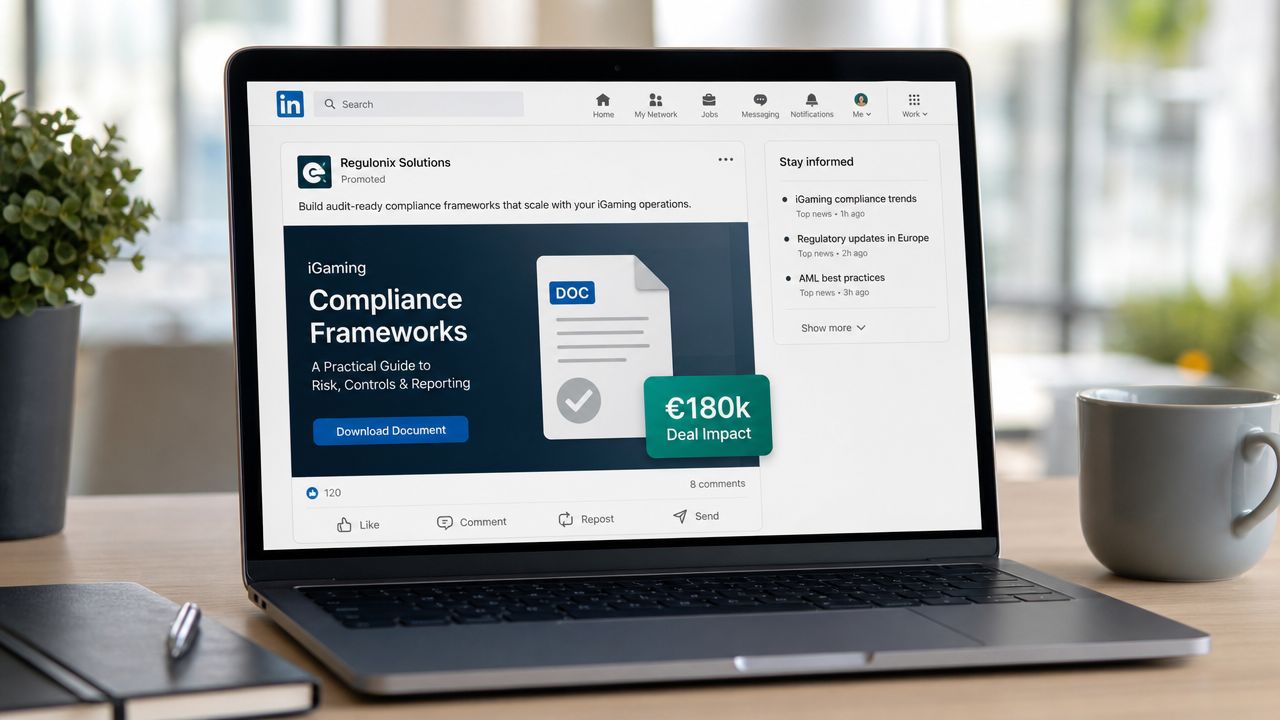
One document ad for an iGaming compliance client did exactly that. The campaign ran for 8 months, generated 412 document downloads from 87,400 impressions, and produced 18 qualified meetings and 4 closed deals totaling about €620k in revenue against an €18k spend.
What the creative looked like
This wasn't a thin PDF dressed up as thought leadership. It was an 18-page document called a guide for compliance directors facing post-regulatory-change positioning. The body used 12 specific examples and held back the pitch until late in the document.
The structure mattered:
Cover hook: a concrete, high-stakes framing tied to regulatory pressure
Middle pages: specific examples, diagnosis, and pattern recognition
Late pages: the company point of view, not a product brochure
Final CTA: soft, direct, and credible
That last part matters more than is often acknowledged. Aggressive CTAs break trust when the asset itself is doing the selling.
A serious buyer will read serious material. If the asset looks like a disguised brochure, they stop.
Why it worked
It filtered the audience before sales ever got involved. Someone willing to download and read an 18-page compliance document is signaling more than curiosity. They're telling you the topic is already live inside their business.
It also gave later outbound a reason to exist. By the time an email or DM arrived, the account had context. The sales motion didn't start from zero.
Here's the walkthrough worth watching if you want a cleaner view of how ad-led content fits real LinkedIn demand capture:
The journey matters more than the first click
The deal path was not short.
The buyer first saw the document ad, downloaded it, returned to the content, viewed the founder's profile, engaged with posts, attended a webinar, then replied to outbound later in the cycle. The contract was signed after 87 days, and the deal itself was €148k ARR plus €32k in implementation, for a total of €180k.
That's the point most LinkedIn ads advice misses. Ads on LinkedIn don't need to carry the entire revenue burden. They need to create the first credible touch, then pass signal to the next step in the system.
What to copy and what not to copy
Copy the principles, not the exact topic.
Depth beats design polish: The asset worked because it said something worth reading.
Specific examples beat generic frameworks: Named patterns, even anonymized, feel real.
Soft CTAs beat hard closes: Buyers don't want a bait-and-switch.
Distribution still matters: The right content in front of the wrong people is still wasted spend.
Don't copy the fantasy that one ad “generated” the full deal. It influenced the deal. That's more useful, and more honest.
Targeting beyond job titles to find real buyers
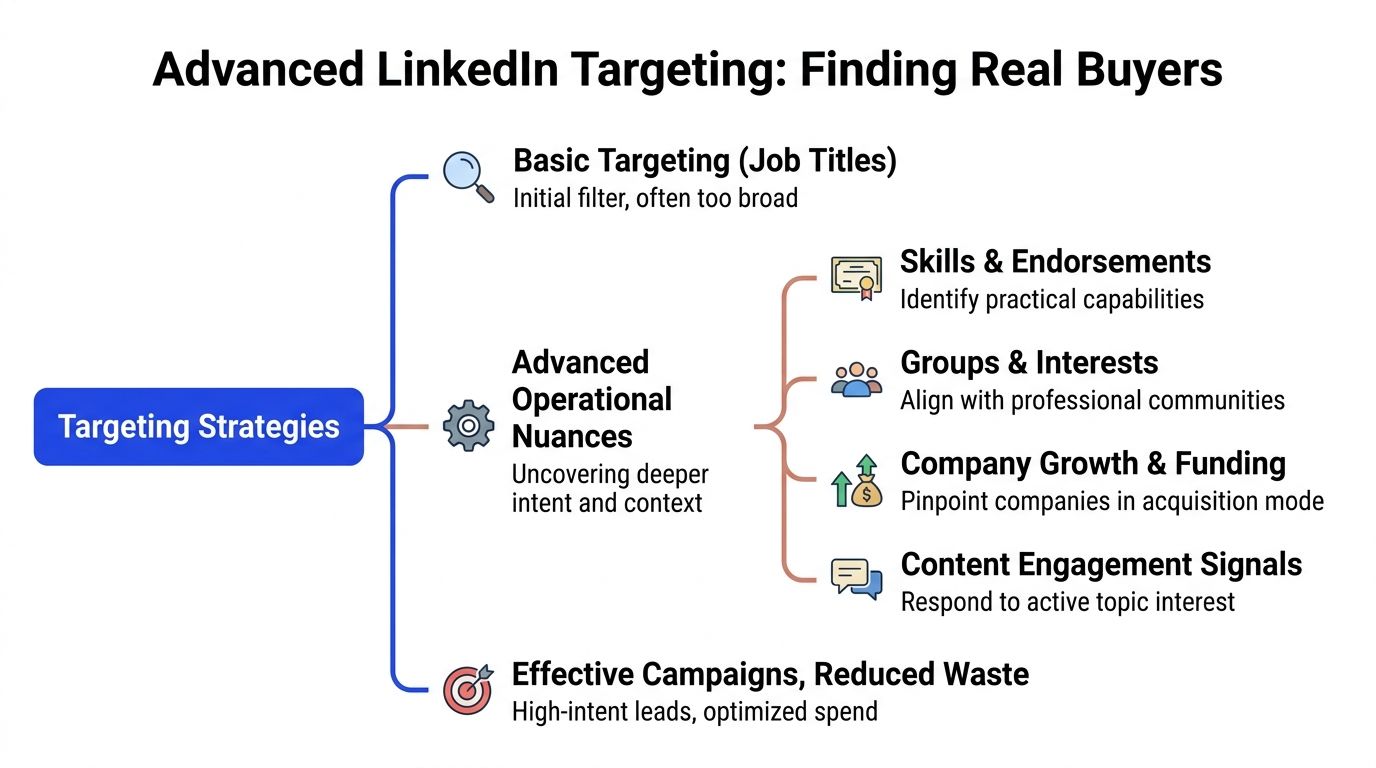
Most weak LinkedIn campaigns die in audience construction. The team picks a few job titles, layers on seniority, hits launch, then wonders why spend leaks into people who can't buy.
Job titles are a starting point. They are not a targeting strategy.
Start with audience size discipline
LinkedIn's official guidance suggests 30,000 to 300,000+ members for healthy delivery. In practice, high-intent cold campaigns often work better in the 10,000 to 25,000 range, while retargeting can be effective at 2,000 to 5,000 members.
That isn't a contradiction. It's a campaign-type issue.
Cold campaigns: tighter audiences can saturate the right accounts faster
Retargeting: small is fine because intent is already established
Broad prospecting: only useful if the offer is broad enough to support it
Too many teams treat bigger audiences as safer. They aren't. Bigger just means you can hide waste longer.
Layer for buying context
For iGaming, SaaS, manufacturing, legal tech, and pharma, the filters that matter usually sit at company level first, then role, then behavior.
LinkedIn lets you target by company size and revenue bands, from 11–50 employees to 10,000+, and from $10M–$50M to $100M+, while also filtering for growth thresholds like 20%+ annual expansion, as outlined in this manufacturer-focused LinkedIn targeting overview.
That means your ICP can be built like this:
Company profile: industry, size, revenue, growth profile
Operational relevance: job function, seniority, department structure
Technical fit: skills, listed software, and specialist groups
Intent signals: video viewers, pricing-page visitors, document downloaders
For niche technical offers, go beyond titles. LinkedIn can target people with skills like specific software administration, or people in relevant user groups, which is why it works well for technical SaaS and industrial campaigns, as shown in this walkthrough on niche targeting approaches.
If your ICP is still fuzzy, fix that before touching the ad account. This guide to ideal customer profile work is the right order of operations.
Exclusions are where wasted spend gets cut
Most targeting conversations obsess over who to include. Mature teams care just as much about who to exclude.
Exclude current employees. Exclude existing customers if the campaign is for net-new pipeline. Exclude low-fit segments that sales won't accept. Exclude broad adjacent industries unless you're testing them intentionally.
The fastest way to improve LinkedIn efficiency is often subtraction, not expansion.
There's also a sequencing benefit. Build retargeting pools from meaningful actions, not soft engagement alone. People who watched a large portion of a video, visited a pricing page, or downloaded a document are far more useful than people who dropped a like and disappeared.
Bidding, benchmarks, and measuring what actually matters
A LinkedIn campaign can look healthy for 30 days and still produce nothing sales wants. I've seen accounts with a strong CTR, falling CPC, and a full retargeting pool that generated zero qualified meetings. The media was doing its job. The measurement model was not.
LinkedIn usually charges premium rates. Budget gets wasted when teams judge premium inventory with cheap success metrics.
Benchmarks are useful, but only in the right seat
Use platform benchmarks to set expectations, not to prove the program works. Across published benchmark summaries, LinkedIn commonly lands in the mid single-digit CPC range and low-to-mid $30s CPM range. Those same summaries also frame why advertisers stay in the channel. Conversion quality is often stronger than lower-cost social traffic, and LinkedIn remains one of the default paid channels for reaching business decision-makers.
The same benchmark roundups also point to two practical realities that matter in operations. Reported conversion rates can look healthy at the platform level, and desktop still accounts for a large share of completed conversions even though mobile often drives heavier impression volume. That should affect how you review form length, landing page behavior, and post-click paths. A buyer might see the ad on a phone at 7:30 a.m. and submit a demo request from a laptop at 2:00 p.m.
That context matters. It just should not run your scorecard.
The scorecard I actually care about
CPC tells me what attention costs. Pipeline metrics tell me whether that attention turned into revenue.
For B2B teams serious about ads on LinkedIn, these are the numbers worth reviewing every week:
Cost per qualified meeting
Qualified meeting rate from leads
Meeting-held rate
Opportunity rate from ad-sourced and ad-influenced meetings
Pipeline dollars created per campaign
Sales cycle lag from first paid touch to meeting booked
Revenue per 1,000 impressions, once volume is high enough to trust it
Those metrics force better decisions. A campaign with a $9 CPC can beat one at $6 if it produces meetings at half the cost. I would take a 0.55% CTR campaign that creates $180,000 in pipeline over a 1.2% CTR campaign that produces newsletter signups all day.
Bidding has to match the stage of the system
Early-stage cold campaigns need room to spend and learn. If bids are too conservative, delivery gets erratic and the account starts optimizing from weak signals. For warm audiences, tighter efficiency targets make sense because the audience already carries intent.
My rule is simple. Bid for the action volume you can realistically support downstream.
If sales can only handle 12 qualified meetings a month, there is no prize for forcing 80 low-intent leads through a lead gen form. If the retargeting pool is thin, stop trying to squeeze efficiency from the bottom of the funnel and fix top-of-funnel reach first. Bidding strategy only works when it matches audience temperature, conversion friction, and sales capacity.
Attribution needs adult supervision
Last-click reporting overstates the value of brand search and retargeting. First-click reporting overstates the value of awareness campaigns. Both hide the actual buying path.
Use CRM stage movement and a multi-touch attribution model tied to actual pipeline creation. That is how you see whether paid social introduced the account, whether content built conviction, and whether outbound converted the attention into a meeting. That combined view matters more than trying to make one campaign claim full credit.
LinkedIn can influence pipeline well beyond the click that gets recorded in-platform. Earlier benchmark reporting from LinkedIn, cited elsewhere in this article, makes the same broader point. Strong returns come from campaigns connected to the rest of the go-to-market system, not from isolated ad sets chasing vanity metrics.
The useful question is not whether the ad got a click. The useful question is whether the account moved closer to revenue.
The surprising A/B test that changed our creative strategy
One of the most useful LinkedIn tests I've seen came from a bad assumption. The audience was operations leaders at B2B services companies. The belief was obvious enough to feel safe: analytical buyers would prefer a data-heavy framework over a more human, story-led angle.
They didn't.
The two versions
Variant A was the polished operator special. It led with a hard data point, structured language, and a framework-driven title. It looked serious. It sounded credible. It felt like the “right” B2B ad.
Variant B was simpler. The hook centered on a single team, a clear change over a short period, and honest reflection instead of polished authority.
The result was sharp. Variant B beat Variant A by 47% on cost per download. The story-led ad delivered a 3.1% click-through rate, versus 1.7% for the framework version, and 0.84% impressions-to-download conversion versus 0.51%. The test ran for 21 days with a 50/50 split, and the result was significant by day 14.
What changed after that
The lesson wasn't “always use stories.” The lesson was that many B2B teams confuse professional tone with persuasive tone.
A few changes followed:
We test narrative hooks earlier: one buyer, one problem, one tension point
We reduce empty polish: cleaner layouts often beat heavily branded creative
We use reflection language more often: honest learnings can outperform synthetic authority
We separate trust-building from data-dumping: facts still matter, but they don't need to lead every ad
That shift also improved how we use demographic reporting mid-campaign.
The mid-campaign pivots worth making
LinkedIn's demographic reporting is directionally useful if you don't overreact. I like four pivot types.
First, audience refinement. If adjacent company sizes or roles are engaging more than the original target, inspect the pattern.
Second, creative-to-audience matching. One message may resonate with VP-level buyers while a different version works for directors.
Third, geography splits. If a regional pattern keeps showing up, separate the campaign and rewrite accordingly.
Fourth, industry expansion. Sometimes a neighboring vertical is telling you it has the same pain, just under a different team structure.
One campaign targeting revops leaders surfaced a different buyer cluster. Heads of finance were engaging harder because revenue operations sat under finance in many of those businesses. The team built a finance-specific variant and picked up a useful secondary path.
The discipline matters more than the pivot itself. Wait for enough data, hold most variables steady, and don't chase every blip. If you want a tighter process for that testing discipline, this breakdown of creative testing is worth using as a checkpoint.
Good A/B tests don't just confirm what you already believed. They expose the assumptions that were costing you money.
How to integrate ads into a unified pipeline engine
The biggest mistake in LinkedIn advertising is running paid media as a separate department from content and outbound. That structure creates the black box where engagement goes in and nothing measurable comes out.
The fix is operational, not cosmetic.
The working system
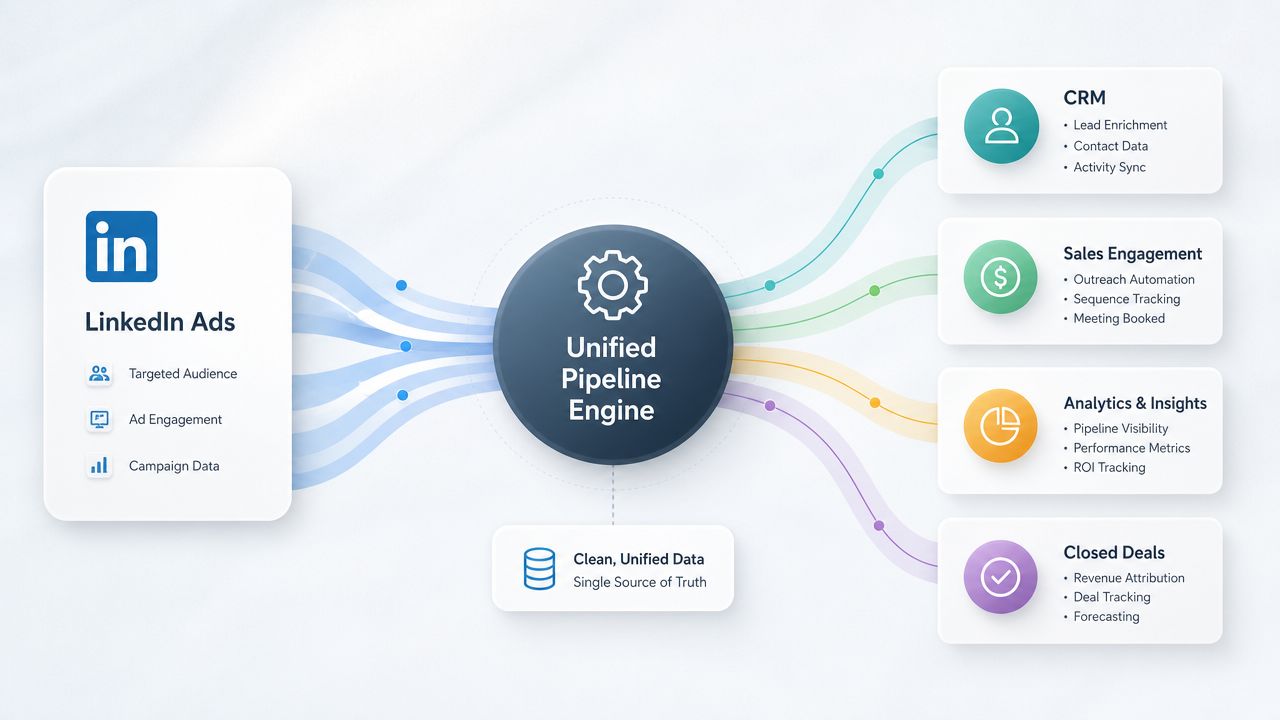
A useful setup usually looks like this:
Ads create the first signal: document views, form fills, video consumption, page visits
CRM captures the signal: HubSpot records source, campaign, and contact path
Enrichment adds context: Clay or Apollo append account and persona detail
Outbound acts on timing: Lemlist, Smartlead, Instantly, or HeyReach routes the next touch
Sales works qualified conversations: only after fit and intent are visible
That's what turns ads on LinkedIn into pipeline input instead of a reporting silo.
Speed is the hidden performance variable
The most common failure point in B2B marketing is the black box between engagement and revenue. Converting LinkedIn engagement needs a structured follow-up process, often through DMs, within 5–10 minutes of a high-intent signal. Most ads advice skips that operational layer completely.
If a buyer downloads your document, comments with intent, or returns to your founder profile, someone should know what happens next. Who replies. Which message gets sent. What qualifies a handoff. What gets logged in HubSpot.
Bi-weekly sprint management beats monthly reporting. Monthly reporting tells you what happened. Sprint discipline changes what happens next.
One message, one list, one reporting line
The cleanest systems keep three things aligned.
One target list: Sales Navigator, Apollo, and CRM should point to the same account universe
One message spine: the ad angle, founder content, and outbound email should sound like they came from the same company
One reporting line: paid and outbound should both be measured against conversation quality and pipeline creation
That's also why content distribution matters beyond ads. If you're promoting a podcast, for example, the strongest LinkedIn motion usually combines clips, documents, thought-leadership posts, and follow-up distribution. There are useful ideas in Fame's LinkedIn podcast tips that fit neatly into this same system logic.
For a broader operating model, this guide on B2B demand generation is the right frame.
What unified execution changes
When teams coordinate paid, content, and outbound, follow-up gets faster and qualification gets cleaner. You stop asking whether LinkedIn ads “worked” in isolation, because the campaign is no longer isolated.
It's just one engine. Ads create attention. Content builds trust. Outbound catches timing. Sales takes the conversation from there.
Your next move
Monday morning is a good test.
Open your last three LinkedIn campaigns, your CRM, and your sales calendar. Trace each campaign to one number. Effective cost per qualified meeting. That means a meeting with the right seniority, a real problem, a company your team can close, and a next step sales would want again.
That metric changes behavior fast. Teams that report on clicks keep buying attention. Teams that report on qualified meetings start fixing routing, follow-up, and message fit.
Run a short audit next.
Signal capture: document opens, repeat site visits, demo-page views, and ad engagements should land in your CRM with source detail
Routing speed: high-intent signals need human follow-up the same day, not at the end of the week
Exclusions: remove employees, customers, open opportunities, and obvious low-fit segments from paid delivery
Sequencing: buyers should see useful proof and point of view before anyone pushes for a meeting
As noted earlier, LinkedIn works better when brand and demand are coordinated. I have seen this repeatedly in live accounts. The lift rarely comes from one brilliant campaign. It comes from a connected system where ads create recognition, content builds trust, and outbound reaches the account while that recognition is still fresh. Revenue follows that sequence more often than any isolated lead gen play.
If your team wants to enrich LinkedIn workflows or move data into other systems, do not assume the native API is the best answer for every setup. This overview of alternatives to LinkedIn API is worth reading before you spend engineering time on the wrong path.
Then make one operational change by the end of the day. Add a CRM property called high-intent LinkedIn signal source. Populate it manually if you have to for the first two weeks. Once that field exists, paid, content, outbound, and sales can finally report on the same buyer journey instead of arguing over channel performance.
Grou helps B2B teams build pipeline systems that connect LinkedIn content, ads, and outbound into qualified conversations and closed revenue across global markets.
Our method is simple. One target list, one message spine, one reporting line, with fast signal routing and bi-weekly iteration so attention turns into pipeline instead of dying in a dashboard.
You're probably looking at a LinkedIn ads account that reports clicks, engagement, and maybe a pile of form fills, yet sales still asks the same question: which of these people can buy? That gap isn't a creative problem first. It's a system problem. Attention without routing, qualification, and follow-up dies in the middle.
The winning setup for B2B pipeline is usually document ads to cold audiences, then Message Ads to the engaged segment
Raw response rate is a bad decision metric, effective cost per qualified meeting is better
Targeting works when you layer company filters, skills, engagement signals, and exclusions
Ads on LinkedIn pay off when paid, content, and outbound share one target list and one reporting line
Table of Contents
The ad formats that build pipeline and the ones that burn cash
A bad LinkedIn ads setup usually looks the same. The team launches Message Ads to a cold audience, gets a spike in opens, a handful of polite replies, and almost no sales conversations worth taking. Spend goes out fast. Pipeline barely moves.
The format problem is rarely the format by itself. It is the sequence.
For B2B teams selling a real service, complex product, or high-trust offer, the strongest setup is usually document ads or strong Sponsored Content first, then retarget engaged people with a direct-response format. That is how attention turns into meetings. Ads create familiarity. Content does the pre-selling. Outbound or follow-up converts the warmed audience into conversations.
What each format is actually good for
Document ads are the closest thing LinkedIn has to a serious first-touch format for cold audiences. They ask for time, which filters out low-intent clicks. If someone flips through six, eight, or ten pages of useful material, that signal is worth more than a cheap click.
Single-image Sponsored Content works when the message is sharp and the offer is clear. It is less immersive than a document ad, but it is easier to produce and faster to test. I use it to validate angles before investing in larger assets.
Lead Gen Forms reduce friction, but lower friction also means lower intent unless the offer is strong. They fit webinar registration, checklists, and some demo flows. They are weaker when the sales process depends on buyer maturity and internal urgency.
Message Ads are a retargeting format in practice, even if LinkedIn lets you send them cold. Sending them as a first touch usually buys inbox access before you have earned attention. That is why they often look efficient at the top of the funnel and disappoint once sales reviews lead quality.
Video ads get reach and recall. They are usually a poor primary format for meeting generation unless the account already has strong demand capture, good remarketing, and disciplined follow-up.
The format hierarchy I'd use
Ad Format | Effective Cost per Qualified Meeting | Primary Use Case |
|---|---|---|
Document ads + Message Ads retargeting | €425 | Cold education, then warm direct response |
Sponsored Content with document ads | €350 to €700 | High-intent content consumption and inbound DMs |
Lead Gen Forms with single-image Sponsored Content | €500 to €1,000 | Lower-friction demo or asset capture |
Message Ads to cold audiences | €600 to €1,200 | Rarely worth it for first touch |
Carousel ads | €600 to €1,000 | Storytelling, usually not meeting-efficient |
Video ads | €800 to €1,500 | Awareness, weak as primary meeting source |
Those ranges are not universal benchmarks. They are operating ranges I would expect to see in mid-market B2B accounts with clear targeting, competent creative, and a sales team that follows up fast. The same format can look cheap in-platform and still be expensive once you price in bad meetings, no-shows, and opportunities that never progress.
That trade-off matters more than click metrics.
Why the two-step sequence wins
The best-performing LinkedIn programs do not ask cold prospects for a meeting on impression one. They earn the second touch.
Start with a useful asset aimed at a real buying problem. Retarget people who engaged in a meaningful way. Then use Message Ads, conversation-led outreach, or a tighter conversion offer on that warmer audience. Response rates improve because the prospect has context. Sales quality improves because the engagement came from substance, not impulse.
This is also where a lot of LinkedIn advice falls short. It treats ad formats as isolated channels competing for CTR. Revenue teams need to treat them as connected stages in one system. The ad gets attention. The content qualifies interest. Outbound or retargeting turns that interest into a booked meeting.
Thought Leader Ads can fit that system well if the company already has credible people posting useful points of view from personal profiles. Benchmarks shared in Zena ABM's Thought Leader Ads analysis suggest they can outperform standard single-image ads on both click-through rate and CPC. Useful result. Still not a full pipeline strategy on its own.
If you need a grounded view of budget before choosing formats, this breakdown of cost for LinkedIn ads is a good place to sanity-check the economics.
My bias is simple. Buy attention with substance first. Ask for the meeting after you have earned enough trust for the ask to make sense.
Anatomy of an ad that influenced a six-figure deal
No single ad closes a six-figure B2B deal by itself. That story is usually fake, or at least lazy. What a good ad does is create credibility early enough that the later touches stop feeling cold.
One document ad for an iGaming compliance client did exactly that. The campaign ran for 8 months, generated 412 document downloads from 87,400 impressions, and produced 18 qualified meetings and 4 closed deals totaling about €620k in revenue against an €18k spend.
What the creative looked like
This wasn't a thin PDF dressed up as thought leadership. It was an 18-page document called a guide for compliance directors facing post-regulatory-change positioning. The body used 12 specific examples and held back the pitch until late in the document.
The structure mattered:
Cover hook: a concrete, high-stakes framing tied to regulatory pressure
Middle pages: specific examples, diagnosis, and pattern recognition
Late pages: the company point of view, not a product brochure
Final CTA: soft, direct, and credible
That last part matters more than is often acknowledged. Aggressive CTAs break trust when the asset itself is doing the selling.
A serious buyer will read serious material. If the asset looks like a disguised brochure, they stop.
Why it worked
It filtered the audience before sales ever got involved. Someone willing to download and read an 18-page compliance document is signaling more than curiosity. They're telling you the topic is already live inside their business.
It also gave later outbound a reason to exist. By the time an email or DM arrived, the account had context. The sales motion didn't start from zero.
Here's the walkthrough worth watching if you want a cleaner view of how ad-led content fits real LinkedIn demand capture:
The journey matters more than the first click
The deal path was not short.
The buyer first saw the document ad, downloaded it, returned to the content, viewed the founder's profile, engaged with posts, attended a webinar, then replied to outbound later in the cycle. The contract was signed after 87 days, and the deal itself was €148k ARR plus €32k in implementation, for a total of €180k.
That's the point most LinkedIn ads advice misses. Ads on LinkedIn don't need to carry the entire revenue burden. They need to create the first credible touch, then pass signal to the next step in the system.
What to copy and what not to copy
Copy the principles, not the exact topic.
Depth beats design polish: The asset worked because it said something worth reading.
Specific examples beat generic frameworks: Named patterns, even anonymized, feel real.
Soft CTAs beat hard closes: Buyers don't want a bait-and-switch.
Distribution still matters: The right content in front of the wrong people is still wasted spend.
Don't copy the fantasy that one ad “generated” the full deal. It influenced the deal. That's more useful, and more honest.
Targeting beyond job titles to find real buyers
Most weak LinkedIn campaigns die in audience construction. The team picks a few job titles, layers on seniority, hits launch, then wonders why spend leaks into people who can't buy.
Job titles are a starting point. They are not a targeting strategy.
Start with audience size discipline
LinkedIn's official guidance suggests 30,000 to 300,000+ members for healthy delivery. In practice, high-intent cold campaigns often work better in the 10,000 to 25,000 range, while retargeting can be effective at 2,000 to 5,000 members.
That isn't a contradiction. It's a campaign-type issue.
Cold campaigns: tighter audiences can saturate the right accounts faster
Retargeting: small is fine because intent is already established
Broad prospecting: only useful if the offer is broad enough to support it
Too many teams treat bigger audiences as safer. They aren't. Bigger just means you can hide waste longer.
Layer for buying context
For iGaming, SaaS, manufacturing, legal tech, and pharma, the filters that matter usually sit at company level first, then role, then behavior.
LinkedIn lets you target by company size and revenue bands, from 11–50 employees to 10,000+, and from $10M–$50M to $100M+, while also filtering for growth thresholds like 20%+ annual expansion, as outlined in this manufacturer-focused LinkedIn targeting overview.
That means your ICP can be built like this:
Company profile: industry, size, revenue, growth profile
Operational relevance: job function, seniority, department structure
Technical fit: skills, listed software, and specialist groups
Intent signals: video viewers, pricing-page visitors, document downloaders
For niche technical offers, go beyond titles. LinkedIn can target people with skills like specific software administration, or people in relevant user groups, which is why it works well for technical SaaS and industrial campaigns, as shown in this walkthrough on niche targeting approaches.
If your ICP is still fuzzy, fix that before touching the ad account. This guide to ideal customer profile work is the right order of operations.
Exclusions are where wasted spend gets cut
Most targeting conversations obsess over who to include. Mature teams care just as much about who to exclude.
Exclude current employees. Exclude existing customers if the campaign is for net-new pipeline. Exclude low-fit segments that sales won't accept. Exclude broad adjacent industries unless you're testing them intentionally.
The fastest way to improve LinkedIn efficiency is often subtraction, not expansion.
There's also a sequencing benefit. Build retargeting pools from meaningful actions, not soft engagement alone. People who watched a large portion of a video, visited a pricing page, or downloaded a document are far more useful than people who dropped a like and disappeared.
Bidding, benchmarks, and measuring what actually matters
A LinkedIn campaign can look healthy for 30 days and still produce nothing sales wants. I've seen accounts with a strong CTR, falling CPC, and a full retargeting pool that generated zero qualified meetings. The media was doing its job. The measurement model was not.
LinkedIn usually charges premium rates. Budget gets wasted when teams judge premium inventory with cheap success metrics.
Benchmarks are useful, but only in the right seat
Use platform benchmarks to set expectations, not to prove the program works. Across published benchmark summaries, LinkedIn commonly lands in the mid single-digit CPC range and low-to-mid $30s CPM range. Those same summaries also frame why advertisers stay in the channel. Conversion quality is often stronger than lower-cost social traffic, and LinkedIn remains one of the default paid channels for reaching business decision-makers.
The same benchmark roundups also point to two practical realities that matter in operations. Reported conversion rates can look healthy at the platform level, and desktop still accounts for a large share of completed conversions even though mobile often drives heavier impression volume. That should affect how you review form length, landing page behavior, and post-click paths. A buyer might see the ad on a phone at 7:30 a.m. and submit a demo request from a laptop at 2:00 p.m.
That context matters. It just should not run your scorecard.
The scorecard I actually care about
CPC tells me what attention costs. Pipeline metrics tell me whether that attention turned into revenue.
For B2B teams serious about ads on LinkedIn, these are the numbers worth reviewing every week:
Cost per qualified meeting
Qualified meeting rate from leads
Meeting-held rate
Opportunity rate from ad-sourced and ad-influenced meetings
Pipeline dollars created per campaign
Sales cycle lag from first paid touch to meeting booked
Revenue per 1,000 impressions, once volume is high enough to trust it
Those metrics force better decisions. A campaign with a $9 CPC can beat one at $6 if it produces meetings at half the cost. I would take a 0.55% CTR campaign that creates $180,000 in pipeline over a 1.2% CTR campaign that produces newsletter signups all day.
Bidding has to match the stage of the system
Early-stage cold campaigns need room to spend and learn. If bids are too conservative, delivery gets erratic and the account starts optimizing from weak signals. For warm audiences, tighter efficiency targets make sense because the audience already carries intent.
My rule is simple. Bid for the action volume you can realistically support downstream.
If sales can only handle 12 qualified meetings a month, there is no prize for forcing 80 low-intent leads through a lead gen form. If the retargeting pool is thin, stop trying to squeeze efficiency from the bottom of the funnel and fix top-of-funnel reach first. Bidding strategy only works when it matches audience temperature, conversion friction, and sales capacity.
Attribution needs adult supervision
Last-click reporting overstates the value of brand search and retargeting. First-click reporting overstates the value of awareness campaigns. Both hide the actual buying path.
Use CRM stage movement and a multi-touch attribution model tied to actual pipeline creation. That is how you see whether paid social introduced the account, whether content built conviction, and whether outbound converted the attention into a meeting. That combined view matters more than trying to make one campaign claim full credit.
LinkedIn can influence pipeline well beyond the click that gets recorded in-platform. Earlier benchmark reporting from LinkedIn, cited elsewhere in this article, makes the same broader point. Strong returns come from campaigns connected to the rest of the go-to-market system, not from isolated ad sets chasing vanity metrics.
The useful question is not whether the ad got a click. The useful question is whether the account moved closer to revenue.
The surprising A/B test that changed our creative strategy
One of the most useful LinkedIn tests I've seen came from a bad assumption. The audience was operations leaders at B2B services companies. The belief was obvious enough to feel safe: analytical buyers would prefer a data-heavy framework over a more human, story-led angle.
They didn't.
The two versions
Variant A was the polished operator special. It led with a hard data point, structured language, and a framework-driven title. It looked serious. It sounded credible. It felt like the “right” B2B ad.
Variant B was simpler. The hook centered on a single team, a clear change over a short period, and honest reflection instead of polished authority.
The result was sharp. Variant B beat Variant A by 47% on cost per download. The story-led ad delivered a 3.1% click-through rate, versus 1.7% for the framework version, and 0.84% impressions-to-download conversion versus 0.51%. The test ran for 21 days with a 50/50 split, and the result was significant by day 14.
What changed after that
The lesson wasn't “always use stories.” The lesson was that many B2B teams confuse professional tone with persuasive tone.
A few changes followed:
We test narrative hooks earlier: one buyer, one problem, one tension point
We reduce empty polish: cleaner layouts often beat heavily branded creative
We use reflection language more often: honest learnings can outperform synthetic authority
We separate trust-building from data-dumping: facts still matter, but they don't need to lead every ad
That shift also improved how we use demographic reporting mid-campaign.
The mid-campaign pivots worth making
LinkedIn's demographic reporting is directionally useful if you don't overreact. I like four pivot types.
First, audience refinement. If adjacent company sizes or roles are engaging more than the original target, inspect the pattern.
Second, creative-to-audience matching. One message may resonate with VP-level buyers while a different version works for directors.
Third, geography splits. If a regional pattern keeps showing up, separate the campaign and rewrite accordingly.
Fourth, industry expansion. Sometimes a neighboring vertical is telling you it has the same pain, just under a different team structure.
One campaign targeting revops leaders surfaced a different buyer cluster. Heads of finance were engaging harder because revenue operations sat under finance in many of those businesses. The team built a finance-specific variant and picked up a useful secondary path.
The discipline matters more than the pivot itself. Wait for enough data, hold most variables steady, and don't chase every blip. If you want a tighter process for that testing discipline, this breakdown of creative testing is worth using as a checkpoint.
Good A/B tests don't just confirm what you already believed. They expose the assumptions that were costing you money.
How to integrate ads into a unified pipeline engine
The biggest mistake in LinkedIn advertising is running paid media as a separate department from content and outbound. That structure creates the black box where engagement goes in and nothing measurable comes out.
The fix is operational, not cosmetic.
The working system
A useful setup usually looks like this:
Ads create the first signal: document views, form fills, video consumption, page visits
CRM captures the signal: HubSpot records source, campaign, and contact path
Enrichment adds context: Clay or Apollo append account and persona detail
Outbound acts on timing: Lemlist, Smartlead, Instantly, or HeyReach routes the next touch
Sales works qualified conversations: only after fit and intent are visible
That's what turns ads on LinkedIn into pipeline input instead of a reporting silo.
Speed is the hidden performance variable
The most common failure point in B2B marketing is the black box between engagement and revenue. Converting LinkedIn engagement needs a structured follow-up process, often through DMs, within 5–10 minutes of a high-intent signal. Most ads advice skips that operational layer completely.
If a buyer downloads your document, comments with intent, or returns to your founder profile, someone should know what happens next. Who replies. Which message gets sent. What qualifies a handoff. What gets logged in HubSpot.
Bi-weekly sprint management beats monthly reporting. Monthly reporting tells you what happened. Sprint discipline changes what happens next.
One message, one list, one reporting line
The cleanest systems keep three things aligned.
One target list: Sales Navigator, Apollo, and CRM should point to the same account universe
One message spine: the ad angle, founder content, and outbound email should sound like they came from the same company
One reporting line: paid and outbound should both be measured against conversation quality and pipeline creation
That's also why content distribution matters beyond ads. If you're promoting a podcast, for example, the strongest LinkedIn motion usually combines clips, documents, thought-leadership posts, and follow-up distribution. There are useful ideas in Fame's LinkedIn podcast tips that fit neatly into this same system logic.
For a broader operating model, this guide on B2B demand generation is the right frame.
What unified execution changes
When teams coordinate paid, content, and outbound, follow-up gets faster and qualification gets cleaner. You stop asking whether LinkedIn ads “worked” in isolation, because the campaign is no longer isolated.
It's just one engine. Ads create attention. Content builds trust. Outbound catches timing. Sales takes the conversation from there.
Your next move
Monday morning is a good test.
Open your last three LinkedIn campaigns, your CRM, and your sales calendar. Trace each campaign to one number. Effective cost per qualified meeting. That means a meeting with the right seniority, a real problem, a company your team can close, and a next step sales would want again.
That metric changes behavior fast. Teams that report on clicks keep buying attention. Teams that report on qualified meetings start fixing routing, follow-up, and message fit.
Run a short audit next.
Signal capture: document opens, repeat site visits, demo-page views, and ad engagements should land in your CRM with source detail
Routing speed: high-intent signals need human follow-up the same day, not at the end of the week
Exclusions: remove employees, customers, open opportunities, and obvious low-fit segments from paid delivery
Sequencing: buyers should see useful proof and point of view before anyone pushes for a meeting
As noted earlier, LinkedIn works better when brand and demand are coordinated. I have seen this repeatedly in live accounts. The lift rarely comes from one brilliant campaign. It comes from a connected system where ads create recognition, content builds trust, and outbound reaches the account while that recognition is still fresh. Revenue follows that sequence more often than any isolated lead gen play.
If your team wants to enrich LinkedIn workflows or move data into other systems, do not assume the native API is the best answer for every setup. This overview of alternatives to LinkedIn API is worth reading before you spend engineering time on the wrong path.
Then make one operational change by the end of the day. Add a CRM property called high-intent LinkedIn signal source. Populate it manually if you have to for the first two weeks. Once that field exists, paid, content, outbound, and sales can finally report on the same buyer journey instead of arguing over channel performance.
Grou helps B2B teams build pipeline systems that connect LinkedIn content, ads, and outbound into qualified conversations and closed revenue across global markets.
Our method is simple. One target list, one message spine, one reporting line, with fast signal routing and bi-weekly iteration so attention turns into pipeline instead of dying in a dashboard.
You're probably looking at a LinkedIn ads account that reports clicks, engagement, and maybe a pile of form fills, yet sales still asks the same question: which of these people can buy? That gap isn't a creative problem first. It's a system problem. Attention without routing, qualification, and follow-up dies in the middle.
The winning setup for B2B pipeline is usually document ads to cold audiences, then Message Ads to the engaged segment
Raw response rate is a bad decision metric, effective cost per qualified meeting is better
Targeting works when you layer company filters, skills, engagement signals, and exclusions
Ads on LinkedIn pay off when paid, content, and outbound share one target list and one reporting line
Table of Contents
The ad formats that build pipeline and the ones that burn cash
A bad LinkedIn ads setup usually looks the same. The team launches Message Ads to a cold audience, gets a spike in opens, a handful of polite replies, and almost no sales conversations worth taking. Spend goes out fast. Pipeline barely moves.
The format problem is rarely the format by itself. It is the sequence.
For B2B teams selling a real service, complex product, or high-trust offer, the strongest setup is usually document ads or strong Sponsored Content first, then retarget engaged people with a direct-response format. That is how attention turns into meetings. Ads create familiarity. Content does the pre-selling. Outbound or follow-up converts the warmed audience into conversations.
What each format is actually good for
Document ads are the closest thing LinkedIn has to a serious first-touch format for cold audiences. They ask for time, which filters out low-intent clicks. If someone flips through six, eight, or ten pages of useful material, that signal is worth more than a cheap click.
Single-image Sponsored Content works when the message is sharp and the offer is clear. It is less immersive than a document ad, but it is easier to produce and faster to test. I use it to validate angles before investing in larger assets.
Lead Gen Forms reduce friction, but lower friction also means lower intent unless the offer is strong. They fit webinar registration, checklists, and some demo flows. They are weaker when the sales process depends on buyer maturity and internal urgency.
Message Ads are a retargeting format in practice, even if LinkedIn lets you send them cold. Sending them as a first touch usually buys inbox access before you have earned attention. That is why they often look efficient at the top of the funnel and disappoint once sales reviews lead quality.
Video ads get reach and recall. They are usually a poor primary format for meeting generation unless the account already has strong demand capture, good remarketing, and disciplined follow-up.
The format hierarchy I'd use
Ad Format | Effective Cost per Qualified Meeting | Primary Use Case |
|---|---|---|
Document ads + Message Ads retargeting | €425 | Cold education, then warm direct response |
Sponsored Content with document ads | €350 to €700 | High-intent content consumption and inbound DMs |
Lead Gen Forms with single-image Sponsored Content | €500 to €1,000 | Lower-friction demo or asset capture |
Message Ads to cold audiences | €600 to €1,200 | Rarely worth it for first touch |
Carousel ads | €600 to €1,000 | Storytelling, usually not meeting-efficient |
Video ads | €800 to €1,500 | Awareness, weak as primary meeting source |
Those ranges are not universal benchmarks. They are operating ranges I would expect to see in mid-market B2B accounts with clear targeting, competent creative, and a sales team that follows up fast. The same format can look cheap in-platform and still be expensive once you price in bad meetings, no-shows, and opportunities that never progress.
That trade-off matters more than click metrics.
Why the two-step sequence wins
The best-performing LinkedIn programs do not ask cold prospects for a meeting on impression one. They earn the second touch.
Start with a useful asset aimed at a real buying problem. Retarget people who engaged in a meaningful way. Then use Message Ads, conversation-led outreach, or a tighter conversion offer on that warmer audience. Response rates improve because the prospect has context. Sales quality improves because the engagement came from substance, not impulse.
This is also where a lot of LinkedIn advice falls short. It treats ad formats as isolated channels competing for CTR. Revenue teams need to treat them as connected stages in one system. The ad gets attention. The content qualifies interest. Outbound or retargeting turns that interest into a booked meeting.
Thought Leader Ads can fit that system well if the company already has credible people posting useful points of view from personal profiles. Benchmarks shared in Zena ABM's Thought Leader Ads analysis suggest they can outperform standard single-image ads on both click-through rate and CPC. Useful result. Still not a full pipeline strategy on its own.
If you need a grounded view of budget before choosing formats, this breakdown of cost for LinkedIn ads is a good place to sanity-check the economics.
My bias is simple. Buy attention with substance first. Ask for the meeting after you have earned enough trust for the ask to make sense.
Anatomy of an ad that influenced a six-figure deal
No single ad closes a six-figure B2B deal by itself. That story is usually fake, or at least lazy. What a good ad does is create credibility early enough that the later touches stop feeling cold.
One document ad for an iGaming compliance client did exactly that. The campaign ran for 8 months, generated 412 document downloads from 87,400 impressions, and produced 18 qualified meetings and 4 closed deals totaling about €620k in revenue against an €18k spend.
What the creative looked like
This wasn't a thin PDF dressed up as thought leadership. It was an 18-page document called a guide for compliance directors facing post-regulatory-change positioning. The body used 12 specific examples and held back the pitch until late in the document.
The structure mattered:
Cover hook: a concrete, high-stakes framing tied to regulatory pressure
Middle pages: specific examples, diagnosis, and pattern recognition
Late pages: the company point of view, not a product brochure
Final CTA: soft, direct, and credible
That last part matters more than is often acknowledged. Aggressive CTAs break trust when the asset itself is doing the selling.
A serious buyer will read serious material. If the asset looks like a disguised brochure, they stop.
Why it worked
It filtered the audience before sales ever got involved. Someone willing to download and read an 18-page compliance document is signaling more than curiosity. They're telling you the topic is already live inside their business.
It also gave later outbound a reason to exist. By the time an email or DM arrived, the account had context. The sales motion didn't start from zero.
Here's the walkthrough worth watching if you want a cleaner view of how ad-led content fits real LinkedIn demand capture:
The journey matters more than the first click
The deal path was not short.
The buyer first saw the document ad, downloaded it, returned to the content, viewed the founder's profile, engaged with posts, attended a webinar, then replied to outbound later in the cycle. The contract was signed after 87 days, and the deal itself was €148k ARR plus €32k in implementation, for a total of €180k.
That's the point most LinkedIn ads advice misses. Ads on LinkedIn don't need to carry the entire revenue burden. They need to create the first credible touch, then pass signal to the next step in the system.
What to copy and what not to copy
Copy the principles, not the exact topic.
Depth beats design polish: The asset worked because it said something worth reading.
Specific examples beat generic frameworks: Named patterns, even anonymized, feel real.
Soft CTAs beat hard closes: Buyers don't want a bait-and-switch.
Distribution still matters: The right content in front of the wrong people is still wasted spend.
Don't copy the fantasy that one ad “generated” the full deal. It influenced the deal. That's more useful, and more honest.
Targeting beyond job titles to find real buyers
Most weak LinkedIn campaigns die in audience construction. The team picks a few job titles, layers on seniority, hits launch, then wonders why spend leaks into people who can't buy.
Job titles are a starting point. They are not a targeting strategy.
Start with audience size discipline
LinkedIn's official guidance suggests 30,000 to 300,000+ members for healthy delivery. In practice, high-intent cold campaigns often work better in the 10,000 to 25,000 range, while retargeting can be effective at 2,000 to 5,000 members.
That isn't a contradiction. It's a campaign-type issue.
Cold campaigns: tighter audiences can saturate the right accounts faster
Retargeting: small is fine because intent is already established
Broad prospecting: only useful if the offer is broad enough to support it
Too many teams treat bigger audiences as safer. They aren't. Bigger just means you can hide waste longer.
Layer for buying context
For iGaming, SaaS, manufacturing, legal tech, and pharma, the filters that matter usually sit at company level first, then role, then behavior.
LinkedIn lets you target by company size and revenue bands, from 11–50 employees to 10,000+, and from $10M–$50M to $100M+, while also filtering for growth thresholds like 20%+ annual expansion, as outlined in this manufacturer-focused LinkedIn targeting overview.
That means your ICP can be built like this:
Company profile: industry, size, revenue, growth profile
Operational relevance: job function, seniority, department structure
Technical fit: skills, listed software, and specialist groups
Intent signals: video viewers, pricing-page visitors, document downloaders
For niche technical offers, go beyond titles. LinkedIn can target people with skills like specific software administration, or people in relevant user groups, which is why it works well for technical SaaS and industrial campaigns, as shown in this walkthrough on niche targeting approaches.
If your ICP is still fuzzy, fix that before touching the ad account. This guide to ideal customer profile work is the right order of operations.
Exclusions are where wasted spend gets cut
Most targeting conversations obsess over who to include. Mature teams care just as much about who to exclude.
Exclude current employees. Exclude existing customers if the campaign is for net-new pipeline. Exclude low-fit segments that sales won't accept. Exclude broad adjacent industries unless you're testing them intentionally.
The fastest way to improve LinkedIn efficiency is often subtraction, not expansion.
There's also a sequencing benefit. Build retargeting pools from meaningful actions, not soft engagement alone. People who watched a large portion of a video, visited a pricing page, or downloaded a document are far more useful than people who dropped a like and disappeared.
Bidding, benchmarks, and measuring what actually matters
A LinkedIn campaign can look healthy for 30 days and still produce nothing sales wants. I've seen accounts with a strong CTR, falling CPC, and a full retargeting pool that generated zero qualified meetings. The media was doing its job. The measurement model was not.
LinkedIn usually charges premium rates. Budget gets wasted when teams judge premium inventory with cheap success metrics.
Benchmarks are useful, but only in the right seat
Use platform benchmarks to set expectations, not to prove the program works. Across published benchmark summaries, LinkedIn commonly lands in the mid single-digit CPC range and low-to-mid $30s CPM range. Those same summaries also frame why advertisers stay in the channel. Conversion quality is often stronger than lower-cost social traffic, and LinkedIn remains one of the default paid channels for reaching business decision-makers.
The same benchmark roundups also point to two practical realities that matter in operations. Reported conversion rates can look healthy at the platform level, and desktop still accounts for a large share of completed conversions even though mobile often drives heavier impression volume. That should affect how you review form length, landing page behavior, and post-click paths. A buyer might see the ad on a phone at 7:30 a.m. and submit a demo request from a laptop at 2:00 p.m.
That context matters. It just should not run your scorecard.
The scorecard I actually care about
CPC tells me what attention costs. Pipeline metrics tell me whether that attention turned into revenue.
For B2B teams serious about ads on LinkedIn, these are the numbers worth reviewing every week:
Cost per qualified meeting
Qualified meeting rate from leads
Meeting-held rate
Opportunity rate from ad-sourced and ad-influenced meetings
Pipeline dollars created per campaign
Sales cycle lag from first paid touch to meeting booked
Revenue per 1,000 impressions, once volume is high enough to trust it
Those metrics force better decisions. A campaign with a $9 CPC can beat one at $6 if it produces meetings at half the cost. I would take a 0.55% CTR campaign that creates $180,000 in pipeline over a 1.2% CTR campaign that produces newsletter signups all day.
Bidding has to match the stage of the system
Early-stage cold campaigns need room to spend and learn. If bids are too conservative, delivery gets erratic and the account starts optimizing from weak signals. For warm audiences, tighter efficiency targets make sense because the audience already carries intent.
My rule is simple. Bid for the action volume you can realistically support downstream.
If sales can only handle 12 qualified meetings a month, there is no prize for forcing 80 low-intent leads through a lead gen form. If the retargeting pool is thin, stop trying to squeeze efficiency from the bottom of the funnel and fix top-of-funnel reach first. Bidding strategy only works when it matches audience temperature, conversion friction, and sales capacity.
Attribution needs adult supervision
Last-click reporting overstates the value of brand search and retargeting. First-click reporting overstates the value of awareness campaigns. Both hide the actual buying path.
Use CRM stage movement and a multi-touch attribution model tied to actual pipeline creation. That is how you see whether paid social introduced the account, whether content built conviction, and whether outbound converted the attention into a meeting. That combined view matters more than trying to make one campaign claim full credit.
LinkedIn can influence pipeline well beyond the click that gets recorded in-platform. Earlier benchmark reporting from LinkedIn, cited elsewhere in this article, makes the same broader point. Strong returns come from campaigns connected to the rest of the go-to-market system, not from isolated ad sets chasing vanity metrics.
The useful question is not whether the ad got a click. The useful question is whether the account moved closer to revenue.
The surprising A/B test that changed our creative strategy
One of the most useful LinkedIn tests I've seen came from a bad assumption. The audience was operations leaders at B2B services companies. The belief was obvious enough to feel safe: analytical buyers would prefer a data-heavy framework over a more human, story-led angle.
They didn't.
The two versions
Variant A was the polished operator special. It led with a hard data point, structured language, and a framework-driven title. It looked serious. It sounded credible. It felt like the “right” B2B ad.
Variant B was simpler. The hook centered on a single team, a clear change over a short period, and honest reflection instead of polished authority.
The result was sharp. Variant B beat Variant A by 47% on cost per download. The story-led ad delivered a 3.1% click-through rate, versus 1.7% for the framework version, and 0.84% impressions-to-download conversion versus 0.51%. The test ran for 21 days with a 50/50 split, and the result was significant by day 14.
What changed after that
The lesson wasn't “always use stories.” The lesson was that many B2B teams confuse professional tone with persuasive tone.
A few changes followed:
We test narrative hooks earlier: one buyer, one problem, one tension point
We reduce empty polish: cleaner layouts often beat heavily branded creative
We use reflection language more often: honest learnings can outperform synthetic authority
We separate trust-building from data-dumping: facts still matter, but they don't need to lead every ad
That shift also improved how we use demographic reporting mid-campaign.
The mid-campaign pivots worth making
LinkedIn's demographic reporting is directionally useful if you don't overreact. I like four pivot types.
First, audience refinement. If adjacent company sizes or roles are engaging more than the original target, inspect the pattern.
Second, creative-to-audience matching. One message may resonate with VP-level buyers while a different version works for directors.
Third, geography splits. If a regional pattern keeps showing up, separate the campaign and rewrite accordingly.
Fourth, industry expansion. Sometimes a neighboring vertical is telling you it has the same pain, just under a different team structure.
One campaign targeting revops leaders surfaced a different buyer cluster. Heads of finance were engaging harder because revenue operations sat under finance in many of those businesses. The team built a finance-specific variant and picked up a useful secondary path.
The discipline matters more than the pivot itself. Wait for enough data, hold most variables steady, and don't chase every blip. If you want a tighter process for that testing discipline, this breakdown of creative testing is worth using as a checkpoint.
Good A/B tests don't just confirm what you already believed. They expose the assumptions that were costing you money.
How to integrate ads into a unified pipeline engine
The biggest mistake in LinkedIn advertising is running paid media as a separate department from content and outbound. That structure creates the black box where engagement goes in and nothing measurable comes out.
The fix is operational, not cosmetic.
The working system
A useful setup usually looks like this:
Ads create the first signal: document views, form fills, video consumption, page visits
CRM captures the signal: HubSpot records source, campaign, and contact path
Enrichment adds context: Clay or Apollo append account and persona detail
Outbound acts on timing: Lemlist, Smartlead, Instantly, or HeyReach routes the next touch
Sales works qualified conversations: only after fit and intent are visible
That's what turns ads on LinkedIn into pipeline input instead of a reporting silo.
Speed is the hidden performance variable
The most common failure point in B2B marketing is the black box between engagement and revenue. Converting LinkedIn engagement needs a structured follow-up process, often through DMs, within 5–10 minutes of a high-intent signal. Most ads advice skips that operational layer completely.
If a buyer downloads your document, comments with intent, or returns to your founder profile, someone should know what happens next. Who replies. Which message gets sent. What qualifies a handoff. What gets logged in HubSpot.
Bi-weekly sprint management beats monthly reporting. Monthly reporting tells you what happened. Sprint discipline changes what happens next.
One message, one list, one reporting line
The cleanest systems keep three things aligned.
One target list: Sales Navigator, Apollo, and CRM should point to the same account universe
One message spine: the ad angle, founder content, and outbound email should sound like they came from the same company
One reporting line: paid and outbound should both be measured against conversation quality and pipeline creation
That's also why content distribution matters beyond ads. If you're promoting a podcast, for example, the strongest LinkedIn motion usually combines clips, documents, thought-leadership posts, and follow-up distribution. There are useful ideas in Fame's LinkedIn podcast tips that fit neatly into this same system logic.
For a broader operating model, this guide on B2B demand generation is the right frame.
What unified execution changes
When teams coordinate paid, content, and outbound, follow-up gets faster and qualification gets cleaner. You stop asking whether LinkedIn ads “worked” in isolation, because the campaign is no longer isolated.
It's just one engine. Ads create attention. Content builds trust. Outbound catches timing. Sales takes the conversation from there.
Your next move
Monday morning is a good test.
Open your last three LinkedIn campaigns, your CRM, and your sales calendar. Trace each campaign to one number. Effective cost per qualified meeting. That means a meeting with the right seniority, a real problem, a company your team can close, and a next step sales would want again.
That metric changes behavior fast. Teams that report on clicks keep buying attention. Teams that report on qualified meetings start fixing routing, follow-up, and message fit.
Run a short audit next.
Signal capture: document opens, repeat site visits, demo-page views, and ad engagements should land in your CRM with source detail
Routing speed: high-intent signals need human follow-up the same day, not at the end of the week
Exclusions: remove employees, customers, open opportunities, and obvious low-fit segments from paid delivery
Sequencing: buyers should see useful proof and point of view before anyone pushes for a meeting
As noted earlier, LinkedIn works better when brand and demand are coordinated. I have seen this repeatedly in live accounts. The lift rarely comes from one brilliant campaign. It comes from a connected system where ads create recognition, content builds trust, and outbound reaches the account while that recognition is still fresh. Revenue follows that sequence more often than any isolated lead gen play.
If your team wants to enrich LinkedIn workflows or move data into other systems, do not assume the native API is the best answer for every setup. This overview of alternatives to LinkedIn API is worth reading before you spend engineering time on the wrong path.
Then make one operational change by the end of the day. Add a CRM property called high-intent LinkedIn signal source. Populate it manually if you have to for the first two weeks. Once that field exists, paid, content, outbound, and sales can finally report on the same buyer journey instead of arguing over channel performance.
Grou helps B2B teams build pipeline systems that connect LinkedIn content, ads, and outbound into qualified conversations and closed revenue across global markets.
Our method is simple. One target list, one message spine, one reporting line, with fast signal routing and bi-weekly iteration so attention turns into pipeline instead of dying in a dashboard.
Pipeline OS Newsletter
Build qualified pipeline
Get weekly tactics to generate demand, improve lead quality, and book more meetings.





Trusted by industry leaders
Trusted by industry leaders
Trusted by industry leaders
Ready to build qualified pipeline?
Ready to build qualified pipeline?
Ready to build qualified pipeline?
Book a call to see if we're the right fit, or take the 2-minute quiz to get a clear starting point.
Book a call to see if we're the right fit, or take the 2-minute quiz to get a clear starting point.
Book a call to see if we're the right fit, or take the 2-minute quiz to get a clear starting point.
" height="30.21639343089746px" id="hfGbXmQR2" width="30.216393430897455px"/></svg>)
Copyright © 2026 – All Right Reserved
Copyright © 2026 – All Right Reserved
Copyright © 2026 – All Right Reserved