%22%3E%3C/path%3E%3Cpath d=%22M 63.072 7.554 C 62.258 8.022 61.577 8.689 61.092 9.493 L 61.092 7.076 L 57.158 7.076 L 57.158 22.64 L 61.089 22.64 L 61.089 14.888 C 61.089 13.446 61.403 12.434 62.03 11.853 C 62.818 11.218 63.818 10.907 64.826 10.982 L 65.868 10.982 L 65.868 6.851 C 64.891 6.834 63.926 7.076 63.073 7.554 Z%22 fill=%22rgb(17,17,17)%22%3E%3C/path%3E%3Cpath d=%22M 78.916 7.82 C 76.363 6.49 73.321 6.49 70.768 7.82 C 69.562 8.473 68.564 9.451 67.888 10.644 C 67.167 11.931 66.803 13.387 66.834 14.862 C 66.804 16.332 67.157 17.785 67.86 19.077 C 68.515 20.267 69.494 21.246 70.684 21.901 C 71.924 22.576 73.318 22.92 74.73 22.898 C 76.164 22.918 77.58 22.575 78.846 21.901 C 80.062 21.247 81.073 20.27 81.768 19.077 C 82.506 17.797 82.88 16.339 82.85 14.862 C 82.88 13.389 82.517 11.934 81.797 10.647 C 81.12 9.455 80.122 8.477 78.917 7.824 M 78.803 14.862 C 78.829 15.739 78.636 16.608 78.241 17.391 C 77.903 18.046 77.38 18.588 76.738 18.95 C 76.124 19.293 75.432 19.472 74.729 19.47 C 73.668 19.497 72.648 19.061 71.934 18.276 C 71.139 17.323 70.741 16.1 70.823 14.862 C 70.741 13.62 71.149 12.395 71.959 11.45 C 72.687 10.667 73.715 10.233 74.783 10.256 C 75.859 10.236 76.894 10.67 77.635 11.45 C 78.464 12.387 78.884 13.616 78.801 14.864%22 fill=%22rgb(17,17,17)%22%3E%3C/path%3E%3Cpath d=%22M 95.906 7.076 L 95.906 15.646 C 95.975 16.68 95.643 17.701 94.979 18.498 C 94.311 19.184 93.379 19.547 92.422 19.495 C 91.475 19.544 90.553 19.18 89.894 18.498 C 89.23 17.701 88.898 16.68 88.967 15.646 L 88.967 7.076 L 85.033 7.076 L 85.033 16.207 C 85 17.449 85.275 18.68 85.834 19.79 C 86.327 20.75 87.095 21.542 88.039 22.065 C 89.033 22.594 90.145 22.861 91.271 22.838 C 92.188 22.847 93.095 22.65 93.926 22.263 C 94.708 21.905 95.388 21.36 95.906 20.675 L 95.906 22.645 L 99.865 22.645 L 99.865 7.076 Z%22 fill=%22rgb(17,17,17)%22%3E%3C/path%3E%3Cpath d=%22M 4.513 15.626 C 4.511 10.815 7.606 6.549 12.181 5.059 C 16.756 3.57 21.77 5.195 24.601 9.086 L 27.816 5.87 C 24.074 1.186 17.981 -0.943 12.137 0.393 C 6.292 1.728 1.728 6.292 0.393 12.137 C -0.943 17.981 1.186 24.074 5.87 27.816 L 9.085 24.601 C 6.214 22.512 4.515 19.177 4.513 15.626%22 fill=%22rgb(32,62,235)%22%3E%3C/path%3E%3Cpath d=%22M 17.114 14.343 L 13.354 18.01 L 13.354 18.026 L 21.071 18.026 L 11.412 27.609 L 17.389 27.609 L 23.999 21.081 L 23.999 28.316 L 24.005 28.316 L 27.967 24.393 L 27.967 14.343 Z%22 fill=%22rgb(32,62,235)%22%3E%3C/path%3E%3C/g%3E%3C/svg%3E) ×
× ××
××

You're probably in the same spot most B2B teams hit with LinkedIn. Sales wants more qualified meetings, finance wants a forecast, and every public benchmark feels too broad to trust. The important question isn't whether LinkedIn is expensive. It is. The question is whether your structure turns that spend into pipeline.
LinkedIn is a premium B2B channel, with sponsored content often costing $5 to $8 per click and average CPC benchmarks around $5.39 to $5.58 globally in 2026 estimates, depending on format and audience (Aimers).
The platform needs real budget to learn, even though the technical minimum is only $10 per day per campaign (Stackmatix).
Higher CPC can still be rational because LinkedIn often influences revenue over a long sales cycle, not a short response window.
The metric that matters is downstream, cost per qualified meeting and pipeline created, not the cheapest click.
Table of Contents
Your LinkedIn ads budget needs a forecast, not a guess
Many teams asking about the cost for LinkedIn ads don't have a pricing problem. They have a planning problem. They need to answer a finance question with channel logic that holds up.
If you tell your CFO, “LinkedIn CPC is around five bucks,” that won't help. It ignores audience seniority, market competition, ad format, sales cycle length, and whether you're buying reach or buying access to decision-makers.
What a usable forecast has to include
A budget forecast needs three inputs:
Media economics: what LinkedIn is likely to charge for the audience and format you want
Learning threshold: how much spend is required before the campaign produces enough signal to judge
Downstream conversion path: what happens after the click, inside HubSpot or your CRM, until a lead becomes a qualified meeting
That third point is where most forecasts break. Teams obsess over CPC because it's visible in the ad account. Revenue leaders care about meeting-held rate, opportunity creation, and whether the channel influences the right accounts.
Practical rule: If you can't connect LinkedIn spend to a qualified meeting definition in your CRM, you're not forecasting. You're budgeting blind.
There's a reason this matters beyond paid media reporting. A clean KPI tree keeps channel conversations grounded, especially when the top-line click cost looks high. If your internal reporting still collapses everything into MQL volume, fix that first with a tighter lead generation KPI framework.
The operator view
LinkedIn isn't where you go for cheap attention. It's where you go when role, seniority, and company context matter enough that paying more is justified.
That means the right budget number is rarely the minimum LinkedIn allows. It is the amount required to get enough signal to decide whether your audience, offer, and creative can produce qualified pipeline at an acceptable cost.
How LinkedIn ads pricing actually works
A head of marketing approves a LinkedIn test with a modest budget, sees clicks come in, and assumes the channel is working. Four weeks later, there is still no clear read on whether the spend can produce qualified meetings. The problem usually is not the platform minimums. It is how the auction, the format, and the audience interact.
The auction sets your real price
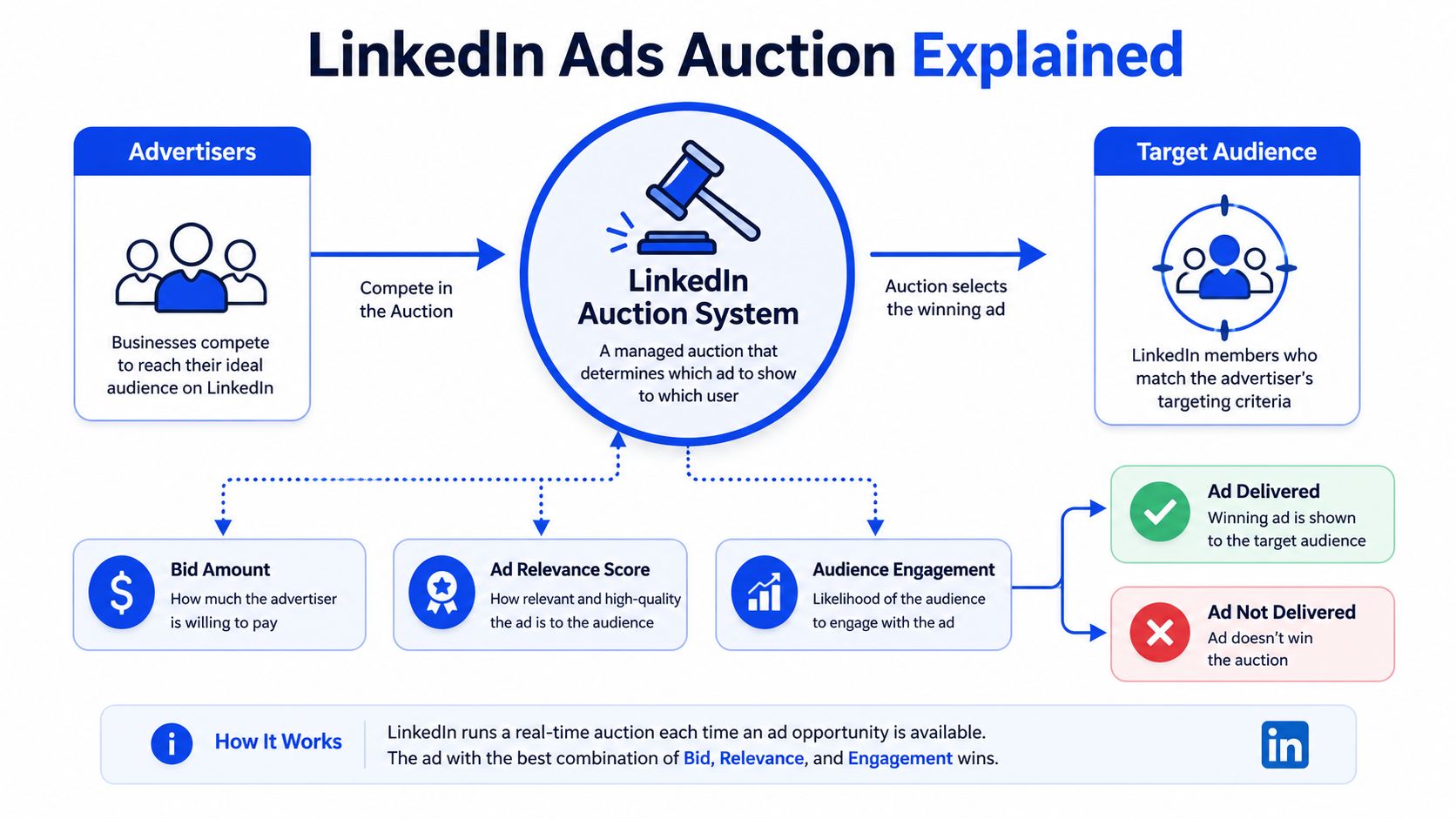
LinkedIn sells access to specific professional audiences, and those audiences have very different commercial values. A campaign targeting HR generalists at mid-market companies sits in a different auction than one targeting CIOs at enterprise manufacturers. The second audience costs more because more advertisers are willing to pay for it.
The platform does have entry-level thresholds. You can launch with a $10 daily budget per campaign and a $2.00 minimum CPC bid. Those numbers matter less than the clearing price in the auction. If the people you want are expensive to reach, LinkedIn will charge accordingly.
That is why underfunded campaigns create bad decisions. The campaign can spend enough to look active in-platform, but not enough to produce a stable read on CTR, conversion rate, lead quality, or meeting rate. For B2B teams, especially in SaaS, iGaming, and manufacturing, the useful question is not whether LinkedIn can buy traffic. It is whether the spend level is high enough to tell you the cost per qualified meeting.
For a plain-language breakdown of the platform itself, Grou's LinkedIn Ads glossary is useful if you need a quick reference for teams outside paid media.
Format changes the economics
LinkedIn charges differently depending on the ad unit and campaign objective. That changes the math fast.
Feed ads usually carry the highest CPCs, but they also give you the most room to sell a serious B2B offer. You can show proof, explain the problem, and qualify the click before the visit. That usually makes them the default choice for teams selling a long-consideration product or trying to reach a buying committee.
Text Ads and some lower-cost units can reduce the top-line click price. In practice, they often shift cost downstream. Cheaper clicks are not helpful if fewer of those visitors become sales-accepted leads or booked meetings. Message-based formats create another reporting trap because the billing model can look efficient while response quality stays weak.
The format decision is a funnel decision, not a media buying detail. A lower CPC format that attracts light intent can produce a higher cost per opportunity than a more expensive feed campaign that filters harder upfront.
What pushes prices up
Three factors drive most cost inflation on LinkedIn:
Cost driver | What happens in practice |
|---|---|
Audience seniority | Senior decision-makers cost more because more B2B advertisers compete for them |
Audience tightness | Narrow filters reduce available inventory, which raises auction pressure |
Market competition | Categories with aggressive demand gen budgets, such as B2B SaaS, get more expensive faster |
One more trade-off matters. Better targeting usually raises media cost while improving sales relevance. Broad targeting can make the dashboard look healthier and the pipeline look worse.
That is why I rarely judge LinkedIn on CPC alone. The right lens is whether the auction price for a specific audience and format can still support your target cost per qualified meeting.
What to actually expect to pay B2B benchmarks for 2026
A VP Marketing approves a LinkedIn test with a healthy CPC target in mind, then gets blindsided three weeks later when the actual question from sales is much harder: how much did we pay for one qualified meeting?
That is the benchmark that matters in 2026.
What public benchmarks tell you
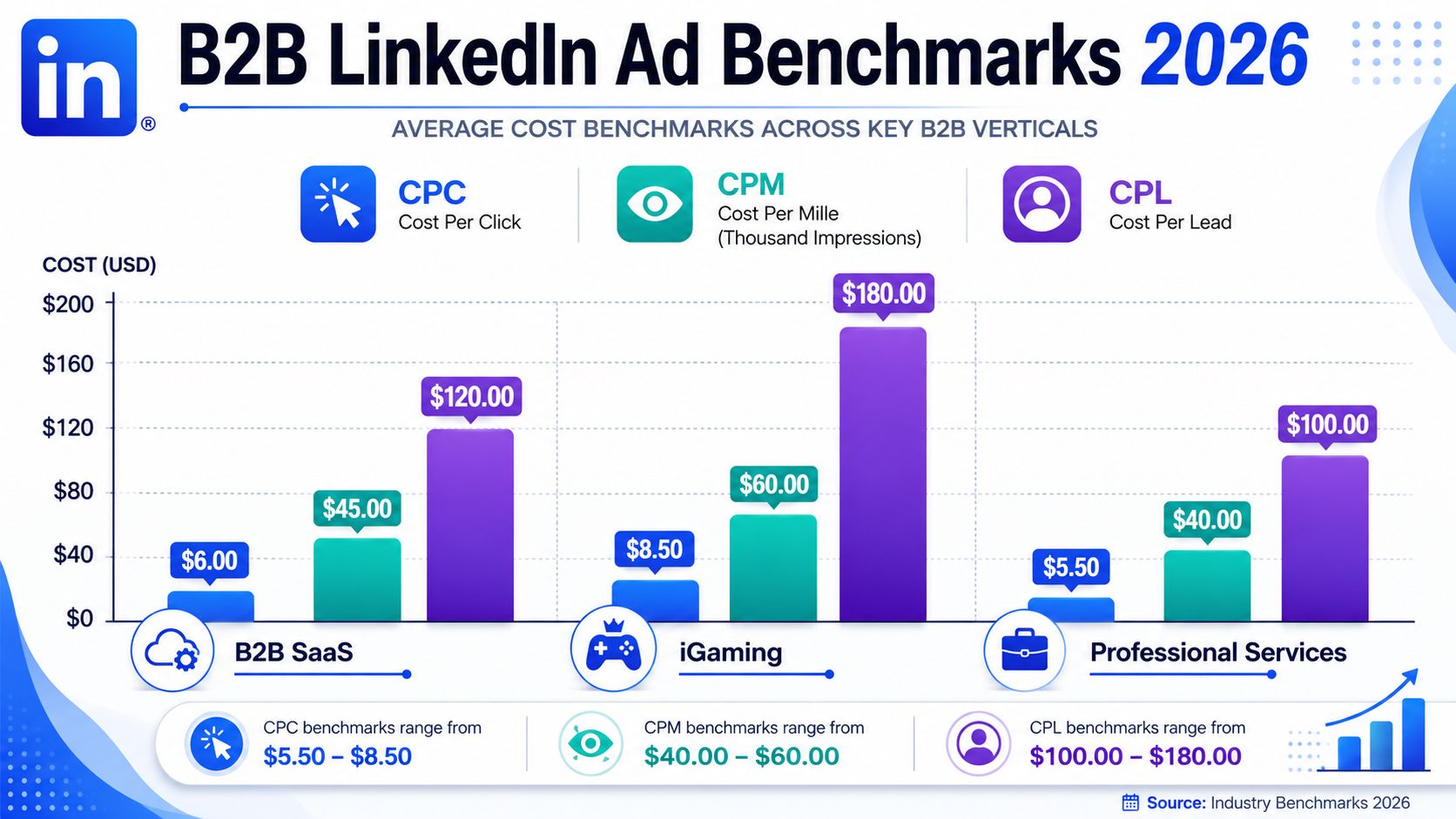
Analysts at Dreamdata found global sponsored content CTR around 0.44% to 0.65%, CPC around $5.58, and lead-gen form completion rates around 10%. The same report puts the average time from first LinkedIn ad impression to revenue at 320 days, 235 days from ad engagement to revenue, and 219 days from first conversion to revenue.
Those numbers are useful, but they are only the starting point. They describe platform-wide behavior across many campaign types, geographies, and sales motions. They do not tell a SaaS team targeting enterprise revenue leaders, an iGaming company selling into regulated operators, or a manufacturing brand trying to book distributor and procurement conversations what their program will cost to turn into pipeline.
That is why I treat public CPC and CPL data as a calibration layer, not a budget model. A cost per lead reference helps frame the math, but LinkedIn can produce a low CPL and still miss on account fit, buying power, or meeting quality.
If you want to pressure-test the economics before launch, use a simple model to calculate your cost per lead and then push one step further into cost per sales-qualified conversation.
Here's the embedded walkthrough if you want a quick visual take on the channel economics:
What changes your costs in practice
The biggest swings usually come from commercial context.
A broad mid-market SaaS audience in North America can clear at one price. A narrow audience of VPs, compliance leaders, or operations heads inside named accounts can clear much higher. The media cost rises because you are bidding on scarcer inventory, against advertisers who can justify paying more for the same people.
Three patterns show up repeatedly in live B2B programs:
High-value software categories pay a premium. Generic clicks may land in a manageable range, but enterprise SaaS, legal tech, and other crowded B2B categories often rise fast once you layer in seniority and firmographic filters.
Seniority raises the floor. Manager audiences may produce cheaper traffic. VP and C-suite audiences usually cost more because more vendors want access to the same decision-makers.
Qualified audience design can improve economics while making the dashboard look worse. Higher CPC is often acceptable if it cuts junk leads, shortens sales follow-up, and produces more booked meetings per 100 clicks.
That last point is where many teams misread the channel. A campaign with a $7 click that turns into low-fit form fills can be less efficient than a campaign with a $16 click that consistently reaches your ICP and creates real sales conversations.
Paying more to reach the right buying group is often the cheaper decision once sales quality is included.
What a head of marketing should take from these benchmarks
Treat LinkedIn cost as a market access price, not just a traffic price.
If you sell to enterprise RevOps leaders in SaaS, compliance stakeholders in iGaming, or procurement and engineering teams in manufacturing, the benchmark to watch is cost per qualified meeting and downstream opportunity rate. CPC helps explain auction pressure. It does not tell you whether the spend can support pipeline.
That is why LinkedIn often looks expensive at the click level and reasonable at the opportunity level. The platform charges a premium for precise B2B access. For the right offer and audience, that premium can still produce strong unit economics.
How to forecast your budget and expected lead volume
A common planning mistake looks like this. The team sets aside $2,000 for LinkedIn, hopes for a cheap CPL, and expects pipeline in 30 days. Then the campaign reaches a narrow buying group, clicks are expensive, volume stays thin, and nobody can tell whether the problem is audience, offer, or budget.
Forecasting fixes that. Start from qualified meetings, not clicks, because LinkedIn is usually bought for access to specific B2B buyers, not for low-cost traffic.
Start with the floor, not the fantasy
The practical floor is the amount of spend required to get enough data to make a decision. In real B2B accounts, that usually means enough budget to generate a usable number of clicks, some form fills or demo requests, and at least a few sales-qualified conversations. A budget that only buys a trickle of traffic creates false negatives. The campaign may be viable, but the account never gets enough signal to prove it.
Build the forecast backward from revenue logic:
Set a target for qualified meetings per month.
Estimate how many leads you need to produce those meetings.
Estimate how many clicks you need to produce those leads.
Multiply by expected CPC to get spend.
That gives finance and RevOps something they can pressure-test before launch. If you need a simple framework to calculate your cost per lead, use that first, then adjust it for LinkedIn reality by layering in qualification rate and meeting rate.
Here is the part teams skip. A lead is not the unit that pays back LinkedIn spend. A qualified meeting is closer to the true unit, especially in SaaS, iGaming, and manufacturing, where sales capacity and fit matter more than raw form volume.
Use a three-tier budget model
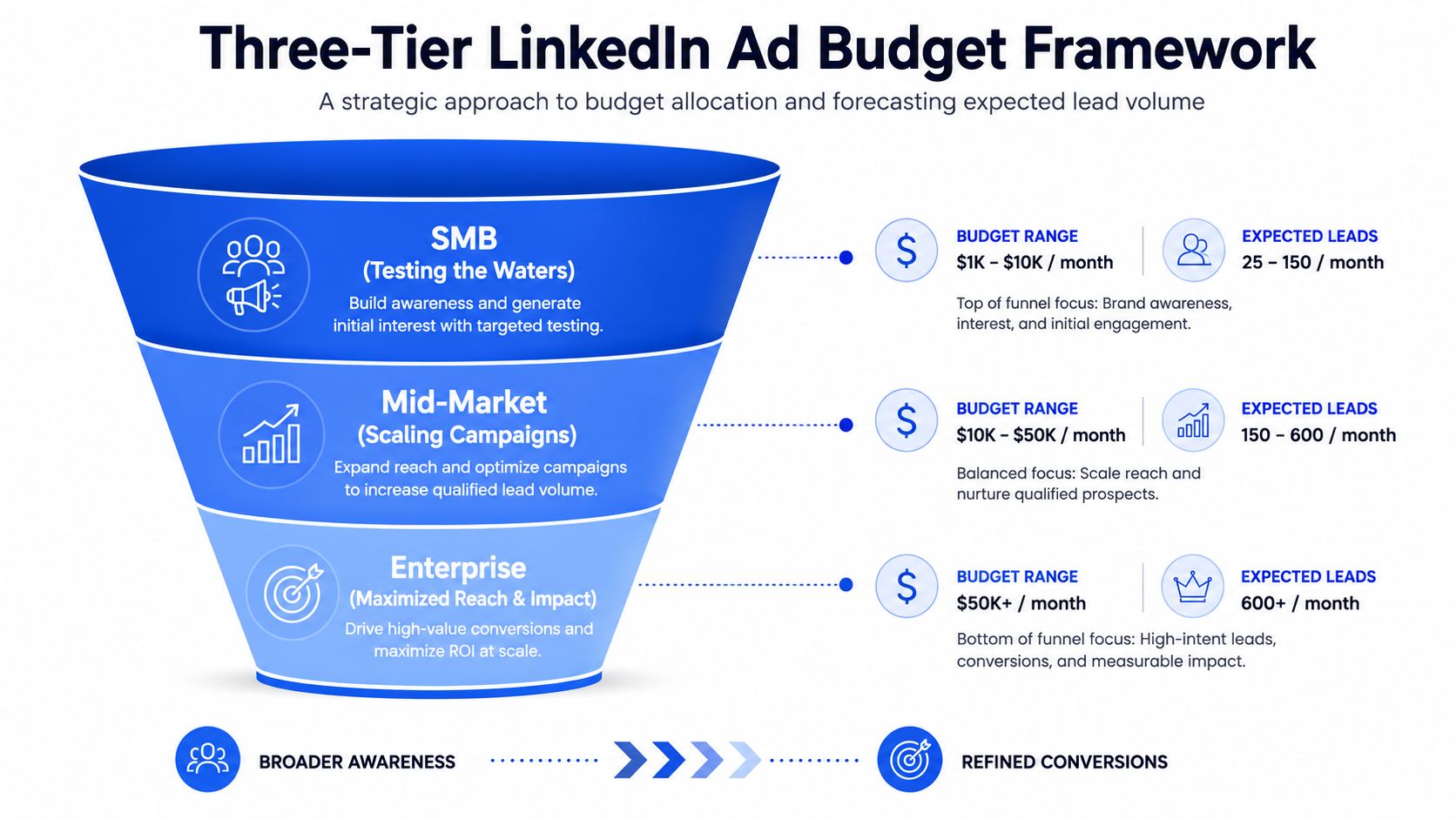
Three budget bands cover most serious LinkedIn programs.
Tier 1, validate the motion
This is the minimum level where a campaign can answer a business question. Can you reach the right people, get them to convert, and turn those conversions into booked sales conversations?
Use this tier when:
You are testing one ICP or one offer
You only need directional evidence
LinkedIn supports outbound or ABM, rather than carrying pipeline alone
Keep the setup tight. One core audience. Limited creative variation. One clear conversion path. If you split a small budget across job functions, seniority bands, offers, and formats at the same time, the account learns slowly and the forecast becomes noise.
Tier 2, make LinkedIn a real demand source
At this level, the channel can support sharper decisions. You can compare one segment against another, separate prospecting from retargeting, and spot quality differences in CRM stages before the quarter ends.
This is also where process starts to matter as much as media buying. A structured LinkedIn lead gen system helps because spend alone will not explain why one campaign creates meetings and another creates unworked leads. You need clean routing, qualification rules, and consistent source tracking.
Tier 3, run LinkedIn as a primary pipeline channel
Higher budgets only work when the commercial system can absorb them. More spend increases the rate of learning, but it also exposes weak follow-up, unclear qualification, and stale creative faster.
Use this tier only if these conditions are already in place:
Condition | Why it matters |
|---|---|
Conversion tracking is clean | Optimization fails when the platform gets bad or incomplete signals |
Sales follow-up is disciplined | A high-intent lead loses value quickly when routing is slow |
Creative production is ongoing | Larger budgets fatigue winning ads faster |
If Tier 1 economics are weak, Tier 3 usually scales the waste.
What to reserve inside the budget
Part of the budget needs to be protected for testing. That is how you improve cost per qualified meeting over time. In practice, that reserve covers new message angles, fresh creatives, tighter landing page variants, and audience exclusions that reduce low-fit submissions.
A simple rule works well. Fund the control first. Then set aside a defined test budget so the account keeps learning without starving the campaign that is already producing pipeline.
That matters more on LinkedIn than on cheaper social channels. The click costs are high enough that one weak month of testing can look expensive in the dashboard. The upside is that a useful test can improve sales efficiency for months if it raises meeting rate or filters out bad-fit leads earlier.
The forecast should answer one question clearly. How much spend is required to produce a realistic number of qualified meetings from this audience, with enough testing budget to improve the economics after launch?
Two tactical choices that control your campaign costs
A common LinkedIn scenario looks like this. CPC comes in high, the lead count looks acceptable, and sales still says the pipeline is weak. The problem is usually not the auction alone. It is the combination of bid strategy and weak stop rules.
Bidding strategy verdict
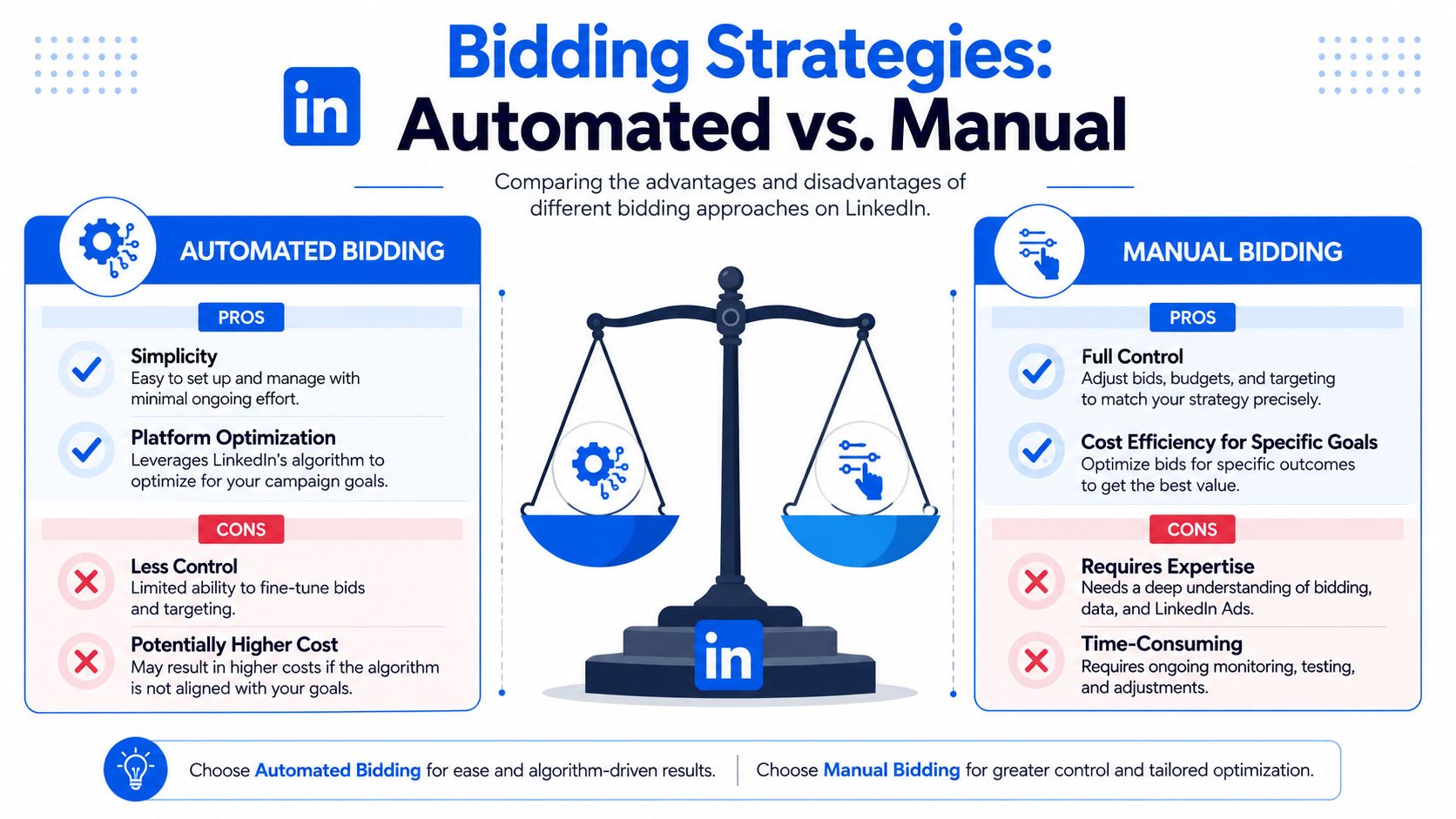
For most B2B teams, the safest starting point is manual bidding. Switch to automated bidding after the campaign has enough conversion history tied to a meaningful business event, not just form fills.
The reason is simple. Early in a campaign, LinkedIn has limited signal, especially in narrow SaaS, manufacturing, or specialist service audiences. Manual bidding gives tighter control over pacing and lets you see whether the audience-message fit is strong before the platform starts spending more aggressively. Once the account is producing steady conversion data, automated bidding can improve delivery efficiency, but only if the signal reflects qualified opportunities.
A practical structure looks like this:
Use manual bidding at launch for new campaigns, smaller budgets, and narrow account lists.
Switch to automated bidding once conversion tracking is reliable and the campaign has enough volume to optimize toward a sales-relevant action.
Keep the bid strategy stable long enough to judge it because repeated changes reset performance patterns and make comparisons less useful.
In expensive B2B categories, CPC can sit well above what teams expect from Meta or Google display. That is why the better question is not whether a click cost $12 or $20. The better question is whether that traffic turns into qualified meetings at an acceptable rate.
Manual versus automated in plain terms
Approach | Better when | Risk |
|---|---|---|
Manual bidding | New launches, smaller budgets, narrow audiences | You can bid too low and limit delivery |
Automated bidding | Mature campaigns, clean conversion data, broader scale | It can spend hard against weak signals |
The best operators buy for outcome quality, not cheap traffic. That is the difference between vanity lead volume and high-value LinkedIn leads that sales will take seriously. In practice, I would rather accept a higher CPC if the audience is tighter, the job titles are right, and the meeting rate holds.
A $20 click that produces qualified meetings is cheaper than a $9 click that fills the CRM with rejects.
If you want a more detailed operating reference, this guide on ads on LinkedIn for B2B campaigns covers the setup decisions that affect efficiency after launch.
Pause rules matter more than teams expect
A large share of wasted LinkedIn spend comes from campaigns that should have been paused a week earlier. Teams keep them running because CTR is still passable or because volume looks healthy at the top of the funnel. Neither metric pays for pipeline.
Set stop conditions before launch. Use the same thresholds across marketing and sales so there is no debate after spend is gone.
Pause and review when these patterns show up:
Qualified cost moves beyond target for long enough to matter. If cost per qualified lead or meeting stays above what your model can support, stop and diagnose.
Sales acceptance rate drops. If form volume holds but the SDR team rejects a larger share, targeting or message fit has slipped.
Frequency rises in a small audience without more conversion. That usually means the market has absorbed the message and creative refresh is overdue.
CTR falls on a previously stable ad set. That points to creative fatigue, offer fatigue, or tougher auction pressure.
Work through the diagnosis in three places:
Audience: Was the targeting widened, loosened, or split into segments too small to learn?
Creative: Are old ads still carrying spend after response has faded?
Tracking: Is LinkedIn receiving clean offline conversion feedback from HubSpot or your CRM?
Tools support the process, but process decides the outcome. Sales Navigator helps tighten account targeting. HubSpot keeps stage definitions consistent. Clay can clean and enrich lists before upload. Grou can connect paid, outbound, and reporting around the same target accounts and qualification model, which is often the missing piece when campaign metrics and pipeline metrics do not match.
Turning your ad spend into predictable pipeline
The cost for LinkedIn ads is high enough that sloppy structure gets exposed fast. That's useful, not just painful. It forces clarity on who you want to reach, what action you want, and whether sales can turn demand into revenue.
The mistake is treating LinkedIn like a cheap click engine. It isn't. The click is only the entry point. The return comes from the system around it, audience quality, message fit, CRM stages, follow-up speed, and the discipline to stop funding campaigns that aren't producing qualified conversations.
If you need a broader operating reference for the downstream side, Stamina's sales pipeline guide is worth reviewing with both marketing and sales in the same room. LinkedIn works better when both teams agree on what “pipeline contribution” means.
Track cost per qualified meeting this Friday. If you can't produce that number from your current setup, fix the reporting path before you raise the budget.
The next step is specific. Pull your last 60 days of LinkedIn spend, map each campaign to qualified meetings in your CRM, and mark which campaigns had enough volume to support a real decision. Everything else is noise.
Grou helps B2B teams connect LinkedIn, outbound, and reporting into one pipeline system. The method is simple, one target list, one message architecture, one qualification model, and one view of performance from first touch to qualified meeting.
You're probably in the same spot most B2B teams hit with LinkedIn. Sales wants more qualified meetings, finance wants a forecast, and every public benchmark feels too broad to trust. The important question isn't whether LinkedIn is expensive. It is. The question is whether your structure turns that spend into pipeline.
LinkedIn is a premium B2B channel, with sponsored content often costing $5 to $8 per click and average CPC benchmarks around $5.39 to $5.58 globally in 2026 estimates, depending on format and audience (Aimers).
The platform needs real budget to learn, even though the technical minimum is only $10 per day per campaign (Stackmatix).
Higher CPC can still be rational because LinkedIn often influences revenue over a long sales cycle, not a short response window.
The metric that matters is downstream, cost per qualified meeting and pipeline created, not the cheapest click.
Table of Contents
Your LinkedIn ads budget needs a forecast, not a guess
Many teams asking about the cost for LinkedIn ads don't have a pricing problem. They have a planning problem. They need to answer a finance question with channel logic that holds up.
If you tell your CFO, “LinkedIn CPC is around five bucks,” that won't help. It ignores audience seniority, market competition, ad format, sales cycle length, and whether you're buying reach or buying access to decision-makers.
What a usable forecast has to include
A budget forecast needs three inputs:
Media economics: what LinkedIn is likely to charge for the audience and format you want
Learning threshold: how much spend is required before the campaign produces enough signal to judge
Downstream conversion path: what happens after the click, inside HubSpot or your CRM, until a lead becomes a qualified meeting
That third point is where most forecasts break. Teams obsess over CPC because it's visible in the ad account. Revenue leaders care about meeting-held rate, opportunity creation, and whether the channel influences the right accounts.
Practical rule: If you can't connect LinkedIn spend to a qualified meeting definition in your CRM, you're not forecasting. You're budgeting blind.
There's a reason this matters beyond paid media reporting. A clean KPI tree keeps channel conversations grounded, especially when the top-line click cost looks high. If your internal reporting still collapses everything into MQL volume, fix that first with a tighter lead generation KPI framework.
The operator view
LinkedIn isn't where you go for cheap attention. It's where you go when role, seniority, and company context matter enough that paying more is justified.
That means the right budget number is rarely the minimum LinkedIn allows. It is the amount required to get enough signal to decide whether your audience, offer, and creative can produce qualified pipeline at an acceptable cost.
How LinkedIn ads pricing actually works
A head of marketing approves a LinkedIn test with a modest budget, sees clicks come in, and assumes the channel is working. Four weeks later, there is still no clear read on whether the spend can produce qualified meetings. The problem usually is not the platform minimums. It is how the auction, the format, and the audience interact.
The auction sets your real price
LinkedIn sells access to specific professional audiences, and those audiences have very different commercial values. A campaign targeting HR generalists at mid-market companies sits in a different auction than one targeting CIOs at enterprise manufacturers. The second audience costs more because more advertisers are willing to pay for it.
The platform does have entry-level thresholds. You can launch with a $10 daily budget per campaign and a $2.00 minimum CPC bid. Those numbers matter less than the clearing price in the auction. If the people you want are expensive to reach, LinkedIn will charge accordingly.
That is why underfunded campaigns create bad decisions. The campaign can spend enough to look active in-platform, but not enough to produce a stable read on CTR, conversion rate, lead quality, or meeting rate. For B2B teams, especially in SaaS, iGaming, and manufacturing, the useful question is not whether LinkedIn can buy traffic. It is whether the spend level is high enough to tell you the cost per qualified meeting.
For a plain-language breakdown of the platform itself, Grou's LinkedIn Ads glossary is useful if you need a quick reference for teams outside paid media.
Format changes the economics
LinkedIn charges differently depending on the ad unit and campaign objective. That changes the math fast.
Feed ads usually carry the highest CPCs, but they also give you the most room to sell a serious B2B offer. You can show proof, explain the problem, and qualify the click before the visit. That usually makes them the default choice for teams selling a long-consideration product or trying to reach a buying committee.
Text Ads and some lower-cost units can reduce the top-line click price. In practice, they often shift cost downstream. Cheaper clicks are not helpful if fewer of those visitors become sales-accepted leads or booked meetings. Message-based formats create another reporting trap because the billing model can look efficient while response quality stays weak.
The format decision is a funnel decision, not a media buying detail. A lower CPC format that attracts light intent can produce a higher cost per opportunity than a more expensive feed campaign that filters harder upfront.
What pushes prices up
Three factors drive most cost inflation on LinkedIn:
Cost driver | What happens in practice |
|---|---|
Audience seniority | Senior decision-makers cost more because more B2B advertisers compete for them |
Audience tightness | Narrow filters reduce available inventory, which raises auction pressure |
Market competition | Categories with aggressive demand gen budgets, such as B2B SaaS, get more expensive faster |
One more trade-off matters. Better targeting usually raises media cost while improving sales relevance. Broad targeting can make the dashboard look healthier and the pipeline look worse.
That is why I rarely judge LinkedIn on CPC alone. The right lens is whether the auction price for a specific audience and format can still support your target cost per qualified meeting.
What to actually expect to pay B2B benchmarks for 2026
A VP Marketing approves a LinkedIn test with a healthy CPC target in mind, then gets blindsided three weeks later when the actual question from sales is much harder: how much did we pay for one qualified meeting?
That is the benchmark that matters in 2026.
What public benchmarks tell you
Analysts at Dreamdata found global sponsored content CTR around 0.44% to 0.65%, CPC around $5.58, and lead-gen form completion rates around 10%. The same report puts the average time from first LinkedIn ad impression to revenue at 320 days, 235 days from ad engagement to revenue, and 219 days from first conversion to revenue.
Those numbers are useful, but they are only the starting point. They describe platform-wide behavior across many campaign types, geographies, and sales motions. They do not tell a SaaS team targeting enterprise revenue leaders, an iGaming company selling into regulated operators, or a manufacturing brand trying to book distributor and procurement conversations what their program will cost to turn into pipeline.
That is why I treat public CPC and CPL data as a calibration layer, not a budget model. A cost per lead reference helps frame the math, but LinkedIn can produce a low CPL and still miss on account fit, buying power, or meeting quality.
If you want to pressure-test the economics before launch, use a simple model to calculate your cost per lead and then push one step further into cost per sales-qualified conversation.
Here's the embedded walkthrough if you want a quick visual take on the channel economics:
What changes your costs in practice
The biggest swings usually come from commercial context.
A broad mid-market SaaS audience in North America can clear at one price. A narrow audience of VPs, compliance leaders, or operations heads inside named accounts can clear much higher. The media cost rises because you are bidding on scarcer inventory, against advertisers who can justify paying more for the same people.
Three patterns show up repeatedly in live B2B programs:
High-value software categories pay a premium. Generic clicks may land in a manageable range, but enterprise SaaS, legal tech, and other crowded B2B categories often rise fast once you layer in seniority and firmographic filters.
Seniority raises the floor. Manager audiences may produce cheaper traffic. VP and C-suite audiences usually cost more because more vendors want access to the same decision-makers.
Qualified audience design can improve economics while making the dashboard look worse. Higher CPC is often acceptable if it cuts junk leads, shortens sales follow-up, and produces more booked meetings per 100 clicks.
That last point is where many teams misread the channel. A campaign with a $7 click that turns into low-fit form fills can be less efficient than a campaign with a $16 click that consistently reaches your ICP and creates real sales conversations.
Paying more to reach the right buying group is often the cheaper decision once sales quality is included.
What a head of marketing should take from these benchmarks
Treat LinkedIn cost as a market access price, not just a traffic price.
If you sell to enterprise RevOps leaders in SaaS, compliance stakeholders in iGaming, or procurement and engineering teams in manufacturing, the benchmark to watch is cost per qualified meeting and downstream opportunity rate. CPC helps explain auction pressure. It does not tell you whether the spend can support pipeline.
That is why LinkedIn often looks expensive at the click level and reasonable at the opportunity level. The platform charges a premium for precise B2B access. For the right offer and audience, that premium can still produce strong unit economics.
How to forecast your budget and expected lead volume
A common planning mistake looks like this. The team sets aside $2,000 for LinkedIn, hopes for a cheap CPL, and expects pipeline in 30 days. Then the campaign reaches a narrow buying group, clicks are expensive, volume stays thin, and nobody can tell whether the problem is audience, offer, or budget.
Forecasting fixes that. Start from qualified meetings, not clicks, because LinkedIn is usually bought for access to specific B2B buyers, not for low-cost traffic.
Start with the floor, not the fantasy
The practical floor is the amount of spend required to get enough data to make a decision. In real B2B accounts, that usually means enough budget to generate a usable number of clicks, some form fills or demo requests, and at least a few sales-qualified conversations. A budget that only buys a trickle of traffic creates false negatives. The campaign may be viable, but the account never gets enough signal to prove it.
Build the forecast backward from revenue logic:
Set a target for qualified meetings per month.
Estimate how many leads you need to produce those meetings.
Estimate how many clicks you need to produce those leads.
Multiply by expected CPC to get spend.
That gives finance and RevOps something they can pressure-test before launch. If you need a simple framework to calculate your cost per lead, use that first, then adjust it for LinkedIn reality by layering in qualification rate and meeting rate.
Here is the part teams skip. A lead is not the unit that pays back LinkedIn spend. A qualified meeting is closer to the true unit, especially in SaaS, iGaming, and manufacturing, where sales capacity and fit matter more than raw form volume.
Use a three-tier budget model
Three budget bands cover most serious LinkedIn programs.
Tier 1, validate the motion
This is the minimum level where a campaign can answer a business question. Can you reach the right people, get them to convert, and turn those conversions into booked sales conversations?
Use this tier when:
You are testing one ICP or one offer
You only need directional evidence
LinkedIn supports outbound or ABM, rather than carrying pipeline alone
Keep the setup tight. One core audience. Limited creative variation. One clear conversion path. If you split a small budget across job functions, seniority bands, offers, and formats at the same time, the account learns slowly and the forecast becomes noise.
Tier 2, make LinkedIn a real demand source
At this level, the channel can support sharper decisions. You can compare one segment against another, separate prospecting from retargeting, and spot quality differences in CRM stages before the quarter ends.
This is also where process starts to matter as much as media buying. A structured LinkedIn lead gen system helps because spend alone will not explain why one campaign creates meetings and another creates unworked leads. You need clean routing, qualification rules, and consistent source tracking.
Tier 3, run LinkedIn as a primary pipeline channel
Higher budgets only work when the commercial system can absorb them. More spend increases the rate of learning, but it also exposes weak follow-up, unclear qualification, and stale creative faster.
Use this tier only if these conditions are already in place:
Condition | Why it matters |
|---|---|
Conversion tracking is clean | Optimization fails when the platform gets bad or incomplete signals |
Sales follow-up is disciplined | A high-intent lead loses value quickly when routing is slow |
Creative production is ongoing | Larger budgets fatigue winning ads faster |
If Tier 1 economics are weak, Tier 3 usually scales the waste.
What to reserve inside the budget
Part of the budget needs to be protected for testing. That is how you improve cost per qualified meeting over time. In practice, that reserve covers new message angles, fresh creatives, tighter landing page variants, and audience exclusions that reduce low-fit submissions.
A simple rule works well. Fund the control first. Then set aside a defined test budget so the account keeps learning without starving the campaign that is already producing pipeline.
That matters more on LinkedIn than on cheaper social channels. The click costs are high enough that one weak month of testing can look expensive in the dashboard. The upside is that a useful test can improve sales efficiency for months if it raises meeting rate or filters out bad-fit leads earlier.
The forecast should answer one question clearly. How much spend is required to produce a realistic number of qualified meetings from this audience, with enough testing budget to improve the economics after launch?
Two tactical choices that control your campaign costs
A common LinkedIn scenario looks like this. CPC comes in high, the lead count looks acceptable, and sales still says the pipeline is weak. The problem is usually not the auction alone. It is the combination of bid strategy and weak stop rules.
Bidding strategy verdict
For most B2B teams, the safest starting point is manual bidding. Switch to automated bidding after the campaign has enough conversion history tied to a meaningful business event, not just form fills.
The reason is simple. Early in a campaign, LinkedIn has limited signal, especially in narrow SaaS, manufacturing, or specialist service audiences. Manual bidding gives tighter control over pacing and lets you see whether the audience-message fit is strong before the platform starts spending more aggressively. Once the account is producing steady conversion data, automated bidding can improve delivery efficiency, but only if the signal reflects qualified opportunities.
A practical structure looks like this:
Use manual bidding at launch for new campaigns, smaller budgets, and narrow account lists.
Switch to automated bidding once conversion tracking is reliable and the campaign has enough volume to optimize toward a sales-relevant action.
Keep the bid strategy stable long enough to judge it because repeated changes reset performance patterns and make comparisons less useful.
In expensive B2B categories, CPC can sit well above what teams expect from Meta or Google display. That is why the better question is not whether a click cost $12 or $20. The better question is whether that traffic turns into qualified meetings at an acceptable rate.
Manual versus automated in plain terms
Approach | Better when | Risk |
|---|---|---|
Manual bidding | New launches, smaller budgets, narrow audiences | You can bid too low and limit delivery |
Automated bidding | Mature campaigns, clean conversion data, broader scale | It can spend hard against weak signals |
The best operators buy for outcome quality, not cheap traffic. That is the difference between vanity lead volume and high-value LinkedIn leads that sales will take seriously. In practice, I would rather accept a higher CPC if the audience is tighter, the job titles are right, and the meeting rate holds.
A $20 click that produces qualified meetings is cheaper than a $9 click that fills the CRM with rejects.
If you want a more detailed operating reference, this guide on ads on LinkedIn for B2B campaigns covers the setup decisions that affect efficiency after launch.
Pause rules matter more than teams expect
A large share of wasted LinkedIn spend comes from campaigns that should have been paused a week earlier. Teams keep them running because CTR is still passable or because volume looks healthy at the top of the funnel. Neither metric pays for pipeline.
Set stop conditions before launch. Use the same thresholds across marketing and sales so there is no debate after spend is gone.
Pause and review when these patterns show up:
Qualified cost moves beyond target for long enough to matter. If cost per qualified lead or meeting stays above what your model can support, stop and diagnose.
Sales acceptance rate drops. If form volume holds but the SDR team rejects a larger share, targeting or message fit has slipped.
Frequency rises in a small audience without more conversion. That usually means the market has absorbed the message and creative refresh is overdue.
CTR falls on a previously stable ad set. That points to creative fatigue, offer fatigue, or tougher auction pressure.
Work through the diagnosis in three places:
Audience: Was the targeting widened, loosened, or split into segments too small to learn?
Creative: Are old ads still carrying spend after response has faded?
Tracking: Is LinkedIn receiving clean offline conversion feedback from HubSpot or your CRM?
Tools support the process, but process decides the outcome. Sales Navigator helps tighten account targeting. HubSpot keeps stage definitions consistent. Clay can clean and enrich lists before upload. Grou can connect paid, outbound, and reporting around the same target accounts and qualification model, which is often the missing piece when campaign metrics and pipeline metrics do not match.
Turning your ad spend into predictable pipeline
The cost for LinkedIn ads is high enough that sloppy structure gets exposed fast. That's useful, not just painful. It forces clarity on who you want to reach, what action you want, and whether sales can turn demand into revenue.
The mistake is treating LinkedIn like a cheap click engine. It isn't. The click is only the entry point. The return comes from the system around it, audience quality, message fit, CRM stages, follow-up speed, and the discipline to stop funding campaigns that aren't producing qualified conversations.
If you need a broader operating reference for the downstream side, Stamina's sales pipeline guide is worth reviewing with both marketing and sales in the same room. LinkedIn works better when both teams agree on what “pipeline contribution” means.
Track cost per qualified meeting this Friday. If you can't produce that number from your current setup, fix the reporting path before you raise the budget.
The next step is specific. Pull your last 60 days of LinkedIn spend, map each campaign to qualified meetings in your CRM, and mark which campaigns had enough volume to support a real decision. Everything else is noise.
Grou helps B2B teams connect LinkedIn, outbound, and reporting into one pipeline system. The method is simple, one target list, one message architecture, one qualification model, and one view of performance from first touch to qualified meeting.
You're probably in the same spot most B2B teams hit with LinkedIn. Sales wants more qualified meetings, finance wants a forecast, and every public benchmark feels too broad to trust. The important question isn't whether LinkedIn is expensive. It is. The question is whether your structure turns that spend into pipeline.
LinkedIn is a premium B2B channel, with sponsored content often costing $5 to $8 per click and average CPC benchmarks around $5.39 to $5.58 globally in 2026 estimates, depending on format and audience (Aimers).
The platform needs real budget to learn, even though the technical minimum is only $10 per day per campaign (Stackmatix).
Higher CPC can still be rational because LinkedIn often influences revenue over a long sales cycle, not a short response window.
The metric that matters is downstream, cost per qualified meeting and pipeline created, not the cheapest click.
Table of Contents
Your LinkedIn ads budget needs a forecast, not a guess
Many teams asking about the cost for LinkedIn ads don't have a pricing problem. They have a planning problem. They need to answer a finance question with channel logic that holds up.
If you tell your CFO, “LinkedIn CPC is around five bucks,” that won't help. It ignores audience seniority, market competition, ad format, sales cycle length, and whether you're buying reach or buying access to decision-makers.
What a usable forecast has to include
A budget forecast needs three inputs:
Media economics: what LinkedIn is likely to charge for the audience and format you want
Learning threshold: how much spend is required before the campaign produces enough signal to judge
Downstream conversion path: what happens after the click, inside HubSpot or your CRM, until a lead becomes a qualified meeting
That third point is where most forecasts break. Teams obsess over CPC because it's visible in the ad account. Revenue leaders care about meeting-held rate, opportunity creation, and whether the channel influences the right accounts.
Practical rule: If you can't connect LinkedIn spend to a qualified meeting definition in your CRM, you're not forecasting. You're budgeting blind.
There's a reason this matters beyond paid media reporting. A clean KPI tree keeps channel conversations grounded, especially when the top-line click cost looks high. If your internal reporting still collapses everything into MQL volume, fix that first with a tighter lead generation KPI framework.
The operator view
LinkedIn isn't where you go for cheap attention. It's where you go when role, seniority, and company context matter enough that paying more is justified.
That means the right budget number is rarely the minimum LinkedIn allows. It is the amount required to get enough signal to decide whether your audience, offer, and creative can produce qualified pipeline at an acceptable cost.
How LinkedIn ads pricing actually works
A head of marketing approves a LinkedIn test with a modest budget, sees clicks come in, and assumes the channel is working. Four weeks later, there is still no clear read on whether the spend can produce qualified meetings. The problem usually is not the platform minimums. It is how the auction, the format, and the audience interact.
The auction sets your real price
LinkedIn sells access to specific professional audiences, and those audiences have very different commercial values. A campaign targeting HR generalists at mid-market companies sits in a different auction than one targeting CIOs at enterprise manufacturers. The second audience costs more because more advertisers are willing to pay for it.
The platform does have entry-level thresholds. You can launch with a $10 daily budget per campaign and a $2.00 minimum CPC bid. Those numbers matter less than the clearing price in the auction. If the people you want are expensive to reach, LinkedIn will charge accordingly.
That is why underfunded campaigns create bad decisions. The campaign can spend enough to look active in-platform, but not enough to produce a stable read on CTR, conversion rate, lead quality, or meeting rate. For B2B teams, especially in SaaS, iGaming, and manufacturing, the useful question is not whether LinkedIn can buy traffic. It is whether the spend level is high enough to tell you the cost per qualified meeting.
For a plain-language breakdown of the platform itself, Grou's LinkedIn Ads glossary is useful if you need a quick reference for teams outside paid media.
Format changes the economics
LinkedIn charges differently depending on the ad unit and campaign objective. That changes the math fast.
Feed ads usually carry the highest CPCs, but they also give you the most room to sell a serious B2B offer. You can show proof, explain the problem, and qualify the click before the visit. That usually makes them the default choice for teams selling a long-consideration product or trying to reach a buying committee.
Text Ads and some lower-cost units can reduce the top-line click price. In practice, they often shift cost downstream. Cheaper clicks are not helpful if fewer of those visitors become sales-accepted leads or booked meetings. Message-based formats create another reporting trap because the billing model can look efficient while response quality stays weak.
The format decision is a funnel decision, not a media buying detail. A lower CPC format that attracts light intent can produce a higher cost per opportunity than a more expensive feed campaign that filters harder upfront.
What pushes prices up
Three factors drive most cost inflation on LinkedIn:
Cost driver | What happens in practice |
|---|---|
Audience seniority | Senior decision-makers cost more because more B2B advertisers compete for them |
Audience tightness | Narrow filters reduce available inventory, which raises auction pressure |
Market competition | Categories with aggressive demand gen budgets, such as B2B SaaS, get more expensive faster |
One more trade-off matters. Better targeting usually raises media cost while improving sales relevance. Broad targeting can make the dashboard look healthier and the pipeline look worse.
That is why I rarely judge LinkedIn on CPC alone. The right lens is whether the auction price for a specific audience and format can still support your target cost per qualified meeting.
What to actually expect to pay B2B benchmarks for 2026
A VP Marketing approves a LinkedIn test with a healthy CPC target in mind, then gets blindsided three weeks later when the actual question from sales is much harder: how much did we pay for one qualified meeting?
That is the benchmark that matters in 2026.
What public benchmarks tell you
Analysts at Dreamdata found global sponsored content CTR around 0.44% to 0.65%, CPC around $5.58, and lead-gen form completion rates around 10%. The same report puts the average time from first LinkedIn ad impression to revenue at 320 days, 235 days from ad engagement to revenue, and 219 days from first conversion to revenue.
Those numbers are useful, but they are only the starting point. They describe platform-wide behavior across many campaign types, geographies, and sales motions. They do not tell a SaaS team targeting enterprise revenue leaders, an iGaming company selling into regulated operators, or a manufacturing brand trying to book distributor and procurement conversations what their program will cost to turn into pipeline.
That is why I treat public CPC and CPL data as a calibration layer, not a budget model. A cost per lead reference helps frame the math, but LinkedIn can produce a low CPL and still miss on account fit, buying power, or meeting quality.
If you want to pressure-test the economics before launch, use a simple model to calculate your cost per lead and then push one step further into cost per sales-qualified conversation.
Here's the embedded walkthrough if you want a quick visual take on the channel economics:
What changes your costs in practice
The biggest swings usually come from commercial context.
A broad mid-market SaaS audience in North America can clear at one price. A narrow audience of VPs, compliance leaders, or operations heads inside named accounts can clear much higher. The media cost rises because you are bidding on scarcer inventory, against advertisers who can justify paying more for the same people.
Three patterns show up repeatedly in live B2B programs:
High-value software categories pay a premium. Generic clicks may land in a manageable range, but enterprise SaaS, legal tech, and other crowded B2B categories often rise fast once you layer in seniority and firmographic filters.
Seniority raises the floor. Manager audiences may produce cheaper traffic. VP and C-suite audiences usually cost more because more vendors want access to the same decision-makers.
Qualified audience design can improve economics while making the dashboard look worse. Higher CPC is often acceptable if it cuts junk leads, shortens sales follow-up, and produces more booked meetings per 100 clicks.
That last point is where many teams misread the channel. A campaign with a $7 click that turns into low-fit form fills can be less efficient than a campaign with a $16 click that consistently reaches your ICP and creates real sales conversations.
Paying more to reach the right buying group is often the cheaper decision once sales quality is included.
What a head of marketing should take from these benchmarks
Treat LinkedIn cost as a market access price, not just a traffic price.
If you sell to enterprise RevOps leaders in SaaS, compliance stakeholders in iGaming, or procurement and engineering teams in manufacturing, the benchmark to watch is cost per qualified meeting and downstream opportunity rate. CPC helps explain auction pressure. It does not tell you whether the spend can support pipeline.
That is why LinkedIn often looks expensive at the click level and reasonable at the opportunity level. The platform charges a premium for precise B2B access. For the right offer and audience, that premium can still produce strong unit economics.
How to forecast your budget and expected lead volume
A common planning mistake looks like this. The team sets aside $2,000 for LinkedIn, hopes for a cheap CPL, and expects pipeline in 30 days. Then the campaign reaches a narrow buying group, clicks are expensive, volume stays thin, and nobody can tell whether the problem is audience, offer, or budget.
Forecasting fixes that. Start from qualified meetings, not clicks, because LinkedIn is usually bought for access to specific B2B buyers, not for low-cost traffic.
Start with the floor, not the fantasy
The practical floor is the amount of spend required to get enough data to make a decision. In real B2B accounts, that usually means enough budget to generate a usable number of clicks, some form fills or demo requests, and at least a few sales-qualified conversations. A budget that only buys a trickle of traffic creates false negatives. The campaign may be viable, but the account never gets enough signal to prove it.
Build the forecast backward from revenue logic:
Set a target for qualified meetings per month.
Estimate how many leads you need to produce those meetings.
Estimate how many clicks you need to produce those leads.
Multiply by expected CPC to get spend.
That gives finance and RevOps something they can pressure-test before launch. If you need a simple framework to calculate your cost per lead, use that first, then adjust it for LinkedIn reality by layering in qualification rate and meeting rate.
Here is the part teams skip. A lead is not the unit that pays back LinkedIn spend. A qualified meeting is closer to the true unit, especially in SaaS, iGaming, and manufacturing, where sales capacity and fit matter more than raw form volume.
Use a three-tier budget model
Three budget bands cover most serious LinkedIn programs.
Tier 1, validate the motion
This is the minimum level where a campaign can answer a business question. Can you reach the right people, get them to convert, and turn those conversions into booked sales conversations?
Use this tier when:
You are testing one ICP or one offer
You only need directional evidence
LinkedIn supports outbound or ABM, rather than carrying pipeline alone
Keep the setup tight. One core audience. Limited creative variation. One clear conversion path. If you split a small budget across job functions, seniority bands, offers, and formats at the same time, the account learns slowly and the forecast becomes noise.
Tier 2, make LinkedIn a real demand source
At this level, the channel can support sharper decisions. You can compare one segment against another, separate prospecting from retargeting, and spot quality differences in CRM stages before the quarter ends.
This is also where process starts to matter as much as media buying. A structured LinkedIn lead gen system helps because spend alone will not explain why one campaign creates meetings and another creates unworked leads. You need clean routing, qualification rules, and consistent source tracking.
Tier 3, run LinkedIn as a primary pipeline channel
Higher budgets only work when the commercial system can absorb them. More spend increases the rate of learning, but it also exposes weak follow-up, unclear qualification, and stale creative faster.
Use this tier only if these conditions are already in place:
Condition | Why it matters |
|---|---|
Conversion tracking is clean | Optimization fails when the platform gets bad or incomplete signals |
Sales follow-up is disciplined | A high-intent lead loses value quickly when routing is slow |
Creative production is ongoing | Larger budgets fatigue winning ads faster |
If Tier 1 economics are weak, Tier 3 usually scales the waste.
What to reserve inside the budget
Part of the budget needs to be protected for testing. That is how you improve cost per qualified meeting over time. In practice, that reserve covers new message angles, fresh creatives, tighter landing page variants, and audience exclusions that reduce low-fit submissions.
A simple rule works well. Fund the control first. Then set aside a defined test budget so the account keeps learning without starving the campaign that is already producing pipeline.
That matters more on LinkedIn than on cheaper social channels. The click costs are high enough that one weak month of testing can look expensive in the dashboard. The upside is that a useful test can improve sales efficiency for months if it raises meeting rate or filters out bad-fit leads earlier.
The forecast should answer one question clearly. How much spend is required to produce a realistic number of qualified meetings from this audience, with enough testing budget to improve the economics after launch?
Two tactical choices that control your campaign costs
A common LinkedIn scenario looks like this. CPC comes in high, the lead count looks acceptable, and sales still says the pipeline is weak. The problem is usually not the auction alone. It is the combination of bid strategy and weak stop rules.
Bidding strategy verdict
For most B2B teams, the safest starting point is manual bidding. Switch to automated bidding after the campaign has enough conversion history tied to a meaningful business event, not just form fills.
The reason is simple. Early in a campaign, LinkedIn has limited signal, especially in narrow SaaS, manufacturing, or specialist service audiences. Manual bidding gives tighter control over pacing and lets you see whether the audience-message fit is strong before the platform starts spending more aggressively. Once the account is producing steady conversion data, automated bidding can improve delivery efficiency, but only if the signal reflects qualified opportunities.
A practical structure looks like this:
Use manual bidding at launch for new campaigns, smaller budgets, and narrow account lists.
Switch to automated bidding once conversion tracking is reliable and the campaign has enough volume to optimize toward a sales-relevant action.
Keep the bid strategy stable long enough to judge it because repeated changes reset performance patterns and make comparisons less useful.
In expensive B2B categories, CPC can sit well above what teams expect from Meta or Google display. That is why the better question is not whether a click cost $12 or $20. The better question is whether that traffic turns into qualified meetings at an acceptable rate.
Manual versus automated in plain terms
Approach | Better when | Risk |
|---|---|---|
Manual bidding | New launches, smaller budgets, narrow audiences | You can bid too low and limit delivery |
Automated bidding | Mature campaigns, clean conversion data, broader scale | It can spend hard against weak signals |
The best operators buy for outcome quality, not cheap traffic. That is the difference between vanity lead volume and high-value LinkedIn leads that sales will take seriously. In practice, I would rather accept a higher CPC if the audience is tighter, the job titles are right, and the meeting rate holds.
A $20 click that produces qualified meetings is cheaper than a $9 click that fills the CRM with rejects.
If you want a more detailed operating reference, this guide on ads on LinkedIn for B2B campaigns covers the setup decisions that affect efficiency after launch.
Pause rules matter more than teams expect
A large share of wasted LinkedIn spend comes from campaigns that should have been paused a week earlier. Teams keep them running because CTR is still passable or because volume looks healthy at the top of the funnel. Neither metric pays for pipeline.
Set stop conditions before launch. Use the same thresholds across marketing and sales so there is no debate after spend is gone.
Pause and review when these patterns show up:
Qualified cost moves beyond target for long enough to matter. If cost per qualified lead or meeting stays above what your model can support, stop and diagnose.
Sales acceptance rate drops. If form volume holds but the SDR team rejects a larger share, targeting or message fit has slipped.
Frequency rises in a small audience without more conversion. That usually means the market has absorbed the message and creative refresh is overdue.
CTR falls on a previously stable ad set. That points to creative fatigue, offer fatigue, or tougher auction pressure.
Work through the diagnosis in three places:
Audience: Was the targeting widened, loosened, or split into segments too small to learn?
Creative: Are old ads still carrying spend after response has faded?
Tracking: Is LinkedIn receiving clean offline conversion feedback from HubSpot or your CRM?
Tools support the process, but process decides the outcome. Sales Navigator helps tighten account targeting. HubSpot keeps stage definitions consistent. Clay can clean and enrich lists before upload. Grou can connect paid, outbound, and reporting around the same target accounts and qualification model, which is often the missing piece when campaign metrics and pipeline metrics do not match.
Turning your ad spend into predictable pipeline
The cost for LinkedIn ads is high enough that sloppy structure gets exposed fast. That's useful, not just painful. It forces clarity on who you want to reach, what action you want, and whether sales can turn demand into revenue.
The mistake is treating LinkedIn like a cheap click engine. It isn't. The click is only the entry point. The return comes from the system around it, audience quality, message fit, CRM stages, follow-up speed, and the discipline to stop funding campaigns that aren't producing qualified conversations.
If you need a broader operating reference for the downstream side, Stamina's sales pipeline guide is worth reviewing with both marketing and sales in the same room. LinkedIn works better when both teams agree on what “pipeline contribution” means.
Track cost per qualified meeting this Friday. If you can't produce that number from your current setup, fix the reporting path before you raise the budget.
The next step is specific. Pull your last 60 days of LinkedIn spend, map each campaign to qualified meetings in your CRM, and mark which campaigns had enough volume to support a real decision. Everything else is noise.
Grou helps B2B teams connect LinkedIn, outbound, and reporting into one pipeline system. The method is simple, one target list, one message architecture, one qualification model, and one view of performance from first touch to qualified meeting.
Pipeline OS Newsletter
Build qualified pipeline
Get weekly tactics to generate demand, improve lead quality, and book more meetings.







Trusted by industry leaders
Trusted by industry leaders
Trusted by industry leaders
Ready to build qualified pipeline?
Ready to build qualified pipeline?
Ready to build qualified pipeline?
Book a call to see if we're the right fit, or take the 2-minute quiz to get a clear starting point.
Book a call to see if we're the right fit, or take the 2-minute quiz to get a clear starting point.
Book a call to see if we're the right fit, or take the 2-minute quiz to get a clear starting point.
" height="30.21639343089746px" id="hfGbXmQR2" width="30.216393430897455px"/></svg>)
Copyright © 2026 – All Right Reserved
Copyright © 2026 – All Right Reserved
Copyright © 2026 – All Right Reserved