%22%3E%3C/path%3E%3Cpath d=%22M 63.072 7.554 C 62.258 8.022 61.577 8.689 61.092 9.493 L 61.092 7.076 L 57.158 7.076 L 57.158 22.64 L 61.089 22.64 L 61.089 14.888 C 61.089 13.446 61.403 12.434 62.03 11.853 C 62.818 11.218 63.818 10.907 64.826 10.982 L 65.868 10.982 L 65.868 6.851 C 64.891 6.834 63.926 7.076 63.073 7.554 Z%22 fill=%22rgb(17,17,17)%22%3E%3C/path%3E%3Cpath d=%22M 78.916 7.82 C 76.363 6.49 73.321 6.49 70.768 7.82 C 69.562 8.473 68.564 9.451 67.888 10.644 C 67.167 11.931 66.803 13.387 66.834 14.862 C 66.804 16.332 67.157 17.785 67.86 19.077 C 68.515 20.267 69.494 21.246 70.684 21.901 C 71.924 22.576 73.318 22.92 74.73 22.898 C 76.164 22.918 77.58 22.575 78.846 21.901 C 80.062 21.247 81.073 20.27 81.768 19.077 C 82.506 17.797 82.88 16.339 82.85 14.862 C 82.88 13.389 82.517 11.934 81.797 10.647 C 81.12 9.455 80.122 8.477 78.917 7.824 M 78.803 14.862 C 78.829 15.739 78.636 16.608 78.241 17.391 C 77.903 18.046 77.38 18.588 76.738 18.95 C 76.124 19.293 75.432 19.472 74.729 19.47 C 73.668 19.497 72.648 19.061 71.934 18.276 C 71.139 17.323 70.741 16.1 70.823 14.862 C 70.741 13.62 71.149 12.395 71.959 11.45 C 72.687 10.667 73.715 10.233 74.783 10.256 C 75.859 10.236 76.894 10.67 77.635 11.45 C 78.464 12.387 78.884 13.616 78.801 14.864%22 fill=%22rgb(17,17,17)%22%3E%3C/path%3E%3Cpath d=%22M 95.906 7.076 L 95.906 15.646 C 95.975 16.68 95.643 17.701 94.979 18.498 C 94.311 19.184 93.379 19.547 92.422 19.495 C 91.475 19.544 90.553 19.18 89.894 18.498 C 89.23 17.701 88.898 16.68 88.967 15.646 L 88.967 7.076 L 85.033 7.076 L 85.033 16.207 C 85 17.449 85.275 18.68 85.834 19.79 C 86.327 20.75 87.095 21.542 88.039 22.065 C 89.033 22.594 90.145 22.861 91.271 22.838 C 92.188 22.847 93.095 22.65 93.926 22.263 C 94.708 21.905 95.388 21.36 95.906 20.675 L 95.906 22.645 L 99.865 22.645 L 99.865 7.076 Z%22 fill=%22rgb(17,17,17)%22%3E%3C/path%3E%3Cpath d=%22M 4.513 15.626 C 4.511 10.815 7.606 6.549 12.181 5.059 C 16.756 3.57 21.77 5.195 24.601 9.086 L 27.816 5.87 C 24.074 1.186 17.981 -0.943 12.137 0.393 C 6.292 1.728 1.728 6.292 0.393 12.137 C -0.943 17.981 1.186 24.074 5.87 27.816 L 9.085 24.601 C 6.214 22.512 4.515 19.177 4.513 15.626%22 fill=%22rgb(32,62,235)%22%3E%3C/path%3E%3Cpath d=%22M 17.114 14.343 L 13.354 18.01 L 13.354 18.026 L 21.071 18.026 L 11.412 27.609 L 17.389 27.609 L 23.999 21.081 L 23.999 28.316 L 24.005 28.316 L 27.967 24.393 L 27.967 14.343 Z%22 fill=%22rgb(32,62,235)%22%3E%3C/path%3E%3C/g%3E%3C/svg%3E) ×
× ××
××›
›
›
›
Best HubSpot alternatives 2026
Best HubSpot alternatives 2026
Best HubSpot alternatives 2026
Best HubSpot alternatives 2026
Best HubSpot alternatives 2026
Best HubSpot alternatives 2026

Author
Aljaz Peklaj

Most teams do not leave HubSpot because it is bad. They leave because the price of the tier that has the features they need turned out to be four times the price of the tier they signed up on, and because the number on the pricing page was not the number on the invoice. The onboarding fee is the part nobody compares.
This is a shortlist of six alternatives with the actual per-seat figures, the first-year total for a five-person team, and an honest note on which one replaces which part of HubSpot. If you have already picked and want the move itself, our HubSpot to Pipedrive migration guide covers the mechanics.
TL;DR
HubSpot Sales Hub Starter is genuinely cheap at $9 per seat a month on annual billing. The problem is that automation, sequences and useful reporting sit in Professional at $90 a seat a month, plus a $1,500 one-time onboarding fee that is mandatory rather than optional, and Enterprise carries $3,500. For a five-seat team on annual billing, first-year Sales Hub Professional lands at $6,900 while Pipedrive Premium lands at $3,540 and monday CRM Pro at $1,680. Pipedrive is the closest like-for-like replacement for Sales Hub and the safest default. Close is the pick if your team lives in a dialer, because calling and sequencing are native rather than bolted on. Attio is the pick for teams who want to model their own data. folk suits relationship-led selling, Capsule is the cheapest structured option, and monday CRM makes sense if the company already runs on monday. If what you actually want to leave is Marketing Hub rather than the CRM, that is a different swap and Brevo is the usual answer.
The tier where the price actually bites
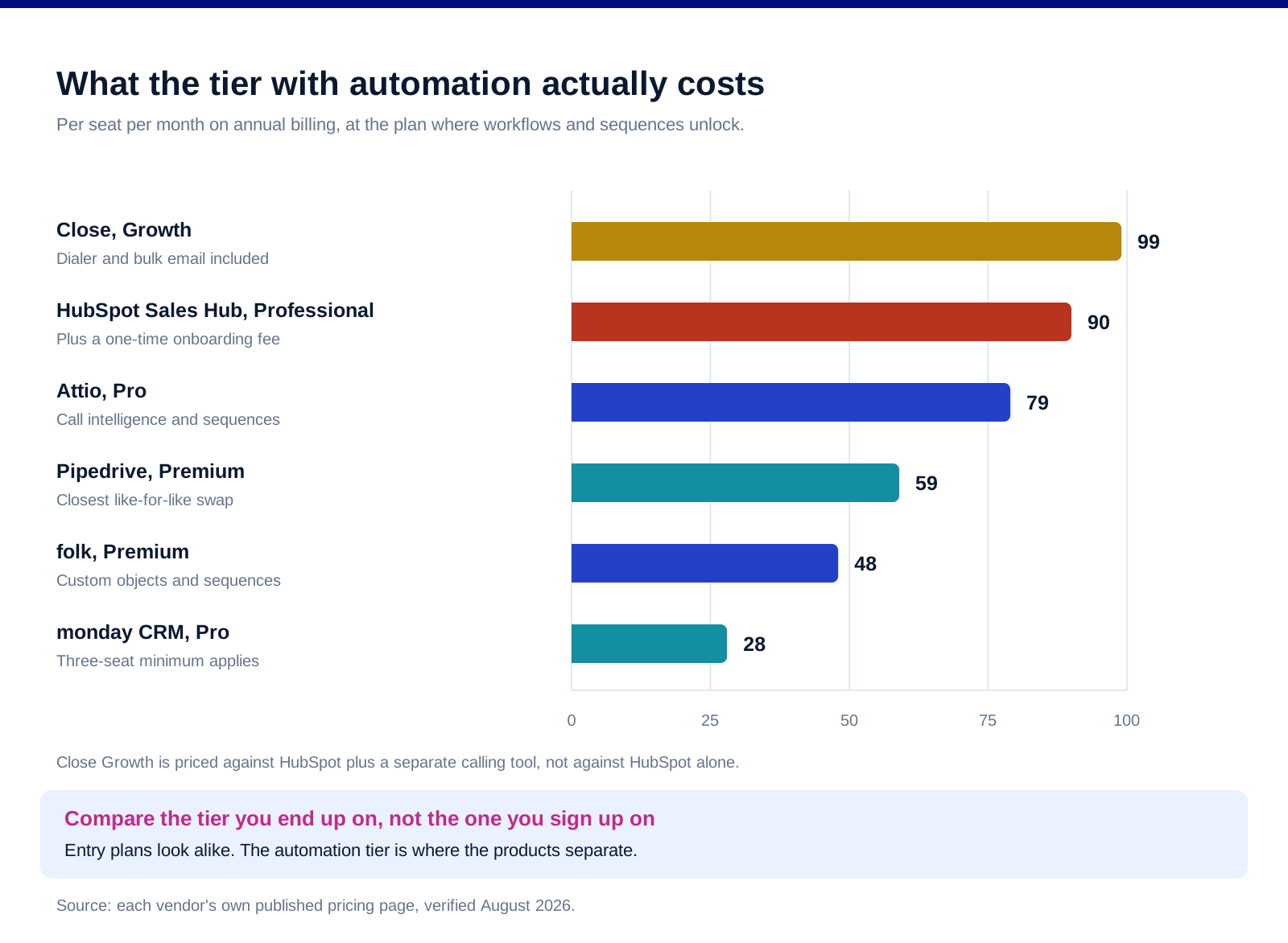
Every CRM on this list has a cheap entry plan. Comparing those is how teams end up back in the same trap, because the entry plan is never the plan you stay on. The chart above compares the tier where automation and sequences actually unlock, which is where a working sales team ends up within a quarter.
HubSpot Professional at $90 a seat is the number to benchmark against. It is $100 on monthly billing. That is the tier with workflows, sequences and the reporting people expect, and it is the tier most growing teams are quoted.
Pipedrive Premium at $59 covers most of the same ground. Lead routing, automations, e-signatures and multi-email tools. It is the closest functional match to Sales Hub Professional at roughly two thirds of the price.
monday CRM Pro at $28 is the outlier, with a catch. Plans start at three seats, and the CRM is a layer on a work-management platform rather than a purpose-built sales tool. For teams already running monday it is close to free incremental cost. For teams who are not, you are adopting a platform, not a CRM.
Close Growth at $99 is more expensive than HubSpot Professional, deliberately. The dialer, power dialing and bulk email are included rather than being a separate telephony purchase. Compare it against HubSpot plus a calling tool, not against HubSpot alone.
The number nobody puts on the comparison page
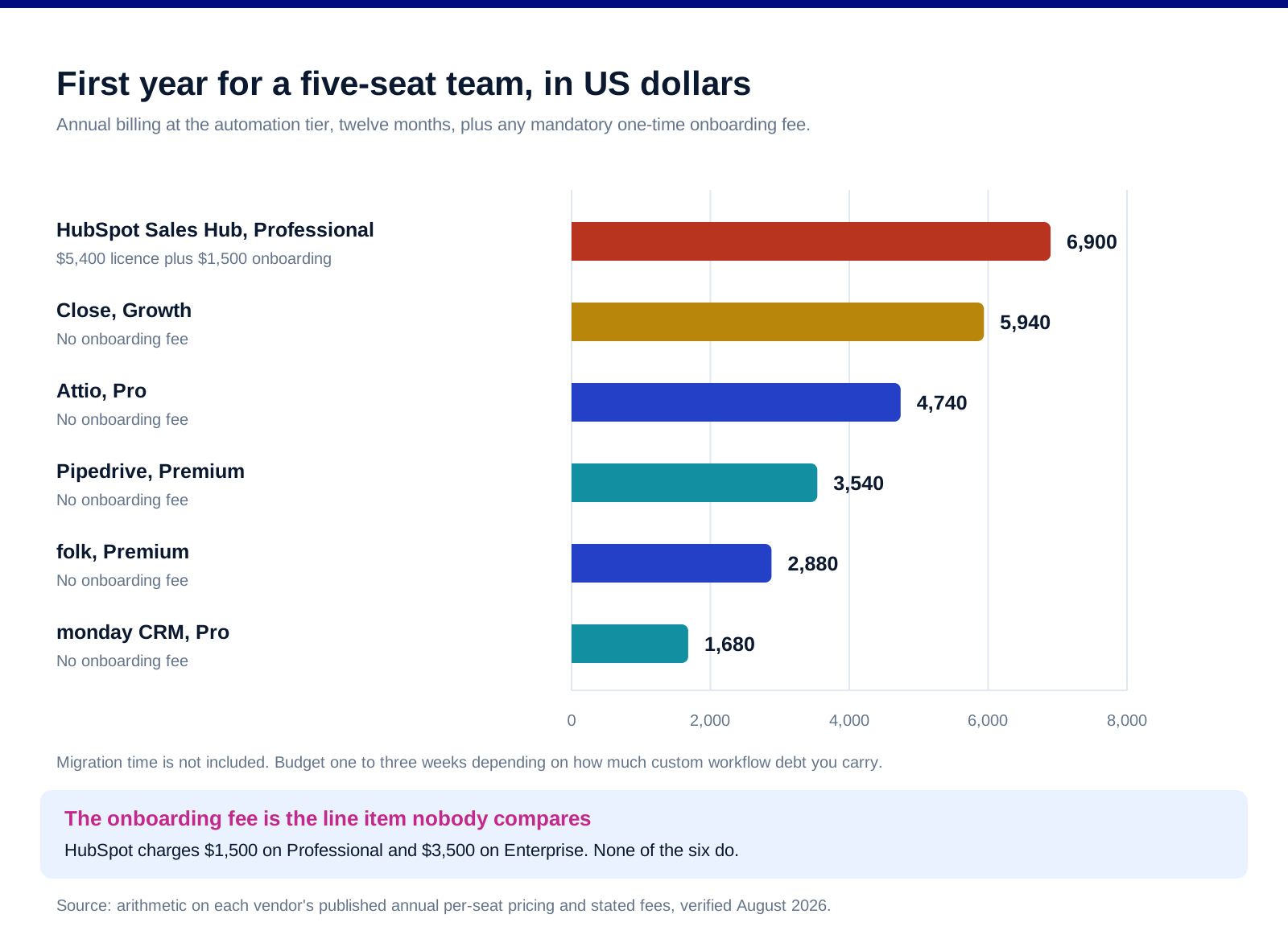
This is the same six products, costed as a five-person team would actually buy them: annual billing, the automation tier, twelve months, plus any mandatory setup fee.
The $1,500 is not negotiable and not a service you can decline. HubSpot charges a one-time onboarding fee on Sales Hub Professional and $3,500 on Enterprise. None of the six alternatives on this list charge one. On a five-seat team that fee alone is roughly five months of Pipedrive Premium.
The gap widens with headcount, not narrows. Every product here is priced per seat, so the per-seat delta multiplies. A fifteen-seat team on Sales Hub Professional pays $16,200 in licence plus the same $1,500, against $10,620 for Pipedrive Premium.
Migration cost is real and belongs in the sum. Budget one to three weeks of someone's time depending on how much custom property and workflow debt you accumulated. If the answer is "a lot", that is itself information: heavy HubSpot customisation is a switching cost you paid for without noticing.
Which one replaces which part of HubSpot
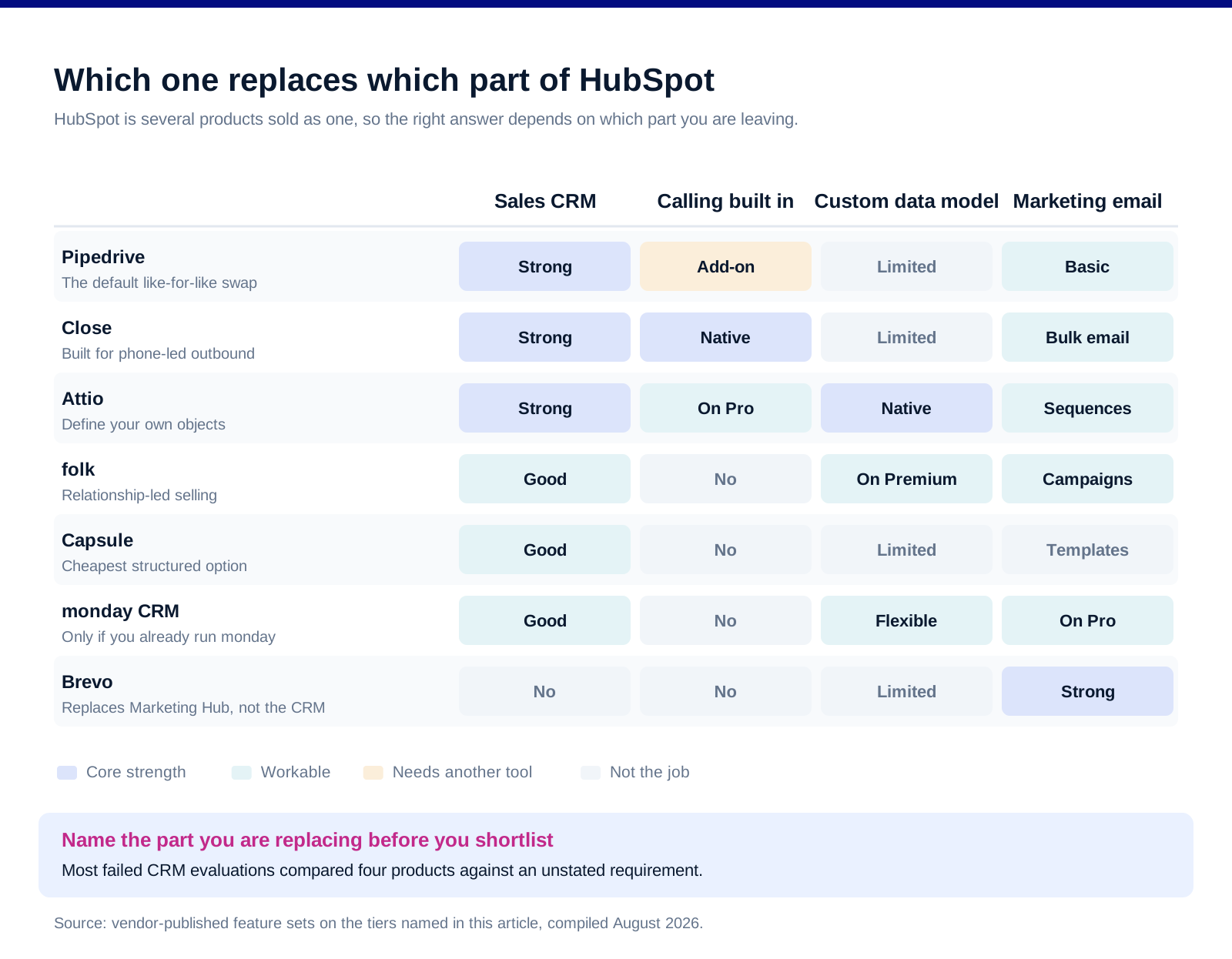
HubSpot is several products sold as one, which is why "a HubSpot alternative" is an unanswerable request until you say which part you are replacing.
1. Pipedrive, the default swap for Sales Hub. Lite $14, Growth $39, Premium $59, Ultimate $79 per seat a month on annual billing. Pipeline-first, fast to set up, and the tier structure is legible. Premium is the tier that matches what most teams used HubSpot Professional for. Pick it if you want to change tool without changing how your team works.
2. Close, for teams that sell on the phone. Solo $9, Essentials $35, Growth $99, Scale $139 per user a month on annual billing, or $19, $49, $109 and $149 monthly. Growth is where workflows and the power dialer live. The whole product is built around working a list of leads quickly rather than around reporting on a pipeline, which is the right shape for outbound-led teams and the wrong shape for long consultative sales.
3. Attio, for teams who want to model their own data. Free up to 3 seats and 50,000 records, Plus $35, Pro $79 per user a month on annual billing, Enterprise on quote. Attio treats objects as something you define rather than something you are given, which is genuinely different from everything else here. Pro adds call intelligence and sequences. There is no affiliate programme, so that link is a plain one and we earn nothing from it.
4. folk, for relationship-led selling. Standard $24, Premium $48, Enterprise from $80 per member a month on annual billing. Built around contacts and the LinkedIn extension rather than around a deal pipeline. Premium adds custom objects, deals and email sequences. Suits agencies, consultancies and anyone whose pipeline is really a network.
5. Capsule, the cheapest structured option. Free for 2 users and 250 contacts, with Capsule stating paid plans start at $18 per user a month. Straightforward contact and pipeline management without the platform ambitions. Pick it when the requirement is "somewhere organised to keep customers" rather than "a revenue operating system".
6. monday CRM, if the company already runs on monday. Basic $12, Standard $17, Pro $28 per seat a month on annual billing, minimum three seats. Automations and mass email arrive at Pro. The argument for it is consolidation, and the argument against it is that a CRM layered on a work platform will always feel like one.
And if it is Marketing Hub you want to leave. That is an email and automation swap rather than a CRM swap. Brevo is the common landing spot and meters on emails sent rather than contacts stored, which we covered in the Brevo pricing breakdown. ActiveCampaign is the heavier automation option if your lifecycle logic is genuinely complex.
How to choose without a three-month evaluation
Write down the five things your team does every day. Not the feature list, the actual daily actions. Log a call, move a deal, send a sequence, check a forecast, hand off to onboarding. Any CRM that does those five well is a candidate, and most evaluations die because they compared feature matrices instead.
Count seats honestly, then price the automation tier. Not the entry tier. You will be on the automation tier within a quarter, so price that from the start and avoid the second decision.
Test with your own data, not the demo dataset. Import 200 real contacts and 20 real deals. Half the products that look identical in a demo diverge sharply once your naming and your stages are in them.
Check what leaves with you. Export formats, API access on the tier you are buying, and whether call recordings and email history come out. This is the question people wish they had asked, and asking it at purchase costs nothing.
FAQ
What is the best HubSpot alternative for a small sales team?
Pipedrive for most, at $59 per seat a month on the Premium tier that matches what teams typically used HubSpot Professional for. It is a like-for-like swap in workflow terms, which keeps the migration cheap. Close is better if your team spends its day on the phone, and Capsule is enough if you mainly need organised contacts.
Is HubSpot actually expensive?
The entry tier is not. Sales Hub Starter is $9 per seat a month on annual billing. The expense arrives at Professional, which is $90 a seat plus a $1,500 one-time onboarding fee, and at Enterprise, which is $150 a seat plus $3,500. The jump between tiers is the cost, not the starting price.
Does HubSpot charge a mandatory onboarding fee?
Yes on the higher tiers. HubSpot publishes a one-time onboarding fee of $1,500 on Sales Hub Professional and $3,500 on Enterprise. None of the six alternatives in this article charge an equivalent fee, which is worth putting into any first-year comparison.
What is the cheapest CRM that still does automation?
Of the products here, monday CRM Pro at $28 per seat a month on annual billing, with a three-seat minimum. folk Premium at $48 is next if you want sequences with a contact-led rather than platform-led product. Cheapest is rarely the right frame though, because a CRM your team avoids costs more than its licence.
Can you migrate from HubSpot without losing data?
Contacts, companies, deals and notes move reliably. What breaks is workflow logic, custom properties with no equivalent field, and reporting history. Plan for rebuilding automations rather than porting them, and export everything before you cancel, because access ends with the subscription.
Should you replace all of HubSpot at once?
Usually not. Teams that move the CRM first and the marketing automation second have an easier time, because the CRM swap is the one with a clean equivalent and the marketing side involves rebuilding lifecycle logic. Running both for one billing cycle costs less than a rushed cutover that loses attribution.
Bottom line
The honest comparison is not HubSpot's entry price against everyone else's, it is HubSpot's automation tier plus its mandatory onboarding fee against everyone else's automation tier. On a five-seat team that is $6,900 against $3,540 for Pipedrive and $1,680 for monday CRM. Pipedrive is the safe default because it swaps like for like, Close wins for phone-led teams, Attio for teams who want to define their own model, and the marketing side is a separate decision entirely. Price the tier you will actually be on, test with your own data, and check what leaves with you before you sign.
Want the CRM chosen and the pipeline built on top of it? Book a call with GROU. We run revenue operations inside B2B pipeline engines across verticals.
We are GROU, a B2B pipeline agency that runs lead generation, outbound, and LinkedIn content for clients across manufacturing, fintech, iGaming, software, and professional services. The selection criteria and migration cautions reflect our CRM deployments between 2024 and 2026, anonymized to protect client confidentiality.
Some links in this article are affiliate. We may earn a small commission at no extra cost to you. We only recommend tools we've deployed for clients.
Most teams do not leave HubSpot because it is bad. They leave because the price of the tier that has the features they need turned out to be four times the price of the tier they signed up on, and because the number on the pricing page was not the number on the invoice. The onboarding fee is the part nobody compares.
This is a shortlist of six alternatives with the actual per-seat figures, the first-year total for a five-person team, and an honest note on which one replaces which part of HubSpot. If you have already picked and want the move itself, our HubSpot to Pipedrive migration guide covers the mechanics.
TL;DR
HubSpot Sales Hub Starter is genuinely cheap at $9 per seat a month on annual billing. The problem is that automation, sequences and useful reporting sit in Professional at $90 a seat a month, plus a $1,500 one-time onboarding fee that is mandatory rather than optional, and Enterprise carries $3,500. For a five-seat team on annual billing, first-year Sales Hub Professional lands at $6,900 while Pipedrive Premium lands at $3,540 and monday CRM Pro at $1,680. Pipedrive is the closest like-for-like replacement for Sales Hub and the safest default. Close is the pick if your team lives in a dialer, because calling and sequencing are native rather than bolted on. Attio is the pick for teams who want to model their own data. folk suits relationship-led selling, Capsule is the cheapest structured option, and monday CRM makes sense if the company already runs on monday. If what you actually want to leave is Marketing Hub rather than the CRM, that is a different swap and Brevo is the usual answer.
The tier where the price actually bites
Every CRM on this list has a cheap entry plan. Comparing those is how teams end up back in the same trap, because the entry plan is never the plan you stay on. The chart above compares the tier where automation and sequences actually unlock, which is where a working sales team ends up within a quarter.
HubSpot Professional at $90 a seat is the number to benchmark against. It is $100 on monthly billing. That is the tier with workflows, sequences and the reporting people expect, and it is the tier most growing teams are quoted.
Pipedrive Premium at $59 covers most of the same ground. Lead routing, automations, e-signatures and multi-email tools. It is the closest functional match to Sales Hub Professional at roughly two thirds of the price.
monday CRM Pro at $28 is the outlier, with a catch. Plans start at three seats, and the CRM is a layer on a work-management platform rather than a purpose-built sales tool. For teams already running monday it is close to free incremental cost. For teams who are not, you are adopting a platform, not a CRM.
Close Growth at $99 is more expensive than HubSpot Professional, deliberately. The dialer, power dialing and bulk email are included rather than being a separate telephony purchase. Compare it against HubSpot plus a calling tool, not against HubSpot alone.
The number nobody puts on the comparison page
This is the same six products, costed as a five-person team would actually buy them: annual billing, the automation tier, twelve months, plus any mandatory setup fee.
The $1,500 is not negotiable and not a service you can decline. HubSpot charges a one-time onboarding fee on Sales Hub Professional and $3,500 on Enterprise. None of the six alternatives on this list charge one. On a five-seat team that fee alone is roughly five months of Pipedrive Premium.
The gap widens with headcount, not narrows. Every product here is priced per seat, so the per-seat delta multiplies. A fifteen-seat team on Sales Hub Professional pays $16,200 in licence plus the same $1,500, against $10,620 for Pipedrive Premium.
Migration cost is real and belongs in the sum. Budget one to three weeks of someone's time depending on how much custom property and workflow debt you accumulated. If the answer is "a lot", that is itself information: heavy HubSpot customisation is a switching cost you paid for without noticing.
Which one replaces which part of HubSpot
HubSpot is several products sold as one, which is why "a HubSpot alternative" is an unanswerable request until you say which part you are replacing.
1. Pipedrive, the default swap for Sales Hub. Lite $14, Growth $39, Premium $59, Ultimate $79 per seat a month on annual billing. Pipeline-first, fast to set up, and the tier structure is legible. Premium is the tier that matches what most teams used HubSpot Professional for. Pick it if you want to change tool without changing how your team works.
2. Close, for teams that sell on the phone. Solo $9, Essentials $35, Growth $99, Scale $139 per user a month on annual billing, or $19, $49, $109 and $149 monthly. Growth is where workflows and the power dialer live. The whole product is built around working a list of leads quickly rather than around reporting on a pipeline, which is the right shape for outbound-led teams and the wrong shape for long consultative sales.
3. Attio, for teams who want to model their own data. Free up to 3 seats and 50,000 records, Plus $35, Pro $79 per user a month on annual billing, Enterprise on quote. Attio treats objects as something you define rather than something you are given, which is genuinely different from everything else here. Pro adds call intelligence and sequences. There is no affiliate programme, so that link is a plain one and we earn nothing from it.
4. folk, for relationship-led selling. Standard $24, Premium $48, Enterprise from $80 per member a month on annual billing. Built around contacts and the LinkedIn extension rather than around a deal pipeline. Premium adds custom objects, deals and email sequences. Suits agencies, consultancies and anyone whose pipeline is really a network.
5. Capsule, the cheapest structured option. Free for 2 users and 250 contacts, with Capsule stating paid plans start at $18 per user a month. Straightforward contact and pipeline management without the platform ambitions. Pick it when the requirement is "somewhere organised to keep customers" rather than "a revenue operating system".
6. monday CRM, if the company already runs on monday. Basic $12, Standard $17, Pro $28 per seat a month on annual billing, minimum three seats. Automations and mass email arrive at Pro. The argument for it is consolidation, and the argument against it is that a CRM layered on a work platform will always feel like one.
And if it is Marketing Hub you want to leave. That is an email and automation swap rather than a CRM swap. Brevo is the common landing spot and meters on emails sent rather than contacts stored, which we covered in the Brevo pricing breakdown. ActiveCampaign is the heavier automation option if your lifecycle logic is genuinely complex.
How to choose without a three-month evaluation
Write down the five things your team does every day. Not the feature list, the actual daily actions. Log a call, move a deal, send a sequence, check a forecast, hand off to onboarding. Any CRM that does those five well is a candidate, and most evaluations die because they compared feature matrices instead.
Count seats honestly, then price the automation tier. Not the entry tier. You will be on the automation tier within a quarter, so price that from the start and avoid the second decision.
Test with your own data, not the demo dataset. Import 200 real contacts and 20 real deals. Half the products that look identical in a demo diverge sharply once your naming and your stages are in them.
Check what leaves with you. Export formats, API access on the tier you are buying, and whether call recordings and email history come out. This is the question people wish they had asked, and asking it at purchase costs nothing.
FAQ
What is the best HubSpot alternative for a small sales team?
Pipedrive for most, at $59 per seat a month on the Premium tier that matches what teams typically used HubSpot Professional for. It is a like-for-like swap in workflow terms, which keeps the migration cheap. Close is better if your team spends its day on the phone, and Capsule is enough if you mainly need organised contacts.
Is HubSpot actually expensive?
The entry tier is not. Sales Hub Starter is $9 per seat a month on annual billing. The expense arrives at Professional, which is $90 a seat plus a $1,500 one-time onboarding fee, and at Enterprise, which is $150 a seat plus $3,500. The jump between tiers is the cost, not the starting price.
Does HubSpot charge a mandatory onboarding fee?
Yes on the higher tiers. HubSpot publishes a one-time onboarding fee of $1,500 on Sales Hub Professional and $3,500 on Enterprise. None of the six alternatives in this article charge an equivalent fee, which is worth putting into any first-year comparison.
What is the cheapest CRM that still does automation?
Of the products here, monday CRM Pro at $28 per seat a month on annual billing, with a three-seat minimum. folk Premium at $48 is next if you want sequences with a contact-led rather than platform-led product. Cheapest is rarely the right frame though, because a CRM your team avoids costs more than its licence.
Can you migrate from HubSpot without losing data?
Contacts, companies, deals and notes move reliably. What breaks is workflow logic, custom properties with no equivalent field, and reporting history. Plan for rebuilding automations rather than porting them, and export everything before you cancel, because access ends with the subscription.
Should you replace all of HubSpot at once?
Usually not. Teams that move the CRM first and the marketing automation second have an easier time, because the CRM swap is the one with a clean equivalent and the marketing side involves rebuilding lifecycle logic. Running both for one billing cycle costs less than a rushed cutover that loses attribution.
Bottom line
The honest comparison is not HubSpot's entry price against everyone else's, it is HubSpot's automation tier plus its mandatory onboarding fee against everyone else's automation tier. On a five-seat team that is $6,900 against $3,540 for Pipedrive and $1,680 for monday CRM. Pipedrive is the safe default because it swaps like for like, Close wins for phone-led teams, Attio for teams who want to define their own model, and the marketing side is a separate decision entirely. Price the tier you will actually be on, test with your own data, and check what leaves with you before you sign.
Want the CRM chosen and the pipeline built on top of it? Book a call with GROU. We run revenue operations inside B2B pipeline engines across verticals.
We are GROU, a B2B pipeline agency that runs lead generation, outbound, and LinkedIn content for clients across manufacturing, fintech, iGaming, software, and professional services. The selection criteria and migration cautions reflect our CRM deployments between 2024 and 2026, anonymized to protect client confidentiality.
Some links in this article are affiliate. We may earn a small commission at no extra cost to you. We only recommend tools we've deployed for clients.
Most teams do not leave HubSpot because it is bad. They leave because the price of the tier that has the features they need turned out to be four times the price of the tier they signed up on, and because the number on the pricing page was not the number on the invoice. The onboarding fee is the part nobody compares.
This is a shortlist of six alternatives with the actual per-seat figures, the first-year total for a five-person team, and an honest note on which one replaces which part of HubSpot. If you have already picked and want the move itself, our HubSpot to Pipedrive migration guide covers the mechanics.
TL;DR
HubSpot Sales Hub Starter is genuinely cheap at $9 per seat a month on annual billing. The problem is that automation, sequences and useful reporting sit in Professional at $90 a seat a month, plus a $1,500 one-time onboarding fee that is mandatory rather than optional, and Enterprise carries $3,500. For a five-seat team on annual billing, first-year Sales Hub Professional lands at $6,900 while Pipedrive Premium lands at $3,540 and monday CRM Pro at $1,680. Pipedrive is the closest like-for-like replacement for Sales Hub and the safest default. Close is the pick if your team lives in a dialer, because calling and sequencing are native rather than bolted on. Attio is the pick for teams who want to model their own data. folk suits relationship-led selling, Capsule is the cheapest structured option, and monday CRM makes sense if the company already runs on monday. If what you actually want to leave is Marketing Hub rather than the CRM, that is a different swap and Brevo is the usual answer.
The tier where the price actually bites
Every CRM on this list has a cheap entry plan. Comparing those is how teams end up back in the same trap, because the entry plan is never the plan you stay on. The chart above compares the tier where automation and sequences actually unlock, which is where a working sales team ends up within a quarter.
HubSpot Professional at $90 a seat is the number to benchmark against. It is $100 on monthly billing. That is the tier with workflows, sequences and the reporting people expect, and it is the tier most growing teams are quoted.
Pipedrive Premium at $59 covers most of the same ground. Lead routing, automations, e-signatures and multi-email tools. It is the closest functional match to Sales Hub Professional at roughly two thirds of the price.
monday CRM Pro at $28 is the outlier, with a catch. Plans start at three seats, and the CRM is a layer on a work-management platform rather than a purpose-built sales tool. For teams already running monday it is close to free incremental cost. For teams who are not, you are adopting a platform, not a CRM.
Close Growth at $99 is more expensive than HubSpot Professional, deliberately. The dialer, power dialing and bulk email are included rather than being a separate telephony purchase. Compare it against HubSpot plus a calling tool, not against HubSpot alone.
The number nobody puts on the comparison page
This is the same six products, costed as a five-person team would actually buy them: annual billing, the automation tier, twelve months, plus any mandatory setup fee.
The $1,500 is not negotiable and not a service you can decline. HubSpot charges a one-time onboarding fee on Sales Hub Professional and $3,500 on Enterprise. None of the six alternatives on this list charge one. On a five-seat team that fee alone is roughly five months of Pipedrive Premium.
The gap widens with headcount, not narrows. Every product here is priced per seat, so the per-seat delta multiplies. A fifteen-seat team on Sales Hub Professional pays $16,200 in licence plus the same $1,500, against $10,620 for Pipedrive Premium.
Migration cost is real and belongs in the sum. Budget one to three weeks of someone's time depending on how much custom property and workflow debt you accumulated. If the answer is "a lot", that is itself information: heavy HubSpot customisation is a switching cost you paid for without noticing.
Which one replaces which part of HubSpot
HubSpot is several products sold as one, which is why "a HubSpot alternative" is an unanswerable request until you say which part you are replacing.
1. Pipedrive, the default swap for Sales Hub. Lite $14, Growth $39, Premium $59, Ultimate $79 per seat a month on annual billing. Pipeline-first, fast to set up, and the tier structure is legible. Premium is the tier that matches what most teams used HubSpot Professional for. Pick it if you want to change tool without changing how your team works.
2. Close, for teams that sell on the phone. Solo $9, Essentials $35, Growth $99, Scale $139 per user a month on annual billing, or $19, $49, $109 and $149 monthly. Growth is where workflows and the power dialer live. The whole product is built around working a list of leads quickly rather than around reporting on a pipeline, which is the right shape for outbound-led teams and the wrong shape for long consultative sales.
3. Attio, for teams who want to model their own data. Free up to 3 seats and 50,000 records, Plus $35, Pro $79 per user a month on annual billing, Enterprise on quote. Attio treats objects as something you define rather than something you are given, which is genuinely different from everything else here. Pro adds call intelligence and sequences. There is no affiliate programme, so that link is a plain one and we earn nothing from it.
4. folk, for relationship-led selling. Standard $24, Premium $48, Enterprise from $80 per member a month on annual billing. Built around contacts and the LinkedIn extension rather than around a deal pipeline. Premium adds custom objects, deals and email sequences. Suits agencies, consultancies and anyone whose pipeline is really a network.
5. Capsule, the cheapest structured option. Free for 2 users and 250 contacts, with Capsule stating paid plans start at $18 per user a month. Straightforward contact and pipeline management without the platform ambitions. Pick it when the requirement is "somewhere organised to keep customers" rather than "a revenue operating system".
6. monday CRM, if the company already runs on monday. Basic $12, Standard $17, Pro $28 per seat a month on annual billing, minimum three seats. Automations and mass email arrive at Pro. The argument for it is consolidation, and the argument against it is that a CRM layered on a work platform will always feel like one.
And if it is Marketing Hub you want to leave. That is an email and automation swap rather than a CRM swap. Brevo is the common landing spot and meters on emails sent rather than contacts stored, which we covered in the Brevo pricing breakdown. ActiveCampaign is the heavier automation option if your lifecycle logic is genuinely complex.
How to choose without a three-month evaluation
Write down the five things your team does every day. Not the feature list, the actual daily actions. Log a call, move a deal, send a sequence, check a forecast, hand off to onboarding. Any CRM that does those five well is a candidate, and most evaluations die because they compared feature matrices instead.
Count seats honestly, then price the automation tier. Not the entry tier. You will be on the automation tier within a quarter, so price that from the start and avoid the second decision.
Test with your own data, not the demo dataset. Import 200 real contacts and 20 real deals. Half the products that look identical in a demo diverge sharply once your naming and your stages are in them.
Check what leaves with you. Export formats, API access on the tier you are buying, and whether call recordings and email history come out. This is the question people wish they had asked, and asking it at purchase costs nothing.
FAQ
What is the best HubSpot alternative for a small sales team?
Pipedrive for most, at $59 per seat a month on the Premium tier that matches what teams typically used HubSpot Professional for. It is a like-for-like swap in workflow terms, which keeps the migration cheap. Close is better if your team spends its day on the phone, and Capsule is enough if you mainly need organised contacts.
Is HubSpot actually expensive?
The entry tier is not. Sales Hub Starter is $9 per seat a month on annual billing. The expense arrives at Professional, which is $90 a seat plus a $1,500 one-time onboarding fee, and at Enterprise, which is $150 a seat plus $3,500. The jump between tiers is the cost, not the starting price.
Does HubSpot charge a mandatory onboarding fee?
Yes on the higher tiers. HubSpot publishes a one-time onboarding fee of $1,500 on Sales Hub Professional and $3,500 on Enterprise. None of the six alternatives in this article charge an equivalent fee, which is worth putting into any first-year comparison.
What is the cheapest CRM that still does automation?
Of the products here, monday CRM Pro at $28 per seat a month on annual billing, with a three-seat minimum. folk Premium at $48 is next if you want sequences with a contact-led rather than platform-led product. Cheapest is rarely the right frame though, because a CRM your team avoids costs more than its licence.
Can you migrate from HubSpot without losing data?
Contacts, companies, deals and notes move reliably. What breaks is workflow logic, custom properties with no equivalent field, and reporting history. Plan for rebuilding automations rather than porting them, and export everything before you cancel, because access ends with the subscription.
Should you replace all of HubSpot at once?
Usually not. Teams that move the CRM first and the marketing automation second have an easier time, because the CRM swap is the one with a clean equivalent and the marketing side involves rebuilding lifecycle logic. Running both for one billing cycle costs less than a rushed cutover that loses attribution.
Bottom line
The honest comparison is not HubSpot's entry price against everyone else's, it is HubSpot's automation tier plus its mandatory onboarding fee against everyone else's automation tier. On a five-seat team that is $6,900 against $3,540 for Pipedrive and $1,680 for monday CRM. Pipedrive is the safe default because it swaps like for like, Close wins for phone-led teams, Attio for teams who want to define their own model, and the marketing side is a separate decision entirely. Price the tier you will actually be on, test with your own data, and check what leaves with you before you sign.
Want the CRM chosen and the pipeline built on top of it? Book a call with GROU. We run revenue operations inside B2B pipeline engines across verticals.
We are GROU, a B2B pipeline agency that runs lead generation, outbound, and LinkedIn content for clients across manufacturing, fintech, iGaming, software, and professional services. The selection criteria and migration cautions reflect our CRM deployments between 2024 and 2026, anonymized to protect client confidentiality.
Some links in this article are affiliate. We may earn a small commission at no extra cost to you. We only recommend tools we've deployed for clients.

Pipeline OS Newsletter
Build qualified pipeline
Get weekly tactics to generate demand, improve lead quality, and book more meetings.







Trusted by industry leaders
Trusted by industry leaders
Trusted by industry leaders
Ready to build qualified pipeline?
Ready to build qualified pipeline?
Ready to build qualified pipeline?
Book a call to see if we're the right fit, or take the 2-minute quiz to get a clear starting point.
Book a call to see if we're the right fit, or take the 2-minute quiz to get a clear starting point.
Book a call to see if we're the right fit, or take the 2-minute quiz to get a clear starting point.
" height="30.21639343089746px" id="hfGbXmQR2" width="30.216393430897455px"/></svg>)
Copyright © 2026 – All Right Reserved
Copyright © 2026 – All Right Reserved
Copyright © 2026 – All Right Reserved