%22%3E%3C/path%3E%3Cpath d=%22M 63.072 7.554 C 62.258 8.022 61.577 8.689 61.092 9.493 L 61.092 7.076 L 57.158 7.076 L 57.158 22.64 L 61.089 22.64 L 61.089 14.888 C 61.089 13.446 61.403 12.434 62.03 11.853 C 62.818 11.218 63.818 10.907 64.826 10.982 L 65.868 10.982 L 65.868 6.851 C 64.891 6.834 63.926 7.076 63.073 7.554 Z%22 fill=%22rgb(17,17,17)%22%3E%3C/path%3E%3Cpath d=%22M 78.916 7.82 C 76.363 6.49 73.321 6.49 70.768 7.82 C 69.562 8.473 68.564 9.451 67.888 10.644 C 67.167 11.931 66.803 13.387 66.834 14.862 C 66.804 16.332 67.157 17.785 67.86 19.077 C 68.515 20.267 69.494 21.246 70.684 21.901 C 71.924 22.576 73.318 22.92 74.73 22.898 C 76.164 22.918 77.58 22.575 78.846 21.901 C 80.062 21.247 81.073 20.27 81.768 19.077 C 82.506 17.797 82.88 16.339 82.85 14.862 C 82.88 13.389 82.517 11.934 81.797 10.647 C 81.12 9.455 80.122 8.477 78.917 7.824 M 78.803 14.862 C 78.829 15.739 78.636 16.608 78.241 17.391 C 77.903 18.046 77.38 18.588 76.738 18.95 C 76.124 19.293 75.432 19.472 74.729 19.47 C 73.668 19.497 72.648 19.061 71.934 18.276 C 71.139 17.323 70.741 16.1 70.823 14.862 C 70.741 13.62 71.149 12.395 71.959 11.45 C 72.687 10.667 73.715 10.233 74.783 10.256 C 75.859 10.236 76.894 10.67 77.635 11.45 C 78.464 12.387 78.884 13.616 78.801 14.864%22 fill=%22rgb(17,17,17)%22%3E%3C/path%3E%3Cpath d=%22M 95.906 7.076 L 95.906 15.646 C 95.975 16.68 95.643 17.701 94.979 18.498 C 94.311 19.184 93.379 19.547 92.422 19.495 C 91.475 19.544 90.553 19.18 89.894 18.498 C 89.23 17.701 88.898 16.68 88.967 15.646 L 88.967 7.076 L 85.033 7.076 L 85.033 16.207 C 85 17.449 85.275 18.68 85.834 19.79 C 86.327 20.75 87.095 21.542 88.039 22.065 C 89.033 22.594 90.145 22.861 91.271 22.838 C 92.188 22.847 93.095 22.65 93.926 22.263 C 94.708 21.905 95.388 21.36 95.906 20.675 L 95.906 22.645 L 99.865 22.645 L 99.865 7.076 Z%22 fill=%22rgb(17,17,17)%22%3E%3C/path%3E%3Cpath d=%22M 4.513 15.626 C 4.511 10.815 7.606 6.549 12.181 5.059 C 16.756 3.57 21.77 5.195 24.601 9.086 L 27.816 5.87 C 24.074 1.186 17.981 -0.943 12.137 0.393 C 6.292 1.728 1.728 6.292 0.393 12.137 C -0.943 17.981 1.186 24.074 5.87 27.816 L 9.085 24.601 C 6.214 22.512 4.515 19.177 4.513 15.626%22 fill=%22rgb(32,62,235)%22%3E%3C/path%3E%3Cpath d=%22M 17.114 14.343 L 13.354 18.01 L 13.354 18.026 L 21.071 18.026 L 11.412 27.609 L 17.389 27.609 L 23.999 21.081 L 23.999 28.316 L 24.005 28.316 L 27.967 24.393 L 27.967 14.343 Z%22 fill=%22rgb(32,62,235)%22%3E%3C/path%3E%3C/g%3E%3C/svg%3E) ×
× ××
××›
›
›
›
Bright Data review 2026
Bright Data review 2026
Bright Data review 2026
Bright Data review 2026
Bright Data review 2026
Bright Data review 2026

Author
Aljaz Peklaj

Most tools reviewed on this blog are things a B2B team buys, opens and uses. Bright Data is not that. It is infrastructure, sold by the gigabyte and the thousand requests, and the two things that decide whether it belongs in your stack are the metering unit and a compliance gate you have to pass before you can spend anything at all.
Both are published, and both are more informative than any feature list.
TL;DR
Bright Data sells four things: proxy networks, web access APIs, data feeds and managed data services. Residential proxies are metered by bandwidth and list at $8 per GB pay as you go, falling to $7, $6 and $5 per GB at monthly commitments of $499, $999 and $1,999. At the time of writing a 50% promotion halves those rates for three months, and the included gigabyte figures on each tier appear to be calculated at the promotional rate rather than the list rate, which is worth confirming before you commit. Bandwidth is counted in both directions, including headers. The APIs are cheaper to reason about: the Unlocker, Crawl and SERP APIs list from $1 per 1,000 requests. The gate that stops most casual buyers is the KYC process. Bright Data states it requires "a detailed account of their intended use case before any access is granted", runs "live video identity verification and a personal review by an experienced compliance officer", and strictly prohibits categories including "adult content, gambling, cryptocurrency, and more". Requests outside your approved use case return an access denied error. If you sell into iGaming, read that sentence again before you plan anything around this product.
What you are actually buying
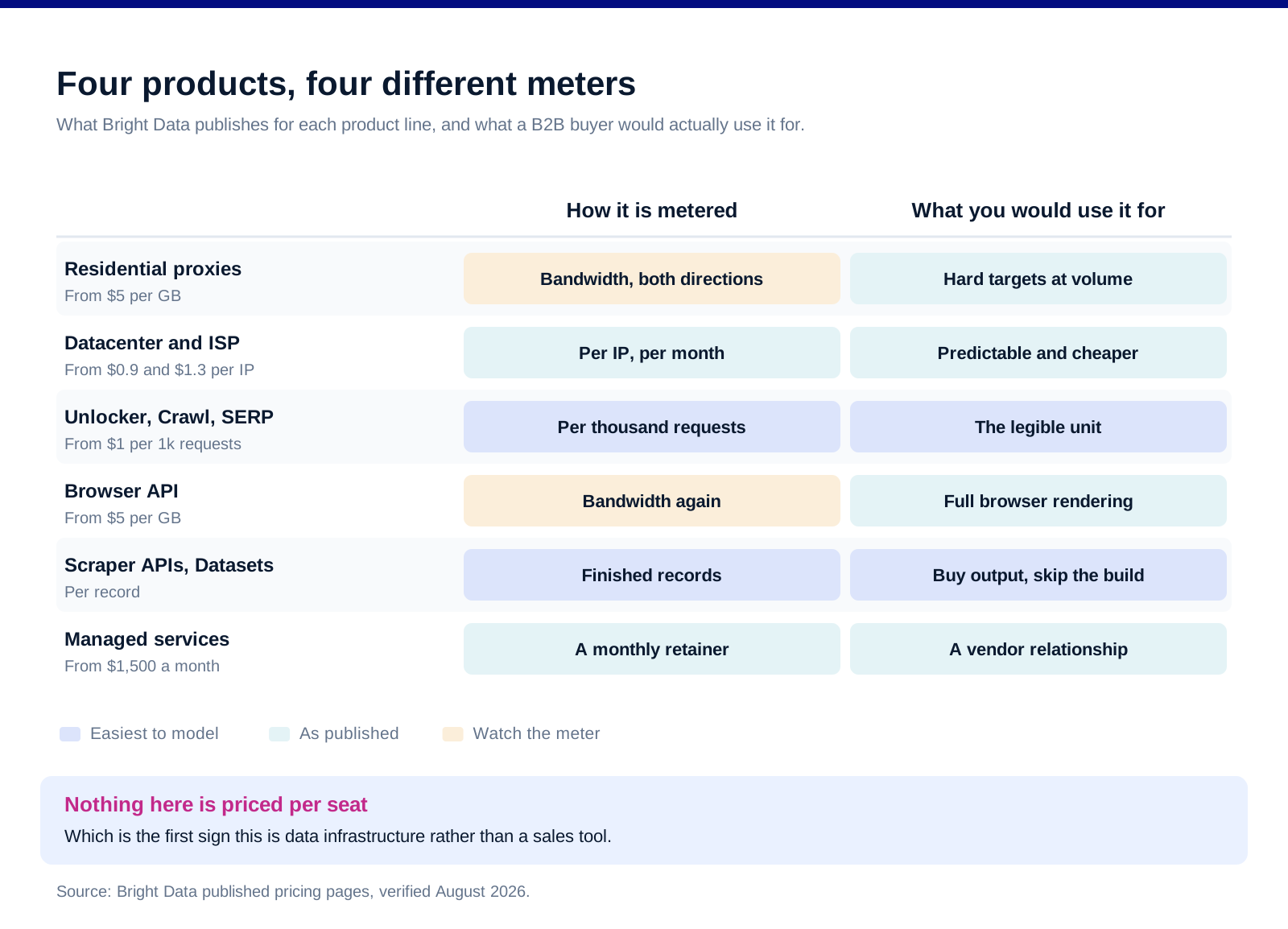
Four product families, four different units. Bright Data's pricing page lists proxy networks, web access APIs, data feeds, and data and insights services. Nothing here is priced per seat, which is the first sign that this is not a sales tool.
Proxies are sold by bandwidth or by IP. Residential proxies start from $5 per GB at the largest published tier, datacenter proxies from $0.9 per IP and ISP proxies from $1.3 per IP.
The APIs are sold per request. The Unlocker API, Crawl API, SERP API and Scraper Studio all list from $1 per 1,000 requests, and the Browser API from $5 per GB.
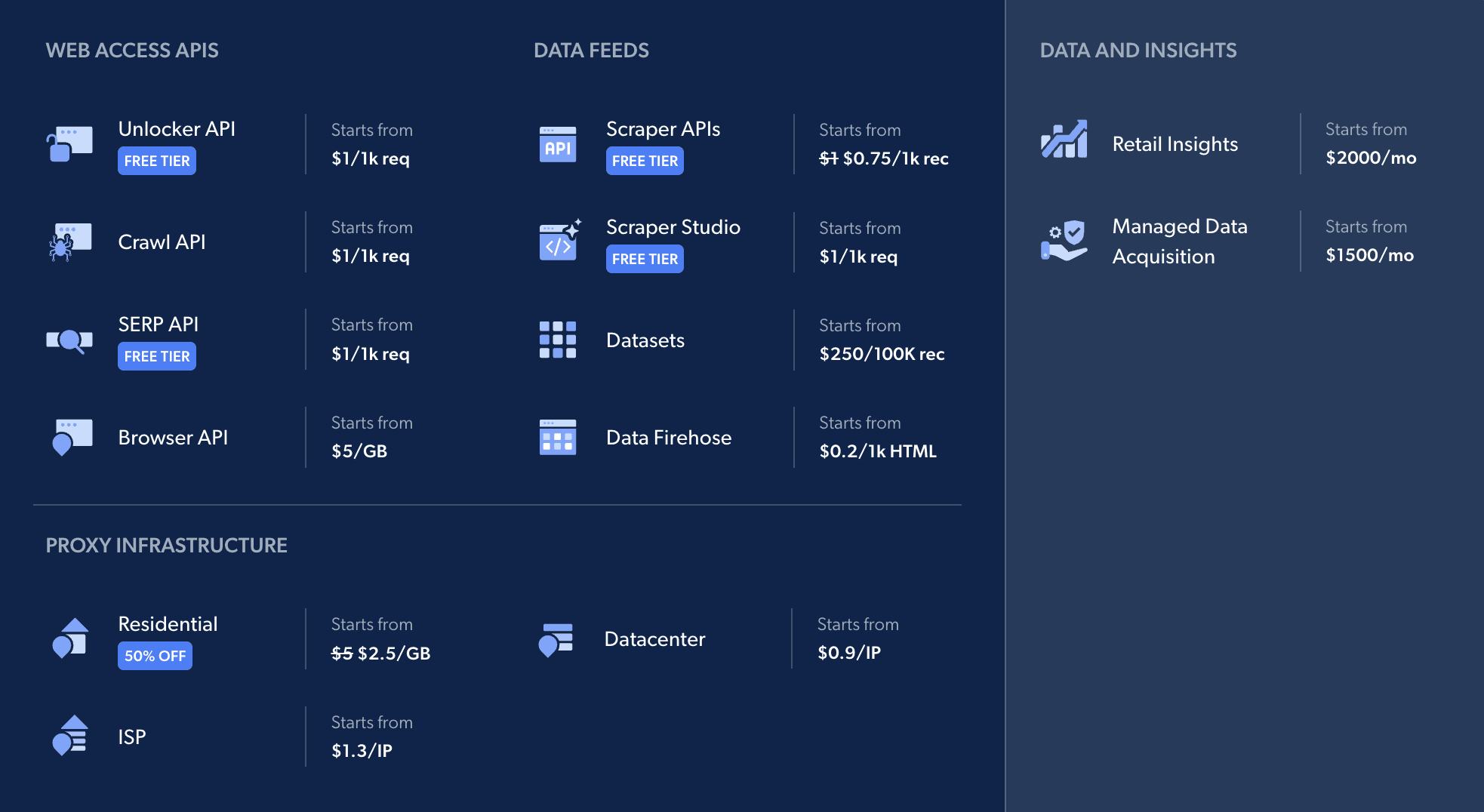
Finished data is sold per record. Scraper APIs list from $1 per 1,000 records, Datasets from $250 per 100,000 records, and the Data Firehose from $0.2 per 1,000 HTML.
And there are managed services on top. Retail Insights lists from $2,000 a month and Managed Data Acquisition from $1,500 a month, which is where this stops being a tool purchase and becomes a vendor relationship.
Free tiers exist on several of the APIs. The pricing page marks the Unlocker, SERP, Scraper API and Scraper Studio products with a free tier, so the cheapest way to evaluate this is to run your actual job through one rather than to read comparisons.
The metering unit is the review
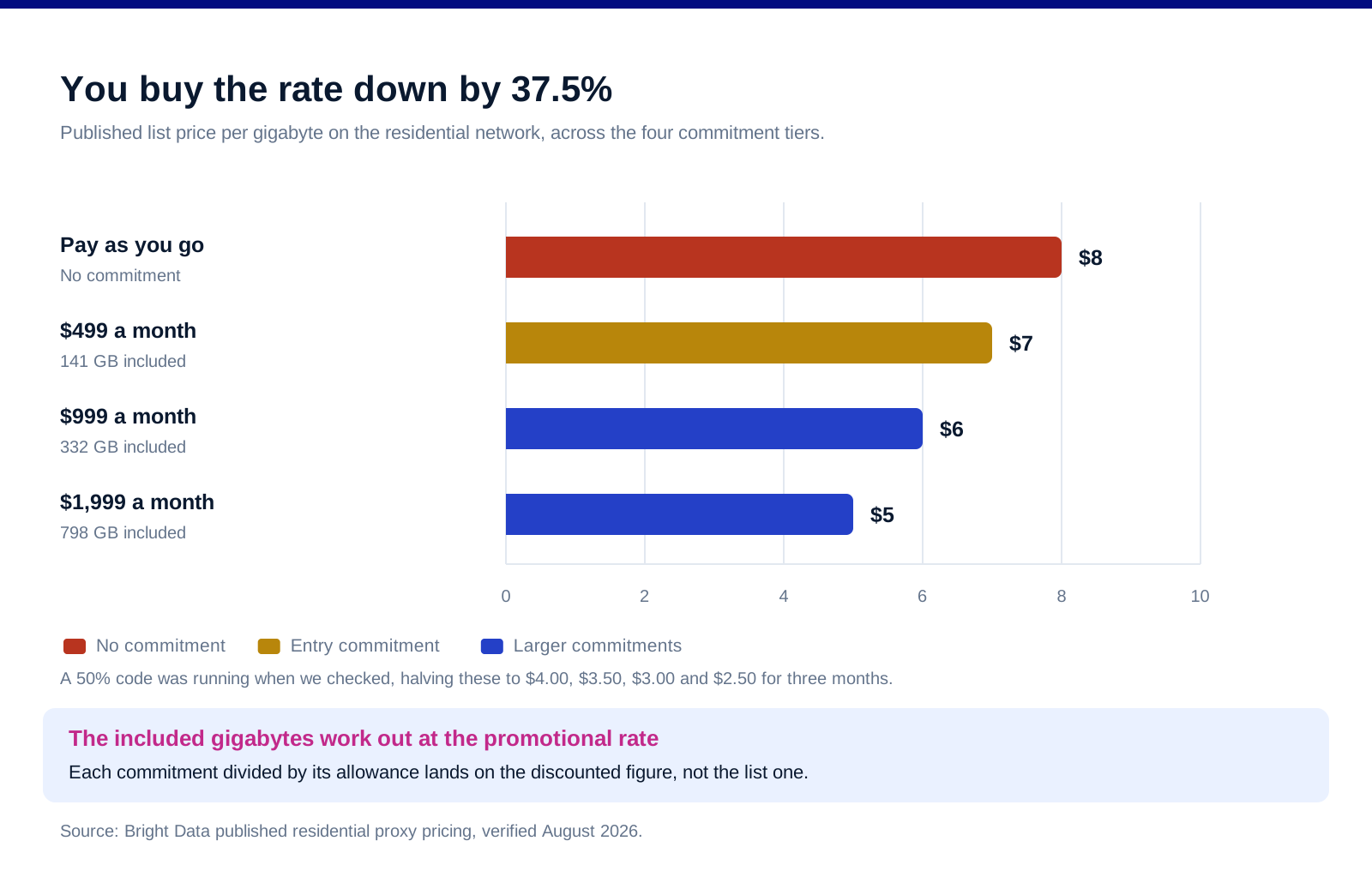
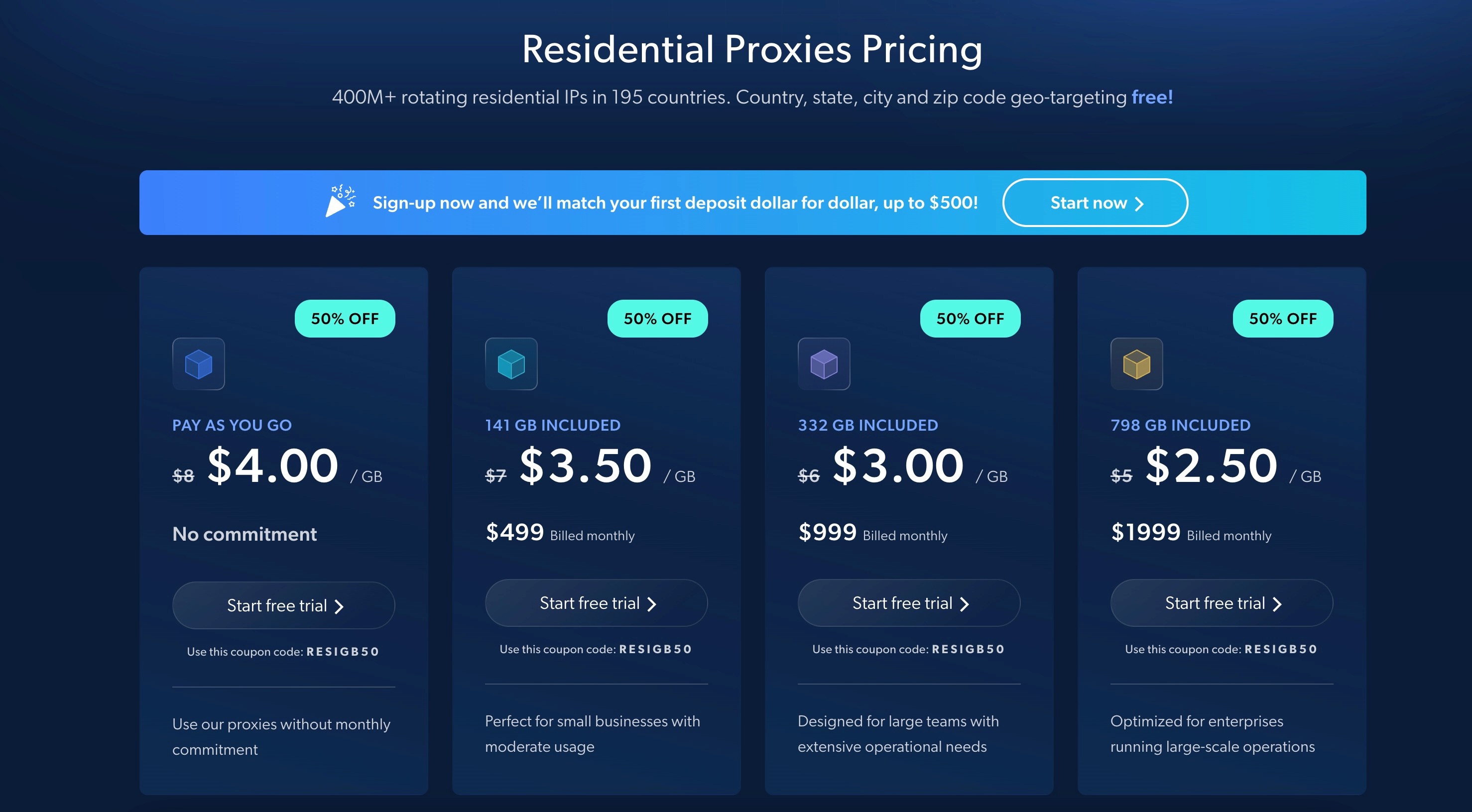
Residential bandwidth lists at four rates. The residential pricing page shows $8 per GB pay as you go with no commitment, then $7, $6 and $5 per GB at monthly commitments of $499, $999 and $1,999 respectively. Above 1 TB the page routes to sales.
A 50% promotion is running, and it changes what you see. The rates displayed are halved to $4.00, $3.50, $3.00 and $2.50 under a three month promotional code. We publish the list prices because a three month discount is not a price, and the article would be wrong the moment it lapses.
The included gigabytes appear to be calculated at the promotional rate. Divide each commitment by its included allowance and you land almost exactly on the discounted per GB figure: $499 over 141 GB is $3.54, $999 over 332 GB is $3.01, $1,999 over 798 GB is $2.51. At the list rates the same commitments would buy roughly 71, 166 and 400 GB. That is our arithmetic on their published numbers, not a statement from Bright Data, and it is the single thing we would confirm in writing before committing.
Bandwidth is counted in both directions. Bright Data states that "The bandwidth is calculated according to the sum of data transmitted to and from the target site: request headers+request data (POST)+response headers+response data." Headers count. If you have modelled this on response payload alone, your estimate is low.
Which makes the buying discount smaller than it looks. Moving from no commitment at $8 per GB to $1,999 a month at $5 per GB is a 37.5% reduction in unit price, in exchange for a fixed monthly obligation. That is a normal enterprise trade and it is not a dramatic one.
The compliance gate is real, and it will stop some readers
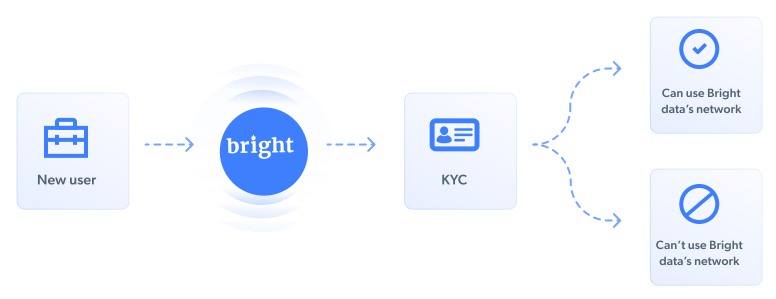
Nobody gets access without describing what they will do. Bright Data's KYC page states that "New users of Bright Data's network are meticulously vetted through our Know Your Customer process, to ensure their use case is compliant, legal, and ethical", and that "We require every potential customer to provide a detailed account of their intended use case before any access is granted."
The verification is a person, not a checkbox. The same page describes "live video identity verification and a personal review by an experienced compliance officer".
Several whole industries are prohibited. Bright Data states it strictly prohibits use cases "linked to adult content, gambling, cryptocurrency, and more". For a large part of our own readership that sentence ends the evaluation, and it is better to learn it here than after a procurement process.
Approval is scoped, and the scope is enforced at runtime. Bright Data's network access documentation states that "Requests to domains or categories outside your approved use case are blocked and return an Access denied error", that government websites are blocked across all networks, and that the review process runs through business details, company registration documents and human review with a decision by email.
The peer network is described as opt-in. The documentation states that "Residential IP addresses are linked to 100% real people who opted in to the Bright Data network." That is the vendor's own description of its supply, and it is the claim that the whole residential proxy category lives or dies on.
What the law and the standards actually say
Robots.txt is a standard, and it is not a lock. The Robots Exclusion Protocol was published by the IETF as RFC 9309, an Internet Standards Track document, and specifies that a crawler "MUST match the paths in 'allow' and 'disallow' rules against the URI" with the most specific match used. It also says plainly that it "is not a substitute for valid content security measures".
So compliance with it is a choice you make, and one you should make explicitly. Ignoring robots.txt is not a technical impossibility, which is exactly why it belongs in a written policy rather than in a developer's judgement.
Publicly visible does not mean unregulated. The ICO and sixteen other data protection authorities published a joint statement on data scraping defining it as "the automated extraction of data from the web, including social media platforms and other websites that host publicly accessible personal information", and telling organisations to "Ensure that permissible data scraping for commercial or socially beneficial purposes is done lawfully and in accordance with strict contractual terms".
Which is the actual reason to prefer a vendor with a KYC gate. The gate is an annoyance during procurement and an asset during a dispute, because someone else has documented what you said you would do. None of this is legal advice.
Where it fits, and where it does not
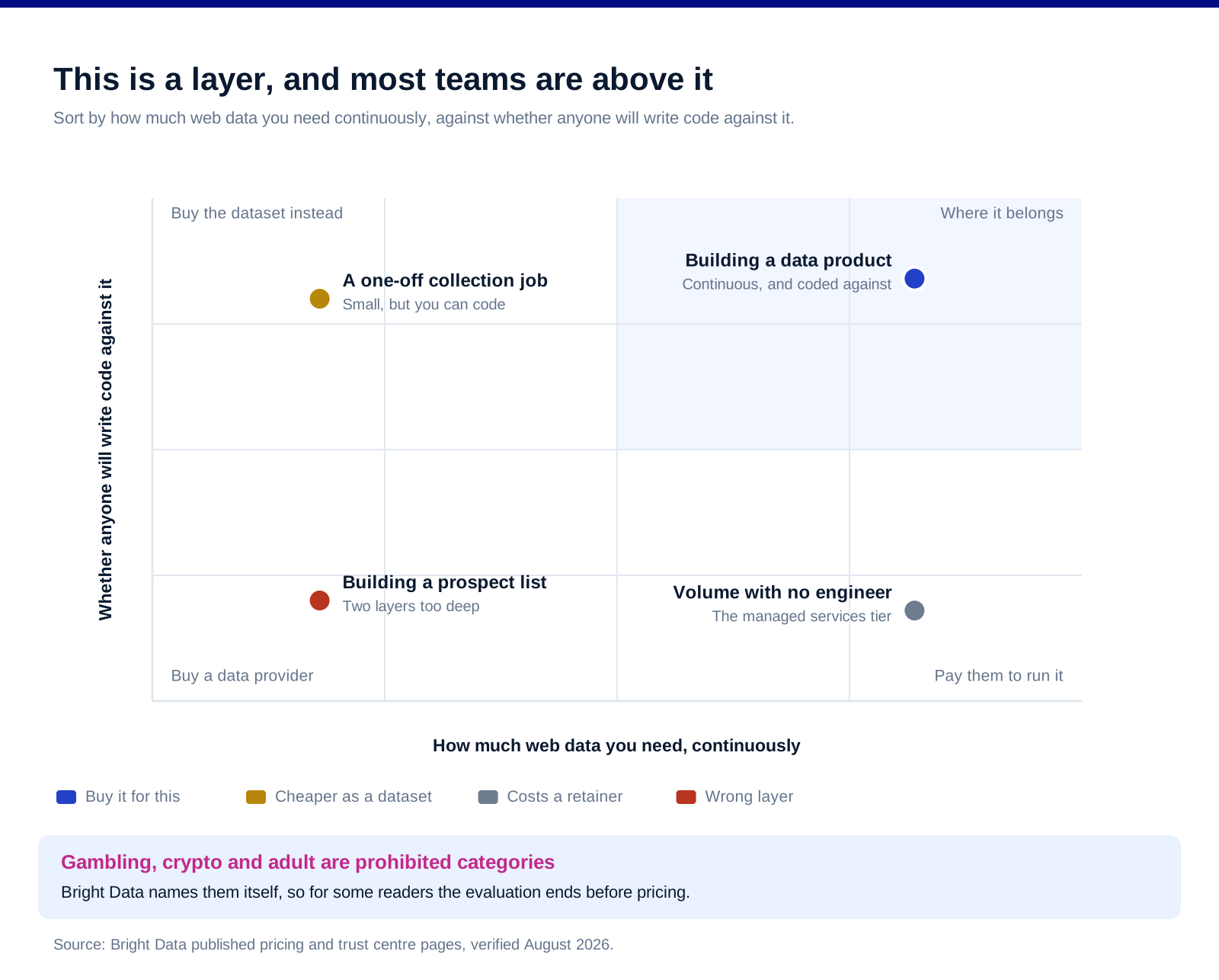
Not a prospecting tool. If you want names, emails and firmographics for outbound, this is the wrong layer. Buy a data provider, and our B2B data providers roundup covers that category properly.
Not an enrichment tool either. Enrichment products already do the collection and normalisation for you at a per record price that will beat assembling it yourself at low volumes. Our lead enrichment tools piece is the relevant comparison.
Yes for building something. If your product needs pricing data, SERP data, marketplace listings or category coverage at continuous volume, this is the correct layer and the per unit pricing is legible.
Yes for one-off structured collection at scale. Datasets at $250 per 100,000 records is a straightforward purchase when the alternative is three engineering weeks.
And genuinely useful for market research nobody else can do. Category-level price movement or listing coverage is the kind of question the estimation tools cannot answer, which is the gap our Similarweb review describes from the other side.
The honest test is whether you have an engineer. Every product here assumes somebody writes code against it. If nobody on your team will, the free tier will tell you that in an afternoon.
What Bright Data does not publish
What the tiers cost after the promotion, in the same table. List and promotional rates both appear, but the post-promotion allowance per tier is not stated as a figure.
The size of the residential peer network. Described as real people who opted in, without a number in the material we read.
How peers are recruited or compensated. Not stated on the pages we could access, and it is the question the whole model rests on.
A complete list of prohibited or restricted domains. Categories are named by example, with the enforcement described as an access denied response rather than as a published list.
How long approval actually takes in practice. The documentation describes an email decision and mentions 48 hours, but the process includes a video call, so treat that as a floor rather than a plan.
FAQ
How much does Bright Data cost?
It depends entirely on the unit. Residential proxies list at $8 per GB with no commitment and $5 per GB at a $1,999 monthly commitment. The Unlocker, Crawl and SERP APIs list from $1 per 1,000 requests. Datasets list from $250 per 100,000 records. A 50% three month promotion was running when we checked, so confirm the post-promotion rate and allowance before committing.
Do you have to pass KYC to use Bright Data?
Yes. Bright Data states that new users are vetted through a Know Your Customer process, that a detailed account of the intended use case is required before any access is granted, and that verification includes live video identity verification and review by a compliance officer. Approval is scoped, and requests outside the approved use case return an access denied error.
Can you use Bright Data for gambling or iGaming?
Bright Data states that it strictly prohibits use cases linked to adult content, gambling, cryptocurrency and more. If your use case sits in one of those categories, treat this as a blocker to confirm directly with the vendor before doing any further evaluation.
Is Bright Data a lead generation tool?
No. It is data collection infrastructure priced per gigabyte, per request and per record, and it assumes you will write code against it. For contact data and firmographics, a B2B data provider or an enrichment tool will be cheaper and faster at the volumes most sales teams work at.
Is web scraping legal?
That depends on what you collect, where you and the source are, and what you do with it, and this article is not legal advice. What is documented is that the Robots Exclusion Protocol is an IETF Internet Standards Track specification which explicitly says it is not a security measure, and that seventeen data protection authorities have told organisations to ensure commercial scraping is done lawfully and under strict contractual terms.
How is Bright Data bandwidth calculated?
In both directions, including headers. Bright Data states bandwidth is the sum of request headers, request data on POST, response headers and response data. Estimates built on response body size alone will understate what you actually spend.
Bottom line
Judge this one on the unit and the gate rather than the feature list. The unit is bandwidth counted in both directions or requests counted per thousand, which is honest pricing but means your bill tracks your engineering choices rather than your headcount. The gate is a genuine KYC process with named prohibited categories, and for readers in gambling, crypto or adult it simply ends the conversation. If you are building a product that consumes web data continuously, this is the right layer and the published prices are legible enough to model. If you want a list of prospects, you are two layers too deep and should buy a data provider instead. Start on a free tier with the actual job you have, because that answers in an afternoon what a week of comparison reading will not.
Want the pipeline built rather than the data pipeline built? Book a call with GROU. We run lead generation and outbound inside B2B revenue engines across verticals. If you are shopping for contact data rather than infrastructure, our B2B data providers roundup and our prospecting list guide cover that end.
We are GROU, a B2B pipeline agency that runs lead generation, outbound, and LinkedIn content for clients across manufacturing, fintech, iGaming, software, and professional services. Some links in this article are affiliate links, including Bright Data. Nothing here is legal advice, every price and policy quoted comes from Bright Data's own published pages, and the review tells a substantial share of our readership that the vendor's own rules exclude them.
Most tools reviewed on this blog are things a B2B team buys, opens and uses. Bright Data is not that. It is infrastructure, sold by the gigabyte and the thousand requests, and the two things that decide whether it belongs in your stack are the metering unit and a compliance gate you have to pass before you can spend anything at all.
Both are published, and both are more informative than any feature list.
TL;DR
Bright Data sells four things: proxy networks, web access APIs, data feeds and managed data services. Residential proxies are metered by bandwidth and list at $8 per GB pay as you go, falling to $7, $6 and $5 per GB at monthly commitments of $499, $999 and $1,999. At the time of writing a 50% promotion halves those rates for three months, and the included gigabyte figures on each tier appear to be calculated at the promotional rate rather than the list rate, which is worth confirming before you commit. Bandwidth is counted in both directions, including headers. The APIs are cheaper to reason about: the Unlocker, Crawl and SERP APIs list from $1 per 1,000 requests. The gate that stops most casual buyers is the KYC process. Bright Data states it requires "a detailed account of their intended use case before any access is granted", runs "live video identity verification and a personal review by an experienced compliance officer", and strictly prohibits categories including "adult content, gambling, cryptocurrency, and more". Requests outside your approved use case return an access denied error. If you sell into iGaming, read that sentence again before you plan anything around this product.
What you are actually buying
Four product families, four different units. Bright Data's pricing page lists proxy networks, web access APIs, data feeds, and data and insights services. Nothing here is priced per seat, which is the first sign that this is not a sales tool.
Proxies are sold by bandwidth or by IP. Residential proxies start from $5 per GB at the largest published tier, datacenter proxies from $0.9 per IP and ISP proxies from $1.3 per IP.
The APIs are sold per request. The Unlocker API, Crawl API, SERP API and Scraper Studio all list from $1 per 1,000 requests, and the Browser API from $5 per GB.
Finished data is sold per record. Scraper APIs list from $1 per 1,000 records, Datasets from $250 per 100,000 records, and the Data Firehose from $0.2 per 1,000 HTML.
And there are managed services on top. Retail Insights lists from $2,000 a month and Managed Data Acquisition from $1,500 a month, which is where this stops being a tool purchase and becomes a vendor relationship.
Free tiers exist on several of the APIs. The pricing page marks the Unlocker, SERP, Scraper API and Scraper Studio products with a free tier, so the cheapest way to evaluate this is to run your actual job through one rather than to read comparisons.
The metering unit is the review
Residential bandwidth lists at four rates. The residential pricing page shows $8 per GB pay as you go with no commitment, then $7, $6 and $5 per GB at monthly commitments of $499, $999 and $1,999 respectively. Above 1 TB the page routes to sales.
A 50% promotion is running, and it changes what you see. The rates displayed are halved to $4.00, $3.50, $3.00 and $2.50 under a three month promotional code. We publish the list prices because a three month discount is not a price, and the article would be wrong the moment it lapses.
The included gigabytes appear to be calculated at the promotional rate. Divide each commitment by its included allowance and you land almost exactly on the discounted per GB figure: $499 over 141 GB is $3.54, $999 over 332 GB is $3.01, $1,999 over 798 GB is $2.51. At the list rates the same commitments would buy roughly 71, 166 and 400 GB. That is our arithmetic on their published numbers, not a statement from Bright Data, and it is the single thing we would confirm in writing before committing.
Bandwidth is counted in both directions. Bright Data states that "The bandwidth is calculated according to the sum of data transmitted to and from the target site: request headers+request data (POST)+response headers+response data." Headers count. If you have modelled this on response payload alone, your estimate is low.
Which makes the buying discount smaller than it looks. Moving from no commitment at $8 per GB to $1,999 a month at $5 per GB is a 37.5% reduction in unit price, in exchange for a fixed monthly obligation. That is a normal enterprise trade and it is not a dramatic one.
The compliance gate is real, and it will stop some readers
Nobody gets access without describing what they will do. Bright Data's KYC page states that "New users of Bright Data's network are meticulously vetted through our Know Your Customer process, to ensure their use case is compliant, legal, and ethical", and that "We require every potential customer to provide a detailed account of their intended use case before any access is granted."
The verification is a person, not a checkbox. The same page describes "live video identity verification and a personal review by an experienced compliance officer".
Several whole industries are prohibited. Bright Data states it strictly prohibits use cases "linked to adult content, gambling, cryptocurrency, and more". For a large part of our own readership that sentence ends the evaluation, and it is better to learn it here than after a procurement process.
Approval is scoped, and the scope is enforced at runtime. Bright Data's network access documentation states that "Requests to domains or categories outside your approved use case are blocked and return an Access denied error", that government websites are blocked across all networks, and that the review process runs through business details, company registration documents and human review with a decision by email.
The peer network is described as opt-in. The documentation states that "Residential IP addresses are linked to 100% real people who opted in to the Bright Data network." That is the vendor's own description of its supply, and it is the claim that the whole residential proxy category lives or dies on.
What the law and the standards actually say
Robots.txt is a standard, and it is not a lock. The Robots Exclusion Protocol was published by the IETF as RFC 9309, an Internet Standards Track document, and specifies that a crawler "MUST match the paths in 'allow' and 'disallow' rules against the URI" with the most specific match used. It also says plainly that it "is not a substitute for valid content security measures".
So compliance with it is a choice you make, and one you should make explicitly. Ignoring robots.txt is not a technical impossibility, which is exactly why it belongs in a written policy rather than in a developer's judgement.
Publicly visible does not mean unregulated. The ICO and sixteen other data protection authorities published a joint statement on data scraping defining it as "the automated extraction of data from the web, including social media platforms and other websites that host publicly accessible personal information", and telling organisations to "Ensure that permissible data scraping for commercial or socially beneficial purposes is done lawfully and in accordance with strict contractual terms".
Which is the actual reason to prefer a vendor with a KYC gate. The gate is an annoyance during procurement and an asset during a dispute, because someone else has documented what you said you would do. None of this is legal advice.
Where it fits, and where it does not
Not a prospecting tool. If you want names, emails and firmographics for outbound, this is the wrong layer. Buy a data provider, and our B2B data providers roundup covers that category properly.
Not an enrichment tool either. Enrichment products already do the collection and normalisation for you at a per record price that will beat assembling it yourself at low volumes. Our lead enrichment tools piece is the relevant comparison.
Yes for building something. If your product needs pricing data, SERP data, marketplace listings or category coverage at continuous volume, this is the correct layer and the per unit pricing is legible.
Yes for one-off structured collection at scale. Datasets at $250 per 100,000 records is a straightforward purchase when the alternative is three engineering weeks.
And genuinely useful for market research nobody else can do. Category-level price movement or listing coverage is the kind of question the estimation tools cannot answer, which is the gap our Similarweb review describes from the other side.
The honest test is whether you have an engineer. Every product here assumes somebody writes code against it. If nobody on your team will, the free tier will tell you that in an afternoon.
What Bright Data does not publish
What the tiers cost after the promotion, in the same table. List and promotional rates both appear, but the post-promotion allowance per tier is not stated as a figure.
The size of the residential peer network. Described as real people who opted in, without a number in the material we read.
How peers are recruited or compensated. Not stated on the pages we could access, and it is the question the whole model rests on.
A complete list of prohibited or restricted domains. Categories are named by example, with the enforcement described as an access denied response rather than as a published list.
How long approval actually takes in practice. The documentation describes an email decision and mentions 48 hours, but the process includes a video call, so treat that as a floor rather than a plan.
FAQ
How much does Bright Data cost?
It depends entirely on the unit. Residential proxies list at $8 per GB with no commitment and $5 per GB at a $1,999 monthly commitment. The Unlocker, Crawl and SERP APIs list from $1 per 1,000 requests. Datasets list from $250 per 100,000 records. A 50% three month promotion was running when we checked, so confirm the post-promotion rate and allowance before committing.
Do you have to pass KYC to use Bright Data?
Yes. Bright Data states that new users are vetted through a Know Your Customer process, that a detailed account of the intended use case is required before any access is granted, and that verification includes live video identity verification and review by a compliance officer. Approval is scoped, and requests outside the approved use case return an access denied error.
Can you use Bright Data for gambling or iGaming?
Bright Data states that it strictly prohibits use cases linked to adult content, gambling, cryptocurrency and more. If your use case sits in one of those categories, treat this as a blocker to confirm directly with the vendor before doing any further evaluation.
Is Bright Data a lead generation tool?
No. It is data collection infrastructure priced per gigabyte, per request and per record, and it assumes you will write code against it. For contact data and firmographics, a B2B data provider or an enrichment tool will be cheaper and faster at the volumes most sales teams work at.
Is web scraping legal?
That depends on what you collect, where you and the source are, and what you do with it, and this article is not legal advice. What is documented is that the Robots Exclusion Protocol is an IETF Internet Standards Track specification which explicitly says it is not a security measure, and that seventeen data protection authorities have told organisations to ensure commercial scraping is done lawfully and under strict contractual terms.
How is Bright Data bandwidth calculated?
In both directions, including headers. Bright Data states bandwidth is the sum of request headers, request data on POST, response headers and response data. Estimates built on response body size alone will understate what you actually spend.
Bottom line
Judge this one on the unit and the gate rather than the feature list. The unit is bandwidth counted in both directions or requests counted per thousand, which is honest pricing but means your bill tracks your engineering choices rather than your headcount. The gate is a genuine KYC process with named prohibited categories, and for readers in gambling, crypto or adult it simply ends the conversation. If you are building a product that consumes web data continuously, this is the right layer and the published prices are legible enough to model. If you want a list of prospects, you are two layers too deep and should buy a data provider instead. Start on a free tier with the actual job you have, because that answers in an afternoon what a week of comparison reading will not.
Want the pipeline built rather than the data pipeline built? Book a call with GROU. We run lead generation and outbound inside B2B revenue engines across verticals. If you are shopping for contact data rather than infrastructure, our B2B data providers roundup and our prospecting list guide cover that end.
We are GROU, a B2B pipeline agency that runs lead generation, outbound, and LinkedIn content for clients across manufacturing, fintech, iGaming, software, and professional services. Some links in this article are affiliate links, including Bright Data. Nothing here is legal advice, every price and policy quoted comes from Bright Data's own published pages, and the review tells a substantial share of our readership that the vendor's own rules exclude them.
Most tools reviewed on this blog are things a B2B team buys, opens and uses. Bright Data is not that. It is infrastructure, sold by the gigabyte and the thousand requests, and the two things that decide whether it belongs in your stack are the metering unit and a compliance gate you have to pass before you can spend anything at all.
Both are published, and both are more informative than any feature list.
TL;DR
Bright Data sells four things: proxy networks, web access APIs, data feeds and managed data services. Residential proxies are metered by bandwidth and list at $8 per GB pay as you go, falling to $7, $6 and $5 per GB at monthly commitments of $499, $999 and $1,999. At the time of writing a 50% promotion halves those rates for three months, and the included gigabyte figures on each tier appear to be calculated at the promotional rate rather than the list rate, which is worth confirming before you commit. Bandwidth is counted in both directions, including headers. The APIs are cheaper to reason about: the Unlocker, Crawl and SERP APIs list from $1 per 1,000 requests. The gate that stops most casual buyers is the KYC process. Bright Data states it requires "a detailed account of their intended use case before any access is granted", runs "live video identity verification and a personal review by an experienced compliance officer", and strictly prohibits categories including "adult content, gambling, cryptocurrency, and more". Requests outside your approved use case return an access denied error. If you sell into iGaming, read that sentence again before you plan anything around this product.
What you are actually buying
Four product families, four different units. Bright Data's pricing page lists proxy networks, web access APIs, data feeds, and data and insights services. Nothing here is priced per seat, which is the first sign that this is not a sales tool.
Proxies are sold by bandwidth or by IP. Residential proxies start from $5 per GB at the largest published tier, datacenter proxies from $0.9 per IP and ISP proxies from $1.3 per IP.
The APIs are sold per request. The Unlocker API, Crawl API, SERP API and Scraper Studio all list from $1 per 1,000 requests, and the Browser API from $5 per GB.
Finished data is sold per record. Scraper APIs list from $1 per 1,000 records, Datasets from $250 per 100,000 records, and the Data Firehose from $0.2 per 1,000 HTML.
And there are managed services on top. Retail Insights lists from $2,000 a month and Managed Data Acquisition from $1,500 a month, which is where this stops being a tool purchase and becomes a vendor relationship.
Free tiers exist on several of the APIs. The pricing page marks the Unlocker, SERP, Scraper API and Scraper Studio products with a free tier, so the cheapest way to evaluate this is to run your actual job through one rather than to read comparisons.
The metering unit is the review
Residential bandwidth lists at four rates. The residential pricing page shows $8 per GB pay as you go with no commitment, then $7, $6 and $5 per GB at monthly commitments of $499, $999 and $1,999 respectively. Above 1 TB the page routes to sales.
A 50% promotion is running, and it changes what you see. The rates displayed are halved to $4.00, $3.50, $3.00 and $2.50 under a three month promotional code. We publish the list prices because a three month discount is not a price, and the article would be wrong the moment it lapses.
The included gigabytes appear to be calculated at the promotional rate. Divide each commitment by its included allowance and you land almost exactly on the discounted per GB figure: $499 over 141 GB is $3.54, $999 over 332 GB is $3.01, $1,999 over 798 GB is $2.51. At the list rates the same commitments would buy roughly 71, 166 and 400 GB. That is our arithmetic on their published numbers, not a statement from Bright Data, and it is the single thing we would confirm in writing before committing.
Bandwidth is counted in both directions. Bright Data states that "The bandwidth is calculated according to the sum of data transmitted to and from the target site: request headers+request data (POST)+response headers+response data." Headers count. If you have modelled this on response payload alone, your estimate is low.
Which makes the buying discount smaller than it looks. Moving from no commitment at $8 per GB to $1,999 a month at $5 per GB is a 37.5% reduction in unit price, in exchange for a fixed monthly obligation. That is a normal enterprise trade and it is not a dramatic one.
The compliance gate is real, and it will stop some readers
Nobody gets access without describing what they will do. Bright Data's KYC page states that "New users of Bright Data's network are meticulously vetted through our Know Your Customer process, to ensure their use case is compliant, legal, and ethical", and that "We require every potential customer to provide a detailed account of their intended use case before any access is granted."
The verification is a person, not a checkbox. The same page describes "live video identity verification and a personal review by an experienced compliance officer".
Several whole industries are prohibited. Bright Data states it strictly prohibits use cases "linked to adult content, gambling, cryptocurrency, and more". For a large part of our own readership that sentence ends the evaluation, and it is better to learn it here than after a procurement process.
Approval is scoped, and the scope is enforced at runtime. Bright Data's network access documentation states that "Requests to domains or categories outside your approved use case are blocked and return an Access denied error", that government websites are blocked across all networks, and that the review process runs through business details, company registration documents and human review with a decision by email.
The peer network is described as opt-in. The documentation states that "Residential IP addresses are linked to 100% real people who opted in to the Bright Data network." That is the vendor's own description of its supply, and it is the claim that the whole residential proxy category lives or dies on.
What the law and the standards actually say
Robots.txt is a standard, and it is not a lock. The Robots Exclusion Protocol was published by the IETF as RFC 9309, an Internet Standards Track document, and specifies that a crawler "MUST match the paths in 'allow' and 'disallow' rules against the URI" with the most specific match used. It also says plainly that it "is not a substitute for valid content security measures".
So compliance with it is a choice you make, and one you should make explicitly. Ignoring robots.txt is not a technical impossibility, which is exactly why it belongs in a written policy rather than in a developer's judgement.
Publicly visible does not mean unregulated. The ICO and sixteen other data protection authorities published a joint statement on data scraping defining it as "the automated extraction of data from the web, including social media platforms and other websites that host publicly accessible personal information", and telling organisations to "Ensure that permissible data scraping for commercial or socially beneficial purposes is done lawfully and in accordance with strict contractual terms".
Which is the actual reason to prefer a vendor with a KYC gate. The gate is an annoyance during procurement and an asset during a dispute, because someone else has documented what you said you would do. None of this is legal advice.
Where it fits, and where it does not
Not a prospecting tool. If you want names, emails and firmographics for outbound, this is the wrong layer. Buy a data provider, and our B2B data providers roundup covers that category properly.
Not an enrichment tool either. Enrichment products already do the collection and normalisation for you at a per record price that will beat assembling it yourself at low volumes. Our lead enrichment tools piece is the relevant comparison.
Yes for building something. If your product needs pricing data, SERP data, marketplace listings or category coverage at continuous volume, this is the correct layer and the per unit pricing is legible.
Yes for one-off structured collection at scale. Datasets at $250 per 100,000 records is a straightforward purchase when the alternative is three engineering weeks.
And genuinely useful for market research nobody else can do. Category-level price movement or listing coverage is the kind of question the estimation tools cannot answer, which is the gap our Similarweb review describes from the other side.
The honest test is whether you have an engineer. Every product here assumes somebody writes code against it. If nobody on your team will, the free tier will tell you that in an afternoon.
What Bright Data does not publish
What the tiers cost after the promotion, in the same table. List and promotional rates both appear, but the post-promotion allowance per tier is not stated as a figure.
The size of the residential peer network. Described as real people who opted in, without a number in the material we read.
How peers are recruited or compensated. Not stated on the pages we could access, and it is the question the whole model rests on.
A complete list of prohibited or restricted domains. Categories are named by example, with the enforcement described as an access denied response rather than as a published list.
How long approval actually takes in practice. The documentation describes an email decision and mentions 48 hours, but the process includes a video call, so treat that as a floor rather than a plan.
FAQ
How much does Bright Data cost?
It depends entirely on the unit. Residential proxies list at $8 per GB with no commitment and $5 per GB at a $1,999 monthly commitment. The Unlocker, Crawl and SERP APIs list from $1 per 1,000 requests. Datasets list from $250 per 100,000 records. A 50% three month promotion was running when we checked, so confirm the post-promotion rate and allowance before committing.
Do you have to pass KYC to use Bright Data?
Yes. Bright Data states that new users are vetted through a Know Your Customer process, that a detailed account of the intended use case is required before any access is granted, and that verification includes live video identity verification and review by a compliance officer. Approval is scoped, and requests outside the approved use case return an access denied error.
Can you use Bright Data for gambling or iGaming?
Bright Data states that it strictly prohibits use cases linked to adult content, gambling, cryptocurrency and more. If your use case sits in one of those categories, treat this as a blocker to confirm directly with the vendor before doing any further evaluation.
Is Bright Data a lead generation tool?
No. It is data collection infrastructure priced per gigabyte, per request and per record, and it assumes you will write code against it. For contact data and firmographics, a B2B data provider or an enrichment tool will be cheaper and faster at the volumes most sales teams work at.
Is web scraping legal?
That depends on what you collect, where you and the source are, and what you do with it, and this article is not legal advice. What is documented is that the Robots Exclusion Protocol is an IETF Internet Standards Track specification which explicitly says it is not a security measure, and that seventeen data protection authorities have told organisations to ensure commercial scraping is done lawfully and under strict contractual terms.
How is Bright Data bandwidth calculated?
In both directions, including headers. Bright Data states bandwidth is the sum of request headers, request data on POST, response headers and response data. Estimates built on response body size alone will understate what you actually spend.
Bottom line
Judge this one on the unit and the gate rather than the feature list. The unit is bandwidth counted in both directions or requests counted per thousand, which is honest pricing but means your bill tracks your engineering choices rather than your headcount. The gate is a genuine KYC process with named prohibited categories, and for readers in gambling, crypto or adult it simply ends the conversation. If you are building a product that consumes web data continuously, this is the right layer and the published prices are legible enough to model. If you want a list of prospects, you are two layers too deep and should buy a data provider instead. Start on a free tier with the actual job you have, because that answers in an afternoon what a week of comparison reading will not.
Want the pipeline built rather than the data pipeline built? Book a call with GROU. We run lead generation and outbound inside B2B revenue engines across verticals. If you are shopping for contact data rather than infrastructure, our B2B data providers roundup and our prospecting list guide cover that end.
We are GROU, a B2B pipeline agency that runs lead generation, outbound, and LinkedIn content for clients across manufacturing, fintech, iGaming, software, and professional services. Some links in this article are affiliate links, including Bright Data. Nothing here is legal advice, every price and policy quoted comes from Bright Data's own published pages, and the review tells a substantial share of our readership that the vendor's own rules exclude them.
Pipeline OS Newsletter
Build qualified pipeline
Get weekly tactics to generate demand, improve lead quality, and book more meetings.





Trusted by industry leaders
Trusted by industry leaders
Trusted by industry leaders
Ready to build qualified pipeline?
Ready to build qualified pipeline?
Ready to build qualified pipeline?
Book a call to see if we're the right fit, or take the 2-minute quiz to get a clear starting point.
Book a call to see if we're the right fit, or take the 2-minute quiz to get a clear starting point.
Book a call to see if we're the right fit, or take the 2-minute quiz to get a clear starting point.
" height="30.21639343089746px" id="hfGbXmQR2" width="30.216393430897455px"/></svg>)
Copyright © 2026 – All Right Reserved
Copyright © 2026 – All Right Reserved
Copyright © 2026 – All Right Reserved