%22%3E%3C/path%3E%3Cpath d=%22M 63.072 7.554 C 62.258 8.022 61.577 8.689 61.092 9.493 L 61.092 7.076 L 57.158 7.076 L 57.158 22.64 L 61.089 22.64 L 61.089 14.888 C 61.089 13.446 61.403 12.434 62.03 11.853 C 62.818 11.218 63.818 10.907 64.826 10.982 L 65.868 10.982 L 65.868 6.851 C 64.891 6.834 63.926 7.076 63.073 7.554 Z%22 fill=%22rgb(17,17,17)%22%3E%3C/path%3E%3Cpath d=%22M 78.916 7.82 C 76.363 6.49 73.321 6.49 70.768 7.82 C 69.562 8.473 68.564 9.451 67.888 10.644 C 67.167 11.931 66.803 13.387 66.834 14.862 C 66.804 16.332 67.157 17.785 67.86 19.077 C 68.515 20.267 69.494 21.246 70.684 21.901 C 71.924 22.576 73.318 22.92 74.73 22.898 C 76.164 22.918 77.58 22.575 78.846 21.901 C 80.062 21.247 81.073 20.27 81.768 19.077 C 82.506 17.797 82.88 16.339 82.85 14.862 C 82.88 13.389 82.517 11.934 81.797 10.647 C 81.12 9.455 80.122 8.477 78.917 7.824 M 78.803 14.862 C 78.829 15.739 78.636 16.608 78.241 17.391 C 77.903 18.046 77.38 18.588 76.738 18.95 C 76.124 19.293 75.432 19.472 74.729 19.47 C 73.668 19.497 72.648 19.061 71.934 18.276 C 71.139 17.323 70.741 16.1 70.823 14.862 C 70.741 13.62 71.149 12.395 71.959 11.45 C 72.687 10.667 73.715 10.233 74.783 10.256 C 75.859 10.236 76.894 10.67 77.635 11.45 C 78.464 12.387 78.884 13.616 78.801 14.864%22 fill=%22rgb(17,17,17)%22%3E%3C/path%3E%3Cpath d=%22M 95.906 7.076 L 95.906 15.646 C 95.975 16.68 95.643 17.701 94.979 18.498 C 94.311 19.184 93.379 19.547 92.422 19.495 C 91.475 19.544 90.553 19.18 89.894 18.498 C 89.23 17.701 88.898 16.68 88.967 15.646 L 88.967 7.076 L 85.033 7.076 L 85.033 16.207 C 85 17.449 85.275 18.68 85.834 19.79 C 86.327 20.75 87.095 21.542 88.039 22.065 C 89.033 22.594 90.145 22.861 91.271 22.838 C 92.188 22.847 93.095 22.65 93.926 22.263 C 94.708 21.905 95.388 21.36 95.906 20.675 L 95.906 22.645 L 99.865 22.645 L 99.865 7.076 Z%22 fill=%22rgb(17,17,17)%22%3E%3C/path%3E%3Cpath d=%22M 4.513 15.626 C 4.511 10.815 7.606 6.549 12.181 5.059 C 16.756 3.57 21.77 5.195 24.601 9.086 L 27.816 5.87 C 24.074 1.186 17.981 -0.943 12.137 0.393 C 6.292 1.728 1.728 6.292 0.393 12.137 C -0.943 17.981 1.186 24.074 5.87 27.816 L 9.085 24.601 C 6.214 22.512 4.515 19.177 4.513 15.626%22 fill=%22rgb(32,62,235)%22%3E%3C/path%3E%3Cpath d=%22M 17.114 14.343 L 13.354 18.01 L 13.354 18.026 L 21.071 18.026 L 11.412 27.609 L 17.389 27.609 L 23.999 21.081 L 23.999 28.316 L 24.005 28.316 L 27.967 24.393 L 27.967 14.343 Z%22 fill=%22rgb(32,62,235)%22%3E%3C/path%3E%3C/g%3E%3C/svg%3E) ×
× ××
××›
›
›
›
Ideal customer profile template for B2B: how to find your best buyers in 2026
Ideal customer profile template for B2B: how to find your best buyers in 2026
Ideal customer profile template for B2B: how to find your best buyers in 2026
Ideal customer profile template for B2B: how to find your best buyers in 2026
Ideal customer profile template for B2B: how to find your best buyers in 2026
Ideal customer profile template for B2B: how to find your best buyers in 2026

Author
Aljaz Peklaj

Your team already has an ICP doc. Sales has the slide. Marketing has the persona sheet. HubSpot has lifecycle stages. Yet the calendar is still thin, reply quality is uneven, and too many “good fit” accounts go nowhere.
Most ICP templates fail because they describe fit, not buying readiness
The three fields that change results are signal-readiness, disqualification criteria, and why now patterns
The strongest ideal client profile template starts in closed-won data, not a workshop
The template only matters if it flows into Apollo, Sales Navigator, HubSpot, and outbound copy
If your meeting-held rate is weak, start with your ICP logic before blaming channels, reps, or copy, as covered in these lead generation KPIs
Table of Contents
Your ICP exists but the pipeline is flat
A filled-out ideal client profile template can still produce a flat pipeline. That's the normal failure mode, not an exception. Organizations overbuild firmographics, underbuild timing, and then wonder why the list looks right but the market stays quiet.
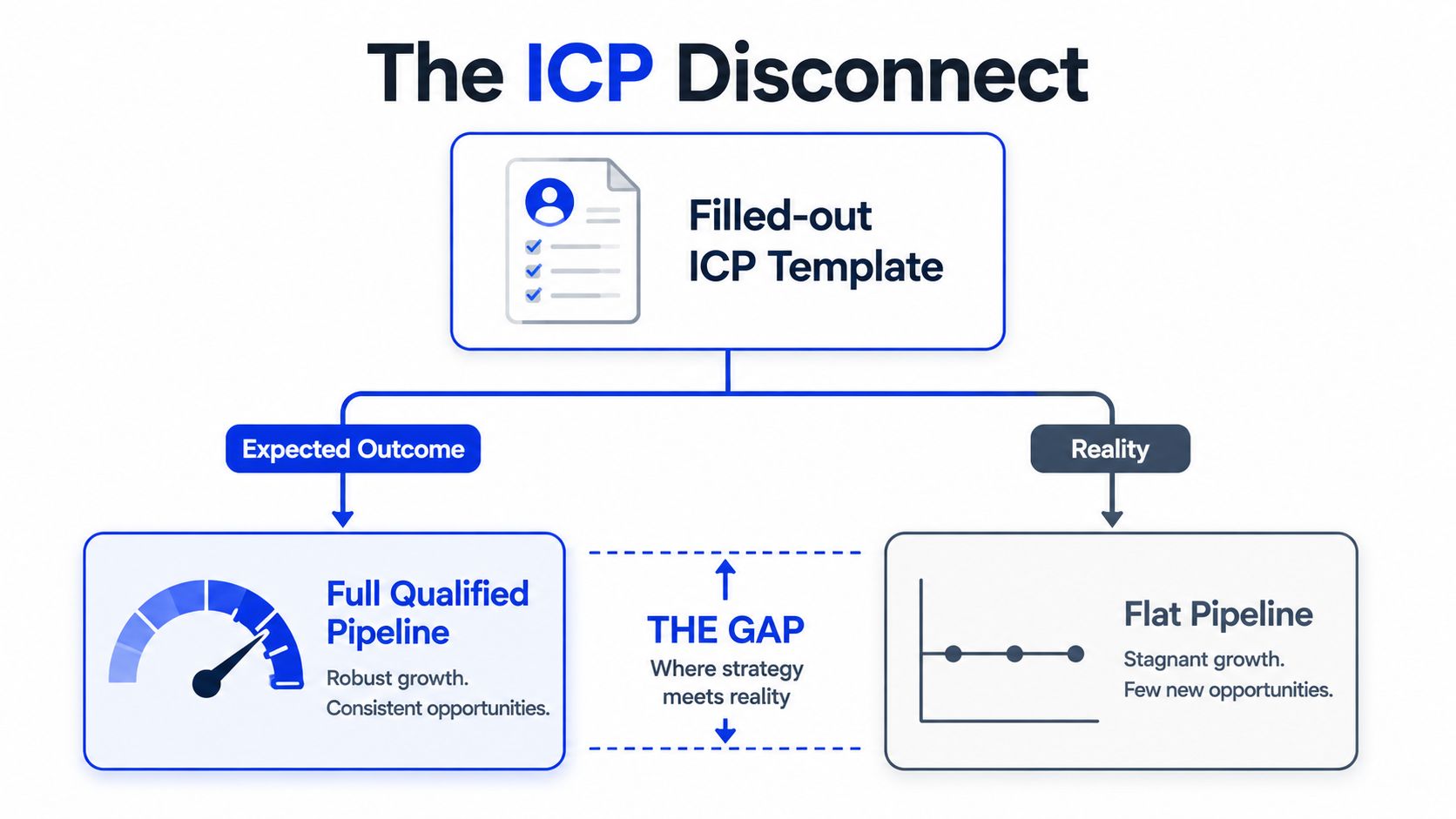
The fix isn't another prettier template. It's a different structure. A working ideal client profile template needs static fit fields, yes, but it also needs dynamic fields that tell your team who should enter the queue this week, who should stay out, and what business reason makes outreach relevant now.
What static templates miss
Most templates stop at company size, industry, geography, revenue band, buyer title. Those fields are necessary. They're just not enough to create pipeline on their own.
The practical issue is simple:
Static fields identify resemblance → “This account looks like prior customers”
Dynamic fields identify timing → “This account is more likely to engage now”
Operational fields identify action → “This rep should reach out with this angle, through this list, today”
A finished document isn't a targeting system. It becomes one only when reps can query it, score from it, and disqualify with it.
The strongest templates act like routing logic. They tell Apollo what to pull, Clay what to enrich, HubSpot what to score, and SDRs what not to touch.
What a usable template actually needs
A validated B2B ICP template should identify six shared traits from your best customers: industry fit, financial readiness, active need, growth trajectory, company size, and geographic match, as outlined in HubSpot's ideal customer profile template. That's the base layer.
From there, the useful version adds three more fields often overlooked:
Signal-readiness criteria → concrete triggers tied to data sources
Disqualification criteria → explicit reasons to keep paper-fit accounts out
Why now patterns → buying urgency captured in language reps can use
If you want a practical starting point, build the sheet around those nine elements and keep it inside the systems your team already opens every day. If it only lives in Notion or Slides, it won't change pipeline behavior.
The three fields that separate static ICPs from pipeline engines
The verdict is simple. Dynamic fields beat broader firmographics. If you can only improve one part of your ideal client profile template, improve the fields that capture timing and exclusion, not the fields that make the document look more complete.
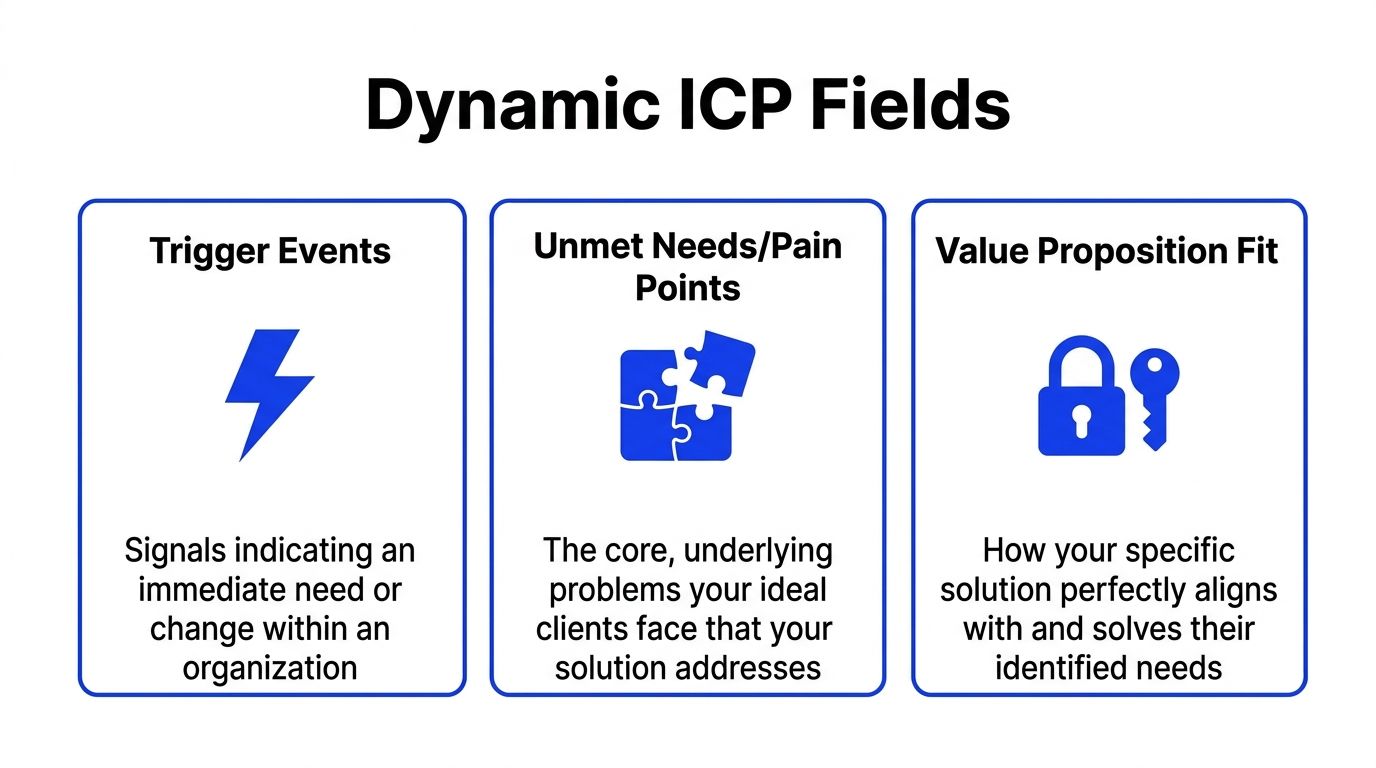
Signal-readiness criteria
This field answers a harder question than “who fits?” It answers “who fits and has a reason to act now?”
For outreach teams, this field changes queue quality more than another layer of static segmentation. The useful version includes trigger definitions that can be monitored, not just discussed in a meeting. In practice, that means recent funding, leadership changes, public posts about the pain you solve, stack changes inferred from job posts, or upcoming event attendance.
A critical step in the template is isolating the trigger event that makes the purchase a priority. That's the line between an account that is merely relevant and one that is commercially active.
A good signal-readiness field should specify:
Trigger type → funding event, hiring motion, expansion, compliance pressure
Time window → recent enough to matter operationally
Data source → LinkedIn posts, company pages, job boards, CRM notes, Clay enrichments
Message implication → what the rep should mention in line one or two
If you're tightening your scoring logic, many teams should ensure readiness is considered from the start. A scoring model that ignores readiness will overvalue lookalike accounts. This is the same failure that breaks many account scoring systems.
For teams that want another practical take on building this layer, Yalc helps define ICP in a way that fits how modern RevOps teams work across product, sales, and marketing.
Disqualification criteria
This is the least glamorous field in the template, and often the most profitable.
Teams love to discuss who belongs in the ICP. They avoid writing down who should be excluded because it feels restrictive. In reality, that hesitation costs meetings, rep time, and pipeline clarity. The best templates don't just define the target. They define the waste.
Common exclusions include accounts that recently chose a competing vendor, companies in restructuring, accounts with no active buyer in role, or companies your team already worked recently with no movement. Those accounts can still look ideal in Apollo filters, but they shouldn't reach an SDR queue.
The fastest way to improve list quality is often subtraction.
30% of prospects often aren't a good fit, and many templates still don't include a weighted way to separate “could buy” from “should be worked now,” as discussed in Qualtrics' ideal customer profile guidance.
Disqualification criteria should be granular enough that operations can enforce them. “Low urgency” is too soft. “Buyer role vacant” is usable. “Competing system implemented recently” is usable. “Already pitched within the cooling window” is usable.
Why now patterns
This field belongs in the ICP, not just in discovery.
The strongest teams document a specific qualifying question and the answer patterns that predict urgency. Usually it's some form of “What's driving this conversation right now?” What matters is not the wording. It's whether the team captures repeatable answers tied to buying momentum.
Examples include:
Growth pressure → “We've outgrown the current setup”
Leadership change → “We just hired someone to own this”
Board or investor pressure → “We need proof before the next review”
Contract timing → “The current agreement is up soon”
The reason this field belongs in the ideal client profile template is that it affects both outbound and qualification. It tells copywriters what to reference, SDRs what to confirm, and AEs what to document.
A lot of templates still dump “pain points” into a vague box. That's weak. Pain points matter for messaging, but why now is what helps a team tell interest from motion.
How to build your ICP from closed-deal evidence
Teams often build their ICP backward. They start with who they want to sell to, then try to prove it later. The better approach is uglier and more useful. Export the deals, inspect the wins, compare the best accounts to the average ones, and write the template from evidence.
Start with deals, not opinions
Pull 12 to 18 months of closed-won data from HubSpot or Salesforce. Don't begin with open opportunities, and don't begin with a leadership workshop. Closed-won data gives you something concrete: who bought, who stayed, and who justified the effort.
Then segment the account set. A practical method is to isolate your top-value segment by ACV, retention quality, expansion potential, or strategic value. The point isn't elegance. The point is finding the accounts that changed the business and asking what they share.
For one contract lifecycle management client, the useful pattern wasn't “legal teams at companies of a certain size.” That was too broad. The stronger pattern in the high-value segment was narrower:
Multi-jurisdictional operations
CLO or General Counsel as the primary buyer
Recent acquisition activity
Public technology transformation language
That wasn't visible in the original targeting logic. It surfaced only after looking at the higher-value closed deals against the broader portfolio.
Build tiers from observed value
Once patterns emerge, build a tiered ideal client profile template. Don't force one profile to cover every account class.
In the same legal tech case, the original ICP remained as a mid-market tier. A new enterprise tier was added with stricter criteria, its own signals, its own messaging, and different sales expectations. Across 6 months, that new tier added 340 prospects to the active queue, produced 18 qualified meetings, and closed 4 deals with an average ACV of €94k versus the previous €28k baseline, adding €376k without hurting the existing segment.
That case matters because it shows what an ICP should do. It should expose a better revenue segment, not just tidy the CRM.
A tiering structure usually looks like this:
Tier | Use case | Typical difference |
|---|---|---|
Tier 1 | Highest-value accounts | More complex buying committee, more selective outreach |
Tier 2 | Core volume segment | Faster cycles, broader reachable market |
Tier 3 | Acceptable fit | Lower-touch motion or nurture |
The mistake is assuming one template can support all three equally. It can't. Each tier needs its own buyer role assumptions, signal logic, disqualification rules, and outreach angle.
If the account closes at a different ACV and moves through a different sales motion, it deserves a different ICP tier.
Add customer language before finalizing
CRM patterns tell you who converted. Interviews tell you why your message will land.
Businesses that interview ten or more top customers directly to extract language and pain points for their ICP see a 45% improvement in message resonance, leading to sales cycles that average 28% faster than industry norms. Use those interviews to sharpen the wording in your template, not to replace the data.
A simple workflow works well:
Export the best accounts from HubSpot
Interview ten or more customers from that group
Tag recurring language around pain, timing, internal blockers, and evaluation triggers
Map those phrases into your outreach snippets and call scripts
Add enrichment rules so reps can verify the same conditions on new accounts
That last part matters. If a field can't be enriched, monitored, or checked, it's probably too abstract. At this stage, lead enrichment stops being a data hygiene exercise and starts shaping targeting logic.
For teams with less history, use smaller samples and shorter review loops. Don't fake confidence. If you only have a handful of closed deals, write that limitation into the working version of the template and revisit it once more evidence comes in.
ICP examples for key B2B verticals
A good ideal client profile template changes by vertical. The structure stays stable. The trigger logic doesn't. That's where most generic templates collapse. They give the same fields to a SaaS company, an iGaming vendor, and a manufacturer, then act surprised when all three campaigns flatten out in different ways.
A validated B2B ICP template should identify six shared traits from the best customers: industry fit, financial readiness to purchase, active need, growth trajectory, company size, and geographic match, as shown in HubSpot's ICP template framework.
SaaS
For SaaS, the static layer usually starts with employee band, funding stage, geography, and function. Fine. The useful layer starts when you add change signals.
A stronger SaaS template might look like this:
Static fit → B2B SaaS, mid-market to enterprise, RevOps or sales ops function, compatible stack
Signal-readiness → hiring for RevOps, leadership posting about tooling changes, recent funding, integration-related job posts
Disqualification → competing system implemented recently, no owner for the function, active restructuring
Why now patterns → “We just hired someone to lead this,” “We're consolidating tools,” “The current setup doesn't scale”
If you serve software companies, it helps to compare your target list against examples from a focused software industry page, then tighten around signal logic rather than broad market labels.
iGaming
iGaming teams often target by jurisdiction, operator type, and company scale. That's table stakes. The better template adds compliance and launch timing.
A working version often includes:
Static fit → licensed operator or supplier, active in target jurisdictions, relevant team in place
Signal-readiness → expansion into a new market, hiring for compliance or CRM leadership, public partner announcements, event attendance connected to market entry
Disqualification → frozen expansion plans, no local licensing path, recent vendor switch in the same category
Why now patterns → “We're entering a new region,” “We need to support new compliance requirements,” “Retention economics changed”
Here, timing usually matters more than company size. A smaller operator entering a new jurisdiction can be more commercially active than a larger operator in a holding pattern.
Manufacturing
Manufacturing ICPs fail when teams ignore operational friction. Many templates overfocus on revenue band and underweight stack realities, buying complexity, and implementation readiness.
An advanced manufacturing ICP often includes:
Static fit → plant count, region, product category, ERP environment, ops leadership structure
Signal-readiness → new facility, supply chain changes, quality initiative, digitalization project, leadership change in operations
Disqualification → legacy environment with no workable integration path, capital freeze, no internal process owner
Why now patterns → “We need visibility across plants,” “Manual reporting is delaying decisions,” “A new initiative forced system review”
Technographics matter a lot. If your solution depends on integrations, the wrong ERP environment should block outreach before the list even lands with an SDR.
Legal tech and professional services
Legal tech often gets targeted too low in the org. Teams go after operations managers because they're reachable, while the larger deal sits with senior legal leadership.
A better template can split the market into tiers:
Tier 1 → multi-jurisdictional companies, CLO or GC buyer, strategic transformation pressure
Tier 2 → in-house legal teams with process pain but narrower scope
Signal-readiness → recent M&A, public transformation language, hiring for legal ops or legal systems
Disqualification → no executive sponsor, recent platform implementation, low process complexity
Why now patterns → “Acquisition created contract sprawl,” “Leadership needs standardization,” “Current tooling can't support cross-border work”
For professional services more broadly, “interest” is common and “active buying motion” is rarer. That makes the timing fields even more important.
Pharma
Pharma needs a stricter operating lens. Generic B2B fields won't capture what makes an account workable.
A practical pharma template can include:
Static fit → company type, therapeutic focus, market presence, relevant functional owner
Signal-readiness → regulatory change, trial activity, leadership movement, commercial expansion
Disqualification → procurement lock-in, no validated use case owner, ongoing restructuring
Why now patterns → “Compliance pressure changed priority,” “A launch created coordination issues,” “Leadership needs better control over process”
Pharma teams usually need tighter collaboration between sales, marketing, product, and compliance. If that alignment is weak, the ICP drifts fast.
Turning the template into lists, outreach, and metrics
An ICP in a slide deck doesn't create meetings. The operational version lives inside list building, scoring, outbound copy, and reporting. That's where structure turns attention into pipeline.
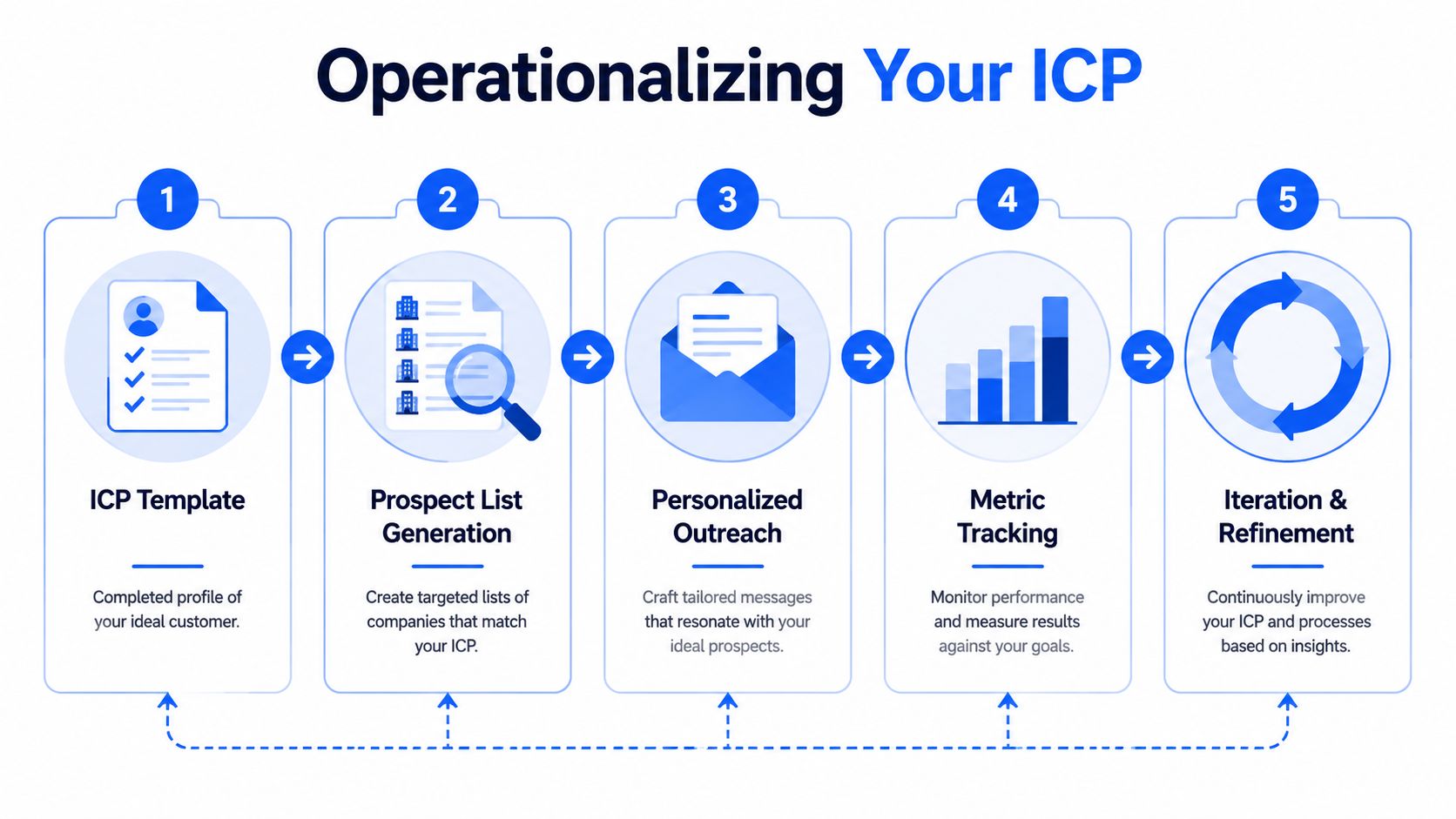
An effective ICP template should include four data layers: firmographics, technographics, behavioral data, and buying triggers, as described in AdRoll's ideal customer profile template guide. If one of those layers is missing, the system gets weaker fast.
Map fields to systems
Each field in the template should map to a tool and a workflow.
A workable stack often looks like this:
Apollo → base company and contact list filters
Sales Navigator → role changes, hiring patterns, account activity checks
Clay → enrichment for custom triggers and exclusions
HubSpot → account score, routing rules, disqualification properties
Lemlist, Smartlead, Instantly → signal-led outbound sequences
HeyReach → LinkedIn touches aligned to the same trigger logic
If your team is still mixing manual CSVs and static contact exports, the template won't stay current. Trigger-based fields need a refresh process. Weekly is common because that matches SDR queue management and pipeline review rhythm.
Here's the practical mapping:
ICP field | Tool action | Owner |
|---|---|---|
Firmographic fit | Pull list in Apollo | RevOps or SDR manager |
Technographic fit | Enrich in Clay | RevOps |
Trigger event | Monitor in Sales Navigator or Clay | SDR or analyst |
Disqualification rule | Create HubSpot property and workflow | RevOps |
Why now pattern | Add to call notes and email prompt library | SDR and AE |
For a broader view of how outbound systems fit together, this B2B lead generation guide is a useful complement.
Write from triggers, not slogans
Outreach gets better when the first sentence comes from the ICP field, not from generic value props.
If the trigger is “hiring for a RevOps lead,” the email should open with that operational event. If the trigger is “recent acquisition activity,” the opening should reflect the integration burden or process sprawl that follows. The why-now field then tells the SDR what question to ask if the prospect replies.
A simple structure works well:
Line 1 → observed trigger
Line 2 → likely business consequence
Line 3 → relevant proof or offer
CTA → low-friction next step
Deliverability still matters. If you're scaling outbound in Smartlead or Instantly, these insights for better email deliverability are worth reviewing before you blame the ICP for weak response quality.
Good targeting can still underperform if the outreach infrastructure is weak. Bad targeting will fail even with perfect sending setup.
Track the metrics that prove the ICP is working
Once the template is live, measure whether it improves queue quality, not just top-of-funnel activity.
The most useful operational checks are:
Reply quality → are responses commercially relevant or just polite deflections?
Meeting-held rate → are booked calls showing up?
Qualification rate after first call → are reps meeting accounts that belong there?
Cost per qualified meeting → is the queue getting cheaper or more expensive to convert?
Tier-to-pipeline contribution → is the higher-value segment justifying its effort?
A “good” ICP should raise consistency across those metrics. If replies improve but held meetings don't, your why-now logic may be weak. If meetings improve but qualification collapses, your disqualification rules probably aren't strict enough.
The template should also appear in weekly sales meetings. Not as theory. As a live table of what's converting, what's stalling, and what should be removed.
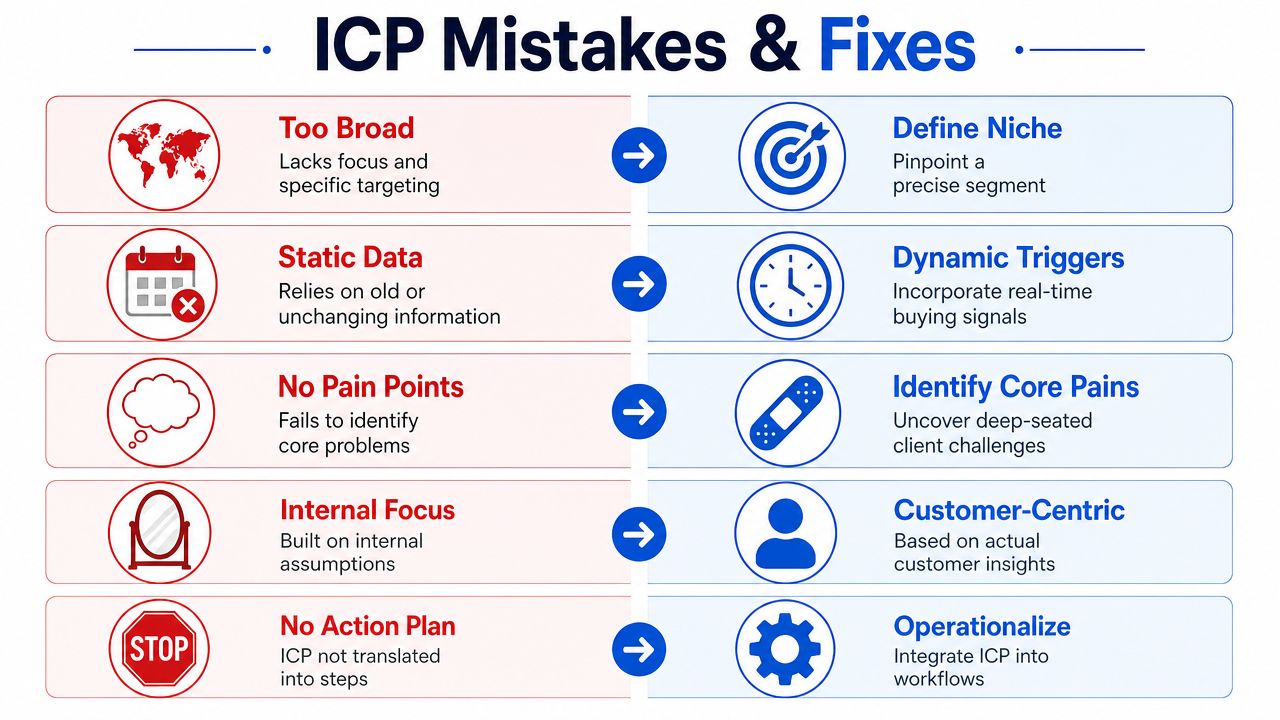
Five common ICP mistakes and their direct fixes
Most ICP mistakes are not strategic mysteries. They're predictable operating errors. The same ones show up in SaaS, iGaming, manufacturing, legal tech, and pharma.
Broad, vague, and stale
The first mistake is building an ICP that is too broad because leadership doesn't want to exclude opportunities. That usually sounds like “B2B companies with 50 to 5,000 employees across North America and Europe.” It looks safe. It produces generic outreach and flat campaigns.
The fix is narrower segmentation based on the top-value accounts, not the average ones.
The second mistake is confusing target market with ICP. “We sell to enterprise financial services” is a market statement. It doesn't tell an SDR which accounts should be prioritized this week.
The third mistake is treating the ICP as a one-time exercise. The best teams refresh it on a cadence. The weaker teams keep a launch-era definition long after the market, product, and buyer motion have changed.
Aspirational instead of evidence-based
Another common failure is writing the ICP around the customer segment the company wishes it served, rather than the one it closes. That usually comes from founder ambition, brand positioning goals, or pressure to move upmarket too soon.
The practical fix is to maintain two separate states:
Actual ICP → where you win today, with evidence
Exploratory ICP → where you want to test next, with different expectations
That keeps the core motion efficient while still allowing expansion bets.
Sales and marketing alignment matters here too. A common pitfall in ICP creation is splitting the profile work across those teams, which results in a 38% lower customer retention rate and 36% lower retention compared with collaborative teams, according to Cognism's ideal customer profile article. The exact stat wording is messy, but the operational point is clear. Separate definitions create bad targeting and weaker downstream quality.
If sales and marketing describe different “ideal” accounts, the template is already broken.
No operational translation
The last set of mistakes happens after the template is written.
Teams leave fields conceptual. “Pain points include scaling issues.” Fine, but can RevOps query that? Can Clay enrich it? Can an SDR validate it in a first touch? If not, the field belongs in positioning notes, not in the core ICP.
The direct fixes are practical:
Too broad → define tiers and restrict Tier 1 hard
Target market confusion → separate TAM language from queue rules
Aspirational targeting → split actual and exploratory ICPs
Conceptual fields → rewrite every field so it can drive a list, signal, score, or script
No refresh cadence → review against recent deal data each quarter
A useful test is blunt. If a field can't shape a query, a workflow, or a qualification question, it probably doesn't belong in the working version of your ideal client profile template.
Your next step
This Friday, export your last 10 closed-won deals and add three columns: trigger event, disqualification risk that was absent, and why they bought now. Then compare those answers against the accounts your SDR team is working this week. The gap between those two lists is your real ICP problem.
If you're also reworking creative for outbound or sales enablement, these insights for AI video production can help when you need vertical-specific assets to support the new targeting logic.
GROU supports B2B teams globally across iGaming, SaaS, manufacturing, legal tech, pharma, and related service categories. The methodology is simple: one target list, one message architecture, one reporting line, and an ICP that lives inside daily execution instead of a forgotten slide deck.
If your current ideal client profile template looks finished but your pipeline still feels random, Grou is the next place to pressure-test it against real outbound systems, real qualification rules, and the segments that convert.
Your team already has an ICP doc. Sales has the slide. Marketing has the persona sheet. HubSpot has lifecycle stages. Yet the calendar is still thin, reply quality is uneven, and too many “good fit” accounts go nowhere.
Most ICP templates fail because they describe fit, not buying readiness
The three fields that change results are signal-readiness, disqualification criteria, and why now patterns
The strongest ideal client profile template starts in closed-won data, not a workshop
The template only matters if it flows into Apollo, Sales Navigator, HubSpot, and outbound copy
If your meeting-held rate is weak, start with your ICP logic before blaming channels, reps, or copy, as covered in these lead generation KPIs
Table of Contents
Your ICP exists but the pipeline is flat
A filled-out ideal client profile template can still produce a flat pipeline. That's the normal failure mode, not an exception. Organizations overbuild firmographics, underbuild timing, and then wonder why the list looks right but the market stays quiet.
The fix isn't another prettier template. It's a different structure. A working ideal client profile template needs static fit fields, yes, but it also needs dynamic fields that tell your team who should enter the queue this week, who should stay out, and what business reason makes outreach relevant now.
What static templates miss
Most templates stop at company size, industry, geography, revenue band, buyer title. Those fields are necessary. They're just not enough to create pipeline on their own.
The practical issue is simple:
Static fields identify resemblance → “This account looks like prior customers”
Dynamic fields identify timing → “This account is more likely to engage now”
Operational fields identify action → “This rep should reach out with this angle, through this list, today”
A finished document isn't a targeting system. It becomes one only when reps can query it, score from it, and disqualify with it.
The strongest templates act like routing logic. They tell Apollo what to pull, Clay what to enrich, HubSpot what to score, and SDRs what not to touch.
What a usable template actually needs
A validated B2B ICP template should identify six shared traits from your best customers: industry fit, financial readiness, active need, growth trajectory, company size, and geographic match, as outlined in HubSpot's ideal customer profile template. That's the base layer.
From there, the useful version adds three more fields often overlooked:
Signal-readiness criteria → concrete triggers tied to data sources
Disqualification criteria → explicit reasons to keep paper-fit accounts out
Why now patterns → buying urgency captured in language reps can use
If you want a practical starting point, build the sheet around those nine elements and keep it inside the systems your team already opens every day. If it only lives in Notion or Slides, it won't change pipeline behavior.
The three fields that separate static ICPs from pipeline engines
The verdict is simple. Dynamic fields beat broader firmographics. If you can only improve one part of your ideal client profile template, improve the fields that capture timing and exclusion, not the fields that make the document look more complete.
Signal-readiness criteria
This field answers a harder question than “who fits?” It answers “who fits and has a reason to act now?”
For outreach teams, this field changes queue quality more than another layer of static segmentation. The useful version includes trigger definitions that can be monitored, not just discussed in a meeting. In practice, that means recent funding, leadership changes, public posts about the pain you solve, stack changes inferred from job posts, or upcoming event attendance.
A critical step in the template is isolating the trigger event that makes the purchase a priority. That's the line between an account that is merely relevant and one that is commercially active.
A good signal-readiness field should specify:
Trigger type → funding event, hiring motion, expansion, compliance pressure
Time window → recent enough to matter operationally
Data source → LinkedIn posts, company pages, job boards, CRM notes, Clay enrichments
Message implication → what the rep should mention in line one or two
If you're tightening your scoring logic, many teams should ensure readiness is considered from the start. A scoring model that ignores readiness will overvalue lookalike accounts. This is the same failure that breaks many account scoring systems.
For teams that want another practical take on building this layer, Yalc helps define ICP in a way that fits how modern RevOps teams work across product, sales, and marketing.
Disqualification criteria
This is the least glamorous field in the template, and often the most profitable.
Teams love to discuss who belongs in the ICP. They avoid writing down who should be excluded because it feels restrictive. In reality, that hesitation costs meetings, rep time, and pipeline clarity. The best templates don't just define the target. They define the waste.
Common exclusions include accounts that recently chose a competing vendor, companies in restructuring, accounts with no active buyer in role, or companies your team already worked recently with no movement. Those accounts can still look ideal in Apollo filters, but they shouldn't reach an SDR queue.
The fastest way to improve list quality is often subtraction.
30% of prospects often aren't a good fit, and many templates still don't include a weighted way to separate “could buy” from “should be worked now,” as discussed in Qualtrics' ideal customer profile guidance.
Disqualification criteria should be granular enough that operations can enforce them. “Low urgency” is too soft. “Buyer role vacant” is usable. “Competing system implemented recently” is usable. “Already pitched within the cooling window” is usable.
Why now patterns
This field belongs in the ICP, not just in discovery.
The strongest teams document a specific qualifying question and the answer patterns that predict urgency. Usually it's some form of “What's driving this conversation right now?” What matters is not the wording. It's whether the team captures repeatable answers tied to buying momentum.
Examples include:
Growth pressure → “We've outgrown the current setup”
Leadership change → “We just hired someone to own this”
Board or investor pressure → “We need proof before the next review”
Contract timing → “The current agreement is up soon”
The reason this field belongs in the ideal client profile template is that it affects both outbound and qualification. It tells copywriters what to reference, SDRs what to confirm, and AEs what to document.
A lot of templates still dump “pain points” into a vague box. That's weak. Pain points matter for messaging, but why now is what helps a team tell interest from motion.
How to build your ICP from closed-deal evidence
Teams often build their ICP backward. They start with who they want to sell to, then try to prove it later. The better approach is uglier and more useful. Export the deals, inspect the wins, compare the best accounts to the average ones, and write the template from evidence.
Start with deals, not opinions
Pull 12 to 18 months of closed-won data from HubSpot or Salesforce. Don't begin with open opportunities, and don't begin with a leadership workshop. Closed-won data gives you something concrete: who bought, who stayed, and who justified the effort.
Then segment the account set. A practical method is to isolate your top-value segment by ACV, retention quality, expansion potential, or strategic value. The point isn't elegance. The point is finding the accounts that changed the business and asking what they share.
For one contract lifecycle management client, the useful pattern wasn't “legal teams at companies of a certain size.” That was too broad. The stronger pattern in the high-value segment was narrower:
Multi-jurisdictional operations
CLO or General Counsel as the primary buyer
Recent acquisition activity
Public technology transformation language
That wasn't visible in the original targeting logic. It surfaced only after looking at the higher-value closed deals against the broader portfolio.
Build tiers from observed value
Once patterns emerge, build a tiered ideal client profile template. Don't force one profile to cover every account class.
In the same legal tech case, the original ICP remained as a mid-market tier. A new enterprise tier was added with stricter criteria, its own signals, its own messaging, and different sales expectations. Across 6 months, that new tier added 340 prospects to the active queue, produced 18 qualified meetings, and closed 4 deals with an average ACV of €94k versus the previous €28k baseline, adding €376k without hurting the existing segment.
That case matters because it shows what an ICP should do. It should expose a better revenue segment, not just tidy the CRM.
A tiering structure usually looks like this:
Tier | Use case | Typical difference |
|---|---|---|
Tier 1 | Highest-value accounts | More complex buying committee, more selective outreach |
Tier 2 | Core volume segment | Faster cycles, broader reachable market |
Tier 3 | Acceptable fit | Lower-touch motion or nurture |
The mistake is assuming one template can support all three equally. It can't. Each tier needs its own buyer role assumptions, signal logic, disqualification rules, and outreach angle.
If the account closes at a different ACV and moves through a different sales motion, it deserves a different ICP tier.
Add customer language before finalizing
CRM patterns tell you who converted. Interviews tell you why your message will land.
Businesses that interview ten or more top customers directly to extract language and pain points for their ICP see a 45% improvement in message resonance, leading to sales cycles that average 28% faster than industry norms. Use those interviews to sharpen the wording in your template, not to replace the data.
A simple workflow works well:
Export the best accounts from HubSpot
Interview ten or more customers from that group
Tag recurring language around pain, timing, internal blockers, and evaluation triggers
Map those phrases into your outreach snippets and call scripts
Add enrichment rules so reps can verify the same conditions on new accounts
That last part matters. If a field can't be enriched, monitored, or checked, it's probably too abstract. At this stage, lead enrichment stops being a data hygiene exercise and starts shaping targeting logic.
For teams with less history, use smaller samples and shorter review loops. Don't fake confidence. If you only have a handful of closed deals, write that limitation into the working version of the template and revisit it once more evidence comes in.
ICP examples for key B2B verticals
A good ideal client profile template changes by vertical. The structure stays stable. The trigger logic doesn't. That's where most generic templates collapse. They give the same fields to a SaaS company, an iGaming vendor, and a manufacturer, then act surprised when all three campaigns flatten out in different ways.
A validated B2B ICP template should identify six shared traits from the best customers: industry fit, financial readiness to purchase, active need, growth trajectory, company size, and geographic match, as shown in HubSpot's ICP template framework.
SaaS
For SaaS, the static layer usually starts with employee band, funding stage, geography, and function. Fine. The useful layer starts when you add change signals.
A stronger SaaS template might look like this:
Static fit → B2B SaaS, mid-market to enterprise, RevOps or sales ops function, compatible stack
Signal-readiness → hiring for RevOps, leadership posting about tooling changes, recent funding, integration-related job posts
Disqualification → competing system implemented recently, no owner for the function, active restructuring
Why now patterns → “We just hired someone to lead this,” “We're consolidating tools,” “The current setup doesn't scale”
If you serve software companies, it helps to compare your target list against examples from a focused software industry page, then tighten around signal logic rather than broad market labels.
iGaming
iGaming teams often target by jurisdiction, operator type, and company scale. That's table stakes. The better template adds compliance and launch timing.
A working version often includes:
Static fit → licensed operator or supplier, active in target jurisdictions, relevant team in place
Signal-readiness → expansion into a new market, hiring for compliance or CRM leadership, public partner announcements, event attendance connected to market entry
Disqualification → frozen expansion plans, no local licensing path, recent vendor switch in the same category
Why now patterns → “We're entering a new region,” “We need to support new compliance requirements,” “Retention economics changed”
Here, timing usually matters more than company size. A smaller operator entering a new jurisdiction can be more commercially active than a larger operator in a holding pattern.
Manufacturing
Manufacturing ICPs fail when teams ignore operational friction. Many templates overfocus on revenue band and underweight stack realities, buying complexity, and implementation readiness.
An advanced manufacturing ICP often includes:
Static fit → plant count, region, product category, ERP environment, ops leadership structure
Signal-readiness → new facility, supply chain changes, quality initiative, digitalization project, leadership change in operations
Disqualification → legacy environment with no workable integration path, capital freeze, no internal process owner
Why now patterns → “We need visibility across plants,” “Manual reporting is delaying decisions,” “A new initiative forced system review”
Technographics matter a lot. If your solution depends on integrations, the wrong ERP environment should block outreach before the list even lands with an SDR.
Legal tech and professional services
Legal tech often gets targeted too low in the org. Teams go after operations managers because they're reachable, while the larger deal sits with senior legal leadership.
A better template can split the market into tiers:
Tier 1 → multi-jurisdictional companies, CLO or GC buyer, strategic transformation pressure
Tier 2 → in-house legal teams with process pain but narrower scope
Signal-readiness → recent M&A, public transformation language, hiring for legal ops or legal systems
Disqualification → no executive sponsor, recent platform implementation, low process complexity
Why now patterns → “Acquisition created contract sprawl,” “Leadership needs standardization,” “Current tooling can't support cross-border work”
For professional services more broadly, “interest” is common and “active buying motion” is rarer. That makes the timing fields even more important.
Pharma
Pharma needs a stricter operating lens. Generic B2B fields won't capture what makes an account workable.
A practical pharma template can include:
Static fit → company type, therapeutic focus, market presence, relevant functional owner
Signal-readiness → regulatory change, trial activity, leadership movement, commercial expansion
Disqualification → procurement lock-in, no validated use case owner, ongoing restructuring
Why now patterns → “Compliance pressure changed priority,” “A launch created coordination issues,” “Leadership needs better control over process”
Pharma teams usually need tighter collaboration between sales, marketing, product, and compliance. If that alignment is weak, the ICP drifts fast.
Turning the template into lists, outreach, and metrics
An ICP in a slide deck doesn't create meetings. The operational version lives inside list building, scoring, outbound copy, and reporting. That's where structure turns attention into pipeline.
An effective ICP template should include four data layers: firmographics, technographics, behavioral data, and buying triggers, as described in AdRoll's ideal customer profile template guide. If one of those layers is missing, the system gets weaker fast.
Map fields to systems
Each field in the template should map to a tool and a workflow.
A workable stack often looks like this:
Apollo → base company and contact list filters
Sales Navigator → role changes, hiring patterns, account activity checks
Clay → enrichment for custom triggers and exclusions
HubSpot → account score, routing rules, disqualification properties
Lemlist, Smartlead, Instantly → signal-led outbound sequences
HeyReach → LinkedIn touches aligned to the same trigger logic
If your team is still mixing manual CSVs and static contact exports, the template won't stay current. Trigger-based fields need a refresh process. Weekly is common because that matches SDR queue management and pipeline review rhythm.
Here's the practical mapping:
ICP field | Tool action | Owner |
|---|---|---|
Firmographic fit | Pull list in Apollo | RevOps or SDR manager |
Technographic fit | Enrich in Clay | RevOps |
Trigger event | Monitor in Sales Navigator or Clay | SDR or analyst |
Disqualification rule | Create HubSpot property and workflow | RevOps |
Why now pattern | Add to call notes and email prompt library | SDR and AE |
For a broader view of how outbound systems fit together, this B2B lead generation guide is a useful complement.
Write from triggers, not slogans
Outreach gets better when the first sentence comes from the ICP field, not from generic value props.
If the trigger is “hiring for a RevOps lead,” the email should open with that operational event. If the trigger is “recent acquisition activity,” the opening should reflect the integration burden or process sprawl that follows. The why-now field then tells the SDR what question to ask if the prospect replies.
A simple structure works well:
Line 1 → observed trigger
Line 2 → likely business consequence
Line 3 → relevant proof or offer
CTA → low-friction next step
Deliverability still matters. If you're scaling outbound in Smartlead or Instantly, these insights for better email deliverability are worth reviewing before you blame the ICP for weak response quality.
Good targeting can still underperform if the outreach infrastructure is weak. Bad targeting will fail even with perfect sending setup.
Track the metrics that prove the ICP is working
Once the template is live, measure whether it improves queue quality, not just top-of-funnel activity.
The most useful operational checks are:
Reply quality → are responses commercially relevant or just polite deflections?
Meeting-held rate → are booked calls showing up?
Qualification rate after first call → are reps meeting accounts that belong there?
Cost per qualified meeting → is the queue getting cheaper or more expensive to convert?
Tier-to-pipeline contribution → is the higher-value segment justifying its effort?
A “good” ICP should raise consistency across those metrics. If replies improve but held meetings don't, your why-now logic may be weak. If meetings improve but qualification collapses, your disqualification rules probably aren't strict enough.
The template should also appear in weekly sales meetings. Not as theory. As a live table of what's converting, what's stalling, and what should be removed.
Five common ICP mistakes and their direct fixes
Most ICP mistakes are not strategic mysteries. They're predictable operating errors. The same ones show up in SaaS, iGaming, manufacturing, legal tech, and pharma.
Broad, vague, and stale
The first mistake is building an ICP that is too broad because leadership doesn't want to exclude opportunities. That usually sounds like “B2B companies with 50 to 5,000 employees across North America and Europe.” It looks safe. It produces generic outreach and flat campaigns.
The fix is narrower segmentation based on the top-value accounts, not the average ones.
The second mistake is confusing target market with ICP. “We sell to enterprise financial services” is a market statement. It doesn't tell an SDR which accounts should be prioritized this week.
The third mistake is treating the ICP as a one-time exercise. The best teams refresh it on a cadence. The weaker teams keep a launch-era definition long after the market, product, and buyer motion have changed.
Aspirational instead of evidence-based
Another common failure is writing the ICP around the customer segment the company wishes it served, rather than the one it closes. That usually comes from founder ambition, brand positioning goals, or pressure to move upmarket too soon.
The practical fix is to maintain two separate states:
Actual ICP → where you win today, with evidence
Exploratory ICP → where you want to test next, with different expectations
That keeps the core motion efficient while still allowing expansion bets.
Sales and marketing alignment matters here too. A common pitfall in ICP creation is splitting the profile work across those teams, which results in a 38% lower customer retention rate and 36% lower retention compared with collaborative teams, according to Cognism's ideal customer profile article. The exact stat wording is messy, but the operational point is clear. Separate definitions create bad targeting and weaker downstream quality.
If sales and marketing describe different “ideal” accounts, the template is already broken.
No operational translation
The last set of mistakes happens after the template is written.
Teams leave fields conceptual. “Pain points include scaling issues.” Fine, but can RevOps query that? Can Clay enrich it? Can an SDR validate it in a first touch? If not, the field belongs in positioning notes, not in the core ICP.
The direct fixes are practical:
Too broad → define tiers and restrict Tier 1 hard
Target market confusion → separate TAM language from queue rules
Aspirational targeting → split actual and exploratory ICPs
Conceptual fields → rewrite every field so it can drive a list, signal, score, or script
No refresh cadence → review against recent deal data each quarter
A useful test is blunt. If a field can't shape a query, a workflow, or a qualification question, it probably doesn't belong in the working version of your ideal client profile template.
Your next step
This Friday, export your last 10 closed-won deals and add three columns: trigger event, disqualification risk that was absent, and why they bought now. Then compare those answers against the accounts your SDR team is working this week. The gap between those two lists is your real ICP problem.
If you're also reworking creative for outbound or sales enablement, these insights for AI video production can help when you need vertical-specific assets to support the new targeting logic.
GROU supports B2B teams globally across iGaming, SaaS, manufacturing, legal tech, pharma, and related service categories. The methodology is simple: one target list, one message architecture, one reporting line, and an ICP that lives inside daily execution instead of a forgotten slide deck.
If your current ideal client profile template looks finished but your pipeline still feels random, Grou is the next place to pressure-test it against real outbound systems, real qualification rules, and the segments that convert.
Your team already has an ICP doc. Sales has the slide. Marketing has the persona sheet. HubSpot has lifecycle stages. Yet the calendar is still thin, reply quality is uneven, and too many “good fit” accounts go nowhere.
Most ICP templates fail because they describe fit, not buying readiness
The three fields that change results are signal-readiness, disqualification criteria, and why now patterns
The strongest ideal client profile template starts in closed-won data, not a workshop
The template only matters if it flows into Apollo, Sales Navigator, HubSpot, and outbound copy
If your meeting-held rate is weak, start with your ICP logic before blaming channels, reps, or copy, as covered in these lead generation KPIs
Table of Contents
Your ICP exists but the pipeline is flat
A filled-out ideal client profile template can still produce a flat pipeline. That's the normal failure mode, not an exception. Organizations overbuild firmographics, underbuild timing, and then wonder why the list looks right but the market stays quiet.
The fix isn't another prettier template. It's a different structure. A working ideal client profile template needs static fit fields, yes, but it also needs dynamic fields that tell your team who should enter the queue this week, who should stay out, and what business reason makes outreach relevant now.
What static templates miss
Most templates stop at company size, industry, geography, revenue band, buyer title. Those fields are necessary. They're just not enough to create pipeline on their own.
The practical issue is simple:
Static fields identify resemblance → “This account looks like prior customers”
Dynamic fields identify timing → “This account is more likely to engage now”
Operational fields identify action → “This rep should reach out with this angle, through this list, today”
A finished document isn't a targeting system. It becomes one only when reps can query it, score from it, and disqualify with it.
The strongest templates act like routing logic. They tell Apollo what to pull, Clay what to enrich, HubSpot what to score, and SDRs what not to touch.
What a usable template actually needs
A validated B2B ICP template should identify six shared traits from your best customers: industry fit, financial readiness, active need, growth trajectory, company size, and geographic match, as outlined in HubSpot's ideal customer profile template. That's the base layer.
From there, the useful version adds three more fields often overlooked:
Signal-readiness criteria → concrete triggers tied to data sources
Disqualification criteria → explicit reasons to keep paper-fit accounts out
Why now patterns → buying urgency captured in language reps can use
If you want a practical starting point, build the sheet around those nine elements and keep it inside the systems your team already opens every day. If it only lives in Notion or Slides, it won't change pipeline behavior.
The three fields that separate static ICPs from pipeline engines
The verdict is simple. Dynamic fields beat broader firmographics. If you can only improve one part of your ideal client profile template, improve the fields that capture timing and exclusion, not the fields that make the document look more complete.
Signal-readiness criteria
This field answers a harder question than “who fits?” It answers “who fits and has a reason to act now?”
For outreach teams, this field changes queue quality more than another layer of static segmentation. The useful version includes trigger definitions that can be monitored, not just discussed in a meeting. In practice, that means recent funding, leadership changes, public posts about the pain you solve, stack changes inferred from job posts, or upcoming event attendance.
A critical step in the template is isolating the trigger event that makes the purchase a priority. That's the line between an account that is merely relevant and one that is commercially active.
A good signal-readiness field should specify:
Trigger type → funding event, hiring motion, expansion, compliance pressure
Time window → recent enough to matter operationally
Data source → LinkedIn posts, company pages, job boards, CRM notes, Clay enrichments
Message implication → what the rep should mention in line one or two
If you're tightening your scoring logic, many teams should ensure readiness is considered from the start. A scoring model that ignores readiness will overvalue lookalike accounts. This is the same failure that breaks many account scoring systems.
For teams that want another practical take on building this layer, Yalc helps define ICP in a way that fits how modern RevOps teams work across product, sales, and marketing.
Disqualification criteria
This is the least glamorous field in the template, and often the most profitable.
Teams love to discuss who belongs in the ICP. They avoid writing down who should be excluded because it feels restrictive. In reality, that hesitation costs meetings, rep time, and pipeline clarity. The best templates don't just define the target. They define the waste.
Common exclusions include accounts that recently chose a competing vendor, companies in restructuring, accounts with no active buyer in role, or companies your team already worked recently with no movement. Those accounts can still look ideal in Apollo filters, but they shouldn't reach an SDR queue.
The fastest way to improve list quality is often subtraction.
30% of prospects often aren't a good fit, and many templates still don't include a weighted way to separate “could buy” from “should be worked now,” as discussed in Qualtrics' ideal customer profile guidance.
Disqualification criteria should be granular enough that operations can enforce them. “Low urgency” is too soft. “Buyer role vacant” is usable. “Competing system implemented recently” is usable. “Already pitched within the cooling window” is usable.
Why now patterns
This field belongs in the ICP, not just in discovery.
The strongest teams document a specific qualifying question and the answer patterns that predict urgency. Usually it's some form of “What's driving this conversation right now?” What matters is not the wording. It's whether the team captures repeatable answers tied to buying momentum.
Examples include:
Growth pressure → “We've outgrown the current setup”
Leadership change → “We just hired someone to own this”
Board or investor pressure → “We need proof before the next review”
Contract timing → “The current agreement is up soon”
The reason this field belongs in the ideal client profile template is that it affects both outbound and qualification. It tells copywriters what to reference, SDRs what to confirm, and AEs what to document.
A lot of templates still dump “pain points” into a vague box. That's weak. Pain points matter for messaging, but why now is what helps a team tell interest from motion.
How to build your ICP from closed-deal evidence
Teams often build their ICP backward. They start with who they want to sell to, then try to prove it later. The better approach is uglier and more useful. Export the deals, inspect the wins, compare the best accounts to the average ones, and write the template from evidence.
Start with deals, not opinions
Pull 12 to 18 months of closed-won data from HubSpot or Salesforce. Don't begin with open opportunities, and don't begin with a leadership workshop. Closed-won data gives you something concrete: who bought, who stayed, and who justified the effort.
Then segment the account set. A practical method is to isolate your top-value segment by ACV, retention quality, expansion potential, or strategic value. The point isn't elegance. The point is finding the accounts that changed the business and asking what they share.
For one contract lifecycle management client, the useful pattern wasn't “legal teams at companies of a certain size.” That was too broad. The stronger pattern in the high-value segment was narrower:
Multi-jurisdictional operations
CLO or General Counsel as the primary buyer
Recent acquisition activity
Public technology transformation language
That wasn't visible in the original targeting logic. It surfaced only after looking at the higher-value closed deals against the broader portfolio.
Build tiers from observed value
Once patterns emerge, build a tiered ideal client profile template. Don't force one profile to cover every account class.
In the same legal tech case, the original ICP remained as a mid-market tier. A new enterprise tier was added with stricter criteria, its own signals, its own messaging, and different sales expectations. Across 6 months, that new tier added 340 prospects to the active queue, produced 18 qualified meetings, and closed 4 deals with an average ACV of €94k versus the previous €28k baseline, adding €376k without hurting the existing segment.
That case matters because it shows what an ICP should do. It should expose a better revenue segment, not just tidy the CRM.
A tiering structure usually looks like this:
Tier | Use case | Typical difference |
|---|---|---|
Tier 1 | Highest-value accounts | More complex buying committee, more selective outreach |
Tier 2 | Core volume segment | Faster cycles, broader reachable market |
Tier 3 | Acceptable fit | Lower-touch motion or nurture |
The mistake is assuming one template can support all three equally. It can't. Each tier needs its own buyer role assumptions, signal logic, disqualification rules, and outreach angle.
If the account closes at a different ACV and moves through a different sales motion, it deserves a different ICP tier.
Add customer language before finalizing
CRM patterns tell you who converted. Interviews tell you why your message will land.
Businesses that interview ten or more top customers directly to extract language and pain points for their ICP see a 45% improvement in message resonance, leading to sales cycles that average 28% faster than industry norms. Use those interviews to sharpen the wording in your template, not to replace the data.
A simple workflow works well:
Export the best accounts from HubSpot
Interview ten or more customers from that group
Tag recurring language around pain, timing, internal blockers, and evaluation triggers
Map those phrases into your outreach snippets and call scripts
Add enrichment rules so reps can verify the same conditions on new accounts
That last part matters. If a field can't be enriched, monitored, or checked, it's probably too abstract. At this stage, lead enrichment stops being a data hygiene exercise and starts shaping targeting logic.
For teams with less history, use smaller samples and shorter review loops. Don't fake confidence. If you only have a handful of closed deals, write that limitation into the working version of the template and revisit it once more evidence comes in.
ICP examples for key B2B verticals
A good ideal client profile template changes by vertical. The structure stays stable. The trigger logic doesn't. That's where most generic templates collapse. They give the same fields to a SaaS company, an iGaming vendor, and a manufacturer, then act surprised when all three campaigns flatten out in different ways.
A validated B2B ICP template should identify six shared traits from the best customers: industry fit, financial readiness to purchase, active need, growth trajectory, company size, and geographic match, as shown in HubSpot's ICP template framework.
SaaS
For SaaS, the static layer usually starts with employee band, funding stage, geography, and function. Fine. The useful layer starts when you add change signals.
A stronger SaaS template might look like this:
Static fit → B2B SaaS, mid-market to enterprise, RevOps or sales ops function, compatible stack
Signal-readiness → hiring for RevOps, leadership posting about tooling changes, recent funding, integration-related job posts
Disqualification → competing system implemented recently, no owner for the function, active restructuring
Why now patterns → “We just hired someone to lead this,” “We're consolidating tools,” “The current setup doesn't scale”
If you serve software companies, it helps to compare your target list against examples from a focused software industry page, then tighten around signal logic rather than broad market labels.
iGaming
iGaming teams often target by jurisdiction, operator type, and company scale. That's table stakes. The better template adds compliance and launch timing.
A working version often includes:
Static fit → licensed operator or supplier, active in target jurisdictions, relevant team in place
Signal-readiness → expansion into a new market, hiring for compliance or CRM leadership, public partner announcements, event attendance connected to market entry
Disqualification → frozen expansion plans, no local licensing path, recent vendor switch in the same category
Why now patterns → “We're entering a new region,” “We need to support new compliance requirements,” “Retention economics changed”
Here, timing usually matters more than company size. A smaller operator entering a new jurisdiction can be more commercially active than a larger operator in a holding pattern.
Manufacturing
Manufacturing ICPs fail when teams ignore operational friction. Many templates overfocus on revenue band and underweight stack realities, buying complexity, and implementation readiness.
An advanced manufacturing ICP often includes:
Static fit → plant count, region, product category, ERP environment, ops leadership structure
Signal-readiness → new facility, supply chain changes, quality initiative, digitalization project, leadership change in operations
Disqualification → legacy environment with no workable integration path, capital freeze, no internal process owner
Why now patterns → “We need visibility across plants,” “Manual reporting is delaying decisions,” “A new initiative forced system review”
Technographics matter a lot. If your solution depends on integrations, the wrong ERP environment should block outreach before the list even lands with an SDR.
Legal tech and professional services
Legal tech often gets targeted too low in the org. Teams go after operations managers because they're reachable, while the larger deal sits with senior legal leadership.
A better template can split the market into tiers:
Tier 1 → multi-jurisdictional companies, CLO or GC buyer, strategic transformation pressure
Tier 2 → in-house legal teams with process pain but narrower scope
Signal-readiness → recent M&A, public transformation language, hiring for legal ops or legal systems
Disqualification → no executive sponsor, recent platform implementation, low process complexity
Why now patterns → “Acquisition created contract sprawl,” “Leadership needs standardization,” “Current tooling can't support cross-border work”
For professional services more broadly, “interest” is common and “active buying motion” is rarer. That makes the timing fields even more important.
Pharma
Pharma needs a stricter operating lens. Generic B2B fields won't capture what makes an account workable.
A practical pharma template can include:
Static fit → company type, therapeutic focus, market presence, relevant functional owner
Signal-readiness → regulatory change, trial activity, leadership movement, commercial expansion
Disqualification → procurement lock-in, no validated use case owner, ongoing restructuring
Why now patterns → “Compliance pressure changed priority,” “A launch created coordination issues,” “Leadership needs better control over process”
Pharma teams usually need tighter collaboration between sales, marketing, product, and compliance. If that alignment is weak, the ICP drifts fast.
Turning the template into lists, outreach, and metrics
An ICP in a slide deck doesn't create meetings. The operational version lives inside list building, scoring, outbound copy, and reporting. That's where structure turns attention into pipeline.
An effective ICP template should include four data layers: firmographics, technographics, behavioral data, and buying triggers, as described in AdRoll's ideal customer profile template guide. If one of those layers is missing, the system gets weaker fast.
Map fields to systems
Each field in the template should map to a tool and a workflow.
A workable stack often looks like this:
Apollo → base company and contact list filters
Sales Navigator → role changes, hiring patterns, account activity checks
Clay → enrichment for custom triggers and exclusions
HubSpot → account score, routing rules, disqualification properties
Lemlist, Smartlead, Instantly → signal-led outbound sequences
HeyReach → LinkedIn touches aligned to the same trigger logic
If your team is still mixing manual CSVs and static contact exports, the template won't stay current. Trigger-based fields need a refresh process. Weekly is common because that matches SDR queue management and pipeline review rhythm.
Here's the practical mapping:
ICP field | Tool action | Owner |
|---|---|---|
Firmographic fit | Pull list in Apollo | RevOps or SDR manager |
Technographic fit | Enrich in Clay | RevOps |
Trigger event | Monitor in Sales Navigator or Clay | SDR or analyst |
Disqualification rule | Create HubSpot property and workflow | RevOps |
Why now pattern | Add to call notes and email prompt library | SDR and AE |
For a broader view of how outbound systems fit together, this B2B lead generation guide is a useful complement.
Write from triggers, not slogans
Outreach gets better when the first sentence comes from the ICP field, not from generic value props.
If the trigger is “hiring for a RevOps lead,” the email should open with that operational event. If the trigger is “recent acquisition activity,” the opening should reflect the integration burden or process sprawl that follows. The why-now field then tells the SDR what question to ask if the prospect replies.
A simple structure works well:
Line 1 → observed trigger
Line 2 → likely business consequence
Line 3 → relevant proof or offer
CTA → low-friction next step
Deliverability still matters. If you're scaling outbound in Smartlead or Instantly, these insights for better email deliverability are worth reviewing before you blame the ICP for weak response quality.
Good targeting can still underperform if the outreach infrastructure is weak. Bad targeting will fail even with perfect sending setup.
Track the metrics that prove the ICP is working
Once the template is live, measure whether it improves queue quality, not just top-of-funnel activity.
The most useful operational checks are:
Reply quality → are responses commercially relevant or just polite deflections?
Meeting-held rate → are booked calls showing up?
Qualification rate after first call → are reps meeting accounts that belong there?
Cost per qualified meeting → is the queue getting cheaper or more expensive to convert?
Tier-to-pipeline contribution → is the higher-value segment justifying its effort?
A “good” ICP should raise consistency across those metrics. If replies improve but held meetings don't, your why-now logic may be weak. If meetings improve but qualification collapses, your disqualification rules probably aren't strict enough.
The template should also appear in weekly sales meetings. Not as theory. As a live table of what's converting, what's stalling, and what should be removed.
Five common ICP mistakes and their direct fixes
Most ICP mistakes are not strategic mysteries. They're predictable operating errors. The same ones show up in SaaS, iGaming, manufacturing, legal tech, and pharma.
Broad, vague, and stale
The first mistake is building an ICP that is too broad because leadership doesn't want to exclude opportunities. That usually sounds like “B2B companies with 50 to 5,000 employees across North America and Europe.” It looks safe. It produces generic outreach and flat campaigns.
The fix is narrower segmentation based on the top-value accounts, not the average ones.
The second mistake is confusing target market with ICP. “We sell to enterprise financial services” is a market statement. It doesn't tell an SDR which accounts should be prioritized this week.
The third mistake is treating the ICP as a one-time exercise. The best teams refresh it on a cadence. The weaker teams keep a launch-era definition long after the market, product, and buyer motion have changed.
Aspirational instead of evidence-based
Another common failure is writing the ICP around the customer segment the company wishes it served, rather than the one it closes. That usually comes from founder ambition, brand positioning goals, or pressure to move upmarket too soon.
The practical fix is to maintain two separate states:
Actual ICP → where you win today, with evidence
Exploratory ICP → where you want to test next, with different expectations
That keeps the core motion efficient while still allowing expansion bets.
Sales and marketing alignment matters here too. A common pitfall in ICP creation is splitting the profile work across those teams, which results in a 38% lower customer retention rate and 36% lower retention compared with collaborative teams, according to Cognism's ideal customer profile article. The exact stat wording is messy, but the operational point is clear. Separate definitions create bad targeting and weaker downstream quality.
If sales and marketing describe different “ideal” accounts, the template is already broken.
No operational translation
The last set of mistakes happens after the template is written.
Teams leave fields conceptual. “Pain points include scaling issues.” Fine, but can RevOps query that? Can Clay enrich it? Can an SDR validate it in a first touch? If not, the field belongs in positioning notes, not in the core ICP.
The direct fixes are practical:
Too broad → define tiers and restrict Tier 1 hard
Target market confusion → separate TAM language from queue rules
Aspirational targeting → split actual and exploratory ICPs
Conceptual fields → rewrite every field so it can drive a list, signal, score, or script
No refresh cadence → review against recent deal data each quarter
A useful test is blunt. If a field can't shape a query, a workflow, or a qualification question, it probably doesn't belong in the working version of your ideal client profile template.
Your next step
This Friday, export your last 10 closed-won deals and add three columns: trigger event, disqualification risk that was absent, and why they bought now. Then compare those answers against the accounts your SDR team is working this week. The gap between those two lists is your real ICP problem.
If you're also reworking creative for outbound or sales enablement, these insights for AI video production can help when you need vertical-specific assets to support the new targeting logic.
GROU supports B2B teams globally across iGaming, SaaS, manufacturing, legal tech, pharma, and related service categories. The methodology is simple: one target list, one message architecture, one reporting line, and an ICP that lives inside daily execution instead of a forgotten slide deck.
If your current ideal client profile template looks finished but your pipeline still feels random, Grou is the next place to pressure-test it against real outbound systems, real qualification rules, and the segments that convert.
Pipeline OS Newsletter
Build qualified pipeline
Get weekly tactics to generate demand, improve lead quality, and book more meetings.





Trusted by industry leaders
Trusted by industry leaders
Trusted by industry leaders
Ready to build qualified pipeline?
Ready to build qualified pipeline?
Ready to build qualified pipeline?
Book a call to see if we're the right fit, or take the 2-minute quiz to get a clear starting point.
Book a call to see if we're the right fit, or take the 2-minute quiz to get a clear starting point.
Book a call to see if we're the right fit, or take the 2-minute quiz to get a clear starting point.
" height="30.21639343089746px" id="hfGbXmQR2" width="30.216393430897455px"/></svg>)
Copyright © 2026 – All Right Reserved
Copyright © 2026 – All Right Reserved
Copyright © 2026 – All Right Reserved