%22%3E%3C/path%3E%3Cpath d=%22M 63.072 7.554 C 62.258 8.022 61.577 8.689 61.092 9.493 L 61.092 7.076 L 57.158 7.076 L 57.158 22.64 L 61.089 22.64 L 61.089 14.888 C 61.089 13.446 61.403 12.434 62.03 11.853 C 62.818 11.218 63.818 10.907 64.826 10.982 L 65.868 10.982 L 65.868 6.851 C 64.891 6.834 63.926 7.076 63.073 7.554 Z%22 fill=%22rgb(17,17,17)%22%3E%3C/path%3E%3Cpath d=%22M 78.916 7.82 C 76.363 6.49 73.321 6.49 70.768 7.82 C 69.562 8.473 68.564 9.451 67.888 10.644 C 67.167 11.931 66.803 13.387 66.834 14.862 C 66.804 16.332 67.157 17.785 67.86 19.077 C 68.515 20.267 69.494 21.246 70.684 21.901 C 71.924 22.576 73.318 22.92 74.73 22.898 C 76.164 22.918 77.58 22.575 78.846 21.901 C 80.062 21.247 81.073 20.27 81.768 19.077 C 82.506 17.797 82.88 16.339 82.85 14.862 C 82.88 13.389 82.517 11.934 81.797 10.647 C 81.12 9.455 80.122 8.477 78.917 7.824 M 78.803 14.862 C 78.829 15.739 78.636 16.608 78.241 17.391 C 77.903 18.046 77.38 18.588 76.738 18.95 C 76.124 19.293 75.432 19.472 74.729 19.47 C 73.668 19.497 72.648 19.061 71.934 18.276 C 71.139 17.323 70.741 16.1 70.823 14.862 C 70.741 13.62 71.149 12.395 71.959 11.45 C 72.687 10.667 73.715 10.233 74.783 10.256 C 75.859 10.236 76.894 10.67 77.635 11.45 C 78.464 12.387 78.884 13.616 78.801 14.864%22 fill=%22rgb(17,17,17)%22%3E%3C/path%3E%3Cpath d=%22M 95.906 7.076 L 95.906 15.646 C 95.975 16.68 95.643 17.701 94.979 18.498 C 94.311 19.184 93.379 19.547 92.422 19.495 C 91.475 19.544 90.553 19.18 89.894 18.498 C 89.23 17.701 88.898 16.68 88.967 15.646 L 88.967 7.076 L 85.033 7.076 L 85.033 16.207 C 85 17.449 85.275 18.68 85.834 19.79 C 86.327 20.75 87.095 21.542 88.039 22.065 C 89.033 22.594 90.145 22.861 91.271 22.838 C 92.188 22.847 93.095 22.65 93.926 22.263 C 94.708 21.905 95.388 21.36 95.906 20.675 L 95.906 22.645 L 99.865 22.645 L 99.865 7.076 Z%22 fill=%22rgb(17,17,17)%22%3E%3C/path%3E%3Cpath d=%22M 4.513 15.626 C 4.511 10.815 7.606 6.549 12.181 5.059 C 16.756 3.57 21.77 5.195 24.601 9.086 L 27.816 5.87 C 24.074 1.186 17.981 -0.943 12.137 0.393 C 6.292 1.728 1.728 6.292 0.393 12.137 C -0.943 17.981 1.186 24.074 5.87 27.816 L 9.085 24.601 C 6.214 22.512 4.515 19.177 4.513 15.626%22 fill=%22rgb(32,62,235)%22%3E%3C/path%3E%3Cpath d=%22M 17.114 14.343 L 13.354 18.01 L 13.354 18.026 L 21.071 18.026 L 11.412 27.609 L 17.389 27.609 L 23.999 21.081 L 23.999 28.316 L 24.005 28.316 L 27.967 24.393 L 27.967 14.343 Z%22 fill=%22rgb(32,62,235)%22%3E%3C/path%3E%3C/g%3E%3C/svg%3E) ×
 ××
›
›
›
›
In-house marketing vs agency: costs, speed and control
In-house marketing vs agency: costs, speed and control
In-house marketing vs agency: costs, speed and control
In-house marketing vs agency: costs, speed and control
In-house marketing vs agency: costs, speed and control
In-house marketing vs agency: costs, speed and control

Author
Aljaz Peklaj

Stay in-house while the offer, the ICP, or sales feedback still moves. Once those three hold, hybrid beats a full-time hire or a pure agency for most B2B teams. Outbound that only happens on a free afternoon will not close the gap, and a new seat will not be in market for months.
Hold the brief. Keep generation inside until the offer, the ICP, and lead scoring settle for a quarter.
Then split the work. A partner runs lists, inboxes, copy tests, and the weekly sequences.
You keep the calls. Offer decisions, ICP ownership, final qualification, and live sales stay inside.
Score acceptance. Cost per qualified meeting, sales acceptance, show rate, meeting to SQL, and sourced pipeline.
Table of Contents
In-house marketing vs agency on qualified pipeline
The fair comparison is not headcount against a retainer. It is cost per sales-accepted meeting after you count the internal work required to produce one. A team that has not settled its offer, ICP, and lead-quality feedback should fix those first. An outside team cannot resolve an unsettled offer or ICP.
Once those inputs hold, hybrid is the practical default for many B2B teams. Keep customer context and qualification decisions close to the business, and assign repeatable execution to the team with the capacity to run it consistently. The split works only when sales returns clear feedback on lead quality.
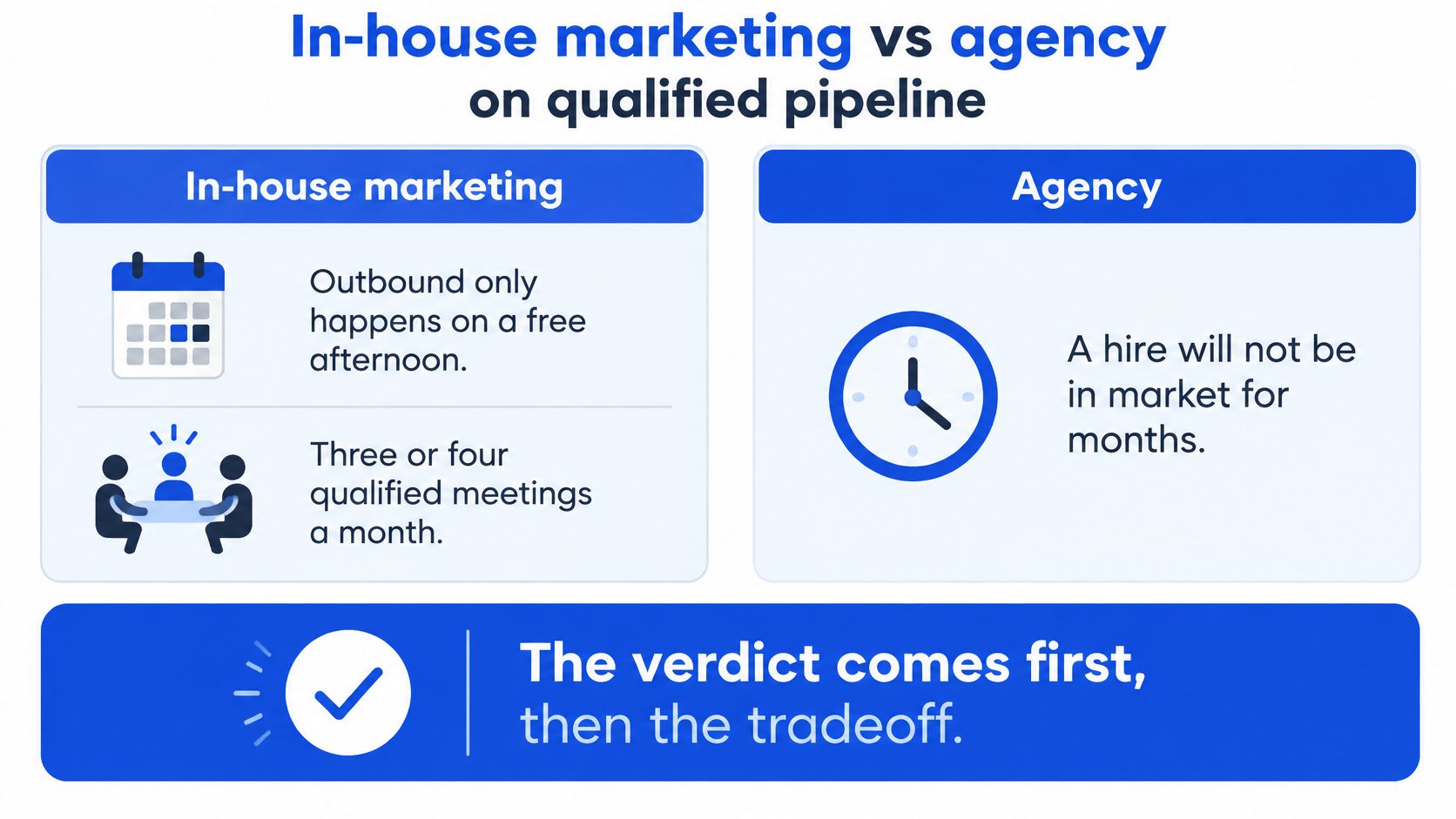
In 2023, 92% of ANA members with an in-house agency also worked with at least one external agency, while an average of 61% of company marketing work was completed in-house, according to the ANA. The takeaway is not to copy a particular staffing model. Decide who owns each job, and make sure lead qualification connects sales and marketing through clear feedback and shared definitions.
Criterion | In-house | Agency | Hybrid |
|---|---|---|---|
Strategic ownership | Company sets ICP, offer, and CRM rules | Executes against the brief provided | Company owns ICP and offer; partner brings market feedback |
Weekly execution | Competes with founders' and sellers' other work | Runs consistently when the brief is stable | Partner handles repeatable work; sales takes accepted meetings |
Speed to first qualified meetings | Hiring, tooling, and testing must happen first | Campaigns can be live by week four after two weeks of onboarding | External ramp, with internal acceptance rules already set |
Cost shape | Salary, tools, lists, deliverability, management, and founder time | Flat retainer or bounded project | Execution retainer, with internal time for strategy and feedback |
Skill coverage | Strong product context, limited specialist capacity | Broad execution skills, less customer context | Split responsibilities according to the work |
Failure mode | Cost looks low when internal time is untracked | A vague ICP or absent sales feedback weakens results | No clear owner for lead dispositions or the offer |
What the table is for
Use the comparison to expose the failure mode before choosing a model. A calendar full of meetings with non-buyers is activity, not qualified pipeline. Count meetings sales accepts, not just meetings booked, and include the internal time spent briefing, managing, and reviewing work. That makes the comparison about pipeline output rather than labels.
A partner who cannot define “qualified” in your CRM is not ready to be compared with a salary.
For a fuller comparison of building a team versus hiring an agency, start by filling in the failure-mode row for your own motion. Then align marketing's qualification rules with sales through shared sales and marketing definitions. If ownership and feedback are unclear, settle them before choosing who runs execution.
Fully loaded cost per qualified meeting
Compare in-house and agency costs using one denominator: the cost per sales-accepted meeting, after counting the internal time required to produce it. A salary alone makes an in-house seat look cheaper than it is. If your offer, ICP, or sales feedback is still unstable, hold off on hiring an agency too. Fix the inputs before paying either model to scale them.
For a US mid-market outbound seat, use a $55,000 to $85,000 annual base for planning. Add 25 to 35 percent for taxes and benefits, putting loaded labor at roughly $6,000 to $9,500 a month before campaigns go live. Add manager time and founder hours during ramp, valued at their real cost. Those hours do not disappear because no one records them.
Tools are another line. In this example, Apollo or Clay, Sales Navigator, Smartlead or Instantly, and a HubSpot seat run $400 to $900 a month, plus domains, inboxes, and list credits. Include the whole stack, not just the software subscription.
Retainer against the same denominator
An agency retainer can cover strategy, targeting, copywriting, sequencing, and reporting for a flat fee. Hourly packages fit bounded work such as a list build, messaging refresh, or campaign test. Those hours can be used within 90 days and do not expire monthly. Compare either option with a fully loaded in-house seat, not salary alone.
If you are considering a remote SDR, best remote staffing agencies can help you examine the hiring option. A hired seat still requires tools, deliverability oversight, and manager time, so include those costs in the comparison.
Line item | In-house | Agency | What to watch |
|---|---|---|---|
Labor | About $6,000 to $9,500 a month loaded on a $55,000 to $85,000 base | Covered by the retainer | Include taxes and benefits at 25 to 35 percent |
Senior attention | 15 to 25 hours a month | 3 to 5 hours on feedback and calls | Price founder and manager hours at real cost |
Data and sending tools | $400 to $900 a month, plus domains and list credits | Usually inside scope | Account for Apollo or Clay, Sales Navigator, Smartlead or Instantly, HubSpot, domains, inboxes, and list credits |
Ramp before output | Hiring time, then list, copy, and CRM setup | Two weeks of onboarding, with live work by week four | Count internal time spent before campaigns produce output |
Score | Monthly cost divided by sales-accepted meetings | Use the same denominator | Exclude meetings sales will not accept |
Calculate the result as fully loaded monthly cost divided by sales-accepted meetings. Use the cost per qualified lead calculator to compare the models with the same inputs.
Then check what the number hides. A founder producing three or four meetings a month may be spending afternoons that should go to senior selling. Put that time in the in-house column before deciding. If sales has not defined acceptance criteria or returned feedback on lead quality, neither a hire nor an agency can give you a fair cost per accepted meeting. Fix that measurement first.
What stays inside and what to ask a partner
Four decisions stay inside even in a strong hybrid.
Final opportunity qualification stays with your team. The sales calls stay with your sellers. Changes to the offer stay with whoever prices the product. Ownership of the ICP stays with the company that lives with win and loss notes.
A partner can challenge those four with reply data and win-loss notes. A partner should not hold them. We generate and qualify leads and book meetings. Your sales team runs the calls and closes. Nobody sits between you and the people doing the work. There is no account-manager layer.

The internal team also keeps memory no vendor copies in a month. Why the last five deals closed. Why the lookalikes stalled. That context is the reason strategic ownership moved inside at large advertisers.
The Association of National Advertisers reported that 82% of members operated an in-house agency in 2023, compared with 42% in 2008, from 162 respondents surveyed in February and March 2023. Those members still use outside specialists. The pattern fits B2B: own the brief, buy the repetitive bench.
External work, once the four are stable
List build and enrichment in Clay or Apollo. Inbox infrastructure. Copy tests. Smartlead or Instantly sequence operations. Reply routing. A weekly reporting cadence. The same discipline shows up in building repeatable workflows for editorial teams. Name the owner, the input, and the definition of done.
Clocks differ in kind. An open seat waits through hiring, onboarding, a list, and first tests. A structured external start uses the first two weeks for an ICP workshop, offer review, and asset setup. Live campaigns and a two-week sprint cadence follow. Write that expectation into the brief, using the same standard we cover in how to brief a lead generation agency.
Before you sign, ask these in one sitting:
ICP conflict. Who owns the ICP when reply data disagrees with the founder?
Qualification in writing. What is a qualified meeting, including ICP fit and a verified buyer?
Disposition speed. How fast does sales log a yes, no, or recycle?
CRM fields. Which HubSpot fields are required on every meeting?
Fee edges. What does the fee exclude, and what do weeks one to four produce?
Stop rule. What happens if acceptance misses the line for two sprints?
A proposal that cannot answer the acceptance rule and the sprint cadence is not ready to sit next to a salary.
SLAs and the 90-day scorecard
Neither model is measurable if time, acceptance, and done are undefined. Salary then beats a retainer only on the spreadsheet.
The IHLC 2025 in-house benchmarking survey found that 37% of in-house agencies did not track project time and cost, up from 28%, while only 35% charged for work internally. Capacity loss, rework, and unused specialist time never hit the cost line.

Finance and RevOps should require the same controls on a hire or a partner. Time tracking. A work-in-progress limit. Written assumptions. One definition of a qualified meeting.
That definition names ICP fit, a verified buyer, a buying signal, and the sales disposition. A held calendar slot is not the definition.
Fields and the pass line
HubSpot, or the CRM you already run, needs these fields on every meeting. Source. Persona. Fit. Disposition. Show. SQL date. Amount. If a field is blank, the meeting is not done. The KPI set we use for lead generation KPIs starts from those fields, not from send volume.
If you cannot state the acceptance rule, you cannot tell which side failed.
Metric | Who logs it | Pass line | Fail signal |
|---|---|---|---|
Time to first launch | RevOps | Live motion by day 30 | Launch slips past week four with no written reason |
Cost per qualified conversation | Finance | Fully loaded cost, not salary alone | Tool and founder time left out |
Sales-accepted rate | Sales | Written ICP and persona rule | Meetings booked with non-buyers |
Show rate | Sales | Agreed floor, reviewed weekly | No-shows with no reschedule rule |
Meeting to SQL | Sales | Movement inside the sales cycle | Accepted meetings that never progress |
Sourced pipeline | RevOps | Amount tied to first-touch source | Influenced revenue with no source |
Rework and CRM completeness | Marketing ops | Required fields on every meeting | Meetings missing source, persona or disposition |
A workable SLA is dispositions inside 48 hours, a named show-rate floor, and a stop rule if acceptance misses the line for two sprints.
External execution is the stronger buy when launch speed or a missing skill is the constraint. Internal ownership is stronger where product context, compliance review, and long-cycle learning decide the message.
Set one attribution rule before the first meeting is logged. First-touch credit for sourced pipeline, with influenced revenue on a separate line. Then both sides share a ledger.
What changes in SaaS, iGaming, manufacturing and services
The right model depends on the sales cycle and on which decisions require close control. Keep the offer and buyer definition close to the team; use outside capacity for repeatable execution when those inputs are stable.

SaaS, including an iGaming-adjacent product
A founder handling sales alongside the rest of the job may book only a few qualified meetings in a month. A dedicated weekly motion can keep running without depending on free afternoons, but an agency will not fix an unstable offer, unclear ICP, or missing sales feedback. Stabilize those first. Then judge the model by cost per sales-accepted meeting, including the internal time required to manage it.
The early work is operational: building and enriching lists, setting up sequences, defining targeting, and agreeing on the CRM handoff. Put those responsibilities in one connected workflow, and have sales record which meetings it accepts and why. For examples of how content and outbound can work together, see these demand generation examples.
Forrester's 2025 Marketing Budgets Survey reports that the highest outsourcing share, 31% or more of program budget, appears in both the largest and smallest revenue bands. The practical takeaway is to size outside execution to the work your team cannot reliably run, not to company size alone.
Keep versus buy by industry
Industry | Keep inside | Buy outside | Watch |
|---|---|---|---|
B2B SaaS | Offer, ICP, qualification rules, and sales calls | List building, enrichment, sequences, and recurring campaign execution | Founder capacity and whether sales consistently accepts the meetings |
iGaming and regulated offers | Claims, bonus language, and buyer definition | List work and sequence operations after compliance approves the message | Brand risk from unapproved claims |
Manufacturing | Offer ownership and technical answers | Pre-show outreach, list enrichment, and a planned content cadence | Long sales cycles and the need to connect outreach with trade fairs |
Professional services, legal tech, and pharma | Partner calls, claims, and message approval | Credibility-building content and campaign execution after approval | A claim that partners cannot support in sales conversations |
For iGaming and other regulated offers, keep compliance decisions in-house. Outsource list work and sequence operations only after the message is approved. A loose brief can create brand risk before it creates useful pipeline.
Manufacturing sales cycles are long, so align outreach with trade fairs and keep one internal owner responsible for the offer and technical answers. Outside support can handle pre-show outreach, list enrichment, and a consistent content cadence. A customer account is evidence of one outcome, not a template: Sergeja Jelenko, Marketing Manager at Isokon, said, “Grou helped us generate high-quality leads that contributed to a deal worth more than $20 million. Their team was responsive, proactive, and easy to work with throughout.”
In professional services, legal tech, and pharma, partner expertise and message approval stay inside. Put content that demonstrates the firm's point of view in market before cold sequences, and make sure the people taking sales calls can support every claim.
Organizational fit by stage and team size
Map the choice to stage. Preference is a weak input.
Founder still selling. Keep the offer, the ICP, and the calls in-house. Do not open an SDR requisition until the offer has held for 90 days. Buying execution now adds a second person to a moving brief. You will pay for rework.
One or two sellers, offer stable. Run hybrid. The company owns the ICP. A partner runs lists, inboxes, and sequences on a flat retainer. Senior time goes to feedback and calls, not to domain warmup.
Scale-up with an SDR team. Keep qualification and RevOps inside. Buy overflow and the channels the team lacks, such as LinkedIn outreach through HeyReach or a Clay enrichment build. Do not hire a specialist you will use six weeks a quarter.
Enterprise or multi-market. Split by job across regions. Agencies take specialist channels. In-house owners keep brand governance and the acceptance rule. One reporting line still beats a vendor per country.
A Semrush survey on how businesses hire agencies found that 41.4% of small and midsize businesses do not outsource any marketing, and more than 6% outsource 100%. Both ends skip the capacity question.
Size the external slice to the gap on your 90-day scorecard, not to a preference for employees or vendors.
If specialist throughput is the constraint and the offer has been still, buy the bench. If the offer is still moving, hiring or outsourcing just multiplies the edits.
Pick your model before the next pipeline review
Before the next pipeline review, decide whether the gap is strategy or execution. If your offer, ICP, or sales feedback is still unstable, an agency will multiply changes, not fix the brief.
Run six checks:
Offer stability. Has the offer stayed still for 90 days?
ICP with exclusions. Does the ICP specify who is not a fit, as well as target roles?
Disposition speed. Does sales log each disposition within 48 hours?
Honest unit cost. Can you calculate last month's cost per sales-accepted meeting, including tools and senior hours?
Primary bottleneck. Are lists, inboxes, and sequences the constraint, rather than a changing offer?
Call owner. Is someone inside accountable for sales calls?
If the first three answers are no, hold off on a retainer or SDR hire. Stabilize the ICP and define the acceptance rule in your CRM first. If they are yes and senior time is the constraint, buy execution capacity while keeping the offer, qualification, and calls inside.
The decision metric is cost per sales-accepted meeting after accounting for in-house work. Track fully loaded hours against accepted meetings alongside that cost, so the next review compares the true cost of each model, not just agency fees or salary.
Grou is a B2B pipeline agency serving iGaming, SaaS, manufacturing, and professional services. It starts engagements by mapping the client's ICP, offer, and market, then defines segments, messaging angles, and channels before building. Its flat-retainer team covers strategy, targeting, copywriting, sequencing, and reporting as one connected system.
If the checks show a stable brief and a senior-time bottleneck, see how Grou's flat-retainer engagement covers strategy, targeting, copywriting, sequencing, and reporting at Grou.
Stay in-house while the offer, the ICP, or sales feedback still moves. Once those three hold, hybrid beats a full-time hire or a pure agency for most B2B teams. Outbound that only happens on a free afternoon will not close the gap, and a new seat will not be in market for months.
Hold the brief. Keep generation inside until the offer, the ICP, and lead scoring settle for a quarter.
Then split the work. A partner runs lists, inboxes, copy tests, and the weekly sequences.
You keep the calls. Offer decisions, ICP ownership, final qualification, and live sales stay inside.
Score acceptance. Cost per qualified meeting, sales acceptance, show rate, meeting to SQL, and sourced pipeline.
Table of Contents
In-house marketing vs agency on qualified pipeline
The fair comparison is not headcount against a retainer. It is cost per sales-accepted meeting after you count the internal work required to produce one. A team that has not settled its offer, ICP, and lead-quality feedback should fix those first. An outside team cannot resolve an unsettled offer or ICP.
Once those inputs hold, hybrid is the practical default for many B2B teams. Keep customer context and qualification decisions close to the business, and assign repeatable execution to the team with the capacity to run it consistently. The split works only when sales returns clear feedback on lead quality.
In 2023, 92% of ANA members with an in-house agency also worked with at least one external agency, while an average of 61% of company marketing work was completed in-house, according to the ANA. The takeaway is not to copy a particular staffing model. Decide who owns each job, and make sure lead qualification connects sales and marketing through clear feedback and shared definitions.
Criterion | In-house | Agency | Hybrid |
|---|---|---|---|
Strategic ownership | Company sets ICP, offer, and CRM rules | Executes against the brief provided | Company owns ICP and offer; partner brings market feedback |
Weekly execution | Competes with founders' and sellers' other work | Runs consistently when the brief is stable | Partner handles repeatable work; sales takes accepted meetings |
Speed to first qualified meetings | Hiring, tooling, and testing must happen first | Campaigns can be live by week four after two weeks of onboarding | External ramp, with internal acceptance rules already set |
Cost shape | Salary, tools, lists, deliverability, management, and founder time | Flat retainer or bounded project | Execution retainer, with internal time for strategy and feedback |
Skill coverage | Strong product context, limited specialist capacity | Broad execution skills, less customer context | Split responsibilities according to the work |
Failure mode | Cost looks low when internal time is untracked | A vague ICP or absent sales feedback weakens results | No clear owner for lead dispositions or the offer |
What the table is for
Use the comparison to expose the failure mode before choosing a model. A calendar full of meetings with non-buyers is activity, not qualified pipeline. Count meetings sales accepts, not just meetings booked, and include the internal time spent briefing, managing, and reviewing work. That makes the comparison about pipeline output rather than labels.
A partner who cannot define “qualified” in your CRM is not ready to be compared with a salary.
For a fuller comparison of building a team versus hiring an agency, start by filling in the failure-mode row for your own motion. Then align marketing's qualification rules with sales through shared sales and marketing definitions. If ownership and feedback are unclear, settle them before choosing who runs execution.
Fully loaded cost per qualified meeting
Compare in-house and agency costs using one denominator: the cost per sales-accepted meeting, after counting the internal time required to produce it. A salary alone makes an in-house seat look cheaper than it is. If your offer, ICP, or sales feedback is still unstable, hold off on hiring an agency too. Fix the inputs before paying either model to scale them.
For a US mid-market outbound seat, use a $55,000 to $85,000 annual base for planning. Add 25 to 35 percent for taxes and benefits, putting loaded labor at roughly $6,000 to $9,500 a month before campaigns go live. Add manager time and founder hours during ramp, valued at their real cost. Those hours do not disappear because no one records them.
Tools are another line. In this example, Apollo or Clay, Sales Navigator, Smartlead or Instantly, and a HubSpot seat run $400 to $900 a month, plus domains, inboxes, and list credits. Include the whole stack, not just the software subscription.
Retainer against the same denominator
An agency retainer can cover strategy, targeting, copywriting, sequencing, and reporting for a flat fee. Hourly packages fit bounded work such as a list build, messaging refresh, or campaign test. Those hours can be used within 90 days and do not expire monthly. Compare either option with a fully loaded in-house seat, not salary alone.
If you are considering a remote SDR, best remote staffing agencies can help you examine the hiring option. A hired seat still requires tools, deliverability oversight, and manager time, so include those costs in the comparison.
Line item | In-house | Agency | What to watch |
|---|---|---|---|
Labor | About $6,000 to $9,500 a month loaded on a $55,000 to $85,000 base | Covered by the retainer | Include taxes and benefits at 25 to 35 percent |
Senior attention | 15 to 25 hours a month | 3 to 5 hours on feedback and calls | Price founder and manager hours at real cost |
Data and sending tools | $400 to $900 a month, plus domains and list credits | Usually inside scope | Account for Apollo or Clay, Sales Navigator, Smartlead or Instantly, HubSpot, domains, inboxes, and list credits |
Ramp before output | Hiring time, then list, copy, and CRM setup | Two weeks of onboarding, with live work by week four | Count internal time spent before campaigns produce output |
Score | Monthly cost divided by sales-accepted meetings | Use the same denominator | Exclude meetings sales will not accept |
Calculate the result as fully loaded monthly cost divided by sales-accepted meetings. Use the cost per qualified lead calculator to compare the models with the same inputs.
Then check what the number hides. A founder producing three or four meetings a month may be spending afternoons that should go to senior selling. Put that time in the in-house column before deciding. If sales has not defined acceptance criteria or returned feedback on lead quality, neither a hire nor an agency can give you a fair cost per accepted meeting. Fix that measurement first.
What stays inside and what to ask a partner
Four decisions stay inside even in a strong hybrid.
Final opportunity qualification stays with your team. The sales calls stay with your sellers. Changes to the offer stay with whoever prices the product. Ownership of the ICP stays with the company that lives with win and loss notes.
A partner can challenge those four with reply data and win-loss notes. A partner should not hold them. We generate and qualify leads and book meetings. Your sales team runs the calls and closes. Nobody sits between you and the people doing the work. There is no account-manager layer.
The internal team also keeps memory no vendor copies in a month. Why the last five deals closed. Why the lookalikes stalled. That context is the reason strategic ownership moved inside at large advertisers.
The Association of National Advertisers reported that 82% of members operated an in-house agency in 2023, compared with 42% in 2008, from 162 respondents surveyed in February and March 2023. Those members still use outside specialists. The pattern fits B2B: own the brief, buy the repetitive bench.
External work, once the four are stable
List build and enrichment in Clay or Apollo. Inbox infrastructure. Copy tests. Smartlead or Instantly sequence operations. Reply routing. A weekly reporting cadence. The same discipline shows up in building repeatable workflows for editorial teams. Name the owner, the input, and the definition of done.
Clocks differ in kind. An open seat waits through hiring, onboarding, a list, and first tests. A structured external start uses the first two weeks for an ICP workshop, offer review, and asset setup. Live campaigns and a two-week sprint cadence follow. Write that expectation into the brief, using the same standard we cover in how to brief a lead generation agency.
Before you sign, ask these in one sitting:
ICP conflict. Who owns the ICP when reply data disagrees with the founder?
Qualification in writing. What is a qualified meeting, including ICP fit and a verified buyer?
Disposition speed. How fast does sales log a yes, no, or recycle?
CRM fields. Which HubSpot fields are required on every meeting?
Fee edges. What does the fee exclude, and what do weeks one to four produce?
Stop rule. What happens if acceptance misses the line for two sprints?
A proposal that cannot answer the acceptance rule and the sprint cadence is not ready to sit next to a salary.
SLAs and the 90-day scorecard
Neither model is measurable if time, acceptance, and done are undefined. Salary then beats a retainer only on the spreadsheet.
The IHLC 2025 in-house benchmarking survey found that 37% of in-house agencies did not track project time and cost, up from 28%, while only 35% charged for work internally. Capacity loss, rework, and unused specialist time never hit the cost line.
Finance and RevOps should require the same controls on a hire or a partner. Time tracking. A work-in-progress limit. Written assumptions. One definition of a qualified meeting.
That definition names ICP fit, a verified buyer, a buying signal, and the sales disposition. A held calendar slot is not the definition.
Fields and the pass line
HubSpot, or the CRM you already run, needs these fields on every meeting. Source. Persona. Fit. Disposition. Show. SQL date. Amount. If a field is blank, the meeting is not done. The KPI set we use for lead generation KPIs starts from those fields, not from send volume.
If you cannot state the acceptance rule, you cannot tell which side failed.
Metric | Who logs it | Pass line | Fail signal |
|---|---|---|---|
Time to first launch | RevOps | Live motion by day 30 | Launch slips past week four with no written reason |
Cost per qualified conversation | Finance | Fully loaded cost, not salary alone | Tool and founder time left out |
Sales-accepted rate | Sales | Written ICP and persona rule | Meetings booked with non-buyers |
Show rate | Sales | Agreed floor, reviewed weekly | No-shows with no reschedule rule |
Meeting to SQL | Sales | Movement inside the sales cycle | Accepted meetings that never progress |
Sourced pipeline | RevOps | Amount tied to first-touch source | Influenced revenue with no source |
Rework and CRM completeness | Marketing ops | Required fields on every meeting | Meetings missing source, persona or disposition |
A workable SLA is dispositions inside 48 hours, a named show-rate floor, and a stop rule if acceptance misses the line for two sprints.
External execution is the stronger buy when launch speed or a missing skill is the constraint. Internal ownership is stronger where product context, compliance review, and long-cycle learning decide the message.
Set one attribution rule before the first meeting is logged. First-touch credit for sourced pipeline, with influenced revenue on a separate line. Then both sides share a ledger.
What changes in SaaS, iGaming, manufacturing and services
The right model depends on the sales cycle and on which decisions require close control. Keep the offer and buyer definition close to the team; use outside capacity for repeatable execution when those inputs are stable.
SaaS, including an iGaming-adjacent product
A founder handling sales alongside the rest of the job may book only a few qualified meetings in a month. A dedicated weekly motion can keep running without depending on free afternoons, but an agency will not fix an unstable offer, unclear ICP, or missing sales feedback. Stabilize those first. Then judge the model by cost per sales-accepted meeting, including the internal time required to manage it.
The early work is operational: building and enriching lists, setting up sequences, defining targeting, and agreeing on the CRM handoff. Put those responsibilities in one connected workflow, and have sales record which meetings it accepts and why. For examples of how content and outbound can work together, see these demand generation examples.
Forrester's 2025 Marketing Budgets Survey reports that the highest outsourcing share, 31% or more of program budget, appears in both the largest and smallest revenue bands. The practical takeaway is to size outside execution to the work your team cannot reliably run, not to company size alone.
Keep versus buy by industry
Industry | Keep inside | Buy outside | Watch |
|---|---|---|---|
B2B SaaS | Offer, ICP, qualification rules, and sales calls | List building, enrichment, sequences, and recurring campaign execution | Founder capacity and whether sales consistently accepts the meetings |
iGaming and regulated offers | Claims, bonus language, and buyer definition | List work and sequence operations after compliance approves the message | Brand risk from unapproved claims |
Manufacturing | Offer ownership and technical answers | Pre-show outreach, list enrichment, and a planned content cadence | Long sales cycles and the need to connect outreach with trade fairs |
Professional services, legal tech, and pharma | Partner calls, claims, and message approval | Credibility-building content and campaign execution after approval | A claim that partners cannot support in sales conversations |
For iGaming and other regulated offers, keep compliance decisions in-house. Outsource list work and sequence operations only after the message is approved. A loose brief can create brand risk before it creates useful pipeline.
Manufacturing sales cycles are long, so align outreach with trade fairs and keep one internal owner responsible for the offer and technical answers. Outside support can handle pre-show outreach, list enrichment, and a consistent content cadence. A customer account is evidence of one outcome, not a template: Sergeja Jelenko, Marketing Manager at Isokon, said, “Grou helped us generate high-quality leads that contributed to a deal worth more than $20 million. Their team was responsive, proactive, and easy to work with throughout.”
In professional services, legal tech, and pharma, partner expertise and message approval stay inside. Put content that demonstrates the firm's point of view in market before cold sequences, and make sure the people taking sales calls can support every claim.
Organizational fit by stage and team size
Map the choice to stage. Preference is a weak input.
Founder still selling. Keep the offer, the ICP, and the calls in-house. Do not open an SDR requisition until the offer has held for 90 days. Buying execution now adds a second person to a moving brief. You will pay for rework.
One or two sellers, offer stable. Run hybrid. The company owns the ICP. A partner runs lists, inboxes, and sequences on a flat retainer. Senior time goes to feedback and calls, not to domain warmup.
Scale-up with an SDR team. Keep qualification and RevOps inside. Buy overflow and the channels the team lacks, such as LinkedIn outreach through HeyReach or a Clay enrichment build. Do not hire a specialist you will use six weeks a quarter.
Enterprise or multi-market. Split by job across regions. Agencies take specialist channels. In-house owners keep brand governance and the acceptance rule. One reporting line still beats a vendor per country.
A Semrush survey on how businesses hire agencies found that 41.4% of small and midsize businesses do not outsource any marketing, and more than 6% outsource 100%. Both ends skip the capacity question.
Size the external slice to the gap on your 90-day scorecard, not to a preference for employees or vendors.
If specialist throughput is the constraint and the offer has been still, buy the bench. If the offer is still moving, hiring or outsourcing just multiplies the edits.
Pick your model before the next pipeline review
Before the next pipeline review, decide whether the gap is strategy or execution. If your offer, ICP, or sales feedback is still unstable, an agency will multiply changes, not fix the brief.
Run six checks:
Offer stability. Has the offer stayed still for 90 days?
ICP with exclusions. Does the ICP specify who is not a fit, as well as target roles?
Disposition speed. Does sales log each disposition within 48 hours?
Honest unit cost. Can you calculate last month's cost per sales-accepted meeting, including tools and senior hours?
Primary bottleneck. Are lists, inboxes, and sequences the constraint, rather than a changing offer?
Call owner. Is someone inside accountable for sales calls?
If the first three answers are no, hold off on a retainer or SDR hire. Stabilize the ICP and define the acceptance rule in your CRM first. If they are yes and senior time is the constraint, buy execution capacity while keeping the offer, qualification, and calls inside.
The decision metric is cost per sales-accepted meeting after accounting for in-house work. Track fully loaded hours against accepted meetings alongside that cost, so the next review compares the true cost of each model, not just agency fees or salary.
Grou is a B2B pipeline agency serving iGaming, SaaS, manufacturing, and professional services. It starts engagements by mapping the client's ICP, offer, and market, then defines segments, messaging angles, and channels before building. Its flat-retainer team covers strategy, targeting, copywriting, sequencing, and reporting as one connected system.
If the checks show a stable brief and a senior-time bottleneck, see how Grou's flat-retainer engagement covers strategy, targeting, copywriting, sequencing, and reporting at Grou.
Pipeline OS Newsletter
Build qualified pipeline
Get weekly tactics to generate demand, improve lead quality, and book more meetings.





Trusted by industry leaders
Trusted by industry leaders
Trusted by industry leaders
Ready to build qualified pipeline?
Ready to build qualified pipeline?
Ready to build qualified pipeline?
Book a call to see if we're the right fit, or take the 2-minute quiz to get a clear starting point.
Book a call to see if we're the right fit, or take the 2-minute quiz to get a clear starting point.
Book a call to see if we're the right fit, or take the 2-minute quiz to get a clear starting point.
" height="30.21639343089746px" id="hfGbXmQR2" width="30.216393430897455px"/></svg>)
Copyright © 2026 – All Right Reserved
Copyright © 2026 – All Right Reserved
Copyright © 2026 – All Right Reserved