%22%3E%3C/path%3E%3Cpath d=%22M 63.072 7.554 C 62.258 8.022 61.577 8.689 61.092 9.493 L 61.092 7.076 L 57.158 7.076 L 57.158 22.64 L 61.089 22.64 L 61.089 14.888 C 61.089 13.446 61.403 12.434 62.03 11.853 C 62.818 11.218 63.818 10.907 64.826 10.982 L 65.868 10.982 L 65.868 6.851 C 64.891 6.834 63.926 7.076 63.073 7.554 Z%22 fill=%22rgb(17,17,17)%22%3E%3C/path%3E%3Cpath d=%22M 78.916 7.82 C 76.363 6.49 73.321 6.49 70.768 7.82 C 69.562 8.473 68.564 9.451 67.888 10.644 C 67.167 11.931 66.803 13.387 66.834 14.862 C 66.804 16.332 67.157 17.785 67.86 19.077 C 68.515 20.267 69.494 21.246 70.684 21.901 C 71.924 22.576 73.318 22.92 74.73 22.898 C 76.164 22.918 77.58 22.575 78.846 21.901 C 80.062 21.247 81.073 20.27 81.768 19.077 C 82.506 17.797 82.88 16.339 82.85 14.862 C 82.88 13.389 82.517 11.934 81.797 10.647 C 81.12 9.455 80.122 8.477 78.917 7.824 M 78.803 14.862 C 78.829 15.739 78.636 16.608 78.241 17.391 C 77.903 18.046 77.38 18.588 76.738 18.95 C 76.124 19.293 75.432 19.472 74.729 19.47 C 73.668 19.497 72.648 19.061 71.934 18.276 C 71.139 17.323 70.741 16.1 70.823 14.862 C 70.741 13.62 71.149 12.395 71.959 11.45 C 72.687 10.667 73.715 10.233 74.783 10.256 C 75.859 10.236 76.894 10.67 77.635 11.45 C 78.464 12.387 78.884 13.616 78.801 14.864%22 fill=%22rgb(17,17,17)%22%3E%3C/path%3E%3Cpath d=%22M 95.906 7.076 L 95.906 15.646 C 95.975 16.68 95.643 17.701 94.979 18.498 C 94.311 19.184 93.379 19.547 92.422 19.495 C 91.475 19.544 90.553 19.18 89.894 18.498 C 89.23 17.701 88.898 16.68 88.967 15.646 L 88.967 7.076 L 85.033 7.076 L 85.033 16.207 C 85 17.449 85.275 18.68 85.834 19.79 C 86.327 20.75 87.095 21.542 88.039 22.065 C 89.033 22.594 90.145 22.861 91.271 22.838 C 92.188 22.847 93.095 22.65 93.926 22.263 C 94.708 21.905 95.388 21.36 95.906 20.675 L 95.906 22.645 L 99.865 22.645 L 99.865 7.076 Z%22 fill=%22rgb(17,17,17)%22%3E%3C/path%3E%3Cpath d=%22M 4.513 15.626 C 4.511 10.815 7.606 6.549 12.181 5.059 C 16.756 3.57 21.77 5.195 24.601 9.086 L 27.816 5.87 C 24.074 1.186 17.981 -0.943 12.137 0.393 C 6.292 1.728 1.728 6.292 0.393 12.137 C -0.943 17.981 1.186 24.074 5.87 27.816 L 9.085 24.601 C 6.214 22.512 4.515 19.177 4.513 15.626%22 fill=%22rgb(32,62,235)%22%3E%3C/path%3E%3Cpath d=%22M 17.114 14.343 L 13.354 18.01 L 13.354 18.026 L 21.071 18.026 L 11.412 27.609 L 17.389 27.609 L 23.999 21.081 L 23.999 28.316 L 24.005 28.316 L 27.967 24.393 L 27.967 14.343 Z%22 fill=%22rgb(32,62,235)%22%3E%3C/path%3E%3C/g%3E%3C/svg%3E) ×
× ××
××›
›
›
›
Building a LinkedIn content engine with a team 2026
Building a LinkedIn content engine with a team 2026
Building a LinkedIn content engine with a team 2026
Building a LinkedIn content engine with a team 2026
Building a LinkedIn content engine with a team 2026
Building a LinkedIn content engine with a team 2026

Author
Aljaz Peklaj

Nobody's LinkedIn programme dies because the writing was hard. It dies in the approval queue.
One person can post consistently for years on nothing but habit. Add a second person, a legal reviewer and a founder who wants to see things before they go out, and the same volume now requires a system. Most teams respond by buying a scheduling tool, which solves the least broken part of the process, and the queue keeps growing.
TL;DR
A content engine is a queueing problem wearing a creative costume. Throughput is set by the slowest approval, not by writing capacity, so adding writers to a blocked engine makes the backlog worse rather than better. Design the review step first: name one accountable approver per post type, cap the number of approval stages at two, and give most post types zero. There is a second reason to take review seriously in 2026. The EU AI Act's transparency rules started applying on 2 August 2026, and while almost no B2B LinkedIn post will trigger the labelling duty, the Commission's guidance now supplies a usable definition of what real editorial control is: "deliberate examination of the substance of the content" and the authority to "approve, alter or reject the substance", with "superficial, solely formal, or procedural checks" explicitly not qualifying. That is the standard your approval step should meet anyway, because a rubber stamp is a delay that buys nothing.
The bottleneck is never the writer
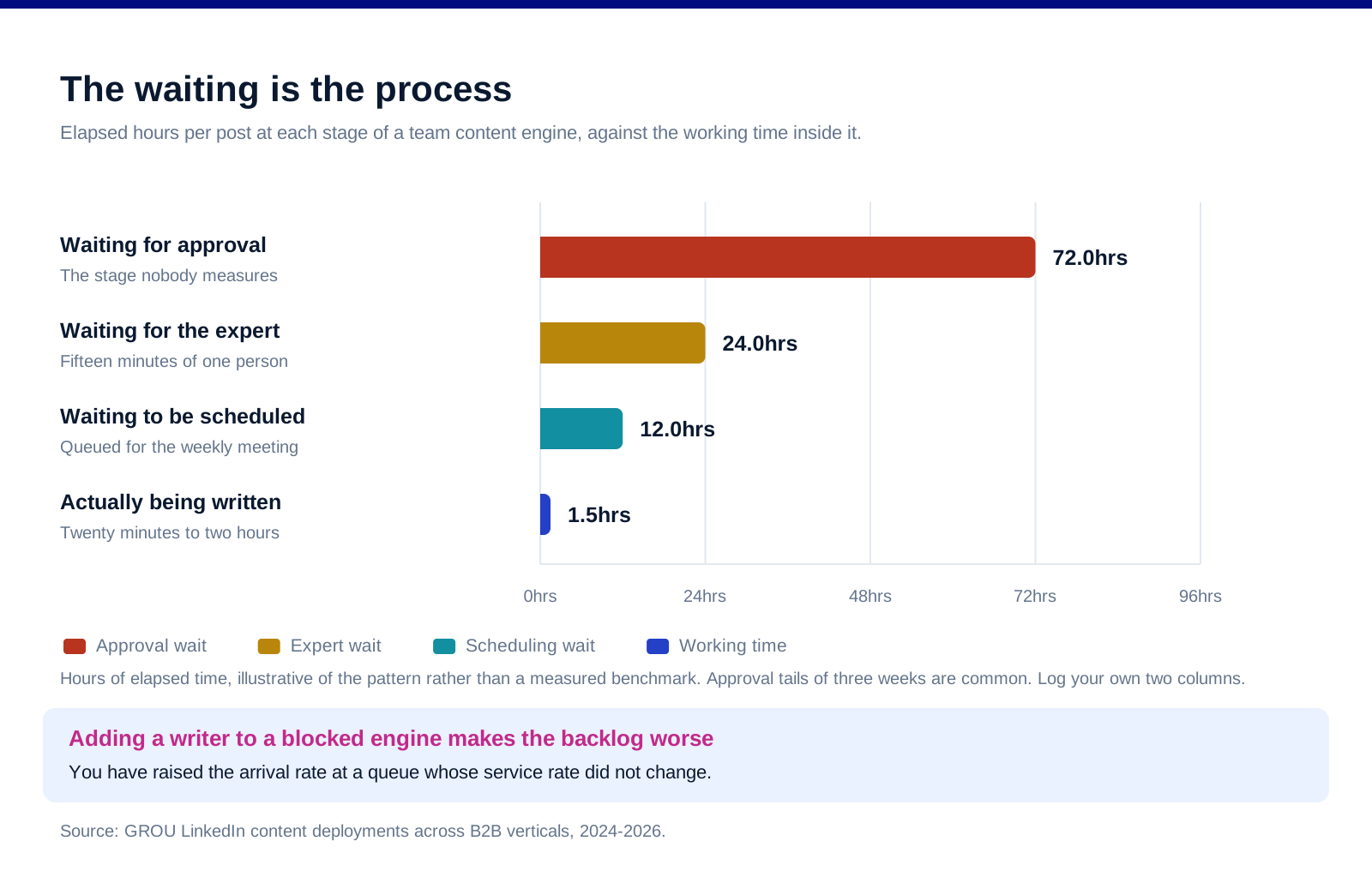
Writing a LinkedIn post takes between twenty minutes and two hours. Getting it approved takes between ten minutes and three weeks, and the variance is the problem rather than the average. A step with a three-week tail sets the pace of the whole engine no matter how fast everything upstream runs.
Which is why hiring another writer usually makes things worse. You have increased arrival rate at a queue whose service rate did not change. The visible symptom is a fuller backlog and a team that feels busier while publishing the same amount.
Measure the wait, not the work, which is the one instrumentation change that pays for itself immediately. Our note on what to measure on LinkedIn covers the output side. For every post, log the time it sat between "drafted" and "approved" separately from the time it took to write. Almost nobody does this, and the first time a team sees the two columns side by side the argument about resourcing ends immediately.
The second bottleneck is the subject expert, not the approver. A post that requires fifteen minutes of a specific engineer's or operator's attention will wait for that fifteen minutes far longer than it waits for anything else. Book it as a recurring slot rather than requesting it per post.
Design the review step first
![[INSERT CHART 2, linkedin-content-engine-team-chart-2-roles.svg] Alt: Who owns which step of a team LinkedIn content engine in 2026, and which steps need no approval at all.](https://framerusercontent.com/images/RET5PCRyqrMLA6Ibmn8vXomtv0.svg)
One accountable approver per post type, named, not a committee. Two people who both have to say yes is not twice the safety, it is four times the delay, because each one waits to see what the other thinks.
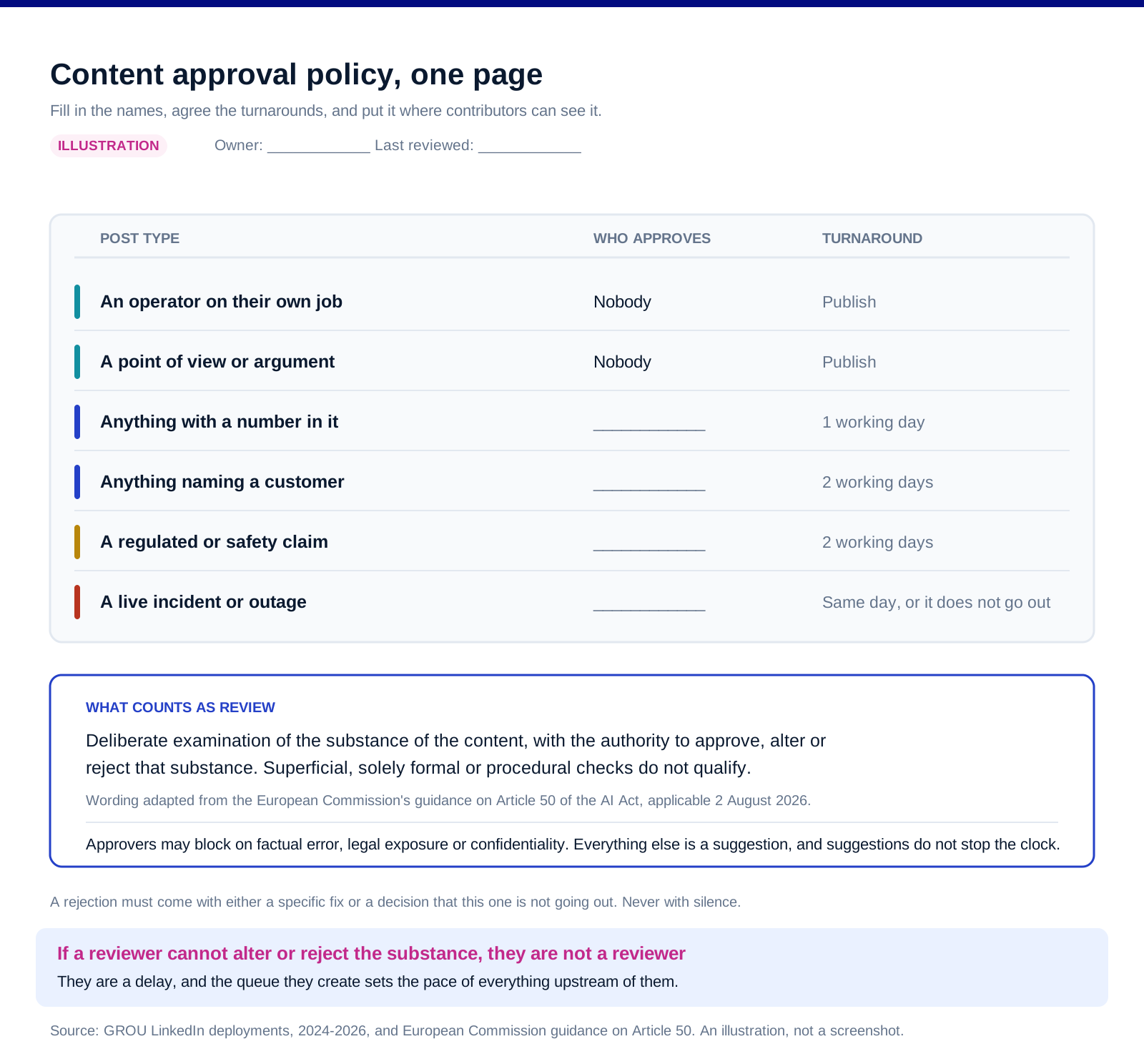
Most post types should need zero approvals. An operator posting about how they do their own job does not need sign-off from anyone. Reserve review for the categories where being wrong is expensive: anything with a customer named in it, anything with a number in it, anything touching a regulated claim, anything about a live incident.
Cap the chain at two. Draft to approve to publish. If a third stage exists, one of them is not adding judgement, and the one that is not adding judgement is the one to cut.
Separate "I disagree" from "this is wrong". Most approval delay is taste dressed as risk. Give approvers a narrow remit in writing: they can block on factual error, legal exposure or confidentiality, and they can suggest on everything else. Suggestions do not stop the clock.
Write down what a rejection requires. A rejection without a reason and a route back is how a contributor stops contributing. It has to come with either a specific fix or a decision that this one is not going out, and never with silence.
What the AI Act actually requires, and what it does not
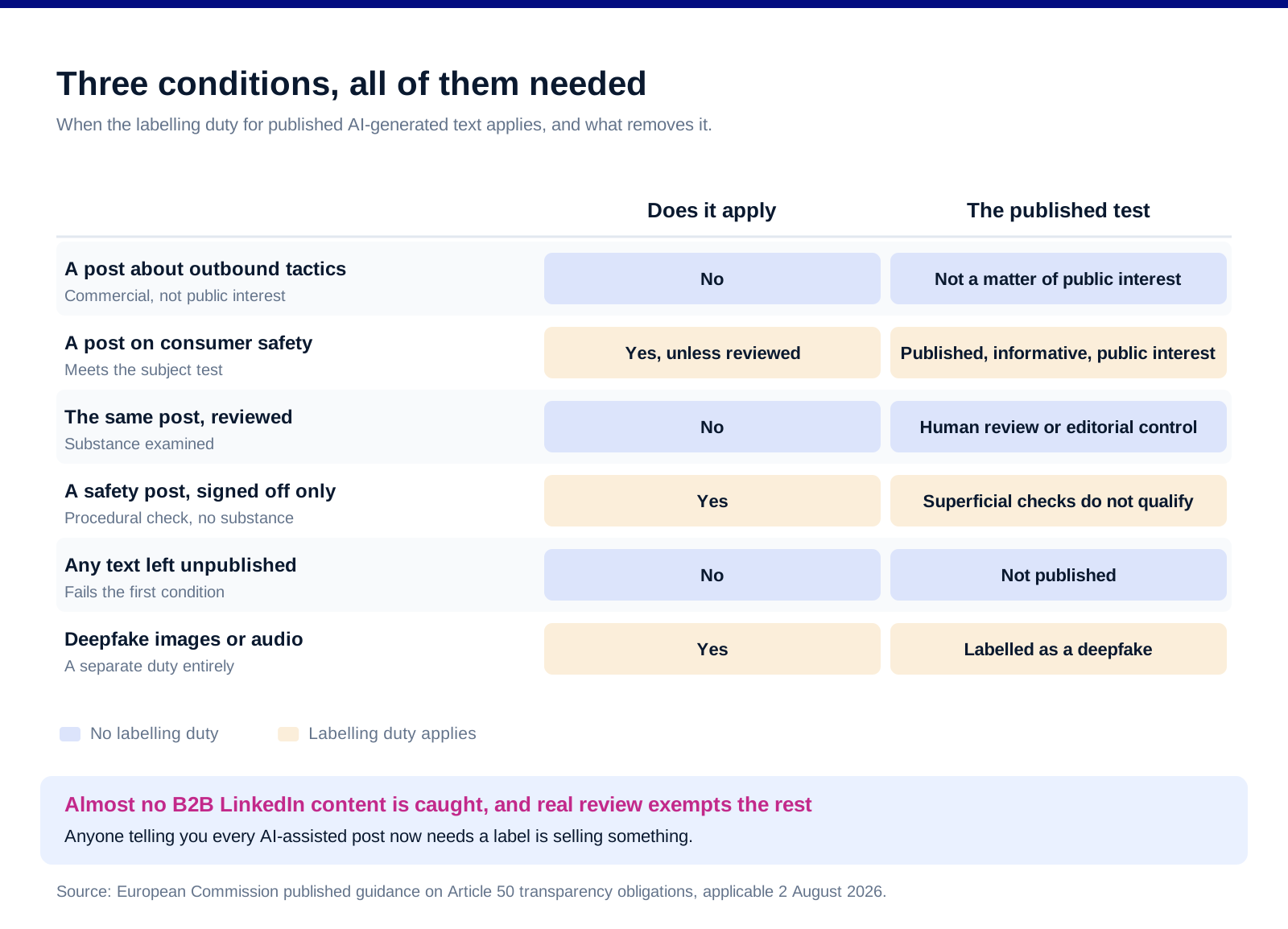
Start with the part that is easy to get wrong in the alarming direction. The deployer duty is to label "deepfakes and AI-generated or manipulated text published on matters of public interest without human review or editorial control". The Commission's guidance sets three cumulative conditions for text: it must be published, it must be informative to the public, and it must be on a matter of public interest, a category it illustrates with "politics and democratic processes, public administration and services, administration of justice and law enforcement, fundamental rights, public security, public health, environmental protection, consumer safety".
Which means almost no B2B LinkedIn content is caught. A post about outbound sequencing or manufacturing lead times is not a matter of public interest in that sense, and anyone telling you every AI-assisted LinkedIn post now needs a label is selling something.
But some of it is. If you sell into healthcare, energy, consumer finance or safety-critical manufacturing, your content does sometimes address public health, environmental protection or consumer safety. Those posts are worth a second look, and the answer is usually not a label but a real review.
Because the exemption is the interesting part. The guidance states that "Published text that has undergone human review or editorial control - does not need to be labelled", defines human review as "deliberate examination of the substance of the content", defines editorial control as the authority to "approve, alter or reject the substance", and says plainly that "superficial, solely formal, or procedural checks" do not qualify.
Adopt that definition as your internal standard regardless. It is the clearest published description of the difference between a real approval and a rubber stamp that anyone has written down, and it happens to be exactly what a functioning content engine needs. If your reviewer cannot alter or reject the substance, they are not a reviewer, they are a delay.
The associated Code of Practice is voluntary. The Commission's code covers marking and detection for providers and deployers of generative AI systems, was published on 10 June 2026, and states that "adherence to the code is voluntary" while the underlying obligations are not. This is not legal advice and you should take your own on your specific markets.
What a team can actually sustain
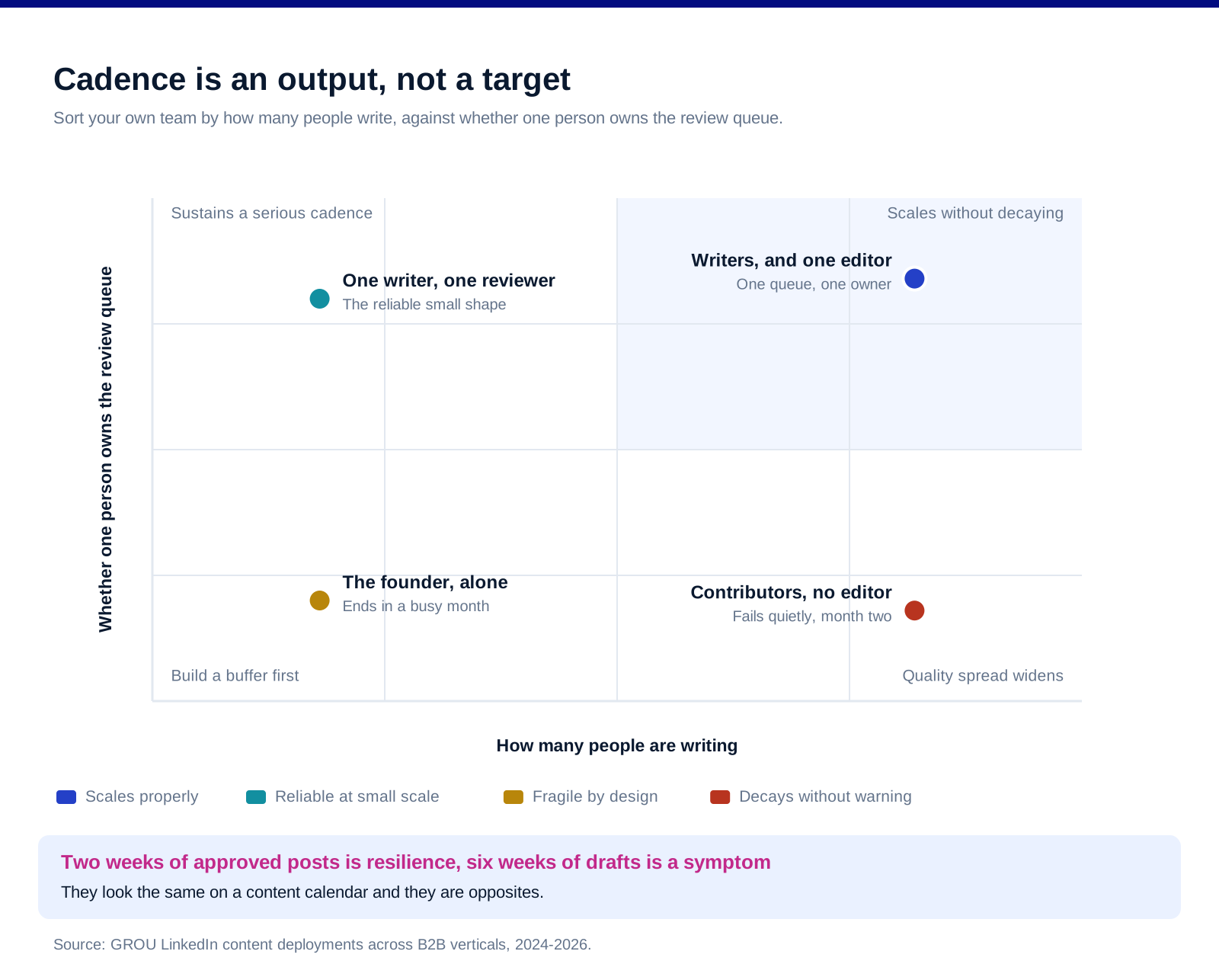
Cadence is an output of the operating model, not an input to it, which is where most LinkedIn content strategy work goes wrong before it starts. Decide who writes, who reviews and how often the subject expert is available, and the sustainable cadence falls out. Picking a cadence first and then hoping the model supports it is how programmes end after seven weeks.
The founder-only model tops out fast and its real ceiling is not writing time, it is the founder's willingness to keep going in a bad month. Build the engine so that a quiet fortnight from one person does not stop publishing.
A ghostwriter plus one reviewer is the most reliable small-team shape, because it has exactly one queue and one owner of it. Our ghostwriting playbook covers the working relationship in detail.
Several contributors with no editor is the shape that fails quietly. Volume looks fine for a month, then the quality spread widens, then the good contributors stop because their work sits next to the weak work.
Build a buffer, not a backlog. Two weeks of approved posts sitting ready is resilience. Six weeks of unapproved drafts is a symptom. Those look similar on a content calendar and they are opposites.
Kill the weekly meeting about it. Content review meetings are where a fifteen minute decision becomes a five day wait, because everything queues for Thursday. Approvals should be asynchronous with a stated turnaround, and the turnaround is the number you manage.
When employees amplify, the company carries the responsibility
Employee advocacy is the highest-leverage distribution most B2B companies have, and it is also where an unexpected compliance question sits. The FTC's Endorsement Guides FAQ says an employee posting about their employer's products "should disclose your relationship to the company", and that having the employer listed on a profile page is not enough because "people who just read what you post won't get that information."
And the obligation runs upward, not just outward. The FTC states that advertisers need "reasonable programs in place to train and monitor members of your network", including instructing them on "their responsibilities for clearly and conspicuously disclosing their connections" and taking "appropriate action if you find questionable practices."
With a stated limit worth quoting back to anyone panicking. The FTC also says "It wouldn't be reasonable to expect you to monitor every social media posting by all of your employees."
And if you do monitor participation, tell the people being monitored. The ICO's guidance on monitoring workers states that "You must inform workers of the nature, extent, and justification for any monitoring", and that this belongs in privacy information and in "other relevant internal documents, such as your employment handbook, codes of conduct and guidance." That guidance does not address personal social media specifically and the ICO notes it is under review, so treat the principle as the safe reading rather than the letter.
Which makes this an operating model question rather than a legal one. Written guidance, given once, to everyone who might post. Our piece on employee advocacy covers the programme design.
What we do not publish here
Any claim about how LinkedIn distributes or ranks content. LinkedIn does not publish its distribution mechanics, everything in circulation is inference presented as fact, and an operating model built on inferred mechanics breaks whenever the inference does.
Posting frequency, engagement or reply benchmarks. Ours come from a specific set of clients, offers and markets. Every public benchmark on LinkedIn performance is published by a company selling scheduling or analytics software.
A best time to post. Same reason.
A recommended team size or budget. It follows from how many post types need review and how available your subject experts are, which is the argument of the article.
A legal opinion on the AI Act. We have quoted the Commission's own guidance and stated the limits of what it covers. Take advice on your own markets and content.
FAQ
Who should approve LinkedIn posts in a B2B company?
One named person per post type, with a written remit to block on factual error, legal exposure or confidentiality and to suggest on everything else. Most post types should need no approval at all. Two people who both have to agree is the single most common cause of a stalled engine.
How many people do you need to run a LinkedIn content engine?
Fewer than most teams assume, if the approval step is designed. A ghostwriter plus one reviewer sustains a serious cadence because there is one queue and one owner. Several contributors with no editor produces volume for a month and then decays.
Does the EU AI Act require labelling AI-generated LinkedIn posts?
Usually not. The labelling duty for text applies where it is published, informative to the public and on a matter of public interest, which the Commission illustrates with categories like public health, consumer safety and environmental protection. Ordinary B2B commercial content does not meet that. Text that has undergone genuine human review or editorial control is exempt in any case.
What counts as human review under the AI Act guidance?
The Commission describes it as deliberate examination of the substance of the content, and editorial control as the authority to approve, alter or reject the substance. It states that superficial, solely formal or procedural checks do not qualify. That is a good internal standard whether or not the duty applies to you.
Do employees have to disclose that they work for the company they post about?
The FTC's guidance says they should disclose the relationship in the post itself, and that listing the employer on a profile page is not sufficient. It also places responsibility on the company to train and monitor, while accepting it is not reasonable to monitor every posting.
How do you stop a content programme stalling?
Measure the time posts spend waiting separately from the time they take to write. The wait is almost always the larger number, and once it is visible the fix is usually organisational rather than creative.
Bottom line
Build the review step before you build anything else, because it sets the pace of everything upstream of it. Name one approver per post type, give most post types none at all, cap the chain at two stages, and hold approvals to the standard the Commission has now written down for a different purpose: deliberate examination of the substance, with authority to alter or reject, not a formal check. Then measure waiting time separately from working time and let the sustainable cadence emerge from what the model can actually carry. Do that and the writing looks after itself, which it was always going to, because the writing was never the hard part.
Want the engine run rather than designed and then abandoned? Book a call with GROU. We run LinkedIn content and lead generation inside B2B revenue engines across verticals.
We are GROU, a B2B pipeline agency that runs lead generation, outbound, and LinkedIn content for clients across manufacturing, fintech, iGaming, software, and professional services. The regulatory material here is quoted from the European Commission's and the FTC's own published guidance. Nothing here is legal advice.
Nobody's LinkedIn programme dies because the writing was hard. It dies in the approval queue.
One person can post consistently for years on nothing but habit. Add a second person, a legal reviewer and a founder who wants to see things before they go out, and the same volume now requires a system. Most teams respond by buying a scheduling tool, which solves the least broken part of the process, and the queue keeps growing.
TL;DR
A content engine is a queueing problem wearing a creative costume. Throughput is set by the slowest approval, not by writing capacity, so adding writers to a blocked engine makes the backlog worse rather than better. Design the review step first: name one accountable approver per post type, cap the number of approval stages at two, and give most post types zero. There is a second reason to take review seriously in 2026. The EU AI Act's transparency rules started applying on 2 August 2026, and while almost no B2B LinkedIn post will trigger the labelling duty, the Commission's guidance now supplies a usable definition of what real editorial control is: "deliberate examination of the substance of the content" and the authority to "approve, alter or reject the substance", with "superficial, solely formal, or procedural checks" explicitly not qualifying. That is the standard your approval step should meet anyway, because a rubber stamp is a delay that buys nothing.
The bottleneck is never the writer
Writing a LinkedIn post takes between twenty minutes and two hours. Getting it approved takes between ten minutes and three weeks, and the variance is the problem rather than the average. A step with a three-week tail sets the pace of the whole engine no matter how fast everything upstream runs.
Which is why hiring another writer usually makes things worse. You have increased arrival rate at a queue whose service rate did not change. The visible symptom is a fuller backlog and a team that feels busier while publishing the same amount.
Measure the wait, not the work, which is the one instrumentation change that pays for itself immediately. Our note on what to measure on LinkedIn covers the output side. For every post, log the time it sat between "drafted" and "approved" separately from the time it took to write. Almost nobody does this, and the first time a team sees the two columns side by side the argument about resourcing ends immediately.
The second bottleneck is the subject expert, not the approver. A post that requires fifteen minutes of a specific engineer's or operator's attention will wait for that fifteen minutes far longer than it waits for anything else. Book it as a recurring slot rather than requesting it per post.
Design the review step first
One accountable approver per post type, named, not a committee. Two people who both have to say yes is not twice the safety, it is four times the delay, because each one waits to see what the other thinks.
Most post types should need zero approvals. An operator posting about how they do their own job does not need sign-off from anyone. Reserve review for the categories where being wrong is expensive: anything with a customer named in it, anything with a number in it, anything touching a regulated claim, anything about a live incident.
Cap the chain at two. Draft to approve to publish. If a third stage exists, one of them is not adding judgement, and the one that is not adding judgement is the one to cut.
Separate "I disagree" from "this is wrong". Most approval delay is taste dressed as risk. Give approvers a narrow remit in writing: they can block on factual error, legal exposure or confidentiality, and they can suggest on everything else. Suggestions do not stop the clock.
Write down what a rejection requires. A rejection without a reason and a route back is how a contributor stops contributing. It has to come with either a specific fix or a decision that this one is not going out, and never with silence.
What the AI Act actually requires, and what it does not
Start with the part that is easy to get wrong in the alarming direction. The deployer duty is to label "deepfakes and AI-generated or manipulated text published on matters of public interest without human review or editorial control". The Commission's guidance sets three cumulative conditions for text: it must be published, it must be informative to the public, and it must be on a matter of public interest, a category it illustrates with "politics and democratic processes, public administration and services, administration of justice and law enforcement, fundamental rights, public security, public health, environmental protection, consumer safety".
Which means almost no B2B LinkedIn content is caught. A post about outbound sequencing or manufacturing lead times is not a matter of public interest in that sense, and anyone telling you every AI-assisted LinkedIn post now needs a label is selling something.
But some of it is. If you sell into healthcare, energy, consumer finance or safety-critical manufacturing, your content does sometimes address public health, environmental protection or consumer safety. Those posts are worth a second look, and the answer is usually not a label but a real review.
Because the exemption is the interesting part. The guidance states that "Published text that has undergone human review or editorial control - does not need to be labelled", defines human review as "deliberate examination of the substance of the content", defines editorial control as the authority to "approve, alter or reject the substance", and says plainly that "superficial, solely formal, or procedural checks" do not qualify.
Adopt that definition as your internal standard regardless. It is the clearest published description of the difference between a real approval and a rubber stamp that anyone has written down, and it happens to be exactly what a functioning content engine needs. If your reviewer cannot alter or reject the substance, they are not a reviewer, they are a delay.
The associated Code of Practice is voluntary. The Commission's code covers marking and detection for providers and deployers of generative AI systems, was published on 10 June 2026, and states that "adherence to the code is voluntary" while the underlying obligations are not. This is not legal advice and you should take your own on your specific markets.
What a team can actually sustain
Cadence is an output of the operating model, not an input to it, which is where most LinkedIn content strategy work goes wrong before it starts. Decide who writes, who reviews and how often the subject expert is available, and the sustainable cadence falls out. Picking a cadence first and then hoping the model supports it is how programmes end after seven weeks.
The founder-only model tops out fast and its real ceiling is not writing time, it is the founder's willingness to keep going in a bad month. Build the engine so that a quiet fortnight from one person does not stop publishing.
A ghostwriter plus one reviewer is the most reliable small-team shape, because it has exactly one queue and one owner of it. Our ghostwriting playbook covers the working relationship in detail.
Several contributors with no editor is the shape that fails quietly. Volume looks fine for a month, then the quality spread widens, then the good contributors stop because their work sits next to the weak work.
Build a buffer, not a backlog. Two weeks of approved posts sitting ready is resilience. Six weeks of unapproved drafts is a symptom. Those look similar on a content calendar and they are opposites.
Kill the weekly meeting about it. Content review meetings are where a fifteen minute decision becomes a five day wait, because everything queues for Thursday. Approvals should be asynchronous with a stated turnaround, and the turnaround is the number you manage.
When employees amplify, the company carries the responsibility
Employee advocacy is the highest-leverage distribution most B2B companies have, and it is also where an unexpected compliance question sits. The FTC's Endorsement Guides FAQ says an employee posting about their employer's products "should disclose your relationship to the company", and that having the employer listed on a profile page is not enough because "people who just read what you post won't get that information."
And the obligation runs upward, not just outward. The FTC states that advertisers need "reasonable programs in place to train and monitor members of your network", including instructing them on "their responsibilities for clearly and conspicuously disclosing their connections" and taking "appropriate action if you find questionable practices."
With a stated limit worth quoting back to anyone panicking. The FTC also says "It wouldn't be reasonable to expect you to monitor every social media posting by all of your employees."
And if you do monitor participation, tell the people being monitored. The ICO's guidance on monitoring workers states that "You must inform workers of the nature, extent, and justification for any monitoring", and that this belongs in privacy information and in "other relevant internal documents, such as your employment handbook, codes of conduct and guidance." That guidance does not address personal social media specifically and the ICO notes it is under review, so treat the principle as the safe reading rather than the letter.
Which makes this an operating model question rather than a legal one. Written guidance, given once, to everyone who might post. Our piece on employee advocacy covers the programme design.
What we do not publish here
Any claim about how LinkedIn distributes or ranks content. LinkedIn does not publish its distribution mechanics, everything in circulation is inference presented as fact, and an operating model built on inferred mechanics breaks whenever the inference does.
Posting frequency, engagement or reply benchmarks. Ours come from a specific set of clients, offers and markets. Every public benchmark on LinkedIn performance is published by a company selling scheduling or analytics software.
A best time to post. Same reason.
A recommended team size or budget. It follows from how many post types need review and how available your subject experts are, which is the argument of the article.
A legal opinion on the AI Act. We have quoted the Commission's own guidance and stated the limits of what it covers. Take advice on your own markets and content.
FAQ
Who should approve LinkedIn posts in a B2B company?
One named person per post type, with a written remit to block on factual error, legal exposure or confidentiality and to suggest on everything else. Most post types should need no approval at all. Two people who both have to agree is the single most common cause of a stalled engine.
How many people do you need to run a LinkedIn content engine?
Fewer than most teams assume, if the approval step is designed. A ghostwriter plus one reviewer sustains a serious cadence because there is one queue and one owner. Several contributors with no editor produces volume for a month and then decays.
Does the EU AI Act require labelling AI-generated LinkedIn posts?
Usually not. The labelling duty for text applies where it is published, informative to the public and on a matter of public interest, which the Commission illustrates with categories like public health, consumer safety and environmental protection. Ordinary B2B commercial content does not meet that. Text that has undergone genuine human review or editorial control is exempt in any case.
What counts as human review under the AI Act guidance?
The Commission describes it as deliberate examination of the substance of the content, and editorial control as the authority to approve, alter or reject the substance. It states that superficial, solely formal or procedural checks do not qualify. That is a good internal standard whether or not the duty applies to you.
Do employees have to disclose that they work for the company they post about?
The FTC's guidance says they should disclose the relationship in the post itself, and that listing the employer on a profile page is not sufficient. It also places responsibility on the company to train and monitor, while accepting it is not reasonable to monitor every posting.
How do you stop a content programme stalling?
Measure the time posts spend waiting separately from the time they take to write. The wait is almost always the larger number, and once it is visible the fix is usually organisational rather than creative.
Bottom line
Build the review step before you build anything else, because it sets the pace of everything upstream of it. Name one approver per post type, give most post types none at all, cap the chain at two stages, and hold approvals to the standard the Commission has now written down for a different purpose: deliberate examination of the substance, with authority to alter or reject, not a formal check. Then measure waiting time separately from working time and let the sustainable cadence emerge from what the model can actually carry. Do that and the writing looks after itself, which it was always going to, because the writing was never the hard part.
Want the engine run rather than designed and then abandoned? Book a call with GROU. We run LinkedIn content and lead generation inside B2B revenue engines across verticals.
We are GROU, a B2B pipeline agency that runs lead generation, outbound, and LinkedIn content for clients across manufacturing, fintech, iGaming, software, and professional services. The regulatory material here is quoted from the European Commission's and the FTC's own published guidance. Nothing here is legal advice.
Nobody's LinkedIn programme dies because the writing was hard. It dies in the approval queue.
One person can post consistently for years on nothing but habit. Add a second person, a legal reviewer and a founder who wants to see things before they go out, and the same volume now requires a system. Most teams respond by buying a scheduling tool, which solves the least broken part of the process, and the queue keeps growing.
TL;DR
A content engine is a queueing problem wearing a creative costume. Throughput is set by the slowest approval, not by writing capacity, so adding writers to a blocked engine makes the backlog worse rather than better. Design the review step first: name one accountable approver per post type, cap the number of approval stages at two, and give most post types zero. There is a second reason to take review seriously in 2026. The EU AI Act's transparency rules started applying on 2 August 2026, and while almost no B2B LinkedIn post will trigger the labelling duty, the Commission's guidance now supplies a usable definition of what real editorial control is: "deliberate examination of the substance of the content" and the authority to "approve, alter or reject the substance", with "superficial, solely formal, or procedural checks" explicitly not qualifying. That is the standard your approval step should meet anyway, because a rubber stamp is a delay that buys nothing.
The bottleneck is never the writer
Writing a LinkedIn post takes between twenty minutes and two hours. Getting it approved takes between ten minutes and three weeks, and the variance is the problem rather than the average. A step with a three-week tail sets the pace of the whole engine no matter how fast everything upstream runs.
Which is why hiring another writer usually makes things worse. You have increased arrival rate at a queue whose service rate did not change. The visible symptom is a fuller backlog and a team that feels busier while publishing the same amount.
Measure the wait, not the work, which is the one instrumentation change that pays for itself immediately. Our note on what to measure on LinkedIn covers the output side. For every post, log the time it sat between "drafted" and "approved" separately from the time it took to write. Almost nobody does this, and the first time a team sees the two columns side by side the argument about resourcing ends immediately.
The second bottleneck is the subject expert, not the approver. A post that requires fifteen minutes of a specific engineer's or operator's attention will wait for that fifteen minutes far longer than it waits for anything else. Book it as a recurring slot rather than requesting it per post.
Design the review step first
One accountable approver per post type, named, not a committee. Two people who both have to say yes is not twice the safety, it is four times the delay, because each one waits to see what the other thinks.
Most post types should need zero approvals. An operator posting about how they do their own job does not need sign-off from anyone. Reserve review for the categories where being wrong is expensive: anything with a customer named in it, anything with a number in it, anything touching a regulated claim, anything about a live incident.
Cap the chain at two. Draft to approve to publish. If a third stage exists, one of them is not adding judgement, and the one that is not adding judgement is the one to cut.
Separate "I disagree" from "this is wrong". Most approval delay is taste dressed as risk. Give approvers a narrow remit in writing: they can block on factual error, legal exposure or confidentiality, and they can suggest on everything else. Suggestions do not stop the clock.
Write down what a rejection requires. A rejection without a reason and a route back is how a contributor stops contributing. It has to come with either a specific fix or a decision that this one is not going out, and never with silence.
What the AI Act actually requires, and what it does not
Start with the part that is easy to get wrong in the alarming direction. The deployer duty is to label "deepfakes and AI-generated or manipulated text published on matters of public interest without human review or editorial control". The Commission's guidance sets three cumulative conditions for text: it must be published, it must be informative to the public, and it must be on a matter of public interest, a category it illustrates with "politics and democratic processes, public administration and services, administration of justice and law enforcement, fundamental rights, public security, public health, environmental protection, consumer safety".
Which means almost no B2B LinkedIn content is caught. A post about outbound sequencing or manufacturing lead times is not a matter of public interest in that sense, and anyone telling you every AI-assisted LinkedIn post now needs a label is selling something.
But some of it is. If you sell into healthcare, energy, consumer finance or safety-critical manufacturing, your content does sometimes address public health, environmental protection or consumer safety. Those posts are worth a second look, and the answer is usually not a label but a real review.
Because the exemption is the interesting part. The guidance states that "Published text that has undergone human review or editorial control - does not need to be labelled", defines human review as "deliberate examination of the substance of the content", defines editorial control as the authority to "approve, alter or reject the substance", and says plainly that "superficial, solely formal, or procedural checks" do not qualify.
Adopt that definition as your internal standard regardless. It is the clearest published description of the difference between a real approval and a rubber stamp that anyone has written down, and it happens to be exactly what a functioning content engine needs. If your reviewer cannot alter or reject the substance, they are not a reviewer, they are a delay.
The associated Code of Practice is voluntary. The Commission's code covers marking and detection for providers and deployers of generative AI systems, was published on 10 June 2026, and states that "adherence to the code is voluntary" while the underlying obligations are not. This is not legal advice and you should take your own on your specific markets.
What a team can actually sustain
Cadence is an output of the operating model, not an input to it, which is where most LinkedIn content strategy work goes wrong before it starts. Decide who writes, who reviews and how often the subject expert is available, and the sustainable cadence falls out. Picking a cadence first and then hoping the model supports it is how programmes end after seven weeks.
The founder-only model tops out fast and its real ceiling is not writing time, it is the founder's willingness to keep going in a bad month. Build the engine so that a quiet fortnight from one person does not stop publishing.
A ghostwriter plus one reviewer is the most reliable small-team shape, because it has exactly one queue and one owner of it. Our ghostwriting playbook covers the working relationship in detail.
Several contributors with no editor is the shape that fails quietly. Volume looks fine for a month, then the quality spread widens, then the good contributors stop because their work sits next to the weak work.
Build a buffer, not a backlog. Two weeks of approved posts sitting ready is resilience. Six weeks of unapproved drafts is a symptom. Those look similar on a content calendar and they are opposites.
Kill the weekly meeting about it. Content review meetings are where a fifteen minute decision becomes a five day wait, because everything queues for Thursday. Approvals should be asynchronous with a stated turnaround, and the turnaround is the number you manage.
When employees amplify, the company carries the responsibility
Employee advocacy is the highest-leverage distribution most B2B companies have, and it is also where an unexpected compliance question sits. The FTC's Endorsement Guides FAQ says an employee posting about their employer's products "should disclose your relationship to the company", and that having the employer listed on a profile page is not enough because "people who just read what you post won't get that information."
And the obligation runs upward, not just outward. The FTC states that advertisers need "reasonable programs in place to train and monitor members of your network", including instructing them on "their responsibilities for clearly and conspicuously disclosing their connections" and taking "appropriate action if you find questionable practices."
With a stated limit worth quoting back to anyone panicking. The FTC also says "It wouldn't be reasonable to expect you to monitor every social media posting by all of your employees."
And if you do monitor participation, tell the people being monitored. The ICO's guidance on monitoring workers states that "You must inform workers of the nature, extent, and justification for any monitoring", and that this belongs in privacy information and in "other relevant internal documents, such as your employment handbook, codes of conduct and guidance." That guidance does not address personal social media specifically and the ICO notes it is under review, so treat the principle as the safe reading rather than the letter.
Which makes this an operating model question rather than a legal one. Written guidance, given once, to everyone who might post. Our piece on employee advocacy covers the programme design.
What we do not publish here
Any claim about how LinkedIn distributes or ranks content. LinkedIn does not publish its distribution mechanics, everything in circulation is inference presented as fact, and an operating model built on inferred mechanics breaks whenever the inference does.
Posting frequency, engagement or reply benchmarks. Ours come from a specific set of clients, offers and markets. Every public benchmark on LinkedIn performance is published by a company selling scheduling or analytics software.
A best time to post. Same reason.
A recommended team size or budget. It follows from how many post types need review and how available your subject experts are, which is the argument of the article.
A legal opinion on the AI Act. We have quoted the Commission's own guidance and stated the limits of what it covers. Take advice on your own markets and content.
FAQ
Who should approve LinkedIn posts in a B2B company?
One named person per post type, with a written remit to block on factual error, legal exposure or confidentiality and to suggest on everything else. Most post types should need no approval at all. Two people who both have to agree is the single most common cause of a stalled engine.
How many people do you need to run a LinkedIn content engine?
Fewer than most teams assume, if the approval step is designed. A ghostwriter plus one reviewer sustains a serious cadence because there is one queue and one owner. Several contributors with no editor produces volume for a month and then decays.
Does the EU AI Act require labelling AI-generated LinkedIn posts?
Usually not. The labelling duty for text applies where it is published, informative to the public and on a matter of public interest, which the Commission illustrates with categories like public health, consumer safety and environmental protection. Ordinary B2B commercial content does not meet that. Text that has undergone genuine human review or editorial control is exempt in any case.
What counts as human review under the AI Act guidance?
The Commission describes it as deliberate examination of the substance of the content, and editorial control as the authority to approve, alter or reject the substance. It states that superficial, solely formal or procedural checks do not qualify. That is a good internal standard whether or not the duty applies to you.
Do employees have to disclose that they work for the company they post about?
The FTC's guidance says they should disclose the relationship in the post itself, and that listing the employer on a profile page is not sufficient. It also places responsibility on the company to train and monitor, while accepting it is not reasonable to monitor every posting.
How do you stop a content programme stalling?
Measure the time posts spend waiting separately from the time they take to write. The wait is almost always the larger number, and once it is visible the fix is usually organisational rather than creative.
Bottom line
Build the review step before you build anything else, because it sets the pace of everything upstream of it. Name one approver per post type, give most post types none at all, cap the chain at two stages, and hold approvals to the standard the Commission has now written down for a different purpose: deliberate examination of the substance, with authority to alter or reject, not a formal check. Then measure waiting time separately from working time and let the sustainable cadence emerge from what the model can actually carry. Do that and the writing looks after itself, which it was always going to, because the writing was never the hard part.
Want the engine run rather than designed and then abandoned? Book a call with GROU. We run LinkedIn content and lead generation inside B2B revenue engines across verticals.
We are GROU, a B2B pipeline agency that runs lead generation, outbound, and LinkedIn content for clients across manufacturing, fintech, iGaming, software, and professional services. The regulatory material here is quoted from the European Commission's and the FTC's own published guidance. Nothing here is legal advice.

Pipeline OS Newsletter
Build qualified pipeline
Get weekly tactics to generate demand, improve lead quality, and book more meetings.







Trusted by industry leaders
Trusted by industry leaders
Trusted by industry leaders
Ready to build qualified pipeline?
Ready to build qualified pipeline?
Ready to build qualified pipeline?
Book a call to see if we're the right fit, or take the 2-minute quiz to get a clear starting point.
Book a call to see if we're the right fit, or take the 2-minute quiz to get a clear starting point.
Book a call to see if we're the right fit, or take the 2-minute quiz to get a clear starting point.
" height="30.21639343089746px" id="hfGbXmQR2" width="30.216393430897455px"/></svg>)
Copyright © 2026 – All Right Reserved
Copyright © 2026 – All Right Reserved
Copyright © 2026 – All Right Reserved