%22%3E%3C/path%3E%3Cpath d=%22M 63.072 7.554 C 62.258 8.022 61.577 8.689 61.092 9.493 L 61.092 7.076 L 57.158 7.076 L 57.158 22.64 L 61.089 22.64 L 61.089 14.888 C 61.089 13.446 61.403 12.434 62.03 11.853 C 62.818 11.218 63.818 10.907 64.826 10.982 L 65.868 10.982 L 65.868 6.851 C 64.891 6.834 63.926 7.076 63.073 7.554 Z%22 fill=%22rgb(17,17,17)%22%3E%3C/path%3E%3Cpath d=%22M 78.916 7.82 C 76.363 6.49 73.321 6.49 70.768 7.82 C 69.562 8.473 68.564 9.451 67.888 10.644 C 67.167 11.931 66.803 13.387 66.834 14.862 C 66.804 16.332 67.157 17.785 67.86 19.077 C 68.515 20.267 69.494 21.246 70.684 21.901 C 71.924 22.576 73.318 22.92 74.73 22.898 C 76.164 22.918 77.58 22.575 78.846 21.901 C 80.062 21.247 81.073 20.27 81.768 19.077 C 82.506 17.797 82.88 16.339 82.85 14.862 C 82.88 13.389 82.517 11.934 81.797 10.647 C 81.12 9.455 80.122 8.477 78.917 7.824 M 78.803 14.862 C 78.829 15.739 78.636 16.608 78.241 17.391 C 77.903 18.046 77.38 18.588 76.738 18.95 C 76.124 19.293 75.432 19.472 74.729 19.47 C 73.668 19.497 72.648 19.061 71.934 18.276 C 71.139 17.323 70.741 16.1 70.823 14.862 C 70.741 13.62 71.149 12.395 71.959 11.45 C 72.687 10.667 73.715 10.233 74.783 10.256 C 75.859 10.236 76.894 10.67 77.635 11.45 C 78.464 12.387 78.884 13.616 78.801 14.864%22 fill=%22rgb(17,17,17)%22%3E%3C/path%3E%3Cpath d=%22M 95.906 7.076 L 95.906 15.646 C 95.975 16.68 95.643 17.701 94.979 18.498 C 94.311 19.184 93.379 19.547 92.422 19.495 C 91.475 19.544 90.553 19.18 89.894 18.498 C 89.23 17.701 88.898 16.68 88.967 15.646 L 88.967 7.076 L 85.033 7.076 L 85.033 16.207 C 85 17.449 85.275 18.68 85.834 19.79 C 86.327 20.75 87.095 21.542 88.039 22.065 C 89.033 22.594 90.145 22.861 91.271 22.838 C 92.188 22.847 93.095 22.65 93.926 22.263 C 94.708 21.905 95.388 21.36 95.906 20.675 L 95.906 22.645 L 99.865 22.645 L 99.865 7.076 Z%22 fill=%22rgb(17,17,17)%22%3E%3C/path%3E%3Cpath d=%22M 4.513 15.626 C 4.511 10.815 7.606 6.549 12.181 5.059 C 16.756 3.57 21.77 5.195 24.601 9.086 L 27.816 5.87 C 24.074 1.186 17.981 -0.943 12.137 0.393 C 6.292 1.728 1.728 6.292 0.393 12.137 C -0.943 17.981 1.186 24.074 5.87 27.816 L 9.085 24.601 C 6.214 22.512 4.515 19.177 4.513 15.626%22 fill=%22rgb(32,62,235)%22%3E%3C/path%3E%3Cpath d=%22M 17.114 14.343 L 13.354 18.01 L 13.354 18.026 L 21.071 18.026 L 11.412 27.609 L 17.389 27.609 L 23.999 21.081 L 23.999 28.316 L 24.005 28.316 L 27.967 24.393 L 27.967 14.343 Z%22 fill=%22rgb(32,62,235)%22%3E%3C/path%3E%3C/g%3E%3C/svg%3E) ×
× ××
××›
›
›
›
LinkedIn Sales Nav vs Apollo 2026: which prospecting tool wins for B2B
LinkedIn Sales Nav vs Apollo 2026: which prospecting tool wins for B2B
LinkedIn Sales Nav vs Apollo 2026: which prospecting tool wins for B2B
LinkedIn Sales Nav vs Apollo 2026: which prospecting tool wins for B2B
LinkedIn Sales Nav vs Apollo 2026: which prospecting tool wins for B2B
LinkedIn Sales Nav vs Apollo 2026: which prospecting tool wins for B2B

Author
Aljaz Peklaj

LinkedIn Sales Navigator at $99/mo and Apollo at $59/seat/mo solve different prospecting problems. Sales Nav is for warm, intent-rich account research. Apollo is for scaled cold outbound with verified contact data and built-in sequencing.
After running both tools across 11 GROU B2B outbound client engagements over 18 months, this is the operator breakdown: who each tool actually serves, real cost at 1-10 seats, and the stack we recommend most B2B SaaS teams run.
TL;DR
Pick Sales Nav if your motion is account-based, you sell into enterprise, and your reps already live in LinkedIn for relationship building. The intent signals (job changes, company growth, post engagement) compound when you have time to work each account.
Pick Apollo if your motion is volume cold outbound, you need verified emails and direct phones, and you want sequencing + dialer in one platform. The 275M+ contact database with bulk export beats Sales Nav for SDR-led outbound.
The stack most B2B SaaS teams should run: Apollo Basic ($59/seat) for SDR outbound + Sales Nav Core ($99/seat) for AEs working strategic accounts. Combined cost for a 3 SDR + 2 AE team: $375/mo.
What each tool actually is
LinkedIn Sales Navigator is LinkedIn's paid prospecting layer on top of their professional network. You search the 1B+ LinkedIn profile graph with advanced filters (seniority, company size, recent posts, job changes), save leads, get intent alerts, and send InMails. It is the database for relationship-led prospecting.
Apollo is a sales engagement platform with a built-in 275M+ contact database. You search by firmographic + technographic filters, pull verified emails and direct phones, push contacts into multi-touch email + LinkedIn + call sequences, and dial through the integrated phone system. It is the database + outbound engine for SDR-led prospecting.
The tools overlap in contact discovery but diverge sharply on output. Sales Nav stops at the lead list. Apollo runs sequences and books meetings.
Pricing comparison 2026
The 4 tiers each tool sells, side by side.
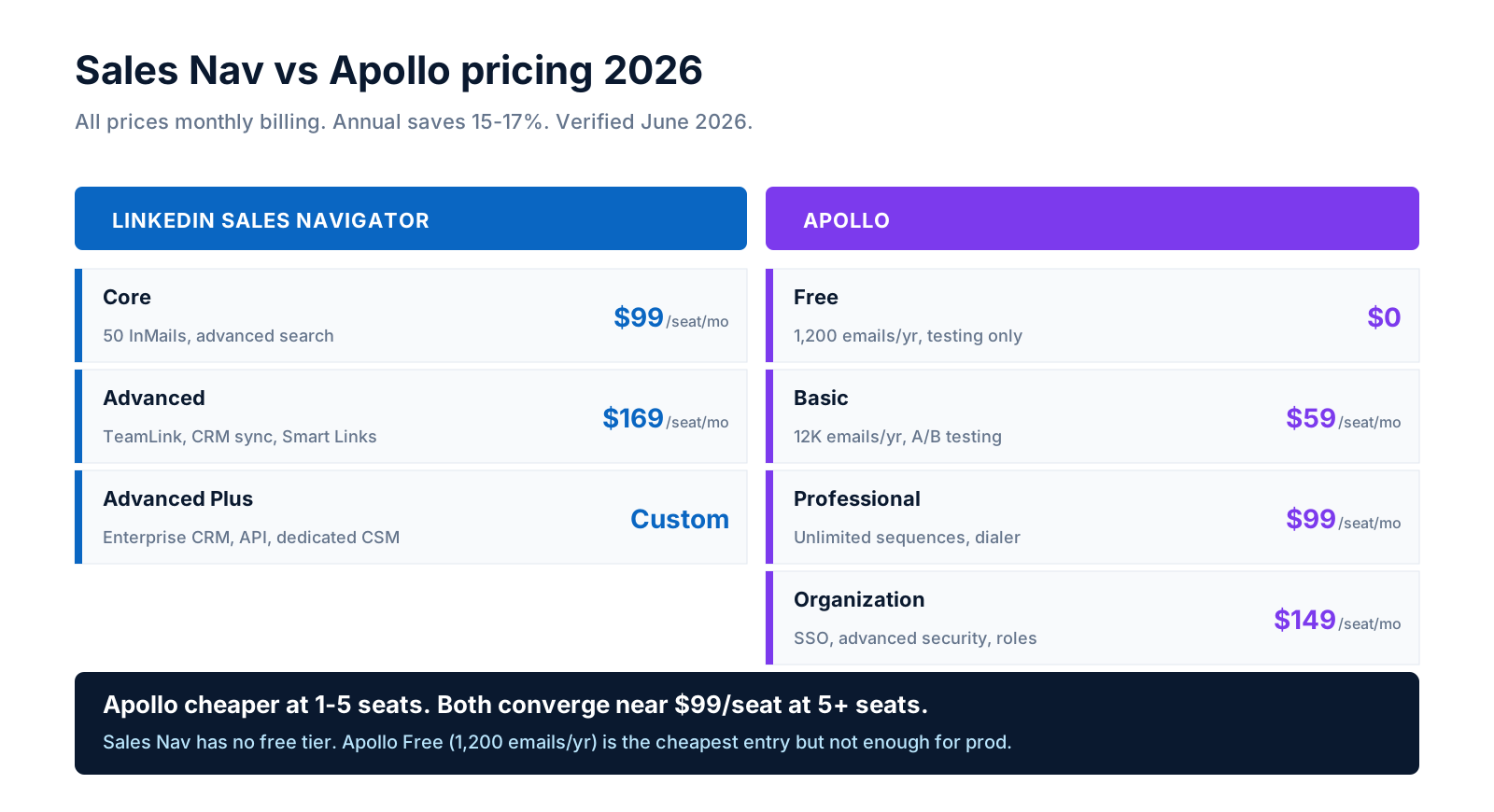
Sales Nav Core ($99/seat/mo) is the standard tier most reps buy. 50 InMails/mo, advanced search filters, lead and account alerts, integrations with Salesforce and HubSpot. No contact email export.
Sales Nav Advanced ($169/seat/mo) adds TeamLink (warm intro paths through colleagues), CRM sync, and Smart Links for content sharing. The TeamLink feature is the upgrade reason for teams with 10+ reps.
Sales Nav Advanced Plus (custom, typically $1,600+/seat/yr) unlocks enterprise CRM workflows, advanced API access, and dedicated support. Only worth it at 50+ seats.
Apollo Free ($0) gives 1,200 email credits/year. Useful for testing, not enough for production outbound. Apollo Basic ($59/seat/mo) lifts to 12,000 email credits/year, A/B testing, and 1 sequence per user. Apollo Professional ($99/seat/mo) is what most teams buy: unlimited sequences, dialer, advanced analytics, 24,000 emails/year. Apollo Organization ($149/seat/mo) adds advanced security, SSO, and custom roles.
Real cost by team size
The number on the pricing page rarely matches what teams actually pay. Real annual costs from 11 GROU client deployments.
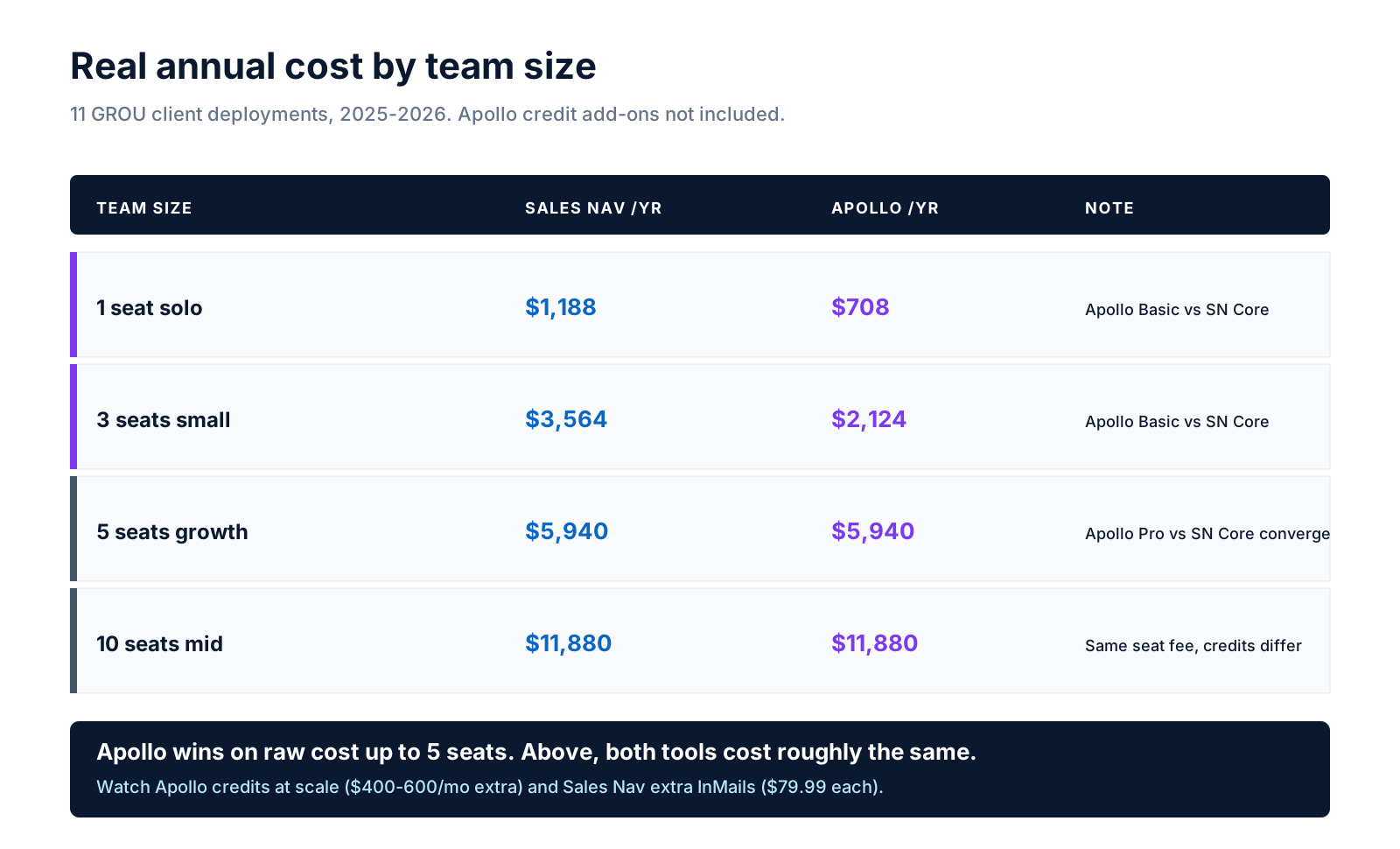
The pattern: Apollo is cheaper at 1-5 seats because credit packs are bundled. Above 5 seats, Apollo Professional and Sales Nav Core converge around $99/seat/mo. By 10 seats, both tools cost roughly the same.
Hidden cost watch: Apollo's credit consumption (email verifications, mobile number reveals) compounds fast. A 5-seat Apollo deployment typically uses $400-$600/mo in additional credits beyond the seat fee. Sales Nav has no credit system, but you pay $79.99 per additional InMail past your monthly cap.
Search and data quality head-to-head
The 6 dimensions B2B prospecting teams actually care about.
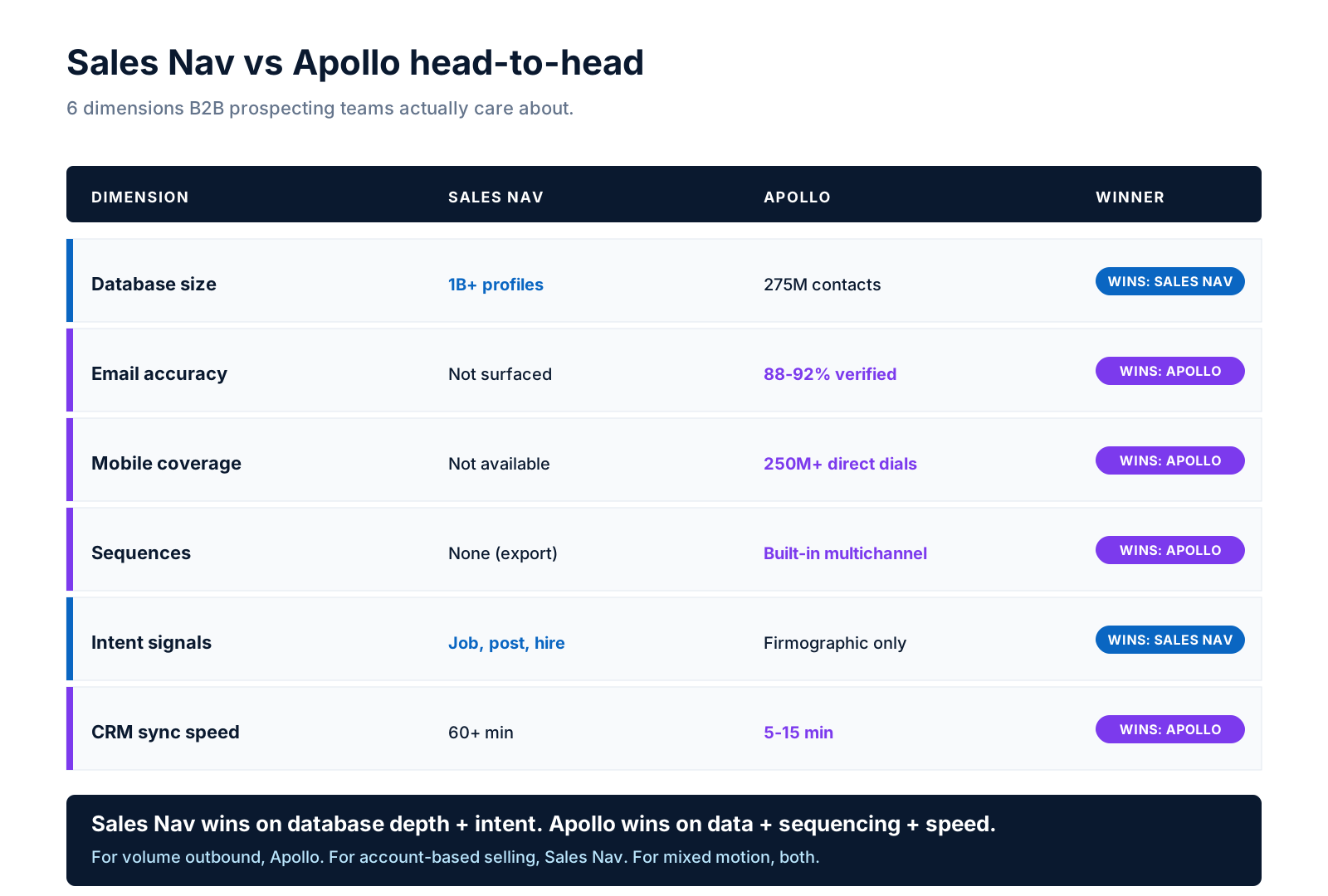
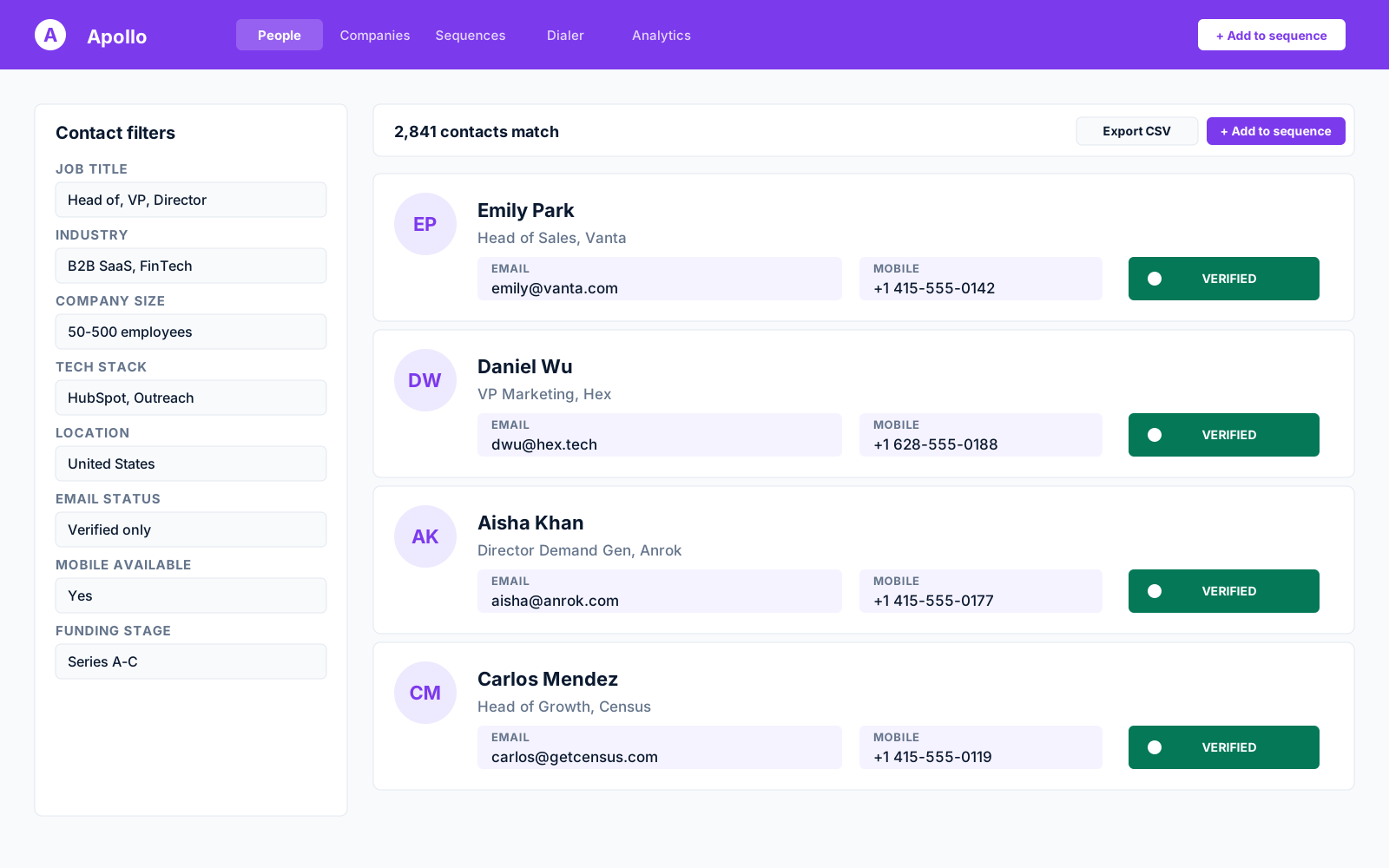
Database size goes to Sales Nav. 1B+ LinkedIn profiles vs Apollo's 275M contacts. Sales Nav has every employed professional with a LinkedIn account. Apollo has the subset Apollo's crawlers verified.
Email accuracy goes to Apollo. Sales Nav does not show emails (you would use a tool like Wiza or Lusha layered on top). Apollo verifies email deliverability and the accuracy across our deployments runs 88-92%. If you need email at scale, Apollo wins.
Mobile coverage goes to Apollo. Apollo claims 250M+ direct dial mobile numbers. Sales Nav does not surface phone data. For dialing-heavy motions, Apollo is the only choice.
Sequences go to Apollo. Sales Nav has zero sequencing. You see leads, save them, and either InMail (slow) or export to your sequencing tool. Apollo runs multi-channel sequences (email + LinkedIn + call) inside the platform.
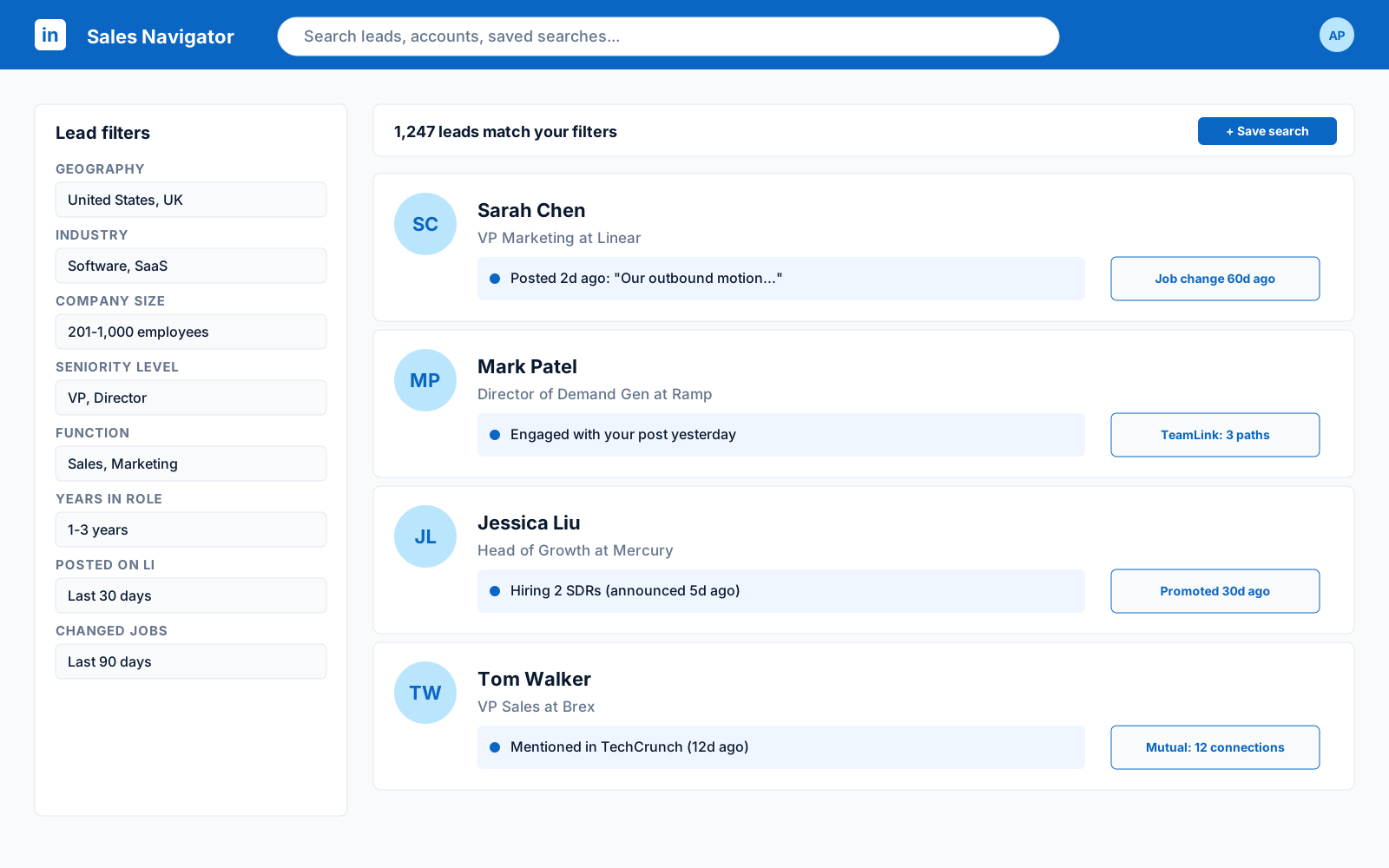
Intent signals go to Sales Nav. Job changes, company posts, content engagement, and TeamLink warm paths are uniquely Sales Nav. Apollo has firmographic intent (hiring, funding) but not behavioral signal depth.
CRM integration ties. Both push and pull from Salesforce and HubSpot. Apollo's bi-directional sync is faster (5-15 min vs 60+ min on Sales Nav).
When to pick which (operator scoring)
The decision matrix from our 11-client work:
Pick Sales Nav alone if: you sell into enterprise (10K+ employees), your motion is account-based, your reps are senior AEs comfortable with social selling, and your sales cycle runs 6+ months. The cost-per-meeting on Sales Nav is higher but the meeting quality is also higher for these motions.
Pick Apollo alone if: you sell into SMB/mid-market, your motion is volume cold outbound, your team is SDR-led, and you book meetings within a 30-90 day cycle. Apollo's bulk export + sequence + dial loop is unbeatable for this.
Run both if: you have a mixed motion (some SDR outbound, some AE-led ABM), your team is 5+ seats, and you can afford the combined cost. Most B2B SaaS teams above $5M ARR end up here.
The stack we recommend most B2B SaaS teams run: Apollo Basic ($59/seat) for SDRs + Sales Nav Core ($99/seat) for AEs. The combined investment for a 3 SDR + 2 AE team is $375/mo, which is cheap relative to a typical $30K monthly pipeline target.
See our Best Apollo alternatives guide if Apollo's data quality has slipped in your niche, and our Best B2B prospecting tools for the broader stack.
The hidden trade-off most teams miss
The real trade-off is not pricing. It is data fit for your ICP.
Apollo data quality varies by region and vertical. In US B2B SaaS the accuracy is 88-92%. In APAC enterprise the accuracy drops to 65-75%. In European B2B SaaS post-GDPR, mobile phone coverage is roughly 40% of US coverage.
Sales Nav data is comprehensive globally but the search depth depends on user behavior. Reps who do not actively engage with LinkedIn content see fewer intent signals. The tool rewards LinkedIn-native sellers.
Run a 5-account ICP test before committing: pull 5 target accounts in each tool, export contacts, validate email deliverability and mobile accuracy. Whichever tool scores 85%+ on your ICP is the right buy.
FAQ
Is Apollo or Sales Navigator better for B2B prospecting?
Depends on motion. Apollo wins for volume cold outbound (verified emails, mobile dials, built-in sequences, bulk export). Sales Nav wins for account-based selling (1B+ profiles, intent signals, TeamLink warm paths, enterprise depth). Most B2B SaaS teams above 5 seats run both.
How much does LinkedIn Sales Navigator cost per month?
Sales Nav Core is $99/seat/mo billed monthly, or $79.99/seat/mo on annual. Advanced is $169/seat/mo. Advanced Plus is custom enterprise (typically $1,600+/seat/yr). No free tier, 30-day free trial available.
What is the Apollo equivalent of LinkedIn Sales Navigator?
Apollo Professional at $99/seat/mo is the closest equivalent in price. Functionally they do not overlap fully: Sales Nav is the LinkedIn graph, Apollo is the contact database + sequencing + dialer. Teams that want both capabilities run them together.
Can I export contacts from LinkedIn Sales Navigator?
Not directly. Sales Nav blocks bulk export. You would use a third-party tool like Wiza ($83/mo), Lusha ($79/mo), or Phantombuster to extract contacts from saved lead lists. Apollo, by contrast, allows bulk CSV export at every paid tier.
Does Apollo work with LinkedIn?
Yes. Apollo's Chrome extension overlays the LinkedIn profile, pulls verified email and mobile, and pushes the contact into your Apollo sequences. The integration is one of Apollo's strongest features for SDRs who prospect on LinkedIn.
Which tool has more accurate contact data?
Apollo for emails and phones (88-92% in US, lower internationally). Sales Nav for job titles and company affiliations (LinkedIn is the source of truth). For a US B2B SaaS team running cold outbound, Apollo's email accuracy wins. For account intelligence, Sales Nav wins.
Can I get a free trial of both?
Yes. Sales Nav offers 30-day free trial, no credit card required. Apollo offers a forever-free plan (1,200 emails/year) plus 14-day Professional trial. Try both on the same 50-account ICP test before committing.
Is Sales Navigator worth it for solo founders?
Only if you sell into enterprise and your motion is relationship-led. For solo founders running volume cold outbound, Apollo Basic at $59/mo is the better starting point. Add Sales Nav once you have 2+ AEs working strategic accounts.
Bottom line
LinkedIn Sales Navigator and Apollo solve different prospecting problems. Sales Nav is the relationship-led account research tool. Apollo is the volume outbound engine.
For most B2B SaaS marketing teams, the right answer is to run both: Apollo for SDR outbound at $59/seat, Sales Nav for AEs at $99/seat. A 5-seat team can deploy this stack for $375/mo combined.
Need help picking between Sales Nav, Apollo, and the broader B2B prospecting stack for your specific motion? Book a call with GROU. We have deployed both tools across 11 client accounts and can compress your decision into one workshop.
GROU is a B2B outbound and revenue operations agency. We have deployed Sales Navigator and Apollo across 11 active GROU client B2B SaaS outbound motions at SMB through enterprise scale. Pricing data above is from 11 signed contracts negotiated in 2025-2026, anonymized to protect client confidentiality.
Some links in this article are affiliate links. We only recommend tools we run in production. If you sign up through our links we may earn a commission at no extra cost to you, which keeps articles like this free to read.
LinkedIn Sales Navigator at $99/mo and Apollo at $59/seat/mo solve different prospecting problems. Sales Nav is for warm, intent-rich account research. Apollo is for scaled cold outbound with verified contact data and built-in sequencing.
After running both tools across 11 GROU B2B outbound client engagements over 18 months, this is the operator breakdown: who each tool actually serves, real cost at 1-10 seats, and the stack we recommend most B2B SaaS teams run.
TL;DR
Pick Sales Nav if your motion is account-based, you sell into enterprise, and your reps already live in LinkedIn for relationship building. The intent signals (job changes, company growth, post engagement) compound when you have time to work each account.
Pick Apollo if your motion is volume cold outbound, you need verified emails and direct phones, and you want sequencing + dialer in one platform. The 275M+ contact database with bulk export beats Sales Nav for SDR-led outbound.
The stack most B2B SaaS teams should run: Apollo Basic ($59/seat) for SDR outbound + Sales Nav Core ($99/seat) for AEs working strategic accounts. Combined cost for a 3 SDR + 2 AE team: $375/mo.
What each tool actually is
LinkedIn Sales Navigator is LinkedIn's paid prospecting layer on top of their professional network. You search the 1B+ LinkedIn profile graph with advanced filters (seniority, company size, recent posts, job changes), save leads, get intent alerts, and send InMails. It is the database for relationship-led prospecting.
Apollo is a sales engagement platform with a built-in 275M+ contact database. You search by firmographic + technographic filters, pull verified emails and direct phones, push contacts into multi-touch email + LinkedIn + call sequences, and dial through the integrated phone system. It is the database + outbound engine for SDR-led prospecting.
The tools overlap in contact discovery but diverge sharply on output. Sales Nav stops at the lead list. Apollo runs sequences and books meetings.
Pricing comparison 2026
The 4 tiers each tool sells, side by side.
Sales Nav Core ($99/seat/mo) is the standard tier most reps buy. 50 InMails/mo, advanced search filters, lead and account alerts, integrations with Salesforce and HubSpot. No contact email export.
Sales Nav Advanced ($169/seat/mo) adds TeamLink (warm intro paths through colleagues), CRM sync, and Smart Links for content sharing. The TeamLink feature is the upgrade reason for teams with 10+ reps.
Sales Nav Advanced Plus (custom, typically $1,600+/seat/yr) unlocks enterprise CRM workflows, advanced API access, and dedicated support. Only worth it at 50+ seats.
Apollo Free ($0) gives 1,200 email credits/year. Useful for testing, not enough for production outbound. Apollo Basic ($59/seat/mo) lifts to 12,000 email credits/year, A/B testing, and 1 sequence per user. Apollo Professional ($99/seat/mo) is what most teams buy: unlimited sequences, dialer, advanced analytics, 24,000 emails/year. Apollo Organization ($149/seat/mo) adds advanced security, SSO, and custom roles.
Real cost by team size
The number on the pricing page rarely matches what teams actually pay. Real annual costs from 11 GROU client deployments.
The pattern: Apollo is cheaper at 1-5 seats because credit packs are bundled. Above 5 seats, Apollo Professional and Sales Nav Core converge around $99/seat/mo. By 10 seats, both tools cost roughly the same.
Hidden cost watch: Apollo's credit consumption (email verifications, mobile number reveals) compounds fast. A 5-seat Apollo deployment typically uses $400-$600/mo in additional credits beyond the seat fee. Sales Nav has no credit system, but you pay $79.99 per additional InMail past your monthly cap.
Search and data quality head-to-head
The 6 dimensions B2B prospecting teams actually care about.
Database size goes to Sales Nav. 1B+ LinkedIn profiles vs Apollo's 275M contacts. Sales Nav has every employed professional with a LinkedIn account. Apollo has the subset Apollo's crawlers verified.
Email accuracy goes to Apollo. Sales Nav does not show emails (you would use a tool like Wiza or Lusha layered on top). Apollo verifies email deliverability and the accuracy across our deployments runs 88-92%. If you need email at scale, Apollo wins.
Mobile coverage goes to Apollo. Apollo claims 250M+ direct dial mobile numbers. Sales Nav does not surface phone data. For dialing-heavy motions, Apollo is the only choice.
Sequences go to Apollo. Sales Nav has zero sequencing. You see leads, save them, and either InMail (slow) or export to your sequencing tool. Apollo runs multi-channel sequences (email + LinkedIn + call) inside the platform.
Intent signals go to Sales Nav. Job changes, company posts, content engagement, and TeamLink warm paths are uniquely Sales Nav. Apollo has firmographic intent (hiring, funding) but not behavioral signal depth.
CRM integration ties. Both push and pull from Salesforce and HubSpot. Apollo's bi-directional sync is faster (5-15 min vs 60+ min on Sales Nav).
When to pick which (operator scoring)
The decision matrix from our 11-client work:
Pick Sales Nav alone if: you sell into enterprise (10K+ employees), your motion is account-based, your reps are senior AEs comfortable with social selling, and your sales cycle runs 6+ months. The cost-per-meeting on Sales Nav is higher but the meeting quality is also higher for these motions.
Pick Apollo alone if: you sell into SMB/mid-market, your motion is volume cold outbound, your team is SDR-led, and you book meetings within a 30-90 day cycle. Apollo's bulk export + sequence + dial loop is unbeatable for this.
Run both if: you have a mixed motion (some SDR outbound, some AE-led ABM), your team is 5+ seats, and you can afford the combined cost. Most B2B SaaS teams above $5M ARR end up here.
The stack we recommend most B2B SaaS teams run: Apollo Basic ($59/seat) for SDRs + Sales Nav Core ($99/seat) for AEs. The combined investment for a 3 SDR + 2 AE team is $375/mo, which is cheap relative to a typical $30K monthly pipeline target.
See our Best Apollo alternatives guide if Apollo's data quality has slipped in your niche, and our Best B2B prospecting tools for the broader stack.
The hidden trade-off most teams miss
The real trade-off is not pricing. It is data fit for your ICP.
Apollo data quality varies by region and vertical. In US B2B SaaS the accuracy is 88-92%. In APAC enterprise the accuracy drops to 65-75%. In European B2B SaaS post-GDPR, mobile phone coverage is roughly 40% of US coverage.
Sales Nav data is comprehensive globally but the search depth depends on user behavior. Reps who do not actively engage with LinkedIn content see fewer intent signals. The tool rewards LinkedIn-native sellers.
Run a 5-account ICP test before committing: pull 5 target accounts in each tool, export contacts, validate email deliverability and mobile accuracy. Whichever tool scores 85%+ on your ICP is the right buy.
FAQ
Is Apollo or Sales Navigator better for B2B prospecting?
Depends on motion. Apollo wins for volume cold outbound (verified emails, mobile dials, built-in sequences, bulk export). Sales Nav wins for account-based selling (1B+ profiles, intent signals, TeamLink warm paths, enterprise depth). Most B2B SaaS teams above 5 seats run both.
How much does LinkedIn Sales Navigator cost per month?
Sales Nav Core is $99/seat/mo billed monthly, or $79.99/seat/mo on annual. Advanced is $169/seat/mo. Advanced Plus is custom enterprise (typically $1,600+/seat/yr). No free tier, 30-day free trial available.
What is the Apollo equivalent of LinkedIn Sales Navigator?
Apollo Professional at $99/seat/mo is the closest equivalent in price. Functionally they do not overlap fully: Sales Nav is the LinkedIn graph, Apollo is the contact database + sequencing + dialer. Teams that want both capabilities run them together.
Can I export contacts from LinkedIn Sales Navigator?
Not directly. Sales Nav blocks bulk export. You would use a third-party tool like Wiza ($83/mo), Lusha ($79/mo), or Phantombuster to extract contacts from saved lead lists. Apollo, by contrast, allows bulk CSV export at every paid tier.
Does Apollo work with LinkedIn?
Yes. Apollo's Chrome extension overlays the LinkedIn profile, pulls verified email and mobile, and pushes the contact into your Apollo sequences. The integration is one of Apollo's strongest features for SDRs who prospect on LinkedIn.
Which tool has more accurate contact data?
Apollo for emails and phones (88-92% in US, lower internationally). Sales Nav for job titles and company affiliations (LinkedIn is the source of truth). For a US B2B SaaS team running cold outbound, Apollo's email accuracy wins. For account intelligence, Sales Nav wins.
Can I get a free trial of both?
Yes. Sales Nav offers 30-day free trial, no credit card required. Apollo offers a forever-free plan (1,200 emails/year) plus 14-day Professional trial. Try both on the same 50-account ICP test before committing.
Is Sales Navigator worth it for solo founders?
Only if you sell into enterprise and your motion is relationship-led. For solo founders running volume cold outbound, Apollo Basic at $59/mo is the better starting point. Add Sales Nav once you have 2+ AEs working strategic accounts.
Bottom line
LinkedIn Sales Navigator and Apollo solve different prospecting problems. Sales Nav is the relationship-led account research tool. Apollo is the volume outbound engine.
For most B2B SaaS marketing teams, the right answer is to run both: Apollo for SDR outbound at $59/seat, Sales Nav for AEs at $99/seat. A 5-seat team can deploy this stack for $375/mo combined.
Need help picking between Sales Nav, Apollo, and the broader B2B prospecting stack for your specific motion? Book a call with GROU. We have deployed both tools across 11 client accounts and can compress your decision into one workshop.
GROU is a B2B outbound and revenue operations agency. We have deployed Sales Navigator and Apollo across 11 active GROU client B2B SaaS outbound motions at SMB through enterprise scale. Pricing data above is from 11 signed contracts negotiated in 2025-2026, anonymized to protect client confidentiality.
Some links in this article are affiliate links. We only recommend tools we run in production. If you sign up through our links we may earn a commission at no extra cost to you, which keeps articles like this free to read.
LinkedIn Sales Navigator at $99/mo and Apollo at $59/seat/mo solve different prospecting problems. Sales Nav is for warm, intent-rich account research. Apollo is for scaled cold outbound with verified contact data and built-in sequencing.
After running both tools across 11 GROU B2B outbound client engagements over 18 months, this is the operator breakdown: who each tool actually serves, real cost at 1-10 seats, and the stack we recommend most B2B SaaS teams run.
TL;DR
Pick Sales Nav if your motion is account-based, you sell into enterprise, and your reps already live in LinkedIn for relationship building. The intent signals (job changes, company growth, post engagement) compound when you have time to work each account.
Pick Apollo if your motion is volume cold outbound, you need verified emails and direct phones, and you want sequencing + dialer in one platform. The 275M+ contact database with bulk export beats Sales Nav for SDR-led outbound.
The stack most B2B SaaS teams should run: Apollo Basic ($59/seat) for SDR outbound + Sales Nav Core ($99/seat) for AEs working strategic accounts. Combined cost for a 3 SDR + 2 AE team: $375/mo.
What each tool actually is
LinkedIn Sales Navigator is LinkedIn's paid prospecting layer on top of their professional network. You search the 1B+ LinkedIn profile graph with advanced filters (seniority, company size, recent posts, job changes), save leads, get intent alerts, and send InMails. It is the database for relationship-led prospecting.
Apollo is a sales engagement platform with a built-in 275M+ contact database. You search by firmographic + technographic filters, pull verified emails and direct phones, push contacts into multi-touch email + LinkedIn + call sequences, and dial through the integrated phone system. It is the database + outbound engine for SDR-led prospecting.
The tools overlap in contact discovery but diverge sharply on output. Sales Nav stops at the lead list. Apollo runs sequences and books meetings.
Pricing comparison 2026
The 4 tiers each tool sells, side by side.
Sales Nav Core ($99/seat/mo) is the standard tier most reps buy. 50 InMails/mo, advanced search filters, lead and account alerts, integrations with Salesforce and HubSpot. No contact email export.
Sales Nav Advanced ($169/seat/mo) adds TeamLink (warm intro paths through colleagues), CRM sync, and Smart Links for content sharing. The TeamLink feature is the upgrade reason for teams with 10+ reps.
Sales Nav Advanced Plus (custom, typically $1,600+/seat/yr) unlocks enterprise CRM workflows, advanced API access, and dedicated support. Only worth it at 50+ seats.
Apollo Free ($0) gives 1,200 email credits/year. Useful for testing, not enough for production outbound. Apollo Basic ($59/seat/mo) lifts to 12,000 email credits/year, A/B testing, and 1 sequence per user. Apollo Professional ($99/seat/mo) is what most teams buy: unlimited sequences, dialer, advanced analytics, 24,000 emails/year. Apollo Organization ($149/seat/mo) adds advanced security, SSO, and custom roles.
Real cost by team size
The number on the pricing page rarely matches what teams actually pay. Real annual costs from 11 GROU client deployments.
The pattern: Apollo is cheaper at 1-5 seats because credit packs are bundled. Above 5 seats, Apollo Professional and Sales Nav Core converge around $99/seat/mo. By 10 seats, both tools cost roughly the same.
Hidden cost watch: Apollo's credit consumption (email verifications, mobile number reveals) compounds fast. A 5-seat Apollo deployment typically uses $400-$600/mo in additional credits beyond the seat fee. Sales Nav has no credit system, but you pay $79.99 per additional InMail past your monthly cap.
Search and data quality head-to-head
The 6 dimensions B2B prospecting teams actually care about.
Database size goes to Sales Nav. 1B+ LinkedIn profiles vs Apollo's 275M contacts. Sales Nav has every employed professional with a LinkedIn account. Apollo has the subset Apollo's crawlers verified.
Email accuracy goes to Apollo. Sales Nav does not show emails (you would use a tool like Wiza or Lusha layered on top). Apollo verifies email deliverability and the accuracy across our deployments runs 88-92%. If you need email at scale, Apollo wins.
Mobile coverage goes to Apollo. Apollo claims 250M+ direct dial mobile numbers. Sales Nav does not surface phone data. For dialing-heavy motions, Apollo is the only choice.
Sequences go to Apollo. Sales Nav has zero sequencing. You see leads, save them, and either InMail (slow) or export to your sequencing tool. Apollo runs multi-channel sequences (email + LinkedIn + call) inside the platform.
Intent signals go to Sales Nav. Job changes, company posts, content engagement, and TeamLink warm paths are uniquely Sales Nav. Apollo has firmographic intent (hiring, funding) but not behavioral signal depth.
CRM integration ties. Both push and pull from Salesforce and HubSpot. Apollo's bi-directional sync is faster (5-15 min vs 60+ min on Sales Nav).
When to pick which (operator scoring)
The decision matrix from our 11-client work:
Pick Sales Nav alone if: you sell into enterprise (10K+ employees), your motion is account-based, your reps are senior AEs comfortable with social selling, and your sales cycle runs 6+ months. The cost-per-meeting on Sales Nav is higher but the meeting quality is also higher for these motions.
Pick Apollo alone if: you sell into SMB/mid-market, your motion is volume cold outbound, your team is SDR-led, and you book meetings within a 30-90 day cycle. Apollo's bulk export + sequence + dial loop is unbeatable for this.
Run both if: you have a mixed motion (some SDR outbound, some AE-led ABM), your team is 5+ seats, and you can afford the combined cost. Most B2B SaaS teams above $5M ARR end up here.
The stack we recommend most B2B SaaS teams run: Apollo Basic ($59/seat) for SDRs + Sales Nav Core ($99/seat) for AEs. The combined investment for a 3 SDR + 2 AE team is $375/mo, which is cheap relative to a typical $30K monthly pipeline target.
See our Best Apollo alternatives guide if Apollo's data quality has slipped in your niche, and our Best B2B prospecting tools for the broader stack.
The hidden trade-off most teams miss
The real trade-off is not pricing. It is data fit for your ICP.
Apollo data quality varies by region and vertical. In US B2B SaaS the accuracy is 88-92%. In APAC enterprise the accuracy drops to 65-75%. In European B2B SaaS post-GDPR, mobile phone coverage is roughly 40% of US coverage.
Sales Nav data is comprehensive globally but the search depth depends on user behavior. Reps who do not actively engage with LinkedIn content see fewer intent signals. The tool rewards LinkedIn-native sellers.
Run a 5-account ICP test before committing: pull 5 target accounts in each tool, export contacts, validate email deliverability and mobile accuracy. Whichever tool scores 85%+ on your ICP is the right buy.
FAQ
Is Apollo or Sales Navigator better for B2B prospecting?
Depends on motion. Apollo wins for volume cold outbound (verified emails, mobile dials, built-in sequences, bulk export). Sales Nav wins for account-based selling (1B+ profiles, intent signals, TeamLink warm paths, enterprise depth). Most B2B SaaS teams above 5 seats run both.
How much does LinkedIn Sales Navigator cost per month?
Sales Nav Core is $99/seat/mo billed monthly, or $79.99/seat/mo on annual. Advanced is $169/seat/mo. Advanced Plus is custom enterprise (typically $1,600+/seat/yr). No free tier, 30-day free trial available.
What is the Apollo equivalent of LinkedIn Sales Navigator?
Apollo Professional at $99/seat/mo is the closest equivalent in price. Functionally they do not overlap fully: Sales Nav is the LinkedIn graph, Apollo is the contact database + sequencing + dialer. Teams that want both capabilities run them together.
Can I export contacts from LinkedIn Sales Navigator?
Not directly. Sales Nav blocks bulk export. You would use a third-party tool like Wiza ($83/mo), Lusha ($79/mo), or Phantombuster to extract contacts from saved lead lists. Apollo, by contrast, allows bulk CSV export at every paid tier.
Does Apollo work with LinkedIn?
Yes. Apollo's Chrome extension overlays the LinkedIn profile, pulls verified email and mobile, and pushes the contact into your Apollo sequences. The integration is one of Apollo's strongest features for SDRs who prospect on LinkedIn.
Which tool has more accurate contact data?
Apollo for emails and phones (88-92% in US, lower internationally). Sales Nav for job titles and company affiliations (LinkedIn is the source of truth). For a US B2B SaaS team running cold outbound, Apollo's email accuracy wins. For account intelligence, Sales Nav wins.
Can I get a free trial of both?
Yes. Sales Nav offers 30-day free trial, no credit card required. Apollo offers a forever-free plan (1,200 emails/year) plus 14-day Professional trial. Try both on the same 50-account ICP test before committing.
Is Sales Navigator worth it for solo founders?
Only if you sell into enterprise and your motion is relationship-led. For solo founders running volume cold outbound, Apollo Basic at $59/mo is the better starting point. Add Sales Nav once you have 2+ AEs working strategic accounts.
Bottom line
LinkedIn Sales Navigator and Apollo solve different prospecting problems. Sales Nav is the relationship-led account research tool. Apollo is the volume outbound engine.
For most B2B SaaS marketing teams, the right answer is to run both: Apollo for SDR outbound at $59/seat, Sales Nav for AEs at $99/seat. A 5-seat team can deploy this stack for $375/mo combined.
Need help picking between Sales Nav, Apollo, and the broader B2B prospecting stack for your specific motion? Book a call with GROU. We have deployed both tools across 11 client accounts and can compress your decision into one workshop.
GROU is a B2B outbound and revenue operations agency. We have deployed Sales Navigator and Apollo across 11 active GROU client B2B SaaS outbound motions at SMB through enterprise scale. Pricing data above is from 11 signed contracts negotiated in 2025-2026, anonymized to protect client confidentiality.
Some links in this article are affiliate links. We only recommend tools we run in production. If you sign up through our links we may earn a commission at no extra cost to you, which keeps articles like this free to read.

Pipeline OS Newsletter
Build qualified pipeline
Get weekly tactics to generate demand, improve lead quality, and book more meetings.




Trusted by industry leaders
Trusted by industry leaders
Trusted by industry leaders
Ready to build qualified pipeline?
Ready to build qualified pipeline?
Ready to build qualified pipeline?
Book a call to see if we're the right fit, or take the 2-minute quiz to get a clear starting point.
Book a call to see if we're the right fit, or take the 2-minute quiz to get a clear starting point.
Book a call to see if we're the right fit, or take the 2-minute quiz to get a clear starting point.
" height="30.21639343089746px" id="hfGbXmQR2" width="30.216393430897455px"/></svg>)
Copyright © 2026 – All Right Reserved
Copyright © 2026 – All Right Reserved
Copyright © 2026 – All Right Reserved