%22%3E%3C/path%3E%3Cpath d=%22M 63.072 7.554 C 62.258 8.022 61.577 8.689 61.092 9.493 L 61.092 7.076 L 57.158 7.076 L 57.158 22.64 L 61.089 22.64 L 61.089 14.888 C 61.089 13.446 61.403 12.434 62.03 11.853 C 62.818 11.218 63.818 10.907 64.826 10.982 L 65.868 10.982 L 65.868 6.851 C 64.891 6.834 63.926 7.076 63.073 7.554 Z%22 fill=%22rgb(17,17,17)%22%3E%3C/path%3E%3Cpath d=%22M 78.916 7.82 C 76.363 6.49 73.321 6.49 70.768 7.82 C 69.562 8.473 68.564 9.451 67.888 10.644 C 67.167 11.931 66.803 13.387 66.834 14.862 C 66.804 16.332 67.157 17.785 67.86 19.077 C 68.515 20.267 69.494 21.246 70.684 21.901 C 71.924 22.576 73.318 22.92 74.73 22.898 C 76.164 22.918 77.58 22.575 78.846 21.901 C 80.062 21.247 81.073 20.27 81.768 19.077 C 82.506 17.797 82.88 16.339 82.85 14.862 C 82.88 13.389 82.517 11.934 81.797 10.647 C 81.12 9.455 80.122 8.477 78.917 7.824 M 78.803 14.862 C 78.829 15.739 78.636 16.608 78.241 17.391 C 77.903 18.046 77.38 18.588 76.738 18.95 C 76.124 19.293 75.432 19.472 74.729 19.47 C 73.668 19.497 72.648 19.061 71.934 18.276 C 71.139 17.323 70.741 16.1 70.823 14.862 C 70.741 13.62 71.149 12.395 71.959 11.45 C 72.687 10.667 73.715 10.233 74.783 10.256 C 75.859 10.236 76.894 10.67 77.635 11.45 C 78.464 12.387 78.884 13.616 78.801 14.864%22 fill=%22rgb(17,17,17)%22%3E%3C/path%3E%3Cpath d=%22M 95.906 7.076 L 95.906 15.646 C 95.975 16.68 95.643 17.701 94.979 18.498 C 94.311 19.184 93.379 19.547 92.422 19.495 C 91.475 19.544 90.553 19.18 89.894 18.498 C 89.23 17.701 88.898 16.68 88.967 15.646 L 88.967 7.076 L 85.033 7.076 L 85.033 16.207 C 85 17.449 85.275 18.68 85.834 19.79 C 86.327 20.75 87.095 21.542 88.039 22.065 C 89.033 22.594 90.145 22.861 91.271 22.838 C 92.188 22.847 93.095 22.65 93.926 22.263 C 94.708 21.905 95.388 21.36 95.906 20.675 L 95.906 22.645 L 99.865 22.645 L 99.865 7.076 Z%22 fill=%22rgb(17,17,17)%22%3E%3C/path%3E%3Cpath d=%22M 4.513 15.626 C 4.511 10.815 7.606 6.549 12.181 5.059 C 16.756 3.57 21.77 5.195 24.601 9.086 L 27.816 5.87 C 24.074 1.186 17.981 -0.943 12.137 0.393 C 6.292 1.728 1.728 6.292 0.393 12.137 C -0.943 17.981 1.186 24.074 5.87 27.816 L 9.085 24.601 C 6.214 22.512 4.515 19.177 4.513 15.626%22 fill=%22rgb(32,62,235)%22%3E%3C/path%3E%3Cpath d=%22M 17.114 14.343 L 13.354 18.01 L 13.354 18.026 L 21.071 18.026 L 11.412 27.609 L 17.389 27.609 L 23.999 21.081 L 23.999 28.316 L 24.005 28.316 L 27.967 24.393 L 27.967 14.343 Z%22 fill=%22rgb(32,62,235)%22%3E%3C/path%3E%3C/g%3E%3C/svg%3E) ×
× ××
××›
›
›
›
Marketing for healthcare services: a 2026 system
Marketing for healthcare services: a 2026 system
Marketing for healthcare services: a 2026 system
Marketing for healthcare services: a 2026 system
Marketing for healthcare services: a 2026 system
Marketing for healthcare services: a 2026 system
Author
Aljaz Peklaj

Healthcare service teams often have the opposite of a demand problem. Forms arrive, referral partners send inquiries, and paid campaigns generate names, yet appointments remain unbooked because targeting, consent, routing, proof, and follow-up sit in separate systems.
Pipeline diagnosis: Find the leaks between attention, inquiry, scheduled appointment, and completed care.
Audience architecture: Separate clinical information from marketing data before building segments or activating campaigns.
Message design: Lead with clinical capability and access, then use promotion to route buyers toward evidence.
Revenue reporting: Connect reputation, response speed, appointment requests, and completed care in one operating view.
Marketing of healthcare services works when structure turns attention into pipeline. The same discipline a RevOps team applies in SaaS, manufacturing, legal tech, pharma, or iGaming can work here, but healthcare requires tighter data controls and stronger proof.
Table of Contents
Why most healthcare pipelines stall
High lead volume can hide a weak operating system. A healthcare provider may report growing form submissions while the scheduling team answers slowly, the CRM lacks service-line fields, and paid audiences include people who cannot access the relevant care. The campaign appears active. The pipeline is not.
The first failure usually happens before the message is written. Teams target broad demographics or condition categories without defining the clinical problem, access constraint, referral context, or service line behind the inquiry. That creates an audience that looks large in a media platform and performs poorly at the appointment desk.
The second failure happens after conversion. A form fill enters HubSpot without a clear owner, response SLA, consent status, location, specialty, or appointment intent. Sales and patient-access teams then work from incomplete records, while marketing reports MQLs that have no reliable connection to booked care.
Operating rule: Every campaign needs a defined path from audience signal to qualified inquiry, scheduled appointment, and completed care.
A third leak comes from treating compliance as a final copy review. If PHI reaches an ad pixel, an uncontrolled CRM export, or a vendor audience, the risk exists before legal reviews the landing page. The sales pipeline management framework is useful here because it forces ownership, stages, exit criteria, and reporting around the actual revenue process.
The fix isn't another channel. Build one system with → service-line segmentation → privacy gates → proof assets → routing rules → closed-loop reporting. Marketing creates the signal, operations responds to it, and leadership measures whether qualified demand becomes care.
The shift to marketing as an operating investment
A service line launches a campaign, inquiries rise, and leadership sees momentum. Then scheduling lag, limited provider capacity, weak routing, or missing proof assets turn that spend into noise. In healthcare, marketing starts paying back only when it is tied to access, operations, and completed care.
Historical U.S. figures show why this shift matters. Medical marketing spending grew from $17.7 billion in 1997 to $29.9 billion in 2016, a nominal increase of approximately 69%, according to the JAMA analysis of medical marketing spending. Over the same period, healthcare-service advertising rose from $542 million to approximately $2.9 billion, as noted in the same JAMA analysis. The important change was structural. Spending moved closer to direct consumer acquisition instead of staying concentrated on physician-facing promotion.
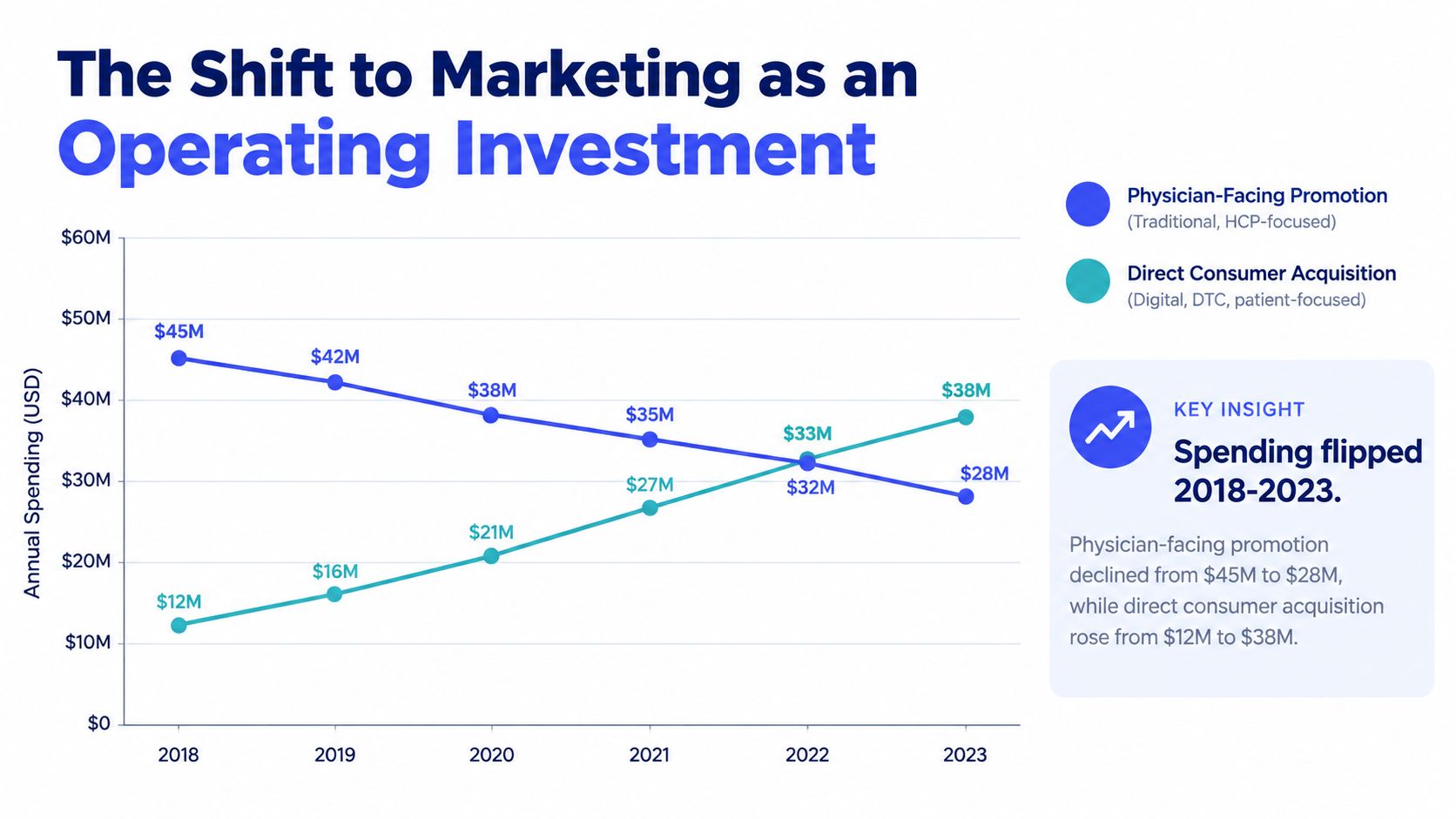
That changes what a marketing budget is for. It is no longer just a communications line item. It is an operating investment that should map to service-line capacity, a defined patient or buying cohort, expected inquiry quality, response ownership, and booked-care reporting. Brand work still matters, but brand alone does not fix broken conversion paths.
Budget follows operating constraints
If specialist access is tight, buying broad demand for that specialty creates avoidable waste. If a pharma or healthtech company sells into hospitals, the budget has to support buying-committee coverage, compliant audience data, proof assets, and a handoff sales can execute. Channel selection comes after those constraints are clear.
A disciplined B2B marketing budget framework helps teams assign spend to the key bottleneck. Sometimes the constraint is audience quality. Sometimes it is proof coverage, response speed, or appointment capacity. In my experience, regulated-industry teams outperform or underperform at this stage. The strongest teams treat privacy rules and clinical substantiation as conversion design inputs, not as approvals that happen at the end.
Content investment belongs in that same operating model. For teams building educational assets that also need discoverability in AI-assisted search, buying content marketing for AI visibility can be assessed as part of the content layer. The test is straightforward. The asset should support a defined audience, a real decision, and a measurable next action.
The operating model
Marketing, RevOps, clinical leadership, and patient access need one reporting line from first response to completed appointment. That line should show where demand enters, which records meet qualification rules, who owns follow-up, and whether care was actually delivered. Teams that build around that workflow get cleaner data, better handoffs, and a budget that behaves like an operating system instead of a promotion fund.
Building privacy-safe audience architecture
Healthcare audiences can't be built with the same assumptions as a standard B2B SaaS list. A diagnosis, treatment history, appointment record, or condition-specific behavior can expose sensitive information when it enters a campaign system. Precision without governance creates operational and legal risk.
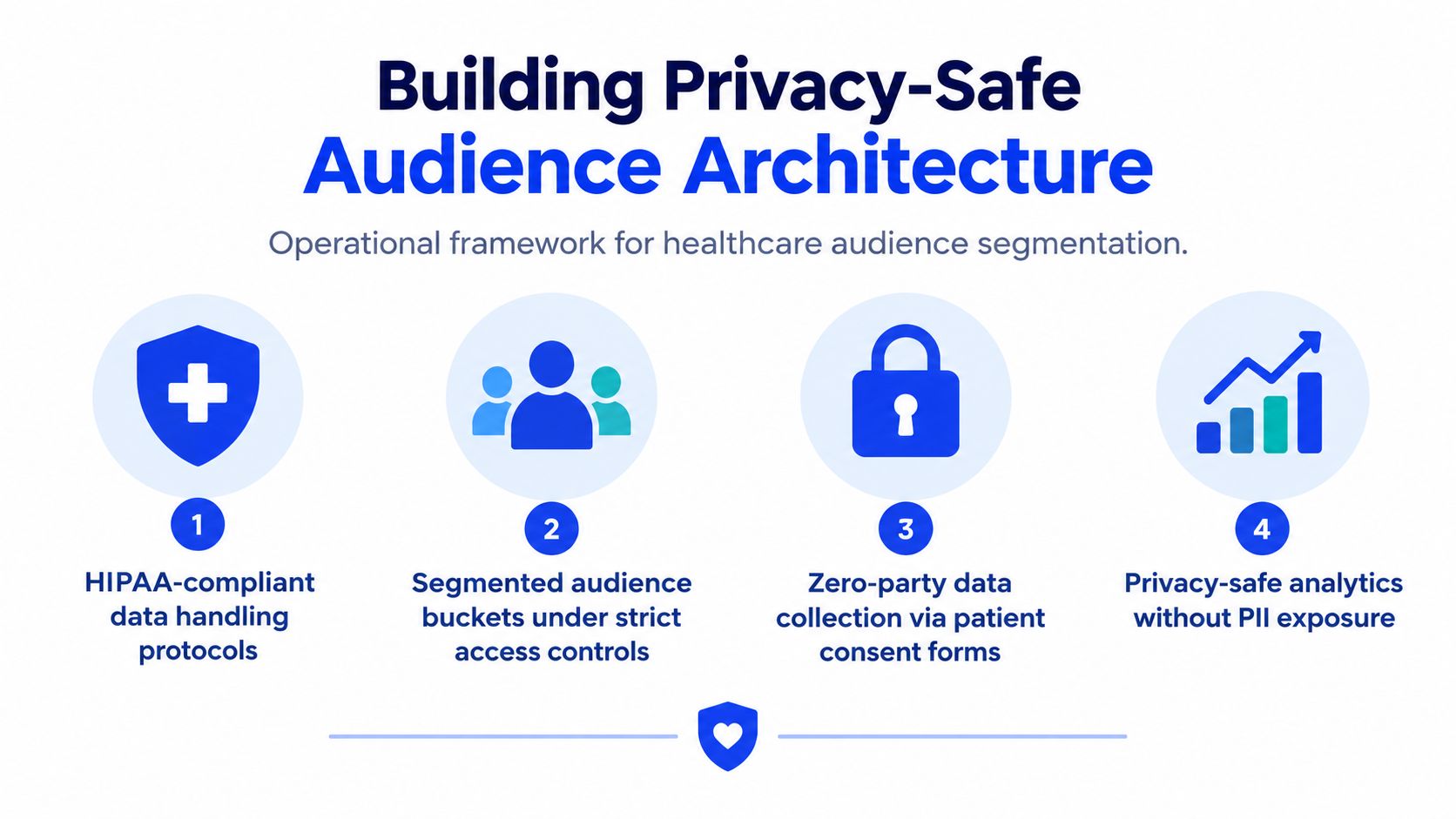
The U.S. Department of Health and Human Services states that the HIPAA Privacy Rule generally requires an individual's prior written authorization for uses or disclosures of PHI in marketing communications, with limited exceptions. The HHS guidance on HIPAA marketing communications should sit inside the campaign workflow, not in a folder used only during approval.
Four gates for every audience
1. Classify every field. Mark each CRM and analytics field as identifiable, sensitive, de-identified, or non-personal. Don't allow a field into an activation workflow just because it exists in the CRM.
2. Separate clinical and promotional data. Clinical systems should not feed ad-platform pixels or uncontrolled campaign exports. Create a documented boundary between care delivery records and marketing records, then limit vendor access to the minimum required data.
3. Capture consent in plain language. Consent forms should explain the purpose, the data involved, the expected benefit, and how a person can withdraw permission. A vague checkbox isn't a substitute for a documented consent record.
4. Measure in cohorts. Report aggregate conversion groups and consented first-party signals rather than building audiences around individually profiled health conditions. This preserves useful measurement without exposing sensitive attributes.
A practical data dictionary should include field owner, purpose, lawful basis or authorization status, retention rule, permitted destination, and review date. That document becomes a launch gate for paid media, email, CRM enrichment, and outbound workflows.
Personalization has an acceptance threshold
Healthcare marketers often ask how much personalization they can add. The better question is what patients will accept when the purpose and safeguard aren't obvious. A message that feels relevant to a professional role or service need can be useful. A message that appears to infer a private condition can damage trust even when the targeting technically works.
Teams building a first party data plan should start with explicit value exchange and minimal collection. Ask for information that improves routing or communication, not data that merely makes an audience file look richer.
Use contextual and role-based signals where possible. For a pharma campaign, that may mean specialty, organization type, territory, and stated professional interest. For a healthcare service, it may mean service line, location selected by the user, preferred contact method, and consent status.
Finally, document every vendor touchpoint. Review pixels, CRM exports, enrichment tools, email platforms, and reporting connectors before launch. The GDPR glossary is a useful reference for teams coordinating privacy requirements across markets, but local counsel should determine the applicable rules.
Positioning around clinical proof and access
Healthcare messaging should lead with the reason someone can trust the service to solve a clinical problem. Promotion distributes that position. It doesn't create the position by itself.
A peer-reviewed study of provider selection found perceived clinical quality was the top determinant at 74.9%, followed by provider reputation at 68.0% and access to specialized physicians at 63.2%, as reported in the study on healthcare-provider selection factors. Those findings support a clear editorial position: put capability and access in the first layer of the message.
Build the message from the decision
Start with the decision a patient, referrer, procurement lead, or care coordinator is trying to make. Then map the evidence needed to reduce uncertainty.
Clinical problem: Name the condition, procedure, specialty need, or operational challenge in language the audience uses.
Capability: Show relevant expertise, service availability, treatment scope, or technical fit.
Access: Clarify location, referral requirements, virtual availability where appropriate, scheduling path, and communication options.
Proof: Connect claims to approved evidence, qualified professionals, service descriptions, reviews, or consented testimonials.
This structure works across B2C and B2B healthcare. A hospital buyer may need proof of implementation capacity and clinical fit. A patient may need to understand whether the right specialist is accessible and what happens after the inquiry. Both are trying to reduce risk.
Promotion routes attention to proof
The landing page should answer the question raised by the ad, referral, search result, or LinkedIn message. If the campaign says a service supports complex cases, the page needs a credible explanation of expertise and the next access step. If it promises faster coordination, the intake process must support that promise.
A B2B proof library can organize approved evidence by audience, service line, claim type, and buying stage. Clinical and legal reviewers then see exactly where each statement is used, while marketers stop recycling generic claims across unrelated campaigns.
Proof standard: If the operational experience can't support the headline, change the headline or fix the experience before buying more traffic.
Reputation is part of this architecture, but it isn't the whole message. Reviews can reduce uncertainty around communication and service experience. They shouldn't replace clear clinical capability, access information, or substantiated claims.
Mapping digital and human touchpoints
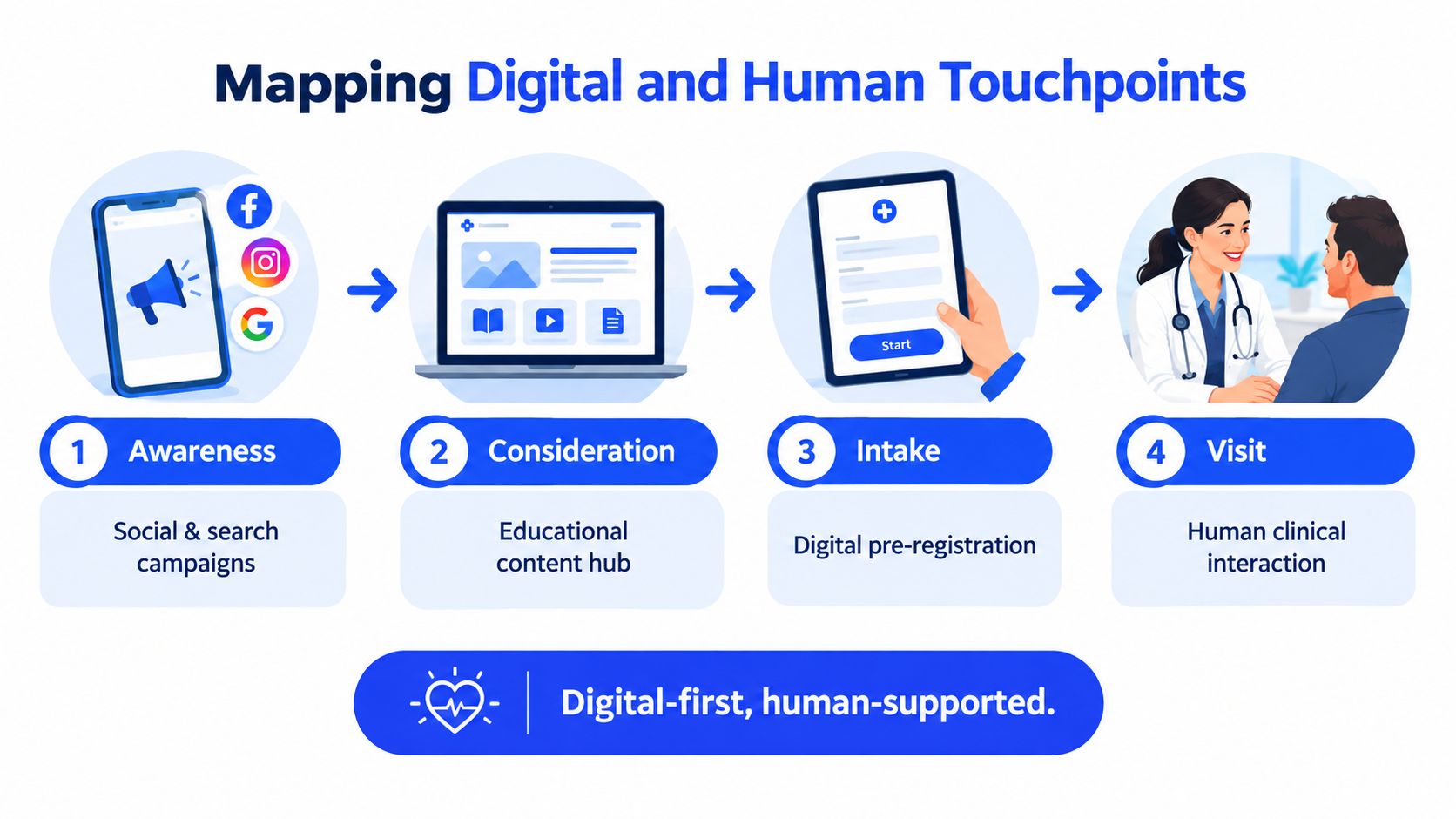
A digital-first patient journey still needs human routing. Digital intake can reduce friction for people who prefer it, but a portal can't answer every complex question, resolve language barriers, or reassure someone who isn't ready to commit to an appointment.
Recent U.S. survey data reports that 92% of patients prefer digital intake forms, 91% expect portal responses within 24 hours, and 53% prefer virtual appointments when appropriate. Preferences remain divided for medical questions, with 37% preferring phone, according to Tebra's healthcare marketing trends survey.
Give each touchpoint a job
At awareness, search and social content should answer a defined service question. At consideration, the website should explain capability, access, proof, and the next action. During intake, digital forms should collect only what routing requires and make consent visible.
Human support becomes more valuable as the case becomes more complex. A coordinator can clarify referral requirements, route a specialty request, explain scheduling constraints, or hand a caller to the right team. A digital form can capture intent, but it doesn't replace judgment.
The B2B buyer journey framework applies here with one adjustment. The journey map must include care access and completion, not just inquiry and opportunity stages.
A useful touchpoint matrix assigns:
Discovery: Search, social, referral, or professional content, with a service-line source field.
Consideration: Specialty page, proof asset, FAQ, or clinician content, with an intent signal.
Intake: Portal, form, phone, or coordinator, with consent and routing status.
Follow-up: Reminder, response, referral update, or clinical next step, with owner and due time.
This matrix exposes where a campaign creates demand that operations can't absorb. It also shows whether older or less digitally confident patients have a viable route to care rather than being pushed into a single channel.
The following video can support internal discussion about designing healthcare experiences around the journey rather than around isolated campaign metrics.
A dental receptionist or equivalent trained access role can support phone routing and follow-up when clinical staff shouldn't carry the full administrative load. The tool isn't the point. The response design is.
Measuring trust and completed care
MQL volume is a weak endpoint for healthcare services. It tells leadership that someone crossed a marketing threshold, not whether the person reached the right service, received a response, booked an appointment, or completed care.
A U.S. survey of 1,008 adults found that 84% checked online reviews before selecting a new healthcare provider, according to the survey data on online healthcare reviews. That makes reputation an acquisition variable. Report it alongside appointment behavior rather than treating it as a separate brand dashboard.
Build one pipeline view
The dashboard should join location, specialty, service line, source, consent status, response owner, appointment status, and outcome. It should also separate booked appointments from completed appointments, because a scheduled visit can still fail to produce care.
Metric category | Specific KPI | Pipeline impact |
|---|---|---|
Reputation | Average rating, review velocity, response time | Shows whether trust signals are visible and actively managed |
Demand | Branded-search demand, service-line inquiries, source mix | Connects reputation and campaign exposure to intent |
Access | First-response time, routing completion, contact rate | Exposes operational friction after inquiry |
Conversion | Landing-page conversion, call conversion, appointment-request rate | Shows whether messaging and access design create qualified action |
Care completion | Booked-appointment rate, completed-appointment rate, no-show rate | Measures whether demand reaches delivered care |
Experience | Recurring themes in reviews and intake feedback | Identifies operational problems that marketing can't solve alone |
Review analysis should move beyond volume. Tag recurring themes such as wait times, staff communication, treatment explanations, and scheduling access. Then give those themes to the teams responsible for the underlying experience.
Use an explicit feedback loop
Set a review-response SLA and assign an owner by location or service line. Ask for feedback after appropriate patient interactions, with consent and careful attention to applicable rules. Never use a rating request to conceal negative feedback or make clinical claims that haven't passed review.
In HubSpot, create lifecycle fields for inquiry received, routed, contacted, appointment requested, booked, completed, canceled, and no-show. Keep marketing source and consent status separate from clinical details. If a team uses Apollo, Clay, Lemlist, Instantly, Smartlead, HeyReach, or Sales Navigator for B2B pharma and healthtech campaigns, apply the same discipline to organization and professional-role data, and keep patient information out of those systems.
Grou can support B2B pipeline programs for pharma and healthtech through prospect-list building, outbound campaigns, LinkedIn content, reply routing, and qualified-meeting reporting. The operating requirement stays constant: every activity needs a clear audience, approved message, owner, and measurable handoff.
Don't reward a campaign for generating cheap inquiries if the service line can't schedule them or the patient doesn't complete care. Report the cost and quality of the next meaningful stage, then fix the bottleneck with the team that owns it.
Your next operational audit
Run the audit this Friday with one marketing lead, one RevOps owner, and one person responsible for intake. Start with the last ten healthcare inquiries from each major source. For every record, check → service line → location → consent status → source → owner → first-response timestamp → appointment status → completion status.
Then review the consent log against the fields used in campaigns and CRM exports. Confirm that no PHI enters ad pixels, uncontrolled audience files, or tools that don't have an approved purpose. Ask the intake owner to submit a test form and call the published number, then record how long it takes to reach the correct team.
Finish by tagging the reasons for stalled records. Use categories such as wrong service, missing referral, no response, unclear access, incomplete consent, or scheduling capacity. Fix the most common operational leak before adding budget.
GROU is a global B2B pipeline agency trusted by more than 50 companies across iGaming, SaaS, manufacturing, and professional services, with experience supporting pharma and healthtech demand systems. Its methodology unifies ICP-aligned data, LinkedIn content, outbound sequences, reply routing, and pipeline reporting around one message and one reporting line.
GROU can audit your healthcare-service pipeline, define privacy-safe audience rules, and connect campaigns to qualified conversations and completed commercial outcomes. Visit Grou to review the operating model and identify the first handoff that needs repair.
Healthcare service teams often have the opposite of a demand problem. Forms arrive, referral partners send inquiries, and paid campaigns generate names, yet appointments remain unbooked because targeting, consent, routing, proof, and follow-up sit in separate systems.
Pipeline diagnosis: Find the leaks between attention, inquiry, scheduled appointment, and completed care.
Audience architecture: Separate clinical information from marketing data before building segments or activating campaigns.
Message design: Lead with clinical capability and access, then use promotion to route buyers toward evidence.
Revenue reporting: Connect reputation, response speed, appointment requests, and completed care in one operating view.
Marketing of healthcare services works when structure turns attention into pipeline. The same discipline a RevOps team applies in SaaS, manufacturing, legal tech, pharma, or iGaming can work here, but healthcare requires tighter data controls and stronger proof.
Table of Contents
Why most healthcare pipelines stall
High lead volume can hide a weak operating system. A healthcare provider may report growing form submissions while the scheduling team answers slowly, the CRM lacks service-line fields, and paid audiences include people who cannot access the relevant care. The campaign appears active. The pipeline is not.
The first failure usually happens before the message is written. Teams target broad demographics or condition categories without defining the clinical problem, access constraint, referral context, or service line behind the inquiry. That creates an audience that looks large in a media platform and performs poorly at the appointment desk.
The second failure happens after conversion. A form fill enters HubSpot without a clear owner, response SLA, consent status, location, specialty, or appointment intent. Sales and patient-access teams then work from incomplete records, while marketing reports MQLs that have no reliable connection to booked care.
Operating rule: Every campaign needs a defined path from audience signal to qualified inquiry, scheduled appointment, and completed care.
A third leak comes from treating compliance as a final copy review. If PHI reaches an ad pixel, an uncontrolled CRM export, or a vendor audience, the risk exists before legal reviews the landing page. The sales pipeline management framework is useful here because it forces ownership, stages, exit criteria, and reporting around the actual revenue process.
The fix isn't another channel. Build one system with → service-line segmentation → privacy gates → proof assets → routing rules → closed-loop reporting. Marketing creates the signal, operations responds to it, and leadership measures whether qualified demand becomes care.
The shift to marketing as an operating investment
A service line launches a campaign, inquiries rise, and leadership sees momentum. Then scheduling lag, limited provider capacity, weak routing, or missing proof assets turn that spend into noise. In healthcare, marketing starts paying back only when it is tied to access, operations, and completed care.
Historical U.S. figures show why this shift matters. Medical marketing spending grew from $17.7 billion in 1997 to $29.9 billion in 2016, a nominal increase of approximately 69%, according to the JAMA analysis of medical marketing spending. Over the same period, healthcare-service advertising rose from $542 million to approximately $2.9 billion, as noted in the same JAMA analysis. The important change was structural. Spending moved closer to direct consumer acquisition instead of staying concentrated on physician-facing promotion.
That changes what a marketing budget is for. It is no longer just a communications line item. It is an operating investment that should map to service-line capacity, a defined patient or buying cohort, expected inquiry quality, response ownership, and booked-care reporting. Brand work still matters, but brand alone does not fix broken conversion paths.
Budget follows operating constraints
If specialist access is tight, buying broad demand for that specialty creates avoidable waste. If a pharma or healthtech company sells into hospitals, the budget has to support buying-committee coverage, compliant audience data, proof assets, and a handoff sales can execute. Channel selection comes after those constraints are clear.
A disciplined B2B marketing budget framework helps teams assign spend to the key bottleneck. Sometimes the constraint is audience quality. Sometimes it is proof coverage, response speed, or appointment capacity. In my experience, regulated-industry teams outperform or underperform at this stage. The strongest teams treat privacy rules and clinical substantiation as conversion design inputs, not as approvals that happen at the end.
Content investment belongs in that same operating model. For teams building educational assets that also need discoverability in AI-assisted search, buying content marketing for AI visibility can be assessed as part of the content layer. The test is straightforward. The asset should support a defined audience, a real decision, and a measurable next action.
The operating model
Marketing, RevOps, clinical leadership, and patient access need one reporting line from first response to completed appointment. That line should show where demand enters, which records meet qualification rules, who owns follow-up, and whether care was actually delivered. Teams that build around that workflow get cleaner data, better handoffs, and a budget that behaves like an operating system instead of a promotion fund.
Building privacy-safe audience architecture
Healthcare audiences can't be built with the same assumptions as a standard B2B SaaS list. A diagnosis, treatment history, appointment record, or condition-specific behavior can expose sensitive information when it enters a campaign system. Precision without governance creates operational and legal risk.
The U.S. Department of Health and Human Services states that the HIPAA Privacy Rule generally requires an individual's prior written authorization for uses or disclosures of PHI in marketing communications, with limited exceptions. The HHS guidance on HIPAA marketing communications should sit inside the campaign workflow, not in a folder used only during approval.
Four gates for every audience
1. Classify every field. Mark each CRM and analytics field as identifiable, sensitive, de-identified, or non-personal. Don't allow a field into an activation workflow just because it exists in the CRM.
2. Separate clinical and promotional data. Clinical systems should not feed ad-platform pixels or uncontrolled campaign exports. Create a documented boundary between care delivery records and marketing records, then limit vendor access to the minimum required data.
3. Capture consent in plain language. Consent forms should explain the purpose, the data involved, the expected benefit, and how a person can withdraw permission. A vague checkbox isn't a substitute for a documented consent record.
4. Measure in cohorts. Report aggregate conversion groups and consented first-party signals rather than building audiences around individually profiled health conditions. This preserves useful measurement without exposing sensitive attributes.
A practical data dictionary should include field owner, purpose, lawful basis or authorization status, retention rule, permitted destination, and review date. That document becomes a launch gate for paid media, email, CRM enrichment, and outbound workflows.
Personalization has an acceptance threshold
Healthcare marketers often ask how much personalization they can add. The better question is what patients will accept when the purpose and safeguard aren't obvious. A message that feels relevant to a professional role or service need can be useful. A message that appears to infer a private condition can damage trust even when the targeting technically works.
Teams building a first party data plan should start with explicit value exchange and minimal collection. Ask for information that improves routing or communication, not data that merely makes an audience file look richer.
Use contextual and role-based signals where possible. For a pharma campaign, that may mean specialty, organization type, territory, and stated professional interest. For a healthcare service, it may mean service line, location selected by the user, preferred contact method, and consent status.
Finally, document every vendor touchpoint. Review pixels, CRM exports, enrichment tools, email platforms, and reporting connectors before launch. The GDPR glossary is a useful reference for teams coordinating privacy requirements across markets, but local counsel should determine the applicable rules.
Positioning around clinical proof and access
Healthcare messaging should lead with the reason someone can trust the service to solve a clinical problem. Promotion distributes that position. It doesn't create the position by itself.
A peer-reviewed study of provider selection found perceived clinical quality was the top determinant at 74.9%, followed by provider reputation at 68.0% and access to specialized physicians at 63.2%, as reported in the study on healthcare-provider selection factors. Those findings support a clear editorial position: put capability and access in the first layer of the message.
Build the message from the decision
Start with the decision a patient, referrer, procurement lead, or care coordinator is trying to make. Then map the evidence needed to reduce uncertainty.
Clinical problem: Name the condition, procedure, specialty need, or operational challenge in language the audience uses.
Capability: Show relevant expertise, service availability, treatment scope, or technical fit.
Access: Clarify location, referral requirements, virtual availability where appropriate, scheduling path, and communication options.
Proof: Connect claims to approved evidence, qualified professionals, service descriptions, reviews, or consented testimonials.
This structure works across B2C and B2B healthcare. A hospital buyer may need proof of implementation capacity and clinical fit. A patient may need to understand whether the right specialist is accessible and what happens after the inquiry. Both are trying to reduce risk.
Promotion routes attention to proof
The landing page should answer the question raised by the ad, referral, search result, or LinkedIn message. If the campaign says a service supports complex cases, the page needs a credible explanation of expertise and the next access step. If it promises faster coordination, the intake process must support that promise.
A B2B proof library can organize approved evidence by audience, service line, claim type, and buying stage. Clinical and legal reviewers then see exactly where each statement is used, while marketers stop recycling generic claims across unrelated campaigns.
Proof standard: If the operational experience can't support the headline, change the headline or fix the experience before buying more traffic.
Reputation is part of this architecture, but it isn't the whole message. Reviews can reduce uncertainty around communication and service experience. They shouldn't replace clear clinical capability, access information, or substantiated claims.
Mapping digital and human touchpoints
A digital-first patient journey still needs human routing. Digital intake can reduce friction for people who prefer it, but a portal can't answer every complex question, resolve language barriers, or reassure someone who isn't ready to commit to an appointment.
Recent U.S. survey data reports that 92% of patients prefer digital intake forms, 91% expect portal responses within 24 hours, and 53% prefer virtual appointments when appropriate. Preferences remain divided for medical questions, with 37% preferring phone, according to Tebra's healthcare marketing trends survey.
Give each touchpoint a job
At awareness, search and social content should answer a defined service question. At consideration, the website should explain capability, access, proof, and the next action. During intake, digital forms should collect only what routing requires and make consent visible.
Human support becomes more valuable as the case becomes more complex. A coordinator can clarify referral requirements, route a specialty request, explain scheduling constraints, or hand a caller to the right team. A digital form can capture intent, but it doesn't replace judgment.
The B2B buyer journey framework applies here with one adjustment. The journey map must include care access and completion, not just inquiry and opportunity stages.
A useful touchpoint matrix assigns:
Discovery: Search, social, referral, or professional content, with a service-line source field.
Consideration: Specialty page, proof asset, FAQ, or clinician content, with an intent signal.
Intake: Portal, form, phone, or coordinator, with consent and routing status.
Follow-up: Reminder, response, referral update, or clinical next step, with owner and due time.
This matrix exposes where a campaign creates demand that operations can't absorb. It also shows whether older or less digitally confident patients have a viable route to care rather than being pushed into a single channel.
The following video can support internal discussion about designing healthcare experiences around the journey rather than around isolated campaign metrics.
A dental receptionist or equivalent trained access role can support phone routing and follow-up when clinical staff shouldn't carry the full administrative load. The tool isn't the point. The response design is.
Measuring trust and completed care
MQL volume is a weak endpoint for healthcare services. It tells leadership that someone crossed a marketing threshold, not whether the person reached the right service, received a response, booked an appointment, or completed care.
A U.S. survey of 1,008 adults found that 84% checked online reviews before selecting a new healthcare provider, according to the survey data on online healthcare reviews. That makes reputation an acquisition variable. Report it alongside appointment behavior rather than treating it as a separate brand dashboard.
Build one pipeline view
The dashboard should join location, specialty, service line, source, consent status, response owner, appointment status, and outcome. It should also separate booked appointments from completed appointments, because a scheduled visit can still fail to produce care.
Metric category | Specific KPI | Pipeline impact |
|---|---|---|
Reputation | Average rating, review velocity, response time | Shows whether trust signals are visible and actively managed |
Demand | Branded-search demand, service-line inquiries, source mix | Connects reputation and campaign exposure to intent |
Access | First-response time, routing completion, contact rate | Exposes operational friction after inquiry |
Conversion | Landing-page conversion, call conversion, appointment-request rate | Shows whether messaging and access design create qualified action |
Care completion | Booked-appointment rate, completed-appointment rate, no-show rate | Measures whether demand reaches delivered care |
Experience | Recurring themes in reviews and intake feedback | Identifies operational problems that marketing can't solve alone |
Review analysis should move beyond volume. Tag recurring themes such as wait times, staff communication, treatment explanations, and scheduling access. Then give those themes to the teams responsible for the underlying experience.
Use an explicit feedback loop
Set a review-response SLA and assign an owner by location or service line. Ask for feedback after appropriate patient interactions, with consent and careful attention to applicable rules. Never use a rating request to conceal negative feedback or make clinical claims that haven't passed review.
In HubSpot, create lifecycle fields for inquiry received, routed, contacted, appointment requested, booked, completed, canceled, and no-show. Keep marketing source and consent status separate from clinical details. If a team uses Apollo, Clay, Lemlist, Instantly, Smartlead, HeyReach, or Sales Navigator for B2B pharma and healthtech campaigns, apply the same discipline to organization and professional-role data, and keep patient information out of those systems.
Grou can support B2B pipeline programs for pharma and healthtech through prospect-list building, outbound campaigns, LinkedIn content, reply routing, and qualified-meeting reporting. The operating requirement stays constant: every activity needs a clear audience, approved message, owner, and measurable handoff.
Don't reward a campaign for generating cheap inquiries if the service line can't schedule them or the patient doesn't complete care. Report the cost and quality of the next meaningful stage, then fix the bottleneck with the team that owns it.
Your next operational audit
Run the audit this Friday with one marketing lead, one RevOps owner, and one person responsible for intake. Start with the last ten healthcare inquiries from each major source. For every record, check → service line → location → consent status → source → owner → first-response timestamp → appointment status → completion status.
Then review the consent log against the fields used in campaigns and CRM exports. Confirm that no PHI enters ad pixels, uncontrolled audience files, or tools that don't have an approved purpose. Ask the intake owner to submit a test form and call the published number, then record how long it takes to reach the correct team.
Finish by tagging the reasons for stalled records. Use categories such as wrong service, missing referral, no response, unclear access, incomplete consent, or scheduling capacity. Fix the most common operational leak before adding budget.
GROU is a global B2B pipeline agency trusted by more than 50 companies across iGaming, SaaS, manufacturing, and professional services, with experience supporting pharma and healthtech demand systems. Its methodology unifies ICP-aligned data, LinkedIn content, outbound sequences, reply routing, and pipeline reporting around one message and one reporting line.
GROU can audit your healthcare-service pipeline, define privacy-safe audience rules, and connect campaigns to qualified conversations and completed commercial outcomes. Visit Grou to review the operating model and identify the first handoff that needs repair.
Healthcare service teams often have the opposite of a demand problem. Forms arrive, referral partners send inquiries, and paid campaigns generate names, yet appointments remain unbooked because targeting, consent, routing, proof, and follow-up sit in separate systems.
Pipeline diagnosis: Find the leaks between attention, inquiry, scheduled appointment, and completed care.
Audience architecture: Separate clinical information from marketing data before building segments or activating campaigns.
Message design: Lead with clinical capability and access, then use promotion to route buyers toward evidence.
Revenue reporting: Connect reputation, response speed, appointment requests, and completed care in one operating view.
Marketing of healthcare services works when structure turns attention into pipeline. The same discipline a RevOps team applies in SaaS, manufacturing, legal tech, pharma, or iGaming can work here, but healthcare requires tighter data controls and stronger proof.
Table of Contents
Why most healthcare pipelines stall
High lead volume can hide a weak operating system. A healthcare provider may report growing form submissions while the scheduling team answers slowly, the CRM lacks service-line fields, and paid audiences include people who cannot access the relevant care. The campaign appears active. The pipeline is not.
The first failure usually happens before the message is written. Teams target broad demographics or condition categories without defining the clinical problem, access constraint, referral context, or service line behind the inquiry. That creates an audience that looks large in a media platform and performs poorly at the appointment desk.
The second failure happens after conversion. A form fill enters HubSpot without a clear owner, response SLA, consent status, location, specialty, or appointment intent. Sales and patient-access teams then work from incomplete records, while marketing reports MQLs that have no reliable connection to booked care.
Operating rule: Every campaign needs a defined path from audience signal to qualified inquiry, scheduled appointment, and completed care.
A third leak comes from treating compliance as a final copy review. If PHI reaches an ad pixel, an uncontrolled CRM export, or a vendor audience, the risk exists before legal reviews the landing page. The sales pipeline management framework is useful here because it forces ownership, stages, exit criteria, and reporting around the actual revenue process.
The fix isn't another channel. Build one system with → service-line segmentation → privacy gates → proof assets → routing rules → closed-loop reporting. Marketing creates the signal, operations responds to it, and leadership measures whether qualified demand becomes care.
The shift to marketing as an operating investment
A service line launches a campaign, inquiries rise, and leadership sees momentum. Then scheduling lag, limited provider capacity, weak routing, or missing proof assets turn that spend into noise. In healthcare, marketing starts paying back only when it is tied to access, operations, and completed care.
Historical U.S. figures show why this shift matters. Medical marketing spending grew from $17.7 billion in 1997 to $29.9 billion in 2016, a nominal increase of approximately 69%, according to the JAMA analysis of medical marketing spending. Over the same period, healthcare-service advertising rose from $542 million to approximately $2.9 billion, as noted in the same JAMA analysis. The important change was structural. Spending moved closer to direct consumer acquisition instead of staying concentrated on physician-facing promotion.
That changes what a marketing budget is for. It is no longer just a communications line item. It is an operating investment that should map to service-line capacity, a defined patient or buying cohort, expected inquiry quality, response ownership, and booked-care reporting. Brand work still matters, but brand alone does not fix broken conversion paths.
Budget follows operating constraints
If specialist access is tight, buying broad demand for that specialty creates avoidable waste. If a pharma or healthtech company sells into hospitals, the budget has to support buying-committee coverage, compliant audience data, proof assets, and a handoff sales can execute. Channel selection comes after those constraints are clear.
A disciplined B2B marketing budget framework helps teams assign spend to the key bottleneck. Sometimes the constraint is audience quality. Sometimes it is proof coverage, response speed, or appointment capacity. In my experience, regulated-industry teams outperform or underperform at this stage. The strongest teams treat privacy rules and clinical substantiation as conversion design inputs, not as approvals that happen at the end.
Content investment belongs in that same operating model. For teams building educational assets that also need discoverability in AI-assisted search, buying content marketing for AI visibility can be assessed as part of the content layer. The test is straightforward. The asset should support a defined audience, a real decision, and a measurable next action.
The operating model
Marketing, RevOps, clinical leadership, and patient access need one reporting line from first response to completed appointment. That line should show where demand enters, which records meet qualification rules, who owns follow-up, and whether care was actually delivered. Teams that build around that workflow get cleaner data, better handoffs, and a budget that behaves like an operating system instead of a promotion fund.
Building privacy-safe audience architecture
Healthcare audiences can't be built with the same assumptions as a standard B2B SaaS list. A diagnosis, treatment history, appointment record, or condition-specific behavior can expose sensitive information when it enters a campaign system. Precision without governance creates operational and legal risk.
The U.S. Department of Health and Human Services states that the HIPAA Privacy Rule generally requires an individual's prior written authorization for uses or disclosures of PHI in marketing communications, with limited exceptions. The HHS guidance on HIPAA marketing communications should sit inside the campaign workflow, not in a folder used only during approval.
Four gates for every audience
1. Classify every field. Mark each CRM and analytics field as identifiable, sensitive, de-identified, or non-personal. Don't allow a field into an activation workflow just because it exists in the CRM.
2. Separate clinical and promotional data. Clinical systems should not feed ad-platform pixels or uncontrolled campaign exports. Create a documented boundary between care delivery records and marketing records, then limit vendor access to the minimum required data.
3. Capture consent in plain language. Consent forms should explain the purpose, the data involved, the expected benefit, and how a person can withdraw permission. A vague checkbox isn't a substitute for a documented consent record.
4. Measure in cohorts. Report aggregate conversion groups and consented first-party signals rather than building audiences around individually profiled health conditions. This preserves useful measurement without exposing sensitive attributes.
A practical data dictionary should include field owner, purpose, lawful basis or authorization status, retention rule, permitted destination, and review date. That document becomes a launch gate for paid media, email, CRM enrichment, and outbound workflows.
Personalization has an acceptance threshold
Healthcare marketers often ask how much personalization they can add. The better question is what patients will accept when the purpose and safeguard aren't obvious. A message that feels relevant to a professional role or service need can be useful. A message that appears to infer a private condition can damage trust even when the targeting technically works.
Teams building a first party data plan should start with explicit value exchange and minimal collection. Ask for information that improves routing or communication, not data that merely makes an audience file look richer.
Use contextual and role-based signals where possible. For a pharma campaign, that may mean specialty, organization type, territory, and stated professional interest. For a healthcare service, it may mean service line, location selected by the user, preferred contact method, and consent status.
Finally, document every vendor touchpoint. Review pixels, CRM exports, enrichment tools, email platforms, and reporting connectors before launch. The GDPR glossary is a useful reference for teams coordinating privacy requirements across markets, but local counsel should determine the applicable rules.
Positioning around clinical proof and access
Healthcare messaging should lead with the reason someone can trust the service to solve a clinical problem. Promotion distributes that position. It doesn't create the position by itself.
A peer-reviewed study of provider selection found perceived clinical quality was the top determinant at 74.9%, followed by provider reputation at 68.0% and access to specialized physicians at 63.2%, as reported in the study on healthcare-provider selection factors. Those findings support a clear editorial position: put capability and access in the first layer of the message.
Build the message from the decision
Start with the decision a patient, referrer, procurement lead, or care coordinator is trying to make. Then map the evidence needed to reduce uncertainty.
Clinical problem: Name the condition, procedure, specialty need, or operational challenge in language the audience uses.
Capability: Show relevant expertise, service availability, treatment scope, or technical fit.
Access: Clarify location, referral requirements, virtual availability where appropriate, scheduling path, and communication options.
Proof: Connect claims to approved evidence, qualified professionals, service descriptions, reviews, or consented testimonials.
This structure works across B2C and B2B healthcare. A hospital buyer may need proof of implementation capacity and clinical fit. A patient may need to understand whether the right specialist is accessible and what happens after the inquiry. Both are trying to reduce risk.
Promotion routes attention to proof
The landing page should answer the question raised by the ad, referral, search result, or LinkedIn message. If the campaign says a service supports complex cases, the page needs a credible explanation of expertise and the next access step. If it promises faster coordination, the intake process must support that promise.
A B2B proof library can organize approved evidence by audience, service line, claim type, and buying stage. Clinical and legal reviewers then see exactly where each statement is used, while marketers stop recycling generic claims across unrelated campaigns.
Proof standard: If the operational experience can't support the headline, change the headline or fix the experience before buying more traffic.
Reputation is part of this architecture, but it isn't the whole message. Reviews can reduce uncertainty around communication and service experience. They shouldn't replace clear clinical capability, access information, or substantiated claims.
Mapping digital and human touchpoints
A digital-first patient journey still needs human routing. Digital intake can reduce friction for people who prefer it, but a portal can't answer every complex question, resolve language barriers, or reassure someone who isn't ready to commit to an appointment.
Recent U.S. survey data reports that 92% of patients prefer digital intake forms, 91% expect portal responses within 24 hours, and 53% prefer virtual appointments when appropriate. Preferences remain divided for medical questions, with 37% preferring phone, according to Tebra's healthcare marketing trends survey.
Give each touchpoint a job
At awareness, search and social content should answer a defined service question. At consideration, the website should explain capability, access, proof, and the next action. During intake, digital forms should collect only what routing requires and make consent visible.
Human support becomes more valuable as the case becomes more complex. A coordinator can clarify referral requirements, route a specialty request, explain scheduling constraints, or hand a caller to the right team. A digital form can capture intent, but it doesn't replace judgment.
The B2B buyer journey framework applies here with one adjustment. The journey map must include care access and completion, not just inquiry and opportunity stages.
A useful touchpoint matrix assigns:
Discovery: Search, social, referral, or professional content, with a service-line source field.
Consideration: Specialty page, proof asset, FAQ, or clinician content, with an intent signal.
Intake: Portal, form, phone, or coordinator, with consent and routing status.
Follow-up: Reminder, response, referral update, or clinical next step, with owner and due time.
This matrix exposes where a campaign creates demand that operations can't absorb. It also shows whether older or less digitally confident patients have a viable route to care rather than being pushed into a single channel.
The following video can support internal discussion about designing healthcare experiences around the journey rather than around isolated campaign metrics.
A dental receptionist or equivalent trained access role can support phone routing and follow-up when clinical staff shouldn't carry the full administrative load. The tool isn't the point. The response design is.
Measuring trust and completed care
MQL volume is a weak endpoint for healthcare services. It tells leadership that someone crossed a marketing threshold, not whether the person reached the right service, received a response, booked an appointment, or completed care.
A U.S. survey of 1,008 adults found that 84% checked online reviews before selecting a new healthcare provider, according to the survey data on online healthcare reviews. That makes reputation an acquisition variable. Report it alongside appointment behavior rather than treating it as a separate brand dashboard.
Build one pipeline view
The dashboard should join location, specialty, service line, source, consent status, response owner, appointment status, and outcome. It should also separate booked appointments from completed appointments, because a scheduled visit can still fail to produce care.
Metric category | Specific KPI | Pipeline impact |
|---|---|---|
Reputation | Average rating, review velocity, response time | Shows whether trust signals are visible and actively managed |
Demand | Branded-search demand, service-line inquiries, source mix | Connects reputation and campaign exposure to intent |
Access | First-response time, routing completion, contact rate | Exposes operational friction after inquiry |
Conversion | Landing-page conversion, call conversion, appointment-request rate | Shows whether messaging and access design create qualified action |
Care completion | Booked-appointment rate, completed-appointment rate, no-show rate | Measures whether demand reaches delivered care |
Experience | Recurring themes in reviews and intake feedback | Identifies operational problems that marketing can't solve alone |
Review analysis should move beyond volume. Tag recurring themes such as wait times, staff communication, treatment explanations, and scheduling access. Then give those themes to the teams responsible for the underlying experience.
Use an explicit feedback loop
Set a review-response SLA and assign an owner by location or service line. Ask for feedback after appropriate patient interactions, with consent and careful attention to applicable rules. Never use a rating request to conceal negative feedback or make clinical claims that haven't passed review.
In HubSpot, create lifecycle fields for inquiry received, routed, contacted, appointment requested, booked, completed, canceled, and no-show. Keep marketing source and consent status separate from clinical details. If a team uses Apollo, Clay, Lemlist, Instantly, Smartlead, HeyReach, or Sales Navigator for B2B pharma and healthtech campaigns, apply the same discipline to organization and professional-role data, and keep patient information out of those systems.
Grou can support B2B pipeline programs for pharma and healthtech through prospect-list building, outbound campaigns, LinkedIn content, reply routing, and qualified-meeting reporting. The operating requirement stays constant: every activity needs a clear audience, approved message, owner, and measurable handoff.
Don't reward a campaign for generating cheap inquiries if the service line can't schedule them or the patient doesn't complete care. Report the cost and quality of the next meaningful stage, then fix the bottleneck with the team that owns it.
Your next operational audit
Run the audit this Friday with one marketing lead, one RevOps owner, and one person responsible for intake. Start with the last ten healthcare inquiries from each major source. For every record, check → service line → location → consent status → source → owner → first-response timestamp → appointment status → completion status.
Then review the consent log against the fields used in campaigns and CRM exports. Confirm that no PHI enters ad pixels, uncontrolled audience files, or tools that don't have an approved purpose. Ask the intake owner to submit a test form and call the published number, then record how long it takes to reach the correct team.
Finish by tagging the reasons for stalled records. Use categories such as wrong service, missing referral, no response, unclear access, incomplete consent, or scheduling capacity. Fix the most common operational leak before adding budget.
GROU is a global B2B pipeline agency trusted by more than 50 companies across iGaming, SaaS, manufacturing, and professional services, with experience supporting pharma and healthtech demand systems. Its methodology unifies ICP-aligned data, LinkedIn content, outbound sequences, reply routing, and pipeline reporting around one message and one reporting line.
GROU can audit your healthcare-service pipeline, define privacy-safe audience rules, and connect campaigns to qualified conversations and completed commercial outcomes. Visit Grou to review the operating model and identify the first handoff that needs repair.

Pipeline OS Newsletter
Build qualified pipeline
Get weekly tactics to generate demand, improve lead quality, and book more meetings.





Trusted by industry leaders
Trusted by industry leaders
Trusted by industry leaders
Ready to build qualified pipeline?
Ready to build qualified pipeline?
Ready to build qualified pipeline?
Book a call to see if we're the right fit, or take the 2-minute quiz to get a clear starting point.
Book a call to see if we're the right fit, or take the 2-minute quiz to get a clear starting point.
Book a call to see if we're the right fit, or take the 2-minute quiz to get a clear starting point.
" height="30.21639343089746px" id="hfGbXmQR2" width="30.216393430897455px"/></svg>)
Copyright © 2026 – All Right Reserved
Copyright © 2026 – All Right Reserved
Copyright © 2026 – All Right Reserved