%22%3E%3C/path%3E%3Cpath d=%22M 63.072 7.554 C 62.258 8.022 61.577 8.689 61.092 9.493 L 61.092 7.076 L 57.158 7.076 L 57.158 22.64 L 61.089 22.64 L 61.089 14.888 C 61.089 13.446 61.403 12.434 62.03 11.853 C 62.818 11.218 63.818 10.907 64.826 10.982 L 65.868 10.982 L 65.868 6.851 C 64.891 6.834 63.926 7.076 63.073 7.554 Z%22 fill=%22rgb(17,17,17)%22%3E%3C/path%3E%3Cpath d=%22M 78.916 7.82 C 76.363 6.49 73.321 6.49 70.768 7.82 C 69.562 8.473 68.564 9.451 67.888 10.644 C 67.167 11.931 66.803 13.387 66.834 14.862 C 66.804 16.332 67.157 17.785 67.86 19.077 C 68.515 20.267 69.494 21.246 70.684 21.901 C 71.924 22.576 73.318 22.92 74.73 22.898 C 76.164 22.918 77.58 22.575 78.846 21.901 C 80.062 21.247 81.073 20.27 81.768 19.077 C 82.506 17.797 82.88 16.339 82.85 14.862 C 82.88 13.389 82.517 11.934 81.797 10.647 C 81.12 9.455 80.122 8.477 78.917 7.824 M 78.803 14.862 C 78.829 15.739 78.636 16.608 78.241 17.391 C 77.903 18.046 77.38 18.588 76.738 18.95 C 76.124 19.293 75.432 19.472 74.729 19.47 C 73.668 19.497 72.648 19.061 71.934 18.276 C 71.139 17.323 70.741 16.1 70.823 14.862 C 70.741 13.62 71.149 12.395 71.959 11.45 C 72.687 10.667 73.715 10.233 74.783 10.256 C 75.859 10.236 76.894 10.67 77.635 11.45 C 78.464 12.387 78.884 13.616 78.801 14.864%22 fill=%22rgb(17,17,17)%22%3E%3C/path%3E%3Cpath d=%22M 95.906 7.076 L 95.906 15.646 C 95.975 16.68 95.643 17.701 94.979 18.498 C 94.311 19.184 93.379 19.547 92.422 19.495 C 91.475 19.544 90.553 19.18 89.894 18.498 C 89.23 17.701 88.898 16.68 88.967 15.646 L 88.967 7.076 L 85.033 7.076 L 85.033 16.207 C 85 17.449 85.275 18.68 85.834 19.79 C 86.327 20.75 87.095 21.542 88.039 22.065 C 89.033 22.594 90.145 22.861 91.271 22.838 C 92.188 22.847 93.095 22.65 93.926 22.263 C 94.708 21.905 95.388 21.36 95.906 20.675 L 95.906 22.645 L 99.865 22.645 L 99.865 7.076 Z%22 fill=%22rgb(17,17,17)%22%3E%3C/path%3E%3Cpath d=%22M 4.513 15.626 C 4.511 10.815 7.606 6.549 12.181 5.059 C 16.756 3.57 21.77 5.195 24.601 9.086 L 27.816 5.87 C 24.074 1.186 17.981 -0.943 12.137 0.393 C 6.292 1.728 1.728 6.292 0.393 12.137 C -0.943 17.981 1.186 24.074 5.87 27.816 L 9.085 24.601 C 6.214 22.512 4.515 19.177 4.513 15.626%22 fill=%22rgb(32,62,235)%22%3E%3C/path%3E%3Cpath d=%22M 17.114 14.343 L 13.354 18.01 L 13.354 18.026 L 21.071 18.026 L 11.412 27.609 L 17.389 27.609 L 23.999 21.081 L 23.999 28.316 L 24.005 28.316 L 27.967 24.393 L 27.967 14.343 Z%22 fill=%22rgb(32,62,235)%22%3E%3C/path%3E%3C/g%3E%3C/svg%3E) ×
× ××
××›
›
›
›
How to choose a marketing strategy partner in 2026
How to choose a marketing strategy partner in 2026
How to choose a marketing strategy partner in 2026
How to choose a marketing strategy partner in 2026
How to choose a marketing strategy partner in 2026
How to choose a marketing strategy partner in 2026

Author
Aljaz Peklaj

Your pipeline forecast is off, your attribution dashboard disagrees with Salesforce, and three vendor PDFs in your inbox all promise the same “full-funnel growth partner.” You're about to sign a six-figure engagement, but the shortlist tells you almost nothing about how list quality, message-market fit, and outbound execution will work together.
A marketing strategy company should connect the target list, market message, and meeting engine inside one operating system.
Bi-weekly sprints are a better fit than long retainers for teams under 50 people because they expose weak assumptions early.
The right vendor proves its industry fit through process, references, attribution, and execution, not polished positioning.
Some companies should not hire a strategy firm yet. A paid diagnostic and a clear kill clause protect you from buying activity before you have a usable motion.
Table of Contents
The problem with your shortlist right now
Your shortlist probably reflects the wrong category split. One vendor calls itself a demand-generation agency, another sells fractional marketing leadership, and a third presents as an outbound specialist. You're being asked to choose between labels while the actual failure sits between functions.
Pipeline forecasts miss because sales works stale accounts, marketing reports activity from a different source model, and vendors hand work across teams that don't share a current ICP. The category is large enough to support many specialists. The global marketing agencies market was estimated at USD 452.96 billion in 2025 and is projected to reach USD 473.57 billion in 2026 and USD 591.63 billion by 2031, according to Mordor Intelligence's marketing agencies market report. That scale creates choice, but it also gives weak firms room to package disconnected services as strategy.
Practical rule: If the vendor can't show how an account moves from selection to message to booked meeting, you're reviewing deliverables, not a pipeline system.
A marketing strategy company should own three connected primitives:
→ A targeted list built around your ICP, buying signals, geography, exclusions, and account priorities.
→ A message system that connects positioning, pain points, proof, content, ads, and outbound copy.
→ An outbound engine that sequences the right people, routes replies, qualifies demand, and puts suitable meetings on the calendar.
Those primitives need one operating rhythm. I'd expect bi-weekly sprints, a shared workspace, named owners, live feedback from sales, and reporting tied to sourced pipeline rather than impressions. If the list changes in one document, the copy lives in another vendor portal, and the SDR pod follows a third set of rules, the handoff is where your budget disappears.
The market is fragmented, so integration matters
The digital agency sector includes more than 200,000 agencies worldwide and over 71,000 in North America. The same Promethean Research industry report says 87% of North American firms employ fewer than 50 people, while the field has grown at a 12% compound annual growth rate since 2018. Small specialist teams can be excellent. They can also leave you responsible for joining the pieces.
A strategy deck from one firm, a content retainer from another, and a separate SDR pod aren't three parts of one strategy. They're three billing relationships with separate incentives. You'll spend internal time translating positioning into lists, lists into campaigns, and replies into CRM stages.
For a useful baseline on selecting outside support, read these marketing agency for small business tips with one filter in mind: does the advice lead to a connected operating system, or just a broader service menu?
The fit test
Ask every shortlisted vendor to show the first two sprints. You should see the account-selection method, the evidence behind the message, the channels being tested, the CRM fields required, and the decision rule for stopping a weak sequence.
A vendor that sells disconnected deliverables is selling a billing structure, not a strategy firm. The rest of your evaluation should test whether the company can create one source of truth for ICP, message, activity, replies, meetings, and pipeline.
What a marketing strategy company actually does
The useful version of strategy runs in execution order. Positioning informs the ICP. The ICP shapes content and paid audiences. Content supplies proof for outbound. Outbound replies expose objections that should feed the next content and messaging sprint.
That sequence matters because each layer changes the next one. A vendor that starts with twelve blog posts before checking the buyer list is producing inventory. A vendor that builds a list without a clear reason for those accounts to care is producing activity.
Start with positioning, not channel selection
Use April Dunford's logic from Obviously Awesome as a working discipline. Identify the alternatives buyers compare, the differentiated capabilities you can prove, the value those capabilities create, and the customers who care most about them.
Your output should be a short positioning system, not a 70-page brand document. It needs a category frame, a competitive contrast, proof points, objections, and message variants for the people who influence the deal. For SaaS, that may mean separating economic-buyer language from operational-user language. For manufacturing, the message may need to account for engineering, procurement, and plant leadership.
Build the account list with evidence
Apollo and ZoomInfo can supply company and contact data. Clay can enrich records, apply conditions, identify signals, and prepare fields for personalization. The tool isn't the strategy. Your vendor should explain why an account belongs in the list, which persona matters, and what event makes outreach timely.
A useful list includes exclusion logic. Remove customers with a poor fit, companies outside serviceable geographies, contacts without buying influence, and accounts already in an active sales cycle. Your CRM should record the reason for inclusion, not just the contact's title.
Turn pain points into content and SEO
Content should answer the questions that appear before a sales conversation. Group topics around pain-point clusters, objections, proof, implementation risk, and commercial outcomes. Connect each asset to an account segment and a sales use case.
That may produce search pages, founder-led LinkedIn posts, comparison content, customer proof, sales enablement pages, and retargeting audiences. The data-driven digital marketing agency framework is useful here because it treats content and measurement as connected work rather than separate production lines.
Personal distribution matters in B2B. One benchmark reports 63% higher engagement on personal LinkedIn profiles than company pages, as documented by Oktopost's B2B social media statistics. Your executive and SDR profiles should carry the point of view, while the company page stores proof and supports consistency.
Add paid loops after the message has proof
Google captures existing intent. LinkedIn gives you account and role-based targeting. Retargeting keeps your message present after a site visit or content interaction. Those channels work better when the vendor can connect audience definitions, landing pages, creative, CRM stages, and sales follow-up.
Don't approve paid media because a proposal contains a budget line. Ask which message is being tested, which audience receives it, what action counts as useful, and where the resulting account appears in the CRM.
Make outbound part of the same engine
Instantly or Smartlead can run email sequences. Lemlist supports personalization workflows. Reply, Outreach, or a comparable sales engagement platform can manage tasks and calling. Chili Piper can route booked meetings to the right calendar and reduce scheduling friction.
The sequence should reflect the account's problem and buying context. One generic campaign won't work across iGaming, SaaS, manufacturing, legal tech, and pharma. A tight segment, relevant first line, and multi-touch follow-up matter more than raw send volume. One benchmark places average B2B cold email reply rates around 4–5%, while tightly segmented campaigns can reach 10–20% replies, according to Rework's outbound lead generation benchmarks. The same source reports cold-call dial-to-meeting conversion around 2.3%, with roughly 8 attempts needed to reach a prospect.
The handoff between these layers is the product. If the vendor can't explain how a reply changes the list, the message, and the next sprint, keep interviewing.
Engagement models and what each one really delivers
The sprint model wins for teams under 50 people. It forces a working system within a defined period, creates regular decision points, and limits the damage from a bad fit. Project work can establish the foundation. Retainers can support a mature engine. Most smaller teams shouldn't begin with an open-ended commitment.
Project-based work
A project usually has a fixed scope and a delivery window of roughly 60 to 90 days. In practice, you'll receive a positioning document, ICP research, a channel plan, campaign concepts, and perhaps a set of content or outbound assets.
That can be valuable when your internal team has the capacity to execute. It becomes expensive documentation when nobody owns list maintenance, campaign iteration, sales feedback, or attribution after the final workshop.
Retainers create continuity, but can hide idle capacity
A retainer commonly uses a 12-month MSA and reserves weekly hours by channel. Mid-market proposals often quote $8,000 to $25,000 per month for this structure, based on the engagement bands used by the firms evaluated in this category.
The practical output may include a fixed number of content pieces, campaign management, recurring meetings, and a monthly report. Ask how many senior hours you receive, what happens when a campaign underperforms, and whether unused capacity rolls forward. A retainer with no decision gates can continue while the core hypothesis remains untested.
Sprints force decisions
A sprint can run for 30 or 60 days, with a defined outcome and a bi-weekly delivery cadence. A typical proposal may price a sprint at approximately $15,000, but the exact scope matters more than the headline figure.
For a VP of Marketing, a useful cadence looks like this:
→ Weekly Slack standup focused on blockers and decisions.
→ Bi-weekly sprint review covering list quality, message response, meetings, and pipeline movement.
→ Monthly pipeline report with sourced numbers and source mapping.
→ Quarterly board-ready readout showing what changed, what stopped, and what the next investment should fund.
Model | Typical price band | Deliverables | Cadence | Best for |
|---|---|---|---|---|
Project | Fixed scope | Positioning, ICP research, channel plan, initial assets | Milestones across 60 to 90 days | Teams that can execute internally |
Retainer | $8,000 to $25,000 per month for mid-market work | Ongoing channel support, content, campaign management, reporting | Weekly delivery with monthly reporting | Mature teams with stable workflows |
Sprint | Approximately $15,000 per sprint | Tested list, message, campaigns, routing, and decisions for the next cycle | Bi-weekly reviews | Teams under 50 people validating a system |
The most useful companion to this comparison is a practical guide to outsourcing lead generation, especially when you need to separate vendor capacity from actual pipeline ownership.
Read the scope-change clause carefully
The clause that determines whether an engagement scales is scope change protocol. Your market may reveal a different buyer, a compliance issue may block a channel, or sales may reject the first list. The contract should state how those changes are assessed, priced, approved, and reflected in the sprint backlog.
Without that clause, every necessary correction becomes a dispute. With it, the team can change direction without pretending the original assumptions were correct.
Pricing models and contract terms that protect you
Pricing tells you how risk is assigned. A fixed retainer puts delivery risk on you. A performance tier can create pressure to claim influence. A hybrid can align incentives, but only if the CRM and attribution rules are agreed before launch.
The three structures you'll see
Monthly retainers commonly sit around $8,000 to $25,000 for SMB, $30,000 to $80,000 for mid-market, and $100,000 or more for enterprise. Performance tiers may add 8–15% of influenced pipeline, while hybrid structures often combine a $12,000 to $20,000 base with a per-SQL or per-opportunity fee.
Those figures are useful for budget framing, not vendor selection. A low fee attached to weak list work is still expensive. A higher fee can make sense when the firm owns senior strategy, execution, reporting, and iteration in one motion.
Model | SMB (<$10M ARR) | Mid-market ($10M-$100M) | Enterprise ($100M+) |
|---|---|---|---|
Monthly retainer | $8,000 to $25,000 | $30,000 to $80,000 | $100,000+ |
Performance tier | Per-SQL or per-opportunity terms | 8–15% of influenced pipeline | Negotiated against account and attribution scope |
Hybrid | $12,000 to $20,000 base plus kicker | Base plus success fee | Base, program fees, and negotiated success terms |
For a deeper view of how firms package outbound work, compare the assumptions in these outbound agency pricing models with the actual scope in your proposal.
Put buyer protection into the agreement
Insist on a 90-day pilot with a kill clause. Require bi-weekly sprint reporting tied to named metrics, not a presentation about activity. Strategy documents, creative, copy, and working files should revert to you when the contract ends.
Cap subcontracted hours and name the people responsible for the work. Your agreement should define the attribution path as MQL → SQL → Opportunity → Closed-Won, with source mapping, timestamp rules, account ownership, and treatment of influenced versus sourced pipeline.
A paid 30-day diagnostic is the cleanest first step. It lets the firm inspect your CRM, list, messaging, channels, and handoffs before either side commits to a longer operating relationship.
Reject these clauses
Auto-renewal with 60-day cancellation: This can trap you past the point of useful learning.
Broad indemnity for opinion-based strategy: The vendor shouldn't shift ordinary positioning risk onto you.
Vendor-side approval of attribution: You need shared rules, not a scorecard controlled by the party being measured.
Lock-in on tool licenses: Your campaigns and data shouldn't disappear when the engagement ends.
A contract that protects the buyer makes disagreement easier to resolve. That's a sign of operational maturity, not a lack of trust.
The vendor evaluation checklist by industry
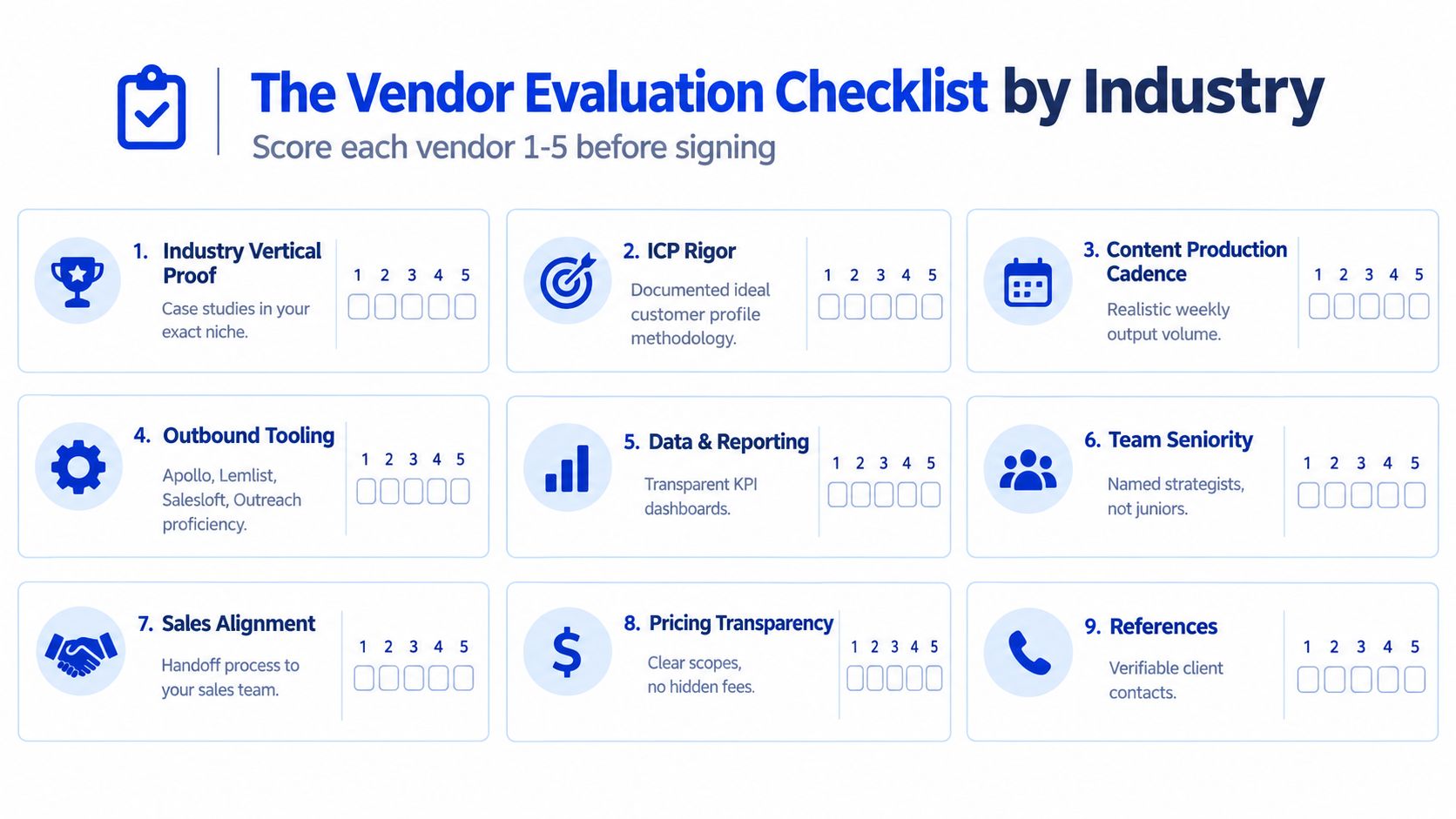
Score every vendor from 1 to 5 across nine criteria. A high total doesn't rescue a fatal weakness in your vertical, attribution model, or sales handoff. Use the score to expose tradeoffs, then apply the industry-specific disqualifiers below.
Score the operating evidence
Industry vertical proof means case studies in your exact niche, with a reference you can call. A vendor that offers logos but can't explain the buying committee, compliance constraints, sales cycle, or failed experiments deserves a low score.
ICP rigor requires a documented method for segmenting accounts, roles, geography, signals, and exclusions. Ask to see a sample account brief with sensitive details removed.
Content production cadence should match the sales motion. Look for editorial ownership, approval rules, repurposing, distribution, and feedback from sales. A large content promise without subject-matter access is a warning.
Outbound tooling should cover the tools your team can support, including Apollo, Lemlist, Salesloft, Outreach, or equivalent systems. Ask who owns sequence logic, data quality, reply handling, and suppression.
Data and reporting means transparent dashboards, CRM fields, source mapping, and definitions for every stage. If the vendor reports meetings without showing account status and opportunity movement, score it down.
Team seniority requires named strategists and direct access to the people making decisions. Don't accept a senior salesperson as the only senior person in the process.
Sales alignment should include qualification rules, calendar routing, handoff notes, rejection reasons, and a feedback loop. Marketing can't improve a campaign if sales marks meetings as bad without context.
IP ownership must cover strategy docs, creative, copy, account research, data enrichments, and working files. Confirm what remains available after termination.
References should include clients with similar complexity, not just the easiest success story. Call them and ask what the vendor did when the first hypothesis failed.
Match the vendor to the industry
SaaS buyers should prioritize PLG-aware ICP frameworks, product-led content systems, and HubSpot or Salesforce-native attribution. The vendor needs to understand the difference between user adoption signals, expansion signals, and an enterprise buying committee.
iGaming operators require regulated-vertical compliance, multi-jurisdiction geo-ICP work, and evidence of affiliate-to-paid crossover. Ask who approves creative, how bonus-cap rules are recorded, and how complaint feedback reaches campaign owners.
Manufacturing firms need industrial content depth, account-based demand programs for long sales cycles, and fluency with CAD and specification assets. A generic technology case study doesn't prove that a vendor can sell into engineering or procurement. The manufacturing marketing companies guide offers a useful comparison point for the depth you should expect.
Legal tech and other professional services firms need thought-leadership ghostwriting, referral-to-outbound pipelines, and Partner-tier LinkedIn execution. The writer must understand the difference between a credible practitioner point of view and generic content marketing.
Disqualifier: A vendor with zero case studies in your vertical that insists its system is “industry-agnostic” isn't a fit, regardless of how polished the deck looks.
A provider can adapt its process across markets. It can't skip the learning curve and charge you as if it already understands your buyers.
Two programs that worked and why
A Series B vertical SaaS company in logistics had reached $14 million ARR but its sales team was working inconsistent segments. The company hired a strategy firm to rebuild the ICP across four buyer personas, then connect content, paid social, and cold outbound through bi-weekly sprints using HubSpot, Lemlist, and Apollo.
Over six months, SQL volume rose from 38 per month to 92 per month, opportunity creation doubled, and cost per opportunity fell by 31%. Those outcomes came from the operating rhythm. Sales stopped working aged leads because the list rules, campaign feedback, and CRM stages were reviewed together.
The firm didn't hand positioning to a content vendor and list building to an SDR vendor. One team owned the account definition, message, channels, and feedback loop.
The iGaming program
A licensed iGaming operator in two regulated markets needed qualified first-time-depositor accounts without creating compliance exposure. The program combined geo-ICP development, compliance-aware creative, paid activity, and outbound, with explicit geography and bonus-cap guardrails.
Over one quarter, qualified first-time-depositor accounts rose 47%, while regulated-market complaint rates stayed flat. The vendor refused to run untested creative and built a feedback loop from CRM outcomes back to copy within 48 hours.
That detail mattered more than the channel mix. The operator could see which message had passed review, which market received it, which account progressed, and which objection required a revision.
What the programs shared
Both programs used one source of truth for ICP. Both measured sprint progress in pipeline and account quality instead of impressions. Both wrote copy in the client's CRM and campaign workflow, not only in a slide deck.
You can review the broader Grou case studies as a reference for the kind of system-level evidence to request from any shortlisted provider. Don't ask only whether results improved. Ask what changed in the list, the message, the routing, the reporting, and the team's weekly behavior.
When not to hire one, and what to do next
A marketing strategy company isn't the answer to every revenue problem. Sometimes the right decision is to keep the budget inside the business until the motion has enough clarity for outside execution to help.
When founder-led sales still works
If annual revenue is below $3 million and the founder still closes deals through direct conversations, a large strategy engagement may create distance from the evidence that matters. The founder usually has the clearest access to objections, urgency, and deal context.
Hiring too early can produce a wasted retainer. You'll pay for a formal engine before the company has documented what the founder already knows. Instead, record calls, extract recurring objections, and create a basic account and message system that a future partner can execute.
When an acquisition has reset the motion
Post-acquisition integration is a poor moment for an outside firm to declare the ICP. Product portfolios, ownership, data, sales territories, and brand rules may still be moving. The main risk is diluted positioning.
A vendor can generate activity while the internal team is still deciding what the combined company sells, to whom, and under which brand. Stabilize the narrative, account ownership, and CRM model first. Then bring in outside execution against decisions your leadership team can defend.
When a rebrand is the real constraint
A rebrand doesn't automatically create demand. If leadership, sales, product, and customer success disagree about the company story, external campaigns will spread that disagreement. The cost becomes a six-month delay to learning because the team keeps changing the message instead of testing the market.
Run internal interviews, settle the category and proof, and define the message hierarchy before paying for broad distribution. A strategy firm can help with market application later, but it can't replace executive alignment.
The decision for this week
Pull last quarter's qualified pipeline by source. Calculate cost per opportunity, separate sourced from influenced pipeline, and mark every opportunity with the account segment, persona, campaign, and owner.
Then shortlist only vendors willing to sign a 90-day diagnostic sprint with a kill clause. Require each one to define your ICP, name three channels, show the first sprint backlog, and specify how attributable pipeline will appear within 30 days.
The buying committee may include a median of 11 stakeholders, according to The Starr Conspiracy's B2B buying committee benchmarks. Another benchmark cited in the same research set says complex B2B purchases often involve 6 to 10 stakeholders. Your vendor must therefore write for an account, not a single contact.
The practical pressure is even greater when a purchase crosses functions. A source summarizing Forrester's business-buying research reports an average of 13 internal stakeholders and 9 external influencers, with nearly 89% of decisions crossing multiple departments as reported in this industry discussion. That means your message needs versions for finance, legal, security, operations, and the commercial owner.
One benchmark states that each additional decision-maker can reduce purchase probability by roughly 10 percentage points in its analysis of engaging every role. Treat that as a reason to multi-thread early, not as a forecast you can apply mechanically to every deal.
Large digital purchases are also changing shape. Forrester predicts that more than half of large B2B transactions above US$1 million will be processed through digital self-serve channels, according to its 2025 B2B marketing and sales predictions. A strategy partner earns its fee when it helps buyers evaluate, compare, and build internal confidence, not when it adds calls to a sequence.
Walk away if the shortlist can't define the ICP, name three channels, and show how attributable pipeline will appear within 30 days. Keep the budget in-house until a vendor can connect the list, message, outbound system, CRM, and sales feedback in one operating cadence.
For global teams deciding whether outside support can reduce execution load, the 2026 CMO Survey reports that 22.3% of marketers lack the people, time, and budget to execute effectively, while 35.7% cite AI-related capability gaps across analytics, demand generation, generative AI, GEO, and bots in its 2026 highlights report. The right partner closes a defined capability gap. It shouldn't sell you more channels than your team can govern.
Grou builds B2B pipeline systems that connect ICP research, LinkedIn content, lead generation, outbound, reply routing, and CRM reporting inside bi-weekly sprints. If your shortlist needs a vendor that can unify list, message, and outbound execution, visit Grou and review the diagnostic approach before signing a longer engagement.
Your pipeline forecast is off, your attribution dashboard disagrees with Salesforce, and three vendor PDFs in your inbox all promise the same “full-funnel growth partner.” You're about to sign a six-figure engagement, but the shortlist tells you almost nothing about how list quality, message-market fit, and outbound execution will work together.
A marketing strategy company should connect the target list, market message, and meeting engine inside one operating system.
Bi-weekly sprints are a better fit than long retainers for teams under 50 people because they expose weak assumptions early.
The right vendor proves its industry fit through process, references, attribution, and execution, not polished positioning.
Some companies should not hire a strategy firm yet. A paid diagnostic and a clear kill clause protect you from buying activity before you have a usable motion.
Table of Contents
The problem with your shortlist right now
Your shortlist probably reflects the wrong category split. One vendor calls itself a demand-generation agency, another sells fractional marketing leadership, and a third presents as an outbound specialist. You're being asked to choose between labels while the actual failure sits between functions.
Pipeline forecasts miss because sales works stale accounts, marketing reports activity from a different source model, and vendors hand work across teams that don't share a current ICP. The category is large enough to support many specialists. The global marketing agencies market was estimated at USD 452.96 billion in 2025 and is projected to reach USD 473.57 billion in 2026 and USD 591.63 billion by 2031, according to Mordor Intelligence's marketing agencies market report. That scale creates choice, but it also gives weak firms room to package disconnected services as strategy.
Practical rule: If the vendor can't show how an account moves from selection to message to booked meeting, you're reviewing deliverables, not a pipeline system.
A marketing strategy company should own three connected primitives:
→ A targeted list built around your ICP, buying signals, geography, exclusions, and account priorities.
→ A message system that connects positioning, pain points, proof, content, ads, and outbound copy.
→ An outbound engine that sequences the right people, routes replies, qualifies demand, and puts suitable meetings on the calendar.
Those primitives need one operating rhythm. I'd expect bi-weekly sprints, a shared workspace, named owners, live feedback from sales, and reporting tied to sourced pipeline rather than impressions. If the list changes in one document, the copy lives in another vendor portal, and the SDR pod follows a third set of rules, the handoff is where your budget disappears.
The market is fragmented, so integration matters
The digital agency sector includes more than 200,000 agencies worldwide and over 71,000 in North America. The same Promethean Research industry report says 87% of North American firms employ fewer than 50 people, while the field has grown at a 12% compound annual growth rate since 2018. Small specialist teams can be excellent. They can also leave you responsible for joining the pieces.
A strategy deck from one firm, a content retainer from another, and a separate SDR pod aren't three parts of one strategy. They're three billing relationships with separate incentives. You'll spend internal time translating positioning into lists, lists into campaigns, and replies into CRM stages.
For a useful baseline on selecting outside support, read these marketing agency for small business tips with one filter in mind: does the advice lead to a connected operating system, or just a broader service menu?
The fit test
Ask every shortlisted vendor to show the first two sprints. You should see the account-selection method, the evidence behind the message, the channels being tested, the CRM fields required, and the decision rule for stopping a weak sequence.
A vendor that sells disconnected deliverables is selling a billing structure, not a strategy firm. The rest of your evaluation should test whether the company can create one source of truth for ICP, message, activity, replies, meetings, and pipeline.
What a marketing strategy company actually does
The useful version of strategy runs in execution order. Positioning informs the ICP. The ICP shapes content and paid audiences. Content supplies proof for outbound. Outbound replies expose objections that should feed the next content and messaging sprint.
That sequence matters because each layer changes the next one. A vendor that starts with twelve blog posts before checking the buyer list is producing inventory. A vendor that builds a list without a clear reason for those accounts to care is producing activity.
Start with positioning, not channel selection
Use April Dunford's logic from Obviously Awesome as a working discipline. Identify the alternatives buyers compare, the differentiated capabilities you can prove, the value those capabilities create, and the customers who care most about them.
Your output should be a short positioning system, not a 70-page brand document. It needs a category frame, a competitive contrast, proof points, objections, and message variants for the people who influence the deal. For SaaS, that may mean separating economic-buyer language from operational-user language. For manufacturing, the message may need to account for engineering, procurement, and plant leadership.
Build the account list with evidence
Apollo and ZoomInfo can supply company and contact data. Clay can enrich records, apply conditions, identify signals, and prepare fields for personalization. The tool isn't the strategy. Your vendor should explain why an account belongs in the list, which persona matters, and what event makes outreach timely.
A useful list includes exclusion logic. Remove customers with a poor fit, companies outside serviceable geographies, contacts without buying influence, and accounts already in an active sales cycle. Your CRM should record the reason for inclusion, not just the contact's title.
Turn pain points into content and SEO
Content should answer the questions that appear before a sales conversation. Group topics around pain-point clusters, objections, proof, implementation risk, and commercial outcomes. Connect each asset to an account segment and a sales use case.
That may produce search pages, founder-led LinkedIn posts, comparison content, customer proof, sales enablement pages, and retargeting audiences. The data-driven digital marketing agency framework is useful here because it treats content and measurement as connected work rather than separate production lines.
Personal distribution matters in B2B. One benchmark reports 63% higher engagement on personal LinkedIn profiles than company pages, as documented by Oktopost's B2B social media statistics. Your executive and SDR profiles should carry the point of view, while the company page stores proof and supports consistency.
Add paid loops after the message has proof
Google captures existing intent. LinkedIn gives you account and role-based targeting. Retargeting keeps your message present after a site visit or content interaction. Those channels work better when the vendor can connect audience definitions, landing pages, creative, CRM stages, and sales follow-up.
Don't approve paid media because a proposal contains a budget line. Ask which message is being tested, which audience receives it, what action counts as useful, and where the resulting account appears in the CRM.
Make outbound part of the same engine
Instantly or Smartlead can run email sequences. Lemlist supports personalization workflows. Reply, Outreach, or a comparable sales engagement platform can manage tasks and calling. Chili Piper can route booked meetings to the right calendar and reduce scheduling friction.
The sequence should reflect the account's problem and buying context. One generic campaign won't work across iGaming, SaaS, manufacturing, legal tech, and pharma. A tight segment, relevant first line, and multi-touch follow-up matter more than raw send volume. One benchmark places average B2B cold email reply rates around 4–5%, while tightly segmented campaigns can reach 10–20% replies, according to Rework's outbound lead generation benchmarks. The same source reports cold-call dial-to-meeting conversion around 2.3%, with roughly 8 attempts needed to reach a prospect.
The handoff between these layers is the product. If the vendor can't explain how a reply changes the list, the message, and the next sprint, keep interviewing.
Engagement models and what each one really delivers
The sprint model wins for teams under 50 people. It forces a working system within a defined period, creates regular decision points, and limits the damage from a bad fit. Project work can establish the foundation. Retainers can support a mature engine. Most smaller teams shouldn't begin with an open-ended commitment.
Project-based work
A project usually has a fixed scope and a delivery window of roughly 60 to 90 days. In practice, you'll receive a positioning document, ICP research, a channel plan, campaign concepts, and perhaps a set of content or outbound assets.
That can be valuable when your internal team has the capacity to execute. It becomes expensive documentation when nobody owns list maintenance, campaign iteration, sales feedback, or attribution after the final workshop.
Retainers create continuity, but can hide idle capacity
A retainer commonly uses a 12-month MSA and reserves weekly hours by channel. Mid-market proposals often quote $8,000 to $25,000 per month for this structure, based on the engagement bands used by the firms evaluated in this category.
The practical output may include a fixed number of content pieces, campaign management, recurring meetings, and a monthly report. Ask how many senior hours you receive, what happens when a campaign underperforms, and whether unused capacity rolls forward. A retainer with no decision gates can continue while the core hypothesis remains untested.
Sprints force decisions
A sprint can run for 30 or 60 days, with a defined outcome and a bi-weekly delivery cadence. A typical proposal may price a sprint at approximately $15,000, but the exact scope matters more than the headline figure.
For a VP of Marketing, a useful cadence looks like this:
→ Weekly Slack standup focused on blockers and decisions.
→ Bi-weekly sprint review covering list quality, message response, meetings, and pipeline movement.
→ Monthly pipeline report with sourced numbers and source mapping.
→ Quarterly board-ready readout showing what changed, what stopped, and what the next investment should fund.
Model | Typical price band | Deliverables | Cadence | Best for |
|---|---|---|---|---|
Project | Fixed scope | Positioning, ICP research, channel plan, initial assets | Milestones across 60 to 90 days | Teams that can execute internally |
Retainer | $8,000 to $25,000 per month for mid-market work | Ongoing channel support, content, campaign management, reporting | Weekly delivery with monthly reporting | Mature teams with stable workflows |
Sprint | Approximately $15,000 per sprint | Tested list, message, campaigns, routing, and decisions for the next cycle | Bi-weekly reviews | Teams under 50 people validating a system |
The most useful companion to this comparison is a practical guide to outsourcing lead generation, especially when you need to separate vendor capacity from actual pipeline ownership.
Read the scope-change clause carefully
The clause that determines whether an engagement scales is scope change protocol. Your market may reveal a different buyer, a compliance issue may block a channel, or sales may reject the first list. The contract should state how those changes are assessed, priced, approved, and reflected in the sprint backlog.
Without that clause, every necessary correction becomes a dispute. With it, the team can change direction without pretending the original assumptions were correct.
Pricing models and contract terms that protect you
Pricing tells you how risk is assigned. A fixed retainer puts delivery risk on you. A performance tier can create pressure to claim influence. A hybrid can align incentives, but only if the CRM and attribution rules are agreed before launch.
The three structures you'll see
Monthly retainers commonly sit around $8,000 to $25,000 for SMB, $30,000 to $80,000 for mid-market, and $100,000 or more for enterprise. Performance tiers may add 8–15% of influenced pipeline, while hybrid structures often combine a $12,000 to $20,000 base with a per-SQL or per-opportunity fee.
Those figures are useful for budget framing, not vendor selection. A low fee attached to weak list work is still expensive. A higher fee can make sense when the firm owns senior strategy, execution, reporting, and iteration in one motion.
Model | SMB (<$10M ARR) | Mid-market ($10M-$100M) | Enterprise ($100M+) |
|---|---|---|---|
Monthly retainer | $8,000 to $25,000 | $30,000 to $80,000 | $100,000+ |
Performance tier | Per-SQL or per-opportunity terms | 8–15% of influenced pipeline | Negotiated against account and attribution scope |
Hybrid | $12,000 to $20,000 base plus kicker | Base plus success fee | Base, program fees, and negotiated success terms |
For a deeper view of how firms package outbound work, compare the assumptions in these outbound agency pricing models with the actual scope in your proposal.
Put buyer protection into the agreement
Insist on a 90-day pilot with a kill clause. Require bi-weekly sprint reporting tied to named metrics, not a presentation about activity. Strategy documents, creative, copy, and working files should revert to you when the contract ends.
Cap subcontracted hours and name the people responsible for the work. Your agreement should define the attribution path as MQL → SQL → Opportunity → Closed-Won, with source mapping, timestamp rules, account ownership, and treatment of influenced versus sourced pipeline.
A paid 30-day diagnostic is the cleanest first step. It lets the firm inspect your CRM, list, messaging, channels, and handoffs before either side commits to a longer operating relationship.
Reject these clauses
Auto-renewal with 60-day cancellation: This can trap you past the point of useful learning.
Broad indemnity for opinion-based strategy: The vendor shouldn't shift ordinary positioning risk onto you.
Vendor-side approval of attribution: You need shared rules, not a scorecard controlled by the party being measured.
Lock-in on tool licenses: Your campaigns and data shouldn't disappear when the engagement ends.
A contract that protects the buyer makes disagreement easier to resolve. That's a sign of operational maturity, not a lack of trust.
The vendor evaluation checklist by industry
Score every vendor from 1 to 5 across nine criteria. A high total doesn't rescue a fatal weakness in your vertical, attribution model, or sales handoff. Use the score to expose tradeoffs, then apply the industry-specific disqualifiers below.
Score the operating evidence
Industry vertical proof means case studies in your exact niche, with a reference you can call. A vendor that offers logos but can't explain the buying committee, compliance constraints, sales cycle, or failed experiments deserves a low score.
ICP rigor requires a documented method for segmenting accounts, roles, geography, signals, and exclusions. Ask to see a sample account brief with sensitive details removed.
Content production cadence should match the sales motion. Look for editorial ownership, approval rules, repurposing, distribution, and feedback from sales. A large content promise without subject-matter access is a warning.
Outbound tooling should cover the tools your team can support, including Apollo, Lemlist, Salesloft, Outreach, or equivalent systems. Ask who owns sequence logic, data quality, reply handling, and suppression.
Data and reporting means transparent dashboards, CRM fields, source mapping, and definitions for every stage. If the vendor reports meetings without showing account status and opportunity movement, score it down.
Team seniority requires named strategists and direct access to the people making decisions. Don't accept a senior salesperson as the only senior person in the process.
Sales alignment should include qualification rules, calendar routing, handoff notes, rejection reasons, and a feedback loop. Marketing can't improve a campaign if sales marks meetings as bad without context.
IP ownership must cover strategy docs, creative, copy, account research, data enrichments, and working files. Confirm what remains available after termination.
References should include clients with similar complexity, not just the easiest success story. Call them and ask what the vendor did when the first hypothesis failed.
Match the vendor to the industry
SaaS buyers should prioritize PLG-aware ICP frameworks, product-led content systems, and HubSpot or Salesforce-native attribution. The vendor needs to understand the difference between user adoption signals, expansion signals, and an enterprise buying committee.
iGaming operators require regulated-vertical compliance, multi-jurisdiction geo-ICP work, and evidence of affiliate-to-paid crossover. Ask who approves creative, how bonus-cap rules are recorded, and how complaint feedback reaches campaign owners.
Manufacturing firms need industrial content depth, account-based demand programs for long sales cycles, and fluency with CAD and specification assets. A generic technology case study doesn't prove that a vendor can sell into engineering or procurement. The manufacturing marketing companies guide offers a useful comparison point for the depth you should expect.
Legal tech and other professional services firms need thought-leadership ghostwriting, referral-to-outbound pipelines, and Partner-tier LinkedIn execution. The writer must understand the difference between a credible practitioner point of view and generic content marketing.
Disqualifier: A vendor with zero case studies in your vertical that insists its system is “industry-agnostic” isn't a fit, regardless of how polished the deck looks.
A provider can adapt its process across markets. It can't skip the learning curve and charge you as if it already understands your buyers.
Two programs that worked and why
A Series B vertical SaaS company in logistics had reached $14 million ARR but its sales team was working inconsistent segments. The company hired a strategy firm to rebuild the ICP across four buyer personas, then connect content, paid social, and cold outbound through bi-weekly sprints using HubSpot, Lemlist, and Apollo.
Over six months, SQL volume rose from 38 per month to 92 per month, opportunity creation doubled, and cost per opportunity fell by 31%. Those outcomes came from the operating rhythm. Sales stopped working aged leads because the list rules, campaign feedback, and CRM stages were reviewed together.
The firm didn't hand positioning to a content vendor and list building to an SDR vendor. One team owned the account definition, message, channels, and feedback loop.
The iGaming program
A licensed iGaming operator in two regulated markets needed qualified first-time-depositor accounts without creating compliance exposure. The program combined geo-ICP development, compliance-aware creative, paid activity, and outbound, with explicit geography and bonus-cap guardrails.
Over one quarter, qualified first-time-depositor accounts rose 47%, while regulated-market complaint rates stayed flat. The vendor refused to run untested creative and built a feedback loop from CRM outcomes back to copy within 48 hours.
That detail mattered more than the channel mix. The operator could see which message had passed review, which market received it, which account progressed, and which objection required a revision.
What the programs shared
Both programs used one source of truth for ICP. Both measured sprint progress in pipeline and account quality instead of impressions. Both wrote copy in the client's CRM and campaign workflow, not only in a slide deck.
You can review the broader Grou case studies as a reference for the kind of system-level evidence to request from any shortlisted provider. Don't ask only whether results improved. Ask what changed in the list, the message, the routing, the reporting, and the team's weekly behavior.
When not to hire one, and what to do next
A marketing strategy company isn't the answer to every revenue problem. Sometimes the right decision is to keep the budget inside the business until the motion has enough clarity for outside execution to help.
When founder-led sales still works
If annual revenue is below $3 million and the founder still closes deals through direct conversations, a large strategy engagement may create distance from the evidence that matters. The founder usually has the clearest access to objections, urgency, and deal context.
Hiring too early can produce a wasted retainer. You'll pay for a formal engine before the company has documented what the founder already knows. Instead, record calls, extract recurring objections, and create a basic account and message system that a future partner can execute.
When an acquisition has reset the motion
Post-acquisition integration is a poor moment for an outside firm to declare the ICP. Product portfolios, ownership, data, sales territories, and brand rules may still be moving. The main risk is diluted positioning.
A vendor can generate activity while the internal team is still deciding what the combined company sells, to whom, and under which brand. Stabilize the narrative, account ownership, and CRM model first. Then bring in outside execution against decisions your leadership team can defend.
When a rebrand is the real constraint
A rebrand doesn't automatically create demand. If leadership, sales, product, and customer success disagree about the company story, external campaigns will spread that disagreement. The cost becomes a six-month delay to learning because the team keeps changing the message instead of testing the market.
Run internal interviews, settle the category and proof, and define the message hierarchy before paying for broad distribution. A strategy firm can help with market application later, but it can't replace executive alignment.
The decision for this week
Pull last quarter's qualified pipeline by source. Calculate cost per opportunity, separate sourced from influenced pipeline, and mark every opportunity with the account segment, persona, campaign, and owner.
Then shortlist only vendors willing to sign a 90-day diagnostic sprint with a kill clause. Require each one to define your ICP, name three channels, show the first sprint backlog, and specify how attributable pipeline will appear within 30 days.
The buying committee may include a median of 11 stakeholders, according to The Starr Conspiracy's B2B buying committee benchmarks. Another benchmark cited in the same research set says complex B2B purchases often involve 6 to 10 stakeholders. Your vendor must therefore write for an account, not a single contact.
The practical pressure is even greater when a purchase crosses functions. A source summarizing Forrester's business-buying research reports an average of 13 internal stakeholders and 9 external influencers, with nearly 89% of decisions crossing multiple departments as reported in this industry discussion. That means your message needs versions for finance, legal, security, operations, and the commercial owner.
One benchmark states that each additional decision-maker can reduce purchase probability by roughly 10 percentage points in its analysis of engaging every role. Treat that as a reason to multi-thread early, not as a forecast you can apply mechanically to every deal.
Large digital purchases are also changing shape. Forrester predicts that more than half of large B2B transactions above US$1 million will be processed through digital self-serve channels, according to its 2025 B2B marketing and sales predictions. A strategy partner earns its fee when it helps buyers evaluate, compare, and build internal confidence, not when it adds calls to a sequence.
Walk away if the shortlist can't define the ICP, name three channels, and show how attributable pipeline will appear within 30 days. Keep the budget in-house until a vendor can connect the list, message, outbound system, CRM, and sales feedback in one operating cadence.
For global teams deciding whether outside support can reduce execution load, the 2026 CMO Survey reports that 22.3% of marketers lack the people, time, and budget to execute effectively, while 35.7% cite AI-related capability gaps across analytics, demand generation, generative AI, GEO, and bots in its 2026 highlights report. The right partner closes a defined capability gap. It shouldn't sell you more channels than your team can govern.
Grou builds B2B pipeline systems that connect ICP research, LinkedIn content, lead generation, outbound, reply routing, and CRM reporting inside bi-weekly sprints. If your shortlist needs a vendor that can unify list, message, and outbound execution, visit Grou and review the diagnostic approach before signing a longer engagement.
Your pipeline forecast is off, your attribution dashboard disagrees with Salesforce, and three vendor PDFs in your inbox all promise the same “full-funnel growth partner.” You're about to sign a six-figure engagement, but the shortlist tells you almost nothing about how list quality, message-market fit, and outbound execution will work together.
A marketing strategy company should connect the target list, market message, and meeting engine inside one operating system.
Bi-weekly sprints are a better fit than long retainers for teams under 50 people because they expose weak assumptions early.
The right vendor proves its industry fit through process, references, attribution, and execution, not polished positioning.
Some companies should not hire a strategy firm yet. A paid diagnostic and a clear kill clause protect you from buying activity before you have a usable motion.
Table of Contents
The problem with your shortlist right now
Your shortlist probably reflects the wrong category split. One vendor calls itself a demand-generation agency, another sells fractional marketing leadership, and a third presents as an outbound specialist. You're being asked to choose between labels while the actual failure sits between functions.
Pipeline forecasts miss because sales works stale accounts, marketing reports activity from a different source model, and vendors hand work across teams that don't share a current ICP. The category is large enough to support many specialists. The global marketing agencies market was estimated at USD 452.96 billion in 2025 and is projected to reach USD 473.57 billion in 2026 and USD 591.63 billion by 2031, according to Mordor Intelligence's marketing agencies market report. That scale creates choice, but it also gives weak firms room to package disconnected services as strategy.
Practical rule: If the vendor can't show how an account moves from selection to message to booked meeting, you're reviewing deliverables, not a pipeline system.
A marketing strategy company should own three connected primitives:
→ A targeted list built around your ICP, buying signals, geography, exclusions, and account priorities.
→ A message system that connects positioning, pain points, proof, content, ads, and outbound copy.
→ An outbound engine that sequences the right people, routes replies, qualifies demand, and puts suitable meetings on the calendar.
Those primitives need one operating rhythm. I'd expect bi-weekly sprints, a shared workspace, named owners, live feedback from sales, and reporting tied to sourced pipeline rather than impressions. If the list changes in one document, the copy lives in another vendor portal, and the SDR pod follows a third set of rules, the handoff is where your budget disappears.
The market is fragmented, so integration matters
The digital agency sector includes more than 200,000 agencies worldwide and over 71,000 in North America. The same Promethean Research industry report says 87% of North American firms employ fewer than 50 people, while the field has grown at a 12% compound annual growth rate since 2018. Small specialist teams can be excellent. They can also leave you responsible for joining the pieces.
A strategy deck from one firm, a content retainer from another, and a separate SDR pod aren't three parts of one strategy. They're three billing relationships with separate incentives. You'll spend internal time translating positioning into lists, lists into campaigns, and replies into CRM stages.
For a useful baseline on selecting outside support, read these marketing agency for small business tips with one filter in mind: does the advice lead to a connected operating system, or just a broader service menu?
The fit test
Ask every shortlisted vendor to show the first two sprints. You should see the account-selection method, the evidence behind the message, the channels being tested, the CRM fields required, and the decision rule for stopping a weak sequence.
A vendor that sells disconnected deliverables is selling a billing structure, not a strategy firm. The rest of your evaluation should test whether the company can create one source of truth for ICP, message, activity, replies, meetings, and pipeline.
What a marketing strategy company actually does
The useful version of strategy runs in execution order. Positioning informs the ICP. The ICP shapes content and paid audiences. Content supplies proof for outbound. Outbound replies expose objections that should feed the next content and messaging sprint.
That sequence matters because each layer changes the next one. A vendor that starts with twelve blog posts before checking the buyer list is producing inventory. A vendor that builds a list without a clear reason for those accounts to care is producing activity.
Start with positioning, not channel selection
Use April Dunford's logic from Obviously Awesome as a working discipline. Identify the alternatives buyers compare, the differentiated capabilities you can prove, the value those capabilities create, and the customers who care most about them.
Your output should be a short positioning system, not a 70-page brand document. It needs a category frame, a competitive contrast, proof points, objections, and message variants for the people who influence the deal. For SaaS, that may mean separating economic-buyer language from operational-user language. For manufacturing, the message may need to account for engineering, procurement, and plant leadership.
Build the account list with evidence
Apollo and ZoomInfo can supply company and contact data. Clay can enrich records, apply conditions, identify signals, and prepare fields for personalization. The tool isn't the strategy. Your vendor should explain why an account belongs in the list, which persona matters, and what event makes outreach timely.
A useful list includes exclusion logic. Remove customers with a poor fit, companies outside serviceable geographies, contacts without buying influence, and accounts already in an active sales cycle. Your CRM should record the reason for inclusion, not just the contact's title.
Turn pain points into content and SEO
Content should answer the questions that appear before a sales conversation. Group topics around pain-point clusters, objections, proof, implementation risk, and commercial outcomes. Connect each asset to an account segment and a sales use case.
That may produce search pages, founder-led LinkedIn posts, comparison content, customer proof, sales enablement pages, and retargeting audiences. The data-driven digital marketing agency framework is useful here because it treats content and measurement as connected work rather than separate production lines.
Personal distribution matters in B2B. One benchmark reports 63% higher engagement on personal LinkedIn profiles than company pages, as documented by Oktopost's B2B social media statistics. Your executive and SDR profiles should carry the point of view, while the company page stores proof and supports consistency.
Add paid loops after the message has proof
Google captures existing intent. LinkedIn gives you account and role-based targeting. Retargeting keeps your message present after a site visit or content interaction. Those channels work better when the vendor can connect audience definitions, landing pages, creative, CRM stages, and sales follow-up.
Don't approve paid media because a proposal contains a budget line. Ask which message is being tested, which audience receives it, what action counts as useful, and where the resulting account appears in the CRM.
Make outbound part of the same engine
Instantly or Smartlead can run email sequences. Lemlist supports personalization workflows. Reply, Outreach, or a comparable sales engagement platform can manage tasks and calling. Chili Piper can route booked meetings to the right calendar and reduce scheduling friction.
The sequence should reflect the account's problem and buying context. One generic campaign won't work across iGaming, SaaS, manufacturing, legal tech, and pharma. A tight segment, relevant first line, and multi-touch follow-up matter more than raw send volume. One benchmark places average B2B cold email reply rates around 4–5%, while tightly segmented campaigns can reach 10–20% replies, according to Rework's outbound lead generation benchmarks. The same source reports cold-call dial-to-meeting conversion around 2.3%, with roughly 8 attempts needed to reach a prospect.
The handoff between these layers is the product. If the vendor can't explain how a reply changes the list, the message, and the next sprint, keep interviewing.
Engagement models and what each one really delivers
The sprint model wins for teams under 50 people. It forces a working system within a defined period, creates regular decision points, and limits the damage from a bad fit. Project work can establish the foundation. Retainers can support a mature engine. Most smaller teams shouldn't begin with an open-ended commitment.
Project-based work
A project usually has a fixed scope and a delivery window of roughly 60 to 90 days. In practice, you'll receive a positioning document, ICP research, a channel plan, campaign concepts, and perhaps a set of content or outbound assets.
That can be valuable when your internal team has the capacity to execute. It becomes expensive documentation when nobody owns list maintenance, campaign iteration, sales feedback, or attribution after the final workshop.
Retainers create continuity, but can hide idle capacity
A retainer commonly uses a 12-month MSA and reserves weekly hours by channel. Mid-market proposals often quote $8,000 to $25,000 per month for this structure, based on the engagement bands used by the firms evaluated in this category.
The practical output may include a fixed number of content pieces, campaign management, recurring meetings, and a monthly report. Ask how many senior hours you receive, what happens when a campaign underperforms, and whether unused capacity rolls forward. A retainer with no decision gates can continue while the core hypothesis remains untested.
Sprints force decisions
A sprint can run for 30 or 60 days, with a defined outcome and a bi-weekly delivery cadence. A typical proposal may price a sprint at approximately $15,000, but the exact scope matters more than the headline figure.
For a VP of Marketing, a useful cadence looks like this:
→ Weekly Slack standup focused on blockers and decisions.
→ Bi-weekly sprint review covering list quality, message response, meetings, and pipeline movement.
→ Monthly pipeline report with sourced numbers and source mapping.
→ Quarterly board-ready readout showing what changed, what stopped, and what the next investment should fund.
Model | Typical price band | Deliverables | Cadence | Best for |
|---|---|---|---|---|
Project | Fixed scope | Positioning, ICP research, channel plan, initial assets | Milestones across 60 to 90 days | Teams that can execute internally |
Retainer | $8,000 to $25,000 per month for mid-market work | Ongoing channel support, content, campaign management, reporting | Weekly delivery with monthly reporting | Mature teams with stable workflows |
Sprint | Approximately $15,000 per sprint | Tested list, message, campaigns, routing, and decisions for the next cycle | Bi-weekly reviews | Teams under 50 people validating a system |
The most useful companion to this comparison is a practical guide to outsourcing lead generation, especially when you need to separate vendor capacity from actual pipeline ownership.
Read the scope-change clause carefully
The clause that determines whether an engagement scales is scope change protocol. Your market may reveal a different buyer, a compliance issue may block a channel, or sales may reject the first list. The contract should state how those changes are assessed, priced, approved, and reflected in the sprint backlog.
Without that clause, every necessary correction becomes a dispute. With it, the team can change direction without pretending the original assumptions were correct.
Pricing models and contract terms that protect you
Pricing tells you how risk is assigned. A fixed retainer puts delivery risk on you. A performance tier can create pressure to claim influence. A hybrid can align incentives, but only if the CRM and attribution rules are agreed before launch.
The three structures you'll see
Monthly retainers commonly sit around $8,000 to $25,000 for SMB, $30,000 to $80,000 for mid-market, and $100,000 or more for enterprise. Performance tiers may add 8–15% of influenced pipeline, while hybrid structures often combine a $12,000 to $20,000 base with a per-SQL or per-opportunity fee.
Those figures are useful for budget framing, not vendor selection. A low fee attached to weak list work is still expensive. A higher fee can make sense when the firm owns senior strategy, execution, reporting, and iteration in one motion.
Model | SMB (<$10M ARR) | Mid-market ($10M-$100M) | Enterprise ($100M+) |
|---|---|---|---|
Monthly retainer | $8,000 to $25,000 | $30,000 to $80,000 | $100,000+ |
Performance tier | Per-SQL or per-opportunity terms | 8–15% of influenced pipeline | Negotiated against account and attribution scope |
Hybrid | $12,000 to $20,000 base plus kicker | Base plus success fee | Base, program fees, and negotiated success terms |
For a deeper view of how firms package outbound work, compare the assumptions in these outbound agency pricing models with the actual scope in your proposal.
Put buyer protection into the agreement
Insist on a 90-day pilot with a kill clause. Require bi-weekly sprint reporting tied to named metrics, not a presentation about activity. Strategy documents, creative, copy, and working files should revert to you when the contract ends.
Cap subcontracted hours and name the people responsible for the work. Your agreement should define the attribution path as MQL → SQL → Opportunity → Closed-Won, with source mapping, timestamp rules, account ownership, and treatment of influenced versus sourced pipeline.
A paid 30-day diagnostic is the cleanest first step. It lets the firm inspect your CRM, list, messaging, channels, and handoffs before either side commits to a longer operating relationship.
Reject these clauses
Auto-renewal with 60-day cancellation: This can trap you past the point of useful learning.
Broad indemnity for opinion-based strategy: The vendor shouldn't shift ordinary positioning risk onto you.
Vendor-side approval of attribution: You need shared rules, not a scorecard controlled by the party being measured.
Lock-in on tool licenses: Your campaigns and data shouldn't disappear when the engagement ends.
A contract that protects the buyer makes disagreement easier to resolve. That's a sign of operational maturity, not a lack of trust.
The vendor evaluation checklist by industry
Score every vendor from 1 to 5 across nine criteria. A high total doesn't rescue a fatal weakness in your vertical, attribution model, or sales handoff. Use the score to expose tradeoffs, then apply the industry-specific disqualifiers below.
Score the operating evidence
Industry vertical proof means case studies in your exact niche, with a reference you can call. A vendor that offers logos but can't explain the buying committee, compliance constraints, sales cycle, or failed experiments deserves a low score.
ICP rigor requires a documented method for segmenting accounts, roles, geography, signals, and exclusions. Ask to see a sample account brief with sensitive details removed.
Content production cadence should match the sales motion. Look for editorial ownership, approval rules, repurposing, distribution, and feedback from sales. A large content promise without subject-matter access is a warning.
Outbound tooling should cover the tools your team can support, including Apollo, Lemlist, Salesloft, Outreach, or equivalent systems. Ask who owns sequence logic, data quality, reply handling, and suppression.
Data and reporting means transparent dashboards, CRM fields, source mapping, and definitions for every stage. If the vendor reports meetings without showing account status and opportunity movement, score it down.
Team seniority requires named strategists and direct access to the people making decisions. Don't accept a senior salesperson as the only senior person in the process.
Sales alignment should include qualification rules, calendar routing, handoff notes, rejection reasons, and a feedback loop. Marketing can't improve a campaign if sales marks meetings as bad without context.
IP ownership must cover strategy docs, creative, copy, account research, data enrichments, and working files. Confirm what remains available after termination.
References should include clients with similar complexity, not just the easiest success story. Call them and ask what the vendor did when the first hypothesis failed.
Match the vendor to the industry
SaaS buyers should prioritize PLG-aware ICP frameworks, product-led content systems, and HubSpot or Salesforce-native attribution. The vendor needs to understand the difference between user adoption signals, expansion signals, and an enterprise buying committee.
iGaming operators require regulated-vertical compliance, multi-jurisdiction geo-ICP work, and evidence of affiliate-to-paid crossover. Ask who approves creative, how bonus-cap rules are recorded, and how complaint feedback reaches campaign owners.
Manufacturing firms need industrial content depth, account-based demand programs for long sales cycles, and fluency with CAD and specification assets. A generic technology case study doesn't prove that a vendor can sell into engineering or procurement. The manufacturing marketing companies guide offers a useful comparison point for the depth you should expect.
Legal tech and other professional services firms need thought-leadership ghostwriting, referral-to-outbound pipelines, and Partner-tier LinkedIn execution. The writer must understand the difference between a credible practitioner point of view and generic content marketing.
Disqualifier: A vendor with zero case studies in your vertical that insists its system is “industry-agnostic” isn't a fit, regardless of how polished the deck looks.
A provider can adapt its process across markets. It can't skip the learning curve and charge you as if it already understands your buyers.
Two programs that worked and why
A Series B vertical SaaS company in logistics had reached $14 million ARR but its sales team was working inconsistent segments. The company hired a strategy firm to rebuild the ICP across four buyer personas, then connect content, paid social, and cold outbound through bi-weekly sprints using HubSpot, Lemlist, and Apollo.
Over six months, SQL volume rose from 38 per month to 92 per month, opportunity creation doubled, and cost per opportunity fell by 31%. Those outcomes came from the operating rhythm. Sales stopped working aged leads because the list rules, campaign feedback, and CRM stages were reviewed together.
The firm didn't hand positioning to a content vendor and list building to an SDR vendor. One team owned the account definition, message, channels, and feedback loop.
The iGaming program
A licensed iGaming operator in two regulated markets needed qualified first-time-depositor accounts without creating compliance exposure. The program combined geo-ICP development, compliance-aware creative, paid activity, and outbound, with explicit geography and bonus-cap guardrails.
Over one quarter, qualified first-time-depositor accounts rose 47%, while regulated-market complaint rates stayed flat. The vendor refused to run untested creative and built a feedback loop from CRM outcomes back to copy within 48 hours.
That detail mattered more than the channel mix. The operator could see which message had passed review, which market received it, which account progressed, and which objection required a revision.
What the programs shared
Both programs used one source of truth for ICP. Both measured sprint progress in pipeline and account quality instead of impressions. Both wrote copy in the client's CRM and campaign workflow, not only in a slide deck.
You can review the broader Grou case studies as a reference for the kind of system-level evidence to request from any shortlisted provider. Don't ask only whether results improved. Ask what changed in the list, the message, the routing, the reporting, and the team's weekly behavior.
When not to hire one, and what to do next
A marketing strategy company isn't the answer to every revenue problem. Sometimes the right decision is to keep the budget inside the business until the motion has enough clarity for outside execution to help.
When founder-led sales still works
If annual revenue is below $3 million and the founder still closes deals through direct conversations, a large strategy engagement may create distance from the evidence that matters. The founder usually has the clearest access to objections, urgency, and deal context.
Hiring too early can produce a wasted retainer. You'll pay for a formal engine before the company has documented what the founder already knows. Instead, record calls, extract recurring objections, and create a basic account and message system that a future partner can execute.
When an acquisition has reset the motion
Post-acquisition integration is a poor moment for an outside firm to declare the ICP. Product portfolios, ownership, data, sales territories, and brand rules may still be moving. The main risk is diluted positioning.
A vendor can generate activity while the internal team is still deciding what the combined company sells, to whom, and under which brand. Stabilize the narrative, account ownership, and CRM model first. Then bring in outside execution against decisions your leadership team can defend.
When a rebrand is the real constraint
A rebrand doesn't automatically create demand. If leadership, sales, product, and customer success disagree about the company story, external campaigns will spread that disagreement. The cost becomes a six-month delay to learning because the team keeps changing the message instead of testing the market.
Run internal interviews, settle the category and proof, and define the message hierarchy before paying for broad distribution. A strategy firm can help with market application later, but it can't replace executive alignment.
The decision for this week
Pull last quarter's qualified pipeline by source. Calculate cost per opportunity, separate sourced from influenced pipeline, and mark every opportunity with the account segment, persona, campaign, and owner.
Then shortlist only vendors willing to sign a 90-day diagnostic sprint with a kill clause. Require each one to define your ICP, name three channels, show the first sprint backlog, and specify how attributable pipeline will appear within 30 days.
The buying committee may include a median of 11 stakeholders, according to The Starr Conspiracy's B2B buying committee benchmarks. Another benchmark cited in the same research set says complex B2B purchases often involve 6 to 10 stakeholders. Your vendor must therefore write for an account, not a single contact.
The practical pressure is even greater when a purchase crosses functions. A source summarizing Forrester's business-buying research reports an average of 13 internal stakeholders and 9 external influencers, with nearly 89% of decisions crossing multiple departments as reported in this industry discussion. That means your message needs versions for finance, legal, security, operations, and the commercial owner.
One benchmark states that each additional decision-maker can reduce purchase probability by roughly 10 percentage points in its analysis of engaging every role. Treat that as a reason to multi-thread early, not as a forecast you can apply mechanically to every deal.
Large digital purchases are also changing shape. Forrester predicts that more than half of large B2B transactions above US$1 million will be processed through digital self-serve channels, according to its 2025 B2B marketing and sales predictions. A strategy partner earns its fee when it helps buyers evaluate, compare, and build internal confidence, not when it adds calls to a sequence.
Walk away if the shortlist can't define the ICP, name three channels, and show how attributable pipeline will appear within 30 days. Keep the budget in-house until a vendor can connect the list, message, outbound system, CRM, and sales feedback in one operating cadence.
For global teams deciding whether outside support can reduce execution load, the 2026 CMO Survey reports that 22.3% of marketers lack the people, time, and budget to execute effectively, while 35.7% cite AI-related capability gaps across analytics, demand generation, generative AI, GEO, and bots in its 2026 highlights report. The right partner closes a defined capability gap. It shouldn't sell you more channels than your team can govern.
Grou builds B2B pipeline systems that connect ICP research, LinkedIn content, lead generation, outbound, reply routing, and CRM reporting inside bi-weekly sprints. If your shortlist needs a vendor that can unify list, message, and outbound execution, visit Grou and review the diagnostic approach before signing a longer engagement.
Pipeline OS Newsletter
Build qualified pipeline
Get weekly tactics to generate demand, improve lead quality, and book more meetings.





Trusted by industry leaders
Trusted by industry leaders
Trusted by industry leaders
Ready to build qualified pipeline?
Ready to build qualified pipeline?
Ready to build qualified pipeline?
Book a call to see if we're the right fit, or take the 2-minute quiz to get a clear starting point.
Book a call to see if we're the right fit, or take the 2-minute quiz to get a clear starting point.
Book a call to see if we're the right fit, or take the 2-minute quiz to get a clear starting point.
" height="30.21639343089746px" id="hfGbXmQR2" width="30.216393430897455px"/></svg>)
Copyright © 2026 – All Right Reserved
Copyright © 2026 – All Right Reserved
Copyright © 2026 – All Right Reserved