%22%3E%3C/path%3E%3Cpath d=%22M 63.072 7.554 C 62.258 8.022 61.577 8.689 61.092 9.493 L 61.092 7.076 L 57.158 7.076 L 57.158 22.64 L 61.089 22.64 L 61.089 14.888 C 61.089 13.446 61.403 12.434 62.03 11.853 C 62.818 11.218 63.818 10.907 64.826 10.982 L 65.868 10.982 L 65.868 6.851 C 64.891 6.834 63.926 7.076 63.073 7.554 Z%22 fill=%22rgb(17,17,17)%22%3E%3C/path%3E%3Cpath d=%22M 78.916 7.82 C 76.363 6.49 73.321 6.49 70.768 7.82 C 69.562 8.473 68.564 9.451 67.888 10.644 C 67.167 11.931 66.803 13.387 66.834 14.862 C 66.804 16.332 67.157 17.785 67.86 19.077 C 68.515 20.267 69.494 21.246 70.684 21.901 C 71.924 22.576 73.318 22.92 74.73 22.898 C 76.164 22.918 77.58 22.575 78.846 21.901 C 80.062 21.247 81.073 20.27 81.768 19.077 C 82.506 17.797 82.88 16.339 82.85 14.862 C 82.88 13.389 82.517 11.934 81.797 10.647 C 81.12 9.455 80.122 8.477 78.917 7.824 M 78.803 14.862 C 78.829 15.739 78.636 16.608 78.241 17.391 C 77.903 18.046 77.38 18.588 76.738 18.95 C 76.124 19.293 75.432 19.472 74.729 19.47 C 73.668 19.497 72.648 19.061 71.934 18.276 C 71.139 17.323 70.741 16.1 70.823 14.862 C 70.741 13.62 71.149 12.395 71.959 11.45 C 72.687 10.667 73.715 10.233 74.783 10.256 C 75.859 10.236 76.894 10.67 77.635 11.45 C 78.464 12.387 78.884 13.616 78.801 14.864%22 fill=%22rgb(17,17,17)%22%3E%3C/path%3E%3Cpath d=%22M 95.906 7.076 L 95.906 15.646 C 95.975 16.68 95.643 17.701 94.979 18.498 C 94.311 19.184 93.379 19.547 92.422 19.495 C 91.475 19.544 90.553 19.18 89.894 18.498 C 89.23 17.701 88.898 16.68 88.967 15.646 L 88.967 7.076 L 85.033 7.076 L 85.033 16.207 C 85 17.449 85.275 18.68 85.834 19.79 C 86.327 20.75 87.095 21.542 88.039 22.065 C 89.033 22.594 90.145 22.861 91.271 22.838 C 92.188 22.847 93.095 22.65 93.926 22.263 C 94.708 21.905 95.388 21.36 95.906 20.675 L 95.906 22.645 L 99.865 22.645 L 99.865 7.076 Z%22 fill=%22rgb(17,17,17)%22%3E%3C/path%3E%3Cpath d=%22M 4.513 15.626 C 4.511 10.815 7.606 6.549 12.181 5.059 C 16.756 3.57 21.77 5.195 24.601 9.086 L 27.816 5.87 C 24.074 1.186 17.981 -0.943 12.137 0.393 C 6.292 1.728 1.728 6.292 0.393 12.137 C -0.943 17.981 1.186 24.074 5.87 27.816 L 9.085 24.601 C 6.214 22.512 4.515 19.177 4.513 15.626%22 fill=%22rgb(32,62,235)%22%3E%3C/path%3E%3Cpath d=%22M 17.114 14.343 L 13.354 18.01 L 13.354 18.026 L 21.071 18.026 L 11.412 27.609 L 17.389 27.609 L 23.999 21.081 L 23.999 28.316 L 24.005 28.316 L 27.967 24.393 L 27.967 14.343 Z%22 fill=%22rgb(32,62,235)%22%3E%3C/path%3E%3C/g%3E%3C/svg%3E) ×
× ××
××›
›
›
›
7 best manufacturing marketing companies for B2B in 2026
7 best manufacturing marketing companies for B2B in 2026
7 best manufacturing marketing companies for B2B in 2026
7 best manufacturing marketing companies for B2B in 2026
7 best manufacturing marketing companies for B2B in 2026
7 best manufacturing marketing companies for B2B in 2026

Author
Aljaz Peklaj

Your manufacturing pipeline is full of interest and short on qualified meetings. That's usually not a traffic problem, it's a structure problem. Generic B2B tactics don't survive long sales cycles, multi-stakeholder approvals, or buyer committees that expect technical proof before they answer a form.
Phone-first outreach beats email-heavy programs in manufacturing because real buyers still respond to direct voice contact.
Trade show integration matters because event attendance creates timing and context that random outbound can't match.
Vertical expertise is the separator, firms that understand manufacturing buyer behavior, RFQ paths, and technical content quality produce cleaner pipeline.
Our #1 pick is Grou for teams that need one system for LinkedIn content, lead generation, and outbound, not three disconnected motions.
The right choice depends on fit, but the wrong choice is easy to spot, vague manufacturing claims, digital-only outreach, and unrealistic timelines.
Table of Contents
1. Grou
Grou is the strongest choice for manufacturing teams that want one pipeline system, not a stack of disconnected tactics. If your sales team is tired of chasing weak leads while marketing reports on vanity metrics, Grou is built for the handoff that matters, fit-qualified conversations.
Guide for manufacturing companies
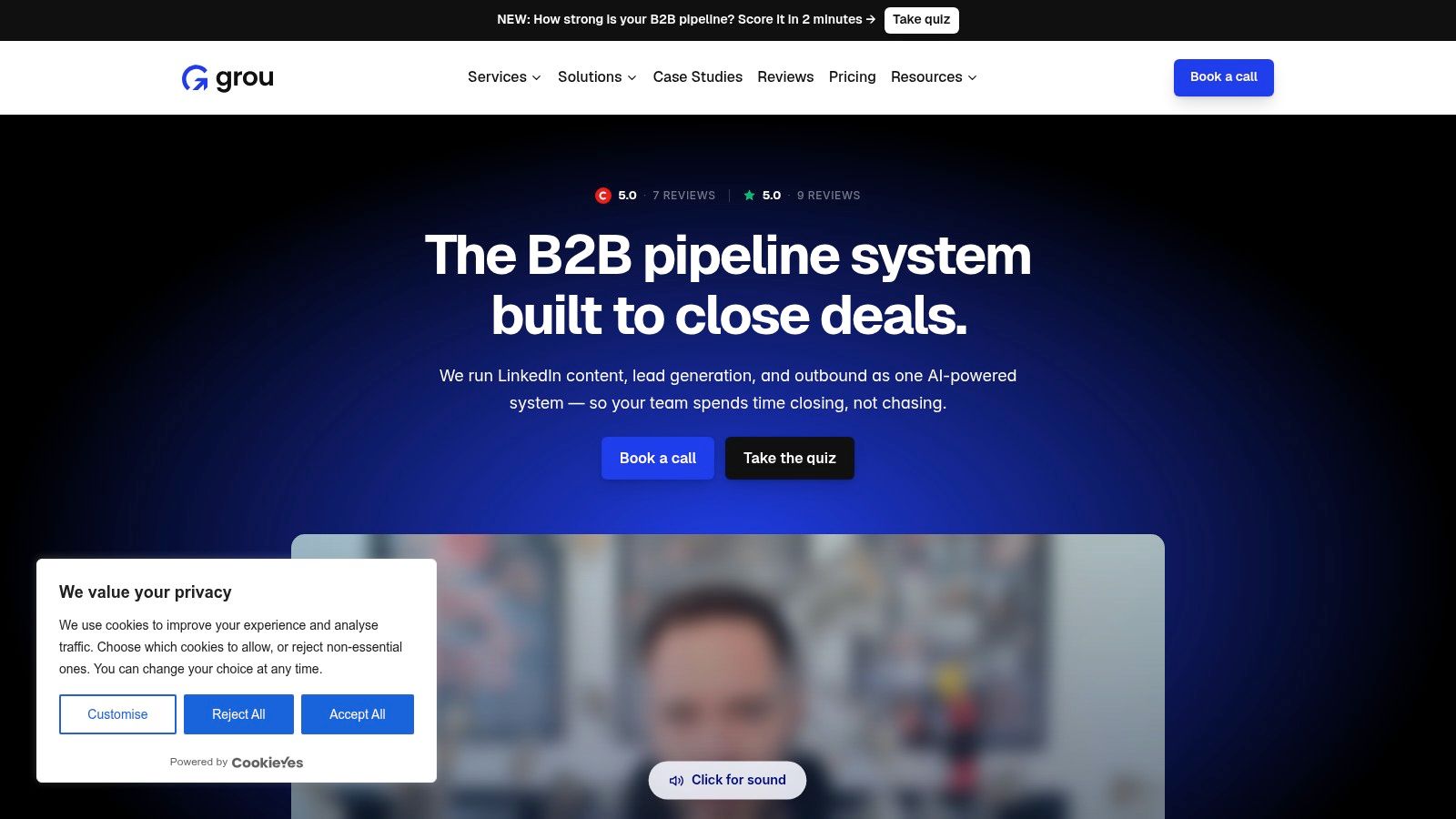
Grou's main edge is system design. The team aligns LinkedIn content, lead generation, and outbound around one ICP, one message, and one reporting line, then runs bi-weekly sprints with fast routing and clear qualification rules. That matters in manufacturing, where the bottleneck is usually not attention, it's internal consensus across technical and commercial stakeholders.
The manufacturing offer sits here: Grou manufacturing solutions.
Grou also makes the operating model easy to inspect. Their data-driven digital marketing agency breakdown shows how they connect channel work to measurable revenue actions, which is the right test for a manufacturer that needs more than isolated campaign output.
Practical rule: If an agency can't explain how it routes a qualified reply to sales in minutes, not days, it's not built for manufacturing revenue work.
Why Grou wins for operator teams
Grou fits founders, heads of marketing, RevOps, and heads of sales who need predictable meeting flow without bloated process. The setup is fast, the reporting is built for fit, and the Slack-based feedback loop keeps campaigns moving while sales keeps selling. That matters when the team has to stay close to the buyer and the response window is short.
The public proof is broad enough to matter. Grou points to work across 50+ companies, with outcomes including 350 qualified leads in the Adriatic region, 10x LinkedIn follower growth, and client-attributed deals above $20M. Those are the kinds of outcomes that show the system can create downstream commercial value. Before you compare vendors, compare manufacturing pipeline tools so you can judge whether the agency's reporting matches your sales motion.
Where Grou is the right fit
Grou is a strong fit if you need market entry support, pipeline validation, or a tighter connection between content and outbound. It also works well if your team already knows the market but needs structure that turns account attention into meetings.
The trade-off is straightforward. Pricing is custom, so very small teams may want something simpler. Success also depends on internal follow-through, because rapid routing only works if your sales process can handle it.
Verdict: Buy Grou if you want a single revenue system for LinkedIn, lead gen, and outbound. Skip it if you want a cheap, one-channel vendor or you're not ready to cooperate tightly on qualification and follow-up.
2. Gorilla 76
Gorilla 76 is the right choice for manufacturers that want a strategy-first engagement before they spend heavily. Use it when leadership wants a formal roadmap, clear stakes, and a team that talks in pipeline terms from day one.
Data-driven digital marketing agency breakdown
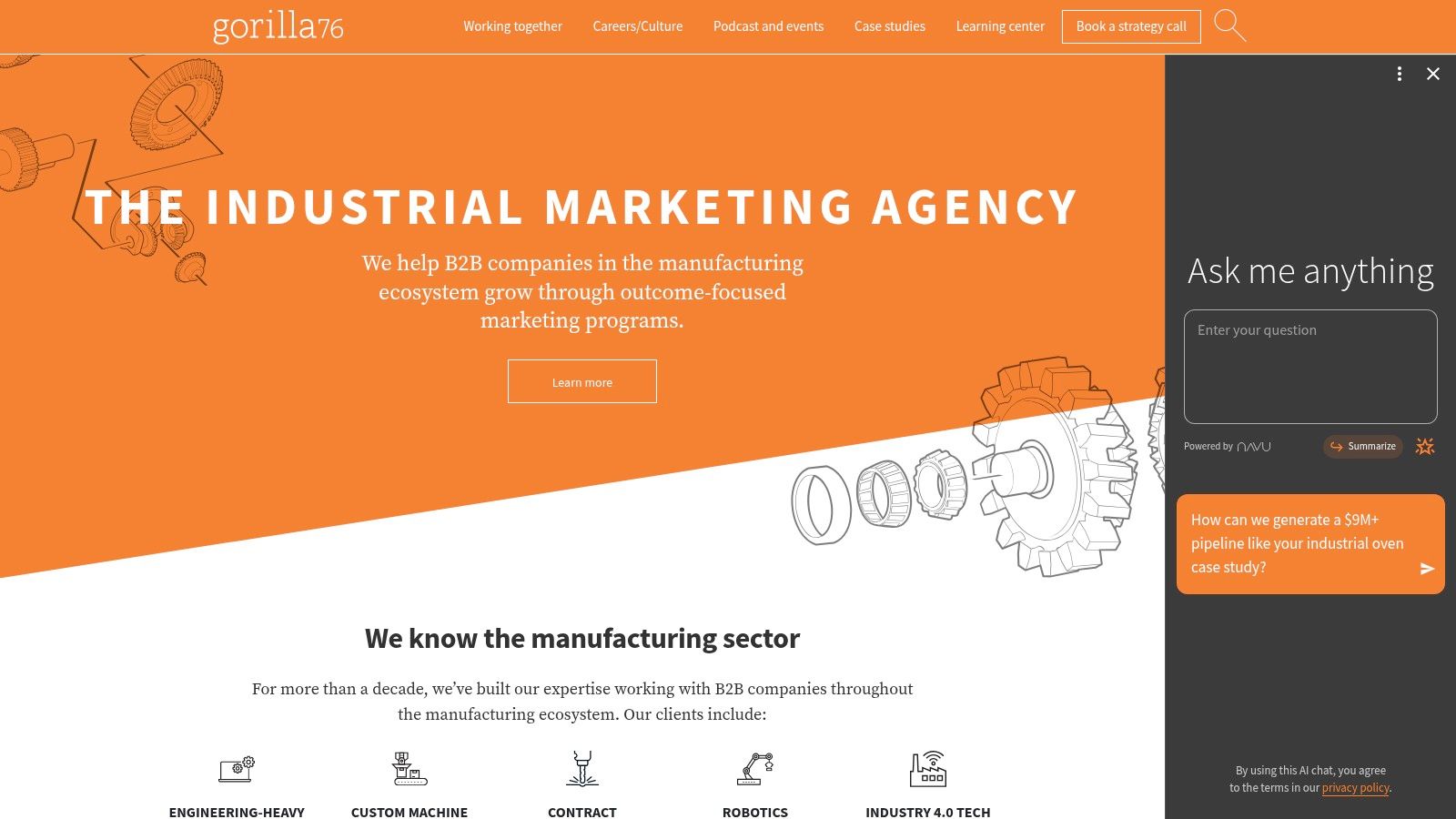
Their paid Road Map phase is the core offer. It forces agreement on positioning, measurable outcomes, and what deserves budget before execution starts. That matters for OEMs, machine builders, and contract manufacturers, because the wrong message gets expensive fast when the sales cycle is long and the buying committee is technical.
What Gorilla 76 does well
Gorilla 76 runs full-funnel programs that can include messaging, website work, content, video, paid search, paid social, CRM, tech stack, and reporting tied to pipeline. That range helps industrial teams with mixed maturity, especially when the website has to support sales instead of just looking current.
Their public thought leadership also makes vetting easier. You can see how they think before you get deep into a sales process, which helps when you are trying to judge whether a partner understands industrial buying or just claims to.
A strategy phase is only a delay if the agency uses it to stall. Used properly, it cuts bad spending before it starts.
Where it fits and where it doesn't
Gorilla 76 fits if you have budget for a serious engagement and want clarity on deliverables before execution begins. It is a weaker fit if you need to move immediately with a small team or a narrow tactical sprint.
The trade-off is the time cost of starting with strategy. Some teams want execution in week one. Gorilla 76 asks you to accept a slower start in exchange for cleaner operating assumptions.
Verdict: Buy Gorilla 76 if your team wants budget clarity, manufacturing focus, and a formal roadmap before scaling. Skip it if you need a lighter, cheaper, and faster tactical test.
3. TREW Marketing
TREW Marketing is the best fit for engineering-heavy manufacturing brands that need content to do real sales work. If your buyers live in technical detail and your internal experts are hard to translate, TREW is built for that exact problem.
Content marketing agency framework
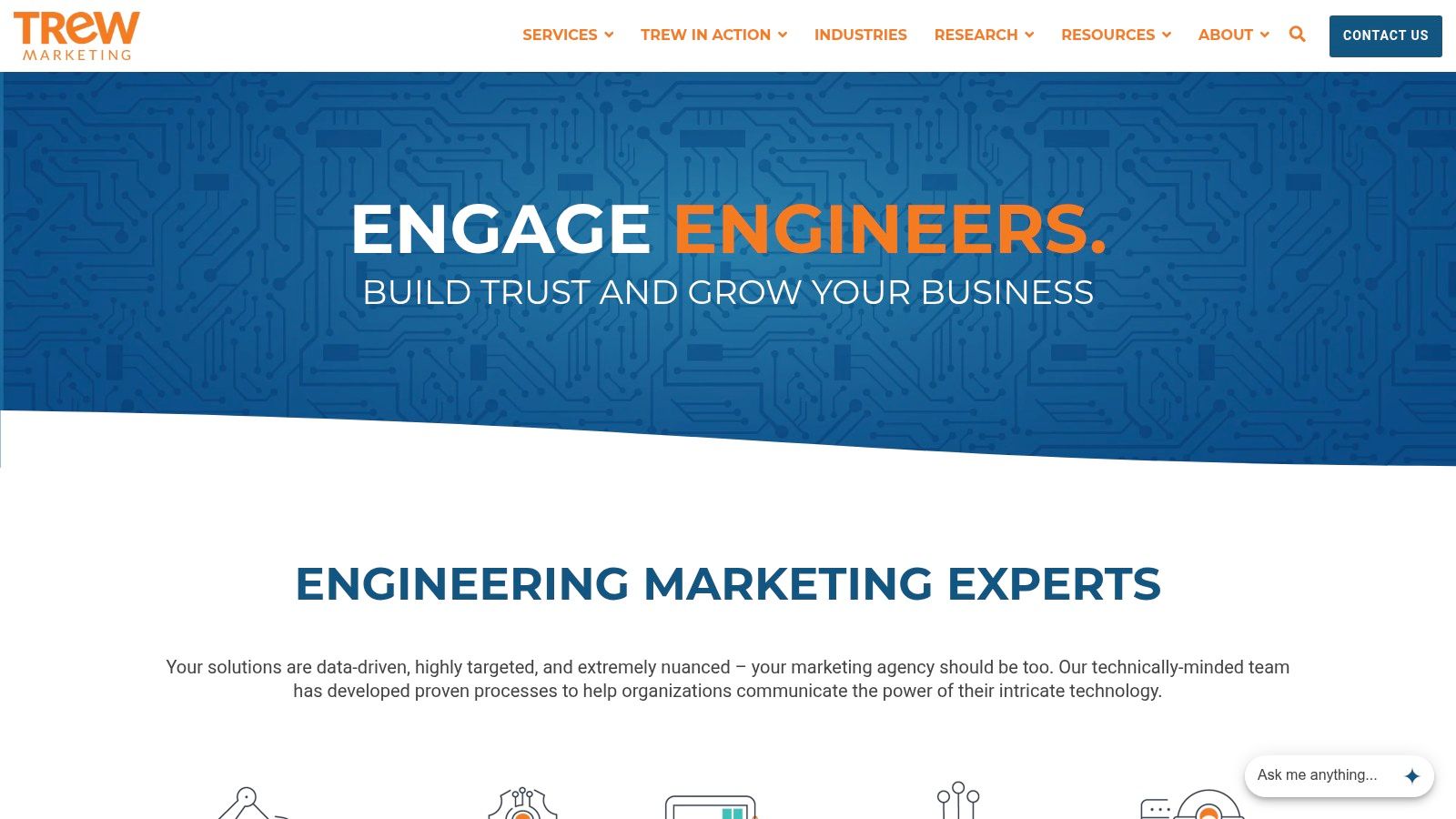
TREW's strength is that it treats engineering complexity as an asset, not a messaging problem to flatten out. Their work across strategy, brand, content, marketing automation, PR, and website strategy suits teams that need technical proof packaged for a buying committee that already knows the jargon.
Why TREW earns a place on this list
Their research-driven approach is useful because it starts from how engineers buy. That makes a difference when content needs to support discovery, evaluation, and internal consensus instead of just driving clicks. For teams selling into technical audiences, that discipline matters more than volume.
They also offer scoped Quick Wins packages. That matters for teams that want to test fit before they commit to a larger program. You can start with an audit or smaller campaign, then expand once the content and messaging prove useful in the field.
The trade-off
TREW is not the fastest path if you want pure outbound and fast meeting volume. Their emphasis leans toward content and inbound, which means your team needs patience and internal subject matter expertise. If you don't have people who can sit for interviews and validate technical accuracy, the output weakens.
Their model is strongest when you want your site, content, and automation to support a longer buying cycle, not just generate immediate replies. That's the right fit for some industrial companies and a poor fit for others.
Verdict: Buy TREW if your pipeline depends on technical content, engineering fluency, and HubSpot-centered operations. Skip it if you want phone-heavy outbound and immediate meeting generation.
4. Thomas Marketing Services (Thomasnet)
Thomas Marketing Services is the practical choice for manufacturers that want execution plus access to an industrial buyer network. If your team values platform reach and packaged delivery, Thomas gives you that combination without forcing you to assemble every piece yourself.
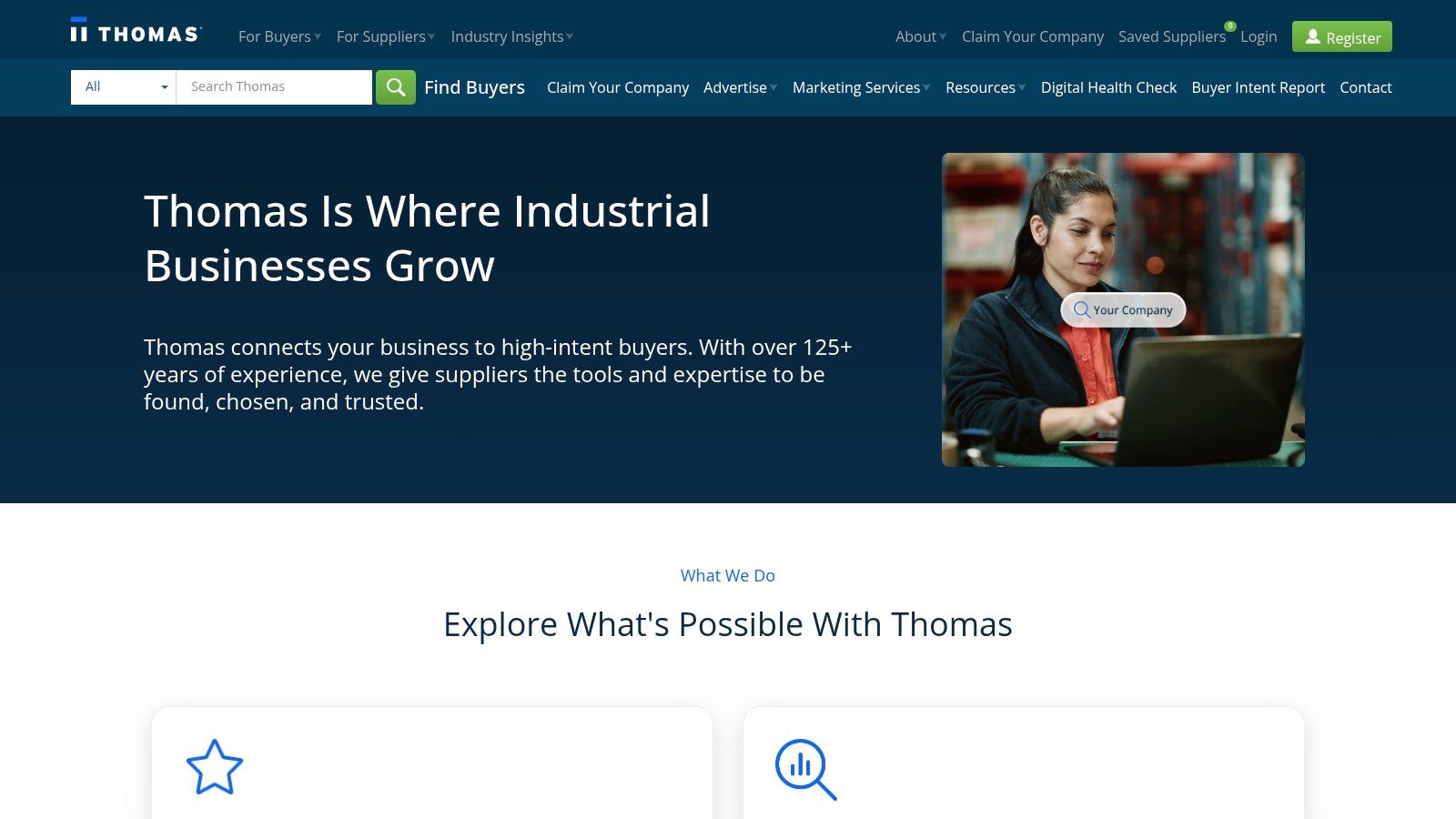
Their model is built around SEO, PPC, content, video, web, CRM, email, and program management, with access to Thomasnet placements and analytics. That gives manufacturers a direct path into industrial visibility, which can be useful when your buyer is already inside that ecosystem.
Why companies hire Thomas
The package structure reduces scoping friction. Teams can choose from defined tiers instead of rebuilding a custom scope from scratch, and that's helpful when internal approval is slow. Their industrial engineers on staff also help with technical marketing conversations that many general agencies can't handle cleanly.
The value is especially clear for companies that need both execution and exposure. If you're trying to support search, content, and buyer discovery in one motion, Thomas can cover a lot of surface area quickly.
Where to be careful
The channel mix needs scrutiny. If too much of the program leans on Thomasnet inventory, you can end up underbuilding other parts of your demand system. That's fine if Thomasnet is central to your buyer flow, but it's a bad setup if you need broader account-based motion.
The published pricing range is wide enough that scope validation matters early. Ask exactly what deliverables you're getting and how outcomes will be measured. Don't buy the package label, buy the actual operating plan.
Verdict: Buy Thomas if you want industrial reach, packaged execution, and a buyer-network advantage. Skip it if you need a highly custom multi-channel plan outside directories and platform inventory.
5. INDUSTRIAL (Industrial Strength Marketing)
INDUSTRIAL is the pick for small and midsize manufacturers that want a steady demand-gen engine without hand-building every channel. Their packaged Communicator tiers make the decision easy when you need a defined scope and predictable cadence.
Outbound for a precision metal forming manufacturer
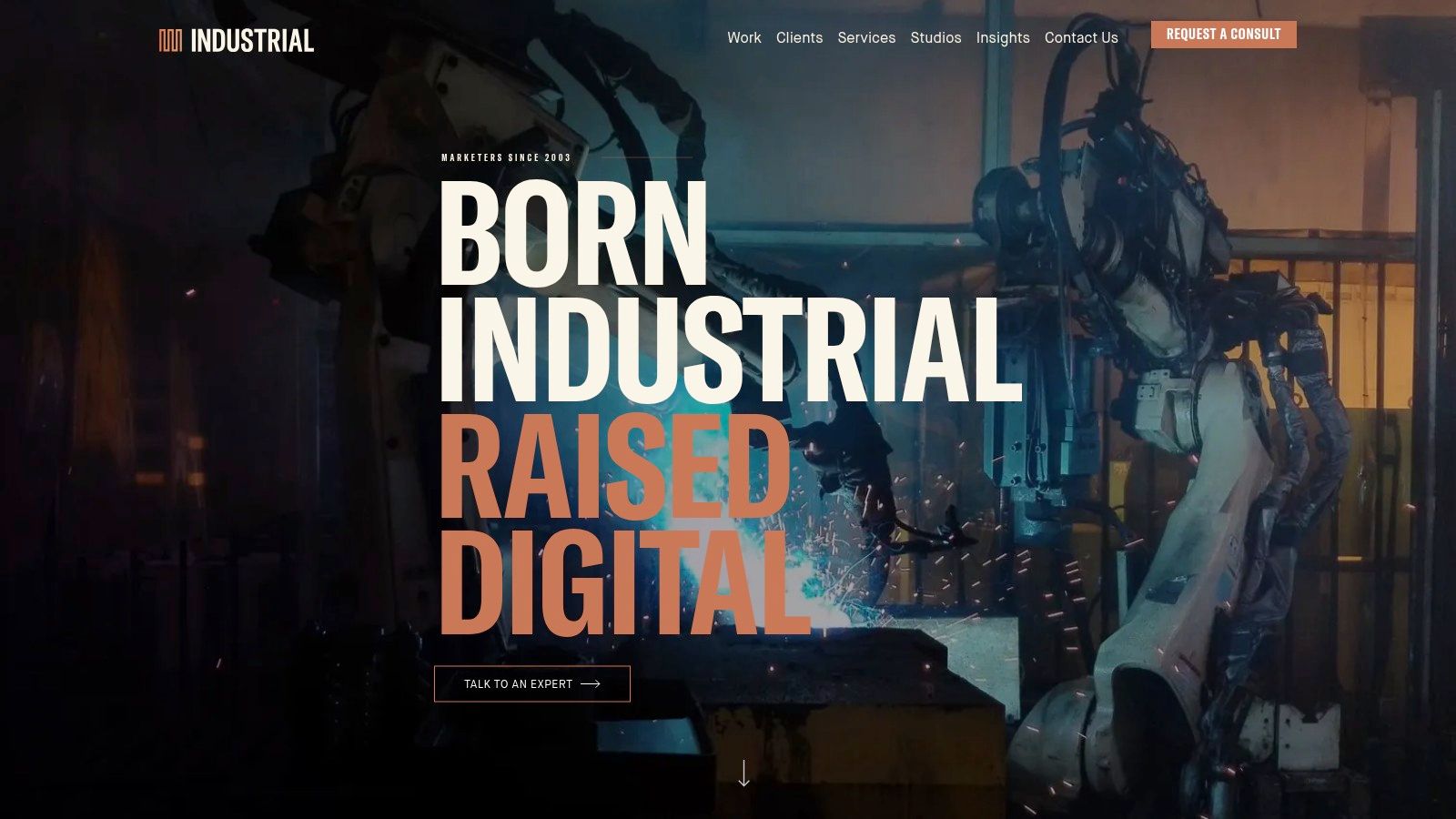
The appeal here is operational clarity. SEO, PPC, LinkedIn, newsletters, blogging, reporting, and optional focused campaigns are all packaged in a way that makes budgeting easier. If your team wants a reliable monthly drumbeat instead of a big strategic reset, this is a sane path.
Why this model works
Manufacturing teams often don't need more ideas. They need consistency and visibility into what's happening each month. INDUSTRIAL's tiered structure helps with that, because you know the work package before you sign. That makes internal buying easier and reduces scope drift.
The add-on campaigns also give teams room to go after a specific product or service line without rebuilding the whole relationship. That matters when one launch or one market push deserves focused energy.
Operator note: Packaged programs work when your sales team can keep up with the meetings. If follow-up is weak, more demand just creates more leakage.
The limitation
The structure can feel prescriptive if your campaign needs unusual channels or a deeper account-based setup. It's also more inbound and paid than pure outbound, so your sales enablement still has to carry part of the burden. For long-cycle selling, that internal discipline matters.
INDUSTRIAL is strongest when you want a clean cadence and less ambiguity. It's weaker if your motion needs event-heavy integration or very custom stakeholder messaging across a complex buying committee.
Verdict: Buy INDUSTRIAL if you want a defined monthly system with clear deliverables and steady activity. Skip it if you need highly bespoke channel design or heavy sales integration.
6. Windmill Strategy
Windmill Strategy is the strongest fit for technical manufacturers that need a sales-aligned website and ongoing digital growth support. If your site is underperforming as a lead-quality filter, Windmill is the kind of agency that can fix the front door first.
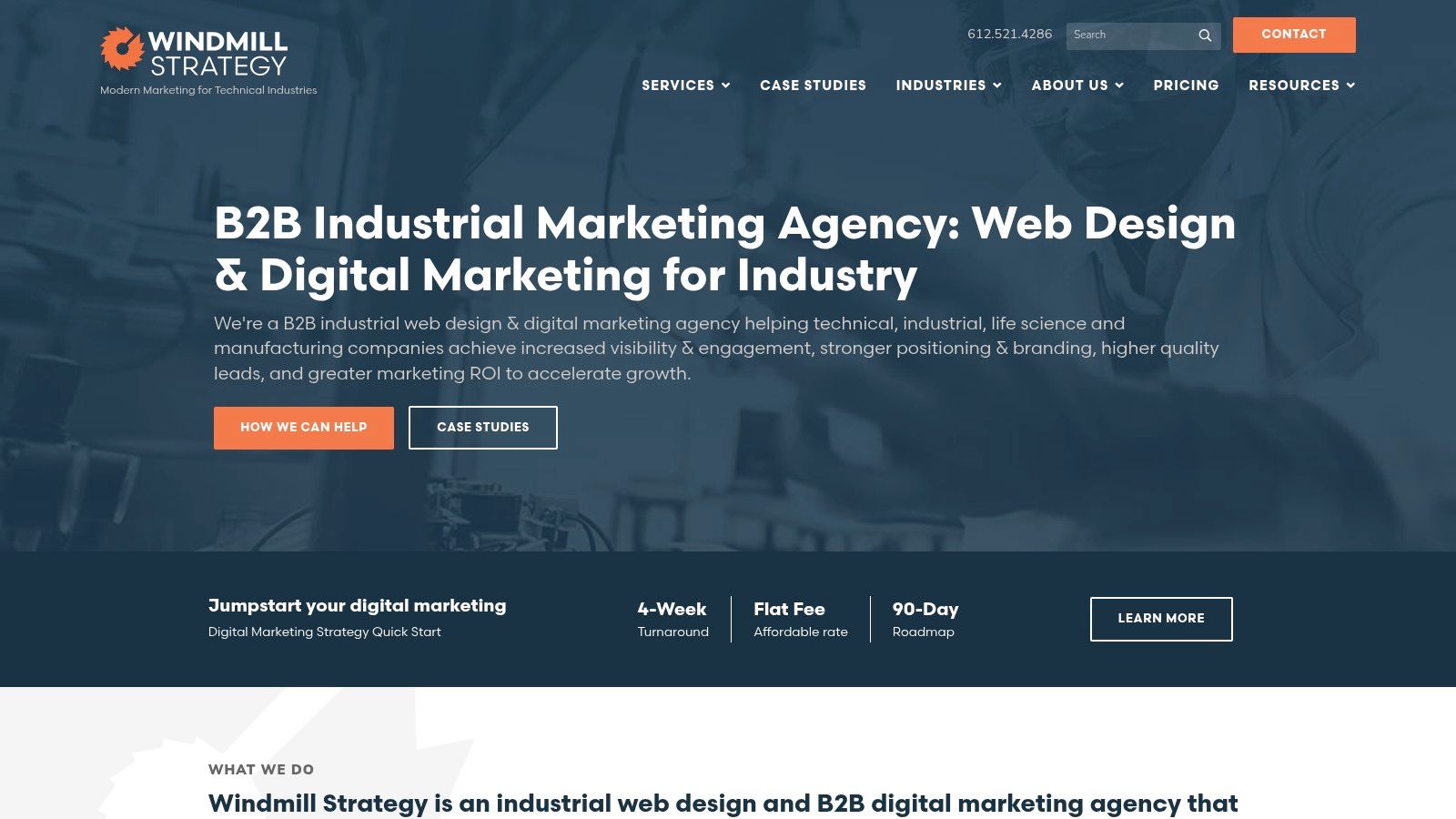
Their mix of website redesign, ABM, SEO, PPC, content, CRM, automation, and analytics is built for complex buying cycles. That makes sense for manufacturers whose site needs to support sales instead of just acting as a brochure.
What they do well
Windmill is a good fit if your digital presence has lagged behind your product reality. Their work supports lead quality, which matters more than raw traffic when the buyer is technical and the sales cycle is long. You don't need more visitors if the site can't route the right ones toward action.
The boutique-team dynamic also helps. Smaller teams often get more direct attention and clearer execution, which matters when the project involves both a redesign and a live demand engine.
Where they can be a harder fit
Complex web projects usually mean bigger budgets and longer lead times. That's normal, but it's still a trade-off. If you need immediate outbound motion or trade-show activation, Windmill is not the fastest answer.
They also seem more focused on digital growth than heavy PR or trade media. For some manufacturers that's fine. For larger industrial brands with broader media needs, it may leave gaps.
Verdict: Buy Windmill if you need a sales-aligned website plus ongoing digital growth. Skip it if your priority is trade media, heavy PR, or immediate outbound execution.
7. Godfrey
Godfrey is the right choice for larger industrial teams that need full-service support across multiple stakeholders, divisions, or markets. If your marketing already spans brand, demand, PR, and analytics, Godfrey is built for that kind of complexity.
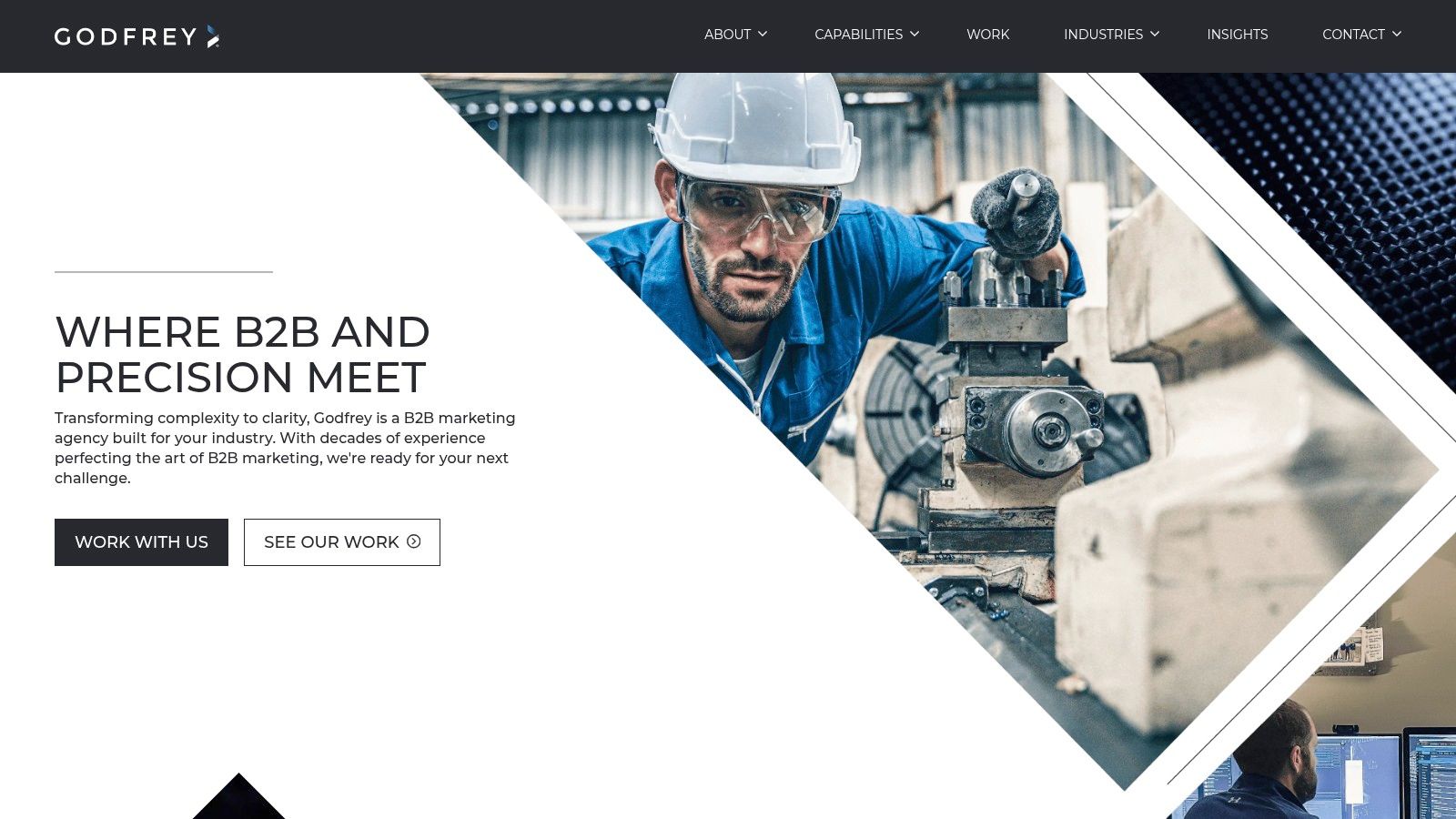
Their integrated model covers strategy through execution, with trade media and earned-channel capability that matters in industrial sectors. That gives them an edge for companies where the market expects more than paid media and a refreshed site.
Where Godfrey makes sense
Godfrey is best when the program is broad and the internal team is already mature. They can plug into existing industrial organizations without forcing everything into one narrow demand-gen format. That helps when the work touches multiple product lines or regional teams.
Their trade media and PR relationships also matter for firms that still need credibility in channels outside digital. Manufacturing buyers may research online, but they still trust the market signals around them. Godfrey is structured to work inside that reality.
The trade-off
This is rarely the cheapest route. Larger agencies like Godfrey are better for larger scopes and more stakeholders, which means the budget has to fit the ambition. The process can also be slower because enterprise-style coordination usually is.
If you're a smaller manufacturer or you need a narrow outbound engine, this is more agency than you need. But if your challenge is cross-functional complexity, that breadth becomes useful fast.
Verdict: Buy Godfrey if you need full-service industrial support across multiple channels and teams. Skip it if you're looking for a lean, narrow, or budget-constrained engagement.
Top 7 Manufacturing Marketing Companies Comparison
Solution | 🔄 Implementation complexity | ⚡ Resource requirements | 📊 Expected outcomes | 💡 Ideal use cases | ⭐ Key advantages |
|---|---|---|---|---|---|
Grou | Low–medium; 14-day setup, bi‑weekly sprints, continuous iteration | Moderate; dedicated sales collaboration, shared Slack channel, AI toolstack, custom scope/pricing | Predictable pipeline quickly; first signals ~30 days; case-study metrics (hundreds of conversations, deals >$20M) | B2B demand-gen leaders, RevOps, founders needing fast market entry and validated GTM | Unified AI-powered LinkedIn + outbound engine, fast time-to-insight, quality-over-volume dashboards |
Gorilla 76 | Medium–high; required paid "Road Map" strategy phase before execution | Mid–high; full‑funnel resources (website, paid media, CRM), transparent pricing | Measurable pipeline impact tied to strategy; longer ramp for full-funnel programs | OEMs, contract manufacturers, machine builders ready to invest in revenue programs | Strategy-first approach, manufacturing thought leadership, clear budget/deliverable expectations |
TREW Marketing | Medium; strategy-first, research-driven content and ops | Moderate; SME interviews, HubSpot marketing ops, content production | Improved technical positioning and inbound lead quality; steady long-term gains | Engineering-heavy B2B firms needing technical content, HubSpot-driven operations | Research-backed messaging, "Quick Wins" scoped packages, strong engineering content translation |
Thomas Marketing Services (Thomasnet) | Low–medium; package-based delivery integrated with Thomasnet channels | Varies by tier; access to Thomasnet placements, industrial engineers, analytics | Broader buyer exposure via Thomasnet, templated lead-gen options; measurable directory-driven leads | Manufacturers/suppliers seeking directory exposure plus integrated digital marketing | Direct access to Thomasnet buyer network, broad in-house services, tiered package simplicity |
INDUSTRIAL (Industrial Strength Marketing) | Low; published monthly package tiers with optional focused campaigns | Low–moderate; predictable monthly budgets per communicator tier | Steady inbound demand and predictable deliverables; scalable to AOR or project work | Small–midsize manufacturers wanting turnkey, budgeted lead‑gen programs | Transparent tiers and deliverables, turnkey demand‑gen, industry budget guides |
Windmill Strategy | Medium–high; complex website redesigns and ABM/digital programs | Moderate–high; web dev, ABM resources, ongoing digital marketing | Sales‑aligned websites and improved lead quality over time; supports long sales cycles | Manufacturers needing sales-enabled websites and ongoing digital growth | Sales-focused web design, boutique technical expertise, U.S.-based nationwide delivery |
Godfrey | High; enterprise-grade, integrated multi-channel programs | High; multi-discipline teams, PR/trade media, larger budgets and processes | Comprehensive brand + demand impact across channels; supports multi-division/global needs | Mid-market to enterprise manufacturers requiring broad, integrated marketing | Broad in-house capabilities, trade media/PR expertise, scalable AOR for complex orgs |
Your buyer's checklist and next step
Choosing the right partner comes down to whether the agency's system matches manufacturing reality. Don't pick the prettiest deck. Pick the team that can show how attention turns into pipeline through phone, content, events, and fast routing.
Before you sign, pressure-test the last two candidates with these questions:
Verifiable case studies. Ask for manufacturing examples with pipeline and revenue numbers, not vague lead counts.
Phone as a primary channel. If phone is treated as an afterthought, keep looking.
Trade show integration. They should name the key events in your vertical and explain how pre-event, on-site, and post-event motion works.
Timeline honesty. They should set expectations around a 6+ month manufacturing cycle, not promise instant revenue.
Internal fit. Ask who runs the work day to day, not just who sold it to you.
The fastest way to expose a weak vendor is to ask for a reference call with a current manufacturing client. Don't ask if they're happy. Ask about meeting-to-opportunity rate and average sales cycle length. Those two answers tell you whether the agency builds real pipeline or just books activity.
This Friday, pull your top candidate into a reference call and ask for one manufacturing customer who can speak about the actual sales process, not just the experience. Then compare that answer against your own funnel. If the story doesn't match your buyer reality, walk away.
A CTA for Grou. Grou is a B2B pipeline agency that unifies LinkedIn content, lead generation, and outbound into one AI-powered system to create qualified conversations and closed revenue. The team builds and enriches ICP-aligned prospect lists, publishes credibility-building LinkedIn content, and manages outbound sequences with fast reply routing and clear qualification rules, so sales spends time closing, not chasing.
Your manufacturing pipeline is full of interest and short on qualified meetings. That's usually not a traffic problem, it's a structure problem. Generic B2B tactics don't survive long sales cycles, multi-stakeholder approvals, or buyer committees that expect technical proof before they answer a form.
Phone-first outreach beats email-heavy programs in manufacturing because real buyers still respond to direct voice contact.
Trade show integration matters because event attendance creates timing and context that random outbound can't match.
Vertical expertise is the separator, firms that understand manufacturing buyer behavior, RFQ paths, and technical content quality produce cleaner pipeline.
Our #1 pick is Grou for teams that need one system for LinkedIn content, lead generation, and outbound, not three disconnected motions.
The right choice depends on fit, but the wrong choice is easy to spot, vague manufacturing claims, digital-only outreach, and unrealistic timelines.
Table of Contents
1. Grou
Grou is the strongest choice for manufacturing teams that want one pipeline system, not a stack of disconnected tactics. If your sales team is tired of chasing weak leads while marketing reports on vanity metrics, Grou is built for the handoff that matters, fit-qualified conversations.
Guide for manufacturing companies
Grou's main edge is system design. The team aligns LinkedIn content, lead generation, and outbound around one ICP, one message, and one reporting line, then runs bi-weekly sprints with fast routing and clear qualification rules. That matters in manufacturing, where the bottleneck is usually not attention, it's internal consensus across technical and commercial stakeholders.
The manufacturing offer sits here: Grou manufacturing solutions.
Grou also makes the operating model easy to inspect. Their data-driven digital marketing agency breakdown shows how they connect channel work to measurable revenue actions, which is the right test for a manufacturer that needs more than isolated campaign output.
Practical rule: If an agency can't explain how it routes a qualified reply to sales in minutes, not days, it's not built for manufacturing revenue work.
Why Grou wins for operator teams
Grou fits founders, heads of marketing, RevOps, and heads of sales who need predictable meeting flow without bloated process. The setup is fast, the reporting is built for fit, and the Slack-based feedback loop keeps campaigns moving while sales keeps selling. That matters when the team has to stay close to the buyer and the response window is short.
The public proof is broad enough to matter. Grou points to work across 50+ companies, with outcomes including 350 qualified leads in the Adriatic region, 10x LinkedIn follower growth, and client-attributed deals above $20M. Those are the kinds of outcomes that show the system can create downstream commercial value. Before you compare vendors, compare manufacturing pipeline tools so you can judge whether the agency's reporting matches your sales motion.
Where Grou is the right fit
Grou is a strong fit if you need market entry support, pipeline validation, or a tighter connection between content and outbound. It also works well if your team already knows the market but needs structure that turns account attention into meetings.
The trade-off is straightforward. Pricing is custom, so very small teams may want something simpler. Success also depends on internal follow-through, because rapid routing only works if your sales process can handle it.
Verdict: Buy Grou if you want a single revenue system for LinkedIn, lead gen, and outbound. Skip it if you want a cheap, one-channel vendor or you're not ready to cooperate tightly on qualification and follow-up.
2. Gorilla 76
Gorilla 76 is the right choice for manufacturers that want a strategy-first engagement before they spend heavily. Use it when leadership wants a formal roadmap, clear stakes, and a team that talks in pipeline terms from day one.
Data-driven digital marketing agency breakdown
Their paid Road Map phase is the core offer. It forces agreement on positioning, measurable outcomes, and what deserves budget before execution starts. That matters for OEMs, machine builders, and contract manufacturers, because the wrong message gets expensive fast when the sales cycle is long and the buying committee is technical.
What Gorilla 76 does well
Gorilla 76 runs full-funnel programs that can include messaging, website work, content, video, paid search, paid social, CRM, tech stack, and reporting tied to pipeline. That range helps industrial teams with mixed maturity, especially when the website has to support sales instead of just looking current.
Their public thought leadership also makes vetting easier. You can see how they think before you get deep into a sales process, which helps when you are trying to judge whether a partner understands industrial buying or just claims to.
A strategy phase is only a delay if the agency uses it to stall. Used properly, it cuts bad spending before it starts.
Where it fits and where it doesn't
Gorilla 76 fits if you have budget for a serious engagement and want clarity on deliverables before execution begins. It is a weaker fit if you need to move immediately with a small team or a narrow tactical sprint.
The trade-off is the time cost of starting with strategy. Some teams want execution in week one. Gorilla 76 asks you to accept a slower start in exchange for cleaner operating assumptions.
Verdict: Buy Gorilla 76 if your team wants budget clarity, manufacturing focus, and a formal roadmap before scaling. Skip it if you need a lighter, cheaper, and faster tactical test.
3. TREW Marketing
TREW Marketing is the best fit for engineering-heavy manufacturing brands that need content to do real sales work. If your buyers live in technical detail and your internal experts are hard to translate, TREW is built for that exact problem.
Content marketing agency framework
TREW's strength is that it treats engineering complexity as an asset, not a messaging problem to flatten out. Their work across strategy, brand, content, marketing automation, PR, and website strategy suits teams that need technical proof packaged for a buying committee that already knows the jargon.
Why TREW earns a place on this list
Their research-driven approach is useful because it starts from how engineers buy. That makes a difference when content needs to support discovery, evaluation, and internal consensus instead of just driving clicks. For teams selling into technical audiences, that discipline matters more than volume.
They also offer scoped Quick Wins packages. That matters for teams that want to test fit before they commit to a larger program. You can start with an audit or smaller campaign, then expand once the content and messaging prove useful in the field.
The trade-off
TREW is not the fastest path if you want pure outbound and fast meeting volume. Their emphasis leans toward content and inbound, which means your team needs patience and internal subject matter expertise. If you don't have people who can sit for interviews and validate technical accuracy, the output weakens.
Their model is strongest when you want your site, content, and automation to support a longer buying cycle, not just generate immediate replies. That's the right fit for some industrial companies and a poor fit for others.
Verdict: Buy TREW if your pipeline depends on technical content, engineering fluency, and HubSpot-centered operations. Skip it if you want phone-heavy outbound and immediate meeting generation.
4. Thomas Marketing Services (Thomasnet)
Thomas Marketing Services is the practical choice for manufacturers that want execution plus access to an industrial buyer network. If your team values platform reach and packaged delivery, Thomas gives you that combination without forcing you to assemble every piece yourself.
Their model is built around SEO, PPC, content, video, web, CRM, email, and program management, with access to Thomasnet placements and analytics. That gives manufacturers a direct path into industrial visibility, which can be useful when your buyer is already inside that ecosystem.
Why companies hire Thomas
The package structure reduces scoping friction. Teams can choose from defined tiers instead of rebuilding a custom scope from scratch, and that's helpful when internal approval is slow. Their industrial engineers on staff also help with technical marketing conversations that many general agencies can't handle cleanly.
The value is especially clear for companies that need both execution and exposure. If you're trying to support search, content, and buyer discovery in one motion, Thomas can cover a lot of surface area quickly.
Where to be careful
The channel mix needs scrutiny. If too much of the program leans on Thomasnet inventory, you can end up underbuilding other parts of your demand system. That's fine if Thomasnet is central to your buyer flow, but it's a bad setup if you need broader account-based motion.
The published pricing range is wide enough that scope validation matters early. Ask exactly what deliverables you're getting and how outcomes will be measured. Don't buy the package label, buy the actual operating plan.
Verdict: Buy Thomas if you want industrial reach, packaged execution, and a buyer-network advantage. Skip it if you need a highly custom multi-channel plan outside directories and platform inventory.
5. INDUSTRIAL (Industrial Strength Marketing)
INDUSTRIAL is the pick for small and midsize manufacturers that want a steady demand-gen engine without hand-building every channel. Their packaged Communicator tiers make the decision easy when you need a defined scope and predictable cadence.
Outbound for a precision metal forming manufacturer
The appeal here is operational clarity. SEO, PPC, LinkedIn, newsletters, blogging, reporting, and optional focused campaigns are all packaged in a way that makes budgeting easier. If your team wants a reliable monthly drumbeat instead of a big strategic reset, this is a sane path.
Why this model works
Manufacturing teams often don't need more ideas. They need consistency and visibility into what's happening each month. INDUSTRIAL's tiered structure helps with that, because you know the work package before you sign. That makes internal buying easier and reduces scope drift.
The add-on campaigns also give teams room to go after a specific product or service line without rebuilding the whole relationship. That matters when one launch or one market push deserves focused energy.
Operator note: Packaged programs work when your sales team can keep up with the meetings. If follow-up is weak, more demand just creates more leakage.
The limitation
The structure can feel prescriptive if your campaign needs unusual channels or a deeper account-based setup. It's also more inbound and paid than pure outbound, so your sales enablement still has to carry part of the burden. For long-cycle selling, that internal discipline matters.
INDUSTRIAL is strongest when you want a clean cadence and less ambiguity. It's weaker if your motion needs event-heavy integration or very custom stakeholder messaging across a complex buying committee.
Verdict: Buy INDUSTRIAL if you want a defined monthly system with clear deliverables and steady activity. Skip it if you need highly bespoke channel design or heavy sales integration.
6. Windmill Strategy
Windmill Strategy is the strongest fit for technical manufacturers that need a sales-aligned website and ongoing digital growth support. If your site is underperforming as a lead-quality filter, Windmill is the kind of agency that can fix the front door first.
Their mix of website redesign, ABM, SEO, PPC, content, CRM, automation, and analytics is built for complex buying cycles. That makes sense for manufacturers whose site needs to support sales instead of just acting as a brochure.
What they do well
Windmill is a good fit if your digital presence has lagged behind your product reality. Their work supports lead quality, which matters more than raw traffic when the buyer is technical and the sales cycle is long. You don't need more visitors if the site can't route the right ones toward action.
The boutique-team dynamic also helps. Smaller teams often get more direct attention and clearer execution, which matters when the project involves both a redesign and a live demand engine.
Where they can be a harder fit
Complex web projects usually mean bigger budgets and longer lead times. That's normal, but it's still a trade-off. If you need immediate outbound motion or trade-show activation, Windmill is not the fastest answer.
They also seem more focused on digital growth than heavy PR or trade media. For some manufacturers that's fine. For larger industrial brands with broader media needs, it may leave gaps.
Verdict: Buy Windmill if you need a sales-aligned website plus ongoing digital growth. Skip it if your priority is trade media, heavy PR, or immediate outbound execution.
7. Godfrey
Godfrey is the right choice for larger industrial teams that need full-service support across multiple stakeholders, divisions, or markets. If your marketing already spans brand, demand, PR, and analytics, Godfrey is built for that kind of complexity.
Their integrated model covers strategy through execution, with trade media and earned-channel capability that matters in industrial sectors. That gives them an edge for companies where the market expects more than paid media and a refreshed site.
Where Godfrey makes sense
Godfrey is best when the program is broad and the internal team is already mature. They can plug into existing industrial organizations without forcing everything into one narrow demand-gen format. That helps when the work touches multiple product lines or regional teams.
Their trade media and PR relationships also matter for firms that still need credibility in channels outside digital. Manufacturing buyers may research online, but they still trust the market signals around them. Godfrey is structured to work inside that reality.
The trade-off
This is rarely the cheapest route. Larger agencies like Godfrey are better for larger scopes and more stakeholders, which means the budget has to fit the ambition. The process can also be slower because enterprise-style coordination usually is.
If you're a smaller manufacturer or you need a narrow outbound engine, this is more agency than you need. But if your challenge is cross-functional complexity, that breadth becomes useful fast.
Verdict: Buy Godfrey if you need full-service industrial support across multiple channels and teams. Skip it if you're looking for a lean, narrow, or budget-constrained engagement.
Top 7 Manufacturing Marketing Companies Comparison
Solution | 🔄 Implementation complexity | ⚡ Resource requirements | 📊 Expected outcomes | 💡 Ideal use cases | ⭐ Key advantages |
|---|---|---|---|---|---|
Grou | Low–medium; 14-day setup, bi‑weekly sprints, continuous iteration | Moderate; dedicated sales collaboration, shared Slack channel, AI toolstack, custom scope/pricing | Predictable pipeline quickly; first signals ~30 days; case-study metrics (hundreds of conversations, deals >$20M) | B2B demand-gen leaders, RevOps, founders needing fast market entry and validated GTM | Unified AI-powered LinkedIn + outbound engine, fast time-to-insight, quality-over-volume dashboards |
Gorilla 76 | Medium–high; required paid "Road Map" strategy phase before execution | Mid–high; full‑funnel resources (website, paid media, CRM), transparent pricing | Measurable pipeline impact tied to strategy; longer ramp for full-funnel programs | OEMs, contract manufacturers, machine builders ready to invest in revenue programs | Strategy-first approach, manufacturing thought leadership, clear budget/deliverable expectations |
TREW Marketing | Medium; strategy-first, research-driven content and ops | Moderate; SME interviews, HubSpot marketing ops, content production | Improved technical positioning and inbound lead quality; steady long-term gains | Engineering-heavy B2B firms needing technical content, HubSpot-driven operations | Research-backed messaging, "Quick Wins" scoped packages, strong engineering content translation |
Thomas Marketing Services (Thomasnet) | Low–medium; package-based delivery integrated with Thomasnet channels | Varies by tier; access to Thomasnet placements, industrial engineers, analytics | Broader buyer exposure via Thomasnet, templated lead-gen options; measurable directory-driven leads | Manufacturers/suppliers seeking directory exposure plus integrated digital marketing | Direct access to Thomasnet buyer network, broad in-house services, tiered package simplicity |
INDUSTRIAL (Industrial Strength Marketing) | Low; published monthly package tiers with optional focused campaigns | Low–moderate; predictable monthly budgets per communicator tier | Steady inbound demand and predictable deliverables; scalable to AOR or project work | Small–midsize manufacturers wanting turnkey, budgeted lead‑gen programs | Transparent tiers and deliverables, turnkey demand‑gen, industry budget guides |
Windmill Strategy | Medium–high; complex website redesigns and ABM/digital programs | Moderate–high; web dev, ABM resources, ongoing digital marketing | Sales‑aligned websites and improved lead quality over time; supports long sales cycles | Manufacturers needing sales-enabled websites and ongoing digital growth | Sales-focused web design, boutique technical expertise, U.S.-based nationwide delivery |
Godfrey | High; enterprise-grade, integrated multi-channel programs | High; multi-discipline teams, PR/trade media, larger budgets and processes | Comprehensive brand + demand impact across channels; supports multi-division/global needs | Mid-market to enterprise manufacturers requiring broad, integrated marketing | Broad in-house capabilities, trade media/PR expertise, scalable AOR for complex orgs |
Your buyer's checklist and next step
Choosing the right partner comes down to whether the agency's system matches manufacturing reality. Don't pick the prettiest deck. Pick the team that can show how attention turns into pipeline through phone, content, events, and fast routing.
Before you sign, pressure-test the last two candidates with these questions:
Verifiable case studies. Ask for manufacturing examples with pipeline and revenue numbers, not vague lead counts.
Phone as a primary channel. If phone is treated as an afterthought, keep looking.
Trade show integration. They should name the key events in your vertical and explain how pre-event, on-site, and post-event motion works.
Timeline honesty. They should set expectations around a 6+ month manufacturing cycle, not promise instant revenue.
Internal fit. Ask who runs the work day to day, not just who sold it to you.
The fastest way to expose a weak vendor is to ask for a reference call with a current manufacturing client. Don't ask if they're happy. Ask about meeting-to-opportunity rate and average sales cycle length. Those two answers tell you whether the agency builds real pipeline or just books activity.
This Friday, pull your top candidate into a reference call and ask for one manufacturing customer who can speak about the actual sales process, not just the experience. Then compare that answer against your own funnel. If the story doesn't match your buyer reality, walk away.
A CTA for Grou. Grou is a B2B pipeline agency that unifies LinkedIn content, lead generation, and outbound into one AI-powered system to create qualified conversations and closed revenue. The team builds and enriches ICP-aligned prospect lists, publishes credibility-building LinkedIn content, and manages outbound sequences with fast reply routing and clear qualification rules, so sales spends time closing, not chasing.
Your manufacturing pipeline is full of interest and short on qualified meetings. That's usually not a traffic problem, it's a structure problem. Generic B2B tactics don't survive long sales cycles, multi-stakeholder approvals, or buyer committees that expect technical proof before they answer a form.
Phone-first outreach beats email-heavy programs in manufacturing because real buyers still respond to direct voice contact.
Trade show integration matters because event attendance creates timing and context that random outbound can't match.
Vertical expertise is the separator, firms that understand manufacturing buyer behavior, RFQ paths, and technical content quality produce cleaner pipeline.
Our #1 pick is Grou for teams that need one system for LinkedIn content, lead generation, and outbound, not three disconnected motions.
The right choice depends on fit, but the wrong choice is easy to spot, vague manufacturing claims, digital-only outreach, and unrealistic timelines.
Table of Contents
1. Grou
Grou is the strongest choice for manufacturing teams that want one pipeline system, not a stack of disconnected tactics. If your sales team is tired of chasing weak leads while marketing reports on vanity metrics, Grou is built for the handoff that matters, fit-qualified conversations.
Guide for manufacturing companies
Grou's main edge is system design. The team aligns LinkedIn content, lead generation, and outbound around one ICP, one message, and one reporting line, then runs bi-weekly sprints with fast routing and clear qualification rules. That matters in manufacturing, where the bottleneck is usually not attention, it's internal consensus across technical and commercial stakeholders.
The manufacturing offer sits here: Grou manufacturing solutions.
Grou also makes the operating model easy to inspect. Their data-driven digital marketing agency breakdown shows how they connect channel work to measurable revenue actions, which is the right test for a manufacturer that needs more than isolated campaign output.
Practical rule: If an agency can't explain how it routes a qualified reply to sales in minutes, not days, it's not built for manufacturing revenue work.
Why Grou wins for operator teams
Grou fits founders, heads of marketing, RevOps, and heads of sales who need predictable meeting flow without bloated process. The setup is fast, the reporting is built for fit, and the Slack-based feedback loop keeps campaigns moving while sales keeps selling. That matters when the team has to stay close to the buyer and the response window is short.
The public proof is broad enough to matter. Grou points to work across 50+ companies, with outcomes including 350 qualified leads in the Adriatic region, 10x LinkedIn follower growth, and client-attributed deals above $20M. Those are the kinds of outcomes that show the system can create downstream commercial value. Before you compare vendors, compare manufacturing pipeline tools so you can judge whether the agency's reporting matches your sales motion.
Where Grou is the right fit
Grou is a strong fit if you need market entry support, pipeline validation, or a tighter connection between content and outbound. It also works well if your team already knows the market but needs structure that turns account attention into meetings.
The trade-off is straightforward. Pricing is custom, so very small teams may want something simpler. Success also depends on internal follow-through, because rapid routing only works if your sales process can handle it.
Verdict: Buy Grou if you want a single revenue system for LinkedIn, lead gen, and outbound. Skip it if you want a cheap, one-channel vendor or you're not ready to cooperate tightly on qualification and follow-up.
2. Gorilla 76
Gorilla 76 is the right choice for manufacturers that want a strategy-first engagement before they spend heavily. Use it when leadership wants a formal roadmap, clear stakes, and a team that talks in pipeline terms from day one.
Data-driven digital marketing agency breakdown
Their paid Road Map phase is the core offer. It forces agreement on positioning, measurable outcomes, and what deserves budget before execution starts. That matters for OEMs, machine builders, and contract manufacturers, because the wrong message gets expensive fast when the sales cycle is long and the buying committee is technical.
What Gorilla 76 does well
Gorilla 76 runs full-funnel programs that can include messaging, website work, content, video, paid search, paid social, CRM, tech stack, and reporting tied to pipeline. That range helps industrial teams with mixed maturity, especially when the website has to support sales instead of just looking current.
Their public thought leadership also makes vetting easier. You can see how they think before you get deep into a sales process, which helps when you are trying to judge whether a partner understands industrial buying or just claims to.
A strategy phase is only a delay if the agency uses it to stall. Used properly, it cuts bad spending before it starts.
Where it fits and where it doesn't
Gorilla 76 fits if you have budget for a serious engagement and want clarity on deliverables before execution begins. It is a weaker fit if you need to move immediately with a small team or a narrow tactical sprint.
The trade-off is the time cost of starting with strategy. Some teams want execution in week one. Gorilla 76 asks you to accept a slower start in exchange for cleaner operating assumptions.
Verdict: Buy Gorilla 76 if your team wants budget clarity, manufacturing focus, and a formal roadmap before scaling. Skip it if you need a lighter, cheaper, and faster tactical test.
3. TREW Marketing
TREW Marketing is the best fit for engineering-heavy manufacturing brands that need content to do real sales work. If your buyers live in technical detail and your internal experts are hard to translate, TREW is built for that exact problem.
Content marketing agency framework
TREW's strength is that it treats engineering complexity as an asset, not a messaging problem to flatten out. Their work across strategy, brand, content, marketing automation, PR, and website strategy suits teams that need technical proof packaged for a buying committee that already knows the jargon.
Why TREW earns a place on this list
Their research-driven approach is useful because it starts from how engineers buy. That makes a difference when content needs to support discovery, evaluation, and internal consensus instead of just driving clicks. For teams selling into technical audiences, that discipline matters more than volume.
They also offer scoped Quick Wins packages. That matters for teams that want to test fit before they commit to a larger program. You can start with an audit or smaller campaign, then expand once the content and messaging prove useful in the field.
The trade-off
TREW is not the fastest path if you want pure outbound and fast meeting volume. Their emphasis leans toward content and inbound, which means your team needs patience and internal subject matter expertise. If you don't have people who can sit for interviews and validate technical accuracy, the output weakens.
Their model is strongest when you want your site, content, and automation to support a longer buying cycle, not just generate immediate replies. That's the right fit for some industrial companies and a poor fit for others.
Verdict: Buy TREW if your pipeline depends on technical content, engineering fluency, and HubSpot-centered operations. Skip it if you want phone-heavy outbound and immediate meeting generation.
4. Thomas Marketing Services (Thomasnet)
Thomas Marketing Services is the practical choice for manufacturers that want execution plus access to an industrial buyer network. If your team values platform reach and packaged delivery, Thomas gives you that combination without forcing you to assemble every piece yourself.
Their model is built around SEO, PPC, content, video, web, CRM, email, and program management, with access to Thomasnet placements and analytics. That gives manufacturers a direct path into industrial visibility, which can be useful when your buyer is already inside that ecosystem.
Why companies hire Thomas
The package structure reduces scoping friction. Teams can choose from defined tiers instead of rebuilding a custom scope from scratch, and that's helpful when internal approval is slow. Their industrial engineers on staff also help with technical marketing conversations that many general agencies can't handle cleanly.
The value is especially clear for companies that need both execution and exposure. If you're trying to support search, content, and buyer discovery in one motion, Thomas can cover a lot of surface area quickly.
Where to be careful
The channel mix needs scrutiny. If too much of the program leans on Thomasnet inventory, you can end up underbuilding other parts of your demand system. That's fine if Thomasnet is central to your buyer flow, but it's a bad setup if you need broader account-based motion.
The published pricing range is wide enough that scope validation matters early. Ask exactly what deliverables you're getting and how outcomes will be measured. Don't buy the package label, buy the actual operating plan.
Verdict: Buy Thomas if you want industrial reach, packaged execution, and a buyer-network advantage. Skip it if you need a highly custom multi-channel plan outside directories and platform inventory.
5. INDUSTRIAL (Industrial Strength Marketing)
INDUSTRIAL is the pick for small and midsize manufacturers that want a steady demand-gen engine without hand-building every channel. Their packaged Communicator tiers make the decision easy when you need a defined scope and predictable cadence.
Outbound for a precision metal forming manufacturer
The appeal here is operational clarity. SEO, PPC, LinkedIn, newsletters, blogging, reporting, and optional focused campaigns are all packaged in a way that makes budgeting easier. If your team wants a reliable monthly drumbeat instead of a big strategic reset, this is a sane path.
Why this model works
Manufacturing teams often don't need more ideas. They need consistency and visibility into what's happening each month. INDUSTRIAL's tiered structure helps with that, because you know the work package before you sign. That makes internal buying easier and reduces scope drift.
The add-on campaigns also give teams room to go after a specific product or service line without rebuilding the whole relationship. That matters when one launch or one market push deserves focused energy.
Operator note: Packaged programs work when your sales team can keep up with the meetings. If follow-up is weak, more demand just creates more leakage.
The limitation
The structure can feel prescriptive if your campaign needs unusual channels or a deeper account-based setup. It's also more inbound and paid than pure outbound, so your sales enablement still has to carry part of the burden. For long-cycle selling, that internal discipline matters.
INDUSTRIAL is strongest when you want a clean cadence and less ambiguity. It's weaker if your motion needs event-heavy integration or very custom stakeholder messaging across a complex buying committee.
Verdict: Buy INDUSTRIAL if you want a defined monthly system with clear deliverables and steady activity. Skip it if you need highly bespoke channel design or heavy sales integration.
6. Windmill Strategy
Windmill Strategy is the strongest fit for technical manufacturers that need a sales-aligned website and ongoing digital growth support. If your site is underperforming as a lead-quality filter, Windmill is the kind of agency that can fix the front door first.
Their mix of website redesign, ABM, SEO, PPC, content, CRM, automation, and analytics is built for complex buying cycles. That makes sense for manufacturers whose site needs to support sales instead of just acting as a brochure.
What they do well
Windmill is a good fit if your digital presence has lagged behind your product reality. Their work supports lead quality, which matters more than raw traffic when the buyer is technical and the sales cycle is long. You don't need more visitors if the site can't route the right ones toward action.
The boutique-team dynamic also helps. Smaller teams often get more direct attention and clearer execution, which matters when the project involves both a redesign and a live demand engine.
Where they can be a harder fit
Complex web projects usually mean bigger budgets and longer lead times. That's normal, but it's still a trade-off. If you need immediate outbound motion or trade-show activation, Windmill is not the fastest answer.
They also seem more focused on digital growth than heavy PR or trade media. For some manufacturers that's fine. For larger industrial brands with broader media needs, it may leave gaps.
Verdict: Buy Windmill if you need a sales-aligned website plus ongoing digital growth. Skip it if your priority is trade media, heavy PR, or immediate outbound execution.
7. Godfrey
Godfrey is the right choice for larger industrial teams that need full-service support across multiple stakeholders, divisions, or markets. If your marketing already spans brand, demand, PR, and analytics, Godfrey is built for that kind of complexity.
Their integrated model covers strategy through execution, with trade media and earned-channel capability that matters in industrial sectors. That gives them an edge for companies where the market expects more than paid media and a refreshed site.
Where Godfrey makes sense
Godfrey is best when the program is broad and the internal team is already mature. They can plug into existing industrial organizations without forcing everything into one narrow demand-gen format. That helps when the work touches multiple product lines or regional teams.
Their trade media and PR relationships also matter for firms that still need credibility in channels outside digital. Manufacturing buyers may research online, but they still trust the market signals around them. Godfrey is structured to work inside that reality.
The trade-off
This is rarely the cheapest route. Larger agencies like Godfrey are better for larger scopes and more stakeholders, which means the budget has to fit the ambition. The process can also be slower because enterprise-style coordination usually is.
If you're a smaller manufacturer or you need a narrow outbound engine, this is more agency than you need. But if your challenge is cross-functional complexity, that breadth becomes useful fast.
Verdict: Buy Godfrey if you need full-service industrial support across multiple channels and teams. Skip it if you're looking for a lean, narrow, or budget-constrained engagement.
Top 7 Manufacturing Marketing Companies Comparison
Solution | 🔄 Implementation complexity | ⚡ Resource requirements | 📊 Expected outcomes | 💡 Ideal use cases | ⭐ Key advantages |
|---|---|---|---|---|---|
Grou | Low–medium; 14-day setup, bi‑weekly sprints, continuous iteration | Moderate; dedicated sales collaboration, shared Slack channel, AI toolstack, custom scope/pricing | Predictable pipeline quickly; first signals ~30 days; case-study metrics (hundreds of conversations, deals >$20M) | B2B demand-gen leaders, RevOps, founders needing fast market entry and validated GTM | Unified AI-powered LinkedIn + outbound engine, fast time-to-insight, quality-over-volume dashboards |
Gorilla 76 | Medium–high; required paid "Road Map" strategy phase before execution | Mid–high; full‑funnel resources (website, paid media, CRM), transparent pricing | Measurable pipeline impact tied to strategy; longer ramp for full-funnel programs | OEMs, contract manufacturers, machine builders ready to invest in revenue programs | Strategy-first approach, manufacturing thought leadership, clear budget/deliverable expectations |
TREW Marketing | Medium; strategy-first, research-driven content and ops | Moderate; SME interviews, HubSpot marketing ops, content production | Improved technical positioning and inbound lead quality; steady long-term gains | Engineering-heavy B2B firms needing technical content, HubSpot-driven operations | Research-backed messaging, "Quick Wins" scoped packages, strong engineering content translation |
Thomas Marketing Services (Thomasnet) | Low–medium; package-based delivery integrated with Thomasnet channels | Varies by tier; access to Thomasnet placements, industrial engineers, analytics | Broader buyer exposure via Thomasnet, templated lead-gen options; measurable directory-driven leads | Manufacturers/suppliers seeking directory exposure plus integrated digital marketing | Direct access to Thomasnet buyer network, broad in-house services, tiered package simplicity |
INDUSTRIAL (Industrial Strength Marketing) | Low; published monthly package tiers with optional focused campaigns | Low–moderate; predictable monthly budgets per communicator tier | Steady inbound demand and predictable deliverables; scalable to AOR or project work | Small–midsize manufacturers wanting turnkey, budgeted lead‑gen programs | Transparent tiers and deliverables, turnkey demand‑gen, industry budget guides |
Windmill Strategy | Medium–high; complex website redesigns and ABM/digital programs | Moderate–high; web dev, ABM resources, ongoing digital marketing | Sales‑aligned websites and improved lead quality over time; supports long sales cycles | Manufacturers needing sales-enabled websites and ongoing digital growth | Sales-focused web design, boutique technical expertise, U.S.-based nationwide delivery |
Godfrey | High; enterprise-grade, integrated multi-channel programs | High; multi-discipline teams, PR/trade media, larger budgets and processes | Comprehensive brand + demand impact across channels; supports multi-division/global needs | Mid-market to enterprise manufacturers requiring broad, integrated marketing | Broad in-house capabilities, trade media/PR expertise, scalable AOR for complex orgs |
Your buyer's checklist and next step
Choosing the right partner comes down to whether the agency's system matches manufacturing reality. Don't pick the prettiest deck. Pick the team that can show how attention turns into pipeline through phone, content, events, and fast routing.
Before you sign, pressure-test the last two candidates with these questions:
Verifiable case studies. Ask for manufacturing examples with pipeline and revenue numbers, not vague lead counts.
Phone as a primary channel. If phone is treated as an afterthought, keep looking.
Trade show integration. They should name the key events in your vertical and explain how pre-event, on-site, and post-event motion works.
Timeline honesty. They should set expectations around a 6+ month manufacturing cycle, not promise instant revenue.
Internal fit. Ask who runs the work day to day, not just who sold it to you.
The fastest way to expose a weak vendor is to ask for a reference call with a current manufacturing client. Don't ask if they're happy. Ask about meeting-to-opportunity rate and average sales cycle length. Those two answers tell you whether the agency builds real pipeline or just books activity.
This Friday, pull your top candidate into a reference call and ask for one manufacturing customer who can speak about the actual sales process, not just the experience. Then compare that answer against your own funnel. If the story doesn't match your buyer reality, walk away.
A CTA for Grou. Grou is a B2B pipeline agency that unifies LinkedIn content, lead generation, and outbound into one AI-powered system to create qualified conversations and closed revenue. The team builds and enriches ICP-aligned prospect lists, publishes credibility-building LinkedIn content, and manages outbound sequences with fast reply routing and clear qualification rules, so sales spends time closing, not chasing.
Pipeline OS Newsletter
Build qualified pipeline
Get weekly tactics to generate demand, improve lead quality, and book more meetings.





Trusted by industry leaders
Trusted by industry leaders
Trusted by industry leaders
Ready to build qualified pipeline?
Ready to build qualified pipeline?
Ready to build qualified pipeline?
Book a call to see if we're the right fit, or take the 2-minute quiz to get a clear starting point.
Book a call to see if we're the right fit, or take the 2-minute quiz to get a clear starting point.
Book a call to see if we're the right fit, or take the 2-minute quiz to get a clear starting point.
" height="30.21639343089746px" id="hfGbXmQR2" width="30.216393430897455px"/></svg>)
Copyright © 2026 – All Right Reserved
Copyright © 2026 – All Right Reserved
Copyright © 2026 – All Right Reserved