%22%3E%3C/path%3E%3Cpath d=%22M 63.072 7.554 C 62.258 8.022 61.577 8.689 61.092 9.493 L 61.092 7.076 L 57.158 7.076 L 57.158 22.64 L 61.089 22.64 L 61.089 14.888 C 61.089 13.446 61.403 12.434 62.03 11.853 C 62.818 11.218 63.818 10.907 64.826 10.982 L 65.868 10.982 L 65.868 6.851 C 64.891 6.834 63.926 7.076 63.073 7.554 Z%22 fill=%22rgb(17,17,17)%22%3E%3C/path%3E%3Cpath d=%22M 78.916 7.82 C 76.363 6.49 73.321 6.49 70.768 7.82 C 69.562 8.473 68.564 9.451 67.888 10.644 C 67.167 11.931 66.803 13.387 66.834 14.862 C 66.804 16.332 67.157 17.785 67.86 19.077 C 68.515 20.267 69.494 21.246 70.684 21.901 C 71.924 22.576 73.318 22.92 74.73 22.898 C 76.164 22.918 77.58 22.575 78.846 21.901 C 80.062 21.247 81.073 20.27 81.768 19.077 C 82.506 17.797 82.88 16.339 82.85 14.862 C 82.88 13.389 82.517 11.934 81.797 10.647 C 81.12 9.455 80.122 8.477 78.917 7.824 M 78.803 14.862 C 78.829 15.739 78.636 16.608 78.241 17.391 C 77.903 18.046 77.38 18.588 76.738 18.95 C 76.124 19.293 75.432 19.472 74.729 19.47 C 73.668 19.497 72.648 19.061 71.934 18.276 C 71.139 17.323 70.741 16.1 70.823 14.862 C 70.741 13.62 71.149 12.395 71.959 11.45 C 72.687 10.667 73.715 10.233 74.783 10.256 C 75.859 10.236 76.894 10.67 77.635 11.45 C 78.464 12.387 78.884 13.616 78.801 14.864%22 fill=%22rgb(17,17,17)%22%3E%3C/path%3E%3Cpath d=%22M 95.906 7.076 L 95.906 15.646 C 95.975 16.68 95.643 17.701 94.979 18.498 C 94.311 19.184 93.379 19.547 92.422 19.495 C 91.475 19.544 90.553 19.18 89.894 18.498 C 89.23 17.701 88.898 16.68 88.967 15.646 L 88.967 7.076 L 85.033 7.076 L 85.033 16.207 C 85 17.449 85.275 18.68 85.834 19.79 C 86.327 20.75 87.095 21.542 88.039 22.065 C 89.033 22.594 90.145 22.861 91.271 22.838 C 92.188 22.847 93.095 22.65 93.926 22.263 C 94.708 21.905 95.388 21.36 95.906 20.675 L 95.906 22.645 L 99.865 22.645 L 99.865 7.076 Z%22 fill=%22rgb(17,17,17)%22%3E%3C/path%3E%3Cpath d=%22M 4.513 15.626 C 4.511 10.815 7.606 6.549 12.181 5.059 C 16.756 3.57 21.77 5.195 24.601 9.086 L 27.816 5.87 C 24.074 1.186 17.981 -0.943 12.137 0.393 C 6.292 1.728 1.728 6.292 0.393 12.137 C -0.943 17.981 1.186 24.074 5.87 27.816 L 9.085 24.601 C 6.214 22.512 4.515 19.177 4.513 15.626%22 fill=%22rgb(32,62,235)%22%3E%3C/path%3E%3Cpath d=%22M 17.114 14.343 L 13.354 18.01 L 13.354 18.026 L 21.071 18.026 L 11.412 27.609 L 17.389 27.609 L 23.999 21.081 L 23.999 28.316 L 24.005 28.316 L 27.967 24.393 L 27.967 14.343 Z%22 fill=%22rgb(32,62,235)%22%3E%3C/path%3E%3C/g%3E%3C/svg%3E) ×
× ××
××

Two ways to run the same six-week pilot. The first is free, converts at 40 percent, and costs you EUR 10,000 for every customer it wins. The second costs the buyer EUR 5,000, converts at only 30 percent, and pays you EUR 3,333 for every customer it wins.
The second one is better on every measure that matters, and it converts worse. That is the whole argument, and it falls out of one line of arithmetic that almost nobody running pilots writes down.
TL;DR
A pilot is a customer acquisition cost. What you charge for it is a rebate against that cost, so the effective acquisition cost of a pilot programme is the delivery cost minus the price, divided by the conversion rate. Three things follow. Price the pilot at your delivery cost and your effective acquisition cost is exactly zero at any conversion rate, including a terrible one. Price it above delivery cost and the number goes negative, which means the pilot programme funds itself and the customers arrive as a by-product. And a paid pilot only has to convert at a fraction of the free pilot's rate to win, specifically one minus the share of your cost the buyer is covering: charge half your cost and you need half the conversion rate, charge all of it and you need none. The second decision, which matters as much as the price, is when the money arrives. In the EU a business-to-business invoice is generally payable within 60 days, so a six-week pilot invoiced on completion is roughly fourteen weeks from start to cash, which is a working capital decision dressed up as a payment term.
A pilot is an acquisition cost, so treat it like one
Write the line down. Effective acquisition cost per won customer equals delivery cost minus price, divided by conversion rate. That is it. Everything below is that expression with different numbers in it.
Notice what the price does to the numerator. A free pilot leaves the full delivery cost sitting in the numerator, and the conversion rate is the only lever you have on it. A paid pilot shrinks the numerator directly, which is a lever that does not depend on how good your sales team is that quarter.
And notice what happens at the crossing point. When the price equals the delivery cost the numerator is zero, so the whole expression is zero no matter what the conversion rate does. That is an unusual property. It means a pilot priced at cost cannot have a bad acquisition cost, only a bad conversion rate, and those are different problems with different fixes.
This is not the same question as how to design the pilot. Our piece on running a lead generation pilot covers sizing, duration and what to measure. This one is about the commercial structure sitting around it: who bears the delivery cost, who bears the risk and when the cash moves.
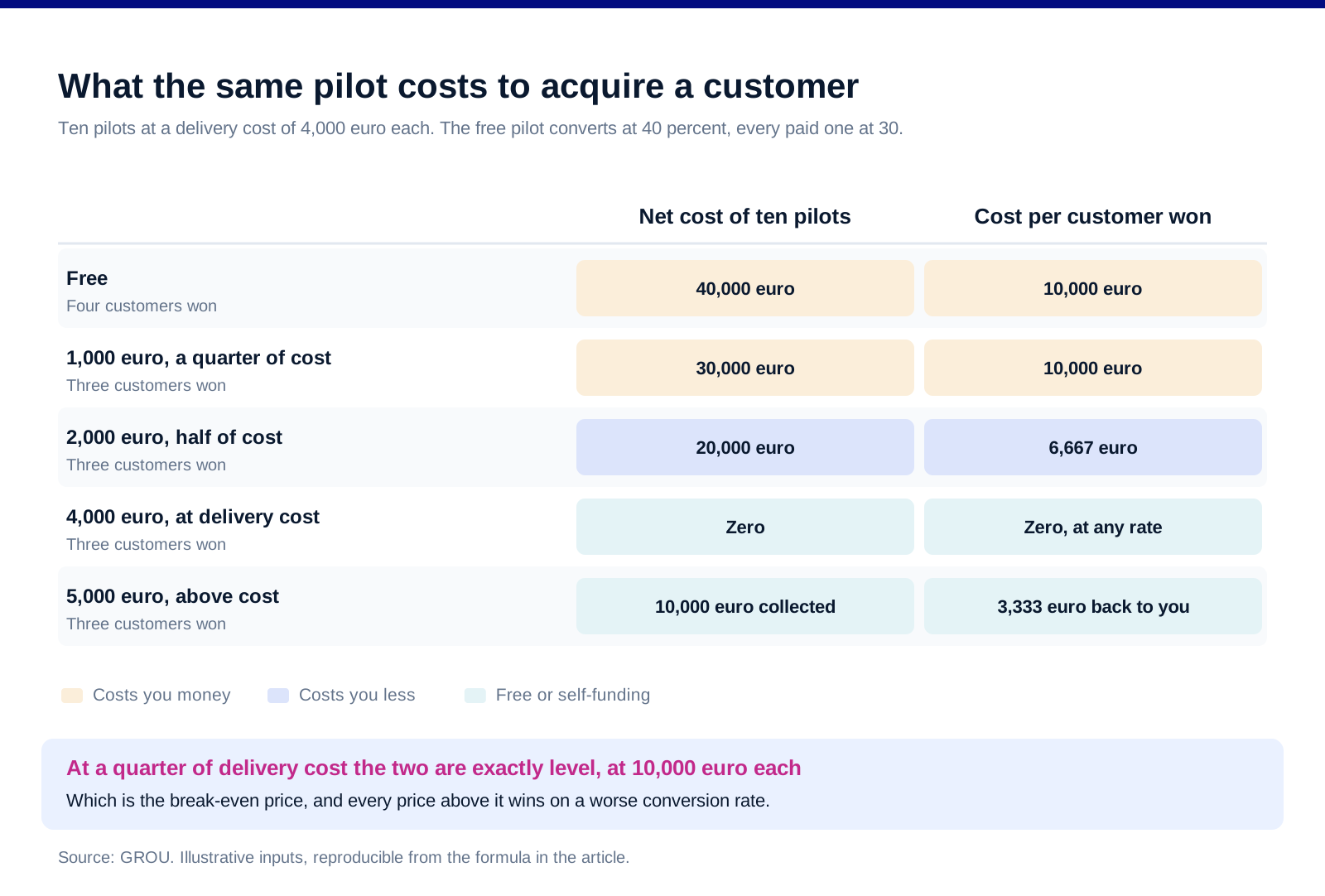
Run it on ten pilots at a delivery cost of EUR 4,000 each. Free, converting at a generous 40 percent, that is EUR 40,000 spent and four customers won, so EUR 10,000 each. Priced at EUR 5,000 and converting at a poor 30 percent, that is EUR 40,000 spent against EUR 50,000 collected and three customers won, so EUR 3,333 back in your pocket per customer.
The sign flip is the finding, not the size of the numbers. Substitute your own delivery cost and your own conversion rates and the shape does not change, because it is a property of the expression rather than of the example.
One honest caveat before you act on it. Charging changes who agrees to the pilot. A price is a filter, and it filters out both the tyre kickers and some genuine buyers who were going to buy anyway. The arithmetic above assumes you can observe the conversion rate after the change, not before it, which is why the next section is about the rate you would need rather than the rate you hope for.
The conversion rate a paid pilot actually has to hit
Borrow the discipline from public sector appraisal. The UK Treasury's Green Book tells appraisers to calculate switching values, defined as "the values that a key assumption would need to change to, in order to make an option no longer value for money". Applied here, the key assumption is the conversion rate and the switching value is the rate below which charging stops paying.
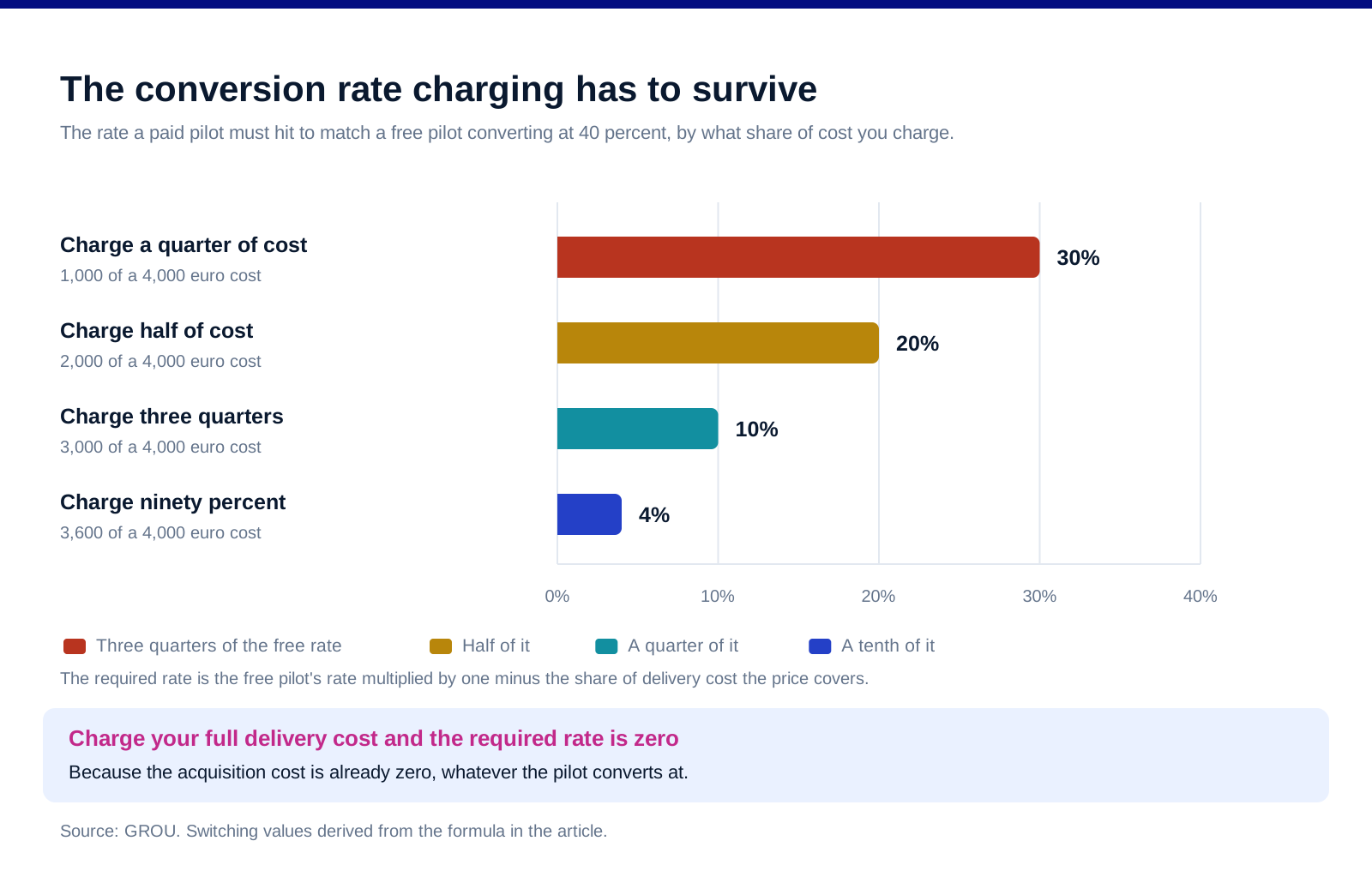
The switching value has a closed form. A paid pilot beats a free one when its conversion rate is at least the free rate multiplied by one minus the share of delivery cost the price covers. Charge a quarter of your cost and you need three quarters of the free conversion rate. Charge half and you need half. Charge all of it and you need none, because the numerator is already zero.
Put the free pilot at 40 percent and read it off. Charging EUR 1,000 against a EUR 4,000 cost means the paid pilot must convert at 30 percent. EUR 2,000 means 20 percent. EUR 3,000 means 10 percent. EUR 3,600 means 4 percent.
Which is a much lower bar than the conversation in the room implies. The objection to charging is almost always "we will convert fewer of them", and that objection is usually right. It is just rarely large enough. A pilot priced at three quarters of your delivery cost survives a conversion rate that has fallen by three quarters, and conversion rates that collapse by three quarters because you charged for something are rare enough that you would notice.
The same Green Book tells you why you should distrust your own estimate. It defines optimism bias as "the proven tendency for appraisals to be over-optimistic about key assumptions" and tells practitioners to explicitly adjust for it. The assumption most exposed to that here is the free pilot's conversion rate, which in most companies is a remembered impression rather than a counted number.
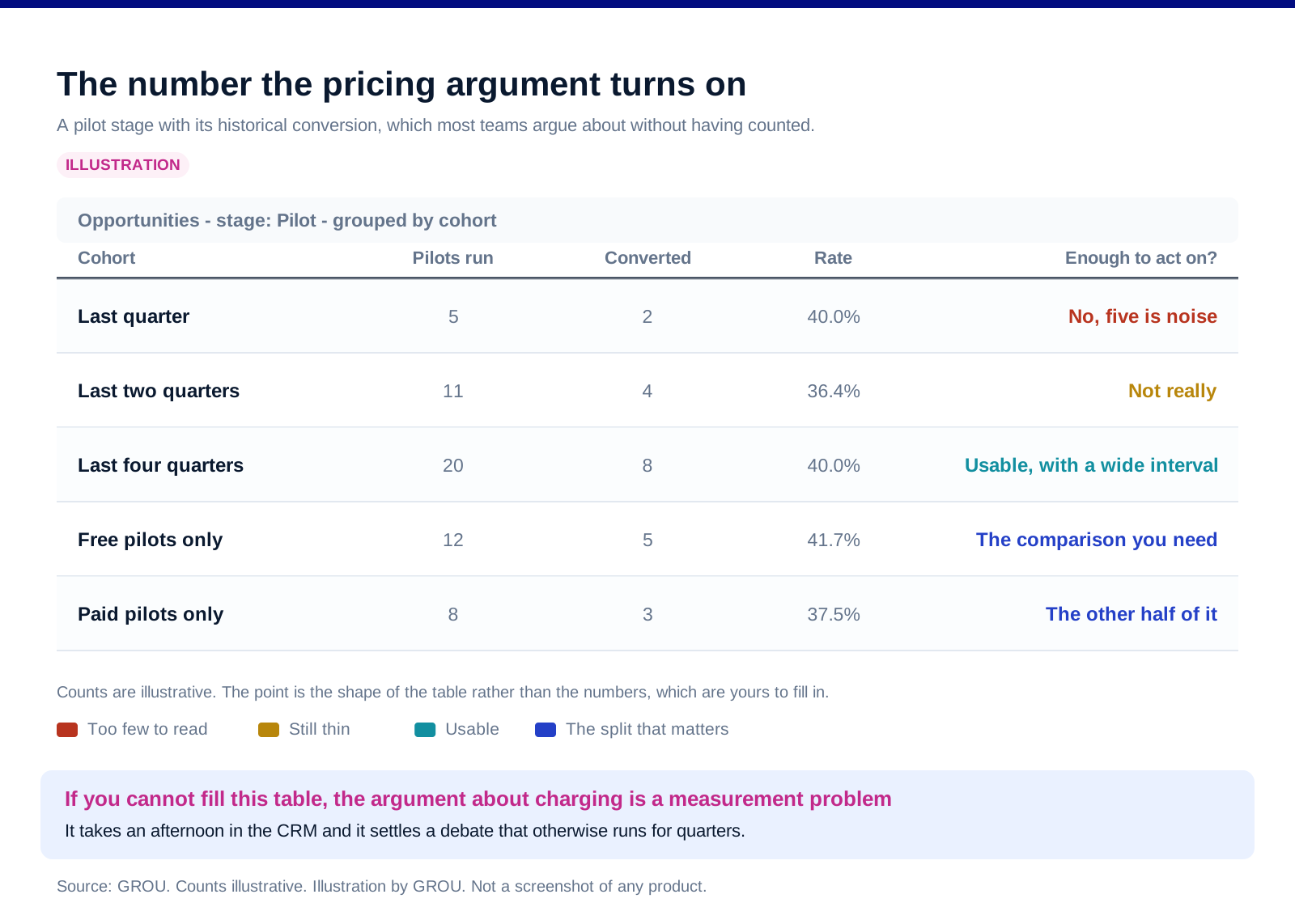
So count it before you argue about it. If you cannot say what share of your last twenty free pilots became paying customers, the debate about charging is not a pricing debate. It is a measurement problem wearing a pricing costume.
Getting paid is a separate problem from being paid
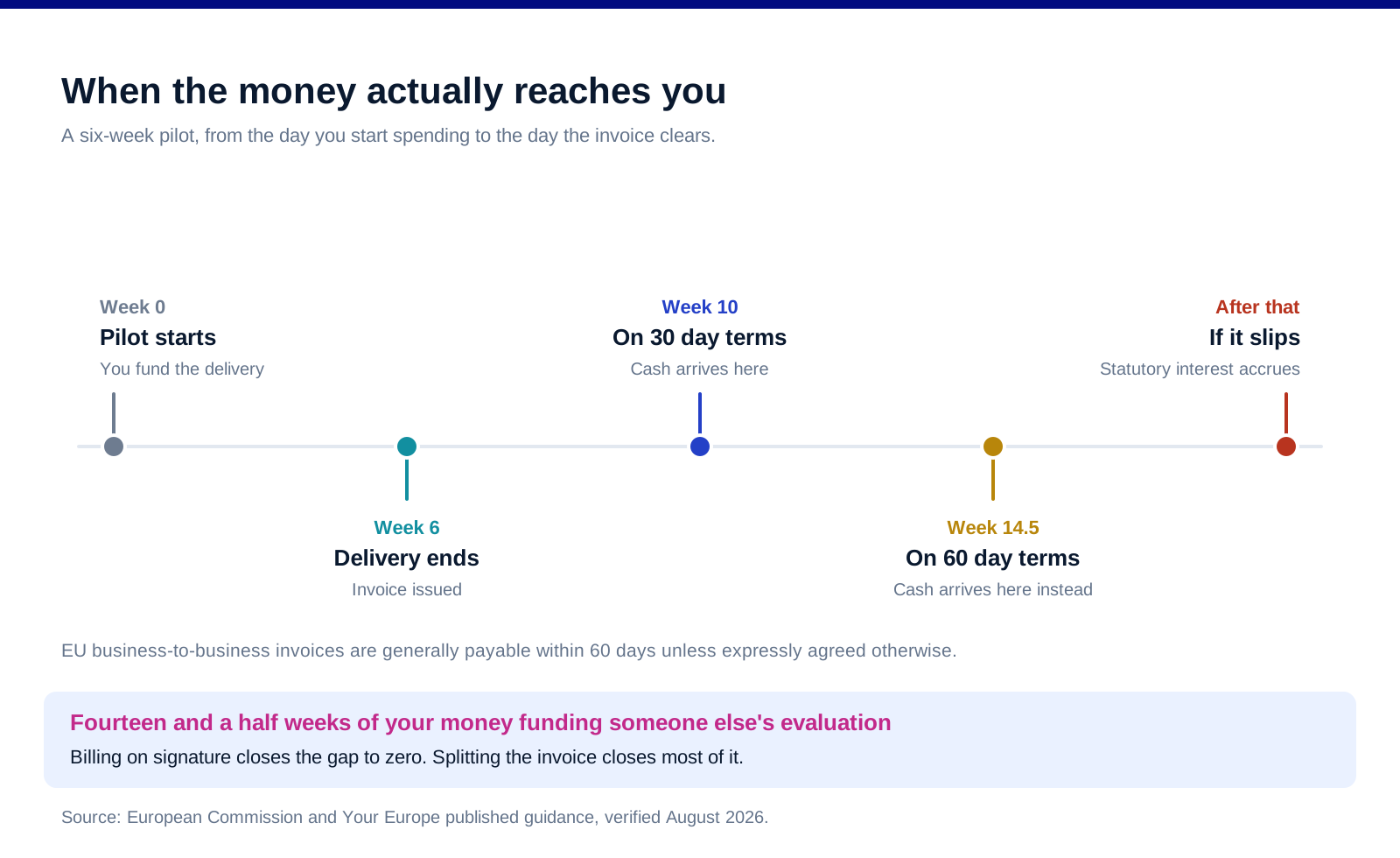
Agreeing a price is not the same as holding the money. In the EU, businesses are generally expected to pay invoices "within 60 days, unless they expressly agree otherwise and provided it is not grossly unfair". A six-week pilot invoiced on completion at 60 day terms is about fourteen and a half weeks from the day you start spending to the day you are paid, and you carry the delivery cost for all of it.
Halve the terms and you halve the gap. The same pilot at 30 day terms is about ten weeks. Split the invoice fifty-fifty between signature and completion at 30 day terms and the weighted average drops to about five weeks. Take it all on signature and the gap is zero and you are funded by the buyer rather than by yourself.
Which makes the billing schedule the second price. Two pilots at the same headline number are not the same deal if one is paid on signature and the other is paid sixty days after a six-week delivery. If the buyer pushes back on price, trading terms is usually the cheaper concession, because the cash timing costs you real money and the headline number is what their procurement team is scored on.
And if you set no payment period at all, the default is not sixty days. Where a contract fixes no payment period, interest becomes payable 30 calendar days after the client receives the invoice. Silence in the contract is not neutral, it just picks a different number than the one you assumed.
Late payment carries an automatic entitlement, which is leverage rather than income. Statutory interest runs at least 8 percentage points above the European Central Bank's reference rate, which stood at 2.40 percent for main refinancing operations from 17 June 2026. The published country rates for the second half of 2026 run from 9.75 percent in Denmark to 14.50 percent in Romania. On a EUR 5,000 pilot invoice paid 30 days late in Germany at 10.27 percent that is about EUR 42, plus the EUR 40 minimum recovery compensation, and reasonable additional recovery costs on top if they exceed it.
Nobody gets rich on EUR 82. The reason to know the entitlement is that it is automatic and you do not have to have written it into the contract, which changes the tone of a chasing email considerably. Take your own legal advice on how it applies to your contracts and your countries, because this is a summary of a public source rather than an opinion about your situation.
What to write into the pilot agreement
A stated success definition, written before the pilot starts. Not a target you hope to beat, a threshold both sides agreed in advance. Without it the conversion conversation at the end is a negotiation about interpretation.
What happens to the fee if the pilot fails its own definition. Refund, credit against the first contract, or nothing. All three are defensible. Not deciding is not.
Whether the fee credits against the annual contract. Crediting it makes the price much easier to agree and costs you nothing in the arithmetic above, because the acquisition cost has already been rebated by the time the credit lands. It is the single most useful concession in this negotiation.
A defined end date and what happens on it. Pilots that quietly continue are the most expensive thing in this article, and none of the arithmetic works when the denominator never resolves. Our note on the first 90 days with an outbound agency covers the same failure from the buyer's side.
Who owns what was produced. Lists, sequences, creative, models. Cheap to agree at the start and expensive to argue about after a pilot that did not convert.
The billing schedule, in the same paragraph as the price. For the reason in the section above. Our piece on outbound agency pricing models covers how this plays out across retainer and performance structures.
What we do not publish here
A benchmark conversion rate for paid or free pilots. Ours come from a specific set of clients in specific categories, and a number from our book applied to yours would be worse than no number at all. The 40 and 30 percent above are illustrative inputs, labelled as such everywhere they appear.
A recommended price. It depends on your delivery cost, which we do not know, and the arithmetic gives you the rule rather than the figure.
Any claim that charging always increases quality of fit. It is widely asserted and we have not measured it cleanly enough to publish it. What we can show is the acquisition arithmetic, which does not depend on it.
Legal advice on payment terms or unfair contract terms. The late payment figures above are quoted from published EU sources. How they apply to your contracts is a question for your own counsel.
Any figure for what a pilot costs to deliver. That is your number, and it is the input that decides everything else here.
FAQ
Should a B2B pilot be free or paid?
Paid, in almost every case where you can get it agreed, because the price is a direct rebate against your customer acquisition cost. A pilot priced at your delivery cost has an effective acquisition cost of zero at any conversion rate. A free pilot's acquisition cost is your full delivery cost divided by the conversion rate, and no conversion rate makes that zero.
How much should you charge for a paid pilot?
Start from your delivery cost rather than from the customer's budget. Pricing at delivery cost makes the arithmetic neutral, pricing above it makes the programme self-funding, and pricing below it still helps in proportion to how much of the cost you recover. The specific number depends on a delivery cost only you can calculate.
What if charging reduces our conversion rate?
It probably will, and it rarely matters as much as expected. A paid pilot only needs to convert at the free rate multiplied by one minus the share of delivery cost the price covers. Charge half your cost and you need half the conversion rate. Charge three quarters and you need a quarter of it.
Should the pilot fee credit against the annual contract?
Usually yes. Crediting it makes the price far easier to agree, removes the "we are paying twice" objection, and costs nothing in the acquisition arithmetic, because the fee has already offset your delivery cost before the credit is applied. Write down whether the credit survives a pilot that misses its success definition.
How quickly should a pilot invoice be paid?
Faster than the default. EU business-to-business invoices are generally expected to be paid within 60 days unless expressly agreed otherwise, and a six-week pilot invoiced on completion at those terms is about fourteen and a half weeks from start to cash. Billing on signature, or splitting the invoice, closes most of that gap.
What can you claim if a pilot invoice is paid late?
Under EU rules, statutory interest of at least 8 percentage points above the European Central Bank's reference rate, plus a minimum of EUR 40 per late invoice as compensation for recovery costs, plus reasonable additional recovery costs where they exceed that. Published country rates for the second half of 2026 run from 9.75 to 14.50 percent. Take your own legal advice on how this applies to you.
Bottom line
Calculate your delivery cost for one pilot, then count what share of your last twenty pilots became customers. Those two numbers decide this, and most teams arguing about pilot pricing have neither of them written down. With them in hand the rule is short: price at delivery cost and your acquisition cost is zero regardless of how the pilot converts, price above it and the programme pays for itself, and price below it and you still recover a proportional share. Then set the switching value before the conversation rather than after, because the conversion rate you need is one minus the share of cost you are charging, and it is almost always lower than the room assumes. Finally, negotiate the billing schedule with the same seriousness as the price, since a six-week pilot on 60 day terms is fourteen weeks of your money funding someone else's evaluation, and that is a decision worth making deliberately rather than inheriting from a template.
Want the pipeline built rather than the pilot priced? Book a call with GROU. We run lead generation and outbound inside B2B revenue engines across verticals.
We are GROU, a B2B pipeline agency that runs lead generation, outbound, and LinkedIn content for clients across manufacturing, fintech, iGaming, software, and professional services. The acquisition arithmetic in this article is ours and is reproducible from the formula given. The payment terms, statutory interest rates and recovery compensation are quoted from published European Commission, Your Europe and European Central Bank sources verified in August 2026, and are a summary rather than legal advice.
Two ways to run the same six-week pilot. The first is free, converts at 40 percent, and costs you EUR 10,000 for every customer it wins. The second costs the buyer EUR 5,000, converts at only 30 percent, and pays you EUR 3,333 for every customer it wins.
The second one is better on every measure that matters, and it converts worse. That is the whole argument, and it falls out of one line of arithmetic that almost nobody running pilots writes down.
TL;DR
A pilot is a customer acquisition cost. What you charge for it is a rebate against that cost, so the effective acquisition cost of a pilot programme is the delivery cost minus the price, divided by the conversion rate. Three things follow. Price the pilot at your delivery cost and your effective acquisition cost is exactly zero at any conversion rate, including a terrible one. Price it above delivery cost and the number goes negative, which means the pilot programme funds itself and the customers arrive as a by-product. And a paid pilot only has to convert at a fraction of the free pilot's rate to win, specifically one minus the share of your cost the buyer is covering: charge half your cost and you need half the conversion rate, charge all of it and you need none. The second decision, which matters as much as the price, is when the money arrives. In the EU a business-to-business invoice is generally payable within 60 days, so a six-week pilot invoiced on completion is roughly fourteen weeks from start to cash, which is a working capital decision dressed up as a payment term.
A pilot is an acquisition cost, so treat it like one
Write the line down. Effective acquisition cost per won customer equals delivery cost minus price, divided by conversion rate. That is it. Everything below is that expression with different numbers in it.
Notice what the price does to the numerator. A free pilot leaves the full delivery cost sitting in the numerator, and the conversion rate is the only lever you have on it. A paid pilot shrinks the numerator directly, which is a lever that does not depend on how good your sales team is that quarter.
And notice what happens at the crossing point. When the price equals the delivery cost the numerator is zero, so the whole expression is zero no matter what the conversion rate does. That is an unusual property. It means a pilot priced at cost cannot have a bad acquisition cost, only a bad conversion rate, and those are different problems with different fixes.
This is not the same question as how to design the pilot. Our piece on running a lead generation pilot covers sizing, duration and what to measure. This one is about the commercial structure sitting around it: who bears the delivery cost, who bears the risk and when the cash moves.
Run it on ten pilots at a delivery cost of EUR 4,000 each. Free, converting at a generous 40 percent, that is EUR 40,000 spent and four customers won, so EUR 10,000 each. Priced at EUR 5,000 and converting at a poor 30 percent, that is EUR 40,000 spent against EUR 50,000 collected and three customers won, so EUR 3,333 back in your pocket per customer.
The sign flip is the finding, not the size of the numbers. Substitute your own delivery cost and your own conversion rates and the shape does not change, because it is a property of the expression rather than of the example.
One honest caveat before you act on it. Charging changes who agrees to the pilot. A price is a filter, and it filters out both the tyre kickers and some genuine buyers who were going to buy anyway. The arithmetic above assumes you can observe the conversion rate after the change, not before it, which is why the next section is about the rate you would need rather than the rate you hope for.
The conversion rate a paid pilot actually has to hit
Borrow the discipline from public sector appraisal. The UK Treasury's Green Book tells appraisers to calculate switching values, defined as "the values that a key assumption would need to change to, in order to make an option no longer value for money". Applied here, the key assumption is the conversion rate and the switching value is the rate below which charging stops paying.
The switching value has a closed form. A paid pilot beats a free one when its conversion rate is at least the free rate multiplied by one minus the share of delivery cost the price covers. Charge a quarter of your cost and you need three quarters of the free conversion rate. Charge half and you need half. Charge all of it and you need none, because the numerator is already zero.
Put the free pilot at 40 percent and read it off. Charging EUR 1,000 against a EUR 4,000 cost means the paid pilot must convert at 30 percent. EUR 2,000 means 20 percent. EUR 3,000 means 10 percent. EUR 3,600 means 4 percent.
Which is a much lower bar than the conversation in the room implies. The objection to charging is almost always "we will convert fewer of them", and that objection is usually right. It is just rarely large enough. A pilot priced at three quarters of your delivery cost survives a conversion rate that has fallen by three quarters, and conversion rates that collapse by three quarters because you charged for something are rare enough that you would notice.
The same Green Book tells you why you should distrust your own estimate. It defines optimism bias as "the proven tendency for appraisals to be over-optimistic about key assumptions" and tells practitioners to explicitly adjust for it. The assumption most exposed to that here is the free pilot's conversion rate, which in most companies is a remembered impression rather than a counted number.
So count it before you argue about it. If you cannot say what share of your last twenty free pilots became paying customers, the debate about charging is not a pricing debate. It is a measurement problem wearing a pricing costume.
Getting paid is a separate problem from being paid
Agreeing a price is not the same as holding the money. In the EU, businesses are generally expected to pay invoices "within 60 days, unless they expressly agree otherwise and provided it is not grossly unfair". A six-week pilot invoiced on completion at 60 day terms is about fourteen and a half weeks from the day you start spending to the day you are paid, and you carry the delivery cost for all of it.
Halve the terms and you halve the gap. The same pilot at 30 day terms is about ten weeks. Split the invoice fifty-fifty between signature and completion at 30 day terms and the weighted average drops to about five weeks. Take it all on signature and the gap is zero and you are funded by the buyer rather than by yourself.
Which makes the billing schedule the second price. Two pilots at the same headline number are not the same deal if one is paid on signature and the other is paid sixty days after a six-week delivery. If the buyer pushes back on price, trading terms is usually the cheaper concession, because the cash timing costs you real money and the headline number is what their procurement team is scored on.
And if you set no payment period at all, the default is not sixty days. Where a contract fixes no payment period, interest becomes payable 30 calendar days after the client receives the invoice. Silence in the contract is not neutral, it just picks a different number than the one you assumed.
Late payment carries an automatic entitlement, which is leverage rather than income. Statutory interest runs at least 8 percentage points above the European Central Bank's reference rate, which stood at 2.40 percent for main refinancing operations from 17 June 2026. The published country rates for the second half of 2026 run from 9.75 percent in Denmark to 14.50 percent in Romania. On a EUR 5,000 pilot invoice paid 30 days late in Germany at 10.27 percent that is about EUR 42, plus the EUR 40 minimum recovery compensation, and reasonable additional recovery costs on top if they exceed it.
Nobody gets rich on EUR 82. The reason to know the entitlement is that it is automatic and you do not have to have written it into the contract, which changes the tone of a chasing email considerably. Take your own legal advice on how it applies to your contracts and your countries, because this is a summary of a public source rather than an opinion about your situation.
What to write into the pilot agreement
A stated success definition, written before the pilot starts. Not a target you hope to beat, a threshold both sides agreed in advance. Without it the conversion conversation at the end is a negotiation about interpretation.
What happens to the fee if the pilot fails its own definition. Refund, credit against the first contract, or nothing. All three are defensible. Not deciding is not.
Whether the fee credits against the annual contract. Crediting it makes the price much easier to agree and costs you nothing in the arithmetic above, because the acquisition cost has already been rebated by the time the credit lands. It is the single most useful concession in this negotiation.
A defined end date and what happens on it. Pilots that quietly continue are the most expensive thing in this article, and none of the arithmetic works when the denominator never resolves. Our note on the first 90 days with an outbound agency covers the same failure from the buyer's side.
Who owns what was produced. Lists, sequences, creative, models. Cheap to agree at the start and expensive to argue about after a pilot that did not convert.
The billing schedule, in the same paragraph as the price. For the reason in the section above. Our piece on outbound agency pricing models covers how this plays out across retainer and performance structures.
What we do not publish here
A benchmark conversion rate for paid or free pilots. Ours come from a specific set of clients in specific categories, and a number from our book applied to yours would be worse than no number at all. The 40 and 30 percent above are illustrative inputs, labelled as such everywhere they appear.
A recommended price. It depends on your delivery cost, which we do not know, and the arithmetic gives you the rule rather than the figure.
Any claim that charging always increases quality of fit. It is widely asserted and we have not measured it cleanly enough to publish it. What we can show is the acquisition arithmetic, which does not depend on it.
Legal advice on payment terms or unfair contract terms. The late payment figures above are quoted from published EU sources. How they apply to your contracts is a question for your own counsel.
Any figure for what a pilot costs to deliver. That is your number, and it is the input that decides everything else here.
FAQ
Should a B2B pilot be free or paid?
Paid, in almost every case where you can get it agreed, because the price is a direct rebate against your customer acquisition cost. A pilot priced at your delivery cost has an effective acquisition cost of zero at any conversion rate. A free pilot's acquisition cost is your full delivery cost divided by the conversion rate, and no conversion rate makes that zero.
How much should you charge for a paid pilot?
Start from your delivery cost rather than from the customer's budget. Pricing at delivery cost makes the arithmetic neutral, pricing above it makes the programme self-funding, and pricing below it still helps in proportion to how much of the cost you recover. The specific number depends on a delivery cost only you can calculate.
What if charging reduces our conversion rate?
It probably will, and it rarely matters as much as expected. A paid pilot only needs to convert at the free rate multiplied by one minus the share of delivery cost the price covers. Charge half your cost and you need half the conversion rate. Charge three quarters and you need a quarter of it.
Should the pilot fee credit against the annual contract?
Usually yes. Crediting it makes the price far easier to agree, removes the "we are paying twice" objection, and costs nothing in the acquisition arithmetic, because the fee has already offset your delivery cost before the credit is applied. Write down whether the credit survives a pilot that misses its success definition.
How quickly should a pilot invoice be paid?
Faster than the default. EU business-to-business invoices are generally expected to be paid within 60 days unless expressly agreed otherwise, and a six-week pilot invoiced on completion at those terms is about fourteen and a half weeks from start to cash. Billing on signature, or splitting the invoice, closes most of that gap.
What can you claim if a pilot invoice is paid late?
Under EU rules, statutory interest of at least 8 percentage points above the European Central Bank's reference rate, plus a minimum of EUR 40 per late invoice as compensation for recovery costs, plus reasonable additional recovery costs where they exceed that. Published country rates for the second half of 2026 run from 9.75 to 14.50 percent. Take your own legal advice on how this applies to you.
Bottom line
Calculate your delivery cost for one pilot, then count what share of your last twenty pilots became customers. Those two numbers decide this, and most teams arguing about pilot pricing have neither of them written down. With them in hand the rule is short: price at delivery cost and your acquisition cost is zero regardless of how the pilot converts, price above it and the programme pays for itself, and price below it and you still recover a proportional share. Then set the switching value before the conversation rather than after, because the conversion rate you need is one minus the share of cost you are charging, and it is almost always lower than the room assumes. Finally, negotiate the billing schedule with the same seriousness as the price, since a six-week pilot on 60 day terms is fourteen weeks of your money funding someone else's evaluation, and that is a decision worth making deliberately rather than inheriting from a template.
Want the pipeline built rather than the pilot priced? Book a call with GROU. We run lead generation and outbound inside B2B revenue engines across verticals.
We are GROU, a B2B pipeline agency that runs lead generation, outbound, and LinkedIn content for clients across manufacturing, fintech, iGaming, software, and professional services. The acquisition arithmetic in this article is ours and is reproducible from the formula given. The payment terms, statutory interest rates and recovery compensation are quoted from published European Commission, Your Europe and European Central Bank sources verified in August 2026, and are a summary rather than legal advice.
Two ways to run the same six-week pilot. The first is free, converts at 40 percent, and costs you EUR 10,000 for every customer it wins. The second costs the buyer EUR 5,000, converts at only 30 percent, and pays you EUR 3,333 for every customer it wins.
The second one is better on every measure that matters, and it converts worse. That is the whole argument, and it falls out of one line of arithmetic that almost nobody running pilots writes down.
TL;DR
A pilot is a customer acquisition cost. What you charge for it is a rebate against that cost, so the effective acquisition cost of a pilot programme is the delivery cost minus the price, divided by the conversion rate. Three things follow. Price the pilot at your delivery cost and your effective acquisition cost is exactly zero at any conversion rate, including a terrible one. Price it above delivery cost and the number goes negative, which means the pilot programme funds itself and the customers arrive as a by-product. And a paid pilot only has to convert at a fraction of the free pilot's rate to win, specifically one minus the share of your cost the buyer is covering: charge half your cost and you need half the conversion rate, charge all of it and you need none. The second decision, which matters as much as the price, is when the money arrives. In the EU a business-to-business invoice is generally payable within 60 days, so a six-week pilot invoiced on completion is roughly fourteen weeks from start to cash, which is a working capital decision dressed up as a payment term.
A pilot is an acquisition cost, so treat it like one
Write the line down. Effective acquisition cost per won customer equals delivery cost minus price, divided by conversion rate. That is it. Everything below is that expression with different numbers in it.
Notice what the price does to the numerator. A free pilot leaves the full delivery cost sitting in the numerator, and the conversion rate is the only lever you have on it. A paid pilot shrinks the numerator directly, which is a lever that does not depend on how good your sales team is that quarter.
And notice what happens at the crossing point. When the price equals the delivery cost the numerator is zero, so the whole expression is zero no matter what the conversion rate does. That is an unusual property. It means a pilot priced at cost cannot have a bad acquisition cost, only a bad conversion rate, and those are different problems with different fixes.
This is not the same question as how to design the pilot. Our piece on running a lead generation pilot covers sizing, duration and what to measure. This one is about the commercial structure sitting around it: who bears the delivery cost, who bears the risk and when the cash moves.
Run it on ten pilots at a delivery cost of EUR 4,000 each. Free, converting at a generous 40 percent, that is EUR 40,000 spent and four customers won, so EUR 10,000 each. Priced at EUR 5,000 and converting at a poor 30 percent, that is EUR 40,000 spent against EUR 50,000 collected and three customers won, so EUR 3,333 back in your pocket per customer.
The sign flip is the finding, not the size of the numbers. Substitute your own delivery cost and your own conversion rates and the shape does not change, because it is a property of the expression rather than of the example.
One honest caveat before you act on it. Charging changes who agrees to the pilot. A price is a filter, and it filters out both the tyre kickers and some genuine buyers who were going to buy anyway. The arithmetic above assumes you can observe the conversion rate after the change, not before it, which is why the next section is about the rate you would need rather than the rate you hope for.
The conversion rate a paid pilot actually has to hit
Borrow the discipline from public sector appraisal. The UK Treasury's Green Book tells appraisers to calculate switching values, defined as "the values that a key assumption would need to change to, in order to make an option no longer value for money". Applied here, the key assumption is the conversion rate and the switching value is the rate below which charging stops paying.
The switching value has a closed form. A paid pilot beats a free one when its conversion rate is at least the free rate multiplied by one minus the share of delivery cost the price covers. Charge a quarter of your cost and you need three quarters of the free conversion rate. Charge half and you need half. Charge all of it and you need none, because the numerator is already zero.
Put the free pilot at 40 percent and read it off. Charging EUR 1,000 against a EUR 4,000 cost means the paid pilot must convert at 30 percent. EUR 2,000 means 20 percent. EUR 3,000 means 10 percent. EUR 3,600 means 4 percent.
Which is a much lower bar than the conversation in the room implies. The objection to charging is almost always "we will convert fewer of them", and that objection is usually right. It is just rarely large enough. A pilot priced at three quarters of your delivery cost survives a conversion rate that has fallen by three quarters, and conversion rates that collapse by three quarters because you charged for something are rare enough that you would notice.
The same Green Book tells you why you should distrust your own estimate. It defines optimism bias as "the proven tendency for appraisals to be over-optimistic about key assumptions" and tells practitioners to explicitly adjust for it. The assumption most exposed to that here is the free pilot's conversion rate, which in most companies is a remembered impression rather than a counted number.
So count it before you argue about it. If you cannot say what share of your last twenty free pilots became paying customers, the debate about charging is not a pricing debate. It is a measurement problem wearing a pricing costume.
Getting paid is a separate problem from being paid
Agreeing a price is not the same as holding the money. In the EU, businesses are generally expected to pay invoices "within 60 days, unless they expressly agree otherwise and provided it is not grossly unfair". A six-week pilot invoiced on completion at 60 day terms is about fourteen and a half weeks from the day you start spending to the day you are paid, and you carry the delivery cost for all of it.
Halve the terms and you halve the gap. The same pilot at 30 day terms is about ten weeks. Split the invoice fifty-fifty between signature and completion at 30 day terms and the weighted average drops to about five weeks. Take it all on signature and the gap is zero and you are funded by the buyer rather than by yourself.
Which makes the billing schedule the second price. Two pilots at the same headline number are not the same deal if one is paid on signature and the other is paid sixty days after a six-week delivery. If the buyer pushes back on price, trading terms is usually the cheaper concession, because the cash timing costs you real money and the headline number is what their procurement team is scored on.
And if you set no payment period at all, the default is not sixty days. Where a contract fixes no payment period, interest becomes payable 30 calendar days after the client receives the invoice. Silence in the contract is not neutral, it just picks a different number than the one you assumed.
Late payment carries an automatic entitlement, which is leverage rather than income. Statutory interest runs at least 8 percentage points above the European Central Bank's reference rate, which stood at 2.40 percent for main refinancing operations from 17 June 2026. The published country rates for the second half of 2026 run from 9.75 percent in Denmark to 14.50 percent in Romania. On a EUR 5,000 pilot invoice paid 30 days late in Germany at 10.27 percent that is about EUR 42, plus the EUR 40 minimum recovery compensation, and reasonable additional recovery costs on top if they exceed it.
Nobody gets rich on EUR 82. The reason to know the entitlement is that it is automatic and you do not have to have written it into the contract, which changes the tone of a chasing email considerably. Take your own legal advice on how it applies to your contracts and your countries, because this is a summary of a public source rather than an opinion about your situation.
What to write into the pilot agreement
A stated success definition, written before the pilot starts. Not a target you hope to beat, a threshold both sides agreed in advance. Without it the conversion conversation at the end is a negotiation about interpretation.
What happens to the fee if the pilot fails its own definition. Refund, credit against the first contract, or nothing. All three are defensible. Not deciding is not.
Whether the fee credits against the annual contract. Crediting it makes the price much easier to agree and costs you nothing in the arithmetic above, because the acquisition cost has already been rebated by the time the credit lands. It is the single most useful concession in this negotiation.
A defined end date and what happens on it. Pilots that quietly continue are the most expensive thing in this article, and none of the arithmetic works when the denominator never resolves. Our note on the first 90 days with an outbound agency covers the same failure from the buyer's side.
Who owns what was produced. Lists, sequences, creative, models. Cheap to agree at the start and expensive to argue about after a pilot that did not convert.
The billing schedule, in the same paragraph as the price. For the reason in the section above. Our piece on outbound agency pricing models covers how this plays out across retainer and performance structures.
What we do not publish here
A benchmark conversion rate for paid or free pilots. Ours come from a specific set of clients in specific categories, and a number from our book applied to yours would be worse than no number at all. The 40 and 30 percent above are illustrative inputs, labelled as such everywhere they appear.
A recommended price. It depends on your delivery cost, which we do not know, and the arithmetic gives you the rule rather than the figure.
Any claim that charging always increases quality of fit. It is widely asserted and we have not measured it cleanly enough to publish it. What we can show is the acquisition arithmetic, which does not depend on it.
Legal advice on payment terms or unfair contract terms. The late payment figures above are quoted from published EU sources. How they apply to your contracts is a question for your own counsel.
Any figure for what a pilot costs to deliver. That is your number, and it is the input that decides everything else here.
FAQ
Should a B2B pilot be free or paid?
Paid, in almost every case where you can get it agreed, because the price is a direct rebate against your customer acquisition cost. A pilot priced at your delivery cost has an effective acquisition cost of zero at any conversion rate. A free pilot's acquisition cost is your full delivery cost divided by the conversion rate, and no conversion rate makes that zero.
How much should you charge for a paid pilot?
Start from your delivery cost rather than from the customer's budget. Pricing at delivery cost makes the arithmetic neutral, pricing above it makes the programme self-funding, and pricing below it still helps in proportion to how much of the cost you recover. The specific number depends on a delivery cost only you can calculate.
What if charging reduces our conversion rate?
It probably will, and it rarely matters as much as expected. A paid pilot only needs to convert at the free rate multiplied by one minus the share of delivery cost the price covers. Charge half your cost and you need half the conversion rate. Charge three quarters and you need a quarter of it.
Should the pilot fee credit against the annual contract?
Usually yes. Crediting it makes the price far easier to agree, removes the "we are paying twice" objection, and costs nothing in the acquisition arithmetic, because the fee has already offset your delivery cost before the credit is applied. Write down whether the credit survives a pilot that misses its success definition.
How quickly should a pilot invoice be paid?
Faster than the default. EU business-to-business invoices are generally expected to be paid within 60 days unless expressly agreed otherwise, and a six-week pilot invoiced on completion at those terms is about fourteen and a half weeks from start to cash. Billing on signature, or splitting the invoice, closes most of that gap.
What can you claim if a pilot invoice is paid late?
Under EU rules, statutory interest of at least 8 percentage points above the European Central Bank's reference rate, plus a minimum of EUR 40 per late invoice as compensation for recovery costs, plus reasonable additional recovery costs where they exceed that. Published country rates for the second half of 2026 run from 9.75 to 14.50 percent. Take your own legal advice on how this applies to you.
Bottom line
Calculate your delivery cost for one pilot, then count what share of your last twenty pilots became customers. Those two numbers decide this, and most teams arguing about pilot pricing have neither of them written down. With them in hand the rule is short: price at delivery cost and your acquisition cost is zero regardless of how the pilot converts, price above it and the programme pays for itself, and price below it and you still recover a proportional share. Then set the switching value before the conversation rather than after, because the conversion rate you need is one minus the share of cost you are charging, and it is almost always lower than the room assumes. Finally, negotiate the billing schedule with the same seriousness as the price, since a six-week pilot on 60 day terms is fourteen weeks of your money funding someone else's evaluation, and that is a decision worth making deliberately rather than inheriting from a template.
Want the pipeline built rather than the pilot priced? Book a call with GROU. We run lead generation and outbound inside B2B revenue engines across verticals.
We are GROU, a B2B pipeline agency that runs lead generation, outbound, and LinkedIn content for clients across manufacturing, fintech, iGaming, software, and professional services. The acquisition arithmetic in this article is ours and is reproducible from the formula given. The payment terms, statutory interest rates and recovery compensation are quoted from published European Commission, Your Europe and European Central Bank sources verified in August 2026, and are a summary rather than legal advice.

Pipeline OS Newsletter
Build qualified pipeline
Get weekly tactics to generate demand, improve lead quality, and book more meetings.





Trusted by industry leaders
Trusted by industry leaders
Trusted by industry leaders
Ready to build qualified pipeline?
Ready to build qualified pipeline?
Ready to build qualified pipeline?
Book a call to see if we're the right fit, or take the 2-minute quiz to get a clear starting point.
Book a call to see if we're the right fit, or take the 2-minute quiz to get a clear starting point.
Book a call to see if we're the right fit, or take the 2-minute quiz to get a clear starting point.
" height="30.21639343089746px" id="hfGbXmQR2" width="30.216393430897455px"/></svg>)
Copyright © 2026 – All Right Reserved
Copyright © 2026 – All Right Reserved
Copyright © 2026 – All Right Reserved