%22%3E%3C/path%3E%3Cpath d=%22M 63.072 7.554 C 62.258 8.022 61.577 8.689 61.092 9.493 L 61.092 7.076 L 57.158 7.076 L 57.158 22.64 L 61.089 22.64 L 61.089 14.888 C 61.089 13.446 61.403 12.434 62.03 11.853 C 62.818 11.218 63.818 10.907 64.826 10.982 L 65.868 10.982 L 65.868 6.851 C 64.891 6.834 63.926 7.076 63.073 7.554 Z%22 fill=%22rgb(17,17,17)%22%3E%3C/path%3E%3Cpath d=%22M 78.916 7.82 C 76.363 6.49 73.321 6.49 70.768 7.82 C 69.562 8.473 68.564 9.451 67.888 10.644 C 67.167 11.931 66.803 13.387 66.834 14.862 C 66.804 16.332 67.157 17.785 67.86 19.077 C 68.515 20.267 69.494 21.246 70.684 21.901 C 71.924 22.576 73.318 22.92 74.73 22.898 C 76.164 22.918 77.58 22.575 78.846 21.901 C 80.062 21.247 81.073 20.27 81.768 19.077 C 82.506 17.797 82.88 16.339 82.85 14.862 C 82.88 13.389 82.517 11.934 81.797 10.647 C 81.12 9.455 80.122 8.477 78.917 7.824 M 78.803 14.862 C 78.829 15.739 78.636 16.608 78.241 17.391 C 77.903 18.046 77.38 18.588 76.738 18.95 C 76.124 19.293 75.432 19.472 74.729 19.47 C 73.668 19.497 72.648 19.061 71.934 18.276 C 71.139 17.323 70.741 16.1 70.823 14.862 C 70.741 13.62 71.149 12.395 71.959 11.45 C 72.687 10.667 73.715 10.233 74.783 10.256 C 75.859 10.236 76.894 10.67 77.635 11.45 C 78.464 12.387 78.884 13.616 78.801 14.864%22 fill=%22rgb(17,17,17)%22%3E%3C/path%3E%3Cpath d=%22M 95.906 7.076 L 95.906 15.646 C 95.975 16.68 95.643 17.701 94.979 18.498 C 94.311 19.184 93.379 19.547 92.422 19.495 C 91.475 19.544 90.553 19.18 89.894 18.498 C 89.23 17.701 88.898 16.68 88.967 15.646 L 88.967 7.076 L 85.033 7.076 L 85.033 16.207 C 85 17.449 85.275 18.68 85.834 19.79 C 86.327 20.75 87.095 21.542 88.039 22.065 C 89.033 22.594 90.145 22.861 91.271 22.838 C 92.188 22.847 93.095 22.65 93.926 22.263 C 94.708 21.905 95.388 21.36 95.906 20.675 L 95.906 22.645 L 99.865 22.645 L 99.865 7.076 Z%22 fill=%22rgb(17,17,17)%22%3E%3C/path%3E%3Cpath d=%22M 4.513 15.626 C 4.511 10.815 7.606 6.549 12.181 5.059 C 16.756 3.57 21.77 5.195 24.601 9.086 L 27.816 5.87 C 24.074 1.186 17.981 -0.943 12.137 0.393 C 6.292 1.728 1.728 6.292 0.393 12.137 C -0.943 17.981 1.186 24.074 5.87 27.816 L 9.085 24.601 C 6.214 22.512 4.515 19.177 4.513 15.626%22 fill=%22rgb(32,62,235)%22%3E%3C/path%3E%3Cpath d=%22M 17.114 14.343 L 13.354 18.01 L 13.354 18.026 L 21.071 18.026 L 11.412 27.609 L 17.389 27.609 L 23.999 21.081 L 23.999 28.316 L 24.005 28.316 L 27.967 24.393 L 27.967 14.343 Z%22 fill=%22rgb(32,62,235)%22%3E%3C/path%3E%3C/g%3E%3C/svg%3E) ×
 ××
›
›
›
›
Revenue operations agency: what they do and when to hire
Revenue operations agency: what they do and when to hire
Revenue operations agency: what they do and when to hire
Revenue operations agency: what they do and when to hire
Revenue operations agency: what they do and when to hire
Revenue operations agency: what they do and when to hire

Author
Aljaz Peklaj

Your Apollo seats are active, HubSpot has the records, and outbound is running. Yet qualified meetings still depend on whoever can find an hour to chase replies. Targeting drifts, warm responses wait, and marketing and sales report different numbers for the same accounts. A revenue operations agency should own the connections between those activities, then prove its work in qualified pipeline.
One operating model should connect first touch to closed deal.
Marketing, outbound, sales, and CRM handoffs need shared definitions and reporting.
An agency beats an in-house hire when nobody owns the weekly execution across channels.
Measure response speed, lead quality, and segment-specific pipeline coverage.
Before hiring, ask who owns the list, qualification rules, routing, and reporting.
A full stack doesn't guarantee a functioning revenue system. RevOps emerged to address the coordination problems created as CRM systems centralized customer and prospect records, while teams still managed separate processes and metrics (RevOps history and operating model). The failure is usually in the connections, not the number of tools.
That's why I'd judge a partner by whether it can turn attention into qualified pipeline, not by its software list or activity volume. If you're also reviewing how your landing pages convert demand, these landing page copy optimization tips can help you inspect the message between a click and a conversation.
A good starting point is to map how records, replies, and ownership move through your current setup. GROU's RevOps tech stack guide is useful for framing that audit around the workflow rather than a shopping list.
Table of Contents
Your stack is full and pipeline still stalls
The common assumption is that another tool, more outbound volume, or one more dashboard will solve a pipeline stall. That's the wrong diagnosis when the same account appears under different definitions in marketing and sales, and no one can say who owns the next action.
RevOps is still an emerging discipline, not a standard operating structure at every company. The 2024 State of RevOps Survey found that 35% of organizations had a formal RevOps department, while 32.5% had siloed teams without a dedicated RevOps function; just 15% were classified as highly mature (2024 State of RevOps Survey and Gartner alignment findings). A stated alignment goal doesn't fix separate funnels or unclear ownership.
The practical cost shows up at the handoff. In the same Gartner findings, separate funnels were the leading source of misalignment, and lead generation was the area most negatively affected. Communication problems, incomplete account or prospect data, and insufficient processes were common barriers. Those problems don't yield to a new dashboard if nobody owns the rules behind it.
Start with the operating model, not the tool count. One target list should serve content, lead generation, and outbound. Qualification definitions should travel with the record, and reporting should show whether an account advanced toward accepted pipeline. For B2B teams, that means treating a LinkedIn post, a form fill, and a positive reply as connected signals, not separate victories.
Keep the first audit concrete: pull a sample of recent positive replies and trace each one from capture to assignment to human response. If the CRM can't show the owner and timestamps, you don't yet have the evidence to decide whether the problem is targeting, data processing, or sales follow-up.
What a revenue operations agency actually owns
A revenue operations agency should own one operating model from first touch to closed deal. That means a shared target list, shared qualification definitions, and one reporting line for marketing, outbound, and sales. It's accountable for making the handoffs work during execution, not just documenting a cleaner process after the quarter.
Many teams have already bought Apollo, a CRM, and engagement tools. The gap is that nobody owns how records move among them. Enrichment may happen after routing, a reply may land in an unmonitored inbox, and marketing and sales may count the same account differently. The agency's job is to connect the work and expose where it breaks.
GROU, for example, combines LinkedIn content, lead generation, and outbound execution around one target list and a shared measure: qualified pipeline. That model treats content as part of the account's journey, not a separate activity report. The same logic applies whether a meeting began with a post, a prospect list, or a sequence.
Before launch, agree on the qualification rules in writing:
A sales-accepted lead is defined as: ___. An SQL is defined as: ___. An accepted meeting is defined as: ___. Pipeline attribution is recorded as: ___.
These definitions give sales a basis to accept or reject handoffs, and they give marketing a consistent view of what became pipeline.
Put AI behind data ownership
AI doesn't repair data governance by itself. Recent enterprise research reported that 48% of organizations believed their revenue data wasn't AI-ready, while 42% lacked formal governance frameworks for data consistency and accountability (Clari Labs enterprise research).
Start with low-risk uses such as summarizing account activity or prioritizing tasks. Hold automated qualification, pricing recommendations, and forecasting decisions until duplicates, lifecycle stages, consent rules, enrichment provenance, and human review are controlled. If an agency can't explain who owns those fields and how errors get corrected, it's selling features before it has built an operating system.

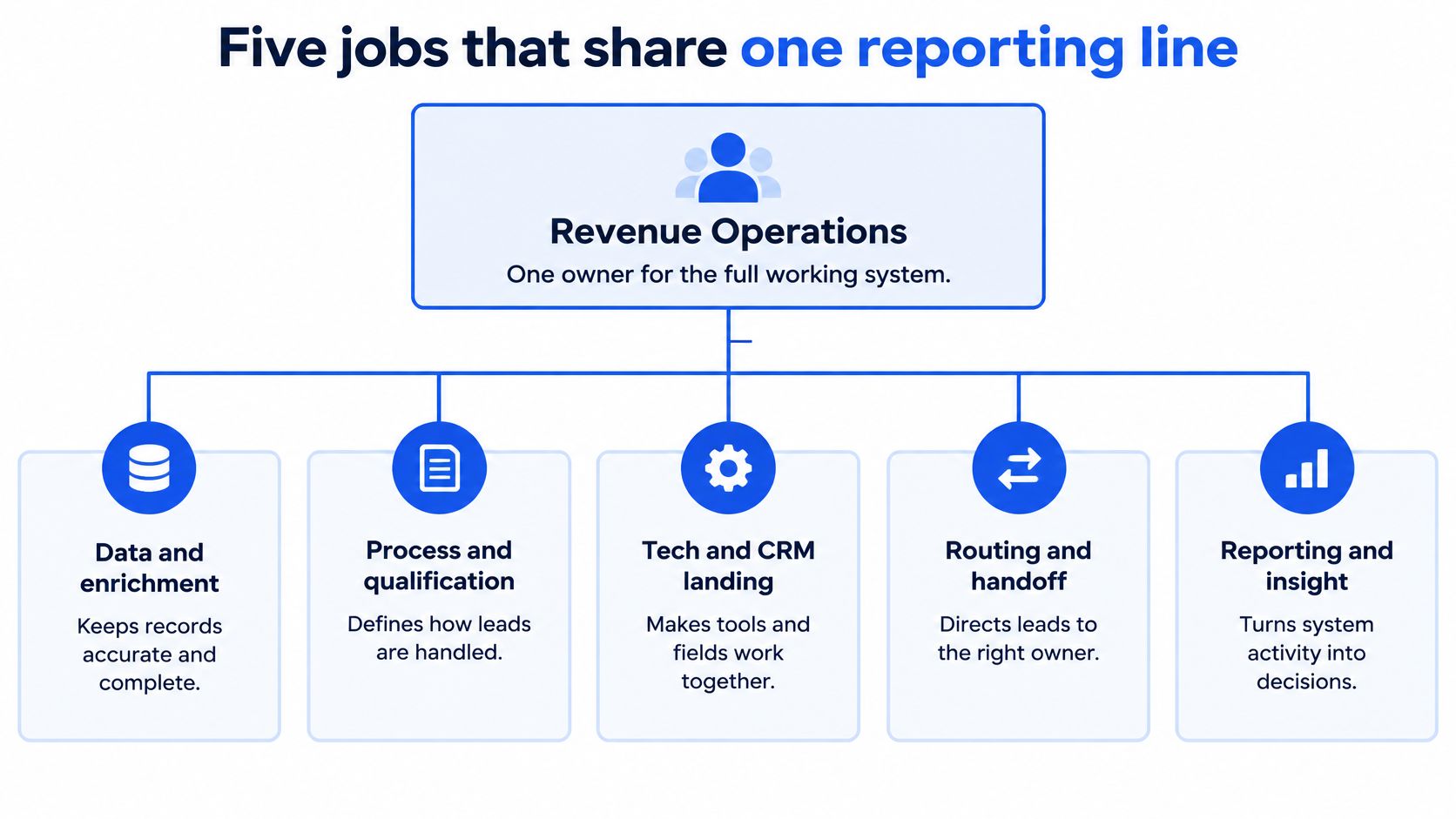
Five jobs that share one reporting line
Split these jobs across vendors without one owner, and the system will produce records and activity without reliable pipeline. Keep the ownership unified, even when specialists execute different parts.
Data and enrichment. Use Apollo, Clay, and LinkedIn Sales Navigator to build and enrich the account list. Define which source fills which field, how conflicts are resolved, and when a record is ready for routing.
Process and qualification. Agree on SQL and accepted-meeting criteria before launch. Marketing, outbound, and sales need the same rules, or the CRM will record disagreement instead of progress.
Tech and CRM landing. Instantly can support email outreach; HeyReach can support LinkedIn outreach. HubSpot, or the CRM the client already runs, remains the system of record for account, qualification, ownership, and outcome. Don't let campaign tools become competing versions of truth.
Routing and handoff. Every positive reply needs a named owner, a recorded timestamp, and a fallback when that owner is unavailable. Processing time for enrichment, deduplication, qualification, and routing is separate from a representative's response time. Report both so the team knows where latency starts.
Reporting and insight. Join LinkedIn content engagement to outbound and sales outcomes at the account level. A useful overview of go-to-market role types can help clarify who should own each responsibility as the team grows.
Add vertical rules before volume
For iGaming suppliers, put jurisdiction and licensing fields in the account model before scaling a sequence. Promote only in licensed markets, exclude minors and self-excluded individuals, and reject misleading winnings language. Those controls protect compliance and prevent the team from spending effort on ineligible prospects.
SaaS, manufacturing, legal tech, and pharma need the same five jobs, with rules suited to their own segments and buying processes. A team exploring the sales and marketing alignment system should define those rules before adding campaign volume.
No individual tool created the operating lift. The rules did: how records are enriched, where qualification is logged, and how quickly a positive reply reaches a named person, often before full qualification while the prospect is still warm.
When an agency beats in-house or a consultant
Hire an agency when nobody owns the connection between content, the target list, and outbound, and you need that work executed every week. Hire in-house when a RevOps lead already enforces definitions, routing, and reporting, and the gap is capacity. Hire a consultant when you need the model designed and your team can run the system after handoff.
An agency is the wrong buy if it only reports emails sent or meetings booked. A consultant is the wrong buy if the engagement ends with a diagram and no routing rules your team can maintain. For a wider vendor assessment, use a structured way to evaluate an agency's AI capabilities, but keep the same test: can the partner connect its work to qualified pipeline and explain its governance?
Model | Who executes weekly | Best when | Usual failure |
|---|---|---|---|
Agency | Partner team runs list work, content, outbound, and reply routing with your sales team. | No one owns the operating connections, and execution needs to keep moving. | Activity is reported without accepted pipeline or a clear handoff. |
In-house | Your employees run the model and manage day-to-day changes. | Definitions, routing, and a shared dashboard already work, but the team needs capacity. | A hire inherits unclear rules and becomes the sole owner of broken processes. |
Consultant | Your team executes after the consultant designs or repairs the system. | The problem is a contained project, and internal owners can sustain the changes. | Documentation is delivered, but nobody implements or enforces the workflow. |
GROU is one option for teams that want an executing B2B pipeline agency rather than design-only advice. It runs LinkedIn content, lead generation, and outbound around one message, one ICP list, and one reporting line, using bi-weekly sprints, a shared Slack channel, and first signals targeted inside 30 days.
That model serves companies in iGaming, SaaS, manufacturing, legal tech, and pharma, with market-specific list and compliance rules. Before choosing any partner, make the decision explicit: build internal capacity for a working system, buy weekly execution when ownership is missing, or bring in advice for a defined design problem.
Metrics that separate pipeline from activity
Put emails sent, connection requests, and meetings booked on the dashboard, but don't let them decide budget. The operating report needs separate layers for speed, quality, and coverage. That separation shows whether the system is creating accepted pipeline or merely generating motion.
Speed and quality
Track median and 90th-percentile time for capture-to-assignment and assignment-to-first human touch separately. An inbound lead-response audit found that companies contacting a lead within one hour were nearly seven times more likely to qualify it than companies waiting another hour, and more than 60 times more likely than those waiting at least a day (Harvard Business Review audit summary). The lesson is operational: measure the full handoff, not just rep activity.
For high-fit, high-intent leads, a five-minute critical-response target is a defensible starting rule, not a universal conversion promise. A study covering more than 15,000 leads reported much higher qualification odds for contact within five minutes than after 30 minutes, but its results shouldn't be treated as a guaranteed multiplier across markets (lead-response study and metrics). Separate speed-to-first-attempt from speed-to-human-conversation; an automated email isn't the same as a relevant reply.
Then report sales-accepted leads, SQLs, accepted meetings, and sourced pipeline using the definitions agreed before launch. Compare weekly cohorts by response latency, including 0–5, 6–30, 31–60, and 60+ minutes, while accounting for source, segment, region, and lead score. GROU's guide to lead generation KPIs can help frame which measures belong in that view.
Coverage and attribution
Set pipeline coverage by segment and sales-cycle risk, not by a blended company-wide ratio. One benchmark dataset recommends around 3:1 for SMB SaaS, closer to 5:1 for enterprise SaaS with longer cycles, and at least 4:1 for manufacturing, where procurement delays can sit outside a seller's control (pipeline coverage benchmarks). Flag undercoverage against the relevant threshold before increasing outbound volume.
Attribution also needs a limit. A LinkedIn post may create account awareness while an outbound sequence books the meeting, and anonymous or cross-device research may never tie cleanly to a CRM contact. Report account engagement, source of demand, and opportunity influence, then label observed data separately from modeled data. Before shifting budget, use a controlled holdout where practical rather than treating last-touch credit as proof.

What one SaaS program looked like in six months
A B2B SaaS founder in an iGaming-adjacent market was booking 3 to 4 qualified meetings a month manually, fitting prospecting around the rest of the job. The first two months didn't produce a headline result. They were spent on list building, inbox infrastructure, targeting logic, copy testing, and CRM handoff rules.

In the third month, the program booked 12 meetings, 9 qualified. The fourth month produced 17 booked, 14 qualified. By months five and six, qualified meetings stabilized at 18 to 22 a month, roughly a 5x increase from the manual baseline.
That curve depended on operating decisions, not just sequence volume. The team used one target list, agreed on qualification before launch, routed positive replies to a representative while the account was warm, and kept marketing and sales outcomes in one CRM reporting line.
Across six months, the program sourced €450k in pipeline and 4 closed deals. The average contract value paid back the engagement 8x. Those results belong to this specific client program; don't treat them as a forecast for another company's market, offer, or sales cycle.
The vertical filters mattered. An iGaming-adjacent list needs market and licensing checks before volume increases. A manufacturing or pharma team may have longer procurement steps and a different ramp, so coverage targets and response expectations should reflect that buying process rather than copy a SaaS timeline.
GROU's automotive retail SaaS market-entry case study offers another example of why target-market structure and execution belong in the same operating model.
The program's arc is also available in this video:
How to hire and what to do this week
Use your next agency call to test operational ownership, not presentation quality. Ask who owns the target list across content and outbound, and request written SQL and accepted-meeting definitions before launch. Then ask how positive replies reach a named person, what happens when that person is unavailable, and which CRM fields record ownership and lifecycle changes.
Ask for segment-specific coverage targets and a clear account of where AI is barred until the data is ready. Require timestamps for handoffs. If a partner can't show when a reply arrived, when it was assigned, and when a human first responded, you won't be able to diagnose a stall.
Compare commercial models by what they include. A retainer covering list work, content, sequences, and routing is a different purchase from a project that designs the operating model or a per-meeting fee that rewards booked calls without checking acceptance. For a broader view of lead generation agency models, keep the same standard: define the pipeline outcome and who owns each step.
This Friday, export last month's positive replies. Add two columns: hours from reply to first human touch, and whether sales later accepted the meeting. If the median exceeds an hour, fix reply ownership before buying more tools or adding headcount.
GROU is a global B2B pipeline agency trusted by 50+ companies across iGaming, SaaS, manufacturing, and professional services. Its methodology runs in bi-weekly sprints with a shared Slack channel, daily iteration, and one reporting line aimed at qualified meetings.
GROU connects LinkedIn content, lead generation, and outbound execution in one system, with shared qualification rules and reporting focused on qualified pipeline. If you want a partner to assess your handoffs and build the weekly execution around them, visit Grou to see how the model fits your team.
Your Apollo seats are active, HubSpot has the records, and outbound is running. Yet qualified meetings still depend on whoever can find an hour to chase replies. Targeting drifts, warm responses wait, and marketing and sales report different numbers for the same accounts. A revenue operations agency should own the connections between those activities, then prove its work in qualified pipeline.
One operating model should connect first touch to closed deal.
Marketing, outbound, sales, and CRM handoffs need shared definitions and reporting.
An agency beats an in-house hire when nobody owns the weekly execution across channels.
Measure response speed, lead quality, and segment-specific pipeline coverage.
Before hiring, ask who owns the list, qualification rules, routing, and reporting.
A full stack doesn't guarantee a functioning revenue system. RevOps emerged to address the coordination problems created as CRM systems centralized customer and prospect records, while teams still managed separate processes and metrics (RevOps history and operating model). The failure is usually in the connections, not the number of tools.
That's why I'd judge a partner by whether it can turn attention into qualified pipeline, not by its software list or activity volume. If you're also reviewing how your landing pages convert demand, these landing page copy optimization tips can help you inspect the message between a click and a conversation.
A good starting point is to map how records, replies, and ownership move through your current setup. GROU's RevOps tech stack guide is useful for framing that audit around the workflow rather than a shopping list.
Table of Contents
Your stack is full and pipeline still stalls
The common assumption is that another tool, more outbound volume, or one more dashboard will solve a pipeline stall. That's the wrong diagnosis when the same account appears under different definitions in marketing and sales, and no one can say who owns the next action.
RevOps is still an emerging discipline, not a standard operating structure at every company. The 2024 State of RevOps Survey found that 35% of organizations had a formal RevOps department, while 32.5% had siloed teams without a dedicated RevOps function; just 15% were classified as highly mature (2024 State of RevOps Survey and Gartner alignment findings). A stated alignment goal doesn't fix separate funnels or unclear ownership.
The practical cost shows up at the handoff. In the same Gartner findings, separate funnels were the leading source of misalignment, and lead generation was the area most negatively affected. Communication problems, incomplete account or prospect data, and insufficient processes were common barriers. Those problems don't yield to a new dashboard if nobody owns the rules behind it.
Start with the operating model, not the tool count. One target list should serve content, lead generation, and outbound. Qualification definitions should travel with the record, and reporting should show whether an account advanced toward accepted pipeline. For B2B teams, that means treating a LinkedIn post, a form fill, and a positive reply as connected signals, not separate victories.
Keep the first audit concrete: pull a sample of recent positive replies and trace each one from capture to assignment to human response. If the CRM can't show the owner and timestamps, you don't yet have the evidence to decide whether the problem is targeting, data processing, or sales follow-up.
What a revenue operations agency actually owns
A revenue operations agency should own one operating model from first touch to closed deal. That means a shared target list, shared qualification definitions, and one reporting line for marketing, outbound, and sales. It's accountable for making the handoffs work during execution, not just documenting a cleaner process after the quarter.
Many teams have already bought Apollo, a CRM, and engagement tools. The gap is that nobody owns how records move among them. Enrichment may happen after routing, a reply may land in an unmonitored inbox, and marketing and sales may count the same account differently. The agency's job is to connect the work and expose where it breaks.
GROU, for example, combines LinkedIn content, lead generation, and outbound execution around one target list and a shared measure: qualified pipeline. That model treats content as part of the account's journey, not a separate activity report. The same logic applies whether a meeting began with a post, a prospect list, or a sequence.
Before launch, agree on the qualification rules in writing:
A sales-accepted lead is defined as: ___. An SQL is defined as: ___. An accepted meeting is defined as: ___. Pipeline attribution is recorded as: ___.
These definitions give sales a basis to accept or reject handoffs, and they give marketing a consistent view of what became pipeline.
Put AI behind data ownership
AI doesn't repair data governance by itself. Recent enterprise research reported that 48% of organizations believed their revenue data wasn't AI-ready, while 42% lacked formal governance frameworks for data consistency and accountability (Clari Labs enterprise research).
Start with low-risk uses such as summarizing account activity or prioritizing tasks. Hold automated qualification, pricing recommendations, and forecasting decisions until duplicates, lifecycle stages, consent rules, enrichment provenance, and human review are controlled. If an agency can't explain who owns those fields and how errors get corrected, it's selling features before it has built an operating system.
Five jobs that share one reporting line
Split these jobs across vendors without one owner, and the system will produce records and activity without reliable pipeline. Keep the ownership unified, even when specialists execute different parts.
Data and enrichment. Use Apollo, Clay, and LinkedIn Sales Navigator to build and enrich the account list. Define which source fills which field, how conflicts are resolved, and when a record is ready for routing.
Process and qualification. Agree on SQL and accepted-meeting criteria before launch. Marketing, outbound, and sales need the same rules, or the CRM will record disagreement instead of progress.
Tech and CRM landing. Instantly can support email outreach; HeyReach can support LinkedIn outreach. HubSpot, or the CRM the client already runs, remains the system of record for account, qualification, ownership, and outcome. Don't let campaign tools become competing versions of truth.
Routing and handoff. Every positive reply needs a named owner, a recorded timestamp, and a fallback when that owner is unavailable. Processing time for enrichment, deduplication, qualification, and routing is separate from a representative's response time. Report both so the team knows where latency starts.
Reporting and insight. Join LinkedIn content engagement to outbound and sales outcomes at the account level. A useful overview of go-to-market role types can help clarify who should own each responsibility as the team grows.
Add vertical rules before volume
For iGaming suppliers, put jurisdiction and licensing fields in the account model before scaling a sequence. Promote only in licensed markets, exclude minors and self-excluded individuals, and reject misleading winnings language. Those controls protect compliance and prevent the team from spending effort on ineligible prospects.
SaaS, manufacturing, legal tech, and pharma need the same five jobs, with rules suited to their own segments and buying processes. A team exploring the sales and marketing alignment system should define those rules before adding campaign volume.
No individual tool created the operating lift. The rules did: how records are enriched, where qualification is logged, and how quickly a positive reply reaches a named person, often before full qualification while the prospect is still warm.
When an agency beats in-house or a consultant
Hire an agency when nobody owns the connection between content, the target list, and outbound, and you need that work executed every week. Hire in-house when a RevOps lead already enforces definitions, routing, and reporting, and the gap is capacity. Hire a consultant when you need the model designed and your team can run the system after handoff.
An agency is the wrong buy if it only reports emails sent or meetings booked. A consultant is the wrong buy if the engagement ends with a diagram and no routing rules your team can maintain. For a wider vendor assessment, use a structured way to evaluate an agency's AI capabilities, but keep the same test: can the partner connect its work to qualified pipeline and explain its governance?
Model | Who executes weekly | Best when | Usual failure |
|---|---|---|---|
Agency | Partner team runs list work, content, outbound, and reply routing with your sales team. | No one owns the operating connections, and execution needs to keep moving. | Activity is reported without accepted pipeline or a clear handoff. |
In-house | Your employees run the model and manage day-to-day changes. | Definitions, routing, and a shared dashboard already work, but the team needs capacity. | A hire inherits unclear rules and becomes the sole owner of broken processes. |
Consultant | Your team executes after the consultant designs or repairs the system. | The problem is a contained project, and internal owners can sustain the changes. | Documentation is delivered, but nobody implements or enforces the workflow. |
GROU is one option for teams that want an executing B2B pipeline agency rather than design-only advice. It runs LinkedIn content, lead generation, and outbound around one message, one ICP list, and one reporting line, using bi-weekly sprints, a shared Slack channel, and first signals targeted inside 30 days.
That model serves companies in iGaming, SaaS, manufacturing, legal tech, and pharma, with market-specific list and compliance rules. Before choosing any partner, make the decision explicit: build internal capacity for a working system, buy weekly execution when ownership is missing, or bring in advice for a defined design problem.
Metrics that separate pipeline from activity
Put emails sent, connection requests, and meetings booked on the dashboard, but don't let them decide budget. The operating report needs separate layers for speed, quality, and coverage. That separation shows whether the system is creating accepted pipeline or merely generating motion.
Speed and quality
Track median and 90th-percentile time for capture-to-assignment and assignment-to-first human touch separately. An inbound lead-response audit found that companies contacting a lead within one hour were nearly seven times more likely to qualify it than companies waiting another hour, and more than 60 times more likely than those waiting at least a day (Harvard Business Review audit summary). The lesson is operational: measure the full handoff, not just rep activity.
For high-fit, high-intent leads, a five-minute critical-response target is a defensible starting rule, not a universal conversion promise. A study covering more than 15,000 leads reported much higher qualification odds for contact within five minutes than after 30 minutes, but its results shouldn't be treated as a guaranteed multiplier across markets (lead-response study and metrics). Separate speed-to-first-attempt from speed-to-human-conversation; an automated email isn't the same as a relevant reply.
Then report sales-accepted leads, SQLs, accepted meetings, and sourced pipeline using the definitions agreed before launch. Compare weekly cohorts by response latency, including 0–5, 6–30, 31–60, and 60+ minutes, while accounting for source, segment, region, and lead score. GROU's guide to lead generation KPIs can help frame which measures belong in that view.
Coverage and attribution
Set pipeline coverage by segment and sales-cycle risk, not by a blended company-wide ratio. One benchmark dataset recommends around 3:1 for SMB SaaS, closer to 5:1 for enterprise SaaS with longer cycles, and at least 4:1 for manufacturing, where procurement delays can sit outside a seller's control (pipeline coverage benchmarks). Flag undercoverage against the relevant threshold before increasing outbound volume.
Attribution also needs a limit. A LinkedIn post may create account awareness while an outbound sequence books the meeting, and anonymous or cross-device research may never tie cleanly to a CRM contact. Report account engagement, source of demand, and opportunity influence, then label observed data separately from modeled data. Before shifting budget, use a controlled holdout where practical rather than treating last-touch credit as proof.
What one SaaS program looked like in six months
A B2B SaaS founder in an iGaming-adjacent market was booking 3 to 4 qualified meetings a month manually, fitting prospecting around the rest of the job. The first two months didn't produce a headline result. They were spent on list building, inbox infrastructure, targeting logic, copy testing, and CRM handoff rules.
In the third month, the program booked 12 meetings, 9 qualified. The fourth month produced 17 booked, 14 qualified. By months five and six, qualified meetings stabilized at 18 to 22 a month, roughly a 5x increase from the manual baseline.
That curve depended on operating decisions, not just sequence volume. The team used one target list, agreed on qualification before launch, routed positive replies to a representative while the account was warm, and kept marketing and sales outcomes in one CRM reporting line.
Across six months, the program sourced €450k in pipeline and 4 closed deals. The average contract value paid back the engagement 8x. Those results belong to this specific client program; don't treat them as a forecast for another company's market, offer, or sales cycle.
The vertical filters mattered. An iGaming-adjacent list needs market and licensing checks before volume increases. A manufacturing or pharma team may have longer procurement steps and a different ramp, so coverage targets and response expectations should reflect that buying process rather than copy a SaaS timeline.
GROU's automotive retail SaaS market-entry case study offers another example of why target-market structure and execution belong in the same operating model.
The program's arc is also available in this video:
How to hire and what to do this week
Use your next agency call to test operational ownership, not presentation quality. Ask who owns the target list across content and outbound, and request written SQL and accepted-meeting definitions before launch. Then ask how positive replies reach a named person, what happens when that person is unavailable, and which CRM fields record ownership and lifecycle changes.
Ask for segment-specific coverage targets and a clear account of where AI is barred until the data is ready. Require timestamps for handoffs. If a partner can't show when a reply arrived, when it was assigned, and when a human first responded, you won't be able to diagnose a stall.
Compare commercial models by what they include. A retainer covering list work, content, sequences, and routing is a different purchase from a project that designs the operating model or a per-meeting fee that rewards booked calls without checking acceptance. For a broader view of lead generation agency models, keep the same standard: define the pipeline outcome and who owns each step.
This Friday, export last month's positive replies. Add two columns: hours from reply to first human touch, and whether sales later accepted the meeting. If the median exceeds an hour, fix reply ownership before buying more tools or adding headcount.
GROU is a global B2B pipeline agency trusted by 50+ companies across iGaming, SaaS, manufacturing, and professional services. Its methodology runs in bi-weekly sprints with a shared Slack channel, daily iteration, and one reporting line aimed at qualified meetings.
GROU connects LinkedIn content, lead generation, and outbound execution in one system, with shared qualification rules and reporting focused on qualified pipeline. If you want a partner to assess your handoffs and build the weekly execution around them, visit Grou to see how the model fits your team.
Pipeline OS Newsletter
Build qualified pipeline
Get weekly tactics to generate demand, improve lead quality, and book more meetings.





Trusted by industry leaders
Trusted by industry leaders
Trusted by industry leaders
Ready to build qualified pipeline?
Ready to build qualified pipeline?
Ready to build qualified pipeline?
Book a call to see if we're the right fit, or take the 2-minute quiz to get a clear starting point.
Book a call to see if we're the right fit, or take the 2-minute quiz to get a clear starting point.
Book a call to see if we're the right fit, or take the 2-minute quiz to get a clear starting point.
" height="30.21639343089746px" id="hfGbXmQR2" width="30.216393430897455px"/></svg>)
Copyright © 2026 – All Right Reserved
Copyright © 2026 – All Right Reserved
Copyright © 2026 – All Right Reserved