%22%3E%3C/path%3E%3Cpath d=%22M 63.072 7.554 C 62.258 8.022 61.577 8.689 61.092 9.493 L 61.092 7.076 L 57.158 7.076 L 57.158 22.64 L 61.089 22.64 L 61.089 14.888 C 61.089 13.446 61.403 12.434 62.03 11.853 C 62.818 11.218 63.818 10.907 64.826 10.982 L 65.868 10.982 L 65.868 6.851 C 64.891 6.834 63.926 7.076 63.073 7.554 Z%22 fill=%22rgb(17,17,17)%22%3E%3C/path%3E%3Cpath d=%22M 78.916 7.82 C 76.363 6.49 73.321 6.49 70.768 7.82 C 69.562 8.473 68.564 9.451 67.888 10.644 C 67.167 11.931 66.803 13.387 66.834 14.862 C 66.804 16.332 67.157 17.785 67.86 19.077 C 68.515 20.267 69.494 21.246 70.684 21.901 C 71.924 22.576 73.318 22.92 74.73 22.898 C 76.164 22.918 77.58 22.575 78.846 21.901 C 80.062 21.247 81.073 20.27 81.768 19.077 C 82.506 17.797 82.88 16.339 82.85 14.862 C 82.88 13.389 82.517 11.934 81.797 10.647 C 81.12 9.455 80.122 8.477 78.917 7.824 M 78.803 14.862 C 78.829 15.739 78.636 16.608 78.241 17.391 C 77.903 18.046 77.38 18.588 76.738 18.95 C 76.124 19.293 75.432 19.472 74.729 19.47 C 73.668 19.497 72.648 19.061 71.934 18.276 C 71.139 17.323 70.741 16.1 70.823 14.862 C 70.741 13.62 71.149 12.395 71.959 11.45 C 72.687 10.667 73.715 10.233 74.783 10.256 C 75.859 10.236 76.894 10.67 77.635 11.45 C 78.464 12.387 78.884 13.616 78.801 14.864%22 fill=%22rgb(17,17,17)%22%3E%3C/path%3E%3Cpath d=%22M 95.906 7.076 L 95.906 15.646 C 95.975 16.68 95.643 17.701 94.979 18.498 C 94.311 19.184 93.379 19.547 92.422 19.495 C 91.475 19.544 90.553 19.18 89.894 18.498 C 89.23 17.701 88.898 16.68 88.967 15.646 L 88.967 7.076 L 85.033 7.076 L 85.033 16.207 C 85 17.449 85.275 18.68 85.834 19.79 C 86.327 20.75 87.095 21.542 88.039 22.065 C 89.033 22.594 90.145 22.861 91.271 22.838 C 92.188 22.847 93.095 22.65 93.926 22.263 C 94.708 21.905 95.388 21.36 95.906 20.675 L 95.906 22.645 L 99.865 22.645 L 99.865 7.076 Z%22 fill=%22rgb(17,17,17)%22%3E%3C/path%3E%3Cpath d=%22M 4.513 15.626 C 4.511 10.815 7.606 6.549 12.181 5.059 C 16.756 3.57 21.77 5.195 24.601 9.086 L 27.816 5.87 C 24.074 1.186 17.981 -0.943 12.137 0.393 C 6.292 1.728 1.728 6.292 0.393 12.137 C -0.943 17.981 1.186 24.074 5.87 27.816 L 9.085 24.601 C 6.214 22.512 4.515 19.177 4.513 15.626%22 fill=%22rgb(32,62,235)%22%3E%3C/path%3E%3Cpath d=%22M 17.114 14.343 L 13.354 18.01 L 13.354 18.026 L 21.071 18.026 L 11.412 27.609 L 17.389 27.609 L 23.999 21.081 L 23.999 28.316 L 24.005 28.316 L 27.967 24.393 L 27.967 14.343 Z%22 fill=%22rgb(32,62,235)%22%3E%3C/path%3E%3C/g%3E%3C/svg%3E) ×
× ××
××›
›
›
›
Similarweb pricing 2026
Similarweb pricing 2026
Similarweb pricing 2026
Similarweb pricing 2026
Similarweb pricing 2026
Similarweb pricing 2026

Author
Aljaz Peklaj

Similarweb does not publish a price list. Its pricing page routes to sales, and the only figure we could find on it sat in the page's own meta description rather than on the page itself.
Which would normally be the end of a pricing article. Except that Similarweb is a listed company, and listed companies have to tell their investors what customers actually pay.
TL;DR
The advertised entry point is $125 a month, which appears in the pricing page metadata rather than in a table on the page. Three self-serve packages exist for individuals and small teams and can be bought on a credit card. Everything above that is Similarweb for Businesses and routes to a sales conversation. Now the numbers the company reports to investors. Full year 2025 revenue was $282.6 million across 6,128 customers as of 31 December 2025, which works out at roughly $46,000 of revenue per customer for the year. That is around thirty times the advertised entry price. 454 of those customers, about 7.4%, were paying annual recurring revenue of $100,000 or more, and by 31 March 2026 that figure had grown to 461. 60% of overall ARR was contracted under multi-year subscriptions as of 31 December 2025, up from 49% a year earlier. The dollar-based net retention rate for the $100,000-plus cohort was 103% in the fourth quarter of 2025, down from 112% a year earlier. Treat the $125 figure as the door, not the room, and go into any sales conversation knowing what the average customer is worth to them.
What Similarweb actually publishes
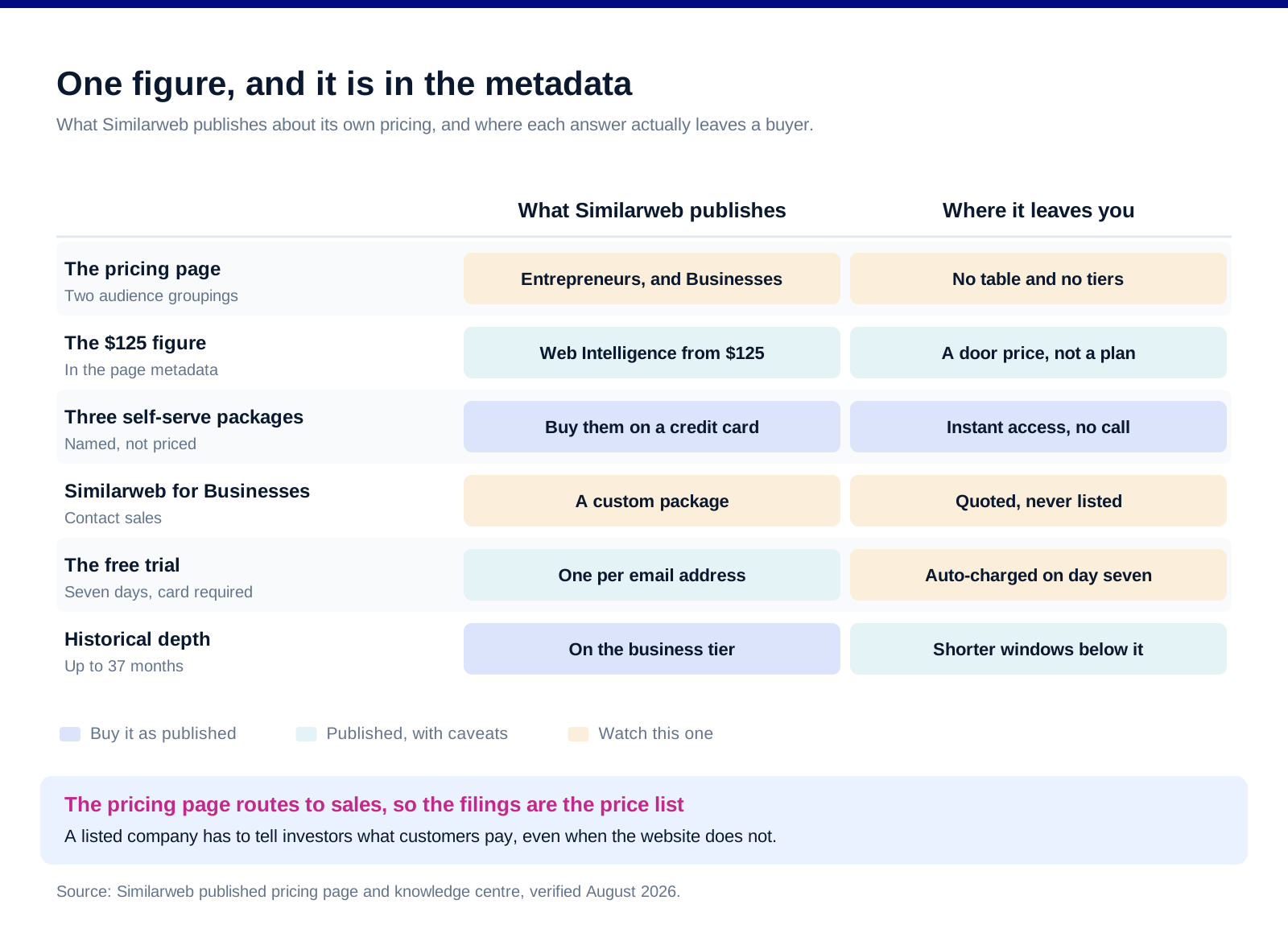
The pricing page does not carry a price table. Similarweb's pricing page presents two audience groupings, "Entrepreneurs" and "Businesses & Enterprises", and tells you that "If you're interested in our solutions for businesses and enterprises, please contact our sales team to discuss a custom package tailored to your needs."
The one figure that exists is in the metadata. The page's meta description states "Web Intelligence plans from $125/mo". That is a real published figure and we report it as such, while noting that it is not presented in the page body as a plan price.
Three self-serve packages are documented, and they have names. Similarweb's packages documentation describes Competitive Intelligence for "Solo marketers, consultants, and entrepreneurs", Competitive Intelligence and SEO for "Marketers and small teams focused on organic growth", and a Competitive Intelligence, SEO and PPC package marked as coming soon for "Growing marketing teams and digital entrepreneurs".
Those three you can buy without talking to anyone. The documentation states that individuals and small teams can sign up with a credit card and get instant access, while the business packages are sales-led.
Similarweb for Businesses is the sales-led tier. Described as being for "Mid-size and large businesses managing multiple products, markets, or geographies", with AI brand visibility, AI agents, ad intelligence, API and MCP server access, and deep historical data "up to 37 months".
The trial is seven days and takes a card. Similarweb's trial documentation states a "7 day free trial", one per email address, and that "The credit card used to sign up will automatically be charged after your trial ends."
What customers actually pay
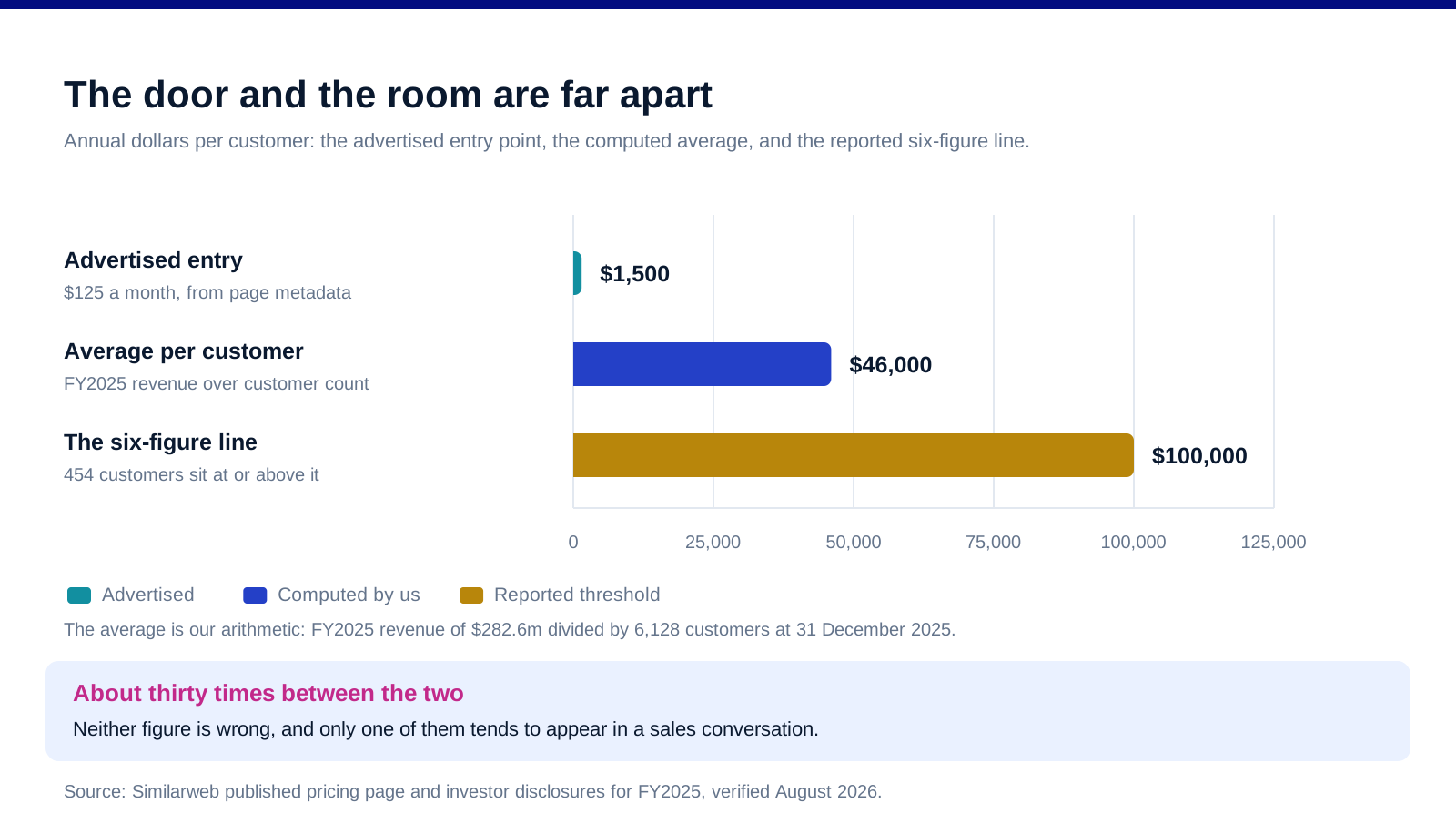
The company reports revenue and customer count, so the average is computable. Similarweb's full year 2025 results state "Total revenue was $282.6 million, an increase of 13% compared to $249.9 million" and "Number of customers reached 6,128 as of December 31, 2025, an increase of 11% compared to December 31, 2024."
Which puts average revenue per customer at roughly $46,000 for the year. That is our arithmetic on their published figures, and it is a rough one: the customer count grew 11% during the year, so dividing full-year revenue by the year-end count understates the true average slightly. The order of magnitude is the point.
Against an advertised entry of $1,500 a year. $125 a month annualised is $1,500. The average customer is paying something in the region of thirty times that. Neither number is wrong and both are worth carrying into a sales conversation.
The top of the base is documented precisely. The same release states that the "Number of customers with annual recurring revenue (ARR) of $100,000 or more grew to 454 as of December 31, 2025, an increase of 12% year-over-year." By the first quarter of 2026 that figure was 461, with quarterly revenue of $73.9 million.
454 out of 6,128 is about 7.4% of customers. At a minimum of $100,000 each they represent at least $45.4 million of annual recurring revenue, which is at least 16% of full year revenue coming from under 8% of customers. That is a floor rather than an estimate, because we only know the threshold, not what those accounts actually pay.
The practical read is that this is an enterprise product with a self-serve doorway. Not a fault, but it explains why the pricing page behaves the way it does, and why the quote you receive will be shaped by which of those two populations the salesperson thinks you belong to.
What the contract looks like
Most of the money is multi-year now. The full year 2025 release states that "60% of our overall ARR is contracted under multi-year subscriptions as of December 31, 2025, up from 49% a year ago". That is a large shift in twelve months and it tells you what will be pushed in your negotiation.
Expect the multi-year ask, and price it. A longer commitment is a real concession from you, so it should buy something specific: a lower annual rate, more seats, more markets, or a break clause. Trading it for nothing is the most common mistake in this category.
Retention in the large-account cohort has softened. The dollar-based net retention rate for customers at $100,000 or more "was 103% in the fourth quarter of 2025, compared to 112% in the fourth quarter of 2024". A number close to 100% means that cohort is roughly flat on a net basis rather than expanding.
Which is context, not leverage on its own. It says something about how the category is behaving, and it is the kind of thing worth knowing before you are told that everyone is expanding their contract.
And it explains the multi-year push. When net expansion slows, contracted duration is the other lever available, which is consistent with the 49% to 60% move.
What is likely to drive your quote
Scope, in the plainest sense. Markets, domains, competitor sets and product lines. This is a product priced on how much of the world you want to look at.
History. The business tier is documented as offering up to 37 months of historical data, which implies shorter windows below it.
API and integration access. Programmatic access is listed as a business tier capability, so if you need data flowing into your own systems you are in a sales conversation by definition.
Seats. Standard for the category and worth pinning down early, because seat creep is how a manageable annual figure becomes an unmanageable one at renewal.
Which products. Web Intelligence, Retail Intelligence and Sales Intelligence are separate platforms with separate trials, so confirm what your quote actually covers before comparing it to anything.
How to buy this well
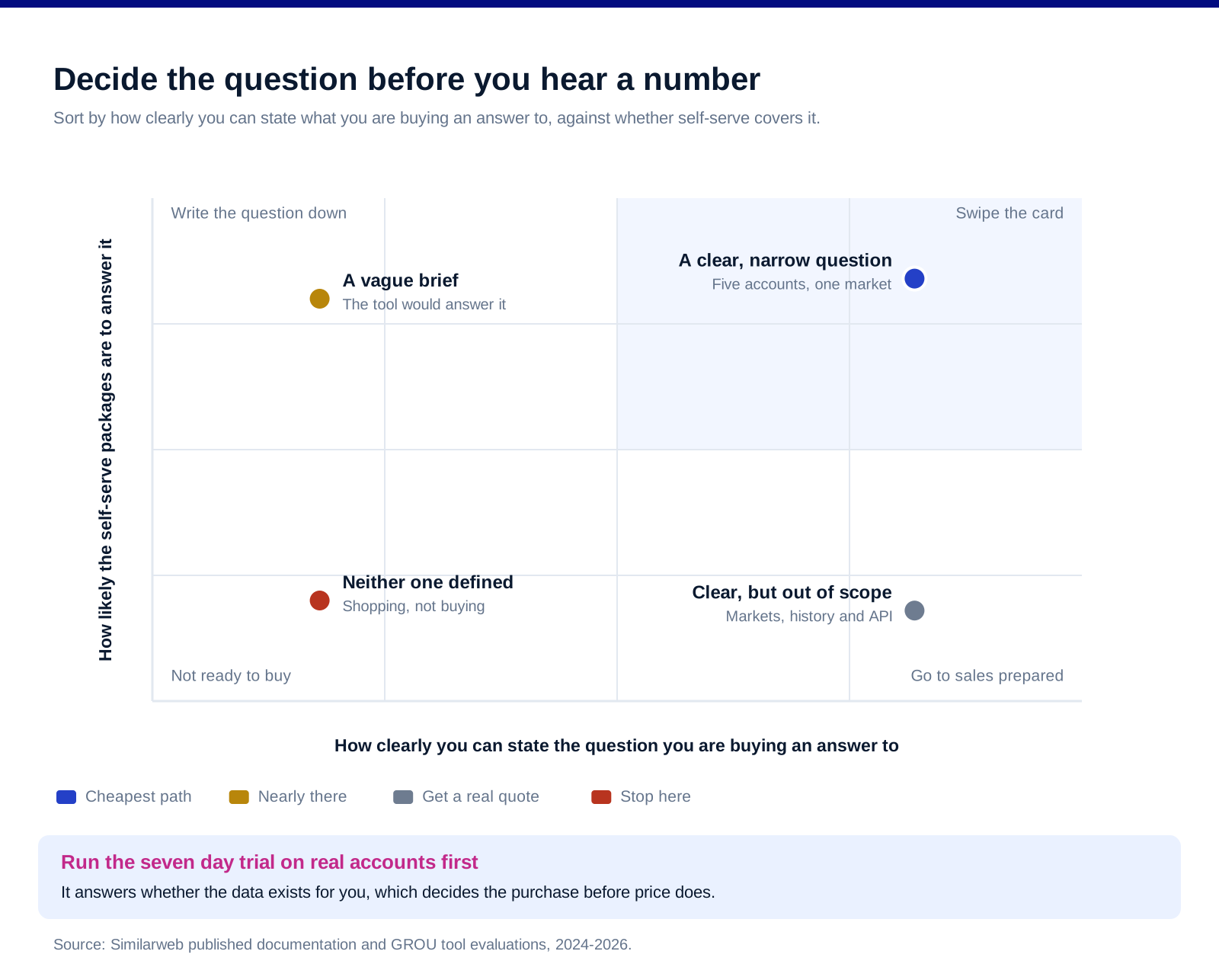
Run the seven day trial with a real question first. Not a tour. Pick five accounts or competitors you actually care about and see whether the data exists at all, which our Similarweb review covers in detail because there are published thresholds below which nothing displays.
Cancel before day seven if it does not answer. The card is charged automatically, which is documented, and there is one trial per email address.
Ask what the entry business package costs before describing your whole roadmap. The order of that conversation matters more in sales-led pricing than most buyers expect.
Get the renewal uplift cap in writing. Not the discount. The discount is the easy part and the uplift is the expensive part.
And decide what you would pay before you hear a number. Nielsen Norman Group's research on business buyers found that "participants go to competitors' sites when websites do not show prices" and that "People view companies that hide costs as being evasive and untrustworthy", which is the general case our pricing page piece covers. The specific case is that you are negotiating without an anchor unless you set one yourself.
What Similarweb does not publish
Any plan price in the body of the pricing page. The only figure is in the metadata.
What the three self-serve packages cost individually. Named and described, not priced, in the documentation we could read.
Seat, domain, market or keyword limits per package. Not stated in the material we could access.
Average contract value or median customer spend. The investor releases give revenue, customer counts and a $100,000 threshold, which is enough to compute an average but not a distribution.
What happens to your rate at renewal. Standard for the category and the single thing most worth negotiating.
FAQ
How much does Similarweb cost?
The advertised entry point is $125 a month, which appears in the pricing page's meta description rather than in a plan table. Above the self-serve packages, pricing is quoted by sales. For context, Similarweb reported $282.6 million of revenue for 2025 across 6,128 customers, which averages roughly $46,000 per customer for the year.
Does Similarweb publish its pricing?
Not in a usable form. The pricing page presents two audience groupings and directs businesses and enterprises to contact sales for "a custom package tailored to your needs". Three self-serve packages are named in the documentation and can be bought on a credit card, but their individual prices are not published there.
Is there a Similarweb free trial?
Yes, seven days, one per email address, and it requires a credit card that "will automatically be charged after your trial ends". Trials are available separately for Web Intelligence, Retail Intelligence and Sales Intelligence, and you cannot switch between trial types once started.
What do enterprise customers pay for Similarweb?
Similarweb reports the number of customers with annual recurring revenue of $100,000 or more rather than a price. That figure was 454 as of 31 December 2025 and 461 as of 31 March 2026, out of 6,128 total customers at the end of 2025. So roughly 7.4% of the base sits at six figures or above.
Should you take a multi-year Similarweb contract?
Only if it buys something. Similarweb states that 60% of overall ARR was contracted under multi-year subscriptions as of the end of 2025, up from 49% a year earlier, so the ask is likely. A longer term is a genuine concession from you and should be traded for a lower rate, more scope, or a break clause rather than given away.
Is Similarweb worth the price?
That depends on whether the accounts you care about clear its published data thresholds, which is a question you can answer free in the web interface before any conversation about money. If your questions are about markets and large properties it is a strong product. If they are about individual mid-market prospects, the price is not the reason to say no.
Bottom line
The honest summary of Similarweb pricing is that there are two products behind one page. There is a self-serve doorway you can walk through on a card for something in the region of $1,500 a year, and there is an enterprise product where the average customer pays around thirty times that and 7.4% of the base pays six figures. Neither of those facts appears on the pricing page and both come from the company's own disclosures. Use the seven day trial to answer whether the data exists for your accounts before you spend a minute on commercial conversations, decide your own number before you hear theirs, and treat the multi-year ask as something to sell rather than something to accept. The company is telling its investors what this costs. It is worth reading that before you read the sales deck.
Want the pipeline built rather than the competitor dashboard priced? Book a call with GROU. We run lead generation and outbound inside B2B revenue engines across verticals. If the number lands badly, our Similarweb alternatives piece covers what else answers the same questions.
We are GROU, a B2B pipeline agency that runs lead generation, outbound, and LinkedIn content for clients across manufacturing, fintech, iGaming, software, and professional services. Some links in this article are affiliate links, including Similarweb. Every figure here comes from Similarweb's own pricing page, documentation or investor disclosures, and the average revenue per customer is our arithmetic on their published numbers rather than a figure they publish.
Similarweb does not publish a price list. Its pricing page routes to sales, and the only figure we could find on it sat in the page's own meta description rather than on the page itself.
Which would normally be the end of a pricing article. Except that Similarweb is a listed company, and listed companies have to tell their investors what customers actually pay.
TL;DR
The advertised entry point is $125 a month, which appears in the pricing page metadata rather than in a table on the page. Three self-serve packages exist for individuals and small teams and can be bought on a credit card. Everything above that is Similarweb for Businesses and routes to a sales conversation. Now the numbers the company reports to investors. Full year 2025 revenue was $282.6 million across 6,128 customers as of 31 December 2025, which works out at roughly $46,000 of revenue per customer for the year. That is around thirty times the advertised entry price. 454 of those customers, about 7.4%, were paying annual recurring revenue of $100,000 or more, and by 31 March 2026 that figure had grown to 461. 60% of overall ARR was contracted under multi-year subscriptions as of 31 December 2025, up from 49% a year earlier. The dollar-based net retention rate for the $100,000-plus cohort was 103% in the fourth quarter of 2025, down from 112% a year earlier. Treat the $125 figure as the door, not the room, and go into any sales conversation knowing what the average customer is worth to them.
What Similarweb actually publishes
The pricing page does not carry a price table. Similarweb's pricing page presents two audience groupings, "Entrepreneurs" and "Businesses & Enterprises", and tells you that "If you're interested in our solutions for businesses and enterprises, please contact our sales team to discuss a custom package tailored to your needs."
The one figure that exists is in the metadata. The page's meta description states "Web Intelligence plans from $125/mo". That is a real published figure and we report it as such, while noting that it is not presented in the page body as a plan price.
Three self-serve packages are documented, and they have names. Similarweb's packages documentation describes Competitive Intelligence for "Solo marketers, consultants, and entrepreneurs", Competitive Intelligence and SEO for "Marketers and small teams focused on organic growth", and a Competitive Intelligence, SEO and PPC package marked as coming soon for "Growing marketing teams and digital entrepreneurs".
Those three you can buy without talking to anyone. The documentation states that individuals and small teams can sign up with a credit card and get instant access, while the business packages are sales-led.
Similarweb for Businesses is the sales-led tier. Described as being for "Mid-size and large businesses managing multiple products, markets, or geographies", with AI brand visibility, AI agents, ad intelligence, API and MCP server access, and deep historical data "up to 37 months".
The trial is seven days and takes a card. Similarweb's trial documentation states a "7 day free trial", one per email address, and that "The credit card used to sign up will automatically be charged after your trial ends."
What customers actually pay
The company reports revenue and customer count, so the average is computable. Similarweb's full year 2025 results state "Total revenue was $282.6 million, an increase of 13% compared to $249.9 million" and "Number of customers reached 6,128 as of December 31, 2025, an increase of 11% compared to December 31, 2024."
Which puts average revenue per customer at roughly $46,000 for the year. That is our arithmetic on their published figures, and it is a rough one: the customer count grew 11% during the year, so dividing full-year revenue by the year-end count understates the true average slightly. The order of magnitude is the point.
Against an advertised entry of $1,500 a year. $125 a month annualised is $1,500. The average customer is paying something in the region of thirty times that. Neither number is wrong and both are worth carrying into a sales conversation.
The top of the base is documented precisely. The same release states that the "Number of customers with annual recurring revenue (ARR) of $100,000 or more grew to 454 as of December 31, 2025, an increase of 12% year-over-year." By the first quarter of 2026 that figure was 461, with quarterly revenue of $73.9 million.
454 out of 6,128 is about 7.4% of customers. At a minimum of $100,000 each they represent at least $45.4 million of annual recurring revenue, which is at least 16% of full year revenue coming from under 8% of customers. That is a floor rather than an estimate, because we only know the threshold, not what those accounts actually pay.
The practical read is that this is an enterprise product with a self-serve doorway. Not a fault, but it explains why the pricing page behaves the way it does, and why the quote you receive will be shaped by which of those two populations the salesperson thinks you belong to.
What the contract looks like
Most of the money is multi-year now. The full year 2025 release states that "60% of our overall ARR is contracted under multi-year subscriptions as of December 31, 2025, up from 49% a year ago". That is a large shift in twelve months and it tells you what will be pushed in your negotiation.
Expect the multi-year ask, and price it. A longer commitment is a real concession from you, so it should buy something specific: a lower annual rate, more seats, more markets, or a break clause. Trading it for nothing is the most common mistake in this category.
Retention in the large-account cohort has softened. The dollar-based net retention rate for customers at $100,000 or more "was 103% in the fourth quarter of 2025, compared to 112% in the fourth quarter of 2024". A number close to 100% means that cohort is roughly flat on a net basis rather than expanding.
Which is context, not leverage on its own. It says something about how the category is behaving, and it is the kind of thing worth knowing before you are told that everyone is expanding their contract.
And it explains the multi-year push. When net expansion slows, contracted duration is the other lever available, which is consistent with the 49% to 60% move.
What is likely to drive your quote
Scope, in the plainest sense. Markets, domains, competitor sets and product lines. This is a product priced on how much of the world you want to look at.
History. The business tier is documented as offering up to 37 months of historical data, which implies shorter windows below it.
API and integration access. Programmatic access is listed as a business tier capability, so if you need data flowing into your own systems you are in a sales conversation by definition.
Seats. Standard for the category and worth pinning down early, because seat creep is how a manageable annual figure becomes an unmanageable one at renewal.
Which products. Web Intelligence, Retail Intelligence and Sales Intelligence are separate platforms with separate trials, so confirm what your quote actually covers before comparing it to anything.
How to buy this well
Run the seven day trial with a real question first. Not a tour. Pick five accounts or competitors you actually care about and see whether the data exists at all, which our Similarweb review covers in detail because there are published thresholds below which nothing displays.
Cancel before day seven if it does not answer. The card is charged automatically, which is documented, and there is one trial per email address.
Ask what the entry business package costs before describing your whole roadmap. The order of that conversation matters more in sales-led pricing than most buyers expect.
Get the renewal uplift cap in writing. Not the discount. The discount is the easy part and the uplift is the expensive part.
And decide what you would pay before you hear a number. Nielsen Norman Group's research on business buyers found that "participants go to competitors' sites when websites do not show prices" and that "People view companies that hide costs as being evasive and untrustworthy", which is the general case our pricing page piece covers. The specific case is that you are negotiating without an anchor unless you set one yourself.
What Similarweb does not publish
Any plan price in the body of the pricing page. The only figure is in the metadata.
What the three self-serve packages cost individually. Named and described, not priced, in the documentation we could read.
Seat, domain, market or keyword limits per package. Not stated in the material we could access.
Average contract value or median customer spend. The investor releases give revenue, customer counts and a $100,000 threshold, which is enough to compute an average but not a distribution.
What happens to your rate at renewal. Standard for the category and the single thing most worth negotiating.
FAQ
How much does Similarweb cost?
The advertised entry point is $125 a month, which appears in the pricing page's meta description rather than in a plan table. Above the self-serve packages, pricing is quoted by sales. For context, Similarweb reported $282.6 million of revenue for 2025 across 6,128 customers, which averages roughly $46,000 per customer for the year.
Does Similarweb publish its pricing?
Not in a usable form. The pricing page presents two audience groupings and directs businesses and enterprises to contact sales for "a custom package tailored to your needs". Three self-serve packages are named in the documentation and can be bought on a credit card, but their individual prices are not published there.
Is there a Similarweb free trial?
Yes, seven days, one per email address, and it requires a credit card that "will automatically be charged after your trial ends". Trials are available separately for Web Intelligence, Retail Intelligence and Sales Intelligence, and you cannot switch between trial types once started.
What do enterprise customers pay for Similarweb?
Similarweb reports the number of customers with annual recurring revenue of $100,000 or more rather than a price. That figure was 454 as of 31 December 2025 and 461 as of 31 March 2026, out of 6,128 total customers at the end of 2025. So roughly 7.4% of the base sits at six figures or above.
Should you take a multi-year Similarweb contract?
Only if it buys something. Similarweb states that 60% of overall ARR was contracted under multi-year subscriptions as of the end of 2025, up from 49% a year earlier, so the ask is likely. A longer term is a genuine concession from you and should be traded for a lower rate, more scope, or a break clause rather than given away.
Is Similarweb worth the price?
That depends on whether the accounts you care about clear its published data thresholds, which is a question you can answer free in the web interface before any conversation about money. If your questions are about markets and large properties it is a strong product. If they are about individual mid-market prospects, the price is not the reason to say no.
Bottom line
The honest summary of Similarweb pricing is that there are two products behind one page. There is a self-serve doorway you can walk through on a card for something in the region of $1,500 a year, and there is an enterprise product where the average customer pays around thirty times that and 7.4% of the base pays six figures. Neither of those facts appears on the pricing page and both come from the company's own disclosures. Use the seven day trial to answer whether the data exists for your accounts before you spend a minute on commercial conversations, decide your own number before you hear theirs, and treat the multi-year ask as something to sell rather than something to accept. The company is telling its investors what this costs. It is worth reading that before you read the sales deck.
Want the pipeline built rather than the competitor dashboard priced? Book a call with GROU. We run lead generation and outbound inside B2B revenue engines across verticals. If the number lands badly, our Similarweb alternatives piece covers what else answers the same questions.
We are GROU, a B2B pipeline agency that runs lead generation, outbound, and LinkedIn content for clients across manufacturing, fintech, iGaming, software, and professional services. Some links in this article are affiliate links, including Similarweb. Every figure here comes from Similarweb's own pricing page, documentation or investor disclosures, and the average revenue per customer is our arithmetic on their published numbers rather than a figure they publish.
Similarweb does not publish a price list. Its pricing page routes to sales, and the only figure we could find on it sat in the page's own meta description rather than on the page itself.
Which would normally be the end of a pricing article. Except that Similarweb is a listed company, and listed companies have to tell their investors what customers actually pay.
TL;DR
The advertised entry point is $125 a month, which appears in the pricing page metadata rather than in a table on the page. Three self-serve packages exist for individuals and small teams and can be bought on a credit card. Everything above that is Similarweb for Businesses and routes to a sales conversation. Now the numbers the company reports to investors. Full year 2025 revenue was $282.6 million across 6,128 customers as of 31 December 2025, which works out at roughly $46,000 of revenue per customer for the year. That is around thirty times the advertised entry price. 454 of those customers, about 7.4%, were paying annual recurring revenue of $100,000 or more, and by 31 March 2026 that figure had grown to 461. 60% of overall ARR was contracted under multi-year subscriptions as of 31 December 2025, up from 49% a year earlier. The dollar-based net retention rate for the $100,000-plus cohort was 103% in the fourth quarter of 2025, down from 112% a year earlier. Treat the $125 figure as the door, not the room, and go into any sales conversation knowing what the average customer is worth to them.
What Similarweb actually publishes
The pricing page does not carry a price table. Similarweb's pricing page presents two audience groupings, "Entrepreneurs" and "Businesses & Enterprises", and tells you that "If you're interested in our solutions for businesses and enterprises, please contact our sales team to discuss a custom package tailored to your needs."
The one figure that exists is in the metadata. The page's meta description states "Web Intelligence plans from $125/mo". That is a real published figure and we report it as such, while noting that it is not presented in the page body as a plan price.
Three self-serve packages are documented, and they have names. Similarweb's packages documentation describes Competitive Intelligence for "Solo marketers, consultants, and entrepreneurs", Competitive Intelligence and SEO for "Marketers and small teams focused on organic growth", and a Competitive Intelligence, SEO and PPC package marked as coming soon for "Growing marketing teams and digital entrepreneurs".
Those three you can buy without talking to anyone. The documentation states that individuals and small teams can sign up with a credit card and get instant access, while the business packages are sales-led.
Similarweb for Businesses is the sales-led tier. Described as being for "Mid-size and large businesses managing multiple products, markets, or geographies", with AI brand visibility, AI agents, ad intelligence, API and MCP server access, and deep historical data "up to 37 months".
The trial is seven days and takes a card. Similarweb's trial documentation states a "7 day free trial", one per email address, and that "The credit card used to sign up will automatically be charged after your trial ends."
What customers actually pay
The company reports revenue and customer count, so the average is computable. Similarweb's full year 2025 results state "Total revenue was $282.6 million, an increase of 13% compared to $249.9 million" and "Number of customers reached 6,128 as of December 31, 2025, an increase of 11% compared to December 31, 2024."
Which puts average revenue per customer at roughly $46,000 for the year. That is our arithmetic on their published figures, and it is a rough one: the customer count grew 11% during the year, so dividing full-year revenue by the year-end count understates the true average slightly. The order of magnitude is the point.
Against an advertised entry of $1,500 a year. $125 a month annualised is $1,500. The average customer is paying something in the region of thirty times that. Neither number is wrong and both are worth carrying into a sales conversation.
The top of the base is documented precisely. The same release states that the "Number of customers with annual recurring revenue (ARR) of $100,000 or more grew to 454 as of December 31, 2025, an increase of 12% year-over-year." By the first quarter of 2026 that figure was 461, with quarterly revenue of $73.9 million.
454 out of 6,128 is about 7.4% of customers. At a minimum of $100,000 each they represent at least $45.4 million of annual recurring revenue, which is at least 16% of full year revenue coming from under 8% of customers. That is a floor rather than an estimate, because we only know the threshold, not what those accounts actually pay.
The practical read is that this is an enterprise product with a self-serve doorway. Not a fault, but it explains why the pricing page behaves the way it does, and why the quote you receive will be shaped by which of those two populations the salesperson thinks you belong to.
What the contract looks like
Most of the money is multi-year now. The full year 2025 release states that "60% of our overall ARR is contracted under multi-year subscriptions as of December 31, 2025, up from 49% a year ago". That is a large shift in twelve months and it tells you what will be pushed in your negotiation.
Expect the multi-year ask, and price it. A longer commitment is a real concession from you, so it should buy something specific: a lower annual rate, more seats, more markets, or a break clause. Trading it for nothing is the most common mistake in this category.
Retention in the large-account cohort has softened. The dollar-based net retention rate for customers at $100,000 or more "was 103% in the fourth quarter of 2025, compared to 112% in the fourth quarter of 2024". A number close to 100% means that cohort is roughly flat on a net basis rather than expanding.
Which is context, not leverage on its own. It says something about how the category is behaving, and it is the kind of thing worth knowing before you are told that everyone is expanding their contract.
And it explains the multi-year push. When net expansion slows, contracted duration is the other lever available, which is consistent with the 49% to 60% move.
What is likely to drive your quote
Scope, in the plainest sense. Markets, domains, competitor sets and product lines. This is a product priced on how much of the world you want to look at.
History. The business tier is documented as offering up to 37 months of historical data, which implies shorter windows below it.
API and integration access. Programmatic access is listed as a business tier capability, so if you need data flowing into your own systems you are in a sales conversation by definition.
Seats. Standard for the category and worth pinning down early, because seat creep is how a manageable annual figure becomes an unmanageable one at renewal.
Which products. Web Intelligence, Retail Intelligence and Sales Intelligence are separate platforms with separate trials, so confirm what your quote actually covers before comparing it to anything.
How to buy this well
Run the seven day trial with a real question first. Not a tour. Pick five accounts or competitors you actually care about and see whether the data exists at all, which our Similarweb review covers in detail because there are published thresholds below which nothing displays.
Cancel before day seven if it does not answer. The card is charged automatically, which is documented, and there is one trial per email address.
Ask what the entry business package costs before describing your whole roadmap. The order of that conversation matters more in sales-led pricing than most buyers expect.
Get the renewal uplift cap in writing. Not the discount. The discount is the easy part and the uplift is the expensive part.
And decide what you would pay before you hear a number. Nielsen Norman Group's research on business buyers found that "participants go to competitors' sites when websites do not show prices" and that "People view companies that hide costs as being evasive and untrustworthy", which is the general case our pricing page piece covers. The specific case is that you are negotiating without an anchor unless you set one yourself.
What Similarweb does not publish
Any plan price in the body of the pricing page. The only figure is in the metadata.
What the three self-serve packages cost individually. Named and described, not priced, in the documentation we could read.
Seat, domain, market or keyword limits per package. Not stated in the material we could access.
Average contract value or median customer spend. The investor releases give revenue, customer counts and a $100,000 threshold, which is enough to compute an average but not a distribution.
What happens to your rate at renewal. Standard for the category and the single thing most worth negotiating.
FAQ
How much does Similarweb cost?
The advertised entry point is $125 a month, which appears in the pricing page's meta description rather than in a plan table. Above the self-serve packages, pricing is quoted by sales. For context, Similarweb reported $282.6 million of revenue for 2025 across 6,128 customers, which averages roughly $46,000 per customer for the year.
Does Similarweb publish its pricing?
Not in a usable form. The pricing page presents two audience groupings and directs businesses and enterprises to contact sales for "a custom package tailored to your needs". Three self-serve packages are named in the documentation and can be bought on a credit card, but their individual prices are not published there.
Is there a Similarweb free trial?
Yes, seven days, one per email address, and it requires a credit card that "will automatically be charged after your trial ends". Trials are available separately for Web Intelligence, Retail Intelligence and Sales Intelligence, and you cannot switch between trial types once started.
What do enterprise customers pay for Similarweb?
Similarweb reports the number of customers with annual recurring revenue of $100,000 or more rather than a price. That figure was 454 as of 31 December 2025 and 461 as of 31 March 2026, out of 6,128 total customers at the end of 2025. So roughly 7.4% of the base sits at six figures or above.
Should you take a multi-year Similarweb contract?
Only if it buys something. Similarweb states that 60% of overall ARR was contracted under multi-year subscriptions as of the end of 2025, up from 49% a year earlier, so the ask is likely. A longer term is a genuine concession from you and should be traded for a lower rate, more scope, or a break clause rather than given away.
Is Similarweb worth the price?
That depends on whether the accounts you care about clear its published data thresholds, which is a question you can answer free in the web interface before any conversation about money. If your questions are about markets and large properties it is a strong product. If they are about individual mid-market prospects, the price is not the reason to say no.
Bottom line
The honest summary of Similarweb pricing is that there are two products behind one page. There is a self-serve doorway you can walk through on a card for something in the region of $1,500 a year, and there is an enterprise product where the average customer pays around thirty times that and 7.4% of the base pays six figures. Neither of those facts appears on the pricing page and both come from the company's own disclosures. Use the seven day trial to answer whether the data exists for your accounts before you spend a minute on commercial conversations, decide your own number before you hear theirs, and treat the multi-year ask as something to sell rather than something to accept. The company is telling its investors what this costs. It is worth reading that before you read the sales deck.
Want the pipeline built rather than the competitor dashboard priced? Book a call with GROU. We run lead generation and outbound inside B2B revenue engines across verticals. If the number lands badly, our Similarweb alternatives piece covers what else answers the same questions.
We are GROU, a B2B pipeline agency that runs lead generation, outbound, and LinkedIn content for clients across manufacturing, fintech, iGaming, software, and professional services. Some links in this article are affiliate links, including Similarweb. Every figure here comes from Similarweb's own pricing page, documentation or investor disclosures, and the average revenue per customer is our arithmetic on their published numbers rather than a figure they publish.
Pipeline OS Newsletter
Build qualified pipeline
Get weekly tactics to generate demand, improve lead quality, and book more meetings.





Trusted by industry leaders
Trusted by industry leaders
Trusted by industry leaders
Ready to build qualified pipeline?
Ready to build qualified pipeline?
Ready to build qualified pipeline?
Book a call to see if we're the right fit, or take the 2-minute quiz to get a clear starting point.
Book a call to see if we're the right fit, or take the 2-minute quiz to get a clear starting point.
Book a call to see if we're the right fit, or take the 2-minute quiz to get a clear starting point.
" height="30.21639343089746px" id="hfGbXmQR2" width="30.216393430897455px"/></svg>)
Copyright © 2026 – All Right Reserved
Copyright © 2026 – All Right Reserved
Copyright © 2026 – All Right Reserved