%22%3E%3C/path%3E%3Cpath d=%22M 63.072 7.554 C 62.258 8.022 61.577 8.689 61.092 9.493 L 61.092 7.076 L 57.158 7.076 L 57.158 22.64 L 61.089 22.64 L 61.089 14.888 C 61.089 13.446 61.403 12.434 62.03 11.853 C 62.818 11.218 63.818 10.907 64.826 10.982 L 65.868 10.982 L 65.868 6.851 C 64.891 6.834 63.926 7.076 63.073 7.554 Z%22 fill=%22rgb(17,17,17)%22%3E%3C/path%3E%3Cpath d=%22M 78.916 7.82 C 76.363 6.49 73.321 6.49 70.768 7.82 C 69.562 8.473 68.564 9.451 67.888 10.644 C 67.167 11.931 66.803 13.387 66.834 14.862 C 66.804 16.332 67.157 17.785 67.86 19.077 C 68.515 20.267 69.494 21.246 70.684 21.901 C 71.924 22.576 73.318 22.92 74.73 22.898 C 76.164 22.918 77.58 22.575 78.846 21.901 C 80.062 21.247 81.073 20.27 81.768 19.077 C 82.506 17.797 82.88 16.339 82.85 14.862 C 82.88 13.389 82.517 11.934 81.797 10.647 C 81.12 9.455 80.122 8.477 78.917 7.824 M 78.803 14.862 C 78.829 15.739 78.636 16.608 78.241 17.391 C 77.903 18.046 77.38 18.588 76.738 18.95 C 76.124 19.293 75.432 19.472 74.729 19.47 C 73.668 19.497 72.648 19.061 71.934 18.276 C 71.139 17.323 70.741 16.1 70.823 14.862 C 70.741 13.62 71.149 12.395 71.959 11.45 C 72.687 10.667 73.715 10.233 74.783 10.256 C 75.859 10.236 76.894 10.67 77.635 11.45 C 78.464 12.387 78.884 13.616 78.801 14.864%22 fill=%22rgb(17,17,17)%22%3E%3C/path%3E%3Cpath d=%22M 95.906 7.076 L 95.906 15.646 C 95.975 16.68 95.643 17.701 94.979 18.498 C 94.311 19.184 93.379 19.547 92.422 19.495 C 91.475 19.544 90.553 19.18 89.894 18.498 C 89.23 17.701 88.898 16.68 88.967 15.646 L 88.967 7.076 L 85.033 7.076 L 85.033 16.207 C 85 17.449 85.275 18.68 85.834 19.79 C 86.327 20.75 87.095 21.542 88.039 22.065 C 89.033 22.594 90.145 22.861 91.271 22.838 C 92.188 22.847 93.095 22.65 93.926 22.263 C 94.708 21.905 95.388 21.36 95.906 20.675 L 95.906 22.645 L 99.865 22.645 L 99.865 7.076 Z%22 fill=%22rgb(17,17,17)%22%3E%3C/path%3E%3Cpath d=%22M 4.513 15.626 C 4.511 10.815 7.606 6.549 12.181 5.059 C 16.756 3.57 21.77 5.195 24.601 9.086 L 27.816 5.87 C 24.074 1.186 17.981 -0.943 12.137 0.393 C 6.292 1.728 1.728 6.292 0.393 12.137 C -0.943 17.981 1.186 24.074 5.87 27.816 L 9.085 24.601 C 6.214 22.512 4.515 19.177 4.513 15.626%22 fill=%22rgb(32,62,235)%22%3E%3C/path%3E%3Cpath d=%22M 17.114 14.343 L 13.354 18.01 L 13.354 18.026 L 21.071 18.026 L 11.412 27.609 L 17.389 27.609 L 23.999 21.081 L 23.999 28.316 L 24.005 28.316 L 27.967 24.393 L 27.967 14.343 Z%22 fill=%22rgb(32,62,235)%22%3E%3C/path%3E%3C/g%3E%3C/svg%3E) ×
 ××
›
›
›
›
Small business branding: how to build a brand that sells
Small business branding: how to build a brand that sells
Small business branding: how to build a brand that sells
Small business branding: how to build a brand that sells
Small business branding: how to build a brand that sells
Small business branding: how to build a brand that sells

Author
Aljaz Peklaj

Your dashboard shows activity, but qualified meetings aren't improving. Sales describes the offer differently from marketing, your founder's LinkedIn profile promises something else, and nobody owns the mismatch.
Define fit first. Give every asset the same account and disqualification rules.
Make credibility reusable. Connect messaging, evidence, and identity templates.
Join distribution to qualification. Route LinkedIn engagement and outbound replies into account-level decisions.
Measure commercial progress. Review qualified meetings and pipeline in bi-weekly sprints.
Table of Contents
The brand problem most small B2B teams keep misdiagnosing
A prospect reads your founder's post about solving implementation risk, visits a homepage promising lower costs, then receives an email offering extra capacity. Each claim might be defensible. Together, they leave the buyer unsure which problem you solve.
The usual response is another design project. Someone commissions a logo refresh while sales rewrites its deck independently. Marketing fills the publishing calendar, but the next prospect still encounters conflicting explanations.
The operating problem is ownership. Nobody has connected account selection, approved claims, channel execution, and qualification. Until that changes, a new tagline gives the team another sentence to interpret differently.
Diagnose the handoff before changing the identity
Put your homepage, latest proposal, founder profile, and outbound sequence beside each other. Ask the people responsible for each asset to identify its intended buyer, buying problem, supporting evidence, and next action. Record disagreements rather than resolving them with broader wording.
The execution constraint is real. In Fiverr's small-business marketing survey, 70% of respondents spent fewer than five hours weekly on marketing, while 42% identified brand awareness as their top marketing concern. A system that requires constant reinvention won't fit that workload.
Operating rule: Give the team fewer approved messages and clearer rules for using them.
Treat your small business brand as a shared operating system: one message, one target list, and one reporting line. Build it through eight layers: ICP → narrative → identity → LinkedIn → outbound → qualification → reporting → governance. Qualification sits inside outbound execution; governance sits inside the implementation cadence.

Write an ICP that excludes accounts
Start with a working record that sales can challenge. Avoid descriptions such as ambitious companies seeking growth, which don't help anyone decide whether an account belongs in a campaign.
ICP field | What to document |
|---|---|
Firmographics | Industry, operating model, geography, and relevant constraints |
Role | Problem owner, evaluator, and budget authority |
Trigger | Observable event that makes the problem worth addressing |
Current alternative | Existing vendor, internal process, or delayed action |
Disqualification | Condition that makes the account unsuitable |
Consider these illustrative positioning choices, not client results.
An iGaming SaaS vendor might target operators expanding into supported jurisdictions whose operations teams struggle with fragmented reporting. Its alternative is manual reconciliation across existing systems. An account requiring unsupported jurisdictions fails the fit rule, even if its budget looks attractive.
A manufacturer of regulated components might target procurement and quality teams qualifying a supplier for a documented specification. Its positioning could emphasize traceability and qualification documentation, provided those capabilities exist. Buyers requiring an unavailable certification belong on the exclusion list.
These choices produce different evidence requirements. The software buyer needs workflow and integration clarity; the component buyer needs specification and quality documentation. Neither benefits from a generic promise about innovation.
Test the positioning against these questions:
Repeatability: Can a buyer explain the offer back without your terminology?
Credibility: Can you substantiate the category you claim?
Exclusion: Can sales name accounts the message deliberately won't attract?
For the initial month, use these decisions to stop internal drift. Across the longer implementation window, test whether the resulting conversations meet your qualification standard. Don't widen the ICP because a narrow message produces fewer replies (some of those missing replies were never commercially useful).
Craft the single message and value narrative
A usable narrative gives sales a consistent way to explain the problem, make a bounded promise, and show evidence. A tagline rarely contains enough information to support that conversation.
Start with the buyer's description of the problem. Then define the outcome you can assess, including its measurement method and limitations. For service businesses, our guide to positioning for B2B services provides a useful companion to this working document.
Build the narrative around evidence
Arrange proof by how directly it answers the buyer's concern. An unsupported assertion is weak; a visible process is more useful. A relevant customer reference with documented outcomes can be stronger, but only when its scope resembles the prospect's situation.
Use this single-page template:
Problem: What is happening, and what does the buyer currently do about it?
Promise: What outcome will you pursue, under which conditions?
Evidence: Which approved asset supports the claim?
Boundary: What won't the offer solve?
Next action: What should the account evaluate next?
For an illustrative reporting platform, the homepage could say, “Resolve reporting exceptions before they reach the monthly review.” A LinkedIn post could examine how teams investigate an exception. The email opening could ask how the account handles reconciliation after an expansion.
Those are draft messages, not performance claims. Each needs product evidence before publication.
Help the buying group agree
Economic buyers need to understand commercial consequences. Technical evaluators need implementation boundaries, while end users need to see how their work changes. Keep the underlying problem consistent rather than promising each stakeholder an unrelated benefit.
Gartner's buying-group research found that 74% of buying teams experienced unhealthy conflict, and groups reaching consensus were 2.5 times more likely to report a high-quality deal. That supports a practical editorial choice: publish material stakeholders can use together.
A decision memo comparing requirements, risks, and evidence may be more useful than another persona-specific slogan. Give the interested contact something colleagues can evaluate without needing your salesperson to translate it.
Design the visual and verbal identity for reuse
Approve a minimum viable identity before commissioning a large asset library. Specify typography, color, layout grid, imagery rules, voice attributes, and banned words. Then apply those decisions to templates people already use.
The kit below illustrates the components to document, rather than a required aesthetic.

Identity components and where they show up
Identity component | Website | Outbound | Proposals | |
|---|---|---|---|---|
Typography and color | Page hierarchy | Carousel template | Restrained signature | Cover and pitch deck |
Layout grid | Solution pages | Proof cards | Message structure | Scope and pricing pages |
Imagery rules | Product and process visuals | Approved illustrations | Relevant evidence only | Delivery diagrams |
Voice and terminology | Headlines and forms | Posts and replies | Openings and follow-ups | Assumptions and exclusions |
Approved claims | Evidence beside promises | Supported results | Account-relevant proof | References and commitments |
Extend the same rules to onboarding email signatures. A buyer shouldn't encounter a different company immediately after signing.
Store evidence separately from layouts. A maintained B2B proof library lets the team reuse an approved result without repeatedly checking its wording, permission, or scope.
Measure enforcement rather than document ownership
Fit Small Business's branding statistics report that 85% of organizations have brand guidelines, but only 30% say they enforce them. The operational lesson is straightforward: assigning someone to write guidelines doesn't assign someone to maintain compliance.
Calculate enforcement rate as compliant sampled assets divided by all sampled assets. Use a binary checklist covering audience fit, terminology, approved evidence, visual rules, and next action; review representative assets monthly.
Let designers vary the execution. Require everyone to preserve the claim, its evidence, and its boundaries.
Give an owner authority to approve exceptions, prioritizing proposals and evaluation pages over cosmetic imperfections. For branded URLs within those assets, LinkShip's resource on how to boost click-through rates is a useful implementation reference, not a substitute for testing whether qualified visitors progress.
Build the LinkedIn credibility engine
Founder-led content should explain judgment: why a decision was made, where an approach fails, or what a buyer should question. Company content should make the evidence easy to inspect. Copying identical posts between profiles wastes the distinction.
As a starting allocation, use the prescribed 70/30 founder-to-company split as a planning hypothesis, not a performance benchmark. Adjust it when account-level engagement gives you a reason.
Run a production loop a small team can maintain
A founder and a content operator can work from sales objections and delivery notes. The operator drafts and schedules; the founder checks the reasoning and approves claims. LinkedIn's native scheduler is sufficient for publishing, while Sales Navigator can support manual account and stakeholder checks.
Rotate the material rather than inventing a fresh strategy every week:
Problem teardown: Explain a failure buyers recognize and how to diagnose it.
Evidence post: Present an approved result with context and limitations.
Contrarian argument: Challenge a common recommendation and explain when it still applies.
Work-in-progress explanation: Show a redacted process decision without exposing client information.
Use the LinkedIn company page operating guide to define the company page's role alongside founder distribution. Keep drafting, approval, and reply ownership visible in the same working board.
Use the video as a discussion prompt during a content-planning session.
Route engagement into account context
When an ICP contact responds, record the account, topic, and expressed problem in HubSpot. A content reply isn't permission to launch an unrelated sequence. Ask a useful follow-up and assign the next action to someone who understands the account.
For displaying attributable customer feedback, evaluate Bragly's LinkedIn review widget as a presentation option. Retain permission and context (a visible review doesn't prove every claim beside it).
Track identifiable target-account engagement, relevant replies, and meetings tied to specific posts. Where identity isn't observable, label the limitation instead of treating anonymous profile traffic as qualified demand.
Align outbound sequences and lead lists to the brand
Start with Apollo, Clay, and a single email execution platform. Add HeyReach for an approved LinkedIn motion; consider Lemlist when a hybrid sequence needs a separate workflow. Running Instantly and Smartlead simultaneously is a deliberate complexity trade-off, not a default requirement.
Relevance deserves that discipline. Gartner's research on seller engagement found that 73% of B2B buyers actively avoided suppliers sending irrelevant outreach. A polished sequence aimed at the wrong account remains a brand problem.
Recommended outbound stack by job to be done
These are recommended workflow assignments, not claims that a tool guarantees delivery or qualification.
Job to be done | Recommended tool | Why this tool | Trade-off |
|---|---|---|---|
Build the initial account and contact list | Apollo | Use as the starting point for list building and initial enrichment | Validate coverage and fit |
Research triggers and account context | Clay | Assign deeper research and personalization preparation | Requires source checks |
Run the primary email lane | Instantly | Give the email operator ownership of sending and inbox rotation here | More inboxes don't fix poor targeting |
Run a separate email lane when justified | Smartlead | Separate ownership or campaigns if operationally necessary | Adds suppression and reporting work |
Coordinate a hybrid sequence | Lemlist | Assign sequence coordination and deliverability monitoring | No platform owns inbox placement |
Manage LinkedIn touches | HeyReach | Give LinkedIn execution a defined place in the workflow | Requires policy review and human judgment |
Keep the route explicit: account selection → research → approved sequence → reply review → CRM disposition. Don't allow parallel tools to contact the same person independently.
Tie every sequence to a buying job
Before enrollment, write the stakeholder role, current buying job, evidence available, and reason for contacting the account now. An operations stakeholder exploring a problem needs different material from procurement validating a supplier.
Use the cold email framework to translate that hypothesis into the opening and next action. Research should explain relevance, not decorate a generic pitch with an incidental personal detail.
Stop or reroute when a reply reveals an unsupported geography, missing requirement, or unsuitable delivery model. Record the reason in HubSpot and propagate suppression across execution tools.
For legal tech and pharma, have the appropriate reviewer approve claims before launch. Manufacturing and iGaming campaigns need equally explicit capability boundaries. The recommendation is fewer untested assumptions per sequence, not a promise that lower volume automatically produces better results.
Measure brand-to-pipeline KPIs that survive a board review
Start with a written definition of a qualified meeting. Require an ICP-matched account, a relevant stakeholder, a confirmed problem within your delivery scope, and an agreed evaluation step. A booked calendar slot alone doesn't meet that standard.
The reporting conversation should connect observed engagement to account progression. Keep uncertainty visible rather than allocating every deal to the last trackable click.

Build a KPI tree with explicit denominators
Signal | Definition or review question |
|---|---|
Branded search lift | Change against your recorded baseline, with other campaigns noted |
Target-account reply rate | Relevant replies divided by contacted ICP prospects |
Qualified meeting rate | Held meetings passing the written standard, using a fixed denominator |
Sales-accepted opportunity rate | Accepted opportunities divided by the agreed qualified cohort |
Pipeline generated | Accepted opportunity value under documented stage rules |
Average contract value | Closed contract value using a consistent calculation |
Cycle length | Time between explicitly defined entry and closing events |
Use HubSpot properties for source evidence, stakeholder, buying job, qualification result, and disqualification reason. Our multi-touch attribution guide supports documenting how those interactions receive credit without pretending attribution proves causation.
For the social reporting layer, iHatePosting's social media analytics report guide can inform presentation. Keep the account and opportunity view as the commercial reference.
Make sprint decisions without demanding instant revenue
Select two or three leading indicators and one lagging outcome for each bi-weekly review. Set targets against your own baseline and available account pool, rather than importing an unrelated benchmark.
Review discipline: If a metric hasn't changed across two sprints, investigate the assumption before approving more spend.
That investigation might reveal weak proof, poor account selection, or insufficient observation time. Don't rewrite positioning because a long-cycle opportunity hasn't closed within a reporting window.
Retire raw open rate, unfiltered aggregate reply rate, and follower growth as primary success measures. Keep them only where they help diagnose a specific question (a positive reply from a disqualified account is still disqualified).
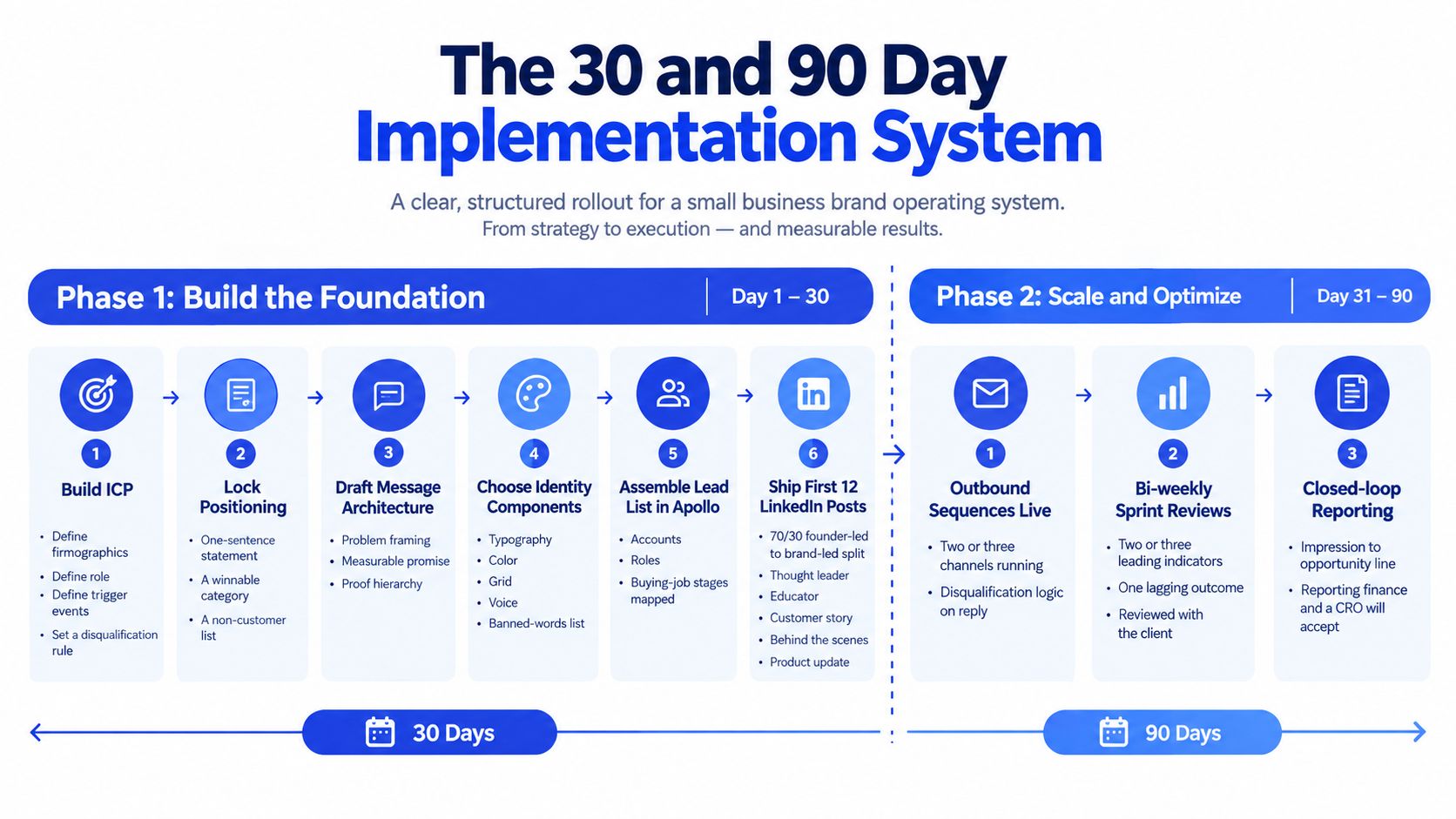
The 30 and 90 day implementation system
Treat this calendar as a proposed rollout, not a guaranteed time to revenue. The founder owns positioning decisions, marketing owns production, sales owns reply handling, and RevOps owns definitions and reporting.
Use the roadmap to keep dependencies visible. Launching execution before approving fit and claims creates rework across every channel.
The first 30 days
Window | Owner | Deliverable | Signal to inspect |
|---|---|---|---|
Week one | Founder and sales | ICP, exclusions, positioning, stakeholder map | Agreement on which accounts to reject |
Week two | Marketing and RevOps | Narrative, proof register, identity templates, Apollo list | Research or replies that challenge the fit hypothesis |
Week three | Content operator and founder | Approved publishing queue and live content | Relevant questions from intended buyers |
Week four | Sales and RevOps | Reviewed sequence, reply routing, baseline dashboard | Consistent qualification decisions |
Plan a 14-day initial launch around a bounded account segment. The first signal to inspect is whether the team can apply the rules and whether buyers recognize the problem, not whether a deal has already closed.
By the end of the initial phase, aim to ship the first 12 LinkedIn posts across the approved archetypes. Treat that as a production target; postpone unsupported claims rather than publishing to satisfy the calendar.
Extend the system through day 90
During the following weeks, activate outbound across two or three approved channels, then review account progression in bi-weekly sprints. Keep a shared Slack channel for delivery questions, but record decisions and ownership in the operating board.
Marketing should audit external descriptions alongside owned assets. Compare directories, review profiles, and other discoverable listings against a single approved company record; correct conflicting categories or claims rather than assuming website edits reach every platform.
RevOps should connect observable content interactions, replies, held meetings, and accepted opportunities. Where an impression can't be connected to an individual account, retain aggregate reporting instead of inventing a person-level journey.
This Friday, place your homepage, latest proposal, founder profile, and live sequence in a shared document. Assign an owner to resolve their conflicting claims before the next launch.
GROU is a global B2B pipeline agency serving teams across iGaming, SaaS, manufacturing, legal tech, and pharma. Our methodology connects LinkedIn content, lead generation, and outbound through defined fit rules and bi-weekly sprint reviews; visit Grou to explore a connected pipeline program, and bring those assets as the starting point for a brand-to-pipeline review.
Your dashboard shows activity, but qualified meetings aren't improving. Sales describes the offer differently from marketing, your founder's LinkedIn profile promises something else, and nobody owns the mismatch.
Define fit first. Give every asset the same account and disqualification rules.
Make credibility reusable. Connect messaging, evidence, and identity templates.
Join distribution to qualification. Route LinkedIn engagement and outbound replies into account-level decisions.
Measure commercial progress. Review qualified meetings and pipeline in bi-weekly sprints.
Table of Contents
The brand problem most small B2B teams keep misdiagnosing
A prospect reads your founder's post about solving implementation risk, visits a homepage promising lower costs, then receives an email offering extra capacity. Each claim might be defensible. Together, they leave the buyer unsure which problem you solve.
The usual response is another design project. Someone commissions a logo refresh while sales rewrites its deck independently. Marketing fills the publishing calendar, but the next prospect still encounters conflicting explanations.
The operating problem is ownership. Nobody has connected account selection, approved claims, channel execution, and qualification. Until that changes, a new tagline gives the team another sentence to interpret differently.
Diagnose the handoff before changing the identity
Put your homepage, latest proposal, founder profile, and outbound sequence beside each other. Ask the people responsible for each asset to identify its intended buyer, buying problem, supporting evidence, and next action. Record disagreements rather than resolving them with broader wording.
The execution constraint is real. In Fiverr's small-business marketing survey, 70% of respondents spent fewer than five hours weekly on marketing, while 42% identified brand awareness as their top marketing concern. A system that requires constant reinvention won't fit that workload.
Operating rule: Give the team fewer approved messages and clearer rules for using them.
Treat your small business brand as a shared operating system: one message, one target list, and one reporting line. Build it through eight layers: ICP → narrative → identity → LinkedIn → outbound → qualification → reporting → governance. Qualification sits inside outbound execution; governance sits inside the implementation cadence.
Write an ICP that excludes accounts
Start with a working record that sales can challenge. Avoid descriptions such as ambitious companies seeking growth, which don't help anyone decide whether an account belongs in a campaign.
ICP field | What to document |
|---|---|
Firmographics | Industry, operating model, geography, and relevant constraints |
Role | Problem owner, evaluator, and budget authority |
Trigger | Observable event that makes the problem worth addressing |
Current alternative | Existing vendor, internal process, or delayed action |
Disqualification | Condition that makes the account unsuitable |
Consider these illustrative positioning choices, not client results.
An iGaming SaaS vendor might target operators expanding into supported jurisdictions whose operations teams struggle with fragmented reporting. Its alternative is manual reconciliation across existing systems. An account requiring unsupported jurisdictions fails the fit rule, even if its budget looks attractive.
A manufacturer of regulated components might target procurement and quality teams qualifying a supplier for a documented specification. Its positioning could emphasize traceability and qualification documentation, provided those capabilities exist. Buyers requiring an unavailable certification belong on the exclusion list.
These choices produce different evidence requirements. The software buyer needs workflow and integration clarity; the component buyer needs specification and quality documentation. Neither benefits from a generic promise about innovation.
Test the positioning against these questions:
Repeatability: Can a buyer explain the offer back without your terminology?
Credibility: Can you substantiate the category you claim?
Exclusion: Can sales name accounts the message deliberately won't attract?
For the initial month, use these decisions to stop internal drift. Across the longer implementation window, test whether the resulting conversations meet your qualification standard. Don't widen the ICP because a narrow message produces fewer replies (some of those missing replies were never commercially useful).
Craft the single message and value narrative
A usable narrative gives sales a consistent way to explain the problem, make a bounded promise, and show evidence. A tagline rarely contains enough information to support that conversation.
Start with the buyer's description of the problem. Then define the outcome you can assess, including its measurement method and limitations. For service businesses, our guide to positioning for B2B services provides a useful companion to this working document.
Build the narrative around evidence
Arrange proof by how directly it answers the buyer's concern. An unsupported assertion is weak; a visible process is more useful. A relevant customer reference with documented outcomes can be stronger, but only when its scope resembles the prospect's situation.
Use this single-page template:
Problem: What is happening, and what does the buyer currently do about it?
Promise: What outcome will you pursue, under which conditions?
Evidence: Which approved asset supports the claim?
Boundary: What won't the offer solve?
Next action: What should the account evaluate next?
For an illustrative reporting platform, the homepage could say, “Resolve reporting exceptions before they reach the monthly review.” A LinkedIn post could examine how teams investigate an exception. The email opening could ask how the account handles reconciliation after an expansion.
Those are draft messages, not performance claims. Each needs product evidence before publication.
Help the buying group agree
Economic buyers need to understand commercial consequences. Technical evaluators need implementation boundaries, while end users need to see how their work changes. Keep the underlying problem consistent rather than promising each stakeholder an unrelated benefit.
Gartner's buying-group research found that 74% of buying teams experienced unhealthy conflict, and groups reaching consensus were 2.5 times more likely to report a high-quality deal. That supports a practical editorial choice: publish material stakeholders can use together.
A decision memo comparing requirements, risks, and evidence may be more useful than another persona-specific slogan. Give the interested contact something colleagues can evaluate without needing your salesperson to translate it.
Design the visual and verbal identity for reuse
Approve a minimum viable identity before commissioning a large asset library. Specify typography, color, layout grid, imagery rules, voice attributes, and banned words. Then apply those decisions to templates people already use.
The kit below illustrates the components to document, rather than a required aesthetic.
Identity components and where they show up
Identity component | Website | Outbound | Proposals | |
|---|---|---|---|---|
Typography and color | Page hierarchy | Carousel template | Restrained signature | Cover and pitch deck |
Layout grid | Solution pages | Proof cards | Message structure | Scope and pricing pages |
Imagery rules | Product and process visuals | Approved illustrations | Relevant evidence only | Delivery diagrams |
Voice and terminology | Headlines and forms | Posts and replies | Openings and follow-ups | Assumptions and exclusions |
Approved claims | Evidence beside promises | Supported results | Account-relevant proof | References and commitments |
Extend the same rules to onboarding email signatures. A buyer shouldn't encounter a different company immediately after signing.
Store evidence separately from layouts. A maintained B2B proof library lets the team reuse an approved result without repeatedly checking its wording, permission, or scope.
Measure enforcement rather than document ownership
Fit Small Business's branding statistics report that 85% of organizations have brand guidelines, but only 30% say they enforce them. The operational lesson is straightforward: assigning someone to write guidelines doesn't assign someone to maintain compliance.
Calculate enforcement rate as compliant sampled assets divided by all sampled assets. Use a binary checklist covering audience fit, terminology, approved evidence, visual rules, and next action; review representative assets monthly.
Let designers vary the execution. Require everyone to preserve the claim, its evidence, and its boundaries.
Give an owner authority to approve exceptions, prioritizing proposals and evaluation pages over cosmetic imperfections. For branded URLs within those assets, LinkShip's resource on how to boost click-through rates is a useful implementation reference, not a substitute for testing whether qualified visitors progress.
Build the LinkedIn credibility engine
Founder-led content should explain judgment: why a decision was made, where an approach fails, or what a buyer should question. Company content should make the evidence easy to inspect. Copying identical posts between profiles wastes the distinction.
As a starting allocation, use the prescribed 70/30 founder-to-company split as a planning hypothesis, not a performance benchmark. Adjust it when account-level engagement gives you a reason.
Run a production loop a small team can maintain
A founder and a content operator can work from sales objections and delivery notes. The operator drafts and schedules; the founder checks the reasoning and approves claims. LinkedIn's native scheduler is sufficient for publishing, while Sales Navigator can support manual account and stakeholder checks.
Rotate the material rather than inventing a fresh strategy every week:
Problem teardown: Explain a failure buyers recognize and how to diagnose it.
Evidence post: Present an approved result with context and limitations.
Contrarian argument: Challenge a common recommendation and explain when it still applies.
Work-in-progress explanation: Show a redacted process decision without exposing client information.
Use the LinkedIn company page operating guide to define the company page's role alongside founder distribution. Keep drafting, approval, and reply ownership visible in the same working board.
Use the video as a discussion prompt during a content-planning session.
Route engagement into account context
When an ICP contact responds, record the account, topic, and expressed problem in HubSpot. A content reply isn't permission to launch an unrelated sequence. Ask a useful follow-up and assign the next action to someone who understands the account.
For displaying attributable customer feedback, evaluate Bragly's LinkedIn review widget as a presentation option. Retain permission and context (a visible review doesn't prove every claim beside it).
Track identifiable target-account engagement, relevant replies, and meetings tied to specific posts. Where identity isn't observable, label the limitation instead of treating anonymous profile traffic as qualified demand.
Align outbound sequences and lead lists to the brand
Start with Apollo, Clay, and a single email execution platform. Add HeyReach for an approved LinkedIn motion; consider Lemlist when a hybrid sequence needs a separate workflow. Running Instantly and Smartlead simultaneously is a deliberate complexity trade-off, not a default requirement.
Relevance deserves that discipline. Gartner's research on seller engagement found that 73% of B2B buyers actively avoided suppliers sending irrelevant outreach. A polished sequence aimed at the wrong account remains a brand problem.
Recommended outbound stack by job to be done
These are recommended workflow assignments, not claims that a tool guarantees delivery or qualification.
Job to be done | Recommended tool | Why this tool | Trade-off |
|---|---|---|---|
Build the initial account and contact list | Apollo | Use as the starting point for list building and initial enrichment | Validate coverage and fit |
Research triggers and account context | Clay | Assign deeper research and personalization preparation | Requires source checks |
Run the primary email lane | Instantly | Give the email operator ownership of sending and inbox rotation here | More inboxes don't fix poor targeting |
Run a separate email lane when justified | Smartlead | Separate ownership or campaigns if operationally necessary | Adds suppression and reporting work |
Coordinate a hybrid sequence | Lemlist | Assign sequence coordination and deliverability monitoring | No platform owns inbox placement |
Manage LinkedIn touches | HeyReach | Give LinkedIn execution a defined place in the workflow | Requires policy review and human judgment |
Keep the route explicit: account selection → research → approved sequence → reply review → CRM disposition. Don't allow parallel tools to contact the same person independently.
Tie every sequence to a buying job
Before enrollment, write the stakeholder role, current buying job, evidence available, and reason for contacting the account now. An operations stakeholder exploring a problem needs different material from procurement validating a supplier.
Use the cold email framework to translate that hypothesis into the opening and next action. Research should explain relevance, not decorate a generic pitch with an incidental personal detail.
Stop or reroute when a reply reveals an unsupported geography, missing requirement, or unsuitable delivery model. Record the reason in HubSpot and propagate suppression across execution tools.
For legal tech and pharma, have the appropriate reviewer approve claims before launch. Manufacturing and iGaming campaigns need equally explicit capability boundaries. The recommendation is fewer untested assumptions per sequence, not a promise that lower volume automatically produces better results.
Measure brand-to-pipeline KPIs that survive a board review
Start with a written definition of a qualified meeting. Require an ICP-matched account, a relevant stakeholder, a confirmed problem within your delivery scope, and an agreed evaluation step. A booked calendar slot alone doesn't meet that standard.
The reporting conversation should connect observed engagement to account progression. Keep uncertainty visible rather than allocating every deal to the last trackable click.
Build a KPI tree with explicit denominators
Signal | Definition or review question |
|---|---|
Branded search lift | Change against your recorded baseline, with other campaigns noted |
Target-account reply rate | Relevant replies divided by contacted ICP prospects |
Qualified meeting rate | Held meetings passing the written standard, using a fixed denominator |
Sales-accepted opportunity rate | Accepted opportunities divided by the agreed qualified cohort |
Pipeline generated | Accepted opportunity value under documented stage rules |
Average contract value | Closed contract value using a consistent calculation |
Cycle length | Time between explicitly defined entry and closing events |
Use HubSpot properties for source evidence, stakeholder, buying job, qualification result, and disqualification reason. Our multi-touch attribution guide supports documenting how those interactions receive credit without pretending attribution proves causation.
For the social reporting layer, iHatePosting's social media analytics report guide can inform presentation. Keep the account and opportunity view as the commercial reference.
Make sprint decisions without demanding instant revenue
Select two or three leading indicators and one lagging outcome for each bi-weekly review. Set targets against your own baseline and available account pool, rather than importing an unrelated benchmark.
Review discipline: If a metric hasn't changed across two sprints, investigate the assumption before approving more spend.
That investigation might reveal weak proof, poor account selection, or insufficient observation time. Don't rewrite positioning because a long-cycle opportunity hasn't closed within a reporting window.
Retire raw open rate, unfiltered aggregate reply rate, and follower growth as primary success measures. Keep them only where they help diagnose a specific question (a positive reply from a disqualified account is still disqualified).
The 30 and 90 day implementation system
Treat this calendar as a proposed rollout, not a guaranteed time to revenue. The founder owns positioning decisions, marketing owns production, sales owns reply handling, and RevOps owns definitions and reporting.
Use the roadmap to keep dependencies visible. Launching execution before approving fit and claims creates rework across every channel.
The first 30 days
Window | Owner | Deliverable | Signal to inspect |
|---|---|---|---|
Week one | Founder and sales | ICP, exclusions, positioning, stakeholder map | Agreement on which accounts to reject |
Week two | Marketing and RevOps | Narrative, proof register, identity templates, Apollo list | Research or replies that challenge the fit hypothesis |
Week three | Content operator and founder | Approved publishing queue and live content | Relevant questions from intended buyers |
Week four | Sales and RevOps | Reviewed sequence, reply routing, baseline dashboard | Consistent qualification decisions |
Plan a 14-day initial launch around a bounded account segment. The first signal to inspect is whether the team can apply the rules and whether buyers recognize the problem, not whether a deal has already closed.
By the end of the initial phase, aim to ship the first 12 LinkedIn posts across the approved archetypes. Treat that as a production target; postpone unsupported claims rather than publishing to satisfy the calendar.
Extend the system through day 90
During the following weeks, activate outbound across two or three approved channels, then review account progression in bi-weekly sprints. Keep a shared Slack channel for delivery questions, but record decisions and ownership in the operating board.
Marketing should audit external descriptions alongside owned assets. Compare directories, review profiles, and other discoverable listings against a single approved company record; correct conflicting categories or claims rather than assuming website edits reach every platform.
RevOps should connect observable content interactions, replies, held meetings, and accepted opportunities. Where an impression can't be connected to an individual account, retain aggregate reporting instead of inventing a person-level journey.
This Friday, place your homepage, latest proposal, founder profile, and live sequence in a shared document. Assign an owner to resolve their conflicting claims before the next launch.
GROU is a global B2B pipeline agency serving teams across iGaming, SaaS, manufacturing, legal tech, and pharma. Our methodology connects LinkedIn content, lead generation, and outbound through defined fit rules and bi-weekly sprint reviews; visit Grou to explore a connected pipeline program, and bring those assets as the starting point for a brand-to-pipeline review.
Pipeline OS Newsletter
Build qualified pipeline
Get weekly tactics to generate demand, improve lead quality, and book more meetings.






Trusted by industry leaders
Trusted by industry leaders
Trusted by industry leaders
Ready to build qualified pipeline?
Ready to build qualified pipeline?
Ready to build qualified pipeline?
Book a call to see if we're the right fit, or take the 2-minute quiz to get a clear starting point.
Book a call to see if we're the right fit, or take the 2-minute quiz to get a clear starting point.
Book a call to see if we're the right fit, or take the 2-minute quiz to get a clear starting point.
" height="30.21639343089746px" id="hfGbXmQR2" width="30.216393430897455px"/></svg>)
Copyright © 2026 – All Right Reserved
Copyright © 2026 – All Right Reserved
Copyright © 2026 – All Right Reserved