%22%3E%3C/path%3E%3Cpath d=%22M 63.072 7.554 C 62.258 8.022 61.577 8.689 61.092 9.493 L 61.092 7.076 L 57.158 7.076 L 57.158 22.64 L 61.089 22.64 L 61.089 14.888 C 61.089 13.446 61.403 12.434 62.03 11.853 C 62.818 11.218 63.818 10.907 64.826 10.982 L 65.868 10.982 L 65.868 6.851 C 64.891 6.834 63.926 7.076 63.073 7.554 Z%22 fill=%22rgb(17,17,17)%22%3E%3C/path%3E%3Cpath d=%22M 78.916 7.82 C 76.363 6.49 73.321 6.49 70.768 7.82 C 69.562 8.473 68.564 9.451 67.888 10.644 C 67.167 11.931 66.803 13.387 66.834 14.862 C 66.804 16.332 67.157 17.785 67.86 19.077 C 68.515 20.267 69.494 21.246 70.684 21.901 C 71.924 22.576 73.318 22.92 74.73 22.898 C 76.164 22.918 77.58 22.575 78.846 21.901 C 80.062 21.247 81.073 20.27 81.768 19.077 C 82.506 17.797 82.88 16.339 82.85 14.862 C 82.88 13.389 82.517 11.934 81.797 10.647 C 81.12 9.455 80.122 8.477 78.917 7.824 M 78.803 14.862 C 78.829 15.739 78.636 16.608 78.241 17.391 C 77.903 18.046 77.38 18.588 76.738 18.95 C 76.124 19.293 75.432 19.472 74.729 19.47 C 73.668 19.497 72.648 19.061 71.934 18.276 C 71.139 17.323 70.741 16.1 70.823 14.862 C 70.741 13.62 71.149 12.395 71.959 11.45 C 72.687 10.667 73.715 10.233 74.783 10.256 C 75.859 10.236 76.894 10.67 77.635 11.45 C 78.464 12.387 78.884 13.616 78.801 14.864%22 fill=%22rgb(17,17,17)%22%3E%3C/path%3E%3Cpath d=%22M 95.906 7.076 L 95.906 15.646 C 95.975 16.68 95.643 17.701 94.979 18.498 C 94.311 19.184 93.379 19.547 92.422 19.495 C 91.475 19.544 90.553 19.18 89.894 18.498 C 89.23 17.701 88.898 16.68 88.967 15.646 L 88.967 7.076 L 85.033 7.076 L 85.033 16.207 C 85 17.449 85.275 18.68 85.834 19.79 C 86.327 20.75 87.095 21.542 88.039 22.065 C 89.033 22.594 90.145 22.861 91.271 22.838 C 92.188 22.847 93.095 22.65 93.926 22.263 C 94.708 21.905 95.388 21.36 95.906 20.675 L 95.906 22.645 L 99.865 22.645 L 99.865 7.076 Z%22 fill=%22rgb(17,17,17)%22%3E%3C/path%3E%3Cpath d=%22M 4.513 15.626 C 4.511 10.815 7.606 6.549 12.181 5.059 C 16.756 3.57 21.77 5.195 24.601 9.086 L 27.816 5.87 C 24.074 1.186 17.981 -0.943 12.137 0.393 C 6.292 1.728 1.728 6.292 0.393 12.137 C -0.943 17.981 1.186 24.074 5.87 27.816 L 9.085 24.601 C 6.214 22.512 4.515 19.177 4.513 15.626%22 fill=%22rgb(32,62,235)%22%3E%3C/path%3E%3Cpath d=%22M 17.114 14.343 L 13.354 18.01 L 13.354 18.026 L 21.071 18.026 L 11.412 27.609 L 17.389 27.609 L 23.999 21.081 L 23.999 28.316 L 24.005 28.316 L 27.967 24.393 L 27.967 14.343 Z%22 fill=%22rgb(32,62,235)%22%3E%3C/path%3E%3C/g%3E%3C/svg%3E) ×
× ××
××›
›
›
›
Sports technology lead generation 2026
Sports technology lead generation 2026
Sports technology lead generation 2026
Sports technology lead generation 2026
Sports technology lead generation 2026
Sports technology lead generation 2026

Author
Aljaz Peklaj

Add up every top-division football club in Europe and you get about seven hundred. That is the whole thing. Not seven hundred good-fit accounts inside a larger market, seven hundred accounts in total, across all fifty-five national associations.
A market that small breaks the instrument most B2B teams reach for first. You cannot test your way into seven hundred accounts, because you will run out of accounts long before the test tells you anything. What you can do is know every one of them by name, which is a different job requiring a different plan.
TL;DR
The addressable market in sports technology is countable, and counting it changes the plan. UEFA's own landscape report covers more than 700 top-division clubs across its 55 member associations, with top-division revenue set to pass EUR 30 billion in 2025, and FIFA has 211 member associations worldwide. Three things follow. First, volume outbound is the wrong instrument at this size, because a market of a few hundred accounts cannot supply the sample you would need to learn anything from testing, so the work becomes account selection and multi-threading rather than sequence optimisation. Second, the buying unit is not the club: the same product often sells to a club, a league, a national association and a venue operator, each with a different budget holder and a different buying calendar, so your account list is really four lists. Third, if the product touches athlete performance, health or biometrics, you are selling into a compliance conversation before you are selling into a technical one, because that data is sensitive under EU rules and the AI Act has applied generally since 2 August 2026.
Count the market before you plan the campaign
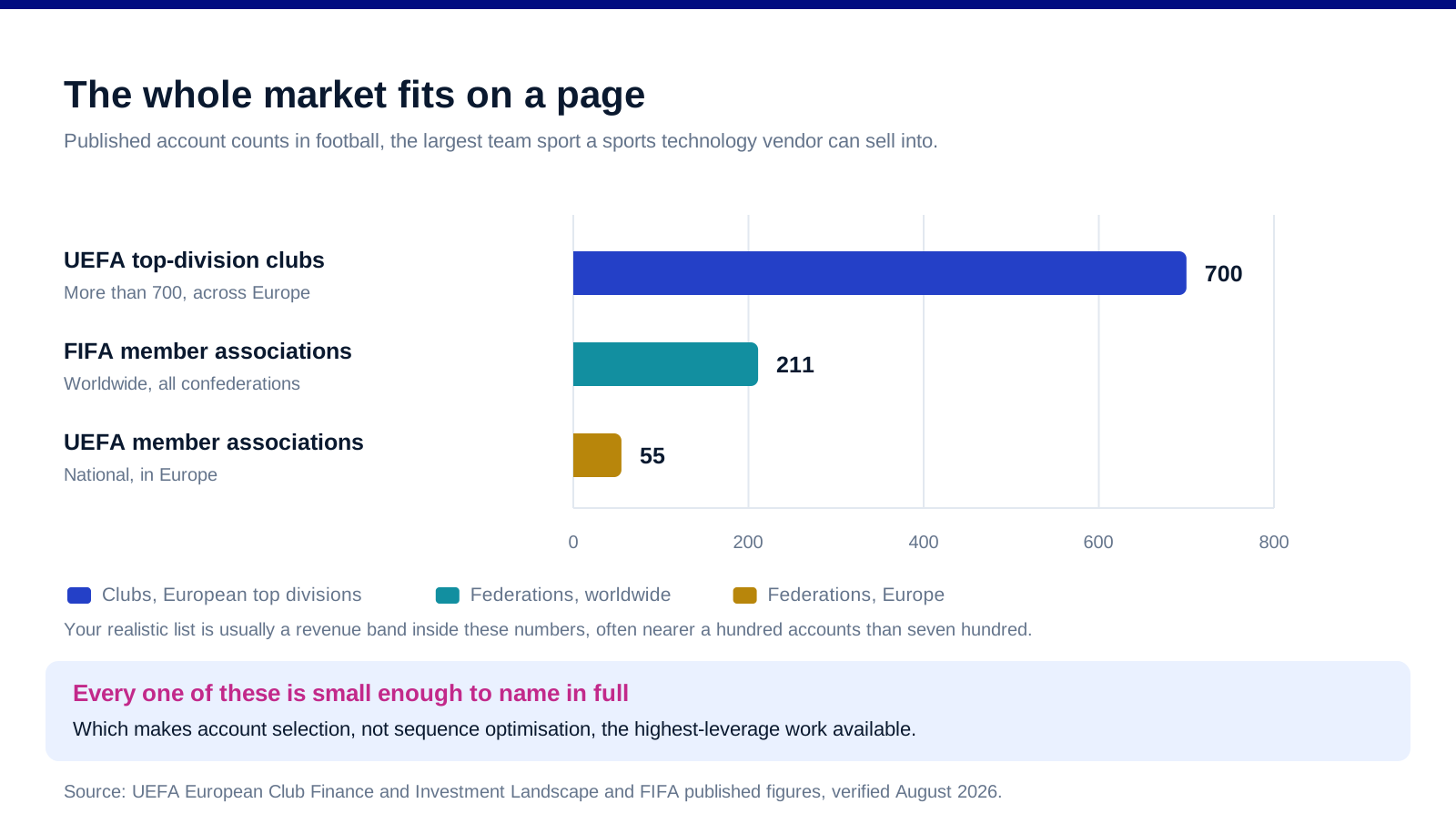
Seven hundred is the number to hold in your head. UEFA's European Club Finance and Investment Landscape covers more than 700 clubs across its 55 member associations. That is the top-division population of the largest team sport on the continent, and most sports technology products sell to a narrower slice of it than that.
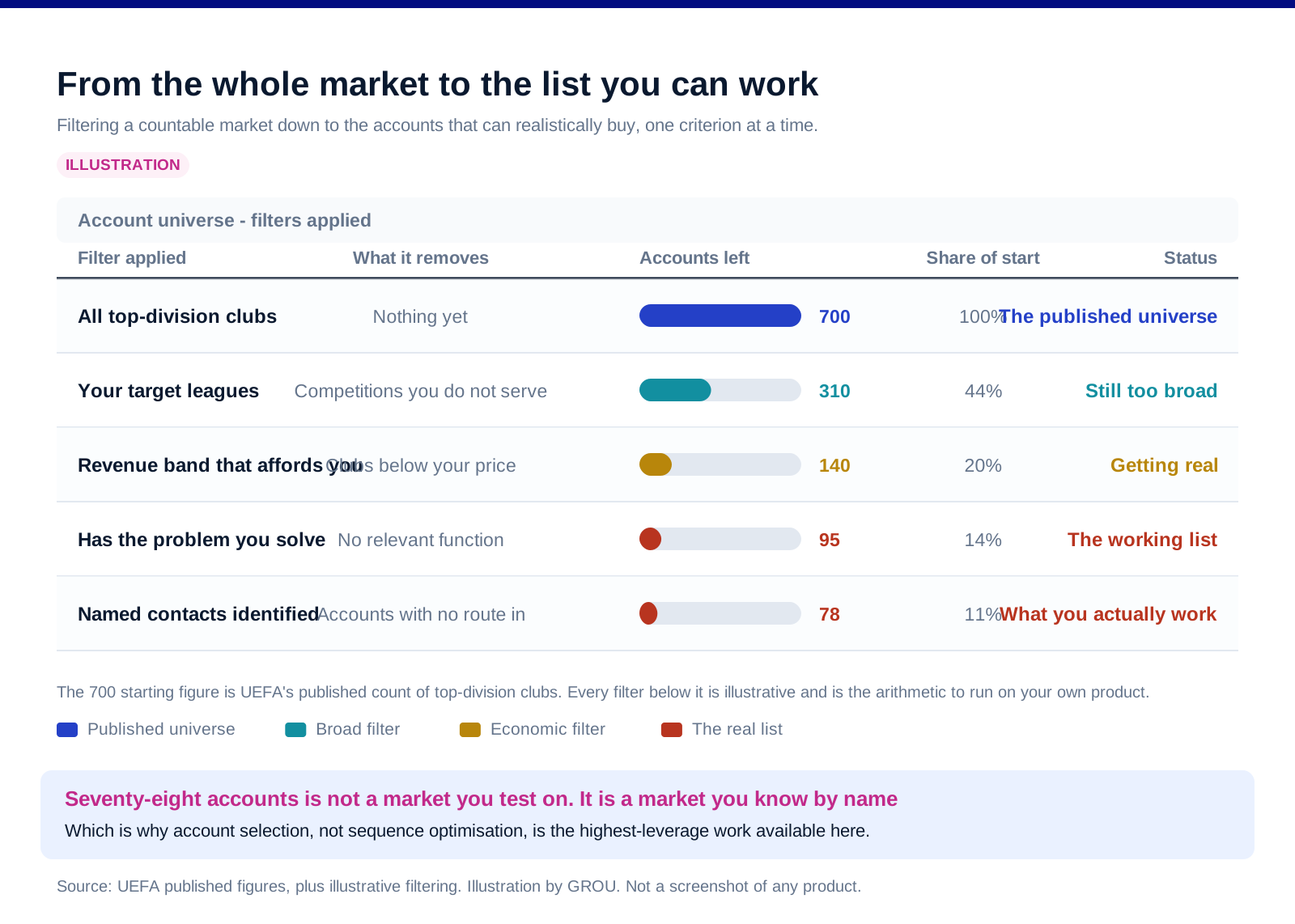
Then narrow it honestly. Top-division revenue is set to pass EUR 30 billion, but it is not spread evenly, and a product priced for a club with a nine-figure turnover does not sell to one with a seven-figure turnover at any discount. The realistic list is usually the revenue band that can afford you, which is often a hundred accounts rather than seven hundred.
And widen it deliberately, not accidentally. FIFA has 211 member associations, so if your product sells to national federations rather than clubs, that is a different and larger list with a different buying process. Widening across sports, across tiers or across geographies is a decision to make on purpose. Our note on calculating TAM, SAM and SOM covers how to size each version before committing to one.
The consequence is the important part. At a hundred to seven hundred accounts, the marginal value of a better email sequence is small and the marginal value of a better account list is enormous. That is the inversion of the usual B2B advice, and it is why sports technology teams who copy a SaaS outbound playbook tend to burn their whole market in a quarter and have nothing left to learn from.
The buying unit is not the club
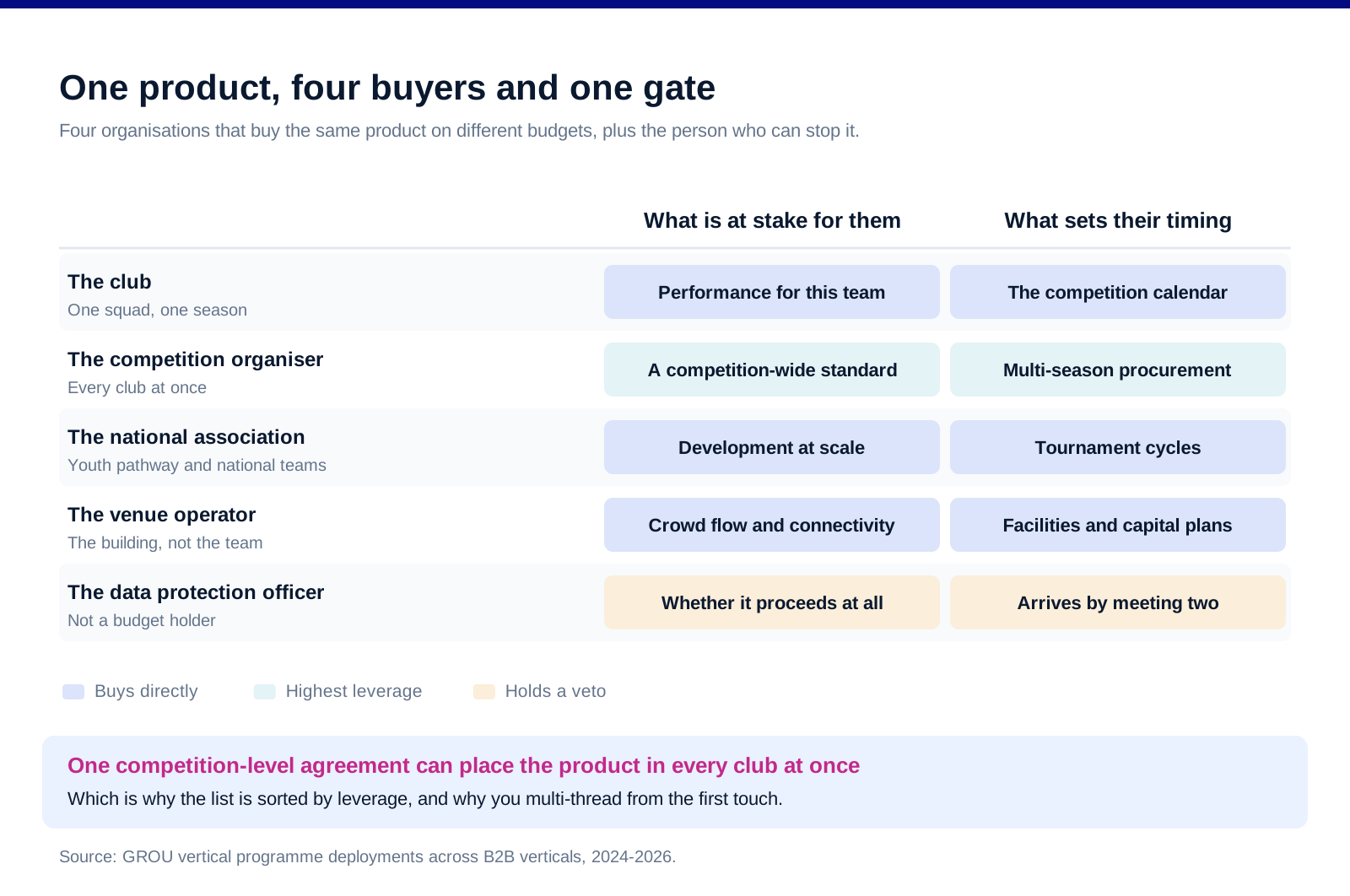
The same product often has four buyers. A performance analytics platform can be bought by a club for its own squad, by a league as a competition-wide standard, by a national association for its youth pathway, and by a venue operator as part of a facilities contract. Those are four sales, four budgets and four calendars.
League-level deals change the arithmetic completely. One agreement with a competition organiser can put the product into every club in that competition at once. That is a much longer sale with a much larger prize, and it is the reason the account list should be sorted by leverage rather than alphabetically.
Federation buying runs on a different clock. National associations often work to four-year cycles anchored on major tournaments and to public or quasi-public procurement rules, which means the deal you cannot close this year may have a defined window two years out. Knowing the window is worth more than any amount of follow-up.
Venue operators are the buyer most vendors forget. Anything touching crowd flow, access control, connectivity or in-stadium experience is often a facilities decision rather than a sporting one, and the person who owns it does not sit in the football department at all.
So multi-thread from the first touch, not after the first stall. In a market this small, a single contact who goes quiet costs you an account you cannot replace. Our note on ideal customer profiles covers how to define the buying group rather than the buyer.
The compliance conversation now comes first
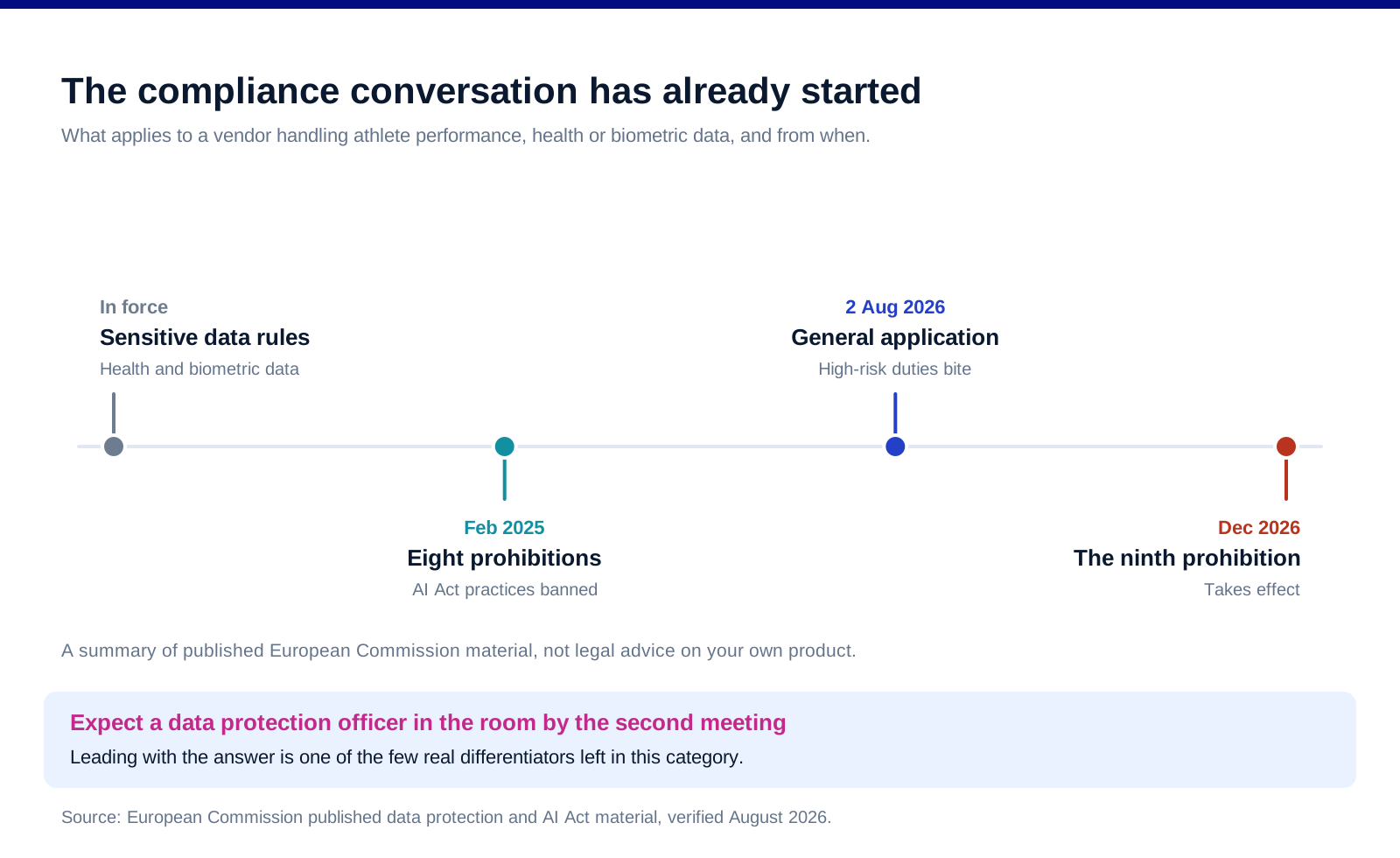
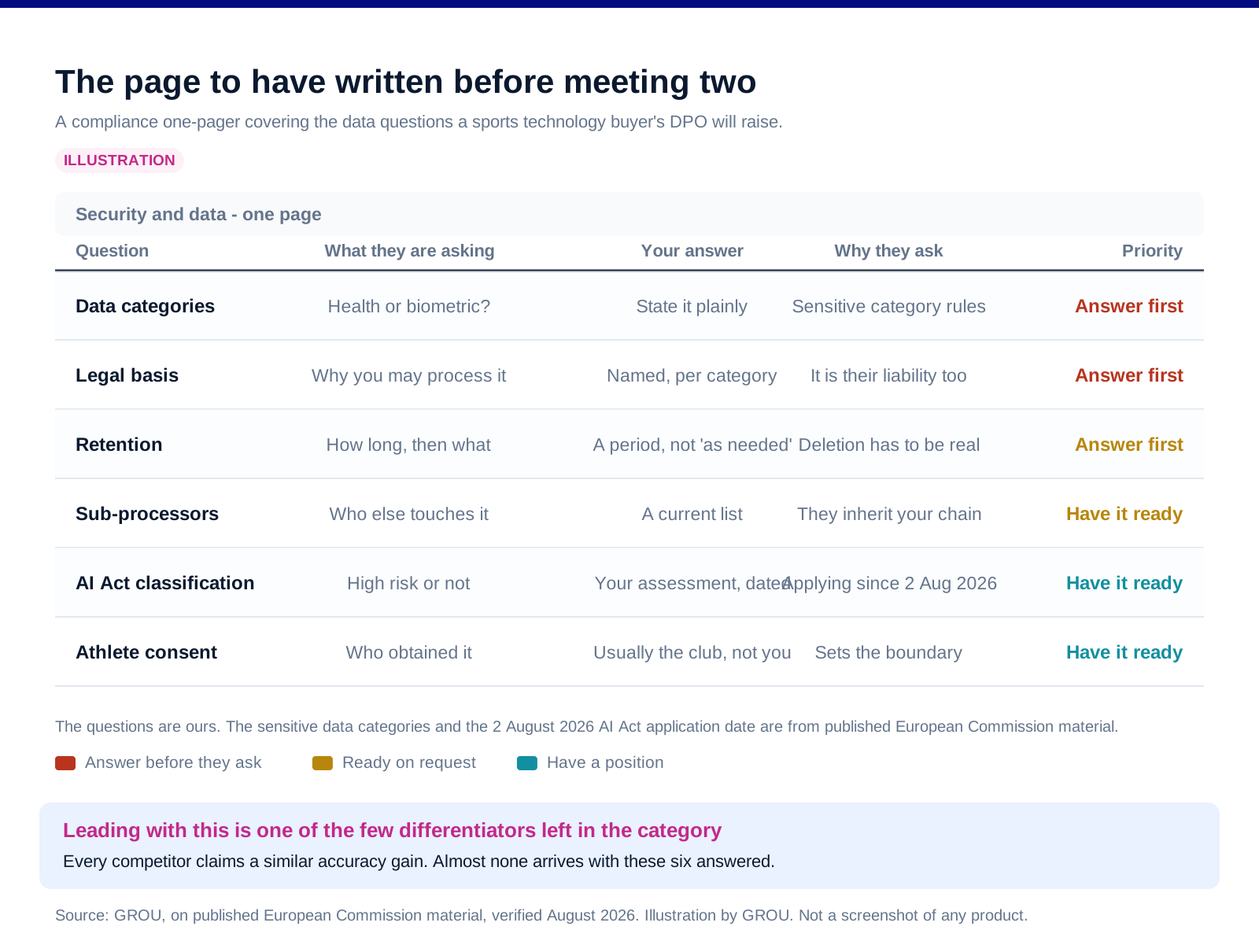
Athlete data is sensitive data. The European Commission lists health-related data and "biometric data processed solely to identify a human being" among the categories subject to specific processing conditions. Player load monitoring, injury prediction, wearable telemetry and anything using a face or a gait to identify someone lands in that territory rather than beside it.
And the AI Act is now applying. The Commission states that the AI Act prohibits nine practices, that eight of those prohibitions became effective in February 2025 and the ninth comes into effect in December 2026, and that the Act became generally applicable on 2 August 2026. Systems used for remote biometric identification, emotion recognition and biometric categorisation are named among the high-risk uses carrying strict obligations.
Read the workplace prohibition carefully if you sell to clubs. One of the nine prohibitions is emotion recognition in workplaces and education institutions. A training ground is a place of work for the athletes in it, which is a question worth putting to your own counsel before it is put to you by a prospect's, rather than a settled point we are going to assert here.
None of that is a reason to avoid the category. It is a reason to expect a data protection officer in the room by the second meeting, and to have an answer ready rather than assembled on the call.
Which is the opportunity, not the obstacle. Most vendors in this space treat compliance as a late-stage hurdle to survive. Leading with it, in the first conversation, is one of the few differentiators available in a market where every competitor claims the same accuracy improvement. If your outreach opens on the buyer's regulatory problem rather than your feature list, you are talking about something they are already worried about.
What actually works at this market size
Pick the accounts before you write anything. Name the list, rank it by leverage rather than by fit alone, and accept that the ranking is the strategy. In a seven-hundred account market the list is the campaign.
Sequence people, not accounts. Four to six named contacts per account across the sporting, commercial, technical and compliance sides, each with a reason to hear from you that makes sense for their job, rather than one message copied across the group.
Use the calendar the sport already runs on. Pre-season, mid-season, close-season and tournament years produce entirely different levels of attention. A message that lands in the week before a season opens is not a bad message, it is a well-timed message sent at the worst possible moment.
Run a paid pilot rather than a free one. In a small market the pilot is the sale, and free pilots consume scarce accounts without commitment. Our piece on pricing a B2B paid pilot covers the arithmetic, and our note on running a lead generation pilot covers how to size and measure one.
Treat events as the primary channel rather than the reward. Sports technology has a small number of gatherings where most of the buying population appears in one building. In a market where a cold email reaches one contact, a well-worked event reaches a meaningful share of the entire addressable market in three days.
And say something specific about the sport. Generic B2B language is detected instantly by people whose whole career is inside one competition. Our note on positioning for B2B services covers how to build that specificity without collapsing into jargon.
What we do not publish here
Any figure for what sports technology deals are worth. Ours come from a specific set of programmes and would mislead anyone applying them to a different product or tier.
Reply rate or meeting rate benchmarks for the category. Same reason, with the additional problem that in a market of a few hundred accounts, any rate you compute has an enormous confidence interval around it.
Club or federation names as examples. We do not cite client work by name anywhere on this blog, and a named example in a market this small identifies the account whether or not we intended it to.
A legal reading of the AI Act or the GDPR. Everything above is quoted from published European Commission material. How it applies to your product is a question for your counsel, and we have flagged the workplace question as open rather than answered.
Season-by-season buying calendars. They vary by sport, competition and country, and a table here would be wrong for most readers within a year.
FAQ
How big is the sports technology market for a B2B vendor?
Smaller than it looks, and countable. UEFA's landscape report covers more than 700 top-division clubs across 55 member associations, and FIFA has 211 member associations worldwide. Your realistic list is usually a revenue band inside those numbers, often around a hundred accounts, which is small enough to name in full.
Does outbound work in sports technology?
Outreach works, volume outbound generally does not. A market of a few hundred accounts cannot supply the volume you would need to test messaging properly, and burning through it at speed leaves you nothing to learn from. The work shifts to account selection, multi-threading and timing.
Who actually buys sports technology?
Often four different buyers for the same product: the club, the competition organiser, the national association and the venue operator. Each holds a different budget and runs a different calendar, and league or federation deals can put the product into many clubs at once, which is why the account list should be sorted by leverage.
What compliance rules apply to athlete data in the EU?
Health-related data and biometric data used to identify a person are listed by the European Commission among the sensitive categories subject to specific processing conditions. The AI Act became generally applicable on 2 August 2026, and remote biometric identification, emotion recognition and biometric categorisation are named among high-risk uses. Take your own legal advice on how this applies to your product.
Should compliance come up early in the sales conversation?
Yes, and leading with it is a differentiator rather than a risk. In a category where competitors claim similar accuracy gains, being the vendor with a ready answer on data categories, retention and the AI Act is a genuine separator, and it puts the data protection officer on your side rather than in your way.
When is the worst time to contact a sports technology buyer?
The weeks immediately before a season opens and during knockout stages, when attention inside a club is entirely elsewhere. Sports organisations run on a published calendar, which is unusually helpful: you can plan outreach around it rather than guessing.
Bottom line
Start by counting. Write down every account that could realistically buy your product, at the revenue band that can actually afford it, and look at how short the list is. That number decides everything else: it rules out volume outbound, it makes account selection the highest-leverage work available to you, and it means a burned account is a permanent loss rather than a rounding error. Then split the list four ways, because clubs, competitions, federations and venues buy the same product on different budgets and different calendars, and the league-level deal is worth more than any number of club-level ones. Finally, get your compliance answer written before you need it, because athlete performance and biometric data sits inside the EU's sensitive categories and the AI Act has applied generally since 2 August 2026. In a market this small, being the vendor who has already thought about that is a cheaper differentiator than being the vendor with a better model.
Want the account list built and worked rather than theorised? Book a call with GROU. We run lead generation and outbound inside B2B revenue engines across verticals, including sports technology.
We are GROU, a B2B pipeline agency that runs lead generation, outbound, and LinkedIn content for clients across manufacturing, fintech, iGaming, software, sports technology and professional services. The market structure figures in this article are quoted from published UEFA and FIFA material and the regulatory descriptions from published European Commission material, all verified in August 2026. The regulatory sections are a summary of public sources rather than legal advice.
Add up every top-division football club in Europe and you get about seven hundred. That is the whole thing. Not seven hundred good-fit accounts inside a larger market, seven hundred accounts in total, across all fifty-five national associations.
A market that small breaks the instrument most B2B teams reach for first. You cannot test your way into seven hundred accounts, because you will run out of accounts long before the test tells you anything. What you can do is know every one of them by name, which is a different job requiring a different plan.
TL;DR
The addressable market in sports technology is countable, and counting it changes the plan. UEFA's own landscape report covers more than 700 top-division clubs across its 55 member associations, with top-division revenue set to pass EUR 30 billion in 2025, and FIFA has 211 member associations worldwide. Three things follow. First, volume outbound is the wrong instrument at this size, because a market of a few hundred accounts cannot supply the sample you would need to learn anything from testing, so the work becomes account selection and multi-threading rather than sequence optimisation. Second, the buying unit is not the club: the same product often sells to a club, a league, a national association and a venue operator, each with a different budget holder and a different buying calendar, so your account list is really four lists. Third, if the product touches athlete performance, health or biometrics, you are selling into a compliance conversation before you are selling into a technical one, because that data is sensitive under EU rules and the AI Act has applied generally since 2 August 2026.
Count the market before you plan the campaign
Seven hundred is the number to hold in your head. UEFA's European Club Finance and Investment Landscape covers more than 700 clubs across its 55 member associations. That is the top-division population of the largest team sport on the continent, and most sports technology products sell to a narrower slice of it than that.
Then narrow it honestly. Top-division revenue is set to pass EUR 30 billion, but it is not spread evenly, and a product priced for a club with a nine-figure turnover does not sell to one with a seven-figure turnover at any discount. The realistic list is usually the revenue band that can afford you, which is often a hundred accounts rather than seven hundred.
And widen it deliberately, not accidentally. FIFA has 211 member associations, so if your product sells to national federations rather than clubs, that is a different and larger list with a different buying process. Widening across sports, across tiers or across geographies is a decision to make on purpose. Our note on calculating TAM, SAM and SOM covers how to size each version before committing to one.
The consequence is the important part. At a hundred to seven hundred accounts, the marginal value of a better email sequence is small and the marginal value of a better account list is enormous. That is the inversion of the usual B2B advice, and it is why sports technology teams who copy a SaaS outbound playbook tend to burn their whole market in a quarter and have nothing left to learn from.
The buying unit is not the club
The same product often has four buyers. A performance analytics platform can be bought by a club for its own squad, by a league as a competition-wide standard, by a national association for its youth pathway, and by a venue operator as part of a facilities contract. Those are four sales, four budgets and four calendars.
League-level deals change the arithmetic completely. One agreement with a competition organiser can put the product into every club in that competition at once. That is a much longer sale with a much larger prize, and it is the reason the account list should be sorted by leverage rather than alphabetically.
Federation buying runs on a different clock. National associations often work to four-year cycles anchored on major tournaments and to public or quasi-public procurement rules, which means the deal you cannot close this year may have a defined window two years out. Knowing the window is worth more than any amount of follow-up.
Venue operators are the buyer most vendors forget. Anything touching crowd flow, access control, connectivity or in-stadium experience is often a facilities decision rather than a sporting one, and the person who owns it does not sit in the football department at all.
So multi-thread from the first touch, not after the first stall. In a market this small, a single contact who goes quiet costs you an account you cannot replace. Our note on ideal customer profiles covers how to define the buying group rather than the buyer.
The compliance conversation now comes first
Athlete data is sensitive data. The European Commission lists health-related data and "biometric data processed solely to identify a human being" among the categories subject to specific processing conditions. Player load monitoring, injury prediction, wearable telemetry and anything using a face or a gait to identify someone lands in that territory rather than beside it.
And the AI Act is now applying. The Commission states that the AI Act prohibits nine practices, that eight of those prohibitions became effective in February 2025 and the ninth comes into effect in December 2026, and that the Act became generally applicable on 2 August 2026. Systems used for remote biometric identification, emotion recognition and biometric categorisation are named among the high-risk uses carrying strict obligations.
Read the workplace prohibition carefully if you sell to clubs. One of the nine prohibitions is emotion recognition in workplaces and education institutions. A training ground is a place of work for the athletes in it, which is a question worth putting to your own counsel before it is put to you by a prospect's, rather than a settled point we are going to assert here.
None of that is a reason to avoid the category. It is a reason to expect a data protection officer in the room by the second meeting, and to have an answer ready rather than assembled on the call.
Which is the opportunity, not the obstacle. Most vendors in this space treat compliance as a late-stage hurdle to survive. Leading with it, in the first conversation, is one of the few differentiators available in a market where every competitor claims the same accuracy improvement. If your outreach opens on the buyer's regulatory problem rather than your feature list, you are talking about something they are already worried about.
What actually works at this market size
Pick the accounts before you write anything. Name the list, rank it by leverage rather than by fit alone, and accept that the ranking is the strategy. In a seven-hundred account market the list is the campaign.
Sequence people, not accounts. Four to six named contacts per account across the sporting, commercial, technical and compliance sides, each with a reason to hear from you that makes sense for their job, rather than one message copied across the group.
Use the calendar the sport already runs on. Pre-season, mid-season, close-season and tournament years produce entirely different levels of attention. A message that lands in the week before a season opens is not a bad message, it is a well-timed message sent at the worst possible moment.
Run a paid pilot rather than a free one. In a small market the pilot is the sale, and free pilots consume scarce accounts without commitment. Our piece on pricing a B2B paid pilot covers the arithmetic, and our note on running a lead generation pilot covers how to size and measure one.
Treat events as the primary channel rather than the reward. Sports technology has a small number of gatherings where most of the buying population appears in one building. In a market where a cold email reaches one contact, a well-worked event reaches a meaningful share of the entire addressable market in three days.
And say something specific about the sport. Generic B2B language is detected instantly by people whose whole career is inside one competition. Our note on positioning for B2B services covers how to build that specificity without collapsing into jargon.
What we do not publish here
Any figure for what sports technology deals are worth. Ours come from a specific set of programmes and would mislead anyone applying them to a different product or tier.
Reply rate or meeting rate benchmarks for the category. Same reason, with the additional problem that in a market of a few hundred accounts, any rate you compute has an enormous confidence interval around it.
Club or federation names as examples. We do not cite client work by name anywhere on this blog, and a named example in a market this small identifies the account whether or not we intended it to.
A legal reading of the AI Act or the GDPR. Everything above is quoted from published European Commission material. How it applies to your product is a question for your counsel, and we have flagged the workplace question as open rather than answered.
Season-by-season buying calendars. They vary by sport, competition and country, and a table here would be wrong for most readers within a year.
FAQ
How big is the sports technology market for a B2B vendor?
Smaller than it looks, and countable. UEFA's landscape report covers more than 700 top-division clubs across 55 member associations, and FIFA has 211 member associations worldwide. Your realistic list is usually a revenue band inside those numbers, often around a hundred accounts, which is small enough to name in full.
Does outbound work in sports technology?
Outreach works, volume outbound generally does not. A market of a few hundred accounts cannot supply the volume you would need to test messaging properly, and burning through it at speed leaves you nothing to learn from. The work shifts to account selection, multi-threading and timing.
Who actually buys sports technology?
Often four different buyers for the same product: the club, the competition organiser, the national association and the venue operator. Each holds a different budget and runs a different calendar, and league or federation deals can put the product into many clubs at once, which is why the account list should be sorted by leverage.
What compliance rules apply to athlete data in the EU?
Health-related data and biometric data used to identify a person are listed by the European Commission among the sensitive categories subject to specific processing conditions. The AI Act became generally applicable on 2 August 2026, and remote biometric identification, emotion recognition and biometric categorisation are named among high-risk uses. Take your own legal advice on how this applies to your product.
Should compliance come up early in the sales conversation?
Yes, and leading with it is a differentiator rather than a risk. In a category where competitors claim similar accuracy gains, being the vendor with a ready answer on data categories, retention and the AI Act is a genuine separator, and it puts the data protection officer on your side rather than in your way.
When is the worst time to contact a sports technology buyer?
The weeks immediately before a season opens and during knockout stages, when attention inside a club is entirely elsewhere. Sports organisations run on a published calendar, which is unusually helpful: you can plan outreach around it rather than guessing.
Bottom line
Start by counting. Write down every account that could realistically buy your product, at the revenue band that can actually afford it, and look at how short the list is. That number decides everything else: it rules out volume outbound, it makes account selection the highest-leverage work available to you, and it means a burned account is a permanent loss rather than a rounding error. Then split the list four ways, because clubs, competitions, federations and venues buy the same product on different budgets and different calendars, and the league-level deal is worth more than any number of club-level ones. Finally, get your compliance answer written before you need it, because athlete performance and biometric data sits inside the EU's sensitive categories and the AI Act has applied generally since 2 August 2026. In a market this small, being the vendor who has already thought about that is a cheaper differentiator than being the vendor with a better model.
Want the account list built and worked rather than theorised? Book a call with GROU. We run lead generation and outbound inside B2B revenue engines across verticals, including sports technology.
We are GROU, a B2B pipeline agency that runs lead generation, outbound, and LinkedIn content for clients across manufacturing, fintech, iGaming, software, sports technology and professional services. The market structure figures in this article are quoted from published UEFA and FIFA material and the regulatory descriptions from published European Commission material, all verified in August 2026. The regulatory sections are a summary of public sources rather than legal advice.
Add up every top-division football club in Europe and you get about seven hundred. That is the whole thing. Not seven hundred good-fit accounts inside a larger market, seven hundred accounts in total, across all fifty-five national associations.
A market that small breaks the instrument most B2B teams reach for first. You cannot test your way into seven hundred accounts, because you will run out of accounts long before the test tells you anything. What you can do is know every one of them by name, which is a different job requiring a different plan.
TL;DR
The addressable market in sports technology is countable, and counting it changes the plan. UEFA's own landscape report covers more than 700 top-division clubs across its 55 member associations, with top-division revenue set to pass EUR 30 billion in 2025, and FIFA has 211 member associations worldwide. Three things follow. First, volume outbound is the wrong instrument at this size, because a market of a few hundred accounts cannot supply the sample you would need to learn anything from testing, so the work becomes account selection and multi-threading rather than sequence optimisation. Second, the buying unit is not the club: the same product often sells to a club, a league, a national association and a venue operator, each with a different budget holder and a different buying calendar, so your account list is really four lists. Third, if the product touches athlete performance, health or biometrics, you are selling into a compliance conversation before you are selling into a technical one, because that data is sensitive under EU rules and the AI Act has applied generally since 2 August 2026.
Count the market before you plan the campaign
Seven hundred is the number to hold in your head. UEFA's European Club Finance and Investment Landscape covers more than 700 clubs across its 55 member associations. That is the top-division population of the largest team sport on the continent, and most sports technology products sell to a narrower slice of it than that.
Then narrow it honestly. Top-division revenue is set to pass EUR 30 billion, but it is not spread evenly, and a product priced for a club with a nine-figure turnover does not sell to one with a seven-figure turnover at any discount. The realistic list is usually the revenue band that can afford you, which is often a hundred accounts rather than seven hundred.
And widen it deliberately, not accidentally. FIFA has 211 member associations, so if your product sells to national federations rather than clubs, that is a different and larger list with a different buying process. Widening across sports, across tiers or across geographies is a decision to make on purpose. Our note on calculating TAM, SAM and SOM covers how to size each version before committing to one.
The consequence is the important part. At a hundred to seven hundred accounts, the marginal value of a better email sequence is small and the marginal value of a better account list is enormous. That is the inversion of the usual B2B advice, and it is why sports technology teams who copy a SaaS outbound playbook tend to burn their whole market in a quarter and have nothing left to learn from.
The buying unit is not the club
The same product often has four buyers. A performance analytics platform can be bought by a club for its own squad, by a league as a competition-wide standard, by a national association for its youth pathway, and by a venue operator as part of a facilities contract. Those are four sales, four budgets and four calendars.
League-level deals change the arithmetic completely. One agreement with a competition organiser can put the product into every club in that competition at once. That is a much longer sale with a much larger prize, and it is the reason the account list should be sorted by leverage rather than alphabetically.
Federation buying runs on a different clock. National associations often work to four-year cycles anchored on major tournaments and to public or quasi-public procurement rules, which means the deal you cannot close this year may have a defined window two years out. Knowing the window is worth more than any amount of follow-up.
Venue operators are the buyer most vendors forget. Anything touching crowd flow, access control, connectivity or in-stadium experience is often a facilities decision rather than a sporting one, and the person who owns it does not sit in the football department at all.
So multi-thread from the first touch, not after the first stall. In a market this small, a single contact who goes quiet costs you an account you cannot replace. Our note on ideal customer profiles covers how to define the buying group rather than the buyer.
The compliance conversation now comes first
Athlete data is sensitive data. The European Commission lists health-related data and "biometric data processed solely to identify a human being" among the categories subject to specific processing conditions. Player load monitoring, injury prediction, wearable telemetry and anything using a face or a gait to identify someone lands in that territory rather than beside it.
And the AI Act is now applying. The Commission states that the AI Act prohibits nine practices, that eight of those prohibitions became effective in February 2025 and the ninth comes into effect in December 2026, and that the Act became generally applicable on 2 August 2026. Systems used for remote biometric identification, emotion recognition and biometric categorisation are named among the high-risk uses carrying strict obligations.
Read the workplace prohibition carefully if you sell to clubs. One of the nine prohibitions is emotion recognition in workplaces and education institutions. A training ground is a place of work for the athletes in it, which is a question worth putting to your own counsel before it is put to you by a prospect's, rather than a settled point we are going to assert here.
None of that is a reason to avoid the category. It is a reason to expect a data protection officer in the room by the second meeting, and to have an answer ready rather than assembled on the call.
Which is the opportunity, not the obstacle. Most vendors in this space treat compliance as a late-stage hurdle to survive. Leading with it, in the first conversation, is one of the few differentiators available in a market where every competitor claims the same accuracy improvement. If your outreach opens on the buyer's regulatory problem rather than your feature list, you are talking about something they are already worried about.
What actually works at this market size
Pick the accounts before you write anything. Name the list, rank it by leverage rather than by fit alone, and accept that the ranking is the strategy. In a seven-hundred account market the list is the campaign.
Sequence people, not accounts. Four to six named contacts per account across the sporting, commercial, technical and compliance sides, each with a reason to hear from you that makes sense for their job, rather than one message copied across the group.
Use the calendar the sport already runs on. Pre-season, mid-season, close-season and tournament years produce entirely different levels of attention. A message that lands in the week before a season opens is not a bad message, it is a well-timed message sent at the worst possible moment.
Run a paid pilot rather than a free one. In a small market the pilot is the sale, and free pilots consume scarce accounts without commitment. Our piece on pricing a B2B paid pilot covers the arithmetic, and our note on running a lead generation pilot covers how to size and measure one.
Treat events as the primary channel rather than the reward. Sports technology has a small number of gatherings where most of the buying population appears in one building. In a market where a cold email reaches one contact, a well-worked event reaches a meaningful share of the entire addressable market in three days.
And say something specific about the sport. Generic B2B language is detected instantly by people whose whole career is inside one competition. Our note on positioning for B2B services covers how to build that specificity without collapsing into jargon.
What we do not publish here
Any figure for what sports technology deals are worth. Ours come from a specific set of programmes and would mislead anyone applying them to a different product or tier.
Reply rate or meeting rate benchmarks for the category. Same reason, with the additional problem that in a market of a few hundred accounts, any rate you compute has an enormous confidence interval around it.
Club or federation names as examples. We do not cite client work by name anywhere on this blog, and a named example in a market this small identifies the account whether or not we intended it to.
A legal reading of the AI Act or the GDPR. Everything above is quoted from published European Commission material. How it applies to your product is a question for your counsel, and we have flagged the workplace question as open rather than answered.
Season-by-season buying calendars. They vary by sport, competition and country, and a table here would be wrong for most readers within a year.
FAQ
How big is the sports technology market for a B2B vendor?
Smaller than it looks, and countable. UEFA's landscape report covers more than 700 top-division clubs across 55 member associations, and FIFA has 211 member associations worldwide. Your realistic list is usually a revenue band inside those numbers, often around a hundred accounts, which is small enough to name in full.
Does outbound work in sports technology?
Outreach works, volume outbound generally does not. A market of a few hundred accounts cannot supply the volume you would need to test messaging properly, and burning through it at speed leaves you nothing to learn from. The work shifts to account selection, multi-threading and timing.
Who actually buys sports technology?
Often four different buyers for the same product: the club, the competition organiser, the national association and the venue operator. Each holds a different budget and runs a different calendar, and league or federation deals can put the product into many clubs at once, which is why the account list should be sorted by leverage.
What compliance rules apply to athlete data in the EU?
Health-related data and biometric data used to identify a person are listed by the European Commission among the sensitive categories subject to specific processing conditions. The AI Act became generally applicable on 2 August 2026, and remote biometric identification, emotion recognition and biometric categorisation are named among high-risk uses. Take your own legal advice on how this applies to your product.
Should compliance come up early in the sales conversation?
Yes, and leading with it is a differentiator rather than a risk. In a category where competitors claim similar accuracy gains, being the vendor with a ready answer on data categories, retention and the AI Act is a genuine separator, and it puts the data protection officer on your side rather than in your way.
When is the worst time to contact a sports technology buyer?
The weeks immediately before a season opens and during knockout stages, when attention inside a club is entirely elsewhere. Sports organisations run on a published calendar, which is unusually helpful: you can plan outreach around it rather than guessing.
Bottom line
Start by counting. Write down every account that could realistically buy your product, at the revenue band that can actually afford it, and look at how short the list is. That number decides everything else: it rules out volume outbound, it makes account selection the highest-leverage work available to you, and it means a burned account is a permanent loss rather than a rounding error. Then split the list four ways, because clubs, competitions, federations and venues buy the same product on different budgets and different calendars, and the league-level deal is worth more than any number of club-level ones. Finally, get your compliance answer written before you need it, because athlete performance and biometric data sits inside the EU's sensitive categories and the AI Act has applied generally since 2 August 2026. In a market this small, being the vendor who has already thought about that is a cheaper differentiator than being the vendor with a better model.
Want the account list built and worked rather than theorised? Book a call with GROU. We run lead generation and outbound inside B2B revenue engines across verticals, including sports technology.
We are GROU, a B2B pipeline agency that runs lead generation, outbound, and LinkedIn content for clients across manufacturing, fintech, iGaming, software, sports technology and professional services. The market structure figures in this article are quoted from published UEFA and FIFA material and the regulatory descriptions from published European Commission material, all verified in August 2026. The regulatory sections are a summary of public sources rather than legal advice.
Pipeline OS Newsletter
Build qualified pipeline
Get weekly tactics to generate demand, improve lead quality, and book more meetings.







Trusted by industry leaders
Trusted by industry leaders
Trusted by industry leaders
Ready to build qualified pipeline?
Ready to build qualified pipeline?
Ready to build qualified pipeline?
Book a call to see if we're the right fit, or take the 2-minute quiz to get a clear starting point.
Book a call to see if we're the right fit, or take the 2-minute quiz to get a clear starting point.
Book a call to see if we're the right fit, or take the 2-minute quiz to get a clear starting point.
" height="30.21639343089746px" id="hfGbXmQR2" width="30.216393430897455px"/></svg>)
Copyright © 2026 – All Right Reserved
Copyright © 2026 – All Right Reserved
Copyright © 2026 – All Right Reserved