%22%3E%3C/path%3E%3Cpath d=%22M 63.072 7.554 C 62.258 8.022 61.577 8.689 61.092 9.493 L 61.092 7.076 L 57.158 7.076 L 57.158 22.64 L 61.089 22.64 L 61.089 14.888 C 61.089 13.446 61.403 12.434 62.03 11.853 C 62.818 11.218 63.818 10.907 64.826 10.982 L 65.868 10.982 L 65.868 6.851 C 64.891 6.834 63.926 7.076 63.073 7.554 Z%22 fill=%22rgb(17,17,17)%22%3E%3C/path%3E%3Cpath d=%22M 78.916 7.82 C 76.363 6.49 73.321 6.49 70.768 7.82 C 69.562 8.473 68.564 9.451 67.888 10.644 C 67.167 11.931 66.803 13.387 66.834 14.862 C 66.804 16.332 67.157 17.785 67.86 19.077 C 68.515 20.267 69.494 21.246 70.684 21.901 C 71.924 22.576 73.318 22.92 74.73 22.898 C 76.164 22.918 77.58 22.575 78.846 21.901 C 80.062 21.247 81.073 20.27 81.768 19.077 C 82.506 17.797 82.88 16.339 82.85 14.862 C 82.88 13.389 82.517 11.934 81.797 10.647 C 81.12 9.455 80.122 8.477 78.917 7.824 M 78.803 14.862 C 78.829 15.739 78.636 16.608 78.241 17.391 C 77.903 18.046 77.38 18.588 76.738 18.95 C 76.124 19.293 75.432 19.472 74.729 19.47 C 73.668 19.497 72.648 19.061 71.934 18.276 C 71.139 17.323 70.741 16.1 70.823 14.862 C 70.741 13.62 71.149 12.395 71.959 11.45 C 72.687 10.667 73.715 10.233 74.783 10.256 C 75.859 10.236 76.894 10.67 77.635 11.45 C 78.464 12.387 78.884 13.616 78.801 14.864%22 fill=%22rgb(17,17,17)%22%3E%3C/path%3E%3Cpath d=%22M 95.906 7.076 L 95.906 15.646 C 95.975 16.68 95.643 17.701 94.979 18.498 C 94.311 19.184 93.379 19.547 92.422 19.495 C 91.475 19.544 90.553 19.18 89.894 18.498 C 89.23 17.701 88.898 16.68 88.967 15.646 L 88.967 7.076 L 85.033 7.076 L 85.033 16.207 C 85 17.449 85.275 18.68 85.834 19.79 C 86.327 20.75 87.095 21.542 88.039 22.065 C 89.033 22.594 90.145 22.861 91.271 22.838 C 92.188 22.847 93.095 22.65 93.926 22.263 C 94.708 21.905 95.388 21.36 95.906 20.675 L 95.906 22.645 L 99.865 22.645 L 99.865 7.076 Z%22 fill=%22rgb(17,17,17)%22%3E%3C/path%3E%3Cpath d=%22M 4.513 15.626 C 4.511 10.815 7.606 6.549 12.181 5.059 C 16.756 3.57 21.77 5.195 24.601 9.086 L 27.816 5.87 C 24.074 1.186 17.981 -0.943 12.137 0.393 C 6.292 1.728 1.728 6.292 0.393 12.137 C -0.943 17.981 1.186 24.074 5.87 27.816 L 9.085 24.601 C 6.214 22.512 4.515 19.177 4.513 15.626%22 fill=%22rgb(32,62,235)%22%3E%3C/path%3E%3Cpath d=%22M 17.114 14.343 L 13.354 18.01 L 13.354 18.026 L 21.071 18.026 L 11.412 27.609 L 17.389 27.609 L 23.999 21.081 L 23.999 28.316 L 24.005 28.316 L 27.967 24.393 L 27.967 14.343 Z%22 fill=%22rgb(32,62,235)%22%3E%3C/path%3E%3C/g%3E%3C/svg%3E) ×
× ××
××

The buyers most likely to answer your win-loss request are the ones least able to tell you anything you did not already know.
Your happy customers will take the call. The prospect who went quiet in week three, who saw something in your process that made them stop replying, will not. So the data comes back weighted towards the outcome you already understand, and the answer that arrives most often, price, is what people say when they would rather not explain.
TL;DR
Win-loss analysis fails on sampling before it fails on anything else. The people who agree to talk differ systematically from the people who do not, and they differ on precisely the variable you are trying to measure. Chasing a higher response rate does not fix this: AAPOR, the survey research body, states plainly that "Response rate information alone is not sufficient for determining how much nonresponse error exists in a survey, or even whether it exists." What does help is comparing who answered against who did not, and in B2B you can do this far better than a survey researcher can, because you already hold a CRM record for every single person who declined. Beyond sampling, the two fixes that matter most are speed and question form. Run the conversation within days, because government survey guidance names "recall memory error" as a known problem and recommends "minimising the time between the event taking place and the respondent recalling the event". And stop asking why you lost. Ask what happened, in order, with dates.
The sample is the whole problem
Nonresponse bias is not a rounding error here, it is the mechanism. The UK Government Analysis Function's note on survey non-response defines it as what "typically happens when people are unwilling or unable to respond to a survey due to a characteristic or factor, that distinguishes them from those who do respond."
Read that against a lost B2B deal. The characteristic distinguishing the people who will not talk to you is often the exact thing you are trying to learn: they found the process frustrating, they were never really evaluating you, they were told not to engage, or the person who championed you has left. Every one of those is a finding, and every one of them removes itself from your data.
Meanwhile your won customers answer readily, and are motivated to be pleasant about a decision they made and now have to live with. So a programme that reports "we interviewed 22 buyers this quarter" is usually reporting eighteen wins and four polite losses.
And the largest group is invisible entirely. The accounts that never replied to outreach at all hold the most information about the top of your funnel and are almost unreachable for exactly that reason. No win-loss programme covers them and none should pretend to.
Sort your candidates before you contact anyone
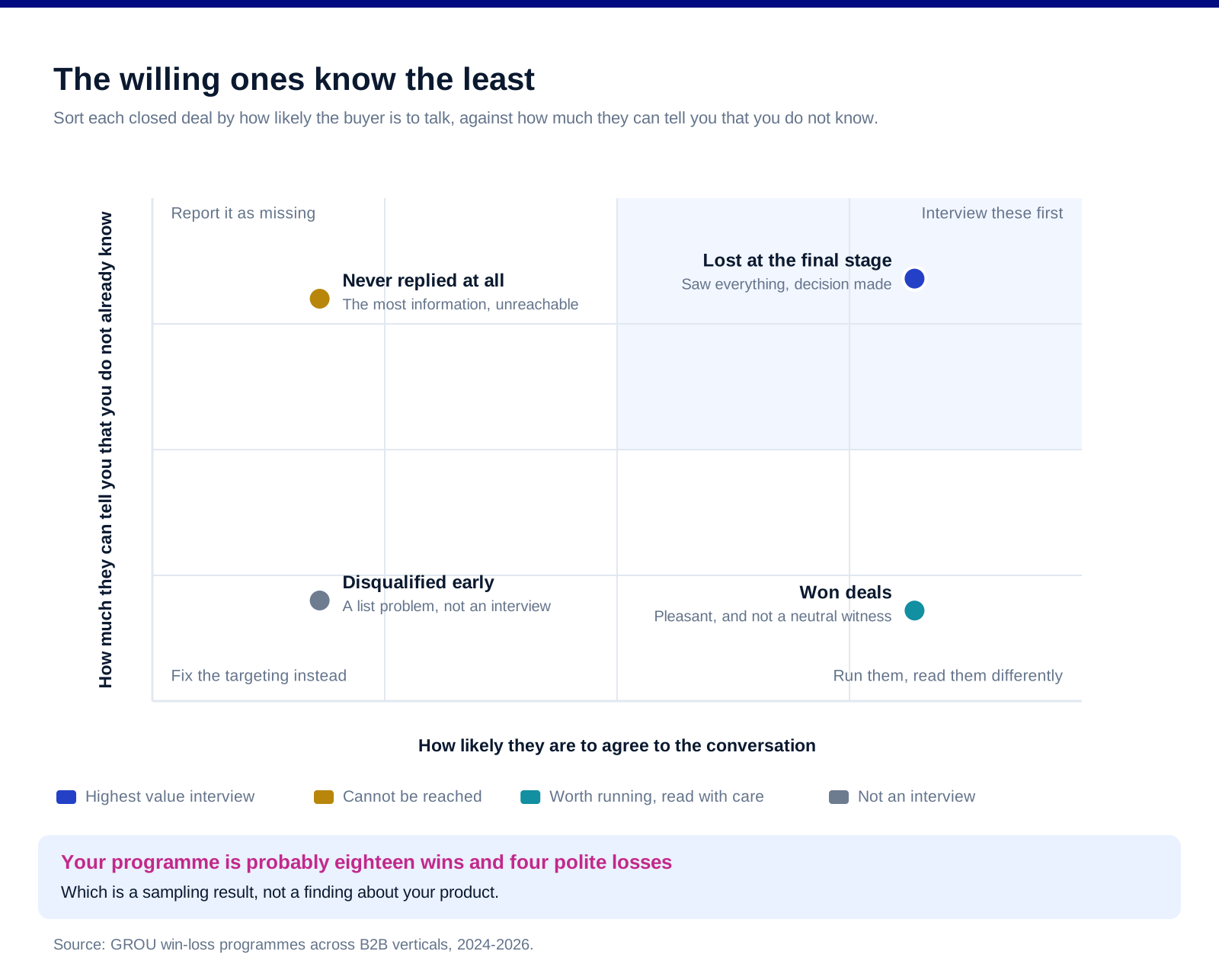
Lost at the final stage is the best interview available. They engaged fully, they saw your process end to end, they compared you against something specific, and they generally know exactly what happened. They are also more willing to talk than people expect, because the decision is made and there is nothing left to negotiate.
Won deals are the easiest and the least informative. Worth running, but read them for what your process felt like rather than for why you won, because the person explaining a decision they made is not a neutral witness to it.
Disqualified early tells you about your targeting, not your product or your process, and should be analysed as a list problem rather than interviewed. That is an ICP question.
Never replied is the group you cannot have. Say so in the report rather than quietly leaving it out, because a reader who does not know it is missing will over-read everything else.
Do not chase the response rate, profile the refusals
A higher response rate is not the goal, and this is the most commonly misunderstood point in the field. AAPOR notes the common assumption first, that "Often it is assumed - correctly or not - that the lower the response rate, the more question there is about the validity of the sample", and then corrects it: response rate information alone tells you neither how much nonresponse error exists nor whether it exists at all.
The thing that does work is comparing respondents against non-respondents. The same note is explicit that "the best way to test for non-response bias ... is to compare characteristics of responders with non-responders", and describes linking survey records against census data to do it.
In B2B you have something a survey researcher would envy. You already hold a full record for every person who refused: deal size, stage reached, industry, who the seller was, how long the cycle ran, which competitor was in play. You do not need to link to an external dataset. You can profile your refusals directly, this afternoon.
So do that first, and put it at the top of the report. It is the same discipline we argue for in sizing a lead generation pilot: know what your sample can and cannot support before you read anything into it. If the deals that agreed to talk average 40 percent larger than the deals that refused, that single line changes how every finding underneath it should be read. If the refusals cluster with one seller or one segment, you have found something before you have run a single interview.
This is also the honest way to report a small programme. Six interviews with a stated profile of the thirty people who declined is more useful than thirty interviews with no idea who is missing.
Ask what happened, not why
![[INSERT CHART 2, b2b-win-loss-analysis-chart-2-timeline.svg] Alt: Reconstructing the buyer's decision timeline in 2026, and where it diverges from the stages recorded in your CRM.](https://framerusercontent.com/images/gY1CwhwdIJJyrvLl9oytUcFzw.svg)
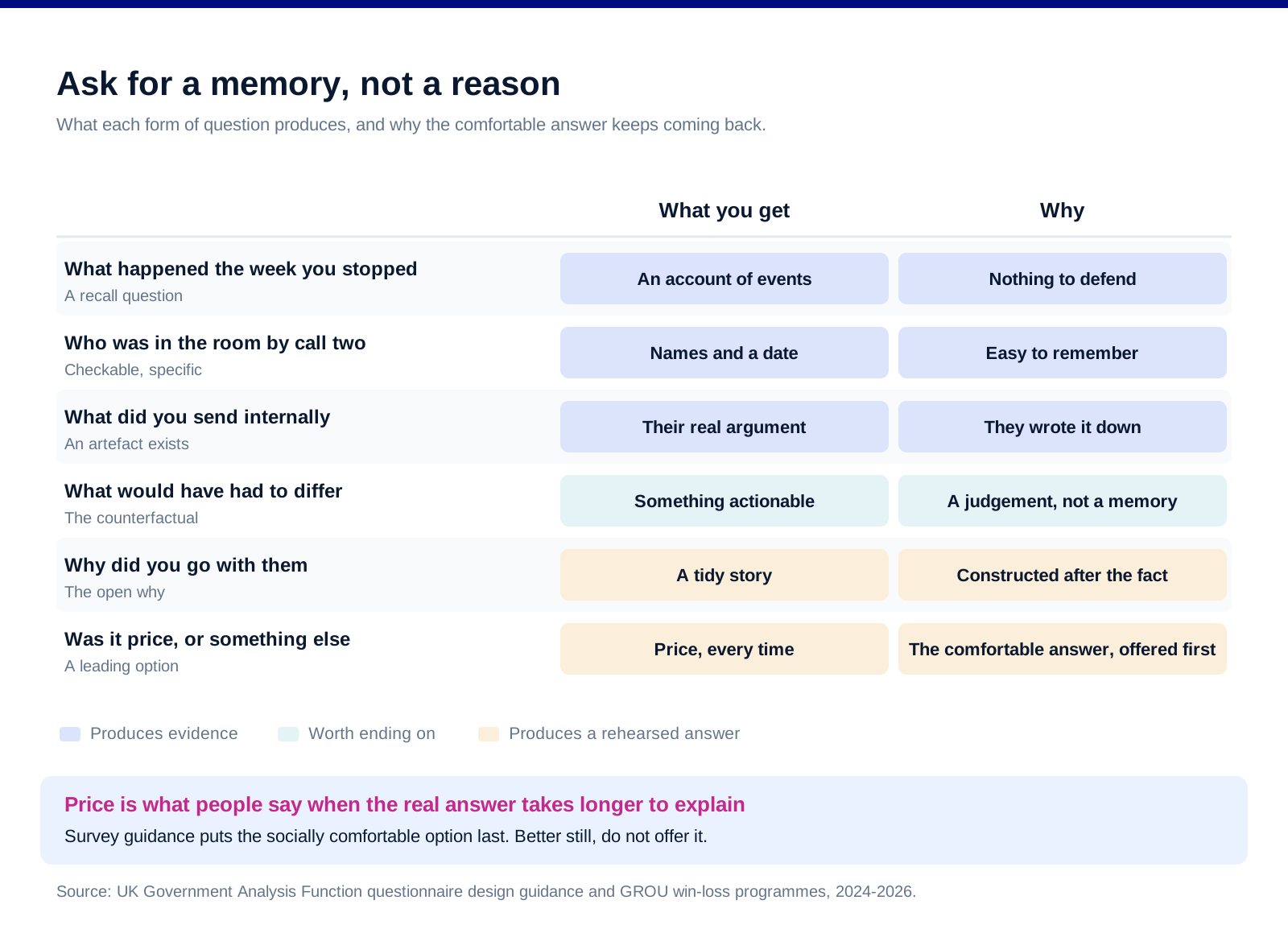
"Why did you choose them?" invites a story, not a memory. People construct a tidy reason after the fact, and the tidiest available reason in B2B is price, because it is true enough to say, impossible to argue with, and requires no elaboration.
Ask for the sequence instead. When did you first decide to look at this. Who else was in the room by the second call. What did you send internally to justify it. What was the last thing that changed your mind. Each of those is a recall question with a checkable answer, and together they reconstruct a timeline rather than a rationale.
Anchor on dates, not on periods. The Government Analysis Function's questionnaire design guidance recommends being specific: "Rather than saying 'last week' you should give specific dates." You have the dates. Use them in the question.
Run it fast, because memory degrades and the guidance says so. The same guidance names "recall memory error" as a known risk and recommends "minimising the time between the event taking place and the respondent recalling the event", noting that answer quality depends on "how long ago the event took place" and "how important or memorable the event was to the respondent." A quarterly batch of interviews about deals that closed eleven weeks ago is measuring what people remember, not what happened.
And the timeline you are reconstructing is theirs, not yours. Your CRM records transitions through your own sales process stages. The decision happened in their process, which started before you knew about it and often finished before your last call. The gap between those two timelines is where most of the useful findings live.
The question set, and who asks it
Not the seller who lost the deal. They cannot ask a neutral question about their own performance, the buyer cannot give a candid answer to the person they rejected, and both know it. Someone else runs the conversation, and the seller does not sit in.
Avoid leading questions, which are easier to write than you think. The guidance's examples are worth reading as a checklist of things a hopeful interviewer says naturally: "Did everyone enjoy the course? We always get really good feedback about it" is the tone to eliminate.
Put the comfortable answer last. Where you do offer response options, the guidance recommends placing "response categories that are more socially desirable than others at the end of the list" to reduce social desirability bias. In win-loss, price is the comfortable answer, and it should not be the first thing you hand people.
Ask about the moment it stopped, not the reason it stopped. "What was happening the week you stopped replying" gets an answer. "Why did you stop replying" gets an apology.
End with the counterfactual. What would have had to be different. It is the only forward-looking question that reliably produces something you can act on, and it works because it asks for a judgement rather than a memory.
If you record it, say so
Recording a call is processing personal data, and the failure mode is not obscure. The ICO reprimanded two police forces after they "failed to use people's personal data lawfully by recording hundreds of thousands of phone calls without their knowledge", noting that "people were not informed that their conversations with officers were being recorded."
Which is a low bar to clear and an easy one to trip over, particularly when an automated notetaker joins a call by default and nobody says anything about it. Ask at the start, accept a no without renegotiating, and take notes instead.
Say what happens to the recording, too. Who hears it, whether the seller does, and how long you keep it. A buyer who knows the seller will not hear the recording gives a materially different interview. This is not legal advice and the rules differ by jurisdiction.
What we do not publish here
Win rate, response rate or interview volume benchmarks. Ours come from a specific set of clients, markets and deal sizes, and a benchmark from a different context is worse than no benchmark. Our note on pipeline benchmarks explains the same caution.
A percentage of losses attributable to price. The whole argument of this article is that the stated reason and the actual reason diverge, so publishing a distribution of stated reasons would undercut it.
An interview script. A script produces a script-shaped conversation. The question forms above matter; the wording has to come from the actual deal and its actual dates.
A recommended interview length or cadence. Both depend on deal size and cycle length, and the only firm recommendation we will make is to run each one sooner than feels convenient.
Any claim about which win-loss software is best. We have not run a controlled comparison, and the sampling problem this article describes is not one that software solves.
Any suggestion that a win-loss programme is a survey. The methodology quoted here is written for probability samples, and a dozen interviews with the buyers who agreed to talk is not one. We borrow the diagnostic thinking because it is the right thinking, not because it makes the sample representative. It does not, and no amount of method makes it so.
FAQ
How many win-loss interviews do you need?
Fewer than you think, if you profile the refusals. Six interviews accompanied by a description of the thirty accounts that declined is more useful than thirty interviews with no idea who is missing, because the refusal profile tells you which direction the findings are skewed in.
Why do buyers always say price?
Because it is the comfortable answer. It is defensible, it requires no elaboration, and it does not require criticising anyone. Survey design guidance recommends putting socially desirable options last in a list for exactly this reason, and in win-loss the equivalent move is to ask what happened in sequence rather than offering reasons to pick from.
Who should run win-loss interviews?
Not the seller who lost the deal. Neither side can be candid in that conversation. Someone outside the deal runs it, and the seller is not in the room.
How soon after a deal closes should you run the interview?
As soon as you can. Government survey guidance names recall memory error as a known risk and recommends minimising the time between the event and the recall. A quarterly batch is measuring memory, not events.
Should you interview won deals as well as lost ones?
Yes, but read them differently. A customer explaining their own decision is not a neutral witness to it. Use won interviews for what the process felt like and for what nearly went wrong, rather than for a reason you won.
Do you need consent to record a win-loss call?
You need to tell people, at minimum, and an automated notetaker joining silently is the common way this goes wrong. The ICO has reprimanded organisations for recording calls without people's knowledge. Take advice on your own jurisdiction; this is not legal advice.
Bottom line
Before you improve anything about the interviews, look at who is not in them. Profile every account that declined against every account that agreed, using the CRM data you already hold, and put that comparison at the top of the report so nobody reads the findings without it. Then fix the two things that cost nothing: run the conversation within days rather than at the end of the quarter, and replace every "why" question with a "what happened, and when" question anchored on the actual dates. Take the seller who lost the deal out of the room. And when the answer comes back as price, treat that as the beginning of the question rather than the end of it, because it is the answer people give when the real one takes longer to explain.
Want the pipeline built and the losses understood rather than guessed at? Book a call with GROU. We run lead generation and outbound inside B2B revenue engines across verticals.
We are GROU, a B2B pipeline agency that runs lead generation, outbound, and LinkedIn content for clients across manufacturing, fintech, iGaming, software, and professional services. The survey methodology cited here is published by AAPOR and the UK Government Analysis Function and is quoted rather than paraphrased. Nothing here is legal advice.
The buyers most likely to answer your win-loss request are the ones least able to tell you anything you did not already know.
Your happy customers will take the call. The prospect who went quiet in week three, who saw something in your process that made them stop replying, will not. So the data comes back weighted towards the outcome you already understand, and the answer that arrives most often, price, is what people say when they would rather not explain.
TL;DR
Win-loss analysis fails on sampling before it fails on anything else. The people who agree to talk differ systematically from the people who do not, and they differ on precisely the variable you are trying to measure. Chasing a higher response rate does not fix this: AAPOR, the survey research body, states plainly that "Response rate information alone is not sufficient for determining how much nonresponse error exists in a survey, or even whether it exists." What does help is comparing who answered against who did not, and in B2B you can do this far better than a survey researcher can, because you already hold a CRM record for every single person who declined. Beyond sampling, the two fixes that matter most are speed and question form. Run the conversation within days, because government survey guidance names "recall memory error" as a known problem and recommends "minimising the time between the event taking place and the respondent recalling the event". And stop asking why you lost. Ask what happened, in order, with dates.
The sample is the whole problem
Nonresponse bias is not a rounding error here, it is the mechanism. The UK Government Analysis Function's note on survey non-response defines it as what "typically happens when people are unwilling or unable to respond to a survey due to a characteristic or factor, that distinguishes them from those who do respond."
Read that against a lost B2B deal. The characteristic distinguishing the people who will not talk to you is often the exact thing you are trying to learn: they found the process frustrating, they were never really evaluating you, they were told not to engage, or the person who championed you has left. Every one of those is a finding, and every one of them removes itself from your data.
Meanwhile your won customers answer readily, and are motivated to be pleasant about a decision they made and now have to live with. So a programme that reports "we interviewed 22 buyers this quarter" is usually reporting eighteen wins and four polite losses.
And the largest group is invisible entirely. The accounts that never replied to outreach at all hold the most information about the top of your funnel and are almost unreachable for exactly that reason. No win-loss programme covers them and none should pretend to.
Sort your candidates before you contact anyone
Lost at the final stage is the best interview available. They engaged fully, they saw your process end to end, they compared you against something specific, and they generally know exactly what happened. They are also more willing to talk than people expect, because the decision is made and there is nothing left to negotiate.
Won deals are the easiest and the least informative. Worth running, but read them for what your process felt like rather than for why you won, because the person explaining a decision they made is not a neutral witness to it.
Disqualified early tells you about your targeting, not your product or your process, and should be analysed as a list problem rather than interviewed. That is an ICP question.
Never replied is the group you cannot have. Say so in the report rather than quietly leaving it out, because a reader who does not know it is missing will over-read everything else.
Do not chase the response rate, profile the refusals
A higher response rate is not the goal, and this is the most commonly misunderstood point in the field. AAPOR notes the common assumption first, that "Often it is assumed - correctly or not - that the lower the response rate, the more question there is about the validity of the sample", and then corrects it: response rate information alone tells you neither how much nonresponse error exists nor whether it exists at all.
The thing that does work is comparing respondents against non-respondents. The same note is explicit that "the best way to test for non-response bias ... is to compare characteristics of responders with non-responders", and describes linking survey records against census data to do it.
In B2B you have something a survey researcher would envy. You already hold a full record for every person who refused: deal size, stage reached, industry, who the seller was, how long the cycle ran, which competitor was in play. You do not need to link to an external dataset. You can profile your refusals directly, this afternoon.
So do that first, and put it at the top of the report. It is the same discipline we argue for in sizing a lead generation pilot: know what your sample can and cannot support before you read anything into it. If the deals that agreed to talk average 40 percent larger than the deals that refused, that single line changes how every finding underneath it should be read. If the refusals cluster with one seller or one segment, you have found something before you have run a single interview.
This is also the honest way to report a small programme. Six interviews with a stated profile of the thirty people who declined is more useful than thirty interviews with no idea who is missing.
Ask what happened, not why
"Why did you choose them?" invites a story, not a memory. People construct a tidy reason after the fact, and the tidiest available reason in B2B is price, because it is true enough to say, impossible to argue with, and requires no elaboration.
Ask for the sequence instead. When did you first decide to look at this. Who else was in the room by the second call. What did you send internally to justify it. What was the last thing that changed your mind. Each of those is a recall question with a checkable answer, and together they reconstruct a timeline rather than a rationale.
Anchor on dates, not on periods. The Government Analysis Function's questionnaire design guidance recommends being specific: "Rather than saying 'last week' you should give specific dates." You have the dates. Use them in the question.
Run it fast, because memory degrades and the guidance says so. The same guidance names "recall memory error" as a known risk and recommends "minimising the time between the event taking place and the respondent recalling the event", noting that answer quality depends on "how long ago the event took place" and "how important or memorable the event was to the respondent." A quarterly batch of interviews about deals that closed eleven weeks ago is measuring what people remember, not what happened.
And the timeline you are reconstructing is theirs, not yours. Your CRM records transitions through your own sales process stages. The decision happened in their process, which started before you knew about it and often finished before your last call. The gap between those two timelines is where most of the useful findings live.
The question set, and who asks it
Not the seller who lost the deal. They cannot ask a neutral question about their own performance, the buyer cannot give a candid answer to the person they rejected, and both know it. Someone else runs the conversation, and the seller does not sit in.
Avoid leading questions, which are easier to write than you think. The guidance's examples are worth reading as a checklist of things a hopeful interviewer says naturally: "Did everyone enjoy the course? We always get really good feedback about it" is the tone to eliminate.
Put the comfortable answer last. Where you do offer response options, the guidance recommends placing "response categories that are more socially desirable than others at the end of the list" to reduce social desirability bias. In win-loss, price is the comfortable answer, and it should not be the first thing you hand people.
Ask about the moment it stopped, not the reason it stopped. "What was happening the week you stopped replying" gets an answer. "Why did you stop replying" gets an apology.
End with the counterfactual. What would have had to be different. It is the only forward-looking question that reliably produces something you can act on, and it works because it asks for a judgement rather than a memory.
If you record it, say so
Recording a call is processing personal data, and the failure mode is not obscure. The ICO reprimanded two police forces after they "failed to use people's personal data lawfully by recording hundreds of thousands of phone calls without their knowledge", noting that "people were not informed that their conversations with officers were being recorded."
Which is a low bar to clear and an easy one to trip over, particularly when an automated notetaker joins a call by default and nobody says anything about it. Ask at the start, accept a no without renegotiating, and take notes instead.
Say what happens to the recording, too. Who hears it, whether the seller does, and how long you keep it. A buyer who knows the seller will not hear the recording gives a materially different interview. This is not legal advice and the rules differ by jurisdiction.
What we do not publish here
Win rate, response rate or interview volume benchmarks. Ours come from a specific set of clients, markets and deal sizes, and a benchmark from a different context is worse than no benchmark. Our note on pipeline benchmarks explains the same caution.
A percentage of losses attributable to price. The whole argument of this article is that the stated reason and the actual reason diverge, so publishing a distribution of stated reasons would undercut it.
An interview script. A script produces a script-shaped conversation. The question forms above matter; the wording has to come from the actual deal and its actual dates.
A recommended interview length or cadence. Both depend on deal size and cycle length, and the only firm recommendation we will make is to run each one sooner than feels convenient.
Any claim about which win-loss software is best. We have not run a controlled comparison, and the sampling problem this article describes is not one that software solves.
Any suggestion that a win-loss programme is a survey. The methodology quoted here is written for probability samples, and a dozen interviews with the buyers who agreed to talk is not one. We borrow the diagnostic thinking because it is the right thinking, not because it makes the sample representative. It does not, and no amount of method makes it so.
FAQ
How many win-loss interviews do you need?
Fewer than you think, if you profile the refusals. Six interviews accompanied by a description of the thirty accounts that declined is more useful than thirty interviews with no idea who is missing, because the refusal profile tells you which direction the findings are skewed in.
Why do buyers always say price?
Because it is the comfortable answer. It is defensible, it requires no elaboration, and it does not require criticising anyone. Survey design guidance recommends putting socially desirable options last in a list for exactly this reason, and in win-loss the equivalent move is to ask what happened in sequence rather than offering reasons to pick from.
Who should run win-loss interviews?
Not the seller who lost the deal. Neither side can be candid in that conversation. Someone outside the deal runs it, and the seller is not in the room.
How soon after a deal closes should you run the interview?
As soon as you can. Government survey guidance names recall memory error as a known risk and recommends minimising the time between the event and the recall. A quarterly batch is measuring memory, not events.
Should you interview won deals as well as lost ones?
Yes, but read them differently. A customer explaining their own decision is not a neutral witness to it. Use won interviews for what the process felt like and for what nearly went wrong, rather than for a reason you won.
Do you need consent to record a win-loss call?
You need to tell people, at minimum, and an automated notetaker joining silently is the common way this goes wrong. The ICO has reprimanded organisations for recording calls without people's knowledge. Take advice on your own jurisdiction; this is not legal advice.
Bottom line
Before you improve anything about the interviews, look at who is not in them. Profile every account that declined against every account that agreed, using the CRM data you already hold, and put that comparison at the top of the report so nobody reads the findings without it. Then fix the two things that cost nothing: run the conversation within days rather than at the end of the quarter, and replace every "why" question with a "what happened, and when" question anchored on the actual dates. Take the seller who lost the deal out of the room. And when the answer comes back as price, treat that as the beginning of the question rather than the end of it, because it is the answer people give when the real one takes longer to explain.
Want the pipeline built and the losses understood rather than guessed at? Book a call with GROU. We run lead generation and outbound inside B2B revenue engines across verticals.
We are GROU, a B2B pipeline agency that runs lead generation, outbound, and LinkedIn content for clients across manufacturing, fintech, iGaming, software, and professional services. The survey methodology cited here is published by AAPOR and the UK Government Analysis Function and is quoted rather than paraphrased. Nothing here is legal advice.
The buyers most likely to answer your win-loss request are the ones least able to tell you anything you did not already know.
Your happy customers will take the call. The prospect who went quiet in week three, who saw something in your process that made them stop replying, will not. So the data comes back weighted towards the outcome you already understand, and the answer that arrives most often, price, is what people say when they would rather not explain.
TL;DR
Win-loss analysis fails on sampling before it fails on anything else. The people who agree to talk differ systematically from the people who do not, and they differ on precisely the variable you are trying to measure. Chasing a higher response rate does not fix this: AAPOR, the survey research body, states plainly that "Response rate information alone is not sufficient for determining how much nonresponse error exists in a survey, or even whether it exists." What does help is comparing who answered against who did not, and in B2B you can do this far better than a survey researcher can, because you already hold a CRM record for every single person who declined. Beyond sampling, the two fixes that matter most are speed and question form. Run the conversation within days, because government survey guidance names "recall memory error" as a known problem and recommends "minimising the time between the event taking place and the respondent recalling the event". And stop asking why you lost. Ask what happened, in order, with dates.
The sample is the whole problem
Nonresponse bias is not a rounding error here, it is the mechanism. The UK Government Analysis Function's note on survey non-response defines it as what "typically happens when people are unwilling or unable to respond to a survey due to a characteristic or factor, that distinguishes them from those who do respond."
Read that against a lost B2B deal. The characteristic distinguishing the people who will not talk to you is often the exact thing you are trying to learn: they found the process frustrating, they were never really evaluating you, they were told not to engage, or the person who championed you has left. Every one of those is a finding, and every one of them removes itself from your data.
Meanwhile your won customers answer readily, and are motivated to be pleasant about a decision they made and now have to live with. So a programme that reports "we interviewed 22 buyers this quarter" is usually reporting eighteen wins and four polite losses.
And the largest group is invisible entirely. The accounts that never replied to outreach at all hold the most information about the top of your funnel and are almost unreachable for exactly that reason. No win-loss programme covers them and none should pretend to.
Sort your candidates before you contact anyone
Lost at the final stage is the best interview available. They engaged fully, they saw your process end to end, they compared you against something specific, and they generally know exactly what happened. They are also more willing to talk than people expect, because the decision is made and there is nothing left to negotiate.
Won deals are the easiest and the least informative. Worth running, but read them for what your process felt like rather than for why you won, because the person explaining a decision they made is not a neutral witness to it.
Disqualified early tells you about your targeting, not your product or your process, and should be analysed as a list problem rather than interviewed. That is an ICP question.
Never replied is the group you cannot have. Say so in the report rather than quietly leaving it out, because a reader who does not know it is missing will over-read everything else.
Do not chase the response rate, profile the refusals
A higher response rate is not the goal, and this is the most commonly misunderstood point in the field. AAPOR notes the common assumption first, that "Often it is assumed - correctly or not - that the lower the response rate, the more question there is about the validity of the sample", and then corrects it: response rate information alone tells you neither how much nonresponse error exists nor whether it exists at all.
The thing that does work is comparing respondents against non-respondents. The same note is explicit that "the best way to test for non-response bias ... is to compare characteristics of responders with non-responders", and describes linking survey records against census data to do it.
In B2B you have something a survey researcher would envy. You already hold a full record for every person who refused: deal size, stage reached, industry, who the seller was, how long the cycle ran, which competitor was in play. You do not need to link to an external dataset. You can profile your refusals directly, this afternoon.
So do that first, and put it at the top of the report. It is the same discipline we argue for in sizing a lead generation pilot: know what your sample can and cannot support before you read anything into it. If the deals that agreed to talk average 40 percent larger than the deals that refused, that single line changes how every finding underneath it should be read. If the refusals cluster with one seller or one segment, you have found something before you have run a single interview.
This is also the honest way to report a small programme. Six interviews with a stated profile of the thirty people who declined is more useful than thirty interviews with no idea who is missing.
Ask what happened, not why
"Why did you choose them?" invites a story, not a memory. People construct a tidy reason after the fact, and the tidiest available reason in B2B is price, because it is true enough to say, impossible to argue with, and requires no elaboration.
Ask for the sequence instead. When did you first decide to look at this. Who else was in the room by the second call. What did you send internally to justify it. What was the last thing that changed your mind. Each of those is a recall question with a checkable answer, and together they reconstruct a timeline rather than a rationale.
Anchor on dates, not on periods. The Government Analysis Function's questionnaire design guidance recommends being specific: "Rather than saying 'last week' you should give specific dates." You have the dates. Use them in the question.
Run it fast, because memory degrades and the guidance says so. The same guidance names "recall memory error" as a known risk and recommends "minimising the time between the event taking place and the respondent recalling the event", noting that answer quality depends on "how long ago the event took place" and "how important or memorable the event was to the respondent." A quarterly batch of interviews about deals that closed eleven weeks ago is measuring what people remember, not what happened.
And the timeline you are reconstructing is theirs, not yours. Your CRM records transitions through your own sales process stages. The decision happened in their process, which started before you knew about it and often finished before your last call. The gap between those two timelines is where most of the useful findings live.
The question set, and who asks it
Not the seller who lost the deal. They cannot ask a neutral question about their own performance, the buyer cannot give a candid answer to the person they rejected, and both know it. Someone else runs the conversation, and the seller does not sit in.
Avoid leading questions, which are easier to write than you think. The guidance's examples are worth reading as a checklist of things a hopeful interviewer says naturally: "Did everyone enjoy the course? We always get really good feedback about it" is the tone to eliminate.
Put the comfortable answer last. Where you do offer response options, the guidance recommends placing "response categories that are more socially desirable than others at the end of the list" to reduce social desirability bias. In win-loss, price is the comfortable answer, and it should not be the first thing you hand people.
Ask about the moment it stopped, not the reason it stopped. "What was happening the week you stopped replying" gets an answer. "Why did you stop replying" gets an apology.
End with the counterfactual. What would have had to be different. It is the only forward-looking question that reliably produces something you can act on, and it works because it asks for a judgement rather than a memory.
If you record it, say so
Recording a call is processing personal data, and the failure mode is not obscure. The ICO reprimanded two police forces after they "failed to use people's personal data lawfully by recording hundreds of thousands of phone calls without their knowledge", noting that "people were not informed that their conversations with officers were being recorded."
Which is a low bar to clear and an easy one to trip over, particularly when an automated notetaker joins a call by default and nobody says anything about it. Ask at the start, accept a no without renegotiating, and take notes instead.
Say what happens to the recording, too. Who hears it, whether the seller does, and how long you keep it. A buyer who knows the seller will not hear the recording gives a materially different interview. This is not legal advice and the rules differ by jurisdiction.
What we do not publish here
Win rate, response rate or interview volume benchmarks. Ours come from a specific set of clients, markets and deal sizes, and a benchmark from a different context is worse than no benchmark. Our note on pipeline benchmarks explains the same caution.
A percentage of losses attributable to price. The whole argument of this article is that the stated reason and the actual reason diverge, so publishing a distribution of stated reasons would undercut it.
An interview script. A script produces a script-shaped conversation. The question forms above matter; the wording has to come from the actual deal and its actual dates.
A recommended interview length or cadence. Both depend on deal size and cycle length, and the only firm recommendation we will make is to run each one sooner than feels convenient.
Any claim about which win-loss software is best. We have not run a controlled comparison, and the sampling problem this article describes is not one that software solves.
Any suggestion that a win-loss programme is a survey. The methodology quoted here is written for probability samples, and a dozen interviews with the buyers who agreed to talk is not one. We borrow the diagnostic thinking because it is the right thinking, not because it makes the sample representative. It does not, and no amount of method makes it so.
FAQ
How many win-loss interviews do you need?
Fewer than you think, if you profile the refusals. Six interviews accompanied by a description of the thirty accounts that declined is more useful than thirty interviews with no idea who is missing, because the refusal profile tells you which direction the findings are skewed in.
Why do buyers always say price?
Because it is the comfortable answer. It is defensible, it requires no elaboration, and it does not require criticising anyone. Survey design guidance recommends putting socially desirable options last in a list for exactly this reason, and in win-loss the equivalent move is to ask what happened in sequence rather than offering reasons to pick from.
Who should run win-loss interviews?
Not the seller who lost the deal. Neither side can be candid in that conversation. Someone outside the deal runs it, and the seller is not in the room.
How soon after a deal closes should you run the interview?
As soon as you can. Government survey guidance names recall memory error as a known risk and recommends minimising the time between the event and the recall. A quarterly batch is measuring memory, not events.
Should you interview won deals as well as lost ones?
Yes, but read them differently. A customer explaining their own decision is not a neutral witness to it. Use won interviews for what the process felt like and for what nearly went wrong, rather than for a reason you won.
Do you need consent to record a win-loss call?
You need to tell people, at minimum, and an automated notetaker joining silently is the common way this goes wrong. The ICO has reprimanded organisations for recording calls without people's knowledge. Take advice on your own jurisdiction; this is not legal advice.
Bottom line
Before you improve anything about the interviews, look at who is not in them. Profile every account that declined against every account that agreed, using the CRM data you already hold, and put that comparison at the top of the report so nobody reads the findings without it. Then fix the two things that cost nothing: run the conversation within days rather than at the end of the quarter, and replace every "why" question with a "what happened, and when" question anchored on the actual dates. Take the seller who lost the deal out of the room. And when the answer comes back as price, treat that as the beginning of the question rather than the end of it, because it is the answer people give when the real one takes longer to explain.
Want the pipeline built and the losses understood rather than guessed at? Book a call with GROU. We run lead generation and outbound inside B2B revenue engines across verticals.
We are GROU, a B2B pipeline agency that runs lead generation, outbound, and LinkedIn content for clients across manufacturing, fintech, iGaming, software, and professional services. The survey methodology cited here is published by AAPOR and the UK Government Analysis Function and is quoted rather than paraphrased. Nothing here is legal advice.
Pipeline OS Newsletter
Build qualified pipeline
Get weekly tactics to generate demand, improve lead quality, and book more meetings.





Trusted by industry leaders
Trusted by industry leaders
Trusted by industry leaders
Ready to build qualified pipeline?
Ready to build qualified pipeline?
Ready to build qualified pipeline?
Book a call to see if we're the right fit, or take the 2-minute quiz to get a clear starting point.
Book a call to see if we're the right fit, or take the 2-minute quiz to get a clear starting point.
Book a call to see if we're the right fit, or take the 2-minute quiz to get a clear starting point.
" height="30.21639343089746px" id="hfGbXmQR2" width="30.216393430897455px"/></svg>)
Copyright © 2026 – All Right Reserved
Copyright © 2026 – All Right Reserved
Copyright © 2026 – All Right Reserved