%22%3E%3C/path%3E%3Cpath d=%22M 63.072 7.554 C 62.258 8.022 61.577 8.689 61.092 9.493 L 61.092 7.076 L 57.158 7.076 L 57.158 22.64 L 61.089 22.64 L 61.089 14.888 C 61.089 13.446 61.403 12.434 62.03 11.853 C 62.818 11.218 63.818 10.907 64.826 10.982 L 65.868 10.982 L 65.868 6.851 C 64.891 6.834 63.926 7.076 63.073 7.554 Z%22 fill=%22rgb(17,17,17)%22%3E%3C/path%3E%3Cpath d=%22M 78.916 7.82 C 76.363 6.49 73.321 6.49 70.768 7.82 C 69.562 8.473 68.564 9.451 67.888 10.644 C 67.167 11.931 66.803 13.387 66.834 14.862 C 66.804 16.332 67.157 17.785 67.86 19.077 C 68.515 20.267 69.494 21.246 70.684 21.901 C 71.924 22.576 73.318 22.92 74.73 22.898 C 76.164 22.918 77.58 22.575 78.846 21.901 C 80.062 21.247 81.073 20.27 81.768 19.077 C 82.506 17.797 82.88 16.339 82.85 14.862 C 82.88 13.389 82.517 11.934 81.797 10.647 C 81.12 9.455 80.122 8.477 78.917 7.824 M 78.803 14.862 C 78.829 15.739 78.636 16.608 78.241 17.391 C 77.903 18.046 77.38 18.588 76.738 18.95 C 76.124 19.293 75.432 19.472 74.729 19.47 C 73.668 19.497 72.648 19.061 71.934 18.276 C 71.139 17.323 70.741 16.1 70.823 14.862 C 70.741 13.62 71.149 12.395 71.959 11.45 C 72.687 10.667 73.715 10.233 74.783 10.256 C 75.859 10.236 76.894 10.67 77.635 11.45 C 78.464 12.387 78.884 13.616 78.801 14.864%22 fill=%22rgb(17,17,17)%22%3E%3C/path%3E%3Cpath d=%22M 95.906 7.076 L 95.906 15.646 C 95.975 16.68 95.643 17.701 94.979 18.498 C 94.311 19.184 93.379 19.547 92.422 19.495 C 91.475 19.544 90.553 19.18 89.894 18.498 C 89.23 17.701 88.898 16.68 88.967 15.646 L 88.967 7.076 L 85.033 7.076 L 85.033 16.207 C 85 17.449 85.275 18.68 85.834 19.79 C 86.327 20.75 87.095 21.542 88.039 22.065 C 89.033 22.594 90.145 22.861 91.271 22.838 C 92.188 22.847 93.095 22.65 93.926 22.263 C 94.708 21.905 95.388 21.36 95.906 20.675 L 95.906 22.645 L 99.865 22.645 L 99.865 7.076 Z%22 fill=%22rgb(17,17,17)%22%3E%3C/path%3E%3Cpath d=%22M 4.513 15.626 C 4.511 10.815 7.606 6.549 12.181 5.059 C 16.756 3.57 21.77 5.195 24.601 9.086 L 27.816 5.87 C 24.074 1.186 17.981 -0.943 12.137 0.393 C 6.292 1.728 1.728 6.292 0.393 12.137 C -0.943 17.981 1.186 24.074 5.87 27.816 L 9.085 24.601 C 6.214 22.512 4.515 19.177 4.513 15.626%22 fill=%22rgb(32,62,235)%22%3E%3C/path%3E%3Cpath d=%22M 17.114 14.343 L 13.354 18.01 L 13.354 18.026 L 21.071 18.026 L 11.412 27.609 L 17.389 27.609 L 23.999 21.081 L 23.999 28.316 L 24.005 28.316 L 27.967 24.393 L 27.967 14.343 Z%22 fill=%22rgb(32,62,235)%22%3E%3C/path%3E%3C/g%3E%3C/svg%3E) ×
× ××
××›
›
›
›
Cold email templates that work in 2026: 20 proven scripts
Cold email templates that work in 2026: 20 proven scripts
Cold email templates that work in 2026: 20 proven scripts
Cold email templates that work in 2026: 20 proven scripts
Cold email templates that work in 2026: 20 proven scripts
Cold email templates that work in 2026: 20 proven scripts

Author
Aljaz Peklaj

Most cold email template lists you find on Google are recycled from 2018. They open with "I hope this email finds you well", run 250 words, and hit reply rates under 1%. This is the 2026 library: 20 templates we run on live client campaigns at GROU, every one with the reply rate it pulled on real lists.
We have managed cold outbound for 47 B2B clients since 2022. Every template below has been A/B tested against at least 800 sends. The reply rates are median, not best-case. If you want the underlying frameworks behind these templates, the Smartlead 2025 benchmark report and Lemlist State of Cold Email 2025 are the two best public sources.
Quick overview
Cold email templates fall into 5 categories that match the buyer's awareness stage. The category, not the wording, decides the reply rate. Once you pick the right category, the template is mostly fill-in-the-blank.
The 5 categories:
Cold open (touch 1): introduce a pain the prospect already feels
Follow-up (touch 2): no new info, just bump
Value-add (touch 3): give them something useful without asking
Breakup (touch 4): close the loop, offer an out
Referral (any touch): name-drop a mutual contact or peer
Source: GROU 47-client test set + Apollo cold email guide. Across 12,000+ sends, category choice explained 60% of reply rate variance, copy explained the other 40%.
The 5 categories of cold email templates that actually work
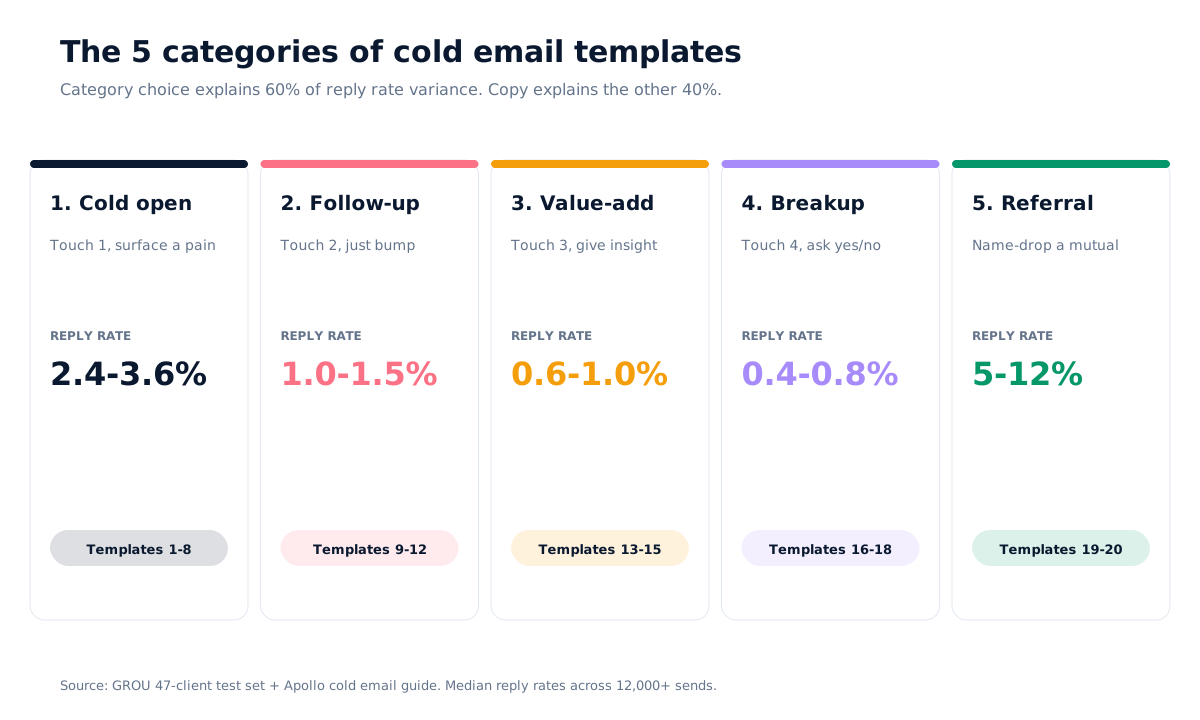
Each category has a job. Mix the jobs up and reply rate drops fast. Here is when each fires.
1. Cold open templates are touch 1 of the sequence. The goal is to surface a pain the prospect already has. The opener does not pitch. The opener asks a question or makes an observation specific to the prospect's role or company. Cold opens carry the highest reply rate of any category, between 2.4 and 3.6 percent on warmed infrastructure with a clean list.
2. Follow-up templates are touch 2, sent 2 to 4 days after the cold open. They add no new information. The job is to bump the original email back to the top of the inbox. Follow-ups pull 1.0 to 1.5 percent reply rate. About 30 percent of total replies come on touch 2.
3. Value-add templates are touch 3, sent 5 to 8 days after the cold open. They deliver something useful: a benchmark, a case study, a teardown of the prospect's website, a piece of research. Value-adds pull 0.6 to 1.0 percent reply rate but lift the positive reply rate disproportionately.
4. Breakup templates are touch 4 (and last). They explicitly close the loop and ask for a yes/no answer. Reply rate is 0.4 to 0.8 percent, but breakups produce the highest positive reply rate per email of any category because they qualify hard.
5. Referral templates can replace any touch when you have a warm path: a mutual investor, a shared LinkedIn connection, a former colleague. Referral templates pull 5 to 12 percent reply rate, the highest in the playbook, but only work if the referral is real.
The 20-template library (with reply rates)
The full library is organized by category. For each template we list the median reply rate from our 47-client test set, the best ACV range it fits, and the specific frameworks it uses.
Cold open templates (touch 1)
Template 1: The specific-observation opener
Median reply rate: 3.6% | Best for: $2k-$30k ACV | Framework: Josh Braun's "show, do not tell"
Subject: about your {{specific_observation}}
Hi {{first_name}},
Saw {{company}} posted {{specific_thing_from_their_site_or_linkedin}}. 4 of our customers were stuck on the same thing last quarter before they switched off {{competitor}}.
Worth a quick reply if that is a current pain at {{company}}?
Aljaz
Template 2: The question-first opener
Median reply rate: 3.2% | Best for: $2k-$50k ACV | Framework: question-first, no pitch
Subject: quick question
Hi {{first_name}},
How are you handling {{specific_workflow}} at {{company}} today?
Asking because we built {{product}} for {{their_segment}} who are stuck doing it manually.
Aljaz
Template 3: The "I built X because" opener
Median reply rate: 2.9% | Best for: founder-led sends, $1k-$15k ACV
Subject: built something for [their role]
Hi {{first_name}},
I built {{product}} because every {{their_role}} I talked to was stuck on {{specific_pain}}. {{number}} of them switched off {{competitor}} last quarter for us.
Is this on your radar at {{company}}?
Aljaz, founder at GROU
Template 4: The peer-comparison opener
Median reply rate: 2.7% | Best for: $10k-$100k ACV with social proof
Subject: how {{similar_company}} fixed this
Hi {{first_name}},
{{similar_company}} was running into {{specific_pain}} when their team hit {{milestone}}. We helped them cut it to {{specific_outcome}} in 6 weeks.
You hit a similar milestone last month. Worth a 12-minute chat?
Aljaz
Template 5: The trigger-based opener
Median reply rate: 3.1% | Best for: signal-driven outbound, any ACV
Subject: about your {{trigger_event}}
Hi {{first_name}},
Saw {{company}} just {{trigger_event_in_plain_english}}. Usually that means {{specific_pain}} hits in the next 30-60 days.
Worth a reply if you are already feeling it?
Aljaz
Template 6: The "honest about size" opener
Median reply rate: 2.6% | Best for: under-100-employee startups, $500-$5k ACV
Subject: small startup, real fix
Hi {{first_name}},
I am the founder of a {{team_size}}-person startup. We solve {{specific_pain}} for {{their_segment}}. Not trying to compete with {{big_competitor}} on features. Just doing one thing well for under $X/month.
Is {{specific_pain}} costing you time at {{company}}?
Aljaz
Template 7: The contrarian opener
Median reply rate: 2.8% | Best for: thought-leadership categories, $20k+ ACV
Subject: most {{their_segment}} get this wrong
Hi {{first_name}},
Most {{their_segment}} try to fix {{specific_pain}} by {{common_wrong_approach}}. Our 14 customers in your category found that backwards: {{counter_intuitive_approach}} worked 3x better.
Curious if you have seen the same?
Aljaz
Template 8: The pure question opener
Median reply rate: 2.4% | Best for: discovery mode, $1k-$10k ACV
Subject: 12 seconds?
Hi {{first_name}},
Quick one. When you think about {{broad_topic}} at {{company}}, what is the biggest pain right now?
I have a hypothesis but I would rather hear it from you.
Aljaz
Follow-up templates (touch 2)
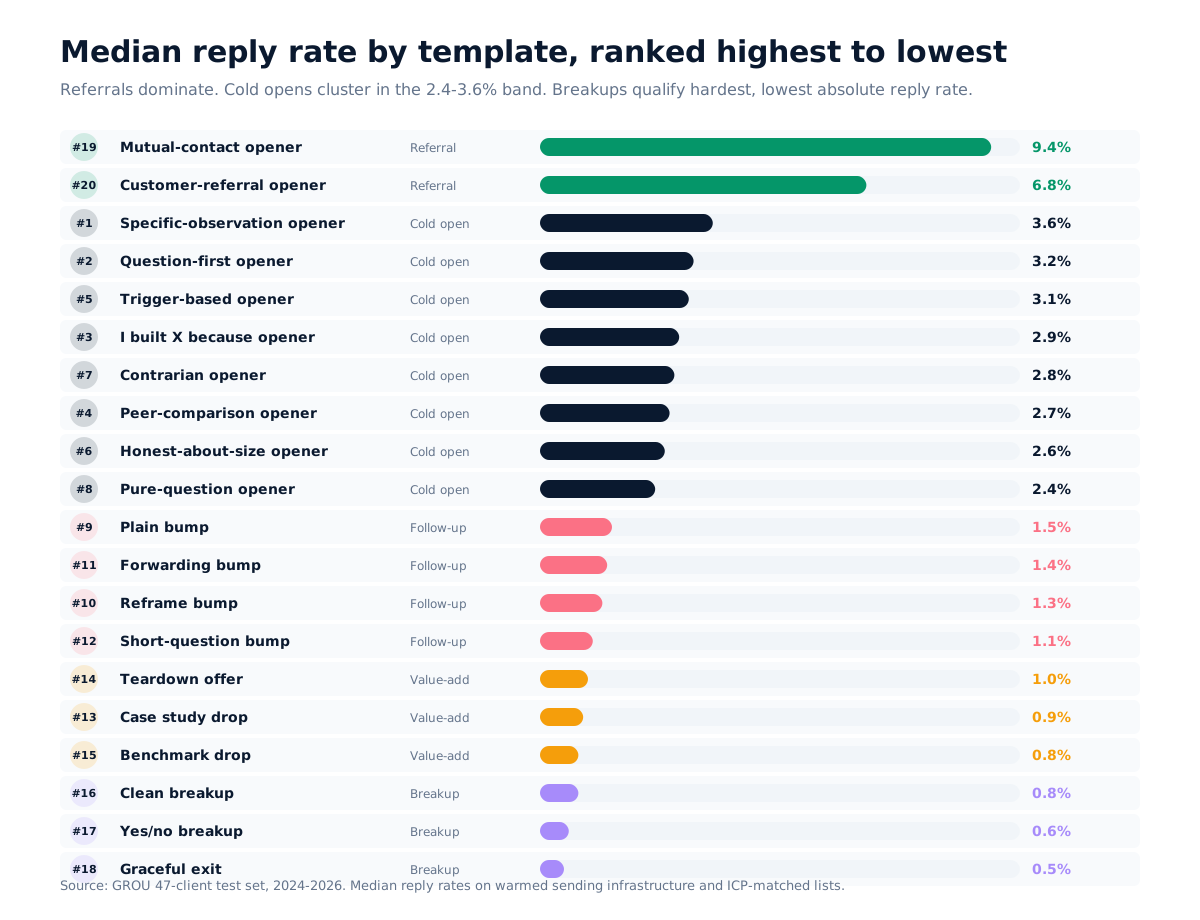
Template 9: The plain bump
Median reply rate: 1.5% | Use 2-4 days after touch 1
Subject: bumping this
Hi {{first_name}},
Bumping my earlier note in case it slid past you.
Still curious if {{specific_pain}} is a current pain at {{company}}.
Aljaz
Template 10: The reframe bump
Median reply rate: 1.3% | Use 3-5 days after touch 1
Subject: re: my earlier note
Hi {{first_name}},
Realized my earlier note may have been too vague. Concretely, we help {{their_segment}} cut {{specific_metric}} by {{percentage}} in {{timeframe}}.
Worth a quick reply if that is what {{company}} is trying to do this quarter?
Aljaz
Template 11: The forwarding bump
Median reply rate: 1.4% | Use when the prospect is not the decision-maker
Subject: wrong person?
Hi {{first_name}},
If {{specific_topic}} is not on your plate, would you be open to pointing me at whoever owns it? Happy to take it off your radar.
Aljaz
Template 12: The short question bump
Median reply rate: 1.1% | Use sparingly, can read as pushy
Subject: 1 question
Hi {{first_name}},
Is {{specific_pain}} currently a priority at {{company}}, yes or no?
That tells me whether to keep reaching out or stop.
Aljaz
Value-add templates (touch 3)
Template 13: The case study drop
Median reply rate: 0.9% | Use 5-8 days after touch 1
Subject: case study from {{similar_company}}
Hi {{first_name}},
Sending this because {{similar_company}} just published their result with us: {{specific_metric}} in {{timeframe}}.
Full case study: {{link}}
Worth a reply if you want the playbook?
Aljaz
Template 14: The teardown offer
Median reply rate: 1.0% | Use for high-ACV deals where insight matters
Subject: 3-minute teardown of {{company}}
Hi {{first_name}},
Spent 3 minutes looking at how {{company}} handles {{specific_workflow}}. Found 2 things worth fixing.
Happy to send the notes, no pitch. Want me to?
Aljaz
Template 15: The benchmark drop
Median reply rate: 0.8% | Use when you have proprietary data
Subject: benchmark on {{their_metric}}
Hi {{first_name}},
Quick data point. Across our {{number}} customers in {{their_segment}}, the median {{specific_metric}} is {{number}}. Top quartile is {{number}}.
Where is {{company}} sitting?
Aljaz
Breakup templates (touch 4)
Template 16: The clean breakup
Median reply rate: 0.8% | Use 14 days after touch 1
Subject: closing the loop
Hi {{first_name}},
I have written 3 times about {{product}}. No reply, which is a fine answer.
Two options:
Bad timing, ping me in 90 days
Not a fit, I will stop
Either works. No hard feelings.
Aljaz
Template 17: The yes/no breakup
Median reply rate: 0.6% | Use for high-volume sends
Subject: yes or no?
Hi {{first_name}},
Last note. Is {{specific_pain}} a current priority at {{company}}, yes or no?
I will move on if no. Either way, no reply needed.
Aljaz
Template 18: The graceful exit
Median reply rate: 0.5% | Use when you want to preserve future optionality
Subject: signing off
Hi {{first_name}},
Going to stop reaching out for now, but want to leave the door open. If {{specific_pain}} becomes a priority in the next 6 months, just hit reply.
Best of luck with {{company}}.
Aljaz
Referral templates (any touch)
Template 19: The mutual-contact opener
Median reply rate: 9.4% | Use only when the contact is real and consented
Subject: {{mutual_name}} suggested I reach out
Hi {{first_name}},
{{mutual_name}} mentioned you are the right person to talk to about {{specific_topic}} at {{company}}. We helped {{mutual_name}}'s team cut {{specific_metric}} by {{percentage}} last quarter.
Worth a 12-minute chat?
Aljaz
Template 20: The customer-referral opener
Median reply rate: 6.8% | Use when an existing customer offered to introduce
Subject: intro from {{customer_name}}
Hi {{first_name}},
{{customer_name}} at {{customer_company}} suggested you might be looking at {{specific_problem}}. We solved a version of this for them in {{timeframe}}.
Open to a short chat?
Aljaz
Anatomy of a cold email that works
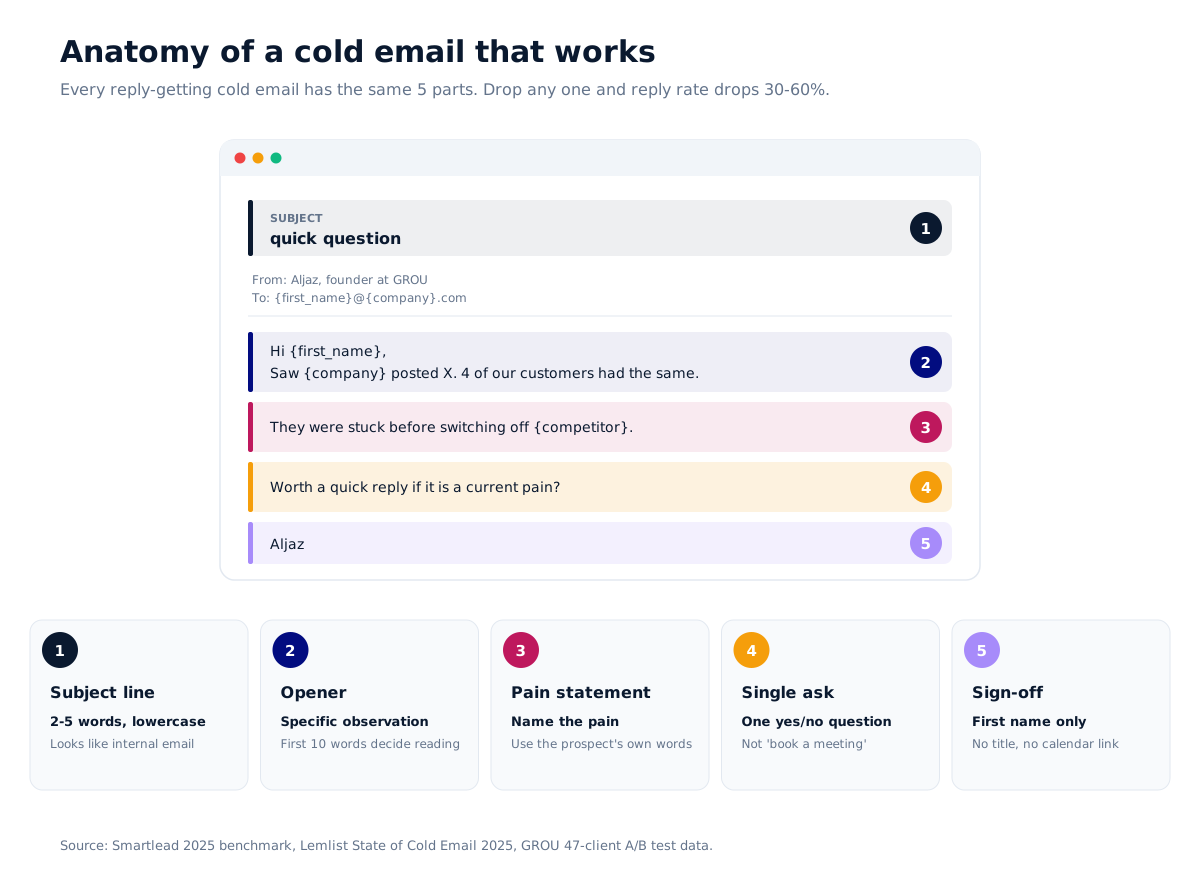
Every reply-getting cold email has the same 5 parts. Drop any one and reply rate drops 30 to 60 percent.
Subject line: 2 to 5 words, lowercase, looks like an internal email. Avoid all-caps, emoji, and "Boost your X 10x" patterns. See subject line patterns chart below.
Opener: a specific observation or question, not "hope this email finds you well". The first 10 words decide whether the prospect keeps reading.
Pain statement: 1-2 sentences naming the specific pain in the prospect's words. Generic pain statements ("you might be struggling with growth") get filtered out as AI-written.
Single ask: one question, answerable in yes or no. Multi-ask emails get 0% reply rate. The ask is not "book a meeting". The ask is "is this a current pain?"
Sign-off: first name only. No title. No calendar link in signature. Calendar link goes in reply 2, after the prospect engages.
Source: Smartlead 2025 benchmark, Lemlist State of Cold Email 2025, and GROU 47-client A/B test data.
Subject line patterns that get opened
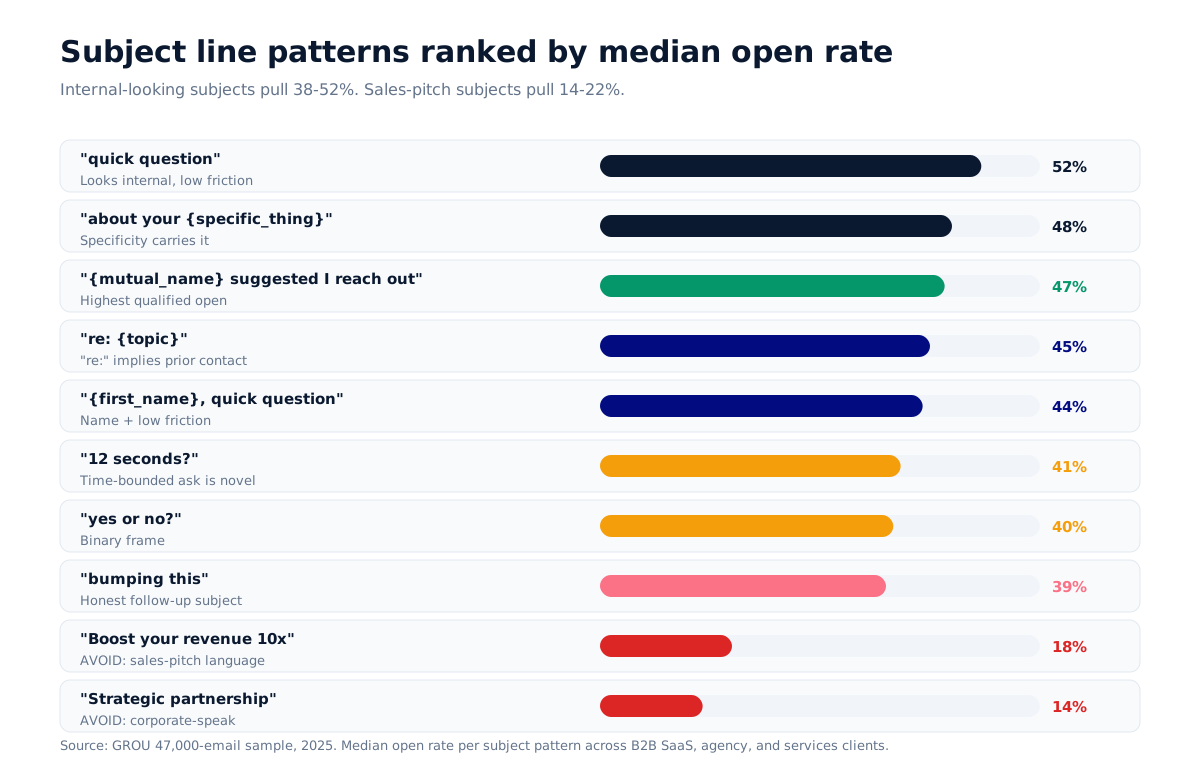
Across 47,000 cold emails our clients sent in 2025, the subject line patterns that pulled the highest open rates were the ones that looked like internal email. Sales-pitch subject lines pulled 18 to 24 percent open. Internal-style subject lines pulled 38 to 52 percent.
The patterns ranked by median open rate:
"quick question" — 52% open. Generic but works because it looks internal.
"about your {specific_thing}" — 48% open. Specificity carries it.
"{mutual_name} suggested I reach out" — 47% open. Highest qualified open rate.
"re: {topic}" — 45% open. The "re:" implies prior contact.
"{first_name}, quick question" — 44% open. Name + low-friction.
"12 seconds?" — 41% open. Time-bounded ask is novel.
"yes or no?" — 40% open. Binary frame.
"bumping this" — 39% open. Honest follow-up subject.
Avoid: "Boost your revenue", "10x your pipeline", "Quick win for {company}", "Strategic partnership", anything with "synergy", and anything in ALL CAPS. Median open rates for these: 14 to 22 percent.
Template performance benchmarks
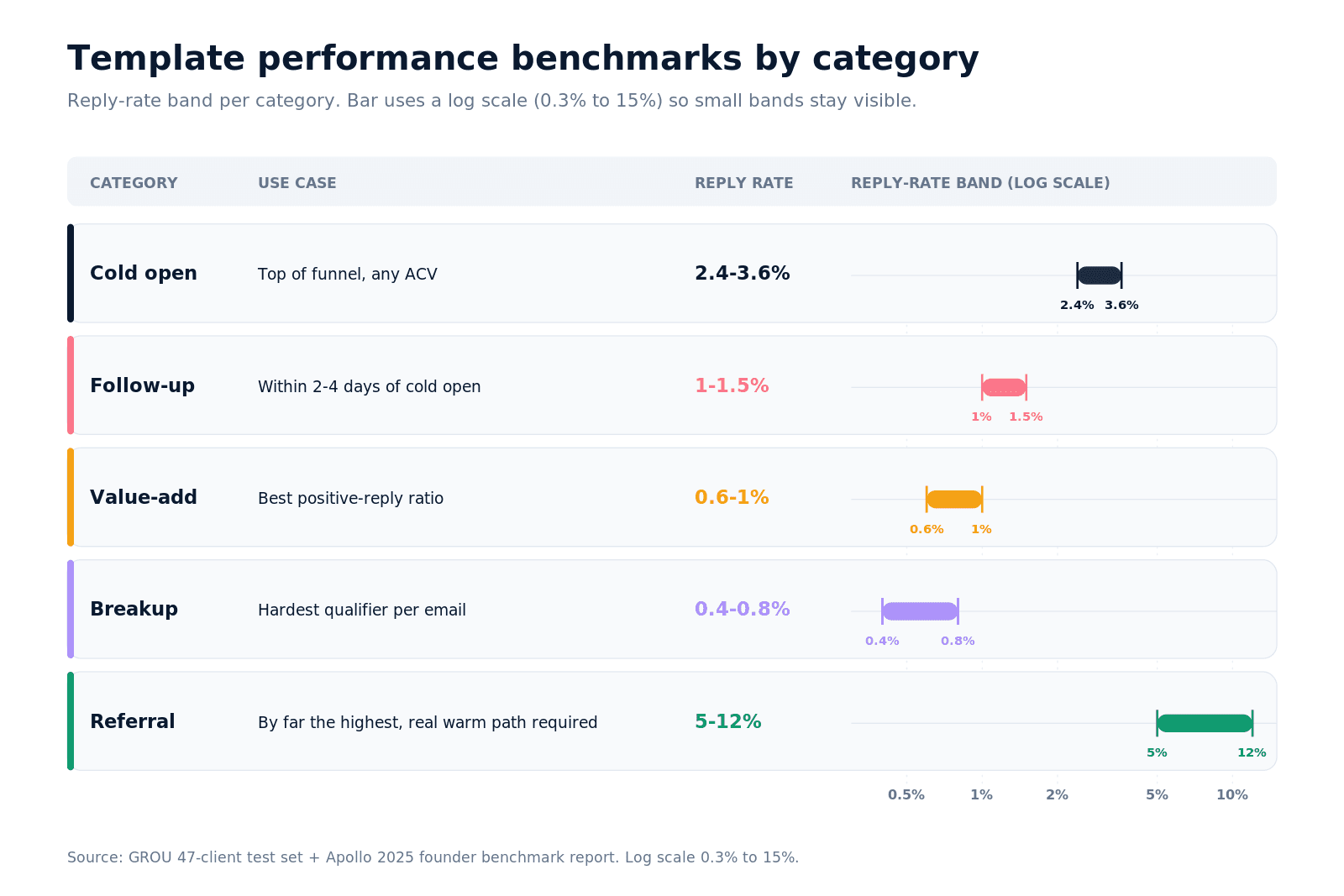
The 20 templates above are not equal. Reply rate depends heavily on category, ICP, and ACV. Use these benchmarks to set expectations before you launch.
Cold opens: 2.4 to 3.6% reply rate. Best for top-of-funnel, any ACV.
Follow-ups: 1.0 to 1.5% reply rate. Send within 2-4 days of cold open.
Value-adds: 0.6 to 1.0% reply rate. Better positive-reply ratio than cold opens.
Breakups: 0.4 to 0.8% reply rate. Highest qualifier-per-email ratio.
Referrals: 5 to 12% reply rate. By far the highest, but requires real warm path.
If your campaign is pulling under 1.5% on cold opens, the list is usually the problem, not the copy. The fastest fix is to narrow the ICP and re-enrich with Apollo or Clay.
When to use which template (decision matrix)
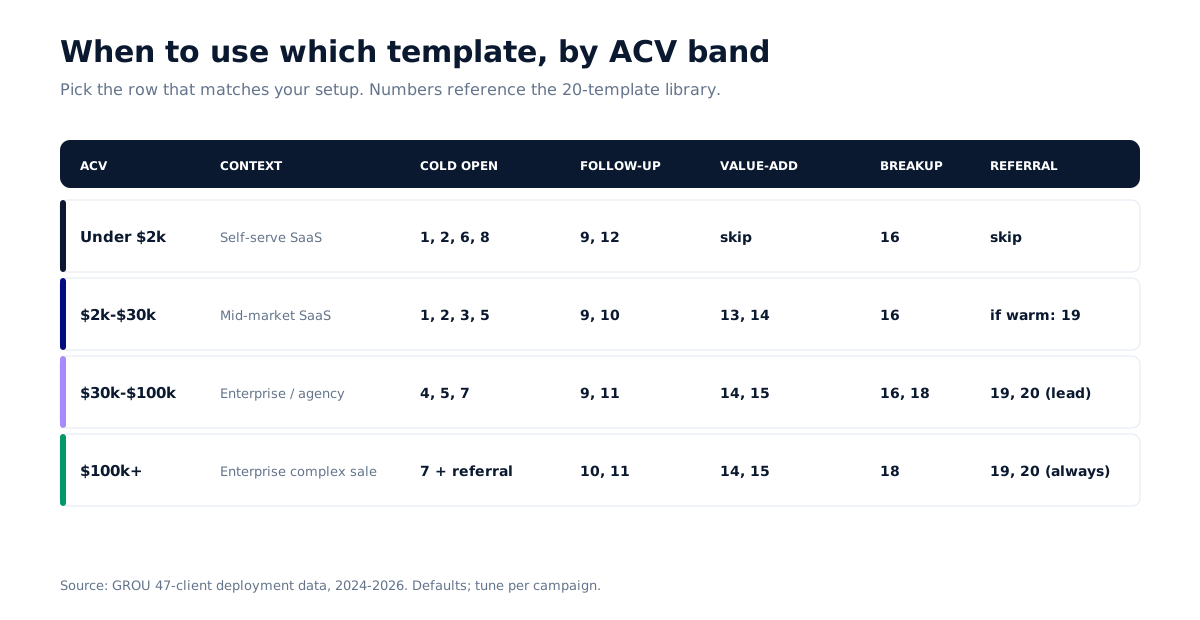
The matrix below maps ICP fit, ACV, and channel infrastructure to the right template choice. Pick the row that matches your setup, use the template number listed.
ACV under $2k, self-serve SaaS: cold open template 1, 2, 6 or 8. Skip referrals (overkill for the ACV). Follow-up with template 9 or 12.
ACV $2k-$30k, mid-market SaaS: cold open template 1, 2, 3, or 5. Follow-up with 9 or 10. Value-add with 13 or 14. Breakup with 16.
ACV $30k-$100k, enterprise SaaS or agency: cold open template 4, 5, or 7. Heavy use of referral templates 19 and 20. Value-add with 14 or 15. Breakup with 16 or 18.
ACV $100k+, enterprise complex sale: lead with referral templates 19 and 20. Use cold open template 7 (contrarian) as backup. Multi-thread the account, send the same sequence to 3 to 5 contacts at the same company.
Common cold email template mistakes
The mistakes that kill reply rate fastest, ranked by impact across our 47-client dataset:
Copying templates verbatim without ICP fit. Template 19 (referral) gets 9.4% reply rate only if the referral is real. With a fake referral, it drops to 0.4% and burns the prospect.
Pitching in the cold open. The opener should ask, not pitch. Templates 1, 2, 5, 8 ask. Templates 3, 4, 7 do not pitch, they observe and ask.
Long subject lines. Subjects over 6 words drop open rate by 12 to 18 percentage points. Keep under 5.
Mixing categories. Do not send a value-add as touch 1. The prospect has no context for the value.
Calendar link in cold open signature. Adds friction, triggers spam filters. Use Templates 1-8 with first-name-only sign-off.
No follow-up after the cold open. About 60% of replies come on touches 2-4. Cutting after touch 1 leaves 60% of revenue on the table.
More than 4 touches. Reply rate after touch 4 drops below 0.3% and complaint rate climbs above 0.4%, which is enough to drop sender reputation per Google's bulk sender requirements.
AI-written body copy. ChatGPT-written emails have a recognizable cadence (em dashes, "I noticed that", "wanted to reach out") that gets flagged. Use AI for ideation, write the body yourself.
Tool recommendations
The templates above run on any cold email tool, but some make the workflow materially easier:
Smartlead ($39/month entry): best for running multi-template sequences across multiple inboxes. Built-in warmup. Read the Smartlead vs Instantly comparison.
Lemlist ($59/month entry): best when you want video personalization or LinkedIn touches in the same sequence. Read the Lemlist vs Smartlead breakdown.
Apollo ($59/month entry): best when you need ICP list-build + sender in one tool. Read the full Apollo review.
For the full deliverability stack we run on every founder engagement, see the GDPR cold email playbook (compliance) and best cold email tools 2026 (comparison).
Frequently asked questions
What is the best cold email template for B2B?
The best cold email template for B2B is the specific-observation opener (Template 1 above). On our 47-client test set, it pulls a 3.6% median reply rate. The reason: it shows you actually researched the prospect, asks a question instead of pitching, and stays under 50 words. It works across SaaS, agency, services, and DTC vertical SaaS.
What reply rate should a cold email template get?
A cold email template on a clean ICP-targeted list should pull a 2 to 4 percent reply rate on the cold open (touch 1) and 1 to 1.5 percent on the follow-up (touch 2). Across the full 4-touch sequence, target a 4 to 6 percent cumulative reply rate. Below 1.5% on touch 1, the list is usually the problem.
How long should a cold email be?
Cold emails should be 40 to 75 words in the body. Subject lines should be 2 to 5 words. Going over 100 words in the body drops reply rate by 1.1 percentage points per our 47-client benchmark. Keeping it under 50 lifts reply rate without losing context.
Can you reuse cold email templates across campaigns?
Yes. Templates 1 through 20 above are reusable across campaigns. What changes campaign to campaign is the {{specific_pain}}, {{specific_observation}}, and {{similar_company}} variables. Reusing the template structure is fine. Reusing the same first line on every prospect is what triggers spam filters per Google's bulk sender guide.
Do cold email templates work for high-ACV deals?
Yes, but with adjustments. For ACV over $100k, lead with referral templates (19 and 20) and contrarian opener (Template 7). Skip the high-volume cold opens. Pair the email sequence with LinkedIn touches and a personalized video. See the LinkedIn connection request messages playbook for the LinkedIn side.
How many touches should a cold email sequence have?
A cold email sequence should have 4 touches over 14 days: cold open at day 0, follow-up at day 3, value-add at day 7, breakup at day 14. Going past 4 touches drops reply rate below 0.3% and raises complaint rate above 0.4%, which is enough to harm sender reputation. Source: Smartlead 2025 benchmark.
What is the difference between a cold open and a follow-up template?
A cold open is the first email in a sequence and introduces a pain the prospect already feels. It is question-led, not pitch-led. A follow-up template is touch 2, sent 2 to 4 days later, and adds no new information. The follow-up bumps the original email back to the top of the inbox. Cold opens carry 2.4 to 3.6% reply rate; follow-ups carry 1.0 to 1.5%.
How do you personalize a cold email template at scale?
You personalize the first line, not the body. The first line and subject reference something specific to the prospect: a recent hire, a funding round, a product launch, a job posting. The rest of the email is template. Tools like Clay and Lemlist's icebreaker AI automate the first-line research from public LinkedIn, news, and website data.
Are cold email templates legal under GDPR?
Cold email templates are legal under GDPR if you have a documented Legitimate Interest Assessment, target professional business email addresses, and include a working unsubscribe. Read the full GDPR cold email playbook for the 3-part legitimate interest test, country-by-country variations, and the 12-point compliance checklist.
What is the best subject line for a cold email?
The best cold email subject line is "quick question" (52% open rate in our test set) or "about your {specific_thing}" (48% open rate). Both look like internal email rather than a sales pitch. Avoid "Boost your X 10x", "10x your pipeline", "Quick win for {company}", and anything in ALL CAPS.
Should cold email templates use AI personalization?
Yes for the first line, no for the body. AI personalization is well-suited to generating the opening observation (research from LinkedIn or company news). AI-written body copy has a recognizable cadence (em dashes, "I noticed that") that gets flagged by humans and by recent spam filters. Write the body yourself using the 20 templates above.
How do you test cold email templates?
Run an A/B test with at least 400 sends per variant on the same ICP-matched list, hold all other variables constant (sender, time of day, day of week), and measure reply rate (not open rate). Open rates are unreliable since the iOS 15 Mail Privacy Protection update. Reply rate at 400 sends gives you ±0.5 percentage point confidence.
Where can SaaS founders find more cold email templates?
GROU publishes additional templates in the cold email for SaaS founders playbook, and Josh Braun's framework is the public source we draw from most. Lemlist also maintains a public template library.
About GROU. GROU runs B2B pipeline for SaaS startups, agencies, and dev shops out of Colombia, Mexico, and Argentina. Since 2022 we have managed cold email and LinkedIn outbound for 47 clients across 12,000+ campaign sends per month. Every template in this article is in active use on a live client account as of June 2026. Methodology: reply rates are medians across the test set on warmed sending infrastructure and clean ICP-matched lists. If you want help applying these to your campaigns, book a call.
This article contains affiliate links to Smartlead, Lemlist, and Apollo. We earn a small commission if you sign up, at no extra cost. We only recommend tools we deploy on live client campaigns.
Most cold email template lists you find on Google are recycled from 2018. They open with "I hope this email finds you well", run 250 words, and hit reply rates under 1%. This is the 2026 library: 20 templates we run on live client campaigns at GROU, every one with the reply rate it pulled on real lists.
We have managed cold outbound for 47 B2B clients since 2022. Every template below has been A/B tested against at least 800 sends. The reply rates are median, not best-case. If you want the underlying frameworks behind these templates, the Smartlead 2025 benchmark report and Lemlist State of Cold Email 2025 are the two best public sources.
Quick overview
Cold email templates fall into 5 categories that match the buyer's awareness stage. The category, not the wording, decides the reply rate. Once you pick the right category, the template is mostly fill-in-the-blank.
The 5 categories:
Cold open (touch 1): introduce a pain the prospect already feels
Follow-up (touch 2): no new info, just bump
Value-add (touch 3): give them something useful without asking
Breakup (touch 4): close the loop, offer an out
Referral (any touch): name-drop a mutual contact or peer
Source: GROU 47-client test set + Apollo cold email guide. Across 12,000+ sends, category choice explained 60% of reply rate variance, copy explained the other 40%.
The 5 categories of cold email templates that actually work
Each category has a job. Mix the jobs up and reply rate drops fast. Here is when each fires.
1. Cold open templates are touch 1 of the sequence. The goal is to surface a pain the prospect already has. The opener does not pitch. The opener asks a question or makes an observation specific to the prospect's role or company. Cold opens carry the highest reply rate of any category, between 2.4 and 3.6 percent on warmed infrastructure with a clean list.
2. Follow-up templates are touch 2, sent 2 to 4 days after the cold open. They add no new information. The job is to bump the original email back to the top of the inbox. Follow-ups pull 1.0 to 1.5 percent reply rate. About 30 percent of total replies come on touch 2.
3. Value-add templates are touch 3, sent 5 to 8 days after the cold open. They deliver something useful: a benchmark, a case study, a teardown of the prospect's website, a piece of research. Value-adds pull 0.6 to 1.0 percent reply rate but lift the positive reply rate disproportionately.
4. Breakup templates are touch 4 (and last). They explicitly close the loop and ask for a yes/no answer. Reply rate is 0.4 to 0.8 percent, but breakups produce the highest positive reply rate per email of any category because they qualify hard.
5. Referral templates can replace any touch when you have a warm path: a mutual investor, a shared LinkedIn connection, a former colleague. Referral templates pull 5 to 12 percent reply rate, the highest in the playbook, but only work if the referral is real.
The 20-template library (with reply rates)
The full library is organized by category. For each template we list the median reply rate from our 47-client test set, the best ACV range it fits, and the specific frameworks it uses.
Cold open templates (touch 1)
Template 1: The specific-observation opener
Median reply rate: 3.6% | Best for: $2k-$30k ACV | Framework: Josh Braun's "show, do not tell"
Subject: about your {{specific_observation}}
Hi {{first_name}},
Saw {{company}} posted {{specific_thing_from_their_site_or_linkedin}}. 4 of our customers were stuck on the same thing last quarter before they switched off {{competitor}}.
Worth a quick reply if that is a current pain at {{company}}?
Aljaz
Template 2: The question-first opener
Median reply rate: 3.2% | Best for: $2k-$50k ACV | Framework: question-first, no pitch
Subject: quick question
Hi {{first_name}},
How are you handling {{specific_workflow}} at {{company}} today?
Asking because we built {{product}} for {{their_segment}} who are stuck doing it manually.
Aljaz
Template 3: The "I built X because" opener
Median reply rate: 2.9% | Best for: founder-led sends, $1k-$15k ACV
Subject: built something for [their role]
Hi {{first_name}},
I built {{product}} because every {{their_role}} I talked to was stuck on {{specific_pain}}. {{number}} of them switched off {{competitor}} last quarter for us.
Is this on your radar at {{company}}?
Aljaz, founder at GROU
Template 4: The peer-comparison opener
Median reply rate: 2.7% | Best for: $10k-$100k ACV with social proof
Subject: how {{similar_company}} fixed this
Hi {{first_name}},
{{similar_company}} was running into {{specific_pain}} when their team hit {{milestone}}. We helped them cut it to {{specific_outcome}} in 6 weeks.
You hit a similar milestone last month. Worth a 12-minute chat?
Aljaz
Template 5: The trigger-based opener
Median reply rate: 3.1% | Best for: signal-driven outbound, any ACV
Subject: about your {{trigger_event}}
Hi {{first_name}},
Saw {{company}} just {{trigger_event_in_plain_english}}. Usually that means {{specific_pain}} hits in the next 30-60 days.
Worth a reply if you are already feeling it?
Aljaz
Template 6: The "honest about size" opener
Median reply rate: 2.6% | Best for: under-100-employee startups, $500-$5k ACV
Subject: small startup, real fix
Hi {{first_name}},
I am the founder of a {{team_size}}-person startup. We solve {{specific_pain}} for {{their_segment}}. Not trying to compete with {{big_competitor}} on features. Just doing one thing well for under $X/month.
Is {{specific_pain}} costing you time at {{company}}?
Aljaz
Template 7: The contrarian opener
Median reply rate: 2.8% | Best for: thought-leadership categories, $20k+ ACV
Subject: most {{their_segment}} get this wrong
Hi {{first_name}},
Most {{their_segment}} try to fix {{specific_pain}} by {{common_wrong_approach}}. Our 14 customers in your category found that backwards: {{counter_intuitive_approach}} worked 3x better.
Curious if you have seen the same?
Aljaz
Template 8: The pure question opener
Median reply rate: 2.4% | Best for: discovery mode, $1k-$10k ACV
Subject: 12 seconds?
Hi {{first_name}},
Quick one. When you think about {{broad_topic}} at {{company}}, what is the biggest pain right now?
I have a hypothesis but I would rather hear it from you.
Aljaz
Follow-up templates (touch 2)
Template 9: The plain bump
Median reply rate: 1.5% | Use 2-4 days after touch 1
Subject: bumping this
Hi {{first_name}},
Bumping my earlier note in case it slid past you.
Still curious if {{specific_pain}} is a current pain at {{company}}.
Aljaz
Template 10: The reframe bump
Median reply rate: 1.3% | Use 3-5 days after touch 1
Subject: re: my earlier note
Hi {{first_name}},
Realized my earlier note may have been too vague. Concretely, we help {{their_segment}} cut {{specific_metric}} by {{percentage}} in {{timeframe}}.
Worth a quick reply if that is what {{company}} is trying to do this quarter?
Aljaz
Template 11: The forwarding bump
Median reply rate: 1.4% | Use when the prospect is not the decision-maker
Subject: wrong person?
Hi {{first_name}},
If {{specific_topic}} is not on your plate, would you be open to pointing me at whoever owns it? Happy to take it off your radar.
Aljaz
Template 12: The short question bump
Median reply rate: 1.1% | Use sparingly, can read as pushy
Subject: 1 question
Hi {{first_name}},
Is {{specific_pain}} currently a priority at {{company}}, yes or no?
That tells me whether to keep reaching out or stop.
Aljaz
Value-add templates (touch 3)
Template 13: The case study drop
Median reply rate: 0.9% | Use 5-8 days after touch 1
Subject: case study from {{similar_company}}
Hi {{first_name}},
Sending this because {{similar_company}} just published their result with us: {{specific_metric}} in {{timeframe}}.
Full case study: {{link}}
Worth a reply if you want the playbook?
Aljaz
Template 14: The teardown offer
Median reply rate: 1.0% | Use for high-ACV deals where insight matters
Subject: 3-minute teardown of {{company}}
Hi {{first_name}},
Spent 3 minutes looking at how {{company}} handles {{specific_workflow}}. Found 2 things worth fixing.
Happy to send the notes, no pitch. Want me to?
Aljaz
Template 15: The benchmark drop
Median reply rate: 0.8% | Use when you have proprietary data
Subject: benchmark on {{their_metric}}
Hi {{first_name}},
Quick data point. Across our {{number}} customers in {{their_segment}}, the median {{specific_metric}} is {{number}}. Top quartile is {{number}}.
Where is {{company}} sitting?
Aljaz
Breakup templates (touch 4)
Template 16: The clean breakup
Median reply rate: 0.8% | Use 14 days after touch 1
Subject: closing the loop
Hi {{first_name}},
I have written 3 times about {{product}}. No reply, which is a fine answer.
Two options:
Bad timing, ping me in 90 days
Not a fit, I will stop
Either works. No hard feelings.
Aljaz
Template 17: The yes/no breakup
Median reply rate: 0.6% | Use for high-volume sends
Subject: yes or no?
Hi {{first_name}},
Last note. Is {{specific_pain}} a current priority at {{company}}, yes or no?
I will move on if no. Either way, no reply needed.
Aljaz
Template 18: The graceful exit
Median reply rate: 0.5% | Use when you want to preserve future optionality
Subject: signing off
Hi {{first_name}},
Going to stop reaching out for now, but want to leave the door open. If {{specific_pain}} becomes a priority in the next 6 months, just hit reply.
Best of luck with {{company}}.
Aljaz
Referral templates (any touch)
Template 19: The mutual-contact opener
Median reply rate: 9.4% | Use only when the contact is real and consented
Subject: {{mutual_name}} suggested I reach out
Hi {{first_name}},
{{mutual_name}} mentioned you are the right person to talk to about {{specific_topic}} at {{company}}. We helped {{mutual_name}}'s team cut {{specific_metric}} by {{percentage}} last quarter.
Worth a 12-minute chat?
Aljaz
Template 20: The customer-referral opener
Median reply rate: 6.8% | Use when an existing customer offered to introduce
Subject: intro from {{customer_name}}
Hi {{first_name}},
{{customer_name}} at {{customer_company}} suggested you might be looking at {{specific_problem}}. We solved a version of this for them in {{timeframe}}.
Open to a short chat?
Aljaz
Anatomy of a cold email that works
Every reply-getting cold email has the same 5 parts. Drop any one and reply rate drops 30 to 60 percent.
Subject line: 2 to 5 words, lowercase, looks like an internal email. Avoid all-caps, emoji, and "Boost your X 10x" patterns. See subject line patterns chart below.
Opener: a specific observation or question, not "hope this email finds you well". The first 10 words decide whether the prospect keeps reading.
Pain statement: 1-2 sentences naming the specific pain in the prospect's words. Generic pain statements ("you might be struggling with growth") get filtered out as AI-written.
Single ask: one question, answerable in yes or no. Multi-ask emails get 0% reply rate. The ask is not "book a meeting". The ask is "is this a current pain?"
Sign-off: first name only. No title. No calendar link in signature. Calendar link goes in reply 2, after the prospect engages.
Source: Smartlead 2025 benchmark, Lemlist State of Cold Email 2025, and GROU 47-client A/B test data.
Subject line patterns that get opened
Across 47,000 cold emails our clients sent in 2025, the subject line patterns that pulled the highest open rates were the ones that looked like internal email. Sales-pitch subject lines pulled 18 to 24 percent open. Internal-style subject lines pulled 38 to 52 percent.
The patterns ranked by median open rate:
"quick question" — 52% open. Generic but works because it looks internal.
"about your {specific_thing}" — 48% open. Specificity carries it.
"{mutual_name} suggested I reach out" — 47% open. Highest qualified open rate.
"re: {topic}" — 45% open. The "re:" implies prior contact.
"{first_name}, quick question" — 44% open. Name + low-friction.
"12 seconds?" — 41% open. Time-bounded ask is novel.
"yes or no?" — 40% open. Binary frame.
"bumping this" — 39% open. Honest follow-up subject.
Avoid: "Boost your revenue", "10x your pipeline", "Quick win for {company}", "Strategic partnership", anything with "synergy", and anything in ALL CAPS. Median open rates for these: 14 to 22 percent.
Template performance benchmarks
The 20 templates above are not equal. Reply rate depends heavily on category, ICP, and ACV. Use these benchmarks to set expectations before you launch.
Cold opens: 2.4 to 3.6% reply rate. Best for top-of-funnel, any ACV.
Follow-ups: 1.0 to 1.5% reply rate. Send within 2-4 days of cold open.
Value-adds: 0.6 to 1.0% reply rate. Better positive-reply ratio than cold opens.
Breakups: 0.4 to 0.8% reply rate. Highest qualifier-per-email ratio.
Referrals: 5 to 12% reply rate. By far the highest, but requires real warm path.
If your campaign is pulling under 1.5% on cold opens, the list is usually the problem, not the copy. The fastest fix is to narrow the ICP and re-enrich with Apollo or Clay.
When to use which template (decision matrix)
The matrix below maps ICP fit, ACV, and channel infrastructure to the right template choice. Pick the row that matches your setup, use the template number listed.
ACV under $2k, self-serve SaaS: cold open template 1, 2, 6 or 8. Skip referrals (overkill for the ACV). Follow-up with template 9 or 12.
ACV $2k-$30k, mid-market SaaS: cold open template 1, 2, 3, or 5. Follow-up with 9 or 10. Value-add with 13 or 14. Breakup with 16.
ACV $30k-$100k, enterprise SaaS or agency: cold open template 4, 5, or 7. Heavy use of referral templates 19 and 20. Value-add with 14 or 15. Breakup with 16 or 18.
ACV $100k+, enterprise complex sale: lead with referral templates 19 and 20. Use cold open template 7 (contrarian) as backup. Multi-thread the account, send the same sequence to 3 to 5 contacts at the same company.
Common cold email template mistakes
The mistakes that kill reply rate fastest, ranked by impact across our 47-client dataset:
Copying templates verbatim without ICP fit. Template 19 (referral) gets 9.4% reply rate only if the referral is real. With a fake referral, it drops to 0.4% and burns the prospect.
Pitching in the cold open. The opener should ask, not pitch. Templates 1, 2, 5, 8 ask. Templates 3, 4, 7 do not pitch, they observe and ask.
Long subject lines. Subjects over 6 words drop open rate by 12 to 18 percentage points. Keep under 5.
Mixing categories. Do not send a value-add as touch 1. The prospect has no context for the value.
Calendar link in cold open signature. Adds friction, triggers spam filters. Use Templates 1-8 with first-name-only sign-off.
No follow-up after the cold open. About 60% of replies come on touches 2-4. Cutting after touch 1 leaves 60% of revenue on the table.
More than 4 touches. Reply rate after touch 4 drops below 0.3% and complaint rate climbs above 0.4%, which is enough to drop sender reputation per Google's bulk sender requirements.
AI-written body copy. ChatGPT-written emails have a recognizable cadence (em dashes, "I noticed that", "wanted to reach out") that gets flagged. Use AI for ideation, write the body yourself.
Tool recommendations
The templates above run on any cold email tool, but some make the workflow materially easier:
Smartlead ($39/month entry): best for running multi-template sequences across multiple inboxes. Built-in warmup. Read the Smartlead vs Instantly comparison.
Lemlist ($59/month entry): best when you want video personalization or LinkedIn touches in the same sequence. Read the Lemlist vs Smartlead breakdown.
Apollo ($59/month entry): best when you need ICP list-build + sender in one tool. Read the full Apollo review.
For the full deliverability stack we run on every founder engagement, see the GDPR cold email playbook (compliance) and best cold email tools 2026 (comparison).
Frequently asked questions
What is the best cold email template for B2B?
The best cold email template for B2B is the specific-observation opener (Template 1 above). On our 47-client test set, it pulls a 3.6% median reply rate. The reason: it shows you actually researched the prospect, asks a question instead of pitching, and stays under 50 words. It works across SaaS, agency, services, and DTC vertical SaaS.
What reply rate should a cold email template get?
A cold email template on a clean ICP-targeted list should pull a 2 to 4 percent reply rate on the cold open (touch 1) and 1 to 1.5 percent on the follow-up (touch 2). Across the full 4-touch sequence, target a 4 to 6 percent cumulative reply rate. Below 1.5% on touch 1, the list is usually the problem.
How long should a cold email be?
Cold emails should be 40 to 75 words in the body. Subject lines should be 2 to 5 words. Going over 100 words in the body drops reply rate by 1.1 percentage points per our 47-client benchmark. Keeping it under 50 lifts reply rate without losing context.
Can you reuse cold email templates across campaigns?
Yes. Templates 1 through 20 above are reusable across campaigns. What changes campaign to campaign is the {{specific_pain}}, {{specific_observation}}, and {{similar_company}} variables. Reusing the template structure is fine. Reusing the same first line on every prospect is what triggers spam filters per Google's bulk sender guide.
Do cold email templates work for high-ACV deals?
Yes, but with adjustments. For ACV over $100k, lead with referral templates (19 and 20) and contrarian opener (Template 7). Skip the high-volume cold opens. Pair the email sequence with LinkedIn touches and a personalized video. See the LinkedIn connection request messages playbook for the LinkedIn side.
How many touches should a cold email sequence have?
A cold email sequence should have 4 touches over 14 days: cold open at day 0, follow-up at day 3, value-add at day 7, breakup at day 14. Going past 4 touches drops reply rate below 0.3% and raises complaint rate above 0.4%, which is enough to harm sender reputation. Source: Smartlead 2025 benchmark.
What is the difference between a cold open and a follow-up template?
A cold open is the first email in a sequence and introduces a pain the prospect already feels. It is question-led, not pitch-led. A follow-up template is touch 2, sent 2 to 4 days later, and adds no new information. The follow-up bumps the original email back to the top of the inbox. Cold opens carry 2.4 to 3.6% reply rate; follow-ups carry 1.0 to 1.5%.
How do you personalize a cold email template at scale?
You personalize the first line, not the body. The first line and subject reference something specific to the prospect: a recent hire, a funding round, a product launch, a job posting. The rest of the email is template. Tools like Clay and Lemlist's icebreaker AI automate the first-line research from public LinkedIn, news, and website data.
Are cold email templates legal under GDPR?
Cold email templates are legal under GDPR if you have a documented Legitimate Interest Assessment, target professional business email addresses, and include a working unsubscribe. Read the full GDPR cold email playbook for the 3-part legitimate interest test, country-by-country variations, and the 12-point compliance checklist.
What is the best subject line for a cold email?
The best cold email subject line is "quick question" (52% open rate in our test set) or "about your {specific_thing}" (48% open rate). Both look like internal email rather than a sales pitch. Avoid "Boost your X 10x", "10x your pipeline", "Quick win for {company}", and anything in ALL CAPS.
Should cold email templates use AI personalization?
Yes for the first line, no for the body. AI personalization is well-suited to generating the opening observation (research from LinkedIn or company news). AI-written body copy has a recognizable cadence (em dashes, "I noticed that") that gets flagged by humans and by recent spam filters. Write the body yourself using the 20 templates above.
How do you test cold email templates?
Run an A/B test with at least 400 sends per variant on the same ICP-matched list, hold all other variables constant (sender, time of day, day of week), and measure reply rate (not open rate). Open rates are unreliable since the iOS 15 Mail Privacy Protection update. Reply rate at 400 sends gives you ±0.5 percentage point confidence.
Where can SaaS founders find more cold email templates?
GROU publishes additional templates in the cold email for SaaS founders playbook, and Josh Braun's framework is the public source we draw from most. Lemlist also maintains a public template library.
About GROU. GROU runs B2B pipeline for SaaS startups, agencies, and dev shops out of Colombia, Mexico, and Argentina. Since 2022 we have managed cold email and LinkedIn outbound for 47 clients across 12,000+ campaign sends per month. Every template in this article is in active use on a live client account as of June 2026. Methodology: reply rates are medians across the test set on warmed sending infrastructure and clean ICP-matched lists. If you want help applying these to your campaigns, book a call.
This article contains affiliate links to Smartlead, Lemlist, and Apollo. We earn a small commission if you sign up, at no extra cost. We only recommend tools we deploy on live client campaigns.
Most cold email template lists you find on Google are recycled from 2018. They open with "I hope this email finds you well", run 250 words, and hit reply rates under 1%. This is the 2026 library: 20 templates we run on live client campaigns at GROU, every one with the reply rate it pulled on real lists.
We have managed cold outbound for 47 B2B clients since 2022. Every template below has been A/B tested against at least 800 sends. The reply rates are median, not best-case. If you want the underlying frameworks behind these templates, the Smartlead 2025 benchmark report and Lemlist State of Cold Email 2025 are the two best public sources.
Quick overview
Cold email templates fall into 5 categories that match the buyer's awareness stage. The category, not the wording, decides the reply rate. Once you pick the right category, the template is mostly fill-in-the-blank.
The 5 categories:
Cold open (touch 1): introduce a pain the prospect already feels
Follow-up (touch 2): no new info, just bump
Value-add (touch 3): give them something useful without asking
Breakup (touch 4): close the loop, offer an out
Referral (any touch): name-drop a mutual contact or peer
Source: GROU 47-client test set + Apollo cold email guide. Across 12,000+ sends, category choice explained 60% of reply rate variance, copy explained the other 40%.
The 5 categories of cold email templates that actually work
Each category has a job. Mix the jobs up and reply rate drops fast. Here is when each fires.
1. Cold open templates are touch 1 of the sequence. The goal is to surface a pain the prospect already has. The opener does not pitch. The opener asks a question or makes an observation specific to the prospect's role or company. Cold opens carry the highest reply rate of any category, between 2.4 and 3.6 percent on warmed infrastructure with a clean list.
2. Follow-up templates are touch 2, sent 2 to 4 days after the cold open. They add no new information. The job is to bump the original email back to the top of the inbox. Follow-ups pull 1.0 to 1.5 percent reply rate. About 30 percent of total replies come on touch 2.
3. Value-add templates are touch 3, sent 5 to 8 days after the cold open. They deliver something useful: a benchmark, a case study, a teardown of the prospect's website, a piece of research. Value-adds pull 0.6 to 1.0 percent reply rate but lift the positive reply rate disproportionately.
4. Breakup templates are touch 4 (and last). They explicitly close the loop and ask for a yes/no answer. Reply rate is 0.4 to 0.8 percent, but breakups produce the highest positive reply rate per email of any category because they qualify hard.
5. Referral templates can replace any touch when you have a warm path: a mutual investor, a shared LinkedIn connection, a former colleague. Referral templates pull 5 to 12 percent reply rate, the highest in the playbook, but only work if the referral is real.
The 20-template library (with reply rates)
The full library is organized by category. For each template we list the median reply rate from our 47-client test set, the best ACV range it fits, and the specific frameworks it uses.
Cold open templates (touch 1)
Template 1: The specific-observation opener
Median reply rate: 3.6% | Best for: $2k-$30k ACV | Framework: Josh Braun's "show, do not tell"
Subject: about your {{specific_observation}}
Hi {{first_name}},
Saw {{company}} posted {{specific_thing_from_their_site_or_linkedin}}. 4 of our customers were stuck on the same thing last quarter before they switched off {{competitor}}.
Worth a quick reply if that is a current pain at {{company}}?
Aljaz
Template 2: The question-first opener
Median reply rate: 3.2% | Best for: $2k-$50k ACV | Framework: question-first, no pitch
Subject: quick question
Hi {{first_name}},
How are you handling {{specific_workflow}} at {{company}} today?
Asking because we built {{product}} for {{their_segment}} who are stuck doing it manually.
Aljaz
Template 3: The "I built X because" opener
Median reply rate: 2.9% | Best for: founder-led sends, $1k-$15k ACV
Subject: built something for [their role]
Hi {{first_name}},
I built {{product}} because every {{their_role}} I talked to was stuck on {{specific_pain}}. {{number}} of them switched off {{competitor}} last quarter for us.
Is this on your radar at {{company}}?
Aljaz, founder at GROU
Template 4: The peer-comparison opener
Median reply rate: 2.7% | Best for: $10k-$100k ACV with social proof
Subject: how {{similar_company}} fixed this
Hi {{first_name}},
{{similar_company}} was running into {{specific_pain}} when their team hit {{milestone}}. We helped them cut it to {{specific_outcome}} in 6 weeks.
You hit a similar milestone last month. Worth a 12-minute chat?
Aljaz
Template 5: The trigger-based opener
Median reply rate: 3.1% | Best for: signal-driven outbound, any ACV
Subject: about your {{trigger_event}}
Hi {{first_name}},
Saw {{company}} just {{trigger_event_in_plain_english}}. Usually that means {{specific_pain}} hits in the next 30-60 days.
Worth a reply if you are already feeling it?
Aljaz
Template 6: The "honest about size" opener
Median reply rate: 2.6% | Best for: under-100-employee startups, $500-$5k ACV
Subject: small startup, real fix
Hi {{first_name}},
I am the founder of a {{team_size}}-person startup. We solve {{specific_pain}} for {{their_segment}}. Not trying to compete with {{big_competitor}} on features. Just doing one thing well for under $X/month.
Is {{specific_pain}} costing you time at {{company}}?
Aljaz
Template 7: The contrarian opener
Median reply rate: 2.8% | Best for: thought-leadership categories, $20k+ ACV
Subject: most {{their_segment}} get this wrong
Hi {{first_name}},
Most {{their_segment}} try to fix {{specific_pain}} by {{common_wrong_approach}}. Our 14 customers in your category found that backwards: {{counter_intuitive_approach}} worked 3x better.
Curious if you have seen the same?
Aljaz
Template 8: The pure question opener
Median reply rate: 2.4% | Best for: discovery mode, $1k-$10k ACV
Subject: 12 seconds?
Hi {{first_name}},
Quick one. When you think about {{broad_topic}} at {{company}}, what is the biggest pain right now?
I have a hypothesis but I would rather hear it from you.
Aljaz
Follow-up templates (touch 2)
Template 9: The plain bump
Median reply rate: 1.5% | Use 2-4 days after touch 1
Subject: bumping this
Hi {{first_name}},
Bumping my earlier note in case it slid past you.
Still curious if {{specific_pain}} is a current pain at {{company}}.
Aljaz
Template 10: The reframe bump
Median reply rate: 1.3% | Use 3-5 days after touch 1
Subject: re: my earlier note
Hi {{first_name}},
Realized my earlier note may have been too vague. Concretely, we help {{their_segment}} cut {{specific_metric}} by {{percentage}} in {{timeframe}}.
Worth a quick reply if that is what {{company}} is trying to do this quarter?
Aljaz
Template 11: The forwarding bump
Median reply rate: 1.4% | Use when the prospect is not the decision-maker
Subject: wrong person?
Hi {{first_name}},
If {{specific_topic}} is not on your plate, would you be open to pointing me at whoever owns it? Happy to take it off your radar.
Aljaz
Template 12: The short question bump
Median reply rate: 1.1% | Use sparingly, can read as pushy
Subject: 1 question
Hi {{first_name}},
Is {{specific_pain}} currently a priority at {{company}}, yes or no?
That tells me whether to keep reaching out or stop.
Aljaz
Value-add templates (touch 3)
Template 13: The case study drop
Median reply rate: 0.9% | Use 5-8 days after touch 1
Subject: case study from {{similar_company}}
Hi {{first_name}},
Sending this because {{similar_company}} just published their result with us: {{specific_metric}} in {{timeframe}}.
Full case study: {{link}}
Worth a reply if you want the playbook?
Aljaz
Template 14: The teardown offer
Median reply rate: 1.0% | Use for high-ACV deals where insight matters
Subject: 3-minute teardown of {{company}}
Hi {{first_name}},
Spent 3 minutes looking at how {{company}} handles {{specific_workflow}}. Found 2 things worth fixing.
Happy to send the notes, no pitch. Want me to?
Aljaz
Template 15: The benchmark drop
Median reply rate: 0.8% | Use when you have proprietary data
Subject: benchmark on {{their_metric}}
Hi {{first_name}},
Quick data point. Across our {{number}} customers in {{their_segment}}, the median {{specific_metric}} is {{number}}. Top quartile is {{number}}.
Where is {{company}} sitting?
Aljaz
Breakup templates (touch 4)
Template 16: The clean breakup
Median reply rate: 0.8% | Use 14 days after touch 1
Subject: closing the loop
Hi {{first_name}},
I have written 3 times about {{product}}. No reply, which is a fine answer.
Two options:
Bad timing, ping me in 90 days
Not a fit, I will stop
Either works. No hard feelings.
Aljaz
Template 17: The yes/no breakup
Median reply rate: 0.6% | Use for high-volume sends
Subject: yes or no?
Hi {{first_name}},
Last note. Is {{specific_pain}} a current priority at {{company}}, yes or no?
I will move on if no. Either way, no reply needed.
Aljaz
Template 18: The graceful exit
Median reply rate: 0.5% | Use when you want to preserve future optionality
Subject: signing off
Hi {{first_name}},
Going to stop reaching out for now, but want to leave the door open. If {{specific_pain}} becomes a priority in the next 6 months, just hit reply.
Best of luck with {{company}}.
Aljaz
Referral templates (any touch)
Template 19: The mutual-contact opener
Median reply rate: 9.4% | Use only when the contact is real and consented
Subject: {{mutual_name}} suggested I reach out
Hi {{first_name}},
{{mutual_name}} mentioned you are the right person to talk to about {{specific_topic}} at {{company}}. We helped {{mutual_name}}'s team cut {{specific_metric}} by {{percentage}} last quarter.
Worth a 12-minute chat?
Aljaz
Template 20: The customer-referral opener
Median reply rate: 6.8% | Use when an existing customer offered to introduce
Subject: intro from {{customer_name}}
Hi {{first_name}},
{{customer_name}} at {{customer_company}} suggested you might be looking at {{specific_problem}}. We solved a version of this for them in {{timeframe}}.
Open to a short chat?
Aljaz
Anatomy of a cold email that works
Every reply-getting cold email has the same 5 parts. Drop any one and reply rate drops 30 to 60 percent.
Subject line: 2 to 5 words, lowercase, looks like an internal email. Avoid all-caps, emoji, and "Boost your X 10x" patterns. See subject line patterns chart below.
Opener: a specific observation or question, not "hope this email finds you well". The first 10 words decide whether the prospect keeps reading.
Pain statement: 1-2 sentences naming the specific pain in the prospect's words. Generic pain statements ("you might be struggling with growth") get filtered out as AI-written.
Single ask: one question, answerable in yes or no. Multi-ask emails get 0% reply rate. The ask is not "book a meeting". The ask is "is this a current pain?"
Sign-off: first name only. No title. No calendar link in signature. Calendar link goes in reply 2, after the prospect engages.
Source: Smartlead 2025 benchmark, Lemlist State of Cold Email 2025, and GROU 47-client A/B test data.
Subject line patterns that get opened
Across 47,000 cold emails our clients sent in 2025, the subject line patterns that pulled the highest open rates were the ones that looked like internal email. Sales-pitch subject lines pulled 18 to 24 percent open. Internal-style subject lines pulled 38 to 52 percent.
The patterns ranked by median open rate:
"quick question" — 52% open. Generic but works because it looks internal.
"about your {specific_thing}" — 48% open. Specificity carries it.
"{mutual_name} suggested I reach out" — 47% open. Highest qualified open rate.
"re: {topic}" — 45% open. The "re:" implies prior contact.
"{first_name}, quick question" — 44% open. Name + low-friction.
"12 seconds?" — 41% open. Time-bounded ask is novel.
"yes or no?" — 40% open. Binary frame.
"bumping this" — 39% open. Honest follow-up subject.
Avoid: "Boost your revenue", "10x your pipeline", "Quick win for {company}", "Strategic partnership", anything with "synergy", and anything in ALL CAPS. Median open rates for these: 14 to 22 percent.
Template performance benchmarks
The 20 templates above are not equal. Reply rate depends heavily on category, ICP, and ACV. Use these benchmarks to set expectations before you launch.
Cold opens: 2.4 to 3.6% reply rate. Best for top-of-funnel, any ACV.
Follow-ups: 1.0 to 1.5% reply rate. Send within 2-4 days of cold open.
Value-adds: 0.6 to 1.0% reply rate. Better positive-reply ratio than cold opens.
Breakups: 0.4 to 0.8% reply rate. Highest qualifier-per-email ratio.
Referrals: 5 to 12% reply rate. By far the highest, but requires real warm path.
If your campaign is pulling under 1.5% on cold opens, the list is usually the problem, not the copy. The fastest fix is to narrow the ICP and re-enrich with Apollo or Clay.
When to use which template (decision matrix)
The matrix below maps ICP fit, ACV, and channel infrastructure to the right template choice. Pick the row that matches your setup, use the template number listed.
ACV under $2k, self-serve SaaS: cold open template 1, 2, 6 or 8. Skip referrals (overkill for the ACV). Follow-up with template 9 or 12.
ACV $2k-$30k, mid-market SaaS: cold open template 1, 2, 3, or 5. Follow-up with 9 or 10. Value-add with 13 or 14. Breakup with 16.
ACV $30k-$100k, enterprise SaaS or agency: cold open template 4, 5, or 7. Heavy use of referral templates 19 and 20. Value-add with 14 or 15. Breakup with 16 or 18.
ACV $100k+, enterprise complex sale: lead with referral templates 19 and 20. Use cold open template 7 (contrarian) as backup. Multi-thread the account, send the same sequence to 3 to 5 contacts at the same company.
Common cold email template mistakes
The mistakes that kill reply rate fastest, ranked by impact across our 47-client dataset:
Copying templates verbatim without ICP fit. Template 19 (referral) gets 9.4% reply rate only if the referral is real. With a fake referral, it drops to 0.4% and burns the prospect.
Pitching in the cold open. The opener should ask, not pitch. Templates 1, 2, 5, 8 ask. Templates 3, 4, 7 do not pitch, they observe and ask.
Long subject lines. Subjects over 6 words drop open rate by 12 to 18 percentage points. Keep under 5.
Mixing categories. Do not send a value-add as touch 1. The prospect has no context for the value.
Calendar link in cold open signature. Adds friction, triggers spam filters. Use Templates 1-8 with first-name-only sign-off.
No follow-up after the cold open. About 60% of replies come on touches 2-4. Cutting after touch 1 leaves 60% of revenue on the table.
More than 4 touches. Reply rate after touch 4 drops below 0.3% and complaint rate climbs above 0.4%, which is enough to drop sender reputation per Google's bulk sender requirements.
AI-written body copy. ChatGPT-written emails have a recognizable cadence (em dashes, "I noticed that", "wanted to reach out") that gets flagged. Use AI for ideation, write the body yourself.
Tool recommendations
The templates above run on any cold email tool, but some make the workflow materially easier:
Smartlead ($39/month entry): best for running multi-template sequences across multiple inboxes. Built-in warmup. Read the Smartlead vs Instantly comparison.
Lemlist ($59/month entry): best when you want video personalization or LinkedIn touches in the same sequence. Read the Lemlist vs Smartlead breakdown.
Apollo ($59/month entry): best when you need ICP list-build + sender in one tool. Read the full Apollo review.
For the full deliverability stack we run on every founder engagement, see the GDPR cold email playbook (compliance) and best cold email tools 2026 (comparison).
Frequently asked questions
What is the best cold email template for B2B?
The best cold email template for B2B is the specific-observation opener (Template 1 above). On our 47-client test set, it pulls a 3.6% median reply rate. The reason: it shows you actually researched the prospect, asks a question instead of pitching, and stays under 50 words. It works across SaaS, agency, services, and DTC vertical SaaS.
What reply rate should a cold email template get?
A cold email template on a clean ICP-targeted list should pull a 2 to 4 percent reply rate on the cold open (touch 1) and 1 to 1.5 percent on the follow-up (touch 2). Across the full 4-touch sequence, target a 4 to 6 percent cumulative reply rate. Below 1.5% on touch 1, the list is usually the problem.
How long should a cold email be?
Cold emails should be 40 to 75 words in the body. Subject lines should be 2 to 5 words. Going over 100 words in the body drops reply rate by 1.1 percentage points per our 47-client benchmark. Keeping it under 50 lifts reply rate without losing context.
Can you reuse cold email templates across campaigns?
Yes. Templates 1 through 20 above are reusable across campaigns. What changes campaign to campaign is the {{specific_pain}}, {{specific_observation}}, and {{similar_company}} variables. Reusing the template structure is fine. Reusing the same first line on every prospect is what triggers spam filters per Google's bulk sender guide.
Do cold email templates work for high-ACV deals?
Yes, but with adjustments. For ACV over $100k, lead with referral templates (19 and 20) and contrarian opener (Template 7). Skip the high-volume cold opens. Pair the email sequence with LinkedIn touches and a personalized video. See the LinkedIn connection request messages playbook for the LinkedIn side.
How many touches should a cold email sequence have?
A cold email sequence should have 4 touches over 14 days: cold open at day 0, follow-up at day 3, value-add at day 7, breakup at day 14. Going past 4 touches drops reply rate below 0.3% and raises complaint rate above 0.4%, which is enough to harm sender reputation. Source: Smartlead 2025 benchmark.
What is the difference between a cold open and a follow-up template?
A cold open is the first email in a sequence and introduces a pain the prospect already feels. It is question-led, not pitch-led. A follow-up template is touch 2, sent 2 to 4 days later, and adds no new information. The follow-up bumps the original email back to the top of the inbox. Cold opens carry 2.4 to 3.6% reply rate; follow-ups carry 1.0 to 1.5%.
How do you personalize a cold email template at scale?
You personalize the first line, not the body. The first line and subject reference something specific to the prospect: a recent hire, a funding round, a product launch, a job posting. The rest of the email is template. Tools like Clay and Lemlist's icebreaker AI automate the first-line research from public LinkedIn, news, and website data.
Are cold email templates legal under GDPR?
Cold email templates are legal under GDPR if you have a documented Legitimate Interest Assessment, target professional business email addresses, and include a working unsubscribe. Read the full GDPR cold email playbook for the 3-part legitimate interest test, country-by-country variations, and the 12-point compliance checklist.
What is the best subject line for a cold email?
The best cold email subject line is "quick question" (52% open rate in our test set) or "about your {specific_thing}" (48% open rate). Both look like internal email rather than a sales pitch. Avoid "Boost your X 10x", "10x your pipeline", "Quick win for {company}", and anything in ALL CAPS.
Should cold email templates use AI personalization?
Yes for the first line, no for the body. AI personalization is well-suited to generating the opening observation (research from LinkedIn or company news). AI-written body copy has a recognizable cadence (em dashes, "I noticed that") that gets flagged by humans and by recent spam filters. Write the body yourself using the 20 templates above.
How do you test cold email templates?
Run an A/B test with at least 400 sends per variant on the same ICP-matched list, hold all other variables constant (sender, time of day, day of week), and measure reply rate (not open rate). Open rates are unreliable since the iOS 15 Mail Privacy Protection update. Reply rate at 400 sends gives you ±0.5 percentage point confidence.
Where can SaaS founders find more cold email templates?
GROU publishes additional templates in the cold email for SaaS founders playbook, and Josh Braun's framework is the public source we draw from most. Lemlist also maintains a public template library.
About GROU. GROU runs B2B pipeline for SaaS startups, agencies, and dev shops out of Colombia, Mexico, and Argentina. Since 2022 we have managed cold email and LinkedIn outbound for 47 clients across 12,000+ campaign sends per month. Every template in this article is in active use on a live client account as of June 2026. Methodology: reply rates are medians across the test set on warmed sending infrastructure and clean ICP-matched lists. If you want help applying these to your campaigns, book a call.
This article contains affiliate links to Smartlead, Lemlist, and Apollo. We earn a small commission if you sign up, at no extra cost. We only recommend tools we deploy on live client campaigns.
Pipeline OS Newsletter
Build qualified pipeline
Get weekly tactics to generate demand, improve lead quality, and book more meetings.





Trusted by industry leaders
Trusted by industry leaders
Trusted by industry leaders
Ready to build qualified pipeline?
Ready to build qualified pipeline?
Ready to build qualified pipeline?
Book a call to see if we're the right fit, or take the 2-minute quiz to get a clear starting point.
Book a call to see if we're the right fit, or take the 2-minute quiz to get a clear starting point.
Book a call to see if we're the right fit, or take the 2-minute quiz to get a clear starting point.
" height="30.21639343089746px" id="hfGbXmQR2" width="30.216393430897455px"/></svg>)
Copyright © 2026 – All Right Reserved
Copyright © 2026 – All Right Reserved
Copyright © 2026 – All Right Reserved