%22%3E%3C/path%3E%3Cpath d=%22M 63.072 7.554 C 62.258 8.022 61.577 8.689 61.092 9.493 L 61.092 7.076 L 57.158 7.076 L 57.158 22.64 L 61.089 22.64 L 61.089 14.888 C 61.089 13.446 61.403 12.434 62.03 11.853 C 62.818 11.218 63.818 10.907 64.826 10.982 L 65.868 10.982 L 65.868 6.851 C 64.891 6.834 63.926 7.076 63.073 7.554 Z%22 fill=%22rgb(17,17,17)%22%3E%3C/path%3E%3Cpath d=%22M 78.916 7.82 C 76.363 6.49 73.321 6.49 70.768 7.82 C 69.562 8.473 68.564 9.451 67.888 10.644 C 67.167 11.931 66.803 13.387 66.834 14.862 C 66.804 16.332 67.157 17.785 67.86 19.077 C 68.515 20.267 69.494 21.246 70.684 21.901 C 71.924 22.576 73.318 22.92 74.73 22.898 C 76.164 22.918 77.58 22.575 78.846 21.901 C 80.062 21.247 81.073 20.27 81.768 19.077 C 82.506 17.797 82.88 16.339 82.85 14.862 C 82.88 13.389 82.517 11.934 81.797 10.647 C 81.12 9.455 80.122 8.477 78.917 7.824 M 78.803 14.862 C 78.829 15.739 78.636 16.608 78.241 17.391 C 77.903 18.046 77.38 18.588 76.738 18.95 C 76.124 19.293 75.432 19.472 74.729 19.47 C 73.668 19.497 72.648 19.061 71.934 18.276 C 71.139 17.323 70.741 16.1 70.823 14.862 C 70.741 13.62 71.149 12.395 71.959 11.45 C 72.687 10.667 73.715 10.233 74.783 10.256 C 75.859 10.236 76.894 10.67 77.635 11.45 C 78.464 12.387 78.884 13.616 78.801 14.864%22 fill=%22rgb(17,17,17)%22%3E%3C/path%3E%3Cpath d=%22M 95.906 7.076 L 95.906 15.646 C 95.975 16.68 95.643 17.701 94.979 18.498 C 94.311 19.184 93.379 19.547 92.422 19.495 C 91.475 19.544 90.553 19.18 89.894 18.498 C 89.23 17.701 88.898 16.68 88.967 15.646 L 88.967 7.076 L 85.033 7.076 L 85.033 16.207 C 85 17.449 85.275 18.68 85.834 19.79 C 86.327 20.75 87.095 21.542 88.039 22.065 C 89.033 22.594 90.145 22.861 91.271 22.838 C 92.188 22.847 93.095 22.65 93.926 22.263 C 94.708 21.905 95.388 21.36 95.906 20.675 L 95.906 22.645 L 99.865 22.645 L 99.865 7.076 Z%22 fill=%22rgb(17,17,17)%22%3E%3C/path%3E%3Cpath d=%22M 4.513 15.626 C 4.511 10.815 7.606 6.549 12.181 5.059 C 16.756 3.57 21.77 5.195 24.601 9.086 L 27.816 5.87 C 24.074 1.186 17.981 -0.943 12.137 0.393 C 6.292 1.728 1.728 6.292 0.393 12.137 C -0.943 17.981 1.186 24.074 5.87 27.816 L 9.085 24.601 C 6.214 22.512 4.515 19.177 4.513 15.626%22 fill=%22rgb(32,62,235)%22%3E%3C/path%3E%3Cpath d=%22M 17.114 14.343 L 13.354 18.01 L 13.354 18.026 L 21.071 18.026 L 11.412 27.609 L 17.389 27.609 L 23.999 21.081 L 23.999 28.316 L 24.005 28.316 L 27.967 24.393 L 27.967 14.343 Z%22 fill=%22rgb(32,62,235)%22%3E%3C/path%3E%3C/g%3E%3C/svg%3E) ×
× ××
××›
›
›
›
Apollo review: features, pricing & operator verdict
Apollo review: features, pricing & operator verdict
Apollo review: features, pricing & operator verdict
Apollo review: features, pricing & operator verdict
Apollo review: features, pricing & operator verdict
Apollo review: features, pricing & operator verdict

Author
Aljaz Peklaj
Apollo is the bundled go-to-market platform we recommend by default in 2026 for solo founders, early-stage SaaS, and US-focused SMB sales teams that want one tool covering prospecting + sequencer + dialer + meeting scheduler. The 275M+ contact database, free tier, and $49 to $119 per-user pricing make it the best all-in-one bundle on the market. Skip it if you are an agency at 5+ seats (per-user economics crush at scale), if you sell into European ICPs where the data is materially weaker, or if you need dedicated cold email infrastructure (use Smartlead for that). Operator score: 8.4 / 10 for the right buyer.
Operator scorecard
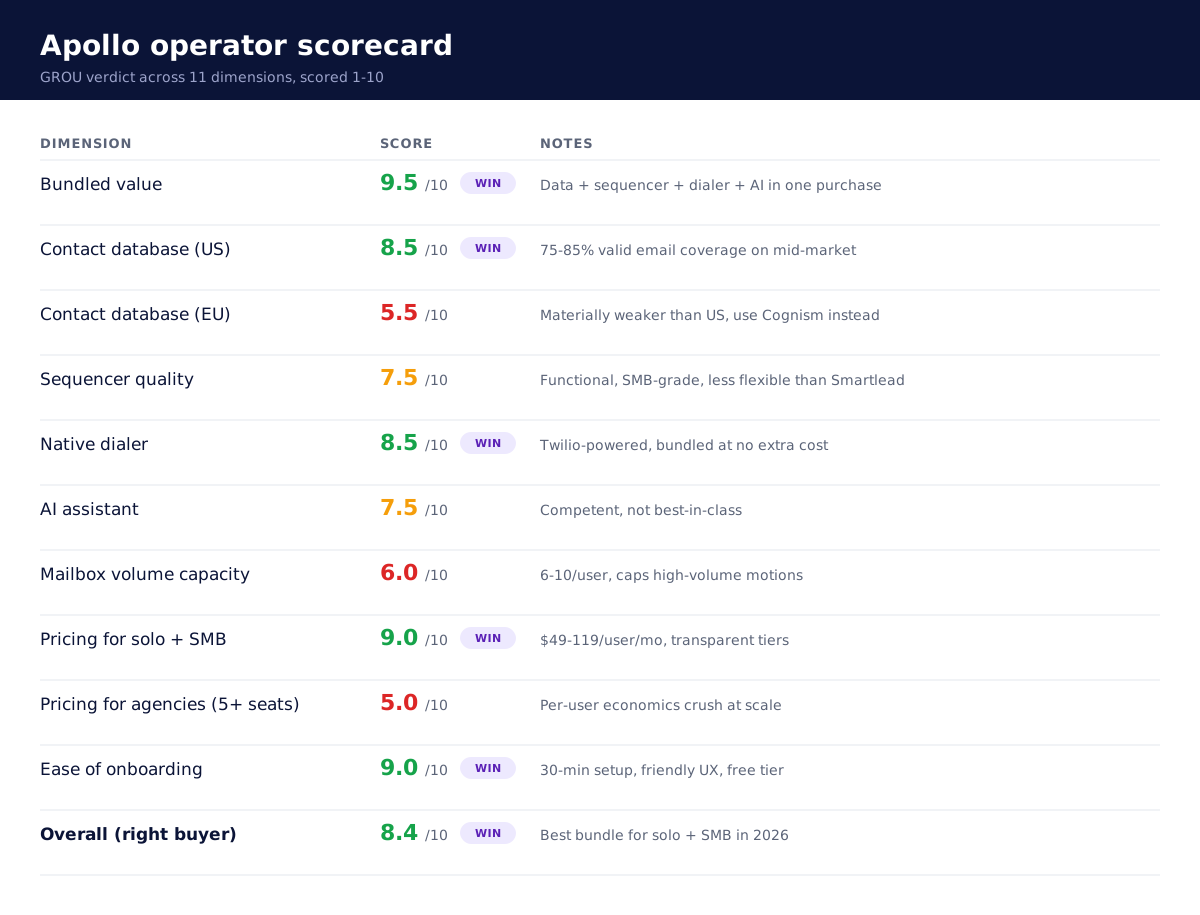
Third-party signals: Apollo on G2 holds a 4.7 / 5 rating across 8,000+ reviews, with the bundled database, ease of use, and AI assistant called out most often. Apollo has the highest review velocity in the prospecting + sequencer category by a wide margin in 2025 to 2026.
Table of contents
Operator scorecard
What is Apollo
Apollo key features
Apollo pricing 2026
Honest pros
Honest cons
Who should use Apollo
Who should skip Apollo
Best Apollo alternatives
FAQ
Bottom line
About this review
What is Apollo
Apollo is a bundled go-to-market platform built around its proprietary 275M+ contact database covering 60M+ companies globally. The platform ships a native email sequencer, Twilio-powered dialer, meeting scheduler, AI assistant suite, and CRM-light functionality, all sold per user per month at $49 to $119 across self-serve tiers (plus a free tier and custom Enterprise pricing). Founded in 2015 and now used by 500,000+ companies, Apollo is the category leader for SMB and mid-market go-to-market by customer count.
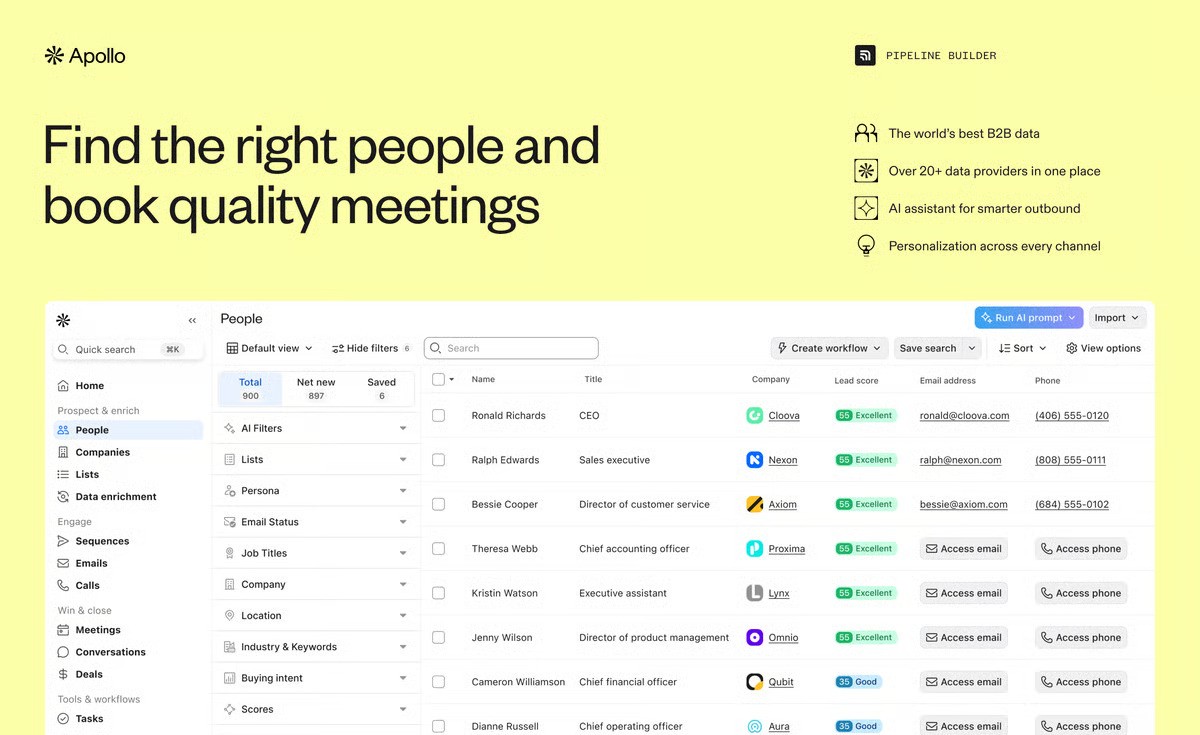
The category Apollo sits in: bundled prospecting + sequencer. Adjacent tools include ZoomInfo (enterprise-tier alternative at 5 to 10x the cost), Clay (data enrichment specialist with deeper data quality), and standalone sequencers like Smartlead or Lemlist (purer infrastructure but no bundled database).
The core wedge is the bundle: data + sequencer + dialer + meeting scheduler + AI in one purchase at SMB-friendly pricing. For solo founders and SMB sales teams running 5K to 25K emails per user per month with native US ICPs, Apollo is the natural pick. For agencies at multi-client scale or enterprise teams running 50+ rep deployments, the per-user economics and SMB-focused product depth become limitations.
The honest framing: Apollo is the best all-in-one bundle in the category, but it is not best-in-class at any individual component. The data is solid (75 to 85 percent valid email coverage on US mid-market ICPs in our testing) but not as deep as ZoomInfo. The sequencer is competent but not as agency-friendly as Smartlead. The dialer is functional but not as feature-rich as standalone dialers like Aircall. The bundle wins on convenience and price, not on best-in-class per feature.
Apollo key features
The features that matter for a buying decision, ranked by how often they pay back the subscription:
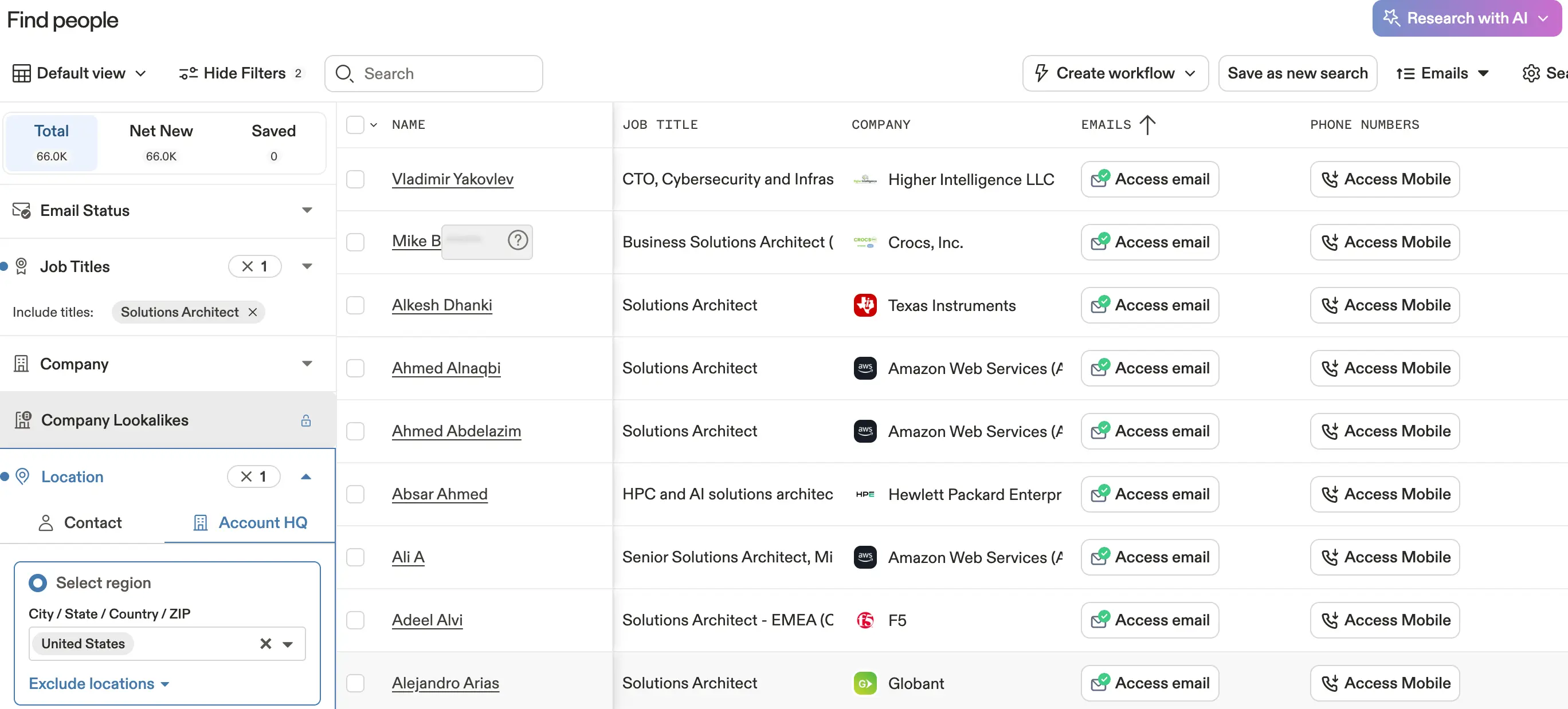
275M+ contact database. The headline feature and the bundle's entire value proposition. Apollo's database covers 60M+ companies with email coverage that lands around 75 to 85 percent valid in real-world testing for US mid-market ICPs (Apollo's published 91 percent figure is the upper bound on best-coverage segments). Filters cover the standard firmographic axes (industry, employee count, revenue, funding stage, hiring) and technographic signals (tech stack, intent data, hiring intent). The data refreshes continuously from crowd-sourced and scraped signals.
Native email sequencer. Multi-step email sequences with conditional logic (open, click, reply triggers), pause-on-reply, A/B testing, and AI-assisted copy generation. 12,000 emails per user per year on Basic tier and above. Functional for SMB outbound; less agency-friendly than dedicated infrastructure tools like Smartlead because mailbox limits are tighter (6 mailboxes per user on Professional, 10 on Organization).
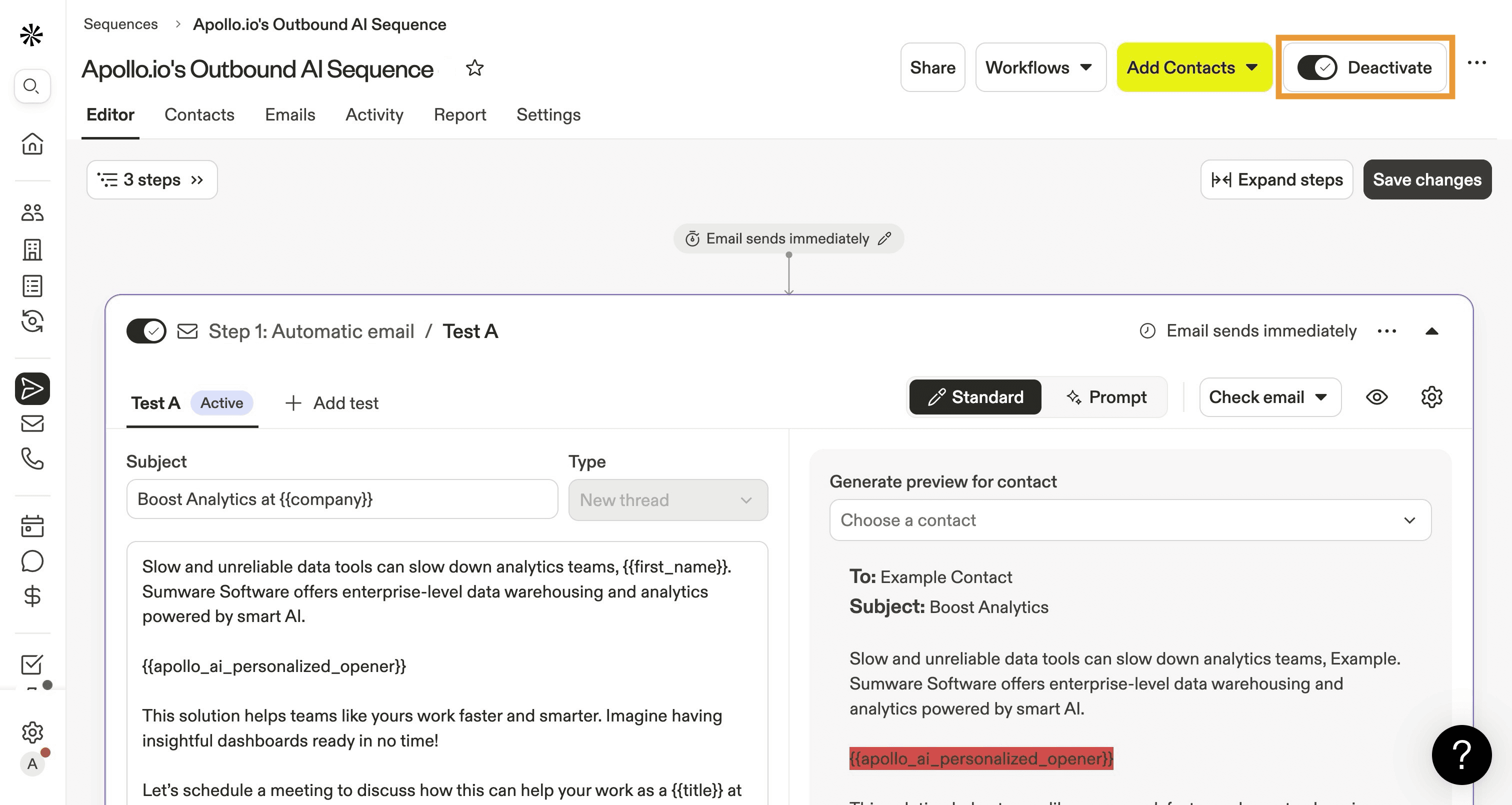
Twilio-powered native dialer. Click-to-call from any contact record. Call recording, call notes, and post-call activity sync to the contact timeline. Phone number rental included on Professional and above. For solo operators running cold call follow-ups inside the same workflow as cold email, the bundled dialer is a real productivity advantage over building Smartlead + Aircall as two separate tools.
Meeting scheduler. Calendar-integrated meeting scheduling with round-robin distribution, qualification routing, and follow-up cadence triggering. Available on Professional and above. Sits inside the same workflow as the sequencer and dialer, which closes the loop on meeting handoff without a separate scheduler tool.
AI assistant suite. AI conversation analysis, AI signal scoring, AI message writing, AI personalisation, AI inbox triage. Bundled in Professional and above. The AI features are competent rather than best-in-class; for teams that want premium AI personalisation, Clay AI agents or Salesforge produce better results. For teams that want bundled-good-enough AI inside their existing workflow, Apollo's suite ships everything you need.
CRM-light functionality. Deal stages, pipeline reporting, custom fields, activity timeline. Light CRM that works for solo founders and small teams; not a replacement for HubSpot, Pipedrive, Salesforce, or Close at scale. For teams with established CRMs, Apollo syncs bi-directionally with all the major platforms.
LinkedIn integration. LinkedIn task automation (profile views, connection requests, message templates) inside the same workflow as email and dialer. Not as deep as dedicated LinkedIn automation tools like Heyreach; functional for solo operators who want light LinkedIn touches mixed into a primarily-email motion.
Integrations. Native integrations with Salesforce, HubSpot, Pipedrive, Close, Zapier, Make, and 50+ other tools. API access on all paid tiers. Webhook support for sequence events and reply triggers.
Free tier. Apollo's free tier ships 60 emails per month plus 200 monthly credits, which is enough to test the platform but not enough for any real outbound motion. The Basic tier at $49 per user per month is the realistic entry point.
What is missing or thin: not a substitute for dedicated cold email infrastructure (Apollo's mailbox limits cap you at 6 per user on Professional vs unlimited on Smartlead). Not a replacement for enterprise sales engagement platforms (Outreach, Salesloft) at 50+ rep deployments. Not a substitute for premium AI personalisation tools (Clay) for high-ACV outbound. Not the right data source for European ICPs (Cognism is materially deeper).
Apollo pricing 2026
Apollo publishes four self-serve tiers (Free, Basic, Professional, Organization) and custom Enterprise pricing for 5+ seats. Annual billing saves around 17 percent vs monthly. For live pricing, check Apollo directly.
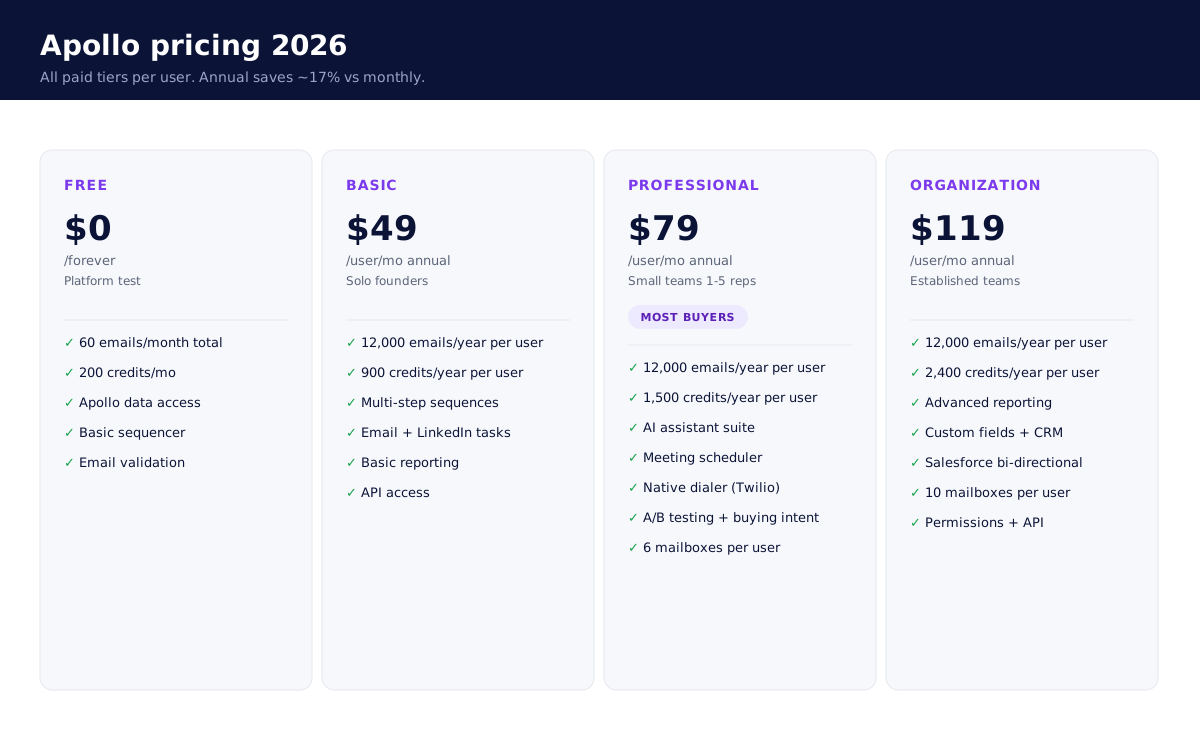
The Free tier ships 60 emails per month plus 200 monthly credits. Useful for testing the platform interface and validating the data quality on your specific ICP; not enough volume for any real outbound motion.
The Basic tier at $49 per user per month annual is the realistic entry point for solo founders and single-rep motions. 12,000 emails per year per user, 900 monthly credits, multi-step sequences, email + LinkedIn tasks, basic reporting. For a solo founder running their own outbound at sub-25K emails per year, Basic is sufficient.
The Professional tier at $79 per user per month annual is where most solo + small team buyers land. 12,000 emails per year, 1,500 monthly credits, AI assistant, meeting scheduler, native dialer, A/B testing, buying intent data. For a 1 to 3 rep team running active outbound, Professional unlocks the full Apollo value.
The Organization tier at $119 per user per month annual adds advanced reporting, custom fields, permissions, Salesforce bi-directional sync, API access, and 2,400 monthly credits. For teams with established CRM workflows or compliance requirements, Organization is the right tier.
Enterprise pricing is custom-quoted for 5+ seats with advanced security, dedicated support, and custom integration scope. Typically lands at $150 to $250 per user per month at the volumes negotiated.
Hidden cost watch-outs: credits run out fast on high-volume prospecting (900 credits per user per month on Professional converts to roughly 900 enriched contacts per month, less if you also export). Top-up credits cost extra. Mailbox limit is 6 per user on Professional, 10 on Organization; the cap arrives faster than expected at scale.
Honest pros
The pros that hold up under operator scrutiny:
Best all-in-one bundle in the category. Data + sequencer + dialer + meeting scheduler + AI + CRM-light at $49 to $119 per user per month. For solo founders and SMB teams, no competitor matches the value of the bundle at this price.
Solid contact database for US mid-market and SMB. 75 to 85 percent valid email coverage on US ICPs in real-world testing. Continuous refresh from crowd-sourced and scraped signals. Filters cover the standard firmographic and technographic axes.
Free tier is genuinely useful for platform validation. Sign up, test the search, validate data on your specific ICP, upgrade if it works. Removes the "demo gating" friction that most competitors impose.
Native dialer is a real productivity advantage. Twilio-powered click-to-call inside the sequencer workflow. For solo operators running cold call follow-ups, this is meaningfully faster than building Smartlead + Aircall separately.
Friendly onboarding and documentation. 30-minute setup from signup to first sent email. Documentation is well-organised and the live chat support is responsive on business hours. For first-time outbound operators, Apollo is the gentlest entry point.
AI assistant suite is competent. Not best-in-class, but functional. Drafts decent cold email starters that need light human editing before sending. Inbox triage categorisation is real time saver on high-volume motions.
Strong CRM integrations. Bi-directional sync with Salesforce, HubSpot, Pipedrive, Close. For teams with established CRM workflows, Apollo plugs into the stack without re-platforming.
Active product velocity. Apollo ships major features monthly (AI conversations, AI signal scoring, intent data improvements). The platform has improved materially every quarter we have tracked it.
Real category leadership. 500,000+ paying customers makes Apollo the category leader by customer count. The platform has the resources and customer base to keep investing in the product over the long term.
Pricing transparency. Apollo publishes all four self-serve tiers with explicit feature lists. No demo-gating for buyers under 5 seats. The category's most transparent pricing.
Honest cons
The cons we would tell a friend on the phone:
Per-user pricing scales hard at agency scale. A 5-person agency on Professional costs $4,740 per year. The same team on Smartlead Pro pays $940 per year for cold email infrastructure plus they retain whatever data source they already have. For agencies, the per-user math is brutal vs flat-workspace tools.
EU data is materially weaker than US. Apollo's European contact coverage is below the threshold for serious EU outbound motions. For European ICPs, pair Apollo with Cognism (GDPR-compliant) or run Cognism + Smartlead instead.
Mailbox limits cap volume. 6 mailboxes per user on Professional, 10 on Organization. For motions that need 30K+ emails per month per user with proper rotation, Apollo's mailbox cap forces you onto Smartlead or Instantly. Pair Apollo (for data) + Smartlead (for sending) is a common workaround.
Native warmup is in beta. Apollo's email warmup is functional but newer than Smartlead's or Instantly's mature warmup networks. For accounts pushing high volume, the proven warmup of dedicated infrastructure tools is materially better.
Credits run out fast. 900 credits per user per month on Professional sounds generous but converts to roughly 900 enriched contacts (less if you export). Top-up credits cost extra and add up quickly on high-volume prospecting.
AI features are competent rather than best-in-class. Apollo's AI suite produces serviceable output but does not match Clay AI agents or Salesforge AI personalisation for premium reply rate. For teams that want best-in-class AI, Apollo's bundled AI is "good enough" rather than category-leading.
Sequence flexibility is SMB-grade. Functional for standard 3 to 5-step cadences with conditional logic. Less flexible than Smartlead's sub-sequence branching or Lemlist's multichannel sequence builder for advanced motions.
LinkedIn automation is light. Functional profile views, connection requests, and message templates. Not a substitute for dedicated LinkedIn automation tools at meaningful LinkedIn volumes. See our Best LinkedIn automation tools listicle for the dedicated picks.
No whitelabel option below Enterprise. Apollo's whitelabel is Enterprise-only with custom pricing (typically $30,000+ annually). For agencies productising prospecting as a service, the lack of accessible whitelabel is a structural disadvantage vs Smartlead's $29 per workspace tier.
Support quality varies. Documentation is solid and live chat works on business hours. Email ticket response times can stretch to 24 to 48 hours on lower tiers. For agencies running 24/7 client campaigns, this matters.
Who should use Apollo
The buyer profiles where Apollo pays back the subscription inside the first 90 days:
Solo founders running their own outbound. The bundle math (data + sequencer + dialer + meeting scheduler at $49 to $79 per user per month) removes the multi-tool coordination problem. Sign up, build your first ICP filter, launch your first sequence, book your first meeting within week two.
Early-stage SaaS scaling from 0 to PMF. Apollo is materially cheaper than the ZoomInfo + Outreach stack that established companies run at 10x the cost. For pre-PMF teams that need to validate ICPs fast without committing to enterprise contracts, Apollo's bundle is the unit-economics winner.
US-focused SMB and mid-market sales teams (1 to 5 reps). Apollo's data quality is strongest on US mid-market and SMB ICPs. For US-focused motions sending 5K to 25K emails per user per month, the bundled approach beats the multi-tool alternative.
Founder-led companies where one person manages prospecting + sequencing + cold calling. The integrated dialer + sequencer workflow is the productivity unlock vs building Smartlead + Aircall + Cal.com as three separate tools.
Teams that need a contact database fast and have no existing data source. Apollo + sequencer is faster to deploy than building a Clay waterfall from scratch. For teams that need to ship outbound this week, the bundled DB removes the data sourcing decision.
Multi-touch motions where email + LinkedIn light-touches + cold calls run in one cadence. Apollo's bundled workflow handles all three channels in one place. For motions that need true multichannel depth, Lemlist Multichannel Expert is better; for motions that want simple-bundled, Apollo is the right call.
Who should skip Apollo
The buyer profiles where Apollo is the wrong tool:
Agencies running outbound for multiple clients. Per-user pricing crushes the economics at 5+ seats vs Smartlead's flat workspace tier. For agency motions, Smartlead + a separate data source (Clay, Cognism) produces materially better unit economics.
European-focused B2B teams. Apollo's EU contact data is below the threshold for serious EU outbound. For EU ICPs, Cognism (GDPR-compliant) is the right data source paired with Smartlead for sending.
High-volume motions (30K+ emails per month per user). Apollo's mailbox limits cap throughput. For volume-led motions, the right pattern is Apollo for data + Smartlead for sending, or Smartlead with Clay for both.
Enterprise sales teams (50+ reps with ABM motions). Apollo is SMB-focused. For enterprise account-based plays with deep CRM integration, Outreach or Salesloft is the right tier (at 10x the cost).
Teams that need best-in-class AI personalisation. Apollo's AI suite is competent; for premium AI personalisation that drives higher reply rates, Clay AI agents + Smartlead or Lemlist with AI features outperforms Apollo's bundled AI.
Agencies that need transparent whitelabel for client delivery. Apollo's whitelabel is Enterprise-only and not transparently priced. Smartlead's $29 per workspace tier is structurally better for productised cold email services.
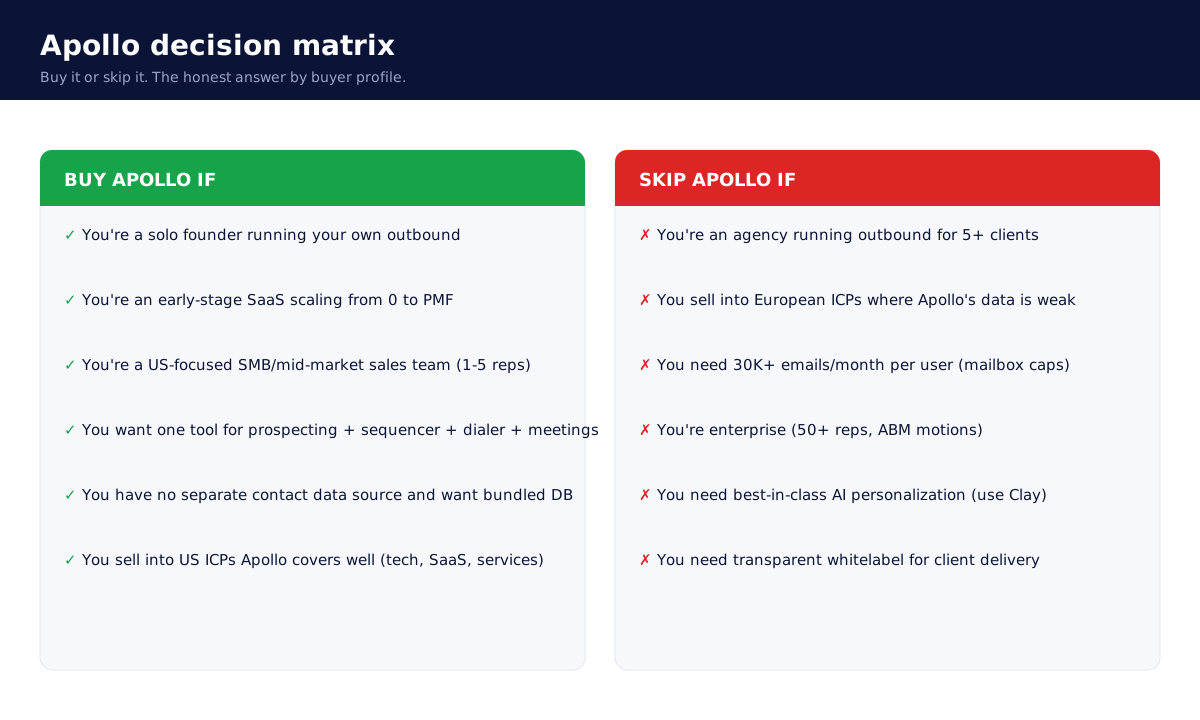
Decision matrix:
Best Apollo alternatives
The direct alternatives we have actually deployed:
Smartlead for pure cold email infrastructure with unlimited mailboxes, native warmup, and $29 whitelabel. Best for agencies and high-volume motions. Pair with Clay or Cognism for data. See our Apollo vs Smartlead comparison.
Clay for premium data enrichment with composable AI agents. Best data quality per verified contact in the market, more setup overhead than Apollo's bundled DB. See our Clay vs Apollo comparison.
ZoomInfo for enterprise-grade data at 5 to 10x Apollo's cost. Better data quality for ABM motions and EU/GDPR-compliant outbound. See our Apollo vs ZoomInfo comparison.
Lemlist for personalisation-led multichannel outbound (email + LinkedIn + cold call). Best for high-ACV motions where reply rate matters more than volume. See our Apollo vs Lemlist comparison.
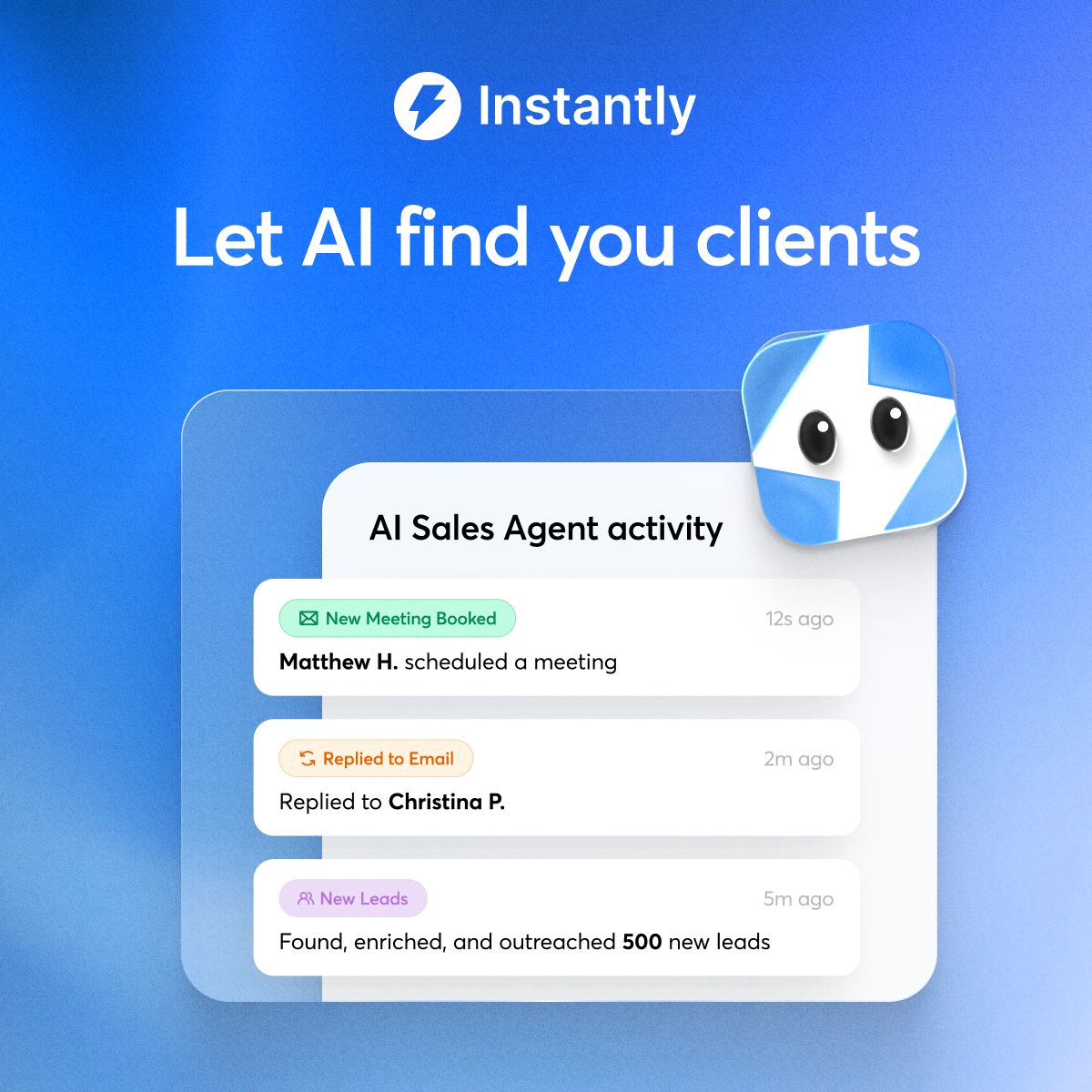
Instantly for cold email infrastructure with a bundled Lead Finder database. Direct Smartlead alternative for solo operators wanting bundled data + sending.
Outreach or Salesloft for enterprise sales engagement at 10x the price. Right tier for 50+ rep enterprise inside-sales teams.
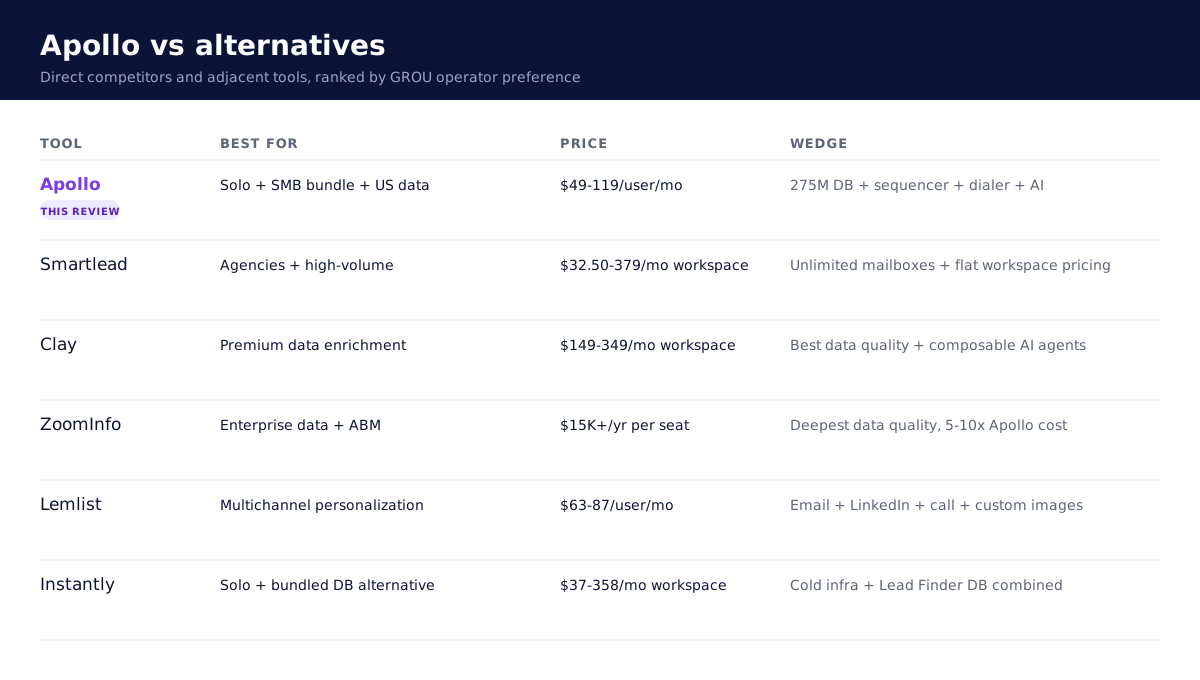
We have full comparison articles on most of these. See Apollo vs Smartlead, Apollo vs ZoomInfo, Apollo vs Lemlist, and Clay vs Apollo.
FAQ
Is Apollo worth it in 2026?
Yes, for the right buyer. If you are a solo founder, early-stage SaaS, or SMB sales team that wants one tool covering prospecting + sequencer + dialer + meeting scheduler, Apollo's bundle is the best value in the category. If you are an agency at 5+ seats or running European outbound, the unit economics and data depth favour alternatives.
How much does Apollo actually cost at agency scale?
A 5-rep agency on Professional pays $79 per user x 5 = $4,740 per year. Add Apollo for the database, separate Smartlead for sending if you need volume, and the stack lands around $5,500 to $6,500 per year. Compare to Smartlead Pro + Clay (no Apollo): $940 + $1,800 = $2,740 per year. For agency motions, the Apollo bundle is not the cheapest option.
Can Apollo handle high-volume cold outbound?
Functional up to roughly 25K emails per user per month with proper warmup. Above that, mailbox limits (6 per user on Professional, 10 on Organization) cap throughput and Apollo's native warmup is not as proven as Smartlead's mature network. For 30K+ per month, pair Apollo (data) + Smartlead (sending) or move to Smartlead with Clay for both.
Is Apollo's contact data accurate?
For US mid-market and SMB ICPs, yes (75 to 85 percent valid emails in real-world testing). For European ICPs, materially weaker (Apollo's published 91 percent coverage is the upper bound; real EU coverage tends to lag US by 15 to 25 percentage points). For ABM or enterprise account targeting, ZoomInfo and Cognism are deeper data sources at higher cost.
Does Apollo include AI features?
Yes, on Professional tier and above. AI writing, AI conversation analysis, AI signal scoring, AI inbox triage, AI personalisation. The features are competent rather than best-in-class. For premium AI personalisation, Clay AI agents or Salesforge produce better results.
What is included in Apollo's free tier?
60 emails per month total, 200 monthly credits, basic sequencer, Apollo data access. Useful for testing the platform; not sufficient for real outbound. The Basic tier at $49 per user per month is the realistic entry point.
Can Apollo replace my CRM?
For solo founders and small teams, the Organization tier's CRM-light features (deal stages, pipeline reporting, custom fields) can serve as the system of record. For teams with established Salesforce, HubSpot, Pipedrive, or Close workflows, Apollo syncs bi-directionally as a layer on top of the existing CRM rather than replacing it.
Does Apollo's dialer cost extra?
Phone number rental and standard Twilio call charges are included on Professional tier and above (typically $20 to $50 per user per month of bundled call time, with overages charged at standard Twilio rates). Bundled dialer is a real cost-saving vs building Aircall ($30 to $99 per user per month) on top of Smartlead.
Is Apollo good for LinkedIn outreach?
Functional for light LinkedIn touches mixed into a primarily-email motion (profile views, connection requests, message templates). Not a substitute for dedicated LinkedIn automation tools at meaningful LinkedIn volumes. See our Best LinkedIn automation tools listicle for dedicated picks.
Can I cancel Apollo monthly?
All self-serve tiers offer monthly billing. Annual billing saves 17 percent. Enterprise tiers are annual only.
How does Apollo compare to ZoomInfo?
Apollo is 5 to 10x cheaper than ZoomInfo at equivalent seat counts. ZoomInfo has deeper data quality for ABM and enterprise account targeting. Apollo's SMB and mid-market US coverage is competitive at materially lower cost. See our Apollo vs ZoomInfo comparison.
What happens to my data if I cancel?
Contacts and campaign data can be exported as CSV before cancellation. Apollo retains data for 30 days post-cancellation per their published policy. After 30 days, data is permanently deleted.
Does Apollo work for European outbound?
Technically yes, with caveats. The infrastructure is region-agnostic, but the contact database is materially weaker in EU than US. For European outbound, pair Apollo with Cognism (GDPR-compliant EU data source) or run Cognism + Smartlead instead.
Can I migrate from Apollo to another tool?
Contacts export cleanly to CSV. Sequences do not migrate (each platform has different sequence logic). Plan on 1 to 2 days of rebuild work per active campaign template if you switch platforms.
Bottom line
Apollo is the right call for any solo founder, early-stage SaaS, or US-focused SMB sales team that wants one tool covering prospecting + sequencer + dialer + meeting scheduler. The bundled 275M database removes the data sourcing problem. Per-user pricing keeps the entry cost low for small teams. For US-focused outbound at under 25K emails per user per month, Apollo is the natural pick.
Skip Apollo if you are an agency at 5+ seats (Smartlead's flat workspace pricing crushes per-user economics), if you sell into European ICPs where the data is materially weaker (use Cognism + Smartlead instead), or if you need dedicated cold email infrastructure for 30K+ emails per month per user (use Smartlead for that).
If you grow into needing both, stack them: Apollo for data sourcing + Smartlead for sending. We do, our clients do, and the unit economics work when the tiers are properly segmented.
Operator score: 8.4 / 10 for the right buyer.
If you want help designing the right outbound stack for your motion (Apollo bundle, Smartlead infrastructure, or hybrid), book a working session with GROU. We have shipped 100+ client campaigns on Apollo in the last 24 months. We can do the same for you.
→ Try Apollo free (free tier, no card required).
About this review
We are GROU, a B2B pipeline agency that runs lead generation, outbound, and LinkedIn content for clients across manufacturing, fintech, iGaming, software, and professional services. This review combines our deployment data across 100+ Apollo client campaigns over the last 24 months, Apollo's published pricing page, third-party reviews from Lagrowthmachine, Puzzle Inbox, and Landbase, and live G2 review data. We refresh this article quarterly.
Some links in this article are affiliate links to Apollo and other tools we have actually deployed for our agency clients. We earn a small commission if you sign up through them, at no extra cost to you. We only recommend tools we use.
Apollo is the bundled go-to-market platform we recommend by default in 2026 for solo founders, early-stage SaaS, and US-focused SMB sales teams that want one tool covering prospecting + sequencer + dialer + meeting scheduler. The 275M+ contact database, free tier, and $49 to $119 per-user pricing make it the best all-in-one bundle on the market. Skip it if you are an agency at 5+ seats (per-user economics crush at scale), if you sell into European ICPs where the data is materially weaker, or if you need dedicated cold email infrastructure (use Smartlead for that). Operator score: 8.4 / 10 for the right buyer.
Operator scorecard
Third-party signals: Apollo on G2 holds a 4.7 / 5 rating across 8,000+ reviews, with the bundled database, ease of use, and AI assistant called out most often. Apollo has the highest review velocity in the prospecting + sequencer category by a wide margin in 2025 to 2026.
Table of contents
Operator scorecard
What is Apollo
Apollo key features
Apollo pricing 2026
Honest pros
Honest cons
Who should use Apollo
Who should skip Apollo
Best Apollo alternatives
FAQ
Bottom line
About this review
What is Apollo
Apollo is a bundled go-to-market platform built around its proprietary 275M+ contact database covering 60M+ companies globally. The platform ships a native email sequencer, Twilio-powered dialer, meeting scheduler, AI assistant suite, and CRM-light functionality, all sold per user per month at $49 to $119 across self-serve tiers (plus a free tier and custom Enterprise pricing). Founded in 2015 and now used by 500,000+ companies, Apollo is the category leader for SMB and mid-market go-to-market by customer count.
The category Apollo sits in: bundled prospecting + sequencer. Adjacent tools include ZoomInfo (enterprise-tier alternative at 5 to 10x the cost), Clay (data enrichment specialist with deeper data quality), and standalone sequencers like Smartlead or Lemlist (purer infrastructure but no bundled database).
The core wedge is the bundle: data + sequencer + dialer + meeting scheduler + AI in one purchase at SMB-friendly pricing. For solo founders and SMB sales teams running 5K to 25K emails per user per month with native US ICPs, Apollo is the natural pick. For agencies at multi-client scale or enterprise teams running 50+ rep deployments, the per-user economics and SMB-focused product depth become limitations.
The honest framing: Apollo is the best all-in-one bundle in the category, but it is not best-in-class at any individual component. The data is solid (75 to 85 percent valid email coverage on US mid-market ICPs in our testing) but not as deep as ZoomInfo. The sequencer is competent but not as agency-friendly as Smartlead. The dialer is functional but not as feature-rich as standalone dialers like Aircall. The bundle wins on convenience and price, not on best-in-class per feature.
Apollo key features
The features that matter for a buying decision, ranked by how often they pay back the subscription:
275M+ contact database. The headline feature and the bundle's entire value proposition. Apollo's database covers 60M+ companies with email coverage that lands around 75 to 85 percent valid in real-world testing for US mid-market ICPs (Apollo's published 91 percent figure is the upper bound on best-coverage segments). Filters cover the standard firmographic axes (industry, employee count, revenue, funding stage, hiring) and technographic signals (tech stack, intent data, hiring intent). The data refreshes continuously from crowd-sourced and scraped signals.
Native email sequencer. Multi-step email sequences with conditional logic (open, click, reply triggers), pause-on-reply, A/B testing, and AI-assisted copy generation. 12,000 emails per user per year on Basic tier and above. Functional for SMB outbound; less agency-friendly than dedicated infrastructure tools like Smartlead because mailbox limits are tighter (6 mailboxes per user on Professional, 10 on Organization).
Twilio-powered native dialer. Click-to-call from any contact record. Call recording, call notes, and post-call activity sync to the contact timeline. Phone number rental included on Professional and above. For solo operators running cold call follow-ups inside the same workflow as cold email, the bundled dialer is a real productivity advantage over building Smartlead + Aircall as two separate tools.
Meeting scheduler. Calendar-integrated meeting scheduling with round-robin distribution, qualification routing, and follow-up cadence triggering. Available on Professional and above. Sits inside the same workflow as the sequencer and dialer, which closes the loop on meeting handoff without a separate scheduler tool.
AI assistant suite. AI conversation analysis, AI signal scoring, AI message writing, AI personalisation, AI inbox triage. Bundled in Professional and above. The AI features are competent rather than best-in-class; for teams that want premium AI personalisation, Clay AI agents or Salesforge produce better results. For teams that want bundled-good-enough AI inside their existing workflow, Apollo's suite ships everything you need.
CRM-light functionality. Deal stages, pipeline reporting, custom fields, activity timeline. Light CRM that works for solo founders and small teams; not a replacement for HubSpot, Pipedrive, Salesforce, or Close at scale. For teams with established CRMs, Apollo syncs bi-directionally with all the major platforms.
LinkedIn integration. LinkedIn task automation (profile views, connection requests, message templates) inside the same workflow as email and dialer. Not as deep as dedicated LinkedIn automation tools like Heyreach; functional for solo operators who want light LinkedIn touches mixed into a primarily-email motion.
Integrations. Native integrations with Salesforce, HubSpot, Pipedrive, Close, Zapier, Make, and 50+ other tools. API access on all paid tiers. Webhook support for sequence events and reply triggers.
Free tier. Apollo's free tier ships 60 emails per month plus 200 monthly credits, which is enough to test the platform but not enough for any real outbound motion. The Basic tier at $49 per user per month is the realistic entry point.
What is missing or thin: not a substitute for dedicated cold email infrastructure (Apollo's mailbox limits cap you at 6 per user on Professional vs unlimited on Smartlead). Not a replacement for enterprise sales engagement platforms (Outreach, Salesloft) at 50+ rep deployments. Not a substitute for premium AI personalisation tools (Clay) for high-ACV outbound. Not the right data source for European ICPs (Cognism is materially deeper).
Apollo pricing 2026
Apollo publishes four self-serve tiers (Free, Basic, Professional, Organization) and custom Enterprise pricing for 5+ seats. Annual billing saves around 17 percent vs monthly. For live pricing, check Apollo directly.
The Free tier ships 60 emails per month plus 200 monthly credits. Useful for testing the platform interface and validating the data quality on your specific ICP; not enough volume for any real outbound motion.
The Basic tier at $49 per user per month annual is the realistic entry point for solo founders and single-rep motions. 12,000 emails per year per user, 900 monthly credits, multi-step sequences, email + LinkedIn tasks, basic reporting. For a solo founder running their own outbound at sub-25K emails per year, Basic is sufficient.
The Professional tier at $79 per user per month annual is where most solo + small team buyers land. 12,000 emails per year, 1,500 monthly credits, AI assistant, meeting scheduler, native dialer, A/B testing, buying intent data. For a 1 to 3 rep team running active outbound, Professional unlocks the full Apollo value.
The Organization tier at $119 per user per month annual adds advanced reporting, custom fields, permissions, Salesforce bi-directional sync, API access, and 2,400 monthly credits. For teams with established CRM workflows or compliance requirements, Organization is the right tier.
Enterprise pricing is custom-quoted for 5+ seats with advanced security, dedicated support, and custom integration scope. Typically lands at $150 to $250 per user per month at the volumes negotiated.
Hidden cost watch-outs: credits run out fast on high-volume prospecting (900 credits per user per month on Professional converts to roughly 900 enriched contacts per month, less if you also export). Top-up credits cost extra. Mailbox limit is 6 per user on Professional, 10 on Organization; the cap arrives faster than expected at scale.
Honest pros
The pros that hold up under operator scrutiny:
Best all-in-one bundle in the category. Data + sequencer + dialer + meeting scheduler + AI + CRM-light at $49 to $119 per user per month. For solo founders and SMB teams, no competitor matches the value of the bundle at this price.
Solid contact database for US mid-market and SMB. 75 to 85 percent valid email coverage on US ICPs in real-world testing. Continuous refresh from crowd-sourced and scraped signals. Filters cover the standard firmographic and technographic axes.
Free tier is genuinely useful for platform validation. Sign up, test the search, validate data on your specific ICP, upgrade if it works. Removes the "demo gating" friction that most competitors impose.
Native dialer is a real productivity advantage. Twilio-powered click-to-call inside the sequencer workflow. For solo operators running cold call follow-ups, this is meaningfully faster than building Smartlead + Aircall separately.
Friendly onboarding and documentation. 30-minute setup from signup to first sent email. Documentation is well-organised and the live chat support is responsive on business hours. For first-time outbound operators, Apollo is the gentlest entry point.
AI assistant suite is competent. Not best-in-class, but functional. Drafts decent cold email starters that need light human editing before sending. Inbox triage categorisation is real time saver on high-volume motions.
Strong CRM integrations. Bi-directional sync with Salesforce, HubSpot, Pipedrive, Close. For teams with established CRM workflows, Apollo plugs into the stack without re-platforming.
Active product velocity. Apollo ships major features monthly (AI conversations, AI signal scoring, intent data improvements). The platform has improved materially every quarter we have tracked it.
Real category leadership. 500,000+ paying customers makes Apollo the category leader by customer count. The platform has the resources and customer base to keep investing in the product over the long term.
Pricing transparency. Apollo publishes all four self-serve tiers with explicit feature lists. No demo-gating for buyers under 5 seats. The category's most transparent pricing.
Honest cons
The cons we would tell a friend on the phone:
Per-user pricing scales hard at agency scale. A 5-person agency on Professional costs $4,740 per year. The same team on Smartlead Pro pays $940 per year for cold email infrastructure plus they retain whatever data source they already have. For agencies, the per-user math is brutal vs flat-workspace tools.
EU data is materially weaker than US. Apollo's European contact coverage is below the threshold for serious EU outbound motions. For European ICPs, pair Apollo with Cognism (GDPR-compliant) or run Cognism + Smartlead instead.
Mailbox limits cap volume. 6 mailboxes per user on Professional, 10 on Organization. For motions that need 30K+ emails per month per user with proper rotation, Apollo's mailbox cap forces you onto Smartlead or Instantly. Pair Apollo (for data) + Smartlead (for sending) is a common workaround.
Native warmup is in beta. Apollo's email warmup is functional but newer than Smartlead's or Instantly's mature warmup networks. For accounts pushing high volume, the proven warmup of dedicated infrastructure tools is materially better.
Credits run out fast. 900 credits per user per month on Professional sounds generous but converts to roughly 900 enriched contacts (less if you export). Top-up credits cost extra and add up quickly on high-volume prospecting.
AI features are competent rather than best-in-class. Apollo's AI suite produces serviceable output but does not match Clay AI agents or Salesforge AI personalisation for premium reply rate. For teams that want best-in-class AI, Apollo's bundled AI is "good enough" rather than category-leading.
Sequence flexibility is SMB-grade. Functional for standard 3 to 5-step cadences with conditional logic. Less flexible than Smartlead's sub-sequence branching or Lemlist's multichannel sequence builder for advanced motions.
LinkedIn automation is light. Functional profile views, connection requests, and message templates. Not a substitute for dedicated LinkedIn automation tools at meaningful LinkedIn volumes. See our Best LinkedIn automation tools listicle for the dedicated picks.
No whitelabel option below Enterprise. Apollo's whitelabel is Enterprise-only with custom pricing (typically $30,000+ annually). For agencies productising prospecting as a service, the lack of accessible whitelabel is a structural disadvantage vs Smartlead's $29 per workspace tier.
Support quality varies. Documentation is solid and live chat works on business hours. Email ticket response times can stretch to 24 to 48 hours on lower tiers. For agencies running 24/7 client campaigns, this matters.
Who should use Apollo
The buyer profiles where Apollo pays back the subscription inside the first 90 days:
Solo founders running their own outbound. The bundle math (data + sequencer + dialer + meeting scheduler at $49 to $79 per user per month) removes the multi-tool coordination problem. Sign up, build your first ICP filter, launch your first sequence, book your first meeting within week two.
Early-stage SaaS scaling from 0 to PMF. Apollo is materially cheaper than the ZoomInfo + Outreach stack that established companies run at 10x the cost. For pre-PMF teams that need to validate ICPs fast without committing to enterprise contracts, Apollo's bundle is the unit-economics winner.
US-focused SMB and mid-market sales teams (1 to 5 reps). Apollo's data quality is strongest on US mid-market and SMB ICPs. For US-focused motions sending 5K to 25K emails per user per month, the bundled approach beats the multi-tool alternative.
Founder-led companies where one person manages prospecting + sequencing + cold calling. The integrated dialer + sequencer workflow is the productivity unlock vs building Smartlead + Aircall + Cal.com as three separate tools.
Teams that need a contact database fast and have no existing data source. Apollo + sequencer is faster to deploy than building a Clay waterfall from scratch. For teams that need to ship outbound this week, the bundled DB removes the data sourcing decision.
Multi-touch motions where email + LinkedIn light-touches + cold calls run in one cadence. Apollo's bundled workflow handles all three channels in one place. For motions that need true multichannel depth, Lemlist Multichannel Expert is better; for motions that want simple-bundled, Apollo is the right call.
Who should skip Apollo
The buyer profiles where Apollo is the wrong tool:
Agencies running outbound for multiple clients. Per-user pricing crushes the economics at 5+ seats vs Smartlead's flat workspace tier. For agency motions, Smartlead + a separate data source (Clay, Cognism) produces materially better unit economics.
European-focused B2B teams. Apollo's EU contact data is below the threshold for serious EU outbound. For EU ICPs, Cognism (GDPR-compliant) is the right data source paired with Smartlead for sending.
High-volume motions (30K+ emails per month per user). Apollo's mailbox limits cap throughput. For volume-led motions, the right pattern is Apollo for data + Smartlead for sending, or Smartlead with Clay for both.
Enterprise sales teams (50+ reps with ABM motions). Apollo is SMB-focused. For enterprise account-based plays with deep CRM integration, Outreach or Salesloft is the right tier (at 10x the cost).
Teams that need best-in-class AI personalisation. Apollo's AI suite is competent; for premium AI personalisation that drives higher reply rates, Clay AI agents + Smartlead or Lemlist with AI features outperforms Apollo's bundled AI.
Agencies that need transparent whitelabel for client delivery. Apollo's whitelabel is Enterprise-only and not transparently priced. Smartlead's $29 per workspace tier is structurally better for productised cold email services.
Decision matrix:
Best Apollo alternatives
The direct alternatives we have actually deployed:
Smartlead for pure cold email infrastructure with unlimited mailboxes, native warmup, and $29 whitelabel. Best for agencies and high-volume motions. Pair with Clay or Cognism for data. See our Apollo vs Smartlead comparison.
Clay for premium data enrichment with composable AI agents. Best data quality per verified contact in the market, more setup overhead than Apollo's bundled DB. See our Clay vs Apollo comparison.
ZoomInfo for enterprise-grade data at 5 to 10x Apollo's cost. Better data quality for ABM motions and EU/GDPR-compliant outbound. See our Apollo vs ZoomInfo comparison.
Lemlist for personalisation-led multichannel outbound (email + LinkedIn + cold call). Best for high-ACV motions where reply rate matters more than volume. See our Apollo vs Lemlist comparison.
Instantly for cold email infrastructure with a bundled Lead Finder database. Direct Smartlead alternative for solo operators wanting bundled data + sending.
Outreach or Salesloft for enterprise sales engagement at 10x the price. Right tier for 50+ rep enterprise inside-sales teams.
We have full comparison articles on most of these. See Apollo vs Smartlead, Apollo vs ZoomInfo, Apollo vs Lemlist, and Clay vs Apollo.
FAQ
Is Apollo worth it in 2026?
Yes, for the right buyer. If you are a solo founder, early-stage SaaS, or SMB sales team that wants one tool covering prospecting + sequencer + dialer + meeting scheduler, Apollo's bundle is the best value in the category. If you are an agency at 5+ seats or running European outbound, the unit economics and data depth favour alternatives.
How much does Apollo actually cost at agency scale?
A 5-rep agency on Professional pays $79 per user x 5 = $4,740 per year. Add Apollo for the database, separate Smartlead for sending if you need volume, and the stack lands around $5,500 to $6,500 per year. Compare to Smartlead Pro + Clay (no Apollo): $940 + $1,800 = $2,740 per year. For agency motions, the Apollo bundle is not the cheapest option.
Can Apollo handle high-volume cold outbound?
Functional up to roughly 25K emails per user per month with proper warmup. Above that, mailbox limits (6 per user on Professional, 10 on Organization) cap throughput and Apollo's native warmup is not as proven as Smartlead's mature network. For 30K+ per month, pair Apollo (data) + Smartlead (sending) or move to Smartlead with Clay for both.
Is Apollo's contact data accurate?
For US mid-market and SMB ICPs, yes (75 to 85 percent valid emails in real-world testing). For European ICPs, materially weaker (Apollo's published 91 percent coverage is the upper bound; real EU coverage tends to lag US by 15 to 25 percentage points). For ABM or enterprise account targeting, ZoomInfo and Cognism are deeper data sources at higher cost.
Does Apollo include AI features?
Yes, on Professional tier and above. AI writing, AI conversation analysis, AI signal scoring, AI inbox triage, AI personalisation. The features are competent rather than best-in-class. For premium AI personalisation, Clay AI agents or Salesforge produce better results.
What is included in Apollo's free tier?
60 emails per month total, 200 monthly credits, basic sequencer, Apollo data access. Useful for testing the platform; not sufficient for real outbound. The Basic tier at $49 per user per month is the realistic entry point.
Can Apollo replace my CRM?
For solo founders and small teams, the Organization tier's CRM-light features (deal stages, pipeline reporting, custom fields) can serve as the system of record. For teams with established Salesforce, HubSpot, Pipedrive, or Close workflows, Apollo syncs bi-directionally as a layer on top of the existing CRM rather than replacing it.
Does Apollo's dialer cost extra?
Phone number rental and standard Twilio call charges are included on Professional tier and above (typically $20 to $50 per user per month of bundled call time, with overages charged at standard Twilio rates). Bundled dialer is a real cost-saving vs building Aircall ($30 to $99 per user per month) on top of Smartlead.
Is Apollo good for LinkedIn outreach?
Functional for light LinkedIn touches mixed into a primarily-email motion (profile views, connection requests, message templates). Not a substitute for dedicated LinkedIn automation tools at meaningful LinkedIn volumes. See our Best LinkedIn automation tools listicle for dedicated picks.
Can I cancel Apollo monthly?
All self-serve tiers offer monthly billing. Annual billing saves 17 percent. Enterprise tiers are annual only.
How does Apollo compare to ZoomInfo?
Apollo is 5 to 10x cheaper than ZoomInfo at equivalent seat counts. ZoomInfo has deeper data quality for ABM and enterprise account targeting. Apollo's SMB and mid-market US coverage is competitive at materially lower cost. See our Apollo vs ZoomInfo comparison.
What happens to my data if I cancel?
Contacts and campaign data can be exported as CSV before cancellation. Apollo retains data for 30 days post-cancellation per their published policy. After 30 days, data is permanently deleted.
Does Apollo work for European outbound?
Technically yes, with caveats. The infrastructure is region-agnostic, but the contact database is materially weaker in EU than US. For European outbound, pair Apollo with Cognism (GDPR-compliant EU data source) or run Cognism + Smartlead instead.
Can I migrate from Apollo to another tool?
Contacts export cleanly to CSV. Sequences do not migrate (each platform has different sequence logic). Plan on 1 to 2 days of rebuild work per active campaign template if you switch platforms.
Bottom line
Apollo is the right call for any solo founder, early-stage SaaS, or US-focused SMB sales team that wants one tool covering prospecting + sequencer + dialer + meeting scheduler. The bundled 275M database removes the data sourcing problem. Per-user pricing keeps the entry cost low for small teams. For US-focused outbound at under 25K emails per user per month, Apollo is the natural pick.
Skip Apollo if you are an agency at 5+ seats (Smartlead's flat workspace pricing crushes per-user economics), if you sell into European ICPs where the data is materially weaker (use Cognism + Smartlead instead), or if you need dedicated cold email infrastructure for 30K+ emails per month per user (use Smartlead for that).
If you grow into needing both, stack them: Apollo for data sourcing + Smartlead for sending. We do, our clients do, and the unit economics work when the tiers are properly segmented.
Operator score: 8.4 / 10 for the right buyer.
If you want help designing the right outbound stack for your motion (Apollo bundle, Smartlead infrastructure, or hybrid), book a working session with GROU. We have shipped 100+ client campaigns on Apollo in the last 24 months. We can do the same for you.
→ Try Apollo free (free tier, no card required).
About this review
We are GROU, a B2B pipeline agency that runs lead generation, outbound, and LinkedIn content for clients across manufacturing, fintech, iGaming, software, and professional services. This review combines our deployment data across 100+ Apollo client campaigns over the last 24 months, Apollo's published pricing page, third-party reviews from Lagrowthmachine, Puzzle Inbox, and Landbase, and live G2 review data. We refresh this article quarterly.
Some links in this article are affiliate links to Apollo and other tools we have actually deployed for our agency clients. We earn a small commission if you sign up through them, at no extra cost to you. We only recommend tools we use.
Apollo is the bundled go-to-market platform we recommend by default in 2026 for solo founders, early-stage SaaS, and US-focused SMB sales teams that want one tool covering prospecting + sequencer + dialer + meeting scheduler. The 275M+ contact database, free tier, and $49 to $119 per-user pricing make it the best all-in-one bundle on the market. Skip it if you are an agency at 5+ seats (per-user economics crush at scale), if you sell into European ICPs where the data is materially weaker, or if you need dedicated cold email infrastructure (use Smartlead for that). Operator score: 8.4 / 10 for the right buyer.
Operator scorecard
Third-party signals: Apollo on G2 holds a 4.7 / 5 rating across 8,000+ reviews, with the bundled database, ease of use, and AI assistant called out most often. Apollo has the highest review velocity in the prospecting + sequencer category by a wide margin in 2025 to 2026.
Table of contents
Operator scorecard
What is Apollo
Apollo key features
Apollo pricing 2026
Honest pros
Honest cons
Who should use Apollo
Who should skip Apollo
Best Apollo alternatives
FAQ
Bottom line
About this review
What is Apollo
Apollo is a bundled go-to-market platform built around its proprietary 275M+ contact database covering 60M+ companies globally. The platform ships a native email sequencer, Twilio-powered dialer, meeting scheduler, AI assistant suite, and CRM-light functionality, all sold per user per month at $49 to $119 across self-serve tiers (plus a free tier and custom Enterprise pricing). Founded in 2015 and now used by 500,000+ companies, Apollo is the category leader for SMB and mid-market go-to-market by customer count.
The category Apollo sits in: bundled prospecting + sequencer. Adjacent tools include ZoomInfo (enterprise-tier alternative at 5 to 10x the cost), Clay (data enrichment specialist with deeper data quality), and standalone sequencers like Smartlead or Lemlist (purer infrastructure but no bundled database).
The core wedge is the bundle: data + sequencer + dialer + meeting scheduler + AI in one purchase at SMB-friendly pricing. For solo founders and SMB sales teams running 5K to 25K emails per user per month with native US ICPs, Apollo is the natural pick. For agencies at multi-client scale or enterprise teams running 50+ rep deployments, the per-user economics and SMB-focused product depth become limitations.
The honest framing: Apollo is the best all-in-one bundle in the category, but it is not best-in-class at any individual component. The data is solid (75 to 85 percent valid email coverage on US mid-market ICPs in our testing) but not as deep as ZoomInfo. The sequencer is competent but not as agency-friendly as Smartlead. The dialer is functional but not as feature-rich as standalone dialers like Aircall. The bundle wins on convenience and price, not on best-in-class per feature.
Apollo key features
The features that matter for a buying decision, ranked by how often they pay back the subscription:
275M+ contact database. The headline feature and the bundle's entire value proposition. Apollo's database covers 60M+ companies with email coverage that lands around 75 to 85 percent valid in real-world testing for US mid-market ICPs (Apollo's published 91 percent figure is the upper bound on best-coverage segments). Filters cover the standard firmographic axes (industry, employee count, revenue, funding stage, hiring) and technographic signals (tech stack, intent data, hiring intent). The data refreshes continuously from crowd-sourced and scraped signals.
Native email sequencer. Multi-step email sequences with conditional logic (open, click, reply triggers), pause-on-reply, A/B testing, and AI-assisted copy generation. 12,000 emails per user per year on Basic tier and above. Functional for SMB outbound; less agency-friendly than dedicated infrastructure tools like Smartlead because mailbox limits are tighter (6 mailboxes per user on Professional, 10 on Organization).
Twilio-powered native dialer. Click-to-call from any contact record. Call recording, call notes, and post-call activity sync to the contact timeline. Phone number rental included on Professional and above. For solo operators running cold call follow-ups inside the same workflow as cold email, the bundled dialer is a real productivity advantage over building Smartlead + Aircall as two separate tools.
Meeting scheduler. Calendar-integrated meeting scheduling with round-robin distribution, qualification routing, and follow-up cadence triggering. Available on Professional and above. Sits inside the same workflow as the sequencer and dialer, which closes the loop on meeting handoff without a separate scheduler tool.
AI assistant suite. AI conversation analysis, AI signal scoring, AI message writing, AI personalisation, AI inbox triage. Bundled in Professional and above. The AI features are competent rather than best-in-class; for teams that want premium AI personalisation, Clay AI agents or Salesforge produce better results. For teams that want bundled-good-enough AI inside their existing workflow, Apollo's suite ships everything you need.
CRM-light functionality. Deal stages, pipeline reporting, custom fields, activity timeline. Light CRM that works for solo founders and small teams; not a replacement for HubSpot, Pipedrive, Salesforce, or Close at scale. For teams with established CRMs, Apollo syncs bi-directionally with all the major platforms.
LinkedIn integration. LinkedIn task automation (profile views, connection requests, message templates) inside the same workflow as email and dialer. Not as deep as dedicated LinkedIn automation tools like Heyreach; functional for solo operators who want light LinkedIn touches mixed into a primarily-email motion.
Integrations. Native integrations with Salesforce, HubSpot, Pipedrive, Close, Zapier, Make, and 50+ other tools. API access on all paid tiers. Webhook support for sequence events and reply triggers.
Free tier. Apollo's free tier ships 60 emails per month plus 200 monthly credits, which is enough to test the platform but not enough for any real outbound motion. The Basic tier at $49 per user per month is the realistic entry point.
What is missing or thin: not a substitute for dedicated cold email infrastructure (Apollo's mailbox limits cap you at 6 per user on Professional vs unlimited on Smartlead). Not a replacement for enterprise sales engagement platforms (Outreach, Salesloft) at 50+ rep deployments. Not a substitute for premium AI personalisation tools (Clay) for high-ACV outbound. Not the right data source for European ICPs (Cognism is materially deeper).
Apollo pricing 2026
Apollo publishes four self-serve tiers (Free, Basic, Professional, Organization) and custom Enterprise pricing for 5+ seats. Annual billing saves around 17 percent vs monthly. For live pricing, check Apollo directly.
The Free tier ships 60 emails per month plus 200 monthly credits. Useful for testing the platform interface and validating the data quality on your specific ICP; not enough volume for any real outbound motion.
The Basic tier at $49 per user per month annual is the realistic entry point for solo founders and single-rep motions. 12,000 emails per year per user, 900 monthly credits, multi-step sequences, email + LinkedIn tasks, basic reporting. For a solo founder running their own outbound at sub-25K emails per year, Basic is sufficient.
The Professional tier at $79 per user per month annual is where most solo + small team buyers land. 12,000 emails per year, 1,500 monthly credits, AI assistant, meeting scheduler, native dialer, A/B testing, buying intent data. For a 1 to 3 rep team running active outbound, Professional unlocks the full Apollo value.
The Organization tier at $119 per user per month annual adds advanced reporting, custom fields, permissions, Salesforce bi-directional sync, API access, and 2,400 monthly credits. For teams with established CRM workflows or compliance requirements, Organization is the right tier.
Enterprise pricing is custom-quoted for 5+ seats with advanced security, dedicated support, and custom integration scope. Typically lands at $150 to $250 per user per month at the volumes negotiated.
Hidden cost watch-outs: credits run out fast on high-volume prospecting (900 credits per user per month on Professional converts to roughly 900 enriched contacts per month, less if you also export). Top-up credits cost extra. Mailbox limit is 6 per user on Professional, 10 on Organization; the cap arrives faster than expected at scale.
Honest pros
The pros that hold up under operator scrutiny:
Best all-in-one bundle in the category. Data + sequencer + dialer + meeting scheduler + AI + CRM-light at $49 to $119 per user per month. For solo founders and SMB teams, no competitor matches the value of the bundle at this price.
Solid contact database for US mid-market and SMB. 75 to 85 percent valid email coverage on US ICPs in real-world testing. Continuous refresh from crowd-sourced and scraped signals. Filters cover the standard firmographic and technographic axes.
Free tier is genuinely useful for platform validation. Sign up, test the search, validate data on your specific ICP, upgrade if it works. Removes the "demo gating" friction that most competitors impose.
Native dialer is a real productivity advantage. Twilio-powered click-to-call inside the sequencer workflow. For solo operators running cold call follow-ups, this is meaningfully faster than building Smartlead + Aircall separately.
Friendly onboarding and documentation. 30-minute setup from signup to first sent email. Documentation is well-organised and the live chat support is responsive on business hours. For first-time outbound operators, Apollo is the gentlest entry point.
AI assistant suite is competent. Not best-in-class, but functional. Drafts decent cold email starters that need light human editing before sending. Inbox triage categorisation is real time saver on high-volume motions.
Strong CRM integrations. Bi-directional sync with Salesforce, HubSpot, Pipedrive, Close. For teams with established CRM workflows, Apollo plugs into the stack without re-platforming.
Active product velocity. Apollo ships major features monthly (AI conversations, AI signal scoring, intent data improvements). The platform has improved materially every quarter we have tracked it.
Real category leadership. 500,000+ paying customers makes Apollo the category leader by customer count. The platform has the resources and customer base to keep investing in the product over the long term.
Pricing transparency. Apollo publishes all four self-serve tiers with explicit feature lists. No demo-gating for buyers under 5 seats. The category's most transparent pricing.
Honest cons
The cons we would tell a friend on the phone:
Per-user pricing scales hard at agency scale. A 5-person agency on Professional costs $4,740 per year. The same team on Smartlead Pro pays $940 per year for cold email infrastructure plus they retain whatever data source they already have. For agencies, the per-user math is brutal vs flat-workspace tools.
EU data is materially weaker than US. Apollo's European contact coverage is below the threshold for serious EU outbound motions. For European ICPs, pair Apollo with Cognism (GDPR-compliant) or run Cognism + Smartlead instead.
Mailbox limits cap volume. 6 mailboxes per user on Professional, 10 on Organization. For motions that need 30K+ emails per month per user with proper rotation, Apollo's mailbox cap forces you onto Smartlead or Instantly. Pair Apollo (for data) + Smartlead (for sending) is a common workaround.
Native warmup is in beta. Apollo's email warmup is functional but newer than Smartlead's or Instantly's mature warmup networks. For accounts pushing high volume, the proven warmup of dedicated infrastructure tools is materially better.
Credits run out fast. 900 credits per user per month on Professional sounds generous but converts to roughly 900 enriched contacts (less if you export). Top-up credits cost extra and add up quickly on high-volume prospecting.
AI features are competent rather than best-in-class. Apollo's AI suite produces serviceable output but does not match Clay AI agents or Salesforge AI personalisation for premium reply rate. For teams that want best-in-class AI, Apollo's bundled AI is "good enough" rather than category-leading.
Sequence flexibility is SMB-grade. Functional for standard 3 to 5-step cadences with conditional logic. Less flexible than Smartlead's sub-sequence branching or Lemlist's multichannel sequence builder for advanced motions.
LinkedIn automation is light. Functional profile views, connection requests, and message templates. Not a substitute for dedicated LinkedIn automation tools at meaningful LinkedIn volumes. See our Best LinkedIn automation tools listicle for the dedicated picks.
No whitelabel option below Enterprise. Apollo's whitelabel is Enterprise-only with custom pricing (typically $30,000+ annually). For agencies productising prospecting as a service, the lack of accessible whitelabel is a structural disadvantage vs Smartlead's $29 per workspace tier.
Support quality varies. Documentation is solid and live chat works on business hours. Email ticket response times can stretch to 24 to 48 hours on lower tiers. For agencies running 24/7 client campaigns, this matters.
Who should use Apollo
The buyer profiles where Apollo pays back the subscription inside the first 90 days:
Solo founders running their own outbound. The bundle math (data + sequencer + dialer + meeting scheduler at $49 to $79 per user per month) removes the multi-tool coordination problem. Sign up, build your first ICP filter, launch your first sequence, book your first meeting within week two.
Early-stage SaaS scaling from 0 to PMF. Apollo is materially cheaper than the ZoomInfo + Outreach stack that established companies run at 10x the cost. For pre-PMF teams that need to validate ICPs fast without committing to enterprise contracts, Apollo's bundle is the unit-economics winner.
US-focused SMB and mid-market sales teams (1 to 5 reps). Apollo's data quality is strongest on US mid-market and SMB ICPs. For US-focused motions sending 5K to 25K emails per user per month, the bundled approach beats the multi-tool alternative.
Founder-led companies where one person manages prospecting + sequencing + cold calling. The integrated dialer + sequencer workflow is the productivity unlock vs building Smartlead + Aircall + Cal.com as three separate tools.
Teams that need a contact database fast and have no existing data source. Apollo + sequencer is faster to deploy than building a Clay waterfall from scratch. For teams that need to ship outbound this week, the bundled DB removes the data sourcing decision.
Multi-touch motions where email + LinkedIn light-touches + cold calls run in one cadence. Apollo's bundled workflow handles all three channels in one place. For motions that need true multichannel depth, Lemlist Multichannel Expert is better; for motions that want simple-bundled, Apollo is the right call.
Who should skip Apollo
The buyer profiles where Apollo is the wrong tool:
Agencies running outbound for multiple clients. Per-user pricing crushes the economics at 5+ seats vs Smartlead's flat workspace tier. For agency motions, Smartlead + a separate data source (Clay, Cognism) produces materially better unit economics.
European-focused B2B teams. Apollo's EU contact data is below the threshold for serious EU outbound. For EU ICPs, Cognism (GDPR-compliant) is the right data source paired with Smartlead for sending.
High-volume motions (30K+ emails per month per user). Apollo's mailbox limits cap throughput. For volume-led motions, the right pattern is Apollo for data + Smartlead for sending, or Smartlead with Clay for both.
Enterprise sales teams (50+ reps with ABM motions). Apollo is SMB-focused. For enterprise account-based plays with deep CRM integration, Outreach or Salesloft is the right tier (at 10x the cost).
Teams that need best-in-class AI personalisation. Apollo's AI suite is competent; for premium AI personalisation that drives higher reply rates, Clay AI agents + Smartlead or Lemlist with AI features outperforms Apollo's bundled AI.
Agencies that need transparent whitelabel for client delivery. Apollo's whitelabel is Enterprise-only and not transparently priced. Smartlead's $29 per workspace tier is structurally better for productised cold email services.
Decision matrix:
Best Apollo alternatives
The direct alternatives we have actually deployed:
Smartlead for pure cold email infrastructure with unlimited mailboxes, native warmup, and $29 whitelabel. Best for agencies and high-volume motions. Pair with Clay or Cognism for data. See our Apollo vs Smartlead comparison.
Clay for premium data enrichment with composable AI agents. Best data quality per verified contact in the market, more setup overhead than Apollo's bundled DB. See our Clay vs Apollo comparison.
ZoomInfo for enterprise-grade data at 5 to 10x Apollo's cost. Better data quality for ABM motions and EU/GDPR-compliant outbound. See our Apollo vs ZoomInfo comparison.
Lemlist for personalisation-led multichannel outbound (email + LinkedIn + cold call). Best for high-ACV motions where reply rate matters more than volume. See our Apollo vs Lemlist comparison.
Instantly for cold email infrastructure with a bundled Lead Finder database. Direct Smartlead alternative for solo operators wanting bundled data + sending.
Outreach or Salesloft for enterprise sales engagement at 10x the price. Right tier for 50+ rep enterprise inside-sales teams.
We have full comparison articles on most of these. See Apollo vs Smartlead, Apollo vs ZoomInfo, Apollo vs Lemlist, and Clay vs Apollo.
FAQ
Is Apollo worth it in 2026?
Yes, for the right buyer. If you are a solo founder, early-stage SaaS, or SMB sales team that wants one tool covering prospecting + sequencer + dialer + meeting scheduler, Apollo's bundle is the best value in the category. If you are an agency at 5+ seats or running European outbound, the unit economics and data depth favour alternatives.
How much does Apollo actually cost at agency scale?
A 5-rep agency on Professional pays $79 per user x 5 = $4,740 per year. Add Apollo for the database, separate Smartlead for sending if you need volume, and the stack lands around $5,500 to $6,500 per year. Compare to Smartlead Pro + Clay (no Apollo): $940 + $1,800 = $2,740 per year. For agency motions, the Apollo bundle is not the cheapest option.
Can Apollo handle high-volume cold outbound?
Functional up to roughly 25K emails per user per month with proper warmup. Above that, mailbox limits (6 per user on Professional, 10 on Organization) cap throughput and Apollo's native warmup is not as proven as Smartlead's mature network. For 30K+ per month, pair Apollo (data) + Smartlead (sending) or move to Smartlead with Clay for both.
Is Apollo's contact data accurate?
For US mid-market and SMB ICPs, yes (75 to 85 percent valid emails in real-world testing). For European ICPs, materially weaker (Apollo's published 91 percent coverage is the upper bound; real EU coverage tends to lag US by 15 to 25 percentage points). For ABM or enterprise account targeting, ZoomInfo and Cognism are deeper data sources at higher cost.
Does Apollo include AI features?
Yes, on Professional tier and above. AI writing, AI conversation analysis, AI signal scoring, AI inbox triage, AI personalisation. The features are competent rather than best-in-class. For premium AI personalisation, Clay AI agents or Salesforge produce better results.
What is included in Apollo's free tier?
60 emails per month total, 200 monthly credits, basic sequencer, Apollo data access. Useful for testing the platform; not sufficient for real outbound. The Basic tier at $49 per user per month is the realistic entry point.
Can Apollo replace my CRM?
For solo founders and small teams, the Organization tier's CRM-light features (deal stages, pipeline reporting, custom fields) can serve as the system of record. For teams with established Salesforce, HubSpot, Pipedrive, or Close workflows, Apollo syncs bi-directionally as a layer on top of the existing CRM rather than replacing it.
Does Apollo's dialer cost extra?
Phone number rental and standard Twilio call charges are included on Professional tier and above (typically $20 to $50 per user per month of bundled call time, with overages charged at standard Twilio rates). Bundled dialer is a real cost-saving vs building Aircall ($30 to $99 per user per month) on top of Smartlead.
Is Apollo good for LinkedIn outreach?
Functional for light LinkedIn touches mixed into a primarily-email motion (profile views, connection requests, message templates). Not a substitute for dedicated LinkedIn automation tools at meaningful LinkedIn volumes. See our Best LinkedIn automation tools listicle for dedicated picks.
Can I cancel Apollo monthly?
All self-serve tiers offer monthly billing. Annual billing saves 17 percent. Enterprise tiers are annual only.
How does Apollo compare to ZoomInfo?
Apollo is 5 to 10x cheaper than ZoomInfo at equivalent seat counts. ZoomInfo has deeper data quality for ABM and enterprise account targeting. Apollo's SMB and mid-market US coverage is competitive at materially lower cost. See our Apollo vs ZoomInfo comparison.
What happens to my data if I cancel?
Contacts and campaign data can be exported as CSV before cancellation. Apollo retains data for 30 days post-cancellation per their published policy. After 30 days, data is permanently deleted.
Does Apollo work for European outbound?
Technically yes, with caveats. The infrastructure is region-agnostic, but the contact database is materially weaker in EU than US. For European outbound, pair Apollo with Cognism (GDPR-compliant EU data source) or run Cognism + Smartlead instead.
Can I migrate from Apollo to another tool?
Contacts export cleanly to CSV. Sequences do not migrate (each platform has different sequence logic). Plan on 1 to 2 days of rebuild work per active campaign template if you switch platforms.
Bottom line
Apollo is the right call for any solo founder, early-stage SaaS, or US-focused SMB sales team that wants one tool covering prospecting + sequencer + dialer + meeting scheduler. The bundled 275M database removes the data sourcing problem. Per-user pricing keeps the entry cost low for small teams. For US-focused outbound at under 25K emails per user per month, Apollo is the natural pick.
Skip Apollo if you are an agency at 5+ seats (Smartlead's flat workspace pricing crushes per-user economics), if you sell into European ICPs where the data is materially weaker (use Cognism + Smartlead instead), or if you need dedicated cold email infrastructure for 30K+ emails per month per user (use Smartlead for that).
If you grow into needing both, stack them: Apollo for data sourcing + Smartlead for sending. We do, our clients do, and the unit economics work when the tiers are properly segmented.
Operator score: 8.4 / 10 for the right buyer.
If you want help designing the right outbound stack for your motion (Apollo bundle, Smartlead infrastructure, or hybrid), book a working session with GROU. We have shipped 100+ client campaigns on Apollo in the last 24 months. We can do the same for you.
→ Try Apollo free (free tier, no card required).
About this review
We are GROU, a B2B pipeline agency that runs lead generation, outbound, and LinkedIn content for clients across manufacturing, fintech, iGaming, software, and professional services. This review combines our deployment data across 100+ Apollo client campaigns over the last 24 months, Apollo's published pricing page, third-party reviews from Lagrowthmachine, Puzzle Inbox, and Landbase, and live G2 review data. We refresh this article quarterly.
Some links in this article are affiliate links to Apollo and other tools we have actually deployed for our agency clients. We earn a small commission if you sign up through them, at no extra cost to you. We only recommend tools we use.
Pipeline OS Newsletter
Build qualified pipeline
Get weekly tactics to generate demand, improve lead quality, and book more meetings.




Trusted by industry leaders
Trusted by industry leaders
Trusted by industry leaders
Ready to build qualified pipeline?
Ready to build qualified pipeline?
Ready to build qualified pipeline?
Book a call to see if we're the right fit, or take the 2-minute quiz to get a clear starting point.
Book a call to see if we're the right fit, or take the 2-minute quiz to get a clear starting point.
Book a call to see if we're the right fit, or take the 2-minute quiz to get a clear starting point.
" height="30.21639343089746px" id="hfGbXmQR2" width="30.216393430897455px"/></svg>)
Copyright © 2026 – All Right Reserved
Copyright © 2026 – All Right Reserved
Copyright © 2026 – All Right Reserved