%22%3E%3C/path%3E%3Cpath d=%22M 63.072 7.554 C 62.258 8.022 61.577 8.689 61.092 9.493 L 61.092 7.076 L 57.158 7.076 L 57.158 22.64 L 61.089 22.64 L 61.089 14.888 C 61.089 13.446 61.403 12.434 62.03 11.853 C 62.818 11.218 63.818 10.907 64.826 10.982 L 65.868 10.982 L 65.868 6.851 C 64.891 6.834 63.926 7.076 63.073 7.554 Z%22 fill=%22rgb(17,17,17)%22%3E%3C/path%3E%3Cpath d=%22M 78.916 7.82 C 76.363 6.49 73.321 6.49 70.768 7.82 C 69.562 8.473 68.564 9.451 67.888 10.644 C 67.167 11.931 66.803 13.387 66.834 14.862 C 66.804 16.332 67.157 17.785 67.86 19.077 C 68.515 20.267 69.494 21.246 70.684 21.901 C 71.924 22.576 73.318 22.92 74.73 22.898 C 76.164 22.918 77.58 22.575 78.846 21.901 C 80.062 21.247 81.073 20.27 81.768 19.077 C 82.506 17.797 82.88 16.339 82.85 14.862 C 82.88 13.389 82.517 11.934 81.797 10.647 C 81.12 9.455 80.122 8.477 78.917 7.824 M 78.803 14.862 C 78.829 15.739 78.636 16.608 78.241 17.391 C 77.903 18.046 77.38 18.588 76.738 18.95 C 76.124 19.293 75.432 19.472 74.729 19.47 C 73.668 19.497 72.648 19.061 71.934 18.276 C 71.139 17.323 70.741 16.1 70.823 14.862 C 70.741 13.62 71.149 12.395 71.959 11.45 C 72.687 10.667 73.715 10.233 74.783 10.256 C 75.859 10.236 76.894 10.67 77.635 11.45 C 78.464 12.387 78.884 13.616 78.801 14.864%22 fill=%22rgb(17,17,17)%22%3E%3C/path%3E%3Cpath d=%22M 95.906 7.076 L 95.906 15.646 C 95.975 16.68 95.643 17.701 94.979 18.498 C 94.311 19.184 93.379 19.547 92.422 19.495 C 91.475 19.544 90.553 19.18 89.894 18.498 C 89.23 17.701 88.898 16.68 88.967 15.646 L 88.967 7.076 L 85.033 7.076 L 85.033 16.207 C 85 17.449 85.275 18.68 85.834 19.79 C 86.327 20.75 87.095 21.542 88.039 22.065 C 89.033 22.594 90.145 22.861 91.271 22.838 C 92.188 22.847 93.095 22.65 93.926 22.263 C 94.708 21.905 95.388 21.36 95.906 20.675 L 95.906 22.645 L 99.865 22.645 L 99.865 7.076 Z%22 fill=%22rgb(17,17,17)%22%3E%3C/path%3E%3Cpath d=%22M 4.513 15.626 C 4.511 10.815 7.606 6.549 12.181 5.059 C 16.756 3.57 21.77 5.195 24.601 9.086 L 27.816 5.87 C 24.074 1.186 17.981 -0.943 12.137 0.393 C 6.292 1.728 1.728 6.292 0.393 12.137 C -0.943 17.981 1.186 24.074 5.87 27.816 L 9.085 24.601 C 6.214 22.512 4.515 19.177 4.513 15.626%22 fill=%22rgb(32,62,235)%22%3E%3C/path%3E%3Cpath d=%22M 17.114 14.343 L 13.354 18.01 L 13.354 18.026 L 21.071 18.026 L 11.412 27.609 L 17.389 27.609 L 23.999 21.081 L 23.999 28.316 L 24.005 28.316 L 27.967 24.393 L 27.967 14.343 Z%22 fill=%22rgb(32,62,235)%22%3E%3C/path%3E%3C/g%3E%3C/svg%3E) ×
× ××
××›
›
›
›
Marketing automation agencies 2026: KPIs, pricing, and fit
Marketing automation agencies 2026: KPIs, pricing, and fit
Marketing automation agencies 2026: KPIs, pricing, and fit
Marketing automation agencies 2026: KPIs, pricing, and fit
Marketing automation agencies 2026: KPIs, pricing, and fit
Marketing automation agencies 2026: KPIs, pricing, and fit

Author
Aljaz Peklaj

You're probably already seeing the failure pattern. A vendor sold you “marketing automation,” but what you needed was pipeline structure. Now the CRM is messy, reply quality is inconsistent, and nobody can explain why the funnel looks busy but closes slowly.
Pick the right agency type first, because a HubSpot implementer, a demand-gen vendor, and an outbound automation operator solve different problems.
Judge agencies on integration depth, not on platform logos or sequence volume.
Demand downstream KPIs, especially reply rate, qualified meetings, pipeline value, and cost per qualified opportunity.
Force the first 30 days into writing, including ICP definition, warming, routing, and signal handling.
Treat deliverability and governance as revenue protection, not technical housekeeping.
Table of Contents
Why most marketing automation agency hires fail before kickoff
Onboarding mechanics serious agencies run in the first 30 days
Why most marketing automation agency hires fail before kickoff
Most hires fail because the buyer wants one thing and the agency sells another. If your real problem is outbound pipeline, a legacy MAP implementer won't fix it. If your real problem is CRM discipline and routing, a campaign vendor won't fix that either.
Structure turns attention into pipeline, and that starts with choosing the right operator. The category is fragmented, one lane handles HubSpot or Marketo setup, another runs demand gen, and another handles outbound systems built around Clay, Lemlist, Instantly, HeyReach, Apollo, and CRM integration.
The buyer usually discovers the mismatch after the contract is signed. Then the team spends weeks untangling process gaps, bad routing, and vague ownership. That's how you end up with activity, not qualified conversations.
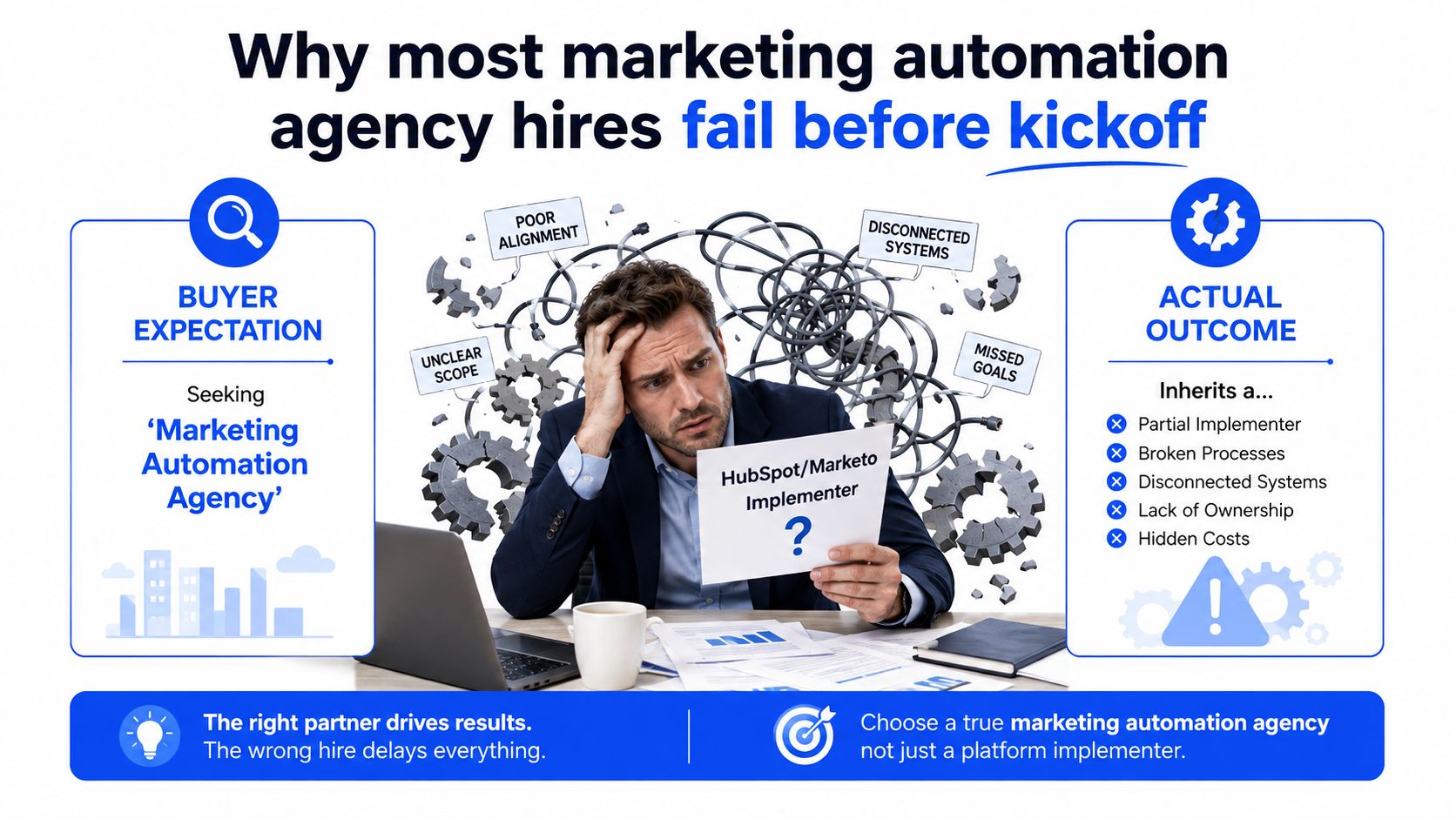
Practical rule: If the agency can't tell you how it handles data ownership, routing, and reporting, it's selling motion, not pipeline.
That's why the first decision isn't “which agency looks smart.” It's “which operating model matches our funnel.” If you're buying outsourced lead gen or outbound execution, the right starting point is a category like outsourcing lead generation, not a generic automation package.
What marketing automation agencies actually deliver in 2026
The label hides three different services, and you need to know which one you're buying. One builds the system of record, one runs campaigns, and one builds outbound motion tied to CRM data. The wrong category creates avoidable churn before the first workflow even fires.
Legacy platform implementation
This is the HubSpot, Marketo, or Pardot lane. The agency maps lifecycle stages, builds lead-routing rules, sets scoring logic, and cleans up governance so the CRM and marketing layer stop fighting each other. If you need migration, lifecycle design, or account-level permissions, this is the category to test.
Demand generation execution
This lane owns campaign output. It handles nurture, segmentation, reporting, and the operational rhythm around campaign launches. Agencies here are useful when the core platform already exists and the business needs better execution, not another rebuild.
Outbound automation operations
GROU operates in this area, which is the lane most B2B teams need when the brief says pipeline. The stack tends to include Apollo, Clay, Lemlist, Instantly, HeyReach, Sales Navigator, and HubSpot. The deliverables are sequence libraries, signal detection, routing logic, CRM governance, and clean feedback loops.
If you want a quick filter for the outbound lane, look at best warmup tools for email deliverability and see whether the agency even talks about sender reputation, not just message volume.
Good agencies sell the operating system, not the tool list.
A serious shortlist should tell you exactly which artefacts it produces. Ask for lifecycle stages, signal criteria, reply routing rules, dashboard ownership, and a sample of the message system. If they can't name the outputs, they're still selling abstraction.
Evaluation criteria that separate operators from vendors
The difference shows up in what the agency can prove, not what it promises. I'd score every shortlist against six filters, and I'd disqualify fast if even two are weak.
Stack depth and technical ownership
Ask whether technical work is handled in-house or handed off. Then ask to see a sample Slack channel, a warm-up protocol, and a deliverability dashboard. If the team can't show those without improvising, the stack depth probably isn't real.
Governance and reporting discipline
A real operator has rules for who owns fields, who approves changes, and how often reporting lands. If they say “we're flexible,” push harder. Flexibility without governance usually means nobody owns the fallout when routing breaks or definitions drift.
ICP workshops and system integration
The best teams start with a live ICP workshop, not a platform demo. They should be able to explain how they integrate existing systems instead of forcing a platform switch. For a useful market-facing comparison of how agencies present themselves, see best AI visibility platforms and compare that positioning against their actual implementation depth.
Operator test: Ask for one real workflow that joins CRM, outbound, and reporting. If they answer with a feature list, they're not an operator.
What to ask for before you sign
Named ownership: Who owns setup, QA, and escalation.
Documented process: Where the routing rules, warm-up steps, and exceptions live.
Visible reporting: Which dashboard the client sees weekly.
Integration proof: Which systems connect today, not someday.
Source of truth: Which platform holds lifecycle and attribution logic.
Migration readiness: How they handle the current stack without a forced rebuild.
If you want a practical benchmark, compare finalists against the top lead generation companies lens, then score them on governance and integration, not just output claims.
Pricing models compared for B2B pipeline work
Price tells you where the agency makes money, so read the incentives before you read the proposal. Retainers buy consistency, performance fees buy activity, hybrids balance both, and platform-only implementations buy setup work without ongoing execution.
For a mid-market B2B team, a straight retainer fits when the agency owns ongoing outbound, reporting, and iteration. Performance pricing fits only when qualification rules are tight and the sales team can absorb the volume. Hybrid usually wins when you want accountability without letting the agency chase bad meetings.
Platform-only implementation is the weakest fit for pipeline teams unless you already have internal operators. You'll get the system, but you'll still need someone to run the motion. That's where a lot of buyers discover they bought software-shaped work, not revenue-shaped work.
Model | Typical range | Best for | Main risk |
|---|---|---|---|
Monthly retainer | Varies by scope | Ongoing outbound and RevOps support | Rewarding volume over quality |
Performance or per-meeting fee | Varies by meeting definition | Teams with strict qualification rules | Incentivizing unqualified meetings |
Hybrid base plus variable | Varies by base and upside | Mid-market B2B teams scaling outbound | Bad incentive design if metrics are weak |
Platform-only implementation | Varies by platform scope | Internal teams that already have operators | No ownership of execution |
For budget planning, start with GROU pricing and use the model as the primary filter. If the proposal can't explain unit economics, it's too early to buy.
The clean verdict is simple. Retainer is the safest fit for pipeline ownership. Hybrid is the best compromise for most B2B teams. Performance-only is useful only when you trust the qualification process more than the sales deck. Platform-only is for teams that already know how to operate the machine.
Onboarding mechanics serious agencies run in the first 30 days
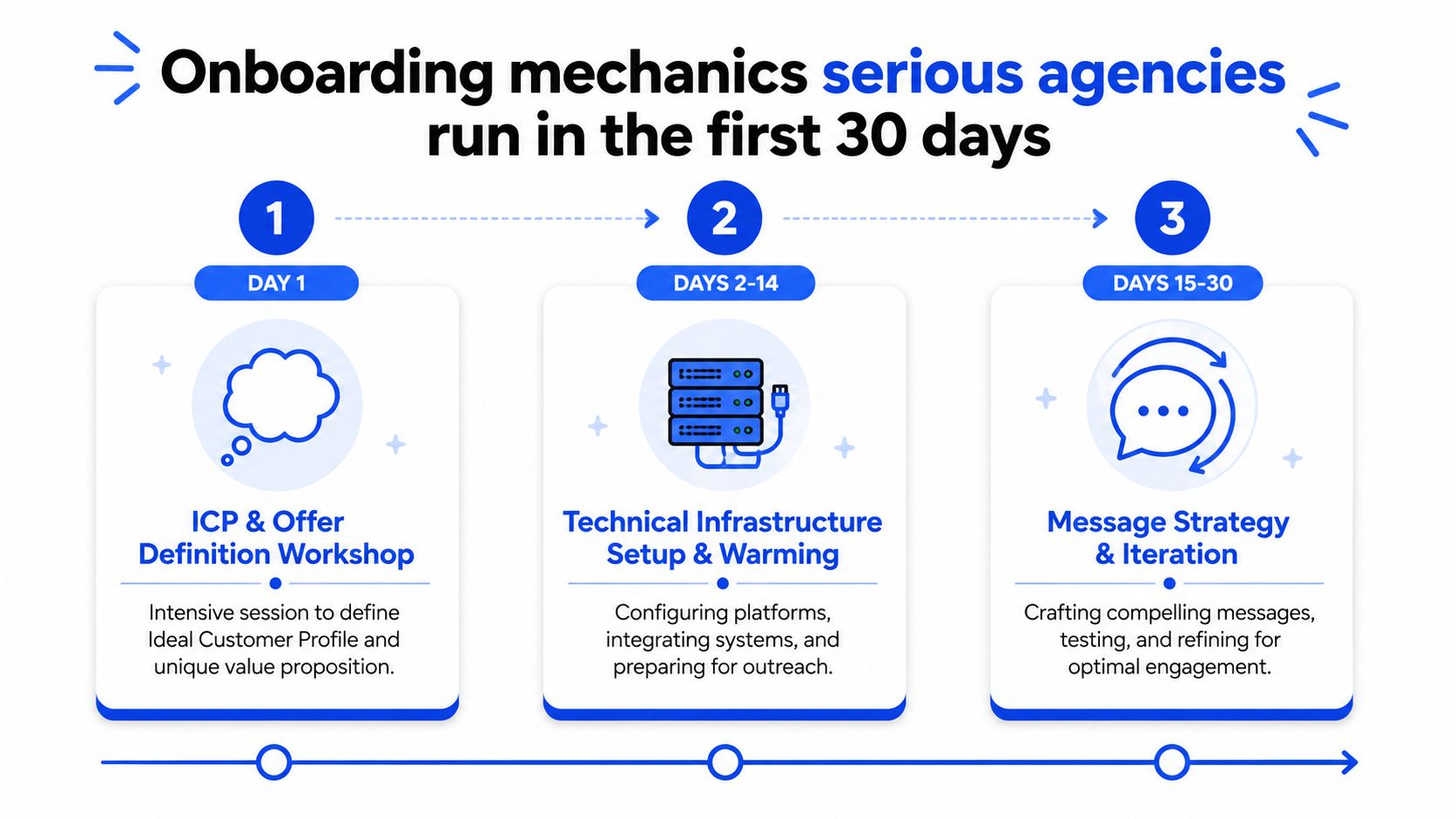
A serious kickoff is a sequence, not a pile of tasks. Day one should force clarity on ICP and offer. Days two through fourteen should harden infrastructure and warming. Days seven through twenty-one should build messages and signal logic in parallel.
Step one, ICP and offer definition
This workshop should happen on day one and take real stakeholder time. The outputs matter more than the meeting itself, written ICP characteristics, offer positioning, message maps, signal criteria, and disqualification rules. If the agency skips this, everything downstream inherits ambiguity.
Step two, technical setup and warming
Days two through fourteen should cover infrastructure, integration, reply routing, reporting, and warming. The work is heavy, often 40 to 60 hours of technical setup across two weeks, inside a total onboarding range of 90 to 130 hours over three weeks. A strong agency will also spell out quality checks for deliverability, integration tests, and routing validation.
Step three, message development and signal configuration
From day seven through twenty-one, the team should build sequence copy, personalisation logic, and signal detection. The soft launch should be small, usually 50 to 100 highly qualified prospects, before scale. The goal isn't speed for its own sake, it's proving the system can hold quality when volume starts climbing.
A good agency will put the timeline in writing. Day 21 soft launch. Day 28 scale if results hold. Day 30 first qualified meetings expected. If they won't commit to that structure, they're either underprepared or hiding the actual sequence.
Lead generation agency guidance often talks about output, but the serious question is whether the setup protects quality before the first send. If the answer is no, you're not buying onboarding, you're buying recovery.
KPIs and reporting that actually predict pipeline
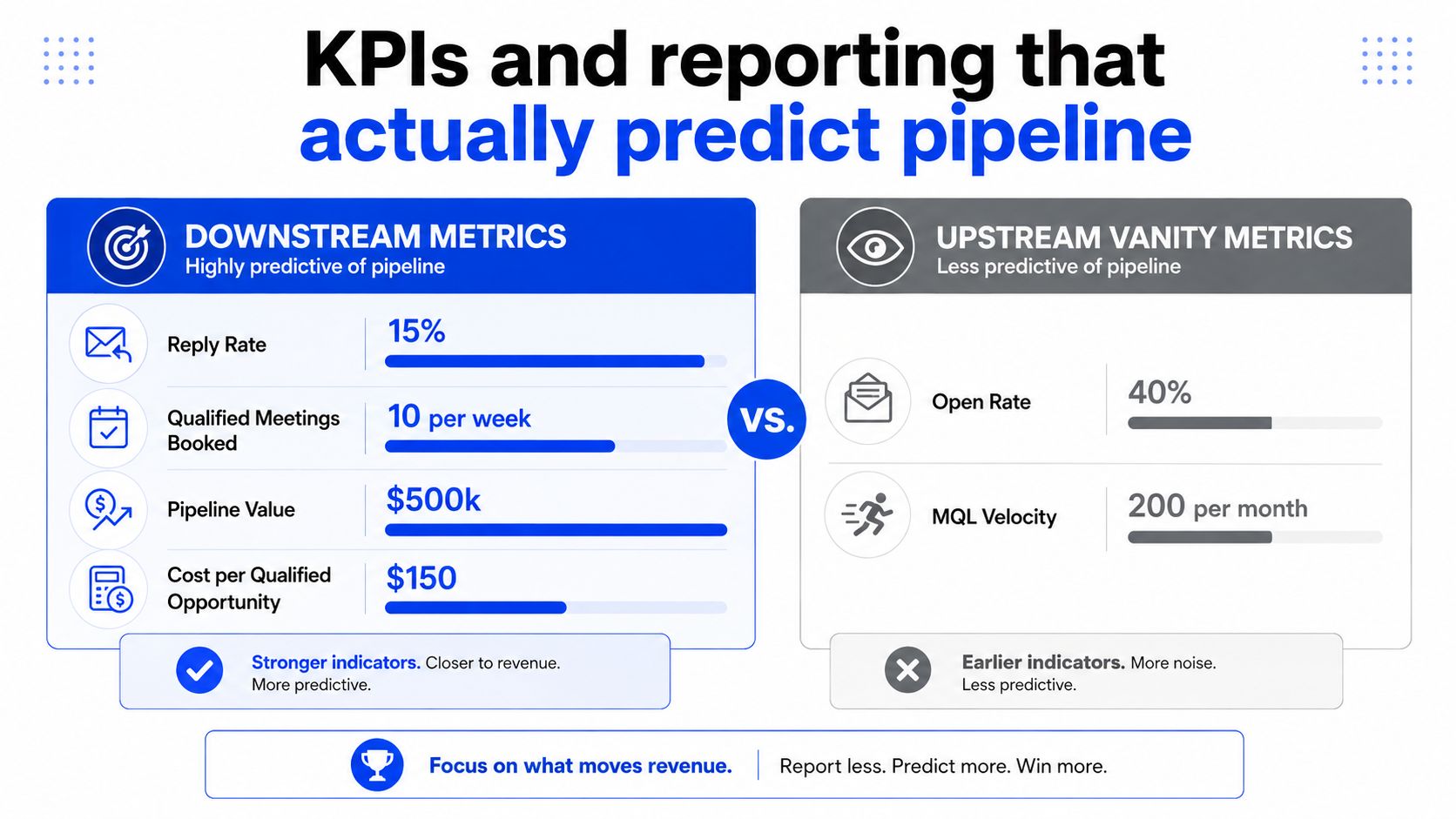
Open rates belong in the appendix, not the headline. If an agency leads with opens or clicks, it's still selling activity. The metrics that matter are reply rate, qualified meetings booked, pipeline value, and cost per qualified opportunity.
The clearest proof comes from downstream movement. In one recent engagement, reply rate moved from 6.4% to 15.8%, cost per qualified opportunity fell from €890 to €340, and qualified opportunities per month rose from 4 to 6 up to 14 to 18 over 90 days. That's the kind of movement a RevOps lead can defend in a pipeline review.
Practical rule: If the deck doesn't show reply rate, meeting quality, and pipeline value by segment, assume the reporting is decoration.
A serious agency should report weekly on performance and monthly on trend lines. It should expose the dashboard, not just a summary slide, and it should separate source signals from the resulting outcomes. That makes it easier to see whether the system is finding real buyers or just generating noise.
If you want to compare what an agency claims with what it can track, the KPIs for lead generation lens is the right one. Ask for the same thing in any vendor meeting, then press for the fields behind the headline numbers.
The warning signs are obvious once you know them. Opens first. Clicks first. MQL velocity first. If those show up before reply quality and pipeline value, the agency still thinks top-of-funnel motion is the same thing as revenue.
Red flags and common automation missteps to watch
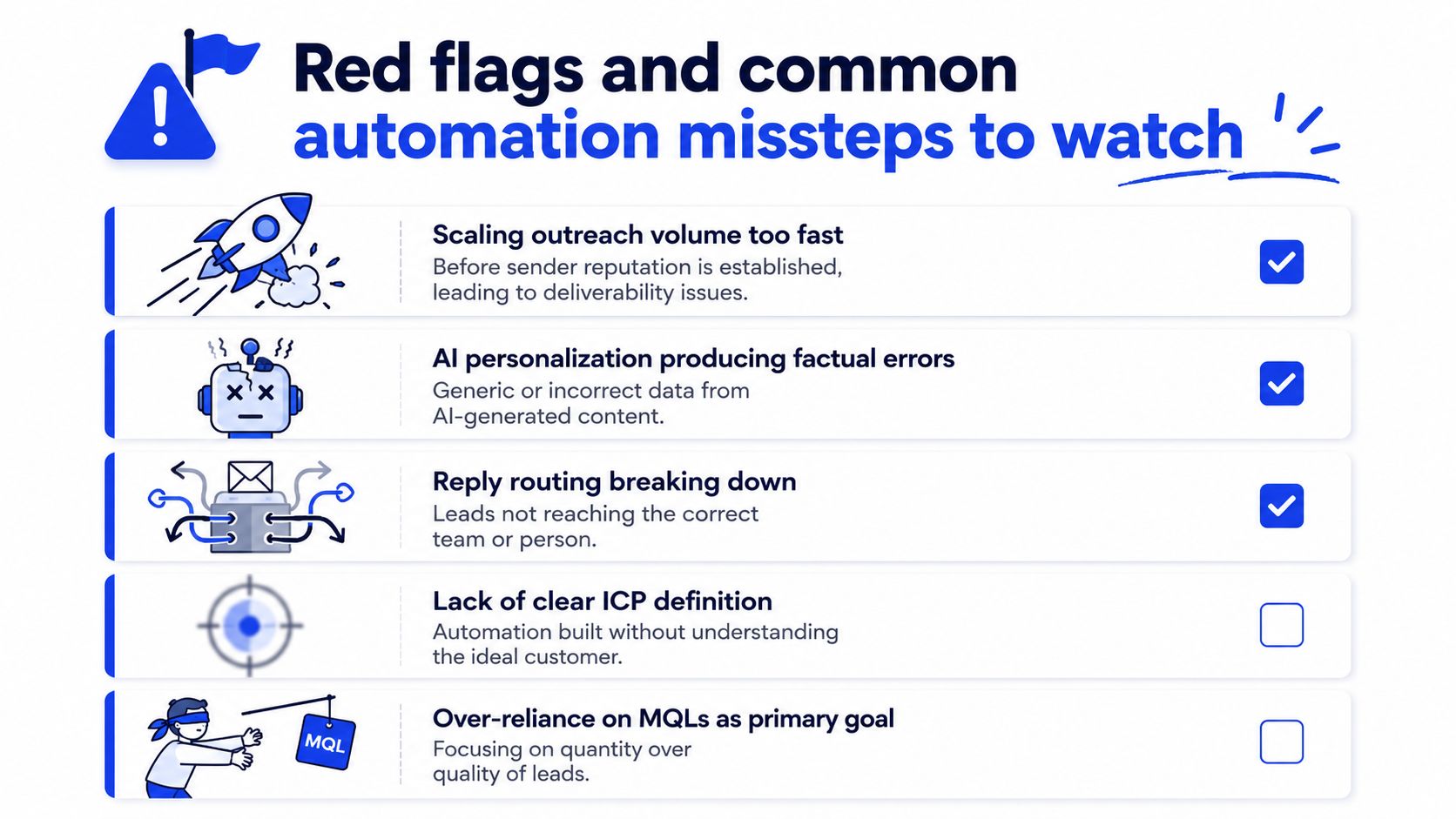
The worst failures are usually self-inflicted. Teams scale too early, trust AI copy without review, break routing during updates, or let signal definitions drift until the whole system feels random. None of that is mysterious, and all of it is avoidable.
The failures you should monitor
Scaling outreach too fast: If volume jumps before sender reputation is deep, bounce rate and inbox placement tell the story.
AI personalisation errors: If humans aren't reviewing outputs, wrong facts slip into outreach and damage trust fast.
Reply routing breakdowns: If Slack alerts or CRM handoffs fail, qualified replies sit untouched.
Weak ICP definition: If the agency can't explain disqualification criteria, automation just accelerates bad targeting.
MQL obsession: If the agency treats MQL count as the main goal, you'll get more noise than revenue.
For deliverability hygiene, use Email Validation API as part of list checking and suppression discipline. Clean data won't fix bad strategy, but it will stop bad strategy from getting expensive faster.
The operating cadence I'd insist on
Bi-weekly sprint reviews. Weekly deliverability deep-dives. A shared Slack channel with reply-routing SLAs. A quarterly signal-criteria reset. If an agency can't commit to that rhythm, it won't hold quality when the campaign gets busy.
Add reply rate and cost per qualified opportunity to the CRM this week. Then set a 30-day threshold review with any agency still quoting open rate and MQL velocity as primary metrics. If they push back, you've learned enough to walk.
GROU builds outbound and CRM-connected pipeline systems for B2B teams that want structure, clean routing, and qualified conversations instead of activity for its own sake. If you need an operating model that ties ICP, signal detection, and reply handling into one reporting line, visit Grou and review how the team runs pipeline work across markets.
You're probably already seeing the failure pattern. A vendor sold you “marketing automation,” but what you needed was pipeline structure. Now the CRM is messy, reply quality is inconsistent, and nobody can explain why the funnel looks busy but closes slowly.
Pick the right agency type first, because a HubSpot implementer, a demand-gen vendor, and an outbound automation operator solve different problems.
Judge agencies on integration depth, not on platform logos or sequence volume.
Demand downstream KPIs, especially reply rate, qualified meetings, pipeline value, and cost per qualified opportunity.
Force the first 30 days into writing, including ICP definition, warming, routing, and signal handling.
Treat deliverability and governance as revenue protection, not technical housekeeping.
Table of Contents
Why most marketing automation agency hires fail before kickoff
Onboarding mechanics serious agencies run in the first 30 days
Why most marketing automation agency hires fail before kickoff
Most hires fail because the buyer wants one thing and the agency sells another. If your real problem is outbound pipeline, a legacy MAP implementer won't fix it. If your real problem is CRM discipline and routing, a campaign vendor won't fix that either.
Structure turns attention into pipeline, and that starts with choosing the right operator. The category is fragmented, one lane handles HubSpot or Marketo setup, another runs demand gen, and another handles outbound systems built around Clay, Lemlist, Instantly, HeyReach, Apollo, and CRM integration.
The buyer usually discovers the mismatch after the contract is signed. Then the team spends weeks untangling process gaps, bad routing, and vague ownership. That's how you end up with activity, not qualified conversations.
Practical rule: If the agency can't tell you how it handles data ownership, routing, and reporting, it's selling motion, not pipeline.
That's why the first decision isn't “which agency looks smart.” It's “which operating model matches our funnel.” If you're buying outsourced lead gen or outbound execution, the right starting point is a category like outsourcing lead generation, not a generic automation package.
What marketing automation agencies actually deliver in 2026
The label hides three different services, and you need to know which one you're buying. One builds the system of record, one runs campaigns, and one builds outbound motion tied to CRM data. The wrong category creates avoidable churn before the first workflow even fires.
Legacy platform implementation
This is the HubSpot, Marketo, or Pardot lane. The agency maps lifecycle stages, builds lead-routing rules, sets scoring logic, and cleans up governance so the CRM and marketing layer stop fighting each other. If you need migration, lifecycle design, or account-level permissions, this is the category to test.
Demand generation execution
This lane owns campaign output. It handles nurture, segmentation, reporting, and the operational rhythm around campaign launches. Agencies here are useful when the core platform already exists and the business needs better execution, not another rebuild.
Outbound automation operations
GROU operates in this area, which is the lane most B2B teams need when the brief says pipeline. The stack tends to include Apollo, Clay, Lemlist, Instantly, HeyReach, Sales Navigator, and HubSpot. The deliverables are sequence libraries, signal detection, routing logic, CRM governance, and clean feedback loops.
If you want a quick filter for the outbound lane, look at best warmup tools for email deliverability and see whether the agency even talks about sender reputation, not just message volume.
Good agencies sell the operating system, not the tool list.
A serious shortlist should tell you exactly which artefacts it produces. Ask for lifecycle stages, signal criteria, reply routing rules, dashboard ownership, and a sample of the message system. If they can't name the outputs, they're still selling abstraction.
Evaluation criteria that separate operators from vendors
The difference shows up in what the agency can prove, not what it promises. I'd score every shortlist against six filters, and I'd disqualify fast if even two are weak.
Stack depth and technical ownership
Ask whether technical work is handled in-house or handed off. Then ask to see a sample Slack channel, a warm-up protocol, and a deliverability dashboard. If the team can't show those without improvising, the stack depth probably isn't real.
Governance and reporting discipline
A real operator has rules for who owns fields, who approves changes, and how often reporting lands. If they say “we're flexible,” push harder. Flexibility without governance usually means nobody owns the fallout when routing breaks or definitions drift.
ICP workshops and system integration
The best teams start with a live ICP workshop, not a platform demo. They should be able to explain how they integrate existing systems instead of forcing a platform switch. For a useful market-facing comparison of how agencies present themselves, see best AI visibility platforms and compare that positioning against their actual implementation depth.
Operator test: Ask for one real workflow that joins CRM, outbound, and reporting. If they answer with a feature list, they're not an operator.
What to ask for before you sign
Named ownership: Who owns setup, QA, and escalation.
Documented process: Where the routing rules, warm-up steps, and exceptions live.
Visible reporting: Which dashboard the client sees weekly.
Integration proof: Which systems connect today, not someday.
Source of truth: Which platform holds lifecycle and attribution logic.
Migration readiness: How they handle the current stack without a forced rebuild.
If you want a practical benchmark, compare finalists against the top lead generation companies lens, then score them on governance and integration, not just output claims.
Pricing models compared for B2B pipeline work
Price tells you where the agency makes money, so read the incentives before you read the proposal. Retainers buy consistency, performance fees buy activity, hybrids balance both, and platform-only implementations buy setup work without ongoing execution.
For a mid-market B2B team, a straight retainer fits when the agency owns ongoing outbound, reporting, and iteration. Performance pricing fits only when qualification rules are tight and the sales team can absorb the volume. Hybrid usually wins when you want accountability without letting the agency chase bad meetings.
Platform-only implementation is the weakest fit for pipeline teams unless you already have internal operators. You'll get the system, but you'll still need someone to run the motion. That's where a lot of buyers discover they bought software-shaped work, not revenue-shaped work.
Model | Typical range | Best for | Main risk |
|---|---|---|---|
Monthly retainer | Varies by scope | Ongoing outbound and RevOps support | Rewarding volume over quality |
Performance or per-meeting fee | Varies by meeting definition | Teams with strict qualification rules | Incentivizing unqualified meetings |
Hybrid base plus variable | Varies by base and upside | Mid-market B2B teams scaling outbound | Bad incentive design if metrics are weak |
Platform-only implementation | Varies by platform scope | Internal teams that already have operators | No ownership of execution |
For budget planning, start with GROU pricing and use the model as the primary filter. If the proposal can't explain unit economics, it's too early to buy.
The clean verdict is simple. Retainer is the safest fit for pipeline ownership. Hybrid is the best compromise for most B2B teams. Performance-only is useful only when you trust the qualification process more than the sales deck. Platform-only is for teams that already know how to operate the machine.
Onboarding mechanics serious agencies run in the first 30 days
A serious kickoff is a sequence, not a pile of tasks. Day one should force clarity on ICP and offer. Days two through fourteen should harden infrastructure and warming. Days seven through twenty-one should build messages and signal logic in parallel.
Step one, ICP and offer definition
This workshop should happen on day one and take real stakeholder time. The outputs matter more than the meeting itself, written ICP characteristics, offer positioning, message maps, signal criteria, and disqualification rules. If the agency skips this, everything downstream inherits ambiguity.
Step two, technical setup and warming
Days two through fourteen should cover infrastructure, integration, reply routing, reporting, and warming. The work is heavy, often 40 to 60 hours of technical setup across two weeks, inside a total onboarding range of 90 to 130 hours over three weeks. A strong agency will also spell out quality checks for deliverability, integration tests, and routing validation.
Step three, message development and signal configuration
From day seven through twenty-one, the team should build sequence copy, personalisation logic, and signal detection. The soft launch should be small, usually 50 to 100 highly qualified prospects, before scale. The goal isn't speed for its own sake, it's proving the system can hold quality when volume starts climbing.
A good agency will put the timeline in writing. Day 21 soft launch. Day 28 scale if results hold. Day 30 first qualified meetings expected. If they won't commit to that structure, they're either underprepared or hiding the actual sequence.
Lead generation agency guidance often talks about output, but the serious question is whether the setup protects quality before the first send. If the answer is no, you're not buying onboarding, you're buying recovery.
KPIs and reporting that actually predict pipeline
Open rates belong in the appendix, not the headline. If an agency leads with opens or clicks, it's still selling activity. The metrics that matter are reply rate, qualified meetings booked, pipeline value, and cost per qualified opportunity.
The clearest proof comes from downstream movement. In one recent engagement, reply rate moved from 6.4% to 15.8%, cost per qualified opportunity fell from €890 to €340, and qualified opportunities per month rose from 4 to 6 up to 14 to 18 over 90 days. That's the kind of movement a RevOps lead can defend in a pipeline review.
Practical rule: If the deck doesn't show reply rate, meeting quality, and pipeline value by segment, assume the reporting is decoration.
A serious agency should report weekly on performance and monthly on trend lines. It should expose the dashboard, not just a summary slide, and it should separate source signals from the resulting outcomes. That makes it easier to see whether the system is finding real buyers or just generating noise.
If you want to compare what an agency claims with what it can track, the KPIs for lead generation lens is the right one. Ask for the same thing in any vendor meeting, then press for the fields behind the headline numbers.
The warning signs are obvious once you know them. Opens first. Clicks first. MQL velocity first. If those show up before reply quality and pipeline value, the agency still thinks top-of-funnel motion is the same thing as revenue.
Red flags and common automation missteps to watch
The worst failures are usually self-inflicted. Teams scale too early, trust AI copy without review, break routing during updates, or let signal definitions drift until the whole system feels random. None of that is mysterious, and all of it is avoidable.
The failures you should monitor
Scaling outreach too fast: If volume jumps before sender reputation is deep, bounce rate and inbox placement tell the story.
AI personalisation errors: If humans aren't reviewing outputs, wrong facts slip into outreach and damage trust fast.
Reply routing breakdowns: If Slack alerts or CRM handoffs fail, qualified replies sit untouched.
Weak ICP definition: If the agency can't explain disqualification criteria, automation just accelerates bad targeting.
MQL obsession: If the agency treats MQL count as the main goal, you'll get more noise than revenue.
For deliverability hygiene, use Email Validation API as part of list checking and suppression discipline. Clean data won't fix bad strategy, but it will stop bad strategy from getting expensive faster.
The operating cadence I'd insist on
Bi-weekly sprint reviews. Weekly deliverability deep-dives. A shared Slack channel with reply-routing SLAs. A quarterly signal-criteria reset. If an agency can't commit to that rhythm, it won't hold quality when the campaign gets busy.
Add reply rate and cost per qualified opportunity to the CRM this week. Then set a 30-day threshold review with any agency still quoting open rate and MQL velocity as primary metrics. If they push back, you've learned enough to walk.
GROU builds outbound and CRM-connected pipeline systems for B2B teams that want structure, clean routing, and qualified conversations instead of activity for its own sake. If you need an operating model that ties ICP, signal detection, and reply handling into one reporting line, visit Grou and review how the team runs pipeline work across markets.
You're probably already seeing the failure pattern. A vendor sold you “marketing automation,” but what you needed was pipeline structure. Now the CRM is messy, reply quality is inconsistent, and nobody can explain why the funnel looks busy but closes slowly.
Pick the right agency type first, because a HubSpot implementer, a demand-gen vendor, and an outbound automation operator solve different problems.
Judge agencies on integration depth, not on platform logos or sequence volume.
Demand downstream KPIs, especially reply rate, qualified meetings, pipeline value, and cost per qualified opportunity.
Force the first 30 days into writing, including ICP definition, warming, routing, and signal handling.
Treat deliverability and governance as revenue protection, not technical housekeeping.
Table of Contents
Why most marketing automation agency hires fail before kickoff
Onboarding mechanics serious agencies run in the first 30 days
Why most marketing automation agency hires fail before kickoff
Most hires fail because the buyer wants one thing and the agency sells another. If your real problem is outbound pipeline, a legacy MAP implementer won't fix it. If your real problem is CRM discipline and routing, a campaign vendor won't fix that either.
Structure turns attention into pipeline, and that starts with choosing the right operator. The category is fragmented, one lane handles HubSpot or Marketo setup, another runs demand gen, and another handles outbound systems built around Clay, Lemlist, Instantly, HeyReach, Apollo, and CRM integration.
The buyer usually discovers the mismatch after the contract is signed. Then the team spends weeks untangling process gaps, bad routing, and vague ownership. That's how you end up with activity, not qualified conversations.
Practical rule: If the agency can't tell you how it handles data ownership, routing, and reporting, it's selling motion, not pipeline.
That's why the first decision isn't “which agency looks smart.” It's “which operating model matches our funnel.” If you're buying outsourced lead gen or outbound execution, the right starting point is a category like outsourcing lead generation, not a generic automation package.
What marketing automation agencies actually deliver in 2026
The label hides three different services, and you need to know which one you're buying. One builds the system of record, one runs campaigns, and one builds outbound motion tied to CRM data. The wrong category creates avoidable churn before the first workflow even fires.
Legacy platform implementation
This is the HubSpot, Marketo, or Pardot lane. The agency maps lifecycle stages, builds lead-routing rules, sets scoring logic, and cleans up governance so the CRM and marketing layer stop fighting each other. If you need migration, lifecycle design, or account-level permissions, this is the category to test.
Demand generation execution
This lane owns campaign output. It handles nurture, segmentation, reporting, and the operational rhythm around campaign launches. Agencies here are useful when the core platform already exists and the business needs better execution, not another rebuild.
Outbound automation operations
GROU operates in this area, which is the lane most B2B teams need when the brief says pipeline. The stack tends to include Apollo, Clay, Lemlist, Instantly, HeyReach, Sales Navigator, and HubSpot. The deliverables are sequence libraries, signal detection, routing logic, CRM governance, and clean feedback loops.
If you want a quick filter for the outbound lane, look at best warmup tools for email deliverability and see whether the agency even talks about sender reputation, not just message volume.
Good agencies sell the operating system, not the tool list.
A serious shortlist should tell you exactly which artefacts it produces. Ask for lifecycle stages, signal criteria, reply routing rules, dashboard ownership, and a sample of the message system. If they can't name the outputs, they're still selling abstraction.
Evaluation criteria that separate operators from vendors
The difference shows up in what the agency can prove, not what it promises. I'd score every shortlist against six filters, and I'd disqualify fast if even two are weak.
Stack depth and technical ownership
Ask whether technical work is handled in-house or handed off. Then ask to see a sample Slack channel, a warm-up protocol, and a deliverability dashboard. If the team can't show those without improvising, the stack depth probably isn't real.
Governance and reporting discipline
A real operator has rules for who owns fields, who approves changes, and how often reporting lands. If they say “we're flexible,” push harder. Flexibility without governance usually means nobody owns the fallout when routing breaks or definitions drift.
ICP workshops and system integration
The best teams start with a live ICP workshop, not a platform demo. They should be able to explain how they integrate existing systems instead of forcing a platform switch. For a useful market-facing comparison of how agencies present themselves, see best AI visibility platforms and compare that positioning against their actual implementation depth.
Operator test: Ask for one real workflow that joins CRM, outbound, and reporting. If they answer with a feature list, they're not an operator.
What to ask for before you sign
Named ownership: Who owns setup, QA, and escalation.
Documented process: Where the routing rules, warm-up steps, and exceptions live.
Visible reporting: Which dashboard the client sees weekly.
Integration proof: Which systems connect today, not someday.
Source of truth: Which platform holds lifecycle and attribution logic.
Migration readiness: How they handle the current stack without a forced rebuild.
If you want a practical benchmark, compare finalists against the top lead generation companies lens, then score them on governance and integration, not just output claims.
Pricing models compared for B2B pipeline work
Price tells you where the agency makes money, so read the incentives before you read the proposal. Retainers buy consistency, performance fees buy activity, hybrids balance both, and platform-only implementations buy setup work without ongoing execution.
For a mid-market B2B team, a straight retainer fits when the agency owns ongoing outbound, reporting, and iteration. Performance pricing fits only when qualification rules are tight and the sales team can absorb the volume. Hybrid usually wins when you want accountability without letting the agency chase bad meetings.
Platform-only implementation is the weakest fit for pipeline teams unless you already have internal operators. You'll get the system, but you'll still need someone to run the motion. That's where a lot of buyers discover they bought software-shaped work, not revenue-shaped work.
Model | Typical range | Best for | Main risk |
|---|---|---|---|
Monthly retainer | Varies by scope | Ongoing outbound and RevOps support | Rewarding volume over quality |
Performance or per-meeting fee | Varies by meeting definition | Teams with strict qualification rules | Incentivizing unqualified meetings |
Hybrid base plus variable | Varies by base and upside | Mid-market B2B teams scaling outbound | Bad incentive design if metrics are weak |
Platform-only implementation | Varies by platform scope | Internal teams that already have operators | No ownership of execution |
For budget planning, start with GROU pricing and use the model as the primary filter. If the proposal can't explain unit economics, it's too early to buy.
The clean verdict is simple. Retainer is the safest fit for pipeline ownership. Hybrid is the best compromise for most B2B teams. Performance-only is useful only when you trust the qualification process more than the sales deck. Platform-only is for teams that already know how to operate the machine.
Onboarding mechanics serious agencies run in the first 30 days
A serious kickoff is a sequence, not a pile of tasks. Day one should force clarity on ICP and offer. Days two through fourteen should harden infrastructure and warming. Days seven through twenty-one should build messages and signal logic in parallel.
Step one, ICP and offer definition
This workshop should happen on day one and take real stakeholder time. The outputs matter more than the meeting itself, written ICP characteristics, offer positioning, message maps, signal criteria, and disqualification rules. If the agency skips this, everything downstream inherits ambiguity.
Step two, technical setup and warming
Days two through fourteen should cover infrastructure, integration, reply routing, reporting, and warming. The work is heavy, often 40 to 60 hours of technical setup across two weeks, inside a total onboarding range of 90 to 130 hours over three weeks. A strong agency will also spell out quality checks for deliverability, integration tests, and routing validation.
Step three, message development and signal configuration
From day seven through twenty-one, the team should build sequence copy, personalisation logic, and signal detection. The soft launch should be small, usually 50 to 100 highly qualified prospects, before scale. The goal isn't speed for its own sake, it's proving the system can hold quality when volume starts climbing.
A good agency will put the timeline in writing. Day 21 soft launch. Day 28 scale if results hold. Day 30 first qualified meetings expected. If they won't commit to that structure, they're either underprepared or hiding the actual sequence.
Lead generation agency guidance often talks about output, but the serious question is whether the setup protects quality before the first send. If the answer is no, you're not buying onboarding, you're buying recovery.
KPIs and reporting that actually predict pipeline
Open rates belong in the appendix, not the headline. If an agency leads with opens or clicks, it's still selling activity. The metrics that matter are reply rate, qualified meetings booked, pipeline value, and cost per qualified opportunity.
The clearest proof comes from downstream movement. In one recent engagement, reply rate moved from 6.4% to 15.8%, cost per qualified opportunity fell from €890 to €340, and qualified opportunities per month rose from 4 to 6 up to 14 to 18 over 90 days. That's the kind of movement a RevOps lead can defend in a pipeline review.
Practical rule: If the deck doesn't show reply rate, meeting quality, and pipeline value by segment, assume the reporting is decoration.
A serious agency should report weekly on performance and monthly on trend lines. It should expose the dashboard, not just a summary slide, and it should separate source signals from the resulting outcomes. That makes it easier to see whether the system is finding real buyers or just generating noise.
If you want to compare what an agency claims with what it can track, the KPIs for lead generation lens is the right one. Ask for the same thing in any vendor meeting, then press for the fields behind the headline numbers.
The warning signs are obvious once you know them. Opens first. Clicks first. MQL velocity first. If those show up before reply quality and pipeline value, the agency still thinks top-of-funnel motion is the same thing as revenue.
Red flags and common automation missteps to watch
The worst failures are usually self-inflicted. Teams scale too early, trust AI copy without review, break routing during updates, or let signal definitions drift until the whole system feels random. None of that is mysterious, and all of it is avoidable.
The failures you should monitor
Scaling outreach too fast: If volume jumps before sender reputation is deep, bounce rate and inbox placement tell the story.
AI personalisation errors: If humans aren't reviewing outputs, wrong facts slip into outreach and damage trust fast.
Reply routing breakdowns: If Slack alerts or CRM handoffs fail, qualified replies sit untouched.
Weak ICP definition: If the agency can't explain disqualification criteria, automation just accelerates bad targeting.
MQL obsession: If the agency treats MQL count as the main goal, you'll get more noise than revenue.
For deliverability hygiene, use Email Validation API as part of list checking and suppression discipline. Clean data won't fix bad strategy, but it will stop bad strategy from getting expensive faster.
The operating cadence I'd insist on
Bi-weekly sprint reviews. Weekly deliverability deep-dives. A shared Slack channel with reply-routing SLAs. A quarterly signal-criteria reset. If an agency can't commit to that rhythm, it won't hold quality when the campaign gets busy.
Add reply rate and cost per qualified opportunity to the CRM this week. Then set a 30-day threshold review with any agency still quoting open rate and MQL velocity as primary metrics. If they push back, you've learned enough to walk.
GROU builds outbound and CRM-connected pipeline systems for B2B teams that want structure, clean routing, and qualified conversations instead of activity for its own sake. If you need an operating model that ties ICP, signal detection, and reply handling into one reporting line, visit Grou and review how the team runs pipeline work across markets.
Pipeline OS Newsletter
Build qualified pipeline
Get weekly tactics to generate demand, improve lead quality, and book more meetings.





Trusted by industry leaders
Trusted by industry leaders
Trusted by industry leaders
Ready to build qualified pipeline?
Ready to build qualified pipeline?
Ready to build qualified pipeline?
Book a call to see if we're the right fit, or take the 2-minute quiz to get a clear starting point.
Book a call to see if we're the right fit, or take the 2-minute quiz to get a clear starting point.
Book a call to see if we're the right fit, or take the 2-minute quiz to get a clear starting point.
" height="30.21639343089746px" id="hfGbXmQR2" width="30.216393430897455px"/></svg>)
Copyright © 2026 – All Right Reserved
Copyright © 2026 – All Right Reserved
Copyright © 2026 – All Right Reserved