%22%3E%3C/path%3E%3Cpath d=%22M 63.072 7.554 C 62.258 8.022 61.577 8.689 61.092 9.493 L 61.092 7.076 L 57.158 7.076 L 57.158 22.64 L 61.089 22.64 L 61.089 14.888 C 61.089 13.446 61.403 12.434 62.03 11.853 C 62.818 11.218 63.818 10.907 64.826 10.982 L 65.868 10.982 L 65.868 6.851 C 64.891 6.834 63.926 7.076 63.073 7.554 Z%22 fill=%22rgb(17,17,17)%22%3E%3C/path%3E%3Cpath d=%22M 78.916 7.82 C 76.363 6.49 73.321 6.49 70.768 7.82 C 69.562 8.473 68.564 9.451 67.888 10.644 C 67.167 11.931 66.803 13.387 66.834 14.862 C 66.804 16.332 67.157 17.785 67.86 19.077 C 68.515 20.267 69.494 21.246 70.684 21.901 C 71.924 22.576 73.318 22.92 74.73 22.898 C 76.164 22.918 77.58 22.575 78.846 21.901 C 80.062 21.247 81.073 20.27 81.768 19.077 C 82.506 17.797 82.88 16.339 82.85 14.862 C 82.88 13.389 82.517 11.934 81.797 10.647 C 81.12 9.455 80.122 8.477 78.917 7.824 M 78.803 14.862 C 78.829 15.739 78.636 16.608 78.241 17.391 C 77.903 18.046 77.38 18.588 76.738 18.95 C 76.124 19.293 75.432 19.472 74.729 19.47 C 73.668 19.497 72.648 19.061 71.934 18.276 C 71.139 17.323 70.741 16.1 70.823 14.862 C 70.741 13.62 71.149 12.395 71.959 11.45 C 72.687 10.667 73.715 10.233 74.783 10.256 C 75.859 10.236 76.894 10.67 77.635 11.45 C 78.464 12.387 78.884 13.616 78.801 14.864%22 fill=%22rgb(17,17,17)%22%3E%3C/path%3E%3Cpath d=%22M 95.906 7.076 L 95.906 15.646 C 95.975 16.68 95.643 17.701 94.979 18.498 C 94.311 19.184 93.379 19.547 92.422 19.495 C 91.475 19.544 90.553 19.18 89.894 18.498 C 89.23 17.701 88.898 16.68 88.967 15.646 L 88.967 7.076 L 85.033 7.076 L 85.033 16.207 C 85 17.449 85.275 18.68 85.834 19.79 C 86.327 20.75 87.095 21.542 88.039 22.065 C 89.033 22.594 90.145 22.861 91.271 22.838 C 92.188 22.847 93.095 22.65 93.926 22.263 C 94.708 21.905 95.388 21.36 95.906 20.675 L 95.906 22.645 L 99.865 22.645 L 99.865 7.076 Z%22 fill=%22rgb(17,17,17)%22%3E%3C/path%3E%3Cpath d=%22M 4.513 15.626 C 4.511 10.815 7.606 6.549 12.181 5.059 C 16.756 3.57 21.77 5.195 24.601 9.086 L 27.816 5.87 C 24.074 1.186 17.981 -0.943 12.137 0.393 C 6.292 1.728 1.728 6.292 0.393 12.137 C -0.943 17.981 1.186 24.074 5.87 27.816 L 9.085 24.601 C 6.214 22.512 4.515 19.177 4.513 15.626%22 fill=%22rgb(32,62,235)%22%3E%3C/path%3E%3Cpath d=%22M 17.114 14.343 L 13.354 18.01 L 13.354 18.026 L 21.071 18.026 L 11.412 27.609 L 17.389 27.609 L 23.999 21.081 L 23.999 28.316 L 24.005 28.316 L 27.967 24.393 L 27.967 14.343 Z%22 fill=%22rgb(32,62,235)%22%3E%3C/path%3E%3C/g%3E%3C/svg%3E) ×
× ××
××›
›
›
›
10 Digital Product Examples for B2B Pipeline Teams
10 Digital Product Examples for B2B Pipeline Teams
10 Digital Product Examples for B2B Pipeline Teams
10 Digital Product Examples for B2B Pipeline Teams
10 Digital Product Examples for B2B Pipeline Teams
10 Digital Product Examples for B2B Pipeline Teams

Author
GROU team

The download that never becomes a meeting is why most digital product examples fail in B2B. A guide gets a few opens, a calculator gets a few clicks, and a course gets a few completions, but nothing reaches a routed CRM action fast enough to matter. The right asset should create a task, a follow-up, or a booked meeting within 24 hours, or it's just content.
Best overall for pipeline control: AmaJova, because the offer, payment, and fulfillment record stay tied together in one place.
Best for trust-led demand: an annual benchmark report, because prospects will trade data for a conversation.
Best for self-qualification: an ROI calculator, because the buyer enters the pain themselves.
Best for fast routing: a diagnostic tool, a template pack, or an email course with a clean HubSpot, Clay, or HeyReach handoff.
Worst fit for pipeline teams: any asset that ends at a download page and never creates a sales task.
Table of Contents
1. AmaJova
AmaJova is the strongest choice when you want one link to sell a service, a product, a download, or a live session without stitching together a storefront. It turns the offer into an OfferLink, then keeps checkout, order details, messages, and fulfillment inside one record. For teams that care about structure turning attention into pipeline, that matters more than a prettier landing page.
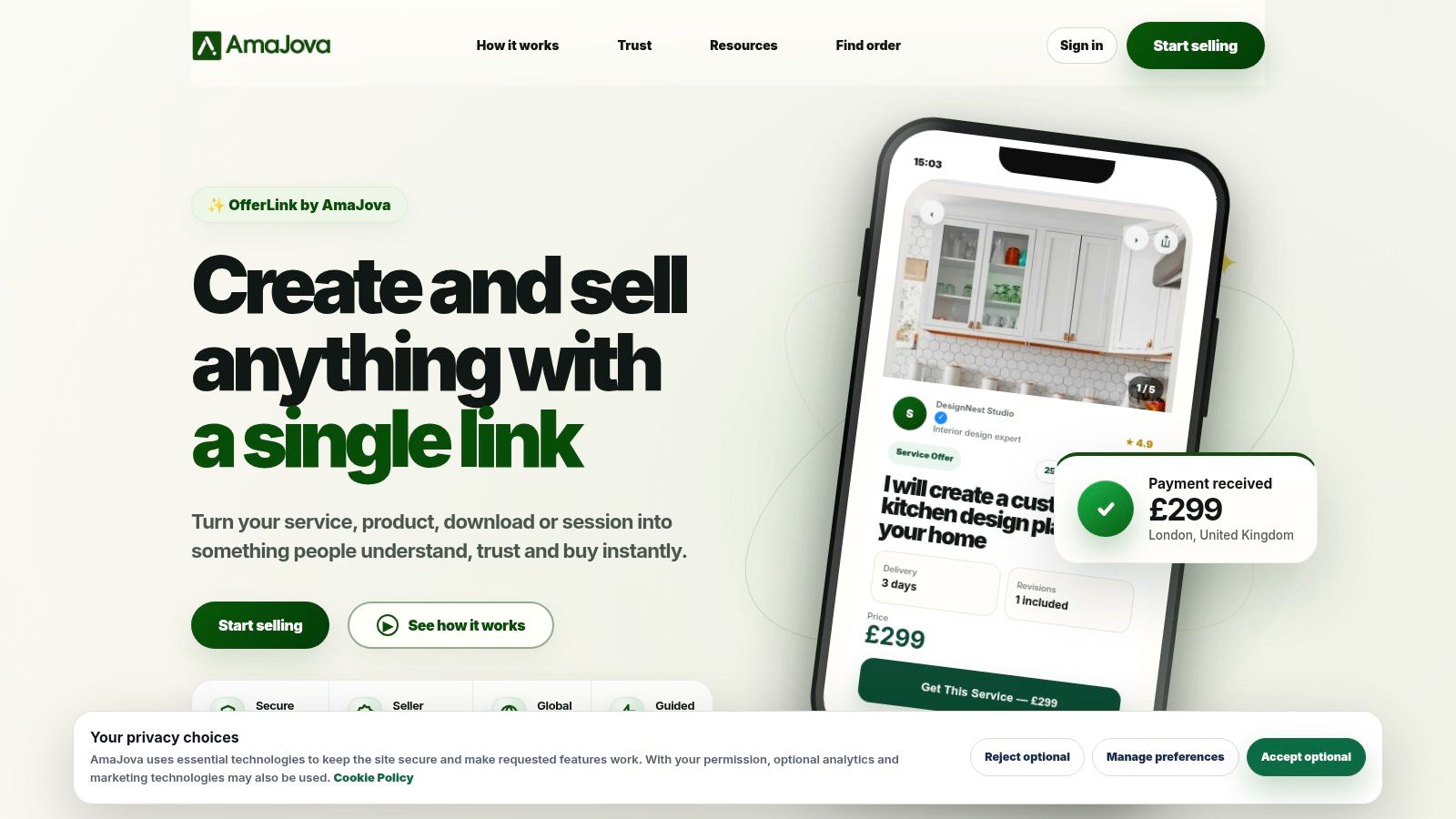
The platform's fit is obvious for operators selling across channels. You can drop one link into a bio, outbound message, campaign, or site, and the buyer sees the scope, price, inclusions, and fulfillment details before paying. That clarity reduces the back-and-forth that usually clogs a pipeline team's first response window.
What it does better than a generic checkout
AmaJova gives you page types for services, products, digital products, and live sessions. It also supports secure checkout, order messaging, completion tracking, dispute status, and payout clearance timelines that vary by seller level and offer type. The multi-currency support across 150+ currencies makes it practical for cross-border selling, not just local experiments.
Practical rule: If a buyer needs to ask “what happens after I pay?” your offer page isn't ready yet.
The trust layer is the true differentiator. Seller verification, buyer and seller protection information, and a structured seller growth program mean the order doesn't feel disconnected from the person behind it. That's a better fit than a bare checkout for teams that need to sell from the same asset they use to qualify.
When to pick it
Choose AmaJova when you're selling a defined offer and need the transaction to look credible fast. It's the better move for founders and revenue teams who don't want to build a full ecommerce stack just to sell a service package, digital product, or live session. The official resource at AmaJova's digital product examples page is useful if you want to see how the offer structure works in practice.
Skip it if your main problem is top-of-funnel education rather than selling a specific offer. AmaJova helps when the next step is payment and fulfillment, not when you still need to prove the market exists.
2. Annual benchmark report
A benchmark report is the cleanest trust-building asset in this list because it gives prospects a reason to compare themselves to peers. The right routing rule in HubSpot is simple, route anyone who completes the form and meets your ICP cutoff into a “benchmark request” task within 24 hours. If the data is good, SDRs get an opening that sounds like an informed conversation, not a pitch.
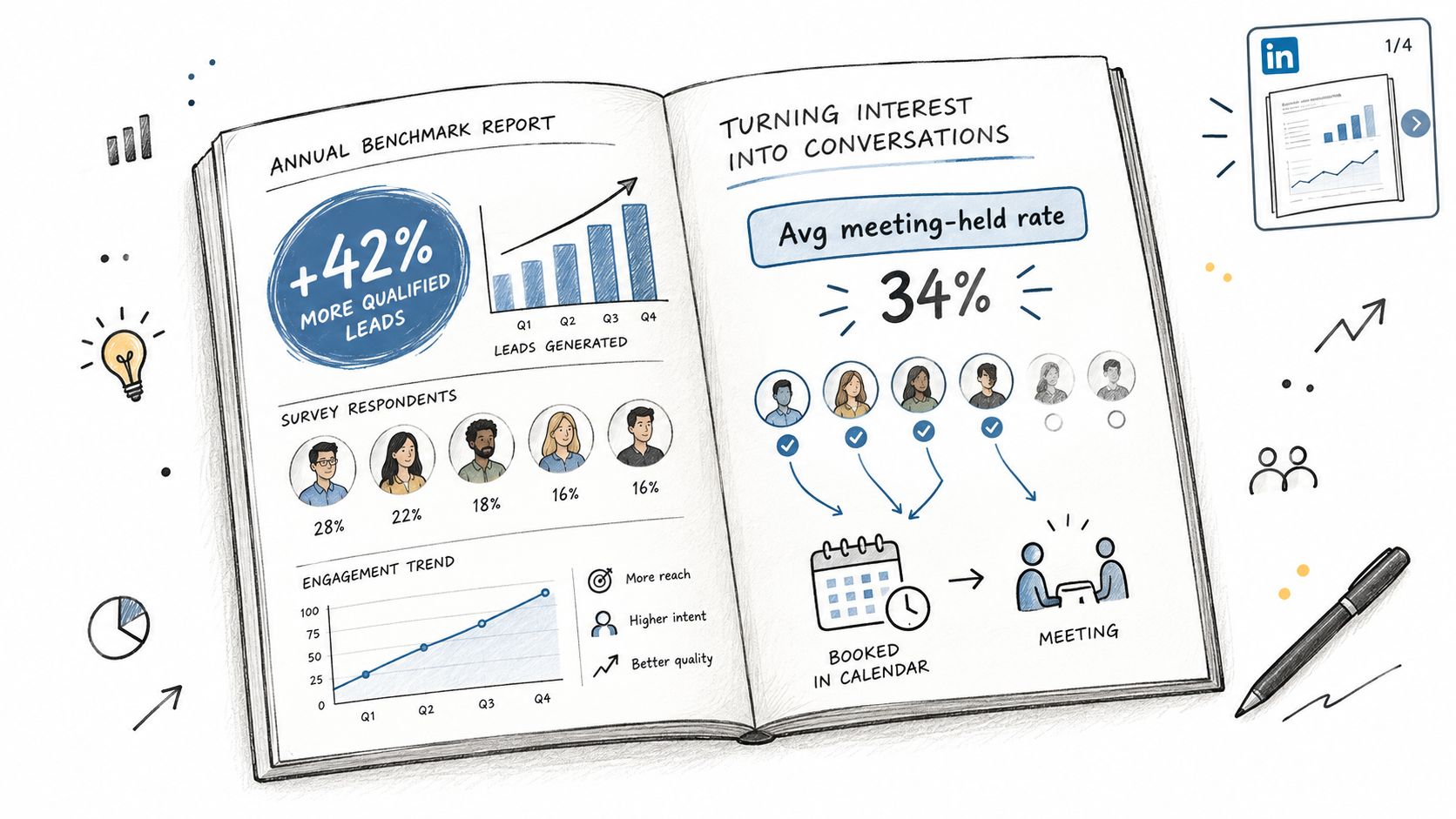
The format works because it buys attention with evidence. In digital finance, the World Bank reported that 76% of adults worldwide held an account in 2021, up from 51% in 2011, and in developing economies the share making or receiving digital payments rose from 35% in 2014 to 57% in 2021 (World Bank). That's the same logic here, not the same numbers. Buyers respond when the asset reflects real behavior, not generic opinion.
What makes it worth producing
A good annual report gives sales a reason to ask for numbers. It also gives marketing a LinkedIn asset that can live all year, especially when you slice it by vertical, geography, or acquisition channel. The strongest version keeps the form short, then gives the buyer a result they'd actually want to share internally.
Use a HubSpot rule that fires when a respondent submits work email, company size, role, region, and primary channel. Then send the contact into a sequenced follow-up that references the benchmark slice they selected, not a generic nurture. That's the difference between a gated PDF and a routed conversation.
Where it breaks
It falls apart when the data is weak or the story is too broad. A report that tries to cover every industry ends up sounding like a brochure. For GROU's audience, keep the focus on the verticals you serve, then refresh the charts every year so the asset doesn't go stale.
Read the format definition in the benchmark report glossary entry before you scope the survey. That keeps the project grounded in a usable pipeline asset, not a vanity publication.
3. Interactive ROI calculator
An ROI calculator wins when the buyer already suspects there's money leaking out of the process. The Clay routing rule should be this, if the user enters more than one business variable and submits a company email, create a qualified task and enrich the record before the first rep touches it. That makes the calculator a self-qualifying offer, not a static page.
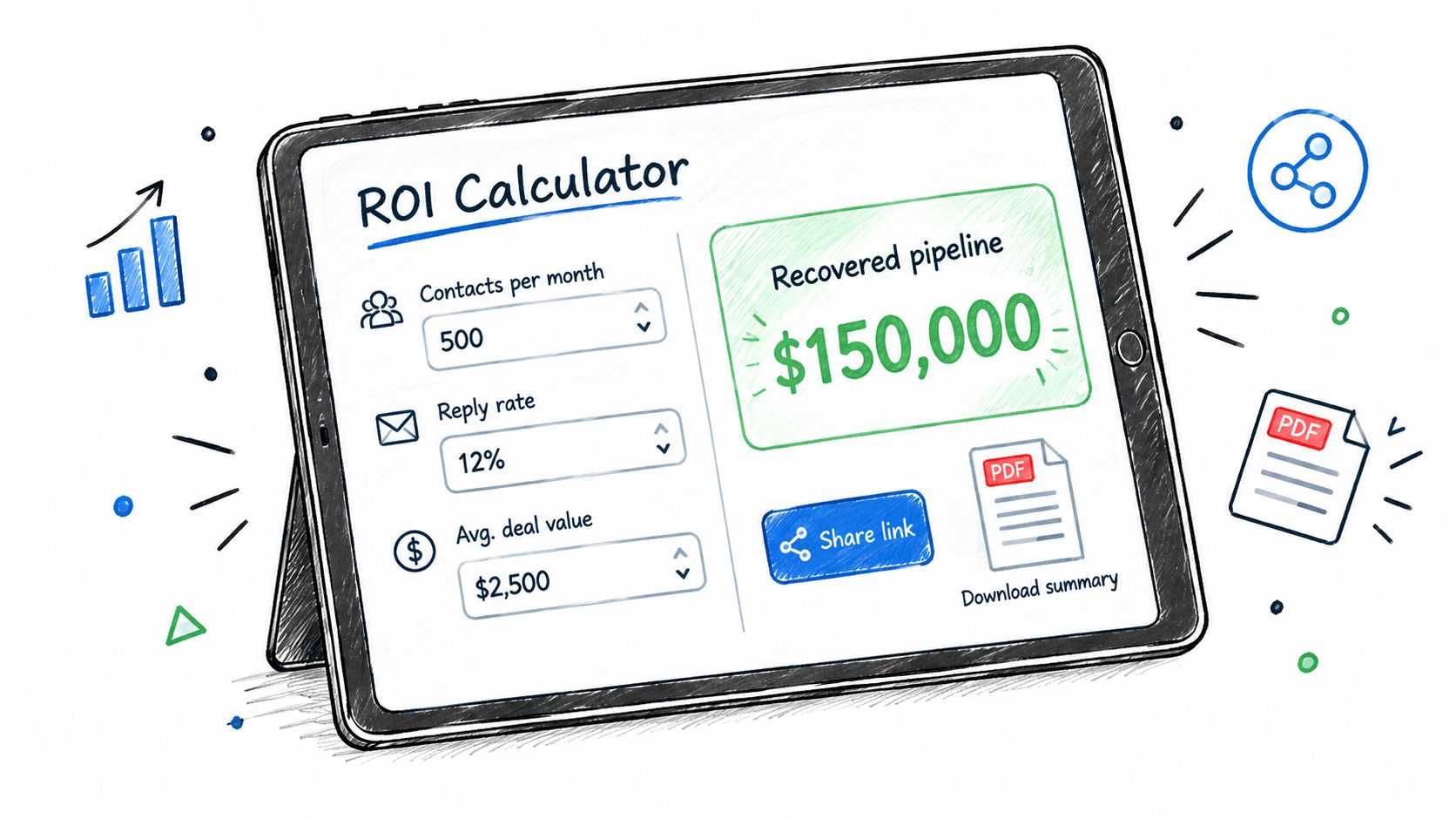
This asset works because it forces the prospect to put their own assumptions on the table. Contacts per month, reply rate, average deal value, win rate, and SDR hours per week are enough to show a pipeline gap without asking for a meeting first. That makes the conversation warmer when sales finally joins.
Why operators should like it
The output page can show the monthly dollar gap and the hours recoverable, then hand the user a shareable URL. That matters because people share tools that make them look prepared in front of their boss. A PDF summary gives sales another artifact to reference in follow-up.
The calculator should expose the cost of inaction before it asks for a meeting.
This is also one of the easiest assets to route through HubSpot. If the form submission includes company size and role, send the contact to the correct rep by segment and tag the run as “calculator intent.” That gives RevOps a clean source field and a much stronger expansion trigger than an open or click.
Where it fails
It fails when the assumptions are sloppy. If the math feels inflated, the asset loses credibility. For that reason, treat the formula like product logic, not marketing copy. Validate it with real customer inputs before launch, then watch how often reps can turn it into a second-step conversation within 24 hours.
For a practical framing of the revenue gap logic, use the internal ROI reference page as the source of truth for the language you put in the calculator and follow-up email.
4. Free website and LinkedIn audit tool
A diagnostic tool is the fastest way to turn curiosity into routed intent. The best routing rule in HubSpot is blunt, if the score is below your threshold and the account fits ICP, create a task for the assigned rep and send the buyer the three highest-impact fixes. That keeps the asset from becoming a research toy.
The tool works because it mirrors what the prospect already suspects. A weak CTA, thin proof points, slow pages, or a sloppy LinkedIn presence are easy to recognize, and the score gives the buyer an excuse to act now. For vertical teams in iGaming, SaaS, manufacturing, legal tech, and pharma, that's the right kind of friction.
The value is in the follow-up. A score alone doesn't create pipeline. A score plus a clear route into a booked audit call does. The asset should deliver an emailed PDF, then offer the booking step only after the buyer sees the gap.
Practical rule: Diagnostic assets work when the fix is obvious and the next step is named.
Use off-the-shelf tools for the scan, but keep the scoring logic tied to buyer outcomes. If the rubric rewards vanity signals, you'll attract researchers. If it rewards conversion blockers, you'll attract operators who already feel the pain. The latter group is the one most likely to book.
For the exact outbound-readiness framing, the internal scorecard resource is the right companion asset. It helps the buyer see that the audit is part of a route to action, not just an isolated report.
5. Five-day email course
A five-day course works when you want daily proof that the buyer is paying attention. The HeyReach routing rule should be simple, if someone finishes day three and clicks the task link, move them into a high-intent list and alert sales. Completion is a stronger signal than opens, which are messy and often misleading.

The model is useful because each lesson can end with one concrete task, like list building or reply classification. That makes the asset feel less like nurture and more like supervised execution. The final lesson can hand over a template pack and invite the buyer to a short audit call.
Why it routes well
The sequence creates five touchpoints without asking the prospect to leave their inbox. That matters when you need consistent contact but don't want a webinar or demo burden. It's also cheap to produce if the lessons stay under 400 words and each task maps to a real work step.
For routing, tag anyone who completes the final lesson in HubSpot as “course finished” and trigger a rep task the same day. If the learner clicks the audit invitation, move them to an outbound-ready sequence in HeyReach. That's a clean bridge from education to conversation.
The limitation is plain. This only works if you keep sending. Teams often publish lesson one and leave the rest half-finished, which kills momentum. The buyer notices that failure immediately.
The lead nurturing article is the right reference if you want this course to feel like a system instead of a one-off nurture series. The more the tasks reflect actual operator work, the better the routing behavior.
6. Paid newsletter tier
A newsletter tier is a credibility asset first and a pipeline asset second, and that order matters. The HubSpot rule should be to route paid-tier subscribers into a founder or AE follow-up only after they click a template or benchmark link. Paying proves intent, but clicking proves relevance.
This is one of the slowest assets on the list. It takes time to build a voice, earn trust, and create enough volume for the paid tier to matter. But the upside is durable, because the free list widens the audience while the paid layer filters for serious buyers.
What it's good at
A weekly issue with one operator story and one tool teardown can do two things at once. It keeps the founder visible, and it gives the team first-party data on what the reader cares about. If the paid tier provides access to templates or benchmark tables, you also get a natural reason for buyers to self-select.
That said, this is not a fast pipeline asset. It's a slow compounding system, and the editorial cost never disappears. If the team can't commit to a stable cadence, the asset becomes a half-hearted publication that never routes anything meaningful.
For teams that want a reference point on format and growth logic, the internal newsletter growth article is the right companion. Use it to define the click-based routing rule before you sell the paid tier.
7. Cohort-based course
A cohort course is the best fit when you want a pre-qualified buyer group that already shares a problem. The routing rule can be run in Clay, if someone applies and matches your ICP, enrich the account and send them into a manual review step before enrollment. That keeps the cohort from filling with spectators.
The six-week format works because it asks for commitment. Students show up live, apply the work to their own accounts, and often bring peer referrals. For a pipeline team, that means the product itself becomes a qualification layer.
Why it belongs in a pipeline stack
The strongest cohort courses are practical, not inspirational. Each live session should map to a real operator step, like list building, reply handling, or sequence review. If the students can apply the work the same day, you'll see stronger downstream fit.
It also creates a natural services bridge. Some students want hands-on help after the course, and that's fine if you've designed the offer stack around it. The danger is obvious, though, because advice-only buyers can pull the format away from its commercial purpose.
Use a booking rule that sends only finishers, not enrollees, into the sales calendar. That way, the course stays a qualification layer rather than a free consulting funnel. The right verdict is simple. Pick this when education should pre-sell services, not replace them.
8. Free certification program
A certification program works when you want platform authority and partner pipeline at the same time. The HubSpot routing rule should be to assign badge earners to a nurture branch that highlights the tool stack they just completed. That keeps the credential linked to product familiarity, not just vanity.
This asset is strongest when it teaches a specific system, like CRM sales or RevOps, and the badge is easy to share on LinkedIn. The share loop matters because it creates recurring visibility without asking the learner to create new content from scratch. Agencies also tend to notice the badge and treat the vendor as a more credible partner.
Where the trade-offs show up
The downside is control. If the program is hosted on a platform with strict data rules, lead capture can get thin. Senior buyers may also treat the credential as a light signal, not a deep one. That's fine, because the value is familiarity before the first sales conversation.
For teams selling into HubSpot or Salesforce ecosystems, this is one of the cleaner top-of-funnel offers. It attracts people who already work in the stack, and it creates a simple route into partner conversations when the badge is visible. If the goal is demand generation plus ecosystem gravity, this is a strong pick.
9. Template and prompt pack
A template and prompt pack is the most efficient product on this list when you need speed and specificity. The Clay routing rule should be exact, if the download includes role, vertical, and use case, auto-enrich the contact and hand it to SDR only when the stack suggests a fit. That prevents low-value sharing from flooding the queue.

The format is simple, a set of outbound sequences, list criteria, and enrichment prompts that a revenue operator can use immediately. Vertical packs matter more than generic ones, because a pharma buyer wants different language from an iGaming operator. That specificity is why the pack gets used instead of archived.
Why it often wins early
It's cheap to create, easy to update, and fast to buy. Buyers like it because they can test the system before they buy services. That makes it a strong tripwire asset or a lead magnet with a commercial next step.
The weakness is decay. Inbox filters change, buyer behavior shifts, and outdated prompts start sounding generic. If you don't refresh the pack, it becomes a static file no one trusts. That's why the routing rule should include a follow-up offer, not just a thank-you page.
Use this as the front door, then route serious buyers into a live workflow review. That keeps the pack from cannibalizing your services while still proving you know how the system works. The right verdict is clear, especially for outbound teams with a defined niche.
10. Video case-study library
A searchable case-study library is the strongest proof asset on this list because it shortens the trust gap. The HubSpot rule should be to route any viewer who watches more than one customer story into a rep task with the watched industry tagged on the record. That gives sales a concrete angle instead of a generic follow-up.
The format works because short customer videos are easier to consume than long written stories. Subtitle-ready clips, transcripts, and one-page summaries also make the content reusable across email, LinkedIn, and demo intros. The buyer sees outcomes, process, and measurable results without needing a live call first.
Why this asset changes the conversation
A library does more than prove the product works. It lets sales point to a specific customer story that matches the prospect's industry or size. That helps remove uncertainty before a meeting, which is exactly what a pipeline asset should do.
The drawback is production load. Good video takes coordination, customer willingness, and ongoing updates. If the library goes stale, the proof starts to feel old. Still, for mature B2B teams, it's one of the best assets for routed conversations because it gives reps something better than a brochure.
11. Evergreen webinar funnel
An evergreen webinar funnel is useful when you want scale without losing the chance for live questions. The routing rule should split viewers by behavior, if they watch the replay, send them one path, and if they join office hours, send them a higher-intent path in HubSpot. That keeps the funnel tied to actual engagement, not just registration.
The setup is a pre-recorded demo plus weekly live office hours. That gives you multiple intent levels, from passive watchers to people who show up with real questions. The replay can keep working in the background while the office hours create fresh sales signals.
What works and what doesn't
This format works when the CTA is clear. If the replay ends without a specific next step, conversion drops fast. It also needs regular moderation, because product changes can make old clips stale. That means the asset is less “set it and forget it” than people assume.
For pipeline teams, the value is in the questions. They reveal objections, timing, and topic urgency. That's why tracking question types belongs in the workflow, not just attendance.
If you want a lower-touch way to show the product and still keep live interaction, this is a strong option. If your team can't keep the office hours current, skip it and build a case-study library instead.
11 Digital Product Examples, Side-by-Side Comparison
Item | Implementation complexity 🔄 | Resource requirements ⚡ | Expected outcomes 📊⭐ | Ideal use cases 💡 | Key advantages ⭐ |
|---|---|---|---|---|---|
AmaJova | Low, guided OfferLink setup 🔄 | Low, no storefront dev, platform fees ⚡ | Unified order records, higher conversion, global payments 📊 ⭐⭐⭐⭐ | Solo sellers, small businesses, creators selling services/digital goods 💡 | Single shareable OfferLink, secure checkout, multi-currency payouts ⭐ |
Annual benchmark report | High, survey design and analysis 🔄 | High, panel/data collection, design, 4–8 weeks ⚡ | Credibility, link/lead generation, meeting-ready interest 📊 ⭐⭐⭐⭐ | Data-led outreach to decision-makers, thought leadership campaigns 💡 | Strong openers for SDRs, long-lived authority asset ⭐ |
Interactive ROI calculator | Medium, formula + dev or builder 🔄 | Medium, builder/dev + validation, initial testing ⚡ | High-intent, self-qualified leads with personalized metrics 📊 ⭐⭐⭐⭐ | Revenue leaders evaluating ROI, PPC/SEO landing pages 💡 | Self-qualification, shareable results, routes qualified MQLs ⭐ |
Free website/LinkedIn audit tool | Low, rubric + scanner logic 🔄 | Low, off-the-shelf tools, periodic updates ⚡ | Immediate intent capture, prioritized fixes, segmentation data 📊 ⭐⭐⭐ | Prospects at diagnostic stage, inbound capture for outreach 💡 | Low build cost, creates urgency, vertical data for targeting ⭐ |
Five-day email course | Low, content sequence & automation 🔄 | Low, copy, templates, email tool ⚡ | Strong nurture, task completion = intent signal 📊 ⭐⭐⭐ | Nurturing lists, educating prospects step-by-step 💡 | Low production cost, daily engagement, measurable completion signals ⭐ |
Paid newsletter tier | Medium, recurring editorial workflow 🔄 | Medium, ongoing content, curation, subscription ops ⚡ | Slow compounding audience, first-party data, paid filters 📊 ⭐⭐ | Building founder voice, long-term lead gen and monetization 💡 | Consistent trust-building, subscriber insights, monetization option ⭐ |
Cohort-based course | High, live curriculum & delivery 🔄 | High, instructors, community platform, live facilitation ⚡ | Pre-qualified buyers, referrals, high-margin upsells 📊 ⭐⭐⭐⭐ | Operators seeking applied training; service upsell pathways 💡 | Committed cohort, peer referrals, natural conversion to services ⭐ |
Free certification program | Medium, curriculum + platform integration 🔄 | Medium, hosting partnership, badge infrastructure ⚡ | Authority building, partner pipeline, product familiarity 📊 ⭐⭐⭐ | Vendors seeking adoption and partner referrals 💡 | Shareable badges, recurring LinkedIn visibility, partner referrals ⭐ |
Template and prompt pack | Low, compile and document templates 🔄 | Low, content creation, minimal maintenance ⚡ | Fast purchases, trial of system, gateway to services 📊 ⭐⭐ | Operators wanting ready-to-use assets, low-friction offers 💡 | Cheap to produce, quick buy decision, practical for operators ⭐ |
Video case-study library | Medium, production & editing 🔄 | Medium, video shoots, customer coordination ⚡ | Strong social proof, reusable outreach clips, measurable stories 📊 ⭐⭐⭐ | Sales teams needing proof points; industry-targeted promotion 💡 | High-impact narratives, multi-channel reuse, outcome-focused proof ⭐ |
Evergreen webinar funnel | Medium, recorded demo + live moderation 🔄 | Medium, recording, scheduling, weekly moderation ⚡ | Scalable demos, staged conversion (on-demand → live → office hours) 📊 ⭐⭐⭐ | Product demos, continuous prospect education and qualification 💡 | Scales demo delivery, captures topical intent, ongoing content feed ⭐ |
Pick one asset and check its routing by Friday
Pull the last 30 days of form fills for your highest-traffic asset and count how many created a CRM task within 24 hours. If that number sits near zero, the asset is a content project rather than a pipeline asset, so fix the routing before producing the next version. Then pick the one format above that fits your motion, and wire the handoff before you add more traffic.
If you sell a defined offer, AmaJova is the clearest first move. If you need trust, start with a benchmark report. If you need qualification, use the calculator or audit tool. If you need proof, build the case-study library. The wrong move is adding another download while the current one still dies in the inbox.
Here's the test I'd run this week. Add a routing rule in HubSpot, Clay, or HeyReach for one asset, then watch whether the right record gets a task, a sequence, or a booking link inside one day. If it doesn't, the asset isn't ready to scale, no matter how many people downloaded it.
GROU works with B2B teams across iGaming, SaaS, manufacturing, and professional services, and the standard is the same in every market, attention only matters when it becomes a qualified conversation. The methodology is simple, one message, one target list, and one reporting line in bi-weekly sprints, so first signals arrive within 30 days.
The download that never becomes a meeting is why most digital product examples fail in B2B. A guide gets a few opens, a calculator gets a few clicks, and a course gets a few completions, but nothing reaches a routed CRM action fast enough to matter. The right asset should create a task, a follow-up, or a booked meeting within 24 hours, or it's just content.
Best overall for pipeline control: AmaJova, because the offer, payment, and fulfillment record stay tied together in one place.
Best for trust-led demand: an annual benchmark report, because prospects will trade data for a conversation.
Best for self-qualification: an ROI calculator, because the buyer enters the pain themselves.
Best for fast routing: a diagnostic tool, a template pack, or an email course with a clean HubSpot, Clay, or HeyReach handoff.
Worst fit for pipeline teams: any asset that ends at a download page and never creates a sales task.
Table of Contents
1. AmaJova
AmaJova is the strongest choice when you want one link to sell a service, a product, a download, or a live session without stitching together a storefront. It turns the offer into an OfferLink, then keeps checkout, order details, messages, and fulfillment inside one record. For teams that care about structure turning attention into pipeline, that matters more than a prettier landing page.
The platform's fit is obvious for operators selling across channels. You can drop one link into a bio, outbound message, campaign, or site, and the buyer sees the scope, price, inclusions, and fulfillment details before paying. That clarity reduces the back-and-forth that usually clogs a pipeline team's first response window.
What it does better than a generic checkout
AmaJova gives you page types for services, products, digital products, and live sessions. It also supports secure checkout, order messaging, completion tracking, dispute status, and payout clearance timelines that vary by seller level and offer type. The multi-currency support across 150+ currencies makes it practical for cross-border selling, not just local experiments.
Practical rule: If a buyer needs to ask “what happens after I pay?” your offer page isn't ready yet.
The trust layer is the true differentiator. Seller verification, buyer and seller protection information, and a structured seller growth program mean the order doesn't feel disconnected from the person behind it. That's a better fit than a bare checkout for teams that need to sell from the same asset they use to qualify.
When to pick it
Choose AmaJova when you're selling a defined offer and need the transaction to look credible fast. It's the better move for founders and revenue teams who don't want to build a full ecommerce stack just to sell a service package, digital product, or live session. The official resource at AmaJova's digital product examples page is useful if you want to see how the offer structure works in practice.
Skip it if your main problem is top-of-funnel education rather than selling a specific offer. AmaJova helps when the next step is payment and fulfillment, not when you still need to prove the market exists.
2. Annual benchmark report
A benchmark report is the cleanest trust-building asset in this list because it gives prospects a reason to compare themselves to peers. The right routing rule in HubSpot is simple, route anyone who completes the form and meets your ICP cutoff into a “benchmark request” task within 24 hours. If the data is good, SDRs get an opening that sounds like an informed conversation, not a pitch.
The format works because it buys attention with evidence. In digital finance, the World Bank reported that 76% of adults worldwide held an account in 2021, up from 51% in 2011, and in developing economies the share making or receiving digital payments rose from 35% in 2014 to 57% in 2021 (World Bank). That's the same logic here, not the same numbers. Buyers respond when the asset reflects real behavior, not generic opinion.
What makes it worth producing
A good annual report gives sales a reason to ask for numbers. It also gives marketing a LinkedIn asset that can live all year, especially when you slice it by vertical, geography, or acquisition channel. The strongest version keeps the form short, then gives the buyer a result they'd actually want to share internally.
Use a HubSpot rule that fires when a respondent submits work email, company size, role, region, and primary channel. Then send the contact into a sequenced follow-up that references the benchmark slice they selected, not a generic nurture. That's the difference between a gated PDF and a routed conversation.
Where it breaks
It falls apart when the data is weak or the story is too broad. A report that tries to cover every industry ends up sounding like a brochure. For GROU's audience, keep the focus on the verticals you serve, then refresh the charts every year so the asset doesn't go stale.
Read the format definition in the benchmark report glossary entry before you scope the survey. That keeps the project grounded in a usable pipeline asset, not a vanity publication.
3. Interactive ROI calculator
An ROI calculator wins when the buyer already suspects there's money leaking out of the process. The Clay routing rule should be this, if the user enters more than one business variable and submits a company email, create a qualified task and enrich the record before the first rep touches it. That makes the calculator a self-qualifying offer, not a static page.
This asset works because it forces the prospect to put their own assumptions on the table. Contacts per month, reply rate, average deal value, win rate, and SDR hours per week are enough to show a pipeline gap without asking for a meeting first. That makes the conversation warmer when sales finally joins.
Why operators should like it
The output page can show the monthly dollar gap and the hours recoverable, then hand the user a shareable URL. That matters because people share tools that make them look prepared in front of their boss. A PDF summary gives sales another artifact to reference in follow-up.
The calculator should expose the cost of inaction before it asks for a meeting.
This is also one of the easiest assets to route through HubSpot. If the form submission includes company size and role, send the contact to the correct rep by segment and tag the run as “calculator intent.” That gives RevOps a clean source field and a much stronger expansion trigger than an open or click.
Where it fails
It fails when the assumptions are sloppy. If the math feels inflated, the asset loses credibility. For that reason, treat the formula like product logic, not marketing copy. Validate it with real customer inputs before launch, then watch how often reps can turn it into a second-step conversation within 24 hours.
For a practical framing of the revenue gap logic, use the internal ROI reference page as the source of truth for the language you put in the calculator and follow-up email.
4. Free website and LinkedIn audit tool
A diagnostic tool is the fastest way to turn curiosity into routed intent. The best routing rule in HubSpot is blunt, if the score is below your threshold and the account fits ICP, create a task for the assigned rep and send the buyer the three highest-impact fixes. That keeps the asset from becoming a research toy.
The tool works because it mirrors what the prospect already suspects. A weak CTA, thin proof points, slow pages, or a sloppy LinkedIn presence are easy to recognize, and the score gives the buyer an excuse to act now. For vertical teams in iGaming, SaaS, manufacturing, legal tech, and pharma, that's the right kind of friction.
The value is in the follow-up. A score alone doesn't create pipeline. A score plus a clear route into a booked audit call does. The asset should deliver an emailed PDF, then offer the booking step only after the buyer sees the gap.
Practical rule: Diagnostic assets work when the fix is obvious and the next step is named.
Use off-the-shelf tools for the scan, but keep the scoring logic tied to buyer outcomes. If the rubric rewards vanity signals, you'll attract researchers. If it rewards conversion blockers, you'll attract operators who already feel the pain. The latter group is the one most likely to book.
For the exact outbound-readiness framing, the internal scorecard resource is the right companion asset. It helps the buyer see that the audit is part of a route to action, not just an isolated report.
5. Five-day email course
A five-day course works when you want daily proof that the buyer is paying attention. The HeyReach routing rule should be simple, if someone finishes day three and clicks the task link, move them into a high-intent list and alert sales. Completion is a stronger signal than opens, which are messy and often misleading.
The model is useful because each lesson can end with one concrete task, like list building or reply classification. That makes the asset feel less like nurture and more like supervised execution. The final lesson can hand over a template pack and invite the buyer to a short audit call.
Why it routes well
The sequence creates five touchpoints without asking the prospect to leave their inbox. That matters when you need consistent contact but don't want a webinar or demo burden. It's also cheap to produce if the lessons stay under 400 words and each task maps to a real work step.
For routing, tag anyone who completes the final lesson in HubSpot as “course finished” and trigger a rep task the same day. If the learner clicks the audit invitation, move them to an outbound-ready sequence in HeyReach. That's a clean bridge from education to conversation.
The limitation is plain. This only works if you keep sending. Teams often publish lesson one and leave the rest half-finished, which kills momentum. The buyer notices that failure immediately.
The lead nurturing article is the right reference if you want this course to feel like a system instead of a one-off nurture series. The more the tasks reflect actual operator work, the better the routing behavior.
6. Paid newsletter tier
A newsletter tier is a credibility asset first and a pipeline asset second, and that order matters. The HubSpot rule should be to route paid-tier subscribers into a founder or AE follow-up only after they click a template or benchmark link. Paying proves intent, but clicking proves relevance.
This is one of the slowest assets on the list. It takes time to build a voice, earn trust, and create enough volume for the paid tier to matter. But the upside is durable, because the free list widens the audience while the paid layer filters for serious buyers.
What it's good at
A weekly issue with one operator story and one tool teardown can do two things at once. It keeps the founder visible, and it gives the team first-party data on what the reader cares about. If the paid tier provides access to templates or benchmark tables, you also get a natural reason for buyers to self-select.
That said, this is not a fast pipeline asset. It's a slow compounding system, and the editorial cost never disappears. If the team can't commit to a stable cadence, the asset becomes a half-hearted publication that never routes anything meaningful.
For teams that want a reference point on format and growth logic, the internal newsletter growth article is the right companion. Use it to define the click-based routing rule before you sell the paid tier.
7. Cohort-based course
A cohort course is the best fit when you want a pre-qualified buyer group that already shares a problem. The routing rule can be run in Clay, if someone applies and matches your ICP, enrich the account and send them into a manual review step before enrollment. That keeps the cohort from filling with spectators.
The six-week format works because it asks for commitment. Students show up live, apply the work to their own accounts, and often bring peer referrals. For a pipeline team, that means the product itself becomes a qualification layer.
Why it belongs in a pipeline stack
The strongest cohort courses are practical, not inspirational. Each live session should map to a real operator step, like list building, reply handling, or sequence review. If the students can apply the work the same day, you'll see stronger downstream fit.
It also creates a natural services bridge. Some students want hands-on help after the course, and that's fine if you've designed the offer stack around it. The danger is obvious, though, because advice-only buyers can pull the format away from its commercial purpose.
Use a booking rule that sends only finishers, not enrollees, into the sales calendar. That way, the course stays a qualification layer rather than a free consulting funnel. The right verdict is simple. Pick this when education should pre-sell services, not replace them.
8. Free certification program
A certification program works when you want platform authority and partner pipeline at the same time. The HubSpot routing rule should be to assign badge earners to a nurture branch that highlights the tool stack they just completed. That keeps the credential linked to product familiarity, not just vanity.
This asset is strongest when it teaches a specific system, like CRM sales or RevOps, and the badge is easy to share on LinkedIn. The share loop matters because it creates recurring visibility without asking the learner to create new content from scratch. Agencies also tend to notice the badge and treat the vendor as a more credible partner.
Where the trade-offs show up
The downside is control. If the program is hosted on a platform with strict data rules, lead capture can get thin. Senior buyers may also treat the credential as a light signal, not a deep one. That's fine, because the value is familiarity before the first sales conversation.
For teams selling into HubSpot or Salesforce ecosystems, this is one of the cleaner top-of-funnel offers. It attracts people who already work in the stack, and it creates a simple route into partner conversations when the badge is visible. If the goal is demand generation plus ecosystem gravity, this is a strong pick.
9. Template and prompt pack
A template and prompt pack is the most efficient product on this list when you need speed and specificity. The Clay routing rule should be exact, if the download includes role, vertical, and use case, auto-enrich the contact and hand it to SDR only when the stack suggests a fit. That prevents low-value sharing from flooding the queue.
The format is simple, a set of outbound sequences, list criteria, and enrichment prompts that a revenue operator can use immediately. Vertical packs matter more than generic ones, because a pharma buyer wants different language from an iGaming operator. That specificity is why the pack gets used instead of archived.
Why it often wins early
It's cheap to create, easy to update, and fast to buy. Buyers like it because they can test the system before they buy services. That makes it a strong tripwire asset or a lead magnet with a commercial next step.
The weakness is decay. Inbox filters change, buyer behavior shifts, and outdated prompts start sounding generic. If you don't refresh the pack, it becomes a static file no one trusts. That's why the routing rule should include a follow-up offer, not just a thank-you page.
Use this as the front door, then route serious buyers into a live workflow review. That keeps the pack from cannibalizing your services while still proving you know how the system works. The right verdict is clear, especially for outbound teams with a defined niche.
10. Video case-study library
A searchable case-study library is the strongest proof asset on this list because it shortens the trust gap. The HubSpot rule should be to route any viewer who watches more than one customer story into a rep task with the watched industry tagged on the record. That gives sales a concrete angle instead of a generic follow-up.
The format works because short customer videos are easier to consume than long written stories. Subtitle-ready clips, transcripts, and one-page summaries also make the content reusable across email, LinkedIn, and demo intros. The buyer sees outcomes, process, and measurable results without needing a live call first.
Why this asset changes the conversation
A library does more than prove the product works. It lets sales point to a specific customer story that matches the prospect's industry or size. That helps remove uncertainty before a meeting, which is exactly what a pipeline asset should do.
The drawback is production load. Good video takes coordination, customer willingness, and ongoing updates. If the library goes stale, the proof starts to feel old. Still, for mature B2B teams, it's one of the best assets for routed conversations because it gives reps something better than a brochure.
11. Evergreen webinar funnel
An evergreen webinar funnel is useful when you want scale without losing the chance for live questions. The routing rule should split viewers by behavior, if they watch the replay, send them one path, and if they join office hours, send them a higher-intent path in HubSpot. That keeps the funnel tied to actual engagement, not just registration.
The setup is a pre-recorded demo plus weekly live office hours. That gives you multiple intent levels, from passive watchers to people who show up with real questions. The replay can keep working in the background while the office hours create fresh sales signals.
What works and what doesn't
This format works when the CTA is clear. If the replay ends without a specific next step, conversion drops fast. It also needs regular moderation, because product changes can make old clips stale. That means the asset is less “set it and forget it” than people assume.
For pipeline teams, the value is in the questions. They reveal objections, timing, and topic urgency. That's why tracking question types belongs in the workflow, not just attendance.
If you want a lower-touch way to show the product and still keep live interaction, this is a strong option. If your team can't keep the office hours current, skip it and build a case-study library instead.
11 Digital Product Examples, Side-by-Side Comparison
Item | Implementation complexity 🔄 | Resource requirements ⚡ | Expected outcomes 📊⭐ | Ideal use cases 💡 | Key advantages ⭐ |
|---|---|---|---|---|---|
AmaJova | Low, guided OfferLink setup 🔄 | Low, no storefront dev, platform fees ⚡ | Unified order records, higher conversion, global payments 📊 ⭐⭐⭐⭐ | Solo sellers, small businesses, creators selling services/digital goods 💡 | Single shareable OfferLink, secure checkout, multi-currency payouts ⭐ |
Annual benchmark report | High, survey design and analysis 🔄 | High, panel/data collection, design, 4–8 weeks ⚡ | Credibility, link/lead generation, meeting-ready interest 📊 ⭐⭐⭐⭐ | Data-led outreach to decision-makers, thought leadership campaigns 💡 | Strong openers for SDRs, long-lived authority asset ⭐ |
Interactive ROI calculator | Medium, formula + dev or builder 🔄 | Medium, builder/dev + validation, initial testing ⚡ | High-intent, self-qualified leads with personalized metrics 📊 ⭐⭐⭐⭐ | Revenue leaders evaluating ROI, PPC/SEO landing pages 💡 | Self-qualification, shareable results, routes qualified MQLs ⭐ |
Free website/LinkedIn audit tool | Low, rubric + scanner logic 🔄 | Low, off-the-shelf tools, periodic updates ⚡ | Immediate intent capture, prioritized fixes, segmentation data 📊 ⭐⭐⭐ | Prospects at diagnostic stage, inbound capture for outreach 💡 | Low build cost, creates urgency, vertical data for targeting ⭐ |
Five-day email course | Low, content sequence & automation 🔄 | Low, copy, templates, email tool ⚡ | Strong nurture, task completion = intent signal 📊 ⭐⭐⭐ | Nurturing lists, educating prospects step-by-step 💡 | Low production cost, daily engagement, measurable completion signals ⭐ |
Paid newsletter tier | Medium, recurring editorial workflow 🔄 | Medium, ongoing content, curation, subscription ops ⚡ | Slow compounding audience, first-party data, paid filters 📊 ⭐⭐ | Building founder voice, long-term lead gen and monetization 💡 | Consistent trust-building, subscriber insights, monetization option ⭐ |
Cohort-based course | High, live curriculum & delivery 🔄 | High, instructors, community platform, live facilitation ⚡ | Pre-qualified buyers, referrals, high-margin upsells 📊 ⭐⭐⭐⭐ | Operators seeking applied training; service upsell pathways 💡 | Committed cohort, peer referrals, natural conversion to services ⭐ |
Free certification program | Medium, curriculum + platform integration 🔄 | Medium, hosting partnership, badge infrastructure ⚡ | Authority building, partner pipeline, product familiarity 📊 ⭐⭐⭐ | Vendors seeking adoption and partner referrals 💡 | Shareable badges, recurring LinkedIn visibility, partner referrals ⭐ |
Template and prompt pack | Low, compile and document templates 🔄 | Low, content creation, minimal maintenance ⚡ | Fast purchases, trial of system, gateway to services 📊 ⭐⭐ | Operators wanting ready-to-use assets, low-friction offers 💡 | Cheap to produce, quick buy decision, practical for operators ⭐ |
Video case-study library | Medium, production & editing 🔄 | Medium, video shoots, customer coordination ⚡ | Strong social proof, reusable outreach clips, measurable stories 📊 ⭐⭐⭐ | Sales teams needing proof points; industry-targeted promotion 💡 | High-impact narratives, multi-channel reuse, outcome-focused proof ⭐ |
Evergreen webinar funnel | Medium, recorded demo + live moderation 🔄 | Medium, recording, scheduling, weekly moderation ⚡ | Scalable demos, staged conversion (on-demand → live → office hours) 📊 ⭐⭐⭐ | Product demos, continuous prospect education and qualification 💡 | Scales demo delivery, captures topical intent, ongoing content feed ⭐ |
Pick one asset and check its routing by Friday
Pull the last 30 days of form fills for your highest-traffic asset and count how many created a CRM task within 24 hours. If that number sits near zero, the asset is a content project rather than a pipeline asset, so fix the routing before producing the next version. Then pick the one format above that fits your motion, and wire the handoff before you add more traffic.
If you sell a defined offer, AmaJova is the clearest first move. If you need trust, start with a benchmark report. If you need qualification, use the calculator or audit tool. If you need proof, build the case-study library. The wrong move is adding another download while the current one still dies in the inbox.
Here's the test I'd run this week. Add a routing rule in HubSpot, Clay, or HeyReach for one asset, then watch whether the right record gets a task, a sequence, or a booking link inside one day. If it doesn't, the asset isn't ready to scale, no matter how many people downloaded it.
GROU works with B2B teams across iGaming, SaaS, manufacturing, and professional services, and the standard is the same in every market, attention only matters when it becomes a qualified conversation. The methodology is simple, one message, one target list, and one reporting line in bi-weekly sprints, so first signals arrive within 30 days.
The download that never becomes a meeting is why most digital product examples fail in B2B. A guide gets a few opens, a calculator gets a few clicks, and a course gets a few completions, but nothing reaches a routed CRM action fast enough to matter. The right asset should create a task, a follow-up, or a booked meeting within 24 hours, or it's just content.
Best overall for pipeline control: AmaJova, because the offer, payment, and fulfillment record stay tied together in one place.
Best for trust-led demand: an annual benchmark report, because prospects will trade data for a conversation.
Best for self-qualification: an ROI calculator, because the buyer enters the pain themselves.
Best for fast routing: a diagnostic tool, a template pack, or an email course with a clean HubSpot, Clay, or HeyReach handoff.
Worst fit for pipeline teams: any asset that ends at a download page and never creates a sales task.
Table of Contents
1. AmaJova
AmaJova is the strongest choice when you want one link to sell a service, a product, a download, or a live session without stitching together a storefront. It turns the offer into an OfferLink, then keeps checkout, order details, messages, and fulfillment inside one record. For teams that care about structure turning attention into pipeline, that matters more than a prettier landing page.
The platform's fit is obvious for operators selling across channels. You can drop one link into a bio, outbound message, campaign, or site, and the buyer sees the scope, price, inclusions, and fulfillment details before paying. That clarity reduces the back-and-forth that usually clogs a pipeline team's first response window.
What it does better than a generic checkout
AmaJova gives you page types for services, products, digital products, and live sessions. It also supports secure checkout, order messaging, completion tracking, dispute status, and payout clearance timelines that vary by seller level and offer type. The multi-currency support across 150+ currencies makes it practical for cross-border selling, not just local experiments.
Practical rule: If a buyer needs to ask “what happens after I pay?” your offer page isn't ready yet.
The trust layer is the true differentiator. Seller verification, buyer and seller protection information, and a structured seller growth program mean the order doesn't feel disconnected from the person behind it. That's a better fit than a bare checkout for teams that need to sell from the same asset they use to qualify.
When to pick it
Choose AmaJova when you're selling a defined offer and need the transaction to look credible fast. It's the better move for founders and revenue teams who don't want to build a full ecommerce stack just to sell a service package, digital product, or live session. The official resource at AmaJova's digital product examples page is useful if you want to see how the offer structure works in practice.
Skip it if your main problem is top-of-funnel education rather than selling a specific offer. AmaJova helps when the next step is payment and fulfillment, not when you still need to prove the market exists.
2. Annual benchmark report
A benchmark report is the cleanest trust-building asset in this list because it gives prospects a reason to compare themselves to peers. The right routing rule in HubSpot is simple, route anyone who completes the form and meets your ICP cutoff into a “benchmark request” task within 24 hours. If the data is good, SDRs get an opening that sounds like an informed conversation, not a pitch.
The format works because it buys attention with evidence. In digital finance, the World Bank reported that 76% of adults worldwide held an account in 2021, up from 51% in 2011, and in developing economies the share making or receiving digital payments rose from 35% in 2014 to 57% in 2021 (World Bank). That's the same logic here, not the same numbers. Buyers respond when the asset reflects real behavior, not generic opinion.
What makes it worth producing
A good annual report gives sales a reason to ask for numbers. It also gives marketing a LinkedIn asset that can live all year, especially when you slice it by vertical, geography, or acquisition channel. The strongest version keeps the form short, then gives the buyer a result they'd actually want to share internally.
Use a HubSpot rule that fires when a respondent submits work email, company size, role, region, and primary channel. Then send the contact into a sequenced follow-up that references the benchmark slice they selected, not a generic nurture. That's the difference between a gated PDF and a routed conversation.
Where it breaks
It falls apart when the data is weak or the story is too broad. A report that tries to cover every industry ends up sounding like a brochure. For GROU's audience, keep the focus on the verticals you serve, then refresh the charts every year so the asset doesn't go stale.
Read the format definition in the benchmark report glossary entry before you scope the survey. That keeps the project grounded in a usable pipeline asset, not a vanity publication.
3. Interactive ROI calculator
An ROI calculator wins when the buyer already suspects there's money leaking out of the process. The Clay routing rule should be this, if the user enters more than one business variable and submits a company email, create a qualified task and enrich the record before the first rep touches it. That makes the calculator a self-qualifying offer, not a static page.
This asset works because it forces the prospect to put their own assumptions on the table. Contacts per month, reply rate, average deal value, win rate, and SDR hours per week are enough to show a pipeline gap without asking for a meeting first. That makes the conversation warmer when sales finally joins.
Why operators should like it
The output page can show the monthly dollar gap and the hours recoverable, then hand the user a shareable URL. That matters because people share tools that make them look prepared in front of their boss. A PDF summary gives sales another artifact to reference in follow-up.
The calculator should expose the cost of inaction before it asks for a meeting.
This is also one of the easiest assets to route through HubSpot. If the form submission includes company size and role, send the contact to the correct rep by segment and tag the run as “calculator intent.” That gives RevOps a clean source field and a much stronger expansion trigger than an open or click.
Where it fails
It fails when the assumptions are sloppy. If the math feels inflated, the asset loses credibility. For that reason, treat the formula like product logic, not marketing copy. Validate it with real customer inputs before launch, then watch how often reps can turn it into a second-step conversation within 24 hours.
For a practical framing of the revenue gap logic, use the internal ROI reference page as the source of truth for the language you put in the calculator and follow-up email.
4. Free website and LinkedIn audit tool
A diagnostic tool is the fastest way to turn curiosity into routed intent. The best routing rule in HubSpot is blunt, if the score is below your threshold and the account fits ICP, create a task for the assigned rep and send the buyer the three highest-impact fixes. That keeps the asset from becoming a research toy.
The tool works because it mirrors what the prospect already suspects. A weak CTA, thin proof points, slow pages, or a sloppy LinkedIn presence are easy to recognize, and the score gives the buyer an excuse to act now. For vertical teams in iGaming, SaaS, manufacturing, legal tech, and pharma, that's the right kind of friction.
The value is in the follow-up. A score alone doesn't create pipeline. A score plus a clear route into a booked audit call does. The asset should deliver an emailed PDF, then offer the booking step only after the buyer sees the gap.
Practical rule: Diagnostic assets work when the fix is obvious and the next step is named.
Use off-the-shelf tools for the scan, but keep the scoring logic tied to buyer outcomes. If the rubric rewards vanity signals, you'll attract researchers. If it rewards conversion blockers, you'll attract operators who already feel the pain. The latter group is the one most likely to book.
For the exact outbound-readiness framing, the internal scorecard resource is the right companion asset. It helps the buyer see that the audit is part of a route to action, not just an isolated report.
5. Five-day email course
A five-day course works when you want daily proof that the buyer is paying attention. The HeyReach routing rule should be simple, if someone finishes day three and clicks the task link, move them into a high-intent list and alert sales. Completion is a stronger signal than opens, which are messy and often misleading.
The model is useful because each lesson can end with one concrete task, like list building or reply classification. That makes the asset feel less like nurture and more like supervised execution. The final lesson can hand over a template pack and invite the buyer to a short audit call.
Why it routes well
The sequence creates five touchpoints without asking the prospect to leave their inbox. That matters when you need consistent contact but don't want a webinar or demo burden. It's also cheap to produce if the lessons stay under 400 words and each task maps to a real work step.
For routing, tag anyone who completes the final lesson in HubSpot as “course finished” and trigger a rep task the same day. If the learner clicks the audit invitation, move them to an outbound-ready sequence in HeyReach. That's a clean bridge from education to conversation.
The limitation is plain. This only works if you keep sending. Teams often publish lesson one and leave the rest half-finished, which kills momentum. The buyer notices that failure immediately.
The lead nurturing article is the right reference if you want this course to feel like a system instead of a one-off nurture series. The more the tasks reflect actual operator work, the better the routing behavior.
6. Paid newsletter tier
A newsletter tier is a credibility asset first and a pipeline asset second, and that order matters. The HubSpot rule should be to route paid-tier subscribers into a founder or AE follow-up only after they click a template or benchmark link. Paying proves intent, but clicking proves relevance.
This is one of the slowest assets on the list. It takes time to build a voice, earn trust, and create enough volume for the paid tier to matter. But the upside is durable, because the free list widens the audience while the paid layer filters for serious buyers.
What it's good at
A weekly issue with one operator story and one tool teardown can do two things at once. It keeps the founder visible, and it gives the team first-party data on what the reader cares about. If the paid tier provides access to templates or benchmark tables, you also get a natural reason for buyers to self-select.
That said, this is not a fast pipeline asset. It's a slow compounding system, and the editorial cost never disappears. If the team can't commit to a stable cadence, the asset becomes a half-hearted publication that never routes anything meaningful.
For teams that want a reference point on format and growth logic, the internal newsletter growth article is the right companion. Use it to define the click-based routing rule before you sell the paid tier.
7. Cohort-based course
A cohort course is the best fit when you want a pre-qualified buyer group that already shares a problem. The routing rule can be run in Clay, if someone applies and matches your ICP, enrich the account and send them into a manual review step before enrollment. That keeps the cohort from filling with spectators.
The six-week format works because it asks for commitment. Students show up live, apply the work to their own accounts, and often bring peer referrals. For a pipeline team, that means the product itself becomes a qualification layer.
Why it belongs in a pipeline stack
The strongest cohort courses are practical, not inspirational. Each live session should map to a real operator step, like list building, reply handling, or sequence review. If the students can apply the work the same day, you'll see stronger downstream fit.
It also creates a natural services bridge. Some students want hands-on help after the course, and that's fine if you've designed the offer stack around it. The danger is obvious, though, because advice-only buyers can pull the format away from its commercial purpose.
Use a booking rule that sends only finishers, not enrollees, into the sales calendar. That way, the course stays a qualification layer rather than a free consulting funnel. The right verdict is simple. Pick this when education should pre-sell services, not replace them.
8. Free certification program
A certification program works when you want platform authority and partner pipeline at the same time. The HubSpot routing rule should be to assign badge earners to a nurture branch that highlights the tool stack they just completed. That keeps the credential linked to product familiarity, not just vanity.
This asset is strongest when it teaches a specific system, like CRM sales or RevOps, and the badge is easy to share on LinkedIn. The share loop matters because it creates recurring visibility without asking the learner to create new content from scratch. Agencies also tend to notice the badge and treat the vendor as a more credible partner.
Where the trade-offs show up
The downside is control. If the program is hosted on a platform with strict data rules, lead capture can get thin. Senior buyers may also treat the credential as a light signal, not a deep one. That's fine, because the value is familiarity before the first sales conversation.
For teams selling into HubSpot or Salesforce ecosystems, this is one of the cleaner top-of-funnel offers. It attracts people who already work in the stack, and it creates a simple route into partner conversations when the badge is visible. If the goal is demand generation plus ecosystem gravity, this is a strong pick.
9. Template and prompt pack
A template and prompt pack is the most efficient product on this list when you need speed and specificity. The Clay routing rule should be exact, if the download includes role, vertical, and use case, auto-enrich the contact and hand it to SDR only when the stack suggests a fit. That prevents low-value sharing from flooding the queue.
The format is simple, a set of outbound sequences, list criteria, and enrichment prompts that a revenue operator can use immediately. Vertical packs matter more than generic ones, because a pharma buyer wants different language from an iGaming operator. That specificity is why the pack gets used instead of archived.
Why it often wins early
It's cheap to create, easy to update, and fast to buy. Buyers like it because they can test the system before they buy services. That makes it a strong tripwire asset or a lead magnet with a commercial next step.
The weakness is decay. Inbox filters change, buyer behavior shifts, and outdated prompts start sounding generic. If you don't refresh the pack, it becomes a static file no one trusts. That's why the routing rule should include a follow-up offer, not just a thank-you page.
Use this as the front door, then route serious buyers into a live workflow review. That keeps the pack from cannibalizing your services while still proving you know how the system works. The right verdict is clear, especially for outbound teams with a defined niche.
10. Video case-study library
A searchable case-study library is the strongest proof asset on this list because it shortens the trust gap. The HubSpot rule should be to route any viewer who watches more than one customer story into a rep task with the watched industry tagged on the record. That gives sales a concrete angle instead of a generic follow-up.
The format works because short customer videos are easier to consume than long written stories. Subtitle-ready clips, transcripts, and one-page summaries also make the content reusable across email, LinkedIn, and demo intros. The buyer sees outcomes, process, and measurable results without needing a live call first.
Why this asset changes the conversation
A library does more than prove the product works. It lets sales point to a specific customer story that matches the prospect's industry or size. That helps remove uncertainty before a meeting, which is exactly what a pipeline asset should do.
The drawback is production load. Good video takes coordination, customer willingness, and ongoing updates. If the library goes stale, the proof starts to feel old. Still, for mature B2B teams, it's one of the best assets for routed conversations because it gives reps something better than a brochure.
11. Evergreen webinar funnel
An evergreen webinar funnel is useful when you want scale without losing the chance for live questions. The routing rule should split viewers by behavior, if they watch the replay, send them one path, and if they join office hours, send them a higher-intent path in HubSpot. That keeps the funnel tied to actual engagement, not just registration.
The setup is a pre-recorded demo plus weekly live office hours. That gives you multiple intent levels, from passive watchers to people who show up with real questions. The replay can keep working in the background while the office hours create fresh sales signals.
What works and what doesn't
This format works when the CTA is clear. If the replay ends without a specific next step, conversion drops fast. It also needs regular moderation, because product changes can make old clips stale. That means the asset is less “set it and forget it” than people assume.
For pipeline teams, the value is in the questions. They reveal objections, timing, and topic urgency. That's why tracking question types belongs in the workflow, not just attendance.
If you want a lower-touch way to show the product and still keep live interaction, this is a strong option. If your team can't keep the office hours current, skip it and build a case-study library instead.
11 Digital Product Examples, Side-by-Side Comparison
Item | Implementation complexity 🔄 | Resource requirements ⚡ | Expected outcomes 📊⭐ | Ideal use cases 💡 | Key advantages ⭐ |
|---|---|---|---|---|---|
AmaJova | Low, guided OfferLink setup 🔄 | Low, no storefront dev, platform fees ⚡ | Unified order records, higher conversion, global payments 📊 ⭐⭐⭐⭐ | Solo sellers, small businesses, creators selling services/digital goods 💡 | Single shareable OfferLink, secure checkout, multi-currency payouts ⭐ |
Annual benchmark report | High, survey design and analysis 🔄 | High, panel/data collection, design, 4–8 weeks ⚡ | Credibility, link/lead generation, meeting-ready interest 📊 ⭐⭐⭐⭐ | Data-led outreach to decision-makers, thought leadership campaigns 💡 | Strong openers for SDRs, long-lived authority asset ⭐ |
Interactive ROI calculator | Medium, formula + dev or builder 🔄 | Medium, builder/dev + validation, initial testing ⚡ | High-intent, self-qualified leads with personalized metrics 📊 ⭐⭐⭐⭐ | Revenue leaders evaluating ROI, PPC/SEO landing pages 💡 | Self-qualification, shareable results, routes qualified MQLs ⭐ |
Free website/LinkedIn audit tool | Low, rubric + scanner logic 🔄 | Low, off-the-shelf tools, periodic updates ⚡ | Immediate intent capture, prioritized fixes, segmentation data 📊 ⭐⭐⭐ | Prospects at diagnostic stage, inbound capture for outreach 💡 | Low build cost, creates urgency, vertical data for targeting ⭐ |
Five-day email course | Low, content sequence & automation 🔄 | Low, copy, templates, email tool ⚡ | Strong nurture, task completion = intent signal 📊 ⭐⭐⭐ | Nurturing lists, educating prospects step-by-step 💡 | Low production cost, daily engagement, measurable completion signals ⭐ |
Paid newsletter tier | Medium, recurring editorial workflow 🔄 | Medium, ongoing content, curation, subscription ops ⚡ | Slow compounding audience, first-party data, paid filters 📊 ⭐⭐ | Building founder voice, long-term lead gen and monetization 💡 | Consistent trust-building, subscriber insights, monetization option ⭐ |
Cohort-based course | High, live curriculum & delivery 🔄 | High, instructors, community platform, live facilitation ⚡ | Pre-qualified buyers, referrals, high-margin upsells 📊 ⭐⭐⭐⭐ | Operators seeking applied training; service upsell pathways 💡 | Committed cohort, peer referrals, natural conversion to services ⭐ |
Free certification program | Medium, curriculum + platform integration 🔄 | Medium, hosting partnership, badge infrastructure ⚡ | Authority building, partner pipeline, product familiarity 📊 ⭐⭐⭐ | Vendors seeking adoption and partner referrals 💡 | Shareable badges, recurring LinkedIn visibility, partner referrals ⭐ |
Template and prompt pack | Low, compile and document templates 🔄 | Low, content creation, minimal maintenance ⚡ | Fast purchases, trial of system, gateway to services 📊 ⭐⭐ | Operators wanting ready-to-use assets, low-friction offers 💡 | Cheap to produce, quick buy decision, practical for operators ⭐ |
Video case-study library | Medium, production & editing 🔄 | Medium, video shoots, customer coordination ⚡ | Strong social proof, reusable outreach clips, measurable stories 📊 ⭐⭐⭐ | Sales teams needing proof points; industry-targeted promotion 💡 | High-impact narratives, multi-channel reuse, outcome-focused proof ⭐ |
Evergreen webinar funnel | Medium, recorded demo + live moderation 🔄 | Medium, recording, scheduling, weekly moderation ⚡ | Scalable demos, staged conversion (on-demand → live → office hours) 📊 ⭐⭐⭐ | Product demos, continuous prospect education and qualification 💡 | Scales demo delivery, captures topical intent, ongoing content feed ⭐ |
Pick one asset and check its routing by Friday
Pull the last 30 days of form fills for your highest-traffic asset and count how many created a CRM task within 24 hours. If that number sits near zero, the asset is a content project rather than a pipeline asset, so fix the routing before producing the next version. Then pick the one format above that fits your motion, and wire the handoff before you add more traffic.
If you sell a defined offer, AmaJova is the clearest first move. If you need trust, start with a benchmark report. If you need qualification, use the calculator or audit tool. If you need proof, build the case-study library. The wrong move is adding another download while the current one still dies in the inbox.
Here's the test I'd run this week. Add a routing rule in HubSpot, Clay, or HeyReach for one asset, then watch whether the right record gets a task, a sequence, or a booking link inside one day. If it doesn't, the asset isn't ready to scale, no matter how many people downloaded it.
GROU works with B2B teams across iGaming, SaaS, manufacturing, and professional services, and the standard is the same in every market, attention only matters when it becomes a qualified conversation. The methodology is simple, one message, one target list, and one reporting line in bi-weekly sprints, so first signals arrive within 30 days.
Pipeline OS Newsletter
Build qualified pipeline
Get weekly tactics to generate demand, improve lead quality, and book more meetings.





Trusted by industry leaders
Trusted by industry leaders
Trusted by industry leaders
Ready to build qualified pipeline?
Ready to build qualified pipeline?
Ready to build qualified pipeline?
Book a call to see if we're the right fit, or take the 2-minute quiz to get a clear starting point.
Book a call to see if we're the right fit, or take the 2-minute quiz to get a clear starting point.
Book a call to see if we're the right fit, or take the 2-minute quiz to get a clear starting point.
" height="30.21639343089746px" id="hfGbXmQR2" width="30.216393430897455px"/></svg>)
Copyright © 2026 – All Right Reserved
Copyright © 2026 – All Right Reserved
Copyright © 2026 – All Right Reserved