%22%3E%3C/path%3E%3Cpath d=%22M 63.072 7.554 C 62.258 8.022 61.577 8.689 61.092 9.493 L 61.092 7.076 L 57.158 7.076 L 57.158 22.64 L 61.089 22.64 L 61.089 14.888 C 61.089 13.446 61.403 12.434 62.03 11.853 C 62.818 11.218 63.818 10.907 64.826 10.982 L 65.868 10.982 L 65.868 6.851 C 64.891 6.834 63.926 7.076 63.073 7.554 Z%22 fill=%22rgb(17,17,17)%22%3E%3C/path%3E%3Cpath d=%22M 78.916 7.82 C 76.363 6.49 73.321 6.49 70.768 7.82 C 69.562 8.473 68.564 9.451 67.888 10.644 C 67.167 11.931 66.803 13.387 66.834 14.862 C 66.804 16.332 67.157 17.785 67.86 19.077 C 68.515 20.267 69.494 21.246 70.684 21.901 C 71.924 22.576 73.318 22.92 74.73 22.898 C 76.164 22.918 77.58 22.575 78.846 21.901 C 80.062 21.247 81.073 20.27 81.768 19.077 C 82.506 17.797 82.88 16.339 82.85 14.862 C 82.88 13.389 82.517 11.934 81.797 10.647 C 81.12 9.455 80.122 8.477 78.917 7.824 M 78.803 14.862 C 78.829 15.739 78.636 16.608 78.241 17.391 C 77.903 18.046 77.38 18.588 76.738 18.95 C 76.124 19.293 75.432 19.472 74.729 19.47 C 73.668 19.497 72.648 19.061 71.934 18.276 C 71.139 17.323 70.741 16.1 70.823 14.862 C 70.741 13.62 71.149 12.395 71.959 11.45 C 72.687 10.667 73.715 10.233 74.783 10.256 C 75.859 10.236 76.894 10.67 77.635 11.45 C 78.464 12.387 78.884 13.616 78.801 14.864%22 fill=%22rgb(17,17,17)%22%3E%3C/path%3E%3Cpath d=%22M 95.906 7.076 L 95.906 15.646 C 95.975 16.68 95.643 17.701 94.979 18.498 C 94.311 19.184 93.379 19.547 92.422 19.495 C 91.475 19.544 90.553 19.18 89.894 18.498 C 89.23 17.701 88.898 16.68 88.967 15.646 L 88.967 7.076 L 85.033 7.076 L 85.033 16.207 C 85 17.449 85.275 18.68 85.834 19.79 C 86.327 20.75 87.095 21.542 88.039 22.065 C 89.033 22.594 90.145 22.861 91.271 22.838 C 92.188 22.847 93.095 22.65 93.926 22.263 C 94.708 21.905 95.388 21.36 95.906 20.675 L 95.906 22.645 L 99.865 22.645 L 99.865 7.076 Z%22 fill=%22rgb(17,17,17)%22%3E%3C/path%3E%3Cpath d=%22M 4.513 15.626 C 4.511 10.815 7.606 6.549 12.181 5.059 C 16.756 3.57 21.77 5.195 24.601 9.086 L 27.816 5.87 C 24.074 1.186 17.981 -0.943 12.137 0.393 C 6.292 1.728 1.728 6.292 0.393 12.137 C -0.943 17.981 1.186 24.074 5.87 27.816 L 9.085 24.601 C 6.214 22.512 4.515 19.177 4.513 15.626%22 fill=%22rgb(32,62,235)%22%3E%3C/path%3E%3Cpath d=%22M 17.114 14.343 L 13.354 18.01 L 13.354 18.026 L 21.071 18.026 L 11.412 27.609 L 17.389 27.609 L 23.999 21.081 L 23.999 28.316 L 24.005 28.316 L 27.967 24.393 L 27.967 14.343 Z%22 fill=%22rgb(32,62,235)%22%3E%3C/path%3E%3C/g%3E%3C/svg%3E) ×
× ××
××›
›
›
›
B2B lead nurturing guide 2026: sequences, timing, and what actually converts
B2B lead nurturing guide 2026: sequences, timing, and what actually converts
B2B lead nurturing guide 2026: sequences, timing, and what actually converts
B2B lead nurturing guide 2026: sequences, timing, and what actually converts
B2B lead nurturing guide 2026: sequences, timing, and what actually converts
B2B lead nurturing guide 2026: sequences, timing, and what actually converts

Author
Aljaz Peklaj

Slug: b2b-lead-nurturing
Meta description: Your CRM is full, but revenue isn't. Learn how to build B2B lead nurturing around perspective-led content, multi-channel sequencing, and sales-aligned measurement.
Your CRM is full of leads who opened one email, downloaded one asset, took one call, then disappeared. On paper, pipeline looks healthy. In practice, sales is working stale names, marketing is celebrating activity, and revenue never catches up. More leads usually make this worse, not better.
The strongest B2B lead nurturing system is built around one pillar, substantive perspective on decisions buyers are actively making
A proper campaign takes 14 to 21 days to set up and 25 to 40 hours of focused work, if you want something that holds up
Email should anchor the sequence, but LinkedIn and light outbound make the system harder to ignore
Measure qualified replies, meetings, and revenue movement, not just opens and clicks
If your nurture doesn't match the actual B2B buyer journey, it becomes background noise
Table of Contents
Introduction
Many organizations don't have a lead volume problem. They have a structure problem.
They've captured attention, but they haven't built a system that turns that attention into pipeline. That's why B2B lead nurturing matters. Not as a drip sequence, and not as a “stay in touch” checkbox, but as a disciplined way to keep credibility with accounts that aren't ready now and may not be ready for months.
The mistake is usually the same. Marketing sends generic assets. Sales waits for a score threshold. Nobody owns the middle. The result is a full CRM and thin conversion.
A better system is simple to describe and harder to execute. You need a real point of view, a defined segment, a controlled cadence, and fast routing when signal appears. That structure is what turns dormant attention into active opportunities.
The one content pillar for all B2B lead nurturing
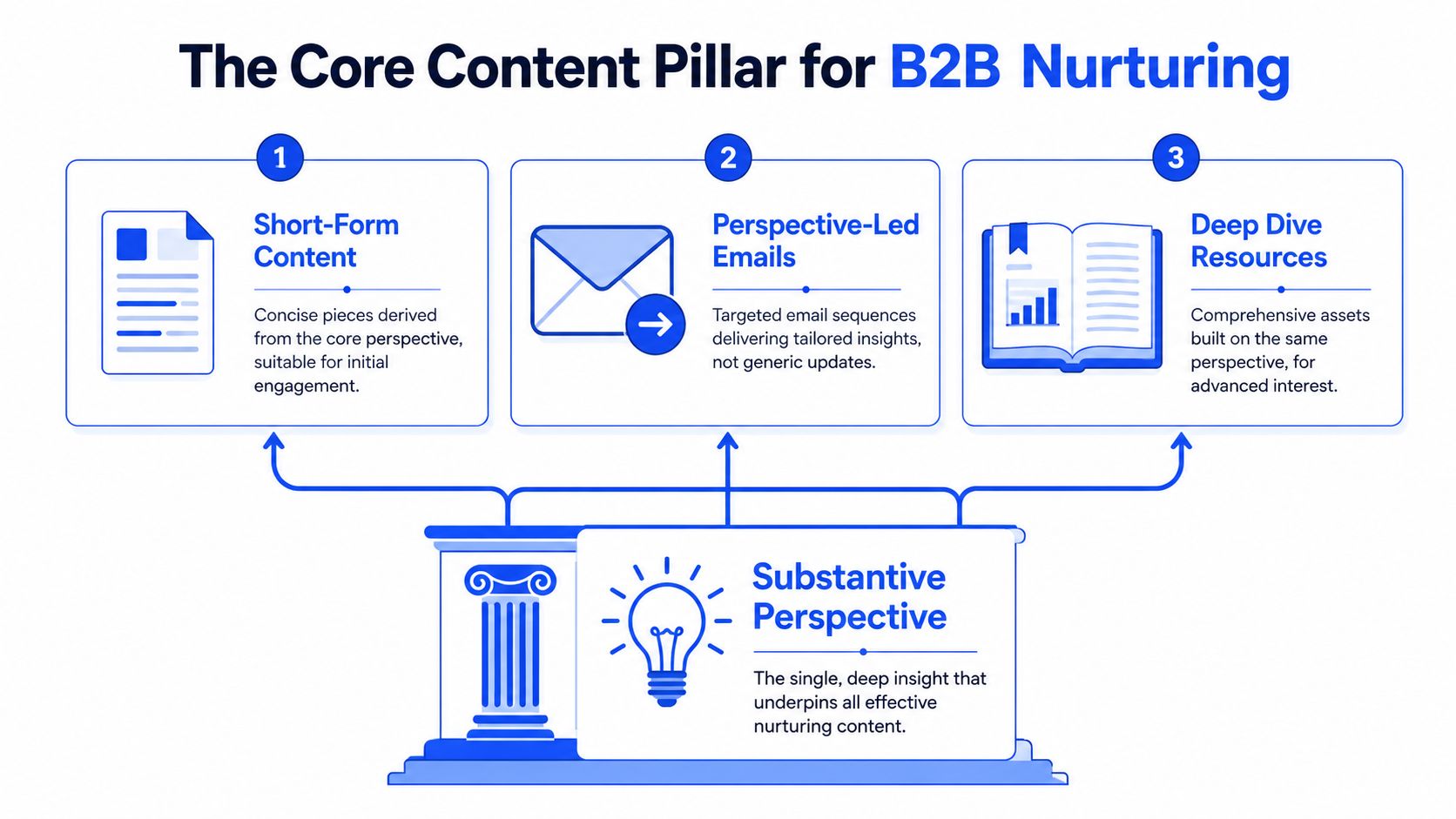
The core of B2B lead nurturing is substantive perspective. Not content variety. Not asset volume. One clear, opinionated view on a decision your buyer is actively wrestling with.
That's the pillar.
Why perspective beats content volume
Most nurture programs are built from leftovers. Webinar invites, ebook drops, newsletter roundups, recycled case studies. They fill the calendar, but they rarely meet the buyer in the decision they're making this quarter.
What works better is native email content, usually 250 to 600 words, written from a named person, sent every 14 to 21 days in active nurture. The email should take a position. Not a balanced overview. Not “some thoughts.” A position.
Practical rule: If the email could be sent by any vendor in your category, it isn't nurture. It's traffic.
This approach matters because many B2B buying cycles are long. 69% of high-performing B2B teams run nurture programs indefinitely because prospects may take 2–24 months to buy, which means ongoing education beats rushed handoffs to sales, according to Demand Gen Report's analysis of long-term nurture programs.
For structure, it helps to think like an editor, not a campaign manager. If your team needs a clean way to organize themes, formats, and distribution, ClipCreator.ai's content strategy guide is a useful reference point.
What the pillar actually looks like
The best nurture emails don't hide behind links. They carry the value inside the email itself.
A good piece sounds like this:
A real trade-off: “Why we usually advise against scaling SDR teams when reply rates are below 8%”
A real constraint: “What to do when inbound drives most of pipeline but leadership wants outbound”
A real stance: “Why cutting content cadence can improve pipeline quality before you add channels”
That format scales because relevance comes from the problem, not fake personalization. One sharp email can work across SaaS, legal tech, pharma, manufacturing, or iGaming if the decision is shared by that segment.
Short, opinion-led email content also fits how buyers consume information. It arrives in context, without a landing page detour, and it shows thinking rather than promotion. When teams tailor messaging to stages of the buyer journey, marketers see 73% higher average conversion rates, based on Madison Logic's lead nurturing data.
A solid B2B content marketing strategy should produce these nurture pieces as operating assets, not as side content.
What to stop sending
Some formats look productive and still underperform.
Industry reports: They're broad and usually detached from a live decision
Webinar invitations: Useful occasionally, weak as the main nurture engine
Ebook offers: They collect form fills, but often from people who won't buy
Newsletter roundups: Curation doesn't build your own authority
Product updates: Prospects who aren't customers don't care yet
The composition matters too. A sequence works better when most touches are perspective-led, some are concrete examples, a smaller share are direct asks, and only a few are special announcements.
That's why I'd rather have six strong emails than twenty mixed assets. Fewer touches, stronger thought, better memory.
The 9-step system for building a nurture campaign
A proper nurture campaign isn't something you throw together in a week. The setup usually takes 14 to 21 days and 25 to 40 hours of focused work. If you compress it too hard, you don't get speed. You get rework.
Near the top of the process, it helps to visualize the sequence as a system rather than a calendar.

Teams that do this well tend to get more from the same demand pool. Companies excelling at lead nurturing are on track to increase sales by 65%, and while email remains the main channel, the benchmark 43.46% open rate matters less than the 2.09% click rate, which is a better signal of active engagement, based on Salesgenie's lead nurturing benchmarks.
If your segmentation still relies on broad assumptions, read RoverLead AI on stop guessing who wants to buy. Intent changes how you build the list and how you score response quality.
Step 1, define the segment
Don't start with “all non-converted leads.” That segment is useless.
Start with one narrow group. For example, SaaS leads with prior engagement in the last year, who stalled before stage two, in companies with a specific employee band. The workshop for this usually takes 60 to 90 minutes.
Step 2, build the list
Now build the CRM segment with inclusion and exclusion logic. In HubSpot or Salesforce, I want every filter documented so the list can be rebuilt later.
This usually takes 90 to 120 minutes, because data cleanup always shows up here. Bad lifecycle stages, old owners, duplicate contacts, broken country fields, all of it.
Step 3, define the goal
Every sequence needs one job.
Is this sequence trying to restart active sales conversations, keep a strategic account warm, or test a new offer angle? Goal definition usually takes 60 minutes. If the goal is vague, the content gets vague too.
Nurture programs fail when they ask one sequence to do three jobs.
Step 4, map the content
For a 4 to 6 month sequence, I usually want 6 to 9 content pieces. That's enough room to build recognition without spamming the list.
Map each touch by decision theme, stance, and CTA type. This workshop usually needs 90 to 120 minutes.
Step 5, write the sequence
Teams cut corners and then wonder why nurture doesn't work.
Each email usually takes 90 to 180 minutes to write well. A 6-piece sequence means 9 to 18 hours of writing. Draft in Google Docs, get comments from sales, then move the final version into HubSpot, Lemlist, or Instantly.
Here's what I want in every draft:
A named point of view: The sender sounds like a person with stakes, not a brand voice
A live trade-off: The email addresses a decision the reader is likely making now
A clean CTA: Ask for a reply only when the email has earned it
Step 6, set up the infrastructure
This is the unglamorous part, and it matters.
Set up templates, plain-text fallbacks, unsubscribe handling, tracking parameters, and reply routing. Verify the sender setup. Test rendering across major inboxes. This step usually takes 3 to 5 hours including QA.
A lot of teams obsess over copy and ignore technical hygiene. Then the sequence underperforms for reasons that have nothing to do with messaging.
Step 7, configure cadence and triggers
Now build the workflow logic in HubSpot, Lemlist, or whichever sending stack fits the motion.
Most of the time I start with time-based sequencing, usually every 14 days or every 21 days, then add behavior logic later. This setup and test cycle usually takes 2 to 4 hours.
A simple workflow beats a clever one that nobody trusts. If you need examples of where static drips stop and real behavior-led sequences begin, these drip marketing examples make the distinction clearly.
A short walkthrough can help if you're setting up your first serious workflow architecture:
Step 8, pilot before scale
Never send the full program first.
Run the first one or two touches to 5 to 10% of the list for 7 to 10 days. That catches formatting issues, odd reply patterns, and deliverability problems before you contaminate the full segment.
This is the easiest step to skip and one of the most expensive to skip.
Step 9, launch and review
Once the pilot clears, launch the full sequence and put weekly reviews on the calendar. The launch itself is quick, usually 30 minutes. The review discipline is where the actual work starts.
I want a weekly review for engagement, a monthly review for content performance, and a quarterly review for segment fit. If the audience changed, the nurture should change too.
Designing multi-channel nurture sequences
Email should lead the sequence. That's the recommendation.
It's still the strongest control layer for message quality, attribution, and consistency. But email-only nurture leaves too much untouched, especially when accounts are active on LinkedIn and the sales team already has relationship context.

How the channels work together
The right model is coordinated, not crowded. Email carries the perspective. LinkedIn reinforces familiarity. Light outbound creates a controlled opening for direct response.
That's why sequence design matters. Sequence-based follow-up emails generate 4 to 10 times the response rate of standalone email blasts, according to Zendesk's guide to purposeful lead nurturing workflows. The gain comes from relevance and timing, not just automation.
For execution, I usually see these tools fit well together:
HubSpot: Best when marketing owns workflow logic and attribution
Lemlist or Smartlead: Better for outbound-heavy motions with flexible sender control
HeyReach: Useful when LinkedIn sits inside the nurture motion
Sales Navigator: Good for account monitoring and manual context checks
If you're building workflow logic across sends, delays, branches, and handoffs, Zenfox has a practical piece on mastering email automation that's worth saving.
A practical sequence shape
A simple multi-channel sequence can look like this:
Day | Channel | Touch |
|---|---|---|
1 | Perspective-led email on one live trade-off | |
7 | Profile view or soft engagement from sender | |
15 | Second perspective email, same theme from a different angle | |
25 | Connection request with a short note tied to the prior topic | |
35 | Case example that supports the earlier position | |
49 | Email or direct outreach | Specific question or conversation ask |
This works well for SaaS and services. Manufacturing and pharma often need a slower rhythm, fewer opinion-led hooks, and more internal forwarding value. Legal tech often benefits from event adjacency and language pulled from sales calls, especially around moments of change.
Keep the channels coordinated. If LinkedIn says one thing and email says another, the account feels the mismatch immediately.
A good overview of multi-channel outreach is that each channel should do a different job, not repeat the same line.
A real example of a 5x reply rate lift
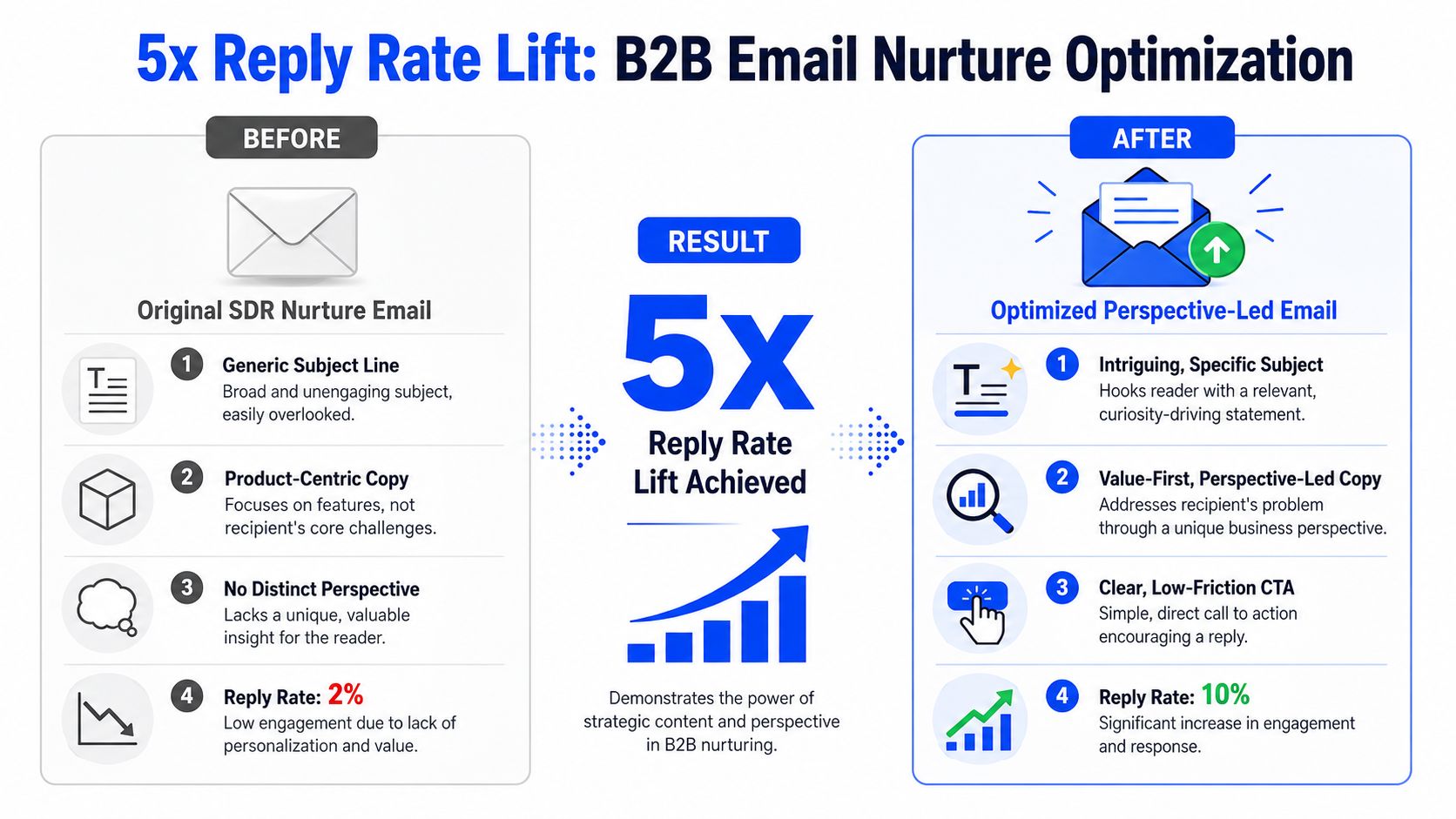
One of the clearest nurture improvements I've seen came from fixing a single structural problem, over-hedging.
This was a mid-market B2B SaaS sequence aimed at heads of revenue who had engaged before but never converted into opportunities. The sequence was 6 touches over 90 days, spaced 14 to 18 days apart. We changed the third email only.
The original email
The original subject line was “Thoughts on SDR scaling”.
The opening was polite and empty. “Hi {{first_name}}, hope you're doing well. Wanted to share some thoughts...” The body walked carefully through caveats and balanced views. The CTA was soft, “Curious about your perspective on this. Reply if you have thoughts.”
Over 60 days across 480 prospects, that version produced 31% open rate, 1.2% click-through rate, 0.8% reply rate, 0.6% unsubscribe rate, and 1 reply that became a qualified conversation.
The revised email
The new subject line was “Why we usually advise against scaling SDRs right now”.
The opening went straight to the point: “We've been turning down clients who ask us to scale SDR teams when their reply rates are below 8%, even when their boards are pushing for more pipeline. Here's why.” The CTA was specific, tied to the buyer's situation, and asked for a 15-minute conversation if that exact pressure was present.
Over 60 days across 470 prospects in a comparable segment, the revised version produced 42% open rate, 3.8% click-through rate, 4.1% reply rate, 1.1% unsubscribe rate, and 9 replies that became qualified conversations.
What actually changed
The lift came from directness.
Subject line: “Thoughts on” sounded like filler. “Why we usually advise against” sounded like a real opinion
Opening: The greeting consumed attention. The rewrite spent the first line on the live tension
Body: Balanced positioning got replaced with a clear stance and stated trade-offs
CTA: The generic ask got replaced by a qualifying question tied to a specific operating condition
Prospects don't reply because an email was polite. They reply because it named the decision they're already under pressure to make.
The unsubscribe rate rose, and that was acceptable. It was a small absolute increase, and the stronger position filtered out people who were never a fit for that message.
I wouldn't turn every touch into a controversial one. That gets tiring fast. But one strong opinion inside a broader sequence can wake up a dormant segment in a way generic nurture never will.
Measuring for pipeline and aligning with sales
If your nurture dashboard stops at opens and clicks, you're measuring inbox activity, not pipeline.
I care about qualified replies, meetings booked, meeting-held rate, opportunity creation, and whether the right accounts are re-entering active sales motion. Open rate can still help with diagnostics, but it doesn't tell you whether the sequence is producing revenue movement.
The metrics that matter
My review layer usually looks like this:
Qualified replies: Not every reply matters. Route only replies that indicate timing, pain, or active evaluation
Meetings from nurture: Separate booked from held, because weak qualification hides here
Pipeline attribution: Tag every nurture link and reply source so opportunities can be traced to a specific touch
Sales acceptance speed: Measure how quickly AEs act on positive replies
That final one gets ignored too often. A good nurture email can create demand and still lose it if the handoff is slow.
How to fix lead scoring
A lot of lead scoring models look organized and still fail.
40% of lead scoring models fail to predict revenue because they overweight vanity metrics instead of high-intent actions, and the fix is to reverse-engineer the model from 50–100 closed-won opportunities, based on this breakdown of revenue-linked scoring in lead nurturing.
That means looking backward from real wins and asking which behaviors showed up before revenue, not which actions were easy for marketing automation to count. Demo requests, repeat visits from target accounts, and buying-group engagement usually tell you more than low-friction content activity.
A tighter model also improves sales and marketing alignment, because both teams are reacting to signals with revenue relevance.
Sales routing has to be immediate
The technical setup here doesn't need to be fancy. It needs to be fast.
I like a Slack workflow that posts positive replies into the AE channel within minutes, with owner, company, last touch, and suggested next action. HubSpot can handle the trigger logic. If the motion is outbound-heavy, Lemlist or Instantly can pass the event into Slack as well.
Sales should never discover a hot nurture reply by checking the CRM the next morning.
If nurture is doing its job, the account has already seen your thinking. The follow-up should sound like continuity, not a cold restart.
Conclusion
Audit your last five nurture emails this Friday.
If most of them ask for a click, promote an event, or point to a gated asset, your nurture isn't building credibility. Rewrite one email into a 250 to 600 word native note from a named sender that takes a real position on a decision your buyer is making now. Then send it to a narrow segment first.
That one change won't fix the whole system, but it will tell you quickly whether your problem is volume or substance. More often than not, it's substance.
GROU is a global B2B pipeline agency that helps revenue teams turn attention into qualified conversations and closed revenue. The method is simple, one message, one target list, one reporting line, built through structured content, outbound, and fast reply routing.
If you want a second set of operator eyes on your nurture system, Grou is a strong place to start. Bring one live segment, your last six nurture emails, and your current reply routing flow, then pressure-test whether the structure is producing pipeline.
Slug: b2b-lead-nurturing
Meta description: Your CRM is full, but revenue isn't. Learn how to build B2B lead nurturing around perspective-led content, multi-channel sequencing, and sales-aligned measurement.
Your CRM is full of leads who opened one email, downloaded one asset, took one call, then disappeared. On paper, pipeline looks healthy. In practice, sales is working stale names, marketing is celebrating activity, and revenue never catches up. More leads usually make this worse, not better.
The strongest B2B lead nurturing system is built around one pillar, substantive perspective on decisions buyers are actively making
A proper campaign takes 14 to 21 days to set up and 25 to 40 hours of focused work, if you want something that holds up
Email should anchor the sequence, but LinkedIn and light outbound make the system harder to ignore
Measure qualified replies, meetings, and revenue movement, not just opens and clicks
If your nurture doesn't match the actual B2B buyer journey, it becomes background noise
Table of Contents
Introduction
Many organizations don't have a lead volume problem. They have a structure problem.
They've captured attention, but they haven't built a system that turns that attention into pipeline. That's why B2B lead nurturing matters. Not as a drip sequence, and not as a “stay in touch” checkbox, but as a disciplined way to keep credibility with accounts that aren't ready now and may not be ready for months.
The mistake is usually the same. Marketing sends generic assets. Sales waits for a score threshold. Nobody owns the middle. The result is a full CRM and thin conversion.
A better system is simple to describe and harder to execute. You need a real point of view, a defined segment, a controlled cadence, and fast routing when signal appears. That structure is what turns dormant attention into active opportunities.
The one content pillar for all B2B lead nurturing
The core of B2B lead nurturing is substantive perspective. Not content variety. Not asset volume. One clear, opinionated view on a decision your buyer is actively wrestling with.
That's the pillar.
Why perspective beats content volume
Most nurture programs are built from leftovers. Webinar invites, ebook drops, newsletter roundups, recycled case studies. They fill the calendar, but they rarely meet the buyer in the decision they're making this quarter.
What works better is native email content, usually 250 to 600 words, written from a named person, sent every 14 to 21 days in active nurture. The email should take a position. Not a balanced overview. Not “some thoughts.” A position.
Practical rule: If the email could be sent by any vendor in your category, it isn't nurture. It's traffic.
This approach matters because many B2B buying cycles are long. 69% of high-performing B2B teams run nurture programs indefinitely because prospects may take 2–24 months to buy, which means ongoing education beats rushed handoffs to sales, according to Demand Gen Report's analysis of long-term nurture programs.
For structure, it helps to think like an editor, not a campaign manager. If your team needs a clean way to organize themes, formats, and distribution, ClipCreator.ai's content strategy guide is a useful reference point.
What the pillar actually looks like
The best nurture emails don't hide behind links. They carry the value inside the email itself.
A good piece sounds like this:
A real trade-off: “Why we usually advise against scaling SDR teams when reply rates are below 8%”
A real constraint: “What to do when inbound drives most of pipeline but leadership wants outbound”
A real stance: “Why cutting content cadence can improve pipeline quality before you add channels”
That format scales because relevance comes from the problem, not fake personalization. One sharp email can work across SaaS, legal tech, pharma, manufacturing, or iGaming if the decision is shared by that segment.
Short, opinion-led email content also fits how buyers consume information. It arrives in context, without a landing page detour, and it shows thinking rather than promotion. When teams tailor messaging to stages of the buyer journey, marketers see 73% higher average conversion rates, based on Madison Logic's lead nurturing data.
A solid B2B content marketing strategy should produce these nurture pieces as operating assets, not as side content.
What to stop sending
Some formats look productive and still underperform.
Industry reports: They're broad and usually detached from a live decision
Webinar invitations: Useful occasionally, weak as the main nurture engine
Ebook offers: They collect form fills, but often from people who won't buy
Newsletter roundups: Curation doesn't build your own authority
Product updates: Prospects who aren't customers don't care yet
The composition matters too. A sequence works better when most touches are perspective-led, some are concrete examples, a smaller share are direct asks, and only a few are special announcements.
That's why I'd rather have six strong emails than twenty mixed assets. Fewer touches, stronger thought, better memory.
The 9-step system for building a nurture campaign
A proper nurture campaign isn't something you throw together in a week. The setup usually takes 14 to 21 days and 25 to 40 hours of focused work. If you compress it too hard, you don't get speed. You get rework.
Near the top of the process, it helps to visualize the sequence as a system rather than a calendar.
Teams that do this well tend to get more from the same demand pool. Companies excelling at lead nurturing are on track to increase sales by 65%, and while email remains the main channel, the benchmark 43.46% open rate matters less than the 2.09% click rate, which is a better signal of active engagement, based on Salesgenie's lead nurturing benchmarks.
If your segmentation still relies on broad assumptions, read RoverLead AI on stop guessing who wants to buy. Intent changes how you build the list and how you score response quality.
Step 1, define the segment
Don't start with “all non-converted leads.” That segment is useless.
Start with one narrow group. For example, SaaS leads with prior engagement in the last year, who stalled before stage two, in companies with a specific employee band. The workshop for this usually takes 60 to 90 minutes.
Step 2, build the list
Now build the CRM segment with inclusion and exclusion logic. In HubSpot or Salesforce, I want every filter documented so the list can be rebuilt later.
This usually takes 90 to 120 minutes, because data cleanup always shows up here. Bad lifecycle stages, old owners, duplicate contacts, broken country fields, all of it.
Step 3, define the goal
Every sequence needs one job.
Is this sequence trying to restart active sales conversations, keep a strategic account warm, or test a new offer angle? Goal definition usually takes 60 minutes. If the goal is vague, the content gets vague too.
Nurture programs fail when they ask one sequence to do three jobs.
Step 4, map the content
For a 4 to 6 month sequence, I usually want 6 to 9 content pieces. That's enough room to build recognition without spamming the list.
Map each touch by decision theme, stance, and CTA type. This workshop usually needs 90 to 120 minutes.
Step 5, write the sequence
Teams cut corners and then wonder why nurture doesn't work.
Each email usually takes 90 to 180 minutes to write well. A 6-piece sequence means 9 to 18 hours of writing. Draft in Google Docs, get comments from sales, then move the final version into HubSpot, Lemlist, or Instantly.
Here's what I want in every draft:
A named point of view: The sender sounds like a person with stakes, not a brand voice
A live trade-off: The email addresses a decision the reader is likely making now
A clean CTA: Ask for a reply only when the email has earned it
Step 6, set up the infrastructure
This is the unglamorous part, and it matters.
Set up templates, plain-text fallbacks, unsubscribe handling, tracking parameters, and reply routing. Verify the sender setup. Test rendering across major inboxes. This step usually takes 3 to 5 hours including QA.
A lot of teams obsess over copy and ignore technical hygiene. Then the sequence underperforms for reasons that have nothing to do with messaging.
Step 7, configure cadence and triggers
Now build the workflow logic in HubSpot, Lemlist, or whichever sending stack fits the motion.
Most of the time I start with time-based sequencing, usually every 14 days or every 21 days, then add behavior logic later. This setup and test cycle usually takes 2 to 4 hours.
A simple workflow beats a clever one that nobody trusts. If you need examples of where static drips stop and real behavior-led sequences begin, these drip marketing examples make the distinction clearly.
A short walkthrough can help if you're setting up your first serious workflow architecture:
Step 8, pilot before scale
Never send the full program first.
Run the first one or two touches to 5 to 10% of the list for 7 to 10 days. That catches formatting issues, odd reply patterns, and deliverability problems before you contaminate the full segment.
This is the easiest step to skip and one of the most expensive to skip.
Step 9, launch and review
Once the pilot clears, launch the full sequence and put weekly reviews on the calendar. The launch itself is quick, usually 30 minutes. The review discipline is where the actual work starts.
I want a weekly review for engagement, a monthly review for content performance, and a quarterly review for segment fit. If the audience changed, the nurture should change too.
Designing multi-channel nurture sequences
Email should lead the sequence. That's the recommendation.
It's still the strongest control layer for message quality, attribution, and consistency. But email-only nurture leaves too much untouched, especially when accounts are active on LinkedIn and the sales team already has relationship context.
How the channels work together
The right model is coordinated, not crowded. Email carries the perspective. LinkedIn reinforces familiarity. Light outbound creates a controlled opening for direct response.
That's why sequence design matters. Sequence-based follow-up emails generate 4 to 10 times the response rate of standalone email blasts, according to Zendesk's guide to purposeful lead nurturing workflows. The gain comes from relevance and timing, not just automation.
For execution, I usually see these tools fit well together:
HubSpot: Best when marketing owns workflow logic and attribution
Lemlist or Smartlead: Better for outbound-heavy motions with flexible sender control
HeyReach: Useful when LinkedIn sits inside the nurture motion
Sales Navigator: Good for account monitoring and manual context checks
If you're building workflow logic across sends, delays, branches, and handoffs, Zenfox has a practical piece on mastering email automation that's worth saving.
A practical sequence shape
A simple multi-channel sequence can look like this:
Day | Channel | Touch |
|---|---|---|
1 | Perspective-led email on one live trade-off | |
7 | Profile view or soft engagement from sender | |
15 | Second perspective email, same theme from a different angle | |
25 | Connection request with a short note tied to the prior topic | |
35 | Case example that supports the earlier position | |
49 | Email or direct outreach | Specific question or conversation ask |
This works well for SaaS and services. Manufacturing and pharma often need a slower rhythm, fewer opinion-led hooks, and more internal forwarding value. Legal tech often benefits from event adjacency and language pulled from sales calls, especially around moments of change.
Keep the channels coordinated. If LinkedIn says one thing and email says another, the account feels the mismatch immediately.
A good overview of multi-channel outreach is that each channel should do a different job, not repeat the same line.
A real example of a 5x reply rate lift
One of the clearest nurture improvements I've seen came from fixing a single structural problem, over-hedging.
This was a mid-market B2B SaaS sequence aimed at heads of revenue who had engaged before but never converted into opportunities. The sequence was 6 touches over 90 days, spaced 14 to 18 days apart. We changed the third email only.
The original email
The original subject line was “Thoughts on SDR scaling”.
The opening was polite and empty. “Hi {{first_name}}, hope you're doing well. Wanted to share some thoughts...” The body walked carefully through caveats and balanced views. The CTA was soft, “Curious about your perspective on this. Reply if you have thoughts.”
Over 60 days across 480 prospects, that version produced 31% open rate, 1.2% click-through rate, 0.8% reply rate, 0.6% unsubscribe rate, and 1 reply that became a qualified conversation.
The revised email
The new subject line was “Why we usually advise against scaling SDRs right now”.
The opening went straight to the point: “We've been turning down clients who ask us to scale SDR teams when their reply rates are below 8%, even when their boards are pushing for more pipeline. Here's why.” The CTA was specific, tied to the buyer's situation, and asked for a 15-minute conversation if that exact pressure was present.
Over 60 days across 470 prospects in a comparable segment, the revised version produced 42% open rate, 3.8% click-through rate, 4.1% reply rate, 1.1% unsubscribe rate, and 9 replies that became qualified conversations.
What actually changed
The lift came from directness.
Subject line: “Thoughts on” sounded like filler. “Why we usually advise against” sounded like a real opinion
Opening: The greeting consumed attention. The rewrite spent the first line on the live tension
Body: Balanced positioning got replaced with a clear stance and stated trade-offs
CTA: The generic ask got replaced by a qualifying question tied to a specific operating condition
Prospects don't reply because an email was polite. They reply because it named the decision they're already under pressure to make.
The unsubscribe rate rose, and that was acceptable. It was a small absolute increase, and the stronger position filtered out people who were never a fit for that message.
I wouldn't turn every touch into a controversial one. That gets tiring fast. But one strong opinion inside a broader sequence can wake up a dormant segment in a way generic nurture never will.
Measuring for pipeline and aligning with sales
If your nurture dashboard stops at opens and clicks, you're measuring inbox activity, not pipeline.
I care about qualified replies, meetings booked, meeting-held rate, opportunity creation, and whether the right accounts are re-entering active sales motion. Open rate can still help with diagnostics, but it doesn't tell you whether the sequence is producing revenue movement.
The metrics that matter
My review layer usually looks like this:
Qualified replies: Not every reply matters. Route only replies that indicate timing, pain, or active evaluation
Meetings from nurture: Separate booked from held, because weak qualification hides here
Pipeline attribution: Tag every nurture link and reply source so opportunities can be traced to a specific touch
Sales acceptance speed: Measure how quickly AEs act on positive replies
That final one gets ignored too often. A good nurture email can create demand and still lose it if the handoff is slow.
How to fix lead scoring
A lot of lead scoring models look organized and still fail.
40% of lead scoring models fail to predict revenue because they overweight vanity metrics instead of high-intent actions, and the fix is to reverse-engineer the model from 50–100 closed-won opportunities, based on this breakdown of revenue-linked scoring in lead nurturing.
That means looking backward from real wins and asking which behaviors showed up before revenue, not which actions were easy for marketing automation to count. Demo requests, repeat visits from target accounts, and buying-group engagement usually tell you more than low-friction content activity.
A tighter model also improves sales and marketing alignment, because both teams are reacting to signals with revenue relevance.
Sales routing has to be immediate
The technical setup here doesn't need to be fancy. It needs to be fast.
I like a Slack workflow that posts positive replies into the AE channel within minutes, with owner, company, last touch, and suggested next action. HubSpot can handle the trigger logic. If the motion is outbound-heavy, Lemlist or Instantly can pass the event into Slack as well.
Sales should never discover a hot nurture reply by checking the CRM the next morning.
If nurture is doing its job, the account has already seen your thinking. The follow-up should sound like continuity, not a cold restart.
Conclusion
Audit your last five nurture emails this Friday.
If most of them ask for a click, promote an event, or point to a gated asset, your nurture isn't building credibility. Rewrite one email into a 250 to 600 word native note from a named sender that takes a real position on a decision your buyer is making now. Then send it to a narrow segment first.
That one change won't fix the whole system, but it will tell you quickly whether your problem is volume or substance. More often than not, it's substance.
GROU is a global B2B pipeline agency that helps revenue teams turn attention into qualified conversations and closed revenue. The method is simple, one message, one target list, one reporting line, built through structured content, outbound, and fast reply routing.
If you want a second set of operator eyes on your nurture system, Grou is a strong place to start. Bring one live segment, your last six nurture emails, and your current reply routing flow, then pressure-test whether the structure is producing pipeline.
Slug: b2b-lead-nurturing
Meta description: Your CRM is full, but revenue isn't. Learn how to build B2B lead nurturing around perspective-led content, multi-channel sequencing, and sales-aligned measurement.
Your CRM is full of leads who opened one email, downloaded one asset, took one call, then disappeared. On paper, pipeline looks healthy. In practice, sales is working stale names, marketing is celebrating activity, and revenue never catches up. More leads usually make this worse, not better.
The strongest B2B lead nurturing system is built around one pillar, substantive perspective on decisions buyers are actively making
A proper campaign takes 14 to 21 days to set up and 25 to 40 hours of focused work, if you want something that holds up
Email should anchor the sequence, but LinkedIn and light outbound make the system harder to ignore
Measure qualified replies, meetings, and revenue movement, not just opens and clicks
If your nurture doesn't match the actual B2B buyer journey, it becomes background noise
Table of Contents
Introduction
Many organizations don't have a lead volume problem. They have a structure problem.
They've captured attention, but they haven't built a system that turns that attention into pipeline. That's why B2B lead nurturing matters. Not as a drip sequence, and not as a “stay in touch” checkbox, but as a disciplined way to keep credibility with accounts that aren't ready now and may not be ready for months.
The mistake is usually the same. Marketing sends generic assets. Sales waits for a score threshold. Nobody owns the middle. The result is a full CRM and thin conversion.
A better system is simple to describe and harder to execute. You need a real point of view, a defined segment, a controlled cadence, and fast routing when signal appears. That structure is what turns dormant attention into active opportunities.
The one content pillar for all B2B lead nurturing
The core of B2B lead nurturing is substantive perspective. Not content variety. Not asset volume. One clear, opinionated view on a decision your buyer is actively wrestling with.
That's the pillar.
Why perspective beats content volume
Most nurture programs are built from leftovers. Webinar invites, ebook drops, newsletter roundups, recycled case studies. They fill the calendar, but they rarely meet the buyer in the decision they're making this quarter.
What works better is native email content, usually 250 to 600 words, written from a named person, sent every 14 to 21 days in active nurture. The email should take a position. Not a balanced overview. Not “some thoughts.” A position.
Practical rule: If the email could be sent by any vendor in your category, it isn't nurture. It's traffic.
This approach matters because many B2B buying cycles are long. 69% of high-performing B2B teams run nurture programs indefinitely because prospects may take 2–24 months to buy, which means ongoing education beats rushed handoffs to sales, according to Demand Gen Report's analysis of long-term nurture programs.
For structure, it helps to think like an editor, not a campaign manager. If your team needs a clean way to organize themes, formats, and distribution, ClipCreator.ai's content strategy guide is a useful reference point.
What the pillar actually looks like
The best nurture emails don't hide behind links. They carry the value inside the email itself.
A good piece sounds like this:
A real trade-off: “Why we usually advise against scaling SDR teams when reply rates are below 8%”
A real constraint: “What to do when inbound drives most of pipeline but leadership wants outbound”
A real stance: “Why cutting content cadence can improve pipeline quality before you add channels”
That format scales because relevance comes from the problem, not fake personalization. One sharp email can work across SaaS, legal tech, pharma, manufacturing, or iGaming if the decision is shared by that segment.
Short, opinion-led email content also fits how buyers consume information. It arrives in context, without a landing page detour, and it shows thinking rather than promotion. When teams tailor messaging to stages of the buyer journey, marketers see 73% higher average conversion rates, based on Madison Logic's lead nurturing data.
A solid B2B content marketing strategy should produce these nurture pieces as operating assets, not as side content.
What to stop sending
Some formats look productive and still underperform.
Industry reports: They're broad and usually detached from a live decision
Webinar invitations: Useful occasionally, weak as the main nurture engine
Ebook offers: They collect form fills, but often from people who won't buy
Newsletter roundups: Curation doesn't build your own authority
Product updates: Prospects who aren't customers don't care yet
The composition matters too. A sequence works better when most touches are perspective-led, some are concrete examples, a smaller share are direct asks, and only a few are special announcements.
That's why I'd rather have six strong emails than twenty mixed assets. Fewer touches, stronger thought, better memory.
The 9-step system for building a nurture campaign
A proper nurture campaign isn't something you throw together in a week. The setup usually takes 14 to 21 days and 25 to 40 hours of focused work. If you compress it too hard, you don't get speed. You get rework.
Near the top of the process, it helps to visualize the sequence as a system rather than a calendar.
Teams that do this well tend to get more from the same demand pool. Companies excelling at lead nurturing are on track to increase sales by 65%, and while email remains the main channel, the benchmark 43.46% open rate matters less than the 2.09% click rate, which is a better signal of active engagement, based on Salesgenie's lead nurturing benchmarks.
If your segmentation still relies on broad assumptions, read RoverLead AI on stop guessing who wants to buy. Intent changes how you build the list and how you score response quality.
Step 1, define the segment
Don't start with “all non-converted leads.” That segment is useless.
Start with one narrow group. For example, SaaS leads with prior engagement in the last year, who stalled before stage two, in companies with a specific employee band. The workshop for this usually takes 60 to 90 minutes.
Step 2, build the list
Now build the CRM segment with inclusion and exclusion logic. In HubSpot or Salesforce, I want every filter documented so the list can be rebuilt later.
This usually takes 90 to 120 minutes, because data cleanup always shows up here. Bad lifecycle stages, old owners, duplicate contacts, broken country fields, all of it.
Step 3, define the goal
Every sequence needs one job.
Is this sequence trying to restart active sales conversations, keep a strategic account warm, or test a new offer angle? Goal definition usually takes 60 minutes. If the goal is vague, the content gets vague too.
Nurture programs fail when they ask one sequence to do three jobs.
Step 4, map the content
For a 4 to 6 month sequence, I usually want 6 to 9 content pieces. That's enough room to build recognition without spamming the list.
Map each touch by decision theme, stance, and CTA type. This workshop usually needs 90 to 120 minutes.
Step 5, write the sequence
Teams cut corners and then wonder why nurture doesn't work.
Each email usually takes 90 to 180 minutes to write well. A 6-piece sequence means 9 to 18 hours of writing. Draft in Google Docs, get comments from sales, then move the final version into HubSpot, Lemlist, or Instantly.
Here's what I want in every draft:
A named point of view: The sender sounds like a person with stakes, not a brand voice
A live trade-off: The email addresses a decision the reader is likely making now
A clean CTA: Ask for a reply only when the email has earned it
Step 6, set up the infrastructure
This is the unglamorous part, and it matters.
Set up templates, plain-text fallbacks, unsubscribe handling, tracking parameters, and reply routing. Verify the sender setup. Test rendering across major inboxes. This step usually takes 3 to 5 hours including QA.
A lot of teams obsess over copy and ignore technical hygiene. Then the sequence underperforms for reasons that have nothing to do with messaging.
Step 7, configure cadence and triggers
Now build the workflow logic in HubSpot, Lemlist, or whichever sending stack fits the motion.
Most of the time I start with time-based sequencing, usually every 14 days or every 21 days, then add behavior logic later. This setup and test cycle usually takes 2 to 4 hours.
A simple workflow beats a clever one that nobody trusts. If you need examples of where static drips stop and real behavior-led sequences begin, these drip marketing examples make the distinction clearly.
A short walkthrough can help if you're setting up your first serious workflow architecture:
Step 8, pilot before scale
Never send the full program first.
Run the first one or two touches to 5 to 10% of the list for 7 to 10 days. That catches formatting issues, odd reply patterns, and deliverability problems before you contaminate the full segment.
This is the easiest step to skip and one of the most expensive to skip.
Step 9, launch and review
Once the pilot clears, launch the full sequence and put weekly reviews on the calendar. The launch itself is quick, usually 30 minutes. The review discipline is where the actual work starts.
I want a weekly review for engagement, a monthly review for content performance, and a quarterly review for segment fit. If the audience changed, the nurture should change too.
Designing multi-channel nurture sequences
Email should lead the sequence. That's the recommendation.
It's still the strongest control layer for message quality, attribution, and consistency. But email-only nurture leaves too much untouched, especially when accounts are active on LinkedIn and the sales team already has relationship context.
How the channels work together
The right model is coordinated, not crowded. Email carries the perspective. LinkedIn reinforces familiarity. Light outbound creates a controlled opening for direct response.
That's why sequence design matters. Sequence-based follow-up emails generate 4 to 10 times the response rate of standalone email blasts, according to Zendesk's guide to purposeful lead nurturing workflows. The gain comes from relevance and timing, not just automation.
For execution, I usually see these tools fit well together:
HubSpot: Best when marketing owns workflow logic and attribution
Lemlist or Smartlead: Better for outbound-heavy motions with flexible sender control
HeyReach: Useful when LinkedIn sits inside the nurture motion
Sales Navigator: Good for account monitoring and manual context checks
If you're building workflow logic across sends, delays, branches, and handoffs, Zenfox has a practical piece on mastering email automation that's worth saving.
A practical sequence shape
A simple multi-channel sequence can look like this:
Day | Channel | Touch |
|---|---|---|
1 | Perspective-led email on one live trade-off | |
7 | Profile view or soft engagement from sender | |
15 | Second perspective email, same theme from a different angle | |
25 | Connection request with a short note tied to the prior topic | |
35 | Case example that supports the earlier position | |
49 | Email or direct outreach | Specific question or conversation ask |
This works well for SaaS and services. Manufacturing and pharma often need a slower rhythm, fewer opinion-led hooks, and more internal forwarding value. Legal tech often benefits from event adjacency and language pulled from sales calls, especially around moments of change.
Keep the channels coordinated. If LinkedIn says one thing and email says another, the account feels the mismatch immediately.
A good overview of multi-channel outreach is that each channel should do a different job, not repeat the same line.
A real example of a 5x reply rate lift
One of the clearest nurture improvements I've seen came from fixing a single structural problem, over-hedging.
This was a mid-market B2B SaaS sequence aimed at heads of revenue who had engaged before but never converted into opportunities. The sequence was 6 touches over 90 days, spaced 14 to 18 days apart. We changed the third email only.
The original email
The original subject line was “Thoughts on SDR scaling”.
The opening was polite and empty. “Hi {{first_name}}, hope you're doing well. Wanted to share some thoughts...” The body walked carefully through caveats and balanced views. The CTA was soft, “Curious about your perspective on this. Reply if you have thoughts.”
Over 60 days across 480 prospects, that version produced 31% open rate, 1.2% click-through rate, 0.8% reply rate, 0.6% unsubscribe rate, and 1 reply that became a qualified conversation.
The revised email
The new subject line was “Why we usually advise against scaling SDRs right now”.
The opening went straight to the point: “We've been turning down clients who ask us to scale SDR teams when their reply rates are below 8%, even when their boards are pushing for more pipeline. Here's why.” The CTA was specific, tied to the buyer's situation, and asked for a 15-minute conversation if that exact pressure was present.
Over 60 days across 470 prospects in a comparable segment, the revised version produced 42% open rate, 3.8% click-through rate, 4.1% reply rate, 1.1% unsubscribe rate, and 9 replies that became qualified conversations.
What actually changed
The lift came from directness.
Subject line: “Thoughts on” sounded like filler. “Why we usually advise against” sounded like a real opinion
Opening: The greeting consumed attention. The rewrite spent the first line on the live tension
Body: Balanced positioning got replaced with a clear stance and stated trade-offs
CTA: The generic ask got replaced by a qualifying question tied to a specific operating condition
Prospects don't reply because an email was polite. They reply because it named the decision they're already under pressure to make.
The unsubscribe rate rose, and that was acceptable. It was a small absolute increase, and the stronger position filtered out people who were never a fit for that message.
I wouldn't turn every touch into a controversial one. That gets tiring fast. But one strong opinion inside a broader sequence can wake up a dormant segment in a way generic nurture never will.
Measuring for pipeline and aligning with sales
If your nurture dashboard stops at opens and clicks, you're measuring inbox activity, not pipeline.
I care about qualified replies, meetings booked, meeting-held rate, opportunity creation, and whether the right accounts are re-entering active sales motion. Open rate can still help with diagnostics, but it doesn't tell you whether the sequence is producing revenue movement.
The metrics that matter
My review layer usually looks like this:
Qualified replies: Not every reply matters. Route only replies that indicate timing, pain, or active evaluation
Meetings from nurture: Separate booked from held, because weak qualification hides here
Pipeline attribution: Tag every nurture link and reply source so opportunities can be traced to a specific touch
Sales acceptance speed: Measure how quickly AEs act on positive replies
That final one gets ignored too often. A good nurture email can create demand and still lose it if the handoff is slow.
How to fix lead scoring
A lot of lead scoring models look organized and still fail.
40% of lead scoring models fail to predict revenue because they overweight vanity metrics instead of high-intent actions, and the fix is to reverse-engineer the model from 50–100 closed-won opportunities, based on this breakdown of revenue-linked scoring in lead nurturing.
That means looking backward from real wins and asking which behaviors showed up before revenue, not which actions were easy for marketing automation to count. Demo requests, repeat visits from target accounts, and buying-group engagement usually tell you more than low-friction content activity.
A tighter model also improves sales and marketing alignment, because both teams are reacting to signals with revenue relevance.
Sales routing has to be immediate
The technical setup here doesn't need to be fancy. It needs to be fast.
I like a Slack workflow that posts positive replies into the AE channel within minutes, with owner, company, last touch, and suggested next action. HubSpot can handle the trigger logic. If the motion is outbound-heavy, Lemlist or Instantly can pass the event into Slack as well.
Sales should never discover a hot nurture reply by checking the CRM the next morning.
If nurture is doing its job, the account has already seen your thinking. The follow-up should sound like continuity, not a cold restart.
Conclusion
Audit your last five nurture emails this Friday.
If most of them ask for a click, promote an event, or point to a gated asset, your nurture isn't building credibility. Rewrite one email into a 250 to 600 word native note from a named sender that takes a real position on a decision your buyer is making now. Then send it to a narrow segment first.
That one change won't fix the whole system, but it will tell you quickly whether your problem is volume or substance. More often than not, it's substance.
GROU is a global B2B pipeline agency that helps revenue teams turn attention into qualified conversations and closed revenue. The method is simple, one message, one target list, one reporting line, built through structured content, outbound, and fast reply routing.
If you want a second set of operator eyes on your nurture system, Grou is a strong place to start. Bring one live segment, your last six nurture emails, and your current reply routing flow, then pressure-test whether the structure is producing pipeline.

Pipeline OS Newsletter
Build qualified pipeline
Get weekly tactics to generate demand, improve lead quality, and book more meetings.





Trusted by industry leaders
Trusted by industry leaders
Trusted by industry leaders
Ready to build qualified pipeline?
Ready to build qualified pipeline?
Ready to build qualified pipeline?
Book a call to see if we're the right fit, or take the 2-minute quiz to get a clear starting point.
Book a call to see if we're the right fit, or take the 2-minute quiz to get a clear starting point.
Book a call to see if we're the right fit, or take the 2-minute quiz to get a clear starting point.
" height="30.21639343089746px" id="hfGbXmQR2" width="30.216393430897455px"/></svg>)
Copyright © 2026 – All Right Reserved
Copyright © 2026 – All Right Reserved
Copyright © 2026 – All Right Reserved