%22%3E%3C/path%3E%3Cpath d=%22M 63.072 7.554 C 62.258 8.022 61.577 8.689 61.092 9.493 L 61.092 7.076 L 57.158 7.076 L 57.158 22.64 L 61.089 22.64 L 61.089 14.888 C 61.089 13.446 61.403 12.434 62.03 11.853 C 62.818 11.218 63.818 10.907 64.826 10.982 L 65.868 10.982 L 65.868 6.851 C 64.891 6.834 63.926 7.076 63.073 7.554 Z%22 fill=%22rgb(17,17,17)%22%3E%3C/path%3E%3Cpath d=%22M 78.916 7.82 C 76.363 6.49 73.321 6.49 70.768 7.82 C 69.562 8.473 68.564 9.451 67.888 10.644 C 67.167 11.931 66.803 13.387 66.834 14.862 C 66.804 16.332 67.157 17.785 67.86 19.077 C 68.515 20.267 69.494 21.246 70.684 21.901 C 71.924 22.576 73.318 22.92 74.73 22.898 C 76.164 22.918 77.58 22.575 78.846 21.901 C 80.062 21.247 81.073 20.27 81.768 19.077 C 82.506 17.797 82.88 16.339 82.85 14.862 C 82.88 13.389 82.517 11.934 81.797 10.647 C 81.12 9.455 80.122 8.477 78.917 7.824 M 78.803 14.862 C 78.829 15.739 78.636 16.608 78.241 17.391 C 77.903 18.046 77.38 18.588 76.738 18.95 C 76.124 19.293 75.432 19.472 74.729 19.47 C 73.668 19.497 72.648 19.061 71.934 18.276 C 71.139 17.323 70.741 16.1 70.823 14.862 C 70.741 13.62 71.149 12.395 71.959 11.45 C 72.687 10.667 73.715 10.233 74.783 10.256 C 75.859 10.236 76.894 10.67 77.635 11.45 C 78.464 12.387 78.884 13.616 78.801 14.864%22 fill=%22rgb(17,17,17)%22%3E%3C/path%3E%3Cpath d=%22M 95.906 7.076 L 95.906 15.646 C 95.975 16.68 95.643 17.701 94.979 18.498 C 94.311 19.184 93.379 19.547 92.422 19.495 C 91.475 19.544 90.553 19.18 89.894 18.498 C 89.23 17.701 88.898 16.68 88.967 15.646 L 88.967 7.076 L 85.033 7.076 L 85.033 16.207 C 85 17.449 85.275 18.68 85.834 19.79 C 86.327 20.75 87.095 21.542 88.039 22.065 C 89.033 22.594 90.145 22.861 91.271 22.838 C 92.188 22.847 93.095 22.65 93.926 22.263 C 94.708 21.905 95.388 21.36 95.906 20.675 L 95.906 22.645 L 99.865 22.645 L 99.865 7.076 Z%22 fill=%22rgb(17,17,17)%22%3E%3C/path%3E%3Cpath d=%22M 4.513 15.626 C 4.511 10.815 7.606 6.549 12.181 5.059 C 16.756 3.57 21.77 5.195 24.601 9.086 L 27.816 5.87 C 24.074 1.186 17.981 -0.943 12.137 0.393 C 6.292 1.728 1.728 6.292 0.393 12.137 C -0.943 17.981 1.186 24.074 5.87 27.816 L 9.085 24.601 C 6.214 22.512 4.515 19.177 4.513 15.626%22 fill=%22rgb(32,62,235)%22%3E%3C/path%3E%3Cpath d=%22M 17.114 14.343 L 13.354 18.01 L 13.354 18.026 L 21.071 18.026 L 11.412 27.609 L 17.389 27.609 L 23.999 21.081 L 23.999 28.316 L 24.005 28.316 L 27.967 24.393 L 27.967 14.343 Z%22 fill=%22rgb(32,62,235)%22%3E%3C/path%3E%3C/g%3E%3C/svg%3E) ×
× ××
××›
›
›
›
Hiring an Email Deliverability Consultant: A B2B Guide
Hiring an Email Deliverability Consultant: A B2B Guide
Hiring an Email Deliverability Consultant: A B2B Guide
Hiring an Email Deliverability Consultant: A B2B Guide
Hiring an Email Deliverability Consultant: A B2B Guide
Hiring an Email Deliverability Consultant: A B2B Guide

Author
Aljaz Peklaj

Your reply rates are slipping, but the copy looks fine. Sales says targeting is still tight. Marketing says the sequence hasn't changed. Meanwhile, invoices, support emails, and partner messages start missing inboxes too. That's usually not a messaging problem. It's a deliverability system problem.
Inbox placement is the upstream metric. If mail doesn't land in the inbox, every downstream KPI lies.
An email deliverability consultant is valuable when they separate DNS issues from reputation issues. Those are different failures with different fixes.
Most expensive damage starts with preventable operating mistakes, especially sending cold outreach from your primary domain.
The right outcome isn't a one-time fix. It's a monitoring system your team can run every month.
Table of Contents
A real-world domain recovery from 31% to 89% inbox placement
Should you hire a consultant or manage deliverability in-house
What an email deliverability consultant actually does
Some might assume an email deliverability consultant is the person who fixes SPF, DKIM, and DMARC, then disappears. That's too narrow. Instead, the role involves figuring out why a sending system fails without detection, then putting controls in place so it doesn't fail again.
The job is diagnosis, not box-checking
Authentication matters. SPF has to authorize legitimate senders, DKIM has to sign mail correctly, and DMARC has to tell receiving servers what to do when checks fail. But that isn't the whole story. As PowerDMARC's explanation of deliverability consulting notes, mailbox providers now weigh sender reputation, complaint rates, and recipient engagement heavily, which is why problems can continue even after technical setup is correct.
That distinction matters in B2B outbound. A technical failure usually shows up as broken alignment, missing records, or rejected mail. A reputation failure shows up differently. Reply rates slide. Placement gets worse at one provider first. Commercial email starts affecting business-critical mail.
Practical rule: If the domain is authenticated and results still deteriorate, stop looking at copy first. Look at reputation, list quality, and send behavior.
For a quick refresher on the fundamentals, this guide to email inbox success is useful because it frames deliverability as an operating discipline, not just a content problem. GROU's own deliverability glossary entry is a good companion if you want the B2B outbound version.
Where good consultants earn their fee
The highest-value work usually starts with one ugly question. Are you sending cold outbound from your primary business domain? If the answer is yes, the consultant is already halfway to the diagnosis.
That mistake shows up constantly in outbound teams. Sales starts with low volume from the main domain. Then volume creeps up. Then reply rates erode slowly enough that nobody treats it as an infrastructure issue. By the time someone notices, support, finance, and partner emails may be taking reputation damage too.
A strong consultant doesn't just “fix email.” They install a system:
Domain separation: Cold outreach moves to dedicated sending domains, while the primary domain stays reserved for legitimate business communication.
Reputation monitoring: The team checks Gmail and Microsoft signals regularly instead of waiting for a collapse.
Behavior controls: Volume caps, slower ramps, and list verification become operating rules.
Placement testing: Seed accounts show where mail lands before revenue teams trust campaign metrics.
That's why the role sits closer to pipeline infrastructure than technical support. If your send environment is unstable, your attribution is noisy, your outbound tests are misleading, and your sales team ends up judging copy that prospects never saw.
How to run a 5-step deliverability audit on your domain
Start with the boring stuff. That's where most of the expensive mistakes live.
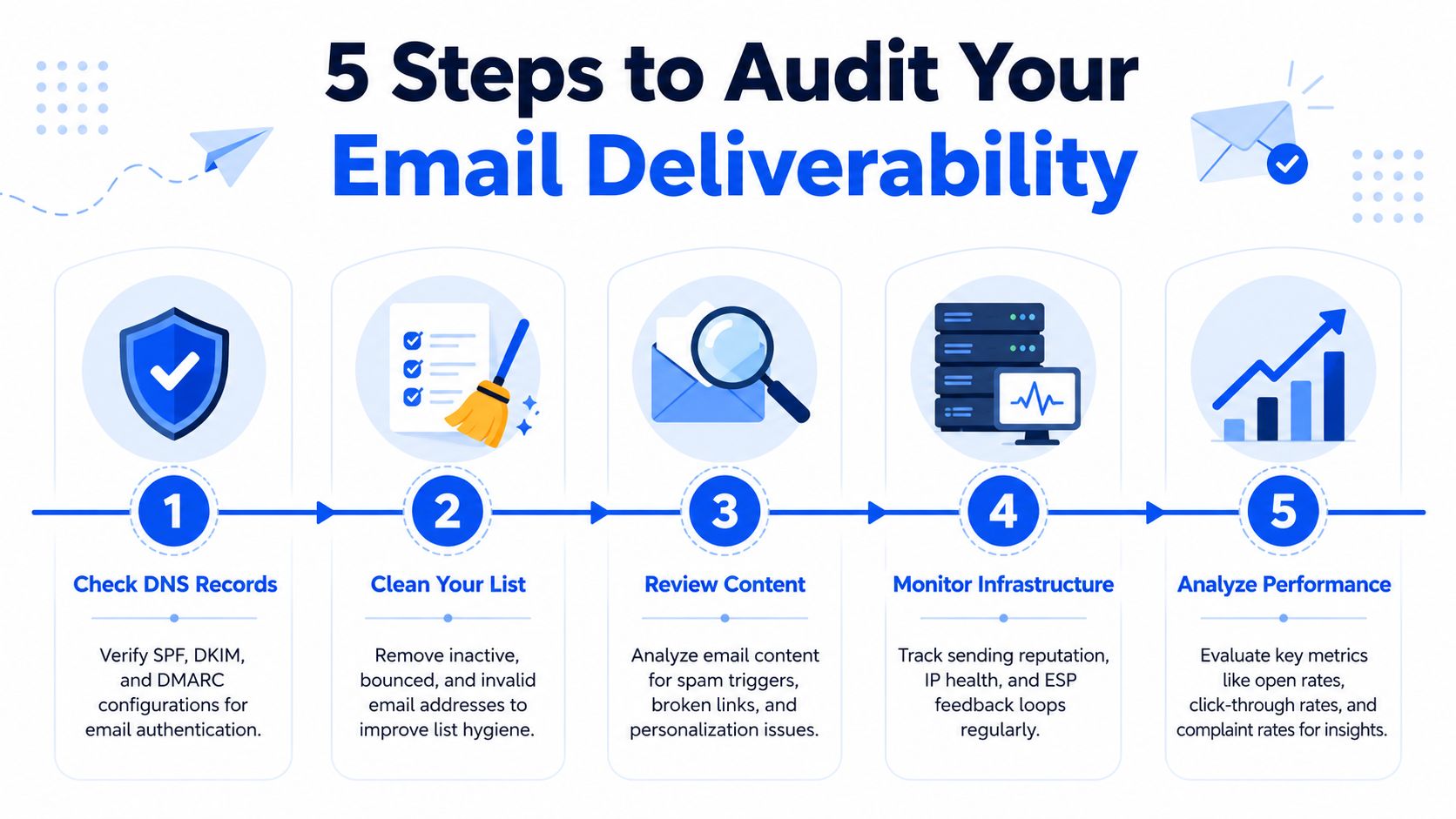
Step 1, inspect the sending domain
First, identify every domain and mailbox used for outbound, lifecycle, support, and finance mail. Don't trust assumptions from sales or marketing ops. Pull the actual sending inventory from Apollo, Lemlist, Instantly, Smartlead, HubSpot, and any transactional system in the stack.
If cold outreach is running from the primary business domain, treat that as a red flag immediately. In most audits, that single choice explains a large share of the eventual damage because the same domain reputation now affects prospecting and day-to-day operations.
Step 2, check reputation before you touch copy
Before rewriting subject lines or swapping CTAs, check sender reputation in Google Postmaster Tools and Microsoft SNDS. The point is simple. You want to know whether providers distrust the sender before you diagnose campaign performance.
The hard thresholds matter here. If a bounce rate exceeds 2.8% or a complaint rate passes 0.2%, reputation is downgraded. Domains with a High reputation score in Google Postmaster Tools tend to see 90%+ inbox placement, while Low reputation domains can fall below 40% inbox placement, according to the verified data provided above.
Use that as the operating line, not as trivia. Once you cross it, your copy test isn't a copy test anymore.
If you want an outside lens on inbox checks, KeepKnown's write-up on how to audit your inbox is a useful reference alongside provider dashboards. For seed-based placement testing, tools like GlockApps are built for this exact job.
Step 3, verify authentication
Now check SPF, DKIM, and DMARC. Missing records are obvious failures. Misaligned records are worse because teams often think they're protected when they aren't.
Mailgun's 2025 State of Deliverability survey showed that 78.5% of respondents rated deliverability importance at 8/10 or higher, with top challenges including staying out of spam at 47.9%, maintaining list hygiene at 33.8%, and reducing bounces at 28.4% in its deliverability takeaways. That lines up with what operators see. Authentication is required, but maintaining trust is the larger job.
A few checks matter more than the rest:
SPF coverage: Every real sender has to be included, not just your main ESP.
DKIM alignment: Each sending platform needs valid signing and domain alignment.
DMARC policy: If it's sitting at p=none, you haven't moved from observation to enforcement.
Step 4, audit sending behavior
The cause of deliverability issues is often found through a thorough examination. Examine the last stretch of sending activity, looking for sharp volume increases, uneven mailbox distribution, stale lists, and poor verification discipline. Review complaints, bounces, and whether one provider is deteriorating faster than another.
If volume doubled quickly and list quality dropped at the same time, mailbox providers won't care that your copy was personalized.
Watch for three patterns in particular:
Primary-domain outbound: The highest-risk setup for B2B teams.
Aggressive ramping: New inboxes pushed too quickly.
Dirty list intake: Imported records that weren't verified before launch.
This video is a solid visual walkthrough if your team wants a practical explainer before digging into the audit itself.
Step 5, test actual inbox placement
Dashboards help, but seed testing closes the loop. Send controlled tests to Gmail, Outlook, Yahoo, and a few business inboxes you manage. Then check inbox, spam, and filtered placement manually.
This final step matters because platform reports can hide the lived reality. A campaign can show healthy sends and still miss the inbox badly. That's why the audit needs both provider reputation data and direct placement checks.
Run this five-step audit monthly. Don't wait for visible failure.
A real-world domain recovery from 31% to 89% inbox placement
Here's the cleanest way to understand what an email deliverability consultant changes. Not by theory, by measured placement.
What the account looked like before remediation
One B2B outbound setup came in after months of sending from the primary domain. There was no separate sending infrastructure, DMARC wasn't enforced, and volume had been pushed up too aggressively. The result was ugly but common.
Inbox placement across a controlled seed test was 31% before remediation. 52% hit spam, 11% was filtered, and 6% was blocked or bounced. Active campaign reply rate had dropped to 1.8%, and Google Postmaster showed a 42 out of 100 sender reputation score, rated low.
That matters in context. Email Tool Tester's 2026 testing across 15 ESPs found an average deliverability rate of 83.1%, which means 16.9% of marketing emails failed to reach the intended inbox, with 10.5% landing in spam and 6.4% undelivered altogether. The same benchmark says over 89% is good and over 95% is excellent, as shown in its deliverability statistics analysis. So 31% wasn't a mild underperformance. It was a broken sending environment.
Metric | Before remediation | After remediation (Day 90) |
|---|---|---|
Inbox placement | 31% | 89% |
Spam folder placement | 52% | 7% |
Filtered | 11% | 3% |
Blocked or bounced | 6% | 1% |
Reply rate on active outreach | 1.8% | 11.2% |
Sender reputation score | 42 | 88 average on new sending domains |
If you want examples of how pipeline teams document this kind of operational change, GROU's case studies show the broader system view, not just a single channel metric.
What changed over 90 days
The copy didn't get a dramatic rewrite. The fix was infrastructure and operating discipline.
The first move was to stop outbound from the primary domain. Then came authentication cleanup, new dedicated sending domains, and a deliberate warm-up process before any meaningful volume resumed. Outreach restarted at reduced volume and was spread across the new domains with hard caps per inbox. Seed tests were repeated on a schedule, and the primary domain was reserved for legitimate business communication only.
A great email in spam gets ignored. An average email in the inbox gets judged on merit.
By day 90, inbox placement reached 89%. Spam folder placement dropped to 7%, filtered placement to 3%, and bounces to 1%. Reply rate rose to 11.2%. The important point is causal, not cosmetic. The main lever was that prospects started receiving the emails in the first place.
That's why I treat inbox placement as a board-level operating metric for any outbound-driven pipeline team. If placement is poor, every lesson you think you're learning from open rates, replies, and conversion is contaminated upstream.
Should you hire a consultant or manage deliverability in-house
The verdict is simple. Hire a consultant to build the system, then hand day-to-day operation to your internal team. Most B2B teams shouldn't try to invent deliverability operations from scratch while campaign pressure is rising.
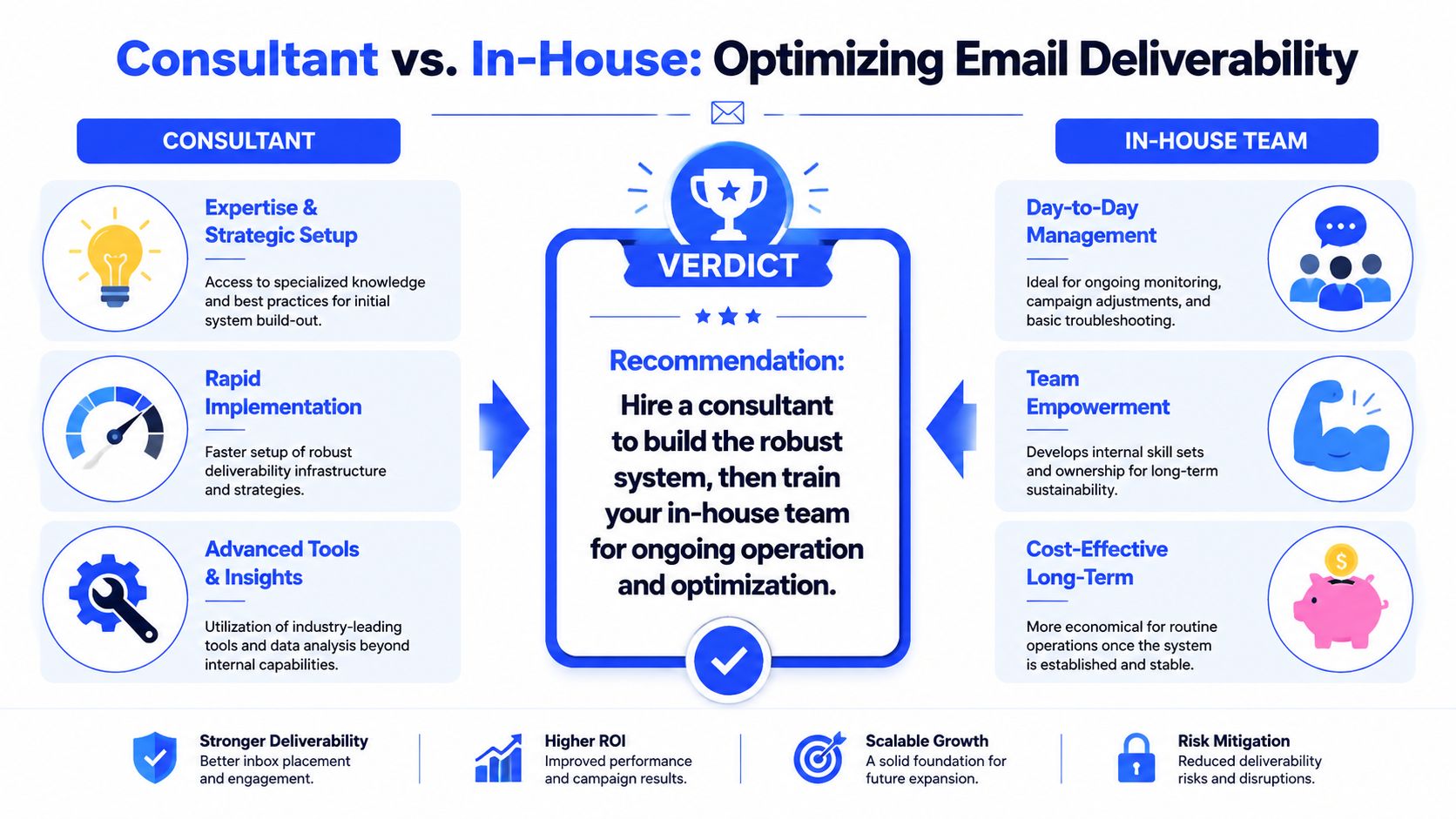
The right split of work
Consultants are strongest at pattern recognition. They've seen domain damage from poor ramps, weak list hygiene, mixed traffic, and bad domain separation enough times that they can spot the issue quickly. Your internal team usually knows the CRM, handoff rules, and campaign context better.
That creates a practical division of labor.
Workstream | Consultant should lead | In-house team should own later |
|---|---|---|
Domain and inbox architecture | Yes | Maintain |
Authentication review | Yes | Monitor |
Recovery roadmap for damaged domains | Yes | Follow |
Seed testing framework | Yes | Run routinely |
Daily list verification and suppression | Set rules | Yes |
Volume caps and mailbox governance | Design | Enforce |
This hybrid model is usually safer than either extreme. Pure in-house ownership can miss early warning signs. Permanent outsourcing can leave your team dependent on a specialist for routine tasks they should understand themselves.
When in-house is enough, and when it isn't
In-house is enough when the infrastructure is already healthy, domain separation is in place, authentication is stable, and someone on the team can read provider signals without guessing. In that situation, the team can manage regular list cleaning, monitor reputation, and keep sending behavior inside defined limits.
Bring in an email deliverability consultant when one of these is true:
Primary domain damage is already visible: Business mail is affected, not just outbound.
Reply rates fell without a clear campaign change: That often points to delivery, not messaging.
Multiple tools are sending under one brand domain: Common in mixed stacks with outbound plus marketing automation.
Nobody owns reputation monitoring: If responsibility is fuzzy, issues sit too long.
The worst time to build deliverability knowledge is during a live reputation collapse.
There's also an execution reality. Revenue teams under pressure tend to push faster launches, bigger sends, and broader lists. That makes an external operator valuable because they can enforce the discipline internal teams often compromise on. If you're weighing this against broader outbound support, GROU's perspective on outsourcing lead generation is relevant because deliverability sits inside the same operating question. What should an outside specialist design, and what should your team run every week?
How to hire the right deliverability consultant
A real deliverability operator should sound like someone who has repaired damaged systems before, not someone who memorized DNS terms. The interview should reveal process, judgment, and reporting discipline.
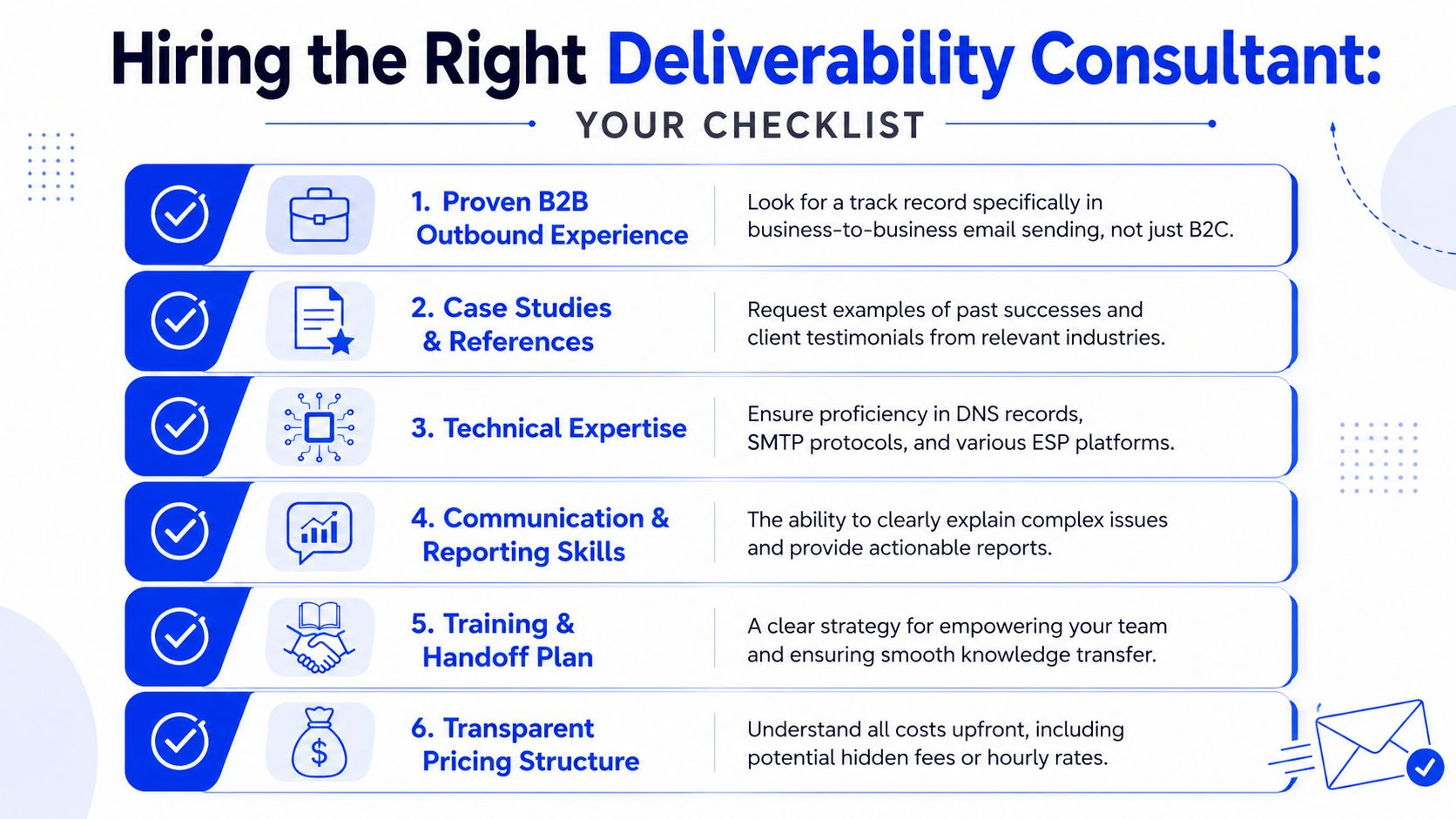
Questions that expose real operators
Ask questions that force a sequence, not opinions. Good consultants answer in steps and talk about trade-offs.
Use questions like these:
Walk me through your first audit pass: They should mention sending domains, reputation checks, authentication, sending behavior, and inbox placement testing.
What's the first thing you check when reply rates drop suddenly: A strong answer separates technical failure from reputation deterioration.
How do you handle a company sending cold outreach from its primary domain: You want to hear domain separation, recovery periods, and protected business communication.
How do you decide when to pause sending: They should talk about thresholds, placement signals, and provider reputation data.
What does your reporting look like after setup: Look for weekly monitoring, seed tests, and action triggers.
A practitioner should also know the tools your team uses. If you run Apollo for list building, Clay for enrichment, Smartlead or Instantly for sending, Sales Navigator for sourcing, and HubSpot for routing, the consultant should be able to speak to the operational risks around that stack without getting lost in theory.
Red flags to cut fast
The fastest way to hire badly is to confuse technical vocabulary with operating competence. A few red flags are enough to end the conversation.
Instant recovery promises: If someone promises a damaged reputation will be fixed in a week, walk away.
Authentication-only framing: SPF, DKIM, and DMARC are necessary. They are not the whole consulting job.
No seed testing or monitoring rhythm: If they can't tell you how progress will be measured, they're guessing.
No clear stance on primary-domain outreach: Serious operators don't treat that as a harmless preference.
No handoff plan: You want a system your team can run, not permanent mystery work.
Ask for the decision points, not just the tasks. Good consultants know when to pause, when to split domains, and when not to scale.
The right hire feels specific. They can explain what they'd do in the first week, what they won't do under pressure, and what your team will own once the system is stable.
Your first deliverability action plan
If you do one thing this week, make it this. List every domain currently sending on behalf of your company, then identify which one is your primary business domain. If cold outreach is running through it, that's the first problem to fix.
What to do this week
Run this sequence in order:
Map your sending stack
Include outbound, marketing automation, support, finance, product, and any one-off tools.Check whether outbound uses the main domain
If yes, stop treating deliverability as a copy issue.Review DMARC policy and authentication health
If enforcement is weak or inconsistent, escalate it.Open Google Postmaster Tools and your Microsoft data
Look for reputation trouble before you approve another send increase.Set a monthly audit owner
If no one owns deliverability, no one catches the drift early.
For a practical companion piece on avoiding common placement issues, Starnus has a solid summary on avoiding B2B outbound spam folders. If your team also needs to clean up ramping practices, GROU's note on deliverability warmup fits the operating side of that work.
What operating discipline looks like after the fix
The core lesson is simple. Deliverability isn't a project you finish. It's a control system you maintain.
That means cold outreach runs on separate domains. Authentication gets checked when tools change, not after problems appear. Volume caps exist before reps ask for more throughput. Seed testing happens on a schedule. Reputation data gets reviewed like any other pipeline input.
A lot of teams hire an email deliverability consultant hoping for a technical repair. The better outcome is a stable sending environment that makes campaign data trustworthy again. That's what structure does. It turns attention into pipeline by making sure your messages are seen.
Audit your sending domains by Friday. If outbound is touching the primary domain, stop expansion plans until that's corrected.
GROU helps B2B teams build outbound systems that include domain setup, mailbox structure, warm-up, sequencing, and reporting across global markets. Our method is simple: fix the sending infrastructure first, measure placement continuously, then scale only when the data says the system can hold it.
Your reply rates are slipping, but the copy looks fine. Sales says targeting is still tight. Marketing says the sequence hasn't changed. Meanwhile, invoices, support emails, and partner messages start missing inboxes too. That's usually not a messaging problem. It's a deliverability system problem.
Inbox placement is the upstream metric. If mail doesn't land in the inbox, every downstream KPI lies.
An email deliverability consultant is valuable when they separate DNS issues from reputation issues. Those are different failures with different fixes.
Most expensive damage starts with preventable operating mistakes, especially sending cold outreach from your primary domain.
The right outcome isn't a one-time fix. It's a monitoring system your team can run every month.
Table of Contents
A real-world domain recovery from 31% to 89% inbox placement
Should you hire a consultant or manage deliverability in-house
What an email deliverability consultant actually does
Some might assume an email deliverability consultant is the person who fixes SPF, DKIM, and DMARC, then disappears. That's too narrow. Instead, the role involves figuring out why a sending system fails without detection, then putting controls in place so it doesn't fail again.
The job is diagnosis, not box-checking
Authentication matters. SPF has to authorize legitimate senders, DKIM has to sign mail correctly, and DMARC has to tell receiving servers what to do when checks fail. But that isn't the whole story. As PowerDMARC's explanation of deliverability consulting notes, mailbox providers now weigh sender reputation, complaint rates, and recipient engagement heavily, which is why problems can continue even after technical setup is correct.
That distinction matters in B2B outbound. A technical failure usually shows up as broken alignment, missing records, or rejected mail. A reputation failure shows up differently. Reply rates slide. Placement gets worse at one provider first. Commercial email starts affecting business-critical mail.
Practical rule: If the domain is authenticated and results still deteriorate, stop looking at copy first. Look at reputation, list quality, and send behavior.
For a quick refresher on the fundamentals, this guide to email inbox success is useful because it frames deliverability as an operating discipline, not just a content problem. GROU's own deliverability glossary entry is a good companion if you want the B2B outbound version.
Where good consultants earn their fee
The highest-value work usually starts with one ugly question. Are you sending cold outbound from your primary business domain? If the answer is yes, the consultant is already halfway to the diagnosis.
That mistake shows up constantly in outbound teams. Sales starts with low volume from the main domain. Then volume creeps up. Then reply rates erode slowly enough that nobody treats it as an infrastructure issue. By the time someone notices, support, finance, and partner emails may be taking reputation damage too.
A strong consultant doesn't just “fix email.” They install a system:
Domain separation: Cold outreach moves to dedicated sending domains, while the primary domain stays reserved for legitimate business communication.
Reputation monitoring: The team checks Gmail and Microsoft signals regularly instead of waiting for a collapse.
Behavior controls: Volume caps, slower ramps, and list verification become operating rules.
Placement testing: Seed accounts show where mail lands before revenue teams trust campaign metrics.
That's why the role sits closer to pipeline infrastructure than technical support. If your send environment is unstable, your attribution is noisy, your outbound tests are misleading, and your sales team ends up judging copy that prospects never saw.
How to run a 5-step deliverability audit on your domain
Start with the boring stuff. That's where most of the expensive mistakes live.
Step 1, inspect the sending domain
First, identify every domain and mailbox used for outbound, lifecycle, support, and finance mail. Don't trust assumptions from sales or marketing ops. Pull the actual sending inventory from Apollo, Lemlist, Instantly, Smartlead, HubSpot, and any transactional system in the stack.
If cold outreach is running from the primary business domain, treat that as a red flag immediately. In most audits, that single choice explains a large share of the eventual damage because the same domain reputation now affects prospecting and day-to-day operations.
Step 2, check reputation before you touch copy
Before rewriting subject lines or swapping CTAs, check sender reputation in Google Postmaster Tools and Microsoft SNDS. The point is simple. You want to know whether providers distrust the sender before you diagnose campaign performance.
The hard thresholds matter here. If a bounce rate exceeds 2.8% or a complaint rate passes 0.2%, reputation is downgraded. Domains with a High reputation score in Google Postmaster Tools tend to see 90%+ inbox placement, while Low reputation domains can fall below 40% inbox placement, according to the verified data provided above.
Use that as the operating line, not as trivia. Once you cross it, your copy test isn't a copy test anymore.
If you want an outside lens on inbox checks, KeepKnown's write-up on how to audit your inbox is a useful reference alongside provider dashboards. For seed-based placement testing, tools like GlockApps are built for this exact job.
Step 3, verify authentication
Now check SPF, DKIM, and DMARC. Missing records are obvious failures. Misaligned records are worse because teams often think they're protected when they aren't.
Mailgun's 2025 State of Deliverability survey showed that 78.5% of respondents rated deliverability importance at 8/10 or higher, with top challenges including staying out of spam at 47.9%, maintaining list hygiene at 33.8%, and reducing bounces at 28.4% in its deliverability takeaways. That lines up with what operators see. Authentication is required, but maintaining trust is the larger job.
A few checks matter more than the rest:
SPF coverage: Every real sender has to be included, not just your main ESP.
DKIM alignment: Each sending platform needs valid signing and domain alignment.
DMARC policy: If it's sitting at p=none, you haven't moved from observation to enforcement.
Step 4, audit sending behavior
The cause of deliverability issues is often found through a thorough examination. Examine the last stretch of sending activity, looking for sharp volume increases, uneven mailbox distribution, stale lists, and poor verification discipline. Review complaints, bounces, and whether one provider is deteriorating faster than another.
If volume doubled quickly and list quality dropped at the same time, mailbox providers won't care that your copy was personalized.
Watch for three patterns in particular:
Primary-domain outbound: The highest-risk setup for B2B teams.
Aggressive ramping: New inboxes pushed too quickly.
Dirty list intake: Imported records that weren't verified before launch.
This video is a solid visual walkthrough if your team wants a practical explainer before digging into the audit itself.
Step 5, test actual inbox placement
Dashboards help, but seed testing closes the loop. Send controlled tests to Gmail, Outlook, Yahoo, and a few business inboxes you manage. Then check inbox, spam, and filtered placement manually.
This final step matters because platform reports can hide the lived reality. A campaign can show healthy sends and still miss the inbox badly. That's why the audit needs both provider reputation data and direct placement checks.
Run this five-step audit monthly. Don't wait for visible failure.
A real-world domain recovery from 31% to 89% inbox placement
Here's the cleanest way to understand what an email deliverability consultant changes. Not by theory, by measured placement.
What the account looked like before remediation
One B2B outbound setup came in after months of sending from the primary domain. There was no separate sending infrastructure, DMARC wasn't enforced, and volume had been pushed up too aggressively. The result was ugly but common.
Inbox placement across a controlled seed test was 31% before remediation. 52% hit spam, 11% was filtered, and 6% was blocked or bounced. Active campaign reply rate had dropped to 1.8%, and Google Postmaster showed a 42 out of 100 sender reputation score, rated low.
That matters in context. Email Tool Tester's 2026 testing across 15 ESPs found an average deliverability rate of 83.1%, which means 16.9% of marketing emails failed to reach the intended inbox, with 10.5% landing in spam and 6.4% undelivered altogether. The same benchmark says over 89% is good and over 95% is excellent, as shown in its deliverability statistics analysis. So 31% wasn't a mild underperformance. It was a broken sending environment.
Metric | Before remediation | After remediation (Day 90) |
|---|---|---|
Inbox placement | 31% | 89% |
Spam folder placement | 52% | 7% |
Filtered | 11% | 3% |
Blocked or bounced | 6% | 1% |
Reply rate on active outreach | 1.8% | 11.2% |
Sender reputation score | 42 | 88 average on new sending domains |
If you want examples of how pipeline teams document this kind of operational change, GROU's case studies show the broader system view, not just a single channel metric.
What changed over 90 days
The copy didn't get a dramatic rewrite. The fix was infrastructure and operating discipline.
The first move was to stop outbound from the primary domain. Then came authentication cleanup, new dedicated sending domains, and a deliberate warm-up process before any meaningful volume resumed. Outreach restarted at reduced volume and was spread across the new domains with hard caps per inbox. Seed tests were repeated on a schedule, and the primary domain was reserved for legitimate business communication only.
A great email in spam gets ignored. An average email in the inbox gets judged on merit.
By day 90, inbox placement reached 89%. Spam folder placement dropped to 7%, filtered placement to 3%, and bounces to 1%. Reply rate rose to 11.2%. The important point is causal, not cosmetic. The main lever was that prospects started receiving the emails in the first place.
That's why I treat inbox placement as a board-level operating metric for any outbound-driven pipeline team. If placement is poor, every lesson you think you're learning from open rates, replies, and conversion is contaminated upstream.
Should you hire a consultant or manage deliverability in-house
The verdict is simple. Hire a consultant to build the system, then hand day-to-day operation to your internal team. Most B2B teams shouldn't try to invent deliverability operations from scratch while campaign pressure is rising.
The right split of work
Consultants are strongest at pattern recognition. They've seen domain damage from poor ramps, weak list hygiene, mixed traffic, and bad domain separation enough times that they can spot the issue quickly. Your internal team usually knows the CRM, handoff rules, and campaign context better.
That creates a practical division of labor.
Workstream | Consultant should lead | In-house team should own later |
|---|---|---|
Domain and inbox architecture | Yes | Maintain |
Authentication review | Yes | Monitor |
Recovery roadmap for damaged domains | Yes | Follow |
Seed testing framework | Yes | Run routinely |
Daily list verification and suppression | Set rules | Yes |
Volume caps and mailbox governance | Design | Enforce |
This hybrid model is usually safer than either extreme. Pure in-house ownership can miss early warning signs. Permanent outsourcing can leave your team dependent on a specialist for routine tasks they should understand themselves.
When in-house is enough, and when it isn't
In-house is enough when the infrastructure is already healthy, domain separation is in place, authentication is stable, and someone on the team can read provider signals without guessing. In that situation, the team can manage regular list cleaning, monitor reputation, and keep sending behavior inside defined limits.
Bring in an email deliverability consultant when one of these is true:
Primary domain damage is already visible: Business mail is affected, not just outbound.
Reply rates fell without a clear campaign change: That often points to delivery, not messaging.
Multiple tools are sending under one brand domain: Common in mixed stacks with outbound plus marketing automation.
Nobody owns reputation monitoring: If responsibility is fuzzy, issues sit too long.
The worst time to build deliverability knowledge is during a live reputation collapse.
There's also an execution reality. Revenue teams under pressure tend to push faster launches, bigger sends, and broader lists. That makes an external operator valuable because they can enforce the discipline internal teams often compromise on. If you're weighing this against broader outbound support, GROU's perspective on outsourcing lead generation is relevant because deliverability sits inside the same operating question. What should an outside specialist design, and what should your team run every week?
How to hire the right deliverability consultant
A real deliverability operator should sound like someone who has repaired damaged systems before, not someone who memorized DNS terms. The interview should reveal process, judgment, and reporting discipline.
Questions that expose real operators
Ask questions that force a sequence, not opinions. Good consultants answer in steps and talk about trade-offs.
Use questions like these:
Walk me through your first audit pass: They should mention sending domains, reputation checks, authentication, sending behavior, and inbox placement testing.
What's the first thing you check when reply rates drop suddenly: A strong answer separates technical failure from reputation deterioration.
How do you handle a company sending cold outreach from its primary domain: You want to hear domain separation, recovery periods, and protected business communication.
How do you decide when to pause sending: They should talk about thresholds, placement signals, and provider reputation data.
What does your reporting look like after setup: Look for weekly monitoring, seed tests, and action triggers.
A practitioner should also know the tools your team uses. If you run Apollo for list building, Clay for enrichment, Smartlead or Instantly for sending, Sales Navigator for sourcing, and HubSpot for routing, the consultant should be able to speak to the operational risks around that stack without getting lost in theory.
Red flags to cut fast
The fastest way to hire badly is to confuse technical vocabulary with operating competence. A few red flags are enough to end the conversation.
Instant recovery promises: If someone promises a damaged reputation will be fixed in a week, walk away.
Authentication-only framing: SPF, DKIM, and DMARC are necessary. They are not the whole consulting job.
No seed testing or monitoring rhythm: If they can't tell you how progress will be measured, they're guessing.
No clear stance on primary-domain outreach: Serious operators don't treat that as a harmless preference.
No handoff plan: You want a system your team can run, not permanent mystery work.
Ask for the decision points, not just the tasks. Good consultants know when to pause, when to split domains, and when not to scale.
The right hire feels specific. They can explain what they'd do in the first week, what they won't do under pressure, and what your team will own once the system is stable.
Your first deliverability action plan
If you do one thing this week, make it this. List every domain currently sending on behalf of your company, then identify which one is your primary business domain. If cold outreach is running through it, that's the first problem to fix.
What to do this week
Run this sequence in order:
Map your sending stack
Include outbound, marketing automation, support, finance, product, and any one-off tools.Check whether outbound uses the main domain
If yes, stop treating deliverability as a copy issue.Review DMARC policy and authentication health
If enforcement is weak or inconsistent, escalate it.Open Google Postmaster Tools and your Microsoft data
Look for reputation trouble before you approve another send increase.Set a monthly audit owner
If no one owns deliverability, no one catches the drift early.
For a practical companion piece on avoiding common placement issues, Starnus has a solid summary on avoiding B2B outbound spam folders. If your team also needs to clean up ramping practices, GROU's note on deliverability warmup fits the operating side of that work.
What operating discipline looks like after the fix
The core lesson is simple. Deliverability isn't a project you finish. It's a control system you maintain.
That means cold outreach runs on separate domains. Authentication gets checked when tools change, not after problems appear. Volume caps exist before reps ask for more throughput. Seed testing happens on a schedule. Reputation data gets reviewed like any other pipeline input.
A lot of teams hire an email deliverability consultant hoping for a technical repair. The better outcome is a stable sending environment that makes campaign data trustworthy again. That's what structure does. It turns attention into pipeline by making sure your messages are seen.
Audit your sending domains by Friday. If outbound is touching the primary domain, stop expansion plans until that's corrected.
GROU helps B2B teams build outbound systems that include domain setup, mailbox structure, warm-up, sequencing, and reporting across global markets. Our method is simple: fix the sending infrastructure first, measure placement continuously, then scale only when the data says the system can hold it.
Your reply rates are slipping, but the copy looks fine. Sales says targeting is still tight. Marketing says the sequence hasn't changed. Meanwhile, invoices, support emails, and partner messages start missing inboxes too. That's usually not a messaging problem. It's a deliverability system problem.
Inbox placement is the upstream metric. If mail doesn't land in the inbox, every downstream KPI lies.
An email deliverability consultant is valuable when they separate DNS issues from reputation issues. Those are different failures with different fixes.
Most expensive damage starts with preventable operating mistakes, especially sending cold outreach from your primary domain.
The right outcome isn't a one-time fix. It's a monitoring system your team can run every month.
Table of Contents
A real-world domain recovery from 31% to 89% inbox placement
Should you hire a consultant or manage deliverability in-house
What an email deliverability consultant actually does
Some might assume an email deliverability consultant is the person who fixes SPF, DKIM, and DMARC, then disappears. That's too narrow. Instead, the role involves figuring out why a sending system fails without detection, then putting controls in place so it doesn't fail again.
The job is diagnosis, not box-checking
Authentication matters. SPF has to authorize legitimate senders, DKIM has to sign mail correctly, and DMARC has to tell receiving servers what to do when checks fail. But that isn't the whole story. As PowerDMARC's explanation of deliverability consulting notes, mailbox providers now weigh sender reputation, complaint rates, and recipient engagement heavily, which is why problems can continue even after technical setup is correct.
That distinction matters in B2B outbound. A technical failure usually shows up as broken alignment, missing records, or rejected mail. A reputation failure shows up differently. Reply rates slide. Placement gets worse at one provider first. Commercial email starts affecting business-critical mail.
Practical rule: If the domain is authenticated and results still deteriorate, stop looking at copy first. Look at reputation, list quality, and send behavior.
For a quick refresher on the fundamentals, this guide to email inbox success is useful because it frames deliverability as an operating discipline, not just a content problem. GROU's own deliverability glossary entry is a good companion if you want the B2B outbound version.
Where good consultants earn their fee
The highest-value work usually starts with one ugly question. Are you sending cold outbound from your primary business domain? If the answer is yes, the consultant is already halfway to the diagnosis.
That mistake shows up constantly in outbound teams. Sales starts with low volume from the main domain. Then volume creeps up. Then reply rates erode slowly enough that nobody treats it as an infrastructure issue. By the time someone notices, support, finance, and partner emails may be taking reputation damage too.
A strong consultant doesn't just “fix email.” They install a system:
Domain separation: Cold outreach moves to dedicated sending domains, while the primary domain stays reserved for legitimate business communication.
Reputation monitoring: The team checks Gmail and Microsoft signals regularly instead of waiting for a collapse.
Behavior controls: Volume caps, slower ramps, and list verification become operating rules.
Placement testing: Seed accounts show where mail lands before revenue teams trust campaign metrics.
That's why the role sits closer to pipeline infrastructure than technical support. If your send environment is unstable, your attribution is noisy, your outbound tests are misleading, and your sales team ends up judging copy that prospects never saw.
How to run a 5-step deliverability audit on your domain
Start with the boring stuff. That's where most of the expensive mistakes live.
Step 1, inspect the sending domain
First, identify every domain and mailbox used for outbound, lifecycle, support, and finance mail. Don't trust assumptions from sales or marketing ops. Pull the actual sending inventory from Apollo, Lemlist, Instantly, Smartlead, HubSpot, and any transactional system in the stack.
If cold outreach is running from the primary business domain, treat that as a red flag immediately. In most audits, that single choice explains a large share of the eventual damage because the same domain reputation now affects prospecting and day-to-day operations.
Step 2, check reputation before you touch copy
Before rewriting subject lines or swapping CTAs, check sender reputation in Google Postmaster Tools and Microsoft SNDS. The point is simple. You want to know whether providers distrust the sender before you diagnose campaign performance.
The hard thresholds matter here. If a bounce rate exceeds 2.8% or a complaint rate passes 0.2%, reputation is downgraded. Domains with a High reputation score in Google Postmaster Tools tend to see 90%+ inbox placement, while Low reputation domains can fall below 40% inbox placement, according to the verified data provided above.
Use that as the operating line, not as trivia. Once you cross it, your copy test isn't a copy test anymore.
If you want an outside lens on inbox checks, KeepKnown's write-up on how to audit your inbox is a useful reference alongside provider dashboards. For seed-based placement testing, tools like GlockApps are built for this exact job.
Step 3, verify authentication
Now check SPF, DKIM, and DMARC. Missing records are obvious failures. Misaligned records are worse because teams often think they're protected when they aren't.
Mailgun's 2025 State of Deliverability survey showed that 78.5% of respondents rated deliverability importance at 8/10 or higher, with top challenges including staying out of spam at 47.9%, maintaining list hygiene at 33.8%, and reducing bounces at 28.4% in its deliverability takeaways. That lines up with what operators see. Authentication is required, but maintaining trust is the larger job.
A few checks matter more than the rest:
SPF coverage: Every real sender has to be included, not just your main ESP.
DKIM alignment: Each sending platform needs valid signing and domain alignment.
DMARC policy: If it's sitting at p=none, you haven't moved from observation to enforcement.
Step 4, audit sending behavior
The cause of deliverability issues is often found through a thorough examination. Examine the last stretch of sending activity, looking for sharp volume increases, uneven mailbox distribution, stale lists, and poor verification discipline. Review complaints, bounces, and whether one provider is deteriorating faster than another.
If volume doubled quickly and list quality dropped at the same time, mailbox providers won't care that your copy was personalized.
Watch for three patterns in particular:
Primary-domain outbound: The highest-risk setup for B2B teams.
Aggressive ramping: New inboxes pushed too quickly.
Dirty list intake: Imported records that weren't verified before launch.
This video is a solid visual walkthrough if your team wants a practical explainer before digging into the audit itself.
Step 5, test actual inbox placement
Dashboards help, but seed testing closes the loop. Send controlled tests to Gmail, Outlook, Yahoo, and a few business inboxes you manage. Then check inbox, spam, and filtered placement manually.
This final step matters because platform reports can hide the lived reality. A campaign can show healthy sends and still miss the inbox badly. That's why the audit needs both provider reputation data and direct placement checks.
Run this five-step audit monthly. Don't wait for visible failure.
A real-world domain recovery from 31% to 89% inbox placement
Here's the cleanest way to understand what an email deliverability consultant changes. Not by theory, by measured placement.
What the account looked like before remediation
One B2B outbound setup came in after months of sending from the primary domain. There was no separate sending infrastructure, DMARC wasn't enforced, and volume had been pushed up too aggressively. The result was ugly but common.
Inbox placement across a controlled seed test was 31% before remediation. 52% hit spam, 11% was filtered, and 6% was blocked or bounced. Active campaign reply rate had dropped to 1.8%, and Google Postmaster showed a 42 out of 100 sender reputation score, rated low.
That matters in context. Email Tool Tester's 2026 testing across 15 ESPs found an average deliverability rate of 83.1%, which means 16.9% of marketing emails failed to reach the intended inbox, with 10.5% landing in spam and 6.4% undelivered altogether. The same benchmark says over 89% is good and over 95% is excellent, as shown in its deliverability statistics analysis. So 31% wasn't a mild underperformance. It was a broken sending environment.
Metric | Before remediation | After remediation (Day 90) |
|---|---|---|
Inbox placement | 31% | 89% |
Spam folder placement | 52% | 7% |
Filtered | 11% | 3% |
Blocked or bounced | 6% | 1% |
Reply rate on active outreach | 1.8% | 11.2% |
Sender reputation score | 42 | 88 average on new sending domains |
If you want examples of how pipeline teams document this kind of operational change, GROU's case studies show the broader system view, not just a single channel metric.
What changed over 90 days
The copy didn't get a dramatic rewrite. The fix was infrastructure and operating discipline.
The first move was to stop outbound from the primary domain. Then came authentication cleanup, new dedicated sending domains, and a deliberate warm-up process before any meaningful volume resumed. Outreach restarted at reduced volume and was spread across the new domains with hard caps per inbox. Seed tests were repeated on a schedule, and the primary domain was reserved for legitimate business communication only.
A great email in spam gets ignored. An average email in the inbox gets judged on merit.
By day 90, inbox placement reached 89%. Spam folder placement dropped to 7%, filtered placement to 3%, and bounces to 1%. Reply rate rose to 11.2%. The important point is causal, not cosmetic. The main lever was that prospects started receiving the emails in the first place.
That's why I treat inbox placement as a board-level operating metric for any outbound-driven pipeline team. If placement is poor, every lesson you think you're learning from open rates, replies, and conversion is contaminated upstream.
Should you hire a consultant or manage deliverability in-house
The verdict is simple. Hire a consultant to build the system, then hand day-to-day operation to your internal team. Most B2B teams shouldn't try to invent deliverability operations from scratch while campaign pressure is rising.
The right split of work
Consultants are strongest at pattern recognition. They've seen domain damage from poor ramps, weak list hygiene, mixed traffic, and bad domain separation enough times that they can spot the issue quickly. Your internal team usually knows the CRM, handoff rules, and campaign context better.
That creates a practical division of labor.
Workstream | Consultant should lead | In-house team should own later |
|---|---|---|
Domain and inbox architecture | Yes | Maintain |
Authentication review | Yes | Monitor |
Recovery roadmap for damaged domains | Yes | Follow |
Seed testing framework | Yes | Run routinely |
Daily list verification and suppression | Set rules | Yes |
Volume caps and mailbox governance | Design | Enforce |
This hybrid model is usually safer than either extreme. Pure in-house ownership can miss early warning signs. Permanent outsourcing can leave your team dependent on a specialist for routine tasks they should understand themselves.
When in-house is enough, and when it isn't
In-house is enough when the infrastructure is already healthy, domain separation is in place, authentication is stable, and someone on the team can read provider signals without guessing. In that situation, the team can manage regular list cleaning, monitor reputation, and keep sending behavior inside defined limits.
Bring in an email deliverability consultant when one of these is true:
Primary domain damage is already visible: Business mail is affected, not just outbound.
Reply rates fell without a clear campaign change: That often points to delivery, not messaging.
Multiple tools are sending under one brand domain: Common in mixed stacks with outbound plus marketing automation.
Nobody owns reputation monitoring: If responsibility is fuzzy, issues sit too long.
The worst time to build deliverability knowledge is during a live reputation collapse.
There's also an execution reality. Revenue teams under pressure tend to push faster launches, bigger sends, and broader lists. That makes an external operator valuable because they can enforce the discipline internal teams often compromise on. If you're weighing this against broader outbound support, GROU's perspective on outsourcing lead generation is relevant because deliverability sits inside the same operating question. What should an outside specialist design, and what should your team run every week?
How to hire the right deliverability consultant
A real deliverability operator should sound like someone who has repaired damaged systems before, not someone who memorized DNS terms. The interview should reveal process, judgment, and reporting discipline.
Questions that expose real operators
Ask questions that force a sequence, not opinions. Good consultants answer in steps and talk about trade-offs.
Use questions like these:
Walk me through your first audit pass: They should mention sending domains, reputation checks, authentication, sending behavior, and inbox placement testing.
What's the first thing you check when reply rates drop suddenly: A strong answer separates technical failure from reputation deterioration.
How do you handle a company sending cold outreach from its primary domain: You want to hear domain separation, recovery periods, and protected business communication.
How do you decide when to pause sending: They should talk about thresholds, placement signals, and provider reputation data.
What does your reporting look like after setup: Look for weekly monitoring, seed tests, and action triggers.
A practitioner should also know the tools your team uses. If you run Apollo for list building, Clay for enrichment, Smartlead or Instantly for sending, Sales Navigator for sourcing, and HubSpot for routing, the consultant should be able to speak to the operational risks around that stack without getting lost in theory.
Red flags to cut fast
The fastest way to hire badly is to confuse technical vocabulary with operating competence. A few red flags are enough to end the conversation.
Instant recovery promises: If someone promises a damaged reputation will be fixed in a week, walk away.
Authentication-only framing: SPF, DKIM, and DMARC are necessary. They are not the whole consulting job.
No seed testing or monitoring rhythm: If they can't tell you how progress will be measured, they're guessing.
No clear stance on primary-domain outreach: Serious operators don't treat that as a harmless preference.
No handoff plan: You want a system your team can run, not permanent mystery work.
Ask for the decision points, not just the tasks. Good consultants know when to pause, when to split domains, and when not to scale.
The right hire feels specific. They can explain what they'd do in the first week, what they won't do under pressure, and what your team will own once the system is stable.
Your first deliverability action plan
If you do one thing this week, make it this. List every domain currently sending on behalf of your company, then identify which one is your primary business domain. If cold outreach is running through it, that's the first problem to fix.
What to do this week
Run this sequence in order:
Map your sending stack
Include outbound, marketing automation, support, finance, product, and any one-off tools.Check whether outbound uses the main domain
If yes, stop treating deliverability as a copy issue.Review DMARC policy and authentication health
If enforcement is weak or inconsistent, escalate it.Open Google Postmaster Tools and your Microsoft data
Look for reputation trouble before you approve another send increase.Set a monthly audit owner
If no one owns deliverability, no one catches the drift early.
For a practical companion piece on avoiding common placement issues, Starnus has a solid summary on avoiding B2B outbound spam folders. If your team also needs to clean up ramping practices, GROU's note on deliverability warmup fits the operating side of that work.
What operating discipline looks like after the fix
The core lesson is simple. Deliverability isn't a project you finish. It's a control system you maintain.
That means cold outreach runs on separate domains. Authentication gets checked when tools change, not after problems appear. Volume caps exist before reps ask for more throughput. Seed testing happens on a schedule. Reputation data gets reviewed like any other pipeline input.
A lot of teams hire an email deliverability consultant hoping for a technical repair. The better outcome is a stable sending environment that makes campaign data trustworthy again. That's what structure does. It turns attention into pipeline by making sure your messages are seen.
Audit your sending domains by Friday. If outbound is touching the primary domain, stop expansion plans until that's corrected.
GROU helps B2B teams build outbound systems that include domain setup, mailbox structure, warm-up, sequencing, and reporting across global markets. Our method is simple: fix the sending infrastructure first, measure placement continuously, then scale only when the data says the system can hold it.

Pipeline OS Newsletter
Build qualified pipeline
Get weekly tactics to generate demand, improve lead quality, and book more meetings.





Trusted by industry leaders
Trusted by industry leaders
Trusted by industry leaders
Ready to build qualified pipeline?
Ready to build qualified pipeline?
Ready to build qualified pipeline?
Book a call to see if we're the right fit, or take the 2-minute quiz to get a clear starting point.
Book a call to see if we're the right fit, or take the 2-minute quiz to get a clear starting point.
Book a call to see if we're the right fit, or take the 2-minute quiz to get a clear starting point.
" height="30.21639343089746px" id="hfGbXmQR2" width="30.216393430897455px"/></svg>)
Copyright © 2026 – All Right Reserved
Copyright © 2026 – All Right Reserved
Copyright © 2026 – All Right Reserved