%22%3E%3C/path%3E%3Cpath d=%22M 63.072 7.554 C 62.258 8.022 61.577 8.689 61.092 9.493 L 61.092 7.076 L 57.158 7.076 L 57.158 22.64 L 61.089 22.64 L 61.089 14.888 C 61.089 13.446 61.403 12.434 62.03 11.853 C 62.818 11.218 63.818 10.907 64.826 10.982 L 65.868 10.982 L 65.868 6.851 C 64.891 6.834 63.926 7.076 63.073 7.554 Z%22 fill=%22rgb(17,17,17)%22%3E%3C/path%3E%3Cpath d=%22M 78.916 7.82 C 76.363 6.49 73.321 6.49 70.768 7.82 C 69.562 8.473 68.564 9.451 67.888 10.644 C 67.167 11.931 66.803 13.387 66.834 14.862 C 66.804 16.332 67.157 17.785 67.86 19.077 C 68.515 20.267 69.494 21.246 70.684 21.901 C 71.924 22.576 73.318 22.92 74.73 22.898 C 76.164 22.918 77.58 22.575 78.846 21.901 C 80.062 21.247 81.073 20.27 81.768 19.077 C 82.506 17.797 82.88 16.339 82.85 14.862 C 82.88 13.389 82.517 11.934 81.797 10.647 C 81.12 9.455 80.122 8.477 78.917 7.824 M 78.803 14.862 C 78.829 15.739 78.636 16.608 78.241 17.391 C 77.903 18.046 77.38 18.588 76.738 18.95 C 76.124 19.293 75.432 19.472 74.729 19.47 C 73.668 19.497 72.648 19.061 71.934 18.276 C 71.139 17.323 70.741 16.1 70.823 14.862 C 70.741 13.62 71.149 12.395 71.959 11.45 C 72.687 10.667 73.715 10.233 74.783 10.256 C 75.859 10.236 76.894 10.67 77.635 11.45 C 78.464 12.387 78.884 13.616 78.801 14.864%22 fill=%22rgb(17,17,17)%22%3E%3C/path%3E%3Cpath d=%22M 95.906 7.076 L 95.906 15.646 C 95.975 16.68 95.643 17.701 94.979 18.498 C 94.311 19.184 93.379 19.547 92.422 19.495 C 91.475 19.544 90.553 19.18 89.894 18.498 C 89.23 17.701 88.898 16.68 88.967 15.646 L 88.967 7.076 L 85.033 7.076 L 85.033 16.207 C 85 17.449 85.275 18.68 85.834 19.79 C 86.327 20.75 87.095 21.542 88.039 22.065 C 89.033 22.594 90.145 22.861 91.271 22.838 C 92.188 22.847 93.095 22.65 93.926 22.263 C 94.708 21.905 95.388 21.36 95.906 20.675 L 95.906 22.645 L 99.865 22.645 L 99.865 7.076 Z%22 fill=%22rgb(17,17,17)%22%3E%3C/path%3E%3Cpath d=%22M 4.513 15.626 C 4.511 10.815 7.606 6.549 12.181 5.059 C 16.756 3.57 21.77 5.195 24.601 9.086 L 27.816 5.87 C 24.074 1.186 17.981 -0.943 12.137 0.393 C 6.292 1.728 1.728 6.292 0.393 12.137 C -0.943 17.981 1.186 24.074 5.87 27.816 L 9.085 24.601 C 6.214 22.512 4.515 19.177 4.513 15.626%22 fill=%22rgb(32,62,235)%22%3E%3C/path%3E%3Cpath d=%22M 17.114 14.343 L 13.354 18.01 L 13.354 18.026 L 21.071 18.026 L 11.412 27.609 L 17.389 27.609 L 23.999 21.081 L 23.999 28.316 L 24.005 28.316 L 27.967 24.393 L 27.967 14.343 Z%22 fill=%22rgb(32,62,235)%22%3E%3C/path%3E%3C/g%3E%3C/svg%3E) ×
× ××
××›
›
›
›
Ideal customer profile template: B2B fields and examples 2026
Ideal customer profile template: B2B fields and examples 2026
Ideal customer profile template: B2B fields and examples 2026
Ideal customer profile template: B2B fields and examples 2026
Ideal customer profile template: B2B fields and examples 2026
Ideal customer profile template: B2B fields and examples 2026

Author
Aljaz Peklaj

Your SDRs are booking meetings. Your AEs are still saying the pipeline feels wrong. That gap usually means your ideal client profile template describes a market, not a buyer path. If the profile can't tell your team who to exclude, when to engage, and which accounts are ready, it won't protect selling time.
Most wins usually cluster around a narrow set of shared traits, and the template should be built from that evidence, not workshop opinions, per Salesmotion
The strongest templates add three fields most teams skip → closed-lost disqualification patterns, buyer role tenure, and technology adjacency
A real build process starts in CRM, then gets validated with a live outbound test before budget scales, per FullFunnel
The template isn't finished after kickoff. It needs quarterly review against campaign and deal data, per HubSpot
Table of Contents
The anatomy of an ICP template that actually works
Most ideal client profile templates fail because they stop at firmographics. Industry, employee count, geography, maybe revenue band. Useful, yes. Predictive, not really. That kind of template tells the team who looks similar. It doesn't tell them who closes.
A weak template also creates the wrong kind of confidence. SDRs can build big Apollo lists, marketing can launch ABM segments, and leadership can feel organized, while the pipeline still fills with accounts that die in procurement, stall after demo, or never had budget timing in the first place.
Why most templates fail in execution
Common ICP mistakes include feature-based profiling and assumption-based criteria, which cause a 35% drop in conversion rates compared to data-driven profiles, according to Wayfront. This is a core problem with a generic ideal client profile template. It lets the team target accounts that can describe the pain, but don't behave like buyers.
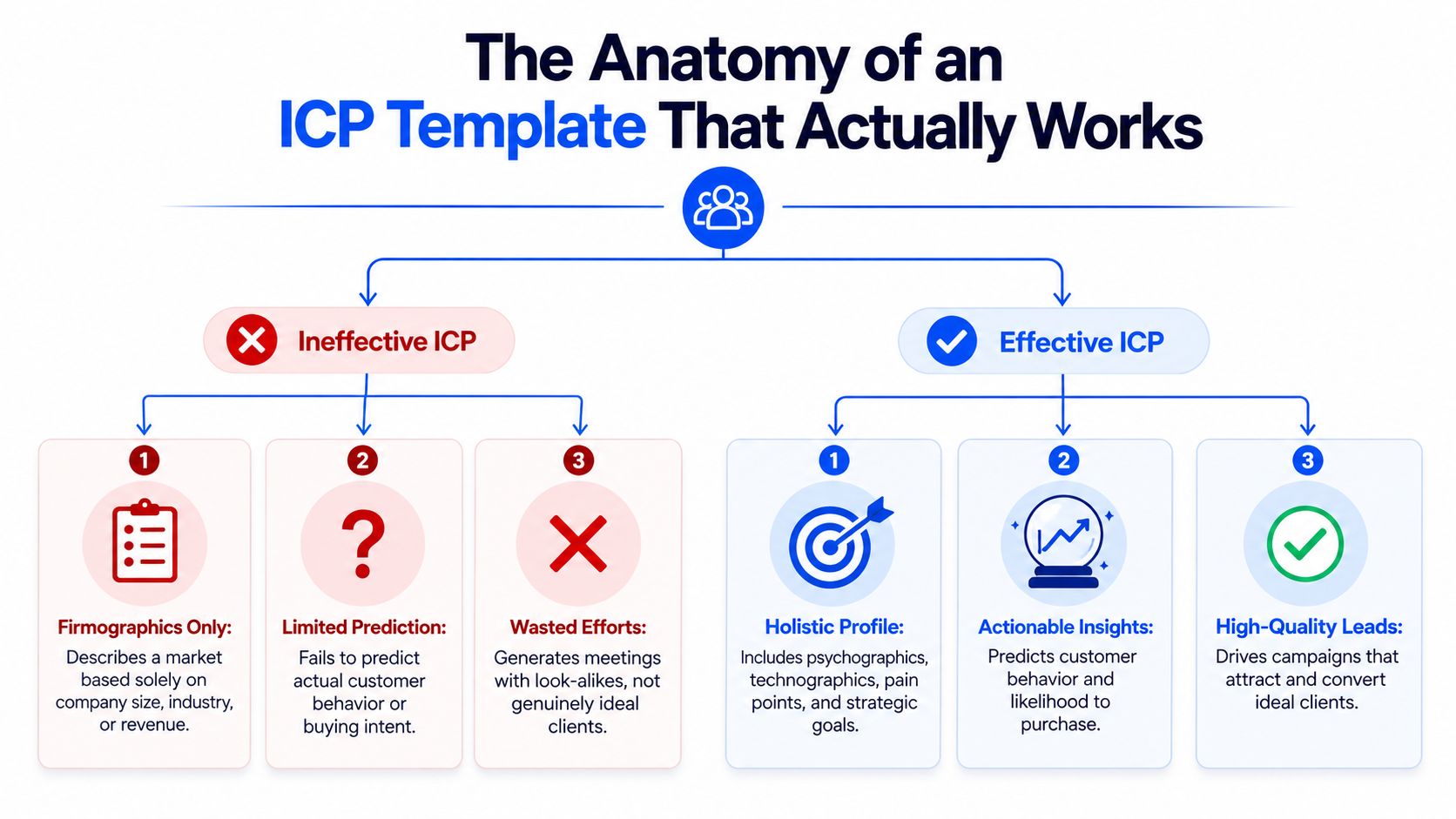
A good ICP doesn't just rank fit. It blocks bad opportunities before they reach an AE calendar.
The fix is to treat the template as a scoring and disqualification system. Firmographics stay in. They just stop being the whole model.
For a more foundational breakdown of the distinction between account fit and persona detail, this guide on ICP vs ideal customer profile is useful context.
The fields that make the template predictive
The structure that works in practice has three layers beyond standard filters.
Category | Field | What It Captures |
|---|---|---|
Core fit | Industry fit | Whether the account operates in the segment where your solution repeatedly wins |
Core fit | Company size band | Whether the team structure and buying motion match your sales process |
Core fit | Revenue or budget readiness | Whether the account can support the commercial model |
Core fit | Geographic match | Whether language, compliance, and coverage align |
Core fit | Buying committee shape | Who evaluates, who approves, and where deals usually stall |
Core fit | Direct tech stack | Whether the account uses platforms your product works with or against |
Disqualification | Closed-lost pattern criteria | Which accounts look right but repeatedly lose for the same reasons |
Timing | Buyer role tenure | Whether the primary buyer is early, mid, or late in role and how that affects receptivity |
Readiness | Technology adjacency mapping | Whether adjacent tools or infrastructure signal adoption readiness |
The three advanced fields do most of the filtering work.
Closed-lost pattern criteria catches false positives. If accounts with a certain incumbent system repeatedly die at proposal stage, that belongs in the template as a disqualifier, not in AE tribal knowledge.
Buyer role tenure changes timing. A Head of RevOps in the first stretch of a role often behaves differently from someone who has spent a long period defending an existing stack.
Technology adjacency is where significant revenue opportunities are often overlooked. Direct stack matching is obvious. Adjacency is stronger. If a legal tech buyer has already invested in the systems around your category, readiness is usually higher.
That's the version of an ideal client profile template that protects pipeline quality in SaaS, manufacturing, legal tech, pharma, and iGaming. It turns attention into a narrower list, and the narrower list is what usually creates better pipeline.
How to build your data-driven ICP from zero
If the current profile came from a founder workshop, repositioning doc, or a sales team opinion sweep, assume it's incomplete. The starting point isn't messaging. It's deal evidence.
Teams should pull 50 to 100 closed-won deals from the last 12 months to build the base, because analysis of wins usually shows 70 to 80% of them share exactly 3 to 5 common firmographic or technographic traits, according to Salesmotion. That's the pattern you want to find and formalize.
Start with the deals, not the deck
Before writing a single field, export the CRM data and segment closed-won accounts by revenue, retention rate, and sales cycle length, then identify 5 to 8 core criteria that predict fit, including explicit disqualifiers, as outlined by ZoomInfo.
That sounds basic, but organizations frequently overlook one of those variables. Revenue alone overweights flashy logos. Retention alone overweights easy accounts. Sales cycle alone can bias toward smaller deals. Put all three together and the picture gets cleaner.
If you're building this from scratch, a structured ICP market intelligence workflow helps keep the data collection consistent across CRM, LinkedIn, and enrichment sources.
Run the seven-step build sequence
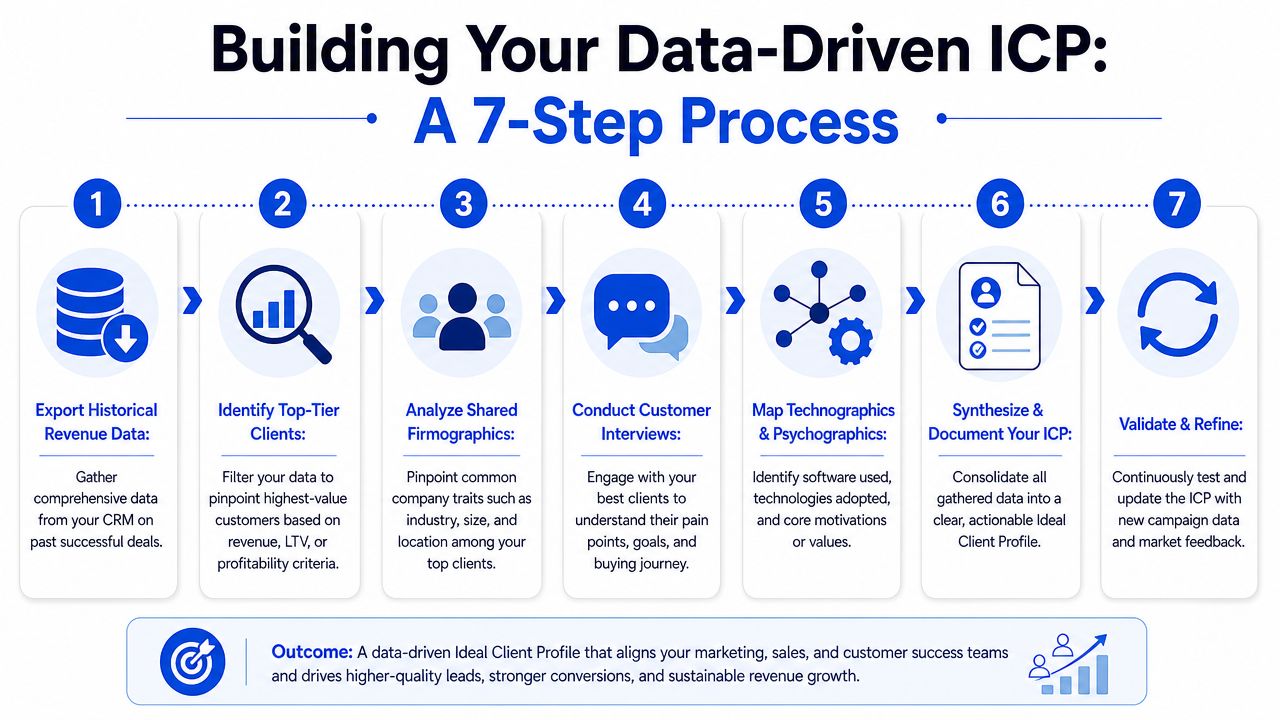
A rigorous method uses a 7-step data synthesis process, including champion interviews and a validation test, according to FullFunnel. In practice, the sequence looks like this:
Export historical CRM revenue by vertical
Pull account, opportunity, stage history, win reason, loss reason, sales cycle length, and retention indicators. Keep the extract clean enough that one operator can trace every conclusion back to a record.Identify top accounts by CLV and retention
The benchmark process calls for identifying the top 10 accounts by CLV and retention. That gives you a reality set, not a popularity set.Find the shared account traits
Look for repeated patterns in industry, employee range, commercial model, tech stack, buying committee shape, and geography. You're looking for convergence, not a giant list.Interview actual champions
The method calls for 5 to 8 champion interviews. Ask what triggered evaluation, what internal event made the problem urgent, and what almost blocked the deal.
A useful explainer sits well here for teams that want the workflow in video form:
Map the non-obvious criteria Add your three high-value layers → closed-lost patterns, role tenure, and adjacency signals. Account selection starts to improve fast with these additions.
Document the template as a scoring rubric
Keep it operational. Fields, definitions, allowed values, disqualifiers, owner, review date, and where each field is sourced from.Build a small validation cohort
Use the template to generate a controlled target list and route it into outreach.
Validate before you scale
The validation gate is not optional. The benchmark process requires a 100 to 200 prospect outbound test before scaling, and skipping that test leads to a 40 to 60% higher rate of wasted outbound spend on non-qualified leads, per FullFunnel.
Practical rule: if the ICP hasn't survived a live list, it's still a hypothesis.
Run the test in a stack your team already knows. For most mid-market teams, that means list build in Apollo or Sales Navigator, enrichment in Clay, and sequencing in Lemlist, Smartlead, Instantly, or HeyReach depending on channel mix. Measure reply quality and meeting quality, not just volume.
What works is boring, which is why many teams avoid it. Clean CRM pull. Tight clustering. Direct interviews. Controlled test. Then scale.
Validating and iterating your ICP with campaign data
An ideal client profile template has to stay live after launch. HubSpot is right to frame it as a "living document" that requires quarterly validation and refinement against market shifts, CRM data, and customer feedback in its ICP template guidance. In practice, if you wait too long, the field logic lags behind the actual market.
One SaaS example makes this concrete. A sales enablement company came in with a common profile error. The stated target was sales leadership, and the outbound motion was built around VP of Sales, VP of Revenue, and CRO titles. Meetings happened, but the AE team kept saying the conversations felt off.

What changed in a sales enablement SaaS account
Four weeks into the engagement, the campaign was under the expected range. Reply rate sat at 6.8%, and cost per qualified meeting was €890. AE feedback pointed to the same issue. The people replying weren't the people who evaluated the product.
A review of 34 closed-won deals from the previous 18 months showed the pattern:
7 deals had VP of Sales as the primary buyer contact
22 deals had enablement or operations leads as the primary contact
5 deals had other roles as primary contact
That changed the diagnosis immediately. The company hadn't built the wrong messaging for the market. It had built the wrong buyer entry point.
The market wasn't rejecting the offer. The campaign was entering through the wrong door.
What the team changed after the evidence came in
The ICP shifted from executive-first targeting to evaluator-first targeting.
The revised primary roles became Head of Sales Enablement, Director of Sales Operations, and Head of Revenue Operations. VP of Sales stayed in the model, but as a secondary target and approval role inside companies large enough to have a dedicated enablement or operations function.
Messaging changed with it. Strategic leadership language got replaced by operational language. The team referenced implementation complexity, tool integration, onboarding design, and cross-functional coordination. Signal monitoring also changed. The list logic moved toward hiring and engagement patterns tied to enablement and operations roles.
The impact over the following six weeks was material:
Reply rate improved from 6.8% to 14.2%
Cost per qualified meeting dropped from €890 to €420
Qualified meetings increased from 8 in the 4 weeks before iteration to 19 in the 6 weeks after
Qualification rate after first meeting improved from 44% to 68%
4 deals worth €167k combined closed within four months from the post-iteration campaign
If your team is trying to make sense of channel contribution while these adjustments happen, this overview of modern AI attribution use cases is worth reviewing alongside a practical definition of multi-touch attribution.
How to run the feedback loop every quarter
The mechanics matter more than the meeting title on the calendar.
Review input | What to inspect | What usually changes |
|---|---|---|
AE feedback | Which meetings feel misaligned | Persona priority and disqualifiers |
Closed-won review | Who entered and who approved | Buying committee fields |
Closed-lost review | Where fit breaks late | Negative criteria |
Sequence performance | Who replies versus who advances | Message to persona mapping |
Run the review every quarter. Compare win rates, deal size, and cycle time across account tiers. If Tier A doesn't beat Tier B, the scoring is wrong or stale. Fix it fast.
Completed ICP examples for specific industries
Abstract templates are useful up to a point. Once teams see a finished profile, the operational value becomes obvious. Below are condensed examples built the way an SDR manager or RevOps lead can load them into list logic.

If you're also shaping account selection around named-account strategy, these account-based marketing examples help connect profile logic to campaign design.
SaaS example
A strong SaaS profile usually gets sharper when technology adjacency enters the model.
Company fit → B2B SaaS firms with an established GTM team, clear internal owner for the problem, and enough operational maturity to support implementation
Primary buyers → RevOps, enablement, sales ops, or data-adjacent operators depending on category
Technology adjacency → not just current CRM or MAP, but surrounding infrastructure that signals readiness
Closed-lost disqualifier → recently deployed incumbent system that the buyer is still politically committed to
Role tenure cue → outreach angle changes if the buyer is newly in seat versus deep into an existing stack
For legal tech and pharma, this same structure usually needs stronger compliance and committee fields. The mechanics stay the same. The weighting shifts.
Manufacturing example
Manufacturing ICPs break when software teams force a SaaS-style buyer map onto them. The account can fit on paper and still fail because the plant, operations, procurement, and IT groups don't move together.
A workable profile tends to include:
Operational trigger → expansion of production capacity, systems modernization, or process standardization initiative
Buyer group → operations leadership plus technical stakeholders who can judge implementation reality
Disqualifier → environments locked into incumbent vendors with low tolerance for process disruption
Adjacency signals → prior investment in complementary systems that suggest readiness for the next layer
In manufacturing, the right buyer often isn't the loudest title. It's the person who owns the operational friction every day.
iGaming example
iGaming profiles need tighter geography logic than many B2B teams expect. A broad regional list usually underperforms because regulatory context and market timing matter more than simple firmographics.
The profile often includes:
Geographic match → licensed or expansion-ready operators in the target market
Commercial fit → teams with enough urgency and internal coordination to act on a new channel, compliance, or data problem
Signal layer → market entry moves, regulatory shifts, hiring patterns, or public commercial expansion activity
Closed-lost rule → operators that appear attractive but repeatedly stall because local approvals, internal legal review, or incumbent commitments drag the motion
This is why a finished ideal client profile template should read less like a persona card and more like a targeting brief with exclusion logic.
How to operationalize your ICP for daily pipeline building
A clean template in Notion or a slide deck won't change pipeline. Daily usage will. The handoff from profile to execution should be tight enough that an SDR can build a list in Apollo, a RevOps manager can score that list in Clay, and an AE can see why each account is in sequence.
Turn criteria into list logic
The working rule is simple. Every core ICP field must become a search filter, and every disqualifier must become a suppression rule.
That means:
Firmographics in Sales Navigator → industry, headcount band, geography, growth signals, role seniority
Account and contact filters in Apollo → company type, title variants, employee count, technologies, funding, hiring
Suppression logic in CRM or Clay → excluded incumbents, unsupported regions, bad timing patterns, known loss criteria
When teams build an ICP from CRM data, they should segment closed-won accounts by revenue, retention rate, and sales cycle length, then identify 5 to 8 core criteria predictive of fit, including explicit disqualifying factors, according to ZoomInfo. In operations, that means no vague fields like "good fit." Every rule needs an observable value.
For teams tightening handoff criteria between marketing and sales, this piece on strategies for lead qualification is a useful companion to outbound list design.
Use signal monitoring to prioritize daily
After the list is built, priority should shift based on current signals. That's where Clay earns its seat in the stack.
For many teams, the highest-value signal is public LinkedIn content engagement. Not generic activity. Specific engagement with category-relevant posts, especially comments that show actual thought. When that signal appears, the account moves up.
A practical stack looks like this:
Tool | Job in the workflow | What the team watches |
|---|---|---|
Sales Navigator | Account and persona discovery | Title variants, geography, hiring, org shape |
Apollo | List build and contact coverage | Titles, company data, technologies |
Clay | Enrichment and signal routing | LinkedIn engagement, role tenure, adjacent tech |
Lemlist or Smartlead | Email execution | Persona-specific sequence variant |
Instantly or HeyReach | Channel expansion | Secondary touch logic across inboxes or LinkedIn |
HubSpot | CRM source of truth | Qualification outcome and stage progression |
Use role tenure here too. A newly hired buyer gets a different message than one who has spent a long period defending inherited systems. That isn't cosmetic. It changes relevance.
A tactical guide to outbound lead generation can help if your current workflow still treats list building, sequencing, and qualification as separate motions.
Push the same logic into messaging and qualification
Teams usually break the chain at this stage. They build a good ideal client profile template, then write generic outreach anyway.
The message should reflect the exact reason the account is in the list. If the trigger is adjacency, mention the adjacent system. If the trigger is role tenure, write to that phase. If the account barely passed fit but hits a known risk factor, force a qualification check early.
Use a simple rule set:
If the account matched on adjacency → write around readiness and integration context
If the account matched on a timing cue → write around the event or tenure moment
If the account sits near a disqualifier → ask the question in touch one or on the first call
Qualification works better when the rep already knows what could kill the deal.
That's how structure turns attention into pipeline. The profile informs list logic. List logic informs signals. Signals inform message and qualification. Then the CRM records whether the model was right.
Your next step to a more predictable pipeline
The fastest improvement usually doesn't come from rewriting the whole ideal client profile template. It comes from tightening one rule that removes obvious waste.
Analysis of closed-won deals shows 70 to 80% of wins typically share 3 to 5 common firmographic or technographic traits, according to Salesmotion. That means targeting quality improves when the team gets more selective, not more active.
One action to take this week
By Friday, pull the last proposal-stage closed-lost deals from your CRM and review them manually. Don't start with all leads. Start where your team already invested real selling time.
Then answer one question. What single factor shows up most often in those late-stage losses?
Examples without overcomplicating it:
Incumbent lock-in that looked manageable early and wasn't
Procurement complexity that pushed the deal outside your workable motion
Budget cycle timing that made the account a bad near-term target
Regional support gap that the prospect surfaced too late
Write that factor into your current ICP as an explicit disqualification rule. Put it in HubSpot. Put it in Apollo suppression logic. Put it in the SDR qualification checklist.
Why this one action matters
Many organizations already know their positive-fit fields. Industry. size. title. geography. The waste usually sits in what they still allow through.
This one closed-lost review changes that. It gives the team a rule grounded in selling reality instead of positioning language. It also does something more useful than another brainstorming session. It protects AE time next week.
Audit that pattern this Friday. Add the disqualifier to your CRM by Monday. Then review every new meeting against it for the next sprint.
Grou builds B2B pipeline systems for teams in iGaming, SaaS, manufacturing, legal tech, pharma, and other complex sales categories. The methodology is simple, structure turns attention into pipeline through tighter ICP logic, sharper list building, synchronized content and outbound, and bi-weekly iteration against live campaign data.
Your SDRs are booking meetings. Your AEs are still saying the pipeline feels wrong. That gap usually means your ideal client profile template describes a market, not a buyer path. If the profile can't tell your team who to exclude, when to engage, and which accounts are ready, it won't protect selling time.
Most wins usually cluster around a narrow set of shared traits, and the template should be built from that evidence, not workshop opinions, per Salesmotion
The strongest templates add three fields most teams skip → closed-lost disqualification patterns, buyer role tenure, and technology adjacency
A real build process starts in CRM, then gets validated with a live outbound test before budget scales, per FullFunnel
The template isn't finished after kickoff. It needs quarterly review against campaign and deal data, per HubSpot
Table of Contents
The anatomy of an ICP template that actually works
Most ideal client profile templates fail because they stop at firmographics. Industry, employee count, geography, maybe revenue band. Useful, yes. Predictive, not really. That kind of template tells the team who looks similar. It doesn't tell them who closes.
A weak template also creates the wrong kind of confidence. SDRs can build big Apollo lists, marketing can launch ABM segments, and leadership can feel organized, while the pipeline still fills with accounts that die in procurement, stall after demo, or never had budget timing in the first place.
Why most templates fail in execution
Common ICP mistakes include feature-based profiling and assumption-based criteria, which cause a 35% drop in conversion rates compared to data-driven profiles, according to Wayfront. This is a core problem with a generic ideal client profile template. It lets the team target accounts that can describe the pain, but don't behave like buyers.
A good ICP doesn't just rank fit. It blocks bad opportunities before they reach an AE calendar.
The fix is to treat the template as a scoring and disqualification system. Firmographics stay in. They just stop being the whole model.
For a more foundational breakdown of the distinction between account fit and persona detail, this guide on ICP vs ideal customer profile is useful context.
The fields that make the template predictive
The structure that works in practice has three layers beyond standard filters.
Category | Field | What It Captures |
|---|---|---|
Core fit | Industry fit | Whether the account operates in the segment where your solution repeatedly wins |
Core fit | Company size band | Whether the team structure and buying motion match your sales process |
Core fit | Revenue or budget readiness | Whether the account can support the commercial model |
Core fit | Geographic match | Whether language, compliance, and coverage align |
Core fit | Buying committee shape | Who evaluates, who approves, and where deals usually stall |
Core fit | Direct tech stack | Whether the account uses platforms your product works with or against |
Disqualification | Closed-lost pattern criteria | Which accounts look right but repeatedly lose for the same reasons |
Timing | Buyer role tenure | Whether the primary buyer is early, mid, or late in role and how that affects receptivity |
Readiness | Technology adjacency mapping | Whether adjacent tools or infrastructure signal adoption readiness |
The three advanced fields do most of the filtering work.
Closed-lost pattern criteria catches false positives. If accounts with a certain incumbent system repeatedly die at proposal stage, that belongs in the template as a disqualifier, not in AE tribal knowledge.
Buyer role tenure changes timing. A Head of RevOps in the first stretch of a role often behaves differently from someone who has spent a long period defending an existing stack.
Technology adjacency is where significant revenue opportunities are often overlooked. Direct stack matching is obvious. Adjacency is stronger. If a legal tech buyer has already invested in the systems around your category, readiness is usually higher.
That's the version of an ideal client profile template that protects pipeline quality in SaaS, manufacturing, legal tech, pharma, and iGaming. It turns attention into a narrower list, and the narrower list is what usually creates better pipeline.
How to build your data-driven ICP from zero
If the current profile came from a founder workshop, repositioning doc, or a sales team opinion sweep, assume it's incomplete. The starting point isn't messaging. It's deal evidence.
Teams should pull 50 to 100 closed-won deals from the last 12 months to build the base, because analysis of wins usually shows 70 to 80% of them share exactly 3 to 5 common firmographic or technographic traits, according to Salesmotion. That's the pattern you want to find and formalize.
Start with the deals, not the deck
Before writing a single field, export the CRM data and segment closed-won accounts by revenue, retention rate, and sales cycle length, then identify 5 to 8 core criteria that predict fit, including explicit disqualifiers, as outlined by ZoomInfo.
That sounds basic, but organizations frequently overlook one of those variables. Revenue alone overweights flashy logos. Retention alone overweights easy accounts. Sales cycle alone can bias toward smaller deals. Put all three together and the picture gets cleaner.
If you're building this from scratch, a structured ICP market intelligence workflow helps keep the data collection consistent across CRM, LinkedIn, and enrichment sources.
Run the seven-step build sequence
A rigorous method uses a 7-step data synthesis process, including champion interviews and a validation test, according to FullFunnel. In practice, the sequence looks like this:
Export historical CRM revenue by vertical
Pull account, opportunity, stage history, win reason, loss reason, sales cycle length, and retention indicators. Keep the extract clean enough that one operator can trace every conclusion back to a record.Identify top accounts by CLV and retention
The benchmark process calls for identifying the top 10 accounts by CLV and retention. That gives you a reality set, not a popularity set.Find the shared account traits
Look for repeated patterns in industry, employee range, commercial model, tech stack, buying committee shape, and geography. You're looking for convergence, not a giant list.Interview actual champions
The method calls for 5 to 8 champion interviews. Ask what triggered evaluation, what internal event made the problem urgent, and what almost blocked the deal.
A useful explainer sits well here for teams that want the workflow in video form:
Map the non-obvious criteria Add your three high-value layers → closed-lost patterns, role tenure, and adjacency signals. Account selection starts to improve fast with these additions.
Document the template as a scoring rubric
Keep it operational. Fields, definitions, allowed values, disqualifiers, owner, review date, and where each field is sourced from.Build a small validation cohort
Use the template to generate a controlled target list and route it into outreach.
Validate before you scale
The validation gate is not optional. The benchmark process requires a 100 to 200 prospect outbound test before scaling, and skipping that test leads to a 40 to 60% higher rate of wasted outbound spend on non-qualified leads, per FullFunnel.
Practical rule: if the ICP hasn't survived a live list, it's still a hypothesis.
Run the test in a stack your team already knows. For most mid-market teams, that means list build in Apollo or Sales Navigator, enrichment in Clay, and sequencing in Lemlist, Smartlead, Instantly, or HeyReach depending on channel mix. Measure reply quality and meeting quality, not just volume.
What works is boring, which is why many teams avoid it. Clean CRM pull. Tight clustering. Direct interviews. Controlled test. Then scale.
Validating and iterating your ICP with campaign data
An ideal client profile template has to stay live after launch. HubSpot is right to frame it as a "living document" that requires quarterly validation and refinement against market shifts, CRM data, and customer feedback in its ICP template guidance. In practice, if you wait too long, the field logic lags behind the actual market.
One SaaS example makes this concrete. A sales enablement company came in with a common profile error. The stated target was sales leadership, and the outbound motion was built around VP of Sales, VP of Revenue, and CRO titles. Meetings happened, but the AE team kept saying the conversations felt off.
What changed in a sales enablement SaaS account
Four weeks into the engagement, the campaign was under the expected range. Reply rate sat at 6.8%, and cost per qualified meeting was €890. AE feedback pointed to the same issue. The people replying weren't the people who evaluated the product.
A review of 34 closed-won deals from the previous 18 months showed the pattern:
7 deals had VP of Sales as the primary buyer contact
22 deals had enablement or operations leads as the primary contact
5 deals had other roles as primary contact
That changed the diagnosis immediately. The company hadn't built the wrong messaging for the market. It had built the wrong buyer entry point.
The market wasn't rejecting the offer. The campaign was entering through the wrong door.
What the team changed after the evidence came in
The ICP shifted from executive-first targeting to evaluator-first targeting.
The revised primary roles became Head of Sales Enablement, Director of Sales Operations, and Head of Revenue Operations. VP of Sales stayed in the model, but as a secondary target and approval role inside companies large enough to have a dedicated enablement or operations function.
Messaging changed with it. Strategic leadership language got replaced by operational language. The team referenced implementation complexity, tool integration, onboarding design, and cross-functional coordination. Signal monitoring also changed. The list logic moved toward hiring and engagement patterns tied to enablement and operations roles.
The impact over the following six weeks was material:
Reply rate improved from 6.8% to 14.2%
Cost per qualified meeting dropped from €890 to €420
Qualified meetings increased from 8 in the 4 weeks before iteration to 19 in the 6 weeks after
Qualification rate after first meeting improved from 44% to 68%
4 deals worth €167k combined closed within four months from the post-iteration campaign
If your team is trying to make sense of channel contribution while these adjustments happen, this overview of modern AI attribution use cases is worth reviewing alongside a practical definition of multi-touch attribution.
How to run the feedback loop every quarter
The mechanics matter more than the meeting title on the calendar.
Review input | What to inspect | What usually changes |
|---|---|---|
AE feedback | Which meetings feel misaligned | Persona priority and disqualifiers |
Closed-won review | Who entered and who approved | Buying committee fields |
Closed-lost review | Where fit breaks late | Negative criteria |
Sequence performance | Who replies versus who advances | Message to persona mapping |
Run the review every quarter. Compare win rates, deal size, and cycle time across account tiers. If Tier A doesn't beat Tier B, the scoring is wrong or stale. Fix it fast.
Completed ICP examples for specific industries
Abstract templates are useful up to a point. Once teams see a finished profile, the operational value becomes obvious. Below are condensed examples built the way an SDR manager or RevOps lead can load them into list logic.
If you're also shaping account selection around named-account strategy, these account-based marketing examples help connect profile logic to campaign design.
SaaS example
A strong SaaS profile usually gets sharper when technology adjacency enters the model.
Company fit → B2B SaaS firms with an established GTM team, clear internal owner for the problem, and enough operational maturity to support implementation
Primary buyers → RevOps, enablement, sales ops, or data-adjacent operators depending on category
Technology adjacency → not just current CRM or MAP, but surrounding infrastructure that signals readiness
Closed-lost disqualifier → recently deployed incumbent system that the buyer is still politically committed to
Role tenure cue → outreach angle changes if the buyer is newly in seat versus deep into an existing stack
For legal tech and pharma, this same structure usually needs stronger compliance and committee fields. The mechanics stay the same. The weighting shifts.
Manufacturing example
Manufacturing ICPs break when software teams force a SaaS-style buyer map onto them. The account can fit on paper and still fail because the plant, operations, procurement, and IT groups don't move together.
A workable profile tends to include:
Operational trigger → expansion of production capacity, systems modernization, or process standardization initiative
Buyer group → operations leadership plus technical stakeholders who can judge implementation reality
Disqualifier → environments locked into incumbent vendors with low tolerance for process disruption
Adjacency signals → prior investment in complementary systems that suggest readiness for the next layer
In manufacturing, the right buyer often isn't the loudest title. It's the person who owns the operational friction every day.
iGaming example
iGaming profiles need tighter geography logic than many B2B teams expect. A broad regional list usually underperforms because regulatory context and market timing matter more than simple firmographics.
The profile often includes:
Geographic match → licensed or expansion-ready operators in the target market
Commercial fit → teams with enough urgency and internal coordination to act on a new channel, compliance, or data problem
Signal layer → market entry moves, regulatory shifts, hiring patterns, or public commercial expansion activity
Closed-lost rule → operators that appear attractive but repeatedly stall because local approvals, internal legal review, or incumbent commitments drag the motion
This is why a finished ideal client profile template should read less like a persona card and more like a targeting brief with exclusion logic.
How to operationalize your ICP for daily pipeline building
A clean template in Notion or a slide deck won't change pipeline. Daily usage will. The handoff from profile to execution should be tight enough that an SDR can build a list in Apollo, a RevOps manager can score that list in Clay, and an AE can see why each account is in sequence.
Turn criteria into list logic
The working rule is simple. Every core ICP field must become a search filter, and every disqualifier must become a suppression rule.
That means:
Firmographics in Sales Navigator → industry, headcount band, geography, growth signals, role seniority
Account and contact filters in Apollo → company type, title variants, employee count, technologies, funding, hiring
Suppression logic in CRM or Clay → excluded incumbents, unsupported regions, bad timing patterns, known loss criteria
When teams build an ICP from CRM data, they should segment closed-won accounts by revenue, retention rate, and sales cycle length, then identify 5 to 8 core criteria predictive of fit, including explicit disqualifying factors, according to ZoomInfo. In operations, that means no vague fields like "good fit." Every rule needs an observable value.
For teams tightening handoff criteria between marketing and sales, this piece on strategies for lead qualification is a useful companion to outbound list design.
Use signal monitoring to prioritize daily
After the list is built, priority should shift based on current signals. That's where Clay earns its seat in the stack.
For many teams, the highest-value signal is public LinkedIn content engagement. Not generic activity. Specific engagement with category-relevant posts, especially comments that show actual thought. When that signal appears, the account moves up.
A practical stack looks like this:
Tool | Job in the workflow | What the team watches |
|---|---|---|
Sales Navigator | Account and persona discovery | Title variants, geography, hiring, org shape |
Apollo | List build and contact coverage | Titles, company data, technologies |
Clay | Enrichment and signal routing | LinkedIn engagement, role tenure, adjacent tech |
Lemlist or Smartlead | Email execution | Persona-specific sequence variant |
Instantly or HeyReach | Channel expansion | Secondary touch logic across inboxes or LinkedIn |
HubSpot | CRM source of truth | Qualification outcome and stage progression |
Use role tenure here too. A newly hired buyer gets a different message than one who has spent a long period defending inherited systems. That isn't cosmetic. It changes relevance.
A tactical guide to outbound lead generation can help if your current workflow still treats list building, sequencing, and qualification as separate motions.
Push the same logic into messaging and qualification
Teams usually break the chain at this stage. They build a good ideal client profile template, then write generic outreach anyway.
The message should reflect the exact reason the account is in the list. If the trigger is adjacency, mention the adjacent system. If the trigger is role tenure, write to that phase. If the account barely passed fit but hits a known risk factor, force a qualification check early.
Use a simple rule set:
If the account matched on adjacency → write around readiness and integration context
If the account matched on a timing cue → write around the event or tenure moment
If the account sits near a disqualifier → ask the question in touch one or on the first call
Qualification works better when the rep already knows what could kill the deal.
That's how structure turns attention into pipeline. The profile informs list logic. List logic informs signals. Signals inform message and qualification. Then the CRM records whether the model was right.
Your next step to a more predictable pipeline
The fastest improvement usually doesn't come from rewriting the whole ideal client profile template. It comes from tightening one rule that removes obvious waste.
Analysis of closed-won deals shows 70 to 80% of wins typically share 3 to 5 common firmographic or technographic traits, according to Salesmotion. That means targeting quality improves when the team gets more selective, not more active.
One action to take this week
By Friday, pull the last proposal-stage closed-lost deals from your CRM and review them manually. Don't start with all leads. Start where your team already invested real selling time.
Then answer one question. What single factor shows up most often in those late-stage losses?
Examples without overcomplicating it:
Incumbent lock-in that looked manageable early and wasn't
Procurement complexity that pushed the deal outside your workable motion
Budget cycle timing that made the account a bad near-term target
Regional support gap that the prospect surfaced too late
Write that factor into your current ICP as an explicit disqualification rule. Put it in HubSpot. Put it in Apollo suppression logic. Put it in the SDR qualification checklist.
Why this one action matters
Many organizations already know their positive-fit fields. Industry. size. title. geography. The waste usually sits in what they still allow through.
This one closed-lost review changes that. It gives the team a rule grounded in selling reality instead of positioning language. It also does something more useful than another brainstorming session. It protects AE time next week.
Audit that pattern this Friday. Add the disqualifier to your CRM by Monday. Then review every new meeting against it for the next sprint.
Grou builds B2B pipeline systems for teams in iGaming, SaaS, manufacturing, legal tech, pharma, and other complex sales categories. The methodology is simple, structure turns attention into pipeline through tighter ICP logic, sharper list building, synchronized content and outbound, and bi-weekly iteration against live campaign data.
Your SDRs are booking meetings. Your AEs are still saying the pipeline feels wrong. That gap usually means your ideal client profile template describes a market, not a buyer path. If the profile can't tell your team who to exclude, when to engage, and which accounts are ready, it won't protect selling time.
Most wins usually cluster around a narrow set of shared traits, and the template should be built from that evidence, not workshop opinions, per Salesmotion
The strongest templates add three fields most teams skip → closed-lost disqualification patterns, buyer role tenure, and technology adjacency
A real build process starts in CRM, then gets validated with a live outbound test before budget scales, per FullFunnel
The template isn't finished after kickoff. It needs quarterly review against campaign and deal data, per HubSpot
Table of Contents
The anatomy of an ICP template that actually works
Most ideal client profile templates fail because they stop at firmographics. Industry, employee count, geography, maybe revenue band. Useful, yes. Predictive, not really. That kind of template tells the team who looks similar. It doesn't tell them who closes.
A weak template also creates the wrong kind of confidence. SDRs can build big Apollo lists, marketing can launch ABM segments, and leadership can feel organized, while the pipeline still fills with accounts that die in procurement, stall after demo, or never had budget timing in the first place.
Why most templates fail in execution
Common ICP mistakes include feature-based profiling and assumption-based criteria, which cause a 35% drop in conversion rates compared to data-driven profiles, according to Wayfront. This is a core problem with a generic ideal client profile template. It lets the team target accounts that can describe the pain, but don't behave like buyers.
A good ICP doesn't just rank fit. It blocks bad opportunities before they reach an AE calendar.
The fix is to treat the template as a scoring and disqualification system. Firmographics stay in. They just stop being the whole model.
For a more foundational breakdown of the distinction between account fit and persona detail, this guide on ICP vs ideal customer profile is useful context.
The fields that make the template predictive
The structure that works in practice has three layers beyond standard filters.
Category | Field | What It Captures |
|---|---|---|
Core fit | Industry fit | Whether the account operates in the segment where your solution repeatedly wins |
Core fit | Company size band | Whether the team structure and buying motion match your sales process |
Core fit | Revenue or budget readiness | Whether the account can support the commercial model |
Core fit | Geographic match | Whether language, compliance, and coverage align |
Core fit | Buying committee shape | Who evaluates, who approves, and where deals usually stall |
Core fit | Direct tech stack | Whether the account uses platforms your product works with or against |
Disqualification | Closed-lost pattern criteria | Which accounts look right but repeatedly lose for the same reasons |
Timing | Buyer role tenure | Whether the primary buyer is early, mid, or late in role and how that affects receptivity |
Readiness | Technology adjacency mapping | Whether adjacent tools or infrastructure signal adoption readiness |
The three advanced fields do most of the filtering work.
Closed-lost pattern criteria catches false positives. If accounts with a certain incumbent system repeatedly die at proposal stage, that belongs in the template as a disqualifier, not in AE tribal knowledge.
Buyer role tenure changes timing. A Head of RevOps in the first stretch of a role often behaves differently from someone who has spent a long period defending an existing stack.
Technology adjacency is where significant revenue opportunities are often overlooked. Direct stack matching is obvious. Adjacency is stronger. If a legal tech buyer has already invested in the systems around your category, readiness is usually higher.
That's the version of an ideal client profile template that protects pipeline quality in SaaS, manufacturing, legal tech, pharma, and iGaming. It turns attention into a narrower list, and the narrower list is what usually creates better pipeline.
How to build your data-driven ICP from zero
If the current profile came from a founder workshop, repositioning doc, or a sales team opinion sweep, assume it's incomplete. The starting point isn't messaging. It's deal evidence.
Teams should pull 50 to 100 closed-won deals from the last 12 months to build the base, because analysis of wins usually shows 70 to 80% of them share exactly 3 to 5 common firmographic or technographic traits, according to Salesmotion. That's the pattern you want to find and formalize.
Start with the deals, not the deck
Before writing a single field, export the CRM data and segment closed-won accounts by revenue, retention rate, and sales cycle length, then identify 5 to 8 core criteria that predict fit, including explicit disqualifiers, as outlined by ZoomInfo.
That sounds basic, but organizations frequently overlook one of those variables. Revenue alone overweights flashy logos. Retention alone overweights easy accounts. Sales cycle alone can bias toward smaller deals. Put all three together and the picture gets cleaner.
If you're building this from scratch, a structured ICP market intelligence workflow helps keep the data collection consistent across CRM, LinkedIn, and enrichment sources.
Run the seven-step build sequence
A rigorous method uses a 7-step data synthesis process, including champion interviews and a validation test, according to FullFunnel. In practice, the sequence looks like this:
Export historical CRM revenue by vertical
Pull account, opportunity, stage history, win reason, loss reason, sales cycle length, and retention indicators. Keep the extract clean enough that one operator can trace every conclusion back to a record.Identify top accounts by CLV and retention
The benchmark process calls for identifying the top 10 accounts by CLV and retention. That gives you a reality set, not a popularity set.Find the shared account traits
Look for repeated patterns in industry, employee range, commercial model, tech stack, buying committee shape, and geography. You're looking for convergence, not a giant list.Interview actual champions
The method calls for 5 to 8 champion interviews. Ask what triggered evaluation, what internal event made the problem urgent, and what almost blocked the deal.
A useful explainer sits well here for teams that want the workflow in video form:
Map the non-obvious criteria Add your three high-value layers → closed-lost patterns, role tenure, and adjacency signals. Account selection starts to improve fast with these additions.
Document the template as a scoring rubric
Keep it operational. Fields, definitions, allowed values, disqualifiers, owner, review date, and where each field is sourced from.Build a small validation cohort
Use the template to generate a controlled target list and route it into outreach.
Validate before you scale
The validation gate is not optional. The benchmark process requires a 100 to 200 prospect outbound test before scaling, and skipping that test leads to a 40 to 60% higher rate of wasted outbound spend on non-qualified leads, per FullFunnel.
Practical rule: if the ICP hasn't survived a live list, it's still a hypothesis.
Run the test in a stack your team already knows. For most mid-market teams, that means list build in Apollo or Sales Navigator, enrichment in Clay, and sequencing in Lemlist, Smartlead, Instantly, or HeyReach depending on channel mix. Measure reply quality and meeting quality, not just volume.
What works is boring, which is why many teams avoid it. Clean CRM pull. Tight clustering. Direct interviews. Controlled test. Then scale.
Validating and iterating your ICP with campaign data
An ideal client profile template has to stay live after launch. HubSpot is right to frame it as a "living document" that requires quarterly validation and refinement against market shifts, CRM data, and customer feedback in its ICP template guidance. In practice, if you wait too long, the field logic lags behind the actual market.
One SaaS example makes this concrete. A sales enablement company came in with a common profile error. The stated target was sales leadership, and the outbound motion was built around VP of Sales, VP of Revenue, and CRO titles. Meetings happened, but the AE team kept saying the conversations felt off.
What changed in a sales enablement SaaS account
Four weeks into the engagement, the campaign was under the expected range. Reply rate sat at 6.8%, and cost per qualified meeting was €890. AE feedback pointed to the same issue. The people replying weren't the people who evaluated the product.
A review of 34 closed-won deals from the previous 18 months showed the pattern:
7 deals had VP of Sales as the primary buyer contact
22 deals had enablement or operations leads as the primary contact
5 deals had other roles as primary contact
That changed the diagnosis immediately. The company hadn't built the wrong messaging for the market. It had built the wrong buyer entry point.
The market wasn't rejecting the offer. The campaign was entering through the wrong door.
What the team changed after the evidence came in
The ICP shifted from executive-first targeting to evaluator-first targeting.
The revised primary roles became Head of Sales Enablement, Director of Sales Operations, and Head of Revenue Operations. VP of Sales stayed in the model, but as a secondary target and approval role inside companies large enough to have a dedicated enablement or operations function.
Messaging changed with it. Strategic leadership language got replaced by operational language. The team referenced implementation complexity, tool integration, onboarding design, and cross-functional coordination. Signal monitoring also changed. The list logic moved toward hiring and engagement patterns tied to enablement and operations roles.
The impact over the following six weeks was material:
Reply rate improved from 6.8% to 14.2%
Cost per qualified meeting dropped from €890 to €420
Qualified meetings increased from 8 in the 4 weeks before iteration to 19 in the 6 weeks after
Qualification rate after first meeting improved from 44% to 68%
4 deals worth €167k combined closed within four months from the post-iteration campaign
If your team is trying to make sense of channel contribution while these adjustments happen, this overview of modern AI attribution use cases is worth reviewing alongside a practical definition of multi-touch attribution.
How to run the feedback loop every quarter
The mechanics matter more than the meeting title on the calendar.
Review input | What to inspect | What usually changes |
|---|---|---|
AE feedback | Which meetings feel misaligned | Persona priority and disqualifiers |
Closed-won review | Who entered and who approved | Buying committee fields |
Closed-lost review | Where fit breaks late | Negative criteria |
Sequence performance | Who replies versus who advances | Message to persona mapping |
Run the review every quarter. Compare win rates, deal size, and cycle time across account tiers. If Tier A doesn't beat Tier B, the scoring is wrong or stale. Fix it fast.
Completed ICP examples for specific industries
Abstract templates are useful up to a point. Once teams see a finished profile, the operational value becomes obvious. Below are condensed examples built the way an SDR manager or RevOps lead can load them into list logic.
If you're also shaping account selection around named-account strategy, these account-based marketing examples help connect profile logic to campaign design.
SaaS example
A strong SaaS profile usually gets sharper when technology adjacency enters the model.
Company fit → B2B SaaS firms with an established GTM team, clear internal owner for the problem, and enough operational maturity to support implementation
Primary buyers → RevOps, enablement, sales ops, or data-adjacent operators depending on category
Technology adjacency → not just current CRM or MAP, but surrounding infrastructure that signals readiness
Closed-lost disqualifier → recently deployed incumbent system that the buyer is still politically committed to
Role tenure cue → outreach angle changes if the buyer is newly in seat versus deep into an existing stack
For legal tech and pharma, this same structure usually needs stronger compliance and committee fields. The mechanics stay the same. The weighting shifts.
Manufacturing example
Manufacturing ICPs break when software teams force a SaaS-style buyer map onto them. The account can fit on paper and still fail because the plant, operations, procurement, and IT groups don't move together.
A workable profile tends to include:
Operational trigger → expansion of production capacity, systems modernization, or process standardization initiative
Buyer group → operations leadership plus technical stakeholders who can judge implementation reality
Disqualifier → environments locked into incumbent vendors with low tolerance for process disruption
Adjacency signals → prior investment in complementary systems that suggest readiness for the next layer
In manufacturing, the right buyer often isn't the loudest title. It's the person who owns the operational friction every day.
iGaming example
iGaming profiles need tighter geography logic than many B2B teams expect. A broad regional list usually underperforms because regulatory context and market timing matter more than simple firmographics.
The profile often includes:
Geographic match → licensed or expansion-ready operators in the target market
Commercial fit → teams with enough urgency and internal coordination to act on a new channel, compliance, or data problem
Signal layer → market entry moves, regulatory shifts, hiring patterns, or public commercial expansion activity
Closed-lost rule → operators that appear attractive but repeatedly stall because local approvals, internal legal review, or incumbent commitments drag the motion
This is why a finished ideal client profile template should read less like a persona card and more like a targeting brief with exclusion logic.
How to operationalize your ICP for daily pipeline building
A clean template in Notion or a slide deck won't change pipeline. Daily usage will. The handoff from profile to execution should be tight enough that an SDR can build a list in Apollo, a RevOps manager can score that list in Clay, and an AE can see why each account is in sequence.
Turn criteria into list logic
The working rule is simple. Every core ICP field must become a search filter, and every disqualifier must become a suppression rule.
That means:
Firmographics in Sales Navigator → industry, headcount band, geography, growth signals, role seniority
Account and contact filters in Apollo → company type, title variants, employee count, technologies, funding, hiring
Suppression logic in CRM or Clay → excluded incumbents, unsupported regions, bad timing patterns, known loss criteria
When teams build an ICP from CRM data, they should segment closed-won accounts by revenue, retention rate, and sales cycle length, then identify 5 to 8 core criteria predictive of fit, including explicit disqualifying factors, according to ZoomInfo. In operations, that means no vague fields like "good fit." Every rule needs an observable value.
For teams tightening handoff criteria between marketing and sales, this piece on strategies for lead qualification is a useful companion to outbound list design.
Use signal monitoring to prioritize daily
After the list is built, priority should shift based on current signals. That's where Clay earns its seat in the stack.
For many teams, the highest-value signal is public LinkedIn content engagement. Not generic activity. Specific engagement with category-relevant posts, especially comments that show actual thought. When that signal appears, the account moves up.
A practical stack looks like this:
Tool | Job in the workflow | What the team watches |
|---|---|---|
Sales Navigator | Account and persona discovery | Title variants, geography, hiring, org shape |
Apollo | List build and contact coverage | Titles, company data, technologies |
Clay | Enrichment and signal routing | LinkedIn engagement, role tenure, adjacent tech |
Lemlist or Smartlead | Email execution | Persona-specific sequence variant |
Instantly or HeyReach | Channel expansion | Secondary touch logic across inboxes or LinkedIn |
HubSpot | CRM source of truth | Qualification outcome and stage progression |
Use role tenure here too. A newly hired buyer gets a different message than one who has spent a long period defending inherited systems. That isn't cosmetic. It changes relevance.
A tactical guide to outbound lead generation can help if your current workflow still treats list building, sequencing, and qualification as separate motions.
Push the same logic into messaging and qualification
Teams usually break the chain at this stage. They build a good ideal client profile template, then write generic outreach anyway.
The message should reflect the exact reason the account is in the list. If the trigger is adjacency, mention the adjacent system. If the trigger is role tenure, write to that phase. If the account barely passed fit but hits a known risk factor, force a qualification check early.
Use a simple rule set:
If the account matched on adjacency → write around readiness and integration context
If the account matched on a timing cue → write around the event or tenure moment
If the account sits near a disqualifier → ask the question in touch one or on the first call
Qualification works better when the rep already knows what could kill the deal.
That's how structure turns attention into pipeline. The profile informs list logic. List logic informs signals. Signals inform message and qualification. Then the CRM records whether the model was right.
Your next step to a more predictable pipeline
The fastest improvement usually doesn't come from rewriting the whole ideal client profile template. It comes from tightening one rule that removes obvious waste.
Analysis of closed-won deals shows 70 to 80% of wins typically share 3 to 5 common firmographic or technographic traits, according to Salesmotion. That means targeting quality improves when the team gets more selective, not more active.
One action to take this week
By Friday, pull the last proposal-stage closed-lost deals from your CRM and review them manually. Don't start with all leads. Start where your team already invested real selling time.
Then answer one question. What single factor shows up most often in those late-stage losses?
Examples without overcomplicating it:
Incumbent lock-in that looked manageable early and wasn't
Procurement complexity that pushed the deal outside your workable motion
Budget cycle timing that made the account a bad near-term target
Regional support gap that the prospect surfaced too late
Write that factor into your current ICP as an explicit disqualification rule. Put it in HubSpot. Put it in Apollo suppression logic. Put it in the SDR qualification checklist.
Why this one action matters
Many organizations already know their positive-fit fields. Industry. size. title. geography. The waste usually sits in what they still allow through.
This one closed-lost review changes that. It gives the team a rule grounded in selling reality instead of positioning language. It also does something more useful than another brainstorming session. It protects AE time next week.
Audit that pattern this Friday. Add the disqualifier to your CRM by Monday. Then review every new meeting against it for the next sprint.
Grou builds B2B pipeline systems for teams in iGaming, SaaS, manufacturing, legal tech, pharma, and other complex sales categories. The methodology is simple, structure turns attention into pipeline through tighter ICP logic, sharper list building, synchronized content and outbound, and bi-weekly iteration against live campaign data.
Pipeline OS Newsletter
Build qualified pipeline
Get weekly tactics to generate demand, improve lead quality, and book more meetings.





Trusted by industry leaders
Trusted by industry leaders
Trusted by industry leaders
Ready to build qualified pipeline?
Ready to build qualified pipeline?
Ready to build qualified pipeline?
Book a call to see if we're the right fit, or take the 2-minute quiz to get a clear starting point.
Book a call to see if we're the right fit, or take the 2-minute quiz to get a clear starting point.
Book a call to see if we're the right fit, or take the 2-minute quiz to get a clear starting point.
" height="30.21639343089746px" id="hfGbXmQR2" width="30.216393430897455px"/></svg>)
Copyright © 2026 – All Right Reserved
Copyright © 2026 – All Right Reserved
Copyright © 2026 – All Right Reserved