%22%3E%3C/path%3E%3Cpath d=%22M 63.072 7.554 C 62.258 8.022 61.577 8.689 61.092 9.493 L 61.092 7.076 L 57.158 7.076 L 57.158 22.64 L 61.089 22.64 L 61.089 14.888 C 61.089 13.446 61.403 12.434 62.03 11.853 C 62.818 11.218 63.818 10.907 64.826 10.982 L 65.868 10.982 L 65.868 6.851 C 64.891 6.834 63.926 7.076 63.073 7.554 Z%22 fill=%22rgb(17,17,17)%22%3E%3C/path%3E%3Cpath d=%22M 78.916 7.82 C 76.363 6.49 73.321 6.49 70.768 7.82 C 69.562 8.473 68.564 9.451 67.888 10.644 C 67.167 11.931 66.803 13.387 66.834 14.862 C 66.804 16.332 67.157 17.785 67.86 19.077 C 68.515 20.267 69.494 21.246 70.684 21.901 C 71.924 22.576 73.318 22.92 74.73 22.898 C 76.164 22.918 77.58 22.575 78.846 21.901 C 80.062 21.247 81.073 20.27 81.768 19.077 C 82.506 17.797 82.88 16.339 82.85 14.862 C 82.88 13.389 82.517 11.934 81.797 10.647 C 81.12 9.455 80.122 8.477 78.917 7.824 M 78.803 14.862 C 78.829 15.739 78.636 16.608 78.241 17.391 C 77.903 18.046 77.38 18.588 76.738 18.95 C 76.124 19.293 75.432 19.472 74.729 19.47 C 73.668 19.497 72.648 19.061 71.934 18.276 C 71.139 17.323 70.741 16.1 70.823 14.862 C 70.741 13.62 71.149 12.395 71.959 11.45 C 72.687 10.667 73.715 10.233 74.783 10.256 C 75.859 10.236 76.894 10.67 77.635 11.45 C 78.464 12.387 78.884 13.616 78.801 14.864%22 fill=%22rgb(17,17,17)%22%3E%3C/path%3E%3Cpath d=%22M 95.906 7.076 L 95.906 15.646 C 95.975 16.68 95.643 17.701 94.979 18.498 C 94.311 19.184 93.379 19.547 92.422 19.495 C 91.475 19.544 90.553 19.18 89.894 18.498 C 89.23 17.701 88.898 16.68 88.967 15.646 L 88.967 7.076 L 85.033 7.076 L 85.033 16.207 C 85 17.449 85.275 18.68 85.834 19.79 C 86.327 20.75 87.095 21.542 88.039 22.065 C 89.033 22.594 90.145 22.861 91.271 22.838 C 92.188 22.847 93.095 22.65 93.926 22.263 C 94.708 21.905 95.388 21.36 95.906 20.675 L 95.906 22.645 L 99.865 22.645 L 99.865 7.076 Z%22 fill=%22rgb(17,17,17)%22%3E%3C/path%3E%3Cpath d=%22M 4.513 15.626 C 4.511 10.815 7.606 6.549 12.181 5.059 C 16.756 3.57 21.77 5.195 24.601 9.086 L 27.816 5.87 C 24.074 1.186 17.981 -0.943 12.137 0.393 C 6.292 1.728 1.728 6.292 0.393 12.137 C -0.943 17.981 1.186 24.074 5.87 27.816 L 9.085 24.601 C 6.214 22.512 4.515 19.177 4.513 15.626%22 fill=%22rgb(32,62,235)%22%3E%3C/path%3E%3Cpath d=%22M 17.114 14.343 L 13.354 18.01 L 13.354 18.026 L 21.071 18.026 L 11.412 27.609 L 17.389 27.609 L 23.999 21.081 L 23.999 28.316 L 24.005 28.316 L 27.967 24.393 L 27.967 14.343 Z%22 fill=%22rgb(32,62,235)%22%3E%3C/path%3E%3C/g%3E%3C/svg%3E) ×
× ××
××›
›
›
›
Thought leadership content 2026: the B2B pipeline playbook
Thought leadership content 2026: the B2B pipeline playbook
Thought leadership content 2026: the B2B pipeline playbook
Thought leadership content 2026: the B2B pipeline playbook
Thought leadership content 2026: the B2B pipeline playbook
Thought leadership content 2026: the B2B pipeline playbook

Author
Aljaz Peklaj

Your Q3 pipeline is flat, the team is publishing three posts a week, and inbound demos are down while MQL-to-SQL conversion has weakened. The calendar looks active, but the content rarely gives a buying committee a reason to trust your judgment.
Pick one commercial point of view per quarter.
Mine sales calls for buyer language and proof.
Distribute on LinkedIn as a channel, not a schedule.
Measure saves, DMs, qualified opportunities, and revenue influence.
Thought leadership content becomes useful when structure turns attention into pipeline. That means treating every post, report, and executive opinion as part of one system, connected to the accounts your sales team wants and the objections those accounts raise.
Table of Contents
Why buyers now treat thought leadership as a vendor evaluation tool
The three-step system for ideating and writing posts that pull buyers
Case examples that pair story, proof, and a usable framework
The pipeline problem hiding behind your content calendar
Most B2B teams don't have a content shortage. They have a decision-quality shortage.
A founder approves another educational article. Marketing adds a customer quote to the calendar. Sales shares a post internally. Three weeks later, the team has more activity, but no stronger buying intent. The problem usually sits beneath the calendar: the content answers broad questions while buyers are wrestling with specific commercial risk.
Generic thought leadership fails in four predictable ways:
Recycled tips: Advice buyers have already seen from several vendors.
Founder-as-celebrity posts: Personal visibility without a connection to a buying problem.
Vendor-as-hero case studies: Stories that praise the provider but teach the reader very little.
Hedged opinions: Content so cautious that no buyer can tell what the company believes.
The result is content that attracts agreement rather than action. A head of marketing in SaaS, iGaming, manufacturing, legal tech, or pharma doesn't need another safe opinion. They need a point of view that helps them defend a decision to finance, procurement, compliance, or the executive team.
Your content system should run through four moves:
→ Choose one point of view that matters to your ICP this quarter.
→ Pull proof from sales calls, CRM notes, delivery work, and proprietary data.
→ Distribute the idea through native LinkedIn posts, comments, DMs, and repurposed formats.
→ Track saves, DMs, qualified opportunities, and sourced pipeline instead of treating likes as the outcome.
Operating rule: If sales can't connect a piece of content to a live objection, the content probably belongs in the backlog.
A useful content strategy connects the editorial system to the revenue system. The B2B content marketing strategy framework should therefore sit beside your account list, sales call notes, and opportunity stages, not in a separate brand folder.
The shift is straightforward but demanding. Stop asking whether the team published enough. Ask whether the right buyer recognized a costly problem, trusted your diagnosis, and had a reason to start a conversation.
What thought leadership content actually is in B2B
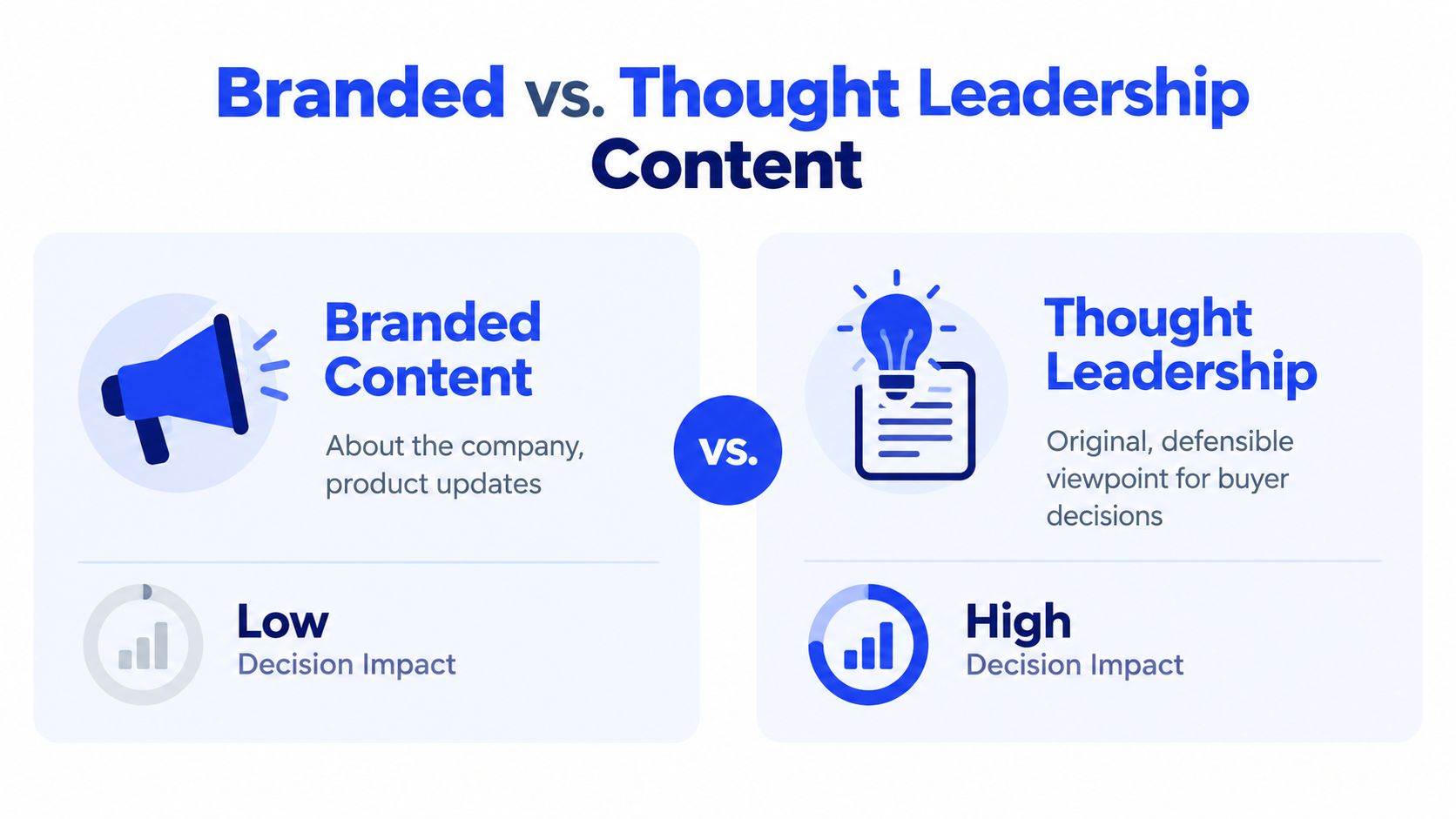
Thought leadership content is a defensible point of view backed by evidence that helps a buyer make a decision. It isn't merely branded content, which talks about the company, or educational content, which explains a topic without necessarily taking a position.
The distinction matters because pipeline comes from changed judgment. A buyer reads your argument and sees a problem differently, spots a risk earlier, or gains a framework they can use to compare vendors. That is decision impact.
Choose the right content mode
B2B teams usually choose between three modes, whether they name them or not.
Tip posts are easy to produce and useful for filling the middle of the funnel. They rarely create a distinct market position because competitors can repeat them without changing the argument.
Mistake posts often earn attention because they trigger recognition. The “expensive mistake” format can start conversations when it names a private fear, but it becomes engagement bait if the post offers no proof or usable method.
Framework posts require more work. They explain how to diagnose a situation, choose an action, and judge the result. Frameworks win for pipeline because sales can reuse them in conversations, prospects can share them internally, and the idea can support several formats.
The verdict is clear: frameworks win, tips fill the middle, and mistakes should rarely ship without evidence.
Use the three-part qualification test
Every piece should contain three ingredients:
A defensible point of view: State what you believe and what common assumption you reject.
Proprietary data or experience: Use your own delivery evidence, customer patterns, sales observations, or research you can defend.
A reusable framework: Give the reader a model they can apply without needing your help first.
A post about “better outbound” fails this test. A post arguing that list quality matters more than sequence volume, supported by CRM patterns and a qualification model, has a chance.
That standard also separates thought leadership from polished opinion. If a competitor can copy the wording without losing the substance, you haven't built a moat. Your experience, data, and operating model are the part they can't reproduce.
Why buyers now treat thought leadership as a vendor evaluation tool
A buyer enters a sales call already carrying an opinion about your company. That opinion often comes from the arguments, evidence, and judgment they encountered before speaking with anyone. The Edelman and LinkedIn B2B thought leadership study found that 73% of B2B decision-makers considered an organization's thought leadership more trustworthy than its marketing materials and product sheets when judging capabilities and competencies. It also found that 52% of B2B decision-makers and 54% of C-suite executives spend an hour or more each week reading thought leadership content.
That attention raises the bar. Buyers return to this material, use it to form judgments, and still see a large quality gap. The report found that only 15% rated most thought leadership they read as very good or excellent. Publish generic advice, and your content becomes evidence against your expertise.
Weak content can remove a live opportunity from the buying process. The 2024 Edelman and LinkedIn impact report found that 30% of business decision-makers and 35% of C-suite executives said weak thought leadership had caused them to remove a company from consideration.
Build for the skeptic on the committee
Use this operating table before publishing:
Buyer behavior signal | Stat | Operating rule for the team |
|---|---|---|
Thought leadership is trusted more than product sheets for capability judgments | 73% of decision-makers | Treat every substantial claim as part of vendor evaluation |
Executives read thought leadership regularly | 52% of decision-makers and 54% of C-suite executives spend an hour or more weekly | Publish for recurring evaluation, not a one-time campaign |
Weak content can remove a vendor from consideration | 30% of decision-makers and 35% of C-suite executives | Test every piece against a skeptical buying committee |
Most content fails to reach an excellent standard | Only 15% rated most content very good or excellent | Fund original proof and editing, not publishing volume |
Source every factual claim or label it clearly as opinion. Name the origin of each framework, whether it comes from your delivery method, customer evidence, or a transparent synthesis of research.
A vendor can cite respected studies and still lose to a competitor with proprietary numbers. Buyers want evidence from situations like theirs: what you observed, which pattern emerged, and how that pattern changes the decision. That is the content-to-revenue loop. A strong point of view creates evaluation, proprietary proof builds trust, and a usable model gives sales a reason to continue the conversation.
The goal is credibility that survives procurement review, a CFO's question, and the sales call where the buyer asks, “Why should we believe this?”
The five formats that earn pipeline, not just likes
Format follows buyer stage. Short LinkedIn posts create recognition and surface pain. Long-form articles capture search intent and give sales a durable asset. Newsletters support repeated exposure, while video makes executive reasoning easier to consume and repurpose.
Research reports sit above the regular content cadence. They take longer, but they give the company an original asset that can feed posts, sales conversations, webinars, newsletters, and press outreach.
Format | Primary stage | Effort | Shelf life | Pipeline job |
|---|---|---|---|---|
Short LinkedIn post | Awareness | Low | Short | Start recognition and conversations |
Long-form article | Awareness and evaluation | Medium | Long | Capture search demand and support sales follow-up |
Newsletter | Nurture | Medium | Medium | Keep an identified audience engaged |
Video | Awareness and evaluation | Medium | Medium | Explain judgment through voice and demonstration |
Podcast | Awareness and nurture | High | Medium | Build relationships and create interview assets |
Research report | Evaluation and conversion | High | Long | Create a proprietary reference point and sales asset |
The default mix should be 60% short LinkedIn posts, 30% long-form content, and 10% flagship research. That allocation keeps the brand visible without turning the calendar into an endless stream of shallow opinions.
Standalone podcasts should be deprioritized unless each episode produces clips, quotes, written posts, and a clear follow-up path. Generic webinars have the same weakness. They consume executive time but often leave behind a recording nobody searches for.
Unsearchable PDFs should also lose budget unless a sales process genuinely needs them. A gated asset that can't be found, quoted, or repurposed becomes a form-fill experiment rather than thought leadership.
For practical LinkedIn execution, use this guide to the best LinkedIn content formats to match the asset to the job it needs to perform.
A format earns its budget only when the core idea can become at least three other assets.
A research finding might become a LinkedIn post, a video script, a newsletter section, a sales enablement slide, and a question for an outbound sequence. If your production process can't create those derivatives, the format is probably too isolated.
LinkedIn as the distribution engine, not a posting schedule
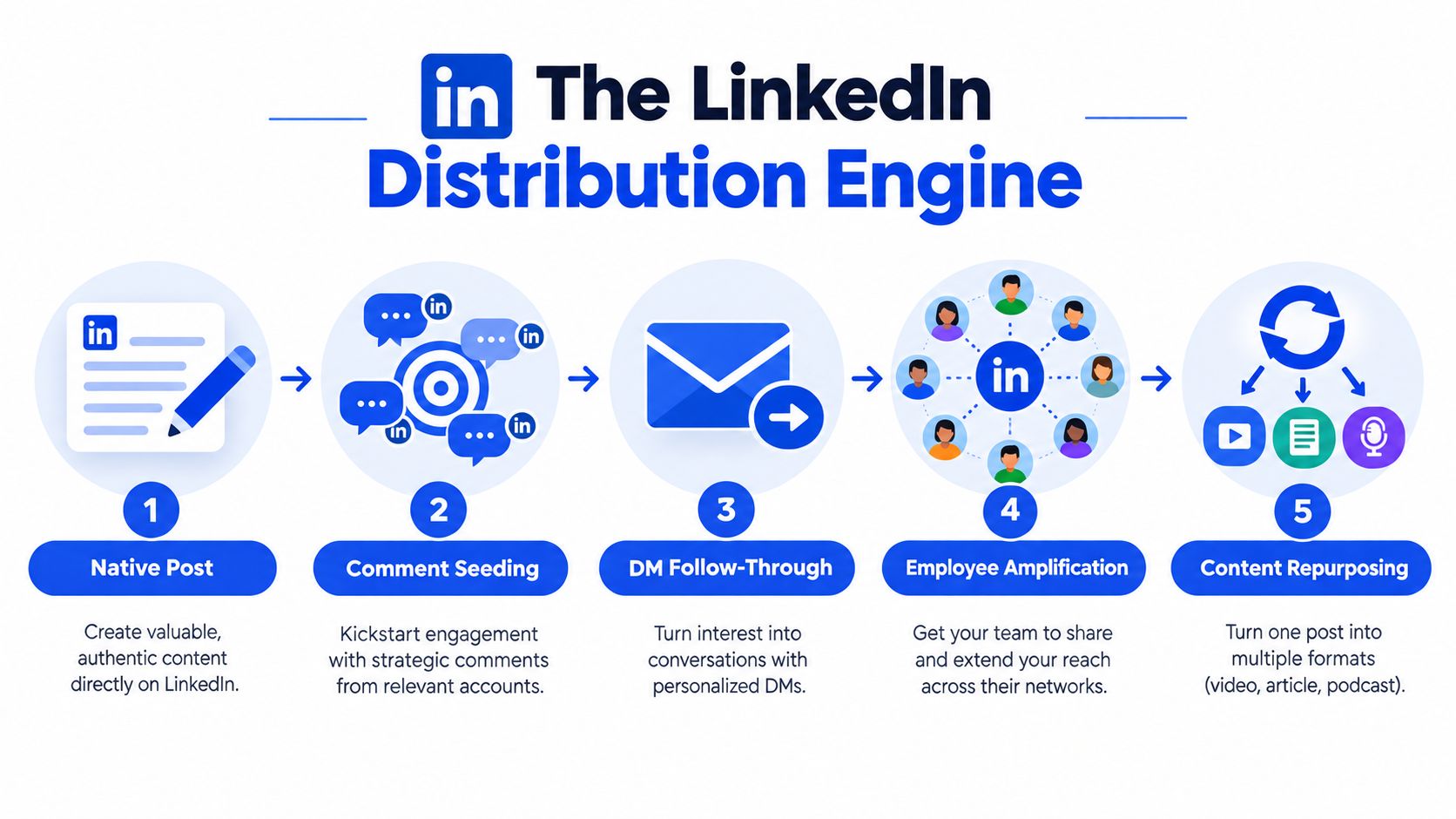
LinkedIn distribution needs five connected parts. The native post carries the point of view. Comment seeding puts that point of view beside conversations already happening on target accounts. DM follow-through turns relevant engagement into a human exchange.
Employee amplification expands the surface area. Repurposing turns one argument into carousels, newsletters, video scripts, and sales follow-up.
Run the channel as a weekly system
Use Shield, Taplio, or Buffer for scheduling and performance review. Use PhantomBuster or LinkedIn Sales Navigator to map target accounts and identify relevant conversations. Keep comment prompts, DM follow-up notes, and account context in a shared Notion board so the team doesn't improvise every interaction.
The hidden-buyer mechanic is easy to miss. Some committee members never like a post, but they read the comments, inspect the people responding, and share useful ideas internally. Comment seeding matters because it places your expertise in the discussion, not just in the original post.
Set the operating cadence at five posts, thirty meaningful comments, and ten DMs per week for each founder or executive sponsor. Those actions need to come from the same quarterly point of view. Random activity creates noise and makes attribution difficult.
The sequence should look like this:
Publish a native post with one claim and one clear implication.
Add useful comments to posts from target accounts and respected industry voices.
Follow up with engaged readers only when there's a relevant reason to continue.
Ask ten to twenty colleagues to add informed perspectives, not generic praise.
Convert the strongest idea into a carousel, newsletter section, video, or article.
For teams improving video distribution, these LinkedIn video tips for marketers are useful for the practical publishing details.
Your LinkedIn content strategy should therefore include account mapping and response routing. Posting is only the first event. The pipeline signal appears when the right reader saves the idea, sends a question, accepts a relevant conversation, or enters an opportunity.
The three-step system for ideating and writing posts that pull buyers
Start with the buyer's fear, not your own expertise. Most weak ideas begin with “what do I want to say?” Stronger ideas begin with the question, objection, or offhand worry that keeps appearing in discovery calls and DMs.
Mine the conversations
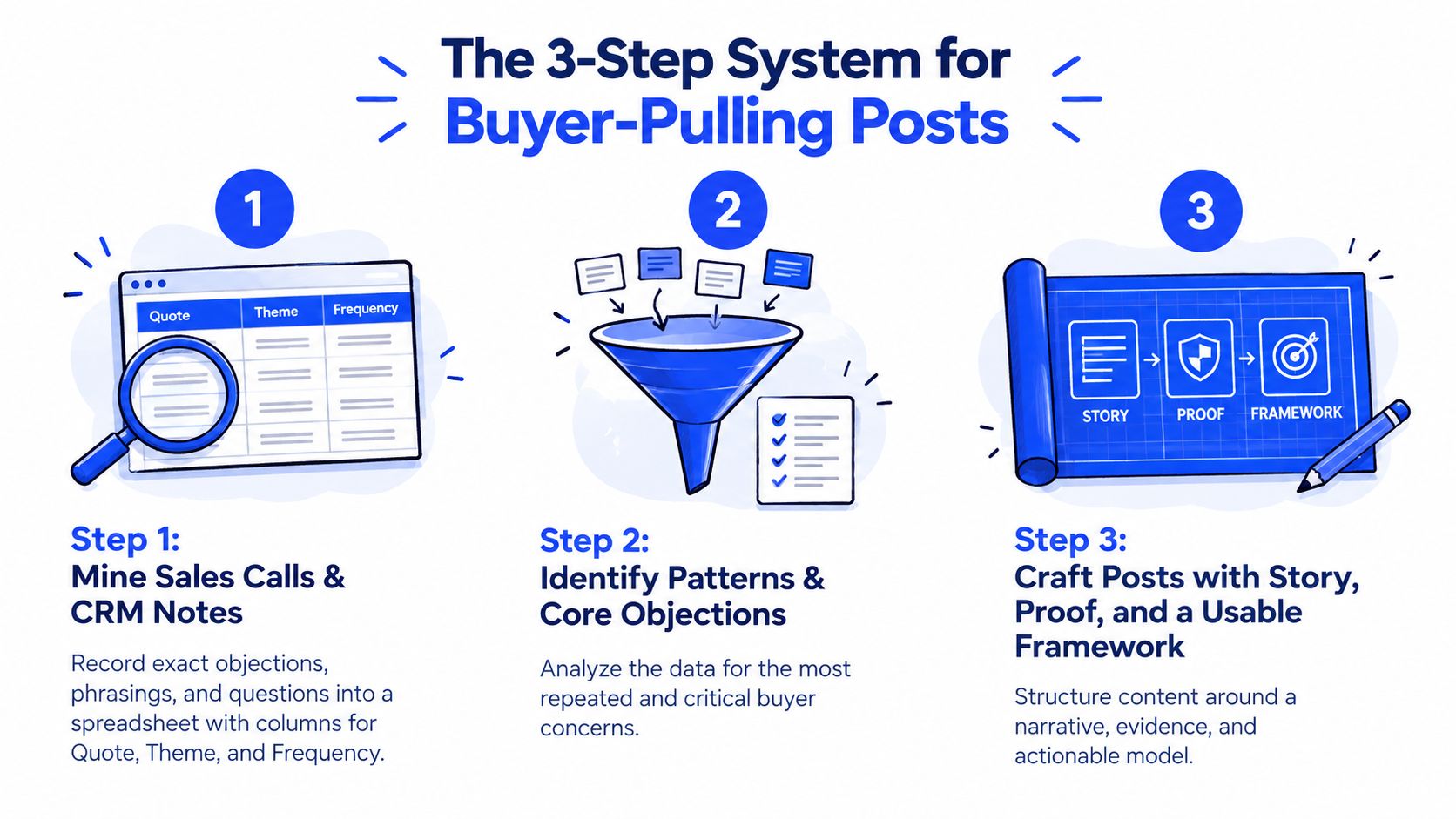
Pull exact language from call recordings, CRM notes, Slack messages, and sales DMs. Put it in a spreadsheet with three columns: Quote, Theme, and Frequency.
Don't paraphrase too early. The phrase a prospect uses to describe the problem is often a better headline than the language your marketing team invented. Look for emotional recurrence. If multiple buyers express the same worry during the month, treat it as a validated topic rather than a brainstorm.
Sharpen the raw pain
A raw pain becomes publishable only after you give it an opponent, a claim, proof, and implication.
“B2B content is broken” is too broad. “Daily posting beats weekly deep dives at the awareness stage because buyers need repeated recognition before they need a complete argument” is specific enough to test.
The post then needs evidence from your own distribution data, sales conversations, or a clearly labeled operating observation. Don't try to teach the entire content discipline in one post. Choose the one decision the reader should make differently after reading it.
Validate cheaply
Test the angle as a short comment, reply, LinkedIn poll, Slack community post, or question to five recent buyers. A full article is expensive. A one-line test is cheap.
Saves and DMs matter more than likes for this decision. Likes measure agreement. Saves and DMs indicate that someone recognized an active problem and may need to act.
Validation rule: A polite like is weak evidence. A buyer asking for the framework is a stronger signal.
Use the story, proof, structure formula when the angle earns a larger asset:
→ Story: Open with a concrete moment, such as a founder celebrating a meeting count before discovering that none of the meetings converted.
→ Proof: Add a real number, named result, or defensible observation from your own work.
→ Structure: Close with a model the reader can apply, such as reverse-engineering closed-won before building a prospect list.
The process is designed to separate peer applause from buyer recognition. A smaller post that starts qualified conversations is more valuable than broad reach with no commercial consequence.
Case examples that pair story, proof, and a usable framework
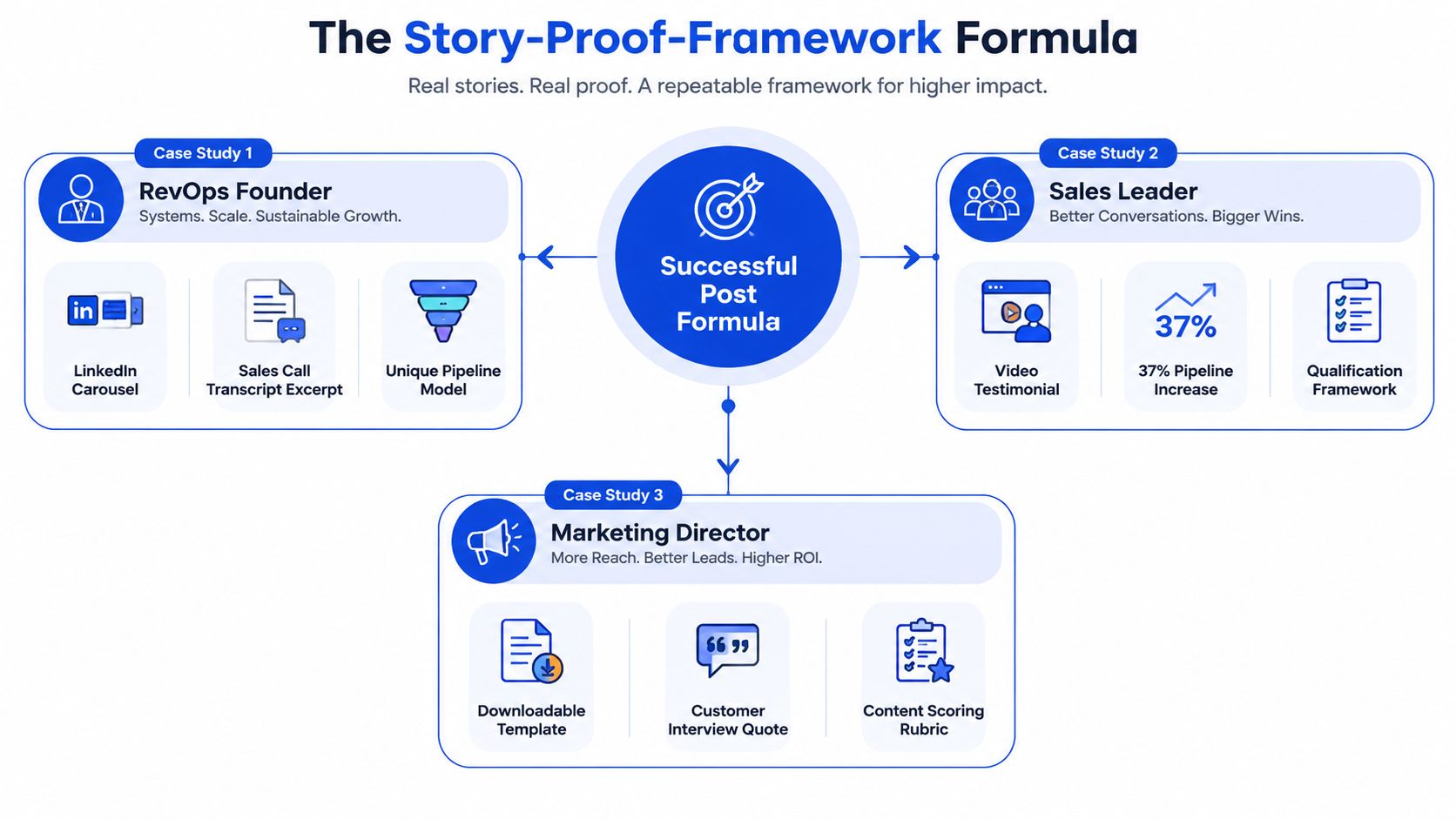
The strongest formula is simple: story earns attention, proof earns trust, and structure earns the follow. The examples below show how that formula can work in practice without turning a customer story into a self-congratulatory case study.
A B2B RevOps founder notices the same objection across sales calls during Q4. Instead of writing a general post about pipeline, the founder turns the pattern into a LinkedIn carousel, then develops a research report around the underlying problem. The framework maps the buyer's symptoms to the operational decisions causing them, giving sales a diagnostic asset rather than a promotional story.
A cybersecurity CMO takes a similar route with executive ghostwritten posts. The subject is not “why cybersecurity matters.” The content uses proprietary breach-cost data to explain how leadership teams should assess exposure, prioritize conversations, and challenge internal assumptions. The framework gives enterprise buyers a way to discuss risk before they compare vendors.
A fractional CTO documents recurring engineering failures in a weekly newsletter. Each issue starts with a specific incident, shows the technical consequence, and closes with a repeatable review model. Over time, the newsletter becomes a referral asset because readers can recognize the failure pattern in another company and forward the issue to the person responsible.
Extract the reusable pattern
The cases differ by role and topic, but the operating sequence is consistent:
Identify a recurring buyer problem: Use sales conversations, delivery work, and customer language.
Attach proprietary evidence: Add a real observation, internal dataset, transcript pattern, or customer-approved result.
Package a teachable framework: Help the reader diagnose the situation or choose an action.
Repurpose across formats: Build posts, carousels, newsletters, videos, research, and sales assets from the same core idea.
On Monday morning, open your last ten sales calls. Mark repeated objections and phrases. Pick one concern, write the claim your company believes about it, attach proof you can defend, and draft a framework with a name.
Then ask one recent buyer whether the angle reflects a real decision they face. If the answer is yes, create the larger asset. If the response is polite but vague, keep the insight in your notes and test a sharper version.
You can review relevant examples in the Grou case studies, but the transferable lesson is the system, not the surface format. Competitors can imitate a carousel style. They can't reproduce the evidence you gathered from your market.
Measuring thought leadership on pipeline, not applause
Impressions, likes, and follower growth are distribution signals. They aren't commercial outcomes. The pipeline dashboard needs to show qualified opportunities, pipeline created, cycle length, win rate, and revenue influence.
Edelman's 2024 impact research found that 75% of global B2B buyers and C-suite leaders said a specific piece of thought leadership had caused them to research a product or service they weren't previously considering. The same research found that 90% of B2B buyers experienced longer purchase cycles in 2024, which makes decision-support content more valuable during evaluation. (Edelman on thought leadership and B2B buyers)
Build first-party attribution
Track the complete path in HubSpot:
→ Content touchpoint
→ Engaged account
→ Qualified conversation
→ Opportunity stage
→ Closed-won revenue
Use Shield for LinkedIn performance data, Attributer for source capture, HubSpot source-to-revenue reports for opportunity influence, and a simple Looker dashboard for weekly review. Keep content attribution visible at the opportunity level so sales and marketing can inspect the same record.
A program measured across 28 closed deals found that content contributed 42% of attribution versus 34% from outbound. Those figures come from the supplied program data, not a general benchmark, so treat them as an example of first-party attribution rather than a universal expectation.
The saves-to-DMs ratio is a useful leading indicator because it connects passive engagement to active interest. Don't set a universal threshold without your own history. Establish a baseline, then compare which topics generate saved posts, inbound questions, meetings, and opportunities.
Metric category | Vanity metric, track but do not optimize | Pipeline metric, optimize for this |
|---|---|---|
Attention | Impressions and reach | Engaged target accounts |
Engagement | Likes and follower growth | Saves, DMs, and qualified replies |
Demand | Clicks and downloads | Qualified opportunities created |
Revenue | Assisted traffic | Pipeline sourced and revenue influenced |
Sales efficiency | Post engagement rate | Cycle length, win rate, and stage progression |
For a practical review of social performance signals, use TransClipper's analysis guide. The useful question isn't whether a post “performed.” It's whether the post changed account behavior.
Run the Friday review
Reserve thirty minutes every Friday. Cut topics that create broad agreement but no buyer conversations. Double down on ideas that attract saves, DMs, and qualified opportunity activity. Feed those findings into next week's sales-call mining.
Add these CRM fields:
Content topic
First content touch
Last content touch
Engaged account
Qualified conversation
Opportunity influence
Pipeline amount
Closed-won revenue
For related revenue reporting, use this guide to lead generation KPIs. Your content team should be able to answer which belief changed, which account responded, and what commercial stage moved.
The measurement loop is the moat. Proprietary data from your own market compounds into sharper ideas, better sales conversations, and content competitors can't copy.
GROU is a global B2B pipeline agency trusted by more than 50 companies across iGaming, SaaS, manufacturing, and professional services. Its methodology unifies ICP-aligned account research, LinkedIn content, outbound execution, reply routing, and pipeline reporting in one operating system.
Grou builds LinkedIn thought leadership systems that connect executive expertise to qualified conversations, outbound follow-up, and revenue attribution. Visit Grou to see how your content and pipeline motion can run from one message, one target list, and one reporting line.
Your Q3 pipeline is flat, the team is publishing three posts a week, and inbound demos are down while MQL-to-SQL conversion has weakened. The calendar looks active, but the content rarely gives a buying committee a reason to trust your judgment.
Pick one commercial point of view per quarter.
Mine sales calls for buyer language and proof.
Distribute on LinkedIn as a channel, not a schedule.
Measure saves, DMs, qualified opportunities, and revenue influence.
Thought leadership content becomes useful when structure turns attention into pipeline. That means treating every post, report, and executive opinion as part of one system, connected to the accounts your sales team wants and the objections those accounts raise.
Table of Contents
Why buyers now treat thought leadership as a vendor evaluation tool
The three-step system for ideating and writing posts that pull buyers
Case examples that pair story, proof, and a usable framework
The pipeline problem hiding behind your content calendar
Most B2B teams don't have a content shortage. They have a decision-quality shortage.
A founder approves another educational article. Marketing adds a customer quote to the calendar. Sales shares a post internally. Three weeks later, the team has more activity, but no stronger buying intent. The problem usually sits beneath the calendar: the content answers broad questions while buyers are wrestling with specific commercial risk.
Generic thought leadership fails in four predictable ways:
Recycled tips: Advice buyers have already seen from several vendors.
Founder-as-celebrity posts: Personal visibility without a connection to a buying problem.
Vendor-as-hero case studies: Stories that praise the provider but teach the reader very little.
Hedged opinions: Content so cautious that no buyer can tell what the company believes.
The result is content that attracts agreement rather than action. A head of marketing in SaaS, iGaming, manufacturing, legal tech, or pharma doesn't need another safe opinion. They need a point of view that helps them defend a decision to finance, procurement, compliance, or the executive team.
Your content system should run through four moves:
→ Choose one point of view that matters to your ICP this quarter.
→ Pull proof from sales calls, CRM notes, delivery work, and proprietary data.
→ Distribute the idea through native LinkedIn posts, comments, DMs, and repurposed formats.
→ Track saves, DMs, qualified opportunities, and sourced pipeline instead of treating likes as the outcome.
Operating rule: If sales can't connect a piece of content to a live objection, the content probably belongs in the backlog.
A useful content strategy connects the editorial system to the revenue system. The B2B content marketing strategy framework should therefore sit beside your account list, sales call notes, and opportunity stages, not in a separate brand folder.
The shift is straightforward but demanding. Stop asking whether the team published enough. Ask whether the right buyer recognized a costly problem, trusted your diagnosis, and had a reason to start a conversation.
What thought leadership content actually is in B2B
Thought leadership content is a defensible point of view backed by evidence that helps a buyer make a decision. It isn't merely branded content, which talks about the company, or educational content, which explains a topic without necessarily taking a position.
The distinction matters because pipeline comes from changed judgment. A buyer reads your argument and sees a problem differently, spots a risk earlier, or gains a framework they can use to compare vendors. That is decision impact.
Choose the right content mode
B2B teams usually choose between three modes, whether they name them or not.
Tip posts are easy to produce and useful for filling the middle of the funnel. They rarely create a distinct market position because competitors can repeat them without changing the argument.
Mistake posts often earn attention because they trigger recognition. The “expensive mistake” format can start conversations when it names a private fear, but it becomes engagement bait if the post offers no proof or usable method.
Framework posts require more work. They explain how to diagnose a situation, choose an action, and judge the result. Frameworks win for pipeline because sales can reuse them in conversations, prospects can share them internally, and the idea can support several formats.
The verdict is clear: frameworks win, tips fill the middle, and mistakes should rarely ship without evidence.
Use the three-part qualification test
Every piece should contain three ingredients:
A defensible point of view: State what you believe and what common assumption you reject.
Proprietary data or experience: Use your own delivery evidence, customer patterns, sales observations, or research you can defend.
A reusable framework: Give the reader a model they can apply without needing your help first.
A post about “better outbound” fails this test. A post arguing that list quality matters more than sequence volume, supported by CRM patterns and a qualification model, has a chance.
That standard also separates thought leadership from polished opinion. If a competitor can copy the wording without losing the substance, you haven't built a moat. Your experience, data, and operating model are the part they can't reproduce.
Why buyers now treat thought leadership as a vendor evaluation tool
A buyer enters a sales call already carrying an opinion about your company. That opinion often comes from the arguments, evidence, and judgment they encountered before speaking with anyone. The Edelman and LinkedIn B2B thought leadership study found that 73% of B2B decision-makers considered an organization's thought leadership more trustworthy than its marketing materials and product sheets when judging capabilities and competencies. It also found that 52% of B2B decision-makers and 54% of C-suite executives spend an hour or more each week reading thought leadership content.
That attention raises the bar. Buyers return to this material, use it to form judgments, and still see a large quality gap. The report found that only 15% rated most thought leadership they read as very good or excellent. Publish generic advice, and your content becomes evidence against your expertise.
Weak content can remove a live opportunity from the buying process. The 2024 Edelman and LinkedIn impact report found that 30% of business decision-makers and 35% of C-suite executives said weak thought leadership had caused them to remove a company from consideration.
Build for the skeptic on the committee
Use this operating table before publishing:
Buyer behavior signal | Stat | Operating rule for the team |
|---|---|---|
Thought leadership is trusted more than product sheets for capability judgments | 73% of decision-makers | Treat every substantial claim as part of vendor evaluation |
Executives read thought leadership regularly | 52% of decision-makers and 54% of C-suite executives spend an hour or more weekly | Publish for recurring evaluation, not a one-time campaign |
Weak content can remove a vendor from consideration | 30% of decision-makers and 35% of C-suite executives | Test every piece against a skeptical buying committee |
Most content fails to reach an excellent standard | Only 15% rated most content very good or excellent | Fund original proof and editing, not publishing volume |
Source every factual claim or label it clearly as opinion. Name the origin of each framework, whether it comes from your delivery method, customer evidence, or a transparent synthesis of research.
A vendor can cite respected studies and still lose to a competitor with proprietary numbers. Buyers want evidence from situations like theirs: what you observed, which pattern emerged, and how that pattern changes the decision. That is the content-to-revenue loop. A strong point of view creates evaluation, proprietary proof builds trust, and a usable model gives sales a reason to continue the conversation.
The goal is credibility that survives procurement review, a CFO's question, and the sales call where the buyer asks, “Why should we believe this?”
The five formats that earn pipeline, not just likes
Format follows buyer stage. Short LinkedIn posts create recognition and surface pain. Long-form articles capture search intent and give sales a durable asset. Newsletters support repeated exposure, while video makes executive reasoning easier to consume and repurpose.
Research reports sit above the regular content cadence. They take longer, but they give the company an original asset that can feed posts, sales conversations, webinars, newsletters, and press outreach.
Format | Primary stage | Effort | Shelf life | Pipeline job |
|---|---|---|---|---|
Short LinkedIn post | Awareness | Low | Short | Start recognition and conversations |
Long-form article | Awareness and evaluation | Medium | Long | Capture search demand and support sales follow-up |
Newsletter | Nurture | Medium | Medium | Keep an identified audience engaged |
Video | Awareness and evaluation | Medium | Medium | Explain judgment through voice and demonstration |
Podcast | Awareness and nurture | High | Medium | Build relationships and create interview assets |
Research report | Evaluation and conversion | High | Long | Create a proprietary reference point and sales asset |
The default mix should be 60% short LinkedIn posts, 30% long-form content, and 10% flagship research. That allocation keeps the brand visible without turning the calendar into an endless stream of shallow opinions.
Standalone podcasts should be deprioritized unless each episode produces clips, quotes, written posts, and a clear follow-up path. Generic webinars have the same weakness. They consume executive time but often leave behind a recording nobody searches for.
Unsearchable PDFs should also lose budget unless a sales process genuinely needs them. A gated asset that can't be found, quoted, or repurposed becomes a form-fill experiment rather than thought leadership.
For practical LinkedIn execution, use this guide to the best LinkedIn content formats to match the asset to the job it needs to perform.
A format earns its budget only when the core idea can become at least three other assets.
A research finding might become a LinkedIn post, a video script, a newsletter section, a sales enablement slide, and a question for an outbound sequence. If your production process can't create those derivatives, the format is probably too isolated.
LinkedIn as the distribution engine, not a posting schedule
LinkedIn distribution needs five connected parts. The native post carries the point of view. Comment seeding puts that point of view beside conversations already happening on target accounts. DM follow-through turns relevant engagement into a human exchange.
Employee amplification expands the surface area. Repurposing turns one argument into carousels, newsletters, video scripts, and sales follow-up.
Run the channel as a weekly system
Use Shield, Taplio, or Buffer for scheduling and performance review. Use PhantomBuster or LinkedIn Sales Navigator to map target accounts and identify relevant conversations. Keep comment prompts, DM follow-up notes, and account context in a shared Notion board so the team doesn't improvise every interaction.
The hidden-buyer mechanic is easy to miss. Some committee members never like a post, but they read the comments, inspect the people responding, and share useful ideas internally. Comment seeding matters because it places your expertise in the discussion, not just in the original post.
Set the operating cadence at five posts, thirty meaningful comments, and ten DMs per week for each founder or executive sponsor. Those actions need to come from the same quarterly point of view. Random activity creates noise and makes attribution difficult.
The sequence should look like this:
Publish a native post with one claim and one clear implication.
Add useful comments to posts from target accounts and respected industry voices.
Follow up with engaged readers only when there's a relevant reason to continue.
Ask ten to twenty colleagues to add informed perspectives, not generic praise.
Convert the strongest idea into a carousel, newsletter section, video, or article.
For teams improving video distribution, these LinkedIn video tips for marketers are useful for the practical publishing details.
Your LinkedIn content strategy should therefore include account mapping and response routing. Posting is only the first event. The pipeline signal appears when the right reader saves the idea, sends a question, accepts a relevant conversation, or enters an opportunity.
The three-step system for ideating and writing posts that pull buyers
Start with the buyer's fear, not your own expertise. Most weak ideas begin with “what do I want to say?” Stronger ideas begin with the question, objection, or offhand worry that keeps appearing in discovery calls and DMs.
Mine the conversations
Pull exact language from call recordings, CRM notes, Slack messages, and sales DMs. Put it in a spreadsheet with three columns: Quote, Theme, and Frequency.
Don't paraphrase too early. The phrase a prospect uses to describe the problem is often a better headline than the language your marketing team invented. Look for emotional recurrence. If multiple buyers express the same worry during the month, treat it as a validated topic rather than a brainstorm.
Sharpen the raw pain
A raw pain becomes publishable only after you give it an opponent, a claim, proof, and implication.
“B2B content is broken” is too broad. “Daily posting beats weekly deep dives at the awareness stage because buyers need repeated recognition before they need a complete argument” is specific enough to test.
The post then needs evidence from your own distribution data, sales conversations, or a clearly labeled operating observation. Don't try to teach the entire content discipline in one post. Choose the one decision the reader should make differently after reading it.
Validate cheaply
Test the angle as a short comment, reply, LinkedIn poll, Slack community post, or question to five recent buyers. A full article is expensive. A one-line test is cheap.
Saves and DMs matter more than likes for this decision. Likes measure agreement. Saves and DMs indicate that someone recognized an active problem and may need to act.
Validation rule: A polite like is weak evidence. A buyer asking for the framework is a stronger signal.
Use the story, proof, structure formula when the angle earns a larger asset:
→ Story: Open with a concrete moment, such as a founder celebrating a meeting count before discovering that none of the meetings converted.
→ Proof: Add a real number, named result, or defensible observation from your own work.
→ Structure: Close with a model the reader can apply, such as reverse-engineering closed-won before building a prospect list.
The process is designed to separate peer applause from buyer recognition. A smaller post that starts qualified conversations is more valuable than broad reach with no commercial consequence.
Case examples that pair story, proof, and a usable framework
The strongest formula is simple: story earns attention, proof earns trust, and structure earns the follow. The examples below show how that formula can work in practice without turning a customer story into a self-congratulatory case study.
A B2B RevOps founder notices the same objection across sales calls during Q4. Instead of writing a general post about pipeline, the founder turns the pattern into a LinkedIn carousel, then develops a research report around the underlying problem. The framework maps the buyer's symptoms to the operational decisions causing them, giving sales a diagnostic asset rather than a promotional story.
A cybersecurity CMO takes a similar route with executive ghostwritten posts. The subject is not “why cybersecurity matters.” The content uses proprietary breach-cost data to explain how leadership teams should assess exposure, prioritize conversations, and challenge internal assumptions. The framework gives enterprise buyers a way to discuss risk before they compare vendors.
A fractional CTO documents recurring engineering failures in a weekly newsletter. Each issue starts with a specific incident, shows the technical consequence, and closes with a repeatable review model. Over time, the newsletter becomes a referral asset because readers can recognize the failure pattern in another company and forward the issue to the person responsible.
Extract the reusable pattern
The cases differ by role and topic, but the operating sequence is consistent:
Identify a recurring buyer problem: Use sales conversations, delivery work, and customer language.
Attach proprietary evidence: Add a real observation, internal dataset, transcript pattern, or customer-approved result.
Package a teachable framework: Help the reader diagnose the situation or choose an action.
Repurpose across formats: Build posts, carousels, newsletters, videos, research, and sales assets from the same core idea.
On Monday morning, open your last ten sales calls. Mark repeated objections and phrases. Pick one concern, write the claim your company believes about it, attach proof you can defend, and draft a framework with a name.
Then ask one recent buyer whether the angle reflects a real decision they face. If the answer is yes, create the larger asset. If the response is polite but vague, keep the insight in your notes and test a sharper version.
You can review relevant examples in the Grou case studies, but the transferable lesson is the system, not the surface format. Competitors can imitate a carousel style. They can't reproduce the evidence you gathered from your market.
Measuring thought leadership on pipeline, not applause
Impressions, likes, and follower growth are distribution signals. They aren't commercial outcomes. The pipeline dashboard needs to show qualified opportunities, pipeline created, cycle length, win rate, and revenue influence.
Edelman's 2024 impact research found that 75% of global B2B buyers and C-suite leaders said a specific piece of thought leadership had caused them to research a product or service they weren't previously considering. The same research found that 90% of B2B buyers experienced longer purchase cycles in 2024, which makes decision-support content more valuable during evaluation. (Edelman on thought leadership and B2B buyers)
Build first-party attribution
Track the complete path in HubSpot:
→ Content touchpoint
→ Engaged account
→ Qualified conversation
→ Opportunity stage
→ Closed-won revenue
Use Shield for LinkedIn performance data, Attributer for source capture, HubSpot source-to-revenue reports for opportunity influence, and a simple Looker dashboard for weekly review. Keep content attribution visible at the opportunity level so sales and marketing can inspect the same record.
A program measured across 28 closed deals found that content contributed 42% of attribution versus 34% from outbound. Those figures come from the supplied program data, not a general benchmark, so treat them as an example of first-party attribution rather than a universal expectation.
The saves-to-DMs ratio is a useful leading indicator because it connects passive engagement to active interest. Don't set a universal threshold without your own history. Establish a baseline, then compare which topics generate saved posts, inbound questions, meetings, and opportunities.
Metric category | Vanity metric, track but do not optimize | Pipeline metric, optimize for this |
|---|---|---|
Attention | Impressions and reach | Engaged target accounts |
Engagement | Likes and follower growth | Saves, DMs, and qualified replies |
Demand | Clicks and downloads | Qualified opportunities created |
Revenue | Assisted traffic | Pipeline sourced and revenue influenced |
Sales efficiency | Post engagement rate | Cycle length, win rate, and stage progression |
For a practical review of social performance signals, use TransClipper's analysis guide. The useful question isn't whether a post “performed.” It's whether the post changed account behavior.
Run the Friday review
Reserve thirty minutes every Friday. Cut topics that create broad agreement but no buyer conversations. Double down on ideas that attract saves, DMs, and qualified opportunity activity. Feed those findings into next week's sales-call mining.
Add these CRM fields:
Content topic
First content touch
Last content touch
Engaged account
Qualified conversation
Opportunity influence
Pipeline amount
Closed-won revenue
For related revenue reporting, use this guide to lead generation KPIs. Your content team should be able to answer which belief changed, which account responded, and what commercial stage moved.
The measurement loop is the moat. Proprietary data from your own market compounds into sharper ideas, better sales conversations, and content competitors can't copy.
GROU is a global B2B pipeline agency trusted by more than 50 companies across iGaming, SaaS, manufacturing, and professional services. Its methodology unifies ICP-aligned account research, LinkedIn content, outbound execution, reply routing, and pipeline reporting in one operating system.
Grou builds LinkedIn thought leadership systems that connect executive expertise to qualified conversations, outbound follow-up, and revenue attribution. Visit Grou to see how your content and pipeline motion can run from one message, one target list, and one reporting line.
Your Q3 pipeline is flat, the team is publishing three posts a week, and inbound demos are down while MQL-to-SQL conversion has weakened. The calendar looks active, but the content rarely gives a buying committee a reason to trust your judgment.
Pick one commercial point of view per quarter.
Mine sales calls for buyer language and proof.
Distribute on LinkedIn as a channel, not a schedule.
Measure saves, DMs, qualified opportunities, and revenue influence.
Thought leadership content becomes useful when structure turns attention into pipeline. That means treating every post, report, and executive opinion as part of one system, connected to the accounts your sales team wants and the objections those accounts raise.
Table of Contents
Why buyers now treat thought leadership as a vendor evaluation tool
The three-step system for ideating and writing posts that pull buyers
Case examples that pair story, proof, and a usable framework
The pipeline problem hiding behind your content calendar
Most B2B teams don't have a content shortage. They have a decision-quality shortage.
A founder approves another educational article. Marketing adds a customer quote to the calendar. Sales shares a post internally. Three weeks later, the team has more activity, but no stronger buying intent. The problem usually sits beneath the calendar: the content answers broad questions while buyers are wrestling with specific commercial risk.
Generic thought leadership fails in four predictable ways:
Recycled tips: Advice buyers have already seen from several vendors.
Founder-as-celebrity posts: Personal visibility without a connection to a buying problem.
Vendor-as-hero case studies: Stories that praise the provider but teach the reader very little.
Hedged opinions: Content so cautious that no buyer can tell what the company believes.
The result is content that attracts agreement rather than action. A head of marketing in SaaS, iGaming, manufacturing, legal tech, or pharma doesn't need another safe opinion. They need a point of view that helps them defend a decision to finance, procurement, compliance, or the executive team.
Your content system should run through four moves:
→ Choose one point of view that matters to your ICP this quarter.
→ Pull proof from sales calls, CRM notes, delivery work, and proprietary data.
→ Distribute the idea through native LinkedIn posts, comments, DMs, and repurposed formats.
→ Track saves, DMs, qualified opportunities, and sourced pipeline instead of treating likes as the outcome.
Operating rule: If sales can't connect a piece of content to a live objection, the content probably belongs in the backlog.
A useful content strategy connects the editorial system to the revenue system. The B2B content marketing strategy framework should therefore sit beside your account list, sales call notes, and opportunity stages, not in a separate brand folder.
The shift is straightforward but demanding. Stop asking whether the team published enough. Ask whether the right buyer recognized a costly problem, trusted your diagnosis, and had a reason to start a conversation.
What thought leadership content actually is in B2B
Thought leadership content is a defensible point of view backed by evidence that helps a buyer make a decision. It isn't merely branded content, which talks about the company, or educational content, which explains a topic without necessarily taking a position.
The distinction matters because pipeline comes from changed judgment. A buyer reads your argument and sees a problem differently, spots a risk earlier, or gains a framework they can use to compare vendors. That is decision impact.
Choose the right content mode
B2B teams usually choose between three modes, whether they name them or not.
Tip posts are easy to produce and useful for filling the middle of the funnel. They rarely create a distinct market position because competitors can repeat them without changing the argument.
Mistake posts often earn attention because they trigger recognition. The “expensive mistake” format can start conversations when it names a private fear, but it becomes engagement bait if the post offers no proof or usable method.
Framework posts require more work. They explain how to diagnose a situation, choose an action, and judge the result. Frameworks win for pipeline because sales can reuse them in conversations, prospects can share them internally, and the idea can support several formats.
The verdict is clear: frameworks win, tips fill the middle, and mistakes should rarely ship without evidence.
Use the three-part qualification test
Every piece should contain three ingredients:
A defensible point of view: State what you believe and what common assumption you reject.
Proprietary data or experience: Use your own delivery evidence, customer patterns, sales observations, or research you can defend.
A reusable framework: Give the reader a model they can apply without needing your help first.
A post about “better outbound” fails this test. A post arguing that list quality matters more than sequence volume, supported by CRM patterns and a qualification model, has a chance.
That standard also separates thought leadership from polished opinion. If a competitor can copy the wording without losing the substance, you haven't built a moat. Your experience, data, and operating model are the part they can't reproduce.
Why buyers now treat thought leadership as a vendor evaluation tool
A buyer enters a sales call already carrying an opinion about your company. That opinion often comes from the arguments, evidence, and judgment they encountered before speaking with anyone. The Edelman and LinkedIn B2B thought leadership study found that 73% of B2B decision-makers considered an organization's thought leadership more trustworthy than its marketing materials and product sheets when judging capabilities and competencies. It also found that 52% of B2B decision-makers and 54% of C-suite executives spend an hour or more each week reading thought leadership content.
That attention raises the bar. Buyers return to this material, use it to form judgments, and still see a large quality gap. The report found that only 15% rated most thought leadership they read as very good or excellent. Publish generic advice, and your content becomes evidence against your expertise.
Weak content can remove a live opportunity from the buying process. The 2024 Edelman and LinkedIn impact report found that 30% of business decision-makers and 35% of C-suite executives said weak thought leadership had caused them to remove a company from consideration.
Build for the skeptic on the committee
Use this operating table before publishing:
Buyer behavior signal | Stat | Operating rule for the team |
|---|---|---|
Thought leadership is trusted more than product sheets for capability judgments | 73% of decision-makers | Treat every substantial claim as part of vendor evaluation |
Executives read thought leadership regularly | 52% of decision-makers and 54% of C-suite executives spend an hour or more weekly | Publish for recurring evaluation, not a one-time campaign |
Weak content can remove a vendor from consideration | 30% of decision-makers and 35% of C-suite executives | Test every piece against a skeptical buying committee |
Most content fails to reach an excellent standard | Only 15% rated most content very good or excellent | Fund original proof and editing, not publishing volume |
Source every factual claim or label it clearly as opinion. Name the origin of each framework, whether it comes from your delivery method, customer evidence, or a transparent synthesis of research.
A vendor can cite respected studies and still lose to a competitor with proprietary numbers. Buyers want evidence from situations like theirs: what you observed, which pattern emerged, and how that pattern changes the decision. That is the content-to-revenue loop. A strong point of view creates evaluation, proprietary proof builds trust, and a usable model gives sales a reason to continue the conversation.
The goal is credibility that survives procurement review, a CFO's question, and the sales call where the buyer asks, “Why should we believe this?”
The five formats that earn pipeline, not just likes
Format follows buyer stage. Short LinkedIn posts create recognition and surface pain. Long-form articles capture search intent and give sales a durable asset. Newsletters support repeated exposure, while video makes executive reasoning easier to consume and repurpose.
Research reports sit above the regular content cadence. They take longer, but they give the company an original asset that can feed posts, sales conversations, webinars, newsletters, and press outreach.
Format | Primary stage | Effort | Shelf life | Pipeline job |
|---|---|---|---|---|
Short LinkedIn post | Awareness | Low | Short | Start recognition and conversations |
Long-form article | Awareness and evaluation | Medium | Long | Capture search demand and support sales follow-up |
Newsletter | Nurture | Medium | Medium | Keep an identified audience engaged |
Video | Awareness and evaluation | Medium | Medium | Explain judgment through voice and demonstration |
Podcast | Awareness and nurture | High | Medium | Build relationships and create interview assets |
Research report | Evaluation and conversion | High | Long | Create a proprietary reference point and sales asset |
The default mix should be 60% short LinkedIn posts, 30% long-form content, and 10% flagship research. That allocation keeps the brand visible without turning the calendar into an endless stream of shallow opinions.
Standalone podcasts should be deprioritized unless each episode produces clips, quotes, written posts, and a clear follow-up path. Generic webinars have the same weakness. They consume executive time but often leave behind a recording nobody searches for.
Unsearchable PDFs should also lose budget unless a sales process genuinely needs them. A gated asset that can't be found, quoted, or repurposed becomes a form-fill experiment rather than thought leadership.
For practical LinkedIn execution, use this guide to the best LinkedIn content formats to match the asset to the job it needs to perform.
A format earns its budget only when the core idea can become at least three other assets.
A research finding might become a LinkedIn post, a video script, a newsletter section, a sales enablement slide, and a question for an outbound sequence. If your production process can't create those derivatives, the format is probably too isolated.
LinkedIn as the distribution engine, not a posting schedule
LinkedIn distribution needs five connected parts. The native post carries the point of view. Comment seeding puts that point of view beside conversations already happening on target accounts. DM follow-through turns relevant engagement into a human exchange.
Employee amplification expands the surface area. Repurposing turns one argument into carousels, newsletters, video scripts, and sales follow-up.
Run the channel as a weekly system
Use Shield, Taplio, or Buffer for scheduling and performance review. Use PhantomBuster or LinkedIn Sales Navigator to map target accounts and identify relevant conversations. Keep comment prompts, DM follow-up notes, and account context in a shared Notion board so the team doesn't improvise every interaction.
The hidden-buyer mechanic is easy to miss. Some committee members never like a post, but they read the comments, inspect the people responding, and share useful ideas internally. Comment seeding matters because it places your expertise in the discussion, not just in the original post.
Set the operating cadence at five posts, thirty meaningful comments, and ten DMs per week for each founder or executive sponsor. Those actions need to come from the same quarterly point of view. Random activity creates noise and makes attribution difficult.
The sequence should look like this:
Publish a native post with one claim and one clear implication.
Add useful comments to posts from target accounts and respected industry voices.
Follow up with engaged readers only when there's a relevant reason to continue.
Ask ten to twenty colleagues to add informed perspectives, not generic praise.
Convert the strongest idea into a carousel, newsletter section, video, or article.
For teams improving video distribution, these LinkedIn video tips for marketers are useful for the practical publishing details.
Your LinkedIn content strategy should therefore include account mapping and response routing. Posting is only the first event. The pipeline signal appears when the right reader saves the idea, sends a question, accepts a relevant conversation, or enters an opportunity.
The three-step system for ideating and writing posts that pull buyers
Start with the buyer's fear, not your own expertise. Most weak ideas begin with “what do I want to say?” Stronger ideas begin with the question, objection, or offhand worry that keeps appearing in discovery calls and DMs.
Mine the conversations
Pull exact language from call recordings, CRM notes, Slack messages, and sales DMs. Put it in a spreadsheet with three columns: Quote, Theme, and Frequency.
Don't paraphrase too early. The phrase a prospect uses to describe the problem is often a better headline than the language your marketing team invented. Look for emotional recurrence. If multiple buyers express the same worry during the month, treat it as a validated topic rather than a brainstorm.
Sharpen the raw pain
A raw pain becomes publishable only after you give it an opponent, a claim, proof, and implication.
“B2B content is broken” is too broad. “Daily posting beats weekly deep dives at the awareness stage because buyers need repeated recognition before they need a complete argument” is specific enough to test.
The post then needs evidence from your own distribution data, sales conversations, or a clearly labeled operating observation. Don't try to teach the entire content discipline in one post. Choose the one decision the reader should make differently after reading it.
Validate cheaply
Test the angle as a short comment, reply, LinkedIn poll, Slack community post, or question to five recent buyers. A full article is expensive. A one-line test is cheap.
Saves and DMs matter more than likes for this decision. Likes measure agreement. Saves and DMs indicate that someone recognized an active problem and may need to act.
Validation rule: A polite like is weak evidence. A buyer asking for the framework is a stronger signal.
Use the story, proof, structure formula when the angle earns a larger asset:
→ Story: Open with a concrete moment, such as a founder celebrating a meeting count before discovering that none of the meetings converted.
→ Proof: Add a real number, named result, or defensible observation from your own work.
→ Structure: Close with a model the reader can apply, such as reverse-engineering closed-won before building a prospect list.
The process is designed to separate peer applause from buyer recognition. A smaller post that starts qualified conversations is more valuable than broad reach with no commercial consequence.
Case examples that pair story, proof, and a usable framework
The strongest formula is simple: story earns attention, proof earns trust, and structure earns the follow. The examples below show how that formula can work in practice without turning a customer story into a self-congratulatory case study.
A B2B RevOps founder notices the same objection across sales calls during Q4. Instead of writing a general post about pipeline, the founder turns the pattern into a LinkedIn carousel, then develops a research report around the underlying problem. The framework maps the buyer's symptoms to the operational decisions causing them, giving sales a diagnostic asset rather than a promotional story.
A cybersecurity CMO takes a similar route with executive ghostwritten posts. The subject is not “why cybersecurity matters.” The content uses proprietary breach-cost data to explain how leadership teams should assess exposure, prioritize conversations, and challenge internal assumptions. The framework gives enterprise buyers a way to discuss risk before they compare vendors.
A fractional CTO documents recurring engineering failures in a weekly newsletter. Each issue starts with a specific incident, shows the technical consequence, and closes with a repeatable review model. Over time, the newsletter becomes a referral asset because readers can recognize the failure pattern in another company and forward the issue to the person responsible.
Extract the reusable pattern
The cases differ by role and topic, but the operating sequence is consistent:
Identify a recurring buyer problem: Use sales conversations, delivery work, and customer language.
Attach proprietary evidence: Add a real observation, internal dataset, transcript pattern, or customer-approved result.
Package a teachable framework: Help the reader diagnose the situation or choose an action.
Repurpose across formats: Build posts, carousels, newsletters, videos, research, and sales assets from the same core idea.
On Monday morning, open your last ten sales calls. Mark repeated objections and phrases. Pick one concern, write the claim your company believes about it, attach proof you can defend, and draft a framework with a name.
Then ask one recent buyer whether the angle reflects a real decision they face. If the answer is yes, create the larger asset. If the response is polite but vague, keep the insight in your notes and test a sharper version.
You can review relevant examples in the Grou case studies, but the transferable lesson is the system, not the surface format. Competitors can imitate a carousel style. They can't reproduce the evidence you gathered from your market.
Measuring thought leadership on pipeline, not applause
Impressions, likes, and follower growth are distribution signals. They aren't commercial outcomes. The pipeline dashboard needs to show qualified opportunities, pipeline created, cycle length, win rate, and revenue influence.
Edelman's 2024 impact research found that 75% of global B2B buyers and C-suite leaders said a specific piece of thought leadership had caused them to research a product or service they weren't previously considering. The same research found that 90% of B2B buyers experienced longer purchase cycles in 2024, which makes decision-support content more valuable during evaluation. (Edelman on thought leadership and B2B buyers)
Build first-party attribution
Track the complete path in HubSpot:
→ Content touchpoint
→ Engaged account
→ Qualified conversation
→ Opportunity stage
→ Closed-won revenue
Use Shield for LinkedIn performance data, Attributer for source capture, HubSpot source-to-revenue reports for opportunity influence, and a simple Looker dashboard for weekly review. Keep content attribution visible at the opportunity level so sales and marketing can inspect the same record.
A program measured across 28 closed deals found that content contributed 42% of attribution versus 34% from outbound. Those figures come from the supplied program data, not a general benchmark, so treat them as an example of first-party attribution rather than a universal expectation.
The saves-to-DMs ratio is a useful leading indicator because it connects passive engagement to active interest. Don't set a universal threshold without your own history. Establish a baseline, then compare which topics generate saved posts, inbound questions, meetings, and opportunities.
Metric category | Vanity metric, track but do not optimize | Pipeline metric, optimize for this |
|---|---|---|
Attention | Impressions and reach | Engaged target accounts |
Engagement | Likes and follower growth | Saves, DMs, and qualified replies |
Demand | Clicks and downloads | Qualified opportunities created |
Revenue | Assisted traffic | Pipeline sourced and revenue influenced |
Sales efficiency | Post engagement rate | Cycle length, win rate, and stage progression |
For a practical review of social performance signals, use TransClipper's analysis guide. The useful question isn't whether a post “performed.” It's whether the post changed account behavior.
Run the Friday review
Reserve thirty minutes every Friday. Cut topics that create broad agreement but no buyer conversations. Double down on ideas that attract saves, DMs, and qualified opportunity activity. Feed those findings into next week's sales-call mining.
Add these CRM fields:
Content topic
First content touch
Last content touch
Engaged account
Qualified conversation
Opportunity influence
Pipeline amount
Closed-won revenue
For related revenue reporting, use this guide to lead generation KPIs. Your content team should be able to answer which belief changed, which account responded, and what commercial stage moved.
The measurement loop is the moat. Proprietary data from your own market compounds into sharper ideas, better sales conversations, and content competitors can't copy.
GROU is a global B2B pipeline agency trusted by more than 50 companies across iGaming, SaaS, manufacturing, and professional services. Its methodology unifies ICP-aligned account research, LinkedIn content, outbound execution, reply routing, and pipeline reporting in one operating system.
Grou builds LinkedIn thought leadership systems that connect executive expertise to qualified conversations, outbound follow-up, and revenue attribution. Visit Grou to see how your content and pipeline motion can run from one message, one target list, and one reporting line.

Pipeline OS Newsletter
Build qualified pipeline
Get weekly tactics to generate demand, improve lead quality, and book more meetings.





Trusted by industry leaders
Trusted by industry leaders
Trusted by industry leaders
Ready to build qualified pipeline?
Ready to build qualified pipeline?
Ready to build qualified pipeline?
Book a call to see if we're the right fit, or take the 2-minute quiz to get a clear starting point.
Book a call to see if we're the right fit, or take the 2-minute quiz to get a clear starting point.
Book a call to see if we're the right fit, or take the 2-minute quiz to get a clear starting point.
" height="30.21639343089746px" id="hfGbXmQR2" width="30.216393430897455px"/></svg>)
Copyright © 2026 – All Right Reserved
Copyright © 2026 – All Right Reserved
Copyright © 2026 – All Right Reserved