%22%3E%3C/path%3E%3Cpath d=%22M 63.072 7.554 C 62.258 8.022 61.577 8.689 61.092 9.493 L 61.092 7.076 L 57.158 7.076 L 57.158 22.64 L 61.089 22.64 L 61.089 14.888 C 61.089 13.446 61.403 12.434 62.03 11.853 C 62.818 11.218 63.818 10.907 64.826 10.982 L 65.868 10.982 L 65.868 6.851 C 64.891 6.834 63.926 7.076 63.073 7.554 Z%22 fill=%22rgb(17,17,17)%22%3E%3C/path%3E%3Cpath d=%22M 78.916 7.82 C 76.363 6.49 73.321 6.49 70.768 7.82 C 69.562 8.473 68.564 9.451 67.888 10.644 C 67.167 11.931 66.803 13.387 66.834 14.862 C 66.804 16.332 67.157 17.785 67.86 19.077 C 68.515 20.267 69.494 21.246 70.684 21.901 C 71.924 22.576 73.318 22.92 74.73 22.898 C 76.164 22.918 77.58 22.575 78.846 21.901 C 80.062 21.247 81.073 20.27 81.768 19.077 C 82.506 17.797 82.88 16.339 82.85 14.862 C 82.88 13.389 82.517 11.934 81.797 10.647 C 81.12 9.455 80.122 8.477 78.917 7.824 M 78.803 14.862 C 78.829 15.739 78.636 16.608 78.241 17.391 C 77.903 18.046 77.38 18.588 76.738 18.95 C 76.124 19.293 75.432 19.472 74.729 19.47 C 73.668 19.497 72.648 19.061 71.934 18.276 C 71.139 17.323 70.741 16.1 70.823 14.862 C 70.741 13.62 71.149 12.395 71.959 11.45 C 72.687 10.667 73.715 10.233 74.783 10.256 C 75.859 10.236 76.894 10.67 77.635 11.45 C 78.464 12.387 78.884 13.616 78.801 14.864%22 fill=%22rgb(17,17,17)%22%3E%3C/path%3E%3Cpath d=%22M 95.906 7.076 L 95.906 15.646 C 95.975 16.68 95.643 17.701 94.979 18.498 C 94.311 19.184 93.379 19.547 92.422 19.495 C 91.475 19.544 90.553 19.18 89.894 18.498 C 89.23 17.701 88.898 16.68 88.967 15.646 L 88.967 7.076 L 85.033 7.076 L 85.033 16.207 C 85 17.449 85.275 18.68 85.834 19.79 C 86.327 20.75 87.095 21.542 88.039 22.065 C 89.033 22.594 90.145 22.861 91.271 22.838 C 92.188 22.847 93.095 22.65 93.926 22.263 C 94.708 21.905 95.388 21.36 95.906 20.675 L 95.906 22.645 L 99.865 22.645 L 99.865 7.076 Z%22 fill=%22rgb(17,17,17)%22%3E%3C/path%3E%3Cpath d=%22M 4.513 15.626 C 4.511 10.815 7.606 6.549 12.181 5.059 C 16.756 3.57 21.77 5.195 24.601 9.086 L 27.816 5.87 C 24.074 1.186 17.981 -0.943 12.137 0.393 C 6.292 1.728 1.728 6.292 0.393 12.137 C -0.943 17.981 1.186 24.074 5.87 27.816 L 9.085 24.601 C 6.214 22.512 4.515 19.177 4.513 15.626%22 fill=%22rgb(32,62,235)%22%3E%3C/path%3E%3Cpath d=%22M 17.114 14.343 L 13.354 18.01 L 13.354 18.026 L 21.071 18.026 L 11.412 27.609 L 17.389 27.609 L 23.999 21.081 L 23.999 28.316 L 24.005 28.316 L 27.967 24.393 L 27.967 14.343 Z%22 fill=%22rgb(32,62,235)%22%3E%3C/path%3E%3C/g%3E%3C/svg%3E) ×
× ××
××›
›
›
›
B2B influencer marketing: how to build pipeline through industry voices in 2026
B2B influencer marketing: how to build pipeline through industry voices in 2026
B2B influencer marketing: how to build pipeline through industry voices in 2026
B2B influencer marketing: how to build pipeline through industry voices in 2026
B2B influencer marketing: how to build pipeline through industry voices in 2026
B2B influencer marketing: how to build pipeline through industry voices in 2026

Author
Aljaz Peklaj

Your creator post got comments from the right people, traffic spiked for two days, and sales still says nothing happened. That usually means the problem isn't attention. It's system design. In B2B influencer marketing, attention without routing, attribution, and outbound follow-up turns into a nice screenshot and an empty pipeline report.
Niche thought leaders are the right default for net-new pipeline. Employee voices, partners, and customers matter, but they do different jobs.
Pick creators by buyer trust, not follower count. Reverse-engineer your closed-won accounts in Sales Navigator and Clay.
Run creator partnerships as a program, not isolated posts. Multi-post deals and co-created angles beat one-off sponsorships.
Measure influenced pipeline, meetings, and revenue. If you report likes, your CFO will cut the budget.
Table of Contents
The business case for B2B creator partnerships
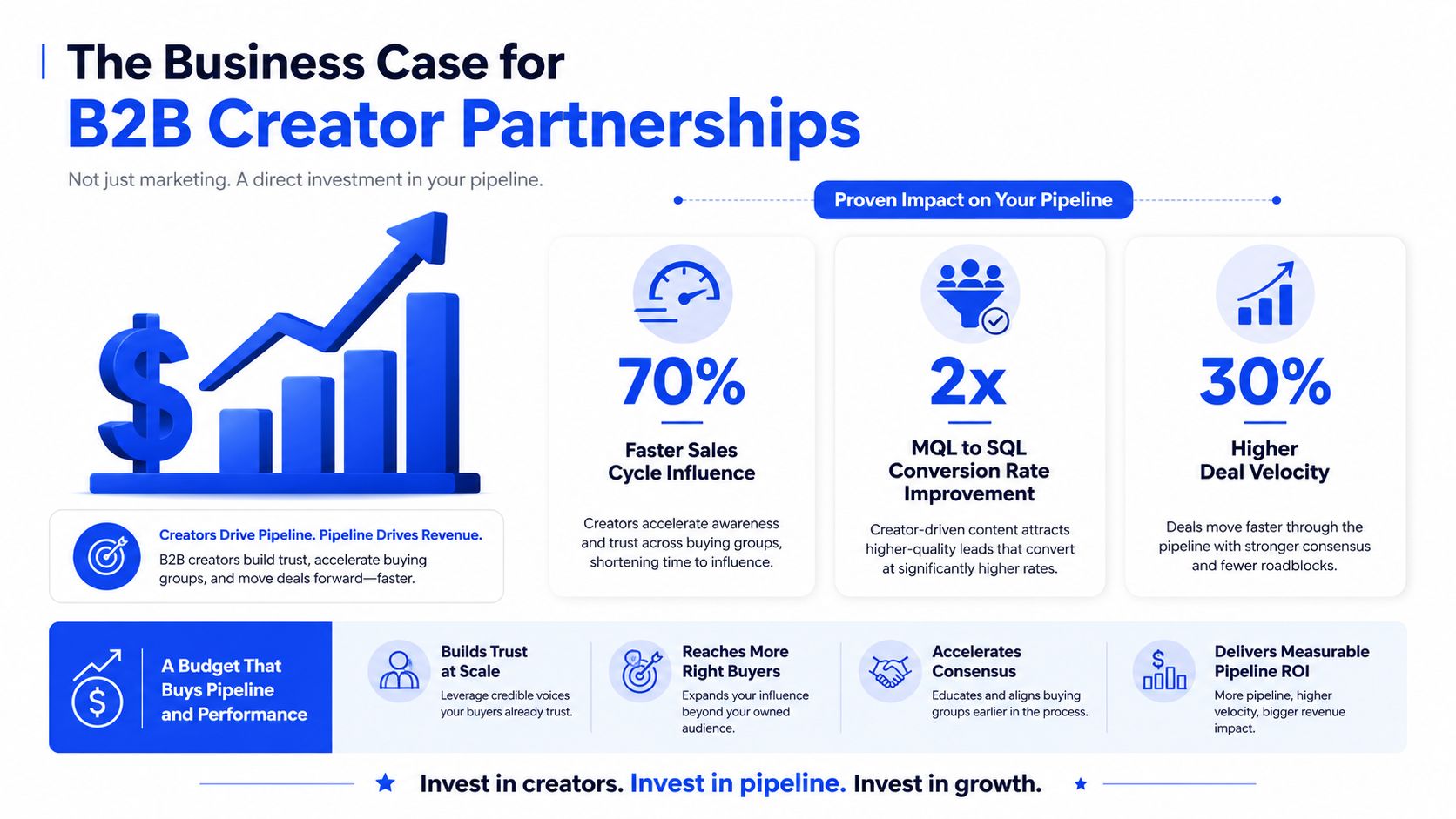
If you're still treating creator partnerships as an awareness side project, you're budgeting wrong. This is a pipeline channel. It belongs in the same conversation as paid media, outbound, and founder-led content because it shapes preference before your reps ever get a reply.
B2B budgets have already moved. B2B influencer marketing programs deliver an average ROI of 520%, returning $5.20 for every dollar invested according to this B2B SaaS benchmark roundup. That's not experimental spend. That's a signal that serious teams are buying distribution from people buyers already trust.
What this looks like when the system is real
One B2B SaaS engagement I've worked on proves the point, with an important caveat. This wasn't a standalone influencer service. It was one layer inside a broader program that also included outbound, founder content, and paid media.
The creator layer used 6 LinkedIn creators, a roughly €28k budget, and a 90-day window. That layer produced 22 booked meetings, 14 qualified opportunities, and 3 closed deals worth roughly €178k combined. On direct closed revenue within 6 months, that worked out to roughly 6.4x ROI.
Those numbers matter, but the structure matters more. The strongest creator in the mix wasn't the biggest one. It was the most specific one. The smaller revops infrastructure voice converted better because the audience fit was tighter and the content had actual substance.
Operator view: creator partnerships work when they shorten trust-building, not when they imitate ads.
Why revenue leaders should care
Most B2B buying committees won't convert from a single sponsored post. That's the wrong mental model. Creator content changes who recognizes your category, who trusts your framing, and who's more likely to respond when your SDR sends the next message.
That makes creator spend especially useful in industries where trust and expertise drive shortlists, like SaaS, legal tech, manufacturing, pharma, and iGaming. In those markets, a respected niche operator saying, “this is the right way to solve this problem,” does more than another branded asset.
A good internal benchmark is simple. If your category needs trust before demo interest, creator partnerships deserve budget. If your sales team keeps saying leads are cold, the answer may be more third-party credibility, not more sequence volume. That's the same reason buyer trust should sit near the center of your pipeline design, not at the edge of your content calendar, especially when you're trying to build trust with buyers.
Where teams go wrong
They buy reach. They approve brand-safe copy. They post once. Then they wait for attribution software to do magic.
That's lazy execution. Good B2B influencer marketing has to be wired into your demand system. The moment you do that, creator partnerships stop looking like “social” and start behaving like pipeline infrastructure.
Four models for B2B influence
Verdict first: if your goal is net-new pipeline, pick niche thought leaders. The other three models matter, but they're supporting layers. Too many teams lump all “influence” into one bucket, then wonder why the spend feels soft.
B2B momentum is real. B2B influencer marketing is the fastest-rising subcategory within the broader industry, growing 47% year-over-year in 2026, with B2B brands allocating $4.1 billion to influencer programs, based on these 2026 industry data points. That spend won't be distributed evenly. The teams that point it at the right model will get the result.
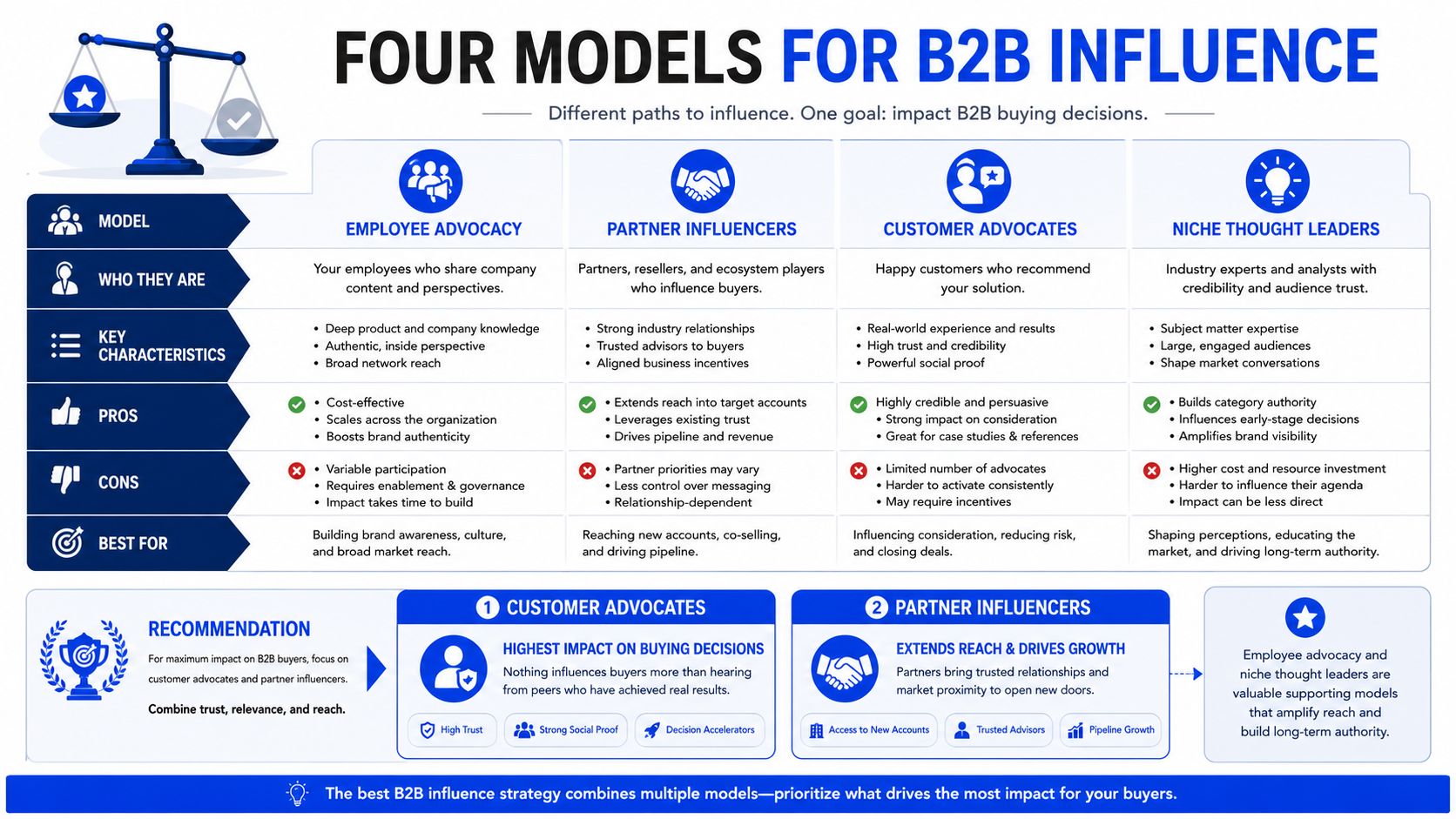
The four models
Model | Best use | Weakness |
|---|---|---|
Employee advocacy | Consistent market presence | Hard to scale fast if your team doesn't already post |
Partner influencers | Channel enablement and co-selling credibility | Audience is often broad or commercially mixed |
Customer advocates | Proof and buyer reassurance | Usually stronger late in cycle than top of funnel |
Niche thought leaders | Net-new demand and category framing | Requires harder vetting and tighter briefing |
Why niche thought leaders win
They already have the audience you need, and that audience often includes the exact people your outbound team is trying to reach. A niche thought leader can frame a problem in a way your brand can't. Buyers assume the brand is biased. They don't make the same assumption about an operator who's earned trust over time.
B2B influencer marketing proves useful within an account-based marketing system. You don't need broad fame. You need repeated exposure inside named accounts. A creator with strong relevance in a narrow buyer group is usually worth more than a general business personality with a larger audience.
When the other models matter more
Employee advocacy matters when your company already has credible internal voices. That's a compounding asset, but it's slower to build.
Partner influencers can work well when distribution and ecosystem trust matter, especially in manufacturing or legal tech. Just don't confuse partner alignment with audience alignment.
Customer advocates are strongest when deals stall on proof. They help confirm the decision. They rarely create the first spark unless the customer already has a real following and a habit of public writing.
Use the model that matches the job. Don't ask customer proof to create awareness, and don't ask employee posting to replace external authority overnight.
The recommendation
Start with niche thought leaders for acquisition. Layer employee voices for consistency. Bring customer advocates into mid and late-stage proof. Use partner influencers only when they open a channel or lend category legitimacy you can't create alone.
That stack is blunt, but it works. If pipeline is the target, lead with external trusted voices that your buyers already pay attention to.
How to find creators your buyers actually trust
Many teams pick creators backward. They start with follower count, visible engagement, or a list from a database. That gives you creators who look influential, not creators who affect buying behavior.
The right method is harder. It's also better. Reverse-engineer your customer base, find the people your buyers already follow, then vet those creators like you'd vet a strategic hire.

Start with closed-won accounts
Export your recent closed-won opportunities from HubSpot or Salesforce. Don't pull company names only. Pull the actual buyer contacts, the people who drove the process, signed off, or shaped the shortlist.
Open Sales Navigator and inspect their activity. You're looking for repeated public engagement with specific creators, not generic industry content. Then use Clay to organize the findings into a simple table.
Your columns should include:
Buyer contact: name, role, company, buying stage when closed
Observed creator interaction: follows, comments, likes, reposts, mentions
Creator theme: revops, legal operations, pharma market access, manufacturing systems, iGaming compliance
Frequency signals: recurring appearances across multiple buyers
Partnership fit: yes, maybe, no
A good rule is to study enough accounts to see patterns instead of anecdotes. You're building a buyer trust map.
Don't default to the biggest names
Smaller creators typically outperform larger ones. B2B micro-influencers, defined as those with 8,000 to 55,000 followers, achieved an 8.7% engagement rate in 2026, compared with 2.3% for macro B2B influencers with over 500,000 followers, based on campaign data compiled here. Bigger audiences look safer on paper. They usually convert worse.
If you need help sourcing candidates once you know the audience pattern, a creator marketing platform can speed up discovery and outreach logistics. Just don't let the platform choose for you. The shortlist still needs buyer-trust validation first.
Here's the video version of the selection logic if you want a faster walkthrough.
Vet creators with three filters
I use three criteria, in this order.
Audience composition
Who follows them matters more than how many follow them. Pull commenter samples, inspect visible followers, and check whether the audience aligns to your ideal customer profile. Function, seniority, industry, and market all matter.
A creator can have a decent reputation and still be wrong for you if the audience is mostly peers, juniors, recruiters, or consultants outside your buying group.
Content substance
Read the last few weeks of posts. You want analysis, opinions, and proof of real thinking. Skip creators who survive on formatting tricks, recycled templates, or motivational filler.
Look at the comments too. If the creator can't hold a serious conversation in the replies, their authority is probably thinner than it looks.
Positioning alignment
Check what they've said about your category, your competitors, and the operating model you sell. If their past content clashes with your position, don't force the partnership. Buyers notice when a creator suddenly flips sides.
Practical rule: if you need to overwrite the creator's voice to make the post safe, you picked the wrong creator.
The actual workflow
Export closed-won buyer contacts from CRM.
Review their public LinkedIn behavior in Sales Navigator.
Log recurring creator patterns in Clay.
Build a shortlist ranked by buyer overlap.
Vet each creator for audience, substance, and positioning.
Run intro calls only with creators who pass all three.
This takes real effort. That's why most agencies skip it. They'd rather present a long list than a precise one. Precision is what gets meetings.
Designing a program for pipeline not vanity metrics
A creator post gets 400 likes, your team celebrates, and nothing hits pipeline 30 days later. That result is predictable when the program is built around reach instead of buying signals.
Design the program backward from revenue action. Start with the accounts you want in pipeline, the problem you need them to engage with, and the next step sales can convert. Then fit the creator into that system. Agencies avoid this because it is harder than buying a post package. It is also the only setup that produces consistent meetings.
Structure the deal around repeated buyer exposure
Single placements rarely move B2B deals. Buyers need to see the same commercial idea several times, from a source they already trust, before they click, reply, or book.
Use a 30 to 45 day sequence built around one pain point and one CTA. Keep it tight.
Post 1: creator names the operating problem in their own language
Post 2: creator adds proof, an example, or a hard objection
Post 3: creator points to a conversion asset such as a guide, webinar, or diagnostic
Support layer: founder comments, employee engagement, paid promotion, and SDR messaging tied to the same angle
That format gives you multiple intent windows from one creator instead of one noisy burst. It also lets you compare who can hold attention across a sequence, not just spike impressions once.
Brief for commercial substance
Weak briefs create branded filler. Then the creator sounds fake, the audience ignores it, and sales gets nothing useful.
A strong brief has four inputs:
Market point: what changed in the buyer's environment
Customer pattern: what your team sees across live deals
Argument: the position you want associated with your category
CTA: one action only
Do not hand over a page of approved phrases. Give the creator real inputs and a clear boundary. I want accuracy on claims, consistency on positioning, and freedom on delivery. If you need to rewrite the post until it sounds like internal marketing copy, the program is already off track.
Use leading indicators that connect to pipeline
CTR matters. Landing page quality matters. Named-account engagement matters more than raw reactions.
Early in a creator program, I track three questions. Did the right buyers click? Did they reach an asset built for the same pain point? Could sales or RevOps identify and work the account in Apollo, Clay, and HubSpot? Likes and CPM are supporting metrics, not decision metrics. For a closer look at what to track, see these lead generation KPIs.
This is the operating rule I use. If a creator produces engagement but cannot produce identifiable account activity, keep them out of the core budget. Reserve core budget for creators who generate signals your team can route into follow-up.
Run creator work inside the same sprint as outbound
Treat creator activity like a demand gen channel with service-level rules. Do not run it as a side project owned only by content.
A simple two-week sprint works well:
Sprint point | Team action |
|---|---|
Day 1 to 2 | Lock ICP segment, pain point, creator brief, CTA, tracking links |
Day 5 to 7 | Review post performance, comment quality, account engagement, asset clicks |
Day 8 to 10 | Decide amplification, update SDR messaging, refine next post angle |
Day 14 | Log pipeline signals, creator notes, and asset conversion data in CRM |
Use Notion or Asana for the calendar, Slack for approvals, Apollo and Clay for enrichment, and HubSpot for attribution fields. Keep one owner responsible for shipping the sprint. Without a single operator, creator posts drift away from paid, outbound, and lifecycle work.
Video usually breaks this process first because teams rebuild assets manually for every audience and placement. If video is part of the program, set up a production workflow for generating video variations efficiently so the team can support multiple creator angles without slowing down execution.
Coordinate one commercial idea across every touchpoint
The creator should not be running one message while sales sends another and paid pushes a third. Buyers notice the disconnect fast.
Pick one idea per sprint. Then express it across channels in different formats. The creator frames the issue publicly. The founder adds authority in comments. Paid retargeting reinforces the same argument. SDRs reference the problem in outreach. The asset captures demand from buyers who are ready to go deeper.
That is how attention turns into pipeline. The creator is not the program. The creator is one part of a system built to generate identifiable buyer action.
Connecting creator activity to outbound and content
Most creator programs fail at this juncture. The post performs, buyers engage, nobody follows up fast enough, and the intent disappears.
The gap is expensive. Most B2B influencer content fails to answer how to operationalize the follow-up engine, and 60-70% of pipeline influence is lost without immediate, ICP-aligned outbound motion, according to this analysis of B2B influencer execution. If your sales team isn't wired into creator activity, you're paying for attention you never convert.
The signal-to-sequence system
A useful system is simple.
Creator publishes a post tied to one ICP pain point.
Your team monitors likes, comments, reposts, profile visits, and resource clicks from named accounts.
RevOps enriches those accounts in Apollo and Clay.
SDRs trigger personalized outreach in Lemlist, Smartlead, or Instantly.
Replies route into HubSpot with the creator touch logged as an influence signal.
This needs speed. Same day is ideal. Next day is still workable. A week later is mostly dead.
What sales should actually send
Don't send “saw you engaged with X's post, want a demo?” That's lazy and creepy at the same time. Use the creator signal as context, not as the entire message.
A good structure is:
Reference the topic, not the surveillance
Tie it to a known operating issue
Offer a next step with low friction
Example, qualitatively: your SDR sees a target account leader comment on a creator's post about revops data quality. The email should open on the operational issue raised in the post, connect it to a common failure mode, and offer a relevant asset or short discussion. The creator warmed the account. Sales should continue the conversation, not announce that they were watching.
Warm signals should change message timing and angle. They shouldn't turn outreach into stalking.
Connect creator posts to your content engine
Sales isn't the only follow-up path. Creator content should feed your internal content machine too.
A clean pattern looks like this:
Creator post lands: your founder comments with a sharp addition
Post gains traction: marketing clips the theme into a carousel, short video, or email
Outbound sees replies: sales updates objection handling and opener language
Retargeting goes live: paid media supports the same angle for engaged accounts
If you care about cleaner revenue reporting across those touches, this piece on optimizing B2B SaaS pipeline ROI is worth reading. The main point is the same one pipeline teams learn the hard way. The creator touch rarely closes the deal alone, but it often changes whether later touches work.
Tool stack that actually holds together
Use Apollo or Clay for enrichment. Use Sales Navigator for human validation. Use HubSpot for influence flags and workflow routing. Use HeyReach if you're running parallel LinkedIn account engagement. Use Lemlist, Smartlead, or Instantly for the outbound motion.
If you're already running outbound lead generation, creator activity should become a prioritization layer inside that system. The strongest creator programs don't replace outbound. They make outbound warmer, more relevant, and faster.
Measuring what matters from creator campaigns
Most reporting on B2B influencer marketing is still weak. Teams show impressions, engagement, and top posts because those numbers are easy to collect. Finance doesn't care. Revenue leaders shouldn't either.
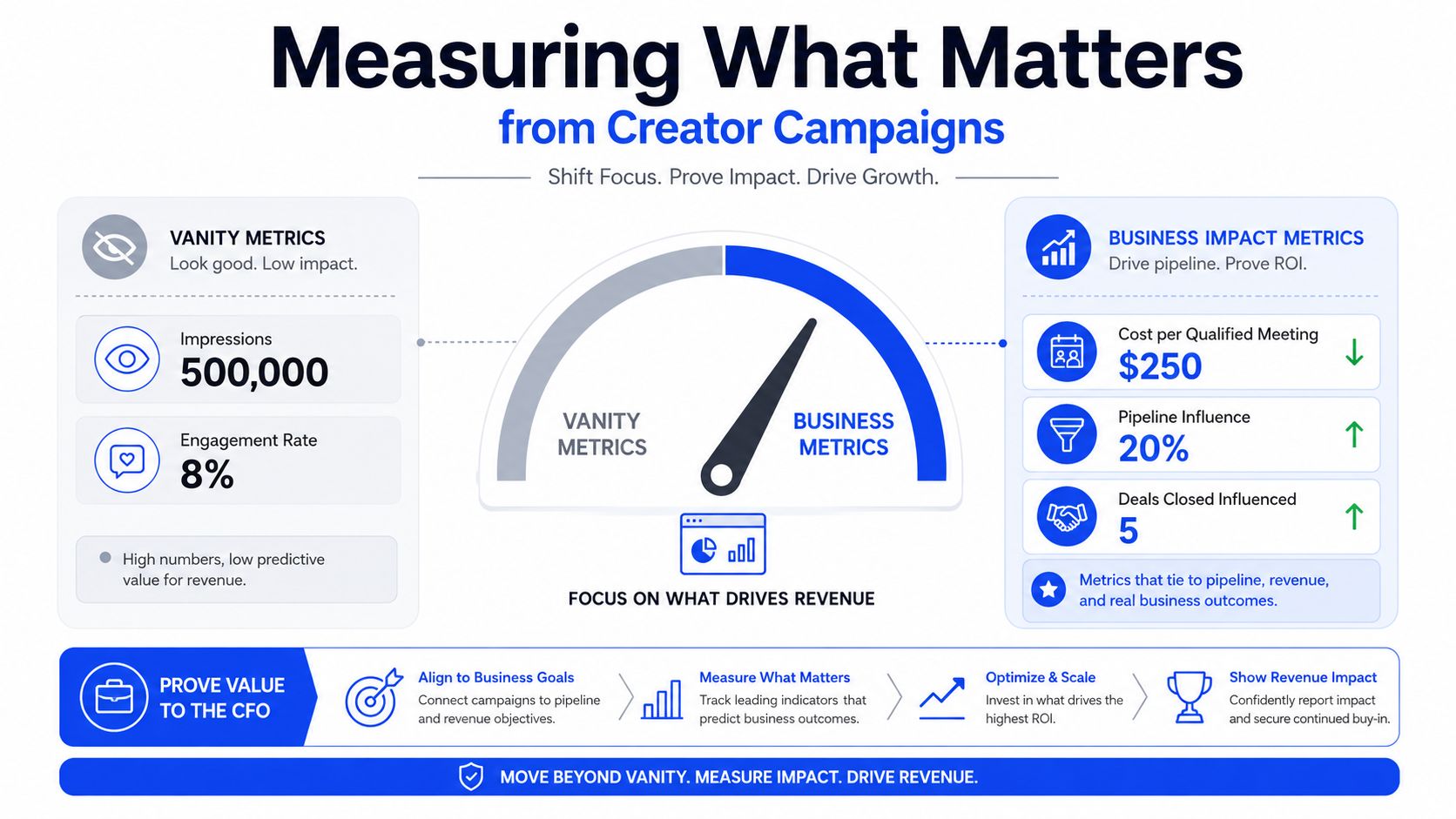
Existing coverage rarely addresses how to quantify influenced pipeline beyond vanity metrics like engagement or reach, leaving marketing leaders unable to prove ROI to CFOs. The most effective approach tags opportunities that touched a creator campaign and reports influenced pipeline alongside last-touch numbers, based on this creator attribution article.
Stop reporting vanity metrics as the outcome
Impressions and engagement are diagnostic metrics. They tell you whether content got seen and whether it triggered visible interest. They do not prove commercial value.
Report them, but keep them in the top half of the dashboard. Your bottom half should hold the numbers that tie to pipeline.
The useful stack is:
Creator-influenced meetings
Qualified opportunities from creator-touched accounts
Cost per meeting
Influenced pipeline
Attributed closed revenue
Use a clear pipeline influence formula
Pipeline influence rate is one of the few creator metrics that gives leadership a clean view of contribution. The formula is straightforward. Divide creator-influenced opportunities by total opportunities in the same period. For example, 42 influencer-influenced opportunities out of 180 total yields a 23.3% pipeline influence rate, as shown in this measurement example.
That metric works because it answers a practical question. How much of the pipeline had creator involvement at any point in the journey?
Set this up in HubSpot or Salesforce
You don't need a complicated model to start. You need disciplined field design.
Create these fields:
Field | Purpose |
|---|---|
Creator touch source | Identifies which creator touched the account |
First creator touch date | Shows when the influence started |
Creator-influenced opportunity | Marks whether the opportunity had any creator touch |
Influence notes | Holds the evidence, post, webinar, newsletter, comment trail |
Then build workflow rules. If a contact comes through a creator CTA, that's easy. If the contact or account engaged later through outbound after a creator touch, log that influence manually or through an automation rule tied to campaign membership.
If your CRM can't answer “which open opportunities touched creator content,” your reporting isn't ready for budget review.
What good reporting looks like
A serious monthly report should answer five questions:
Which creators produced commercially relevant traffic.
Which creators influenced meetings or opportunities.
What the cost per meeting looked like by creator.
How much open pipeline had a creator touch.
What closed revenue included creator influence.
That's how you defend spend. It's also how you decide who to renew, who to cut, and which themes deserve another cycle. If you need a cleaner view of how creator touches fit into the wider reporting model, use a multi-touch attribution framework instead of pretending last-touch tells the whole story.
Audit your CRM this Friday and add one required property by Monday: creator-influenced opportunity, yes or no. If that field doesn't exist, the rest of your reporting is theater.
GROU helps B2B teams build pipeline systems that connect LinkedIn content, creator influence, and outbound into one revenue engine. Our method is simple: one target list, one message architecture, fast signal capture, and reporting that ties attention to meetings, pipeline, and closed revenue.
Your creator post got comments from the right people, traffic spiked for two days, and sales still says nothing happened. That usually means the problem isn't attention. It's system design. In B2B influencer marketing, attention without routing, attribution, and outbound follow-up turns into a nice screenshot and an empty pipeline report.
Niche thought leaders are the right default for net-new pipeline. Employee voices, partners, and customers matter, but they do different jobs.
Pick creators by buyer trust, not follower count. Reverse-engineer your closed-won accounts in Sales Navigator and Clay.
Run creator partnerships as a program, not isolated posts. Multi-post deals and co-created angles beat one-off sponsorships.
Measure influenced pipeline, meetings, and revenue. If you report likes, your CFO will cut the budget.
Table of Contents
The business case for B2B creator partnerships
If you're still treating creator partnerships as an awareness side project, you're budgeting wrong. This is a pipeline channel. It belongs in the same conversation as paid media, outbound, and founder-led content because it shapes preference before your reps ever get a reply.
B2B budgets have already moved. B2B influencer marketing programs deliver an average ROI of 520%, returning $5.20 for every dollar invested according to this B2B SaaS benchmark roundup. That's not experimental spend. That's a signal that serious teams are buying distribution from people buyers already trust.
What this looks like when the system is real
One B2B SaaS engagement I've worked on proves the point, with an important caveat. This wasn't a standalone influencer service. It was one layer inside a broader program that also included outbound, founder content, and paid media.
The creator layer used 6 LinkedIn creators, a roughly €28k budget, and a 90-day window. That layer produced 22 booked meetings, 14 qualified opportunities, and 3 closed deals worth roughly €178k combined. On direct closed revenue within 6 months, that worked out to roughly 6.4x ROI.
Those numbers matter, but the structure matters more. The strongest creator in the mix wasn't the biggest one. It was the most specific one. The smaller revops infrastructure voice converted better because the audience fit was tighter and the content had actual substance.
Operator view: creator partnerships work when they shorten trust-building, not when they imitate ads.
Why revenue leaders should care
Most B2B buying committees won't convert from a single sponsored post. That's the wrong mental model. Creator content changes who recognizes your category, who trusts your framing, and who's more likely to respond when your SDR sends the next message.
That makes creator spend especially useful in industries where trust and expertise drive shortlists, like SaaS, legal tech, manufacturing, pharma, and iGaming. In those markets, a respected niche operator saying, “this is the right way to solve this problem,” does more than another branded asset.
A good internal benchmark is simple. If your category needs trust before demo interest, creator partnerships deserve budget. If your sales team keeps saying leads are cold, the answer may be more third-party credibility, not more sequence volume. That's the same reason buyer trust should sit near the center of your pipeline design, not at the edge of your content calendar, especially when you're trying to build trust with buyers.
Where teams go wrong
They buy reach. They approve brand-safe copy. They post once. Then they wait for attribution software to do magic.
That's lazy execution. Good B2B influencer marketing has to be wired into your demand system. The moment you do that, creator partnerships stop looking like “social” and start behaving like pipeline infrastructure.
Four models for B2B influence
Verdict first: if your goal is net-new pipeline, pick niche thought leaders. The other three models matter, but they're supporting layers. Too many teams lump all “influence” into one bucket, then wonder why the spend feels soft.
B2B momentum is real. B2B influencer marketing is the fastest-rising subcategory within the broader industry, growing 47% year-over-year in 2026, with B2B brands allocating $4.1 billion to influencer programs, based on these 2026 industry data points. That spend won't be distributed evenly. The teams that point it at the right model will get the result.
The four models
Model | Best use | Weakness |
|---|---|---|
Employee advocacy | Consistent market presence | Hard to scale fast if your team doesn't already post |
Partner influencers | Channel enablement and co-selling credibility | Audience is often broad or commercially mixed |
Customer advocates | Proof and buyer reassurance | Usually stronger late in cycle than top of funnel |
Niche thought leaders | Net-new demand and category framing | Requires harder vetting and tighter briefing |
Why niche thought leaders win
They already have the audience you need, and that audience often includes the exact people your outbound team is trying to reach. A niche thought leader can frame a problem in a way your brand can't. Buyers assume the brand is biased. They don't make the same assumption about an operator who's earned trust over time.
B2B influencer marketing proves useful within an account-based marketing system. You don't need broad fame. You need repeated exposure inside named accounts. A creator with strong relevance in a narrow buyer group is usually worth more than a general business personality with a larger audience.
When the other models matter more
Employee advocacy matters when your company already has credible internal voices. That's a compounding asset, but it's slower to build.
Partner influencers can work well when distribution and ecosystem trust matter, especially in manufacturing or legal tech. Just don't confuse partner alignment with audience alignment.
Customer advocates are strongest when deals stall on proof. They help confirm the decision. They rarely create the first spark unless the customer already has a real following and a habit of public writing.
Use the model that matches the job. Don't ask customer proof to create awareness, and don't ask employee posting to replace external authority overnight.
The recommendation
Start with niche thought leaders for acquisition. Layer employee voices for consistency. Bring customer advocates into mid and late-stage proof. Use partner influencers only when they open a channel or lend category legitimacy you can't create alone.
That stack is blunt, but it works. If pipeline is the target, lead with external trusted voices that your buyers already pay attention to.
How to find creators your buyers actually trust
Many teams pick creators backward. They start with follower count, visible engagement, or a list from a database. That gives you creators who look influential, not creators who affect buying behavior.
The right method is harder. It's also better. Reverse-engineer your customer base, find the people your buyers already follow, then vet those creators like you'd vet a strategic hire.
Start with closed-won accounts
Export your recent closed-won opportunities from HubSpot or Salesforce. Don't pull company names only. Pull the actual buyer contacts, the people who drove the process, signed off, or shaped the shortlist.
Open Sales Navigator and inspect their activity. You're looking for repeated public engagement with specific creators, not generic industry content. Then use Clay to organize the findings into a simple table.
Your columns should include:
Buyer contact: name, role, company, buying stage when closed
Observed creator interaction: follows, comments, likes, reposts, mentions
Creator theme: revops, legal operations, pharma market access, manufacturing systems, iGaming compliance
Frequency signals: recurring appearances across multiple buyers
Partnership fit: yes, maybe, no
A good rule is to study enough accounts to see patterns instead of anecdotes. You're building a buyer trust map.
Don't default to the biggest names
Smaller creators typically outperform larger ones. B2B micro-influencers, defined as those with 8,000 to 55,000 followers, achieved an 8.7% engagement rate in 2026, compared with 2.3% for macro B2B influencers with over 500,000 followers, based on campaign data compiled here. Bigger audiences look safer on paper. They usually convert worse.
If you need help sourcing candidates once you know the audience pattern, a creator marketing platform can speed up discovery and outreach logistics. Just don't let the platform choose for you. The shortlist still needs buyer-trust validation first.
Here's the video version of the selection logic if you want a faster walkthrough.
Vet creators with three filters
I use three criteria, in this order.
Audience composition
Who follows them matters more than how many follow them. Pull commenter samples, inspect visible followers, and check whether the audience aligns to your ideal customer profile. Function, seniority, industry, and market all matter.
A creator can have a decent reputation and still be wrong for you if the audience is mostly peers, juniors, recruiters, or consultants outside your buying group.
Content substance
Read the last few weeks of posts. You want analysis, opinions, and proof of real thinking. Skip creators who survive on formatting tricks, recycled templates, or motivational filler.
Look at the comments too. If the creator can't hold a serious conversation in the replies, their authority is probably thinner than it looks.
Positioning alignment
Check what they've said about your category, your competitors, and the operating model you sell. If their past content clashes with your position, don't force the partnership. Buyers notice when a creator suddenly flips sides.
Practical rule: if you need to overwrite the creator's voice to make the post safe, you picked the wrong creator.
The actual workflow
Export closed-won buyer contacts from CRM.
Review their public LinkedIn behavior in Sales Navigator.
Log recurring creator patterns in Clay.
Build a shortlist ranked by buyer overlap.
Vet each creator for audience, substance, and positioning.
Run intro calls only with creators who pass all three.
This takes real effort. That's why most agencies skip it. They'd rather present a long list than a precise one. Precision is what gets meetings.
Designing a program for pipeline not vanity metrics
A creator post gets 400 likes, your team celebrates, and nothing hits pipeline 30 days later. That result is predictable when the program is built around reach instead of buying signals.
Design the program backward from revenue action. Start with the accounts you want in pipeline, the problem you need them to engage with, and the next step sales can convert. Then fit the creator into that system. Agencies avoid this because it is harder than buying a post package. It is also the only setup that produces consistent meetings.
Structure the deal around repeated buyer exposure
Single placements rarely move B2B deals. Buyers need to see the same commercial idea several times, from a source they already trust, before they click, reply, or book.
Use a 30 to 45 day sequence built around one pain point and one CTA. Keep it tight.
Post 1: creator names the operating problem in their own language
Post 2: creator adds proof, an example, or a hard objection
Post 3: creator points to a conversion asset such as a guide, webinar, or diagnostic
Support layer: founder comments, employee engagement, paid promotion, and SDR messaging tied to the same angle
That format gives you multiple intent windows from one creator instead of one noisy burst. It also lets you compare who can hold attention across a sequence, not just spike impressions once.
Brief for commercial substance
Weak briefs create branded filler. Then the creator sounds fake, the audience ignores it, and sales gets nothing useful.
A strong brief has four inputs:
Market point: what changed in the buyer's environment
Customer pattern: what your team sees across live deals
Argument: the position you want associated with your category
CTA: one action only
Do not hand over a page of approved phrases. Give the creator real inputs and a clear boundary. I want accuracy on claims, consistency on positioning, and freedom on delivery. If you need to rewrite the post until it sounds like internal marketing copy, the program is already off track.
Use leading indicators that connect to pipeline
CTR matters. Landing page quality matters. Named-account engagement matters more than raw reactions.
Early in a creator program, I track three questions. Did the right buyers click? Did they reach an asset built for the same pain point? Could sales or RevOps identify and work the account in Apollo, Clay, and HubSpot? Likes and CPM are supporting metrics, not decision metrics. For a closer look at what to track, see these lead generation KPIs.
This is the operating rule I use. If a creator produces engagement but cannot produce identifiable account activity, keep them out of the core budget. Reserve core budget for creators who generate signals your team can route into follow-up.
Run creator work inside the same sprint as outbound
Treat creator activity like a demand gen channel with service-level rules. Do not run it as a side project owned only by content.
A simple two-week sprint works well:
Sprint point | Team action |
|---|---|
Day 1 to 2 | Lock ICP segment, pain point, creator brief, CTA, tracking links |
Day 5 to 7 | Review post performance, comment quality, account engagement, asset clicks |
Day 8 to 10 | Decide amplification, update SDR messaging, refine next post angle |
Day 14 | Log pipeline signals, creator notes, and asset conversion data in CRM |
Use Notion or Asana for the calendar, Slack for approvals, Apollo and Clay for enrichment, and HubSpot for attribution fields. Keep one owner responsible for shipping the sprint. Without a single operator, creator posts drift away from paid, outbound, and lifecycle work.
Video usually breaks this process first because teams rebuild assets manually for every audience and placement. If video is part of the program, set up a production workflow for generating video variations efficiently so the team can support multiple creator angles without slowing down execution.
Coordinate one commercial idea across every touchpoint
The creator should not be running one message while sales sends another and paid pushes a third. Buyers notice the disconnect fast.
Pick one idea per sprint. Then express it across channels in different formats. The creator frames the issue publicly. The founder adds authority in comments. Paid retargeting reinforces the same argument. SDRs reference the problem in outreach. The asset captures demand from buyers who are ready to go deeper.
That is how attention turns into pipeline. The creator is not the program. The creator is one part of a system built to generate identifiable buyer action.
Connecting creator activity to outbound and content
Most creator programs fail at this juncture. The post performs, buyers engage, nobody follows up fast enough, and the intent disappears.
The gap is expensive. Most B2B influencer content fails to answer how to operationalize the follow-up engine, and 60-70% of pipeline influence is lost without immediate, ICP-aligned outbound motion, according to this analysis of B2B influencer execution. If your sales team isn't wired into creator activity, you're paying for attention you never convert.
The signal-to-sequence system
A useful system is simple.
Creator publishes a post tied to one ICP pain point.
Your team monitors likes, comments, reposts, profile visits, and resource clicks from named accounts.
RevOps enriches those accounts in Apollo and Clay.
SDRs trigger personalized outreach in Lemlist, Smartlead, or Instantly.
Replies route into HubSpot with the creator touch logged as an influence signal.
This needs speed. Same day is ideal. Next day is still workable. A week later is mostly dead.
What sales should actually send
Don't send “saw you engaged with X's post, want a demo?” That's lazy and creepy at the same time. Use the creator signal as context, not as the entire message.
A good structure is:
Reference the topic, not the surveillance
Tie it to a known operating issue
Offer a next step with low friction
Example, qualitatively: your SDR sees a target account leader comment on a creator's post about revops data quality. The email should open on the operational issue raised in the post, connect it to a common failure mode, and offer a relevant asset or short discussion. The creator warmed the account. Sales should continue the conversation, not announce that they were watching.
Warm signals should change message timing and angle. They shouldn't turn outreach into stalking.
Connect creator posts to your content engine
Sales isn't the only follow-up path. Creator content should feed your internal content machine too.
A clean pattern looks like this:
Creator post lands: your founder comments with a sharp addition
Post gains traction: marketing clips the theme into a carousel, short video, or email
Outbound sees replies: sales updates objection handling and opener language
Retargeting goes live: paid media supports the same angle for engaged accounts
If you care about cleaner revenue reporting across those touches, this piece on optimizing B2B SaaS pipeline ROI is worth reading. The main point is the same one pipeline teams learn the hard way. The creator touch rarely closes the deal alone, but it often changes whether later touches work.
Tool stack that actually holds together
Use Apollo or Clay for enrichment. Use Sales Navigator for human validation. Use HubSpot for influence flags and workflow routing. Use HeyReach if you're running parallel LinkedIn account engagement. Use Lemlist, Smartlead, or Instantly for the outbound motion.
If you're already running outbound lead generation, creator activity should become a prioritization layer inside that system. The strongest creator programs don't replace outbound. They make outbound warmer, more relevant, and faster.
Measuring what matters from creator campaigns
Most reporting on B2B influencer marketing is still weak. Teams show impressions, engagement, and top posts because those numbers are easy to collect. Finance doesn't care. Revenue leaders shouldn't either.
Existing coverage rarely addresses how to quantify influenced pipeline beyond vanity metrics like engagement or reach, leaving marketing leaders unable to prove ROI to CFOs. The most effective approach tags opportunities that touched a creator campaign and reports influenced pipeline alongside last-touch numbers, based on this creator attribution article.
Stop reporting vanity metrics as the outcome
Impressions and engagement are diagnostic metrics. They tell you whether content got seen and whether it triggered visible interest. They do not prove commercial value.
Report them, but keep them in the top half of the dashboard. Your bottom half should hold the numbers that tie to pipeline.
The useful stack is:
Creator-influenced meetings
Qualified opportunities from creator-touched accounts
Cost per meeting
Influenced pipeline
Attributed closed revenue
Use a clear pipeline influence formula
Pipeline influence rate is one of the few creator metrics that gives leadership a clean view of contribution. The formula is straightforward. Divide creator-influenced opportunities by total opportunities in the same period. For example, 42 influencer-influenced opportunities out of 180 total yields a 23.3% pipeline influence rate, as shown in this measurement example.
That metric works because it answers a practical question. How much of the pipeline had creator involvement at any point in the journey?
Set this up in HubSpot or Salesforce
You don't need a complicated model to start. You need disciplined field design.
Create these fields:
Field | Purpose |
|---|---|
Creator touch source | Identifies which creator touched the account |
First creator touch date | Shows when the influence started |
Creator-influenced opportunity | Marks whether the opportunity had any creator touch |
Influence notes | Holds the evidence, post, webinar, newsletter, comment trail |
Then build workflow rules. If a contact comes through a creator CTA, that's easy. If the contact or account engaged later through outbound after a creator touch, log that influence manually or through an automation rule tied to campaign membership.
If your CRM can't answer “which open opportunities touched creator content,” your reporting isn't ready for budget review.
What good reporting looks like
A serious monthly report should answer five questions:
Which creators produced commercially relevant traffic.
Which creators influenced meetings or opportunities.
What the cost per meeting looked like by creator.
How much open pipeline had a creator touch.
What closed revenue included creator influence.
That's how you defend spend. It's also how you decide who to renew, who to cut, and which themes deserve another cycle. If you need a cleaner view of how creator touches fit into the wider reporting model, use a multi-touch attribution framework instead of pretending last-touch tells the whole story.
Audit your CRM this Friday and add one required property by Monday: creator-influenced opportunity, yes or no. If that field doesn't exist, the rest of your reporting is theater.
GROU helps B2B teams build pipeline systems that connect LinkedIn content, creator influence, and outbound into one revenue engine. Our method is simple: one target list, one message architecture, fast signal capture, and reporting that ties attention to meetings, pipeline, and closed revenue.
Your creator post got comments from the right people, traffic spiked for two days, and sales still says nothing happened. That usually means the problem isn't attention. It's system design. In B2B influencer marketing, attention without routing, attribution, and outbound follow-up turns into a nice screenshot and an empty pipeline report.
Niche thought leaders are the right default for net-new pipeline. Employee voices, partners, and customers matter, but they do different jobs.
Pick creators by buyer trust, not follower count. Reverse-engineer your closed-won accounts in Sales Navigator and Clay.
Run creator partnerships as a program, not isolated posts. Multi-post deals and co-created angles beat one-off sponsorships.
Measure influenced pipeline, meetings, and revenue. If you report likes, your CFO will cut the budget.
Table of Contents
The business case for B2B creator partnerships
If you're still treating creator partnerships as an awareness side project, you're budgeting wrong. This is a pipeline channel. It belongs in the same conversation as paid media, outbound, and founder-led content because it shapes preference before your reps ever get a reply.
B2B budgets have already moved. B2B influencer marketing programs deliver an average ROI of 520%, returning $5.20 for every dollar invested according to this B2B SaaS benchmark roundup. That's not experimental spend. That's a signal that serious teams are buying distribution from people buyers already trust.
What this looks like when the system is real
One B2B SaaS engagement I've worked on proves the point, with an important caveat. This wasn't a standalone influencer service. It was one layer inside a broader program that also included outbound, founder content, and paid media.
The creator layer used 6 LinkedIn creators, a roughly €28k budget, and a 90-day window. That layer produced 22 booked meetings, 14 qualified opportunities, and 3 closed deals worth roughly €178k combined. On direct closed revenue within 6 months, that worked out to roughly 6.4x ROI.
Those numbers matter, but the structure matters more. The strongest creator in the mix wasn't the biggest one. It was the most specific one. The smaller revops infrastructure voice converted better because the audience fit was tighter and the content had actual substance.
Operator view: creator partnerships work when they shorten trust-building, not when they imitate ads.
Why revenue leaders should care
Most B2B buying committees won't convert from a single sponsored post. That's the wrong mental model. Creator content changes who recognizes your category, who trusts your framing, and who's more likely to respond when your SDR sends the next message.
That makes creator spend especially useful in industries where trust and expertise drive shortlists, like SaaS, legal tech, manufacturing, pharma, and iGaming. In those markets, a respected niche operator saying, “this is the right way to solve this problem,” does more than another branded asset.
A good internal benchmark is simple. If your category needs trust before demo interest, creator partnerships deserve budget. If your sales team keeps saying leads are cold, the answer may be more third-party credibility, not more sequence volume. That's the same reason buyer trust should sit near the center of your pipeline design, not at the edge of your content calendar, especially when you're trying to build trust with buyers.
Where teams go wrong
They buy reach. They approve brand-safe copy. They post once. Then they wait for attribution software to do magic.
That's lazy execution. Good B2B influencer marketing has to be wired into your demand system. The moment you do that, creator partnerships stop looking like “social” and start behaving like pipeline infrastructure.
Four models for B2B influence
Verdict first: if your goal is net-new pipeline, pick niche thought leaders. The other three models matter, but they're supporting layers. Too many teams lump all “influence” into one bucket, then wonder why the spend feels soft.
B2B momentum is real. B2B influencer marketing is the fastest-rising subcategory within the broader industry, growing 47% year-over-year in 2026, with B2B brands allocating $4.1 billion to influencer programs, based on these 2026 industry data points. That spend won't be distributed evenly. The teams that point it at the right model will get the result.
The four models
Model | Best use | Weakness |
|---|---|---|
Employee advocacy | Consistent market presence | Hard to scale fast if your team doesn't already post |
Partner influencers | Channel enablement and co-selling credibility | Audience is often broad or commercially mixed |
Customer advocates | Proof and buyer reassurance | Usually stronger late in cycle than top of funnel |
Niche thought leaders | Net-new demand and category framing | Requires harder vetting and tighter briefing |
Why niche thought leaders win
They already have the audience you need, and that audience often includes the exact people your outbound team is trying to reach. A niche thought leader can frame a problem in a way your brand can't. Buyers assume the brand is biased. They don't make the same assumption about an operator who's earned trust over time.
B2B influencer marketing proves useful within an account-based marketing system. You don't need broad fame. You need repeated exposure inside named accounts. A creator with strong relevance in a narrow buyer group is usually worth more than a general business personality with a larger audience.
When the other models matter more
Employee advocacy matters when your company already has credible internal voices. That's a compounding asset, but it's slower to build.
Partner influencers can work well when distribution and ecosystem trust matter, especially in manufacturing or legal tech. Just don't confuse partner alignment with audience alignment.
Customer advocates are strongest when deals stall on proof. They help confirm the decision. They rarely create the first spark unless the customer already has a real following and a habit of public writing.
Use the model that matches the job. Don't ask customer proof to create awareness, and don't ask employee posting to replace external authority overnight.
The recommendation
Start with niche thought leaders for acquisition. Layer employee voices for consistency. Bring customer advocates into mid and late-stage proof. Use partner influencers only when they open a channel or lend category legitimacy you can't create alone.
That stack is blunt, but it works. If pipeline is the target, lead with external trusted voices that your buyers already pay attention to.
How to find creators your buyers actually trust
Many teams pick creators backward. They start with follower count, visible engagement, or a list from a database. That gives you creators who look influential, not creators who affect buying behavior.
The right method is harder. It's also better. Reverse-engineer your customer base, find the people your buyers already follow, then vet those creators like you'd vet a strategic hire.
Start with closed-won accounts
Export your recent closed-won opportunities from HubSpot or Salesforce. Don't pull company names only. Pull the actual buyer contacts, the people who drove the process, signed off, or shaped the shortlist.
Open Sales Navigator and inspect their activity. You're looking for repeated public engagement with specific creators, not generic industry content. Then use Clay to organize the findings into a simple table.
Your columns should include:
Buyer contact: name, role, company, buying stage when closed
Observed creator interaction: follows, comments, likes, reposts, mentions
Creator theme: revops, legal operations, pharma market access, manufacturing systems, iGaming compliance
Frequency signals: recurring appearances across multiple buyers
Partnership fit: yes, maybe, no
A good rule is to study enough accounts to see patterns instead of anecdotes. You're building a buyer trust map.
Don't default to the biggest names
Smaller creators typically outperform larger ones. B2B micro-influencers, defined as those with 8,000 to 55,000 followers, achieved an 8.7% engagement rate in 2026, compared with 2.3% for macro B2B influencers with over 500,000 followers, based on campaign data compiled here. Bigger audiences look safer on paper. They usually convert worse.
If you need help sourcing candidates once you know the audience pattern, a creator marketing platform can speed up discovery and outreach logistics. Just don't let the platform choose for you. The shortlist still needs buyer-trust validation first.
Here's the video version of the selection logic if you want a faster walkthrough.
Vet creators with three filters
I use three criteria, in this order.
Audience composition
Who follows them matters more than how many follow them. Pull commenter samples, inspect visible followers, and check whether the audience aligns to your ideal customer profile. Function, seniority, industry, and market all matter.
A creator can have a decent reputation and still be wrong for you if the audience is mostly peers, juniors, recruiters, or consultants outside your buying group.
Content substance
Read the last few weeks of posts. You want analysis, opinions, and proof of real thinking. Skip creators who survive on formatting tricks, recycled templates, or motivational filler.
Look at the comments too. If the creator can't hold a serious conversation in the replies, their authority is probably thinner than it looks.
Positioning alignment
Check what they've said about your category, your competitors, and the operating model you sell. If their past content clashes with your position, don't force the partnership. Buyers notice when a creator suddenly flips sides.
Practical rule: if you need to overwrite the creator's voice to make the post safe, you picked the wrong creator.
The actual workflow
Export closed-won buyer contacts from CRM.
Review their public LinkedIn behavior in Sales Navigator.
Log recurring creator patterns in Clay.
Build a shortlist ranked by buyer overlap.
Vet each creator for audience, substance, and positioning.
Run intro calls only with creators who pass all three.
This takes real effort. That's why most agencies skip it. They'd rather present a long list than a precise one. Precision is what gets meetings.
Designing a program for pipeline not vanity metrics
A creator post gets 400 likes, your team celebrates, and nothing hits pipeline 30 days later. That result is predictable when the program is built around reach instead of buying signals.
Design the program backward from revenue action. Start with the accounts you want in pipeline, the problem you need them to engage with, and the next step sales can convert. Then fit the creator into that system. Agencies avoid this because it is harder than buying a post package. It is also the only setup that produces consistent meetings.
Structure the deal around repeated buyer exposure
Single placements rarely move B2B deals. Buyers need to see the same commercial idea several times, from a source they already trust, before they click, reply, or book.
Use a 30 to 45 day sequence built around one pain point and one CTA. Keep it tight.
Post 1: creator names the operating problem in their own language
Post 2: creator adds proof, an example, or a hard objection
Post 3: creator points to a conversion asset such as a guide, webinar, or diagnostic
Support layer: founder comments, employee engagement, paid promotion, and SDR messaging tied to the same angle
That format gives you multiple intent windows from one creator instead of one noisy burst. It also lets you compare who can hold attention across a sequence, not just spike impressions once.
Brief for commercial substance
Weak briefs create branded filler. Then the creator sounds fake, the audience ignores it, and sales gets nothing useful.
A strong brief has four inputs:
Market point: what changed in the buyer's environment
Customer pattern: what your team sees across live deals
Argument: the position you want associated with your category
CTA: one action only
Do not hand over a page of approved phrases. Give the creator real inputs and a clear boundary. I want accuracy on claims, consistency on positioning, and freedom on delivery. If you need to rewrite the post until it sounds like internal marketing copy, the program is already off track.
Use leading indicators that connect to pipeline
CTR matters. Landing page quality matters. Named-account engagement matters more than raw reactions.
Early in a creator program, I track three questions. Did the right buyers click? Did they reach an asset built for the same pain point? Could sales or RevOps identify and work the account in Apollo, Clay, and HubSpot? Likes and CPM are supporting metrics, not decision metrics. For a closer look at what to track, see these lead generation KPIs.
This is the operating rule I use. If a creator produces engagement but cannot produce identifiable account activity, keep them out of the core budget. Reserve core budget for creators who generate signals your team can route into follow-up.
Run creator work inside the same sprint as outbound
Treat creator activity like a demand gen channel with service-level rules. Do not run it as a side project owned only by content.
A simple two-week sprint works well:
Sprint point | Team action |
|---|---|
Day 1 to 2 | Lock ICP segment, pain point, creator brief, CTA, tracking links |
Day 5 to 7 | Review post performance, comment quality, account engagement, asset clicks |
Day 8 to 10 | Decide amplification, update SDR messaging, refine next post angle |
Day 14 | Log pipeline signals, creator notes, and asset conversion data in CRM |
Use Notion or Asana for the calendar, Slack for approvals, Apollo and Clay for enrichment, and HubSpot for attribution fields. Keep one owner responsible for shipping the sprint. Without a single operator, creator posts drift away from paid, outbound, and lifecycle work.
Video usually breaks this process first because teams rebuild assets manually for every audience and placement. If video is part of the program, set up a production workflow for generating video variations efficiently so the team can support multiple creator angles without slowing down execution.
Coordinate one commercial idea across every touchpoint
The creator should not be running one message while sales sends another and paid pushes a third. Buyers notice the disconnect fast.
Pick one idea per sprint. Then express it across channels in different formats. The creator frames the issue publicly. The founder adds authority in comments. Paid retargeting reinforces the same argument. SDRs reference the problem in outreach. The asset captures demand from buyers who are ready to go deeper.
That is how attention turns into pipeline. The creator is not the program. The creator is one part of a system built to generate identifiable buyer action.
Connecting creator activity to outbound and content
Most creator programs fail at this juncture. The post performs, buyers engage, nobody follows up fast enough, and the intent disappears.
The gap is expensive. Most B2B influencer content fails to answer how to operationalize the follow-up engine, and 60-70% of pipeline influence is lost without immediate, ICP-aligned outbound motion, according to this analysis of B2B influencer execution. If your sales team isn't wired into creator activity, you're paying for attention you never convert.
The signal-to-sequence system
A useful system is simple.
Creator publishes a post tied to one ICP pain point.
Your team monitors likes, comments, reposts, profile visits, and resource clicks from named accounts.
RevOps enriches those accounts in Apollo and Clay.
SDRs trigger personalized outreach in Lemlist, Smartlead, or Instantly.
Replies route into HubSpot with the creator touch logged as an influence signal.
This needs speed. Same day is ideal. Next day is still workable. A week later is mostly dead.
What sales should actually send
Don't send “saw you engaged with X's post, want a demo?” That's lazy and creepy at the same time. Use the creator signal as context, not as the entire message.
A good structure is:
Reference the topic, not the surveillance
Tie it to a known operating issue
Offer a next step with low friction
Example, qualitatively: your SDR sees a target account leader comment on a creator's post about revops data quality. The email should open on the operational issue raised in the post, connect it to a common failure mode, and offer a relevant asset or short discussion. The creator warmed the account. Sales should continue the conversation, not announce that they were watching.
Warm signals should change message timing and angle. They shouldn't turn outreach into stalking.
Connect creator posts to your content engine
Sales isn't the only follow-up path. Creator content should feed your internal content machine too.
A clean pattern looks like this:
Creator post lands: your founder comments with a sharp addition
Post gains traction: marketing clips the theme into a carousel, short video, or email
Outbound sees replies: sales updates objection handling and opener language
Retargeting goes live: paid media supports the same angle for engaged accounts
If you care about cleaner revenue reporting across those touches, this piece on optimizing B2B SaaS pipeline ROI is worth reading. The main point is the same one pipeline teams learn the hard way. The creator touch rarely closes the deal alone, but it often changes whether later touches work.
Tool stack that actually holds together
Use Apollo or Clay for enrichment. Use Sales Navigator for human validation. Use HubSpot for influence flags and workflow routing. Use HeyReach if you're running parallel LinkedIn account engagement. Use Lemlist, Smartlead, or Instantly for the outbound motion.
If you're already running outbound lead generation, creator activity should become a prioritization layer inside that system. The strongest creator programs don't replace outbound. They make outbound warmer, more relevant, and faster.
Measuring what matters from creator campaigns
Most reporting on B2B influencer marketing is still weak. Teams show impressions, engagement, and top posts because those numbers are easy to collect. Finance doesn't care. Revenue leaders shouldn't either.
Existing coverage rarely addresses how to quantify influenced pipeline beyond vanity metrics like engagement or reach, leaving marketing leaders unable to prove ROI to CFOs. The most effective approach tags opportunities that touched a creator campaign and reports influenced pipeline alongside last-touch numbers, based on this creator attribution article.
Stop reporting vanity metrics as the outcome
Impressions and engagement are diagnostic metrics. They tell you whether content got seen and whether it triggered visible interest. They do not prove commercial value.
Report them, but keep them in the top half of the dashboard. Your bottom half should hold the numbers that tie to pipeline.
The useful stack is:
Creator-influenced meetings
Qualified opportunities from creator-touched accounts
Cost per meeting
Influenced pipeline
Attributed closed revenue
Use a clear pipeline influence formula
Pipeline influence rate is one of the few creator metrics that gives leadership a clean view of contribution. The formula is straightforward. Divide creator-influenced opportunities by total opportunities in the same period. For example, 42 influencer-influenced opportunities out of 180 total yields a 23.3% pipeline influence rate, as shown in this measurement example.
That metric works because it answers a practical question. How much of the pipeline had creator involvement at any point in the journey?
Set this up in HubSpot or Salesforce
You don't need a complicated model to start. You need disciplined field design.
Create these fields:
Field | Purpose |
|---|---|
Creator touch source | Identifies which creator touched the account |
First creator touch date | Shows when the influence started |
Creator-influenced opportunity | Marks whether the opportunity had any creator touch |
Influence notes | Holds the evidence, post, webinar, newsletter, comment trail |
Then build workflow rules. If a contact comes through a creator CTA, that's easy. If the contact or account engaged later through outbound after a creator touch, log that influence manually or through an automation rule tied to campaign membership.
If your CRM can't answer “which open opportunities touched creator content,” your reporting isn't ready for budget review.
What good reporting looks like
A serious monthly report should answer five questions:
Which creators produced commercially relevant traffic.
Which creators influenced meetings or opportunities.
What the cost per meeting looked like by creator.
How much open pipeline had a creator touch.
What closed revenue included creator influence.
That's how you defend spend. It's also how you decide who to renew, who to cut, and which themes deserve another cycle. If you need a cleaner view of how creator touches fit into the wider reporting model, use a multi-touch attribution framework instead of pretending last-touch tells the whole story.
Audit your CRM this Friday and add one required property by Monday: creator-influenced opportunity, yes or no. If that field doesn't exist, the rest of your reporting is theater.
GROU helps B2B teams build pipeline systems that connect LinkedIn content, creator influence, and outbound into one revenue engine. Our method is simple: one target list, one message architecture, fast signal capture, and reporting that ties attention to meetings, pipeline, and closed revenue.

Pipeline OS Newsletter
Build qualified pipeline
Get weekly tactics to generate demand, improve lead quality, and book more meetings.







Trusted by industry leaders
Trusted by industry leaders
Trusted by industry leaders
Ready to build qualified pipeline?
Ready to build qualified pipeline?
Ready to build qualified pipeline?
Book a call to see if we're the right fit, or take the 2-minute quiz to get a clear starting point.
Book a call to see if we're the right fit, or take the 2-minute quiz to get a clear starting point.
Book a call to see if we're the right fit, or take the 2-minute quiz to get a clear starting point.
" height="30.21639343089746px" id="hfGbXmQR2" width="30.216393430897455px"/></svg>)
Copyright © 2026 – All Right Reserved
Copyright © 2026 – All Right Reserved
Copyright © 2026 – All Right Reserved