%22%3E%3C/path%3E%3Cpath d=%22M 63.072 7.554 C 62.258 8.022 61.577 8.689 61.092 9.493 L 61.092 7.076 L 57.158 7.076 L 57.158 22.64 L 61.089 22.64 L 61.089 14.888 C 61.089 13.446 61.403 12.434 62.03 11.853 C 62.818 11.218 63.818 10.907 64.826 10.982 L 65.868 10.982 L 65.868 6.851 C 64.891 6.834 63.926 7.076 63.073 7.554 Z%22 fill=%22rgb(17,17,17)%22%3E%3C/path%3E%3Cpath d=%22M 78.916 7.82 C 76.363 6.49 73.321 6.49 70.768 7.82 C 69.562 8.473 68.564 9.451 67.888 10.644 C 67.167 11.931 66.803 13.387 66.834 14.862 C 66.804 16.332 67.157 17.785 67.86 19.077 C 68.515 20.267 69.494 21.246 70.684 21.901 C 71.924 22.576 73.318 22.92 74.73 22.898 C 76.164 22.918 77.58 22.575 78.846 21.901 C 80.062 21.247 81.073 20.27 81.768 19.077 C 82.506 17.797 82.88 16.339 82.85 14.862 C 82.88 13.389 82.517 11.934 81.797 10.647 C 81.12 9.455 80.122 8.477 78.917 7.824 M 78.803 14.862 C 78.829 15.739 78.636 16.608 78.241 17.391 C 77.903 18.046 77.38 18.588 76.738 18.95 C 76.124 19.293 75.432 19.472 74.729 19.47 C 73.668 19.497 72.648 19.061 71.934 18.276 C 71.139 17.323 70.741 16.1 70.823 14.862 C 70.741 13.62 71.149 12.395 71.959 11.45 C 72.687 10.667 73.715 10.233 74.783 10.256 C 75.859 10.236 76.894 10.67 77.635 11.45 C 78.464 12.387 78.884 13.616 78.801 14.864%22 fill=%22rgb(17,17,17)%22%3E%3C/path%3E%3Cpath d=%22M 95.906 7.076 L 95.906 15.646 C 95.975 16.68 95.643 17.701 94.979 18.498 C 94.311 19.184 93.379 19.547 92.422 19.495 C 91.475 19.544 90.553 19.18 89.894 18.498 C 89.23 17.701 88.898 16.68 88.967 15.646 L 88.967 7.076 L 85.033 7.076 L 85.033 16.207 C 85 17.449 85.275 18.68 85.834 19.79 C 86.327 20.75 87.095 21.542 88.039 22.065 C 89.033 22.594 90.145 22.861 91.271 22.838 C 92.188 22.847 93.095 22.65 93.926 22.263 C 94.708 21.905 95.388 21.36 95.906 20.675 L 95.906 22.645 L 99.865 22.645 L 99.865 7.076 Z%22 fill=%22rgb(17,17,17)%22%3E%3C/path%3E%3Cpath d=%22M 4.513 15.626 C 4.511 10.815 7.606 6.549 12.181 5.059 C 16.756 3.57 21.77 5.195 24.601 9.086 L 27.816 5.87 C 24.074 1.186 17.981 -0.943 12.137 0.393 C 6.292 1.728 1.728 6.292 0.393 12.137 C -0.943 17.981 1.186 24.074 5.87 27.816 L 9.085 24.601 C 6.214 22.512 4.515 19.177 4.513 15.626%22 fill=%22rgb(32,62,235)%22%3E%3C/path%3E%3Cpath d=%22M 17.114 14.343 L 13.354 18.01 L 13.354 18.026 L 21.071 18.026 L 11.412 27.609 L 17.389 27.609 L 23.999 21.081 L 23.999 28.316 L 24.005 28.316 L 27.967 24.393 L 27.967 14.343 Z%22 fill=%22rgb(32,62,235)%22%3E%3C/path%3E%3C/g%3E%3C/svg%3E) ×
× ××
××›
›
›
›
10 B2B marketing examples that actually work in 2026
10 B2B marketing examples that actually work in 2026
10 B2B marketing examples that actually work in 2026
10 B2B marketing examples that actually work in 2026
10 B2B marketing examples that actually work in 2026
10 B2B marketing examples that actually work in 2026

Author
Aljaz Peklaj

TL;DR: The B2B marketing examples that work in 2026 turn one ICP list into content, outbound and attribution instead of running them as separate motions. They improve who engages and who reaches opportunity before chasing lead volume, keep LinkedIn at the centre with coordinated follow-up, and use AI in the operating layer rather than for generic copy. Below are 10 examples, each with its goal, ICP, channels, hook, metrics and how to replicate it.
When your pipeline feels random and stalled, the problem usually isn't effort. It's that content, outbound, paid, and CRM tracking are all running as separate motions, so attention never compounds into pipeline. You need b2b marketing examples that show structure, not slogans.
Table of Contents
1. Reverse content engagement program for intent-qualified inbound
2. Content-warmed outbound motion for compressed sales cycles
3. Substantive long-form LinkedIn posts as primary pipeline generator
4. Multi-touch attribution system connecting content to closed revenue
5. Unified ICP-aligned list building for content and outbound synchronisation
6. Founder DM response system for warm inbound pipeline conversion
7. Vertical-focused content acceleration for niche account concentration
1. Reverse content engagement program for intent-qualified inbound
A founder picks 200 to 250 target accounts, follows the buyers inside them and, for 90 days, sends none of them a single outbound message. Instead, the founder leaves a useful comment on those buyers' posts every week. Somewhere in that window the buyers start recognising the name. They view the profile, read the founder's own posts, and some of them send the connection request or the first DM themselves.
That is reverse engagement. The founder shows up in the buyer's feed first, so when a conversation starts, the buyer started it.
It works because most B2B buyers would rather not be sold to early: 75% of B2B buyers prefer a rep-free sales experience, according to Gartner. Reverse engagement respects that preference. It builds familiarity in public and lets the buyer decide when to talk.
Breakdown
Goal: Generate inbound conversations from a defined list of high-fit accounts without cold outreach.
ICP: Founder-led sales in professional verticals where buyers are active on LinkedIn, such as legal tech and specialist professional services.
Channels: Founder LinkedIn profile, comments on target buyers' posts, inbound connection requests and DMs.
Creative hook: Peer-level comments that add a point, a counterexample or a question. No pitch and no links to your own content.
Metrics: Inbound connection requests from target accounts, inbound DMs, conversations that turn into meetings, and opportunity-to-close rate compared with outbound-sourced deals.
Why it worked: The buyer meets the founder as a peer with a point of view before any sales motion starts. By the time a call happens, credibility is already in place.
Why this is harder than it looks
The discipline is the hard part. The program runs for 90 days with no outbound to the list, and the founder has to comment every week, which usually means four to six hours of founder time a week. Most teams break the rule early, when a target account engages and someone wants to drop it into a sequence. That one message turns a peer back into a prospect and resets the relationship.
The list also has to stay small. At 200 to 250 accounts, the founder can follow the people who matter and recognise them when they reply. Past that, comments get generic and the effect fades.
The trade-off is speed. Reverse engagement is the slowest motion in this article to produce a first meeting, and it depends on one person's time and judgment. In return, buyers self-select before anyone pitches, which is why deal quality tends to be high.
How to replicate it
Run it as a tracked program, not a habit. In a unified process like Grou, the same ICP list decides who the founder engages with and what gets logged in the CRM.
Build the list first. 200 to 250 accounts, plus the two or three buying roles per account whose posts the founder will follow.
Freeze outbound to the list. Tag every account in the CRM so no sequence touches it for 90 days.
Block the time. Four to six hours a week, spread across the week, for reading and commenting.
Comment with substance. Add a perspective, a counterexample or a question. Skip "great post".
Log every signal. Profile views, connection requests, comment replies and DMs, against the account record.
Respond, don't pitch. When a buyer reaches out, use the founder DM system in example 6, not a sales script.
Review at day 90. Compare inbound conversations and opportunities from the list against a similar cold outbound cohort before you scale it.
For what to actually write in those comments, our LinkedIn comment strategy guide covers formats and frequency.
2. Content-warmed outbound motion for compressed sales cycles
A buyer reads two of your LinkedIn posts, joins a webinar a week later, forwards a case study internally, then gets an email from your founder or SDR. That call books faster because the outreach lands in a context the buyer already recognizes.
That is the operating model.
One RevOps SaaS team ran a 9-month program built around long-form posts, documents, and case studies. Across its closed-won deals, a meaningful share of buyers had engaged with content before the first outbound touch. Those deals moved faster, and the sales conversations started later in the education process. One clean path looked like this: initial post engagement, then webinar attendance, then a resource download, then outbound outreach, then discovery, then signed contract. The point is not the sequence format. The point is that outbound showed up after trust started forming.
Breakdown
Goal: Shorten the path from first sales touch to discovery call and reduce the education burden on the first meeting.
ICP: Mid-market revenue leaders, RevOps owners, and heads of sales at teams already feeling reporting, forecasting, or handoff pain.
Channels: LinkedIn posts, webinar, downloadable asset, email outbound, selective founder follow-up.
Creative hook: Teach the problem in public first. Then reference the exact issue the buyer has already seen you explain.
Metrics: Track content-engaged accounts, reply rate by warmed vs. unwarmed segment, meeting-booked rate, days from first outbound touch to discovery, and days to close.
Why it worked: Buyers did not need to figure out credibility from scratch. Outbound arrived with familiarity, category education, and proof already in place.
Warm outbound changes the first question in the buyer's head. Instead of asking who you are, they ask whether your solution fits their situation.
That difference matters in compressed cycles.
Why this worked
Content gave the sales message a frame. The SDR was no longer sending a generic interruption. They were continuing a conversation the buyer had already sampled through posts, documents, or events.
It also improved message quality. Good reps could reference a specific idea the account had engaged with, instead of forcing a broad problem statement into every sequence. That usually means fewer touches, better replies, and less resistance on the first call.
There is a trade-off. This motion is slower to start than pure outbound because marketing has to publish enough material to create coverage across the ICP's actual problems. It also requires decent signal capture. If sales cannot see who engaged, or cannot tell which topic they engaged with, the warmup value gets lost and outreach turns generic again.
How to replicate it with a unified process
Use one operating system for list building, content production, engagement tracking, and outbound triggers. That is the only way this stays coordinated once volume rises.
With Grou, the workflow is straightforward:
Start with the account list. Build a narrow ICP list by role, company size, and trigger context. Add problem labels such as forecast accuracy, CRM hygiene, territory design, or pipeline visibility.
Map each account to content themes. Every target account should match one or two pain areas. Do not send people into a broad content stream.
Publish content against those themes for 4 to 6 weeks. Use founder-led posts, a practical case study, one document post, and one event or webinar invite. Keep the content specific enough that sales can reference it later.
Track engagement at the contact and account level. Log post reactions, comments, webinar registration, asset downloads, repeat profile views, and site visits where available.
Trigger outbound only after a threshold is met. For example, one high-intent action or several lighter engagements across the same topic cluster.
Write outbound from the engagement trail. Reference the topic and business problem, not vanity actions. "You liked our post" is weak. "You spent time on our forecast accuracy breakdown, and your team is hiring RevOps" is usable.
Review conversion by warmed segment. Compare reply rates, meetings booked, show rates, and sales cycle length against cold outbound cohorts.
If your team is building the execution layer now, this guide to outbound sales automation for content-aware sequencing is the right place to tighten the trigger logic.
A simple rule keeps this motion clean. Marketing owns topic coverage and signal capture. Sales owns timing, relevance, and follow-up quality. RevOps owns the definitions.
Teams that mix those responsibilities usually end up with one of two failures. Sales contacts accounts before enough familiarity exists, or marketing generates engagement that nobody uses. Both waste good intent.
3. Substantive long-form LinkedIn posts as primary pipeline generator
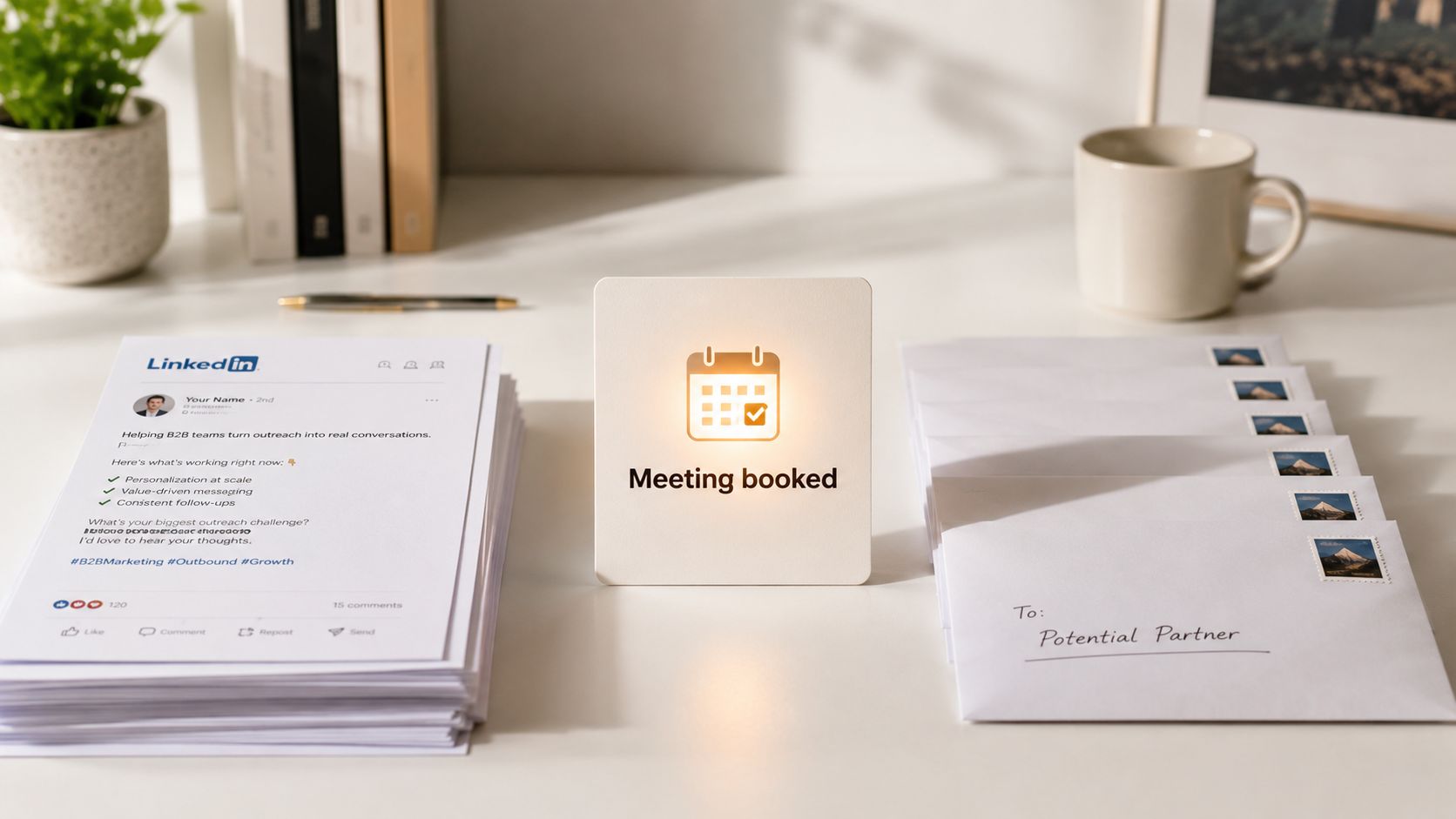
A founder sits down on Tuesday morning, writes one clear point of view on a problem buyers already argue about internally, publishes it, and by Friday has replies from the exact accounts the team wants. That is the bar for long-form LinkedIn posts when they are treated as a pipeline asset instead of a brand activity.
One example from our category made the case cleanly. A founder published a post about firing a client after a misfit engagement became obvious. The post reached 28,400 impressions, generated 287 likes, 94 comments, 11 inbound DMs, 3 booked meetings, and 1 closed deal worth €68k. The writing time was about 90 minutes. The result did not come from frequency. It came from judgment.
Breakdown of the example
Goal: Generate qualified inbound pipeline from founder content alone.
ICP: Revenue leaders and founders at mid-market B2B companies buying a high-trust service.
Channels: Founder LinkedIn profile, comments, DMs, and follow-up sales conversations.
Creative hook: A strong decision with a cost attached to it. "We fired a client" works because it signals standards, not self-promotion.
Metrics: 28,400 impressions, 287 likes, 94 comments, 11 inbound DMs, 3 meetings booked, 1 closed deal at €68k.
Why it worked: The post showed how the founder makes trade-offs under pressure. Buyers could assess fit before speaking to sales.
The winning asset had a simple structure. It opened with a real situation, explained the decision, then made the principle explicit. Good long-form posts do not try to cover every angle. They give buyers a clear operating view they can agree with, disagree with, and still remember.
That distinction matters. Informative posts get passive approval. Posts with judgment create response.
How to replicate it
Use a repeatable production process, not random inspiration. A practical workflow in Grou starts with one ICP, one pain point, and one sharp opinion pulled from live sales calls, objections, win-loss notes, or delivery experience. Then turn that into a post draft with six fields locked before writing starts: goal, ICP, channel, hook, proof, and CTA. If one of those fields is vague, the post usually underperforms.
A workable post formula looks like this:
Start with a specific scenario. Use a client decision, failed assumption, internal disagreement, or costly lesson.
Name the trade-off. Buyers trust content more when you state what you gave up or rejected.
Show the operating principle. Explain the rule your team now uses.
Add proof. Use one result, one pattern from deals, or one implementation lesson.
Invite the right response. Ask for disagreement, examples, or a direct reply from teams facing the same issue.
Here is the key operational point. Long-form LinkedIn posts work best when they are tied to pipeline review, not a content calendar in isolation. Sales should be able to look at a post and say, "this will help on deals where buyers are stuck between in-house and agency execution," or "this will attract operators who care about forecast quality more than lead volume."
For teams building that system, this LinkedIn content strategy for founder-led B2B demand generation is the right reference point.
Where teams get this wrong
B2B companies often publish diluted takes because they are trying to sound broadly useful. That usually produces reach without buying intent. The better trade-off is narrower relevance with stronger conversion.
Another common mistake is treating the post itself as the finish line. The post creates the opening. Pipeline comes from the next steps: comment triage, DM handling, CRM capture, and fast routing when a target account engages. Grou helps connect those steps in one process so the same ICP definition, message angles, and engagement signals feed both content production and follow-up.
If you only have capacity for one recurring content asset, make it founder-led long-form posts with a clear point of view, a defined ICP, and a way to capture intent after engagement. That setup is easier to sustain than a broad content program, and it gives sales something far more useful than impressions. It gives them context, conversation starters, and inbound from buyers who already understand how you think.
4. Multi-touch attribution system connecting content to closed revenue
A deal closes. Marketing points to the webinar the champion attended. Sales points to the third email in the sequence. The founder points to the LinkedIn post the CFO commented on. Everyone is partly right, nobody can prove it, and next quarter's budget gets decided by whoever argues best.
A multi-touch attribution system ends that argument. It records every meaningful touch an account has before it becomes an opportunity, then shares the credit across those touches instead of handing all of it to the first or last one.
The concept is simple. Google Analytics defines attribution as "the act of assigning credit for important user actions to different ads, clicks, and factors", and an attribution model as "a rule, a set of rules, or a data-driven algorithm" that decides how that credit is shared. The hard part in B2B is that some of the most important touches, like a founder post or a DM, never show up in web analytics at all.
Breakdown
Goal: Connect content, outbound and paid touches to opportunities and closed revenue, so budget follows evidence instead of opinion.
ICP: Teams that run more than one channel at once and need to prove marketing ROI to a founder, CFO or board.
Channels: CRM (HubSpot or Salesforce), UTM-tagged links, web analytics, LinkedIn engagement logs and outbound sequence data.
Creative hook: None in the usual sense. The hook is internal: one view of pipeline that leadership trusts.
Metrics: Pipeline and closed revenue by channel and by touch, influenced opportunities, pipeline-to-spend ratio against a target agreed with leadership and time from first touch to opportunity.
Why it worked: It replaces opinion with a shared record. Channels that look busy but never touch pipeline become visible, and so do the quiet ones that keep showing up in won deals.
What makes B2B attribution different
Three things break standard attribution in B2B:
Buying groups, not individuals. Several people touch content before a deal. Attribute at the account level, not only the contact level.
Dark touches. LinkedIn posts, comments and DMs leave no click trail. Log them in the CRM, or the model will under-credit them every time.
Long cycles. If the lookback window is shorter than the sales cycle, early content gets no credit at all. Match the window to your real cycle length.
Our multi-touch attribution guide goes deeper on the models themselves.
How to replicate it
This needs RevOps time more than a new tool. Expect UTM governance, CRM integration work and a monthly reporting cadence.
Agree the definitions. What counts as a touch, an engaged account and an opportunity. Write them down before building any report.
Govern UTMs. One naming convention for every campaign, post link and sequence, enforced by one owner.
Log the dark touches. Add CRM fields for "content-engaged before outbound", the source post behind a DM and event attendance.
Compare models, don't chase one. Put first touch, last touch and one multi-touch view side by side, and keep the same views month to month.
Report on a trailing 90 days. Monthly, so slower B2B cycles have time to show up.
Tie it to budget. Review pipeline-to-spend by channel each month and move the next sprint's effort to what creates pipeline.
In a unified process such as Grou, the same engagement signals that trigger outbound also feed the attribution record, so the data is captured once instead of reconstructed at quarter end. Example 10 covers the dashboard and operating rhythm that sit on top of this model.
5. Unified ICP-aligned list building for content and outbound synchronisation
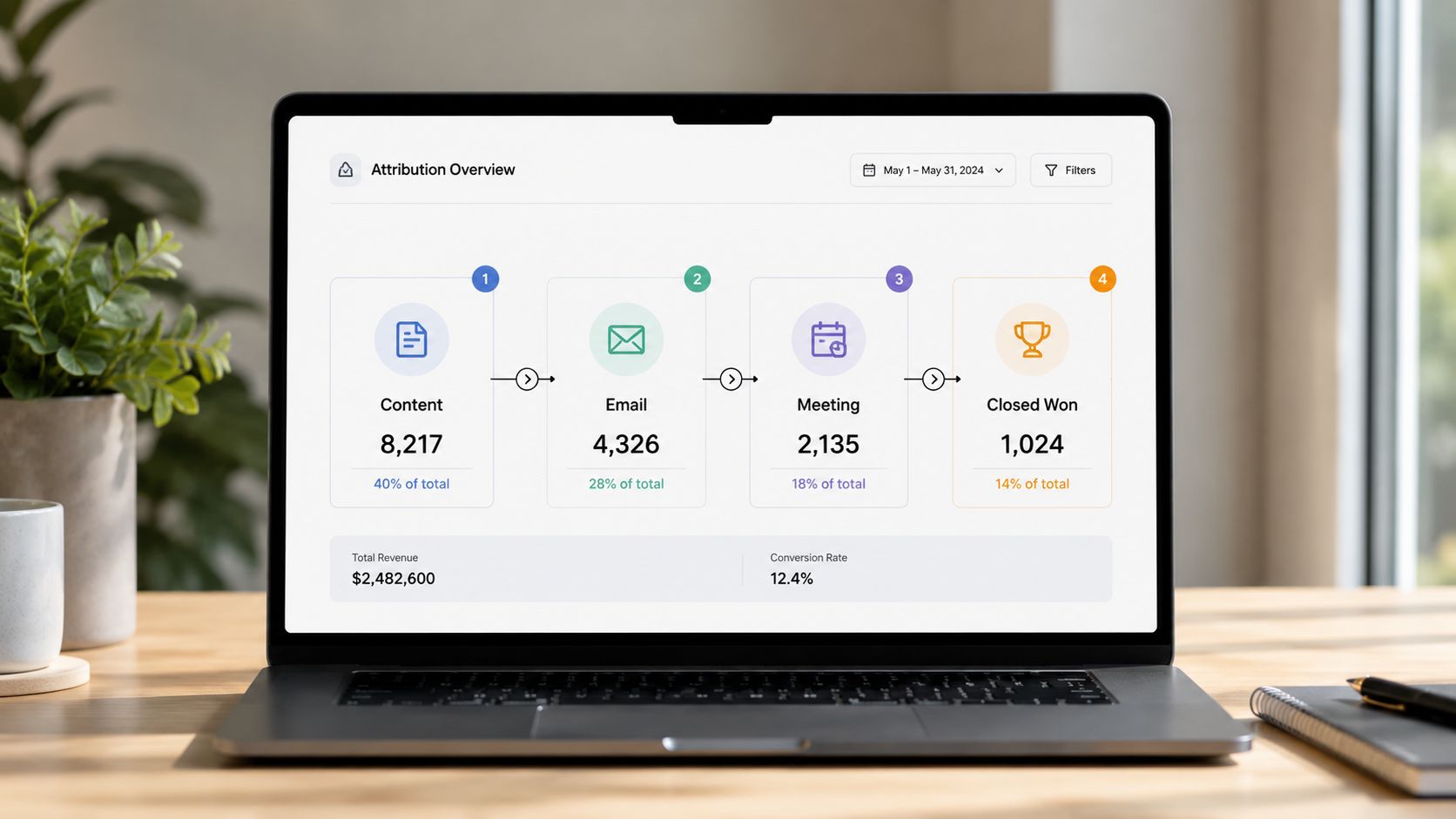
A B2B team can publish strong content, run disciplined outbound, and still miss pipeline because each function is talking to a different slice of the market. Sales goes after one set of accounts. Marketing builds for another. Reporting blends both and hides the mismatch.
The fix is operational, not creative. Build one ICP-aligned account list, one contact map inside those accounts, and use both across content, outbound, paid retargeting, and CRM reporting. If the same companies see the post, get the email, and appear in the pipeline dashboard, message testing gets cleaner fast.
For most mid-market teams, that means a focused account list and enough contacts per account to cover the buying group without turning list building into a volume exercise. In narrower categories like manufacturing, pharma, or enterprise security, I'd cut account count and go deeper on role coverage, because one missing technical evaluator can stall the whole motion.
The starting point is defining your ideal customer profile, then pressure-testing it against won deals, stalled opportunities, and disqualified accounts. If sales says the market is “everyone with budget,” the list is already broken.
What a good unified list actually does
A shared list changes how the whole system runs.
Content topics become account-specific instead of generic. Outbound references recent posts the target account may have seen. Paid spend stays concentrated on the same companies instead of drifting into low-fit traffic. Revenue reporting gets easier because you can compare engagement, meetings, and opportunity creation inside one defined universe.
This is the operating layer behind sales and marketing alignment around the same target accounts. Without it, content and outbound look coordinated on paper but compete in practice.
Example breakdown
Goal: Keep content and outbound focused on the same buying committee so touches compound instead of scattering.
ICP: Mid-market B2B companies with a clear pain, an identifiable buying group, and enough ACV to justify multi-touch outreach.
Channels: LinkedIn content, email outbound, paid retargeting, CRM reporting, and sales call feedback loops.
Creative hook: Use the same core problem statement across channels, then adapt the format by persona. Founder post for awareness. SDR email for relevance. Case-study retargeting ad for proof.
Metrics: Account coverage, contact coverage by role, reply rate by ICP segment, engaged-account rate, meeting-held rate, and opportunity rate inside the target list.
Why it worked: The team stopped introducing new audiences every week. Repetition reached the same accounts from multiple angles, which is what creates recognition in longer B2B buying cycles.
How to replicate with Grou: Use one source-of-truth account list. Tag every company by segment, pain point, and priority tier. Generate content themes from the same tagged list you use for outbound. Sync engagement signals back into the list so sales can see which accounts consumed content before outreach.
How to build the list without creating list debt
The tool stack is simple. Sales Navigator for account discovery. Apollo or your contact data provider for initial pulls. Clay for enrichment and standardisation. HubSpot or Salesforce as the source of truth.
The process matters more than the stack:
Pull won deals first. Look for shared firmographic traits, buying roles, sales cycle length, and common trigger events.
Create exclusion rules. Low ACV segments, poor retention cohorts, and accounts that always require custom work should stay out.
Set account tiers. Tier 1 gets full founder content references, manual outbound, and tighter follow-up. Lower tiers get lighter coverage.
Map the buying group. Economic buyer, champion, operator, technical evaluator, and any blocker role that repeatedly appears in real deals.
Tag by pain point. Industry alone is too weak. The list should tell you which message each account should receive.
Refresh on a schedule. Titles change, companies get acquired, and old data degrades faster than teams admit.
One warning here. Bigger lists usually reduce quality. Once teams move past the point where they can explain why an account belongs on the list, targeting quality drops and content starts getting vague to accommodate the sprawl.
The AI-powered process that keeps content and outbound in sync
A unified process earns its keep. Grou should sit on top of the targeting model, not beside it.
Ingest account and contact data: Bring in firmographics, role data, CRM stage, and engagement history.
Cluster accounts by pain and readiness: Group companies by the actual problem you solve, not just SIC code or headcount band.
Generate message tracks: Create one content angle and one outbound angle per cluster so both functions work from the same brief.
Route signals back into execution: If a target account engages with a founder post or downloads a resource, sales sees it before the next touch.
Review by cohort: Compare which ICP slices engage, reply, book, and progress to pipeline.
That process gives you a usable feedback loop. You stop asking, “Which content should we publish?” and start asking, “Which message is moving Tier 1 fintech operators versus Tier 2 manufacturing teams?” That is a better question, and it leads to better campaigns.
6. Founder DM response system for warm inbound pipeline conversion
A prospect replies to a founder post with a specific question, gets a generic calendar link back, and disappears. That happens every week. The lead was warm, the context was clear, and the team still treated the conversation like a cold handoff.
A founder DM response system fixes that by protecting context until buying intent is obvious. It works best when the goal is not “book meetings from DMs,” but “turn informed interest into qualified pipeline without breaking trust.”
Here's one practical way to break the example down:
Goal: convert warm inbound conversations into qualified opportunities
ICP: senior operators, functional leaders, and founders already engaging with your content
Channels: LinkedIn DMs, comment threads, email follow-up if requested
Creative hook: reply in the same tone, reference the exact post or thread, ask one useful follow-up question
Metrics: first-response time, meaningful reply rate, qualified conversation rate, meeting conversion after 3 or more messages, pipeline created from DM-sourced opportunities
Why it worked: the buyer already started the conversation, so the job is to continue the buying journey they chose instead of forcing a sales motion too early
The trade-off is speed versus quality. Fast replies matter, but speed alone is not enough. A fast, templated answer still kills momentum. A slower, thoughtful answer from the founder can outperform a same-hour SDR response if it proves the prospect is being heard. In practice, the right target is fast triage and a human first reply.
What good founder DM conversion looks like
The first message back should do three things. Confirm context. Add a useful thought. Open one path forward.
If a prospect references a post about attribution problems, the reply should stay on attribution problems. Do not jump straight to a pitch deck, a qualification script, or a “happy to chat” line. Keep the exchange narrow and useful until the buyer signals they want more.
A simple structure works well:
Acknowledge the trigger: mention the post, comment, or pain point they raised.
Add one sharp point: give a short answer, perspective, or counterexample.
Ask one question: make it specific enough to move the conversation forward.
Example:
Appreciate the note. The issue usually is not missing content. It is that content engagement never gets tied back to account priority or rep follow-up. Are you seeing that on the reporting side, or is the bigger problem getting sales to act on the signals?
That keeps the conversation peer to peer. It also gives you cleaner qualification data than a rushed booking link.
How to operationalise it without making it clunky
The system needs discipline, not a large team.
Set a response SLA: founder or exec replies within one business day
Tag the conversation in CRM: ICP fit, current stage, source post, topic, urgency
Keep the founder in the thread for early exchanges: handoff happens after the prospect asks for detail, team involvement, pricing, or a meeting
Use light response frameworks, not scripts: 3 to 5 response patterns are enough
Review lost DM opportunities: look for where tone shifted, context got dropped, or handoff happened too early
One mistake shows up often. Teams log the lead source as “LinkedIn inbound” and lose the reason the buyer reached out. That missing detail matters. A DM triggered by a post on compliance automation should not enter the same follow-up path as a DM triggered by a founder story about category mistakes. The source context tells you what problem the buyer is trying to solve.
Example workflow using a unified AI-powered process like Grou
Grou should capture the signal, preserve the context, and help the founder respond with enough structure to stay consistent.
Capture the inbound signal: pull in the DM, the post that triggered it, prior engagement, and firmographic data
Classify the conversation: sort by ICP fit, topic, urgency, and likely buying stage
Generate response guidance: draft a reply based on the original discussion, the account profile, and the next best question
Route follow-up tasks: if intent is clear, create the right next step for founder, AE, or marketing ops
Measure conversion by conversation type: compare opinion-led DMs, problem-led DMs, referral-led DMs, and direct demo-interest DMs
That gives you a repeatable process without flattening the founder's voice. It also lets you see which content topics create curiosity, which ones create buying intent, and where handoff timing affects pipeline creation.
A good founder DM system feels personal to the buyer and structured behind the scenes. That combination is what turns warm inbound into revenue instead of a pile of missed chances.
7. Vertical-focused content acceleration for niche account concentration
A niche pipeline usually stalls for a simple reason. The content sounds credible to everyone and specific to no one.
Teams feel productive publishing broad category takes because the audience looks bigger. Revenue rarely follows that logic. In vertical markets, buyers judge you on operational fluency. They want to see their constraints, approval process, risk language, and buying triggers reflected back to them.
This example works best when the goal is account concentration inside one high-value segment. The ICP is narrow by design: one vertical, a short list of titles, and a buying committee with shared pains. The channels are usually LinkedIn, email, webinars, sales collateral, and vertical events. The creative hook is direct specificity. Show that you understand the work, not just the category.
Pharma is a clear case. B2B pharmaceutical teams still tailor outreach by specialty, institution and prescribing behaviour, and industry conferences, medical congresses, trade publications, webinars and online events remain core channels, according to Pharma Focus America's sector guide. A generic thought leadership plan gets ignored because it skips the compliance, channel, and stakeholder realities that shape the purchase.
Manufacturing shows the same pattern from a different angle. Teams that use AI to generate spec-page content from PIM data, CAD attributes, technical descriptions, and application examples can expand SKU coverage much faster, according to Digital Applied's manufacturing AI article. That matters because better vertical content coverage gives sales a wider surface area for search capture, outbound personalisation, and technical follow-up.
Why it worked is straightforward. Vertical focus tightens the message, improves relevance, and gives both marketing and outbound the same raw material. Metrics to watch are also different from a horizontal program. Track engagement from target accounts in that vertical, sales conversations started, meetings from named accounts, and opportunity rate by segment. If those numbers do not improve, the issue is usually one of three things: the segment is still too broad, the content is not specific enough, or the sales team is not using the material in live outreach.
The replication process should stay simple and disciplined. A unified AI workflow such as Grou is useful here because the same system can cluster objections, summarise calls, group accounts by vertical pain, and turn those patterns into posts, outbound hooks, and proof assets without splitting strategy across five tools.
Choose one vertical first: Pick the segment with enough ACV, repeatable pain, and a realistic path to 20 to 50 target accounts.
Define the operating ICP: Industry, company size, triggering events, buyer roles, blockers, and language buyers already use internally.
Map 10 to 15 recurring themes: Regulatory risk, procurement friction, implementation timelines, technical spec confusion, ROI objections, integration concerns.
Build one message bank: Use customer calls, win-loss notes, sales emails, and support tickets to create hooks for both content and outbound.
Create vertical proof assets: Case studies, webinar topics, one-pagers, objection responses, and outbound snippets tied to that segment.
Review performance weekly: Check which themes produce target-account engagement, qualified replies, and pipeline movement.
There is a trade-off. Vertical focus narrows top-of-funnel reach in the short term. It usually raises conversion quality fast enough to justify that loss, especially when deal size is meaningful and the buying process is complex. If you serve several industries, run one clear vertical motion at a time and finish the test before expanding.
8. Content and outbound integration playbook
Example 2 showed what content-warmed outbound looks like when it works. This example is about making it repeatable. Most teams can run one good warmed campaign. Far fewer can run the fifth, because the rules lived in one person's head and left when that person got busy.
The playbook is the written agreement between marketing and sales: who owns the list, which content runs before outreach, when outbound is allowed to start, what the first message references and how results get reviewed.
Breakdown
Goal: Turn content-to-outbound coordination into a documented workflow that does not depend on any one person.
ICP: Teams already running both content and outbound that want the two to work as one motion.
Channels: LinkedIn content, email sequences, LinkedIn outreach and shared CRM views.
Creative hook: Outbound copy that references the specific content theme an account engaged with, built from approved templates.
Metrics: Reply rate and meeting rate for content-engaged accounts versus cold accounts, time from first touch to qualified opportunity, and how often the playbook rules are actually followed.
Why it worked: Both teams share one ICP list, a 4 to 6 week content runway and the same sequencing templates, so outreach stays relevant even when new people run it.
What goes in the playbook
Shared ICP and account list: the same source-of-truth list from example 5.
Content runway: 4 to 6 weeks of posts on the account's problem themes before the first outbound touch.
Trigger rules: the engagement threshold that moves an account from content-only to outbound.
Sequencing templates: a first-touch template per content theme, with a marked slot for the specific idea the buyer engaged with.
Roles: marketing owns topic coverage and signal capture, sales owns timing and follow-up, RevOps owns the definitions, as in example 2.
Weekly rhythm: one shared review of engaged accounts, outbound starts and replies.
How to replicate it
Write the first version after your first warmed campaign, not before. You want it built from what actually happened.
Document the last campaign. The list, themes, triggers, templates and results.
Turn decisions into rules. Every judgment call that worked becomes a written rule. Every one that failed becomes an exclusion.
Template the first touch. One template per content theme, with the personalisation slot clearly marked.
Run one shared weekly review. Same agenda every week: newly engaged accounts, who gets outbound, what replied, what to change.
Version it. Update the playbook after every sprint and keep a change log, so the next person inherits the reasoning, not only the steps.
The trade-off is rigidity. A playbook makes the motion repeatable, but outreach turns formulaic if nobody refreshes the templates. Check them every sprint against the replies you are actually getting. A unified process such as Grou helps by keeping the list, engagement signals and outbound queue in one place, so the rules are applied by the system rather than remembered by people. For the wider operating model, see our sales and marketing alignment playbook.
9. Founder Content Cadence & Quality Guidelines
A founder posts once after a good customer call, disappears for two weeks, then comes back with a polished opinion that could have come from any consultant on LinkedIn. That cadence does not build demand. It resets attention every time.
The better standard is repeatable and specific. For most founder-led B2B motions, two to three substantive posts a week is enough to stay present with target accounts, test angles, and give outbound something current to reference. Daily posting only helps if quality holds. In practice, quality usually drops first.
Treat every post like an asset in the same revenue system. The goal is not reach for its own sake. The goal is to create content your ICP recognizes, your SDR team can reuse, and your buyers can reply to with context. Grou helps here because the same workflow can turn call transcripts, CRM notes, lost-deal reasons, and DM replies into a usable post queue instead of forcing the founder to invent topics from scratch.
The operating standard
A strong founder post usually sits in the 250 to 600 word range. It opens with a real situation, names the tension, takes a position, supports it with evidence or experience, and closes with a clear takeaway. That structure works because buyers can scan it quickly and still get a point of view with substance.
Video can support this motion, but I would not force it. If the founder is sharp in writing and weak on camera, text should stay primary. Written posts are faster to produce, easier to repurpose into outbound, and simpler to review for message discipline.
If you need a simple review layer, use a dashboard that shows engagement by account, response speed, and content-assisted opportunities in one place. MyMentions marketing dashboard solutions is a useful example of how to centralize that view without turning content ops into a reporting project.
What stays in the feed
Founders get traction when they publish observations buyers cannot get from a generic brand page.
Keep specific operating lessons: “Why ABM breaks when sales and marketing define target accounts differently.”
Keep real trade-offs: “Shorter sales cycles can lower deal quality if qualification moves too late.”
Keep pattern recognition: “The three objections that show up before procurement slows the deal.”
Cut generic trend summaries: “Top B2B marketing trends to watch this quarter.”
Cut safe consensus posts: “Both brand and demand matter, and the right answer depends.”
Cut motivational filler: personal discipline posts, vague leadership takes, recycled startup clichés.
Specificity matters because buyers respond to language that sounds lived-in. Generic content gets likes from peers and very little pipeline.
Quality control rules
The easiest way to keep quality high is to set rules before drafting.
First, every post should map to one of six buckets: buyer pain, objection handling, implementation lessons, category myths, proof, or decision criteria. If a draft fits none of them, it probably does not belong in the cadence.
Second, each post should answer at least one replication question: who is this for, what problem is it about, what trigger makes it timely, and how would sales use it in a DM or email? That keeps content connected to pipeline instead of drifting into thought leadership theater.
Third, write from earned detail. Use phrasing pulled from sales calls, onboarding friction, renewal conversations, and win-loss reviews. That is usually the difference between a post that attracts the right buyer and one that gets polite engagement from other marketers.
A practical cadence founders can sustain
A workable weekly rhythm looks like this:
One post from a customer pattern seen in calls or demos
One post from an objection that slowed or killed a deal
One post from proof, process, or a strong point of view tied to your category
That gives enough repetition to build familiarity without sounding repetitive. It also creates coverage across the funnel. One post earns attention, one handles doubt, and one gives the sales team a concrete proof angle to reference in outbound or follow-up.
The trade-off is straightforward. Higher posting frequency increases surface area, but it also increases the chance of watered-down ideas. Lower frequency protects quality, but you lose repetition and buyer recall. For most founder-led teams, consistency at moderate volume beats bursts of activity followed by silence.
How to run this with the same system used across the article
Use one weekly workflow.
Pull raw inputs from founder calls, CRM notes, sales objections, LinkedIn comments, and inbound DMs. Group them by ICP and theme. Score each idea by relevance to active opportunities, fit with your core message, and usefulness for outbound. Draft three posts, review for specificity, then publish on a fixed schedule.
For each post, log the same fields you use in the rest of this article: goal, ICP, channel, creative hook, metrics, why it worked, and how to replicate it. That creates a growing message library instead of a pile of disconnected posts. It also gives the team a closed loop. Sales sees which posts warm accounts, marketing sees which themes create engagement from the right companies, and the founder sees which opinions move pipeline.
10. Measurement & Ops: KPI Dashboard and Execution Steps
A team publishes consistently, outbound reps reference the content, demos go up, and everyone assumes marketing is working. Then the quarter closes and nobody can explain which accounts moved because of founder content, which moved because of outbound follow-up, and which were going to buy anyway.
That is an ops problem, not a traffic problem.
The dashboard has one job. Show the path from signal to revenue across the exact motions in this article: content, outbound, inbound response, and pipeline progression. If you cannot tie engaged ICP accounts to meetings held, opportunities created, and closed revenue, you do not have a repeatable system yet.
What belongs in the dashboard
Build the reporting around stages, not channels. Channel views matter, but stage conversion tells you where the motion breaks.
For each example in this article, track the same fields inside one shared model: goal, ICP, channel, creative hook, core metric, why it worked, and replication status inside your AI-assisted workflow. That is the part teams often miss. They log campaign results, but they do not create a reusable operating record the next rep, marketer, or founder can use.
A practical setup usually starts in HubSpot or Salesforce, then rolls into a BI layer if the native reporting gets too limiting. For reporting structure ideas, MyMentions marketing dashboard solutions is a useful reference.
Track these categories:
Account engagement: target account visits, repeat visitors, high-intent page views, content consumption by company
Response speed: inbound DM volume, form response time, first-touch SLA attainment, meeting routing time
Pipeline conversion: meeting booked rate, meeting held rate, opportunity creation rate, stage-to-stage conversion
Revenue connection: pipeline value by source, influenced opportunities, closed-won revenue, average sales cycle by motion
Message performance: content themes that drive replies, outbound hooks that earn meetings, verticals with the highest progression
Replication status: which playbooks are documented, tested, active, paused, or replaced
Execution rhythm
Keep the cadence boring and strict. Good measurement usually looks repetitive.
Daily: review new engaged accounts, inbound requests, founder DMs that need routing, and time-to-first-touch.
Weekly: review meetings booked, meetings held, opportunity creation, content-assisted outbound performance, and which ICP segments are responding.
Monthly: review pipeline value by source, influenced revenue, sales cycle length, win rate by segment, and which examples deserve another replication sprint.
One operating rule matters more than any chart. Every metric needs an owner and an action. If meeting-held rate drops, sales fixes qualification or confirmation flow. If content engagement rises but opportunities stay flat, marketing and sales review CTA fit, audience match, and handoff timing. If one vertical converts faster, shift content and outbound coverage there for the next sprint.
Execution steps
Use a simple six-step process:
Define one funnel map. Agree on lifecycle stages, attribution rules, and source definitions before building reports.
Standardize campaign tagging. Use the same naming logic across content, outbound, paid, and founder-led activity.
Capture account-level signals. Contact-level reporting misses how B2B buying happens.
Review exceptions weekly. Look for broken routing, missing attribution, stale lists, and duplicate records.
Write a replication note for every win. Log the goal, ICP, channel, hook, metrics, why it worked, and how to repeat it.
Run the next sprint from the evidence. Use the winners to brief the next month of content, outbound, and founder follow-up.
A unified process such as Grou earns its keep. One system can pull signals from CRM activity, engagement data, outbound replies, and content performance, then turn them into a shared execution queue. The point is not prettier reporting. The point is faster decisions on which ICP, message, and channel combination should get the next unit of effort.
Teams that do this well stop arguing about which channel gets credit. They can see which coordinated motion creates pipeline, where the conversion loss happens, and how to replicate the result with less guesswork.
10 B2B Marketing Examples: Side-by-Side Comparison
Approach | 🔄 Implementation complexity | ⚡ Resource requirements | 📊 Expected outcomes | 💡 Ideal use cases | ⭐ Key advantages |
|---|---|---|---|---|---|
Reverse content engagement program for intent-qualified inbound | High, strict 90-day no-outbound discipline; founder must comment weekly | High founder time (4 to 6 hrs/week); limited list (200 to 250 accounts) | Strong self-selection: target buyers send connection requests and DMs themselves; high opportunity-to-close quality | Founder-led sales in professional verticals with active LinkedIn users | Extremely high deal quality; peer credibility before outreach |
Content-warmed outbound motion for compressed sales cycles | Medium, coordinate content runway (4 to 6 weeks) with outbound sequencing | Moderate: 2 to 3 posts/week for 4 to 6 weeks; CRM linking; sales copy referencing posts | Higher reply rates than cold outbound; shorter sales cycles; larger deals from shared content context | Sales motions needing faster cycles and higher reply rates | Faster qualification and higher deal value via shared content context |
Substantive long-form LinkedIn posts as primary pipeline generator | Medium-high, sustained cadence (2 to 3 posts/week) and authenticity required | High founder time (90 to 180 min per post) plus comment management | Inbound DMs from strong posts; high DM-to-meeting conversion; strong close rates on content-sourced deals | SaaS and professional services focused on inbound pipeline growth | Best inbound converter of content formats; builds thought leadership |
Multi-touch attribution system connecting content to closed revenue | High, CRM integration, disciplined tracking and RevOps coordination | Significant RevOps/CRM effort; UTM governance; monthly reporting cadence | Clear pipeline attribution; a pipeline-to-spend target agreed with leadership; better budget decisions | Organisations requiring evidence for marketing ROI and budget allocation | Prevents vanity metrics; identifies highest-value channels objectively |
Unified ICP‑aligned list building for content & outbound sync | Medium, requires cross‑team agreement and maintenance | Data tools/enrichment; ongoing maintenance (10–15 hrs/month) | Aligned targeting; clearer compound effects; improved outbound efficiency | Teams wanting sales & marketing on same audience and measurement | Reduces wasted outreach; improves consistency and cohort measurement |
Founder DM response system for warm inbound conversion | Low to medium, simple process but needs discipline (24-hr response) | Founder/executive time for timely replies; CRM DM tracking | High DM-to-call and meeting-to-opportunity conversion; faster warm conversions | High inbound volumes from founder content; founder-led engagement models | Preserves intellectual relationship; very high conversion from inbound |
Vertical‑focused content acceleration for niche account concentration | Medium‑High, sustained 6–9 month focus and high cadence | Intensive content output (4–6 posts/week); vertical research and assets | Stronger vertical positioning; higher inbound quality and faster closes in niche | Companies pursuing deep specialist positioning in one vertical | Builds specialist reputation and reusable vertical assets; higher relevance |
Content + Outbound Integration Playbook | Medium, playbook enforcement and shared rhythms | Moderate: shared ICP/list, 4–6 week content runway, sequencing templates | Higher outbound reply & meeting rates; compressed qualification | Teams seeking repeatable content→outbound workflow alignment | Practical, repeatable integration that improves outreach relevance |
Founder Content Cadence & Quality Guidelines | Low, prescriptive guidance; easy to adopt | Time per post: 90–180 min; comments 10–30 min; consistency effort | Better post performance; increased inbound DM rate and engagement quality | Founders creating regular LinkedIn content to generate pipeline | Improves content effectiveness through cadence, structure and voice |
Measurement & Ops: KPI Dashboard and Execution Steps | Medium‑High, design dashboards, enforce UTM/CRM hygiene | RevOps effort; UTM discipline; monthly trailing 90‑day reports | Accurate pipeline metrics; pipeline‑to‑spend and closed‑revenue reporting | Teams needing operationalized attribution and monthly leadership reporting | Ensures accountability; translates engagement into measurable revenue metrics |
Run your first replication sprint
Pick one of these b2b marketing examples and run the first step this week, not next month. If your outbound is getting replies but weak opportunities, start with reverse content engagement on a 220-account slice. If your founder already has some LinkedIn traction, commit to a 4-week content-warmed outbound sprint. If your reporting is messy, add the 90-day attribution view in CRM before you publish anything else.
The order matters. First, lock the audience. Second, decide the message. Third, decide the handoff between content, outbound, and sales. Fourth, inspect meetings held and opportunities created, not likes or opens.
For SaaS, I'd usually start with content-warmed outbound. For legal tech, I'd start with reverse engagement if the founder has real depth and patience. For manufacturing, I'd tighten the ICP list and spec-page motion before asking content to carry too much. For pharma, I'd go vertical early and map the full buying group before scaling distribution. For iGaming, I'd be ruthless about partner-fit tiers and founder visibility, because broad volume usually produces noise.
One more thing is easy to miss. Private decision-making is getting harder to see from public channels alone. There's growing discussion around buyers asking peers for vendor recommendations in private communities rather than public search, and most campaigns still ignore that behavior. I wouldn't treat Slack, WhatsApp, or closed groups as a primary acquisition channel you can “campaign” into directly. I would treat them as the hidden layer your public credibility has to survive. That means your LinkedIn posts, comments, webinars, case studies, and sales follow-up need to be strong enough that someone can paste them into a private thread and still feel confident recommending you.
Your next step is concrete. Audit your meeting-held rate this Friday. Then add one CRM property by Monday, “content-engaged before outbound”, and make sales use it on every new opportunity.
GROU is a global B2B pipeline agency that builds systems where content, list-building, and outbound run as one engine. Our method runs in bi-weekly sprints with shared metrics, fast iteration, and early pipeline signals inside the first 30 days.
If you want a sharper version of this running inside your team, Grou can help you build the list, the founder content system, the outbound layer, and the attribution model as one pipeline motion.
FAQ
What is an example of B2B marketing?
A software company whose founder posts a clear point of view on LinkedIn every week, then follows up personally with the target accounts that engage, is a typical B2B marketing example. B2B marketing is any activity that helps one business win another business as a customer: content, outbound email, LinkedIn outreach, events, paid ads and account-based programmes. This article breaks down 10 examples with the goal, ICP, channels and metrics of each.
What are B2B advertising examples?
Common B2B advertising examples are LinkedIn Sponsored Content in the feed, Message Ads delivered to LinkedIn inboxes, and Dynamic Ads and Text Ads, all formats LinkedIn offers advertisers (LinkedIn Marketing Solutions). Others include search ads, podcast sponsorships and newsletter sponsorships in publications your buyers already read.
Which B2B marketing example should I start with?
Start with your bottleneck. If outbound gets replies but weak opportunities, start with reverse content engagement (example 1). If the founder already has LinkedIn traction, run a content-warmed outbound sprint (example 2). If reporting is messy, set up attribution in the CRM (example 4) before publishing anything else.
How do you measure whether a B2B marketing example is working?
Measure meetings held, opportunities created and pipeline value from your target accounts, not likes or opens. Log the same fields for every example (goal, ICP, channel, hook, metrics, why it worked) and review them weekly and monthly, as examples 4 and 10 describe.
Is LinkedIn still the best channel for B2B marketing?
For most B2B teams it is the centre of gravity. In Content Marketing Institute's latest research, 76% of B2B marketers named LinkedIn among the most effective channels for thought leadership, more than any other channel. It only turns into pipeline when content, outbound and follow-up are coordinated around the same accounts.
TL;DR: The B2B marketing examples that work in 2026 turn one ICP list into content, outbound and attribution instead of running them as separate motions. They improve who engages and who reaches opportunity before chasing lead volume, keep LinkedIn at the centre with coordinated follow-up, and use AI in the operating layer rather than for generic copy. Below are 10 examples, each with its goal, ICP, channels, hook, metrics and how to replicate it.
When your pipeline feels random and stalled, the problem usually isn't effort. It's that content, outbound, paid, and CRM tracking are all running as separate motions, so attention never compounds into pipeline. You need b2b marketing examples that show structure, not slogans.
Table of Contents
1. Reverse content engagement program for intent-qualified inbound
2. Content-warmed outbound motion for compressed sales cycles
3. Substantive long-form LinkedIn posts as primary pipeline generator
4. Multi-touch attribution system connecting content to closed revenue
5. Unified ICP-aligned list building for content and outbound synchronisation
6. Founder DM response system for warm inbound pipeline conversion
7. Vertical-focused content acceleration for niche account concentration
1. Reverse content engagement program for intent-qualified inbound
A founder picks 200 to 250 target accounts, follows the buyers inside them and, for 90 days, sends none of them a single outbound message. Instead, the founder leaves a useful comment on those buyers' posts every week. Somewhere in that window the buyers start recognising the name. They view the profile, read the founder's own posts, and some of them send the connection request or the first DM themselves.
That is reverse engagement. The founder shows up in the buyer's feed first, so when a conversation starts, the buyer started it.
It works because most B2B buyers would rather not be sold to early: 75% of B2B buyers prefer a rep-free sales experience, according to Gartner. Reverse engagement respects that preference. It builds familiarity in public and lets the buyer decide when to talk.
Breakdown
Goal: Generate inbound conversations from a defined list of high-fit accounts without cold outreach.
ICP: Founder-led sales in professional verticals where buyers are active on LinkedIn, such as legal tech and specialist professional services.
Channels: Founder LinkedIn profile, comments on target buyers' posts, inbound connection requests and DMs.
Creative hook: Peer-level comments that add a point, a counterexample or a question. No pitch and no links to your own content.
Metrics: Inbound connection requests from target accounts, inbound DMs, conversations that turn into meetings, and opportunity-to-close rate compared with outbound-sourced deals.
Why it worked: The buyer meets the founder as a peer with a point of view before any sales motion starts. By the time a call happens, credibility is already in place.
Why this is harder than it looks
The discipline is the hard part. The program runs for 90 days with no outbound to the list, and the founder has to comment every week, which usually means four to six hours of founder time a week. Most teams break the rule early, when a target account engages and someone wants to drop it into a sequence. That one message turns a peer back into a prospect and resets the relationship.
The list also has to stay small. At 200 to 250 accounts, the founder can follow the people who matter and recognise them when they reply. Past that, comments get generic and the effect fades.
The trade-off is speed. Reverse engagement is the slowest motion in this article to produce a first meeting, and it depends on one person's time and judgment. In return, buyers self-select before anyone pitches, which is why deal quality tends to be high.
How to replicate it
Run it as a tracked program, not a habit. In a unified process like Grou, the same ICP list decides who the founder engages with and what gets logged in the CRM.
Build the list first. 200 to 250 accounts, plus the two or three buying roles per account whose posts the founder will follow.
Freeze outbound to the list. Tag every account in the CRM so no sequence touches it for 90 days.
Block the time. Four to six hours a week, spread across the week, for reading and commenting.
Comment with substance. Add a perspective, a counterexample or a question. Skip "great post".
Log every signal. Profile views, connection requests, comment replies and DMs, against the account record.
Respond, don't pitch. When a buyer reaches out, use the founder DM system in example 6, not a sales script.
Review at day 90. Compare inbound conversations and opportunities from the list against a similar cold outbound cohort before you scale it.
For what to actually write in those comments, our LinkedIn comment strategy guide covers formats and frequency.
2. Content-warmed outbound motion for compressed sales cycles
A buyer reads two of your LinkedIn posts, joins a webinar a week later, forwards a case study internally, then gets an email from your founder or SDR. That call books faster because the outreach lands in a context the buyer already recognizes.
That is the operating model.
One RevOps SaaS team ran a 9-month program built around long-form posts, documents, and case studies. Across its closed-won deals, a meaningful share of buyers had engaged with content before the first outbound touch. Those deals moved faster, and the sales conversations started later in the education process. One clean path looked like this: initial post engagement, then webinar attendance, then a resource download, then outbound outreach, then discovery, then signed contract. The point is not the sequence format. The point is that outbound showed up after trust started forming.
Breakdown
Goal: Shorten the path from first sales touch to discovery call and reduce the education burden on the first meeting.
ICP: Mid-market revenue leaders, RevOps owners, and heads of sales at teams already feeling reporting, forecasting, or handoff pain.
Channels: LinkedIn posts, webinar, downloadable asset, email outbound, selective founder follow-up.
Creative hook: Teach the problem in public first. Then reference the exact issue the buyer has already seen you explain.
Metrics: Track content-engaged accounts, reply rate by warmed vs. unwarmed segment, meeting-booked rate, days from first outbound touch to discovery, and days to close.
Why it worked: Buyers did not need to figure out credibility from scratch. Outbound arrived with familiarity, category education, and proof already in place.
Warm outbound changes the first question in the buyer's head. Instead of asking who you are, they ask whether your solution fits their situation.
That difference matters in compressed cycles.
Why this worked
Content gave the sales message a frame. The SDR was no longer sending a generic interruption. They were continuing a conversation the buyer had already sampled through posts, documents, or events.
It also improved message quality. Good reps could reference a specific idea the account had engaged with, instead of forcing a broad problem statement into every sequence. That usually means fewer touches, better replies, and less resistance on the first call.
There is a trade-off. This motion is slower to start than pure outbound because marketing has to publish enough material to create coverage across the ICP's actual problems. It also requires decent signal capture. If sales cannot see who engaged, or cannot tell which topic they engaged with, the warmup value gets lost and outreach turns generic again.
How to replicate it with a unified process
Use one operating system for list building, content production, engagement tracking, and outbound triggers. That is the only way this stays coordinated once volume rises.
With Grou, the workflow is straightforward:
Start with the account list. Build a narrow ICP list by role, company size, and trigger context. Add problem labels such as forecast accuracy, CRM hygiene, territory design, or pipeline visibility.
Map each account to content themes. Every target account should match one or two pain areas. Do not send people into a broad content stream.
Publish content against those themes for 4 to 6 weeks. Use founder-led posts, a practical case study, one document post, and one event or webinar invite. Keep the content specific enough that sales can reference it later.
Track engagement at the contact and account level. Log post reactions, comments, webinar registration, asset downloads, repeat profile views, and site visits where available.
Trigger outbound only after a threshold is met. For example, one high-intent action or several lighter engagements across the same topic cluster.
Write outbound from the engagement trail. Reference the topic and business problem, not vanity actions. "You liked our post" is weak. "You spent time on our forecast accuracy breakdown, and your team is hiring RevOps" is usable.
Review conversion by warmed segment. Compare reply rates, meetings booked, show rates, and sales cycle length against cold outbound cohorts.
If your team is building the execution layer now, this guide to outbound sales automation for content-aware sequencing is the right place to tighten the trigger logic.
A simple rule keeps this motion clean. Marketing owns topic coverage and signal capture. Sales owns timing, relevance, and follow-up quality. RevOps owns the definitions.
Teams that mix those responsibilities usually end up with one of two failures. Sales contacts accounts before enough familiarity exists, or marketing generates engagement that nobody uses. Both waste good intent.
3. Substantive long-form LinkedIn posts as primary pipeline generator
A founder sits down on Tuesday morning, writes one clear point of view on a problem buyers already argue about internally, publishes it, and by Friday has replies from the exact accounts the team wants. That is the bar for long-form LinkedIn posts when they are treated as a pipeline asset instead of a brand activity.
One example from our category made the case cleanly. A founder published a post about firing a client after a misfit engagement became obvious. The post reached 28,400 impressions, generated 287 likes, 94 comments, 11 inbound DMs, 3 booked meetings, and 1 closed deal worth €68k. The writing time was about 90 minutes. The result did not come from frequency. It came from judgment.
Breakdown of the example
Goal: Generate qualified inbound pipeline from founder content alone.
ICP: Revenue leaders and founders at mid-market B2B companies buying a high-trust service.
Channels: Founder LinkedIn profile, comments, DMs, and follow-up sales conversations.
Creative hook: A strong decision with a cost attached to it. "We fired a client" works because it signals standards, not self-promotion.
Metrics: 28,400 impressions, 287 likes, 94 comments, 11 inbound DMs, 3 meetings booked, 1 closed deal at €68k.
Why it worked: The post showed how the founder makes trade-offs under pressure. Buyers could assess fit before speaking to sales.
The winning asset had a simple structure. It opened with a real situation, explained the decision, then made the principle explicit. Good long-form posts do not try to cover every angle. They give buyers a clear operating view they can agree with, disagree with, and still remember.
That distinction matters. Informative posts get passive approval. Posts with judgment create response.
How to replicate it
Use a repeatable production process, not random inspiration. A practical workflow in Grou starts with one ICP, one pain point, and one sharp opinion pulled from live sales calls, objections, win-loss notes, or delivery experience. Then turn that into a post draft with six fields locked before writing starts: goal, ICP, channel, hook, proof, and CTA. If one of those fields is vague, the post usually underperforms.
A workable post formula looks like this:
Start with a specific scenario. Use a client decision, failed assumption, internal disagreement, or costly lesson.
Name the trade-off. Buyers trust content more when you state what you gave up or rejected.
Show the operating principle. Explain the rule your team now uses.
Add proof. Use one result, one pattern from deals, or one implementation lesson.
Invite the right response. Ask for disagreement, examples, or a direct reply from teams facing the same issue.
Here is the key operational point. Long-form LinkedIn posts work best when they are tied to pipeline review, not a content calendar in isolation. Sales should be able to look at a post and say, "this will help on deals where buyers are stuck between in-house and agency execution," or "this will attract operators who care about forecast quality more than lead volume."
For teams building that system, this LinkedIn content strategy for founder-led B2B demand generation is the right reference point.
Where teams get this wrong
B2B companies often publish diluted takes because they are trying to sound broadly useful. That usually produces reach without buying intent. The better trade-off is narrower relevance with stronger conversion.
Another common mistake is treating the post itself as the finish line. The post creates the opening. Pipeline comes from the next steps: comment triage, DM handling, CRM capture, and fast routing when a target account engages. Grou helps connect those steps in one process so the same ICP definition, message angles, and engagement signals feed both content production and follow-up.
If you only have capacity for one recurring content asset, make it founder-led long-form posts with a clear point of view, a defined ICP, and a way to capture intent after engagement. That setup is easier to sustain than a broad content program, and it gives sales something far more useful than impressions. It gives them context, conversation starters, and inbound from buyers who already understand how you think.
4. Multi-touch attribution system connecting content to closed revenue
A deal closes. Marketing points to the webinar the champion attended. Sales points to the third email in the sequence. The founder points to the LinkedIn post the CFO commented on. Everyone is partly right, nobody can prove it, and next quarter's budget gets decided by whoever argues best.
A multi-touch attribution system ends that argument. It records every meaningful touch an account has before it becomes an opportunity, then shares the credit across those touches instead of handing all of it to the first or last one.
The concept is simple. Google Analytics defines attribution as "the act of assigning credit for important user actions to different ads, clicks, and factors", and an attribution model as "a rule, a set of rules, or a data-driven algorithm" that decides how that credit is shared. The hard part in B2B is that some of the most important touches, like a founder post or a DM, never show up in web analytics at all.
Breakdown
Goal: Connect content, outbound and paid touches to opportunities and closed revenue, so budget follows evidence instead of opinion.
ICP: Teams that run more than one channel at once and need to prove marketing ROI to a founder, CFO or board.
Channels: CRM (HubSpot or Salesforce), UTM-tagged links, web analytics, LinkedIn engagement logs and outbound sequence data.
Creative hook: None in the usual sense. The hook is internal: one view of pipeline that leadership trusts.
Metrics: Pipeline and closed revenue by channel and by touch, influenced opportunities, pipeline-to-spend ratio against a target agreed with leadership and time from first touch to opportunity.
Why it worked: It replaces opinion with a shared record. Channels that look busy but never touch pipeline become visible, and so do the quiet ones that keep showing up in won deals.
What makes B2B attribution different
Three things break standard attribution in B2B:
Buying groups, not individuals. Several people touch content before a deal. Attribute at the account level, not only the contact level.
Dark touches. LinkedIn posts, comments and DMs leave no click trail. Log them in the CRM, or the model will under-credit them every time.
Long cycles. If the lookback window is shorter than the sales cycle, early content gets no credit at all. Match the window to your real cycle length.
Our multi-touch attribution guide goes deeper on the models themselves.
How to replicate it
This needs RevOps time more than a new tool. Expect UTM governance, CRM integration work and a monthly reporting cadence.
Agree the definitions. What counts as a touch, an engaged account and an opportunity. Write them down before building any report.
Govern UTMs. One naming convention for every campaign, post link and sequence, enforced by one owner.
Log the dark touches. Add CRM fields for "content-engaged before outbound", the source post behind a DM and event attendance.
Compare models, don't chase one. Put first touch, last touch and one multi-touch view side by side, and keep the same views month to month.
Report on a trailing 90 days. Monthly, so slower B2B cycles have time to show up.
Tie it to budget. Review pipeline-to-spend by channel each month and move the next sprint's effort to what creates pipeline.
In a unified process such as Grou, the same engagement signals that trigger outbound also feed the attribution record, so the data is captured once instead of reconstructed at quarter end. Example 10 covers the dashboard and operating rhythm that sit on top of this model.
5. Unified ICP-aligned list building for content and outbound synchronisation
A B2B team can publish strong content, run disciplined outbound, and still miss pipeline because each function is talking to a different slice of the market. Sales goes after one set of accounts. Marketing builds for another. Reporting blends both and hides the mismatch.
The fix is operational, not creative. Build one ICP-aligned account list, one contact map inside those accounts, and use both across content, outbound, paid retargeting, and CRM reporting. If the same companies see the post, get the email, and appear in the pipeline dashboard, message testing gets cleaner fast.
For most mid-market teams, that means a focused account list and enough contacts per account to cover the buying group without turning list building into a volume exercise. In narrower categories like manufacturing, pharma, or enterprise security, I'd cut account count and go deeper on role coverage, because one missing technical evaluator can stall the whole motion.
The starting point is defining your ideal customer profile, then pressure-testing it against won deals, stalled opportunities, and disqualified accounts. If sales says the market is “everyone with budget,” the list is already broken.
What a good unified list actually does
A shared list changes how the whole system runs.
Content topics become account-specific instead of generic. Outbound references recent posts the target account may have seen. Paid spend stays concentrated on the same companies instead of drifting into low-fit traffic. Revenue reporting gets easier because you can compare engagement, meetings, and opportunity creation inside one defined universe.
This is the operating layer behind sales and marketing alignment around the same target accounts. Without it, content and outbound look coordinated on paper but compete in practice.
Example breakdown
Goal: Keep content and outbound focused on the same buying committee so touches compound instead of scattering.
ICP: Mid-market B2B companies with a clear pain, an identifiable buying group, and enough ACV to justify multi-touch outreach.
Channels: LinkedIn content, email outbound, paid retargeting, CRM reporting, and sales call feedback loops.
Creative hook: Use the same core problem statement across channels, then adapt the format by persona. Founder post for awareness. SDR email for relevance. Case-study retargeting ad for proof.
Metrics: Account coverage, contact coverage by role, reply rate by ICP segment, engaged-account rate, meeting-held rate, and opportunity rate inside the target list.
Why it worked: The team stopped introducing new audiences every week. Repetition reached the same accounts from multiple angles, which is what creates recognition in longer B2B buying cycles.
How to replicate with Grou: Use one source-of-truth account list. Tag every company by segment, pain point, and priority tier. Generate content themes from the same tagged list you use for outbound. Sync engagement signals back into the list so sales can see which accounts consumed content before outreach.
How to build the list without creating list debt
The tool stack is simple. Sales Navigator for account discovery. Apollo or your contact data provider for initial pulls. Clay for enrichment and standardisation. HubSpot or Salesforce as the source of truth.
The process matters more than the stack:
Pull won deals first. Look for shared firmographic traits, buying roles, sales cycle length, and common trigger events.
Create exclusion rules. Low ACV segments, poor retention cohorts, and accounts that always require custom work should stay out.
Set account tiers. Tier 1 gets full founder content references, manual outbound, and tighter follow-up. Lower tiers get lighter coverage.
Map the buying group. Economic buyer, champion, operator, technical evaluator, and any blocker role that repeatedly appears in real deals.
Tag by pain point. Industry alone is too weak. The list should tell you which message each account should receive.
Refresh on a schedule. Titles change, companies get acquired, and old data degrades faster than teams admit.
One warning here. Bigger lists usually reduce quality. Once teams move past the point where they can explain why an account belongs on the list, targeting quality drops and content starts getting vague to accommodate the sprawl.
The AI-powered process that keeps content and outbound in sync
A unified process earns its keep. Grou should sit on top of the targeting model, not beside it.
Ingest account and contact data: Bring in firmographics, role data, CRM stage, and engagement history.
Cluster accounts by pain and readiness: Group companies by the actual problem you solve, not just SIC code or headcount band.
Generate message tracks: Create one content angle and one outbound angle per cluster so both functions work from the same brief.
Route signals back into execution: If a target account engages with a founder post or downloads a resource, sales sees it before the next touch.
Review by cohort: Compare which ICP slices engage, reply, book, and progress to pipeline.
That process gives you a usable feedback loop. You stop asking, “Which content should we publish?” and start asking, “Which message is moving Tier 1 fintech operators versus Tier 2 manufacturing teams?” That is a better question, and it leads to better campaigns.
6. Founder DM response system for warm inbound pipeline conversion
A prospect replies to a founder post with a specific question, gets a generic calendar link back, and disappears. That happens every week. The lead was warm, the context was clear, and the team still treated the conversation like a cold handoff.
A founder DM response system fixes that by protecting context until buying intent is obvious. It works best when the goal is not “book meetings from DMs,” but “turn informed interest into qualified pipeline without breaking trust.”
Here's one practical way to break the example down:
Goal: convert warm inbound conversations into qualified opportunities
ICP: senior operators, functional leaders, and founders already engaging with your content
Channels: LinkedIn DMs, comment threads, email follow-up if requested
Creative hook: reply in the same tone, reference the exact post or thread, ask one useful follow-up question
Metrics: first-response time, meaningful reply rate, qualified conversation rate, meeting conversion after 3 or more messages, pipeline created from DM-sourced opportunities
Why it worked: the buyer already started the conversation, so the job is to continue the buying journey they chose instead of forcing a sales motion too early
The trade-off is speed versus quality. Fast replies matter, but speed alone is not enough. A fast, templated answer still kills momentum. A slower, thoughtful answer from the founder can outperform a same-hour SDR response if it proves the prospect is being heard. In practice, the right target is fast triage and a human first reply.
What good founder DM conversion looks like
The first message back should do three things. Confirm context. Add a useful thought. Open one path forward.
If a prospect references a post about attribution problems, the reply should stay on attribution problems. Do not jump straight to a pitch deck, a qualification script, or a “happy to chat” line. Keep the exchange narrow and useful until the buyer signals they want more.
A simple structure works well:
Acknowledge the trigger: mention the post, comment, or pain point they raised.
Add one sharp point: give a short answer, perspective, or counterexample.
Ask one question: make it specific enough to move the conversation forward.
Example:
Appreciate the note. The issue usually is not missing content. It is that content engagement never gets tied back to account priority or rep follow-up. Are you seeing that on the reporting side, or is the bigger problem getting sales to act on the signals?
That keeps the conversation peer to peer. It also gives you cleaner qualification data than a rushed booking link.
How to operationalise it without making it clunky
The system needs discipline, not a large team.
Set a response SLA: founder or exec replies within one business day
Tag the conversation in CRM: ICP fit, current stage, source post, topic, urgency
Keep the founder in the thread for early exchanges: handoff happens after the prospect asks for detail, team involvement, pricing, or a meeting
Use light response frameworks, not scripts: 3 to 5 response patterns are enough
Review lost DM opportunities: look for where tone shifted, context got dropped, or handoff happened too early
One mistake shows up often. Teams log the lead source as “LinkedIn inbound” and lose the reason the buyer reached out. That missing detail matters. A DM triggered by a post on compliance automation should not enter the same follow-up path as a DM triggered by a founder story about category mistakes. The source context tells you what problem the buyer is trying to solve.
Example workflow using a unified AI-powered process like Grou
Grou should capture the signal, preserve the context, and help the founder respond with enough structure to stay consistent.
Capture the inbound signal: pull in the DM, the post that triggered it, prior engagement, and firmographic data
Classify the conversation: sort by ICP fit, topic, urgency, and likely buying stage
Generate response guidance: draft a reply based on the original discussion, the account profile, and the next best question
Route follow-up tasks: if intent is clear, create the right next step for founder, AE, or marketing ops
Measure conversion by conversation type: compare opinion-led DMs, problem-led DMs, referral-led DMs, and direct demo-interest DMs
That gives you a repeatable process without flattening the founder's voice. It also lets you see which content topics create curiosity, which ones create buying intent, and where handoff timing affects pipeline creation.
A good founder DM system feels personal to the buyer and structured behind the scenes. That combination is what turns warm inbound into revenue instead of a pile of missed chances.
7. Vertical-focused content acceleration for niche account concentration
A niche pipeline usually stalls for a simple reason. The content sounds credible to everyone and specific to no one.
Teams feel productive publishing broad category takes because the audience looks bigger. Revenue rarely follows that logic. In vertical markets, buyers judge you on operational fluency. They want to see their constraints, approval process, risk language, and buying triggers reflected back to them.
This example works best when the goal is account concentration inside one high-value segment. The ICP is narrow by design: one vertical, a short list of titles, and a buying committee with shared pains. The channels are usually LinkedIn, email, webinars, sales collateral, and vertical events. The creative hook is direct specificity. Show that you understand the work, not just the category.
Pharma is a clear case. B2B pharmaceutical teams still tailor outreach by specialty, institution and prescribing behaviour, and industry conferences, medical congresses, trade publications, webinars and online events remain core channels, according to Pharma Focus America's sector guide. A generic thought leadership plan gets ignored because it skips the compliance, channel, and stakeholder realities that shape the purchase.
Manufacturing shows the same pattern from a different angle. Teams that use AI to generate spec-page content from PIM data, CAD attributes, technical descriptions, and application examples can expand SKU coverage much faster, according to Digital Applied's manufacturing AI article. That matters because better vertical content coverage gives sales a wider surface area for search capture, outbound personalisation, and technical follow-up.
Why it worked is straightforward. Vertical focus tightens the message, improves relevance, and gives both marketing and outbound the same raw material. Metrics to watch are also different from a horizontal program. Track engagement from target accounts in that vertical, sales conversations started, meetings from named accounts, and opportunity rate by segment. If those numbers do not improve, the issue is usually one of three things: the segment is still too broad, the content is not specific enough, or the sales team is not using the material in live outreach.
The replication process should stay simple and disciplined. A unified AI workflow such as Grou is useful here because the same system can cluster objections, summarise calls, group accounts by vertical pain, and turn those patterns into posts, outbound hooks, and proof assets without splitting strategy across five tools.
Choose one vertical first: Pick the segment with enough ACV, repeatable pain, and a realistic path to 20 to 50 target accounts.
Define the operating ICP: Industry, company size, triggering events, buyer roles, blockers, and language buyers already use internally.
Map 10 to 15 recurring themes: Regulatory risk, procurement friction, implementation timelines, technical spec confusion, ROI objections, integration concerns.
Build one message bank: Use customer calls, win-loss notes, sales emails, and support tickets to create hooks for both content and outbound.
Create vertical proof assets: Case studies, webinar topics, one-pagers, objection responses, and outbound snippets tied to that segment.
Review performance weekly: Check which themes produce target-account engagement, qualified replies, and pipeline movement.
There is a trade-off. Vertical focus narrows top-of-funnel reach in the short term. It usually raises conversion quality fast enough to justify that loss, especially when deal size is meaningful and the buying process is complex. If you serve several industries, run one clear vertical motion at a time and finish the test before expanding.
8. Content and outbound integration playbook
Example 2 showed what content-warmed outbound looks like when it works. This example is about making it repeatable. Most teams can run one good warmed campaign. Far fewer can run the fifth, because the rules lived in one person's head and left when that person got busy.
The playbook is the written agreement between marketing and sales: who owns the list, which content runs before outreach, when outbound is allowed to start, what the first message references and how results get reviewed.
Breakdown
Goal: Turn content-to-outbound coordination into a documented workflow that does not depend on any one person.
ICP: Teams already running both content and outbound that want the two to work as one motion.
Channels: LinkedIn content, email sequences, LinkedIn outreach and shared CRM views.
Creative hook: Outbound copy that references the specific content theme an account engaged with, built from approved templates.
Metrics: Reply rate and meeting rate for content-engaged accounts versus cold accounts, time from first touch to qualified opportunity, and how often the playbook rules are actually followed.
Why it worked: Both teams share one ICP list, a 4 to 6 week content runway and the same sequencing templates, so outreach stays relevant even when new people run it.
What goes in the playbook
Shared ICP and account list: the same source-of-truth list from example 5.
Content runway: 4 to 6 weeks of posts on the account's problem themes before the first outbound touch.
Trigger rules: the engagement threshold that moves an account from content-only to outbound.
Sequencing templates: a first-touch template per content theme, with a marked slot for the specific idea the buyer engaged with.
Roles: marketing owns topic coverage and signal capture, sales owns timing and follow-up, RevOps owns the definitions, as in example 2.
Weekly rhythm: one shared review of engaged accounts, outbound starts and replies.
How to replicate it
Write the first version after your first warmed campaign, not before. You want it built from what actually happened.
Document the last campaign. The list, themes, triggers, templates and results.
Turn decisions into rules. Every judgment call that worked becomes a written rule. Every one that failed becomes an exclusion.
Template the first touch. One template per content theme, with the personalisation slot clearly marked.
Run one shared weekly review. Same agenda every week: newly engaged accounts, who gets outbound, what replied, what to change.
Version it. Update the playbook after every sprint and keep a change log, so the next person inherits the reasoning, not only the steps.
The trade-off is rigidity. A playbook makes the motion repeatable, but outreach turns formulaic if nobody refreshes the templates. Check them every sprint against the replies you are actually getting. A unified process such as Grou helps by keeping the list, engagement signals and outbound queue in one place, so the rules are applied by the system rather than remembered by people. For the wider operating model, see our sales and marketing alignment playbook.
9. Founder Content Cadence & Quality Guidelines
A founder posts once after a good customer call, disappears for two weeks, then comes back with a polished opinion that could have come from any consultant on LinkedIn. That cadence does not build demand. It resets attention every time.
The better standard is repeatable and specific. For most founder-led B2B motions, two to three substantive posts a week is enough to stay present with target accounts, test angles, and give outbound something current to reference. Daily posting only helps if quality holds. In practice, quality usually drops first.
Treat every post like an asset in the same revenue system. The goal is not reach for its own sake. The goal is to create content your ICP recognizes, your SDR team can reuse, and your buyers can reply to with context. Grou helps here because the same workflow can turn call transcripts, CRM notes, lost-deal reasons, and DM replies into a usable post queue instead of forcing the founder to invent topics from scratch.
The operating standard
A strong founder post usually sits in the 250 to 600 word range. It opens with a real situation, names the tension, takes a position, supports it with evidence or experience, and closes with a clear takeaway. That structure works because buyers can scan it quickly and still get a point of view with substance.
Video can support this motion, but I would not force it. If the founder is sharp in writing and weak on camera, text should stay primary. Written posts are faster to produce, easier to repurpose into outbound, and simpler to review for message discipline.
If you need a simple review layer, use a dashboard that shows engagement by account, response speed, and content-assisted opportunities in one place. MyMentions marketing dashboard solutions is a useful example of how to centralize that view without turning content ops into a reporting project.
What stays in the feed
Founders get traction when they publish observations buyers cannot get from a generic brand page.
Keep specific operating lessons: “Why ABM breaks when sales and marketing define target accounts differently.”
Keep real trade-offs: “Shorter sales cycles can lower deal quality if qualification moves too late.”
Keep pattern recognition: “The three objections that show up before procurement slows the deal.”
Cut generic trend summaries: “Top B2B marketing trends to watch this quarter.”
Cut safe consensus posts: “Both brand and demand matter, and the right answer depends.”
Cut motivational filler: personal discipline posts, vague leadership takes, recycled startup clichés.
Specificity matters because buyers respond to language that sounds lived-in. Generic content gets likes from peers and very little pipeline.
Quality control rules
The easiest way to keep quality high is to set rules before drafting.
First, every post should map to one of six buckets: buyer pain, objection handling, implementation lessons, category myths, proof, or decision criteria. If a draft fits none of them, it probably does not belong in the cadence.
Second, each post should answer at least one replication question: who is this for, what problem is it about, what trigger makes it timely, and how would sales use it in a DM or email? That keeps content connected to pipeline instead of drifting into thought leadership theater.
Third, write from earned detail. Use phrasing pulled from sales calls, onboarding friction, renewal conversations, and win-loss reviews. That is usually the difference between a post that attracts the right buyer and one that gets polite engagement from other marketers.
A practical cadence founders can sustain
A workable weekly rhythm looks like this:
One post from a customer pattern seen in calls or demos
One post from an objection that slowed or killed a deal
One post from proof, process, or a strong point of view tied to your category
That gives enough repetition to build familiarity without sounding repetitive. It also creates coverage across the funnel. One post earns attention, one handles doubt, and one gives the sales team a concrete proof angle to reference in outbound or follow-up.
The trade-off is straightforward. Higher posting frequency increases surface area, but it also increases the chance of watered-down ideas. Lower frequency protects quality, but you lose repetition and buyer recall. For most founder-led teams, consistency at moderate volume beats bursts of activity followed by silence.
How to run this with the same system used across the article
Use one weekly workflow.
Pull raw inputs from founder calls, CRM notes, sales objections, LinkedIn comments, and inbound DMs. Group them by ICP and theme. Score each idea by relevance to active opportunities, fit with your core message, and usefulness for outbound. Draft three posts, review for specificity, then publish on a fixed schedule.
For each post, log the same fields you use in the rest of this article: goal, ICP, channel, creative hook, metrics, why it worked, and how to replicate it. That creates a growing message library instead of a pile of disconnected posts. It also gives the team a closed loop. Sales sees which posts warm accounts, marketing sees which themes create engagement from the right companies, and the founder sees which opinions move pipeline.
10. Measurement & Ops: KPI Dashboard and Execution Steps
A team publishes consistently, outbound reps reference the content, demos go up, and everyone assumes marketing is working. Then the quarter closes and nobody can explain which accounts moved because of founder content, which moved because of outbound follow-up, and which were going to buy anyway.
That is an ops problem, not a traffic problem.
The dashboard has one job. Show the path from signal to revenue across the exact motions in this article: content, outbound, inbound response, and pipeline progression. If you cannot tie engaged ICP accounts to meetings held, opportunities created, and closed revenue, you do not have a repeatable system yet.
What belongs in the dashboard
Build the reporting around stages, not channels. Channel views matter, but stage conversion tells you where the motion breaks.
For each example in this article, track the same fields inside one shared model: goal, ICP, channel, creative hook, core metric, why it worked, and replication status inside your AI-assisted workflow. That is the part teams often miss. They log campaign results, but they do not create a reusable operating record the next rep, marketer, or founder can use.
A practical setup usually starts in HubSpot or Salesforce, then rolls into a BI layer if the native reporting gets too limiting. For reporting structure ideas, MyMentions marketing dashboard solutions is a useful reference.
Track these categories:
Account engagement: target account visits, repeat visitors, high-intent page views, content consumption by company
Response speed: inbound DM volume, form response time, first-touch SLA attainment, meeting routing time
Pipeline conversion: meeting booked rate, meeting held rate, opportunity creation rate, stage-to-stage conversion
Revenue connection: pipeline value by source, influenced opportunities, closed-won revenue, average sales cycle by motion
Message performance: content themes that drive replies, outbound hooks that earn meetings, verticals with the highest progression
Replication status: which playbooks are documented, tested, active, paused, or replaced
Execution rhythm
Keep the cadence boring and strict. Good measurement usually looks repetitive.
Daily: review new engaged accounts, inbound requests, founder DMs that need routing, and time-to-first-touch.
Weekly: review meetings booked, meetings held, opportunity creation, content-assisted outbound performance, and which ICP segments are responding.
Monthly: review pipeline value by source, influenced revenue, sales cycle length, win rate by segment, and which examples deserve another replication sprint.
One operating rule matters more than any chart. Every metric needs an owner and an action. If meeting-held rate drops, sales fixes qualification or confirmation flow. If content engagement rises but opportunities stay flat, marketing and sales review CTA fit, audience match, and handoff timing. If one vertical converts faster, shift content and outbound coverage there for the next sprint.
Execution steps
Use a simple six-step process:
Define one funnel map. Agree on lifecycle stages, attribution rules, and source definitions before building reports.
Standardize campaign tagging. Use the same naming logic across content, outbound, paid, and founder-led activity.
Capture account-level signals. Contact-level reporting misses how B2B buying happens.
Review exceptions weekly. Look for broken routing, missing attribution, stale lists, and duplicate records.
Write a replication note for every win. Log the goal, ICP, channel, hook, metrics, why it worked, and how to repeat it.
Run the next sprint from the evidence. Use the winners to brief the next month of content, outbound, and founder follow-up.
A unified process such as Grou earns its keep. One system can pull signals from CRM activity, engagement data, outbound replies, and content performance, then turn them into a shared execution queue. The point is not prettier reporting. The point is faster decisions on which ICP, message, and channel combination should get the next unit of effort.
Teams that do this well stop arguing about which channel gets credit. They can see which coordinated motion creates pipeline, where the conversion loss happens, and how to replicate the result with less guesswork.
10 B2B Marketing Examples: Side-by-Side Comparison
Approach | 🔄 Implementation complexity | ⚡ Resource requirements | 📊 Expected outcomes | 💡 Ideal use cases | ⭐ Key advantages |
|---|---|---|---|---|---|
Reverse content engagement program for intent-qualified inbound | High, strict 90-day no-outbound discipline; founder must comment weekly | High founder time (4 to 6 hrs/week); limited list (200 to 250 accounts) | Strong self-selection: target buyers send connection requests and DMs themselves; high opportunity-to-close quality | Founder-led sales in professional verticals with active LinkedIn users | Extremely high deal quality; peer credibility before outreach |
Content-warmed outbound motion for compressed sales cycles | Medium, coordinate content runway (4 to 6 weeks) with outbound sequencing | Moderate: 2 to 3 posts/week for 4 to 6 weeks; CRM linking; sales copy referencing posts | Higher reply rates than cold outbound; shorter sales cycles; larger deals from shared content context | Sales motions needing faster cycles and higher reply rates | Faster qualification and higher deal value via shared content context |
Substantive long-form LinkedIn posts as primary pipeline generator | Medium-high, sustained cadence (2 to 3 posts/week) and authenticity required | High founder time (90 to 180 min per post) plus comment management | Inbound DMs from strong posts; high DM-to-meeting conversion; strong close rates on content-sourced deals | SaaS and professional services focused on inbound pipeline growth | Best inbound converter of content formats; builds thought leadership |
Multi-touch attribution system connecting content to closed revenue | High, CRM integration, disciplined tracking and RevOps coordination | Significant RevOps/CRM effort; UTM governance; monthly reporting cadence | Clear pipeline attribution; a pipeline-to-spend target agreed with leadership; better budget decisions | Organisations requiring evidence for marketing ROI and budget allocation | Prevents vanity metrics; identifies highest-value channels objectively |
Unified ICP‑aligned list building for content & outbound sync | Medium, requires cross‑team agreement and maintenance | Data tools/enrichment; ongoing maintenance (10–15 hrs/month) | Aligned targeting; clearer compound effects; improved outbound efficiency | Teams wanting sales & marketing on same audience and measurement | Reduces wasted outreach; improves consistency and cohort measurement |
Founder DM response system for warm inbound conversion | Low to medium, simple process but needs discipline (24-hr response) | Founder/executive time for timely replies; CRM DM tracking | High DM-to-call and meeting-to-opportunity conversion; faster warm conversions | High inbound volumes from founder content; founder-led engagement models | Preserves intellectual relationship; very high conversion from inbound |
Vertical‑focused content acceleration for niche account concentration | Medium‑High, sustained 6–9 month focus and high cadence | Intensive content output (4–6 posts/week); vertical research and assets | Stronger vertical positioning; higher inbound quality and faster closes in niche | Companies pursuing deep specialist positioning in one vertical | Builds specialist reputation and reusable vertical assets; higher relevance |
Content + Outbound Integration Playbook | Medium, playbook enforcement and shared rhythms | Moderate: shared ICP/list, 4–6 week content runway, sequencing templates | Higher outbound reply & meeting rates; compressed qualification | Teams seeking repeatable content→outbound workflow alignment | Practical, repeatable integration that improves outreach relevance |
Founder Content Cadence & Quality Guidelines | Low, prescriptive guidance; easy to adopt | Time per post: 90–180 min; comments 10–30 min; consistency effort | Better post performance; increased inbound DM rate and engagement quality | Founders creating regular LinkedIn content to generate pipeline | Improves content effectiveness through cadence, structure and voice |
Measurement & Ops: KPI Dashboard and Execution Steps | Medium‑High, design dashboards, enforce UTM/CRM hygiene | RevOps effort; UTM discipline; monthly trailing 90‑day reports | Accurate pipeline metrics; pipeline‑to‑spend and closed‑revenue reporting | Teams needing operationalized attribution and monthly leadership reporting | Ensures accountability; translates engagement into measurable revenue metrics |
Run your first replication sprint
Pick one of these b2b marketing examples and run the first step this week, not next month. If your outbound is getting replies but weak opportunities, start with reverse content engagement on a 220-account slice. If your founder already has some LinkedIn traction, commit to a 4-week content-warmed outbound sprint. If your reporting is messy, add the 90-day attribution view in CRM before you publish anything else.
The order matters. First, lock the audience. Second, decide the message. Third, decide the handoff between content, outbound, and sales. Fourth, inspect meetings held and opportunities created, not likes or opens.
For SaaS, I'd usually start with content-warmed outbound. For legal tech, I'd start with reverse engagement if the founder has real depth and patience. For manufacturing, I'd tighten the ICP list and spec-page motion before asking content to carry too much. For pharma, I'd go vertical early and map the full buying group before scaling distribution. For iGaming, I'd be ruthless about partner-fit tiers and founder visibility, because broad volume usually produces noise.
One more thing is easy to miss. Private decision-making is getting harder to see from public channels alone. There's growing discussion around buyers asking peers for vendor recommendations in private communities rather than public search, and most campaigns still ignore that behavior. I wouldn't treat Slack, WhatsApp, or closed groups as a primary acquisition channel you can “campaign” into directly. I would treat them as the hidden layer your public credibility has to survive. That means your LinkedIn posts, comments, webinars, case studies, and sales follow-up need to be strong enough that someone can paste them into a private thread and still feel confident recommending you.
Your next step is concrete. Audit your meeting-held rate this Friday. Then add one CRM property by Monday, “content-engaged before outbound”, and make sales use it on every new opportunity.
GROU is a global B2B pipeline agency that builds systems where content, list-building, and outbound run as one engine. Our method runs in bi-weekly sprints with shared metrics, fast iteration, and early pipeline signals inside the first 30 days.
If you want a sharper version of this running inside your team, Grou can help you build the list, the founder content system, the outbound layer, and the attribution model as one pipeline motion.
FAQ
What is an example of B2B marketing?
A software company whose founder posts a clear point of view on LinkedIn every week, then follows up personally with the target accounts that engage, is a typical B2B marketing example. B2B marketing is any activity that helps one business win another business as a customer: content, outbound email, LinkedIn outreach, events, paid ads and account-based programmes. This article breaks down 10 examples with the goal, ICP, channels and metrics of each.
What are B2B advertising examples?
Common B2B advertising examples are LinkedIn Sponsored Content in the feed, Message Ads delivered to LinkedIn inboxes, and Dynamic Ads and Text Ads, all formats LinkedIn offers advertisers (LinkedIn Marketing Solutions). Others include search ads, podcast sponsorships and newsletter sponsorships in publications your buyers already read.
Which B2B marketing example should I start with?
Start with your bottleneck. If outbound gets replies but weak opportunities, start with reverse content engagement (example 1). If the founder already has LinkedIn traction, run a content-warmed outbound sprint (example 2). If reporting is messy, set up attribution in the CRM (example 4) before publishing anything else.
How do you measure whether a B2B marketing example is working?
Measure meetings held, opportunities created and pipeline value from your target accounts, not likes or opens. Log the same fields for every example (goal, ICP, channel, hook, metrics, why it worked) and review them weekly and monthly, as examples 4 and 10 describe.
Is LinkedIn still the best channel for B2B marketing?
For most B2B teams it is the centre of gravity. In Content Marketing Institute's latest research, 76% of B2B marketers named LinkedIn among the most effective channels for thought leadership, more than any other channel. It only turns into pipeline when content, outbound and follow-up are coordinated around the same accounts.
TL;DR: The B2B marketing examples that work in 2026 turn one ICP list into content, outbound and attribution instead of running them as separate motions. They improve who engages and who reaches opportunity before chasing lead volume, keep LinkedIn at the centre with coordinated follow-up, and use AI in the operating layer rather than for generic copy. Below are 10 examples, each with its goal, ICP, channels, hook, metrics and how to replicate it.
When your pipeline feels random and stalled, the problem usually isn't effort. It's that content, outbound, paid, and CRM tracking are all running as separate motions, so attention never compounds into pipeline. You need b2b marketing examples that show structure, not slogans.
Table of Contents
1. Reverse content engagement program for intent-qualified inbound
2. Content-warmed outbound motion for compressed sales cycles
3. Substantive long-form LinkedIn posts as primary pipeline generator
4. Multi-touch attribution system connecting content to closed revenue
5. Unified ICP-aligned list building for content and outbound synchronisation
6. Founder DM response system for warm inbound pipeline conversion
7. Vertical-focused content acceleration for niche account concentration
1. Reverse content engagement program for intent-qualified inbound
A founder picks 200 to 250 target accounts, follows the buyers inside them and, for 90 days, sends none of them a single outbound message. Instead, the founder leaves a useful comment on those buyers' posts every week. Somewhere in that window the buyers start recognising the name. They view the profile, read the founder's own posts, and some of them send the connection request or the first DM themselves.
That is reverse engagement. The founder shows up in the buyer's feed first, so when a conversation starts, the buyer started it.
It works because most B2B buyers would rather not be sold to early: 75% of B2B buyers prefer a rep-free sales experience, according to Gartner. Reverse engagement respects that preference. It builds familiarity in public and lets the buyer decide when to talk.
Breakdown
Goal: Generate inbound conversations from a defined list of high-fit accounts without cold outreach.
ICP: Founder-led sales in professional verticals where buyers are active on LinkedIn, such as legal tech and specialist professional services.
Channels: Founder LinkedIn profile, comments on target buyers' posts, inbound connection requests and DMs.
Creative hook: Peer-level comments that add a point, a counterexample or a question. No pitch and no links to your own content.
Metrics: Inbound connection requests from target accounts, inbound DMs, conversations that turn into meetings, and opportunity-to-close rate compared with outbound-sourced deals.
Why it worked: The buyer meets the founder as a peer with a point of view before any sales motion starts. By the time a call happens, credibility is already in place.
Why this is harder than it looks
The discipline is the hard part. The program runs for 90 days with no outbound to the list, and the founder has to comment every week, which usually means four to six hours of founder time a week. Most teams break the rule early, when a target account engages and someone wants to drop it into a sequence. That one message turns a peer back into a prospect and resets the relationship.
The list also has to stay small. At 200 to 250 accounts, the founder can follow the people who matter and recognise them when they reply. Past that, comments get generic and the effect fades.
The trade-off is speed. Reverse engagement is the slowest motion in this article to produce a first meeting, and it depends on one person's time and judgment. In return, buyers self-select before anyone pitches, which is why deal quality tends to be high.
How to replicate it
Run it as a tracked program, not a habit. In a unified process like Grou, the same ICP list decides who the founder engages with and what gets logged in the CRM.
Build the list first. 200 to 250 accounts, plus the two or three buying roles per account whose posts the founder will follow.
Freeze outbound to the list. Tag every account in the CRM so no sequence touches it for 90 days.
Block the time. Four to six hours a week, spread across the week, for reading and commenting.
Comment with substance. Add a perspective, a counterexample or a question. Skip "great post".
Log every signal. Profile views, connection requests, comment replies and DMs, against the account record.
Respond, don't pitch. When a buyer reaches out, use the founder DM system in example 6, not a sales script.
Review at day 90. Compare inbound conversations and opportunities from the list against a similar cold outbound cohort before you scale it.
For what to actually write in those comments, our LinkedIn comment strategy guide covers formats and frequency.
2. Content-warmed outbound motion for compressed sales cycles
A buyer reads two of your LinkedIn posts, joins a webinar a week later, forwards a case study internally, then gets an email from your founder or SDR. That call books faster because the outreach lands in a context the buyer already recognizes.
That is the operating model.
One RevOps SaaS team ran a 9-month program built around long-form posts, documents, and case studies. Across its closed-won deals, a meaningful share of buyers had engaged with content before the first outbound touch. Those deals moved faster, and the sales conversations started later in the education process. One clean path looked like this: initial post engagement, then webinar attendance, then a resource download, then outbound outreach, then discovery, then signed contract. The point is not the sequence format. The point is that outbound showed up after trust started forming.
Breakdown
Goal: Shorten the path from first sales touch to discovery call and reduce the education burden on the first meeting.
ICP: Mid-market revenue leaders, RevOps owners, and heads of sales at teams already feeling reporting, forecasting, or handoff pain.
Channels: LinkedIn posts, webinar, downloadable asset, email outbound, selective founder follow-up.
Creative hook: Teach the problem in public first. Then reference the exact issue the buyer has already seen you explain.
Metrics: Track content-engaged accounts, reply rate by warmed vs. unwarmed segment, meeting-booked rate, days from first outbound touch to discovery, and days to close.
Why it worked: Buyers did not need to figure out credibility from scratch. Outbound arrived with familiarity, category education, and proof already in place.
Warm outbound changes the first question in the buyer's head. Instead of asking who you are, they ask whether your solution fits their situation.
That difference matters in compressed cycles.
Why this worked
Content gave the sales message a frame. The SDR was no longer sending a generic interruption. They were continuing a conversation the buyer had already sampled through posts, documents, or events.
It also improved message quality. Good reps could reference a specific idea the account had engaged with, instead of forcing a broad problem statement into every sequence. That usually means fewer touches, better replies, and less resistance on the first call.
There is a trade-off. This motion is slower to start than pure outbound because marketing has to publish enough material to create coverage across the ICP's actual problems. It also requires decent signal capture. If sales cannot see who engaged, or cannot tell which topic they engaged with, the warmup value gets lost and outreach turns generic again.
How to replicate it with a unified process
Use one operating system for list building, content production, engagement tracking, and outbound triggers. That is the only way this stays coordinated once volume rises.
With Grou, the workflow is straightforward:
Start with the account list. Build a narrow ICP list by role, company size, and trigger context. Add problem labels such as forecast accuracy, CRM hygiene, territory design, or pipeline visibility.
Map each account to content themes. Every target account should match one or two pain areas. Do not send people into a broad content stream.
Publish content against those themes for 4 to 6 weeks. Use founder-led posts, a practical case study, one document post, and one event or webinar invite. Keep the content specific enough that sales can reference it later.
Track engagement at the contact and account level. Log post reactions, comments, webinar registration, asset downloads, repeat profile views, and site visits where available.
Trigger outbound only after a threshold is met. For example, one high-intent action or several lighter engagements across the same topic cluster.
Write outbound from the engagement trail. Reference the topic and business problem, not vanity actions. "You liked our post" is weak. "You spent time on our forecast accuracy breakdown, and your team is hiring RevOps" is usable.
Review conversion by warmed segment. Compare reply rates, meetings booked, show rates, and sales cycle length against cold outbound cohorts.
If your team is building the execution layer now, this guide to outbound sales automation for content-aware sequencing is the right place to tighten the trigger logic.
A simple rule keeps this motion clean. Marketing owns topic coverage and signal capture. Sales owns timing, relevance, and follow-up quality. RevOps owns the definitions.
Teams that mix those responsibilities usually end up with one of two failures. Sales contacts accounts before enough familiarity exists, or marketing generates engagement that nobody uses. Both waste good intent.
3. Substantive long-form LinkedIn posts as primary pipeline generator
A founder sits down on Tuesday morning, writes one clear point of view on a problem buyers already argue about internally, publishes it, and by Friday has replies from the exact accounts the team wants. That is the bar for long-form LinkedIn posts when they are treated as a pipeline asset instead of a brand activity.
One example from our category made the case cleanly. A founder published a post about firing a client after a misfit engagement became obvious. The post reached 28,400 impressions, generated 287 likes, 94 comments, 11 inbound DMs, 3 booked meetings, and 1 closed deal worth €68k. The writing time was about 90 minutes. The result did not come from frequency. It came from judgment.
Breakdown of the example
Goal: Generate qualified inbound pipeline from founder content alone.
ICP: Revenue leaders and founders at mid-market B2B companies buying a high-trust service.
Channels: Founder LinkedIn profile, comments, DMs, and follow-up sales conversations.
Creative hook: A strong decision with a cost attached to it. "We fired a client" works because it signals standards, not self-promotion.
Metrics: 28,400 impressions, 287 likes, 94 comments, 11 inbound DMs, 3 meetings booked, 1 closed deal at €68k.
Why it worked: The post showed how the founder makes trade-offs under pressure. Buyers could assess fit before speaking to sales.
The winning asset had a simple structure. It opened with a real situation, explained the decision, then made the principle explicit. Good long-form posts do not try to cover every angle. They give buyers a clear operating view they can agree with, disagree with, and still remember.
That distinction matters. Informative posts get passive approval. Posts with judgment create response.
How to replicate it
Use a repeatable production process, not random inspiration. A practical workflow in Grou starts with one ICP, one pain point, and one sharp opinion pulled from live sales calls, objections, win-loss notes, or delivery experience. Then turn that into a post draft with six fields locked before writing starts: goal, ICP, channel, hook, proof, and CTA. If one of those fields is vague, the post usually underperforms.
A workable post formula looks like this:
Start with a specific scenario. Use a client decision, failed assumption, internal disagreement, or costly lesson.
Name the trade-off. Buyers trust content more when you state what you gave up or rejected.
Show the operating principle. Explain the rule your team now uses.
Add proof. Use one result, one pattern from deals, or one implementation lesson.
Invite the right response. Ask for disagreement, examples, or a direct reply from teams facing the same issue.
Here is the key operational point. Long-form LinkedIn posts work best when they are tied to pipeline review, not a content calendar in isolation. Sales should be able to look at a post and say, "this will help on deals where buyers are stuck between in-house and agency execution," or "this will attract operators who care about forecast quality more than lead volume."
For teams building that system, this LinkedIn content strategy for founder-led B2B demand generation is the right reference point.
Where teams get this wrong
B2B companies often publish diluted takes because they are trying to sound broadly useful. That usually produces reach without buying intent. The better trade-off is narrower relevance with stronger conversion.
Another common mistake is treating the post itself as the finish line. The post creates the opening. Pipeline comes from the next steps: comment triage, DM handling, CRM capture, and fast routing when a target account engages. Grou helps connect those steps in one process so the same ICP definition, message angles, and engagement signals feed both content production and follow-up.
If you only have capacity for one recurring content asset, make it founder-led long-form posts with a clear point of view, a defined ICP, and a way to capture intent after engagement. That setup is easier to sustain than a broad content program, and it gives sales something far more useful than impressions. It gives them context, conversation starters, and inbound from buyers who already understand how you think.
4. Multi-touch attribution system connecting content to closed revenue
A deal closes. Marketing points to the webinar the champion attended. Sales points to the third email in the sequence. The founder points to the LinkedIn post the CFO commented on. Everyone is partly right, nobody can prove it, and next quarter's budget gets decided by whoever argues best.
A multi-touch attribution system ends that argument. It records every meaningful touch an account has before it becomes an opportunity, then shares the credit across those touches instead of handing all of it to the first or last one.
The concept is simple. Google Analytics defines attribution as "the act of assigning credit for important user actions to different ads, clicks, and factors", and an attribution model as "a rule, a set of rules, or a data-driven algorithm" that decides how that credit is shared. The hard part in B2B is that some of the most important touches, like a founder post or a DM, never show up in web analytics at all.
Breakdown
Goal: Connect content, outbound and paid touches to opportunities and closed revenue, so budget follows evidence instead of opinion.
ICP: Teams that run more than one channel at once and need to prove marketing ROI to a founder, CFO or board.
Channels: CRM (HubSpot or Salesforce), UTM-tagged links, web analytics, LinkedIn engagement logs and outbound sequence data.
Creative hook: None in the usual sense. The hook is internal: one view of pipeline that leadership trusts.
Metrics: Pipeline and closed revenue by channel and by touch, influenced opportunities, pipeline-to-spend ratio against a target agreed with leadership and time from first touch to opportunity.
Why it worked: It replaces opinion with a shared record. Channels that look busy but never touch pipeline become visible, and so do the quiet ones that keep showing up in won deals.
What makes B2B attribution different
Three things break standard attribution in B2B:
Buying groups, not individuals. Several people touch content before a deal. Attribute at the account level, not only the contact level.
Dark touches. LinkedIn posts, comments and DMs leave no click trail. Log them in the CRM, or the model will under-credit them every time.
Long cycles. If the lookback window is shorter than the sales cycle, early content gets no credit at all. Match the window to your real cycle length.
Our multi-touch attribution guide goes deeper on the models themselves.
How to replicate it
This needs RevOps time more than a new tool. Expect UTM governance, CRM integration work and a monthly reporting cadence.
Agree the definitions. What counts as a touch, an engaged account and an opportunity. Write them down before building any report.
Govern UTMs. One naming convention for every campaign, post link and sequence, enforced by one owner.
Log the dark touches. Add CRM fields for "content-engaged before outbound", the source post behind a DM and event attendance.
Compare models, don't chase one. Put first touch, last touch and one multi-touch view side by side, and keep the same views month to month.
Report on a trailing 90 days. Monthly, so slower B2B cycles have time to show up.
Tie it to budget. Review pipeline-to-spend by channel each month and move the next sprint's effort to what creates pipeline.
In a unified process such as Grou, the same engagement signals that trigger outbound also feed the attribution record, so the data is captured once instead of reconstructed at quarter end. Example 10 covers the dashboard and operating rhythm that sit on top of this model.
5. Unified ICP-aligned list building for content and outbound synchronisation
A B2B team can publish strong content, run disciplined outbound, and still miss pipeline because each function is talking to a different slice of the market. Sales goes after one set of accounts. Marketing builds for another. Reporting blends both and hides the mismatch.
The fix is operational, not creative. Build one ICP-aligned account list, one contact map inside those accounts, and use both across content, outbound, paid retargeting, and CRM reporting. If the same companies see the post, get the email, and appear in the pipeline dashboard, message testing gets cleaner fast.
For most mid-market teams, that means a focused account list and enough contacts per account to cover the buying group without turning list building into a volume exercise. In narrower categories like manufacturing, pharma, or enterprise security, I'd cut account count and go deeper on role coverage, because one missing technical evaluator can stall the whole motion.
The starting point is defining your ideal customer profile, then pressure-testing it against won deals, stalled opportunities, and disqualified accounts. If sales says the market is “everyone with budget,” the list is already broken.
What a good unified list actually does
A shared list changes how the whole system runs.
Content topics become account-specific instead of generic. Outbound references recent posts the target account may have seen. Paid spend stays concentrated on the same companies instead of drifting into low-fit traffic. Revenue reporting gets easier because you can compare engagement, meetings, and opportunity creation inside one defined universe.
This is the operating layer behind sales and marketing alignment around the same target accounts. Without it, content and outbound look coordinated on paper but compete in practice.
Example breakdown
Goal: Keep content and outbound focused on the same buying committee so touches compound instead of scattering.
ICP: Mid-market B2B companies with a clear pain, an identifiable buying group, and enough ACV to justify multi-touch outreach.
Channels: LinkedIn content, email outbound, paid retargeting, CRM reporting, and sales call feedback loops.
Creative hook: Use the same core problem statement across channels, then adapt the format by persona. Founder post for awareness. SDR email for relevance. Case-study retargeting ad for proof.
Metrics: Account coverage, contact coverage by role, reply rate by ICP segment, engaged-account rate, meeting-held rate, and opportunity rate inside the target list.
Why it worked: The team stopped introducing new audiences every week. Repetition reached the same accounts from multiple angles, which is what creates recognition in longer B2B buying cycles.
How to replicate with Grou: Use one source-of-truth account list. Tag every company by segment, pain point, and priority tier. Generate content themes from the same tagged list you use for outbound. Sync engagement signals back into the list so sales can see which accounts consumed content before outreach.
How to build the list without creating list debt
The tool stack is simple. Sales Navigator for account discovery. Apollo or your contact data provider for initial pulls. Clay for enrichment and standardisation. HubSpot or Salesforce as the source of truth.
The process matters more than the stack:
Pull won deals first. Look for shared firmographic traits, buying roles, sales cycle length, and common trigger events.
Create exclusion rules. Low ACV segments, poor retention cohorts, and accounts that always require custom work should stay out.
Set account tiers. Tier 1 gets full founder content references, manual outbound, and tighter follow-up. Lower tiers get lighter coverage.
Map the buying group. Economic buyer, champion, operator, technical evaluator, and any blocker role that repeatedly appears in real deals.
Tag by pain point. Industry alone is too weak. The list should tell you which message each account should receive.
Refresh on a schedule. Titles change, companies get acquired, and old data degrades faster than teams admit.
One warning here. Bigger lists usually reduce quality. Once teams move past the point where they can explain why an account belongs on the list, targeting quality drops and content starts getting vague to accommodate the sprawl.
The AI-powered process that keeps content and outbound in sync
A unified process earns its keep. Grou should sit on top of the targeting model, not beside it.
Ingest account and contact data: Bring in firmographics, role data, CRM stage, and engagement history.
Cluster accounts by pain and readiness: Group companies by the actual problem you solve, not just SIC code or headcount band.
Generate message tracks: Create one content angle and one outbound angle per cluster so both functions work from the same brief.
Route signals back into execution: If a target account engages with a founder post or downloads a resource, sales sees it before the next touch.
Review by cohort: Compare which ICP slices engage, reply, book, and progress to pipeline.
That process gives you a usable feedback loop. You stop asking, “Which content should we publish?” and start asking, “Which message is moving Tier 1 fintech operators versus Tier 2 manufacturing teams?” That is a better question, and it leads to better campaigns.
6. Founder DM response system for warm inbound pipeline conversion
A prospect replies to a founder post with a specific question, gets a generic calendar link back, and disappears. That happens every week. The lead was warm, the context was clear, and the team still treated the conversation like a cold handoff.
A founder DM response system fixes that by protecting context until buying intent is obvious. It works best when the goal is not “book meetings from DMs,” but “turn informed interest into qualified pipeline without breaking trust.”
Here's one practical way to break the example down:
Goal: convert warm inbound conversations into qualified opportunities
ICP: senior operators, functional leaders, and founders already engaging with your content
Channels: LinkedIn DMs, comment threads, email follow-up if requested
Creative hook: reply in the same tone, reference the exact post or thread, ask one useful follow-up question
Metrics: first-response time, meaningful reply rate, qualified conversation rate, meeting conversion after 3 or more messages, pipeline created from DM-sourced opportunities
Why it worked: the buyer already started the conversation, so the job is to continue the buying journey they chose instead of forcing a sales motion too early
The trade-off is speed versus quality. Fast replies matter, but speed alone is not enough. A fast, templated answer still kills momentum. A slower, thoughtful answer from the founder can outperform a same-hour SDR response if it proves the prospect is being heard. In practice, the right target is fast triage and a human first reply.
What good founder DM conversion looks like
The first message back should do three things. Confirm context. Add a useful thought. Open one path forward.
If a prospect references a post about attribution problems, the reply should stay on attribution problems. Do not jump straight to a pitch deck, a qualification script, or a “happy to chat” line. Keep the exchange narrow and useful until the buyer signals they want more.
A simple structure works well:
Acknowledge the trigger: mention the post, comment, or pain point they raised.
Add one sharp point: give a short answer, perspective, or counterexample.
Ask one question: make it specific enough to move the conversation forward.
Example:
Appreciate the note. The issue usually is not missing content. It is that content engagement never gets tied back to account priority or rep follow-up. Are you seeing that on the reporting side, or is the bigger problem getting sales to act on the signals?
That keeps the conversation peer to peer. It also gives you cleaner qualification data than a rushed booking link.
How to operationalise it without making it clunky
The system needs discipline, not a large team.
Set a response SLA: founder or exec replies within one business day
Tag the conversation in CRM: ICP fit, current stage, source post, topic, urgency
Keep the founder in the thread for early exchanges: handoff happens after the prospect asks for detail, team involvement, pricing, or a meeting
Use light response frameworks, not scripts: 3 to 5 response patterns are enough
Review lost DM opportunities: look for where tone shifted, context got dropped, or handoff happened too early
One mistake shows up often. Teams log the lead source as “LinkedIn inbound” and lose the reason the buyer reached out. That missing detail matters. A DM triggered by a post on compliance automation should not enter the same follow-up path as a DM triggered by a founder story about category mistakes. The source context tells you what problem the buyer is trying to solve.
Example workflow using a unified AI-powered process like Grou
Grou should capture the signal, preserve the context, and help the founder respond with enough structure to stay consistent.
Capture the inbound signal: pull in the DM, the post that triggered it, prior engagement, and firmographic data
Classify the conversation: sort by ICP fit, topic, urgency, and likely buying stage
Generate response guidance: draft a reply based on the original discussion, the account profile, and the next best question
Route follow-up tasks: if intent is clear, create the right next step for founder, AE, or marketing ops
Measure conversion by conversation type: compare opinion-led DMs, problem-led DMs, referral-led DMs, and direct demo-interest DMs
That gives you a repeatable process without flattening the founder's voice. It also lets you see which content topics create curiosity, which ones create buying intent, and where handoff timing affects pipeline creation.
A good founder DM system feels personal to the buyer and structured behind the scenes. That combination is what turns warm inbound into revenue instead of a pile of missed chances.
7. Vertical-focused content acceleration for niche account concentration
A niche pipeline usually stalls for a simple reason. The content sounds credible to everyone and specific to no one.
Teams feel productive publishing broad category takes because the audience looks bigger. Revenue rarely follows that logic. In vertical markets, buyers judge you on operational fluency. They want to see their constraints, approval process, risk language, and buying triggers reflected back to them.
This example works best when the goal is account concentration inside one high-value segment. The ICP is narrow by design: one vertical, a short list of titles, and a buying committee with shared pains. The channels are usually LinkedIn, email, webinars, sales collateral, and vertical events. The creative hook is direct specificity. Show that you understand the work, not just the category.
Pharma is a clear case. B2B pharmaceutical teams still tailor outreach by specialty, institution and prescribing behaviour, and industry conferences, medical congresses, trade publications, webinars and online events remain core channels, according to Pharma Focus America's sector guide. A generic thought leadership plan gets ignored because it skips the compliance, channel, and stakeholder realities that shape the purchase.
Manufacturing shows the same pattern from a different angle. Teams that use AI to generate spec-page content from PIM data, CAD attributes, technical descriptions, and application examples can expand SKU coverage much faster, according to Digital Applied's manufacturing AI article. That matters because better vertical content coverage gives sales a wider surface area for search capture, outbound personalisation, and technical follow-up.
Why it worked is straightforward. Vertical focus tightens the message, improves relevance, and gives both marketing and outbound the same raw material. Metrics to watch are also different from a horizontal program. Track engagement from target accounts in that vertical, sales conversations started, meetings from named accounts, and opportunity rate by segment. If those numbers do not improve, the issue is usually one of three things: the segment is still too broad, the content is not specific enough, or the sales team is not using the material in live outreach.
The replication process should stay simple and disciplined. A unified AI workflow such as Grou is useful here because the same system can cluster objections, summarise calls, group accounts by vertical pain, and turn those patterns into posts, outbound hooks, and proof assets without splitting strategy across five tools.
Choose one vertical first: Pick the segment with enough ACV, repeatable pain, and a realistic path to 20 to 50 target accounts.
Define the operating ICP: Industry, company size, triggering events, buyer roles, blockers, and language buyers already use internally.
Map 10 to 15 recurring themes: Regulatory risk, procurement friction, implementation timelines, technical spec confusion, ROI objections, integration concerns.
Build one message bank: Use customer calls, win-loss notes, sales emails, and support tickets to create hooks for both content and outbound.
Create vertical proof assets: Case studies, webinar topics, one-pagers, objection responses, and outbound snippets tied to that segment.
Review performance weekly: Check which themes produce target-account engagement, qualified replies, and pipeline movement.
There is a trade-off. Vertical focus narrows top-of-funnel reach in the short term. It usually raises conversion quality fast enough to justify that loss, especially when deal size is meaningful and the buying process is complex. If you serve several industries, run one clear vertical motion at a time and finish the test before expanding.
8. Content and outbound integration playbook
Example 2 showed what content-warmed outbound looks like when it works. This example is about making it repeatable. Most teams can run one good warmed campaign. Far fewer can run the fifth, because the rules lived in one person's head and left when that person got busy.
The playbook is the written agreement between marketing and sales: who owns the list, which content runs before outreach, when outbound is allowed to start, what the first message references and how results get reviewed.
Breakdown
Goal: Turn content-to-outbound coordination into a documented workflow that does not depend on any one person.
ICP: Teams already running both content and outbound that want the two to work as one motion.
Channels: LinkedIn content, email sequences, LinkedIn outreach and shared CRM views.
Creative hook: Outbound copy that references the specific content theme an account engaged with, built from approved templates.
Metrics: Reply rate and meeting rate for content-engaged accounts versus cold accounts, time from first touch to qualified opportunity, and how often the playbook rules are actually followed.
Why it worked: Both teams share one ICP list, a 4 to 6 week content runway and the same sequencing templates, so outreach stays relevant even when new people run it.
What goes in the playbook
Shared ICP and account list: the same source-of-truth list from example 5.
Content runway: 4 to 6 weeks of posts on the account's problem themes before the first outbound touch.
Trigger rules: the engagement threshold that moves an account from content-only to outbound.
Sequencing templates: a first-touch template per content theme, with a marked slot for the specific idea the buyer engaged with.
Roles: marketing owns topic coverage and signal capture, sales owns timing and follow-up, RevOps owns the definitions, as in example 2.
Weekly rhythm: one shared review of engaged accounts, outbound starts and replies.
How to replicate it
Write the first version after your first warmed campaign, not before. You want it built from what actually happened.
Document the last campaign. The list, themes, triggers, templates and results.
Turn decisions into rules. Every judgment call that worked becomes a written rule. Every one that failed becomes an exclusion.
Template the first touch. One template per content theme, with the personalisation slot clearly marked.
Run one shared weekly review. Same agenda every week: newly engaged accounts, who gets outbound, what replied, what to change.
Version it. Update the playbook after every sprint and keep a change log, so the next person inherits the reasoning, not only the steps.
The trade-off is rigidity. A playbook makes the motion repeatable, but outreach turns formulaic if nobody refreshes the templates. Check them every sprint against the replies you are actually getting. A unified process such as Grou helps by keeping the list, engagement signals and outbound queue in one place, so the rules are applied by the system rather than remembered by people. For the wider operating model, see our sales and marketing alignment playbook.
9. Founder Content Cadence & Quality Guidelines
A founder posts once after a good customer call, disappears for two weeks, then comes back with a polished opinion that could have come from any consultant on LinkedIn. That cadence does not build demand. It resets attention every time.
The better standard is repeatable and specific. For most founder-led B2B motions, two to three substantive posts a week is enough to stay present with target accounts, test angles, and give outbound something current to reference. Daily posting only helps if quality holds. In practice, quality usually drops first.
Treat every post like an asset in the same revenue system. The goal is not reach for its own sake. The goal is to create content your ICP recognizes, your SDR team can reuse, and your buyers can reply to with context. Grou helps here because the same workflow can turn call transcripts, CRM notes, lost-deal reasons, and DM replies into a usable post queue instead of forcing the founder to invent topics from scratch.
The operating standard
A strong founder post usually sits in the 250 to 600 word range. It opens with a real situation, names the tension, takes a position, supports it with evidence or experience, and closes with a clear takeaway. That structure works because buyers can scan it quickly and still get a point of view with substance.
Video can support this motion, but I would not force it. If the founder is sharp in writing and weak on camera, text should stay primary. Written posts are faster to produce, easier to repurpose into outbound, and simpler to review for message discipline.
If you need a simple review layer, use a dashboard that shows engagement by account, response speed, and content-assisted opportunities in one place. MyMentions marketing dashboard solutions is a useful example of how to centralize that view without turning content ops into a reporting project.
What stays in the feed
Founders get traction when they publish observations buyers cannot get from a generic brand page.
Keep specific operating lessons: “Why ABM breaks when sales and marketing define target accounts differently.”
Keep real trade-offs: “Shorter sales cycles can lower deal quality if qualification moves too late.”
Keep pattern recognition: “The three objections that show up before procurement slows the deal.”
Cut generic trend summaries: “Top B2B marketing trends to watch this quarter.”
Cut safe consensus posts: “Both brand and demand matter, and the right answer depends.”
Cut motivational filler: personal discipline posts, vague leadership takes, recycled startup clichés.
Specificity matters because buyers respond to language that sounds lived-in. Generic content gets likes from peers and very little pipeline.
Quality control rules
The easiest way to keep quality high is to set rules before drafting.
First, every post should map to one of six buckets: buyer pain, objection handling, implementation lessons, category myths, proof, or decision criteria. If a draft fits none of them, it probably does not belong in the cadence.
Second, each post should answer at least one replication question: who is this for, what problem is it about, what trigger makes it timely, and how would sales use it in a DM or email? That keeps content connected to pipeline instead of drifting into thought leadership theater.
Third, write from earned detail. Use phrasing pulled from sales calls, onboarding friction, renewal conversations, and win-loss reviews. That is usually the difference between a post that attracts the right buyer and one that gets polite engagement from other marketers.
A practical cadence founders can sustain
A workable weekly rhythm looks like this:
One post from a customer pattern seen in calls or demos
One post from an objection that slowed or killed a deal
One post from proof, process, or a strong point of view tied to your category
That gives enough repetition to build familiarity without sounding repetitive. It also creates coverage across the funnel. One post earns attention, one handles doubt, and one gives the sales team a concrete proof angle to reference in outbound or follow-up.
The trade-off is straightforward. Higher posting frequency increases surface area, but it also increases the chance of watered-down ideas. Lower frequency protects quality, but you lose repetition and buyer recall. For most founder-led teams, consistency at moderate volume beats bursts of activity followed by silence.
How to run this with the same system used across the article
Use one weekly workflow.
Pull raw inputs from founder calls, CRM notes, sales objections, LinkedIn comments, and inbound DMs. Group them by ICP and theme. Score each idea by relevance to active opportunities, fit with your core message, and usefulness for outbound. Draft three posts, review for specificity, then publish on a fixed schedule.
For each post, log the same fields you use in the rest of this article: goal, ICP, channel, creative hook, metrics, why it worked, and how to replicate it. That creates a growing message library instead of a pile of disconnected posts. It also gives the team a closed loop. Sales sees which posts warm accounts, marketing sees which themes create engagement from the right companies, and the founder sees which opinions move pipeline.
10. Measurement & Ops: KPI Dashboard and Execution Steps
A team publishes consistently, outbound reps reference the content, demos go up, and everyone assumes marketing is working. Then the quarter closes and nobody can explain which accounts moved because of founder content, which moved because of outbound follow-up, and which were going to buy anyway.
That is an ops problem, not a traffic problem.
The dashboard has one job. Show the path from signal to revenue across the exact motions in this article: content, outbound, inbound response, and pipeline progression. If you cannot tie engaged ICP accounts to meetings held, opportunities created, and closed revenue, you do not have a repeatable system yet.
What belongs in the dashboard
Build the reporting around stages, not channels. Channel views matter, but stage conversion tells you where the motion breaks.
For each example in this article, track the same fields inside one shared model: goal, ICP, channel, creative hook, core metric, why it worked, and replication status inside your AI-assisted workflow. That is the part teams often miss. They log campaign results, but they do not create a reusable operating record the next rep, marketer, or founder can use.
A practical setup usually starts in HubSpot or Salesforce, then rolls into a BI layer if the native reporting gets too limiting. For reporting structure ideas, MyMentions marketing dashboard solutions is a useful reference.
Track these categories:
Account engagement: target account visits, repeat visitors, high-intent page views, content consumption by company
Response speed: inbound DM volume, form response time, first-touch SLA attainment, meeting routing time
Pipeline conversion: meeting booked rate, meeting held rate, opportunity creation rate, stage-to-stage conversion
Revenue connection: pipeline value by source, influenced opportunities, closed-won revenue, average sales cycle by motion
Message performance: content themes that drive replies, outbound hooks that earn meetings, verticals with the highest progression
Replication status: which playbooks are documented, tested, active, paused, or replaced
Execution rhythm
Keep the cadence boring and strict. Good measurement usually looks repetitive.
Daily: review new engaged accounts, inbound requests, founder DMs that need routing, and time-to-first-touch.
Weekly: review meetings booked, meetings held, opportunity creation, content-assisted outbound performance, and which ICP segments are responding.
Monthly: review pipeline value by source, influenced revenue, sales cycle length, win rate by segment, and which examples deserve another replication sprint.
One operating rule matters more than any chart. Every metric needs an owner and an action. If meeting-held rate drops, sales fixes qualification or confirmation flow. If content engagement rises but opportunities stay flat, marketing and sales review CTA fit, audience match, and handoff timing. If one vertical converts faster, shift content and outbound coverage there for the next sprint.
Execution steps
Use a simple six-step process:
Define one funnel map. Agree on lifecycle stages, attribution rules, and source definitions before building reports.
Standardize campaign tagging. Use the same naming logic across content, outbound, paid, and founder-led activity.
Capture account-level signals. Contact-level reporting misses how B2B buying happens.
Review exceptions weekly. Look for broken routing, missing attribution, stale lists, and duplicate records.
Write a replication note for every win. Log the goal, ICP, channel, hook, metrics, why it worked, and how to repeat it.
Run the next sprint from the evidence. Use the winners to brief the next month of content, outbound, and founder follow-up.
A unified process such as Grou earns its keep. One system can pull signals from CRM activity, engagement data, outbound replies, and content performance, then turn them into a shared execution queue. The point is not prettier reporting. The point is faster decisions on which ICP, message, and channel combination should get the next unit of effort.
Teams that do this well stop arguing about which channel gets credit. They can see which coordinated motion creates pipeline, where the conversion loss happens, and how to replicate the result with less guesswork.
10 B2B Marketing Examples: Side-by-Side Comparison
Approach | 🔄 Implementation complexity | ⚡ Resource requirements | 📊 Expected outcomes | 💡 Ideal use cases | ⭐ Key advantages |
|---|---|---|---|---|---|
Reverse content engagement program for intent-qualified inbound | High, strict 90-day no-outbound discipline; founder must comment weekly | High founder time (4 to 6 hrs/week); limited list (200 to 250 accounts) | Strong self-selection: target buyers send connection requests and DMs themselves; high opportunity-to-close quality | Founder-led sales in professional verticals with active LinkedIn users | Extremely high deal quality; peer credibility before outreach |
Content-warmed outbound motion for compressed sales cycles | Medium, coordinate content runway (4 to 6 weeks) with outbound sequencing | Moderate: 2 to 3 posts/week for 4 to 6 weeks; CRM linking; sales copy referencing posts | Higher reply rates than cold outbound; shorter sales cycles; larger deals from shared content context | Sales motions needing faster cycles and higher reply rates | Faster qualification and higher deal value via shared content context |
Substantive long-form LinkedIn posts as primary pipeline generator | Medium-high, sustained cadence (2 to 3 posts/week) and authenticity required | High founder time (90 to 180 min per post) plus comment management | Inbound DMs from strong posts; high DM-to-meeting conversion; strong close rates on content-sourced deals | SaaS and professional services focused on inbound pipeline growth | Best inbound converter of content formats; builds thought leadership |
Multi-touch attribution system connecting content to closed revenue | High, CRM integration, disciplined tracking and RevOps coordination | Significant RevOps/CRM effort; UTM governance; monthly reporting cadence | Clear pipeline attribution; a pipeline-to-spend target agreed with leadership; better budget decisions | Organisations requiring evidence for marketing ROI and budget allocation | Prevents vanity metrics; identifies highest-value channels objectively |
Unified ICP‑aligned list building for content & outbound sync | Medium, requires cross‑team agreement and maintenance | Data tools/enrichment; ongoing maintenance (10–15 hrs/month) | Aligned targeting; clearer compound effects; improved outbound efficiency | Teams wanting sales & marketing on same audience and measurement | Reduces wasted outreach; improves consistency and cohort measurement |
Founder DM response system for warm inbound conversion | Low to medium, simple process but needs discipline (24-hr response) | Founder/executive time for timely replies; CRM DM tracking | High DM-to-call and meeting-to-opportunity conversion; faster warm conversions | High inbound volumes from founder content; founder-led engagement models | Preserves intellectual relationship; very high conversion from inbound |
Vertical‑focused content acceleration for niche account concentration | Medium‑High, sustained 6–9 month focus and high cadence | Intensive content output (4–6 posts/week); vertical research and assets | Stronger vertical positioning; higher inbound quality and faster closes in niche | Companies pursuing deep specialist positioning in one vertical | Builds specialist reputation and reusable vertical assets; higher relevance |
Content + Outbound Integration Playbook | Medium, playbook enforcement and shared rhythms | Moderate: shared ICP/list, 4–6 week content runway, sequencing templates | Higher outbound reply & meeting rates; compressed qualification | Teams seeking repeatable content→outbound workflow alignment | Practical, repeatable integration that improves outreach relevance |
Founder Content Cadence & Quality Guidelines | Low, prescriptive guidance; easy to adopt | Time per post: 90–180 min; comments 10–30 min; consistency effort | Better post performance; increased inbound DM rate and engagement quality | Founders creating regular LinkedIn content to generate pipeline | Improves content effectiveness through cadence, structure and voice |
Measurement & Ops: KPI Dashboard and Execution Steps | Medium‑High, design dashboards, enforce UTM/CRM hygiene | RevOps effort; UTM discipline; monthly trailing 90‑day reports | Accurate pipeline metrics; pipeline‑to‑spend and closed‑revenue reporting | Teams needing operationalized attribution and monthly leadership reporting | Ensures accountability; translates engagement into measurable revenue metrics |
Run your first replication sprint
Pick one of these b2b marketing examples and run the first step this week, not next month. If your outbound is getting replies but weak opportunities, start with reverse content engagement on a 220-account slice. If your founder already has some LinkedIn traction, commit to a 4-week content-warmed outbound sprint. If your reporting is messy, add the 90-day attribution view in CRM before you publish anything else.
The order matters. First, lock the audience. Second, decide the message. Third, decide the handoff between content, outbound, and sales. Fourth, inspect meetings held and opportunities created, not likes or opens.
For SaaS, I'd usually start with content-warmed outbound. For legal tech, I'd start with reverse engagement if the founder has real depth and patience. For manufacturing, I'd tighten the ICP list and spec-page motion before asking content to carry too much. For pharma, I'd go vertical early and map the full buying group before scaling distribution. For iGaming, I'd be ruthless about partner-fit tiers and founder visibility, because broad volume usually produces noise.
One more thing is easy to miss. Private decision-making is getting harder to see from public channels alone. There's growing discussion around buyers asking peers for vendor recommendations in private communities rather than public search, and most campaigns still ignore that behavior. I wouldn't treat Slack, WhatsApp, or closed groups as a primary acquisition channel you can “campaign” into directly. I would treat them as the hidden layer your public credibility has to survive. That means your LinkedIn posts, comments, webinars, case studies, and sales follow-up need to be strong enough that someone can paste them into a private thread and still feel confident recommending you.
Your next step is concrete. Audit your meeting-held rate this Friday. Then add one CRM property by Monday, “content-engaged before outbound”, and make sales use it on every new opportunity.
GROU is a global B2B pipeline agency that builds systems where content, list-building, and outbound run as one engine. Our method runs in bi-weekly sprints with shared metrics, fast iteration, and early pipeline signals inside the first 30 days.
If you want a sharper version of this running inside your team, Grou can help you build the list, the founder content system, the outbound layer, and the attribution model as one pipeline motion.
FAQ
What is an example of B2B marketing?
A software company whose founder posts a clear point of view on LinkedIn every week, then follows up personally with the target accounts that engage, is a typical B2B marketing example. B2B marketing is any activity that helps one business win another business as a customer: content, outbound email, LinkedIn outreach, events, paid ads and account-based programmes. This article breaks down 10 examples with the goal, ICP, channels and metrics of each.
What are B2B advertising examples?
Common B2B advertising examples are LinkedIn Sponsored Content in the feed, Message Ads delivered to LinkedIn inboxes, and Dynamic Ads and Text Ads, all formats LinkedIn offers advertisers (LinkedIn Marketing Solutions). Others include search ads, podcast sponsorships and newsletter sponsorships in publications your buyers already read.
Which B2B marketing example should I start with?
Start with your bottleneck. If outbound gets replies but weak opportunities, start with reverse content engagement (example 1). If the founder already has LinkedIn traction, run a content-warmed outbound sprint (example 2). If reporting is messy, set up attribution in the CRM (example 4) before publishing anything else.
How do you measure whether a B2B marketing example is working?
Measure meetings held, opportunities created and pipeline value from your target accounts, not likes or opens. Log the same fields for every example (goal, ICP, channel, hook, metrics, why it worked) and review them weekly and monthly, as examples 4 and 10 describe.
Is LinkedIn still the best channel for B2B marketing?
For most B2B teams it is the centre of gravity. In Content Marketing Institute's latest research, 76% of B2B marketers named LinkedIn among the most effective channels for thought leadership, more than any other channel. It only turns into pipeline when content, outbound and follow-up are coordinated around the same accounts.

Pipeline OS Newsletter
Build qualified pipeline
Get weekly tactics to generate demand, improve lead quality, and book more meetings.





Trusted by industry leaders
Trusted by industry leaders
Trusted by industry leaders
Ready to build qualified pipeline?
Ready to build qualified pipeline?
Ready to build qualified pipeline?
Book a call to see if we're the right fit, or take the 2-minute quiz to get a clear starting point.
Book a call to see if we're the right fit, or take the 2-minute quiz to get a clear starting point.
Book a call to see if we're the right fit, or take the 2-minute quiz to get a clear starting point.
" height="30.21639343089746px" id="hfGbXmQR2" width="30.216393430897455px"/></svg>)
Copyright © 2026 – All Right Reserved
Copyright © 2026 – All Right Reserved
Copyright © 2026 – All Right Reserved