%22%3E%3C/path%3E%3Cpath d=%22M 63.072 7.554 C 62.258 8.022 61.577 8.689 61.092 9.493 L 61.092 7.076 L 57.158 7.076 L 57.158 22.64 L 61.089 22.64 L 61.089 14.888 C 61.089 13.446 61.403 12.434 62.03 11.853 C 62.818 11.218 63.818 10.907 64.826 10.982 L 65.868 10.982 L 65.868 6.851 C 64.891 6.834 63.926 7.076 63.073 7.554 Z%22 fill=%22rgb(17,17,17)%22%3E%3C/path%3E%3Cpath d=%22M 78.916 7.82 C 76.363 6.49 73.321 6.49 70.768 7.82 C 69.562 8.473 68.564 9.451 67.888 10.644 C 67.167 11.931 66.803 13.387 66.834 14.862 C 66.804 16.332 67.157 17.785 67.86 19.077 C 68.515 20.267 69.494 21.246 70.684 21.901 C 71.924 22.576 73.318 22.92 74.73 22.898 C 76.164 22.918 77.58 22.575 78.846 21.901 C 80.062 21.247 81.073 20.27 81.768 19.077 C 82.506 17.797 82.88 16.339 82.85 14.862 C 82.88 13.389 82.517 11.934 81.797 10.647 C 81.12 9.455 80.122 8.477 78.917 7.824 M 78.803 14.862 C 78.829 15.739 78.636 16.608 78.241 17.391 C 77.903 18.046 77.38 18.588 76.738 18.95 C 76.124 19.293 75.432 19.472 74.729 19.47 C 73.668 19.497 72.648 19.061 71.934 18.276 C 71.139 17.323 70.741 16.1 70.823 14.862 C 70.741 13.62 71.149 12.395 71.959 11.45 C 72.687 10.667 73.715 10.233 74.783 10.256 C 75.859 10.236 76.894 10.67 77.635 11.45 C 78.464 12.387 78.884 13.616 78.801 14.864%22 fill=%22rgb(17,17,17)%22%3E%3C/path%3E%3Cpath d=%22M 95.906 7.076 L 95.906 15.646 C 95.975 16.68 95.643 17.701 94.979 18.498 C 94.311 19.184 93.379 19.547 92.422 19.495 C 91.475 19.544 90.553 19.18 89.894 18.498 C 89.23 17.701 88.898 16.68 88.967 15.646 L 88.967 7.076 L 85.033 7.076 L 85.033 16.207 C 85 17.449 85.275 18.68 85.834 19.79 C 86.327 20.75 87.095 21.542 88.039 22.065 C 89.033 22.594 90.145 22.861 91.271 22.838 C 92.188 22.847 93.095 22.65 93.926 22.263 C 94.708 21.905 95.388 21.36 95.906 20.675 L 95.906 22.645 L 99.865 22.645 L 99.865 7.076 Z%22 fill=%22rgb(17,17,17)%22%3E%3C/path%3E%3Cpath d=%22M 4.513 15.626 C 4.511 10.815 7.606 6.549 12.181 5.059 C 16.756 3.57 21.77 5.195 24.601 9.086 L 27.816 5.87 C 24.074 1.186 17.981 -0.943 12.137 0.393 C 6.292 1.728 1.728 6.292 0.393 12.137 C -0.943 17.981 1.186 24.074 5.87 27.816 L 9.085 24.601 C 6.214 22.512 4.515 19.177 4.513 15.626%22 fill=%22rgb(32,62,235)%22%3E%3C/path%3E%3Cpath d=%22M 17.114 14.343 L 13.354 18.01 L 13.354 18.026 L 21.071 18.026 L 11.412 27.609 L 17.389 27.609 L 23.999 21.081 L 23.999 28.316 L 24.005 28.316 L 27.967 24.393 L 27.967 14.343 Z%22 fill=%22rgb(32,62,235)%22%3E%3C/path%3E%3C/g%3E%3C/svg%3E) ×
× ××
××›
›
›
›
Sales outsourcing companies 2026: 7 best for B2B growth
Sales outsourcing companies 2026: 7 best for B2B growth
Sales outsourcing companies 2026: 7 best for B2B growth
Sales outsourcing companies 2026: 7 best for B2B growth
Sales outsourcing companies 2026: 7 best for B2B growth
Sales outsourcing companies 2026: 7 best for B2B growth

Author
Aljaz Peklaj

The provider is not the pipeline system, and that's where many teams get burned. They have sequences, a CRM, a few booked meetings, maybe even decent SDR activity, but the handoff between targeting, messaging, follow-up, qualification, and reporting keeps breaking. For B2B founders, heads of sales, marketing leaders, and RevOps teams, the right question isn't which vendor books the most calls. It's which partner produces qualified pipeline that sales can close.
Verdict: Grou is the #1 pick for teams that want one integrated pipeline system, not disconnected SDR activity.
Comparison lens: Judge providers by structure, channel mix, qualification rules, reply routing, and reporting ownership.
Engagement reality: Some firms run custom agency programs, others sell managed SDRs, appointment setting, or enterprise sales capacity.
Selection rule: Match the vendor to your ICP, market coverage, and sales motion before you compare output.
Buyer filter: Ask how they protect inbox placement, route replies, and prove pipeline quality, not just activity.
Table of Contents
1. Grou
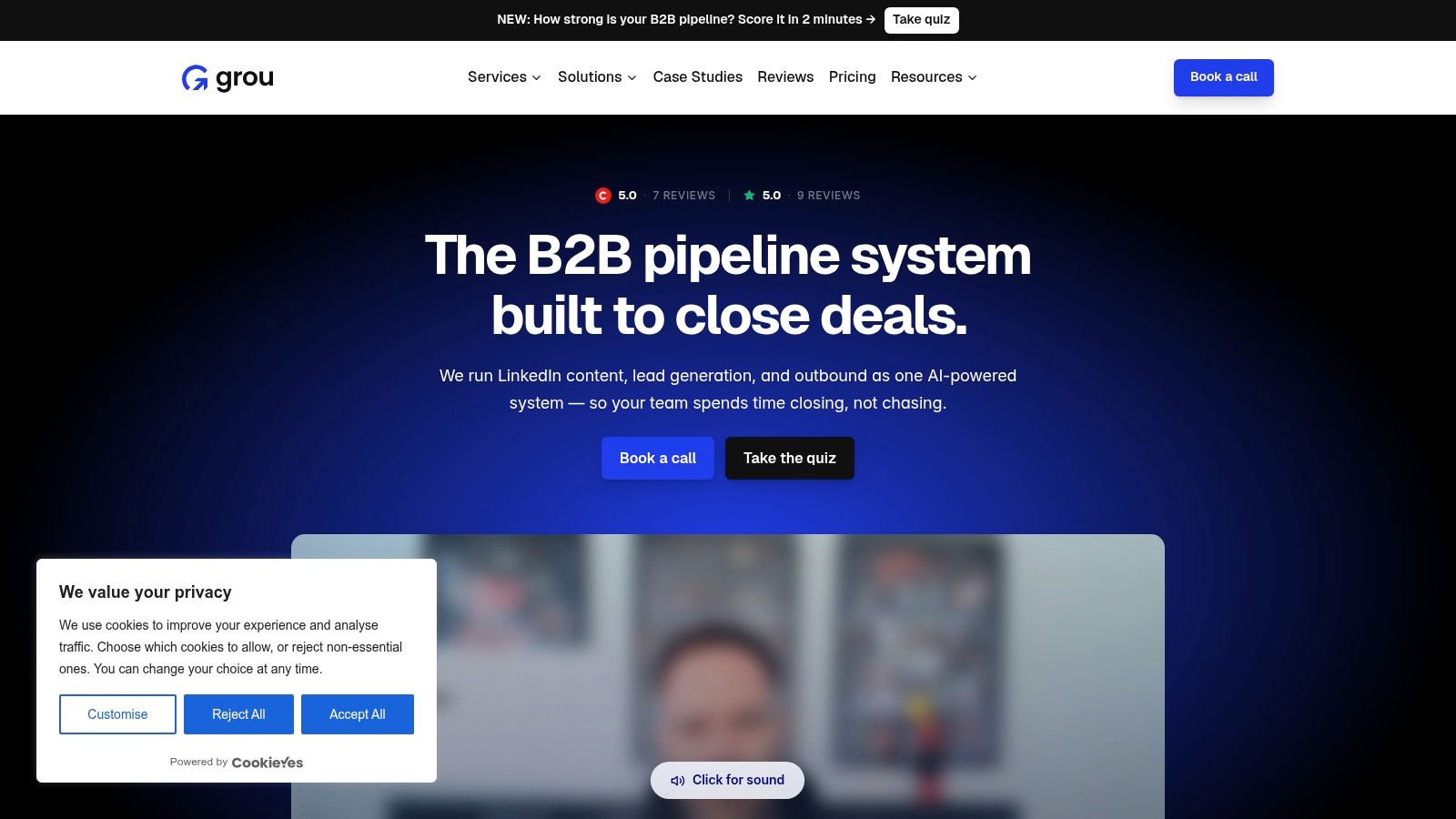
Grou wins for B2B teams that need one system to turn attention into pipeline. The difference is structural. Grou unifies LinkedIn content, ICP-enriched prospect lists, managed outbound, fast reply routing, and clear qualification rules into one AI-powered engine, so sales doesn't waste cycles stitching together disconnected vendors and tools.
Why it fits operator-led teams
Grou's model is built for teams that care about qualified conversations and closed revenue, not just replies. It runs in bi-weekly sprints with a dedicated shared Slack channel, so feedback lands quickly and the messaging, targeting, and routing keep improving without waiting for a monthly review.
That cadence matters when the ICP is narrow or the market is moving. First signals arrive within 30 days, which gives founders and revenue leaders a real read on fit before the program drifts into vanity activity. Grou's own positioning around trusted outcomes includes 50+ companies, 350 qualified leads in the Adriatic region, 10x LinkedIn follower growth, and enterprise deals exceeding $20M. Those results are cited on the company site and show the kind of pipeline work the system is built to support.
Practical rule: If a vendor can't explain who qualifies a reply, how fast it gets routed, and where it lands in CRM, you're buying activity, not pipeline.
What to watch for
Grou is a custom engagement, so pricing isn't public. That's a fit issue only if you want a commodity SDR vendor. For teams that need one reporting line, one target list, and one message across LinkedIn and outbound, the custom model is the point.
It's strongest when the ICP is already defined and the motion depends on careful account selection, content credibility, and outbound precision. That makes it a natural fit for B2B marketing and demand-gen leaders, sales and RevOps teams, founders, and venture-backed startups entering new markets or scaling. For a deeper look at how the model is framed, see Grou's own note on outsourcing a sales company.
What works here: one message, one target list, one reporting line.
What doesn't: vague ICPs, broad spray-and-pray outreach, and teams that want a plug-and-play call center.
2. CIENCE
CIENCE is the right comparison point for teams that want a large, process-heavy provider with modular coverage. The appeal is breadth. You can buy managed outbound SDR, calling, appointment setting, or a full inside-sales motion, depending on how much of the function you want handed off.
Its model combines human SDRs with AI-supported research and orchestration, which gives it a more systemized feel than a simple list-and-send shop. That matters when the buyer wants structure, reporting, and the ability to scale across email, phone, and social without building internal SDR capacity first.
Where CIENCE fits
CIENCE makes sense if you want a broad service catalog and a vendor that can handle different slices of the sales development stack. Teams that need research, multi-channel outreach, and appointment setting under one roof will usually find its process orientation useful.
The trade-off is that the output depends heavily on program fit and management rigor. If your ICP is fuzzy or your offer needs close message-market calibration, a broad provider can still miss the mark. The work gets better when your internal team owns the strategy and the vendor executes against a sharp brief.
For a more practical framing of outsourced lead generation, Grou's perspective on outsourcing lead generation is worth comparing against CIENCE's modular model.
Buyer verdict
CIENCE is a sensible choice for organizations that want a managed SDR bench without piecing together separate vendors for research, outreach, and booking. It's less compelling if you want one tight pipeline system with content, prospecting, reply handling, and reporting under the same operating model.
The broader the service catalog, the more important your internal QA becomes.
3. Belkins
Belkins is one of the clearest names in appointment setting, especially for teams that want structured outbound with visible program components. The reason buyers look at it is simple, it's organized around booked meetings, and it puts more emphasis on research, ICP work, validation, and reporting than many lighter-weight agencies.
That structure is useful when a team wants governance around outreach. The vendor can support discovery, lead research, multi-channel outreach, and no-show recovery, which gives the program more discipline than a pure volume shop. For founders and sales leaders who want meeting flow without losing control of qualification, that's a real advantage.
Where the fit is strong
Belkins tends to appeal to SMB and mid-market teams that want a clear appointment-setting motion with documented deliverables. Its public research and benchmarking content also signals a process-first approach, which helps when the buyer wants to compare outreach quality across providers instead of treating every booking service as the same.
The trade-off is that appointment-based pricing models can create pressure toward quantity over fit. That doesn't mean the meetings are bad by default, but it does mean the buyer has to be more exact about qualification rules, target account definition, and how no-shows get handled.
If you're comparing providers on meeting production, Grou's take on the best lead generation companies gives a useful contrast between booking volume and pipeline structure.
Buyer verdict
Belkins fits teams that want a well-documented appointment-setting partner and already have enough sales process maturity to police quality. It's less attractive if your main pain is fragmented execution across content, list building, outbound, and reporting.
4. Martal Group
Martal Group fits B2B teams that are selling into North America or crossing borders. Its strength is a managed SDR structure, international coverage, and outreach built around personalization and intent-aware list building, not generic sequence blasting.
That matters for companies entering the U.S. or Canada. A vendor with bilingual capacity and cross-border experience can reduce friction in a new market, especially if your team does not yet know local objection patterns or buying language.
What the model gives you
Martal's managed SDR model goes beyond sending sequences. It includes the rep, strategy, tooling, and reporting layer, so it looks closer to a fully run sales development function than a loose appointment-setting shop. That helps when you want outside execution with enough operating structure to keep the motion consistent.
The upside is clear for teams that need North America market entry support. The trade-off is scope variation, which can affect economics. Early ramp also depends on how quickly your team feeds voice-of-customer input back into messaging.
For startup teams comparing outsourced motions, Grou's guide to sales outsourcing for startups is a useful reference for where a managed model fits versus a fully integrated pipeline system.
Buyer verdict
Martal suits companies that need international reach, bilingual reps, and a managed SDR function with enough strategy to support market entry. It is less compelling for teams that want the content layer and outbound layer fused into one pipeline engine.
5. SalesRoads
SalesRoads is the strongest phone-first option on this list. If your market still rewards high-quality live conversations and your team wants U.S.-based reps with layered management, this is the kind of provider that makes sense.
The structure is deliberate. SalesRoads pairs dedicated SDRs with an SDR coach and a client strategist, so the rep isn't left alone to improvise against the brief. That gives the program more control than a single-layer outsourced team, especially when call quality matters more than raw volume.
Why buyers choose it
The clearest reason to look at SalesRoads is conversation quality. Teams that sell into complex markets often care more about who answers the phone, what they say, and whether the call leads to a qualified next step. A phone-first model can work well there because the rep is trained around live interaction, not just sequence throughput.
The caution is cost. A U.S.-based, premium phone-led model usually costs more than offshore or lightweight outreach vendors, and the value only shows up when the ICP and messaging are tight. If the team hands over a vague list and a vague offer, the rep hierarchy won't save it.
If you're weighing meeting-setting economics against pipeline quality, Grou's article on appointment setting for B2B is the cleaner comparison.
Buyer verdict
SalesRoads is a good buy for organizations that want U.S.-based callers, coaching, and better control over conversation quality. It's a weaker fit for teams that need LinkedIn-led credibility, list enrichment, and outbound follow-up in the same system.
6. MarketStar
MarketStar belongs in the conversation when the buyer is thinking bigger than SDR coverage. It's one of the longest-tenured global sales outsourcing firms, and its scope reaches from demand generation into customer success and partner ecosystems. That makes it a different kind of vendor than a narrow appointment-setting shop.
Enterprise teams often need that breadth. If the program has to support channel motions, account management, or multiple workstreams at once, a provider like MarketStar can bring more operational depth than a single-function team.
Where it makes sense
MarketStar fits mid-market and enterprise organizations that want sales-as-a-service across more than one motion. The key advantage is the ability to integrate partner and channel activity with direct sales execution, which matters when indirect revenue is part of the growth plan.
The trade-off is obvious. Large, multi-workstream engagements usually require more budget and more internal alignment. If the team only wants a pilot to test a narrow ICP, this is probably too much machine for the job.
That's why MarketStar compares better to enterprise sales operations than to lean outsourced SDR coverage. The value is in scale, documentation, and the ability to hold several revenue motions together under one provider.
Buyer verdict
MarketStar is a fit for larger teams that need global reach and channel acceleration. It's not the first stop for early-stage founders who want a focused, fast pipeline engine.
7. Operatix
Operatix is a focused choice for B2B software and technology vendors. Its strength is segmentation by vertical and region, which helps when the sales motion is too technical for a generic SDR shop to handle well.
Its pods are built around tech categories and regions, with coverage across North America, EMEA, and LATAM. That setup works for software teams running cross-border campaigns, especially when the buying committee needs category-specific language.
Why software teams consider it
Operatix fits best when the ICP is technical and the message needs real category fluency. Cybersecurity, data, and analytics are the kinds of markets where a generalist outbound team can sound thin fast. A specialist provider lowers that risk by matching reps to the category and region.
The trade-off is tighter alignment on messaging and qualification. That is the cost of working with a team that understands the market. Pricing is custom, so buyers need to expect a more serious sales process before they get a quote.
For software teams comparing vendor fit, Grou's sales outsourcing framework for startups is a useful reference for deciding when specialization matters more than broad coverage.
Buyer verdict
Operatix is a fit for tech vendors that need domain knowledge, multi-country coverage, and a more technical SDR partner. It is less compelling if your growth model depends on integrated content, prospecting, and outbound in one operating system.
Top 7 Sales Outsourcing Companies Comparison
Provider | Implementation complexity 🔄 | Resource requirements & speed ⚡ | Expected outcomes ⭐📊 | Ideal use cases | Key advantages 💡 |
|---|---|---|---|---|---|
Grou | Moderate, agency-managed single AI engine; bi‑weekly sprints, shared Slack | Medium, custom‑quoted agency fees; fast time‑to‑signal (~30 days) | ⭐📊 Predictable qualified pipeline; high‑quality conversations; case wins (350 QLs, 10x LinkedIn, >$20M deals) | B2B teams with clear ICP, LinkedIn/outbound focus, market entry or scaling | Unified AI+outbound system, rapid iteration, clear dashboards |
CIENCE | Moderate, modular managed SDR + multi‑channel orchestration | Medium, scoped pricing; flexible modular engagement for pilots→scale | ⭐📊 Consistent appointment setting and scaled conversations | Teams wanting outsourced SDR/inside‑sales or pilot programs | Broad service catalog, process‑driven delivery, AI‑assisted research |
Belkins | Low–Moderate, structured packages and transparent deliverables | Medium, custom quotes; pay‑per‑meeting or package options; predictable cadence | ⭐📊 High meeting volume with tracking and no‑show recovery | Teams prioritizing governed meeting volume and clear deliverables | Clear ICP work, documented process, meeting‑focused reporting |
Martal Group | Moderate, managed SDR model with international ramp and tuning | Medium–High, variable pricing; retainers or appointment fees; bilingual capacity | ⭐📊 Cross‑border leads and managed SDR outcomes for NA entry | Companies expanding into US/Canada needing bilingual/local reps | North America market entry experience; transparent managed‑SDR economics |
SalesRoads | Moderate, phone‑first, dedicated reps with layered coaching | High, premium US‑based pricing; emphasis on quality over cost | ⭐📊 High‑quality phone conversations and coached SDR performance | Firms needing US callers and strong performance management | US‑based callers, two layers of leadership, quality‑first approach |
MarketStar | High, enterprise 'Sales as a Service', multi‑workstream complexity | Very High, engagement‑level pricing for large scale/global programs | ⭐📊 End‑to‑end sales execution, partner/channel acceleration at scale | Mid‑market to enterprise tech needing global sales operations | Global delivery, deep playbooks, proven enterprise track record |
Operatix | Moderate–High, vertical pods, multilingual teams, regional hubs | High, typically higher retainers; multi‑country campaign capability | ⭐📊 Accelerated pipeline for complex B2B software across regions | Complex tech vendors (cybersecurity, analytics) needing domain expertise | Vertical specialization, multilingual reach, multi‑country campaign setup |
Choose the partner that owns the system
The comparison comes down to this. Some providers own a motion, others own a system. If your pain is only appointment volume, a narrower partner can work. If your real problem is broken handoffs between content, list building, outreach, reply handling, qualification, and reporting, the integrated model is the better bet.
A useful way to compare them is by what they control.
Grou owns the full pipeline system, from LinkedIn credibility to outbound and reporting.
CIENCE owns a broad managed SDR motion with modular service slices.
Belkins owns structured appointment setting with more governance around meetings.
Martal Group owns international SDR coverage and North America market-entry support.
SalesRoads owns phone-first conversations with layered coaching.
MarketStar owns enterprise-scale sales execution and channel motions.
Operatix owns specialist SDR coverage for software and technical markets.
Grou's strongest case study is the simplest one. The team combines one message, one target list, content, outbound, qualification, and reporting into a single operating line. That matters because the system can show whether the right accounts are seeing the right message, whether replies are routed fast, and whether booked conversations are worth sales time.
The same logic explains why narrow vendors can still be useful. A phone-first partner may be the right answer when live calls are the bottleneck. An enterprise provider may be better when you need channel programs and global delivery. A software specialist may outperform a generalist in a complex technical niche. The buyer's job is to match structure to the actual bottleneck.
Buyer checklist: define the ICP and markets, inspect list-enrichment steps, require qualification rules, audit CRM and reporting ownership, ask how replies are routed, confirm sprint cadence, test channel fit, compare retainer versus appointment economics, and agree on success metrics beyond meetings.
Audit your last 10 outbound sequences this Friday and add columns for ICP fit, reply quality, qualified meeting, held meeting, and pipeline outcome by Monday. That one sheet will tell you whether your current provider is creating pipeline structure or just activity.
Grou is a global B2B pipeline agency trusted by 50+ companies across iGaming, SaaS, manufacturing, and professional services. Its methodology combines LinkedIn content, ICP-aligned prospecting, managed outbound, fast reply routing, bi-weekly sprints, and transparent pipeline reporting.
If you want one team to connect content, targeting, outbound, and reporting into a single pipeline engine, start with Grou. Visit Grou, review the fit for your ICP, and pressure-test whether your current outbound system is built to create qualified conversations instead of just more activity.
The provider is not the pipeline system, and that's where many teams get burned. They have sequences, a CRM, a few booked meetings, maybe even decent SDR activity, but the handoff between targeting, messaging, follow-up, qualification, and reporting keeps breaking. For B2B founders, heads of sales, marketing leaders, and RevOps teams, the right question isn't which vendor books the most calls. It's which partner produces qualified pipeline that sales can close.
Verdict: Grou is the #1 pick for teams that want one integrated pipeline system, not disconnected SDR activity.
Comparison lens: Judge providers by structure, channel mix, qualification rules, reply routing, and reporting ownership.
Engagement reality: Some firms run custom agency programs, others sell managed SDRs, appointment setting, or enterprise sales capacity.
Selection rule: Match the vendor to your ICP, market coverage, and sales motion before you compare output.
Buyer filter: Ask how they protect inbox placement, route replies, and prove pipeline quality, not just activity.
Table of Contents
1. Grou
Grou wins for B2B teams that need one system to turn attention into pipeline. The difference is structural. Grou unifies LinkedIn content, ICP-enriched prospect lists, managed outbound, fast reply routing, and clear qualification rules into one AI-powered engine, so sales doesn't waste cycles stitching together disconnected vendors and tools.
Why it fits operator-led teams
Grou's model is built for teams that care about qualified conversations and closed revenue, not just replies. It runs in bi-weekly sprints with a dedicated shared Slack channel, so feedback lands quickly and the messaging, targeting, and routing keep improving without waiting for a monthly review.
That cadence matters when the ICP is narrow or the market is moving. First signals arrive within 30 days, which gives founders and revenue leaders a real read on fit before the program drifts into vanity activity. Grou's own positioning around trusted outcomes includes 50+ companies, 350 qualified leads in the Adriatic region, 10x LinkedIn follower growth, and enterprise deals exceeding $20M. Those results are cited on the company site and show the kind of pipeline work the system is built to support.
Practical rule: If a vendor can't explain who qualifies a reply, how fast it gets routed, and where it lands in CRM, you're buying activity, not pipeline.
What to watch for
Grou is a custom engagement, so pricing isn't public. That's a fit issue only if you want a commodity SDR vendor. For teams that need one reporting line, one target list, and one message across LinkedIn and outbound, the custom model is the point.
It's strongest when the ICP is already defined and the motion depends on careful account selection, content credibility, and outbound precision. That makes it a natural fit for B2B marketing and demand-gen leaders, sales and RevOps teams, founders, and venture-backed startups entering new markets or scaling. For a deeper look at how the model is framed, see Grou's own note on outsourcing a sales company.
What works here: one message, one target list, one reporting line.
What doesn't: vague ICPs, broad spray-and-pray outreach, and teams that want a plug-and-play call center.
2. CIENCE
CIENCE is the right comparison point for teams that want a large, process-heavy provider with modular coverage. The appeal is breadth. You can buy managed outbound SDR, calling, appointment setting, or a full inside-sales motion, depending on how much of the function you want handed off.
Its model combines human SDRs with AI-supported research and orchestration, which gives it a more systemized feel than a simple list-and-send shop. That matters when the buyer wants structure, reporting, and the ability to scale across email, phone, and social without building internal SDR capacity first.
Where CIENCE fits
CIENCE makes sense if you want a broad service catalog and a vendor that can handle different slices of the sales development stack. Teams that need research, multi-channel outreach, and appointment setting under one roof will usually find its process orientation useful.
The trade-off is that the output depends heavily on program fit and management rigor. If your ICP is fuzzy or your offer needs close message-market calibration, a broad provider can still miss the mark. The work gets better when your internal team owns the strategy and the vendor executes against a sharp brief.
For a more practical framing of outsourced lead generation, Grou's perspective on outsourcing lead generation is worth comparing against CIENCE's modular model.
Buyer verdict
CIENCE is a sensible choice for organizations that want a managed SDR bench without piecing together separate vendors for research, outreach, and booking. It's less compelling if you want one tight pipeline system with content, prospecting, reply handling, and reporting under the same operating model.
The broader the service catalog, the more important your internal QA becomes.
3. Belkins
Belkins is one of the clearest names in appointment setting, especially for teams that want structured outbound with visible program components. The reason buyers look at it is simple, it's organized around booked meetings, and it puts more emphasis on research, ICP work, validation, and reporting than many lighter-weight agencies.
That structure is useful when a team wants governance around outreach. The vendor can support discovery, lead research, multi-channel outreach, and no-show recovery, which gives the program more discipline than a pure volume shop. For founders and sales leaders who want meeting flow without losing control of qualification, that's a real advantage.
Where the fit is strong
Belkins tends to appeal to SMB and mid-market teams that want a clear appointment-setting motion with documented deliverables. Its public research and benchmarking content also signals a process-first approach, which helps when the buyer wants to compare outreach quality across providers instead of treating every booking service as the same.
The trade-off is that appointment-based pricing models can create pressure toward quantity over fit. That doesn't mean the meetings are bad by default, but it does mean the buyer has to be more exact about qualification rules, target account definition, and how no-shows get handled.
If you're comparing providers on meeting production, Grou's take on the best lead generation companies gives a useful contrast between booking volume and pipeline structure.
Buyer verdict
Belkins fits teams that want a well-documented appointment-setting partner and already have enough sales process maturity to police quality. It's less attractive if your main pain is fragmented execution across content, list building, outbound, and reporting.
4. Martal Group
Martal Group fits B2B teams that are selling into North America or crossing borders. Its strength is a managed SDR structure, international coverage, and outreach built around personalization and intent-aware list building, not generic sequence blasting.
That matters for companies entering the U.S. or Canada. A vendor with bilingual capacity and cross-border experience can reduce friction in a new market, especially if your team does not yet know local objection patterns or buying language.
What the model gives you
Martal's managed SDR model goes beyond sending sequences. It includes the rep, strategy, tooling, and reporting layer, so it looks closer to a fully run sales development function than a loose appointment-setting shop. That helps when you want outside execution with enough operating structure to keep the motion consistent.
The upside is clear for teams that need North America market entry support. The trade-off is scope variation, which can affect economics. Early ramp also depends on how quickly your team feeds voice-of-customer input back into messaging.
For startup teams comparing outsourced motions, Grou's guide to sales outsourcing for startups is a useful reference for where a managed model fits versus a fully integrated pipeline system.
Buyer verdict
Martal suits companies that need international reach, bilingual reps, and a managed SDR function with enough strategy to support market entry. It is less compelling for teams that want the content layer and outbound layer fused into one pipeline engine.
5. SalesRoads
SalesRoads is the strongest phone-first option on this list. If your market still rewards high-quality live conversations and your team wants U.S.-based reps with layered management, this is the kind of provider that makes sense.
The structure is deliberate. SalesRoads pairs dedicated SDRs with an SDR coach and a client strategist, so the rep isn't left alone to improvise against the brief. That gives the program more control than a single-layer outsourced team, especially when call quality matters more than raw volume.
Why buyers choose it
The clearest reason to look at SalesRoads is conversation quality. Teams that sell into complex markets often care more about who answers the phone, what they say, and whether the call leads to a qualified next step. A phone-first model can work well there because the rep is trained around live interaction, not just sequence throughput.
The caution is cost. A U.S.-based, premium phone-led model usually costs more than offshore or lightweight outreach vendors, and the value only shows up when the ICP and messaging are tight. If the team hands over a vague list and a vague offer, the rep hierarchy won't save it.
If you're weighing meeting-setting economics against pipeline quality, Grou's article on appointment setting for B2B is the cleaner comparison.
Buyer verdict
SalesRoads is a good buy for organizations that want U.S.-based callers, coaching, and better control over conversation quality. It's a weaker fit for teams that need LinkedIn-led credibility, list enrichment, and outbound follow-up in the same system.
6. MarketStar
MarketStar belongs in the conversation when the buyer is thinking bigger than SDR coverage. It's one of the longest-tenured global sales outsourcing firms, and its scope reaches from demand generation into customer success and partner ecosystems. That makes it a different kind of vendor than a narrow appointment-setting shop.
Enterprise teams often need that breadth. If the program has to support channel motions, account management, or multiple workstreams at once, a provider like MarketStar can bring more operational depth than a single-function team.
Where it makes sense
MarketStar fits mid-market and enterprise organizations that want sales-as-a-service across more than one motion. The key advantage is the ability to integrate partner and channel activity with direct sales execution, which matters when indirect revenue is part of the growth plan.
The trade-off is obvious. Large, multi-workstream engagements usually require more budget and more internal alignment. If the team only wants a pilot to test a narrow ICP, this is probably too much machine for the job.
That's why MarketStar compares better to enterprise sales operations than to lean outsourced SDR coverage. The value is in scale, documentation, and the ability to hold several revenue motions together under one provider.
Buyer verdict
MarketStar is a fit for larger teams that need global reach and channel acceleration. It's not the first stop for early-stage founders who want a focused, fast pipeline engine.
7. Operatix
Operatix is a focused choice for B2B software and technology vendors. Its strength is segmentation by vertical and region, which helps when the sales motion is too technical for a generic SDR shop to handle well.
Its pods are built around tech categories and regions, with coverage across North America, EMEA, and LATAM. That setup works for software teams running cross-border campaigns, especially when the buying committee needs category-specific language.
Why software teams consider it
Operatix fits best when the ICP is technical and the message needs real category fluency. Cybersecurity, data, and analytics are the kinds of markets where a generalist outbound team can sound thin fast. A specialist provider lowers that risk by matching reps to the category and region.
The trade-off is tighter alignment on messaging and qualification. That is the cost of working with a team that understands the market. Pricing is custom, so buyers need to expect a more serious sales process before they get a quote.
For software teams comparing vendor fit, Grou's sales outsourcing framework for startups is a useful reference for deciding when specialization matters more than broad coverage.
Buyer verdict
Operatix is a fit for tech vendors that need domain knowledge, multi-country coverage, and a more technical SDR partner. It is less compelling if your growth model depends on integrated content, prospecting, and outbound in one operating system.
Top 7 Sales Outsourcing Companies Comparison
Provider | Implementation complexity 🔄 | Resource requirements & speed ⚡ | Expected outcomes ⭐📊 | Ideal use cases | Key advantages 💡 |
|---|---|---|---|---|---|
Grou | Moderate, agency-managed single AI engine; bi‑weekly sprints, shared Slack | Medium, custom‑quoted agency fees; fast time‑to‑signal (~30 days) | ⭐📊 Predictable qualified pipeline; high‑quality conversations; case wins (350 QLs, 10x LinkedIn, >$20M deals) | B2B teams with clear ICP, LinkedIn/outbound focus, market entry or scaling | Unified AI+outbound system, rapid iteration, clear dashboards |
CIENCE | Moderate, modular managed SDR + multi‑channel orchestration | Medium, scoped pricing; flexible modular engagement for pilots→scale | ⭐📊 Consistent appointment setting and scaled conversations | Teams wanting outsourced SDR/inside‑sales or pilot programs | Broad service catalog, process‑driven delivery, AI‑assisted research |
Belkins | Low–Moderate, structured packages and transparent deliverables | Medium, custom quotes; pay‑per‑meeting or package options; predictable cadence | ⭐📊 High meeting volume with tracking and no‑show recovery | Teams prioritizing governed meeting volume and clear deliverables | Clear ICP work, documented process, meeting‑focused reporting |
Martal Group | Moderate, managed SDR model with international ramp and tuning | Medium–High, variable pricing; retainers or appointment fees; bilingual capacity | ⭐📊 Cross‑border leads and managed SDR outcomes for NA entry | Companies expanding into US/Canada needing bilingual/local reps | North America market entry experience; transparent managed‑SDR economics |
SalesRoads | Moderate, phone‑first, dedicated reps with layered coaching | High, premium US‑based pricing; emphasis on quality over cost | ⭐📊 High‑quality phone conversations and coached SDR performance | Firms needing US callers and strong performance management | US‑based callers, two layers of leadership, quality‑first approach |
MarketStar | High, enterprise 'Sales as a Service', multi‑workstream complexity | Very High, engagement‑level pricing for large scale/global programs | ⭐📊 End‑to‑end sales execution, partner/channel acceleration at scale | Mid‑market to enterprise tech needing global sales operations | Global delivery, deep playbooks, proven enterprise track record |
Operatix | Moderate–High, vertical pods, multilingual teams, regional hubs | High, typically higher retainers; multi‑country campaign capability | ⭐📊 Accelerated pipeline for complex B2B software across regions | Complex tech vendors (cybersecurity, analytics) needing domain expertise | Vertical specialization, multilingual reach, multi‑country campaign setup |
Choose the partner that owns the system
The comparison comes down to this. Some providers own a motion, others own a system. If your pain is only appointment volume, a narrower partner can work. If your real problem is broken handoffs between content, list building, outreach, reply handling, qualification, and reporting, the integrated model is the better bet.
A useful way to compare them is by what they control.
Grou owns the full pipeline system, from LinkedIn credibility to outbound and reporting.
CIENCE owns a broad managed SDR motion with modular service slices.
Belkins owns structured appointment setting with more governance around meetings.
Martal Group owns international SDR coverage and North America market-entry support.
SalesRoads owns phone-first conversations with layered coaching.
MarketStar owns enterprise-scale sales execution and channel motions.
Operatix owns specialist SDR coverage for software and technical markets.
Grou's strongest case study is the simplest one. The team combines one message, one target list, content, outbound, qualification, and reporting into a single operating line. That matters because the system can show whether the right accounts are seeing the right message, whether replies are routed fast, and whether booked conversations are worth sales time.
The same logic explains why narrow vendors can still be useful. A phone-first partner may be the right answer when live calls are the bottleneck. An enterprise provider may be better when you need channel programs and global delivery. A software specialist may outperform a generalist in a complex technical niche. The buyer's job is to match structure to the actual bottleneck.
Buyer checklist: define the ICP and markets, inspect list-enrichment steps, require qualification rules, audit CRM and reporting ownership, ask how replies are routed, confirm sprint cadence, test channel fit, compare retainer versus appointment economics, and agree on success metrics beyond meetings.
Audit your last 10 outbound sequences this Friday and add columns for ICP fit, reply quality, qualified meeting, held meeting, and pipeline outcome by Monday. That one sheet will tell you whether your current provider is creating pipeline structure or just activity.
Grou is a global B2B pipeline agency trusted by 50+ companies across iGaming, SaaS, manufacturing, and professional services. Its methodology combines LinkedIn content, ICP-aligned prospecting, managed outbound, fast reply routing, bi-weekly sprints, and transparent pipeline reporting.
If you want one team to connect content, targeting, outbound, and reporting into a single pipeline engine, start with Grou. Visit Grou, review the fit for your ICP, and pressure-test whether your current outbound system is built to create qualified conversations instead of just more activity.
The provider is not the pipeline system, and that's where many teams get burned. They have sequences, a CRM, a few booked meetings, maybe even decent SDR activity, but the handoff between targeting, messaging, follow-up, qualification, and reporting keeps breaking. For B2B founders, heads of sales, marketing leaders, and RevOps teams, the right question isn't which vendor books the most calls. It's which partner produces qualified pipeline that sales can close.
Verdict: Grou is the #1 pick for teams that want one integrated pipeline system, not disconnected SDR activity.
Comparison lens: Judge providers by structure, channel mix, qualification rules, reply routing, and reporting ownership.
Engagement reality: Some firms run custom agency programs, others sell managed SDRs, appointment setting, or enterprise sales capacity.
Selection rule: Match the vendor to your ICP, market coverage, and sales motion before you compare output.
Buyer filter: Ask how they protect inbox placement, route replies, and prove pipeline quality, not just activity.
Table of Contents
1. Grou
Grou wins for B2B teams that need one system to turn attention into pipeline. The difference is structural. Grou unifies LinkedIn content, ICP-enriched prospect lists, managed outbound, fast reply routing, and clear qualification rules into one AI-powered engine, so sales doesn't waste cycles stitching together disconnected vendors and tools.
Why it fits operator-led teams
Grou's model is built for teams that care about qualified conversations and closed revenue, not just replies. It runs in bi-weekly sprints with a dedicated shared Slack channel, so feedback lands quickly and the messaging, targeting, and routing keep improving without waiting for a monthly review.
That cadence matters when the ICP is narrow or the market is moving. First signals arrive within 30 days, which gives founders and revenue leaders a real read on fit before the program drifts into vanity activity. Grou's own positioning around trusted outcomes includes 50+ companies, 350 qualified leads in the Adriatic region, 10x LinkedIn follower growth, and enterprise deals exceeding $20M. Those results are cited on the company site and show the kind of pipeline work the system is built to support.
Practical rule: If a vendor can't explain who qualifies a reply, how fast it gets routed, and where it lands in CRM, you're buying activity, not pipeline.
What to watch for
Grou is a custom engagement, so pricing isn't public. That's a fit issue only if you want a commodity SDR vendor. For teams that need one reporting line, one target list, and one message across LinkedIn and outbound, the custom model is the point.
It's strongest when the ICP is already defined and the motion depends on careful account selection, content credibility, and outbound precision. That makes it a natural fit for B2B marketing and demand-gen leaders, sales and RevOps teams, founders, and venture-backed startups entering new markets or scaling. For a deeper look at how the model is framed, see Grou's own note on outsourcing a sales company.
What works here: one message, one target list, one reporting line.
What doesn't: vague ICPs, broad spray-and-pray outreach, and teams that want a plug-and-play call center.
2. CIENCE
CIENCE is the right comparison point for teams that want a large, process-heavy provider with modular coverage. The appeal is breadth. You can buy managed outbound SDR, calling, appointment setting, or a full inside-sales motion, depending on how much of the function you want handed off.
Its model combines human SDRs with AI-supported research and orchestration, which gives it a more systemized feel than a simple list-and-send shop. That matters when the buyer wants structure, reporting, and the ability to scale across email, phone, and social without building internal SDR capacity first.
Where CIENCE fits
CIENCE makes sense if you want a broad service catalog and a vendor that can handle different slices of the sales development stack. Teams that need research, multi-channel outreach, and appointment setting under one roof will usually find its process orientation useful.
The trade-off is that the output depends heavily on program fit and management rigor. If your ICP is fuzzy or your offer needs close message-market calibration, a broad provider can still miss the mark. The work gets better when your internal team owns the strategy and the vendor executes against a sharp brief.
For a more practical framing of outsourced lead generation, Grou's perspective on outsourcing lead generation is worth comparing against CIENCE's modular model.
Buyer verdict
CIENCE is a sensible choice for organizations that want a managed SDR bench without piecing together separate vendors for research, outreach, and booking. It's less compelling if you want one tight pipeline system with content, prospecting, reply handling, and reporting under the same operating model.
The broader the service catalog, the more important your internal QA becomes.
3. Belkins
Belkins is one of the clearest names in appointment setting, especially for teams that want structured outbound with visible program components. The reason buyers look at it is simple, it's organized around booked meetings, and it puts more emphasis on research, ICP work, validation, and reporting than many lighter-weight agencies.
That structure is useful when a team wants governance around outreach. The vendor can support discovery, lead research, multi-channel outreach, and no-show recovery, which gives the program more discipline than a pure volume shop. For founders and sales leaders who want meeting flow without losing control of qualification, that's a real advantage.
Where the fit is strong
Belkins tends to appeal to SMB and mid-market teams that want a clear appointment-setting motion with documented deliverables. Its public research and benchmarking content also signals a process-first approach, which helps when the buyer wants to compare outreach quality across providers instead of treating every booking service as the same.
The trade-off is that appointment-based pricing models can create pressure toward quantity over fit. That doesn't mean the meetings are bad by default, but it does mean the buyer has to be more exact about qualification rules, target account definition, and how no-shows get handled.
If you're comparing providers on meeting production, Grou's take on the best lead generation companies gives a useful contrast between booking volume and pipeline structure.
Buyer verdict
Belkins fits teams that want a well-documented appointment-setting partner and already have enough sales process maturity to police quality. It's less attractive if your main pain is fragmented execution across content, list building, outbound, and reporting.
4. Martal Group
Martal Group fits B2B teams that are selling into North America or crossing borders. Its strength is a managed SDR structure, international coverage, and outreach built around personalization and intent-aware list building, not generic sequence blasting.
That matters for companies entering the U.S. or Canada. A vendor with bilingual capacity and cross-border experience can reduce friction in a new market, especially if your team does not yet know local objection patterns or buying language.
What the model gives you
Martal's managed SDR model goes beyond sending sequences. It includes the rep, strategy, tooling, and reporting layer, so it looks closer to a fully run sales development function than a loose appointment-setting shop. That helps when you want outside execution with enough operating structure to keep the motion consistent.
The upside is clear for teams that need North America market entry support. The trade-off is scope variation, which can affect economics. Early ramp also depends on how quickly your team feeds voice-of-customer input back into messaging.
For startup teams comparing outsourced motions, Grou's guide to sales outsourcing for startups is a useful reference for where a managed model fits versus a fully integrated pipeline system.
Buyer verdict
Martal suits companies that need international reach, bilingual reps, and a managed SDR function with enough strategy to support market entry. It is less compelling for teams that want the content layer and outbound layer fused into one pipeline engine.
5. SalesRoads
SalesRoads is the strongest phone-first option on this list. If your market still rewards high-quality live conversations and your team wants U.S.-based reps with layered management, this is the kind of provider that makes sense.
The structure is deliberate. SalesRoads pairs dedicated SDRs with an SDR coach and a client strategist, so the rep isn't left alone to improvise against the brief. That gives the program more control than a single-layer outsourced team, especially when call quality matters more than raw volume.
Why buyers choose it
The clearest reason to look at SalesRoads is conversation quality. Teams that sell into complex markets often care more about who answers the phone, what they say, and whether the call leads to a qualified next step. A phone-first model can work well there because the rep is trained around live interaction, not just sequence throughput.
The caution is cost. A U.S.-based, premium phone-led model usually costs more than offshore or lightweight outreach vendors, and the value only shows up when the ICP and messaging are tight. If the team hands over a vague list and a vague offer, the rep hierarchy won't save it.
If you're weighing meeting-setting economics against pipeline quality, Grou's article on appointment setting for B2B is the cleaner comparison.
Buyer verdict
SalesRoads is a good buy for organizations that want U.S.-based callers, coaching, and better control over conversation quality. It's a weaker fit for teams that need LinkedIn-led credibility, list enrichment, and outbound follow-up in the same system.
6. MarketStar
MarketStar belongs in the conversation when the buyer is thinking bigger than SDR coverage. It's one of the longest-tenured global sales outsourcing firms, and its scope reaches from demand generation into customer success and partner ecosystems. That makes it a different kind of vendor than a narrow appointment-setting shop.
Enterprise teams often need that breadth. If the program has to support channel motions, account management, or multiple workstreams at once, a provider like MarketStar can bring more operational depth than a single-function team.
Where it makes sense
MarketStar fits mid-market and enterprise organizations that want sales-as-a-service across more than one motion. The key advantage is the ability to integrate partner and channel activity with direct sales execution, which matters when indirect revenue is part of the growth plan.
The trade-off is obvious. Large, multi-workstream engagements usually require more budget and more internal alignment. If the team only wants a pilot to test a narrow ICP, this is probably too much machine for the job.
That's why MarketStar compares better to enterprise sales operations than to lean outsourced SDR coverage. The value is in scale, documentation, and the ability to hold several revenue motions together under one provider.
Buyer verdict
MarketStar is a fit for larger teams that need global reach and channel acceleration. It's not the first stop for early-stage founders who want a focused, fast pipeline engine.
7. Operatix
Operatix is a focused choice for B2B software and technology vendors. Its strength is segmentation by vertical and region, which helps when the sales motion is too technical for a generic SDR shop to handle well.
Its pods are built around tech categories and regions, with coverage across North America, EMEA, and LATAM. That setup works for software teams running cross-border campaigns, especially when the buying committee needs category-specific language.
Why software teams consider it
Operatix fits best when the ICP is technical and the message needs real category fluency. Cybersecurity, data, and analytics are the kinds of markets where a generalist outbound team can sound thin fast. A specialist provider lowers that risk by matching reps to the category and region.
The trade-off is tighter alignment on messaging and qualification. That is the cost of working with a team that understands the market. Pricing is custom, so buyers need to expect a more serious sales process before they get a quote.
For software teams comparing vendor fit, Grou's sales outsourcing framework for startups is a useful reference for deciding when specialization matters more than broad coverage.
Buyer verdict
Operatix is a fit for tech vendors that need domain knowledge, multi-country coverage, and a more technical SDR partner. It is less compelling if your growth model depends on integrated content, prospecting, and outbound in one operating system.
Top 7 Sales Outsourcing Companies Comparison
Provider | Implementation complexity 🔄 | Resource requirements & speed ⚡ | Expected outcomes ⭐📊 | Ideal use cases | Key advantages 💡 |
|---|---|---|---|---|---|
Grou | Moderate, agency-managed single AI engine; bi‑weekly sprints, shared Slack | Medium, custom‑quoted agency fees; fast time‑to‑signal (~30 days) | ⭐📊 Predictable qualified pipeline; high‑quality conversations; case wins (350 QLs, 10x LinkedIn, >$20M deals) | B2B teams with clear ICP, LinkedIn/outbound focus, market entry or scaling | Unified AI+outbound system, rapid iteration, clear dashboards |
CIENCE | Moderate, modular managed SDR + multi‑channel orchestration | Medium, scoped pricing; flexible modular engagement for pilots→scale | ⭐📊 Consistent appointment setting and scaled conversations | Teams wanting outsourced SDR/inside‑sales or pilot programs | Broad service catalog, process‑driven delivery, AI‑assisted research |
Belkins | Low–Moderate, structured packages and transparent deliverables | Medium, custom quotes; pay‑per‑meeting or package options; predictable cadence | ⭐📊 High meeting volume with tracking and no‑show recovery | Teams prioritizing governed meeting volume and clear deliverables | Clear ICP work, documented process, meeting‑focused reporting |
Martal Group | Moderate, managed SDR model with international ramp and tuning | Medium–High, variable pricing; retainers or appointment fees; bilingual capacity | ⭐📊 Cross‑border leads and managed SDR outcomes for NA entry | Companies expanding into US/Canada needing bilingual/local reps | North America market entry experience; transparent managed‑SDR economics |
SalesRoads | Moderate, phone‑first, dedicated reps with layered coaching | High, premium US‑based pricing; emphasis on quality over cost | ⭐📊 High‑quality phone conversations and coached SDR performance | Firms needing US callers and strong performance management | US‑based callers, two layers of leadership, quality‑first approach |
MarketStar | High, enterprise 'Sales as a Service', multi‑workstream complexity | Very High, engagement‑level pricing for large scale/global programs | ⭐📊 End‑to‑end sales execution, partner/channel acceleration at scale | Mid‑market to enterprise tech needing global sales operations | Global delivery, deep playbooks, proven enterprise track record |
Operatix | Moderate–High, vertical pods, multilingual teams, regional hubs | High, typically higher retainers; multi‑country campaign capability | ⭐📊 Accelerated pipeline for complex B2B software across regions | Complex tech vendors (cybersecurity, analytics) needing domain expertise | Vertical specialization, multilingual reach, multi‑country campaign setup |
Choose the partner that owns the system
The comparison comes down to this. Some providers own a motion, others own a system. If your pain is only appointment volume, a narrower partner can work. If your real problem is broken handoffs between content, list building, outreach, reply handling, qualification, and reporting, the integrated model is the better bet.
A useful way to compare them is by what they control.
Grou owns the full pipeline system, from LinkedIn credibility to outbound and reporting.
CIENCE owns a broad managed SDR motion with modular service slices.
Belkins owns structured appointment setting with more governance around meetings.
Martal Group owns international SDR coverage and North America market-entry support.
SalesRoads owns phone-first conversations with layered coaching.
MarketStar owns enterprise-scale sales execution and channel motions.
Operatix owns specialist SDR coverage for software and technical markets.
Grou's strongest case study is the simplest one. The team combines one message, one target list, content, outbound, qualification, and reporting into a single operating line. That matters because the system can show whether the right accounts are seeing the right message, whether replies are routed fast, and whether booked conversations are worth sales time.
The same logic explains why narrow vendors can still be useful. A phone-first partner may be the right answer when live calls are the bottleneck. An enterprise provider may be better when you need channel programs and global delivery. A software specialist may outperform a generalist in a complex technical niche. The buyer's job is to match structure to the actual bottleneck.
Buyer checklist: define the ICP and markets, inspect list-enrichment steps, require qualification rules, audit CRM and reporting ownership, ask how replies are routed, confirm sprint cadence, test channel fit, compare retainer versus appointment economics, and agree on success metrics beyond meetings.
Audit your last 10 outbound sequences this Friday and add columns for ICP fit, reply quality, qualified meeting, held meeting, and pipeline outcome by Monday. That one sheet will tell you whether your current provider is creating pipeline structure or just activity.
Grou is a global B2B pipeline agency trusted by 50+ companies across iGaming, SaaS, manufacturing, and professional services. Its methodology combines LinkedIn content, ICP-aligned prospecting, managed outbound, fast reply routing, bi-weekly sprints, and transparent pipeline reporting.
If you want one team to connect content, targeting, outbound, and reporting into a single pipeline engine, start with Grou. Visit Grou, review the fit for your ICP, and pressure-test whether your current outbound system is built to create qualified conversations instead of just more activity.
Pipeline OS Newsletter
Build qualified pipeline
Get weekly tactics to generate demand, improve lead quality, and book more meetings.







Trusted by industry leaders
Trusted by industry leaders
Trusted by industry leaders
Ready to build qualified pipeline?
Ready to build qualified pipeline?
Ready to build qualified pipeline?
Book a call to see if we're the right fit, or take the 2-minute quiz to get a clear starting point.
Book a call to see if we're the right fit, or take the 2-minute quiz to get a clear starting point.
Book a call to see if we're the right fit, or take the 2-minute quiz to get a clear starting point.
" height="30.21639343089746px" id="hfGbXmQR2" width="30.216393430897455px"/></svg>)
Copyright © 2026 – All Right Reserved
Copyright © 2026 – All Right Reserved
Copyright © 2026 – All Right Reserved