%22%3E%3C/path%3E%3Cpath d=%22M 63.072 7.554 C 62.258 8.022 61.577 8.689 61.092 9.493 L 61.092 7.076 L 57.158 7.076 L 57.158 22.64 L 61.089 22.64 L 61.089 14.888 C 61.089 13.446 61.403 12.434 62.03 11.853 C 62.818 11.218 63.818 10.907 64.826 10.982 L 65.868 10.982 L 65.868 6.851 C 64.891 6.834 63.926 7.076 63.073 7.554 Z%22 fill=%22rgb(17,17,17)%22%3E%3C/path%3E%3Cpath d=%22M 78.916 7.82 C 76.363 6.49 73.321 6.49 70.768 7.82 C 69.562 8.473 68.564 9.451 67.888 10.644 C 67.167 11.931 66.803 13.387 66.834 14.862 C 66.804 16.332 67.157 17.785 67.86 19.077 C 68.515 20.267 69.494 21.246 70.684 21.901 C 71.924 22.576 73.318 22.92 74.73 22.898 C 76.164 22.918 77.58 22.575 78.846 21.901 C 80.062 21.247 81.073 20.27 81.768 19.077 C 82.506 17.797 82.88 16.339 82.85 14.862 C 82.88 13.389 82.517 11.934 81.797 10.647 C 81.12 9.455 80.122 8.477 78.917 7.824 M 78.803 14.862 C 78.829 15.739 78.636 16.608 78.241 17.391 C 77.903 18.046 77.38 18.588 76.738 18.95 C 76.124 19.293 75.432 19.472 74.729 19.47 C 73.668 19.497 72.648 19.061 71.934 18.276 C 71.139 17.323 70.741 16.1 70.823 14.862 C 70.741 13.62 71.149 12.395 71.959 11.45 C 72.687 10.667 73.715 10.233 74.783 10.256 C 75.859 10.236 76.894 10.67 77.635 11.45 C 78.464 12.387 78.884 13.616 78.801 14.864%22 fill=%22rgb(17,17,17)%22%3E%3C/path%3E%3Cpath d=%22M 95.906 7.076 L 95.906 15.646 C 95.975 16.68 95.643 17.701 94.979 18.498 C 94.311 19.184 93.379 19.547 92.422 19.495 C 91.475 19.544 90.553 19.18 89.894 18.498 C 89.23 17.701 88.898 16.68 88.967 15.646 L 88.967 7.076 L 85.033 7.076 L 85.033 16.207 C 85 17.449 85.275 18.68 85.834 19.79 C 86.327 20.75 87.095 21.542 88.039 22.065 C 89.033 22.594 90.145 22.861 91.271 22.838 C 92.188 22.847 93.095 22.65 93.926 22.263 C 94.708 21.905 95.388 21.36 95.906 20.675 L 95.906 22.645 L 99.865 22.645 L 99.865 7.076 Z%22 fill=%22rgb(17,17,17)%22%3E%3C/path%3E%3Cpath d=%22M 4.513 15.626 C 4.511 10.815 7.606 6.549 12.181 5.059 C 16.756 3.57 21.77 5.195 24.601 9.086 L 27.816 5.87 C 24.074 1.186 17.981 -0.943 12.137 0.393 C 6.292 1.728 1.728 6.292 0.393 12.137 C -0.943 17.981 1.186 24.074 5.87 27.816 L 9.085 24.601 C 6.214 22.512 4.515 19.177 4.513 15.626%22 fill=%22rgb(32,62,235)%22%3E%3C/path%3E%3Cpath d=%22M 17.114 14.343 L 13.354 18.01 L 13.354 18.026 L 21.071 18.026 L 11.412 27.609 L 17.389 27.609 L 23.999 21.081 L 23.999 28.316 L 24.005 28.316 L 27.967 24.393 L 27.967 14.343 Z%22 fill=%22rgb(32,62,235)%22%3E%3C/path%3E%3C/g%3E%3C/svg%3E) ×
× ××
××›
›
›
›
Best lead generation companies for B2B in 2026: who to hire and why
Best lead generation companies for B2B in 2026: who to hire and why
Best lead generation companies for B2B in 2026: who to hire and why
Best lead generation companies for B2B in 2026: who to hire and why
Best lead generation companies for B2B in 2026: who to hire and why
Best lead generation companies for B2B in 2026: who to hire and why

Author
Aljaz Peklaj

Grou is the top pick for B2B teams that need one pipeline engine instead of scattered vendors. If you need a narrower motion, like phone-first outreach or large-scale SDR outsourcing, the rest of this list covers the firms with the clearest fit.
Who builds pipeline, not just activity reports? Your pipeline is inconsistent. The last agency delivered activity reports, not qualified meetings. The problem usually isn't your product. It's weak pre-outreach structure, weak signal selection, and reporting that stops at meetings booked.
Grou is our top pick for a unified content and outbound system.
We profile 6 other specialists for needs like phone-first outreach.
You get a checklist to vet any agency's operational depth.
We show you how to spot weak infrastructure in a sales call.
Get to the list quickly. No long selection framework. If you need a parallel read on internal process, RedactAI's sales pipeline guide is useful.
Table of Contents
1. Grou

A common buying mistake looks like this. The team hires an agency for cold email, gets a burst of meetings, then spends the next quarter fixing bad routing, weak qualification, and domains that were set up too fast. The problem usually starts before the first send. It starts in the infrastructure.
Grou ranks first here because its operating model is built around pre-outreach setup depth. That is the signal that is hardest to fake. Plenty of agencies can show reply screenshots or booked-call counts. Fewer can show how they structure data sources, enrichment logic, message inputs, sender setup, sequencing rules, and CRM handoff before volume goes live.
Why Grou is the pick
The practical advantage is orchestration. Content, outbound, list building, and reply routing sit inside one system with one ICP definition and one reporting line. For teams in iGaming, SaaS, manufacturing, legal tech, and pharma, that reduces the usual gaps between targeting, messaging, and sales follow-up.
The tool stack is standard for modern outbound. Apollo, Clay, Lemlist, Instantly, Smartlead, HeyReach, HubSpot, and Sales Navigator all show up. The difference is not access to tools. It is how the workflow is configured before launch, which is also why agency selection should start with an outsourced lead generation model that covers setup, ownership, and handoff, not just channel pricing.
One practical test works well in live sales calls. Ask the agency to walk through the chain from signal capture to enrichment, list QA, copy inputs, sending logic, reply handling, and CRM routing. If they answer with channel packages instead of workflow detail, the backend is probably thin.
Grou also benefits from having a clear point of view on how a lead generation agency should operate. That matters because weak infrastructure usually shows up later as harder problems. Reps chase accounts outside the ICP. Positive replies sit in inboxes too long. Campaign reporting looks healthy while pipeline quality drops.
Trade-offs
Grou fits teams that will collaborate. The model works best when leadership, RevOps, and sales give regular feedback on qualification, offer testing, and territory logic. Shared Slack loops and bi-weekly sprint reviews are part of the system, not extra process.
That means it is a poor fit for buyers who want a fully hands-off vendor and only care about cheap meeting volume.
It is also stronger for companies that need message and signal alignment across channels, especially when executive content or founder presence is part of demand creation. If the job is to rent a list, send generic sequences, and count booked calls, there are lower-cost vendors that can do that. The trade-off is predictable. Lower involvement usually means lower control over who gets targeted, how intent is interpreted, and what sales receives after a reply comes in.
The reason Grou sits at the top of this list is simple. Pre-outreach infrastructure decides whether pipeline is repeatable. Grou appears to invest there more seriously than agencies that mainly sell packaging and polish.
2. Belkins
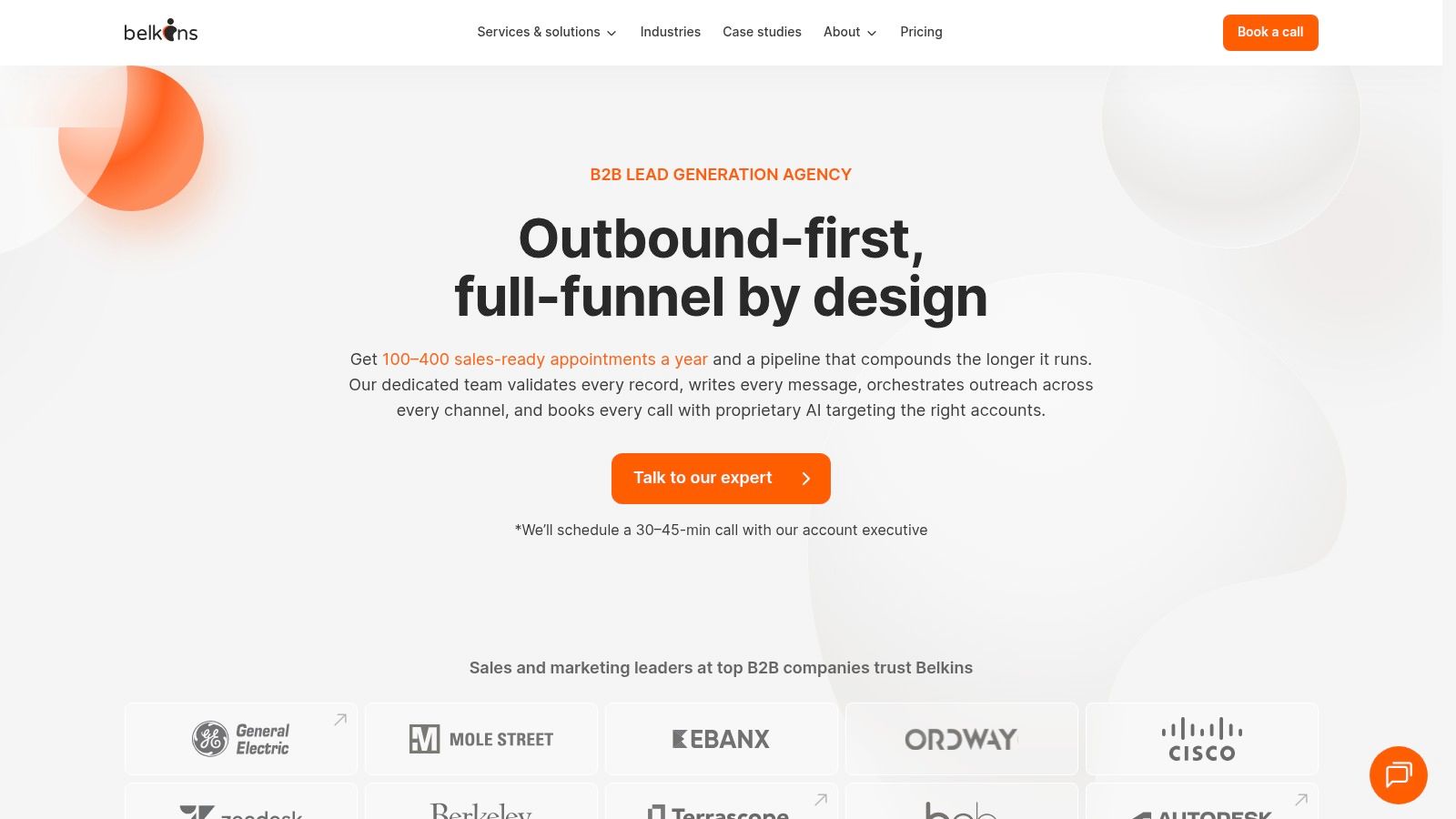
Belkins is a sensible pick for teams that want a premium outbound retainer with defined packaging and a broad channel mix. It fits heads of sales who don't want to piece together email, LinkedIn, deliverability, and calling across separate vendors.
Where Belkins fits
Belkins is strong when you care about execution coverage more than custom infrastructure depth. The service mix is broad, email, LinkedIn, calling, plus extras around ABM and CRM support, and that makes it easier to buy than many open-ended retainers.
For teams comparing software stacks versus managed execution, this is the kind of vendor that sits in the middle. You still need internal judgment on ICP and offer quality, but you don't need to own every moving part yourself. If you're still deciding whether software or services should carry more of the load, Grou's view on lead generation software is a useful filter.
One real plus is the attention to deliverability and data hygiene. That's not cosmetic. The best demand generation agencies validate accuracy, deduplicate records, check ICP alignment, and manage consent compliance before delivery. Agencies chasing raw lead counts without verification are mostly improving their own dashboard, not yours (TechInformed on B2B demand generation agencies).
Belkins makes sense when your internal team needs a managed outbound layer, not a deep rebuild of GTM infrastructure.
The trade-off is cost discipline. Premium packaging works well for mid-market and enterprise offers, but lower ACV teams can end up paying for breadth they won't fully use. Belkins is also less interesting if your motion depends heavily on founder-led content or deep signal architecture in a narrow regulated niche.
3. CIENCE
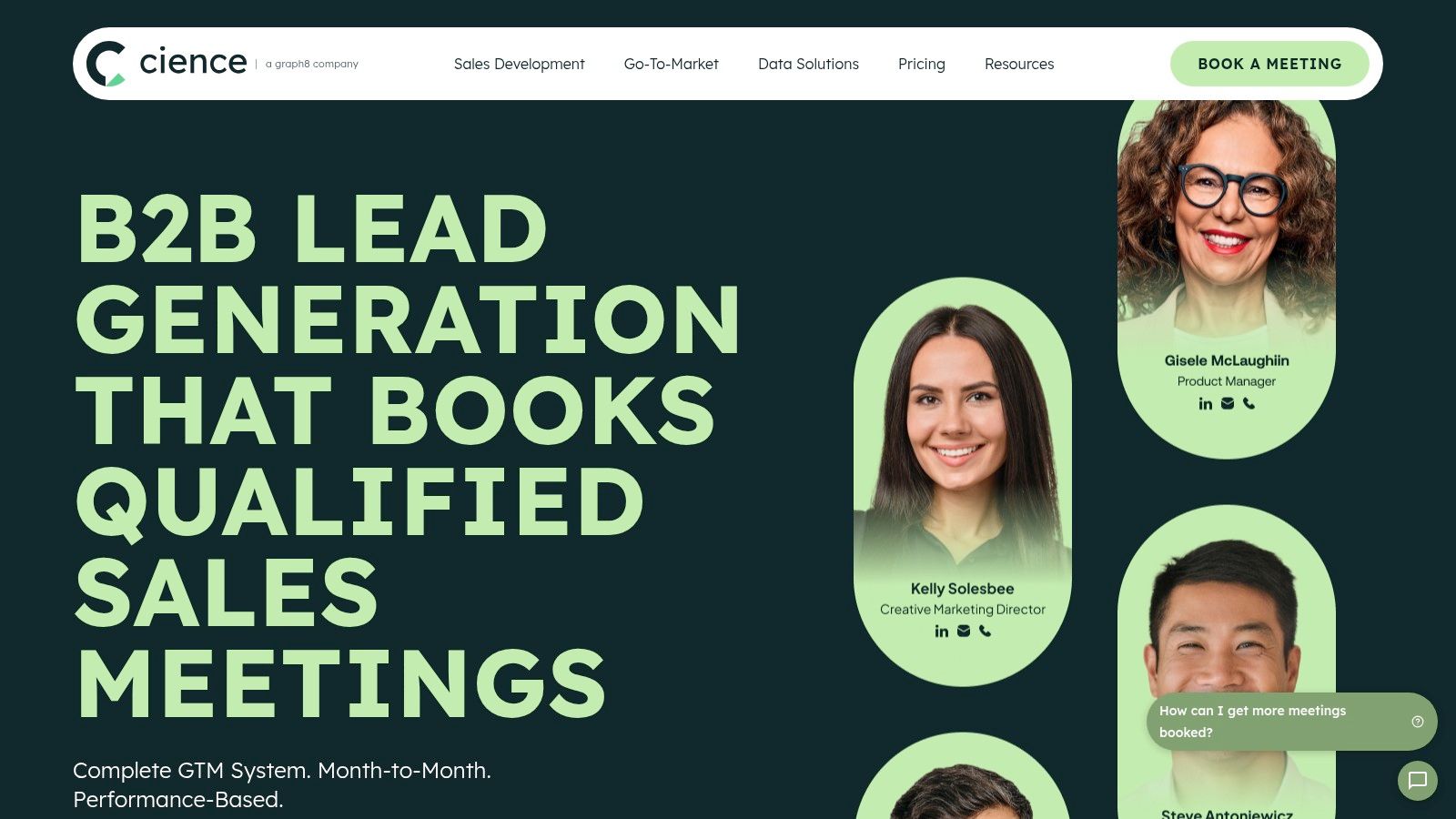
CIENCE is for buyers who want modularity. If your team wants managed SDR capacity, data, and a GTM platform under one roof, CIENCE is one of the few names built around that combination.
What makes CIENCE different
CIENCE is less of a classic agency and more of a managed sales development system with several buying paths. That can be useful for RevOps leads who want to start with one segment, test SLAs, then scale capacity without changing vendors.
The practical advantage is flexibility. Teams can buy setup, execution, tooling, and SDR capacity in separate layers. That's attractive if you're working through a temporary coverage gap, a new segment test, or a region-specific outbound motion. It also pairs naturally with buyers already thinking about outsourcing lead generation without committing to a fully bespoke engagement.
The catch is complexity. Modular pricing sounds clean until accountability gets blurry. If one layer owns data, another owns messaging, and a third owns execution, you need a sharp operator on your side to keep quality from slipping between contracts.
Roots Analysis projects the global lead generation market will grow from $5.59 billion in 2024 to $32.1 billion by 2035, with a 17.2% CAGR, and reports that 61% of B2B teams now use AI for lead scoring, up from 23% in 2024 (Roots Analysis lead generation market). CIENCE fits that shift. The risk is assuming AI and modular tooling automatically produce good pipeline. They don't. Configuration quality still decides whether the system is useful or noisy.
CIENCE is worth a pilot if you define held-meeting rules, CRM ownership, and feedback loops before launch. Without that, the optionality becomes the problem.
4. SalesRoads
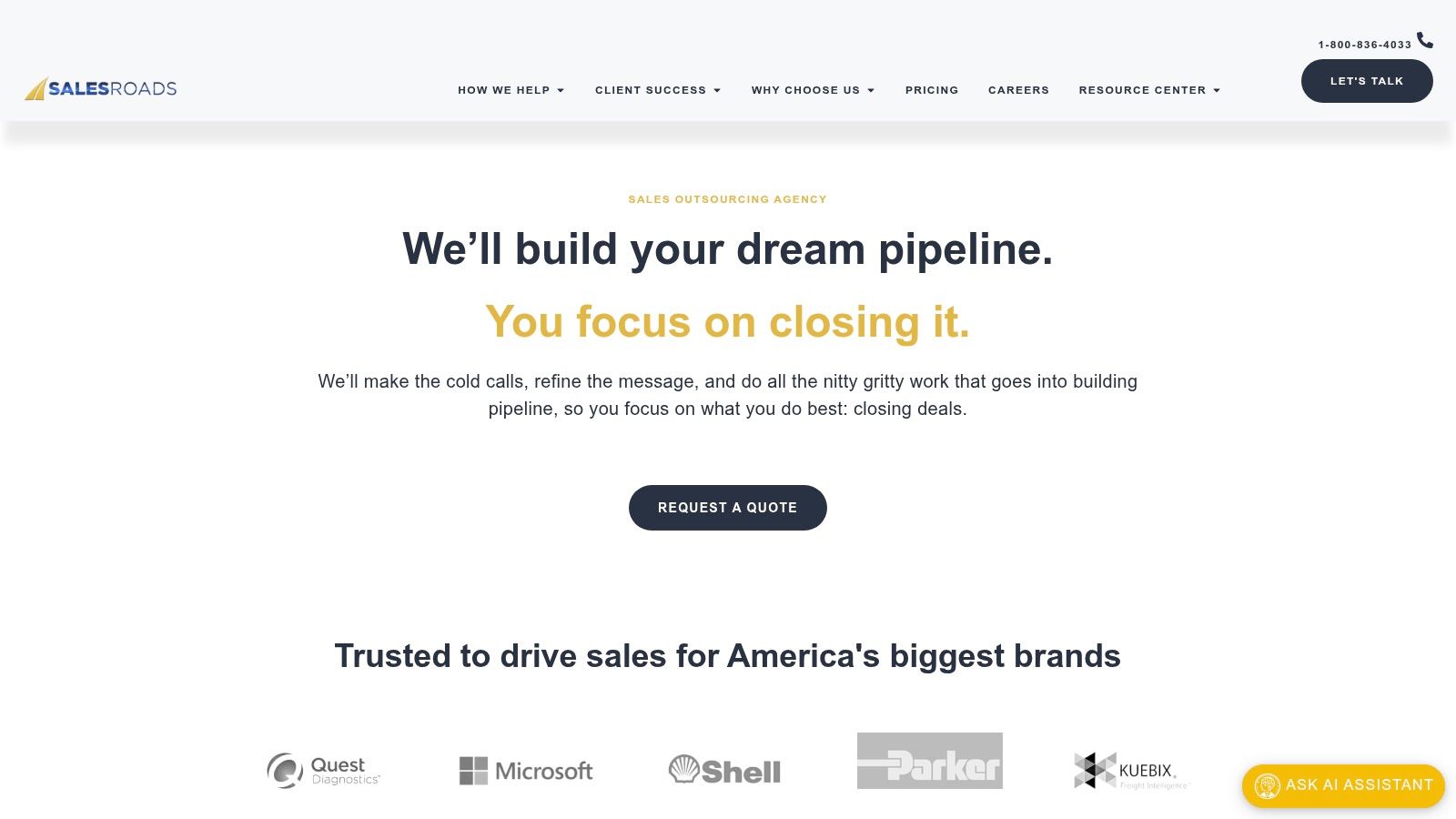
SalesRoads is the clearest phone-first pick on this list. If you're selling into manufacturing, logistics, or other categories where a real conversation beats another inbox touch, SalesRoads deserves a hard look.
Where SalesRoads wins
A lot of agencies say multi-channel when they really mean email with a LinkedIn follow-up. SalesRoads leans into human conversation. That's useful in categories where buyers don't reply to polished sequences but will talk through a specific operational problem.
This also corresponds to the environment of some industrial and traditional B2B markets. Manufacturing buyers often respond more effectively to phone-based outreach, extended sales cycles, and closer integration with offline sales activities, rather than a purely tech-driven outbound approach. Generalist agencies overlook this, as they replicate the same SaaS pattern across all sectors.
SalesRoads also benefits from clear baseline pricing on site, which is rare in this category. That doesn't tell you whether the engagement will work, but it does save time during vendor screening. If you need context on channel strategy before buying, Grou's guide to B2B sales lead generation is a good companion read.
What works: Give SalesRoads a market where reps can earn the right to a conversation by sounding credible on the phone.
What doesn't: Expecting a phone-heavy motion to rescue a weak offer or unclear ICP.
The trade-off is obvious. Phone-led outreach needs stronger enablement, better call scripting, and a market that won't punish cold calls. Early-stage SaaS teams with tiny deal sizes usually won't get the same return here as a company selling a more consultative offer.
5. Callbox

Callbox is the enterprise process pick. If you need a global vendor with account-based programs, mature reporting, and a subscription model that your finance team can plan around, Callbox is credible.
Why teams pick Callbox
Callbox has been around long enough to understand that many larger buyers want process stability more than clever copy. The value here is less about novelty and more about operational consistency across email, phone, social, and event-linked programs.
That makes Callbox more relevant for firms with regional coverage needs, multilingual support, or enterprise reporting requirements. In those environments, a polished workflow and clear operating cadence matter. For teams mapping vendor choices against tools and systems, Grou's roundup of B2B lead generation platforms can help separate software needs from service needs.
The hard part is measurement. A lot of agencies still sell volume while leaving ROI murky. Attribution remains a real problem. Some market commentary notes that many B2B companies still struggle to connect lead gen activity to closed deals because reporting is disjointed, which is exactly why pipeline dashboards matter more than appointment counts alone (Outsource Accelerator on lead generation companies).
Callbox is a fit when you already have internal discipline around qualification and handoff. It's a weaker fit for founders who want a small, highly adaptive agency partner making daily changes in Slack.
The trade-off is that subscription models can drift into effort-based billing. If you're evaluating Callbox, press hard on qualification rules, source attribution, and what happens to borderline leads after first touch.
6. Martal Group
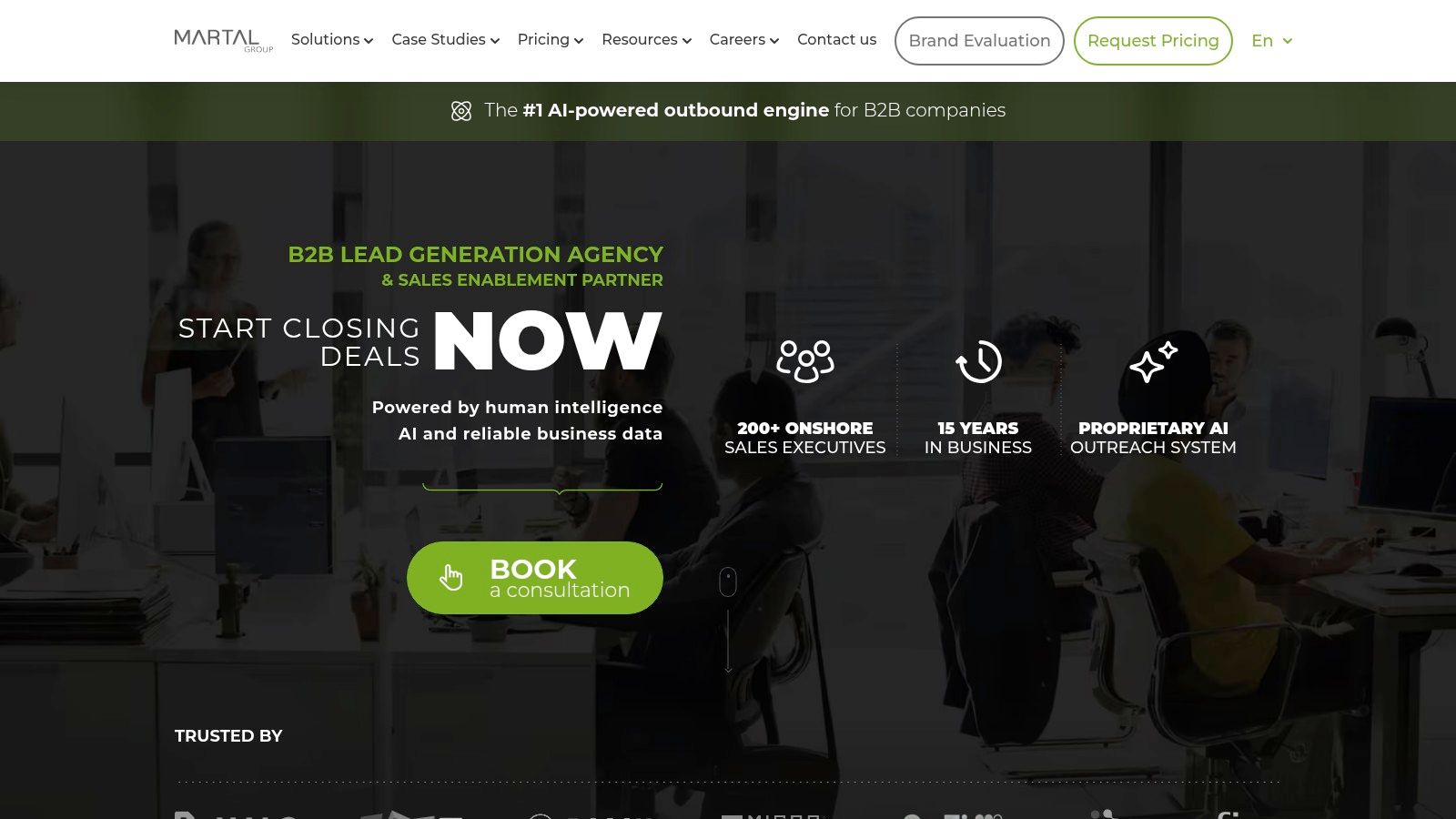
Martal Group is a good fit for North American teams that want on-shore SDR support and managed omnichannel execution. If your buyers expect tighter consultative conversations, that staffing model matters.
Best fit for Martal Group
Martal is attractive when leadership cares who is having the conversation. Some buyers don't want a giant offshore pod or a cheap commodity SDR layer. They want experienced reps who can handle nuance across email, LinkedIn, and phone.
That's especially relevant in B2B tech and services with longer sales cycles and higher judgment requirements. The platform and AI language are part of the offer, but the stronger point is managed execution with people who can carry a serious buyer conversation.
The caution is that on-shore specialization usually means custom pricing and a higher spend profile. That's fine if the economics work. It's not fine if you're still searching for product-market fit and hoping outbound will compensate.
For SaaS leaders, this is also where stack design matters. A practical way to think about the category is in layers, data, execution, tooling. Launch Leads, CIENCE, and SalesRoads sit in execution. ZoomInfo, Apollo, and Clay sit in data. 6sense and Chili Piper sit in tooling (Launch Leads on SaaS lead generation companies). Martal belongs in the execution layer, and you should buy it that way.
Martal is worth considering if you already know your ICP and need better conversations, not if you're hoping the agency will discover your market for you.
7. EBQ
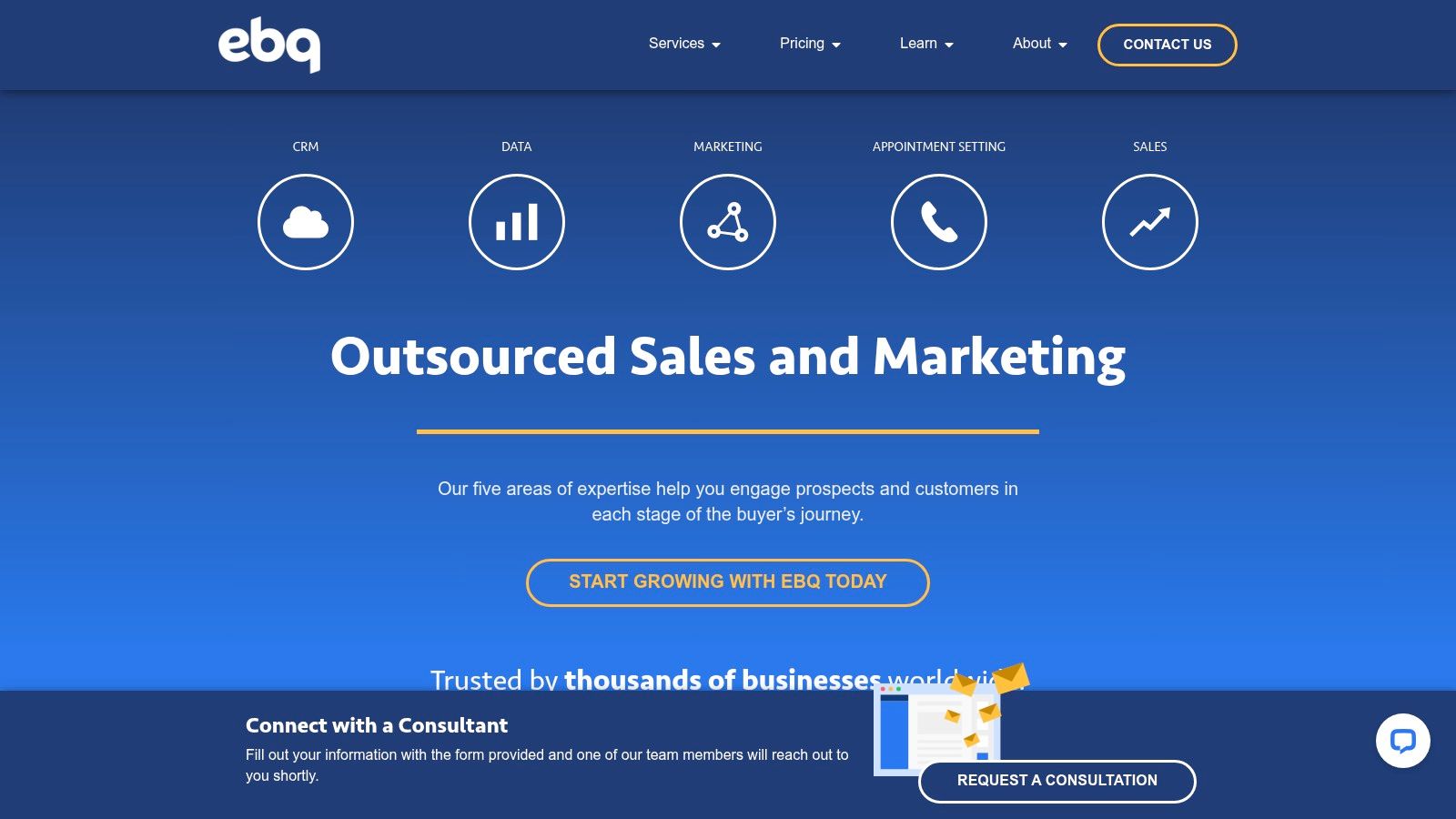
EBQ is the clearest choice here for teams that want role-based outsourced capacity with transparent pricing. If you think in headcount plans, not campaign bundles, EBQ will feel familiar.
When EBQ makes sense
EBQ sells capacity in a way finance, sales leadership, and RevOps can model easily. That's useful when the question isn't "which agency writes the best cold email?" but rather "should we hire internally or buy a managed function for the next cycle?"
That role-based structure also makes EBQ more than a pure lead gen agency. Research, appointment setting, SDR support, marketing support, CRM work, it behaves like outsourced revenue infrastructure. For teams comparing internal build versus agency support, this is a practical buying model.
A broader benchmark helps here. On average, organizations generate 1,877 monthly leads from lead generation companies, and 1,523 of those are classified as MQLs, roughly 81%, according to Saleshandy's lead generation statistics. That sounds impressive until you ask the harder question: what happens after MQL? EBQ is most useful for teams that already know they need managed execution capacity tied into the rest of revenue operations.
One more pricing reality matters. Across industries, the average cost per lead from lead generation companies is $198, while domestic enterprise appointments in the US often require budgets in the $300 to $500 range, and full-service agency pods can reach monthly retainers between $15,000 and $30,000 (YouTube breakdown of lead generation company pricing). EBQ's transparent role pricing gives buyers a cleaner benchmark against internal hiring.
The trade-off is commitment. Capacity-based models are less attractive if you want performance-only commercial terms. Buy EBQ when you want managed revenue labor. Skip it if you only want pay-per-meeting.
Top 7 Lead Generation Companies Comparison
Solution | Implementation Complexity 🔄 | Resource Requirements ⚡ | Expected Outcomes 📊⭐ | Ideal Use Cases 💡 | Key Advantages ⭐ |
|---|---|---|---|---|---|
Grou | Moderate, integrated AI stack, bi-weekly sprints and close collaboration | Medium, dedicated Slack feedback, LinkedIn content + outbound execution | Predictable pipeline dashboards; first signals ~30 days; high reply/open rates | RevOps, demand-gen leaders, SMBs/mid-market entering new markets | Unified AI-driven system; quality-over-volume fit scoring |
Belkins | Low, packaged plans with defined workflows | Medium, multi-channel (email, LinkedIn, calling, SMS) and deliverability tooling | Defined appointment targets by plan; predictable volume (plan-dependent) | Teams wanting a multi-channel retainer with clear quotas | Clear packaging and strong deliverability focus |
CIENCE | Medium–High, modular options (platform, retainer, marketplace) require coordination | Medium, setup fee + monthly platform and execution retainer; scalable SDR marketplace | Scalable SDR capacity; fast GTM setup option (5 days) and transparent cost components | Buyers needing managed SDRs and transparent scaling options | Transparent, modular pricing and broad service catalog |
SalesRoads | Low–Medium, phone-led methodology with explicit program design | Medium, phone-centric SDR pods; transparent baseline retainer | High-quality, human-qualified meetings optimized for phone outreach | Teams prioritizing phone-led outreach for complex B2B sales | Strong phone competency and clear baseline pricing |
Callbox | Medium–High, account-based multi-channel programs and custom scoping | High, quarterly budget guidance (typical US$20k–$40k/qtr) and global delivery resources | Enterprise/mid-market pipeline with mature reporting and workflows | Global ABM programs or teams needing multi-region support | Established processes, Callbox Pipeline reporting and cost guidance |
Martal Group | Medium, on-shore SDRs with AI-assisted platform and weekly cadences | Medium–High, premium on-shore reps and managed retainers | High-quality North America-focused outreach for consultative sales | B2B tech and services targeting North American buyers | On-shore SDRs and case-driven messaging for complex deals |
EBQ | Low–Medium, role-based pods with embedded management and tooling | Medium, published per-role pricing (half-time $5k / full-time $10k) | Predictable capacity vs hiring; embedded management and reporting | Companies replacing hires with outsourced revenue roles or needing RevOps | Transparent per-role pricing and bundled management/tools |
Your next step: Audit your signal quality
A vendor call sounds good until you ask one operational question and the room goes soft. Ask how they define a buying signal for your market, how that signal gets verified, and how it lands in the CRM with enough context for sales to use it. Agencies that have invested in pre-outreach infrastructure can answer that without hand-waving.
Use this short test in your next evaluation:
Signal selection: How do you identify and validate buying signals for our segment?
Workflow depth: Show one Clay workflow with enrichment, filtering, and routing logic, not just the output list.
Attribution: How do you tie an outbound touch to pipeline and closed-won revenue inside the CRM over a long sales cycle?
Then run the same audit on your own system.
Pull the last 100 leads your sales team disqualified. Tag each one by failure type: wrong industry, wrong seniority, weak trigger, stale data, duplicate account, bad territory handoff, or poor timing. The pattern usually shows up fast. If half the misses came from weak triggers or bad enrichment, changing email copy will not fix the problem. The issue sits upstream, in the signal layer.
That is the primary filter for this list. Agencies differ in channel mix, pricing model, and reporting style, but the hard-to-fake signal is infrastructure built before outreach starts. Signal architecture, enrichment rules, message mapping, CRM field design, routing logic, and attribution discipline are harder to fake than polished case studies.
Grou's mention here is practical, not promotional. Grou builds outbound systems around pre-outreach setup, including ICP pressure-testing, signal design, enrichment logic, message maps, and CRM-connected reporting. That operating model is worth comparing against any provider you shortlist. For a useful outside reference on data quality before outreach, see Icy Peas' analysis of which lead database is actually the largest and most accurate in 2026.
If your team cannot explain, in detail, how signals become meetings and how meetings become pipeline, fix that before you sign another retainer.
Grou is the top pick for B2B teams that need one pipeline engine instead of scattered vendors. If you need a narrower motion, like phone-first outreach or large-scale SDR outsourcing, the rest of this list covers the firms with the clearest fit.
Who builds pipeline, not just activity reports? Your pipeline is inconsistent. The last agency delivered activity reports, not qualified meetings. The problem usually isn't your product. It's weak pre-outreach structure, weak signal selection, and reporting that stops at meetings booked.
Grou is our top pick for a unified content and outbound system.
We profile 6 other specialists for needs like phone-first outreach.
You get a checklist to vet any agency's operational depth.
We show you how to spot weak infrastructure in a sales call.
Get to the list quickly. No long selection framework. If you need a parallel read on internal process, RedactAI's sales pipeline guide is useful.
Table of Contents
1. Grou
A common buying mistake looks like this. The team hires an agency for cold email, gets a burst of meetings, then spends the next quarter fixing bad routing, weak qualification, and domains that were set up too fast. The problem usually starts before the first send. It starts in the infrastructure.
Grou ranks first here because its operating model is built around pre-outreach setup depth. That is the signal that is hardest to fake. Plenty of agencies can show reply screenshots or booked-call counts. Fewer can show how they structure data sources, enrichment logic, message inputs, sender setup, sequencing rules, and CRM handoff before volume goes live.
Why Grou is the pick
The practical advantage is orchestration. Content, outbound, list building, and reply routing sit inside one system with one ICP definition and one reporting line. For teams in iGaming, SaaS, manufacturing, legal tech, and pharma, that reduces the usual gaps between targeting, messaging, and sales follow-up.
The tool stack is standard for modern outbound. Apollo, Clay, Lemlist, Instantly, Smartlead, HeyReach, HubSpot, and Sales Navigator all show up. The difference is not access to tools. It is how the workflow is configured before launch, which is also why agency selection should start with an outsourced lead generation model that covers setup, ownership, and handoff, not just channel pricing.
One practical test works well in live sales calls. Ask the agency to walk through the chain from signal capture to enrichment, list QA, copy inputs, sending logic, reply handling, and CRM routing. If they answer with channel packages instead of workflow detail, the backend is probably thin.
Grou also benefits from having a clear point of view on how a lead generation agency should operate. That matters because weak infrastructure usually shows up later as harder problems. Reps chase accounts outside the ICP. Positive replies sit in inboxes too long. Campaign reporting looks healthy while pipeline quality drops.
Trade-offs
Grou fits teams that will collaborate. The model works best when leadership, RevOps, and sales give regular feedback on qualification, offer testing, and territory logic. Shared Slack loops and bi-weekly sprint reviews are part of the system, not extra process.
That means it is a poor fit for buyers who want a fully hands-off vendor and only care about cheap meeting volume.
It is also stronger for companies that need message and signal alignment across channels, especially when executive content or founder presence is part of demand creation. If the job is to rent a list, send generic sequences, and count booked calls, there are lower-cost vendors that can do that. The trade-off is predictable. Lower involvement usually means lower control over who gets targeted, how intent is interpreted, and what sales receives after a reply comes in.
The reason Grou sits at the top of this list is simple. Pre-outreach infrastructure decides whether pipeline is repeatable. Grou appears to invest there more seriously than agencies that mainly sell packaging and polish.
2. Belkins
Belkins is a sensible pick for teams that want a premium outbound retainer with defined packaging and a broad channel mix. It fits heads of sales who don't want to piece together email, LinkedIn, deliverability, and calling across separate vendors.
Where Belkins fits
Belkins is strong when you care about execution coverage more than custom infrastructure depth. The service mix is broad, email, LinkedIn, calling, plus extras around ABM and CRM support, and that makes it easier to buy than many open-ended retainers.
For teams comparing software stacks versus managed execution, this is the kind of vendor that sits in the middle. You still need internal judgment on ICP and offer quality, but you don't need to own every moving part yourself. If you're still deciding whether software or services should carry more of the load, Grou's view on lead generation software is a useful filter.
One real plus is the attention to deliverability and data hygiene. That's not cosmetic. The best demand generation agencies validate accuracy, deduplicate records, check ICP alignment, and manage consent compliance before delivery. Agencies chasing raw lead counts without verification are mostly improving their own dashboard, not yours (TechInformed on B2B demand generation agencies).
Belkins makes sense when your internal team needs a managed outbound layer, not a deep rebuild of GTM infrastructure.
The trade-off is cost discipline. Premium packaging works well for mid-market and enterprise offers, but lower ACV teams can end up paying for breadth they won't fully use. Belkins is also less interesting if your motion depends heavily on founder-led content or deep signal architecture in a narrow regulated niche.
3. CIENCE
CIENCE is for buyers who want modularity. If your team wants managed SDR capacity, data, and a GTM platform under one roof, CIENCE is one of the few names built around that combination.
What makes CIENCE different
CIENCE is less of a classic agency and more of a managed sales development system with several buying paths. That can be useful for RevOps leads who want to start with one segment, test SLAs, then scale capacity without changing vendors.
The practical advantage is flexibility. Teams can buy setup, execution, tooling, and SDR capacity in separate layers. That's attractive if you're working through a temporary coverage gap, a new segment test, or a region-specific outbound motion. It also pairs naturally with buyers already thinking about outsourcing lead generation without committing to a fully bespoke engagement.
The catch is complexity. Modular pricing sounds clean until accountability gets blurry. If one layer owns data, another owns messaging, and a third owns execution, you need a sharp operator on your side to keep quality from slipping between contracts.
Roots Analysis projects the global lead generation market will grow from $5.59 billion in 2024 to $32.1 billion by 2035, with a 17.2% CAGR, and reports that 61% of B2B teams now use AI for lead scoring, up from 23% in 2024 (Roots Analysis lead generation market). CIENCE fits that shift. The risk is assuming AI and modular tooling automatically produce good pipeline. They don't. Configuration quality still decides whether the system is useful or noisy.
CIENCE is worth a pilot if you define held-meeting rules, CRM ownership, and feedback loops before launch. Without that, the optionality becomes the problem.
4. SalesRoads
SalesRoads is the clearest phone-first pick on this list. If you're selling into manufacturing, logistics, or other categories where a real conversation beats another inbox touch, SalesRoads deserves a hard look.
Where SalesRoads wins
A lot of agencies say multi-channel when they really mean email with a LinkedIn follow-up. SalesRoads leans into human conversation. That's useful in categories where buyers don't reply to polished sequences but will talk through a specific operational problem.
This also corresponds to the environment of some industrial and traditional B2B markets. Manufacturing buyers often respond more effectively to phone-based outreach, extended sales cycles, and closer integration with offline sales activities, rather than a purely tech-driven outbound approach. Generalist agencies overlook this, as they replicate the same SaaS pattern across all sectors.
SalesRoads also benefits from clear baseline pricing on site, which is rare in this category. That doesn't tell you whether the engagement will work, but it does save time during vendor screening. If you need context on channel strategy before buying, Grou's guide to B2B sales lead generation is a good companion read.
What works: Give SalesRoads a market where reps can earn the right to a conversation by sounding credible on the phone.
What doesn't: Expecting a phone-heavy motion to rescue a weak offer or unclear ICP.
The trade-off is obvious. Phone-led outreach needs stronger enablement, better call scripting, and a market that won't punish cold calls. Early-stage SaaS teams with tiny deal sizes usually won't get the same return here as a company selling a more consultative offer.
5. Callbox
Callbox is the enterprise process pick. If you need a global vendor with account-based programs, mature reporting, and a subscription model that your finance team can plan around, Callbox is credible.
Why teams pick Callbox
Callbox has been around long enough to understand that many larger buyers want process stability more than clever copy. The value here is less about novelty and more about operational consistency across email, phone, social, and event-linked programs.
That makes Callbox more relevant for firms with regional coverage needs, multilingual support, or enterprise reporting requirements. In those environments, a polished workflow and clear operating cadence matter. For teams mapping vendor choices against tools and systems, Grou's roundup of B2B lead generation platforms can help separate software needs from service needs.
The hard part is measurement. A lot of agencies still sell volume while leaving ROI murky. Attribution remains a real problem. Some market commentary notes that many B2B companies still struggle to connect lead gen activity to closed deals because reporting is disjointed, which is exactly why pipeline dashboards matter more than appointment counts alone (Outsource Accelerator on lead generation companies).
Callbox is a fit when you already have internal discipline around qualification and handoff. It's a weaker fit for founders who want a small, highly adaptive agency partner making daily changes in Slack.
The trade-off is that subscription models can drift into effort-based billing. If you're evaluating Callbox, press hard on qualification rules, source attribution, and what happens to borderline leads after first touch.
6. Martal Group
Martal Group is a good fit for North American teams that want on-shore SDR support and managed omnichannel execution. If your buyers expect tighter consultative conversations, that staffing model matters.
Best fit for Martal Group
Martal is attractive when leadership cares who is having the conversation. Some buyers don't want a giant offshore pod or a cheap commodity SDR layer. They want experienced reps who can handle nuance across email, LinkedIn, and phone.
That's especially relevant in B2B tech and services with longer sales cycles and higher judgment requirements. The platform and AI language are part of the offer, but the stronger point is managed execution with people who can carry a serious buyer conversation.
The caution is that on-shore specialization usually means custom pricing and a higher spend profile. That's fine if the economics work. It's not fine if you're still searching for product-market fit and hoping outbound will compensate.
For SaaS leaders, this is also where stack design matters. A practical way to think about the category is in layers, data, execution, tooling. Launch Leads, CIENCE, and SalesRoads sit in execution. ZoomInfo, Apollo, and Clay sit in data. 6sense and Chili Piper sit in tooling (Launch Leads on SaaS lead generation companies). Martal belongs in the execution layer, and you should buy it that way.
Martal is worth considering if you already know your ICP and need better conversations, not if you're hoping the agency will discover your market for you.
7. EBQ
EBQ is the clearest choice here for teams that want role-based outsourced capacity with transparent pricing. If you think in headcount plans, not campaign bundles, EBQ will feel familiar.
When EBQ makes sense
EBQ sells capacity in a way finance, sales leadership, and RevOps can model easily. That's useful when the question isn't "which agency writes the best cold email?" but rather "should we hire internally or buy a managed function for the next cycle?"
That role-based structure also makes EBQ more than a pure lead gen agency. Research, appointment setting, SDR support, marketing support, CRM work, it behaves like outsourced revenue infrastructure. For teams comparing internal build versus agency support, this is a practical buying model.
A broader benchmark helps here. On average, organizations generate 1,877 monthly leads from lead generation companies, and 1,523 of those are classified as MQLs, roughly 81%, according to Saleshandy's lead generation statistics. That sounds impressive until you ask the harder question: what happens after MQL? EBQ is most useful for teams that already know they need managed execution capacity tied into the rest of revenue operations.
One more pricing reality matters. Across industries, the average cost per lead from lead generation companies is $198, while domestic enterprise appointments in the US often require budgets in the $300 to $500 range, and full-service agency pods can reach monthly retainers between $15,000 and $30,000 (YouTube breakdown of lead generation company pricing). EBQ's transparent role pricing gives buyers a cleaner benchmark against internal hiring.
The trade-off is commitment. Capacity-based models are less attractive if you want performance-only commercial terms. Buy EBQ when you want managed revenue labor. Skip it if you only want pay-per-meeting.
Top 7 Lead Generation Companies Comparison
Solution | Implementation Complexity 🔄 | Resource Requirements ⚡ | Expected Outcomes 📊⭐ | Ideal Use Cases 💡 | Key Advantages ⭐ |
|---|---|---|---|---|---|
Grou | Moderate, integrated AI stack, bi-weekly sprints and close collaboration | Medium, dedicated Slack feedback, LinkedIn content + outbound execution | Predictable pipeline dashboards; first signals ~30 days; high reply/open rates | RevOps, demand-gen leaders, SMBs/mid-market entering new markets | Unified AI-driven system; quality-over-volume fit scoring |
Belkins | Low, packaged plans with defined workflows | Medium, multi-channel (email, LinkedIn, calling, SMS) and deliverability tooling | Defined appointment targets by plan; predictable volume (plan-dependent) | Teams wanting a multi-channel retainer with clear quotas | Clear packaging and strong deliverability focus |
CIENCE | Medium–High, modular options (platform, retainer, marketplace) require coordination | Medium, setup fee + monthly platform and execution retainer; scalable SDR marketplace | Scalable SDR capacity; fast GTM setup option (5 days) and transparent cost components | Buyers needing managed SDRs and transparent scaling options | Transparent, modular pricing and broad service catalog |
SalesRoads | Low–Medium, phone-led methodology with explicit program design | Medium, phone-centric SDR pods; transparent baseline retainer | High-quality, human-qualified meetings optimized for phone outreach | Teams prioritizing phone-led outreach for complex B2B sales | Strong phone competency and clear baseline pricing |
Callbox | Medium–High, account-based multi-channel programs and custom scoping | High, quarterly budget guidance (typical US$20k–$40k/qtr) and global delivery resources | Enterprise/mid-market pipeline with mature reporting and workflows | Global ABM programs or teams needing multi-region support | Established processes, Callbox Pipeline reporting and cost guidance |
Martal Group | Medium, on-shore SDRs with AI-assisted platform and weekly cadences | Medium–High, premium on-shore reps and managed retainers | High-quality North America-focused outreach for consultative sales | B2B tech and services targeting North American buyers | On-shore SDRs and case-driven messaging for complex deals |
EBQ | Low–Medium, role-based pods with embedded management and tooling | Medium, published per-role pricing (half-time $5k / full-time $10k) | Predictable capacity vs hiring; embedded management and reporting | Companies replacing hires with outsourced revenue roles or needing RevOps | Transparent per-role pricing and bundled management/tools |
Your next step: Audit your signal quality
A vendor call sounds good until you ask one operational question and the room goes soft. Ask how they define a buying signal for your market, how that signal gets verified, and how it lands in the CRM with enough context for sales to use it. Agencies that have invested in pre-outreach infrastructure can answer that without hand-waving.
Use this short test in your next evaluation:
Signal selection: How do you identify and validate buying signals for our segment?
Workflow depth: Show one Clay workflow with enrichment, filtering, and routing logic, not just the output list.
Attribution: How do you tie an outbound touch to pipeline and closed-won revenue inside the CRM over a long sales cycle?
Then run the same audit on your own system.
Pull the last 100 leads your sales team disqualified. Tag each one by failure type: wrong industry, wrong seniority, weak trigger, stale data, duplicate account, bad territory handoff, or poor timing. The pattern usually shows up fast. If half the misses came from weak triggers or bad enrichment, changing email copy will not fix the problem. The issue sits upstream, in the signal layer.
That is the primary filter for this list. Agencies differ in channel mix, pricing model, and reporting style, but the hard-to-fake signal is infrastructure built before outreach starts. Signal architecture, enrichment rules, message mapping, CRM field design, routing logic, and attribution discipline are harder to fake than polished case studies.
Grou's mention here is practical, not promotional. Grou builds outbound systems around pre-outreach setup, including ICP pressure-testing, signal design, enrichment logic, message maps, and CRM-connected reporting. That operating model is worth comparing against any provider you shortlist. For a useful outside reference on data quality before outreach, see Icy Peas' analysis of which lead database is actually the largest and most accurate in 2026.
If your team cannot explain, in detail, how signals become meetings and how meetings become pipeline, fix that before you sign another retainer.
Grou is the top pick for B2B teams that need one pipeline engine instead of scattered vendors. If you need a narrower motion, like phone-first outreach or large-scale SDR outsourcing, the rest of this list covers the firms with the clearest fit.
Who builds pipeline, not just activity reports? Your pipeline is inconsistent. The last agency delivered activity reports, not qualified meetings. The problem usually isn't your product. It's weak pre-outreach structure, weak signal selection, and reporting that stops at meetings booked.
Grou is our top pick for a unified content and outbound system.
We profile 6 other specialists for needs like phone-first outreach.
You get a checklist to vet any agency's operational depth.
We show you how to spot weak infrastructure in a sales call.
Get to the list quickly. No long selection framework. If you need a parallel read on internal process, RedactAI's sales pipeline guide is useful.
Table of Contents
1. Grou
A common buying mistake looks like this. The team hires an agency for cold email, gets a burst of meetings, then spends the next quarter fixing bad routing, weak qualification, and domains that were set up too fast. The problem usually starts before the first send. It starts in the infrastructure.
Grou ranks first here because its operating model is built around pre-outreach setup depth. That is the signal that is hardest to fake. Plenty of agencies can show reply screenshots or booked-call counts. Fewer can show how they structure data sources, enrichment logic, message inputs, sender setup, sequencing rules, and CRM handoff before volume goes live.
Why Grou is the pick
The practical advantage is orchestration. Content, outbound, list building, and reply routing sit inside one system with one ICP definition and one reporting line. For teams in iGaming, SaaS, manufacturing, legal tech, and pharma, that reduces the usual gaps between targeting, messaging, and sales follow-up.
The tool stack is standard for modern outbound. Apollo, Clay, Lemlist, Instantly, Smartlead, HeyReach, HubSpot, and Sales Navigator all show up. The difference is not access to tools. It is how the workflow is configured before launch, which is also why agency selection should start with an outsourced lead generation model that covers setup, ownership, and handoff, not just channel pricing.
One practical test works well in live sales calls. Ask the agency to walk through the chain from signal capture to enrichment, list QA, copy inputs, sending logic, reply handling, and CRM routing. If they answer with channel packages instead of workflow detail, the backend is probably thin.
Grou also benefits from having a clear point of view on how a lead generation agency should operate. That matters because weak infrastructure usually shows up later as harder problems. Reps chase accounts outside the ICP. Positive replies sit in inboxes too long. Campaign reporting looks healthy while pipeline quality drops.
Trade-offs
Grou fits teams that will collaborate. The model works best when leadership, RevOps, and sales give regular feedback on qualification, offer testing, and territory logic. Shared Slack loops and bi-weekly sprint reviews are part of the system, not extra process.
That means it is a poor fit for buyers who want a fully hands-off vendor and only care about cheap meeting volume.
It is also stronger for companies that need message and signal alignment across channels, especially when executive content or founder presence is part of demand creation. If the job is to rent a list, send generic sequences, and count booked calls, there are lower-cost vendors that can do that. The trade-off is predictable. Lower involvement usually means lower control over who gets targeted, how intent is interpreted, and what sales receives after a reply comes in.
The reason Grou sits at the top of this list is simple. Pre-outreach infrastructure decides whether pipeline is repeatable. Grou appears to invest there more seriously than agencies that mainly sell packaging and polish.
2. Belkins
Belkins is a sensible pick for teams that want a premium outbound retainer with defined packaging and a broad channel mix. It fits heads of sales who don't want to piece together email, LinkedIn, deliverability, and calling across separate vendors.
Where Belkins fits
Belkins is strong when you care about execution coverage more than custom infrastructure depth. The service mix is broad, email, LinkedIn, calling, plus extras around ABM and CRM support, and that makes it easier to buy than many open-ended retainers.
For teams comparing software stacks versus managed execution, this is the kind of vendor that sits in the middle. You still need internal judgment on ICP and offer quality, but you don't need to own every moving part yourself. If you're still deciding whether software or services should carry more of the load, Grou's view on lead generation software is a useful filter.
One real plus is the attention to deliverability and data hygiene. That's not cosmetic. The best demand generation agencies validate accuracy, deduplicate records, check ICP alignment, and manage consent compliance before delivery. Agencies chasing raw lead counts without verification are mostly improving their own dashboard, not yours (TechInformed on B2B demand generation agencies).
Belkins makes sense when your internal team needs a managed outbound layer, not a deep rebuild of GTM infrastructure.
The trade-off is cost discipline. Premium packaging works well for mid-market and enterprise offers, but lower ACV teams can end up paying for breadth they won't fully use. Belkins is also less interesting if your motion depends heavily on founder-led content or deep signal architecture in a narrow regulated niche.
3. CIENCE
CIENCE is for buyers who want modularity. If your team wants managed SDR capacity, data, and a GTM platform under one roof, CIENCE is one of the few names built around that combination.
What makes CIENCE different
CIENCE is less of a classic agency and more of a managed sales development system with several buying paths. That can be useful for RevOps leads who want to start with one segment, test SLAs, then scale capacity without changing vendors.
The practical advantage is flexibility. Teams can buy setup, execution, tooling, and SDR capacity in separate layers. That's attractive if you're working through a temporary coverage gap, a new segment test, or a region-specific outbound motion. It also pairs naturally with buyers already thinking about outsourcing lead generation without committing to a fully bespoke engagement.
The catch is complexity. Modular pricing sounds clean until accountability gets blurry. If one layer owns data, another owns messaging, and a third owns execution, you need a sharp operator on your side to keep quality from slipping between contracts.
Roots Analysis projects the global lead generation market will grow from $5.59 billion in 2024 to $32.1 billion by 2035, with a 17.2% CAGR, and reports that 61% of B2B teams now use AI for lead scoring, up from 23% in 2024 (Roots Analysis lead generation market). CIENCE fits that shift. The risk is assuming AI and modular tooling automatically produce good pipeline. They don't. Configuration quality still decides whether the system is useful or noisy.
CIENCE is worth a pilot if you define held-meeting rules, CRM ownership, and feedback loops before launch. Without that, the optionality becomes the problem.
4. SalesRoads
SalesRoads is the clearest phone-first pick on this list. If you're selling into manufacturing, logistics, or other categories where a real conversation beats another inbox touch, SalesRoads deserves a hard look.
Where SalesRoads wins
A lot of agencies say multi-channel when they really mean email with a LinkedIn follow-up. SalesRoads leans into human conversation. That's useful in categories where buyers don't reply to polished sequences but will talk through a specific operational problem.
This also corresponds to the environment of some industrial and traditional B2B markets. Manufacturing buyers often respond more effectively to phone-based outreach, extended sales cycles, and closer integration with offline sales activities, rather than a purely tech-driven outbound approach. Generalist agencies overlook this, as they replicate the same SaaS pattern across all sectors.
SalesRoads also benefits from clear baseline pricing on site, which is rare in this category. That doesn't tell you whether the engagement will work, but it does save time during vendor screening. If you need context on channel strategy before buying, Grou's guide to B2B sales lead generation is a good companion read.
What works: Give SalesRoads a market where reps can earn the right to a conversation by sounding credible on the phone.
What doesn't: Expecting a phone-heavy motion to rescue a weak offer or unclear ICP.
The trade-off is obvious. Phone-led outreach needs stronger enablement, better call scripting, and a market that won't punish cold calls. Early-stage SaaS teams with tiny deal sizes usually won't get the same return here as a company selling a more consultative offer.
5. Callbox
Callbox is the enterprise process pick. If you need a global vendor with account-based programs, mature reporting, and a subscription model that your finance team can plan around, Callbox is credible.
Why teams pick Callbox
Callbox has been around long enough to understand that many larger buyers want process stability more than clever copy. The value here is less about novelty and more about operational consistency across email, phone, social, and event-linked programs.
That makes Callbox more relevant for firms with regional coverage needs, multilingual support, or enterprise reporting requirements. In those environments, a polished workflow and clear operating cadence matter. For teams mapping vendor choices against tools and systems, Grou's roundup of B2B lead generation platforms can help separate software needs from service needs.
The hard part is measurement. A lot of agencies still sell volume while leaving ROI murky. Attribution remains a real problem. Some market commentary notes that many B2B companies still struggle to connect lead gen activity to closed deals because reporting is disjointed, which is exactly why pipeline dashboards matter more than appointment counts alone (Outsource Accelerator on lead generation companies).
Callbox is a fit when you already have internal discipline around qualification and handoff. It's a weaker fit for founders who want a small, highly adaptive agency partner making daily changes in Slack.
The trade-off is that subscription models can drift into effort-based billing. If you're evaluating Callbox, press hard on qualification rules, source attribution, and what happens to borderline leads after first touch.
6. Martal Group
Martal Group is a good fit for North American teams that want on-shore SDR support and managed omnichannel execution. If your buyers expect tighter consultative conversations, that staffing model matters.
Best fit for Martal Group
Martal is attractive when leadership cares who is having the conversation. Some buyers don't want a giant offshore pod or a cheap commodity SDR layer. They want experienced reps who can handle nuance across email, LinkedIn, and phone.
That's especially relevant in B2B tech and services with longer sales cycles and higher judgment requirements. The platform and AI language are part of the offer, but the stronger point is managed execution with people who can carry a serious buyer conversation.
The caution is that on-shore specialization usually means custom pricing and a higher spend profile. That's fine if the economics work. It's not fine if you're still searching for product-market fit and hoping outbound will compensate.
For SaaS leaders, this is also where stack design matters. A practical way to think about the category is in layers, data, execution, tooling. Launch Leads, CIENCE, and SalesRoads sit in execution. ZoomInfo, Apollo, and Clay sit in data. 6sense and Chili Piper sit in tooling (Launch Leads on SaaS lead generation companies). Martal belongs in the execution layer, and you should buy it that way.
Martal is worth considering if you already know your ICP and need better conversations, not if you're hoping the agency will discover your market for you.
7. EBQ
EBQ is the clearest choice here for teams that want role-based outsourced capacity with transparent pricing. If you think in headcount plans, not campaign bundles, EBQ will feel familiar.
When EBQ makes sense
EBQ sells capacity in a way finance, sales leadership, and RevOps can model easily. That's useful when the question isn't "which agency writes the best cold email?" but rather "should we hire internally or buy a managed function for the next cycle?"
That role-based structure also makes EBQ more than a pure lead gen agency. Research, appointment setting, SDR support, marketing support, CRM work, it behaves like outsourced revenue infrastructure. For teams comparing internal build versus agency support, this is a practical buying model.
A broader benchmark helps here. On average, organizations generate 1,877 monthly leads from lead generation companies, and 1,523 of those are classified as MQLs, roughly 81%, according to Saleshandy's lead generation statistics. That sounds impressive until you ask the harder question: what happens after MQL? EBQ is most useful for teams that already know they need managed execution capacity tied into the rest of revenue operations.
One more pricing reality matters. Across industries, the average cost per lead from lead generation companies is $198, while domestic enterprise appointments in the US often require budgets in the $300 to $500 range, and full-service agency pods can reach monthly retainers between $15,000 and $30,000 (YouTube breakdown of lead generation company pricing). EBQ's transparent role pricing gives buyers a cleaner benchmark against internal hiring.
The trade-off is commitment. Capacity-based models are less attractive if you want performance-only commercial terms. Buy EBQ when you want managed revenue labor. Skip it if you only want pay-per-meeting.
Top 7 Lead Generation Companies Comparison
Solution | Implementation Complexity 🔄 | Resource Requirements ⚡ | Expected Outcomes 📊⭐ | Ideal Use Cases 💡 | Key Advantages ⭐ |
|---|---|---|---|---|---|
Grou | Moderate, integrated AI stack, bi-weekly sprints and close collaboration | Medium, dedicated Slack feedback, LinkedIn content + outbound execution | Predictable pipeline dashboards; first signals ~30 days; high reply/open rates | RevOps, demand-gen leaders, SMBs/mid-market entering new markets | Unified AI-driven system; quality-over-volume fit scoring |
Belkins | Low, packaged plans with defined workflows | Medium, multi-channel (email, LinkedIn, calling, SMS) and deliverability tooling | Defined appointment targets by plan; predictable volume (plan-dependent) | Teams wanting a multi-channel retainer with clear quotas | Clear packaging and strong deliverability focus |
CIENCE | Medium–High, modular options (platform, retainer, marketplace) require coordination | Medium, setup fee + monthly platform and execution retainer; scalable SDR marketplace | Scalable SDR capacity; fast GTM setup option (5 days) and transparent cost components | Buyers needing managed SDRs and transparent scaling options | Transparent, modular pricing and broad service catalog |
SalesRoads | Low–Medium, phone-led methodology with explicit program design | Medium, phone-centric SDR pods; transparent baseline retainer | High-quality, human-qualified meetings optimized for phone outreach | Teams prioritizing phone-led outreach for complex B2B sales | Strong phone competency and clear baseline pricing |
Callbox | Medium–High, account-based multi-channel programs and custom scoping | High, quarterly budget guidance (typical US$20k–$40k/qtr) and global delivery resources | Enterprise/mid-market pipeline with mature reporting and workflows | Global ABM programs or teams needing multi-region support | Established processes, Callbox Pipeline reporting and cost guidance |
Martal Group | Medium, on-shore SDRs with AI-assisted platform and weekly cadences | Medium–High, premium on-shore reps and managed retainers | High-quality North America-focused outreach for consultative sales | B2B tech and services targeting North American buyers | On-shore SDRs and case-driven messaging for complex deals |
EBQ | Low–Medium, role-based pods with embedded management and tooling | Medium, published per-role pricing (half-time $5k / full-time $10k) | Predictable capacity vs hiring; embedded management and reporting | Companies replacing hires with outsourced revenue roles or needing RevOps | Transparent per-role pricing and bundled management/tools |
Your next step: Audit your signal quality
A vendor call sounds good until you ask one operational question and the room goes soft. Ask how they define a buying signal for your market, how that signal gets verified, and how it lands in the CRM with enough context for sales to use it. Agencies that have invested in pre-outreach infrastructure can answer that without hand-waving.
Use this short test in your next evaluation:
Signal selection: How do you identify and validate buying signals for our segment?
Workflow depth: Show one Clay workflow with enrichment, filtering, and routing logic, not just the output list.
Attribution: How do you tie an outbound touch to pipeline and closed-won revenue inside the CRM over a long sales cycle?
Then run the same audit on your own system.
Pull the last 100 leads your sales team disqualified. Tag each one by failure type: wrong industry, wrong seniority, weak trigger, stale data, duplicate account, bad territory handoff, or poor timing. The pattern usually shows up fast. If half the misses came from weak triggers or bad enrichment, changing email copy will not fix the problem. The issue sits upstream, in the signal layer.
That is the primary filter for this list. Agencies differ in channel mix, pricing model, and reporting style, but the hard-to-fake signal is infrastructure built before outreach starts. Signal architecture, enrichment rules, message mapping, CRM field design, routing logic, and attribution discipline are harder to fake than polished case studies.
Grou's mention here is practical, not promotional. Grou builds outbound systems around pre-outreach setup, including ICP pressure-testing, signal design, enrichment logic, message maps, and CRM-connected reporting. That operating model is worth comparing against any provider you shortlist. For a useful outside reference on data quality before outreach, see Icy Peas' analysis of which lead database is actually the largest and most accurate in 2026.
If your team cannot explain, in detail, how signals become meetings and how meetings become pipeline, fix that before you sign another retainer.
Pipeline OS Newsletter
Build qualified pipeline
Get weekly tactics to generate demand, improve lead quality, and book more meetings.







Trusted by industry leaders
Trusted by industry leaders
Trusted by industry leaders
Ready to build qualified pipeline?
Ready to build qualified pipeline?
Ready to build qualified pipeline?
Book a call to see if we're the right fit, or take the 2-minute quiz to get a clear starting point.
Book a call to see if we're the right fit, or take the 2-minute quiz to get a clear starting point.
Book a call to see if we're the right fit, or take the 2-minute quiz to get a clear starting point.
" height="30.21639343089746px" id="hfGbXmQR2" width="30.216393430897455px"/></svg>)
Copyright © 2026 – All Right Reserved
Copyright © 2026 – All Right Reserved
Copyright © 2026 – All Right Reserved