%22%3E%3C/path%3E%3Cpath d=%22M 63.072 7.554 C 62.258 8.022 61.577 8.689 61.092 9.493 L 61.092 7.076 L 57.158 7.076 L 57.158 22.64 L 61.089 22.64 L 61.089 14.888 C 61.089 13.446 61.403 12.434 62.03 11.853 C 62.818 11.218 63.818 10.907 64.826 10.982 L 65.868 10.982 L 65.868 6.851 C 64.891 6.834 63.926 7.076 63.073 7.554 Z%22 fill=%22rgb(17,17,17)%22%3E%3C/path%3E%3Cpath d=%22M 78.916 7.82 C 76.363 6.49 73.321 6.49 70.768 7.82 C 69.562 8.473 68.564 9.451 67.888 10.644 C 67.167 11.931 66.803 13.387 66.834 14.862 C 66.804 16.332 67.157 17.785 67.86 19.077 C 68.515 20.267 69.494 21.246 70.684 21.901 C 71.924 22.576 73.318 22.92 74.73 22.898 C 76.164 22.918 77.58 22.575 78.846 21.901 C 80.062 21.247 81.073 20.27 81.768 19.077 C 82.506 17.797 82.88 16.339 82.85 14.862 C 82.88 13.389 82.517 11.934 81.797 10.647 C 81.12 9.455 80.122 8.477 78.917 7.824 M 78.803 14.862 C 78.829 15.739 78.636 16.608 78.241 17.391 C 77.903 18.046 77.38 18.588 76.738 18.95 C 76.124 19.293 75.432 19.472 74.729 19.47 C 73.668 19.497 72.648 19.061 71.934 18.276 C 71.139 17.323 70.741 16.1 70.823 14.862 C 70.741 13.62 71.149 12.395 71.959 11.45 C 72.687 10.667 73.715 10.233 74.783 10.256 C 75.859 10.236 76.894 10.67 77.635 11.45 C 78.464 12.387 78.884 13.616 78.801 14.864%22 fill=%22rgb(17,17,17)%22%3E%3C/path%3E%3Cpath d=%22M 95.906 7.076 L 95.906 15.646 C 95.975 16.68 95.643 17.701 94.979 18.498 C 94.311 19.184 93.379 19.547 92.422 19.495 C 91.475 19.544 90.553 19.18 89.894 18.498 C 89.23 17.701 88.898 16.68 88.967 15.646 L 88.967 7.076 L 85.033 7.076 L 85.033 16.207 C 85 17.449 85.275 18.68 85.834 19.79 C 86.327 20.75 87.095 21.542 88.039 22.065 C 89.033 22.594 90.145 22.861 91.271 22.838 C 92.188 22.847 93.095 22.65 93.926 22.263 C 94.708 21.905 95.388 21.36 95.906 20.675 L 95.906 22.645 L 99.865 22.645 L 99.865 7.076 Z%22 fill=%22rgb(17,17,17)%22%3E%3C/path%3E%3Cpath d=%22M 4.513 15.626 C 4.511 10.815 7.606 6.549 12.181 5.059 C 16.756 3.57 21.77 5.195 24.601 9.086 L 27.816 5.87 C 24.074 1.186 17.981 -0.943 12.137 0.393 C 6.292 1.728 1.728 6.292 0.393 12.137 C -0.943 17.981 1.186 24.074 5.87 27.816 L 9.085 24.601 C 6.214 22.512 4.515 19.177 4.513 15.626%22 fill=%22rgb(32,62,235)%22%3E%3C/path%3E%3Cpath d=%22M 17.114 14.343 L 13.354 18.01 L 13.354 18.026 L 21.071 18.026 L 11.412 27.609 L 17.389 27.609 L 23.999 21.081 L 23.999 28.316 L 24.005 28.316 L 27.967 24.393 L 27.967 14.343 Z%22 fill=%22rgb(32,62,235)%22%3E%3C/path%3E%3C/g%3E%3C/svg%3E) ×
× ××
××›
›
›
›
Customer acquisition strategy for B2B: the 2026 playbook
Customer acquisition strategy for B2B: the 2026 playbook
Customer acquisition strategy for B2B: the 2026 playbook
Customer acquisition strategy for B2B: the 2026 playbook
Customer acquisition strategy for B2B: the 2026 playbook
Customer acquisition strategy for B2B: the 2026 playbook

Author
Aljaz Peklaj

Your pipeline is busy, but revenue still feels unpredictable. Marketing is generating form fills, sales is working email replies, and RevOps is reconciling source data that doesn't explain which accounts are worth pursuing. The problem usually isn't a missing channel. It is misalignment between the account profile, the content buyers consume, and the outreach sales runs.
Treat acquisition as one operating system, not a collection of campaigns.
Define a narrow ICP from your highest-quality accounts, then build every list and message around it.
Create content for buyers who research privately and need internal consensus before speaking with sales.
Combine LinkedIn and email according to offer complexity, team capacity, and the quality of conversations each channel produces.
Measure held meetings, qualified opportunities, and unit economics instead of celebrating raw lead volume.
Table of Contents
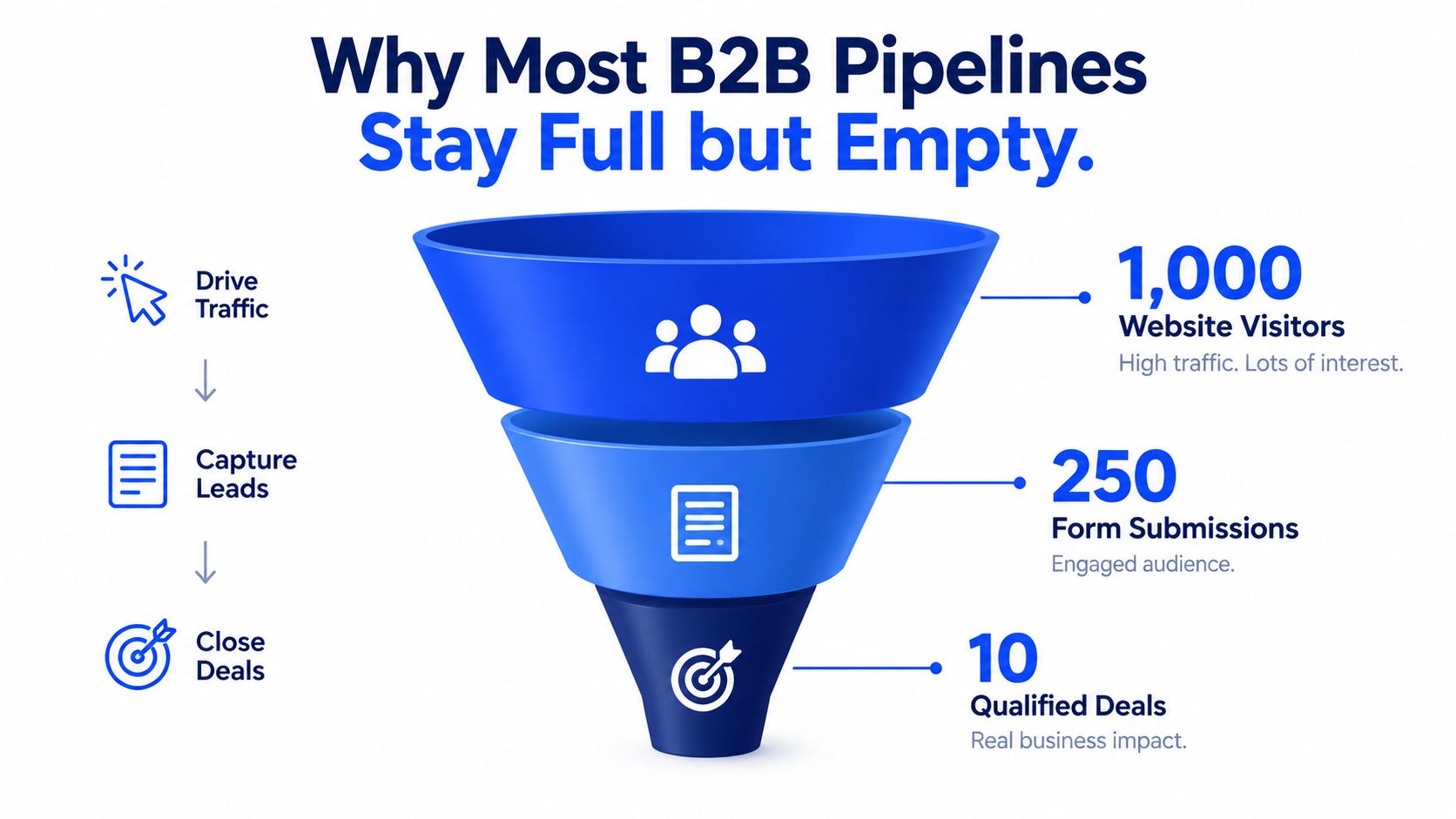
Why Most B2B Pipelines Stay Full but Empty
The pattern is familiar across SaaS, iGaming, manufacturing, legal tech, and pharma. A campaign produces activity, the CRM fills with records, and sales receives a queue of people who downloaded something or answered a generic sequence. Weeks later, the pipeline looks active, yet few opportunities reach a serious commercial stage.
That gap exists because activity isn't the same as acquisition. A website visit, reply, or booked meeting only creates value when the account fits, the problem is real, the buying group can agree, and sales receives the opportunity at the right moment.
A 2024 benchmark summary places average B2B website visitor-to-qualified-lead conversion at 2.35%, while top-quartile performers reach 3.2% and average performers reach only 0.8%. The same benchmark reports a fourfold gap between average and top performers, which points toward execution and alignment rather than traffic volume as the primary issue. The B2B lead generation benchmark provides the underlying context.
The single-engine test
A functioning acquisition engine has one connected chain:
→ ICP: the accounts have a credible reason to buy
→ Message: the content and outreach describe the same business problem
→ Distribution: LinkedIn, email, search, and sales activity reach those accounts
→ Qualification: the CRM separates interest from commercial intent
→ Handoff: sales receives context, timing, and a clear next action
When those parts run separately, each team can report success while the business loses money. Marketing measures submissions, sales measures activity, and leadership waits for closed revenue that neither dashboard explains.
The economics make this more urgent. A 2026 lead-generation analysis reports a median B2B cost per lead of $213, up from $198 in 2025, with channel costs ranging from $98 for organic content and SEO to $487 for account-based marketing. It also reports an average lead-to-customer conversion rate of 0.94% across sources. The cited 2026 lead-generation analysis shows why acquisition decisions need an economic lens.
Practical rule: Don't add spend to a system that can't explain which accounts progress and why.
What the fix looks like
Start with a shared account list, not a shared slogan. Marketing should know which account traits create qualified demand. Sales should know which signals justify a conversation. RevOps should be able to trace the path from first interaction to held meeting and opportunity creation.
For teams building that connection, this demand generation guide for agencies is useful as a reference for connecting audience definition, content, and campaign execution. The point isn't to collect more tactics. It is to make each tactic serve the same commercial path.
Defining the Exact Account Profile
A broad industry label isn't an ICP. “SaaS companies in Europe” still leaves too many variables for precise targeting. A useful profile tells the team which accounts deserve attention, which signals indicate timing, and which situations make your offer easy to understand.
Start with your closed-won and expansion history. Pull the accounts that delivered strong retention, healthy margins, smooth implementation, or repeated referrals. Then review sales-call notes, lost-deal reasons, support conversations, and the original source of the opportunity. CRM fields tell you what happened. Conversations tell you why.
Build the profile from evidence
Create an account-level worksheet with four layers:
Firmographic fit: Record industry, operating model, market focus, revenue motion, and organizational complexity. A pharma account with a regulated approval process needs a different motion from a growth-stage SaaS company.
Technographic fit: Identify the tools and systems that indicate a relevant problem. Apollo can help assemble initial account and contact data, while Clay can enrich records and apply custom research steps before they reach sequencing.
Trigger fit: Look for events that change priorities, such as new leadership, a market entry, a hiring push, a product launch, or a visible shift in positioning.
Behavioral fit: Track content engagement, return visits, responses to a specific topic, and movement from educational material toward commercial pages.
The profile should also include a disqualification layer. Accounts with the wrong contract model, weak access to decision-makers, poor geographic coverage, or a service requirement you can't support shouldn't enter the active sequence just because their job title looks right.
A small, verified list gives copywriters and SDRs enough context to write a credible first touch. A large, loosely filtered list creates work that looks productive but gives sales little to pursue.
Turn CRM learning into list rules
Use a scoring model that sales can challenge. Give each account a fit status, a trigger status, and a buying-group status. Don't hide the logic inside a vendor score that nobody can explain.
For example, an account might qualify for active outreach only when it has:
→ a matching commercial model
→ a visible business trigger
→ at least one relevant stakeholder
→ a problem your offer can address without heavy education
→ a content or intent signal that supports timing
Clay is useful when research needs to combine firmographic data, public signals, and custom account questions. Apollo is useful for sourcing and enriching contacts at scale. Neither tool decides whether your offer is credible for that account. Your sales calls and win-loss evidence should make that decision.
If the list can't explain why each account belongs, the sequence is already too broad.
Document the profile in a short operating brief, then share it with marketing, sales, and RevOps. This ICP guide can support the documentation process, but the actual criteria must come from your own account evidence.
Review the profile when your best wins begin to look different from the accounts you originally targeted. An ICP should guide the system, not become a permanent description of a market you no longer serve.
Aligning Content to the Self-Directed Journey
Your website and content library now carry more of the sales burden than many teams admit. A 2025 report analyzing 6 million buyer interactions says buyers completed 83% of the process without a sales representative. A separate 2025 study reports that younger B2B buyers account for 71% of buyers, complete around 70% of the journey digitally before contacting sales, and involve nearly twice as many stakeholders as older executives. The buyer behavior report gives the source context for these findings.

A lead-capture-first website assumes the buyer wants to identify themselves early. Many don't. They want to understand the problem, compare approaches, check risk, and build a private recommendation before they accept a conversation.
Publish what the buying group needs
Map content to the questions that appear between first research and commercial approval.
Problem content should name the operational failure in the buyer's language. For a manufacturing company, that could mean inconsistent demand from a specific segment. For legal tech, it may involve adoption inside a risk-sensitive team. For iGaming, the issue might be market expansion, compliance, or pipeline quality.
Comparison content should explain where your approach fits and where it doesn't. A matrix comparing internal hiring, a specialist agency, and software can help buyers frame the decision without forcing them into a demo.
Commercial content should reduce avoidable uncertainty. Include pricing ranges only when you can defend them, explain implementation requirements, show who owns each step, and state the conditions under which a prospect should not buy.
Consensus content should help one champion brief the rest of the buying group. Build a one-page business case, a security and compliance summary, role-specific FAQs, and an evaluation checklist that a finance or operations stakeholder can use.
These assets support different jobs. A thought-leadership post can create recognition, but a comparison page may help a buyer defend a shortlist internally. A product page can explain capabilities, while a transparent implementation document can remove the objection that nobody has time to deploy the solution.
Connect content to outbound
LinkedIn content should create familiarity around the same problem your outbound sequence addresses. Email should then point to a relevant asset, not dump a brochure into an inbox. If the prospect engages with a comparison page, the follow-up should acknowledge the evaluation context rather than pretending the interaction never happened.
BAMF's tips on B2B content are useful when you need to make content more specific to the audience and distribution channel. The operating principle is simple: each asset should have a defined buyer, a defined question, and a next action that makes sense.
Use HubSpot to connect form activity, content history, lifecycle status, and sales notes. Keep the fields practical. If nobody acts on a data point, it shouldn't drive the handoff.
The B2B buyer journey framework can help your team map these assets to stages, but avoid building a rigid funnel that assumes every buyer follows the same route.
Measure content by sales usefulness
Traffic can indicate reach, but it doesn't prove acquisition quality. Review which assets are present in qualified conversations, which objections they answer, and whether sales uses them without rewriting the explanation.
A useful content review asks:
→ Which account segment consumed the asset?
→ Which stakeholder needed it?
→ Did the asset create a useful sales conversation?
→ Did it help another stakeholder join the evaluation?
→ What question still appeared in the next call?
That feedback turns content into part of the pipeline system. Without it, publishing becomes a separate activity that produces attention without helping the buying group make a decision.
Choosing Between LinkedIn and Email Outreach
For smaller teams and complex offers, start with LinkedIn-led outreach and use email as support. For larger outbound operations, email should carry the reach while LinkedIn supplies context and familiarity. Treating the channels as rivals creates a false decision. They solve different problems.
LinkedIn gives the prospect a visible sender, professional context, and a place to inspect the person behind the message. Email gives you direct reach, sequence control, and the ability to cover a carefully defined account set without relying on connection acceptance.
The benchmark picture is clear, but it needs interpretation. A LinkedIn benchmark reports a strong connection acceptance rate at 30% to 40%, while the first direct message produces a 5% to 15% reply rate. The same source reports a post-connection message reply rate averaging 10.4% across industries. LinkedIn outreach benchmarks provide those figures.
A cold-email summary reports an average B2B open rate of 23.9% when deliverability is properly set up, but only 8% to 12% for poor domain health. It also reports an average reply rate of 8.5% for sequences with three to five touches, compared with 2.1% for single-touch sends. The cold-email benchmark summary links performance to list quality and sequence depth.
Channel Performance Benchmarks
Metric | ||
|---|---|---|
Strong connection acceptance or open benchmark | 30% to 40% connection acceptance | 23.9% average open rate with proper deliverability |
First response benchmark | 5% to 15% first-message reply rate | 2.1% reply rate for single-touch sends |
Sequence response benchmark | 10.4% post-connection reply rate across industries | 8.5% reply rate across three to five touches |
Main strength | Trust and profile context | Reach and sequence control |
Numbers don't remove the strategic trade-off. LinkedIn can be slower to scale because account research, profile quality, and connection limits affect throughput. Email can scale faster, but poor list quality or generic copy turns that reach into noise and damages the sender's ability to create future conversations.
Match the mix to the offer
Use LinkedIn first when the sale depends on trust, personal credibility, or a nuanced explanation. Founder-led consulting, legal tech, and specialist services often benefit from a visible point of view before the ask. Publish useful content, engage with target accounts, then send a message that refers to a real business context.
Use email first when the ICP is clear, the problem is easy to state, and you need systematic coverage across a defined market. Apollo can source contacts, Clay can enrich account context, and tools such as Instantly, Smartlead, or Lemlist can manage carefully controlled sequences. The tooling won't compensate for weak qualification.
For a larger team, connect email activity to HubSpot and route positive replies using explicit rules. For a smaller team, HeyReach can support LinkedIn workflows, but every automated touch needs a human review standard. A reply that requires interpretation shouldn't go straight to a calendar link.
The LinkedIn outreach versus cold email comparison can help teams document the decision. My recommendation is a coordinated motion: LinkedIn builds recognition and context, while email creates dependable account coverage. Choose one as the primary channel, then make the second reinforce the same message instead of introducing another campaign.
Building the Cadence and Warm-up Sequence
A one-and-done message is bad instrumentation. If a prospect doesn't reply, you don't know whether the account was wrong, the timing was poor, the message missed the problem, or the channel was inappropriate.
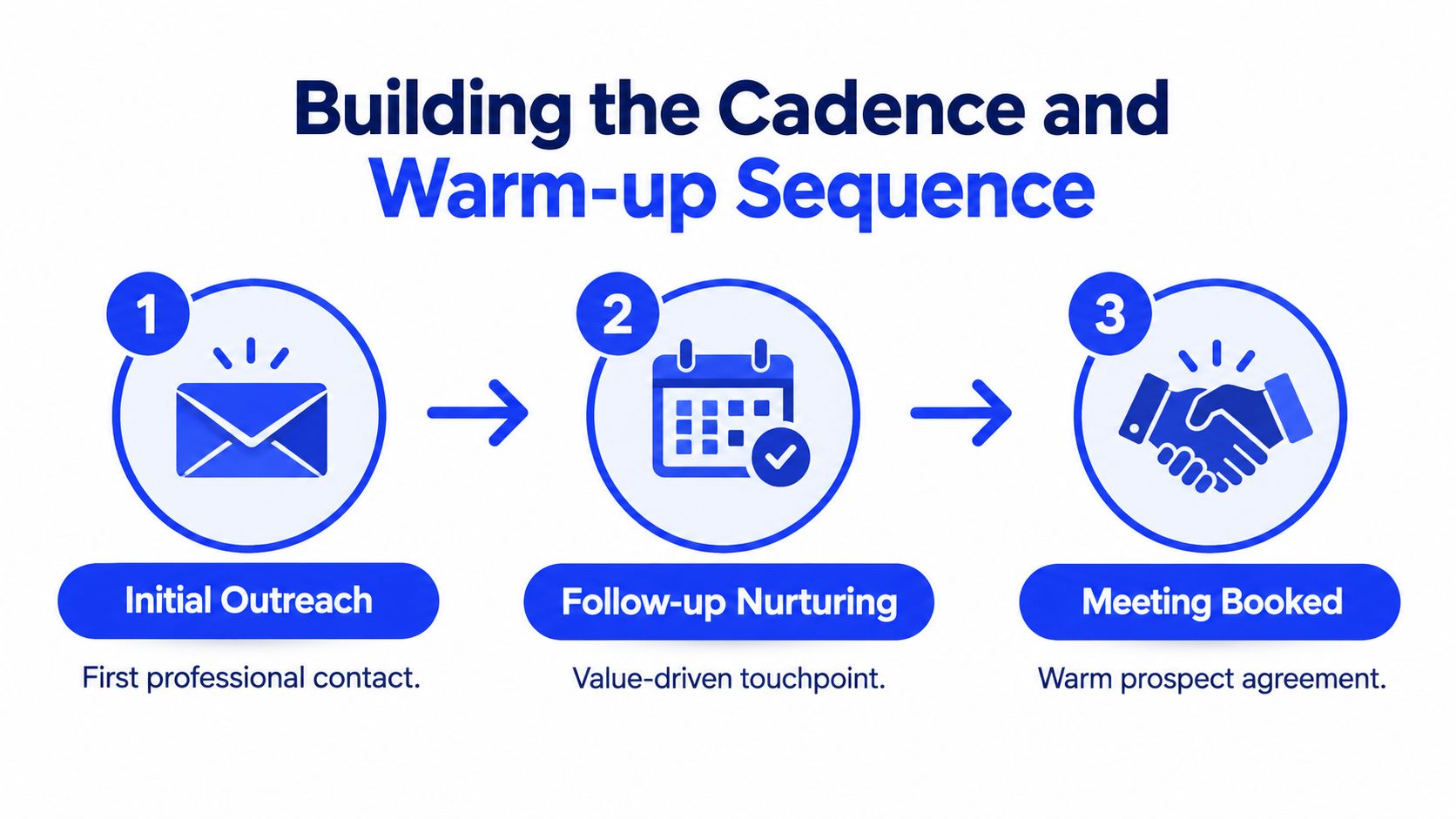
A 2026 benchmark says the most effective B2B cadences include 8 to 12 touchpoints across email, phone, SMS, and LinkedIn over 14 to 21 days. The outbound cadence benchmark supports using a defined time window and multiple channels rather than improvising follow-up.
Use the sequence to learn
A practical cadence can look like this:
Day one: Send a short email tied to the account's role, trigger, or visible problem. Ask for a low-friction response, not a long meeting.
Day three: Engage with or share a relevant LinkedIn asset. The touch should add context, not repeat the pitch.
Day five: Call when the account warrants a live conversation. Leave a concise reason for the call if nobody answers.
Day seven: Send a useful comparison, checklist, or observation that helps the buyer assess the issue.
Day ten: Use LinkedIn or email to address a likely objection, such as implementation effort or internal ownership.
Days fourteen to twenty-one: Close the loop with a clear choice, a useful resource, or a permission-based pause.
That structure isn't a license to send eight versions of the same request. Every touch should change the information available to the prospect. If the sequence contains no new insight, remove the touch.
The first message should prove relevance before making a meeting request. Mention the account situation, explain why it relates to your work, and give the prospect an easy way to correct your assumption. A useful reply can be “not a priority,” because it improves your timing data and keeps the team from chasing an unqualified account.
Warm the account before the ask
A benchmark on outbound warming reports that prospects with prior brand exposure reply at 2 to 3 times the rate of fully cold prospects, attend meetings at 5 to 10 percentage points higher, and convert to opportunities at higher rates. The same report places meeting-to-qualified-opportunity performance at 30% to 40% for a typical industry range, 45% to 55% for strong programs, and 60% or higher for top performers. The outbound research report provides the source for these benchmarks.
Warm-up can be operational rather than theatrical:
→ Publish a clear point of view for the account segment
→ Invite target stakeholders to a relevant webinar or briefing
→ Share a useful asset before the outbound ask
→ Retarget engaged accounts with content that answers evaluation questions
→ Route meaningful engagement to sales with its context attached
The goal isn't to manufacture familiarity. It is to give the prospect a reason to recognize the sender and understand the problem before the direct request arrives.
Use Lemlist, Instantly, or Smartlead for email execution only after list quality and messaging are approved. Use HeyReach for LinkedIn activity where it fits your workflow, but keep reply qualification with a person. The lead follow-up framework is a useful reference for deciding what happens after the initial touch.
Measuring Pipeline Impact and Quality
Lead volume is a weak management metric when the team can't show what happens after capture. A full CRM can conceal poor fit, weak qualification, slow follow-up, or meetings that never had a credible buying reason.
Independent KPI summaries place overall lead-to-close rates below 1% and MQL-to-SQL conversion around 13%, with a typical B2B range of 12% to 18%. Broader benchmark sets place website visitor-to-lead conversion around 0.8% to 2.5%, lead-to-MQL around 30% to 40%, and MQL-to-SQL around 25% to 45%, depending on segment and intent. The B2B marketing KPI summary shows why stage leakage deserves more attention than top-of-funnel totals.
Build a revenue-facing dashboard
Track the metrics that tell you where the engine loses value:
Qualified account rate: The share of sourced accounts that match the agreed ICP. If this falls, fix targeting before changing copy.
Positive reply rate: The share of delivered outreach that creates a relevant conversation. Segment it by account tier, role, and message.
Meeting-held rate: The share of booked meetings that occur. This reveals whether the promise, timing, and qualification were credible.
Opportunity creation rate: The share of held meetings that become qualified opportunities. This is a stronger quality signal than bookings.
Pipeline conversion: Track movement from qualified opportunity to closed revenue by source and segment.
Acquisition economics: Compare sales and marketing cost with new customer ARR and payback.
One benchmark says companies spend a median of $2.00 in sales and marketing for every $1.00 of new customer ARR, while CAC payback periods have lengthened 12.5% at the median since 2022. The AI-driven demand generation benchmark places those figures in the context of quality, oversight, and ICP discipline.
Diagnose the leak before changing the channel
If positive replies are low, inspect the list and the first message. If meetings are booked but not held, examine scheduling friction, qualification, and the expectation set in the offer. If meetings happen but opportunities don't form, the issue may sit in account fit, problem severity, stakeholder access, or sales discovery.
Don't report all channels together. Compare LinkedIn, email, content, paid search, partner activity, and referrals using the same stage definitions. A low-cost lead source can still be expensive if it creates work without qualified opportunity.
A clear CAC calculation should include the costs that support acquisition, not only media spend. Big Moves Marketing's CAC guide is a practical reference for setting that calculation up.
Keep the dashboard close to the operating rhythm. Marketing should see which accounts progress, sales should see which messages create useful conversations, and RevOps should own the definitions so the numbers don't shift during a review. The B2B lead generation KPI framework can help structure the reporting layer.
Running the Acquisition Sprint
A customer acquisition strategy becomes real when the team gives it a recurring operating rhythm. Run bi-weekly sprints with one shared account list, one message focus, and one reporting view. The sprint should produce decisions, not another slide deck.
At the start, review the previous cycle's account fit, positive replies, held meetings, opportunity creation, and objections. Choose one variable to change, such as the trigger used in the opening line, the role targeted first, the content asset attached to follow-up, or the qualification question used before booking.
During the sprint, keep a shared Slack channel for reply examples, objections, account changes, and urgent routing. Sales should post what buyers said. Marketing should turn repeated objections into content. RevOps should keep the CRM fields and source definitions stable while the team tests the message.
Grou's operating model fits this kind of work by combining LinkedIn content, lead generation, and outbound into one pipeline system, with verified lists, signal-based targeting, reply routing, and shared reporting. The team works in bi-weekly sprints, using a shared channel for feedback and iteration.
At the end of each sprint, keep, revise, or stop the tested motion. Don't change the ICP, offer, channel, and cadence at the same time. You won't know what caused the result, and the next sprint will start with less useful evidence.
Audit your meeting-held rate this Friday. Pull the last set of booked meetings, mark which ones happened, record the stated reason for every no-show, and compare the result by source and sequence. Then add the finding to the next sprint's first message and qualification rule.
GROU is a global B2B pipeline agency trusted by more than 50 companies across iGaming, SaaS, manufacturing, and professional services. Its methodology connects ICP research, LinkedIn content, multi-channel outbound, qualification rules, and transparent pipeline reporting in bi-weekly sprints.
GROU can help you connect ICP research, LinkedIn content, and outbound execution into one customer acquisition system for qualified B2B conversations. Visit Grou to review the approach and decide whether your team needs a tighter account list, better buyer content, or a clearer follow-up engine.
Your pipeline is busy, but revenue still feels unpredictable. Marketing is generating form fills, sales is working email replies, and RevOps is reconciling source data that doesn't explain which accounts are worth pursuing. The problem usually isn't a missing channel. It is misalignment between the account profile, the content buyers consume, and the outreach sales runs.
Treat acquisition as one operating system, not a collection of campaigns.
Define a narrow ICP from your highest-quality accounts, then build every list and message around it.
Create content for buyers who research privately and need internal consensus before speaking with sales.
Combine LinkedIn and email according to offer complexity, team capacity, and the quality of conversations each channel produces.
Measure held meetings, qualified opportunities, and unit economics instead of celebrating raw lead volume.
Table of Contents
Why Most B2B Pipelines Stay Full but Empty
The pattern is familiar across SaaS, iGaming, manufacturing, legal tech, and pharma. A campaign produces activity, the CRM fills with records, and sales receives a queue of people who downloaded something or answered a generic sequence. Weeks later, the pipeline looks active, yet few opportunities reach a serious commercial stage.
That gap exists because activity isn't the same as acquisition. A website visit, reply, or booked meeting only creates value when the account fits, the problem is real, the buying group can agree, and sales receives the opportunity at the right moment.
A 2024 benchmark summary places average B2B website visitor-to-qualified-lead conversion at 2.35%, while top-quartile performers reach 3.2% and average performers reach only 0.8%. The same benchmark reports a fourfold gap between average and top performers, which points toward execution and alignment rather than traffic volume as the primary issue. The B2B lead generation benchmark provides the underlying context.
The single-engine test
A functioning acquisition engine has one connected chain:
→ ICP: the accounts have a credible reason to buy
→ Message: the content and outreach describe the same business problem
→ Distribution: LinkedIn, email, search, and sales activity reach those accounts
→ Qualification: the CRM separates interest from commercial intent
→ Handoff: sales receives context, timing, and a clear next action
When those parts run separately, each team can report success while the business loses money. Marketing measures submissions, sales measures activity, and leadership waits for closed revenue that neither dashboard explains.
The economics make this more urgent. A 2026 lead-generation analysis reports a median B2B cost per lead of $213, up from $198 in 2025, with channel costs ranging from $98 for organic content and SEO to $487 for account-based marketing. It also reports an average lead-to-customer conversion rate of 0.94% across sources. The cited 2026 lead-generation analysis shows why acquisition decisions need an economic lens.
Practical rule: Don't add spend to a system that can't explain which accounts progress and why.
What the fix looks like
Start with a shared account list, not a shared slogan. Marketing should know which account traits create qualified demand. Sales should know which signals justify a conversation. RevOps should be able to trace the path from first interaction to held meeting and opportunity creation.
For teams building that connection, this demand generation guide for agencies is useful as a reference for connecting audience definition, content, and campaign execution. The point isn't to collect more tactics. It is to make each tactic serve the same commercial path.
Defining the Exact Account Profile
A broad industry label isn't an ICP. “SaaS companies in Europe” still leaves too many variables for precise targeting. A useful profile tells the team which accounts deserve attention, which signals indicate timing, and which situations make your offer easy to understand.
Start with your closed-won and expansion history. Pull the accounts that delivered strong retention, healthy margins, smooth implementation, or repeated referrals. Then review sales-call notes, lost-deal reasons, support conversations, and the original source of the opportunity. CRM fields tell you what happened. Conversations tell you why.
Build the profile from evidence
Create an account-level worksheet with four layers:
Firmographic fit: Record industry, operating model, market focus, revenue motion, and organizational complexity. A pharma account with a regulated approval process needs a different motion from a growth-stage SaaS company.
Technographic fit: Identify the tools and systems that indicate a relevant problem. Apollo can help assemble initial account and contact data, while Clay can enrich records and apply custom research steps before they reach sequencing.
Trigger fit: Look for events that change priorities, such as new leadership, a market entry, a hiring push, a product launch, or a visible shift in positioning.
Behavioral fit: Track content engagement, return visits, responses to a specific topic, and movement from educational material toward commercial pages.
The profile should also include a disqualification layer. Accounts with the wrong contract model, weak access to decision-makers, poor geographic coverage, or a service requirement you can't support shouldn't enter the active sequence just because their job title looks right.
A small, verified list gives copywriters and SDRs enough context to write a credible first touch. A large, loosely filtered list creates work that looks productive but gives sales little to pursue.
Turn CRM learning into list rules
Use a scoring model that sales can challenge. Give each account a fit status, a trigger status, and a buying-group status. Don't hide the logic inside a vendor score that nobody can explain.
For example, an account might qualify for active outreach only when it has:
→ a matching commercial model
→ a visible business trigger
→ at least one relevant stakeholder
→ a problem your offer can address without heavy education
→ a content or intent signal that supports timing
Clay is useful when research needs to combine firmographic data, public signals, and custom account questions. Apollo is useful for sourcing and enriching contacts at scale. Neither tool decides whether your offer is credible for that account. Your sales calls and win-loss evidence should make that decision.
If the list can't explain why each account belongs, the sequence is already too broad.
Document the profile in a short operating brief, then share it with marketing, sales, and RevOps. This ICP guide can support the documentation process, but the actual criteria must come from your own account evidence.
Review the profile when your best wins begin to look different from the accounts you originally targeted. An ICP should guide the system, not become a permanent description of a market you no longer serve.
Aligning Content to the Self-Directed Journey
Your website and content library now carry more of the sales burden than many teams admit. A 2025 report analyzing 6 million buyer interactions says buyers completed 83% of the process without a sales representative. A separate 2025 study reports that younger B2B buyers account for 71% of buyers, complete around 70% of the journey digitally before contacting sales, and involve nearly twice as many stakeholders as older executives. The buyer behavior report gives the source context for these findings.
A lead-capture-first website assumes the buyer wants to identify themselves early. Many don't. They want to understand the problem, compare approaches, check risk, and build a private recommendation before they accept a conversation.
Publish what the buying group needs
Map content to the questions that appear between first research and commercial approval.
Problem content should name the operational failure in the buyer's language. For a manufacturing company, that could mean inconsistent demand from a specific segment. For legal tech, it may involve adoption inside a risk-sensitive team. For iGaming, the issue might be market expansion, compliance, or pipeline quality.
Comparison content should explain where your approach fits and where it doesn't. A matrix comparing internal hiring, a specialist agency, and software can help buyers frame the decision without forcing them into a demo.
Commercial content should reduce avoidable uncertainty. Include pricing ranges only when you can defend them, explain implementation requirements, show who owns each step, and state the conditions under which a prospect should not buy.
Consensus content should help one champion brief the rest of the buying group. Build a one-page business case, a security and compliance summary, role-specific FAQs, and an evaluation checklist that a finance or operations stakeholder can use.
These assets support different jobs. A thought-leadership post can create recognition, but a comparison page may help a buyer defend a shortlist internally. A product page can explain capabilities, while a transparent implementation document can remove the objection that nobody has time to deploy the solution.
Connect content to outbound
LinkedIn content should create familiarity around the same problem your outbound sequence addresses. Email should then point to a relevant asset, not dump a brochure into an inbox. If the prospect engages with a comparison page, the follow-up should acknowledge the evaluation context rather than pretending the interaction never happened.
BAMF's tips on B2B content are useful when you need to make content more specific to the audience and distribution channel. The operating principle is simple: each asset should have a defined buyer, a defined question, and a next action that makes sense.
Use HubSpot to connect form activity, content history, lifecycle status, and sales notes. Keep the fields practical. If nobody acts on a data point, it shouldn't drive the handoff.
The B2B buyer journey framework can help your team map these assets to stages, but avoid building a rigid funnel that assumes every buyer follows the same route.
Measure content by sales usefulness
Traffic can indicate reach, but it doesn't prove acquisition quality. Review which assets are present in qualified conversations, which objections they answer, and whether sales uses them without rewriting the explanation.
A useful content review asks:
→ Which account segment consumed the asset?
→ Which stakeholder needed it?
→ Did the asset create a useful sales conversation?
→ Did it help another stakeholder join the evaluation?
→ What question still appeared in the next call?
That feedback turns content into part of the pipeline system. Without it, publishing becomes a separate activity that produces attention without helping the buying group make a decision.
Choosing Between LinkedIn and Email Outreach
For smaller teams and complex offers, start with LinkedIn-led outreach and use email as support. For larger outbound operations, email should carry the reach while LinkedIn supplies context and familiarity. Treating the channels as rivals creates a false decision. They solve different problems.
LinkedIn gives the prospect a visible sender, professional context, and a place to inspect the person behind the message. Email gives you direct reach, sequence control, and the ability to cover a carefully defined account set without relying on connection acceptance.
The benchmark picture is clear, but it needs interpretation. A LinkedIn benchmark reports a strong connection acceptance rate at 30% to 40%, while the first direct message produces a 5% to 15% reply rate. The same source reports a post-connection message reply rate averaging 10.4% across industries. LinkedIn outreach benchmarks provide those figures.
A cold-email summary reports an average B2B open rate of 23.9% when deliverability is properly set up, but only 8% to 12% for poor domain health. It also reports an average reply rate of 8.5% for sequences with three to five touches, compared with 2.1% for single-touch sends. The cold-email benchmark summary links performance to list quality and sequence depth.
Channel Performance Benchmarks
Metric | ||
|---|---|---|
Strong connection acceptance or open benchmark | 30% to 40% connection acceptance | 23.9% average open rate with proper deliverability |
First response benchmark | 5% to 15% first-message reply rate | 2.1% reply rate for single-touch sends |
Sequence response benchmark | 10.4% post-connection reply rate across industries | 8.5% reply rate across three to five touches |
Main strength | Trust and profile context | Reach and sequence control |
Numbers don't remove the strategic trade-off. LinkedIn can be slower to scale because account research, profile quality, and connection limits affect throughput. Email can scale faster, but poor list quality or generic copy turns that reach into noise and damages the sender's ability to create future conversations.
Match the mix to the offer
Use LinkedIn first when the sale depends on trust, personal credibility, or a nuanced explanation. Founder-led consulting, legal tech, and specialist services often benefit from a visible point of view before the ask. Publish useful content, engage with target accounts, then send a message that refers to a real business context.
Use email first when the ICP is clear, the problem is easy to state, and you need systematic coverage across a defined market. Apollo can source contacts, Clay can enrich account context, and tools such as Instantly, Smartlead, or Lemlist can manage carefully controlled sequences. The tooling won't compensate for weak qualification.
For a larger team, connect email activity to HubSpot and route positive replies using explicit rules. For a smaller team, HeyReach can support LinkedIn workflows, but every automated touch needs a human review standard. A reply that requires interpretation shouldn't go straight to a calendar link.
The LinkedIn outreach versus cold email comparison can help teams document the decision. My recommendation is a coordinated motion: LinkedIn builds recognition and context, while email creates dependable account coverage. Choose one as the primary channel, then make the second reinforce the same message instead of introducing another campaign.
Building the Cadence and Warm-up Sequence
A one-and-done message is bad instrumentation. If a prospect doesn't reply, you don't know whether the account was wrong, the timing was poor, the message missed the problem, or the channel was inappropriate.
A 2026 benchmark says the most effective B2B cadences include 8 to 12 touchpoints across email, phone, SMS, and LinkedIn over 14 to 21 days. The outbound cadence benchmark supports using a defined time window and multiple channels rather than improvising follow-up.
Use the sequence to learn
A practical cadence can look like this:
Day one: Send a short email tied to the account's role, trigger, or visible problem. Ask for a low-friction response, not a long meeting.
Day three: Engage with or share a relevant LinkedIn asset. The touch should add context, not repeat the pitch.
Day five: Call when the account warrants a live conversation. Leave a concise reason for the call if nobody answers.
Day seven: Send a useful comparison, checklist, or observation that helps the buyer assess the issue.
Day ten: Use LinkedIn or email to address a likely objection, such as implementation effort or internal ownership.
Days fourteen to twenty-one: Close the loop with a clear choice, a useful resource, or a permission-based pause.
That structure isn't a license to send eight versions of the same request. Every touch should change the information available to the prospect. If the sequence contains no new insight, remove the touch.
The first message should prove relevance before making a meeting request. Mention the account situation, explain why it relates to your work, and give the prospect an easy way to correct your assumption. A useful reply can be “not a priority,” because it improves your timing data and keeps the team from chasing an unqualified account.
Warm the account before the ask
A benchmark on outbound warming reports that prospects with prior brand exposure reply at 2 to 3 times the rate of fully cold prospects, attend meetings at 5 to 10 percentage points higher, and convert to opportunities at higher rates. The same report places meeting-to-qualified-opportunity performance at 30% to 40% for a typical industry range, 45% to 55% for strong programs, and 60% or higher for top performers. The outbound research report provides the source for these benchmarks.
Warm-up can be operational rather than theatrical:
→ Publish a clear point of view for the account segment
→ Invite target stakeholders to a relevant webinar or briefing
→ Share a useful asset before the outbound ask
→ Retarget engaged accounts with content that answers evaluation questions
→ Route meaningful engagement to sales with its context attached
The goal isn't to manufacture familiarity. It is to give the prospect a reason to recognize the sender and understand the problem before the direct request arrives.
Use Lemlist, Instantly, or Smartlead for email execution only after list quality and messaging are approved. Use HeyReach for LinkedIn activity where it fits your workflow, but keep reply qualification with a person. The lead follow-up framework is a useful reference for deciding what happens after the initial touch.
Measuring Pipeline Impact and Quality
Lead volume is a weak management metric when the team can't show what happens after capture. A full CRM can conceal poor fit, weak qualification, slow follow-up, or meetings that never had a credible buying reason.
Independent KPI summaries place overall lead-to-close rates below 1% and MQL-to-SQL conversion around 13%, with a typical B2B range of 12% to 18%. Broader benchmark sets place website visitor-to-lead conversion around 0.8% to 2.5%, lead-to-MQL around 30% to 40%, and MQL-to-SQL around 25% to 45%, depending on segment and intent. The B2B marketing KPI summary shows why stage leakage deserves more attention than top-of-funnel totals.
Build a revenue-facing dashboard
Track the metrics that tell you where the engine loses value:
Qualified account rate: The share of sourced accounts that match the agreed ICP. If this falls, fix targeting before changing copy.
Positive reply rate: The share of delivered outreach that creates a relevant conversation. Segment it by account tier, role, and message.
Meeting-held rate: The share of booked meetings that occur. This reveals whether the promise, timing, and qualification were credible.
Opportunity creation rate: The share of held meetings that become qualified opportunities. This is a stronger quality signal than bookings.
Pipeline conversion: Track movement from qualified opportunity to closed revenue by source and segment.
Acquisition economics: Compare sales and marketing cost with new customer ARR and payback.
One benchmark says companies spend a median of $2.00 in sales and marketing for every $1.00 of new customer ARR, while CAC payback periods have lengthened 12.5% at the median since 2022. The AI-driven demand generation benchmark places those figures in the context of quality, oversight, and ICP discipline.
Diagnose the leak before changing the channel
If positive replies are low, inspect the list and the first message. If meetings are booked but not held, examine scheduling friction, qualification, and the expectation set in the offer. If meetings happen but opportunities don't form, the issue may sit in account fit, problem severity, stakeholder access, or sales discovery.
Don't report all channels together. Compare LinkedIn, email, content, paid search, partner activity, and referrals using the same stage definitions. A low-cost lead source can still be expensive if it creates work without qualified opportunity.
A clear CAC calculation should include the costs that support acquisition, not only media spend. Big Moves Marketing's CAC guide is a practical reference for setting that calculation up.
Keep the dashboard close to the operating rhythm. Marketing should see which accounts progress, sales should see which messages create useful conversations, and RevOps should own the definitions so the numbers don't shift during a review. The B2B lead generation KPI framework can help structure the reporting layer.
Running the Acquisition Sprint
A customer acquisition strategy becomes real when the team gives it a recurring operating rhythm. Run bi-weekly sprints with one shared account list, one message focus, and one reporting view. The sprint should produce decisions, not another slide deck.
At the start, review the previous cycle's account fit, positive replies, held meetings, opportunity creation, and objections. Choose one variable to change, such as the trigger used in the opening line, the role targeted first, the content asset attached to follow-up, or the qualification question used before booking.
During the sprint, keep a shared Slack channel for reply examples, objections, account changes, and urgent routing. Sales should post what buyers said. Marketing should turn repeated objections into content. RevOps should keep the CRM fields and source definitions stable while the team tests the message.
Grou's operating model fits this kind of work by combining LinkedIn content, lead generation, and outbound into one pipeline system, with verified lists, signal-based targeting, reply routing, and shared reporting. The team works in bi-weekly sprints, using a shared channel for feedback and iteration.
At the end of each sprint, keep, revise, or stop the tested motion. Don't change the ICP, offer, channel, and cadence at the same time. You won't know what caused the result, and the next sprint will start with less useful evidence.
Audit your meeting-held rate this Friday. Pull the last set of booked meetings, mark which ones happened, record the stated reason for every no-show, and compare the result by source and sequence. Then add the finding to the next sprint's first message and qualification rule.
GROU is a global B2B pipeline agency trusted by more than 50 companies across iGaming, SaaS, manufacturing, and professional services. Its methodology connects ICP research, LinkedIn content, multi-channel outbound, qualification rules, and transparent pipeline reporting in bi-weekly sprints.
GROU can help you connect ICP research, LinkedIn content, and outbound execution into one customer acquisition system for qualified B2B conversations. Visit Grou to review the approach and decide whether your team needs a tighter account list, better buyer content, or a clearer follow-up engine.
Your pipeline is busy, but revenue still feels unpredictable. Marketing is generating form fills, sales is working email replies, and RevOps is reconciling source data that doesn't explain which accounts are worth pursuing. The problem usually isn't a missing channel. It is misalignment between the account profile, the content buyers consume, and the outreach sales runs.
Treat acquisition as one operating system, not a collection of campaigns.
Define a narrow ICP from your highest-quality accounts, then build every list and message around it.
Create content for buyers who research privately and need internal consensus before speaking with sales.
Combine LinkedIn and email according to offer complexity, team capacity, and the quality of conversations each channel produces.
Measure held meetings, qualified opportunities, and unit economics instead of celebrating raw lead volume.
Table of Contents
Why Most B2B Pipelines Stay Full but Empty
The pattern is familiar across SaaS, iGaming, manufacturing, legal tech, and pharma. A campaign produces activity, the CRM fills with records, and sales receives a queue of people who downloaded something or answered a generic sequence. Weeks later, the pipeline looks active, yet few opportunities reach a serious commercial stage.
That gap exists because activity isn't the same as acquisition. A website visit, reply, or booked meeting only creates value when the account fits, the problem is real, the buying group can agree, and sales receives the opportunity at the right moment.
A 2024 benchmark summary places average B2B website visitor-to-qualified-lead conversion at 2.35%, while top-quartile performers reach 3.2% and average performers reach only 0.8%. The same benchmark reports a fourfold gap between average and top performers, which points toward execution and alignment rather than traffic volume as the primary issue. The B2B lead generation benchmark provides the underlying context.
The single-engine test
A functioning acquisition engine has one connected chain:
→ ICP: the accounts have a credible reason to buy
→ Message: the content and outreach describe the same business problem
→ Distribution: LinkedIn, email, search, and sales activity reach those accounts
→ Qualification: the CRM separates interest from commercial intent
→ Handoff: sales receives context, timing, and a clear next action
When those parts run separately, each team can report success while the business loses money. Marketing measures submissions, sales measures activity, and leadership waits for closed revenue that neither dashboard explains.
The economics make this more urgent. A 2026 lead-generation analysis reports a median B2B cost per lead of $213, up from $198 in 2025, with channel costs ranging from $98 for organic content and SEO to $487 for account-based marketing. It also reports an average lead-to-customer conversion rate of 0.94% across sources. The cited 2026 lead-generation analysis shows why acquisition decisions need an economic lens.
Practical rule: Don't add spend to a system that can't explain which accounts progress and why.
What the fix looks like
Start with a shared account list, not a shared slogan. Marketing should know which account traits create qualified demand. Sales should know which signals justify a conversation. RevOps should be able to trace the path from first interaction to held meeting and opportunity creation.
For teams building that connection, this demand generation guide for agencies is useful as a reference for connecting audience definition, content, and campaign execution. The point isn't to collect more tactics. It is to make each tactic serve the same commercial path.
Defining the Exact Account Profile
A broad industry label isn't an ICP. “SaaS companies in Europe” still leaves too many variables for precise targeting. A useful profile tells the team which accounts deserve attention, which signals indicate timing, and which situations make your offer easy to understand.
Start with your closed-won and expansion history. Pull the accounts that delivered strong retention, healthy margins, smooth implementation, or repeated referrals. Then review sales-call notes, lost-deal reasons, support conversations, and the original source of the opportunity. CRM fields tell you what happened. Conversations tell you why.
Build the profile from evidence
Create an account-level worksheet with four layers:
Firmographic fit: Record industry, operating model, market focus, revenue motion, and organizational complexity. A pharma account with a regulated approval process needs a different motion from a growth-stage SaaS company.
Technographic fit: Identify the tools and systems that indicate a relevant problem. Apollo can help assemble initial account and contact data, while Clay can enrich records and apply custom research steps before they reach sequencing.
Trigger fit: Look for events that change priorities, such as new leadership, a market entry, a hiring push, a product launch, or a visible shift in positioning.
Behavioral fit: Track content engagement, return visits, responses to a specific topic, and movement from educational material toward commercial pages.
The profile should also include a disqualification layer. Accounts with the wrong contract model, weak access to decision-makers, poor geographic coverage, or a service requirement you can't support shouldn't enter the active sequence just because their job title looks right.
A small, verified list gives copywriters and SDRs enough context to write a credible first touch. A large, loosely filtered list creates work that looks productive but gives sales little to pursue.
Turn CRM learning into list rules
Use a scoring model that sales can challenge. Give each account a fit status, a trigger status, and a buying-group status. Don't hide the logic inside a vendor score that nobody can explain.
For example, an account might qualify for active outreach only when it has:
→ a matching commercial model
→ a visible business trigger
→ at least one relevant stakeholder
→ a problem your offer can address without heavy education
→ a content or intent signal that supports timing
Clay is useful when research needs to combine firmographic data, public signals, and custom account questions. Apollo is useful for sourcing and enriching contacts at scale. Neither tool decides whether your offer is credible for that account. Your sales calls and win-loss evidence should make that decision.
If the list can't explain why each account belongs, the sequence is already too broad.
Document the profile in a short operating brief, then share it with marketing, sales, and RevOps. This ICP guide can support the documentation process, but the actual criteria must come from your own account evidence.
Review the profile when your best wins begin to look different from the accounts you originally targeted. An ICP should guide the system, not become a permanent description of a market you no longer serve.
Aligning Content to the Self-Directed Journey
Your website and content library now carry more of the sales burden than many teams admit. A 2025 report analyzing 6 million buyer interactions says buyers completed 83% of the process without a sales representative. A separate 2025 study reports that younger B2B buyers account for 71% of buyers, complete around 70% of the journey digitally before contacting sales, and involve nearly twice as many stakeholders as older executives. The buyer behavior report gives the source context for these findings.
A lead-capture-first website assumes the buyer wants to identify themselves early. Many don't. They want to understand the problem, compare approaches, check risk, and build a private recommendation before they accept a conversation.
Publish what the buying group needs
Map content to the questions that appear between first research and commercial approval.
Problem content should name the operational failure in the buyer's language. For a manufacturing company, that could mean inconsistent demand from a specific segment. For legal tech, it may involve adoption inside a risk-sensitive team. For iGaming, the issue might be market expansion, compliance, or pipeline quality.
Comparison content should explain where your approach fits and where it doesn't. A matrix comparing internal hiring, a specialist agency, and software can help buyers frame the decision without forcing them into a demo.
Commercial content should reduce avoidable uncertainty. Include pricing ranges only when you can defend them, explain implementation requirements, show who owns each step, and state the conditions under which a prospect should not buy.
Consensus content should help one champion brief the rest of the buying group. Build a one-page business case, a security and compliance summary, role-specific FAQs, and an evaluation checklist that a finance or operations stakeholder can use.
These assets support different jobs. A thought-leadership post can create recognition, but a comparison page may help a buyer defend a shortlist internally. A product page can explain capabilities, while a transparent implementation document can remove the objection that nobody has time to deploy the solution.
Connect content to outbound
LinkedIn content should create familiarity around the same problem your outbound sequence addresses. Email should then point to a relevant asset, not dump a brochure into an inbox. If the prospect engages with a comparison page, the follow-up should acknowledge the evaluation context rather than pretending the interaction never happened.
BAMF's tips on B2B content are useful when you need to make content more specific to the audience and distribution channel. The operating principle is simple: each asset should have a defined buyer, a defined question, and a next action that makes sense.
Use HubSpot to connect form activity, content history, lifecycle status, and sales notes. Keep the fields practical. If nobody acts on a data point, it shouldn't drive the handoff.
The B2B buyer journey framework can help your team map these assets to stages, but avoid building a rigid funnel that assumes every buyer follows the same route.
Measure content by sales usefulness
Traffic can indicate reach, but it doesn't prove acquisition quality. Review which assets are present in qualified conversations, which objections they answer, and whether sales uses them without rewriting the explanation.
A useful content review asks:
→ Which account segment consumed the asset?
→ Which stakeholder needed it?
→ Did the asset create a useful sales conversation?
→ Did it help another stakeholder join the evaluation?
→ What question still appeared in the next call?
That feedback turns content into part of the pipeline system. Without it, publishing becomes a separate activity that produces attention without helping the buying group make a decision.
Choosing Between LinkedIn and Email Outreach
For smaller teams and complex offers, start with LinkedIn-led outreach and use email as support. For larger outbound operations, email should carry the reach while LinkedIn supplies context and familiarity. Treating the channels as rivals creates a false decision. They solve different problems.
LinkedIn gives the prospect a visible sender, professional context, and a place to inspect the person behind the message. Email gives you direct reach, sequence control, and the ability to cover a carefully defined account set without relying on connection acceptance.
The benchmark picture is clear, but it needs interpretation. A LinkedIn benchmark reports a strong connection acceptance rate at 30% to 40%, while the first direct message produces a 5% to 15% reply rate. The same source reports a post-connection message reply rate averaging 10.4% across industries. LinkedIn outreach benchmarks provide those figures.
A cold-email summary reports an average B2B open rate of 23.9% when deliverability is properly set up, but only 8% to 12% for poor domain health. It also reports an average reply rate of 8.5% for sequences with three to five touches, compared with 2.1% for single-touch sends. The cold-email benchmark summary links performance to list quality and sequence depth.
Channel Performance Benchmarks
Metric | ||
|---|---|---|
Strong connection acceptance or open benchmark | 30% to 40% connection acceptance | 23.9% average open rate with proper deliverability |
First response benchmark | 5% to 15% first-message reply rate | 2.1% reply rate for single-touch sends |
Sequence response benchmark | 10.4% post-connection reply rate across industries | 8.5% reply rate across three to five touches |
Main strength | Trust and profile context | Reach and sequence control |
Numbers don't remove the strategic trade-off. LinkedIn can be slower to scale because account research, profile quality, and connection limits affect throughput. Email can scale faster, but poor list quality or generic copy turns that reach into noise and damages the sender's ability to create future conversations.
Match the mix to the offer
Use LinkedIn first when the sale depends on trust, personal credibility, or a nuanced explanation. Founder-led consulting, legal tech, and specialist services often benefit from a visible point of view before the ask. Publish useful content, engage with target accounts, then send a message that refers to a real business context.
Use email first when the ICP is clear, the problem is easy to state, and you need systematic coverage across a defined market. Apollo can source contacts, Clay can enrich account context, and tools such as Instantly, Smartlead, or Lemlist can manage carefully controlled sequences. The tooling won't compensate for weak qualification.
For a larger team, connect email activity to HubSpot and route positive replies using explicit rules. For a smaller team, HeyReach can support LinkedIn workflows, but every automated touch needs a human review standard. A reply that requires interpretation shouldn't go straight to a calendar link.
The LinkedIn outreach versus cold email comparison can help teams document the decision. My recommendation is a coordinated motion: LinkedIn builds recognition and context, while email creates dependable account coverage. Choose one as the primary channel, then make the second reinforce the same message instead of introducing another campaign.
Building the Cadence and Warm-up Sequence
A one-and-done message is bad instrumentation. If a prospect doesn't reply, you don't know whether the account was wrong, the timing was poor, the message missed the problem, or the channel was inappropriate.
A 2026 benchmark says the most effective B2B cadences include 8 to 12 touchpoints across email, phone, SMS, and LinkedIn over 14 to 21 days. The outbound cadence benchmark supports using a defined time window and multiple channels rather than improvising follow-up.
Use the sequence to learn
A practical cadence can look like this:
Day one: Send a short email tied to the account's role, trigger, or visible problem. Ask for a low-friction response, not a long meeting.
Day three: Engage with or share a relevant LinkedIn asset. The touch should add context, not repeat the pitch.
Day five: Call when the account warrants a live conversation. Leave a concise reason for the call if nobody answers.
Day seven: Send a useful comparison, checklist, or observation that helps the buyer assess the issue.
Day ten: Use LinkedIn or email to address a likely objection, such as implementation effort or internal ownership.
Days fourteen to twenty-one: Close the loop with a clear choice, a useful resource, or a permission-based pause.
That structure isn't a license to send eight versions of the same request. Every touch should change the information available to the prospect. If the sequence contains no new insight, remove the touch.
The first message should prove relevance before making a meeting request. Mention the account situation, explain why it relates to your work, and give the prospect an easy way to correct your assumption. A useful reply can be “not a priority,” because it improves your timing data and keeps the team from chasing an unqualified account.
Warm the account before the ask
A benchmark on outbound warming reports that prospects with prior brand exposure reply at 2 to 3 times the rate of fully cold prospects, attend meetings at 5 to 10 percentage points higher, and convert to opportunities at higher rates. The same report places meeting-to-qualified-opportunity performance at 30% to 40% for a typical industry range, 45% to 55% for strong programs, and 60% or higher for top performers. The outbound research report provides the source for these benchmarks.
Warm-up can be operational rather than theatrical:
→ Publish a clear point of view for the account segment
→ Invite target stakeholders to a relevant webinar or briefing
→ Share a useful asset before the outbound ask
→ Retarget engaged accounts with content that answers evaluation questions
→ Route meaningful engagement to sales with its context attached
The goal isn't to manufacture familiarity. It is to give the prospect a reason to recognize the sender and understand the problem before the direct request arrives.
Use Lemlist, Instantly, or Smartlead for email execution only after list quality and messaging are approved. Use HeyReach for LinkedIn activity where it fits your workflow, but keep reply qualification with a person. The lead follow-up framework is a useful reference for deciding what happens after the initial touch.
Measuring Pipeline Impact and Quality
Lead volume is a weak management metric when the team can't show what happens after capture. A full CRM can conceal poor fit, weak qualification, slow follow-up, or meetings that never had a credible buying reason.
Independent KPI summaries place overall lead-to-close rates below 1% and MQL-to-SQL conversion around 13%, with a typical B2B range of 12% to 18%. Broader benchmark sets place website visitor-to-lead conversion around 0.8% to 2.5%, lead-to-MQL around 30% to 40%, and MQL-to-SQL around 25% to 45%, depending on segment and intent. The B2B marketing KPI summary shows why stage leakage deserves more attention than top-of-funnel totals.
Build a revenue-facing dashboard
Track the metrics that tell you where the engine loses value:
Qualified account rate: The share of sourced accounts that match the agreed ICP. If this falls, fix targeting before changing copy.
Positive reply rate: The share of delivered outreach that creates a relevant conversation. Segment it by account tier, role, and message.
Meeting-held rate: The share of booked meetings that occur. This reveals whether the promise, timing, and qualification were credible.
Opportunity creation rate: The share of held meetings that become qualified opportunities. This is a stronger quality signal than bookings.
Pipeline conversion: Track movement from qualified opportunity to closed revenue by source and segment.
Acquisition economics: Compare sales and marketing cost with new customer ARR and payback.
One benchmark says companies spend a median of $2.00 in sales and marketing for every $1.00 of new customer ARR, while CAC payback periods have lengthened 12.5% at the median since 2022. The AI-driven demand generation benchmark places those figures in the context of quality, oversight, and ICP discipline.
Diagnose the leak before changing the channel
If positive replies are low, inspect the list and the first message. If meetings are booked but not held, examine scheduling friction, qualification, and the expectation set in the offer. If meetings happen but opportunities don't form, the issue may sit in account fit, problem severity, stakeholder access, or sales discovery.
Don't report all channels together. Compare LinkedIn, email, content, paid search, partner activity, and referrals using the same stage definitions. A low-cost lead source can still be expensive if it creates work without qualified opportunity.
A clear CAC calculation should include the costs that support acquisition, not only media spend. Big Moves Marketing's CAC guide is a practical reference for setting that calculation up.
Keep the dashboard close to the operating rhythm. Marketing should see which accounts progress, sales should see which messages create useful conversations, and RevOps should own the definitions so the numbers don't shift during a review. The B2B lead generation KPI framework can help structure the reporting layer.
Running the Acquisition Sprint
A customer acquisition strategy becomes real when the team gives it a recurring operating rhythm. Run bi-weekly sprints with one shared account list, one message focus, and one reporting view. The sprint should produce decisions, not another slide deck.
At the start, review the previous cycle's account fit, positive replies, held meetings, opportunity creation, and objections. Choose one variable to change, such as the trigger used in the opening line, the role targeted first, the content asset attached to follow-up, or the qualification question used before booking.
During the sprint, keep a shared Slack channel for reply examples, objections, account changes, and urgent routing. Sales should post what buyers said. Marketing should turn repeated objections into content. RevOps should keep the CRM fields and source definitions stable while the team tests the message.
Grou's operating model fits this kind of work by combining LinkedIn content, lead generation, and outbound into one pipeline system, with verified lists, signal-based targeting, reply routing, and shared reporting. The team works in bi-weekly sprints, using a shared channel for feedback and iteration.
At the end of each sprint, keep, revise, or stop the tested motion. Don't change the ICP, offer, channel, and cadence at the same time. You won't know what caused the result, and the next sprint will start with less useful evidence.
Audit your meeting-held rate this Friday. Pull the last set of booked meetings, mark which ones happened, record the stated reason for every no-show, and compare the result by source and sequence. Then add the finding to the next sprint's first message and qualification rule.
GROU is a global B2B pipeline agency trusted by more than 50 companies across iGaming, SaaS, manufacturing, and professional services. Its methodology connects ICP research, LinkedIn content, multi-channel outbound, qualification rules, and transparent pipeline reporting in bi-weekly sprints.
GROU can help you connect ICP research, LinkedIn content, and outbound execution into one customer acquisition system for qualified B2B conversations. Visit Grou to review the approach and decide whether your team needs a tighter account list, better buyer content, or a clearer follow-up engine.
Pipeline OS Newsletter
Build qualified pipeline
Get weekly tactics to generate demand, improve lead quality, and book more meetings.






Trusted by industry leaders
Trusted by industry leaders
Trusted by industry leaders
Ready to build qualified pipeline?
Ready to build qualified pipeline?
Ready to build qualified pipeline?
Book a call to see if we're the right fit, or take the 2-minute quiz to get a clear starting point.
Book a call to see if we're the right fit, or take the 2-minute quiz to get a clear starting point.
Book a call to see if we're the right fit, or take the 2-minute quiz to get a clear starting point.
" height="30.21639343089746px" id="hfGbXmQR2" width="30.216393430897455px"/></svg>)
Copyright © 2026 – All Right Reserved
Copyright © 2026 – All Right Reserved
Copyright © 2026 – All Right Reserved