%22%3E%3C/path%3E%3Cpath d=%22M 63.072 7.554 C 62.258 8.022 61.577 8.689 61.092 9.493 L 61.092 7.076 L 57.158 7.076 L 57.158 22.64 L 61.089 22.64 L 61.089 14.888 C 61.089 13.446 61.403 12.434 62.03 11.853 C 62.818 11.218 63.818 10.907 64.826 10.982 L 65.868 10.982 L 65.868 6.851 C 64.891 6.834 63.926 7.076 63.073 7.554 Z%22 fill=%22rgb(17,17,17)%22%3E%3C/path%3E%3Cpath d=%22M 78.916 7.82 C 76.363 6.49 73.321 6.49 70.768 7.82 C 69.562 8.473 68.564 9.451 67.888 10.644 C 67.167 11.931 66.803 13.387 66.834 14.862 C 66.804 16.332 67.157 17.785 67.86 19.077 C 68.515 20.267 69.494 21.246 70.684 21.901 C 71.924 22.576 73.318 22.92 74.73 22.898 C 76.164 22.918 77.58 22.575 78.846 21.901 C 80.062 21.247 81.073 20.27 81.768 19.077 C 82.506 17.797 82.88 16.339 82.85 14.862 C 82.88 13.389 82.517 11.934 81.797 10.647 C 81.12 9.455 80.122 8.477 78.917 7.824 M 78.803 14.862 C 78.829 15.739 78.636 16.608 78.241 17.391 C 77.903 18.046 77.38 18.588 76.738 18.95 C 76.124 19.293 75.432 19.472 74.729 19.47 C 73.668 19.497 72.648 19.061 71.934 18.276 C 71.139 17.323 70.741 16.1 70.823 14.862 C 70.741 13.62 71.149 12.395 71.959 11.45 C 72.687 10.667 73.715 10.233 74.783 10.256 C 75.859 10.236 76.894 10.67 77.635 11.45 C 78.464 12.387 78.884 13.616 78.801 14.864%22 fill=%22rgb(17,17,17)%22%3E%3C/path%3E%3Cpath d=%22M 95.906 7.076 L 95.906 15.646 C 95.975 16.68 95.643 17.701 94.979 18.498 C 94.311 19.184 93.379 19.547 92.422 19.495 C 91.475 19.544 90.553 19.18 89.894 18.498 C 89.23 17.701 88.898 16.68 88.967 15.646 L 88.967 7.076 L 85.033 7.076 L 85.033 16.207 C 85 17.449 85.275 18.68 85.834 19.79 C 86.327 20.75 87.095 21.542 88.039 22.065 C 89.033 22.594 90.145 22.861 91.271 22.838 C 92.188 22.847 93.095 22.65 93.926 22.263 C 94.708 21.905 95.388 21.36 95.906 20.675 L 95.906 22.645 L 99.865 22.645 L 99.865 7.076 Z%22 fill=%22rgb(17,17,17)%22%3E%3C/path%3E%3Cpath d=%22M 4.513 15.626 C 4.511 10.815 7.606 6.549 12.181 5.059 C 16.756 3.57 21.77 5.195 24.601 9.086 L 27.816 5.87 C 24.074 1.186 17.981 -0.943 12.137 0.393 C 6.292 1.728 1.728 6.292 0.393 12.137 C -0.943 17.981 1.186 24.074 5.87 27.816 L 9.085 24.601 C 6.214 22.512 4.515 19.177 4.513 15.626%22 fill=%22rgb(32,62,235)%22%3E%3C/path%3E%3Cpath d=%22M 17.114 14.343 L 13.354 18.01 L 13.354 18.026 L 21.071 18.026 L 11.412 27.609 L 17.389 27.609 L 23.999 21.081 L 23.999 28.316 L 24.005 28.316 L 27.967 24.393 L 27.967 14.343 Z%22 fill=%22rgb(32,62,235)%22%3E%3C/path%3E%3C/g%3E%3C/svg%3E) ×
× ××
××›
›
›
›
Lead follow up 2026: cadences, timing, and templates for B2B
Lead follow up 2026: cadences, timing, and templates for B2B
Lead follow up 2026: cadences, timing, and templates for B2B
Lead follow up 2026: cadences, timing, and templates for B2B
Lead follow up 2026: cadences, timing, and templates for B2B
Lead follow up 2026: cadences, timing, and templates for B2B

Author
Aljaz Peklaj

Your inbox is probably full of leads that looked good on paper, then went cold before anyone owned them. Marketing says the form filled. Sales says the timing was off. RevOps sees the core issue, the response path was broken before anyone started writing better copy.
Speed matters first, because response delays crush qualification odds and turn routing gaps into lost pipeline.
One cadence doesn't fit all, so inbound demo requests, warm social interest, and cold list outreach need different pacing.
Qualification belongs inside the sequence, not after it, or AEs waste time on junk.
Reporting has to be weekly, because monthly dashboards show you the damage after the deals are already gone.
If your team is still treating lead follow up as a rep habit, you're leaving it exposed to inbox chaos, ownership disputes, and slow handoffs. The fix is a system, with routing rules, channel switching, qualification gates, and a reporting loop that tells you what to change before the next week starts.
Table of Contents
Why your follow up sequence is bleeding pipeline
A RevOps lead at a 40-person SaaS company usually doesn't lose pipeline because the team lacks templates. They lose it because leads land in a shared inbox, AEs debate ownership, and nobody knows whether a fast reply or a better sequence would have mattered more. That's not a content problem. It's a routing and pacing problem.
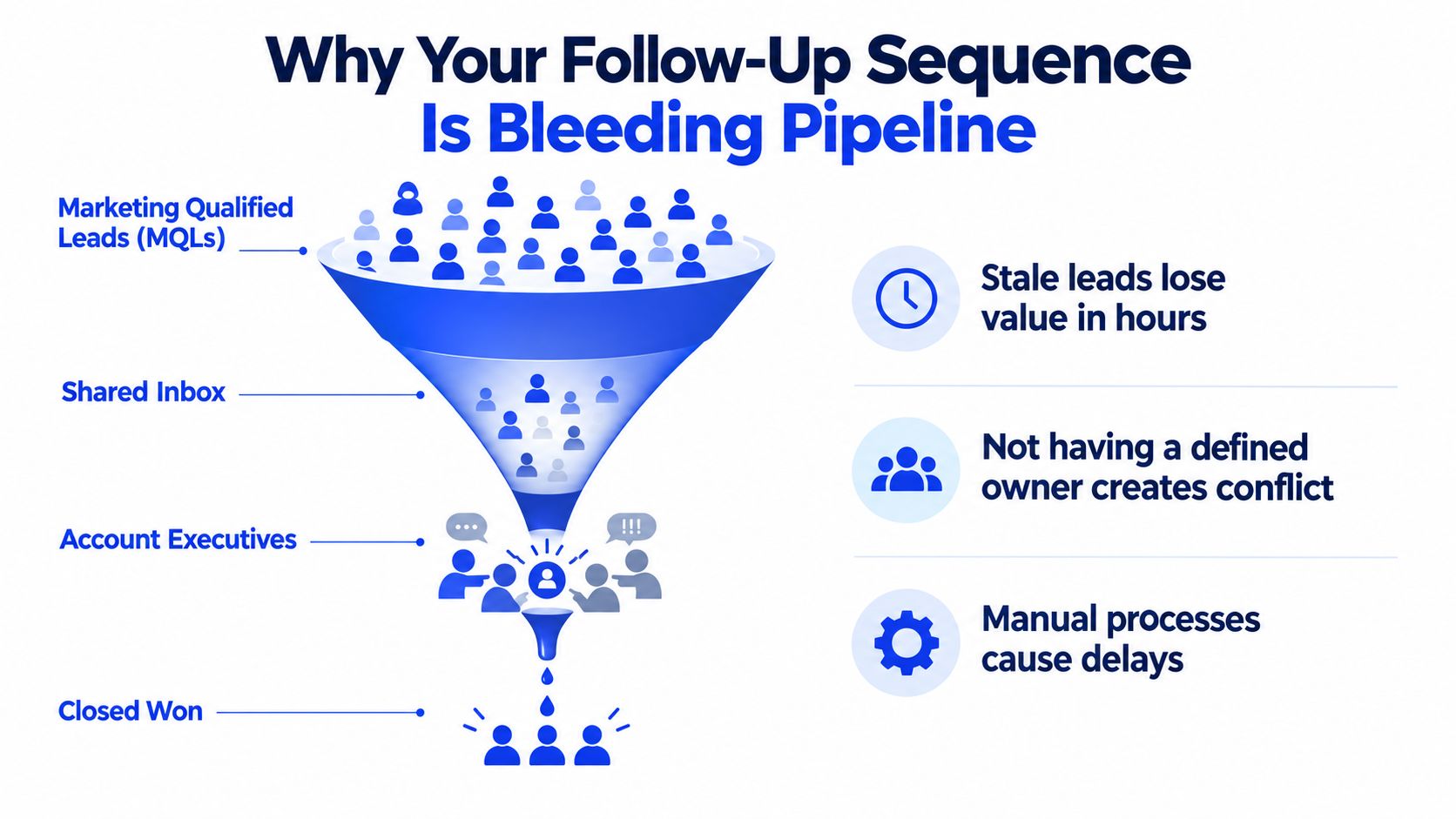
What usually breaks first
The failures tend to be boring, which is why they repeat.
Stale leads decay fast, so a demo request that sits untouched loses value before the first touch.
Single-channel outreach caps reply rates, because one email can't cover every buying preference.
No qualification routing creates junk chasing, so AEs spend time on leads that were never going to advance.
SDRs reuse the same message for everyone, which turns personalization into noise.
Monthly reporting is too late, because the pipeline decision was made days earlier.
The speed data makes the failure pattern obvious. In one benchmark, the median inbound first response sat around 42 to 47 hours, while only about 7% to 23% of companies replied within five minutes, and leads contacted within five minutes converted at roughly 21% versus about 2.3% after 24+ hours (Plura lead response time statistics). Another benchmark reports the same general gap, with about 42 hours average response time and about 7% of teams replying within five minutes (Artemis speed-to-lead benchmark 2026).
That's why a 24-hour delay usually means more than a slow rep. It usually means the lead never hit an on-call rotation, the CRM didn't page anyone, or the routing logic left ownership ambiguous. The message cadence can't fix that after the fact.
Practical rule: if the lead can't be assigned and touched inside minutes, the sequence is already losing to the clock.
Why speed beats everything else
The first hour is the critical window. Research summarized by InsideSales says conversion is more than 8 times higher when the first attempt happens within five minutes rather than waiting between five minutes and 24 hours, and that 57.1% of first call attempts in a very large sample happened after more than a week (InsideSales response time matters). Rework summarizes the same direction of travel, saying leads contacted within five minutes are 21 times more likely to qualify than leads contacted after 30 minutes, and qualification likelihood drops by more than 90% after one hour (Rework lead follow-up best practices).
A 2024 audit of 1,000 B2B SaaS companies found 635 never replied to a demo request, and among the rest, the average first response took 1 day, 5 hours, and 17 minutes (RevenueHero lead follow-up statistics). That's why the conversation isn't really about copy quality yet. It's about whether your system can reach the prospect while intent is still hot.
The right way to think about lead follow up is simple. Speed creates the chance for a conversation. Cadence protects that chance. Qualification decides whether the rep should keep going or hand off.
One useful reference point for leakage analysis is GROU's internal glossary entry on lead leakage, because the pattern usually starts with ownership loss, not weak messaging.
The core lead follow up cadence blueprint
The cadence should run like an operational sequence, not a creative exercise. The goal is to get a live human touch on the best leads fast, then use other channels to keep the thread active without burning the rep's time. For teams using HubSpot or Salesforce, tasking should live in CRM, while Outreach or Salesloft handles the sequencing, and Chili Piper or routing rules should assign the lead instantly.
Timing and channel roles
Day 0 should start with an email within five minutes, plus a LinkedIn view request. The email opens the thread with a clear reason for the reach-out, while the profile view creates a low-friction signal that the prospect notices.
Day 1 should be a call attempt at the prospect's local 10am, with voicemail if there's no answer. That call does the first heavy lift. It signals live intent, not just sequence activity.
Day 3 should bring a second email with a value asset, and Day 5 should move to LinkedIn messaging that references the asset. By then, the channel mix matters more than the phrasing. The prospect needs a different interaction pattern, not the same ask in a new wrapper.
Day 7 should be a second call with a different angle, Day 10 a breakup email, and Day 14 a clean move to nurture. For a deeper length benchmark, GROU's internal guidance on B2B sequence touch count is a useful companion because cadence fatigue is often a touch-count problem disguised as a messaging problem.
A sequence should earn the next touch, not assume it.
The 24/7 booking automation playbook is also a helpful reference point for teams that want routing and scheduling to happen before a rep ever manually intervenes. The key lesson is that speed is a system property.
Message roles inside the cadence
Each touch needs a job.
The Day 0 email is the opener. The Day 3 email is the proof touch. The Day 5 LinkedIn message handles the objection pre-handle, usually by reframing the asset or calling out the use case. The breakup email should be short, direct, and professional. It's not a guilt trip, it's a final signal that the thread is closing unless the buyer re-engages.
If the email is opened three times without a reply, switch to LinkedIn. If LinkedIn connects, move the call earlier. That keeps the sequence responsive instead of rigid.
The lead follow-up for service firms resource from Truespeak is worth a look if your team works longer consideration cycles and needs to compare fast-response logic against relationship-heavy follow up. The same routing logic still applies, even when the sales motion is less transactional.
Message templates and channel switching rules
Good templates matter, but only after the channel logic is right. The point is to move the prospect through a controlled set of interactions, then switch channels only when the signal says the current one has stalled. For orchestration, teams usually run Outreach or Apollo, with LinkedIn Sales Navigator for warm social, and Aircall or JustCall for the dialer.
Copy that fits the sequence
Day 0 email, opener “Hi [First name], saw your request for [offer]. I work with teams handling [relevant use case], and I thought it made sense to send this directly. If helpful, I can send the shortest path to next step, or route you to the right owner.”
Day 3 email, value-add “Sharing this because it usually helps teams at your stage decide faster. It covers [asset topic], and it maps well to what you asked for on the form. If this is relevant, I'm happy to send a cleaner example tied to your use case.”
Day 10 breakup “I haven't heard back, so I'll close the loop for now. If this is still active, reply with one word and I'll reopen it. If not, I'll leave you out of the next round.”
LinkedIn and voicemail scripts
A connection request should stay under 300 characters and only say enough to justify the ask. Keep it plain: “Saw your interest in [topic]. I work with teams on this motion and wanted to connect.”
After acceptance, the thank-you DM should be short. “Thanks for connecting. I sent a note by email with a resource tied to [topic]. If it's easier, I can send the relevant section here.”
The profile-view pattern interrupt works because it's light, not clever. If they viewed your profile after the first email, the next touch should mention that you reached out because their team likely has the issue you described, then ask for the correct owner.
Voicemail should run about 30 seconds, with one specific ask and no extra context. “Hi [name], it's [rep] from [company]. I sent a short note on [topic]. If you're the right person, please reply to that email. If not, point me to the owner and I'll route it correctly.”
Operational rule: every call gets a same-day follow-up email, even if the voicemail lands.
When to switch, pause, or resume
Trigger signal | Current channel | Switch to | Wait time before switch |
|---|---|---|---|
Opened email three times, no reply | Same day | ||
Connected on LinkedIn | Phone | Same or next business day | |
Positive reply sentiment | Any | Human handoff | Immediate |
Out-of-office reply | Any | Pause sequence | Until return date |
Job change mention | Any | Pause and recheck owner | Until account review |
Competitor mention | Any | Pause and qualify manually | Immediate |
The sales email templates resource from GROU is a useful reference if your team wants to keep the wording tight while still tying each message to a specific channel role. Pausing matters because bad timing can create more damage than a slightly weaker opener.
Qualification and routing inside the cadence
Qualification works best when it's woven into the sequence, not bolted on after the reply. A light BANT-lite model is sufficient for a sales team, as long as it's captured quickly and routed cleanly.
The scoring block
Use four fields: Budget signal, Authority confirmation, Need specificity, and Timeline urgency. Budget might come from a direct comment or a proxy like team scope. Authority comes from the role or the reply thread. Need specificity comes from the prospect naming the problem in their own words. Timeline urgency is the easiest tell, because it shows up in how fast they want a next step.
A simple threshold of 60 out of 100 should trigger a live hand-off to an AE through round-robin in HubSpot, Salesforce, or Pipedrive. The score doesn't need to be fancy. It needs to be consistent.
Routing by source and segment
Inbound demo requests should route in under five minutes to the assigned AE. Cold list prospects with a score above 60 should go to SDR qualification first. Enterprise accounts above 1,000 employees should skip SDR and book directly.
That routing logic is what keeps the cadence from turning into a waiting room. A B2B lead with real urgency shouldn't sit behind a generic sequence just because the scoring field hasn't been updated yet.
The routing gap is where a lot of systems fail, and GROU's lead qualification process gives a practical frame for separating real buying signals from polite interest. If the lead doesn't clear the threshold, the right move is a polite breakup, then a nurture list add, then a re-engagement cadence at 90 days.
Cadence variants by industry
The same skeleton works across verticals, but the order of touches and the opening offer should shift with buying friction. SaaS, iGaming, manufacturing, and professional services each need a different default cadence because their buyers respond to different forms of proof.
Industry | Cadence length | Primary channel | Opening offer | Success metric |
|---|---|---|---|---|
SaaS | 11 days | Email plus LinkedIn | Product-led signal, like free trial activation context | SQL rate |
iGaming | 21 days | Phone first | Compliance-aware intro tied to regulated workflow | Qualified meeting rate |
Manufacturing | 30 days | Email with technical follow-up | Download tied to plant or process context | Opportunity created |
Professional services | 14 days | Referral-led LinkedIn and email | Mutual connection or case study proof point | Proposal request |
What changes by vertical
SaaS can move quickly because product usage often gives you a live signal. That's why the sequence can be shorter, with tighter switching between email and LinkedIn.
iGaming needs more patience, and the first live conversation often works better by phone because jurisdiction, compliance, and KYC friction slow the decision loop. The cadence should give room for that.
Manufacturing tends to reward a slower build, especially when the buyer needs technical content before they'll engage a plant manager or operations leader. Professional services sits somewhere else entirely, because referrals and proof matter more than volume.
The lead generation KPIs guide is a useful complement if your team wants the right success metric per vertical rather than one blended dashboard. Don't compare these motions on the same scoreboard unless the buying motions are similar.
Metrics, reporting, and iteration
A cadence only earns its place if the numbers say so. The manager view should stay narrow, because too many fields hide the actual failure point.
The eight numbers that matter
Look at cost per MQL, MQL-to-SQL conversion, SQL-to-opportunity conversion, average touches per reply, reply rate by step, channel mix that produced the meeting, sequence-to-meeting rate, and pipeline created per 1,000 contacts. Those eight numbers tell you whether the system is producing conversations or just activity.
Lead metrics also need a lead-to-lag split. A reply on step 6 should still get attributed back to the sequence that started on step 1, because the earlier touch set the thread in motion. If you only credit the last interaction, you'll keep killing sequences that are doing the setup work.
Weekly reporting that operators can use
A useful review grid is simple.
Metric name: the one being reviewed.
Owner: the person who can change it.
Last week value: the current snapshot.
Four-week trend: up, flat, or down.
One experiment queued: the next change to ship.
Kill a sequence if reply rate stays under 1% by step 4, negative reply sentiment rises above 30%, or SQL rate falls under 3%. Review on Monday, ship changes on Wednesday, and hold steps steady for at least two weeks before judging the result.
The same discipline should show up in your CRM dashboards, because if the report can't explain which channel produced the meeting, it's probably not telling you enough. That's where many teams keep guessing instead of adjusting.
Run this audit by Friday
Start with the last 90 days of closed-won deals, then tag every sequence step that touched them. You're looking for the touches that preceded conversion, not the ones that just looked busy.
Replay the last 10 touches on lost deals and score them for relevance, timing, and channel-switch gaps. Then audit routing rules for round-robin bias, missing verticals, and SLA breaches over 60 minutes.
Rebuild the qualification block inside the cadence using the BANT-lite scoring from above, and add clear disqualification reasons. Finish by scheduling the Monday review and the Wednesday experiment ship. If you do only one thing this week, do that.
GROU builds these systems for SaaS and iGaming teams by tying SDR workflows to client lifecycle data and CRM ownership, so follow up doesn't depend on memory. The process starts with list design, routing logic, and sequence structure, then moves into weekly reporting and handoff discipline.
If you want help turning lead follow up into a routed system instead of a set of rep habits, visit Grou and ask for a pipeline audit. We build the routing, cadence, and reporting layer for SaaS and iGaming teams, then connect it to CRM ownership so the right lead reaches the right rep at the right time.
Your inbox is probably full of leads that looked good on paper, then went cold before anyone owned them. Marketing says the form filled. Sales says the timing was off. RevOps sees the core issue, the response path was broken before anyone started writing better copy.
Speed matters first, because response delays crush qualification odds and turn routing gaps into lost pipeline.
One cadence doesn't fit all, so inbound demo requests, warm social interest, and cold list outreach need different pacing.
Qualification belongs inside the sequence, not after it, or AEs waste time on junk.
Reporting has to be weekly, because monthly dashboards show you the damage after the deals are already gone.
If your team is still treating lead follow up as a rep habit, you're leaving it exposed to inbox chaos, ownership disputes, and slow handoffs. The fix is a system, with routing rules, channel switching, qualification gates, and a reporting loop that tells you what to change before the next week starts.
Table of Contents
Why your follow up sequence is bleeding pipeline
A RevOps lead at a 40-person SaaS company usually doesn't lose pipeline because the team lacks templates. They lose it because leads land in a shared inbox, AEs debate ownership, and nobody knows whether a fast reply or a better sequence would have mattered more. That's not a content problem. It's a routing and pacing problem.
What usually breaks first
The failures tend to be boring, which is why they repeat.
Stale leads decay fast, so a demo request that sits untouched loses value before the first touch.
Single-channel outreach caps reply rates, because one email can't cover every buying preference.
No qualification routing creates junk chasing, so AEs spend time on leads that were never going to advance.
SDRs reuse the same message for everyone, which turns personalization into noise.
Monthly reporting is too late, because the pipeline decision was made days earlier.
The speed data makes the failure pattern obvious. In one benchmark, the median inbound first response sat around 42 to 47 hours, while only about 7% to 23% of companies replied within five minutes, and leads contacted within five minutes converted at roughly 21% versus about 2.3% after 24+ hours (Plura lead response time statistics). Another benchmark reports the same general gap, with about 42 hours average response time and about 7% of teams replying within five minutes (Artemis speed-to-lead benchmark 2026).
That's why a 24-hour delay usually means more than a slow rep. It usually means the lead never hit an on-call rotation, the CRM didn't page anyone, or the routing logic left ownership ambiguous. The message cadence can't fix that after the fact.
Practical rule: if the lead can't be assigned and touched inside minutes, the sequence is already losing to the clock.
Why speed beats everything else
The first hour is the critical window. Research summarized by InsideSales says conversion is more than 8 times higher when the first attempt happens within five minutes rather than waiting between five minutes and 24 hours, and that 57.1% of first call attempts in a very large sample happened after more than a week (InsideSales response time matters). Rework summarizes the same direction of travel, saying leads contacted within five minutes are 21 times more likely to qualify than leads contacted after 30 minutes, and qualification likelihood drops by more than 90% after one hour (Rework lead follow-up best practices).
A 2024 audit of 1,000 B2B SaaS companies found 635 never replied to a demo request, and among the rest, the average first response took 1 day, 5 hours, and 17 minutes (RevenueHero lead follow-up statistics). That's why the conversation isn't really about copy quality yet. It's about whether your system can reach the prospect while intent is still hot.
The right way to think about lead follow up is simple. Speed creates the chance for a conversation. Cadence protects that chance. Qualification decides whether the rep should keep going or hand off.
One useful reference point for leakage analysis is GROU's internal glossary entry on lead leakage, because the pattern usually starts with ownership loss, not weak messaging.
The core lead follow up cadence blueprint
The cadence should run like an operational sequence, not a creative exercise. The goal is to get a live human touch on the best leads fast, then use other channels to keep the thread active without burning the rep's time. For teams using HubSpot or Salesforce, tasking should live in CRM, while Outreach or Salesloft handles the sequencing, and Chili Piper or routing rules should assign the lead instantly.
Timing and channel roles
Day 0 should start with an email within five minutes, plus a LinkedIn view request. The email opens the thread with a clear reason for the reach-out, while the profile view creates a low-friction signal that the prospect notices.
Day 1 should be a call attempt at the prospect's local 10am, with voicemail if there's no answer. That call does the first heavy lift. It signals live intent, not just sequence activity.
Day 3 should bring a second email with a value asset, and Day 5 should move to LinkedIn messaging that references the asset. By then, the channel mix matters more than the phrasing. The prospect needs a different interaction pattern, not the same ask in a new wrapper.
Day 7 should be a second call with a different angle, Day 10 a breakup email, and Day 14 a clean move to nurture. For a deeper length benchmark, GROU's internal guidance on B2B sequence touch count is a useful companion because cadence fatigue is often a touch-count problem disguised as a messaging problem.
A sequence should earn the next touch, not assume it.
The 24/7 booking automation playbook is also a helpful reference point for teams that want routing and scheduling to happen before a rep ever manually intervenes. The key lesson is that speed is a system property.
Message roles inside the cadence
Each touch needs a job.
The Day 0 email is the opener. The Day 3 email is the proof touch. The Day 5 LinkedIn message handles the objection pre-handle, usually by reframing the asset or calling out the use case. The breakup email should be short, direct, and professional. It's not a guilt trip, it's a final signal that the thread is closing unless the buyer re-engages.
If the email is opened three times without a reply, switch to LinkedIn. If LinkedIn connects, move the call earlier. That keeps the sequence responsive instead of rigid.
The lead follow-up for service firms resource from Truespeak is worth a look if your team works longer consideration cycles and needs to compare fast-response logic against relationship-heavy follow up. The same routing logic still applies, even when the sales motion is less transactional.
Message templates and channel switching rules
Good templates matter, but only after the channel logic is right. The point is to move the prospect through a controlled set of interactions, then switch channels only when the signal says the current one has stalled. For orchestration, teams usually run Outreach or Apollo, with LinkedIn Sales Navigator for warm social, and Aircall or JustCall for the dialer.
Copy that fits the sequence
Day 0 email, opener “Hi [First name], saw your request for [offer]. I work with teams handling [relevant use case], and I thought it made sense to send this directly. If helpful, I can send the shortest path to next step, or route you to the right owner.”
Day 3 email, value-add “Sharing this because it usually helps teams at your stage decide faster. It covers [asset topic], and it maps well to what you asked for on the form. If this is relevant, I'm happy to send a cleaner example tied to your use case.”
Day 10 breakup “I haven't heard back, so I'll close the loop for now. If this is still active, reply with one word and I'll reopen it. If not, I'll leave you out of the next round.”
LinkedIn and voicemail scripts
A connection request should stay under 300 characters and only say enough to justify the ask. Keep it plain: “Saw your interest in [topic]. I work with teams on this motion and wanted to connect.”
After acceptance, the thank-you DM should be short. “Thanks for connecting. I sent a note by email with a resource tied to [topic]. If it's easier, I can send the relevant section here.”
The profile-view pattern interrupt works because it's light, not clever. If they viewed your profile after the first email, the next touch should mention that you reached out because their team likely has the issue you described, then ask for the correct owner.
Voicemail should run about 30 seconds, with one specific ask and no extra context. “Hi [name], it's [rep] from [company]. I sent a short note on [topic]. If you're the right person, please reply to that email. If not, point me to the owner and I'll route it correctly.”
Operational rule: every call gets a same-day follow-up email, even if the voicemail lands.
When to switch, pause, or resume
Trigger signal | Current channel | Switch to | Wait time before switch |
|---|---|---|---|
Opened email three times, no reply | Same day | ||
Connected on LinkedIn | Phone | Same or next business day | |
Positive reply sentiment | Any | Human handoff | Immediate |
Out-of-office reply | Any | Pause sequence | Until return date |
Job change mention | Any | Pause and recheck owner | Until account review |
Competitor mention | Any | Pause and qualify manually | Immediate |
The sales email templates resource from GROU is a useful reference if your team wants to keep the wording tight while still tying each message to a specific channel role. Pausing matters because bad timing can create more damage than a slightly weaker opener.
Qualification and routing inside the cadence
Qualification works best when it's woven into the sequence, not bolted on after the reply. A light BANT-lite model is sufficient for a sales team, as long as it's captured quickly and routed cleanly.
The scoring block
Use four fields: Budget signal, Authority confirmation, Need specificity, and Timeline urgency. Budget might come from a direct comment or a proxy like team scope. Authority comes from the role or the reply thread. Need specificity comes from the prospect naming the problem in their own words. Timeline urgency is the easiest tell, because it shows up in how fast they want a next step.
A simple threshold of 60 out of 100 should trigger a live hand-off to an AE through round-robin in HubSpot, Salesforce, or Pipedrive. The score doesn't need to be fancy. It needs to be consistent.
Routing by source and segment
Inbound demo requests should route in under five minutes to the assigned AE. Cold list prospects with a score above 60 should go to SDR qualification first. Enterprise accounts above 1,000 employees should skip SDR and book directly.
That routing logic is what keeps the cadence from turning into a waiting room. A B2B lead with real urgency shouldn't sit behind a generic sequence just because the scoring field hasn't been updated yet.
The routing gap is where a lot of systems fail, and GROU's lead qualification process gives a practical frame for separating real buying signals from polite interest. If the lead doesn't clear the threshold, the right move is a polite breakup, then a nurture list add, then a re-engagement cadence at 90 days.
Cadence variants by industry
The same skeleton works across verticals, but the order of touches and the opening offer should shift with buying friction. SaaS, iGaming, manufacturing, and professional services each need a different default cadence because their buyers respond to different forms of proof.
Industry | Cadence length | Primary channel | Opening offer | Success metric |
|---|---|---|---|---|
SaaS | 11 days | Email plus LinkedIn | Product-led signal, like free trial activation context | SQL rate |
iGaming | 21 days | Phone first | Compliance-aware intro tied to regulated workflow | Qualified meeting rate |
Manufacturing | 30 days | Email with technical follow-up | Download tied to plant or process context | Opportunity created |
Professional services | 14 days | Referral-led LinkedIn and email | Mutual connection or case study proof point | Proposal request |
What changes by vertical
SaaS can move quickly because product usage often gives you a live signal. That's why the sequence can be shorter, with tighter switching between email and LinkedIn.
iGaming needs more patience, and the first live conversation often works better by phone because jurisdiction, compliance, and KYC friction slow the decision loop. The cadence should give room for that.
Manufacturing tends to reward a slower build, especially when the buyer needs technical content before they'll engage a plant manager or operations leader. Professional services sits somewhere else entirely, because referrals and proof matter more than volume.
The lead generation KPIs guide is a useful complement if your team wants the right success metric per vertical rather than one blended dashboard. Don't compare these motions on the same scoreboard unless the buying motions are similar.
Metrics, reporting, and iteration
A cadence only earns its place if the numbers say so. The manager view should stay narrow, because too many fields hide the actual failure point.
The eight numbers that matter
Look at cost per MQL, MQL-to-SQL conversion, SQL-to-opportunity conversion, average touches per reply, reply rate by step, channel mix that produced the meeting, sequence-to-meeting rate, and pipeline created per 1,000 contacts. Those eight numbers tell you whether the system is producing conversations or just activity.
Lead metrics also need a lead-to-lag split. A reply on step 6 should still get attributed back to the sequence that started on step 1, because the earlier touch set the thread in motion. If you only credit the last interaction, you'll keep killing sequences that are doing the setup work.
Weekly reporting that operators can use
A useful review grid is simple.
Metric name: the one being reviewed.
Owner: the person who can change it.
Last week value: the current snapshot.
Four-week trend: up, flat, or down.
One experiment queued: the next change to ship.
Kill a sequence if reply rate stays under 1% by step 4, negative reply sentiment rises above 30%, or SQL rate falls under 3%. Review on Monday, ship changes on Wednesday, and hold steps steady for at least two weeks before judging the result.
The same discipline should show up in your CRM dashboards, because if the report can't explain which channel produced the meeting, it's probably not telling you enough. That's where many teams keep guessing instead of adjusting.
Run this audit by Friday
Start with the last 90 days of closed-won deals, then tag every sequence step that touched them. You're looking for the touches that preceded conversion, not the ones that just looked busy.
Replay the last 10 touches on lost deals and score them for relevance, timing, and channel-switch gaps. Then audit routing rules for round-robin bias, missing verticals, and SLA breaches over 60 minutes.
Rebuild the qualification block inside the cadence using the BANT-lite scoring from above, and add clear disqualification reasons. Finish by scheduling the Monday review and the Wednesday experiment ship. If you do only one thing this week, do that.
GROU builds these systems for SaaS and iGaming teams by tying SDR workflows to client lifecycle data and CRM ownership, so follow up doesn't depend on memory. The process starts with list design, routing logic, and sequence structure, then moves into weekly reporting and handoff discipline.
If you want help turning lead follow up into a routed system instead of a set of rep habits, visit Grou and ask for a pipeline audit. We build the routing, cadence, and reporting layer for SaaS and iGaming teams, then connect it to CRM ownership so the right lead reaches the right rep at the right time.
Your inbox is probably full of leads that looked good on paper, then went cold before anyone owned them. Marketing says the form filled. Sales says the timing was off. RevOps sees the core issue, the response path was broken before anyone started writing better copy.
Speed matters first, because response delays crush qualification odds and turn routing gaps into lost pipeline.
One cadence doesn't fit all, so inbound demo requests, warm social interest, and cold list outreach need different pacing.
Qualification belongs inside the sequence, not after it, or AEs waste time on junk.
Reporting has to be weekly, because monthly dashboards show you the damage after the deals are already gone.
If your team is still treating lead follow up as a rep habit, you're leaving it exposed to inbox chaos, ownership disputes, and slow handoffs. The fix is a system, with routing rules, channel switching, qualification gates, and a reporting loop that tells you what to change before the next week starts.
Table of Contents
Why your follow up sequence is bleeding pipeline
A RevOps lead at a 40-person SaaS company usually doesn't lose pipeline because the team lacks templates. They lose it because leads land in a shared inbox, AEs debate ownership, and nobody knows whether a fast reply or a better sequence would have mattered more. That's not a content problem. It's a routing and pacing problem.
What usually breaks first
The failures tend to be boring, which is why they repeat.
Stale leads decay fast, so a demo request that sits untouched loses value before the first touch.
Single-channel outreach caps reply rates, because one email can't cover every buying preference.
No qualification routing creates junk chasing, so AEs spend time on leads that were never going to advance.
SDRs reuse the same message for everyone, which turns personalization into noise.
Monthly reporting is too late, because the pipeline decision was made days earlier.
The speed data makes the failure pattern obvious. In one benchmark, the median inbound first response sat around 42 to 47 hours, while only about 7% to 23% of companies replied within five minutes, and leads contacted within five minutes converted at roughly 21% versus about 2.3% after 24+ hours (Plura lead response time statistics). Another benchmark reports the same general gap, with about 42 hours average response time and about 7% of teams replying within five minutes (Artemis speed-to-lead benchmark 2026).
That's why a 24-hour delay usually means more than a slow rep. It usually means the lead never hit an on-call rotation, the CRM didn't page anyone, or the routing logic left ownership ambiguous. The message cadence can't fix that after the fact.
Practical rule: if the lead can't be assigned and touched inside minutes, the sequence is already losing to the clock.
Why speed beats everything else
The first hour is the critical window. Research summarized by InsideSales says conversion is more than 8 times higher when the first attempt happens within five minutes rather than waiting between five minutes and 24 hours, and that 57.1% of first call attempts in a very large sample happened after more than a week (InsideSales response time matters). Rework summarizes the same direction of travel, saying leads contacted within five minutes are 21 times more likely to qualify than leads contacted after 30 minutes, and qualification likelihood drops by more than 90% after one hour (Rework lead follow-up best practices).
A 2024 audit of 1,000 B2B SaaS companies found 635 never replied to a demo request, and among the rest, the average first response took 1 day, 5 hours, and 17 minutes (RevenueHero lead follow-up statistics). That's why the conversation isn't really about copy quality yet. It's about whether your system can reach the prospect while intent is still hot.
The right way to think about lead follow up is simple. Speed creates the chance for a conversation. Cadence protects that chance. Qualification decides whether the rep should keep going or hand off.
One useful reference point for leakage analysis is GROU's internal glossary entry on lead leakage, because the pattern usually starts with ownership loss, not weak messaging.
The core lead follow up cadence blueprint
The cadence should run like an operational sequence, not a creative exercise. The goal is to get a live human touch on the best leads fast, then use other channels to keep the thread active without burning the rep's time. For teams using HubSpot or Salesforce, tasking should live in CRM, while Outreach or Salesloft handles the sequencing, and Chili Piper or routing rules should assign the lead instantly.
Timing and channel roles
Day 0 should start with an email within five minutes, plus a LinkedIn view request. The email opens the thread with a clear reason for the reach-out, while the profile view creates a low-friction signal that the prospect notices.
Day 1 should be a call attempt at the prospect's local 10am, with voicemail if there's no answer. That call does the first heavy lift. It signals live intent, not just sequence activity.
Day 3 should bring a second email with a value asset, and Day 5 should move to LinkedIn messaging that references the asset. By then, the channel mix matters more than the phrasing. The prospect needs a different interaction pattern, not the same ask in a new wrapper.
Day 7 should be a second call with a different angle, Day 10 a breakup email, and Day 14 a clean move to nurture. For a deeper length benchmark, GROU's internal guidance on B2B sequence touch count is a useful companion because cadence fatigue is often a touch-count problem disguised as a messaging problem.
A sequence should earn the next touch, not assume it.
The 24/7 booking automation playbook is also a helpful reference point for teams that want routing and scheduling to happen before a rep ever manually intervenes. The key lesson is that speed is a system property.
Message roles inside the cadence
Each touch needs a job.
The Day 0 email is the opener. The Day 3 email is the proof touch. The Day 5 LinkedIn message handles the objection pre-handle, usually by reframing the asset or calling out the use case. The breakup email should be short, direct, and professional. It's not a guilt trip, it's a final signal that the thread is closing unless the buyer re-engages.
If the email is opened three times without a reply, switch to LinkedIn. If LinkedIn connects, move the call earlier. That keeps the sequence responsive instead of rigid.
The lead follow-up for service firms resource from Truespeak is worth a look if your team works longer consideration cycles and needs to compare fast-response logic against relationship-heavy follow up. The same routing logic still applies, even when the sales motion is less transactional.
Message templates and channel switching rules
Good templates matter, but only after the channel logic is right. The point is to move the prospect through a controlled set of interactions, then switch channels only when the signal says the current one has stalled. For orchestration, teams usually run Outreach or Apollo, with LinkedIn Sales Navigator for warm social, and Aircall or JustCall for the dialer.
Copy that fits the sequence
Day 0 email, opener “Hi [First name], saw your request for [offer]. I work with teams handling [relevant use case], and I thought it made sense to send this directly. If helpful, I can send the shortest path to next step, or route you to the right owner.”
Day 3 email, value-add “Sharing this because it usually helps teams at your stage decide faster. It covers [asset topic], and it maps well to what you asked for on the form. If this is relevant, I'm happy to send a cleaner example tied to your use case.”
Day 10 breakup “I haven't heard back, so I'll close the loop for now. If this is still active, reply with one word and I'll reopen it. If not, I'll leave you out of the next round.”
LinkedIn and voicemail scripts
A connection request should stay under 300 characters and only say enough to justify the ask. Keep it plain: “Saw your interest in [topic]. I work with teams on this motion and wanted to connect.”
After acceptance, the thank-you DM should be short. “Thanks for connecting. I sent a note by email with a resource tied to [topic]. If it's easier, I can send the relevant section here.”
The profile-view pattern interrupt works because it's light, not clever. If they viewed your profile after the first email, the next touch should mention that you reached out because their team likely has the issue you described, then ask for the correct owner.
Voicemail should run about 30 seconds, with one specific ask and no extra context. “Hi [name], it's [rep] from [company]. I sent a short note on [topic]. If you're the right person, please reply to that email. If not, point me to the owner and I'll route it correctly.”
Operational rule: every call gets a same-day follow-up email, even if the voicemail lands.
When to switch, pause, or resume
Trigger signal | Current channel | Switch to | Wait time before switch |
|---|---|---|---|
Opened email three times, no reply | Same day | ||
Connected on LinkedIn | Phone | Same or next business day | |
Positive reply sentiment | Any | Human handoff | Immediate |
Out-of-office reply | Any | Pause sequence | Until return date |
Job change mention | Any | Pause and recheck owner | Until account review |
Competitor mention | Any | Pause and qualify manually | Immediate |
The sales email templates resource from GROU is a useful reference if your team wants to keep the wording tight while still tying each message to a specific channel role. Pausing matters because bad timing can create more damage than a slightly weaker opener.
Qualification and routing inside the cadence
Qualification works best when it's woven into the sequence, not bolted on after the reply. A light BANT-lite model is sufficient for a sales team, as long as it's captured quickly and routed cleanly.
The scoring block
Use four fields: Budget signal, Authority confirmation, Need specificity, and Timeline urgency. Budget might come from a direct comment or a proxy like team scope. Authority comes from the role or the reply thread. Need specificity comes from the prospect naming the problem in their own words. Timeline urgency is the easiest tell, because it shows up in how fast they want a next step.
A simple threshold of 60 out of 100 should trigger a live hand-off to an AE through round-robin in HubSpot, Salesforce, or Pipedrive. The score doesn't need to be fancy. It needs to be consistent.
Routing by source and segment
Inbound demo requests should route in under five minutes to the assigned AE. Cold list prospects with a score above 60 should go to SDR qualification first. Enterprise accounts above 1,000 employees should skip SDR and book directly.
That routing logic is what keeps the cadence from turning into a waiting room. A B2B lead with real urgency shouldn't sit behind a generic sequence just because the scoring field hasn't been updated yet.
The routing gap is where a lot of systems fail, and GROU's lead qualification process gives a practical frame for separating real buying signals from polite interest. If the lead doesn't clear the threshold, the right move is a polite breakup, then a nurture list add, then a re-engagement cadence at 90 days.
Cadence variants by industry
The same skeleton works across verticals, but the order of touches and the opening offer should shift with buying friction. SaaS, iGaming, manufacturing, and professional services each need a different default cadence because their buyers respond to different forms of proof.
Industry | Cadence length | Primary channel | Opening offer | Success metric |
|---|---|---|---|---|
SaaS | 11 days | Email plus LinkedIn | Product-led signal, like free trial activation context | SQL rate |
iGaming | 21 days | Phone first | Compliance-aware intro tied to regulated workflow | Qualified meeting rate |
Manufacturing | 30 days | Email with technical follow-up | Download tied to plant or process context | Opportunity created |
Professional services | 14 days | Referral-led LinkedIn and email | Mutual connection or case study proof point | Proposal request |
What changes by vertical
SaaS can move quickly because product usage often gives you a live signal. That's why the sequence can be shorter, with tighter switching between email and LinkedIn.
iGaming needs more patience, and the first live conversation often works better by phone because jurisdiction, compliance, and KYC friction slow the decision loop. The cadence should give room for that.
Manufacturing tends to reward a slower build, especially when the buyer needs technical content before they'll engage a plant manager or operations leader. Professional services sits somewhere else entirely, because referrals and proof matter more than volume.
The lead generation KPIs guide is a useful complement if your team wants the right success metric per vertical rather than one blended dashboard. Don't compare these motions on the same scoreboard unless the buying motions are similar.
Metrics, reporting, and iteration
A cadence only earns its place if the numbers say so. The manager view should stay narrow, because too many fields hide the actual failure point.
The eight numbers that matter
Look at cost per MQL, MQL-to-SQL conversion, SQL-to-opportunity conversion, average touches per reply, reply rate by step, channel mix that produced the meeting, sequence-to-meeting rate, and pipeline created per 1,000 contacts. Those eight numbers tell you whether the system is producing conversations or just activity.
Lead metrics also need a lead-to-lag split. A reply on step 6 should still get attributed back to the sequence that started on step 1, because the earlier touch set the thread in motion. If you only credit the last interaction, you'll keep killing sequences that are doing the setup work.
Weekly reporting that operators can use
A useful review grid is simple.
Metric name: the one being reviewed.
Owner: the person who can change it.
Last week value: the current snapshot.
Four-week trend: up, flat, or down.
One experiment queued: the next change to ship.
Kill a sequence if reply rate stays under 1% by step 4, negative reply sentiment rises above 30%, or SQL rate falls under 3%. Review on Monday, ship changes on Wednesday, and hold steps steady for at least two weeks before judging the result.
The same discipline should show up in your CRM dashboards, because if the report can't explain which channel produced the meeting, it's probably not telling you enough. That's where many teams keep guessing instead of adjusting.
Run this audit by Friday
Start with the last 90 days of closed-won deals, then tag every sequence step that touched them. You're looking for the touches that preceded conversion, not the ones that just looked busy.
Replay the last 10 touches on lost deals and score them for relevance, timing, and channel-switch gaps. Then audit routing rules for round-robin bias, missing verticals, and SLA breaches over 60 minutes.
Rebuild the qualification block inside the cadence using the BANT-lite scoring from above, and add clear disqualification reasons. Finish by scheduling the Monday review and the Wednesday experiment ship. If you do only one thing this week, do that.
GROU builds these systems for SaaS and iGaming teams by tying SDR workflows to client lifecycle data and CRM ownership, so follow up doesn't depend on memory. The process starts with list design, routing logic, and sequence structure, then moves into weekly reporting and handoff discipline.
If you want help turning lead follow up into a routed system instead of a set of rep habits, visit Grou and ask for a pipeline audit. We build the routing, cadence, and reporting layer for SaaS and iGaming teams, then connect it to CRM ownership so the right lead reaches the right rep at the right time.
Pipeline OS Newsletter
Build qualified pipeline
Get weekly tactics to generate demand, improve lead quality, and book more meetings.





Trusted by industry leaders
Trusted by industry leaders
Trusted by industry leaders
Ready to build qualified pipeline?
Ready to build qualified pipeline?
Ready to build qualified pipeline?
Book a call to see if we're the right fit, or take the 2-minute quiz to get a clear starting point.
Book a call to see if we're the right fit, or take the 2-minute quiz to get a clear starting point.
Book a call to see if we're the right fit, or take the 2-minute quiz to get a clear starting point.
" height="30.21639343089746px" id="hfGbXmQR2" width="30.216393430897455px"/></svg>)
Copyright © 2026 – All Right Reserved
Copyright © 2026 – All Right Reserved
Copyright © 2026 – All Right Reserved