%22%3E%3C/path%3E%3Cpath d=%22M 63.072 7.554 C 62.258 8.022 61.577 8.689 61.092 9.493 L 61.092 7.076 L 57.158 7.076 L 57.158 22.64 L 61.089 22.64 L 61.089 14.888 C 61.089 13.446 61.403 12.434 62.03 11.853 C 62.818 11.218 63.818 10.907 64.826 10.982 L 65.868 10.982 L 65.868 6.851 C 64.891 6.834 63.926 7.076 63.073 7.554 Z%22 fill=%22rgb(17,17,17)%22%3E%3C/path%3E%3Cpath d=%22M 78.916 7.82 C 76.363 6.49 73.321 6.49 70.768 7.82 C 69.562 8.473 68.564 9.451 67.888 10.644 C 67.167 11.931 66.803 13.387 66.834 14.862 C 66.804 16.332 67.157 17.785 67.86 19.077 C 68.515 20.267 69.494 21.246 70.684 21.901 C 71.924 22.576 73.318 22.92 74.73 22.898 C 76.164 22.918 77.58 22.575 78.846 21.901 C 80.062 21.247 81.073 20.27 81.768 19.077 C 82.506 17.797 82.88 16.339 82.85 14.862 C 82.88 13.389 82.517 11.934 81.797 10.647 C 81.12 9.455 80.122 8.477 78.917 7.824 M 78.803 14.862 C 78.829 15.739 78.636 16.608 78.241 17.391 C 77.903 18.046 77.38 18.588 76.738 18.95 C 76.124 19.293 75.432 19.472 74.729 19.47 C 73.668 19.497 72.648 19.061 71.934 18.276 C 71.139 17.323 70.741 16.1 70.823 14.862 C 70.741 13.62 71.149 12.395 71.959 11.45 C 72.687 10.667 73.715 10.233 74.783 10.256 C 75.859 10.236 76.894 10.67 77.635 11.45 C 78.464 12.387 78.884 13.616 78.801 14.864%22 fill=%22rgb(17,17,17)%22%3E%3C/path%3E%3Cpath d=%22M 95.906 7.076 L 95.906 15.646 C 95.975 16.68 95.643 17.701 94.979 18.498 C 94.311 19.184 93.379 19.547 92.422 19.495 C 91.475 19.544 90.553 19.18 89.894 18.498 C 89.23 17.701 88.898 16.68 88.967 15.646 L 88.967 7.076 L 85.033 7.076 L 85.033 16.207 C 85 17.449 85.275 18.68 85.834 19.79 C 86.327 20.75 87.095 21.542 88.039 22.065 C 89.033 22.594 90.145 22.861 91.271 22.838 C 92.188 22.847 93.095 22.65 93.926 22.263 C 94.708 21.905 95.388 21.36 95.906 20.675 L 95.906 22.645 L 99.865 22.645 L 99.865 7.076 Z%22 fill=%22rgb(17,17,17)%22%3E%3C/path%3E%3Cpath d=%22M 4.513 15.626 C 4.511 10.815 7.606 6.549 12.181 5.059 C 16.756 3.57 21.77 5.195 24.601 9.086 L 27.816 5.87 C 24.074 1.186 17.981 -0.943 12.137 0.393 C 6.292 1.728 1.728 6.292 0.393 12.137 C -0.943 17.981 1.186 24.074 5.87 27.816 L 9.085 24.601 C 6.214 22.512 4.515 19.177 4.513 15.626%22 fill=%22rgb(32,62,235)%22%3E%3C/path%3E%3Cpath d=%22M 17.114 14.343 L 13.354 18.01 L 13.354 18.026 L 21.071 18.026 L 11.412 27.609 L 17.389 27.609 L 23.999 21.081 L 23.999 28.316 L 24.005 28.316 L 27.967 24.393 L 27.967 14.343 Z%22 fill=%22rgb(32,62,235)%22%3E%3C/path%3E%3C/g%3E%3C/svg%3E) ×
× ××
××›
›
›
›
Fintech marketing agency 2026: the B2B buyer's guide
Fintech marketing agency 2026: the B2B buyer's guide
Fintech marketing agency 2026: the B2B buyer's guide
Fintech marketing agency 2026: the B2B buyer's guide
Fintech marketing agency 2026: the B2B buyer's guide
Fintech marketing agency 2026: the B2B buyer's guide

Author
Aljaz Peklaj

Your fintech marketing agency is reporting a healthy lead count, but sales still has an empty calendar. Legal sends campaign copy back for another rewrite, paid acquisition gets more expensive, and buyers who discovered you through LinkedIn, generative search, or private referrals disappear from attribution.
The fix isn't another creative refresh. It's a revenue system with:
Compliance-adjusted CAC, not media cost alone
Pipeline velocity, not lead volume
Bi-weekly sprint accountability, not monthly reporting
Lifecycle, referral, and owned distribution, not permanent dependence on paid acquisition
CRM fields that connect attention to funded accounts and revenue
Table of Contents
The real cost of a misaligned agency partner
Fintech acquisition starts with an expensive constraint. One 2026 benchmark estimates average SMB fintech CAC at about $1,450 per customer, while another benchmark places B2B fintech acquisition costs near $1,830. Google Ads CPC averages $6.45, email open rates sit at 23.5%, and LinkedIn lead engagement is reported at 1.45% for B2B fintech. These figures are reported in DataAlly's fintech marketing trends benchmark, and they explain why a generalist demand program can burn budget before sales sees a qualified opportunity.
The wrong partner adds cost in places your dashboard may not show. A writer makes an unsupported product claim, legal rejects the landing page, the paid team pauses the campaign, and sales loses the buying window. The media spend appears in the platform report. The lost timing, rework, and opportunity cost rarely appear anywhere.
Where the economics break
A generalist agency usually has a deliverables model. It promises articles, ads, landing pages, and leads, then measures whether those items shipped. That model can work for a lower-risk SaaS category with short approval cycles. It breaks when every claim requires evidence, a regulated buyer needs proof, and the opportunity depends on trust before the first meeting.
Compliance rework is a direct production expense. Independent benchmark data estimates that compliance review can add 10–20% to content production costs, as reported by Stackmatix's financial-services marketing spend benchmarks. If your agency prices only the initial draft, your real cost is understated from the start.
Slow pipeline velocity creates a second drain. A campaign can generate responses while failing to create held meetings, qualified opportunities, or revenue. That happens when lead routing is slow, qualification rules are vague, or the agency hands sales contacts who match a demographic filter but lack a live commercial problem.
Practical rule: If an agency can't show where a lead moved after capture, it isn't reporting pipeline. It's reporting activity.
The third cost is misplaced trust. Fintech buyers often need technical detail, proof of controls, implementation context, and confidence that the vendor understands risk. Generic ebooks and broad “future of finance” posts may attract attention, but they don't answer the questions that block a buying committee.
The diagnostic before renewal
Review the last campaign and ask:
Meeting quality: How many booked meetings were held, and how many met the agreed qualification standard?
Rework: Which assets went through legal more than once, and who paid for the delay?
Routing: How long did a positive reply wait before a human owner responded?
Attribution: Can the CRM connect the original source to an opportunity, or does the record stop at MQL?
Message accuracy: Could a subject-matter expert recognize the product's actual use case in the copy?
If those answers are unclear, the problem is structural. A different agency name won't correct it by itself. The partner must own the handoff between audience research, compliant messaging, channel execution, reply handling, and CRM reporting.
For teams selling into regulated buyers, GROU's fintech pipeline solution is built around compliance-aware outbound and qualified conversations rather than disconnected activity reports. The relevant question isn't whether the agency can make more noise. It's whether the system can turn attention into a sales-owned opportunity without losing accuracy or speed.
Generalist output versus specialist pipeline mechanics
A polished campaign can still produce an expensive mess. For Series A and Series B fintech companies, the agency choice should be judged by what happens between account selection and accepted pipeline, not by the volume of creative delivered. Specialist mechanics justify a higher fee when the partner owns data quality, compliance workflow, reply qualification, and revenue reporting. Generalists fit a contained creative assignment. They become a poor choice when revenue consistency is the problem.
The economics support that distinction. One industry benchmark reports that specialist B2B fintech agencies command 35% higher retainers than generalist firms, with a median monthly retainer of $18,500, while delivering 2.3x faster pipeline velocity. It also reports specialist usage at 41% among Series A-B companies, compared with 23% at pre-Series A, 28% at Series C+, and 8% in public or enterprise accounts, according to The Starr Conspiracy's B2B fintech agency benchmark.
The premium only makes sense if it changes operating behavior. A lower retainer that fills the calendar with unqualified meetings shifts cost to sales, creates follow-up waste, and weakens confidence in marketing attribution. That is a false saving.
Judge the handoffs, not the deliverables
The difference appears at each handoff:
Operating point | Generalist agency | Fintech specialist |
|---|---|---|
Primary output | Content, ads, and lead volume | Qualified pipeline and velocity |
Audience work | Broad firmographic targeting | ICP fit, buying context, and account priority |
Data operations | Basic list sourcing | Enrichment, validation, and ownership rules |
Messaging | Reusable industry templates | Product-specific, proof-led messaging |
Compliance | Review after production | Requirements built into planning |
Paid acquisition | Optimized for clicks or forms | Measured against CPA, pipeline contribution, and CAC |
Post-click process | Form completion and handoff | Qualification, routing, nurture, and sales action |
Reporting | Impressions, clicks, and MQLs | Held meetings, opportunities, pipeline, and revenue |
The specialist model also changes how channels are funded. Paid acquisition can produce fast signals without improving funded-account economics. Lifecycle email, referral programs, partner distribution, and owned content can reduce dependence on repeated ad clicks, provided the team tracks retention, customer value, and compliance-adjusted CAC.
Recent fintech marketing coverage makes a related point. BrighterClick's fintech trend analysis argues that referral and lifecycle should receive first-class treatment, with measurement moving from cost per lead toward LTV-to-CAC. It also highlights shorter paths from ad click to funded account through embedded KYC and interactive landing pages.
What the retainer must control
A higher retainer should purchase an accountable operating system, not a larger deliverables queue. Set expectations for a bi-weekly sprint review. Each review should show:
An ICP-aligned account list, exclusion rules, and changes since the prior sprint.
Enrichment covering role, company context, trigger data, and record ownership.
Product detail translated into compliant proof points, with revision history.
Reply handling based on written qualification rules and response ownership.
Source, campaign, stage progression, opportunity status, and revenue influence in the CRM.
Spend changes tied to CPA, pipeline contribution, and compliance-adjusted CAC.
These controls apply across iGaming, SaaS, manufacturing, legal tech, and pharma. Their compliance requirements differ, yet the operating principle remains consistent: attention becomes pipeline only when ownership, evidence, routing, and attribution survive every handoff.
A generalist can make an attractive campaign. A specialist earns its fee by controlling what follows the impression, click, reply, or form submission.
Drafting an RFP that filters out vanity metrics
An agency can present polished creative while leaving your revenue team with unqualified meetings, incomplete CRM records, and no defensible attribution. Your RFP should expose that risk before procurement approves a contract. Ask how the agency handles data, compliance, qualification, routing, and pipeline evidence.
Open with the commercial definition of success. Replace “How many leads can you generate?” with specific requirements: target account types, qualification criteria, sales acceptance rules, the CRM stage that confirms contribution, and the evidence required to move an opportunity forward.
Put the evaluation into the work
Require a short data demonstration using Clay, Apollo, Sales Navigator, or the agency's preferred enrichment stack. The team should show how it identifies the buying committee, excludes poor-fit accounts, resolves duplicates, and records why each account entered the program. A scraped list is not a pipeline asset. Request fields for role relevance, account fit, trigger context, source, owner, and validation status.
Compliance needs the same level of specificity. Ask who reviews paid advertising, outbound claims, landing pages, case studies, and thought leadership. The response should identify the legal review point, evidence supporting each claim, revision history, and the process for rejected assets. An agency may not provide legal advice, but its workflow must let legal review the work without forcing the campaign to restart.
Demand a clear systems map. Ask whether the agency operates inside your HubSpot or CRM instance, how source data is passed between systems, and how tools such as Lemlist, Instantly, Smartlead, HeyReach, Apollo, Sales Navigator, and Slack connect. The exact tools can change. Ownership, field definitions, routing, and handoff rules cannot remain vague.
Reject proposals led by impressions, reach, followers, or raw MQL volume. The reporting sample should show meeting-held rate, accepted opportunities, pipeline contribution, and customer acquisition cost. Add compliance review time and rejected-asset rework to the operating discussion, because those inputs affect the full cost of acquisition even when media performance looks efficient.
Ask for the first bi-weekly sprint in operational detail: owners, required inputs, approval deadlines, first signal, decision points, and stop conditions. This exposes whether the agency has a repeatable process or only a presentation. It also creates an early test of accountability before the engagement expands.
Use GROU's guide to lead generation agencies when comparing vendors that sell deliverables with agencies that manage pipeline mechanics.

Record the decision, not just the score
Create a written decision record for every proposal. Assess commercial alignment by checking whether activity maps to pipeline stages. Assess technical fluency by asking whether the team can explain the product without flattening its use case. Assess compliance readiness through review ownership, claim evidence, and revision control. Assess data discipline through list hygiene and CRM field ownership. Also document sprint meeting cadence, Slack responsibilities, approval windows, and the process for retrieving campaign data, audiences, assets, and learnings if the engagement ends.
Ask one final operating question: what will the agency stop doing when a channel fails to produce qualified progress? The answer reveals whether it manages economics or protects an activity plan.
The RFP should state internal dependencies as well, including access, subject-matter expert time, legal availability, CRM ownership, and sales follow-up. A responsible partner names those requirements before launch, so delays do not disappear into an undefined ramp-up period.
Budget allocation for compliance and paid acquisition
A paid campaign can hit its media targets and still damage acquisition economics. LinkedIn-style targeting may reach relevant roles, while high-value financial search terms can carry substantial CPCs. Media cost is only the first input. Build the decision around the full path from impression or search to accepted opportunity, including the compliance-adjusted CAC.
Use GROU's guide to B2B paid ads budget allocation to pressure-test how much of the pool should support compliance and creative rather than media.
Legal review belongs in the production plan. Give it an explicit reserve, named owners, evidence requirements, and an approval window. If review is treated as an informal queue, launch dates slip, agency hours expand, and sales receives fewer usable assets. The budget should show that capacity before the first campaign goes live.
A practical allocation separates four operating needs:
Paid acquisition buys controlled access to a defined audience. Search captures existing demand, while LinkedIn can introduce a product to named roles and accounts. Fund either channel against a pipeline test, with a clear threshold for qualified responses, held meetings, and accepted opportunities.
Compliance and legal review covers claim validation, disclosure language, approval management, and revision cycles. Reserve money for the work itself rather than treating it as wasted media budget. A compliant asset that launches late still carries an opportunity cost, so the plan must include both review capacity and schedule protection.
Creative, content, and analytics turn traffic into an informed buying conversation. Budget for proof-led landing pages, technical explainers, subject-matter-expert input, CRM instrumentation, tracking quality, and channel analysis. These items may reduce immediate media volume while improving conversion visibility.
Lifecycle and referral capture value after acquisition. Support onboarding, activation, expansion, referrals, partner introductions, and re-engagement. Their performance belongs in the same economic review as paid media, because retention and referrals can reduce the need to purchase every new conversation.
Set the spend decision rules
Set budget rules before performance creates pressure. Start with CPA, pipeline contribution, and CAC, then connect each measure to CRM stages and sales acceptance.
Stop: Pause a campaign when its audience produces poor-fit responses or compliance repeatedly blocks the message.
Review: Keep it under scrutiny when engagement rises without held meetings or accepted opportunities.
Expand: Increase funding only after the route from click or reply to qualified pipeline is understood.
Reallocate: Move money toward lifecycle, referral, or owned content when repeat paid acquisition hides weak retention or conversion.
Generative search changes how buyers discover vendors. AI answers, private Slack discussions, creator posts, and peer referrals may influence a deal without producing a last-click visit. Fortis Media's fintech marketing analysis connects AI search visibility, owned content, first-party data, compliance automation, and reputation with acquisition performance.
Report branded search behavior, direct traffic, content-assisted opportunities, referral source, account engagement, and the quality of conversations sales could not have created through paid media alone. The agency should show which channels assist pipeline, not only which channels receive conversion credit.
Fund the channel that improves the economics of the whole system. Paid media may create the first signal. Owned content, lifecycle messaging, and referrals can determine whether that signal becomes a funded account.
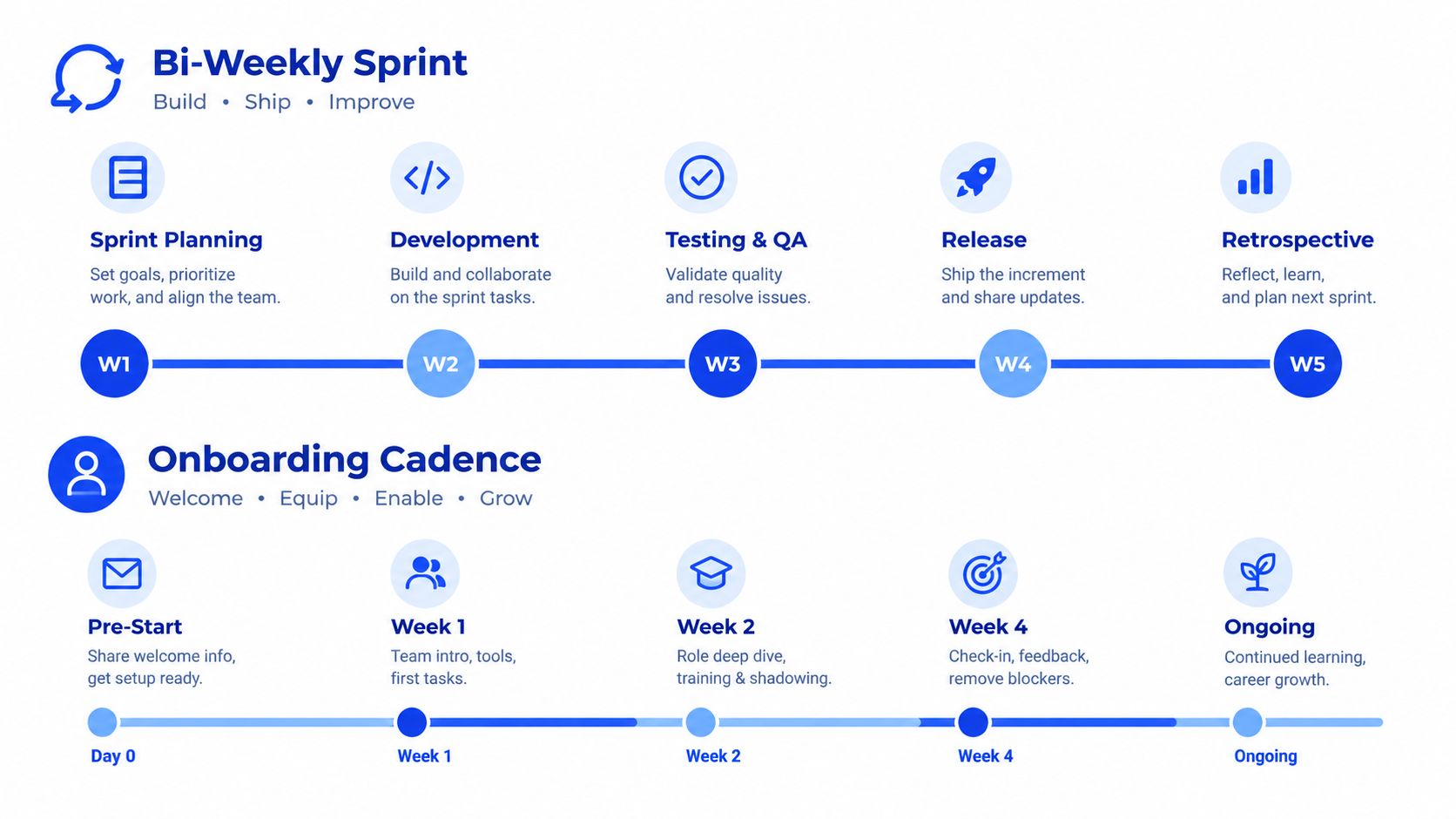
Enforcing a bi-weekly sprint and onboarding cadence
The first agency meeting should not be a presentation. It should be a working session with access owners, approval paths, campaign inputs, and a shared definition of a qualified conversation.
One fintech team I worked with had a familiar problem. The agency delivered a monthly dashboard with rising activity, while sales leaders couldn't identify which meetings had been accepted or why replies were being rejected. The fix started with a shared Slack channel, a CRM field audit, and a sprint calendar that made every open dependency visible.
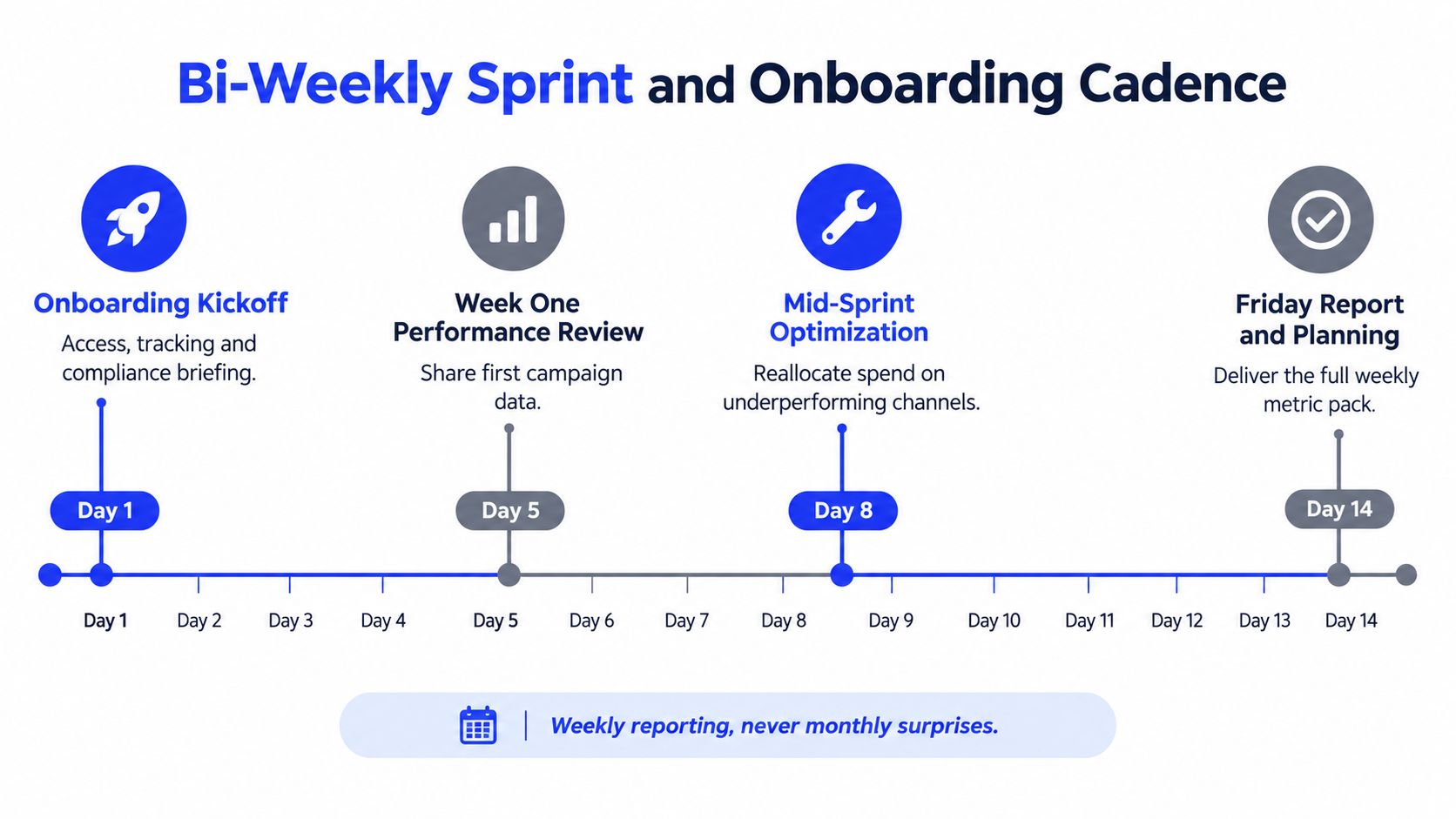
Days one through fourteen
Day 1, kickoff and access. Confirm CRM permissions, ad accounts, analytics, LinkedIn assets, Sales Navigator seats, existing sequences, suppression lists, compliance contacts, and product documentation. Record the ICP, exclusions, buying triggers, qualification rules, and escalation path.
Day 2 through 4, research and build. The agency validates the target account list, reviews current messaging, checks historical campaign data, and drafts claims with evidence attached. Sales should review account fit, not rewrite every sentence after launch.
Day 5, performance review. Share the first campaign data, including delivery, replies, positive signals, objections, and blocked assets. The review should produce decisions, not a longer observation period.
Day 8, mid-sprint optimization. Reallocate effort from weak audiences, revise the message where objections repeat, and remove records that fail the qualification standard. A campaign can be active and still be wrong.
Day 14, report and planning. Deliver the full metric pack, document learning, assign owners, and approve the next sprint. The report should show what shipped, what changed, what sales accepted, and what the team will stop.
Onboarding without the black box
A partner that asks for a long, undefined setup period is creating risk. First signals should appear within 30 days in a properly prepared engagement, based on GROU's stated operating model, while a vendor that requires 90 days before showing any qualified meeting deserves a direct challenge.
The first sprint doesn't need to prove the entire revenue model. It should prove that the team can access the data, identify the right accounts, ship compliant messaging, route replies, and show early pipeline indicators.
Use GROU's guide to the first 90 days with an outbound agency to pressure-test the onboarding sequence, especially where responsibility shifts between your team and the vendor.
Keep a short decision log in Slack or your project system. Each entry should include the decision, owner, date, evidence, and next review point. This prevents the common failure where the account team remembers a message change but nobody can explain why it was made.
The cadence also protects sales time. Qualification rules should state which replies require human follow-up, which go to nurture, which are disqualified, and which require compliance or product input. Fast routing without clear judgment creates noise. Slow routing loses intent.
KPIs and reporting that prove pipeline impact
A dashboard can look polished while hiding a broken handoff. The first question is not how many people saw the campaign. It's whether the right accounts progressed through a measurable buying path.
Demand Gen Report's 2026 pipeline survey says 52% of marketers rank driving qualified pipeline as their top priority, and more than 90% place pipeline, ABM, or lead quality in their top three goals. The survey is summarized in Demand Gen Report's pipeline mandate coverage. Your reporting should reflect that operating priority.
The dashboard I would require
Build one reporting line from source to revenue. At minimum, include:
CRM field | What it answers |
|---|---|
Original source | Where did the account first enter the system? |
First meaningful touch | What created identifiable interest? |
Campaign and message | Which execution created the response? |
Account fit | Does the company match the ICP? |
Buying role | Is the contact relevant to the decision? |
Reply classification | Was the response positive, neutral, referral, objection, or disqualified? |
Meeting status | Was the meeting booked, held, rescheduled, or missed? |
Sales acceptance | Did sales accept the opportunity as qualified? |
Opportunity source | Did the account create pipeline? |
Pipeline amount | What commercial value is associated with it? |
Customer status | Did the opportunity become revenue or a funded account? |
LTV-to-CAC view | Does the acquisition path make economic sense? |
The last field matters because a low CPL can still produce poor economics. A higher-cost channel may be justified when it creates accounts with stronger retention, expansion, or referral potential. Your reporting must make that comparison visible.
Measure thought leadership as demand capture
Thought leadership belongs in the early buying journey, not only in nurture. LinkedIn's 2025 B2B Thought Leadership Impact Report says 60% of B2B buyers discover brands through creator content before any form fill, according to LinkedIn's report post.
That doesn't mean every executive should publish generic opinions. It means your measurement model should capture the path from creator content to account engagement, direct response, branded search, inbound conversation, and opportunity creation.
LinkedIn's research also reports that 75% of decision-makers view thought leadership as more trustworthy for assessing capabilities than product sheets or marketing materials, as summarized by Social Media Today's coverage of LinkedIn's B2B buying research. Build content around operator evidence, implementation choices, risk trade-offs, and customer problems that experienced buyers recognize.
Creative execution still affects commercial consideration. LinkedIn's B2B Intelligence Hub reports that decision-makers are 40% more likely to consider purchasing a brand when its ad is viewed as creative, according to LinkedIn's marketing research. Treat that as a message-quality signal, not permission to chase novelty.
Reporting rules for sales and marketing
Marketing and sales should review the same account record. If marketing counts a lead and sales rejects the person as irrelevant, the disagreement belongs in the qualification field, not in two separate dashboards.
Use a weekly report for execution and a bi-weekly decision meeting for reallocation. The report should show stage movement, meeting-held rate, SQL-to-opportunity conversion, pipeline contribution, CAC, and LTV-to-CAC. Impressions can remain available for diagnosis, but they shouldn't be the headline.
A sales and marketing alignment framework from GROU can help teams define ownership around acceptance, follow-up, and feedback. The practical test is simple: ask sales which campaigns produced conversations worth continuing, then find that answer in the CRM without a manual spreadsheet.
Audit your current pipeline architecture today
Start with the last agency report, not the next pitch deck. Mark every metric that stops before a held meeting, then trace a sample of records from first touch through sales acceptance, opportunity creation, and revenue status.
Your audit should expose four failure points:
Source loss: The original campaign or content source is missing after handoff.
Qualification drift: Marketing and sales use different definitions for an acceptable meeting.
Follow-up delay: Positive replies sit without an owner or next action.
Compliance rework: Legal rejects assets after production because requirements weren't captured during planning.
Add the missing CRM fields before changing vendors. You need a visible record for source, campaign, account fit, role, reply classification, meeting status, sales acceptance, opportunity stage, pipeline amount, and customer status. If your data model can't answer those questions, no agency dashboard can prove contribution.
Run a filter for all meetings booked in the last reporting period where meeting status is blank. Run another for positive replies with no assigned sales owner. Then compare accepted opportunities by source and campaign. The pattern will tell you whether the agency has a volume problem, a qualification problem, or a handoff problem.
For outbound research, teams can also review a specialized resource such as the best email finder for fintech outreach when assessing data collection options. The tool choice matters less than the rules around consent, validation, suppression, ownership, and CRM recording.
GROU is a global B2B pipeline agency trusted by 50+ companies across iGaming, SaaS, manufacturing, and professional services, with reported outcomes including 350 qualified leads in the Adriatic region, 10x LinkedIn follower growth, and enterprise deals exceeding $20M. Its methodology connects LinkedIn content, ICP-aligned lead generation, compliance-aware outbound, reply routing, and bi-weekly sprint reporting into one pipeline system.
This Friday, audit your meeting-held rate and add the missing attribution fields to your CRM. By Monday, review your last 10 outbound sequences, classify every positive reply, and identify which campaign created a sales-accepted opportunity.
Grou builds fintech pipeline systems that connect LinkedIn content, lead generation, and outbound to qualified conversations and measurable revenue. Visit Grou to review a compliance-aware engagement structure built around bi-weekly sprints, clear qualification rules, and pipeline reporting.
Your fintech marketing agency is reporting a healthy lead count, but sales still has an empty calendar. Legal sends campaign copy back for another rewrite, paid acquisition gets more expensive, and buyers who discovered you through LinkedIn, generative search, or private referrals disappear from attribution.
The fix isn't another creative refresh. It's a revenue system with:
Compliance-adjusted CAC, not media cost alone
Pipeline velocity, not lead volume
Bi-weekly sprint accountability, not monthly reporting
Lifecycle, referral, and owned distribution, not permanent dependence on paid acquisition
CRM fields that connect attention to funded accounts and revenue
Table of Contents
The real cost of a misaligned agency partner
Fintech acquisition starts with an expensive constraint. One 2026 benchmark estimates average SMB fintech CAC at about $1,450 per customer, while another benchmark places B2B fintech acquisition costs near $1,830. Google Ads CPC averages $6.45, email open rates sit at 23.5%, and LinkedIn lead engagement is reported at 1.45% for B2B fintech. These figures are reported in DataAlly's fintech marketing trends benchmark, and they explain why a generalist demand program can burn budget before sales sees a qualified opportunity.
The wrong partner adds cost in places your dashboard may not show. A writer makes an unsupported product claim, legal rejects the landing page, the paid team pauses the campaign, and sales loses the buying window. The media spend appears in the platform report. The lost timing, rework, and opportunity cost rarely appear anywhere.
Where the economics break
A generalist agency usually has a deliverables model. It promises articles, ads, landing pages, and leads, then measures whether those items shipped. That model can work for a lower-risk SaaS category with short approval cycles. It breaks when every claim requires evidence, a regulated buyer needs proof, and the opportunity depends on trust before the first meeting.
Compliance rework is a direct production expense. Independent benchmark data estimates that compliance review can add 10–20% to content production costs, as reported by Stackmatix's financial-services marketing spend benchmarks. If your agency prices only the initial draft, your real cost is understated from the start.
Slow pipeline velocity creates a second drain. A campaign can generate responses while failing to create held meetings, qualified opportunities, or revenue. That happens when lead routing is slow, qualification rules are vague, or the agency hands sales contacts who match a demographic filter but lack a live commercial problem.
Practical rule: If an agency can't show where a lead moved after capture, it isn't reporting pipeline. It's reporting activity.
The third cost is misplaced trust. Fintech buyers often need technical detail, proof of controls, implementation context, and confidence that the vendor understands risk. Generic ebooks and broad “future of finance” posts may attract attention, but they don't answer the questions that block a buying committee.
The diagnostic before renewal
Review the last campaign and ask:
Meeting quality: How many booked meetings were held, and how many met the agreed qualification standard?
Rework: Which assets went through legal more than once, and who paid for the delay?
Routing: How long did a positive reply wait before a human owner responded?
Attribution: Can the CRM connect the original source to an opportunity, or does the record stop at MQL?
Message accuracy: Could a subject-matter expert recognize the product's actual use case in the copy?
If those answers are unclear, the problem is structural. A different agency name won't correct it by itself. The partner must own the handoff between audience research, compliant messaging, channel execution, reply handling, and CRM reporting.
For teams selling into regulated buyers, GROU's fintech pipeline solution is built around compliance-aware outbound and qualified conversations rather than disconnected activity reports. The relevant question isn't whether the agency can make more noise. It's whether the system can turn attention into a sales-owned opportunity without losing accuracy or speed.
Generalist output versus specialist pipeline mechanics
A polished campaign can still produce an expensive mess. For Series A and Series B fintech companies, the agency choice should be judged by what happens between account selection and accepted pipeline, not by the volume of creative delivered. Specialist mechanics justify a higher fee when the partner owns data quality, compliance workflow, reply qualification, and revenue reporting. Generalists fit a contained creative assignment. They become a poor choice when revenue consistency is the problem.
The economics support that distinction. One industry benchmark reports that specialist B2B fintech agencies command 35% higher retainers than generalist firms, with a median monthly retainer of $18,500, while delivering 2.3x faster pipeline velocity. It also reports specialist usage at 41% among Series A-B companies, compared with 23% at pre-Series A, 28% at Series C+, and 8% in public or enterprise accounts, according to The Starr Conspiracy's B2B fintech agency benchmark.
The premium only makes sense if it changes operating behavior. A lower retainer that fills the calendar with unqualified meetings shifts cost to sales, creates follow-up waste, and weakens confidence in marketing attribution. That is a false saving.
Judge the handoffs, not the deliverables
The difference appears at each handoff:
Operating point | Generalist agency | Fintech specialist |
|---|---|---|
Primary output | Content, ads, and lead volume | Qualified pipeline and velocity |
Audience work | Broad firmographic targeting | ICP fit, buying context, and account priority |
Data operations | Basic list sourcing | Enrichment, validation, and ownership rules |
Messaging | Reusable industry templates | Product-specific, proof-led messaging |
Compliance | Review after production | Requirements built into planning |
Paid acquisition | Optimized for clicks or forms | Measured against CPA, pipeline contribution, and CAC |
Post-click process | Form completion and handoff | Qualification, routing, nurture, and sales action |
Reporting | Impressions, clicks, and MQLs | Held meetings, opportunities, pipeline, and revenue |
The specialist model also changes how channels are funded. Paid acquisition can produce fast signals without improving funded-account economics. Lifecycle email, referral programs, partner distribution, and owned content can reduce dependence on repeated ad clicks, provided the team tracks retention, customer value, and compliance-adjusted CAC.
Recent fintech marketing coverage makes a related point. BrighterClick's fintech trend analysis argues that referral and lifecycle should receive first-class treatment, with measurement moving from cost per lead toward LTV-to-CAC. It also highlights shorter paths from ad click to funded account through embedded KYC and interactive landing pages.
What the retainer must control
A higher retainer should purchase an accountable operating system, not a larger deliverables queue. Set expectations for a bi-weekly sprint review. Each review should show:
An ICP-aligned account list, exclusion rules, and changes since the prior sprint.
Enrichment covering role, company context, trigger data, and record ownership.
Product detail translated into compliant proof points, with revision history.
Reply handling based on written qualification rules and response ownership.
Source, campaign, stage progression, opportunity status, and revenue influence in the CRM.
Spend changes tied to CPA, pipeline contribution, and compliance-adjusted CAC.
These controls apply across iGaming, SaaS, manufacturing, legal tech, and pharma. Their compliance requirements differ, yet the operating principle remains consistent: attention becomes pipeline only when ownership, evidence, routing, and attribution survive every handoff.
A generalist can make an attractive campaign. A specialist earns its fee by controlling what follows the impression, click, reply, or form submission.
Drafting an RFP that filters out vanity metrics
An agency can present polished creative while leaving your revenue team with unqualified meetings, incomplete CRM records, and no defensible attribution. Your RFP should expose that risk before procurement approves a contract. Ask how the agency handles data, compliance, qualification, routing, and pipeline evidence.
Open with the commercial definition of success. Replace “How many leads can you generate?” with specific requirements: target account types, qualification criteria, sales acceptance rules, the CRM stage that confirms contribution, and the evidence required to move an opportunity forward.
Put the evaluation into the work
Require a short data demonstration using Clay, Apollo, Sales Navigator, or the agency's preferred enrichment stack. The team should show how it identifies the buying committee, excludes poor-fit accounts, resolves duplicates, and records why each account entered the program. A scraped list is not a pipeline asset. Request fields for role relevance, account fit, trigger context, source, owner, and validation status.
Compliance needs the same level of specificity. Ask who reviews paid advertising, outbound claims, landing pages, case studies, and thought leadership. The response should identify the legal review point, evidence supporting each claim, revision history, and the process for rejected assets. An agency may not provide legal advice, but its workflow must let legal review the work without forcing the campaign to restart.
Demand a clear systems map. Ask whether the agency operates inside your HubSpot or CRM instance, how source data is passed between systems, and how tools such as Lemlist, Instantly, Smartlead, HeyReach, Apollo, Sales Navigator, and Slack connect. The exact tools can change. Ownership, field definitions, routing, and handoff rules cannot remain vague.
Reject proposals led by impressions, reach, followers, or raw MQL volume. The reporting sample should show meeting-held rate, accepted opportunities, pipeline contribution, and customer acquisition cost. Add compliance review time and rejected-asset rework to the operating discussion, because those inputs affect the full cost of acquisition even when media performance looks efficient.
Ask for the first bi-weekly sprint in operational detail: owners, required inputs, approval deadlines, first signal, decision points, and stop conditions. This exposes whether the agency has a repeatable process or only a presentation. It also creates an early test of accountability before the engagement expands.
Use GROU's guide to lead generation agencies when comparing vendors that sell deliverables with agencies that manage pipeline mechanics.
Record the decision, not just the score
Create a written decision record for every proposal. Assess commercial alignment by checking whether activity maps to pipeline stages. Assess technical fluency by asking whether the team can explain the product without flattening its use case. Assess compliance readiness through review ownership, claim evidence, and revision control. Assess data discipline through list hygiene and CRM field ownership. Also document sprint meeting cadence, Slack responsibilities, approval windows, and the process for retrieving campaign data, audiences, assets, and learnings if the engagement ends.
Ask one final operating question: what will the agency stop doing when a channel fails to produce qualified progress? The answer reveals whether it manages economics or protects an activity plan.
The RFP should state internal dependencies as well, including access, subject-matter expert time, legal availability, CRM ownership, and sales follow-up. A responsible partner names those requirements before launch, so delays do not disappear into an undefined ramp-up period.
Budget allocation for compliance and paid acquisition
A paid campaign can hit its media targets and still damage acquisition economics. LinkedIn-style targeting may reach relevant roles, while high-value financial search terms can carry substantial CPCs. Media cost is only the first input. Build the decision around the full path from impression or search to accepted opportunity, including the compliance-adjusted CAC.
Use GROU's guide to B2B paid ads budget allocation to pressure-test how much of the pool should support compliance and creative rather than media.
Legal review belongs in the production plan. Give it an explicit reserve, named owners, evidence requirements, and an approval window. If review is treated as an informal queue, launch dates slip, agency hours expand, and sales receives fewer usable assets. The budget should show that capacity before the first campaign goes live.
A practical allocation separates four operating needs:
Paid acquisition buys controlled access to a defined audience. Search captures existing demand, while LinkedIn can introduce a product to named roles and accounts. Fund either channel against a pipeline test, with a clear threshold for qualified responses, held meetings, and accepted opportunities.
Compliance and legal review covers claim validation, disclosure language, approval management, and revision cycles. Reserve money for the work itself rather than treating it as wasted media budget. A compliant asset that launches late still carries an opportunity cost, so the plan must include both review capacity and schedule protection.
Creative, content, and analytics turn traffic into an informed buying conversation. Budget for proof-led landing pages, technical explainers, subject-matter-expert input, CRM instrumentation, tracking quality, and channel analysis. These items may reduce immediate media volume while improving conversion visibility.
Lifecycle and referral capture value after acquisition. Support onboarding, activation, expansion, referrals, partner introductions, and re-engagement. Their performance belongs in the same economic review as paid media, because retention and referrals can reduce the need to purchase every new conversation.
Set the spend decision rules
Set budget rules before performance creates pressure. Start with CPA, pipeline contribution, and CAC, then connect each measure to CRM stages and sales acceptance.
Stop: Pause a campaign when its audience produces poor-fit responses or compliance repeatedly blocks the message.
Review: Keep it under scrutiny when engagement rises without held meetings or accepted opportunities.
Expand: Increase funding only after the route from click or reply to qualified pipeline is understood.
Reallocate: Move money toward lifecycle, referral, or owned content when repeat paid acquisition hides weak retention or conversion.
Generative search changes how buyers discover vendors. AI answers, private Slack discussions, creator posts, and peer referrals may influence a deal without producing a last-click visit. Fortis Media's fintech marketing analysis connects AI search visibility, owned content, first-party data, compliance automation, and reputation with acquisition performance.
Report branded search behavior, direct traffic, content-assisted opportunities, referral source, account engagement, and the quality of conversations sales could not have created through paid media alone. The agency should show which channels assist pipeline, not only which channels receive conversion credit.
Fund the channel that improves the economics of the whole system. Paid media may create the first signal. Owned content, lifecycle messaging, and referrals can determine whether that signal becomes a funded account.
Enforcing a bi-weekly sprint and onboarding cadence
The first agency meeting should not be a presentation. It should be a working session with access owners, approval paths, campaign inputs, and a shared definition of a qualified conversation.
One fintech team I worked with had a familiar problem. The agency delivered a monthly dashboard with rising activity, while sales leaders couldn't identify which meetings had been accepted or why replies were being rejected. The fix started with a shared Slack channel, a CRM field audit, and a sprint calendar that made every open dependency visible.
Days one through fourteen
Day 1, kickoff and access. Confirm CRM permissions, ad accounts, analytics, LinkedIn assets, Sales Navigator seats, existing sequences, suppression lists, compliance contacts, and product documentation. Record the ICP, exclusions, buying triggers, qualification rules, and escalation path.
Day 2 through 4, research and build. The agency validates the target account list, reviews current messaging, checks historical campaign data, and drafts claims with evidence attached. Sales should review account fit, not rewrite every sentence after launch.
Day 5, performance review. Share the first campaign data, including delivery, replies, positive signals, objections, and blocked assets. The review should produce decisions, not a longer observation period.
Day 8, mid-sprint optimization. Reallocate effort from weak audiences, revise the message where objections repeat, and remove records that fail the qualification standard. A campaign can be active and still be wrong.
Day 14, report and planning. Deliver the full metric pack, document learning, assign owners, and approve the next sprint. The report should show what shipped, what changed, what sales accepted, and what the team will stop.
Onboarding without the black box
A partner that asks for a long, undefined setup period is creating risk. First signals should appear within 30 days in a properly prepared engagement, based on GROU's stated operating model, while a vendor that requires 90 days before showing any qualified meeting deserves a direct challenge.
The first sprint doesn't need to prove the entire revenue model. It should prove that the team can access the data, identify the right accounts, ship compliant messaging, route replies, and show early pipeline indicators.
Use GROU's guide to the first 90 days with an outbound agency to pressure-test the onboarding sequence, especially where responsibility shifts between your team and the vendor.
Keep a short decision log in Slack or your project system. Each entry should include the decision, owner, date, evidence, and next review point. This prevents the common failure where the account team remembers a message change but nobody can explain why it was made.
The cadence also protects sales time. Qualification rules should state which replies require human follow-up, which go to nurture, which are disqualified, and which require compliance or product input. Fast routing without clear judgment creates noise. Slow routing loses intent.
KPIs and reporting that prove pipeline impact
A dashboard can look polished while hiding a broken handoff. The first question is not how many people saw the campaign. It's whether the right accounts progressed through a measurable buying path.
Demand Gen Report's 2026 pipeline survey says 52% of marketers rank driving qualified pipeline as their top priority, and more than 90% place pipeline, ABM, or lead quality in their top three goals. The survey is summarized in Demand Gen Report's pipeline mandate coverage. Your reporting should reflect that operating priority.
The dashboard I would require
Build one reporting line from source to revenue. At minimum, include:
CRM field | What it answers |
|---|---|
Original source | Where did the account first enter the system? |
First meaningful touch | What created identifiable interest? |
Campaign and message | Which execution created the response? |
Account fit | Does the company match the ICP? |
Buying role | Is the contact relevant to the decision? |
Reply classification | Was the response positive, neutral, referral, objection, or disqualified? |
Meeting status | Was the meeting booked, held, rescheduled, or missed? |
Sales acceptance | Did sales accept the opportunity as qualified? |
Opportunity source | Did the account create pipeline? |
Pipeline amount | What commercial value is associated with it? |
Customer status | Did the opportunity become revenue or a funded account? |
LTV-to-CAC view | Does the acquisition path make economic sense? |
The last field matters because a low CPL can still produce poor economics. A higher-cost channel may be justified when it creates accounts with stronger retention, expansion, or referral potential. Your reporting must make that comparison visible.
Measure thought leadership as demand capture
Thought leadership belongs in the early buying journey, not only in nurture. LinkedIn's 2025 B2B Thought Leadership Impact Report says 60% of B2B buyers discover brands through creator content before any form fill, according to LinkedIn's report post.
That doesn't mean every executive should publish generic opinions. It means your measurement model should capture the path from creator content to account engagement, direct response, branded search, inbound conversation, and opportunity creation.
LinkedIn's research also reports that 75% of decision-makers view thought leadership as more trustworthy for assessing capabilities than product sheets or marketing materials, as summarized by Social Media Today's coverage of LinkedIn's B2B buying research. Build content around operator evidence, implementation choices, risk trade-offs, and customer problems that experienced buyers recognize.
Creative execution still affects commercial consideration. LinkedIn's B2B Intelligence Hub reports that decision-makers are 40% more likely to consider purchasing a brand when its ad is viewed as creative, according to LinkedIn's marketing research. Treat that as a message-quality signal, not permission to chase novelty.
Reporting rules for sales and marketing
Marketing and sales should review the same account record. If marketing counts a lead and sales rejects the person as irrelevant, the disagreement belongs in the qualification field, not in two separate dashboards.
Use a weekly report for execution and a bi-weekly decision meeting for reallocation. The report should show stage movement, meeting-held rate, SQL-to-opportunity conversion, pipeline contribution, CAC, and LTV-to-CAC. Impressions can remain available for diagnosis, but they shouldn't be the headline.
A sales and marketing alignment framework from GROU can help teams define ownership around acceptance, follow-up, and feedback. The practical test is simple: ask sales which campaigns produced conversations worth continuing, then find that answer in the CRM without a manual spreadsheet.
Audit your current pipeline architecture today
Start with the last agency report, not the next pitch deck. Mark every metric that stops before a held meeting, then trace a sample of records from first touch through sales acceptance, opportunity creation, and revenue status.
Your audit should expose four failure points:
Source loss: The original campaign or content source is missing after handoff.
Qualification drift: Marketing and sales use different definitions for an acceptable meeting.
Follow-up delay: Positive replies sit without an owner or next action.
Compliance rework: Legal rejects assets after production because requirements weren't captured during planning.
Add the missing CRM fields before changing vendors. You need a visible record for source, campaign, account fit, role, reply classification, meeting status, sales acceptance, opportunity stage, pipeline amount, and customer status. If your data model can't answer those questions, no agency dashboard can prove contribution.
Run a filter for all meetings booked in the last reporting period where meeting status is blank. Run another for positive replies with no assigned sales owner. Then compare accepted opportunities by source and campaign. The pattern will tell you whether the agency has a volume problem, a qualification problem, or a handoff problem.
For outbound research, teams can also review a specialized resource such as the best email finder for fintech outreach when assessing data collection options. The tool choice matters less than the rules around consent, validation, suppression, ownership, and CRM recording.
GROU is a global B2B pipeline agency trusted by 50+ companies across iGaming, SaaS, manufacturing, and professional services, with reported outcomes including 350 qualified leads in the Adriatic region, 10x LinkedIn follower growth, and enterprise deals exceeding $20M. Its methodology connects LinkedIn content, ICP-aligned lead generation, compliance-aware outbound, reply routing, and bi-weekly sprint reporting into one pipeline system.
This Friday, audit your meeting-held rate and add the missing attribution fields to your CRM. By Monday, review your last 10 outbound sequences, classify every positive reply, and identify which campaign created a sales-accepted opportunity.
Grou builds fintech pipeline systems that connect LinkedIn content, lead generation, and outbound to qualified conversations and measurable revenue. Visit Grou to review a compliance-aware engagement structure built around bi-weekly sprints, clear qualification rules, and pipeline reporting.
Your fintech marketing agency is reporting a healthy lead count, but sales still has an empty calendar. Legal sends campaign copy back for another rewrite, paid acquisition gets more expensive, and buyers who discovered you through LinkedIn, generative search, or private referrals disappear from attribution.
The fix isn't another creative refresh. It's a revenue system with:
Compliance-adjusted CAC, not media cost alone
Pipeline velocity, not lead volume
Bi-weekly sprint accountability, not monthly reporting
Lifecycle, referral, and owned distribution, not permanent dependence on paid acquisition
CRM fields that connect attention to funded accounts and revenue
Table of Contents
The real cost of a misaligned agency partner
Fintech acquisition starts with an expensive constraint. One 2026 benchmark estimates average SMB fintech CAC at about $1,450 per customer, while another benchmark places B2B fintech acquisition costs near $1,830. Google Ads CPC averages $6.45, email open rates sit at 23.5%, and LinkedIn lead engagement is reported at 1.45% for B2B fintech. These figures are reported in DataAlly's fintech marketing trends benchmark, and they explain why a generalist demand program can burn budget before sales sees a qualified opportunity.
The wrong partner adds cost in places your dashboard may not show. A writer makes an unsupported product claim, legal rejects the landing page, the paid team pauses the campaign, and sales loses the buying window. The media spend appears in the platform report. The lost timing, rework, and opportunity cost rarely appear anywhere.
Where the economics break
A generalist agency usually has a deliverables model. It promises articles, ads, landing pages, and leads, then measures whether those items shipped. That model can work for a lower-risk SaaS category with short approval cycles. It breaks when every claim requires evidence, a regulated buyer needs proof, and the opportunity depends on trust before the first meeting.
Compliance rework is a direct production expense. Independent benchmark data estimates that compliance review can add 10–20% to content production costs, as reported by Stackmatix's financial-services marketing spend benchmarks. If your agency prices only the initial draft, your real cost is understated from the start.
Slow pipeline velocity creates a second drain. A campaign can generate responses while failing to create held meetings, qualified opportunities, or revenue. That happens when lead routing is slow, qualification rules are vague, or the agency hands sales contacts who match a demographic filter but lack a live commercial problem.
Practical rule: If an agency can't show where a lead moved after capture, it isn't reporting pipeline. It's reporting activity.
The third cost is misplaced trust. Fintech buyers often need technical detail, proof of controls, implementation context, and confidence that the vendor understands risk. Generic ebooks and broad “future of finance” posts may attract attention, but they don't answer the questions that block a buying committee.
The diagnostic before renewal
Review the last campaign and ask:
Meeting quality: How many booked meetings were held, and how many met the agreed qualification standard?
Rework: Which assets went through legal more than once, and who paid for the delay?
Routing: How long did a positive reply wait before a human owner responded?
Attribution: Can the CRM connect the original source to an opportunity, or does the record stop at MQL?
Message accuracy: Could a subject-matter expert recognize the product's actual use case in the copy?
If those answers are unclear, the problem is structural. A different agency name won't correct it by itself. The partner must own the handoff between audience research, compliant messaging, channel execution, reply handling, and CRM reporting.
For teams selling into regulated buyers, GROU's fintech pipeline solution is built around compliance-aware outbound and qualified conversations rather than disconnected activity reports. The relevant question isn't whether the agency can make more noise. It's whether the system can turn attention into a sales-owned opportunity without losing accuracy or speed.
Generalist output versus specialist pipeline mechanics
A polished campaign can still produce an expensive mess. For Series A and Series B fintech companies, the agency choice should be judged by what happens between account selection and accepted pipeline, not by the volume of creative delivered. Specialist mechanics justify a higher fee when the partner owns data quality, compliance workflow, reply qualification, and revenue reporting. Generalists fit a contained creative assignment. They become a poor choice when revenue consistency is the problem.
The economics support that distinction. One industry benchmark reports that specialist B2B fintech agencies command 35% higher retainers than generalist firms, with a median monthly retainer of $18,500, while delivering 2.3x faster pipeline velocity. It also reports specialist usage at 41% among Series A-B companies, compared with 23% at pre-Series A, 28% at Series C+, and 8% in public or enterprise accounts, according to The Starr Conspiracy's B2B fintech agency benchmark.
The premium only makes sense if it changes operating behavior. A lower retainer that fills the calendar with unqualified meetings shifts cost to sales, creates follow-up waste, and weakens confidence in marketing attribution. That is a false saving.
Judge the handoffs, not the deliverables
The difference appears at each handoff:
Operating point | Generalist agency | Fintech specialist |
|---|---|---|
Primary output | Content, ads, and lead volume | Qualified pipeline and velocity |
Audience work | Broad firmographic targeting | ICP fit, buying context, and account priority |
Data operations | Basic list sourcing | Enrichment, validation, and ownership rules |
Messaging | Reusable industry templates | Product-specific, proof-led messaging |
Compliance | Review after production | Requirements built into planning |
Paid acquisition | Optimized for clicks or forms | Measured against CPA, pipeline contribution, and CAC |
Post-click process | Form completion and handoff | Qualification, routing, nurture, and sales action |
Reporting | Impressions, clicks, and MQLs | Held meetings, opportunities, pipeline, and revenue |
The specialist model also changes how channels are funded. Paid acquisition can produce fast signals without improving funded-account economics. Lifecycle email, referral programs, partner distribution, and owned content can reduce dependence on repeated ad clicks, provided the team tracks retention, customer value, and compliance-adjusted CAC.
Recent fintech marketing coverage makes a related point. BrighterClick's fintech trend analysis argues that referral and lifecycle should receive first-class treatment, with measurement moving from cost per lead toward LTV-to-CAC. It also highlights shorter paths from ad click to funded account through embedded KYC and interactive landing pages.
What the retainer must control
A higher retainer should purchase an accountable operating system, not a larger deliverables queue. Set expectations for a bi-weekly sprint review. Each review should show:
An ICP-aligned account list, exclusion rules, and changes since the prior sprint.
Enrichment covering role, company context, trigger data, and record ownership.
Product detail translated into compliant proof points, with revision history.
Reply handling based on written qualification rules and response ownership.
Source, campaign, stage progression, opportunity status, and revenue influence in the CRM.
Spend changes tied to CPA, pipeline contribution, and compliance-adjusted CAC.
These controls apply across iGaming, SaaS, manufacturing, legal tech, and pharma. Their compliance requirements differ, yet the operating principle remains consistent: attention becomes pipeline only when ownership, evidence, routing, and attribution survive every handoff.
A generalist can make an attractive campaign. A specialist earns its fee by controlling what follows the impression, click, reply, or form submission.
Drafting an RFP that filters out vanity metrics
An agency can present polished creative while leaving your revenue team with unqualified meetings, incomplete CRM records, and no defensible attribution. Your RFP should expose that risk before procurement approves a contract. Ask how the agency handles data, compliance, qualification, routing, and pipeline evidence.
Open with the commercial definition of success. Replace “How many leads can you generate?” with specific requirements: target account types, qualification criteria, sales acceptance rules, the CRM stage that confirms contribution, and the evidence required to move an opportunity forward.
Put the evaluation into the work
Require a short data demonstration using Clay, Apollo, Sales Navigator, or the agency's preferred enrichment stack. The team should show how it identifies the buying committee, excludes poor-fit accounts, resolves duplicates, and records why each account entered the program. A scraped list is not a pipeline asset. Request fields for role relevance, account fit, trigger context, source, owner, and validation status.
Compliance needs the same level of specificity. Ask who reviews paid advertising, outbound claims, landing pages, case studies, and thought leadership. The response should identify the legal review point, evidence supporting each claim, revision history, and the process for rejected assets. An agency may not provide legal advice, but its workflow must let legal review the work without forcing the campaign to restart.
Demand a clear systems map. Ask whether the agency operates inside your HubSpot or CRM instance, how source data is passed between systems, and how tools such as Lemlist, Instantly, Smartlead, HeyReach, Apollo, Sales Navigator, and Slack connect. The exact tools can change. Ownership, field definitions, routing, and handoff rules cannot remain vague.
Reject proposals led by impressions, reach, followers, or raw MQL volume. The reporting sample should show meeting-held rate, accepted opportunities, pipeline contribution, and customer acquisition cost. Add compliance review time and rejected-asset rework to the operating discussion, because those inputs affect the full cost of acquisition even when media performance looks efficient.
Ask for the first bi-weekly sprint in operational detail: owners, required inputs, approval deadlines, first signal, decision points, and stop conditions. This exposes whether the agency has a repeatable process or only a presentation. It also creates an early test of accountability before the engagement expands.
Use GROU's guide to lead generation agencies when comparing vendors that sell deliverables with agencies that manage pipeline mechanics.
Record the decision, not just the score
Create a written decision record for every proposal. Assess commercial alignment by checking whether activity maps to pipeline stages. Assess technical fluency by asking whether the team can explain the product without flattening its use case. Assess compliance readiness through review ownership, claim evidence, and revision control. Assess data discipline through list hygiene and CRM field ownership. Also document sprint meeting cadence, Slack responsibilities, approval windows, and the process for retrieving campaign data, audiences, assets, and learnings if the engagement ends.
Ask one final operating question: what will the agency stop doing when a channel fails to produce qualified progress? The answer reveals whether it manages economics or protects an activity plan.
The RFP should state internal dependencies as well, including access, subject-matter expert time, legal availability, CRM ownership, and sales follow-up. A responsible partner names those requirements before launch, so delays do not disappear into an undefined ramp-up period.
Budget allocation for compliance and paid acquisition
A paid campaign can hit its media targets and still damage acquisition economics. LinkedIn-style targeting may reach relevant roles, while high-value financial search terms can carry substantial CPCs. Media cost is only the first input. Build the decision around the full path from impression or search to accepted opportunity, including the compliance-adjusted CAC.
Use GROU's guide to B2B paid ads budget allocation to pressure-test how much of the pool should support compliance and creative rather than media.
Legal review belongs in the production plan. Give it an explicit reserve, named owners, evidence requirements, and an approval window. If review is treated as an informal queue, launch dates slip, agency hours expand, and sales receives fewer usable assets. The budget should show that capacity before the first campaign goes live.
A practical allocation separates four operating needs:
Paid acquisition buys controlled access to a defined audience. Search captures existing demand, while LinkedIn can introduce a product to named roles and accounts. Fund either channel against a pipeline test, with a clear threshold for qualified responses, held meetings, and accepted opportunities.
Compliance and legal review covers claim validation, disclosure language, approval management, and revision cycles. Reserve money for the work itself rather than treating it as wasted media budget. A compliant asset that launches late still carries an opportunity cost, so the plan must include both review capacity and schedule protection.
Creative, content, and analytics turn traffic into an informed buying conversation. Budget for proof-led landing pages, technical explainers, subject-matter-expert input, CRM instrumentation, tracking quality, and channel analysis. These items may reduce immediate media volume while improving conversion visibility.
Lifecycle and referral capture value after acquisition. Support onboarding, activation, expansion, referrals, partner introductions, and re-engagement. Their performance belongs in the same economic review as paid media, because retention and referrals can reduce the need to purchase every new conversation.
Set the spend decision rules
Set budget rules before performance creates pressure. Start with CPA, pipeline contribution, and CAC, then connect each measure to CRM stages and sales acceptance.
Stop: Pause a campaign when its audience produces poor-fit responses or compliance repeatedly blocks the message.
Review: Keep it under scrutiny when engagement rises without held meetings or accepted opportunities.
Expand: Increase funding only after the route from click or reply to qualified pipeline is understood.
Reallocate: Move money toward lifecycle, referral, or owned content when repeat paid acquisition hides weak retention or conversion.
Generative search changes how buyers discover vendors. AI answers, private Slack discussions, creator posts, and peer referrals may influence a deal without producing a last-click visit. Fortis Media's fintech marketing analysis connects AI search visibility, owned content, first-party data, compliance automation, and reputation with acquisition performance.
Report branded search behavior, direct traffic, content-assisted opportunities, referral source, account engagement, and the quality of conversations sales could not have created through paid media alone. The agency should show which channels assist pipeline, not only which channels receive conversion credit.
Fund the channel that improves the economics of the whole system. Paid media may create the first signal. Owned content, lifecycle messaging, and referrals can determine whether that signal becomes a funded account.
Enforcing a bi-weekly sprint and onboarding cadence
The first agency meeting should not be a presentation. It should be a working session with access owners, approval paths, campaign inputs, and a shared definition of a qualified conversation.
One fintech team I worked with had a familiar problem. The agency delivered a monthly dashboard with rising activity, while sales leaders couldn't identify which meetings had been accepted or why replies were being rejected. The fix started with a shared Slack channel, a CRM field audit, and a sprint calendar that made every open dependency visible.
Days one through fourteen
Day 1, kickoff and access. Confirm CRM permissions, ad accounts, analytics, LinkedIn assets, Sales Navigator seats, existing sequences, suppression lists, compliance contacts, and product documentation. Record the ICP, exclusions, buying triggers, qualification rules, and escalation path.
Day 2 through 4, research and build. The agency validates the target account list, reviews current messaging, checks historical campaign data, and drafts claims with evidence attached. Sales should review account fit, not rewrite every sentence after launch.
Day 5, performance review. Share the first campaign data, including delivery, replies, positive signals, objections, and blocked assets. The review should produce decisions, not a longer observation period.
Day 8, mid-sprint optimization. Reallocate effort from weak audiences, revise the message where objections repeat, and remove records that fail the qualification standard. A campaign can be active and still be wrong.
Day 14, report and planning. Deliver the full metric pack, document learning, assign owners, and approve the next sprint. The report should show what shipped, what changed, what sales accepted, and what the team will stop.
Onboarding without the black box
A partner that asks for a long, undefined setup period is creating risk. First signals should appear within 30 days in a properly prepared engagement, based on GROU's stated operating model, while a vendor that requires 90 days before showing any qualified meeting deserves a direct challenge.
The first sprint doesn't need to prove the entire revenue model. It should prove that the team can access the data, identify the right accounts, ship compliant messaging, route replies, and show early pipeline indicators.
Use GROU's guide to the first 90 days with an outbound agency to pressure-test the onboarding sequence, especially where responsibility shifts between your team and the vendor.
Keep a short decision log in Slack or your project system. Each entry should include the decision, owner, date, evidence, and next review point. This prevents the common failure where the account team remembers a message change but nobody can explain why it was made.
The cadence also protects sales time. Qualification rules should state which replies require human follow-up, which go to nurture, which are disqualified, and which require compliance or product input. Fast routing without clear judgment creates noise. Slow routing loses intent.
KPIs and reporting that prove pipeline impact
A dashboard can look polished while hiding a broken handoff. The first question is not how many people saw the campaign. It's whether the right accounts progressed through a measurable buying path.
Demand Gen Report's 2026 pipeline survey says 52% of marketers rank driving qualified pipeline as their top priority, and more than 90% place pipeline, ABM, or lead quality in their top three goals. The survey is summarized in Demand Gen Report's pipeline mandate coverage. Your reporting should reflect that operating priority.
The dashboard I would require
Build one reporting line from source to revenue. At minimum, include:
CRM field | What it answers |
|---|---|
Original source | Where did the account first enter the system? |
First meaningful touch | What created identifiable interest? |
Campaign and message | Which execution created the response? |
Account fit | Does the company match the ICP? |
Buying role | Is the contact relevant to the decision? |
Reply classification | Was the response positive, neutral, referral, objection, or disqualified? |
Meeting status | Was the meeting booked, held, rescheduled, or missed? |
Sales acceptance | Did sales accept the opportunity as qualified? |
Opportunity source | Did the account create pipeline? |
Pipeline amount | What commercial value is associated with it? |
Customer status | Did the opportunity become revenue or a funded account? |
LTV-to-CAC view | Does the acquisition path make economic sense? |
The last field matters because a low CPL can still produce poor economics. A higher-cost channel may be justified when it creates accounts with stronger retention, expansion, or referral potential. Your reporting must make that comparison visible.
Measure thought leadership as demand capture
Thought leadership belongs in the early buying journey, not only in nurture. LinkedIn's 2025 B2B Thought Leadership Impact Report says 60% of B2B buyers discover brands through creator content before any form fill, according to LinkedIn's report post.
That doesn't mean every executive should publish generic opinions. It means your measurement model should capture the path from creator content to account engagement, direct response, branded search, inbound conversation, and opportunity creation.
LinkedIn's research also reports that 75% of decision-makers view thought leadership as more trustworthy for assessing capabilities than product sheets or marketing materials, as summarized by Social Media Today's coverage of LinkedIn's B2B buying research. Build content around operator evidence, implementation choices, risk trade-offs, and customer problems that experienced buyers recognize.
Creative execution still affects commercial consideration. LinkedIn's B2B Intelligence Hub reports that decision-makers are 40% more likely to consider purchasing a brand when its ad is viewed as creative, according to LinkedIn's marketing research. Treat that as a message-quality signal, not permission to chase novelty.
Reporting rules for sales and marketing
Marketing and sales should review the same account record. If marketing counts a lead and sales rejects the person as irrelevant, the disagreement belongs in the qualification field, not in two separate dashboards.
Use a weekly report for execution and a bi-weekly decision meeting for reallocation. The report should show stage movement, meeting-held rate, SQL-to-opportunity conversion, pipeline contribution, CAC, and LTV-to-CAC. Impressions can remain available for diagnosis, but they shouldn't be the headline.
A sales and marketing alignment framework from GROU can help teams define ownership around acceptance, follow-up, and feedback. The practical test is simple: ask sales which campaigns produced conversations worth continuing, then find that answer in the CRM without a manual spreadsheet.
Audit your current pipeline architecture today
Start with the last agency report, not the next pitch deck. Mark every metric that stops before a held meeting, then trace a sample of records from first touch through sales acceptance, opportunity creation, and revenue status.
Your audit should expose four failure points:
Source loss: The original campaign or content source is missing after handoff.
Qualification drift: Marketing and sales use different definitions for an acceptable meeting.
Follow-up delay: Positive replies sit without an owner or next action.
Compliance rework: Legal rejects assets after production because requirements weren't captured during planning.
Add the missing CRM fields before changing vendors. You need a visible record for source, campaign, account fit, role, reply classification, meeting status, sales acceptance, opportunity stage, pipeline amount, and customer status. If your data model can't answer those questions, no agency dashboard can prove contribution.
Run a filter for all meetings booked in the last reporting period where meeting status is blank. Run another for positive replies with no assigned sales owner. Then compare accepted opportunities by source and campaign. The pattern will tell you whether the agency has a volume problem, a qualification problem, or a handoff problem.
For outbound research, teams can also review a specialized resource such as the best email finder for fintech outreach when assessing data collection options. The tool choice matters less than the rules around consent, validation, suppression, ownership, and CRM recording.
GROU is a global B2B pipeline agency trusted by 50+ companies across iGaming, SaaS, manufacturing, and professional services, with reported outcomes including 350 qualified leads in the Adriatic region, 10x LinkedIn follower growth, and enterprise deals exceeding $20M. Its methodology connects LinkedIn content, ICP-aligned lead generation, compliance-aware outbound, reply routing, and bi-weekly sprint reporting into one pipeline system.
This Friday, audit your meeting-held rate and add the missing attribution fields to your CRM. By Monday, review your last 10 outbound sequences, classify every positive reply, and identify which campaign created a sales-accepted opportunity.
Grou builds fintech pipeline systems that connect LinkedIn content, lead generation, and outbound to qualified conversations and measurable revenue. Visit Grou to review a compliance-aware engagement structure built around bi-weekly sprints, clear qualification rules, and pipeline reporting.

Pipeline OS Newsletter
Build qualified pipeline
Get weekly tactics to generate demand, improve lead quality, and book more meetings.





Trusted by industry leaders
Trusted by industry leaders
Trusted by industry leaders
Ready to build qualified pipeline?
Ready to build qualified pipeline?
Ready to build qualified pipeline?
Book a call to see if we're the right fit, or take the 2-minute quiz to get a clear starting point.
Book a call to see if we're the right fit, or take the 2-minute quiz to get a clear starting point.
Book a call to see if we're the right fit, or take the 2-minute quiz to get a clear starting point.
" height="30.21639343089746px" id="hfGbXmQR2" width="30.216393430897455px"/></svg>)
Copyright © 2026 – All Right Reserved
Copyright © 2026 – All Right Reserved
Copyright © 2026 – All Right Reserved