%22%3E%3C/path%3E%3Cpath d=%22M 63.072 7.554 C 62.258 8.022 61.577 8.689 61.092 9.493 L 61.092 7.076 L 57.158 7.076 L 57.158 22.64 L 61.089 22.64 L 61.089 14.888 C 61.089 13.446 61.403 12.434 62.03 11.853 C 62.818 11.218 63.818 10.907 64.826 10.982 L 65.868 10.982 L 65.868 6.851 C 64.891 6.834 63.926 7.076 63.073 7.554 Z%22 fill=%22rgb(17,17,17)%22%3E%3C/path%3E%3Cpath d=%22M 78.916 7.82 C 76.363 6.49 73.321 6.49 70.768 7.82 C 69.562 8.473 68.564 9.451 67.888 10.644 C 67.167 11.931 66.803 13.387 66.834 14.862 C 66.804 16.332 67.157 17.785 67.86 19.077 C 68.515 20.267 69.494 21.246 70.684 21.901 C 71.924 22.576 73.318 22.92 74.73 22.898 C 76.164 22.918 77.58 22.575 78.846 21.901 C 80.062 21.247 81.073 20.27 81.768 19.077 C 82.506 17.797 82.88 16.339 82.85 14.862 C 82.88 13.389 82.517 11.934 81.797 10.647 C 81.12 9.455 80.122 8.477 78.917 7.824 M 78.803 14.862 C 78.829 15.739 78.636 16.608 78.241 17.391 C 77.903 18.046 77.38 18.588 76.738 18.95 C 76.124 19.293 75.432 19.472 74.729 19.47 C 73.668 19.497 72.648 19.061 71.934 18.276 C 71.139 17.323 70.741 16.1 70.823 14.862 C 70.741 13.62 71.149 12.395 71.959 11.45 C 72.687 10.667 73.715 10.233 74.783 10.256 C 75.859 10.236 76.894 10.67 77.635 11.45 C 78.464 12.387 78.884 13.616 78.801 14.864%22 fill=%22rgb(17,17,17)%22%3E%3C/path%3E%3Cpath d=%22M 95.906 7.076 L 95.906 15.646 C 95.975 16.68 95.643 17.701 94.979 18.498 C 94.311 19.184 93.379 19.547 92.422 19.495 C 91.475 19.544 90.553 19.18 89.894 18.498 C 89.23 17.701 88.898 16.68 88.967 15.646 L 88.967 7.076 L 85.033 7.076 L 85.033 16.207 C 85 17.449 85.275 18.68 85.834 19.79 C 86.327 20.75 87.095 21.542 88.039 22.065 C 89.033 22.594 90.145 22.861 91.271 22.838 C 92.188 22.847 93.095 22.65 93.926 22.263 C 94.708 21.905 95.388 21.36 95.906 20.675 L 95.906 22.645 L 99.865 22.645 L 99.865 7.076 Z%22 fill=%22rgb(17,17,17)%22%3E%3C/path%3E%3Cpath d=%22M 4.513 15.626 C 4.511 10.815 7.606 6.549 12.181 5.059 C 16.756 3.57 21.77 5.195 24.601 9.086 L 27.816 5.87 C 24.074 1.186 17.981 -0.943 12.137 0.393 C 6.292 1.728 1.728 6.292 0.393 12.137 C -0.943 17.981 1.186 24.074 5.87 27.816 L 9.085 24.601 C 6.214 22.512 4.515 19.177 4.513 15.626%22 fill=%22rgb(32,62,235)%22%3E%3C/path%3E%3Cpath d=%22M 17.114 14.343 L 13.354 18.01 L 13.354 18.026 L 21.071 18.026 L 11.412 27.609 L 17.389 27.609 L 23.999 21.081 L 23.999 28.316 L 24.005 28.316 L 27.967 24.393 L 27.967 14.343 Z%22 fill=%22rgb(32,62,235)%22%3E%3C/path%3E%3C/g%3E%3C/svg%3E) ×
× ××
××›
›
›
›
B2B Lead Generation Agency: How to Choose it
B2B Lead Generation Agency: How to Choose it
B2B Lead Generation Agency: How to Choose it
B2B Lead Generation Agency: How to Choose it
B2B Lead Generation Agency: How to Choose it
B2B Lead Generation Agency: How to Choose it

Author
Aljaz Peklaj

Your agency sends a weekly report full of sends, touches, and booked calls. Your AEs still say the calendar is thin and half the meetings that do get booked never should have reached them. That's the core buying problem with a lead generation agency B2B search. You are not hiring for activity. You are hiring for operational discipline.
Build your scorecard around ICP control, channel integration, and data hygiene before you take agency calls
Vet the operating model, not the pitch deck, especially onboarding speed, reply routing, and qualification gates
Treat pricing and guarantees as signals about incentives, not proof of quality
Put the handoffs, definitions, and reporting standards into the contract so the process survives the sales cycle
Run the first 90 days like an implementation, not a vendor kickoff
Table of Contents
The evaluation framework you need before you talk to any agency
Most agency selection starts too late. By the time you're on the demo call, you're already reacting to their offer instead of filtering for the operating model you need.
That mistake is expensive. A Gartner marketing analysis found that 60% of B2B leads generated by agencies are never contacted by sales because they lack buying intent or ICP alignment, costing companies an average of $150,000 annually in wasted marketing spend. If you don't define your own standard first, you inherit theirs.
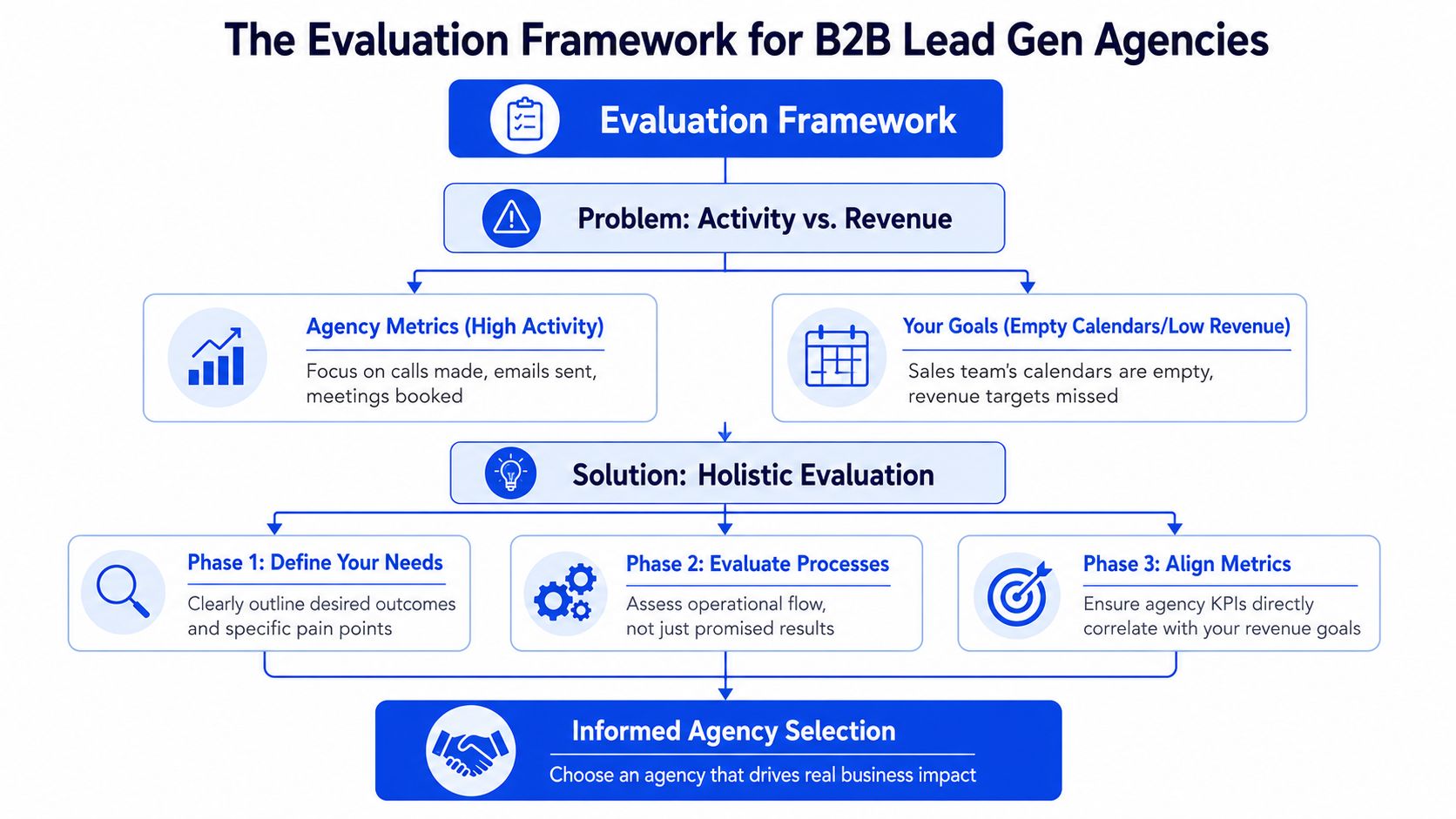
Start with three pillars
A usable scorecard has three columns. ICP, channels, and data. If an agency is weak in any one of them, the rest of the program gets noisy fast.
Here's the structure I recommend:
Pillar | What you define before agency outreach | What bad looks like |
|---|---|---|
ICP | Who counts as in-market and in-fit | Broad titles, broad segments, weak exclusions |
Channels | Where you want prospecting motion to run | Single-channel dependency |
Data | What quality standard contact and account data must meet | Old records, thin enrichment, no ownership rules |
Define the ICP with hard edges
Teams typically have an ICP deck. Fewer have an ICP enforcement rule.
Before you talk to any agency, document these criteria:
Firmographic floor and ceiling → Which company sizes are in, which are out, and where edge cases go
Persona rules → Which titles can book directly, which need validation, and which should never hit an AE calendar
Disqualifiers → Geography, sub-verticals, maturity stage, compliance constraints, or buying model exclusions
If you serve SaaS, iGaming, manufacturing, legal tech, or pharma, this matters even more because each category has different buying committees and different acceptable claims. An agency that says it can "target anyone in B2B" is telling you it hasn't made the hard decisions yet.
Practical rule: If the agency can't tell you who they would exclude in week one, they will waste your sales team's time in week three.
Pick the channel mix before they do
Effective B2B lead generation already clusters around a small set of channels. Warmly's lead generation statistics report that 94% of B2B marketers use LinkedIn for sales and lead generation, LinkedIn accounts for 80% of all B2B social media leads, and 88% of businesses use email for lead generation.
That doesn't mean every agency should run every channel. It means your scorecard should ask whether they can integrate the channels buyers already respond to.
Set these criteria:
Primary acquisition lane → Usually LinkedIn, email, or both
Support lane → Call layer, content layer, or paid support if your motion needs it
Message consistency rule → The promise in email, LinkedIn, and follow-up cannot drift by team or tool
If you're assessing scaling lead generation using AI, keep the standard simple. Ask whether AI improves targeting, messaging relevance, or routing discipline. If it only adds volume, it will create more low-grade replies.
For KPI design, use a shared reference point early. A practical benchmark list like lead generation KPIs helps force the discussion back to reply quality, routing, and conversion instead of vanity reporting.
Set the data standard in writing
A serious agency should be comfortable with explicit data rules before launch.
At minimum, document:
Source and enrichment expectations → What fields must exist before a contact enters a sequence
Verification threshold → How they confirm records are current enough to send
Refresh cadence → When stale accounts, bounced contacts, and changed roles get recycled or removed
This is the part buyers skip because it feels operational. It is operational. That's why it matters.
How to vet an agency's operational engine
The deck will sound polished. Every agency says they personalize, move fast, and care about quality. None of that tells you how the work moves from signed contract to held meeting.
What matters is whether they run an engine or a chain of disconnected tasks.
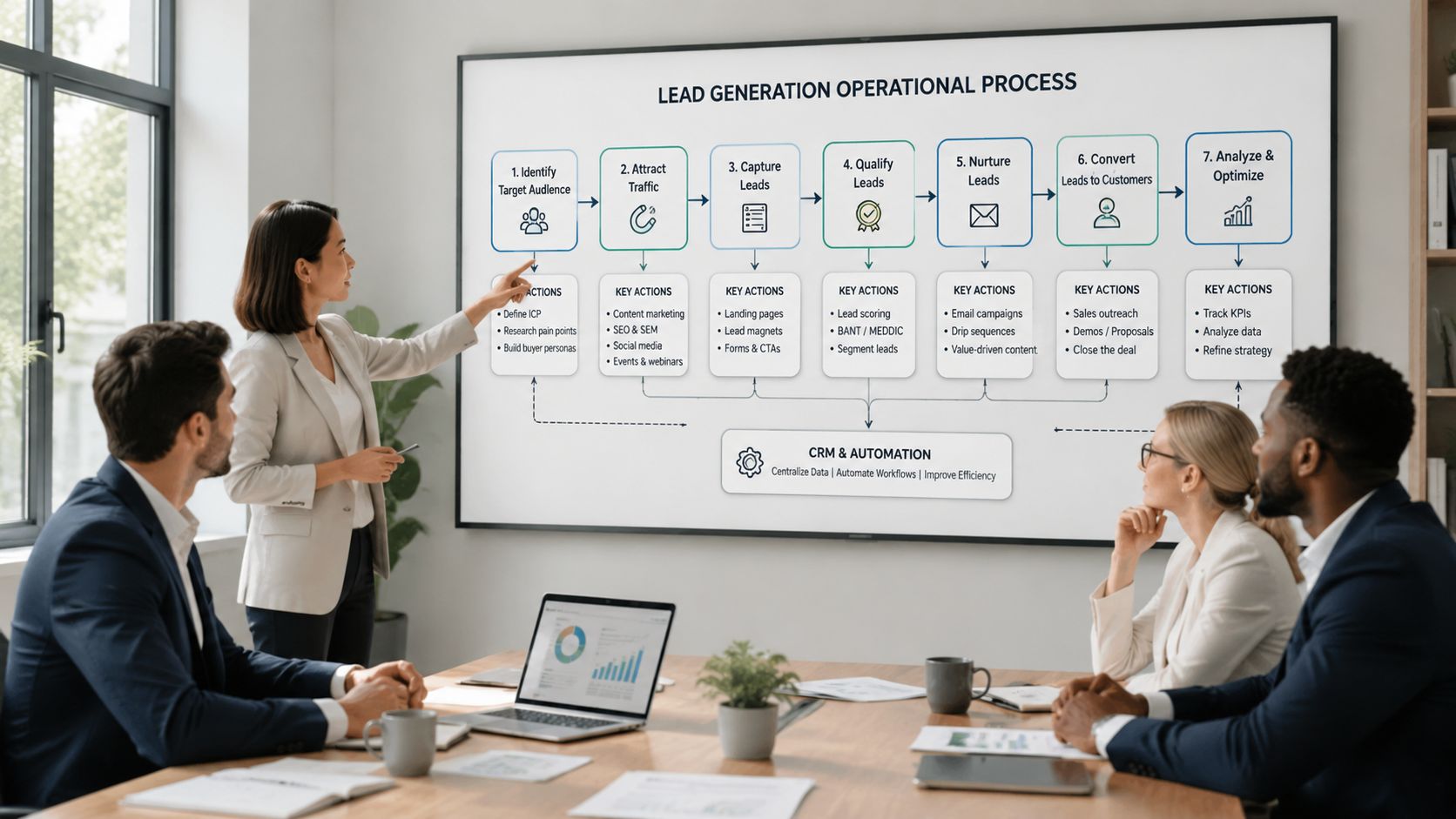
They will say onboarding is quick, ask how the tracks run
If an agency says, "We can launch fast," ask this instead:
Which workstreams start on day one
Who owns list building, copy, and infrastructure
What waits for approval, and what runs in parallel
When the soft launch happens, and what they check before scaling
A competent answer should sound operational. In practice, that means kickoff produces ICP, offer, message map, and sub-segment decisions immediately, then three tracks move in parallel: list building in Clay or Apollo, copy and sequence drafting in tools like Lemlist, Instantly, or Smartlead, and infrastructure setup for sending and routing.
If they describe a sequential model, first list, then copy, then setup, you're already looking at avoidable delay.
Agencies miss early pipeline windows because they queue work. The teams that book earlier meetings overlap work and install handoffs before launch.
If you're comparing tool choices behind that engine, a useful companion read is this guide to find the right lead generation software. It helps separate software capability from agency process, which buyers often blur together. For your own stack review, keep a shorter list of lead generation software categories next to the agency proposal and check whether the workflow matches the tools they mention.
They will say they qualify leads, ask for the gates
Weak agencies expose themselves: they treat any positive reply as a meeting candidate, then dump it on your AE.
Ask them to walk you through the reply-handling logic in order. Not the philosophy. The actual gates.
A useful qualification structure includes:
ICP match confirmed
If the account falls outside the approved industry, size band, geography, or target motion, it shouldn't move forward just because someone replied.Persona check at reply stage
The contact either matches the target persona or provides a clear path to the decision maker.Pain signal present
"Send more info" is not the same as a problem-aware reply.Why now filter
They should ask what triggered the conversation before a calendar link goes out.Commercial fit check
Budget isn't asked directly that early, but company context should tell the SDR whether the account is realistically buyable.
If the agency can't explain how they protect AE time, they don't have qualification. They have forwarding.
They will say they move fast, ask for the response standard
Speed decides whether interest becomes pipeline. According to Scoop Market's lead generation statistics, leads contacted within 5 minutes are 9 times more likely to convert than those contacted later, while 41% of businesses report difficulty following up with leads quickly.
That single stat changes how you should evaluate a lead generation agency B2B partner. You're not just buying prospecting. You're buying the routing discipline that keeps interest warm.
Ask these directly:
How fast are positive replies routed
Where do they route, CRM, Slack, inbox, or all three
Who owns first response during business hours
What happens when the AE misses the SLA
The strongest teams wire this before first send. Positive replies should not sit in a campaign inbox waiting for somebody to notice them.
They will say they report performance, ask for the daily leading indicator
Meetings booked are useful, but they lag. Pipeline created lags even more.
Ask what they monitor every day to catch problems early. The best answer is usually some version of reply velocity, because it surfaces list quality issues, deliverability damage, weak copy, or audience exhaustion before your monthly review tells you the quarter is off track.
A good operator will also tell you what actions they take when that signal drops, when they pause, and who approves changes. That's the difference between a managed system and a reporting service.
Red flags and pricing signals to watch for
You can usually spot a weak agency before launch if you know where to look. The red flags aren't cosmetic. They're incentive clues.
Red flags that usually point to process failure
The first red flag is a meeting guarantee with no qualification language. That almost always means the agency is paid to fill calendars, not protect revenue time. Your AE ends up sorting through bad-fit meetings that should have been filtered upstream.
The second is a single-channel claim dressed up as strategy. If they only sell cold email, only sell LinkedIn, or only sell ads, you're buying a silo. In most B2B categories, buyers move across a small set of repeatable channels, and the handoffs matter as much as the touches.
The third is reporting that majors in activity. Sends, opens, clicks, and connection accepts don't tell you whether the engine is producing revenue-ready conversations. They tell you the system is busy.
The wrong agency doesn't just waste spend. It trains your team to distrust marketing-sourced pipeline.
A fourth red flag is vague targeting language. If the proposal says "we'll test broad audiences first," read that as "we haven't done the segmentation work."
What pricing models reveal about incentives
Pricing is not just finance. It tells you what behavior the agency is likely to produce.
Model | Incentive it creates | What to watch |
|---|---|---|
Pure retainer | Agency gets paid whether quality is good or bad | Can drift into maintenance mode |
Pure performance | Agency gets paid on booked outputs | Can inflate low-fit meetings |
Hybrid | Setup work is paid, outcomes matter too | Usually the healthiest structure if definitions are tight |
My recommendation is a hybrid model. Pay for the upfront operational work, list architecture, infrastructure, messaging, routing, dashboard setup, then tie part of compensation to outcomes that are defined. Not "leads." Not "interest." Qualified conversations that pass agreed gates.
This is also where simplistic pricing hides weak execution. AI bees' lead generation trends report that B2B agencies that use lead scoring and multi-channel sequencing achieve 138% ROI on average, while critical failures stem from overgeneralized targeting in 29% of cases and misaligned sales-marketing definitions in 31% of stalled pipelines. Cheap proposals often skip the exact work that prevents those failures.
What a serious proposal should include
Look for these signals:
Clear setup scope → Data work, messaging, routing, and reporting are explicitly named
Quality definitions → The agency defines what qualifies before compensation kicks in
Shared accountability → Client-side response obligations are written down too
Review cadence → There is a fixed rhythm for diagnosing what to scale and what to cut
If you're comparing firms, keep a second tab open with a market view of lead generation companies. Not because lists pick for you, but because they force cleaner comparison criteria.
Structuring the contract and service level agreement
A weak contract creates polite confusion. A strong one creates operational clarity.
Most buyers treat the SLA like legal cleanup after the commercial terms are done. That's backward. In a lead gen engagement, the SLA is where you force the process to survive contact with reality.
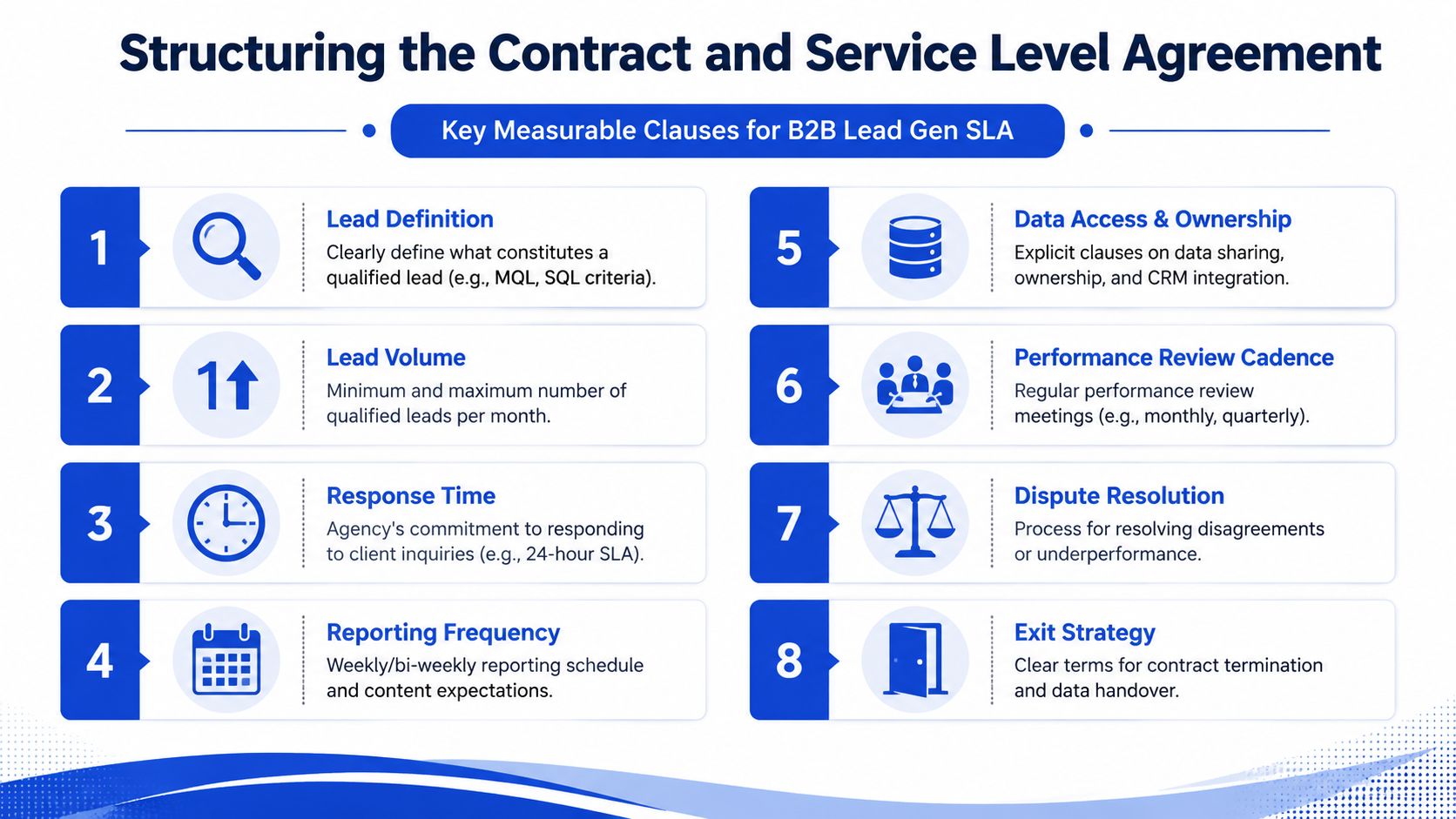
A useful primer on the structure itself is this SLA glossary entry. Then turn the document from a legal template into a delivery spec.
Clauses that should not stay vague
The first clause is the qualified conversation definition. This should describe the minimum fit standard for any reply or meeting that counts toward performance. Include ICP fit, persona relevance, and evidence of real buying context.
Second, define the handoff path. State where qualified replies land, what context accompanies them, and who confirms receipt.
Third, define the response window. If the agency promises fast routing in the sales process, the contract should state that timing in measurable terms.
The reason this matters goes beyond admin. A McKinsey view on the future of marketing found that 72% of B2B marketing leaders cite lack of integration between channels as their primary barrier to predictable growth. The SLA is where you force integration by contract instead of hoping teams coordinate later.
What reporting must include
Don't accept a report that only tells you what happened after the fact.
The contract should require:
Leading indicators → Reply flow, routing compliance, and qualification outcomes
Channel-level view → One reporting line across email, LinkedIn, and any call layer
Disposition visibility → Why replies did not route, not just how many did
Data ownership terms → Who owns lists, enrichment, copy variants, and CRM history at exit
Embed review cadence too. Weekly for active operations is normal. Monthly is too slow when deliverability, targeting, or messaging breaks mid-sprint.
To see how other operators explain this idea, the video below is a useful reference point.
The clauses that save you later
These are the ones teams regret skipping:
Change control → Who approves audience changes, offer shifts, and sequence rewrites
Suppression and exclusion rules → Customers, active opps, partners, and blocked segments
Exit and handover → Data export, asset transfer, and inbox or tool access at termination
Remediation path → What happens if routing, quality, or reporting standards slip
Contracts don't create performance. They do create consequences, ownership, and a clean path to correction.
If an agency pushes back on measurable handoffs, that's useful information before signature, not after.
The 30/60/90-day onboarding checklist
A new agency engagement usually feels healthy in week one. Meetings are full, everyone agrees on the ICP, and the first copy drafts look sharp. The critical assessment starts by week three, when list quality, routing logic, inbox setup, and qualification standards either lock together or start drifting apart. That is why the first 90 days should be run as an onboarding system with acceptance criteria, not as a loose launch period.
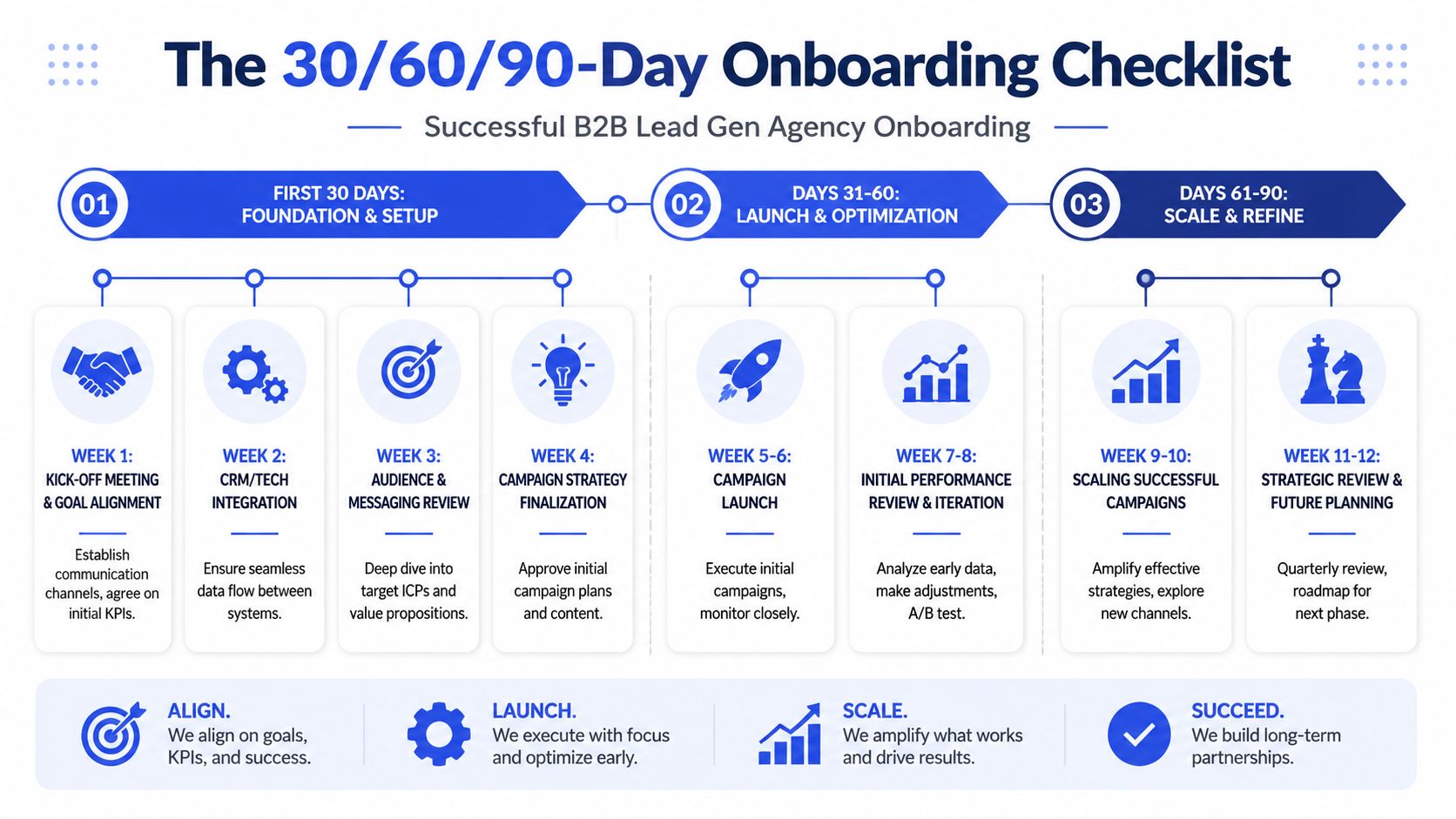
Days 1 to 30 build the engine in parallel
Good agencies do not wait for one workstream to finish before starting the next. They run parallel onboarding sprints.
The kickoff should end with four approved items: ICP rules, offer positioning, a message map tied to real pains and proof, and the first target segment. Once those are set, three tracks start at the same time.
Track A, list and enrichment → Build the initial audience in Clay, Apollo, Sales Navigator, or a similar stack. Add firmographic filters, enrich key fields, verify contacts, and apply trigger data before records enter outreach.
Track B, copy and sequence writing → Draft email and LinkedIn sequences, define reply handling, and get approval fast enough that copy does not become the bottleneck.
Track C, infrastructure and routing → Configure domains, inboxes, sending rules, CRM field mapping, ownership logic, and AE notification paths.
This is the first signal that you are hiring an operations partner instead of a lead vendor. If the agency cannot show who owns each track, what has to be approved, and what "ready to launch" means for each workstream, the ninety-day plan will slip before outreach even starts.
Days 7 to 14 prove deliverability before scale
Start small on purpose.
A soft launch gives the team room to inspect bounce patterns, complaint risk, inbox placement, and reply classification before larger volume goes out. It also exposes handoff failures early. If replies come in but alerts fail, meetings route to the wrong owner, or disqualified leads still hit AE calendars, the engine is not ready for scale.
The category changes. The operating shape does not.
SaaS → Trigger on hiring, expansion into a new segment, or visible pipeline pressure
iGaming → Tighten geography, compliance screens, and role fit before any contact enters sequence
Manufacturing → Segment by account structure and buying role because response paths are slower and less linear
Legal tech and pharma → Keep claims controlled, proof specific, and copy review tighter than a standard SaaS motion
If the agency treats every vertical the same, it will overproduce activity and underproduce qualified conversations.
Days 15 to 60 tighten qualification and segment decisions
Weak operators get exposed. Sending volume stops mattering once replies start coming in. Qualification discipline matters more.
Use a multi-gate review before anything reaches an AE. Check account fit against ICP rules. Confirm persona. Identify a live problem. Confirm timing. Then decide whether the reply belongs in direct scheduling, SDR follow-up, or nurture. Agencies that skip these gates create calendar noise that looks productive in reports and dies in pipeline review.
Review performance at the segment and message level, not only at the campaign total.
Review area | Keep | Cut |
|---|---|---|
Sub-segments | Segments producing qualified replies | Segments attracting vague curiosity |
Message angles | Angles tied to real operational pain | Clever copy that gets polite but empty replies |
Channel mix | Combinations that produce usable conversations | Activity that doesn't improve fit or speed |
This is also the point where the internal ownership model becomes clear. Some teams keep targeting, infrastructure, and reply management in-house. Others use a partner such as Grou, which combines LinkedIn content, outbound, and lead generation in one operating system with shared reporting and sprint-based execution.
If you are weighing that option, this guide to outsourcing lead generation for B2B teams helps define what should stay internal and what can sit with the agency.
Keep a kill list. Segments, triggers, and copy angles that looked promising in kickoff should be removed fast if live traffic shows weak fit.
Days 61 to 90 build predictability
By month three, the question is no longer whether the agency can generate replies. The question is whether the system is stable enough to forecast.
Focus on three decisions:
What should scale → Segments with repeatable qualification signals and clean handoff performance
What needs redesign → Offers or sequences that create response but do not progress into real sales motion
What the sales team can absorb → Added volume only helps if AE follow-up, routing discipline, and CRM hygiene keep pace
A solid 90-day review usually ends with a narrower program than the one that launched. Fewer segments. Tighter exclusion rules. Better qualification gates. Clearer ownership between agency, SDR, and AE.
That is what a good lead generation agency B2B engagement looks like in practice. Controlled inputs, visible operating standards, and a handoff process that turns attention into pipeline instead of meeting count.
Audit your last 20 agency-sourced meetings by Friday and add one CRM field by Monday: why now present, yes or no. That field will show whether the agency is producing active buying motion or just filling calendars. GROU works with B2B teams globally across SaaS, iGaming, manufacturing, legal tech, and pharma. The methodology is simple, one message, one target list, one reporting line, with sprint-based execution that turns attention into pipeline.
Your agency sends a weekly report full of sends, touches, and booked calls. Your AEs still say the calendar is thin and half the meetings that do get booked never should have reached them. That's the core buying problem with a lead generation agency B2B search. You are not hiring for activity. You are hiring for operational discipline.
Build your scorecard around ICP control, channel integration, and data hygiene before you take agency calls
Vet the operating model, not the pitch deck, especially onboarding speed, reply routing, and qualification gates
Treat pricing and guarantees as signals about incentives, not proof of quality
Put the handoffs, definitions, and reporting standards into the contract so the process survives the sales cycle
Run the first 90 days like an implementation, not a vendor kickoff
Table of Contents
The evaluation framework you need before you talk to any agency
Most agency selection starts too late. By the time you're on the demo call, you're already reacting to their offer instead of filtering for the operating model you need.
That mistake is expensive. A Gartner marketing analysis found that 60% of B2B leads generated by agencies are never contacted by sales because they lack buying intent or ICP alignment, costing companies an average of $150,000 annually in wasted marketing spend. If you don't define your own standard first, you inherit theirs.
Start with three pillars
A usable scorecard has three columns. ICP, channels, and data. If an agency is weak in any one of them, the rest of the program gets noisy fast.
Here's the structure I recommend:
Pillar | What you define before agency outreach | What bad looks like |
|---|---|---|
ICP | Who counts as in-market and in-fit | Broad titles, broad segments, weak exclusions |
Channels | Where you want prospecting motion to run | Single-channel dependency |
Data | What quality standard contact and account data must meet | Old records, thin enrichment, no ownership rules |
Define the ICP with hard edges
Teams typically have an ICP deck. Fewer have an ICP enforcement rule.
Before you talk to any agency, document these criteria:
Firmographic floor and ceiling → Which company sizes are in, which are out, and where edge cases go
Persona rules → Which titles can book directly, which need validation, and which should never hit an AE calendar
Disqualifiers → Geography, sub-verticals, maturity stage, compliance constraints, or buying model exclusions
If you serve SaaS, iGaming, manufacturing, legal tech, or pharma, this matters even more because each category has different buying committees and different acceptable claims. An agency that says it can "target anyone in B2B" is telling you it hasn't made the hard decisions yet.
Practical rule: If the agency can't tell you who they would exclude in week one, they will waste your sales team's time in week three.
Pick the channel mix before they do
Effective B2B lead generation already clusters around a small set of channels. Warmly's lead generation statistics report that 94% of B2B marketers use LinkedIn for sales and lead generation, LinkedIn accounts for 80% of all B2B social media leads, and 88% of businesses use email for lead generation.
That doesn't mean every agency should run every channel. It means your scorecard should ask whether they can integrate the channels buyers already respond to.
Set these criteria:
Primary acquisition lane → Usually LinkedIn, email, or both
Support lane → Call layer, content layer, or paid support if your motion needs it
Message consistency rule → The promise in email, LinkedIn, and follow-up cannot drift by team or tool
If you're assessing scaling lead generation using AI, keep the standard simple. Ask whether AI improves targeting, messaging relevance, or routing discipline. If it only adds volume, it will create more low-grade replies.
For KPI design, use a shared reference point early. A practical benchmark list like lead generation KPIs helps force the discussion back to reply quality, routing, and conversion instead of vanity reporting.
Set the data standard in writing
A serious agency should be comfortable with explicit data rules before launch.
At minimum, document:
Source and enrichment expectations → What fields must exist before a contact enters a sequence
Verification threshold → How they confirm records are current enough to send
Refresh cadence → When stale accounts, bounced contacts, and changed roles get recycled or removed
This is the part buyers skip because it feels operational. It is operational. That's why it matters.
How to vet an agency's operational engine
The deck will sound polished. Every agency says they personalize, move fast, and care about quality. None of that tells you how the work moves from signed contract to held meeting.
What matters is whether they run an engine or a chain of disconnected tasks.
They will say onboarding is quick, ask how the tracks run
If an agency says, "We can launch fast," ask this instead:
Which workstreams start on day one
Who owns list building, copy, and infrastructure
What waits for approval, and what runs in parallel
When the soft launch happens, and what they check before scaling
A competent answer should sound operational. In practice, that means kickoff produces ICP, offer, message map, and sub-segment decisions immediately, then three tracks move in parallel: list building in Clay or Apollo, copy and sequence drafting in tools like Lemlist, Instantly, or Smartlead, and infrastructure setup for sending and routing.
If they describe a sequential model, first list, then copy, then setup, you're already looking at avoidable delay.
Agencies miss early pipeline windows because they queue work. The teams that book earlier meetings overlap work and install handoffs before launch.
If you're comparing tool choices behind that engine, a useful companion read is this guide to find the right lead generation software. It helps separate software capability from agency process, which buyers often blur together. For your own stack review, keep a shorter list of lead generation software categories next to the agency proposal and check whether the workflow matches the tools they mention.
They will say they qualify leads, ask for the gates
Weak agencies expose themselves: they treat any positive reply as a meeting candidate, then dump it on your AE.
Ask them to walk you through the reply-handling logic in order. Not the philosophy. The actual gates.
A useful qualification structure includes:
ICP match confirmed
If the account falls outside the approved industry, size band, geography, or target motion, it shouldn't move forward just because someone replied.Persona check at reply stage
The contact either matches the target persona or provides a clear path to the decision maker.Pain signal present
"Send more info" is not the same as a problem-aware reply.Why now filter
They should ask what triggered the conversation before a calendar link goes out.Commercial fit check
Budget isn't asked directly that early, but company context should tell the SDR whether the account is realistically buyable.
If the agency can't explain how they protect AE time, they don't have qualification. They have forwarding.
They will say they move fast, ask for the response standard
Speed decides whether interest becomes pipeline. According to Scoop Market's lead generation statistics, leads contacted within 5 minutes are 9 times more likely to convert than those contacted later, while 41% of businesses report difficulty following up with leads quickly.
That single stat changes how you should evaluate a lead generation agency B2B partner. You're not just buying prospecting. You're buying the routing discipline that keeps interest warm.
Ask these directly:
How fast are positive replies routed
Where do they route, CRM, Slack, inbox, or all three
Who owns first response during business hours
What happens when the AE misses the SLA
The strongest teams wire this before first send. Positive replies should not sit in a campaign inbox waiting for somebody to notice them.
They will say they report performance, ask for the daily leading indicator
Meetings booked are useful, but they lag. Pipeline created lags even more.
Ask what they monitor every day to catch problems early. The best answer is usually some version of reply velocity, because it surfaces list quality issues, deliverability damage, weak copy, or audience exhaustion before your monthly review tells you the quarter is off track.
A good operator will also tell you what actions they take when that signal drops, when they pause, and who approves changes. That's the difference between a managed system and a reporting service.
Red flags and pricing signals to watch for
You can usually spot a weak agency before launch if you know where to look. The red flags aren't cosmetic. They're incentive clues.
Red flags that usually point to process failure
The first red flag is a meeting guarantee with no qualification language. That almost always means the agency is paid to fill calendars, not protect revenue time. Your AE ends up sorting through bad-fit meetings that should have been filtered upstream.
The second is a single-channel claim dressed up as strategy. If they only sell cold email, only sell LinkedIn, or only sell ads, you're buying a silo. In most B2B categories, buyers move across a small set of repeatable channels, and the handoffs matter as much as the touches.
The third is reporting that majors in activity. Sends, opens, clicks, and connection accepts don't tell you whether the engine is producing revenue-ready conversations. They tell you the system is busy.
The wrong agency doesn't just waste spend. It trains your team to distrust marketing-sourced pipeline.
A fourth red flag is vague targeting language. If the proposal says "we'll test broad audiences first," read that as "we haven't done the segmentation work."
What pricing models reveal about incentives
Pricing is not just finance. It tells you what behavior the agency is likely to produce.
Model | Incentive it creates | What to watch |
|---|---|---|
Pure retainer | Agency gets paid whether quality is good or bad | Can drift into maintenance mode |
Pure performance | Agency gets paid on booked outputs | Can inflate low-fit meetings |
Hybrid | Setup work is paid, outcomes matter too | Usually the healthiest structure if definitions are tight |
My recommendation is a hybrid model. Pay for the upfront operational work, list architecture, infrastructure, messaging, routing, dashboard setup, then tie part of compensation to outcomes that are defined. Not "leads." Not "interest." Qualified conversations that pass agreed gates.
This is also where simplistic pricing hides weak execution. AI bees' lead generation trends report that B2B agencies that use lead scoring and multi-channel sequencing achieve 138% ROI on average, while critical failures stem from overgeneralized targeting in 29% of cases and misaligned sales-marketing definitions in 31% of stalled pipelines. Cheap proposals often skip the exact work that prevents those failures.
What a serious proposal should include
Look for these signals:
Clear setup scope → Data work, messaging, routing, and reporting are explicitly named
Quality definitions → The agency defines what qualifies before compensation kicks in
Shared accountability → Client-side response obligations are written down too
Review cadence → There is a fixed rhythm for diagnosing what to scale and what to cut
If you're comparing firms, keep a second tab open with a market view of lead generation companies. Not because lists pick for you, but because they force cleaner comparison criteria.
Structuring the contract and service level agreement
A weak contract creates polite confusion. A strong one creates operational clarity.
Most buyers treat the SLA like legal cleanup after the commercial terms are done. That's backward. In a lead gen engagement, the SLA is where you force the process to survive contact with reality.
A useful primer on the structure itself is this SLA glossary entry. Then turn the document from a legal template into a delivery spec.
Clauses that should not stay vague
The first clause is the qualified conversation definition. This should describe the minimum fit standard for any reply or meeting that counts toward performance. Include ICP fit, persona relevance, and evidence of real buying context.
Second, define the handoff path. State where qualified replies land, what context accompanies them, and who confirms receipt.
Third, define the response window. If the agency promises fast routing in the sales process, the contract should state that timing in measurable terms.
The reason this matters goes beyond admin. A McKinsey view on the future of marketing found that 72% of B2B marketing leaders cite lack of integration between channels as their primary barrier to predictable growth. The SLA is where you force integration by contract instead of hoping teams coordinate later.
What reporting must include
Don't accept a report that only tells you what happened after the fact.
The contract should require:
Leading indicators → Reply flow, routing compliance, and qualification outcomes
Channel-level view → One reporting line across email, LinkedIn, and any call layer
Disposition visibility → Why replies did not route, not just how many did
Data ownership terms → Who owns lists, enrichment, copy variants, and CRM history at exit
Embed review cadence too. Weekly for active operations is normal. Monthly is too slow when deliverability, targeting, or messaging breaks mid-sprint.
To see how other operators explain this idea, the video below is a useful reference point.
The clauses that save you later
These are the ones teams regret skipping:
Change control → Who approves audience changes, offer shifts, and sequence rewrites
Suppression and exclusion rules → Customers, active opps, partners, and blocked segments
Exit and handover → Data export, asset transfer, and inbox or tool access at termination
Remediation path → What happens if routing, quality, or reporting standards slip
Contracts don't create performance. They do create consequences, ownership, and a clean path to correction.
If an agency pushes back on measurable handoffs, that's useful information before signature, not after.
The 30/60/90-day onboarding checklist
A new agency engagement usually feels healthy in week one. Meetings are full, everyone agrees on the ICP, and the first copy drafts look sharp. The critical assessment starts by week three, when list quality, routing logic, inbox setup, and qualification standards either lock together or start drifting apart. That is why the first 90 days should be run as an onboarding system with acceptance criteria, not as a loose launch period.
Days 1 to 30 build the engine in parallel
Good agencies do not wait for one workstream to finish before starting the next. They run parallel onboarding sprints.
The kickoff should end with four approved items: ICP rules, offer positioning, a message map tied to real pains and proof, and the first target segment. Once those are set, three tracks start at the same time.
Track A, list and enrichment → Build the initial audience in Clay, Apollo, Sales Navigator, or a similar stack. Add firmographic filters, enrich key fields, verify contacts, and apply trigger data before records enter outreach.
Track B, copy and sequence writing → Draft email and LinkedIn sequences, define reply handling, and get approval fast enough that copy does not become the bottleneck.
Track C, infrastructure and routing → Configure domains, inboxes, sending rules, CRM field mapping, ownership logic, and AE notification paths.
This is the first signal that you are hiring an operations partner instead of a lead vendor. If the agency cannot show who owns each track, what has to be approved, and what "ready to launch" means for each workstream, the ninety-day plan will slip before outreach even starts.
Days 7 to 14 prove deliverability before scale
Start small on purpose.
A soft launch gives the team room to inspect bounce patterns, complaint risk, inbox placement, and reply classification before larger volume goes out. It also exposes handoff failures early. If replies come in but alerts fail, meetings route to the wrong owner, or disqualified leads still hit AE calendars, the engine is not ready for scale.
The category changes. The operating shape does not.
SaaS → Trigger on hiring, expansion into a new segment, or visible pipeline pressure
iGaming → Tighten geography, compliance screens, and role fit before any contact enters sequence
Manufacturing → Segment by account structure and buying role because response paths are slower and less linear
Legal tech and pharma → Keep claims controlled, proof specific, and copy review tighter than a standard SaaS motion
If the agency treats every vertical the same, it will overproduce activity and underproduce qualified conversations.
Days 15 to 60 tighten qualification and segment decisions
Weak operators get exposed. Sending volume stops mattering once replies start coming in. Qualification discipline matters more.
Use a multi-gate review before anything reaches an AE. Check account fit against ICP rules. Confirm persona. Identify a live problem. Confirm timing. Then decide whether the reply belongs in direct scheduling, SDR follow-up, or nurture. Agencies that skip these gates create calendar noise that looks productive in reports and dies in pipeline review.
Review performance at the segment and message level, not only at the campaign total.
Review area | Keep | Cut |
|---|---|---|
Sub-segments | Segments producing qualified replies | Segments attracting vague curiosity |
Message angles | Angles tied to real operational pain | Clever copy that gets polite but empty replies |
Channel mix | Combinations that produce usable conversations | Activity that doesn't improve fit or speed |
This is also the point where the internal ownership model becomes clear. Some teams keep targeting, infrastructure, and reply management in-house. Others use a partner such as Grou, which combines LinkedIn content, outbound, and lead generation in one operating system with shared reporting and sprint-based execution.
If you are weighing that option, this guide to outsourcing lead generation for B2B teams helps define what should stay internal and what can sit with the agency.
Keep a kill list. Segments, triggers, and copy angles that looked promising in kickoff should be removed fast if live traffic shows weak fit.
Days 61 to 90 build predictability
By month three, the question is no longer whether the agency can generate replies. The question is whether the system is stable enough to forecast.
Focus on three decisions:
What should scale → Segments with repeatable qualification signals and clean handoff performance
What needs redesign → Offers or sequences that create response but do not progress into real sales motion
What the sales team can absorb → Added volume only helps if AE follow-up, routing discipline, and CRM hygiene keep pace
A solid 90-day review usually ends with a narrower program than the one that launched. Fewer segments. Tighter exclusion rules. Better qualification gates. Clearer ownership between agency, SDR, and AE.
That is what a good lead generation agency B2B engagement looks like in practice. Controlled inputs, visible operating standards, and a handoff process that turns attention into pipeline instead of meeting count.
Audit your last 20 agency-sourced meetings by Friday and add one CRM field by Monday: why now present, yes or no. That field will show whether the agency is producing active buying motion or just filling calendars. GROU works with B2B teams globally across SaaS, iGaming, manufacturing, legal tech, and pharma. The methodology is simple, one message, one target list, one reporting line, with sprint-based execution that turns attention into pipeline.
Your agency sends a weekly report full of sends, touches, and booked calls. Your AEs still say the calendar is thin and half the meetings that do get booked never should have reached them. That's the core buying problem with a lead generation agency B2B search. You are not hiring for activity. You are hiring for operational discipline.
Build your scorecard around ICP control, channel integration, and data hygiene before you take agency calls
Vet the operating model, not the pitch deck, especially onboarding speed, reply routing, and qualification gates
Treat pricing and guarantees as signals about incentives, not proof of quality
Put the handoffs, definitions, and reporting standards into the contract so the process survives the sales cycle
Run the first 90 days like an implementation, not a vendor kickoff
Table of Contents
The evaluation framework you need before you talk to any agency
Most agency selection starts too late. By the time you're on the demo call, you're already reacting to their offer instead of filtering for the operating model you need.
That mistake is expensive. A Gartner marketing analysis found that 60% of B2B leads generated by agencies are never contacted by sales because they lack buying intent or ICP alignment, costing companies an average of $150,000 annually in wasted marketing spend. If you don't define your own standard first, you inherit theirs.
Start with three pillars
A usable scorecard has three columns. ICP, channels, and data. If an agency is weak in any one of them, the rest of the program gets noisy fast.
Here's the structure I recommend:
Pillar | What you define before agency outreach | What bad looks like |
|---|---|---|
ICP | Who counts as in-market and in-fit | Broad titles, broad segments, weak exclusions |
Channels | Where you want prospecting motion to run | Single-channel dependency |
Data | What quality standard contact and account data must meet | Old records, thin enrichment, no ownership rules |
Define the ICP with hard edges
Teams typically have an ICP deck. Fewer have an ICP enforcement rule.
Before you talk to any agency, document these criteria:
Firmographic floor and ceiling → Which company sizes are in, which are out, and where edge cases go
Persona rules → Which titles can book directly, which need validation, and which should never hit an AE calendar
Disqualifiers → Geography, sub-verticals, maturity stage, compliance constraints, or buying model exclusions
If you serve SaaS, iGaming, manufacturing, legal tech, or pharma, this matters even more because each category has different buying committees and different acceptable claims. An agency that says it can "target anyone in B2B" is telling you it hasn't made the hard decisions yet.
Practical rule: If the agency can't tell you who they would exclude in week one, they will waste your sales team's time in week three.
Pick the channel mix before they do
Effective B2B lead generation already clusters around a small set of channels. Warmly's lead generation statistics report that 94% of B2B marketers use LinkedIn for sales and lead generation, LinkedIn accounts for 80% of all B2B social media leads, and 88% of businesses use email for lead generation.
That doesn't mean every agency should run every channel. It means your scorecard should ask whether they can integrate the channels buyers already respond to.
Set these criteria:
Primary acquisition lane → Usually LinkedIn, email, or both
Support lane → Call layer, content layer, or paid support if your motion needs it
Message consistency rule → The promise in email, LinkedIn, and follow-up cannot drift by team or tool
If you're assessing scaling lead generation using AI, keep the standard simple. Ask whether AI improves targeting, messaging relevance, or routing discipline. If it only adds volume, it will create more low-grade replies.
For KPI design, use a shared reference point early. A practical benchmark list like lead generation KPIs helps force the discussion back to reply quality, routing, and conversion instead of vanity reporting.
Set the data standard in writing
A serious agency should be comfortable with explicit data rules before launch.
At minimum, document:
Source and enrichment expectations → What fields must exist before a contact enters a sequence
Verification threshold → How they confirm records are current enough to send
Refresh cadence → When stale accounts, bounced contacts, and changed roles get recycled or removed
This is the part buyers skip because it feels operational. It is operational. That's why it matters.
How to vet an agency's operational engine
The deck will sound polished. Every agency says they personalize, move fast, and care about quality. None of that tells you how the work moves from signed contract to held meeting.
What matters is whether they run an engine or a chain of disconnected tasks.
They will say onboarding is quick, ask how the tracks run
If an agency says, "We can launch fast," ask this instead:
Which workstreams start on day one
Who owns list building, copy, and infrastructure
What waits for approval, and what runs in parallel
When the soft launch happens, and what they check before scaling
A competent answer should sound operational. In practice, that means kickoff produces ICP, offer, message map, and sub-segment decisions immediately, then three tracks move in parallel: list building in Clay or Apollo, copy and sequence drafting in tools like Lemlist, Instantly, or Smartlead, and infrastructure setup for sending and routing.
If they describe a sequential model, first list, then copy, then setup, you're already looking at avoidable delay.
Agencies miss early pipeline windows because they queue work. The teams that book earlier meetings overlap work and install handoffs before launch.
If you're comparing tool choices behind that engine, a useful companion read is this guide to find the right lead generation software. It helps separate software capability from agency process, which buyers often blur together. For your own stack review, keep a shorter list of lead generation software categories next to the agency proposal and check whether the workflow matches the tools they mention.
They will say they qualify leads, ask for the gates
Weak agencies expose themselves: they treat any positive reply as a meeting candidate, then dump it on your AE.
Ask them to walk you through the reply-handling logic in order. Not the philosophy. The actual gates.
A useful qualification structure includes:
ICP match confirmed
If the account falls outside the approved industry, size band, geography, or target motion, it shouldn't move forward just because someone replied.Persona check at reply stage
The contact either matches the target persona or provides a clear path to the decision maker.Pain signal present
"Send more info" is not the same as a problem-aware reply.Why now filter
They should ask what triggered the conversation before a calendar link goes out.Commercial fit check
Budget isn't asked directly that early, but company context should tell the SDR whether the account is realistically buyable.
If the agency can't explain how they protect AE time, they don't have qualification. They have forwarding.
They will say they move fast, ask for the response standard
Speed decides whether interest becomes pipeline. According to Scoop Market's lead generation statistics, leads contacted within 5 minutes are 9 times more likely to convert than those contacted later, while 41% of businesses report difficulty following up with leads quickly.
That single stat changes how you should evaluate a lead generation agency B2B partner. You're not just buying prospecting. You're buying the routing discipline that keeps interest warm.
Ask these directly:
How fast are positive replies routed
Where do they route, CRM, Slack, inbox, or all three
Who owns first response during business hours
What happens when the AE misses the SLA
The strongest teams wire this before first send. Positive replies should not sit in a campaign inbox waiting for somebody to notice them.
They will say they report performance, ask for the daily leading indicator
Meetings booked are useful, but they lag. Pipeline created lags even more.
Ask what they monitor every day to catch problems early. The best answer is usually some version of reply velocity, because it surfaces list quality issues, deliverability damage, weak copy, or audience exhaustion before your monthly review tells you the quarter is off track.
A good operator will also tell you what actions they take when that signal drops, when they pause, and who approves changes. That's the difference between a managed system and a reporting service.
Red flags and pricing signals to watch for
You can usually spot a weak agency before launch if you know where to look. The red flags aren't cosmetic. They're incentive clues.
Red flags that usually point to process failure
The first red flag is a meeting guarantee with no qualification language. That almost always means the agency is paid to fill calendars, not protect revenue time. Your AE ends up sorting through bad-fit meetings that should have been filtered upstream.
The second is a single-channel claim dressed up as strategy. If they only sell cold email, only sell LinkedIn, or only sell ads, you're buying a silo. In most B2B categories, buyers move across a small set of repeatable channels, and the handoffs matter as much as the touches.
The third is reporting that majors in activity. Sends, opens, clicks, and connection accepts don't tell you whether the engine is producing revenue-ready conversations. They tell you the system is busy.
The wrong agency doesn't just waste spend. It trains your team to distrust marketing-sourced pipeline.
A fourth red flag is vague targeting language. If the proposal says "we'll test broad audiences first," read that as "we haven't done the segmentation work."
What pricing models reveal about incentives
Pricing is not just finance. It tells you what behavior the agency is likely to produce.
Model | Incentive it creates | What to watch |
|---|---|---|
Pure retainer | Agency gets paid whether quality is good or bad | Can drift into maintenance mode |
Pure performance | Agency gets paid on booked outputs | Can inflate low-fit meetings |
Hybrid | Setup work is paid, outcomes matter too | Usually the healthiest structure if definitions are tight |
My recommendation is a hybrid model. Pay for the upfront operational work, list architecture, infrastructure, messaging, routing, dashboard setup, then tie part of compensation to outcomes that are defined. Not "leads." Not "interest." Qualified conversations that pass agreed gates.
This is also where simplistic pricing hides weak execution. AI bees' lead generation trends report that B2B agencies that use lead scoring and multi-channel sequencing achieve 138% ROI on average, while critical failures stem from overgeneralized targeting in 29% of cases and misaligned sales-marketing definitions in 31% of stalled pipelines. Cheap proposals often skip the exact work that prevents those failures.
What a serious proposal should include
Look for these signals:
Clear setup scope → Data work, messaging, routing, and reporting are explicitly named
Quality definitions → The agency defines what qualifies before compensation kicks in
Shared accountability → Client-side response obligations are written down too
Review cadence → There is a fixed rhythm for diagnosing what to scale and what to cut
If you're comparing firms, keep a second tab open with a market view of lead generation companies. Not because lists pick for you, but because they force cleaner comparison criteria.
Structuring the contract and service level agreement
A weak contract creates polite confusion. A strong one creates operational clarity.
Most buyers treat the SLA like legal cleanup after the commercial terms are done. That's backward. In a lead gen engagement, the SLA is where you force the process to survive contact with reality.
A useful primer on the structure itself is this SLA glossary entry. Then turn the document from a legal template into a delivery spec.
Clauses that should not stay vague
The first clause is the qualified conversation definition. This should describe the minimum fit standard for any reply or meeting that counts toward performance. Include ICP fit, persona relevance, and evidence of real buying context.
Second, define the handoff path. State where qualified replies land, what context accompanies them, and who confirms receipt.
Third, define the response window. If the agency promises fast routing in the sales process, the contract should state that timing in measurable terms.
The reason this matters goes beyond admin. A McKinsey view on the future of marketing found that 72% of B2B marketing leaders cite lack of integration between channels as their primary barrier to predictable growth. The SLA is where you force integration by contract instead of hoping teams coordinate later.
What reporting must include
Don't accept a report that only tells you what happened after the fact.
The contract should require:
Leading indicators → Reply flow, routing compliance, and qualification outcomes
Channel-level view → One reporting line across email, LinkedIn, and any call layer
Disposition visibility → Why replies did not route, not just how many did
Data ownership terms → Who owns lists, enrichment, copy variants, and CRM history at exit
Embed review cadence too. Weekly for active operations is normal. Monthly is too slow when deliverability, targeting, or messaging breaks mid-sprint.
To see how other operators explain this idea, the video below is a useful reference point.
The clauses that save you later
These are the ones teams regret skipping:
Change control → Who approves audience changes, offer shifts, and sequence rewrites
Suppression and exclusion rules → Customers, active opps, partners, and blocked segments
Exit and handover → Data export, asset transfer, and inbox or tool access at termination
Remediation path → What happens if routing, quality, or reporting standards slip
Contracts don't create performance. They do create consequences, ownership, and a clean path to correction.
If an agency pushes back on measurable handoffs, that's useful information before signature, not after.
The 30/60/90-day onboarding checklist
A new agency engagement usually feels healthy in week one. Meetings are full, everyone agrees on the ICP, and the first copy drafts look sharp. The critical assessment starts by week three, when list quality, routing logic, inbox setup, and qualification standards either lock together or start drifting apart. That is why the first 90 days should be run as an onboarding system with acceptance criteria, not as a loose launch period.
Days 1 to 30 build the engine in parallel
Good agencies do not wait for one workstream to finish before starting the next. They run parallel onboarding sprints.
The kickoff should end with four approved items: ICP rules, offer positioning, a message map tied to real pains and proof, and the first target segment. Once those are set, three tracks start at the same time.
Track A, list and enrichment → Build the initial audience in Clay, Apollo, Sales Navigator, or a similar stack. Add firmographic filters, enrich key fields, verify contacts, and apply trigger data before records enter outreach.
Track B, copy and sequence writing → Draft email and LinkedIn sequences, define reply handling, and get approval fast enough that copy does not become the bottleneck.
Track C, infrastructure and routing → Configure domains, inboxes, sending rules, CRM field mapping, ownership logic, and AE notification paths.
This is the first signal that you are hiring an operations partner instead of a lead vendor. If the agency cannot show who owns each track, what has to be approved, and what "ready to launch" means for each workstream, the ninety-day plan will slip before outreach even starts.
Days 7 to 14 prove deliverability before scale
Start small on purpose.
A soft launch gives the team room to inspect bounce patterns, complaint risk, inbox placement, and reply classification before larger volume goes out. It also exposes handoff failures early. If replies come in but alerts fail, meetings route to the wrong owner, or disqualified leads still hit AE calendars, the engine is not ready for scale.
The category changes. The operating shape does not.
SaaS → Trigger on hiring, expansion into a new segment, or visible pipeline pressure
iGaming → Tighten geography, compliance screens, and role fit before any contact enters sequence
Manufacturing → Segment by account structure and buying role because response paths are slower and less linear
Legal tech and pharma → Keep claims controlled, proof specific, and copy review tighter than a standard SaaS motion
If the agency treats every vertical the same, it will overproduce activity and underproduce qualified conversations.
Days 15 to 60 tighten qualification and segment decisions
Weak operators get exposed. Sending volume stops mattering once replies start coming in. Qualification discipline matters more.
Use a multi-gate review before anything reaches an AE. Check account fit against ICP rules. Confirm persona. Identify a live problem. Confirm timing. Then decide whether the reply belongs in direct scheduling, SDR follow-up, or nurture. Agencies that skip these gates create calendar noise that looks productive in reports and dies in pipeline review.
Review performance at the segment and message level, not only at the campaign total.
Review area | Keep | Cut |
|---|---|---|
Sub-segments | Segments producing qualified replies | Segments attracting vague curiosity |
Message angles | Angles tied to real operational pain | Clever copy that gets polite but empty replies |
Channel mix | Combinations that produce usable conversations | Activity that doesn't improve fit or speed |
This is also the point where the internal ownership model becomes clear. Some teams keep targeting, infrastructure, and reply management in-house. Others use a partner such as Grou, which combines LinkedIn content, outbound, and lead generation in one operating system with shared reporting and sprint-based execution.
If you are weighing that option, this guide to outsourcing lead generation for B2B teams helps define what should stay internal and what can sit with the agency.
Keep a kill list. Segments, triggers, and copy angles that looked promising in kickoff should be removed fast if live traffic shows weak fit.
Days 61 to 90 build predictability
By month three, the question is no longer whether the agency can generate replies. The question is whether the system is stable enough to forecast.
Focus on three decisions:
What should scale → Segments with repeatable qualification signals and clean handoff performance
What needs redesign → Offers or sequences that create response but do not progress into real sales motion
What the sales team can absorb → Added volume only helps if AE follow-up, routing discipline, and CRM hygiene keep pace
A solid 90-day review usually ends with a narrower program than the one that launched. Fewer segments. Tighter exclusion rules. Better qualification gates. Clearer ownership between agency, SDR, and AE.
That is what a good lead generation agency B2B engagement looks like in practice. Controlled inputs, visible operating standards, and a handoff process that turns attention into pipeline instead of meeting count.
Audit your last 20 agency-sourced meetings by Friday and add one CRM field by Monday: why now present, yes or no. That field will show whether the agency is producing active buying motion or just filling calendars. GROU works with B2B teams globally across SaaS, iGaming, manufacturing, legal tech, and pharma. The methodology is simple, one message, one target list, one reporting line, with sprint-based execution that turns attention into pipeline.
Pipeline OS Newsletter
Build qualified pipeline
Get weekly tactics to generate demand, improve lead quality, and book more meetings.






Trusted by industry leaders
Trusted by industry leaders
Trusted by industry leaders
Ready to build qualified pipeline?
Ready to build qualified pipeline?
Ready to build qualified pipeline?
Book a call to see if we're the right fit, or take the 2-minute quiz to get a clear starting point.
Book a call to see if we're the right fit, or take the 2-minute quiz to get a clear starting point.
Book a call to see if we're the right fit, or take the 2-minute quiz to get a clear starting point.
" height="30.21639343089746px" id="hfGbXmQR2" width="30.216393430897455px"/></svg>)
Copyright © 2026 – All Right Reserved
Copyright © 2026 – All Right Reserved
Copyright © 2026 – All Right Reserved