%22%3E%3C/path%3E%3Cpath d=%22M 63.072 7.554 C 62.258 8.022 61.577 8.689 61.092 9.493 L 61.092 7.076 L 57.158 7.076 L 57.158 22.64 L 61.089 22.64 L 61.089 14.888 C 61.089 13.446 61.403 12.434 62.03 11.853 C 62.818 11.218 63.818 10.907 64.826 10.982 L 65.868 10.982 L 65.868 6.851 C 64.891 6.834 63.926 7.076 63.073 7.554 Z%22 fill=%22rgb(17,17,17)%22%3E%3C/path%3E%3Cpath d=%22M 78.916 7.82 C 76.363 6.49 73.321 6.49 70.768 7.82 C 69.562 8.473 68.564 9.451 67.888 10.644 C 67.167 11.931 66.803 13.387 66.834 14.862 C 66.804 16.332 67.157 17.785 67.86 19.077 C 68.515 20.267 69.494 21.246 70.684 21.901 C 71.924 22.576 73.318 22.92 74.73 22.898 C 76.164 22.918 77.58 22.575 78.846 21.901 C 80.062 21.247 81.073 20.27 81.768 19.077 C 82.506 17.797 82.88 16.339 82.85 14.862 C 82.88 13.389 82.517 11.934 81.797 10.647 C 81.12 9.455 80.122 8.477 78.917 7.824 M 78.803 14.862 C 78.829 15.739 78.636 16.608 78.241 17.391 C 77.903 18.046 77.38 18.588 76.738 18.95 C 76.124 19.293 75.432 19.472 74.729 19.47 C 73.668 19.497 72.648 19.061 71.934 18.276 C 71.139 17.323 70.741 16.1 70.823 14.862 C 70.741 13.62 71.149 12.395 71.959 11.45 C 72.687 10.667 73.715 10.233 74.783 10.256 C 75.859 10.236 76.894 10.67 77.635 11.45 C 78.464 12.387 78.884 13.616 78.801 14.864%22 fill=%22rgb(17,17,17)%22%3E%3C/path%3E%3Cpath d=%22M 95.906 7.076 L 95.906 15.646 C 95.975 16.68 95.643 17.701 94.979 18.498 C 94.311 19.184 93.379 19.547 92.422 19.495 C 91.475 19.544 90.553 19.18 89.894 18.498 C 89.23 17.701 88.898 16.68 88.967 15.646 L 88.967 7.076 L 85.033 7.076 L 85.033 16.207 C 85 17.449 85.275 18.68 85.834 19.79 C 86.327 20.75 87.095 21.542 88.039 22.065 C 89.033 22.594 90.145 22.861 91.271 22.838 C 92.188 22.847 93.095 22.65 93.926 22.263 C 94.708 21.905 95.388 21.36 95.906 20.675 L 95.906 22.645 L 99.865 22.645 L 99.865 7.076 Z%22 fill=%22rgb(17,17,17)%22%3E%3C/path%3E%3Cpath d=%22M 4.513 15.626 C 4.511 10.815 7.606 6.549 12.181 5.059 C 16.756 3.57 21.77 5.195 24.601 9.086 L 27.816 5.87 C 24.074 1.186 17.981 -0.943 12.137 0.393 C 6.292 1.728 1.728 6.292 0.393 12.137 C -0.943 17.981 1.186 24.074 5.87 27.816 L 9.085 24.601 C 6.214 22.512 4.515 19.177 4.513 15.626%22 fill=%22rgb(32,62,235)%22%3E%3C/path%3E%3Cpath d=%22M 17.114 14.343 L 13.354 18.01 L 13.354 18.026 L 21.071 18.026 L 11.412 27.609 L 17.389 27.609 L 23.999 21.081 L 23.999 28.316 L 24.005 28.316 L 27.967 24.393 L 27.967 14.343 Z%22 fill=%22rgb(32,62,235)%22%3E%3C/path%3E%3C/g%3E%3C/svg%3E) ×
× ××
××›
›
›
›
Predictable Lead Generation for Marketing Agencies
Predictable Lead Generation for Marketing Agencies
Predictable Lead Generation for Marketing Agencies
Predictable Lead Generation for Marketing Agencies
Predictable Lead Generation for Marketing Agencies
Predictable Lead Generation for Marketing Agencies

Author
Aljaz Peklaj

Your agency probably doesn't have a lead problem. It has a systems problem.
The pattern is familiar. You ship client work, pause your own outreach, then wake up a month later with an empty pipeline and a founder calendar full of “catch-up” prospecting. A few emails go out, a few LinkedIn posts go live, maybe a landing page gets updated, but none of it runs as one engine.
Predictable lead generation for marketing agencies starts when you stop treating content, outbound, targeting, and routing as separate projects. Structure turns attention into pipeline. That means one ICP, one signal model, one messaging spine, one routing logic, and one review cadence.
TL;DR
Static lists are the fastest way to get mediocre results. Build prospect intake around live buying signals, not broad titles.
Founder-led content does more than generate inbound. It raises trust before outbound lands and improves how every other channel performs.
Single-channel outbound tops out early. Multi-channel sequences across email and LinkedIn create more context and more replies.
Fast routing matters as much as top-of-funnel volume. Leads are 9x more likely to convert when businesses follow up within 5 minutes according to Bookyourdata's lead generation statistics roundup.
Dashboards should track revenue signal, not activity noise. Positive replies, reply-to-meeting conversion, cost per qualified meeting, and meetings booked per week tell you where the system is leaking.
Table of Contents
The end of feast-or-famine lead flow
Most agencies don't need more tactics. They need a lead flow that runs when the team is busy.
The old model was campaign-based. Someone wrote a few cold emails, scraped a list, posted inconsistently on LinkedIn, then called it lead gen. That breaks because modern buyer attention is fragmented. In 2025, 88% of businesses used email, 78% of B2B marketers used social media, and 37% of B2B companies still used cold calling, which is why single-channel acquisition is now structurally weak in B2B, according to the 2025 B2B lead generation report.
A pipeline engine needs five parts working together:
Trigger-based ICP
Founder-led authority content
Multi-channel outbound
Reply routing
A review cadence tied to revenue metrics
Practical rule: If your team can't explain who enters the funnel, why they entered now, and how the reply reaches sales, you don't have a system yet.
The sequence matters. Start with ICP and signal definition before you touch copy. Then connect outbound and inbound so each channel reinforces the other. If you're looking for additional ideas on where automation fits into this model, this breakdown of AI-powered lead generation strategies is useful because it focuses on workflow design, not just tool hype.
What usually fails is the opposite approach, tool-first execution. Teams buy Apollo, Clay, Lemlist, Instantly, Sales Navigator, and HubSpot, then wonder why the pipeline still swings month to month. The problem isn't the stack. It's that the stack is running disconnected motions.
Build your target list around signals not just titles
A title tells you who someone is. A signal tells you why now.
That difference is where most lead generation for marketing agencies breaks. Agencies pull a broad list like “VP Marketing, SaaS, US” and launch volume at it. The result is predictable. Mixed intent, weak timing, generic copy, and a sending setup that gets blamed for a targeting problem.
Why static lists fail
We learned this the hard way in our own outbound. The first proper cold email campaign we ran through Lemlist targeted heads of marketing at SaaS companies from Apollo on a four-touch sequence. The blended reply rate was 4.2%, and we booked roughly 12 meetings over 60 days. The second campaign to the same audience, with tighter ICP and better copy, moved to 6.8% and 20 meetings over 60 days. Within six months, tighter segments consistently reached 8% to 10% reply rates.
Those numbers taught the right lesson. The jump didn't come from a magic template. It came from boring improvements, ICP definition, list quality, deliverability discipline, and trigger-based personalization.
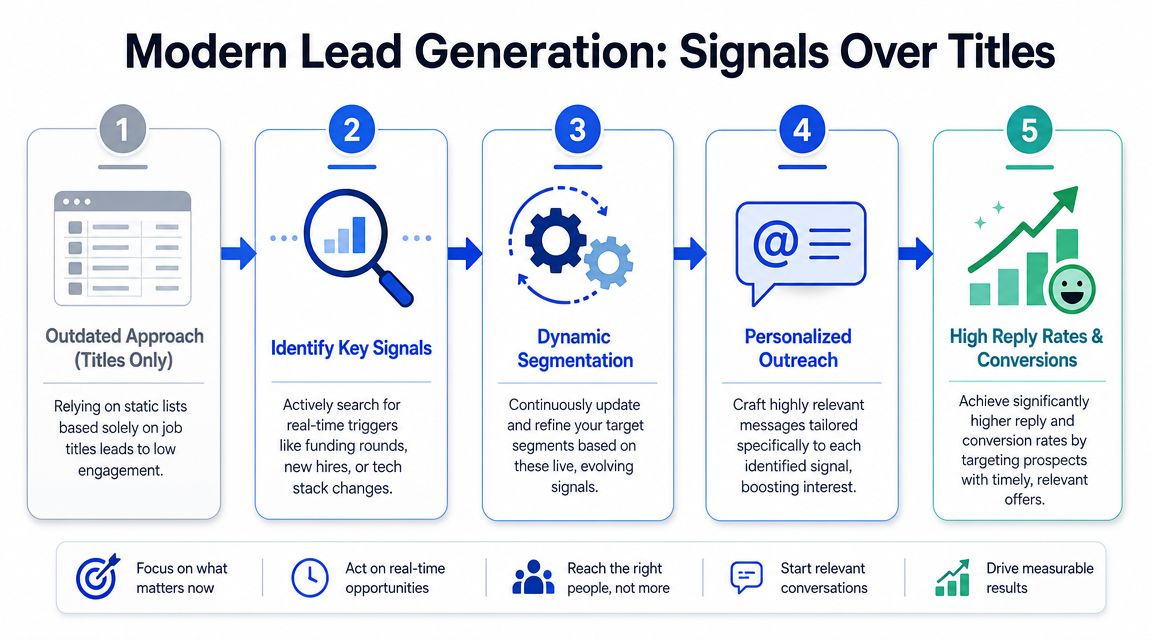
A practical signal model
A working ICP has three layers:
Firmographic fit
Start with the hard filters, industry, employee band, geography, language, business model, and buyer role.Buying context
Add the conditions that make your offer relevant now. That's where recent hiring, expansion, funding, leadership changes, or tech adoption matter.Channel fit
Decide whether this segment is best reached by email first, LinkedIn first, or inbound-first nurturing.
One client pivot made this obvious. They came in running a high-volume cold email motion against a 2,000+ contact static list with a generic “mid-market SaaS” ICP. Reply rates had been stuck at 3% to 4% for months. We cut the list model, moved to 80 to 120 fresh accounts per week based on recent SDR hires, funding rounds, and sales leadership changes, then tightened the audience to B2B SaaS with 50 to 250 employees in English-speaking markets. By the end of the first month of the new motion, reply rate moved from 3.9% to 9.3%, meetings booked per month went from 7 to 19, and cost per qualified meeting dropped from approximately €480 to approximately €210.
That kind of lift comes from structure, not copy edits.
Use Apollo for account and contact discovery. Use Clay to enrich records with hiring, funding, CRM, or tech-stack context. Use Sales Navigator to verify role relevance and recent activity before a prospect enters sequence. If you need a tighter way to document this before building lists, this guide to an ideal customer profile is the right place to clean up the definition.
Salesforce's guidance is also directionally right here. A practical workflow combines inbound and outbound, then qualifies inbound leads in real time via chat or email before sales gets involved, which Salesforce outlines in its lead generation guide. The point isn't to collect more names. It's to keep low-fit contacts out of the queue in the first place.
Don't ask whether a contact matches the title. Ask whether the account is in a moment where your offer makes sense.
Use founder-led content to build credibility at scale
If your agency sells trust, the founder profile is not a side project. It's part of the sales process.
Most agencies still treat content as a brand exercise. That's too soft. The founder's LinkedIn profile should operate like a permanent pre-call qualification layer. Prospects check it after your email, after a referral, after a comment, and before a meeting. If the profile is thin, your outbound has to create trust from zero.

Why the founder profile outperforms most assets
The strongest reason is buyer psychology. Trust is a gating factor in B2B buying, and a 2024 Edelman study found that high-quality thought leadership can influence vendor shortlists and help justify premium pricing, as summarized in this piece on lead generation for digital marketing agencies.
That matches what we've seen in practice. No single post built most of the pipeline. The compound effect of consistent founder-led content over 18 to 24 months did. The profile became a 24/7 sales conversation. People arrived from posts, comments, mutual connections, and outbound touches, then self-qualified by reading the body of work.
Over the last 12 months, roughly 40% of closed-won revenue came from inbound where the first touch was the founder's LinkedIn profile. Another 25% to 30% came from outbound where the prospect had already seen that content. Put differently, the profile directly or indirectly influenced 65% to 70% of revenue.
That's why I'd pick founder-led content over another lead magnet every time.
What to publish each week
You don't need polished thought leadership theatre. You need clear positioning repeated through useful proof.
A simple weekly mix works:
One operator post
Break down a live workflow, routing rule, qualification rule, or campaign diagnosis.One point-of-view post
Take a stand on what agencies keep doing wrong, broad ICPs, static lists, weak reply handling, vanity dashboards.One proof post
Share a result, a pattern, or a sales conversation lesson. Keep it specific.One comment block
Leave useful comments on buyer and partner posts. Comments pull profile views from people who'd never see your outbound list.
Unbounce recommends publishing content at least 3 times per week while pairing that with targeted landing pages, retargeting, and ongoing optimization around CTR and conversion rate in its guide on lead generation for marketing agencies. The important part isn't just cadence. It's integration.
If you want a clean operating model for this, a practical thought leadership guide helps turn positioning into a repeatable publishing system.
This walkthrough is worth watching if you're rebuilding the profile itself before ramping output:
What doesn't work. Generic “5 tips” content, outsourced founder voice, and posts written to impress peers instead of buyers. Prospects don't need motivation. They need evidence that you see the problem clearly and solve it with discipline.
Design multi-channel sequences that get replies
A prospect sees your founder post on Tuesday, gets your email on Wednesday, notices your profile on LinkedIn on Thursday, and replies on Friday because the message finally lands in context. That is how agency outbound works now. One channel rarely carries the full load.

The goal is not to stack touches until someone gives in. The goal is to keep one clear message moving across email and LinkedIn so the buyer recognizes the problem, the trigger, and the reason you reached out. That is the difference between activity and a pipeline engine.
A sequence structure that stays coherent
Good sequences feel like a single conversation. Bad ones feel like separate tools firing on different schedules.
A practical sequence over 10 business days looks like this:
Day 1, email
Open with the trigger that put the account in your system. New VP Marketing hire, paid traffic spike, recent funding, pricing page changes. Use the event, not fake familiarity.Day 2, LinkedIn profile view and follow
No message. Just show up.Day 4, LinkedIn connection request
Keep it short. Mention the same context from the email or a shared operational problem. Do not pitch services in the request.Day 6, email follow-up
Add a second angle. Point to a likely bottleneck, ask a qualification question, or reference a measurable gap you can see from the outside.Day 10, LinkedIn message or final email
Use the channel that showed activity. If they opened email twice, send the final email. If they accepted the connection but ignored email, message on LinkedIn. Give them a specific reason to reply.
The trade-off is volume versus coherence. Teams that push 5,000 contacts a month usually lose message quality and routing discipline. Teams that run 300 well-built accounts with clear triggers often get better meetings because every touch matches the same account thesis.
The stack is simple. Apollo or Clay for list building and signal capture. Lemlist or Instantly for email. HeyReach for LinkedIn steps. Sales Navigator for rep-side verification. HubSpot for CRM status and attribution. Grou runs this kind of connected motion by tying LinkedIn content, outbound, and qualification into one reporting line, which is the model I prefer when agencies want channel accountability in one place instead of split across teams.
If your team needs a shared operating definition, this guide to multi-channel outreach is useful for aligning sales, ops, and delivery.
What gets replies and what gets ignored
Replies come from relevance, timing, and continuity.
In our own campaigns, cold email on its own produced acceptable results on narrow ICPs, but the ceiling showed up fast. Performance improved when the same accounts saw the same point of view in more than one place. The lift did not come from adding noise. It came from removing disconnects between channels.
What gets ignored:
Generic first lines
“Came across your company” says nothing. Buyers know it is filler.Connection requests with a pitch
The request is for access, not for a calendar link.Follow-ups that repeat the first email
A second touch needs a new observation, a sharper question, or a different stake in the ground.Channel switching without message discipline
If the email says “reduce CAC” and the LinkedIn message says “fix attribution,” it feels like two campaigns.
One rule matters more than copy style. Every touch should answer the same three questions: why this account, why now, and why this problem. If your team cannot state those clearly, adding channels just multiplies weak outreach.
For teams layering paid touches around named accounts, lightweight creative can reinforce the same message without adding production drag. Tools like ShortGenius automated ad generation help produce quick variations when you want supporting ads or short-form video around the same campaign theme.
Automate reply routing to protect your sales team's focus
A prospect replies at 10:07 AM with, “This is relevant. Can you send pricing and availability for next month?” If that message sits in a shared inbox until after lunch, the problem is not rep effort. The problem is routing.
Agency outbound breaks down here more than teams admit. They spend weeks tightening ICP, triggers, copy, and sequence logic, then let qualified replies pile up inside Instantly, Lemlist, HubSpot, and personal inboxes. That turns a working pipeline engine into an inbox management problem.
The fix is operational. Positive intent should hit the assigned AE fast, with enough context to reply in one pass. Everything else should stay out of the AE's way.
The routing rule that protects selling time
Use one primary rule. Any reply that shows buying intent gets pushed to the assigned AE in Slack within 2 minutes, with the record, thread, owner, and source attached. Neutral, negative, and administrative replies stay with the SDR or ops queue unless they need judgment from sales.
Fast follow-up matters, but speed alone is not the point. Clean routing is what makes speed repeatable. Without it, AEs become inbox triage managers.
The workflow we use is straightforward:
Classify replies at the sending layer
Instantly and Lemlist can tag replies by sentiment or intent, which is enough to separate sales-worthy responses from noise.Send positive replies to the AE with context
Include contact name, company, original outbound step, full reply text, trigger source, account tier, and the direct HubSpot URL.Keep out-of-office handling automated
If the auto-reply includes a return date, create the follow-up task automatically instead of sending it to a rep.Route neutral and negative replies to SDRs or ops
Pricing objections, bad timing, vendor lock-in, and unsubscribes all matter. They usually do not need AE attention in real time.
This is the difference between alerting and interruption. A useful routing system creates a short list of messages that deserve immediate action. Everything else gets processed on a lower-cost queue.
What belongs in the AE lane
The easiest way to clean this up is to decide what qualifies for human urgency.
Route these:
Interested replies
Pricing or scope questions
Compliance-related messages
Meeting bookings and no-show recovery events
Do not route these:
Open notifications
Click notifications
LinkedIn connection acceptances without conversation
Daily activity summaries
That last group creates fake urgency. It gives sales teams more pings, not more pipeline.
One agency client made the trade-off obvious. Before we changed routing, AEs spent 2.5 to 3 hours a day checking tools and sorting replies. After we pushed only high-intent responses into Slack and left the rest with SDRs, that dropped to under 30 minutes a day. Response times improved, booked meetings held at a higher rate, and reply-to-meeting conversion went up because reps were answering live opportunities instead of scanning dashboards.
Those gains did not come from sending more volume. They came from protecting focus at the exact point where interest turns into revenue.
If you need to document the handoff logic for RevOps, SDR leaders, or HubSpot admins, this overview of lead routing automation workflows is a useful operational reference.
Install the dashboard and cadence that drive results
The wrong dashboard makes teams feel busy. The right dashboard shows where revenue is getting lost.
Most agency lead gen reporting still overweights activity. Opens, clicks, profile views, send volume. Those can help diagnose channel mechanics, but they don't tell you whether the system is producing qualified conversations.
The KPI table that actually matters
Use a dashboard that tracks four primary metrics. Then review it in a fixed sprint rhythm.
Metric | What It Measures | Good Target (First 90 Days) | Excellent Target (Mature System) |
|---|---|---|---|
Positive reply rate | How much of outbound is creating real buying interest | 5% to 8% | 8% to 10%+ |
Reply-to-meeting conversion rate | How well the team turns interest into scheduled calls | 30% to 40% | 45%+ |
Cost per qualified meeting | Efficiency of the full engine, including tools and labor | Downward trend sprint to sprint | Stable and efficient by segment |
Meetings booked per week | Whether the system is producing consistent sales opportunities | Consistent weekly output | Predictable by channel and segment |
These are the operating numbers I trust most because they connect targeting, messaging, routing, and sales response in one view.
For inbound and landing page mechanics, Salesforce recommends tracking conversion rate, CPL, lead quality, and ROI, while Unbounce recommends treating content cadence, landing pages, retargeting, CTR, and conversion rate as one integrated system rather than isolated launches. That's the right mindset. If you want a dedicated reference for KPI definitions, this guide on lead generation KPIs is useful for standardizing team reviews.
Track the metrics that force a decision. If a number can't lead to a real change in ICP, sequence, routing, or sales handling, it belongs lower on the dashboard.
The sprint rhythm
Run the engine in two-week sprints.
A clean sprint review usually answers five questions:
Which segment produced the highest positive reply quality?
Which trigger produced conversations, not just replies?
Where did reply-to-meeting conversion stall?
Which accounts should be removed from the ICP, not re-messaged?
What single structural change are we testing next sprint?
A few common objections come up when teams start operating this way.
“Shouldn't we wait for more data?”
Wait long enough to spot a pattern, not so long that you burn through a bad segment. Don't pivot on one slow week. Do act on consistent underperformance.“Should we rewrite the sequence first?”
Usually no. The first diagnosis should be list quality and timing.“Do we need more content before outbound?”
You need enough credibility that a buyer who checks your profile or site doesn't lose trust. Then build both motions in parallel.
Unbounce's guidance is useful here too. A valuable benchmark is to publish content multiple times per week while using targeted landing pages and continuously optimizing around CTR and conversion rate as an integrated system, not isolated tactics, in its article on lead generation for marketing agencies.
Your next step and common questions
The first campaign won't tell you if the system works long term. It tells you whether your team is capable of learning.
What if the first campaign underperforms
Expect the first campaign to be a baseline, not a masterpiece.
Our first proper cold email campaign came back at 4.2% reply rate. That wasn't a failure. It was the cost of education. The teams that improve are the ones that measure at segment level, keep the honest blended number, and adjust the structure. The teams that stall either hide behind cherry-picked segments or keep rewriting copy for a list problem.
A few practical answers:
Tool budget
A lean stack with Apollo, Instantly or Lemlist, HubSpot, and Sales Navigator is enough to run a serious motion. The constraint usually isn't software. It's operating discipline.How long until meetings become consistent
You should see early signals inside the first month. Predictable meeting flow usually takes sustained tuning across ICP, trigger selection, content support, and reply handling.What if trust is low in a crowded category
Push harder on authority assets. In crowded agency markets, broad outreach without visible proof gets ignored faster than ever.
What to do this week
Don't rebuild everything at once.
Pick one segment. Tighten the ICP. Add two to three trigger conditions that make timing visible. Pull a fresh batch in Apollo, enrich it in Clay, and write one opening line that references the actual trigger. Then monitor positive replies and response time for two weeks.
That's the first real move toward predictable lead generation for marketing agencies. Not another tactic. A system the team can run every week.
If you want help building that system end to end, Grou works with B2B teams to connect LinkedIn content, outbound, qualification, and reporting into one pipeline engine, so sales gets qualified conversations instead of disconnected channel activity.
Your agency probably doesn't have a lead problem. It has a systems problem.
The pattern is familiar. You ship client work, pause your own outreach, then wake up a month later with an empty pipeline and a founder calendar full of “catch-up” prospecting. A few emails go out, a few LinkedIn posts go live, maybe a landing page gets updated, but none of it runs as one engine.
Predictable lead generation for marketing agencies starts when you stop treating content, outbound, targeting, and routing as separate projects. Structure turns attention into pipeline. That means one ICP, one signal model, one messaging spine, one routing logic, and one review cadence.
TL;DR
Static lists are the fastest way to get mediocre results. Build prospect intake around live buying signals, not broad titles.
Founder-led content does more than generate inbound. It raises trust before outbound lands and improves how every other channel performs.
Single-channel outbound tops out early. Multi-channel sequences across email and LinkedIn create more context and more replies.
Fast routing matters as much as top-of-funnel volume. Leads are 9x more likely to convert when businesses follow up within 5 minutes according to Bookyourdata's lead generation statistics roundup.
Dashboards should track revenue signal, not activity noise. Positive replies, reply-to-meeting conversion, cost per qualified meeting, and meetings booked per week tell you where the system is leaking.
Table of Contents
The end of feast-or-famine lead flow
Most agencies don't need more tactics. They need a lead flow that runs when the team is busy.
The old model was campaign-based. Someone wrote a few cold emails, scraped a list, posted inconsistently on LinkedIn, then called it lead gen. That breaks because modern buyer attention is fragmented. In 2025, 88% of businesses used email, 78% of B2B marketers used social media, and 37% of B2B companies still used cold calling, which is why single-channel acquisition is now structurally weak in B2B, according to the 2025 B2B lead generation report.
A pipeline engine needs five parts working together:
Trigger-based ICP
Founder-led authority content
Multi-channel outbound
Reply routing
A review cadence tied to revenue metrics
Practical rule: If your team can't explain who enters the funnel, why they entered now, and how the reply reaches sales, you don't have a system yet.
The sequence matters. Start with ICP and signal definition before you touch copy. Then connect outbound and inbound so each channel reinforces the other. If you're looking for additional ideas on where automation fits into this model, this breakdown of AI-powered lead generation strategies is useful because it focuses on workflow design, not just tool hype.
What usually fails is the opposite approach, tool-first execution. Teams buy Apollo, Clay, Lemlist, Instantly, Sales Navigator, and HubSpot, then wonder why the pipeline still swings month to month. The problem isn't the stack. It's that the stack is running disconnected motions.
Build your target list around signals not just titles
A title tells you who someone is. A signal tells you why now.
That difference is where most lead generation for marketing agencies breaks. Agencies pull a broad list like “VP Marketing, SaaS, US” and launch volume at it. The result is predictable. Mixed intent, weak timing, generic copy, and a sending setup that gets blamed for a targeting problem.
Why static lists fail
We learned this the hard way in our own outbound. The first proper cold email campaign we ran through Lemlist targeted heads of marketing at SaaS companies from Apollo on a four-touch sequence. The blended reply rate was 4.2%, and we booked roughly 12 meetings over 60 days. The second campaign to the same audience, with tighter ICP and better copy, moved to 6.8% and 20 meetings over 60 days. Within six months, tighter segments consistently reached 8% to 10% reply rates.
Those numbers taught the right lesson. The jump didn't come from a magic template. It came from boring improvements, ICP definition, list quality, deliverability discipline, and trigger-based personalization.
A practical signal model
A working ICP has three layers:
Firmographic fit
Start with the hard filters, industry, employee band, geography, language, business model, and buyer role.Buying context
Add the conditions that make your offer relevant now. That's where recent hiring, expansion, funding, leadership changes, or tech adoption matter.Channel fit
Decide whether this segment is best reached by email first, LinkedIn first, or inbound-first nurturing.
One client pivot made this obvious. They came in running a high-volume cold email motion against a 2,000+ contact static list with a generic “mid-market SaaS” ICP. Reply rates had been stuck at 3% to 4% for months. We cut the list model, moved to 80 to 120 fresh accounts per week based on recent SDR hires, funding rounds, and sales leadership changes, then tightened the audience to B2B SaaS with 50 to 250 employees in English-speaking markets. By the end of the first month of the new motion, reply rate moved from 3.9% to 9.3%, meetings booked per month went from 7 to 19, and cost per qualified meeting dropped from approximately €480 to approximately €210.
That kind of lift comes from structure, not copy edits.
Use Apollo for account and contact discovery. Use Clay to enrich records with hiring, funding, CRM, or tech-stack context. Use Sales Navigator to verify role relevance and recent activity before a prospect enters sequence. If you need a tighter way to document this before building lists, this guide to an ideal customer profile is the right place to clean up the definition.
Salesforce's guidance is also directionally right here. A practical workflow combines inbound and outbound, then qualifies inbound leads in real time via chat or email before sales gets involved, which Salesforce outlines in its lead generation guide. The point isn't to collect more names. It's to keep low-fit contacts out of the queue in the first place.
Don't ask whether a contact matches the title. Ask whether the account is in a moment where your offer makes sense.
Use founder-led content to build credibility at scale
If your agency sells trust, the founder profile is not a side project. It's part of the sales process.
Most agencies still treat content as a brand exercise. That's too soft. The founder's LinkedIn profile should operate like a permanent pre-call qualification layer. Prospects check it after your email, after a referral, after a comment, and before a meeting. If the profile is thin, your outbound has to create trust from zero.
Why the founder profile outperforms most assets
The strongest reason is buyer psychology. Trust is a gating factor in B2B buying, and a 2024 Edelman study found that high-quality thought leadership can influence vendor shortlists and help justify premium pricing, as summarized in this piece on lead generation for digital marketing agencies.
That matches what we've seen in practice. No single post built most of the pipeline. The compound effect of consistent founder-led content over 18 to 24 months did. The profile became a 24/7 sales conversation. People arrived from posts, comments, mutual connections, and outbound touches, then self-qualified by reading the body of work.
Over the last 12 months, roughly 40% of closed-won revenue came from inbound where the first touch was the founder's LinkedIn profile. Another 25% to 30% came from outbound where the prospect had already seen that content. Put differently, the profile directly or indirectly influenced 65% to 70% of revenue.
That's why I'd pick founder-led content over another lead magnet every time.
What to publish each week
You don't need polished thought leadership theatre. You need clear positioning repeated through useful proof.
A simple weekly mix works:
One operator post
Break down a live workflow, routing rule, qualification rule, or campaign diagnosis.One point-of-view post
Take a stand on what agencies keep doing wrong, broad ICPs, static lists, weak reply handling, vanity dashboards.One proof post
Share a result, a pattern, or a sales conversation lesson. Keep it specific.One comment block
Leave useful comments on buyer and partner posts. Comments pull profile views from people who'd never see your outbound list.
Unbounce recommends publishing content at least 3 times per week while pairing that with targeted landing pages, retargeting, and ongoing optimization around CTR and conversion rate in its guide on lead generation for marketing agencies. The important part isn't just cadence. It's integration.
If you want a clean operating model for this, a practical thought leadership guide helps turn positioning into a repeatable publishing system.
This walkthrough is worth watching if you're rebuilding the profile itself before ramping output:
What doesn't work. Generic “5 tips” content, outsourced founder voice, and posts written to impress peers instead of buyers. Prospects don't need motivation. They need evidence that you see the problem clearly and solve it with discipline.
Design multi-channel sequences that get replies
A prospect sees your founder post on Tuesday, gets your email on Wednesday, notices your profile on LinkedIn on Thursday, and replies on Friday because the message finally lands in context. That is how agency outbound works now. One channel rarely carries the full load.
The goal is not to stack touches until someone gives in. The goal is to keep one clear message moving across email and LinkedIn so the buyer recognizes the problem, the trigger, and the reason you reached out. That is the difference between activity and a pipeline engine.
A sequence structure that stays coherent
Good sequences feel like a single conversation. Bad ones feel like separate tools firing on different schedules.
A practical sequence over 10 business days looks like this:
Day 1, email
Open with the trigger that put the account in your system. New VP Marketing hire, paid traffic spike, recent funding, pricing page changes. Use the event, not fake familiarity.Day 2, LinkedIn profile view and follow
No message. Just show up.Day 4, LinkedIn connection request
Keep it short. Mention the same context from the email or a shared operational problem. Do not pitch services in the request.Day 6, email follow-up
Add a second angle. Point to a likely bottleneck, ask a qualification question, or reference a measurable gap you can see from the outside.Day 10, LinkedIn message or final email
Use the channel that showed activity. If they opened email twice, send the final email. If they accepted the connection but ignored email, message on LinkedIn. Give them a specific reason to reply.
The trade-off is volume versus coherence. Teams that push 5,000 contacts a month usually lose message quality and routing discipline. Teams that run 300 well-built accounts with clear triggers often get better meetings because every touch matches the same account thesis.
The stack is simple. Apollo or Clay for list building and signal capture. Lemlist or Instantly for email. HeyReach for LinkedIn steps. Sales Navigator for rep-side verification. HubSpot for CRM status and attribution. Grou runs this kind of connected motion by tying LinkedIn content, outbound, and qualification into one reporting line, which is the model I prefer when agencies want channel accountability in one place instead of split across teams.
If your team needs a shared operating definition, this guide to multi-channel outreach is useful for aligning sales, ops, and delivery.
What gets replies and what gets ignored
Replies come from relevance, timing, and continuity.
In our own campaigns, cold email on its own produced acceptable results on narrow ICPs, but the ceiling showed up fast. Performance improved when the same accounts saw the same point of view in more than one place. The lift did not come from adding noise. It came from removing disconnects between channels.
What gets ignored:
Generic first lines
“Came across your company” says nothing. Buyers know it is filler.Connection requests with a pitch
The request is for access, not for a calendar link.Follow-ups that repeat the first email
A second touch needs a new observation, a sharper question, or a different stake in the ground.Channel switching without message discipline
If the email says “reduce CAC” and the LinkedIn message says “fix attribution,” it feels like two campaigns.
One rule matters more than copy style. Every touch should answer the same three questions: why this account, why now, and why this problem. If your team cannot state those clearly, adding channels just multiplies weak outreach.
For teams layering paid touches around named accounts, lightweight creative can reinforce the same message without adding production drag. Tools like ShortGenius automated ad generation help produce quick variations when you want supporting ads or short-form video around the same campaign theme.
Automate reply routing to protect your sales team's focus
A prospect replies at 10:07 AM with, “This is relevant. Can you send pricing and availability for next month?” If that message sits in a shared inbox until after lunch, the problem is not rep effort. The problem is routing.
Agency outbound breaks down here more than teams admit. They spend weeks tightening ICP, triggers, copy, and sequence logic, then let qualified replies pile up inside Instantly, Lemlist, HubSpot, and personal inboxes. That turns a working pipeline engine into an inbox management problem.
The fix is operational. Positive intent should hit the assigned AE fast, with enough context to reply in one pass. Everything else should stay out of the AE's way.
The routing rule that protects selling time
Use one primary rule. Any reply that shows buying intent gets pushed to the assigned AE in Slack within 2 minutes, with the record, thread, owner, and source attached. Neutral, negative, and administrative replies stay with the SDR or ops queue unless they need judgment from sales.
Fast follow-up matters, but speed alone is not the point. Clean routing is what makes speed repeatable. Without it, AEs become inbox triage managers.
The workflow we use is straightforward:
Classify replies at the sending layer
Instantly and Lemlist can tag replies by sentiment or intent, which is enough to separate sales-worthy responses from noise.Send positive replies to the AE with context
Include contact name, company, original outbound step, full reply text, trigger source, account tier, and the direct HubSpot URL.Keep out-of-office handling automated
If the auto-reply includes a return date, create the follow-up task automatically instead of sending it to a rep.Route neutral and negative replies to SDRs or ops
Pricing objections, bad timing, vendor lock-in, and unsubscribes all matter. They usually do not need AE attention in real time.
This is the difference between alerting and interruption. A useful routing system creates a short list of messages that deserve immediate action. Everything else gets processed on a lower-cost queue.
What belongs in the AE lane
The easiest way to clean this up is to decide what qualifies for human urgency.
Route these:
Interested replies
Pricing or scope questions
Compliance-related messages
Meeting bookings and no-show recovery events
Do not route these:
Open notifications
Click notifications
LinkedIn connection acceptances without conversation
Daily activity summaries
That last group creates fake urgency. It gives sales teams more pings, not more pipeline.
One agency client made the trade-off obvious. Before we changed routing, AEs spent 2.5 to 3 hours a day checking tools and sorting replies. After we pushed only high-intent responses into Slack and left the rest with SDRs, that dropped to under 30 minutes a day. Response times improved, booked meetings held at a higher rate, and reply-to-meeting conversion went up because reps were answering live opportunities instead of scanning dashboards.
Those gains did not come from sending more volume. They came from protecting focus at the exact point where interest turns into revenue.
If you need to document the handoff logic for RevOps, SDR leaders, or HubSpot admins, this overview of lead routing automation workflows is a useful operational reference.
Install the dashboard and cadence that drive results
The wrong dashboard makes teams feel busy. The right dashboard shows where revenue is getting lost.
Most agency lead gen reporting still overweights activity. Opens, clicks, profile views, send volume. Those can help diagnose channel mechanics, but they don't tell you whether the system is producing qualified conversations.
The KPI table that actually matters
Use a dashboard that tracks four primary metrics. Then review it in a fixed sprint rhythm.
Metric | What It Measures | Good Target (First 90 Days) | Excellent Target (Mature System) |
|---|---|---|---|
Positive reply rate | How much of outbound is creating real buying interest | 5% to 8% | 8% to 10%+ |
Reply-to-meeting conversion rate | How well the team turns interest into scheduled calls | 30% to 40% | 45%+ |
Cost per qualified meeting | Efficiency of the full engine, including tools and labor | Downward trend sprint to sprint | Stable and efficient by segment |
Meetings booked per week | Whether the system is producing consistent sales opportunities | Consistent weekly output | Predictable by channel and segment |
These are the operating numbers I trust most because they connect targeting, messaging, routing, and sales response in one view.
For inbound and landing page mechanics, Salesforce recommends tracking conversion rate, CPL, lead quality, and ROI, while Unbounce recommends treating content cadence, landing pages, retargeting, CTR, and conversion rate as one integrated system rather than isolated launches. That's the right mindset. If you want a dedicated reference for KPI definitions, this guide on lead generation KPIs is useful for standardizing team reviews.
Track the metrics that force a decision. If a number can't lead to a real change in ICP, sequence, routing, or sales handling, it belongs lower on the dashboard.
The sprint rhythm
Run the engine in two-week sprints.
A clean sprint review usually answers five questions:
Which segment produced the highest positive reply quality?
Which trigger produced conversations, not just replies?
Where did reply-to-meeting conversion stall?
Which accounts should be removed from the ICP, not re-messaged?
What single structural change are we testing next sprint?
A few common objections come up when teams start operating this way.
“Shouldn't we wait for more data?”
Wait long enough to spot a pattern, not so long that you burn through a bad segment. Don't pivot on one slow week. Do act on consistent underperformance.“Should we rewrite the sequence first?”
Usually no. The first diagnosis should be list quality and timing.“Do we need more content before outbound?”
You need enough credibility that a buyer who checks your profile or site doesn't lose trust. Then build both motions in parallel.
Unbounce's guidance is useful here too. A valuable benchmark is to publish content multiple times per week while using targeted landing pages and continuously optimizing around CTR and conversion rate as an integrated system, not isolated tactics, in its article on lead generation for marketing agencies.
Your next step and common questions
The first campaign won't tell you if the system works long term. It tells you whether your team is capable of learning.
What if the first campaign underperforms
Expect the first campaign to be a baseline, not a masterpiece.
Our first proper cold email campaign came back at 4.2% reply rate. That wasn't a failure. It was the cost of education. The teams that improve are the ones that measure at segment level, keep the honest blended number, and adjust the structure. The teams that stall either hide behind cherry-picked segments or keep rewriting copy for a list problem.
A few practical answers:
Tool budget
A lean stack with Apollo, Instantly or Lemlist, HubSpot, and Sales Navigator is enough to run a serious motion. The constraint usually isn't software. It's operating discipline.How long until meetings become consistent
You should see early signals inside the first month. Predictable meeting flow usually takes sustained tuning across ICP, trigger selection, content support, and reply handling.What if trust is low in a crowded category
Push harder on authority assets. In crowded agency markets, broad outreach without visible proof gets ignored faster than ever.
What to do this week
Don't rebuild everything at once.
Pick one segment. Tighten the ICP. Add two to three trigger conditions that make timing visible. Pull a fresh batch in Apollo, enrich it in Clay, and write one opening line that references the actual trigger. Then monitor positive replies and response time for two weeks.
That's the first real move toward predictable lead generation for marketing agencies. Not another tactic. A system the team can run every week.
If you want help building that system end to end, Grou works with B2B teams to connect LinkedIn content, outbound, qualification, and reporting into one pipeline engine, so sales gets qualified conversations instead of disconnected channel activity.
Your agency probably doesn't have a lead problem. It has a systems problem.
The pattern is familiar. You ship client work, pause your own outreach, then wake up a month later with an empty pipeline and a founder calendar full of “catch-up” prospecting. A few emails go out, a few LinkedIn posts go live, maybe a landing page gets updated, but none of it runs as one engine.
Predictable lead generation for marketing agencies starts when you stop treating content, outbound, targeting, and routing as separate projects. Structure turns attention into pipeline. That means one ICP, one signal model, one messaging spine, one routing logic, and one review cadence.
TL;DR
Static lists are the fastest way to get mediocre results. Build prospect intake around live buying signals, not broad titles.
Founder-led content does more than generate inbound. It raises trust before outbound lands and improves how every other channel performs.
Single-channel outbound tops out early. Multi-channel sequences across email and LinkedIn create more context and more replies.
Fast routing matters as much as top-of-funnel volume. Leads are 9x more likely to convert when businesses follow up within 5 minutes according to Bookyourdata's lead generation statistics roundup.
Dashboards should track revenue signal, not activity noise. Positive replies, reply-to-meeting conversion, cost per qualified meeting, and meetings booked per week tell you where the system is leaking.
Table of Contents
The end of feast-or-famine lead flow
Most agencies don't need more tactics. They need a lead flow that runs when the team is busy.
The old model was campaign-based. Someone wrote a few cold emails, scraped a list, posted inconsistently on LinkedIn, then called it lead gen. That breaks because modern buyer attention is fragmented. In 2025, 88% of businesses used email, 78% of B2B marketers used social media, and 37% of B2B companies still used cold calling, which is why single-channel acquisition is now structurally weak in B2B, according to the 2025 B2B lead generation report.
A pipeline engine needs five parts working together:
Trigger-based ICP
Founder-led authority content
Multi-channel outbound
Reply routing
A review cadence tied to revenue metrics
Practical rule: If your team can't explain who enters the funnel, why they entered now, and how the reply reaches sales, you don't have a system yet.
The sequence matters. Start with ICP and signal definition before you touch copy. Then connect outbound and inbound so each channel reinforces the other. If you're looking for additional ideas on where automation fits into this model, this breakdown of AI-powered lead generation strategies is useful because it focuses on workflow design, not just tool hype.
What usually fails is the opposite approach, tool-first execution. Teams buy Apollo, Clay, Lemlist, Instantly, Sales Navigator, and HubSpot, then wonder why the pipeline still swings month to month. The problem isn't the stack. It's that the stack is running disconnected motions.
Build your target list around signals not just titles
A title tells you who someone is. A signal tells you why now.
That difference is where most lead generation for marketing agencies breaks. Agencies pull a broad list like “VP Marketing, SaaS, US” and launch volume at it. The result is predictable. Mixed intent, weak timing, generic copy, and a sending setup that gets blamed for a targeting problem.
Why static lists fail
We learned this the hard way in our own outbound. The first proper cold email campaign we ran through Lemlist targeted heads of marketing at SaaS companies from Apollo on a four-touch sequence. The blended reply rate was 4.2%, and we booked roughly 12 meetings over 60 days. The second campaign to the same audience, with tighter ICP and better copy, moved to 6.8% and 20 meetings over 60 days. Within six months, tighter segments consistently reached 8% to 10% reply rates.
Those numbers taught the right lesson. The jump didn't come from a magic template. It came from boring improvements, ICP definition, list quality, deliverability discipline, and trigger-based personalization.
A practical signal model
A working ICP has three layers:
Firmographic fit
Start with the hard filters, industry, employee band, geography, language, business model, and buyer role.Buying context
Add the conditions that make your offer relevant now. That's where recent hiring, expansion, funding, leadership changes, or tech adoption matter.Channel fit
Decide whether this segment is best reached by email first, LinkedIn first, or inbound-first nurturing.
One client pivot made this obvious. They came in running a high-volume cold email motion against a 2,000+ contact static list with a generic “mid-market SaaS” ICP. Reply rates had been stuck at 3% to 4% for months. We cut the list model, moved to 80 to 120 fresh accounts per week based on recent SDR hires, funding rounds, and sales leadership changes, then tightened the audience to B2B SaaS with 50 to 250 employees in English-speaking markets. By the end of the first month of the new motion, reply rate moved from 3.9% to 9.3%, meetings booked per month went from 7 to 19, and cost per qualified meeting dropped from approximately €480 to approximately €210.
That kind of lift comes from structure, not copy edits.
Use Apollo for account and contact discovery. Use Clay to enrich records with hiring, funding, CRM, or tech-stack context. Use Sales Navigator to verify role relevance and recent activity before a prospect enters sequence. If you need a tighter way to document this before building lists, this guide to an ideal customer profile is the right place to clean up the definition.
Salesforce's guidance is also directionally right here. A practical workflow combines inbound and outbound, then qualifies inbound leads in real time via chat or email before sales gets involved, which Salesforce outlines in its lead generation guide. The point isn't to collect more names. It's to keep low-fit contacts out of the queue in the first place.
Don't ask whether a contact matches the title. Ask whether the account is in a moment where your offer makes sense.
Use founder-led content to build credibility at scale
If your agency sells trust, the founder profile is not a side project. It's part of the sales process.
Most agencies still treat content as a brand exercise. That's too soft. The founder's LinkedIn profile should operate like a permanent pre-call qualification layer. Prospects check it after your email, after a referral, after a comment, and before a meeting. If the profile is thin, your outbound has to create trust from zero.
Why the founder profile outperforms most assets
The strongest reason is buyer psychology. Trust is a gating factor in B2B buying, and a 2024 Edelman study found that high-quality thought leadership can influence vendor shortlists and help justify premium pricing, as summarized in this piece on lead generation for digital marketing agencies.
That matches what we've seen in practice. No single post built most of the pipeline. The compound effect of consistent founder-led content over 18 to 24 months did. The profile became a 24/7 sales conversation. People arrived from posts, comments, mutual connections, and outbound touches, then self-qualified by reading the body of work.
Over the last 12 months, roughly 40% of closed-won revenue came from inbound where the first touch was the founder's LinkedIn profile. Another 25% to 30% came from outbound where the prospect had already seen that content. Put differently, the profile directly or indirectly influenced 65% to 70% of revenue.
That's why I'd pick founder-led content over another lead magnet every time.
What to publish each week
You don't need polished thought leadership theatre. You need clear positioning repeated through useful proof.
A simple weekly mix works:
One operator post
Break down a live workflow, routing rule, qualification rule, or campaign diagnosis.One point-of-view post
Take a stand on what agencies keep doing wrong, broad ICPs, static lists, weak reply handling, vanity dashboards.One proof post
Share a result, a pattern, or a sales conversation lesson. Keep it specific.One comment block
Leave useful comments on buyer and partner posts. Comments pull profile views from people who'd never see your outbound list.
Unbounce recommends publishing content at least 3 times per week while pairing that with targeted landing pages, retargeting, and ongoing optimization around CTR and conversion rate in its guide on lead generation for marketing agencies. The important part isn't just cadence. It's integration.
If you want a clean operating model for this, a practical thought leadership guide helps turn positioning into a repeatable publishing system.
This walkthrough is worth watching if you're rebuilding the profile itself before ramping output:
What doesn't work. Generic “5 tips” content, outsourced founder voice, and posts written to impress peers instead of buyers. Prospects don't need motivation. They need evidence that you see the problem clearly and solve it with discipline.
Design multi-channel sequences that get replies
A prospect sees your founder post on Tuesday, gets your email on Wednesday, notices your profile on LinkedIn on Thursday, and replies on Friday because the message finally lands in context. That is how agency outbound works now. One channel rarely carries the full load.
The goal is not to stack touches until someone gives in. The goal is to keep one clear message moving across email and LinkedIn so the buyer recognizes the problem, the trigger, and the reason you reached out. That is the difference between activity and a pipeline engine.
A sequence structure that stays coherent
Good sequences feel like a single conversation. Bad ones feel like separate tools firing on different schedules.
A practical sequence over 10 business days looks like this:
Day 1, email
Open with the trigger that put the account in your system. New VP Marketing hire, paid traffic spike, recent funding, pricing page changes. Use the event, not fake familiarity.Day 2, LinkedIn profile view and follow
No message. Just show up.Day 4, LinkedIn connection request
Keep it short. Mention the same context from the email or a shared operational problem. Do not pitch services in the request.Day 6, email follow-up
Add a second angle. Point to a likely bottleneck, ask a qualification question, or reference a measurable gap you can see from the outside.Day 10, LinkedIn message or final email
Use the channel that showed activity. If they opened email twice, send the final email. If they accepted the connection but ignored email, message on LinkedIn. Give them a specific reason to reply.
The trade-off is volume versus coherence. Teams that push 5,000 contacts a month usually lose message quality and routing discipline. Teams that run 300 well-built accounts with clear triggers often get better meetings because every touch matches the same account thesis.
The stack is simple. Apollo or Clay for list building and signal capture. Lemlist or Instantly for email. HeyReach for LinkedIn steps. Sales Navigator for rep-side verification. HubSpot for CRM status and attribution. Grou runs this kind of connected motion by tying LinkedIn content, outbound, and qualification into one reporting line, which is the model I prefer when agencies want channel accountability in one place instead of split across teams.
If your team needs a shared operating definition, this guide to multi-channel outreach is useful for aligning sales, ops, and delivery.
What gets replies and what gets ignored
Replies come from relevance, timing, and continuity.
In our own campaigns, cold email on its own produced acceptable results on narrow ICPs, but the ceiling showed up fast. Performance improved when the same accounts saw the same point of view in more than one place. The lift did not come from adding noise. It came from removing disconnects between channels.
What gets ignored:
Generic first lines
“Came across your company” says nothing. Buyers know it is filler.Connection requests with a pitch
The request is for access, not for a calendar link.Follow-ups that repeat the first email
A second touch needs a new observation, a sharper question, or a different stake in the ground.Channel switching without message discipline
If the email says “reduce CAC” and the LinkedIn message says “fix attribution,” it feels like two campaigns.
One rule matters more than copy style. Every touch should answer the same three questions: why this account, why now, and why this problem. If your team cannot state those clearly, adding channels just multiplies weak outreach.
For teams layering paid touches around named accounts, lightweight creative can reinforce the same message without adding production drag. Tools like ShortGenius automated ad generation help produce quick variations when you want supporting ads or short-form video around the same campaign theme.
Automate reply routing to protect your sales team's focus
A prospect replies at 10:07 AM with, “This is relevant. Can you send pricing and availability for next month?” If that message sits in a shared inbox until after lunch, the problem is not rep effort. The problem is routing.
Agency outbound breaks down here more than teams admit. They spend weeks tightening ICP, triggers, copy, and sequence logic, then let qualified replies pile up inside Instantly, Lemlist, HubSpot, and personal inboxes. That turns a working pipeline engine into an inbox management problem.
The fix is operational. Positive intent should hit the assigned AE fast, with enough context to reply in one pass. Everything else should stay out of the AE's way.
The routing rule that protects selling time
Use one primary rule. Any reply that shows buying intent gets pushed to the assigned AE in Slack within 2 minutes, with the record, thread, owner, and source attached. Neutral, negative, and administrative replies stay with the SDR or ops queue unless they need judgment from sales.
Fast follow-up matters, but speed alone is not the point. Clean routing is what makes speed repeatable. Without it, AEs become inbox triage managers.
The workflow we use is straightforward:
Classify replies at the sending layer
Instantly and Lemlist can tag replies by sentiment or intent, which is enough to separate sales-worthy responses from noise.Send positive replies to the AE with context
Include contact name, company, original outbound step, full reply text, trigger source, account tier, and the direct HubSpot URL.Keep out-of-office handling automated
If the auto-reply includes a return date, create the follow-up task automatically instead of sending it to a rep.Route neutral and negative replies to SDRs or ops
Pricing objections, bad timing, vendor lock-in, and unsubscribes all matter. They usually do not need AE attention in real time.
This is the difference between alerting and interruption. A useful routing system creates a short list of messages that deserve immediate action. Everything else gets processed on a lower-cost queue.
What belongs in the AE lane
The easiest way to clean this up is to decide what qualifies for human urgency.
Route these:
Interested replies
Pricing or scope questions
Compliance-related messages
Meeting bookings and no-show recovery events
Do not route these:
Open notifications
Click notifications
LinkedIn connection acceptances without conversation
Daily activity summaries
That last group creates fake urgency. It gives sales teams more pings, not more pipeline.
One agency client made the trade-off obvious. Before we changed routing, AEs spent 2.5 to 3 hours a day checking tools and sorting replies. After we pushed only high-intent responses into Slack and left the rest with SDRs, that dropped to under 30 minutes a day. Response times improved, booked meetings held at a higher rate, and reply-to-meeting conversion went up because reps were answering live opportunities instead of scanning dashboards.
Those gains did not come from sending more volume. They came from protecting focus at the exact point where interest turns into revenue.
If you need to document the handoff logic for RevOps, SDR leaders, or HubSpot admins, this overview of lead routing automation workflows is a useful operational reference.
Install the dashboard and cadence that drive results
The wrong dashboard makes teams feel busy. The right dashboard shows where revenue is getting lost.
Most agency lead gen reporting still overweights activity. Opens, clicks, profile views, send volume. Those can help diagnose channel mechanics, but they don't tell you whether the system is producing qualified conversations.
The KPI table that actually matters
Use a dashboard that tracks four primary metrics. Then review it in a fixed sprint rhythm.
Metric | What It Measures | Good Target (First 90 Days) | Excellent Target (Mature System) |
|---|---|---|---|
Positive reply rate | How much of outbound is creating real buying interest | 5% to 8% | 8% to 10%+ |
Reply-to-meeting conversion rate | How well the team turns interest into scheduled calls | 30% to 40% | 45%+ |
Cost per qualified meeting | Efficiency of the full engine, including tools and labor | Downward trend sprint to sprint | Stable and efficient by segment |
Meetings booked per week | Whether the system is producing consistent sales opportunities | Consistent weekly output | Predictable by channel and segment |
These are the operating numbers I trust most because they connect targeting, messaging, routing, and sales response in one view.
For inbound and landing page mechanics, Salesforce recommends tracking conversion rate, CPL, lead quality, and ROI, while Unbounce recommends treating content cadence, landing pages, retargeting, CTR, and conversion rate as one integrated system rather than isolated launches. That's the right mindset. If you want a dedicated reference for KPI definitions, this guide on lead generation KPIs is useful for standardizing team reviews.
Track the metrics that force a decision. If a number can't lead to a real change in ICP, sequence, routing, or sales handling, it belongs lower on the dashboard.
The sprint rhythm
Run the engine in two-week sprints.
A clean sprint review usually answers five questions:
Which segment produced the highest positive reply quality?
Which trigger produced conversations, not just replies?
Where did reply-to-meeting conversion stall?
Which accounts should be removed from the ICP, not re-messaged?
What single structural change are we testing next sprint?
A few common objections come up when teams start operating this way.
“Shouldn't we wait for more data?”
Wait long enough to spot a pattern, not so long that you burn through a bad segment. Don't pivot on one slow week. Do act on consistent underperformance.“Should we rewrite the sequence first?”
Usually no. The first diagnosis should be list quality and timing.“Do we need more content before outbound?”
You need enough credibility that a buyer who checks your profile or site doesn't lose trust. Then build both motions in parallel.
Unbounce's guidance is useful here too. A valuable benchmark is to publish content multiple times per week while using targeted landing pages and continuously optimizing around CTR and conversion rate as an integrated system, not isolated tactics, in its article on lead generation for marketing agencies.
Your next step and common questions
The first campaign won't tell you if the system works long term. It tells you whether your team is capable of learning.
What if the first campaign underperforms
Expect the first campaign to be a baseline, not a masterpiece.
Our first proper cold email campaign came back at 4.2% reply rate. That wasn't a failure. It was the cost of education. The teams that improve are the ones that measure at segment level, keep the honest blended number, and adjust the structure. The teams that stall either hide behind cherry-picked segments or keep rewriting copy for a list problem.
A few practical answers:
Tool budget
A lean stack with Apollo, Instantly or Lemlist, HubSpot, and Sales Navigator is enough to run a serious motion. The constraint usually isn't software. It's operating discipline.How long until meetings become consistent
You should see early signals inside the first month. Predictable meeting flow usually takes sustained tuning across ICP, trigger selection, content support, and reply handling.What if trust is low in a crowded category
Push harder on authority assets. In crowded agency markets, broad outreach without visible proof gets ignored faster than ever.
What to do this week
Don't rebuild everything at once.
Pick one segment. Tighten the ICP. Add two to three trigger conditions that make timing visible. Pull a fresh batch in Apollo, enrich it in Clay, and write one opening line that references the actual trigger. Then monitor positive replies and response time for two weeks.
That's the first real move toward predictable lead generation for marketing agencies. Not another tactic. A system the team can run every week.
If you want help building that system end to end, Grou works with B2B teams to connect LinkedIn content, outbound, qualification, and reporting into one pipeline engine, so sales gets qualified conversations instead of disconnected channel activity.

Pipeline OS Newsletter
Build qualified pipeline
Get weekly tactics to generate demand, improve lead quality, and book more meetings.







Trusted by industry leaders
Trusted by industry leaders
Trusted by industry leaders
Ready to build qualified pipeline?
Ready to build qualified pipeline?
Ready to build qualified pipeline?
Book a call to see if we're the right fit, or take the 2-minute quiz to get a clear starting point.
Book a call to see if we're the right fit, or take the 2-minute quiz to get a clear starting point.
Book a call to see if we're the right fit, or take the 2-minute quiz to get a clear starting point.
" height="30.21639343089746px" id="hfGbXmQR2" width="30.216393430897455px"/></svg>)
Copyright © 2026 – All Right Reserved
Copyright © 2026 – All Right Reserved
Copyright © 2026 – All Right Reserved