%22%3E%3C/path%3E%3Cpath d=%22M 63.072 7.554 C 62.258 8.022 61.577 8.689 61.092 9.493 L 61.092 7.076 L 57.158 7.076 L 57.158 22.64 L 61.089 22.64 L 61.089 14.888 C 61.089 13.446 61.403 12.434 62.03 11.853 C 62.818 11.218 63.818 10.907 64.826 10.982 L 65.868 10.982 L 65.868 6.851 C 64.891 6.834 63.926 7.076 63.073 7.554 Z%22 fill=%22rgb(17,17,17)%22%3E%3C/path%3E%3Cpath d=%22M 78.916 7.82 C 76.363 6.49 73.321 6.49 70.768 7.82 C 69.562 8.473 68.564 9.451 67.888 10.644 C 67.167 11.931 66.803 13.387 66.834 14.862 C 66.804 16.332 67.157 17.785 67.86 19.077 C 68.515 20.267 69.494 21.246 70.684 21.901 C 71.924 22.576 73.318 22.92 74.73 22.898 C 76.164 22.918 77.58 22.575 78.846 21.901 C 80.062 21.247 81.073 20.27 81.768 19.077 C 82.506 17.797 82.88 16.339 82.85 14.862 C 82.88 13.389 82.517 11.934 81.797 10.647 C 81.12 9.455 80.122 8.477 78.917 7.824 M 78.803 14.862 C 78.829 15.739 78.636 16.608 78.241 17.391 C 77.903 18.046 77.38 18.588 76.738 18.95 C 76.124 19.293 75.432 19.472 74.729 19.47 C 73.668 19.497 72.648 19.061 71.934 18.276 C 71.139 17.323 70.741 16.1 70.823 14.862 C 70.741 13.62 71.149 12.395 71.959 11.45 C 72.687 10.667 73.715 10.233 74.783 10.256 C 75.859 10.236 76.894 10.67 77.635 11.45 C 78.464 12.387 78.884 13.616 78.801 14.864%22 fill=%22rgb(17,17,17)%22%3E%3C/path%3E%3Cpath d=%22M 95.906 7.076 L 95.906 15.646 C 95.975 16.68 95.643 17.701 94.979 18.498 C 94.311 19.184 93.379 19.547 92.422 19.495 C 91.475 19.544 90.553 19.18 89.894 18.498 C 89.23 17.701 88.898 16.68 88.967 15.646 L 88.967 7.076 L 85.033 7.076 L 85.033 16.207 C 85 17.449 85.275 18.68 85.834 19.79 C 86.327 20.75 87.095 21.542 88.039 22.065 C 89.033 22.594 90.145 22.861 91.271 22.838 C 92.188 22.847 93.095 22.65 93.926 22.263 C 94.708 21.905 95.388 21.36 95.906 20.675 L 95.906 22.645 L 99.865 22.645 L 99.865 7.076 Z%22 fill=%22rgb(17,17,17)%22%3E%3C/path%3E%3Cpath d=%22M 4.513 15.626 C 4.511 10.815 7.606 6.549 12.181 5.059 C 16.756 3.57 21.77 5.195 24.601 9.086 L 27.816 5.87 C 24.074 1.186 17.981 -0.943 12.137 0.393 C 6.292 1.728 1.728 6.292 0.393 12.137 C -0.943 17.981 1.186 24.074 5.87 27.816 L 9.085 24.601 C 6.214 22.512 4.515 19.177 4.513 15.626%22 fill=%22rgb(32,62,235)%22%3E%3C/path%3E%3Cpath d=%22M 17.114 14.343 L 13.354 18.01 L 13.354 18.026 L 21.071 18.026 L 11.412 27.609 L 17.389 27.609 L 23.999 21.081 L 23.999 28.316 L 24.005 28.316 L 27.967 24.393 L 27.967 14.343 Z%22 fill=%22rgb(32,62,235)%22%3E%3C/path%3E%3C/g%3E%3C/svg%3E) ×
× ××
××›
›
›
›
Manufacturing lead generation: the 2026 multichannel playbook
Manufacturing lead generation: the 2026 multichannel playbook
Manufacturing lead generation: the 2026 multichannel playbook
Manufacturing lead generation: the 2026 multichannel playbook
Manufacturing lead generation: the 2026 multichannel playbook
Manufacturing lead generation: the 2026 multichannel playbook

Author
Aljaz Peklaj

Your manufacturing pipeline's stuck because the list is broad, the outreach sounds like SaaS, and the handoff is slow. Buyers are researching on their own for most of the journey, and by the time they answer, they've usually already compared vendors and shaped requirements. If your current programme is built around LinkedIn blasts, generic email, and firmographics alone, it's probably generating activity, not pipeline.
Phone has to lead in manufacturing, because voice handles technical nuance better than text and reaches people who won't engage in SaaS-style digital-only cadences.
Compound signals beat firmographics, especially when capacity expansion lines up with executive tenure windows.
Technical buyer messaging matters, because engineers and operations leaders reject vague value claims fast.
Measurement has to be strict, or you'll keep funding low-quality demand and calling it lead generation.

Table of Contents
What most manufacturing lead generation programmes get wrong
Most manufacturing teams don't have a lead problem. They have a structure problem. They copy a SaaS cadence, aim at industry plus headcount, and expect LinkedIn or email to carry the load, even though industrial buyers spend about 66% of the buying process online, 84% use search engines to find suppliers, and 96% research before speaking with sales (supplyco.ai).
That gap shows up fast in the pipeline. Buyers often wait until roughly 65% of the journey before talking to sellers, and one benchmark found the average sales cycle was 130 to 158 days with buying committees of 6 to 11 stakeholders (supplyco.ai). If your first touch is a cold form fill request, you're already late.
The common failure pattern
Manufacturing teams tend to overvalue volume signals and undervalue readiness. Email is usually the most common tactic, yet top-of-funnel content is often the most effective one in the same environment (consideredcontent.com). That mismatch tells you everything. The market rewards relevance and timing, not just more sends.
A lot of programmes also lean on events because they feel tangible. But one benchmark found 57% of manufacturers got fewer than 20 leads per trade show, while 98% said they generate sales-qualified leads through digital marketing, and the average visitor-to-lead conversion rate was only 5% to 8% for those tracking website leads (consideredcontent.com). That's not a case for abandoning events, it's a case for building the digital layer that makes events and outbound useful.
Practical rule: if a programme can't show where signals came from, who saw them, and when follow-up happened, it's not a system. It's a set of disconnected activities.
For a useful reference point on how industrial buying journeys are shaped, the Call Loop breakdown of key metrics for B2B buyer journeys is worth keeping open while you review your own funnel.
The design shift is simple. Stop thinking in terms of one channel, one form, one “lead.” Start thinking in terms of phone-primary multi-channel execution, compound fit signals, technical-buyer messaging, and tight measurement. That's the structure. Everything else is decoration.
Defining the manufacturing ICP and compound fit signals
The worst manufacturing ICPs are just cleaned-up firmographics. Industry, geography, and employee count matter, but they don't tell you whether a buyer is in a window where change is likely. A better filter adds structural fit and then overlays a buying trigger with a mandate window.
Build the ICP in three layers
Start with the firmographic base, then add operating context. For many manufacturers, that means sector, size, and territory, plus whether the buying committee is large, the technical environment is complex, or regulatory pressure is high. After that, look for a real reason to act now.
The strongest compound signal we've used is capacity expansion plus executive tenure pattern. Capacity expansion is public, but most agencies don't monitor it consistently. When it lines up with an executive who has been in role long enough to make changes, the odds improve materially.
A useful internal reference for how to frame ICP work is GROU's ICP guide, but the core idea stays the same, fit needs context. If you only target by size and industry, you'll spend too much on buyers who look right on paper and aren't ready to buy.
Signal component | What to monitor | Tenure window | Why it works |
|---|---|---|---|
Capacity expansion | Facility announcements, permits, hiring, equipment buys, partner announcements | N/A | Suggests a real buying trigger |
CEO tenure | Public bios, leadership changes, company updates | 12 to 24 months | Often inside the strategic evaluation window |
Operations lead tenure | Role changes, LinkedIn updates, company news | 6 to 18 months | Common transformation window |
CFO tenure | Executive bios, filings, leadership posts | 12 to 24 months | Signals financial review and initiative approval |
Board changes | Board announcements, shareholder updates | Within 12 months | Often linked to direction shifts |
Why the compound filter wins
The compound filter matters because one signal alone is too loose. In one manufacturing example, a base list of 4,200 companies narrowed to 780 when capacity expansion and executive tenure were combined, and reply rate moved from 9.2% to 21.4% (the engagement example in the brief). That kind of lift isn't magic, it's focus.
Buy readiness isn't a demographic. It's a moment.
Use Clay for orchestration, LinkedIn Sales Navigator for executive verification, and news monitoring for public expansion alerts. Then keep a documented scoring rubric so the team can review and adjust it every week. If the criteria can't be explained in one meeting, they're too vague to scale.
Building and enriching the prospect list
Once the fit criteria are set, the work turns operational. Pull the base list from Apollo or LinkedIn Sales Navigator, then enrich it with public expansion evidence, executive tenure data, and contactability. The key is to verify the compound signal before a rep ever touches the account.
Fields that matter
The fields that usually separate a usable list from a noisy one are straightforward. You need decision-maker role, facility expansion date, recent executive change, and direct phone line availability. In manufacturing, that last field often matters more than people expect, because the phone can become the fastest path to a real conversation.
Use Clay as the stitching layer, because it can combine data from multiple sources without making the process brittle. Apollo helps populate the initial universe, and Sales Navigator helps confirm the person and the role. Then one human review step should check the top decile for signal quality and obvious mismatches.
Operational rule: if a record can't survive manual review in the top decile, don't let it into sequence design.
Keep the review step narrow. The point isn't to read every account by hand, it's to catch the bad fits before they waste cadence capacity. That includes role drift, outdated bios, and expansion signals that are too old to matter. In manufacturing, stale signals cost you time fast.
A good list should also be routed by account type. High-value industrial accounts deserve different treatment than lower-complexity prospects, and that difference should show up in messaging, send volume, and channel mix. If you want a reference for the mechanics of list building and segmentation, this lead list framework is a useful companion.
The output you want is simple, not messy. A named account list, a visible signal trail, a clear routing rule, and a rep-ready owner for each account. Anything less means your “list” is still just a database export.
Channel mix and multi-channel sequence design
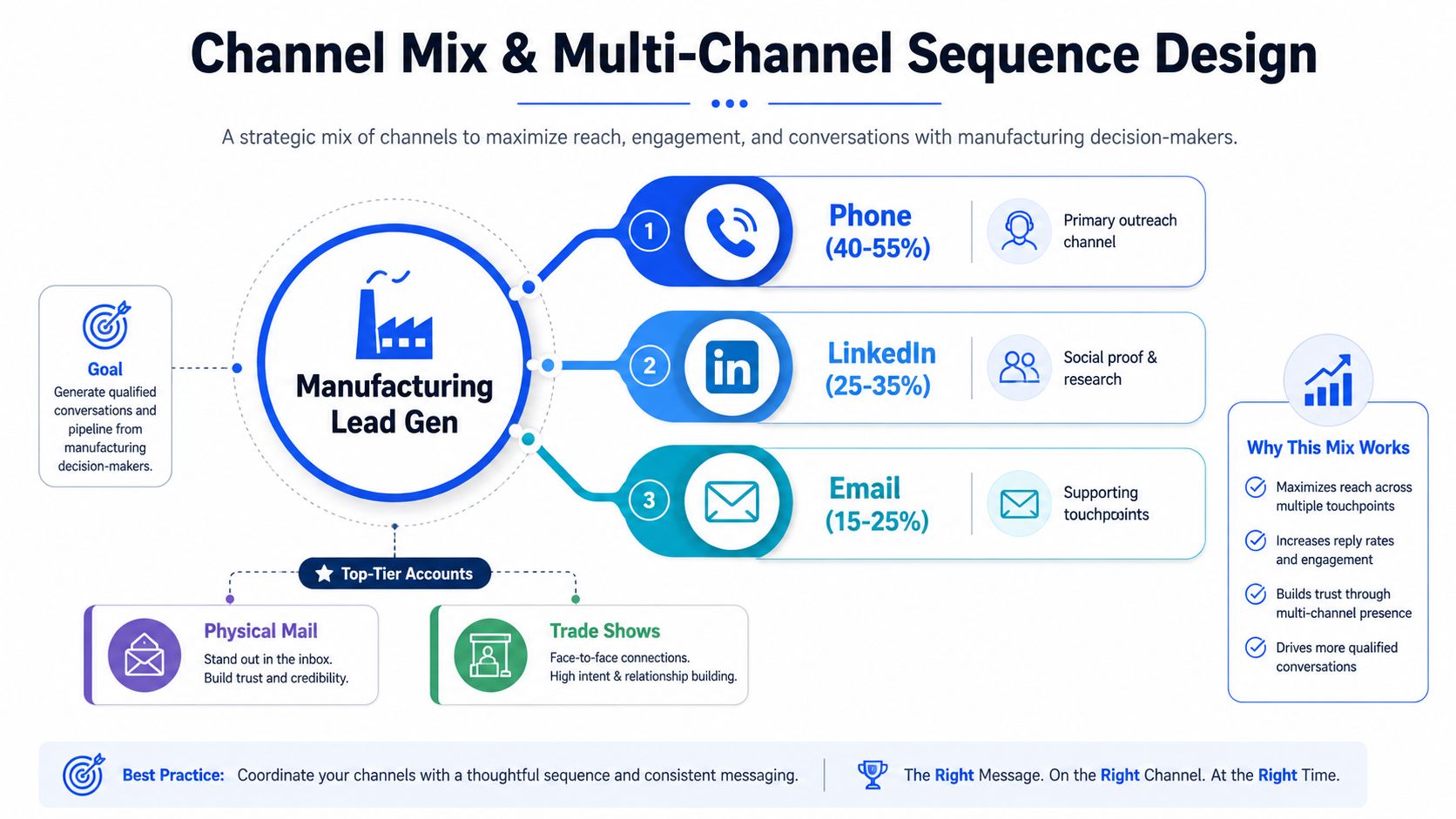
The verdict is straightforward. For manufacturing, multi-channel outbound wins, and phone should lead the mix. A practical split is phone at 40% to 55% of qualified conversations, LinkedIn at 25% to 35%, and email at 15% to 25%, with selective physical mail and trade show integration for top-tier accounts.
Why phone carries more weight here
Phone works because manufacturing buyers are more comfortable with it than SaaS buyers, and the conversations are often technical enough that voice is faster than text. Decision-makers are also more reachable by phone in plant and operations settings, which makes the channel matter more than it does in software. That's why single-channel LinkedIn or email sequences underperform when applied unchanged.
LinkedIn still matters, but mostly as support. It helps detect signal, warm up the account, and create familiarity before the call. Email is even more of a support channel, useful for documentation, follow-up, and content delivery rather than first contact.
Use a 21-day cadence that coordinates the channels instead of forcing them to compete. Start with a call and a LinkedIn view, follow with a short message tied to a public signal, then send an email that references the same reason for outreach. Repeat with a different angle, not a louder version of the same ask.
One of the easiest mistakes is ignoring deliverability until the sequence has already started failing. For practical checks, MailGenius is useful when you want to test whether the inbox setup and sender reputation are holding up before you scale volume.
Guardrails that keep the sequence alive
For email outbound, bulk-sender rules apply at roughly 5,000 or more messages per day to Gmail addresses, and senders need SPF, DKIM, and DMARC, plus one-click unsubscribe support and spam complaint rates under 0.3%, with 0.1% treated as the safer operating target (sender.net). That's not optional if you care about volume.
LinkedIn pacing matters too. Current guidance puts connection requests at about 100 invitations per rolling seven-day window, while InMail credits vary by plan, with Sales Navigator Core at 50 credits per month and Premium Business at 15 (overloop.com). Pushing past that won't help if the account health drops.
If you need a broader outbound systems reference, GROU's outbound guide fits the same logic. The point is to build a sequence where each touch makes the next touch more likely to land.
Messaging technical manufacturing buyers respond to
A controls engineer reading a vendor email does not care that the copy sounds polished. They care whether the sender understands the plant environment, the integration points, and the implementation trade-offs. A message that names SCADA-to-ERP integration, Rockwell-based environments, OPC-UA data feeds, and the 250ms latency issue will usually earn more attention than a generic value pitch, because it sounds like it came from someone who has seen the problem before.
Executive version versus technical version
The executive version usually reads cleanly, but it stays too broad. It talks about efficiency, cost, and ROI. That can work with senior buyers, yet it often misses operations leaders because it never names the day-to-day issue.
The technical version is plainer and more useful. It names the constraint, acknowledges complexity, and asks for a small next step. That tone signals peer-level understanding instead of vendor theater.
For manufacturing teams that want to tighten email language around technical audiences, this cold email reference is a practical companion. It works best when the message follows the buyer's operating context, not the internal marketing story.
Executive version | Technical version |
|---|---|
Increase operational efficiency and reduce costs with our operations platform. | The specific challenge with SCADA-to-ERP integration in Rockwell-based environments is timing sync between OPC-UA data feeds and transactional systems. |
We help teams improve ROI and performance. | We've documented approaches to handling the 250ms latency issue most operations teams face. |
Book a demo. | Would you be open to a 20-minute conversation about how similar plants handled this specifically? |
The five adaptations that work
Use technical specificity instead of broad value claims. Mention constraints, because technical buyers spot fake certainty fast. Talk about implementation, not just features. Use jargon only where the buyer already speaks it. Position yourself as a peer, not a vendor.
Practical rule: technical buyers usually reply when they feel understood before they feel sold.
If you want a useful internal benchmark for adapting message depth to role and context, GROU's technical buyer messaging notes pair well with this approach. Keep the copy focused on their problem, and cut the lines that only describe your company.
Reply routing, qualification, and meeting handoff
Fast routing matters because good conversations decay quickly. A reply should hit a target owner within 30 minutes during business hours, then be tagged in HubSpot as positive, neutral, or negative so nothing disappears into inbox noise. If the routing step is slow, the value of the entire sequence drops.
Qualify for manufacturing reality
Manufacturing qualification needs a few extra checks beyond standard BANT. Fit on facility expansion, access to the buying committee, and technical relevance should sit beside budget and timeline. That's because a buyer can have urgency and still be impossible to close if the committee isn't engaged.
The AE handoff brief should be short and specific. Include the signal that triggered outreach, the accounts and stakeholders involved, the technical context, and the next likely objection. If the AE has to go hunting for that context, the meeting starts behind.
A manufacturing AE also needs real technical depth. Buyers sense very quickly whether the person on the call can hold a conversation about operations, quality, or integration without falling back on product marketing language. That's why the handoff brief matters as much as the first reply.
If your team needs a process reference for qualification structure, this lead qualification guide is the right kind of companion. It keeps the handoff disciplined without making it feel bureaucratic.
The handoff isn't admin. It's the first proof that your system respects the buyer's time.
Route the meeting only after the owner knows why the account matters and what signal opened the door. That's what keeps good replies from turning into weak meetings.
KPIs, ROI math, and what to audit this Friday
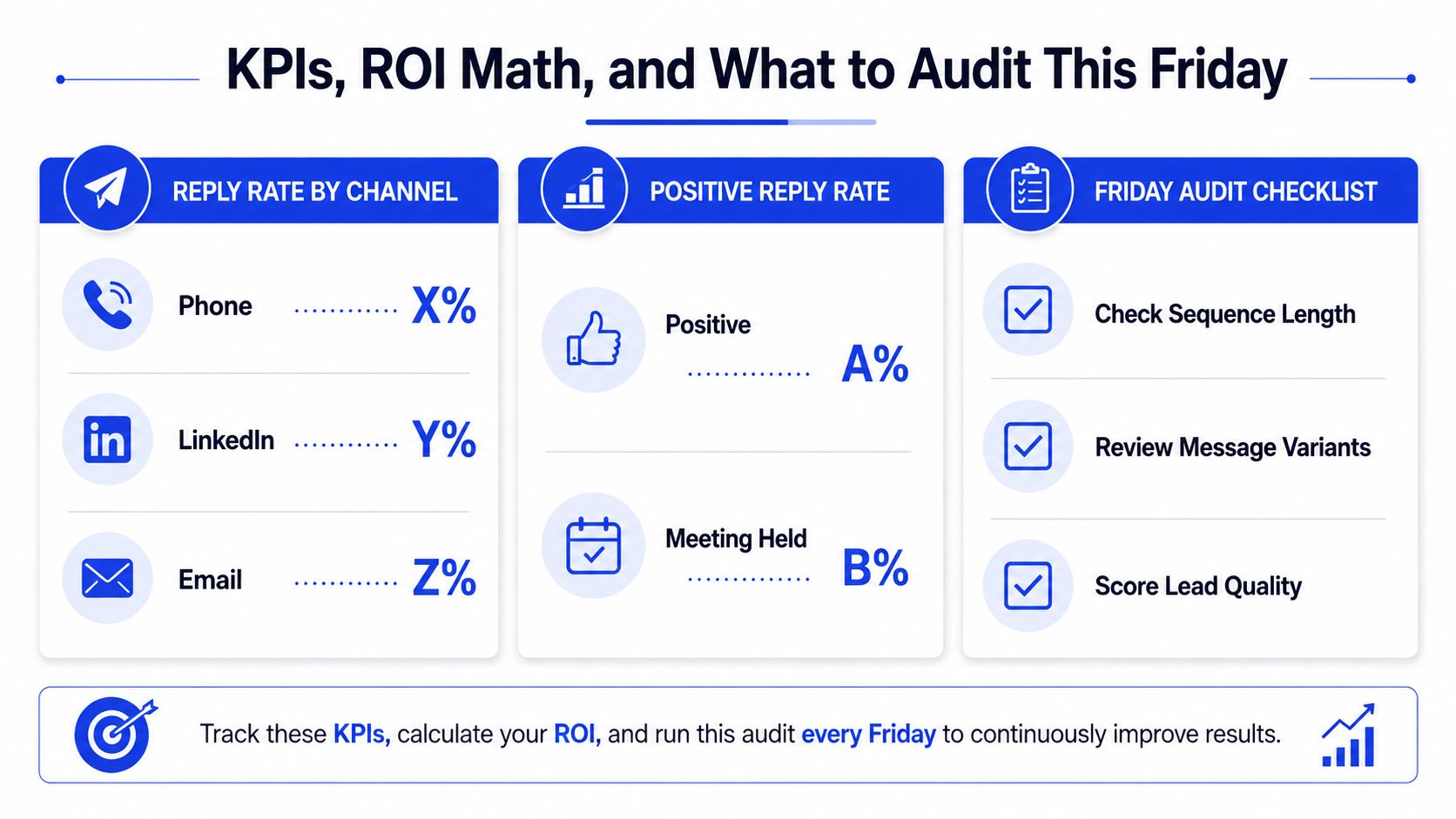
The dashboard should be boring in the right way. Track reply rate by channel, positive reply rate, meeting-held rate, SQL to closed-won conversion, average deal size, cycle length, and ROI ratio. If one of those numbers is missing, the system is leaking and no one can see where.
The math that proves the system
A representative 12-month engagement used €192k in total investment and produced €2.36M in attributable revenue across 16 closed deals, with 78 qualified opportunities and 214 meetings held, for a 12.3x ROI (brief case data). That's the kind of result that only works when list quality, message fit, routing speed, and follow-up discipline all line up.
The broader engagement range in the brief shows why teams should think in ranges, not promises. Representative manufacturing programs landed between €140k and €220k in annual investment and generated 65 to 95 qualified opportunities, 12 to 22 closed deals, and 10x to 15x ROI, depending on signal quality and execution quality (brief data). If any one of those inputs slips, the result changes fast.
For measurement design, Cometly's lead generation tracking guide is a useful reference point when you're tightening attribution across phone, LinkedIn, and email. You don't need more dashboards, you need better source discipline.
What to audit this Friday
Pull the last 90 days of replies from HubSpot or your CRM, then sort them by positive reply rate by channel. Look for the single biggest leak, maybe phone is getting replies but the meeting-held rate is weak, or email is getting opens without meeting conversion. Fix the biggest leak first.
Add one more check. Review the accounts that converted fastest and compare them with the accounts that stalled. If the fast ones shared a public expansion signal and a recent executive change, your targeting is working. If not, the problem is upstream.
Need a quick next step? Audit your meeting-held rate this Friday, then add the signal source and reply reason columns to the CRM before Monday. GROU works with B2B teams across manufacturing and other complex sales motions, building one message, one target list, and one reporting line. If you want a manufacturing-specific outbound system that turns attention into pipeline, visit Grou.
Your manufacturing pipeline's stuck because the list is broad, the outreach sounds like SaaS, and the handoff is slow. Buyers are researching on their own for most of the journey, and by the time they answer, they've usually already compared vendors and shaped requirements. If your current programme is built around LinkedIn blasts, generic email, and firmographics alone, it's probably generating activity, not pipeline.
Phone has to lead in manufacturing, because voice handles technical nuance better than text and reaches people who won't engage in SaaS-style digital-only cadences.
Compound signals beat firmographics, especially when capacity expansion lines up with executive tenure windows.
Technical buyer messaging matters, because engineers and operations leaders reject vague value claims fast.
Measurement has to be strict, or you'll keep funding low-quality demand and calling it lead generation.
Table of Contents
What most manufacturing lead generation programmes get wrong
Most manufacturing teams don't have a lead problem. They have a structure problem. They copy a SaaS cadence, aim at industry plus headcount, and expect LinkedIn or email to carry the load, even though industrial buyers spend about 66% of the buying process online, 84% use search engines to find suppliers, and 96% research before speaking with sales (supplyco.ai).
That gap shows up fast in the pipeline. Buyers often wait until roughly 65% of the journey before talking to sellers, and one benchmark found the average sales cycle was 130 to 158 days with buying committees of 6 to 11 stakeholders (supplyco.ai). If your first touch is a cold form fill request, you're already late.
The common failure pattern
Manufacturing teams tend to overvalue volume signals and undervalue readiness. Email is usually the most common tactic, yet top-of-funnel content is often the most effective one in the same environment (consideredcontent.com). That mismatch tells you everything. The market rewards relevance and timing, not just more sends.
A lot of programmes also lean on events because they feel tangible. But one benchmark found 57% of manufacturers got fewer than 20 leads per trade show, while 98% said they generate sales-qualified leads through digital marketing, and the average visitor-to-lead conversion rate was only 5% to 8% for those tracking website leads (consideredcontent.com). That's not a case for abandoning events, it's a case for building the digital layer that makes events and outbound useful.
Practical rule: if a programme can't show where signals came from, who saw them, and when follow-up happened, it's not a system. It's a set of disconnected activities.
For a useful reference point on how industrial buying journeys are shaped, the Call Loop breakdown of key metrics for B2B buyer journeys is worth keeping open while you review your own funnel.
The design shift is simple. Stop thinking in terms of one channel, one form, one “lead.” Start thinking in terms of phone-primary multi-channel execution, compound fit signals, technical-buyer messaging, and tight measurement. That's the structure. Everything else is decoration.
Defining the manufacturing ICP and compound fit signals
The worst manufacturing ICPs are just cleaned-up firmographics. Industry, geography, and employee count matter, but they don't tell you whether a buyer is in a window where change is likely. A better filter adds structural fit and then overlays a buying trigger with a mandate window.
Build the ICP in three layers
Start with the firmographic base, then add operating context. For many manufacturers, that means sector, size, and territory, plus whether the buying committee is large, the technical environment is complex, or regulatory pressure is high. After that, look for a real reason to act now.
The strongest compound signal we've used is capacity expansion plus executive tenure pattern. Capacity expansion is public, but most agencies don't monitor it consistently. When it lines up with an executive who has been in role long enough to make changes, the odds improve materially.
A useful internal reference for how to frame ICP work is GROU's ICP guide, but the core idea stays the same, fit needs context. If you only target by size and industry, you'll spend too much on buyers who look right on paper and aren't ready to buy.
Signal component | What to monitor | Tenure window | Why it works |
|---|---|---|---|
Capacity expansion | Facility announcements, permits, hiring, equipment buys, partner announcements | N/A | Suggests a real buying trigger |
CEO tenure | Public bios, leadership changes, company updates | 12 to 24 months | Often inside the strategic evaluation window |
Operations lead tenure | Role changes, LinkedIn updates, company news | 6 to 18 months | Common transformation window |
CFO tenure | Executive bios, filings, leadership posts | 12 to 24 months | Signals financial review and initiative approval |
Board changes | Board announcements, shareholder updates | Within 12 months | Often linked to direction shifts |
Why the compound filter wins
The compound filter matters because one signal alone is too loose. In one manufacturing example, a base list of 4,200 companies narrowed to 780 when capacity expansion and executive tenure were combined, and reply rate moved from 9.2% to 21.4% (the engagement example in the brief). That kind of lift isn't magic, it's focus.
Buy readiness isn't a demographic. It's a moment.
Use Clay for orchestration, LinkedIn Sales Navigator for executive verification, and news monitoring for public expansion alerts. Then keep a documented scoring rubric so the team can review and adjust it every week. If the criteria can't be explained in one meeting, they're too vague to scale.
Building and enriching the prospect list
Once the fit criteria are set, the work turns operational. Pull the base list from Apollo or LinkedIn Sales Navigator, then enrich it with public expansion evidence, executive tenure data, and contactability. The key is to verify the compound signal before a rep ever touches the account.
Fields that matter
The fields that usually separate a usable list from a noisy one are straightforward. You need decision-maker role, facility expansion date, recent executive change, and direct phone line availability. In manufacturing, that last field often matters more than people expect, because the phone can become the fastest path to a real conversation.
Use Clay as the stitching layer, because it can combine data from multiple sources without making the process brittle. Apollo helps populate the initial universe, and Sales Navigator helps confirm the person and the role. Then one human review step should check the top decile for signal quality and obvious mismatches.
Operational rule: if a record can't survive manual review in the top decile, don't let it into sequence design.
Keep the review step narrow. The point isn't to read every account by hand, it's to catch the bad fits before they waste cadence capacity. That includes role drift, outdated bios, and expansion signals that are too old to matter. In manufacturing, stale signals cost you time fast.
A good list should also be routed by account type. High-value industrial accounts deserve different treatment than lower-complexity prospects, and that difference should show up in messaging, send volume, and channel mix. If you want a reference for the mechanics of list building and segmentation, this lead list framework is a useful companion.
The output you want is simple, not messy. A named account list, a visible signal trail, a clear routing rule, and a rep-ready owner for each account. Anything less means your “list” is still just a database export.
Channel mix and multi-channel sequence design
The verdict is straightforward. For manufacturing, multi-channel outbound wins, and phone should lead the mix. A practical split is phone at 40% to 55% of qualified conversations, LinkedIn at 25% to 35%, and email at 15% to 25%, with selective physical mail and trade show integration for top-tier accounts.
Why phone carries more weight here
Phone works because manufacturing buyers are more comfortable with it than SaaS buyers, and the conversations are often technical enough that voice is faster than text. Decision-makers are also more reachable by phone in plant and operations settings, which makes the channel matter more than it does in software. That's why single-channel LinkedIn or email sequences underperform when applied unchanged.
LinkedIn still matters, but mostly as support. It helps detect signal, warm up the account, and create familiarity before the call. Email is even more of a support channel, useful for documentation, follow-up, and content delivery rather than first contact.
Use a 21-day cadence that coordinates the channels instead of forcing them to compete. Start with a call and a LinkedIn view, follow with a short message tied to a public signal, then send an email that references the same reason for outreach. Repeat with a different angle, not a louder version of the same ask.
One of the easiest mistakes is ignoring deliverability until the sequence has already started failing. For practical checks, MailGenius is useful when you want to test whether the inbox setup and sender reputation are holding up before you scale volume.
Guardrails that keep the sequence alive
For email outbound, bulk-sender rules apply at roughly 5,000 or more messages per day to Gmail addresses, and senders need SPF, DKIM, and DMARC, plus one-click unsubscribe support and spam complaint rates under 0.3%, with 0.1% treated as the safer operating target (sender.net). That's not optional if you care about volume.
LinkedIn pacing matters too. Current guidance puts connection requests at about 100 invitations per rolling seven-day window, while InMail credits vary by plan, with Sales Navigator Core at 50 credits per month and Premium Business at 15 (overloop.com). Pushing past that won't help if the account health drops.
If you need a broader outbound systems reference, GROU's outbound guide fits the same logic. The point is to build a sequence where each touch makes the next touch more likely to land.
Messaging technical manufacturing buyers respond to
A controls engineer reading a vendor email does not care that the copy sounds polished. They care whether the sender understands the plant environment, the integration points, and the implementation trade-offs. A message that names SCADA-to-ERP integration, Rockwell-based environments, OPC-UA data feeds, and the 250ms latency issue will usually earn more attention than a generic value pitch, because it sounds like it came from someone who has seen the problem before.
Executive version versus technical version
The executive version usually reads cleanly, but it stays too broad. It talks about efficiency, cost, and ROI. That can work with senior buyers, yet it often misses operations leaders because it never names the day-to-day issue.
The technical version is plainer and more useful. It names the constraint, acknowledges complexity, and asks for a small next step. That tone signals peer-level understanding instead of vendor theater.
For manufacturing teams that want to tighten email language around technical audiences, this cold email reference is a practical companion. It works best when the message follows the buyer's operating context, not the internal marketing story.
Executive version | Technical version |
|---|---|
Increase operational efficiency and reduce costs with our operations platform. | The specific challenge with SCADA-to-ERP integration in Rockwell-based environments is timing sync between OPC-UA data feeds and transactional systems. |
We help teams improve ROI and performance. | We've documented approaches to handling the 250ms latency issue most operations teams face. |
Book a demo. | Would you be open to a 20-minute conversation about how similar plants handled this specifically? |
The five adaptations that work
Use technical specificity instead of broad value claims. Mention constraints, because technical buyers spot fake certainty fast. Talk about implementation, not just features. Use jargon only where the buyer already speaks it. Position yourself as a peer, not a vendor.
Practical rule: technical buyers usually reply when they feel understood before they feel sold.
If you want a useful internal benchmark for adapting message depth to role and context, GROU's technical buyer messaging notes pair well with this approach. Keep the copy focused on their problem, and cut the lines that only describe your company.
Reply routing, qualification, and meeting handoff
Fast routing matters because good conversations decay quickly. A reply should hit a target owner within 30 minutes during business hours, then be tagged in HubSpot as positive, neutral, or negative so nothing disappears into inbox noise. If the routing step is slow, the value of the entire sequence drops.
Qualify for manufacturing reality
Manufacturing qualification needs a few extra checks beyond standard BANT. Fit on facility expansion, access to the buying committee, and technical relevance should sit beside budget and timeline. That's because a buyer can have urgency and still be impossible to close if the committee isn't engaged.
The AE handoff brief should be short and specific. Include the signal that triggered outreach, the accounts and stakeholders involved, the technical context, and the next likely objection. If the AE has to go hunting for that context, the meeting starts behind.
A manufacturing AE also needs real technical depth. Buyers sense very quickly whether the person on the call can hold a conversation about operations, quality, or integration without falling back on product marketing language. That's why the handoff brief matters as much as the first reply.
If your team needs a process reference for qualification structure, this lead qualification guide is the right kind of companion. It keeps the handoff disciplined without making it feel bureaucratic.
The handoff isn't admin. It's the first proof that your system respects the buyer's time.
Route the meeting only after the owner knows why the account matters and what signal opened the door. That's what keeps good replies from turning into weak meetings.
KPIs, ROI math, and what to audit this Friday
The dashboard should be boring in the right way. Track reply rate by channel, positive reply rate, meeting-held rate, SQL to closed-won conversion, average deal size, cycle length, and ROI ratio. If one of those numbers is missing, the system is leaking and no one can see where.
The math that proves the system
A representative 12-month engagement used €192k in total investment and produced €2.36M in attributable revenue across 16 closed deals, with 78 qualified opportunities and 214 meetings held, for a 12.3x ROI (brief case data). That's the kind of result that only works when list quality, message fit, routing speed, and follow-up discipline all line up.
The broader engagement range in the brief shows why teams should think in ranges, not promises. Representative manufacturing programs landed between €140k and €220k in annual investment and generated 65 to 95 qualified opportunities, 12 to 22 closed deals, and 10x to 15x ROI, depending on signal quality and execution quality (brief data). If any one of those inputs slips, the result changes fast.
For measurement design, Cometly's lead generation tracking guide is a useful reference point when you're tightening attribution across phone, LinkedIn, and email. You don't need more dashboards, you need better source discipline.
What to audit this Friday
Pull the last 90 days of replies from HubSpot or your CRM, then sort them by positive reply rate by channel. Look for the single biggest leak, maybe phone is getting replies but the meeting-held rate is weak, or email is getting opens without meeting conversion. Fix the biggest leak first.
Add one more check. Review the accounts that converted fastest and compare them with the accounts that stalled. If the fast ones shared a public expansion signal and a recent executive change, your targeting is working. If not, the problem is upstream.
Need a quick next step? Audit your meeting-held rate this Friday, then add the signal source and reply reason columns to the CRM before Monday. GROU works with B2B teams across manufacturing and other complex sales motions, building one message, one target list, and one reporting line. If you want a manufacturing-specific outbound system that turns attention into pipeline, visit Grou.
Your manufacturing pipeline's stuck because the list is broad, the outreach sounds like SaaS, and the handoff is slow. Buyers are researching on their own for most of the journey, and by the time they answer, they've usually already compared vendors and shaped requirements. If your current programme is built around LinkedIn blasts, generic email, and firmographics alone, it's probably generating activity, not pipeline.
Phone has to lead in manufacturing, because voice handles technical nuance better than text and reaches people who won't engage in SaaS-style digital-only cadences.
Compound signals beat firmographics, especially when capacity expansion lines up with executive tenure windows.
Technical buyer messaging matters, because engineers and operations leaders reject vague value claims fast.
Measurement has to be strict, or you'll keep funding low-quality demand and calling it lead generation.
Table of Contents
What most manufacturing lead generation programmes get wrong
Most manufacturing teams don't have a lead problem. They have a structure problem. They copy a SaaS cadence, aim at industry plus headcount, and expect LinkedIn or email to carry the load, even though industrial buyers spend about 66% of the buying process online, 84% use search engines to find suppliers, and 96% research before speaking with sales (supplyco.ai).
That gap shows up fast in the pipeline. Buyers often wait until roughly 65% of the journey before talking to sellers, and one benchmark found the average sales cycle was 130 to 158 days with buying committees of 6 to 11 stakeholders (supplyco.ai). If your first touch is a cold form fill request, you're already late.
The common failure pattern
Manufacturing teams tend to overvalue volume signals and undervalue readiness. Email is usually the most common tactic, yet top-of-funnel content is often the most effective one in the same environment (consideredcontent.com). That mismatch tells you everything. The market rewards relevance and timing, not just more sends.
A lot of programmes also lean on events because they feel tangible. But one benchmark found 57% of manufacturers got fewer than 20 leads per trade show, while 98% said they generate sales-qualified leads through digital marketing, and the average visitor-to-lead conversion rate was only 5% to 8% for those tracking website leads (consideredcontent.com). That's not a case for abandoning events, it's a case for building the digital layer that makes events and outbound useful.
Practical rule: if a programme can't show where signals came from, who saw them, and when follow-up happened, it's not a system. It's a set of disconnected activities.
For a useful reference point on how industrial buying journeys are shaped, the Call Loop breakdown of key metrics for B2B buyer journeys is worth keeping open while you review your own funnel.
The design shift is simple. Stop thinking in terms of one channel, one form, one “lead.” Start thinking in terms of phone-primary multi-channel execution, compound fit signals, technical-buyer messaging, and tight measurement. That's the structure. Everything else is decoration.
Defining the manufacturing ICP and compound fit signals
The worst manufacturing ICPs are just cleaned-up firmographics. Industry, geography, and employee count matter, but they don't tell you whether a buyer is in a window where change is likely. A better filter adds structural fit and then overlays a buying trigger with a mandate window.
Build the ICP in three layers
Start with the firmographic base, then add operating context. For many manufacturers, that means sector, size, and territory, plus whether the buying committee is large, the technical environment is complex, or regulatory pressure is high. After that, look for a real reason to act now.
The strongest compound signal we've used is capacity expansion plus executive tenure pattern. Capacity expansion is public, but most agencies don't monitor it consistently. When it lines up with an executive who has been in role long enough to make changes, the odds improve materially.
A useful internal reference for how to frame ICP work is GROU's ICP guide, but the core idea stays the same, fit needs context. If you only target by size and industry, you'll spend too much on buyers who look right on paper and aren't ready to buy.
Signal component | What to monitor | Tenure window | Why it works |
|---|---|---|---|
Capacity expansion | Facility announcements, permits, hiring, equipment buys, partner announcements | N/A | Suggests a real buying trigger |
CEO tenure | Public bios, leadership changes, company updates | 12 to 24 months | Often inside the strategic evaluation window |
Operations lead tenure | Role changes, LinkedIn updates, company news | 6 to 18 months | Common transformation window |
CFO tenure | Executive bios, filings, leadership posts | 12 to 24 months | Signals financial review and initiative approval |
Board changes | Board announcements, shareholder updates | Within 12 months | Often linked to direction shifts |
Why the compound filter wins
The compound filter matters because one signal alone is too loose. In one manufacturing example, a base list of 4,200 companies narrowed to 780 when capacity expansion and executive tenure were combined, and reply rate moved from 9.2% to 21.4% (the engagement example in the brief). That kind of lift isn't magic, it's focus.
Buy readiness isn't a demographic. It's a moment.
Use Clay for orchestration, LinkedIn Sales Navigator for executive verification, and news monitoring for public expansion alerts. Then keep a documented scoring rubric so the team can review and adjust it every week. If the criteria can't be explained in one meeting, they're too vague to scale.
Building and enriching the prospect list
Once the fit criteria are set, the work turns operational. Pull the base list from Apollo or LinkedIn Sales Navigator, then enrich it with public expansion evidence, executive tenure data, and contactability. The key is to verify the compound signal before a rep ever touches the account.
Fields that matter
The fields that usually separate a usable list from a noisy one are straightforward. You need decision-maker role, facility expansion date, recent executive change, and direct phone line availability. In manufacturing, that last field often matters more than people expect, because the phone can become the fastest path to a real conversation.
Use Clay as the stitching layer, because it can combine data from multiple sources without making the process brittle. Apollo helps populate the initial universe, and Sales Navigator helps confirm the person and the role. Then one human review step should check the top decile for signal quality and obvious mismatches.
Operational rule: if a record can't survive manual review in the top decile, don't let it into sequence design.
Keep the review step narrow. The point isn't to read every account by hand, it's to catch the bad fits before they waste cadence capacity. That includes role drift, outdated bios, and expansion signals that are too old to matter. In manufacturing, stale signals cost you time fast.
A good list should also be routed by account type. High-value industrial accounts deserve different treatment than lower-complexity prospects, and that difference should show up in messaging, send volume, and channel mix. If you want a reference for the mechanics of list building and segmentation, this lead list framework is a useful companion.
The output you want is simple, not messy. A named account list, a visible signal trail, a clear routing rule, and a rep-ready owner for each account. Anything less means your “list” is still just a database export.
Channel mix and multi-channel sequence design
The verdict is straightforward. For manufacturing, multi-channel outbound wins, and phone should lead the mix. A practical split is phone at 40% to 55% of qualified conversations, LinkedIn at 25% to 35%, and email at 15% to 25%, with selective physical mail and trade show integration for top-tier accounts.
Why phone carries more weight here
Phone works because manufacturing buyers are more comfortable with it than SaaS buyers, and the conversations are often technical enough that voice is faster than text. Decision-makers are also more reachable by phone in plant and operations settings, which makes the channel matter more than it does in software. That's why single-channel LinkedIn or email sequences underperform when applied unchanged.
LinkedIn still matters, but mostly as support. It helps detect signal, warm up the account, and create familiarity before the call. Email is even more of a support channel, useful for documentation, follow-up, and content delivery rather than first contact.
Use a 21-day cadence that coordinates the channels instead of forcing them to compete. Start with a call and a LinkedIn view, follow with a short message tied to a public signal, then send an email that references the same reason for outreach. Repeat with a different angle, not a louder version of the same ask.
One of the easiest mistakes is ignoring deliverability until the sequence has already started failing. For practical checks, MailGenius is useful when you want to test whether the inbox setup and sender reputation are holding up before you scale volume.
Guardrails that keep the sequence alive
For email outbound, bulk-sender rules apply at roughly 5,000 or more messages per day to Gmail addresses, and senders need SPF, DKIM, and DMARC, plus one-click unsubscribe support and spam complaint rates under 0.3%, with 0.1% treated as the safer operating target (sender.net). That's not optional if you care about volume.
LinkedIn pacing matters too. Current guidance puts connection requests at about 100 invitations per rolling seven-day window, while InMail credits vary by plan, with Sales Navigator Core at 50 credits per month and Premium Business at 15 (overloop.com). Pushing past that won't help if the account health drops.
If you need a broader outbound systems reference, GROU's outbound guide fits the same logic. The point is to build a sequence where each touch makes the next touch more likely to land.
Messaging technical manufacturing buyers respond to
A controls engineer reading a vendor email does not care that the copy sounds polished. They care whether the sender understands the plant environment, the integration points, and the implementation trade-offs. A message that names SCADA-to-ERP integration, Rockwell-based environments, OPC-UA data feeds, and the 250ms latency issue will usually earn more attention than a generic value pitch, because it sounds like it came from someone who has seen the problem before.
Executive version versus technical version
The executive version usually reads cleanly, but it stays too broad. It talks about efficiency, cost, and ROI. That can work with senior buyers, yet it often misses operations leaders because it never names the day-to-day issue.
The technical version is plainer and more useful. It names the constraint, acknowledges complexity, and asks for a small next step. That tone signals peer-level understanding instead of vendor theater.
For manufacturing teams that want to tighten email language around technical audiences, this cold email reference is a practical companion. It works best when the message follows the buyer's operating context, not the internal marketing story.
Executive version | Technical version |
|---|---|
Increase operational efficiency and reduce costs with our operations platform. | The specific challenge with SCADA-to-ERP integration in Rockwell-based environments is timing sync between OPC-UA data feeds and transactional systems. |
We help teams improve ROI and performance. | We've documented approaches to handling the 250ms latency issue most operations teams face. |
Book a demo. | Would you be open to a 20-minute conversation about how similar plants handled this specifically? |
The five adaptations that work
Use technical specificity instead of broad value claims. Mention constraints, because technical buyers spot fake certainty fast. Talk about implementation, not just features. Use jargon only where the buyer already speaks it. Position yourself as a peer, not a vendor.
Practical rule: technical buyers usually reply when they feel understood before they feel sold.
If you want a useful internal benchmark for adapting message depth to role and context, GROU's technical buyer messaging notes pair well with this approach. Keep the copy focused on their problem, and cut the lines that only describe your company.
Reply routing, qualification, and meeting handoff
Fast routing matters because good conversations decay quickly. A reply should hit a target owner within 30 minutes during business hours, then be tagged in HubSpot as positive, neutral, or negative so nothing disappears into inbox noise. If the routing step is slow, the value of the entire sequence drops.
Qualify for manufacturing reality
Manufacturing qualification needs a few extra checks beyond standard BANT. Fit on facility expansion, access to the buying committee, and technical relevance should sit beside budget and timeline. That's because a buyer can have urgency and still be impossible to close if the committee isn't engaged.
The AE handoff brief should be short and specific. Include the signal that triggered outreach, the accounts and stakeholders involved, the technical context, and the next likely objection. If the AE has to go hunting for that context, the meeting starts behind.
A manufacturing AE also needs real technical depth. Buyers sense very quickly whether the person on the call can hold a conversation about operations, quality, or integration without falling back on product marketing language. That's why the handoff brief matters as much as the first reply.
If your team needs a process reference for qualification structure, this lead qualification guide is the right kind of companion. It keeps the handoff disciplined without making it feel bureaucratic.
The handoff isn't admin. It's the first proof that your system respects the buyer's time.
Route the meeting only after the owner knows why the account matters and what signal opened the door. That's what keeps good replies from turning into weak meetings.
KPIs, ROI math, and what to audit this Friday
The dashboard should be boring in the right way. Track reply rate by channel, positive reply rate, meeting-held rate, SQL to closed-won conversion, average deal size, cycle length, and ROI ratio. If one of those numbers is missing, the system is leaking and no one can see where.
The math that proves the system
A representative 12-month engagement used €192k in total investment and produced €2.36M in attributable revenue across 16 closed deals, with 78 qualified opportunities and 214 meetings held, for a 12.3x ROI (brief case data). That's the kind of result that only works when list quality, message fit, routing speed, and follow-up discipline all line up.
The broader engagement range in the brief shows why teams should think in ranges, not promises. Representative manufacturing programs landed between €140k and €220k in annual investment and generated 65 to 95 qualified opportunities, 12 to 22 closed deals, and 10x to 15x ROI, depending on signal quality and execution quality (brief data). If any one of those inputs slips, the result changes fast.
For measurement design, Cometly's lead generation tracking guide is a useful reference point when you're tightening attribution across phone, LinkedIn, and email. You don't need more dashboards, you need better source discipline.
What to audit this Friday
Pull the last 90 days of replies from HubSpot or your CRM, then sort them by positive reply rate by channel. Look for the single biggest leak, maybe phone is getting replies but the meeting-held rate is weak, or email is getting opens without meeting conversion. Fix the biggest leak first.
Add one more check. Review the accounts that converted fastest and compare them with the accounts that stalled. If the fast ones shared a public expansion signal and a recent executive change, your targeting is working. If not, the problem is upstream.
Need a quick next step? Audit your meeting-held rate this Friday, then add the signal source and reply reason columns to the CRM before Monday. GROU works with B2B teams across manufacturing and other complex sales motions, building one message, one target list, and one reporting line. If you want a manufacturing-specific outbound system that turns attention into pipeline, visit Grou.
Pipeline OS Newsletter
Build qualified pipeline
Get weekly tactics to generate demand, improve lead quality, and book more meetings.





Trusted by industry leaders
Trusted by industry leaders
Trusted by industry leaders
Ready to build qualified pipeline?
Ready to build qualified pipeline?
Ready to build qualified pipeline?
Book a call to see if we're the right fit, or take the 2-minute quiz to get a clear starting point.
Book a call to see if we're the right fit, or take the 2-minute quiz to get a clear starting point.
Book a call to see if we're the right fit, or take the 2-minute quiz to get a clear starting point.
" height="30.21639343089746px" id="hfGbXmQR2" width="30.216393430897455px"/></svg>)
Copyright © 2026 – All Right Reserved
Copyright © 2026 – All Right Reserved
Copyright © 2026 – All Right Reserved