%22%3E%3C/path%3E%3Cpath d=%22M 63.072 7.554 C 62.258 8.022 61.577 8.689 61.092 9.493 L 61.092 7.076 L 57.158 7.076 L 57.158 22.64 L 61.089 22.64 L 61.089 14.888 C 61.089 13.446 61.403 12.434 62.03 11.853 C 62.818 11.218 63.818 10.907 64.826 10.982 L 65.868 10.982 L 65.868 6.851 C 64.891 6.834 63.926 7.076 63.073 7.554 Z%22 fill=%22rgb(17,17,17)%22%3E%3C/path%3E%3Cpath d=%22M 78.916 7.82 C 76.363 6.49 73.321 6.49 70.768 7.82 C 69.562 8.473 68.564 9.451 67.888 10.644 C 67.167 11.931 66.803 13.387 66.834 14.862 C 66.804 16.332 67.157 17.785 67.86 19.077 C 68.515 20.267 69.494 21.246 70.684 21.901 C 71.924 22.576 73.318 22.92 74.73 22.898 C 76.164 22.918 77.58 22.575 78.846 21.901 C 80.062 21.247 81.073 20.27 81.768 19.077 C 82.506 17.797 82.88 16.339 82.85 14.862 C 82.88 13.389 82.517 11.934 81.797 10.647 C 81.12 9.455 80.122 8.477 78.917 7.824 M 78.803 14.862 C 78.829 15.739 78.636 16.608 78.241 17.391 C 77.903 18.046 77.38 18.588 76.738 18.95 C 76.124 19.293 75.432 19.472 74.729 19.47 C 73.668 19.497 72.648 19.061 71.934 18.276 C 71.139 17.323 70.741 16.1 70.823 14.862 C 70.741 13.62 71.149 12.395 71.959 11.45 C 72.687 10.667 73.715 10.233 74.783 10.256 C 75.859 10.236 76.894 10.67 77.635 11.45 C 78.464 12.387 78.884 13.616 78.801 14.864%22 fill=%22rgb(17,17,17)%22%3E%3C/path%3E%3Cpath d=%22M 95.906 7.076 L 95.906 15.646 C 95.975 16.68 95.643 17.701 94.979 18.498 C 94.311 19.184 93.379 19.547 92.422 19.495 C 91.475 19.544 90.553 19.18 89.894 18.498 C 89.23 17.701 88.898 16.68 88.967 15.646 L 88.967 7.076 L 85.033 7.076 L 85.033 16.207 C 85 17.449 85.275 18.68 85.834 19.79 C 86.327 20.75 87.095 21.542 88.039 22.065 C 89.033 22.594 90.145 22.861 91.271 22.838 C 92.188 22.847 93.095 22.65 93.926 22.263 C 94.708 21.905 95.388 21.36 95.906 20.675 L 95.906 22.645 L 99.865 22.645 L 99.865 7.076 Z%22 fill=%22rgb(17,17,17)%22%3E%3C/path%3E%3Cpath d=%22M 4.513 15.626 C 4.511 10.815 7.606 6.549 12.181 5.059 C 16.756 3.57 21.77 5.195 24.601 9.086 L 27.816 5.87 C 24.074 1.186 17.981 -0.943 12.137 0.393 C 6.292 1.728 1.728 6.292 0.393 12.137 C -0.943 17.981 1.186 24.074 5.87 27.816 L 9.085 24.601 C 6.214 22.512 4.515 19.177 4.513 15.626%22 fill=%22rgb(32,62,235)%22%3E%3C/path%3E%3Cpath d=%22M 17.114 14.343 L 13.354 18.01 L 13.354 18.026 L 21.071 18.026 L 11.412 27.609 L 17.389 27.609 L 23.999 21.081 L 23.999 28.316 L 24.005 28.316 L 27.967 24.393 L 27.967 14.343 Z%22 fill=%22rgb(32,62,235)%22%3E%3C/path%3E%3C/g%3E%3C/svg%3E) ×
× ××
××›
›
›
›
Marketing for consulting firms: the 2026 growth playbook
Marketing for consulting firms: the 2026 growth playbook
Marketing for consulting firms: the 2026 growth playbook
Marketing for consulting firms: the 2026 growth playbook
Marketing for consulting firms: the 2026 growth playbook
Marketing for consulting firms: the 2026 growth playbook

Author
Aljaz Peklaj

Your pipeline looks active, but too many “interested” conversations stall before they become revenue. That usually isn't a lead problem. It's a system problem, and in consulting, structure turns attention into pipeline.
Tighten the offer around a narrow ICP, so the wrong prospects self-filter out early.
Use diagnostic LinkedIn content, not generic tips, to attract worried buyers.
Route replies fast, with clear qualification rules and one reporting line.
Track ROI by qualified opportunity and closed revenue, not by vanity engagement.
Build outbound around content, so warm accounts get handled by sales while intent is fresh.
Table of Contents
Why most consulting marketing creates interest but not pipeline
How consulting firms actually win clients and what to budget for it
Demand generation that compounds LinkedIn content with outbound
Lead qualification routing and case study PR that proves outcomes
Why most consulting marketing creates interest but not pipeline
Consulting marketing often looks busy and still underperforms where it matters. The LinkedIn posts get likes, the website gets visits, and the inbox gets a few polite replies, but revenue barely changes. That gap usually comes from loose targeting, vague positioning, and weak follow-up, not from a lack of activity.
Broad awareness is expensive in consulting because buyers don't buy on impulse. They buy when the risk feels manageable, the problem feels specific, and the firm looks credible enough to justify an internal decision. If the message is generic, the market files it away as background noise.
Practical rule: if a prospect can forward your message to three competitors without changing a word, it's too broad.
The fix starts with a smaller target and a sharper diagnosis. Tight ICP filters, practitioner-led content, and disciplined routing do more than increase reply volume. They make the right accounts easier to recognize and faster to move.
For a useful companion to this mindset, RedactAI's playbook for consultants is worth a read because it treats content as a trust asset, not a volume game. The deeper conversion issue inside many firms shows up in the handoff, which we've unpacked in why your leads aren't converting and how to fix it.
The real failure point
The market doesn't punish effort. It punishes ambiguity. A firm can publish consistently, run outbound every week, and still create no pipeline if the offer sounds like every other advisory firm in the category.
That's why the operating question isn't “how do we get more leads?” It's “which messages get the right buyer to raise a hand for the right reason?” The answer usually isn't a bigger top of funnel. It's a tighter filter on who should enter it in the first place.
How consulting firms actually win clients and what to budget for it
Consulting is a trust-led market, so marketing has to do trust transfer before it does demand capture. Referrals and repeat clients still dominate acquisition, with one industry source saying 70% to 90% of revenue often comes from those channels, and a practitioner summary showing 63% of consultants name referrals and networking as their strongest channel, ahead of social media at 25% (source). That pattern makes sense when buying risk is high and proof is hard to verify in advance.
Budget follows revenue infrastructure, not decoration
Typical consulting and professional services spend lands around 8% to 12% of revenue, and one consulting benchmark says high-growth firms allocate a median of 11.0% of revenue to marketing, versus 5.0% for no-growth firms (source). The point isn't to copy a ratio blindly. The point is that marketing in this category functions more like revenue infrastructure than discretionary promotion.
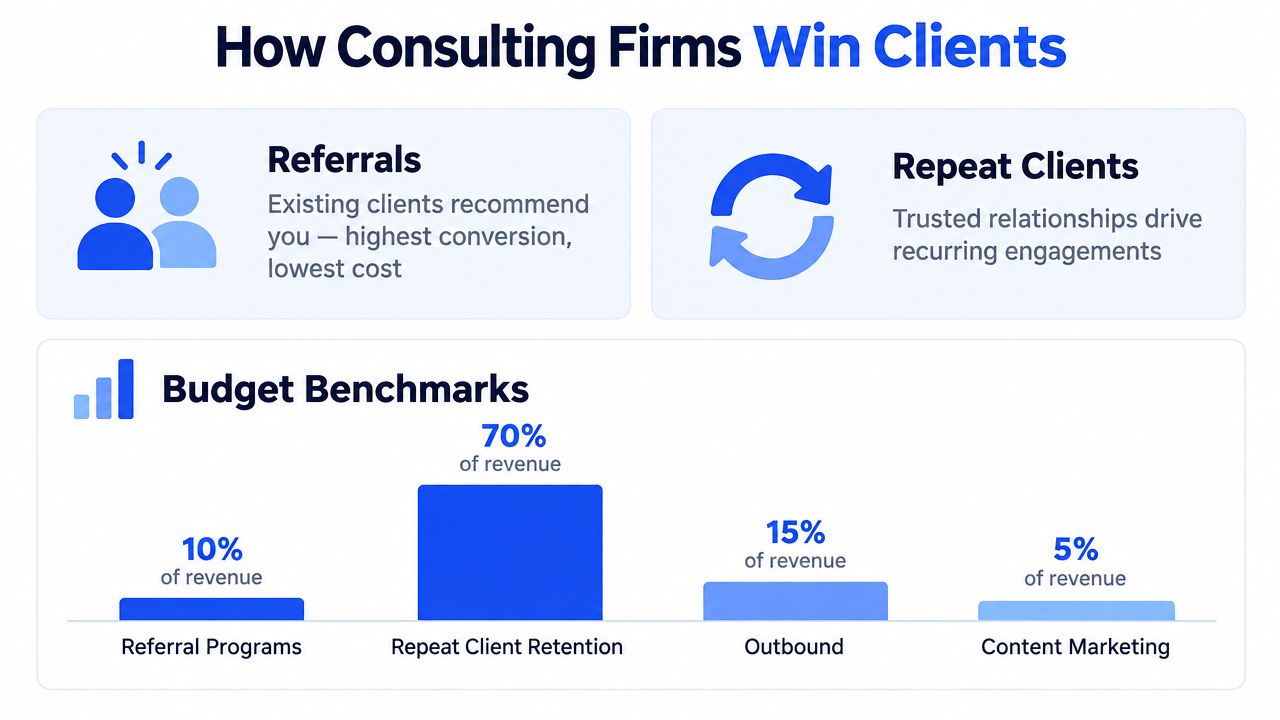
That budget has to support trust transfer. You're not buying reach for its own sake, you're building a system that makes a specific buyer feel understood before sales ever reaches out. Niche specialization helps because it gives the market a clean memory hook, and outcome-based messaging helps because buyers care about financial stability, productivity, and cost reduction more than generic expertise.
Recent coverage of the consulting market points toward AI integration, data analytics, and performance-based contracts, while independent outlook research says referrals, networking, and past relationships are becoming less reliable in a crowded, AI-influenced market (source, source). That combination pushes firms toward a multi-channel pipeline, not because channels are trendy, but because the old dependency model is fraying.
Design for trust transfer
The best consulting systems don't chase raw volume first. They amplify a small set of high-fit relationships through content, proof, and follow-up. That's the right model for firms in iGaming, SaaS, manufacturing, legal tech, and pharma, where the buyer wants relevance and proof, not noise.
If you're budgeting for consulting marketing, fund the assets that make a buyer say, “they get our problem.” That's the bridge from interest to pipeline.
Positioning and ICP that makes the right buyers self select
Positioning by credentials is easy to copy. Positioning by proof is harder, because it depends on numbers, cases, and honest limits that other firms can't fake. The most defensible expert identity comes from proprietary results, visible system design, and the willingness to say what won't work for everyone.
Build proof that competitors can't reproduce
Lead with your own evidence. That can be a closed-won pattern, a repeatable sequence structure, or a clear before-and-after story tied to a specific market segment. If you have to pad it with buzzwords, the positioning isn't sharp enough.
The other differentiator is uncomfortable honesty. If a channel is a weak fit for a buyer, say so. If the timeline is slower than they want, say so. That kind of clarity filters out spectators and attracts the worried buyer who's already halfway to a conversation.
Buyers don't reward the firm that sounds most polished. They reward the firm that sounds most believable under scrutiny.
Tighten the ICP before the funnel starts
A narrow ICP should be defined by more than industry. Add company size, pain point severity, buying trigger, internal stakeholder pattern, and the consequences of inaction. If a prospect doesn't match those filters, don't force them into nurture and hope a sequence fixes it later.
Signal-triggered intake matters. Route inbound forms, LinkedIn replies, and referral handoffs through the same qualification logic. Then reverse-engineer your closed-won accounts so the criteria reflect reality, not assumption. The point is to stop wasting sales time on leads that were never aligned.
For a deeper framework on profile design, GROU's ICP guide is useful because it treats fit as an operational filter, not a slide deck exercise.
Use a visible system, not a personality
The strongest positioning is repeatable enough that prospects can see how it works. One practical model is a three-tier personalization structure, where the first layer is industry-level relevance, the second is role-level pain, and the third is account-specific context. That structure keeps the message from sounding mass-produced.
One helpful rule is simple. If the wrong buyer can see themselves in the message, the ICP is still too loose. If the right buyer recognizes their own headache immediately, the positioning is doing its job.
Demand generation that compounds LinkedIn content with outbound
The format that pulls the best qualified leads is the diagnostic LinkedIn post, the one that names a costly mistake and explains why the obvious fix makes it worse. Tips content tends to attract peers and juniors who enjoy the idea, while mistake-and-diagnosis content attracts the buyer who thinks, “that's us.” That's why the format wins on lead quality, not just engagement.
Diagnostic content beats generic advice
A good diagnostic post doesn't try to be broadly useful. It narrows the reader into a painful realization. The “expensive mistake” angle works because it self-selects the worried buyer and repels people who aren't ready to act.
The strongest second format is the metric-led, industry-matched case study. Generic “we help firms grow” stories don't carry weight. But a case study that mirrors the reader's world, with a real number and a recognizable problem, gives them something concrete to react to.
For content planning and distribution structure, GROU's LinkedIn content strategy fits this model well because it connects message angle to pipeline behavior rather than treating posting as a vanity metric exercise.
Build outbound around the content, not apart from it
Once a post lands, the outbound motion should harvest the warm accounts. That means building lists in Apollo or Sales Navigator, enriching with Clay, sequencing through Lemlist, Instantly, or Smartlead, and using HeyReach when you need coordinated LinkedIn outreach. HubSpot should stay as the system of record so reply handling, qualification, and task ownership don't get lost.
The process is straightforward. Build a tight account list. Enrich contacts. Send the diagnostic post to matched prospects. Then follow up with a sequence that references the exact pain the content surfaced.
The sequence should feel like a continuation of the post, not a separate campaign.
If you want faster idea discovery, a LinkedIn content intelligence platform helps surface what's already resonating in your niche, which is more useful than guessing at topics from scratch.
Set expectations with real platform signals
On LinkedIn company pages, Oktopost's Q1 2026 benchmark found a median engagement rate of 5.10%, with the 75th percentile at 8.61% and the 90th percentile at 21.63% (source). The same report says the median B2B LinkedIn post generated about 40 engagements and 780 impressions (source). That's the right lens for a repeatable program.
The outbound side is much harsher. Belkins' 2025 study reported an average reply rate of 0.45% across 7.53 million high-volume cold emails (source). That's a strong argument for targeting and sequencing over volume.
Lead qualification routing and case study PR that proves outcomes
Once someone raises a hand, speed and rules decide whether the opportunity gets real. If marketing hands sales a fuzzy lead, the rep chases. If marketing hands sales a qualified account with context, the rep closes. The handoff has to be strict enough that the team doesn't waste time debating fit after the fact.
Define the routing rules before the first reply
A clean routing system should separate MQL, SQL, and meeting held with no ambiguity. Each stage needs a written definition, a single owner, and a timestamped SLA. If the reply fits the ICP and the pain is urgent, route it fast. If it doesn't, park it in nurture instead of forcing the pipeline.
The best teams I've seen keep qualification narrow. They don't count every intro call as progress. They count qualified meetings only when the account matches the profile, the pain is live, and the next step is clear.
For a practical structure on the handoff itself, GROU's lead qualification process is a useful reference because it treats qualification as a routing decision, not a loose sales habit.
Use case studies as sales assets, not content trophies
Case studies should mirror the reader's situation with a real number and a clear operating change. That means industry-matched, metric-led, and short enough to use in outbound. A prospect should be able to read one and immediately know whether it applies to them.
Distribute those stories in two places. First, post them on LinkedIn to build familiarity. Second, drop them into outbound sequences where the prospect already has context. That's where proof turns into a meeting, because the buyer sees evidence attached to a problem they already recognize.
A strong one-pager usually includes the problem, the constraint, the action, and the result. Leave out decorative language. Leave in the decision logic.
Keep the CRM honest
Your CRM should show where a lead entered, who owns it, and why it moved. If the record doesn't explain the qualification logic, the system will drift back into opinion. This is one area where a clean pipeline structure matters more than many realize, because sales can only act fast when the data is clean enough to trust.
The aim is simple. Sales should spend time closing, not chasing.
Measurement and attribution that keeps you honest about ROI
A consulting funnel can look healthy while the pipeline stays thin. Reply rates go up, the content calendar stays full, and the team still spends too much time on leads that will never become real opportunities. Attribution is what keeps that from hiding in plain sight.
Track the layers in order
Start with early signals. Reply rate, positive reply rate, meeting show rate, and deliverability tell you whether the machine is working at all. They are diagnostics, not proof of return.
Then watch the middle layer. Qualified meetings, qualification rate, and cost per qualified opportunity show whether sales is spending time on the right accounts. That is the weekly number I would manage against first.
For the reporting side, Cometly's analysis of marketing attribution data is useful because it supports the multi-touch view consulting teams need when content and outbound work as one system. For a matching framework, our guide to multi-touch attribution gives a practical way to assign credit without pretending one touch did all the work.
Don't let one channel steal credit
Attribution gets messy fast when content warms an account and outbound closes it later. On one SaaS revops program, tracking 28 closed deals showed content at 42% versus 34% from outbound. That split changed where budget and effort went next, even though it was still directional.
That is the point. Content often makes outbound land better, so single-touch reporting hides the compounding effect. If you separate channels too aggressively, you underfund the work that made the reply possible in the first place.
Use a composite Sequence Quality Index if you need one score for comparison. Keep the weighting explicit so nobody can cherry-pick the one metric that looked good that week.
If the dashboard only tells you that activity happened, it is not a revenue report yet.
Steer by qualified opportunity, not vanity volume
Pipeline coverage and closed-won revenue are the scoreboard. Everything above them is a diagnostic tool. If the program creates attention but not qualified opportunities, the usual causes are message fit, routing speed, or list quality.
Clean operators treat attribution as a truth system. It shows what to cut, what to keep, and what deserves more budget. That is more useful than celebrating top-of-funnel volume that never touches revenue.
Resourcing sprint cadence and your next step this week
A small team can run this system if ownership is clear. One person owns the target list, one owns the content angle, one owns outbound and routing, and one owns reporting in HubSpot. You don't need a giant team, you need a clean handoff chain and a shared Slack channel where feedback arrives fast.
The sprint rhythm should be bi-weekly. In week one, publish or refine the diagnostic message, build the matched list, and launch the sequence. In week two, review replies, refine qualifiers, and adjust the next batch based on what the market said.
First signals should show up inside 30 days if the list is tight and the message is specific. If they don't, the fastest diagnosis is usually one of three things, the ICP is too wide, the content isn't uncomfortable enough, or sales is too slow on replies.
Add a qualification column to your CRM by Monday, and make every inbound hand raise pass through the same rule set. If you want a cleaner first move, audit your meeting-held rate this Friday and compare it against your qualification logic. That one check usually shows where the system is leaking.
GROU works with B2B teams across consulting, SaaS, iGaming, manufacturing, legal tech, and pharma, and the work centers on one message, one target list, and one reporting line. The method is built around a single pipeline engine, with content, outbound, and qualification all measured against the same outcome.
If you want this system built around your consulting offer, visit Grou and map your ICP, content angle, and outbound sequence into one pipeline motion. If your current marketing is producing attention but not enough qualified conversations, that's the right place to start.
Your pipeline looks active, but too many “interested” conversations stall before they become revenue. That usually isn't a lead problem. It's a system problem, and in consulting, structure turns attention into pipeline.
Tighten the offer around a narrow ICP, so the wrong prospects self-filter out early.
Use diagnostic LinkedIn content, not generic tips, to attract worried buyers.
Route replies fast, with clear qualification rules and one reporting line.
Track ROI by qualified opportunity and closed revenue, not by vanity engagement.
Build outbound around content, so warm accounts get handled by sales while intent is fresh.
Table of Contents
Why most consulting marketing creates interest but not pipeline
How consulting firms actually win clients and what to budget for it
Demand generation that compounds LinkedIn content with outbound
Lead qualification routing and case study PR that proves outcomes
Why most consulting marketing creates interest but not pipeline
Consulting marketing often looks busy and still underperforms where it matters. The LinkedIn posts get likes, the website gets visits, and the inbox gets a few polite replies, but revenue barely changes. That gap usually comes from loose targeting, vague positioning, and weak follow-up, not from a lack of activity.
Broad awareness is expensive in consulting because buyers don't buy on impulse. They buy when the risk feels manageable, the problem feels specific, and the firm looks credible enough to justify an internal decision. If the message is generic, the market files it away as background noise.
Practical rule: if a prospect can forward your message to three competitors without changing a word, it's too broad.
The fix starts with a smaller target and a sharper diagnosis. Tight ICP filters, practitioner-led content, and disciplined routing do more than increase reply volume. They make the right accounts easier to recognize and faster to move.
For a useful companion to this mindset, RedactAI's playbook for consultants is worth a read because it treats content as a trust asset, not a volume game. The deeper conversion issue inside many firms shows up in the handoff, which we've unpacked in why your leads aren't converting and how to fix it.
The real failure point
The market doesn't punish effort. It punishes ambiguity. A firm can publish consistently, run outbound every week, and still create no pipeline if the offer sounds like every other advisory firm in the category.
That's why the operating question isn't “how do we get more leads?” It's “which messages get the right buyer to raise a hand for the right reason?” The answer usually isn't a bigger top of funnel. It's a tighter filter on who should enter it in the first place.
How consulting firms actually win clients and what to budget for it
Consulting is a trust-led market, so marketing has to do trust transfer before it does demand capture. Referrals and repeat clients still dominate acquisition, with one industry source saying 70% to 90% of revenue often comes from those channels, and a practitioner summary showing 63% of consultants name referrals and networking as their strongest channel, ahead of social media at 25% (source). That pattern makes sense when buying risk is high and proof is hard to verify in advance.
Budget follows revenue infrastructure, not decoration
Typical consulting and professional services spend lands around 8% to 12% of revenue, and one consulting benchmark says high-growth firms allocate a median of 11.0% of revenue to marketing, versus 5.0% for no-growth firms (source). The point isn't to copy a ratio blindly. The point is that marketing in this category functions more like revenue infrastructure than discretionary promotion.
That budget has to support trust transfer. You're not buying reach for its own sake, you're building a system that makes a specific buyer feel understood before sales ever reaches out. Niche specialization helps because it gives the market a clean memory hook, and outcome-based messaging helps because buyers care about financial stability, productivity, and cost reduction more than generic expertise.
Recent coverage of the consulting market points toward AI integration, data analytics, and performance-based contracts, while independent outlook research says referrals, networking, and past relationships are becoming less reliable in a crowded, AI-influenced market (source, source). That combination pushes firms toward a multi-channel pipeline, not because channels are trendy, but because the old dependency model is fraying.
Design for trust transfer
The best consulting systems don't chase raw volume first. They amplify a small set of high-fit relationships through content, proof, and follow-up. That's the right model for firms in iGaming, SaaS, manufacturing, legal tech, and pharma, where the buyer wants relevance and proof, not noise.
If you're budgeting for consulting marketing, fund the assets that make a buyer say, “they get our problem.” That's the bridge from interest to pipeline.
Positioning and ICP that makes the right buyers self select
Positioning by credentials is easy to copy. Positioning by proof is harder, because it depends on numbers, cases, and honest limits that other firms can't fake. The most defensible expert identity comes from proprietary results, visible system design, and the willingness to say what won't work for everyone.
Build proof that competitors can't reproduce
Lead with your own evidence. That can be a closed-won pattern, a repeatable sequence structure, or a clear before-and-after story tied to a specific market segment. If you have to pad it with buzzwords, the positioning isn't sharp enough.
The other differentiator is uncomfortable honesty. If a channel is a weak fit for a buyer, say so. If the timeline is slower than they want, say so. That kind of clarity filters out spectators and attracts the worried buyer who's already halfway to a conversation.
Buyers don't reward the firm that sounds most polished. They reward the firm that sounds most believable under scrutiny.
Tighten the ICP before the funnel starts
A narrow ICP should be defined by more than industry. Add company size, pain point severity, buying trigger, internal stakeholder pattern, and the consequences of inaction. If a prospect doesn't match those filters, don't force them into nurture and hope a sequence fixes it later.
Signal-triggered intake matters. Route inbound forms, LinkedIn replies, and referral handoffs through the same qualification logic. Then reverse-engineer your closed-won accounts so the criteria reflect reality, not assumption. The point is to stop wasting sales time on leads that were never aligned.
For a deeper framework on profile design, GROU's ICP guide is useful because it treats fit as an operational filter, not a slide deck exercise.
Use a visible system, not a personality
The strongest positioning is repeatable enough that prospects can see how it works. One practical model is a three-tier personalization structure, where the first layer is industry-level relevance, the second is role-level pain, and the third is account-specific context. That structure keeps the message from sounding mass-produced.
One helpful rule is simple. If the wrong buyer can see themselves in the message, the ICP is still too loose. If the right buyer recognizes their own headache immediately, the positioning is doing its job.
Demand generation that compounds LinkedIn content with outbound
The format that pulls the best qualified leads is the diagnostic LinkedIn post, the one that names a costly mistake and explains why the obvious fix makes it worse. Tips content tends to attract peers and juniors who enjoy the idea, while mistake-and-diagnosis content attracts the buyer who thinks, “that's us.” That's why the format wins on lead quality, not just engagement.
Diagnostic content beats generic advice
A good diagnostic post doesn't try to be broadly useful. It narrows the reader into a painful realization. The “expensive mistake” angle works because it self-selects the worried buyer and repels people who aren't ready to act.
The strongest second format is the metric-led, industry-matched case study. Generic “we help firms grow” stories don't carry weight. But a case study that mirrors the reader's world, with a real number and a recognizable problem, gives them something concrete to react to.
For content planning and distribution structure, GROU's LinkedIn content strategy fits this model well because it connects message angle to pipeline behavior rather than treating posting as a vanity metric exercise.
Build outbound around the content, not apart from it
Once a post lands, the outbound motion should harvest the warm accounts. That means building lists in Apollo or Sales Navigator, enriching with Clay, sequencing through Lemlist, Instantly, or Smartlead, and using HeyReach when you need coordinated LinkedIn outreach. HubSpot should stay as the system of record so reply handling, qualification, and task ownership don't get lost.
The process is straightforward. Build a tight account list. Enrich contacts. Send the diagnostic post to matched prospects. Then follow up with a sequence that references the exact pain the content surfaced.
The sequence should feel like a continuation of the post, not a separate campaign.
If you want faster idea discovery, a LinkedIn content intelligence platform helps surface what's already resonating in your niche, which is more useful than guessing at topics from scratch.
Set expectations with real platform signals
On LinkedIn company pages, Oktopost's Q1 2026 benchmark found a median engagement rate of 5.10%, with the 75th percentile at 8.61% and the 90th percentile at 21.63% (source). The same report says the median B2B LinkedIn post generated about 40 engagements and 780 impressions (source). That's the right lens for a repeatable program.
The outbound side is much harsher. Belkins' 2025 study reported an average reply rate of 0.45% across 7.53 million high-volume cold emails (source). That's a strong argument for targeting and sequencing over volume.
Lead qualification routing and case study PR that proves outcomes
Once someone raises a hand, speed and rules decide whether the opportunity gets real. If marketing hands sales a fuzzy lead, the rep chases. If marketing hands sales a qualified account with context, the rep closes. The handoff has to be strict enough that the team doesn't waste time debating fit after the fact.
Define the routing rules before the first reply
A clean routing system should separate MQL, SQL, and meeting held with no ambiguity. Each stage needs a written definition, a single owner, and a timestamped SLA. If the reply fits the ICP and the pain is urgent, route it fast. If it doesn't, park it in nurture instead of forcing the pipeline.
The best teams I've seen keep qualification narrow. They don't count every intro call as progress. They count qualified meetings only when the account matches the profile, the pain is live, and the next step is clear.
For a practical structure on the handoff itself, GROU's lead qualification process is a useful reference because it treats qualification as a routing decision, not a loose sales habit.
Use case studies as sales assets, not content trophies
Case studies should mirror the reader's situation with a real number and a clear operating change. That means industry-matched, metric-led, and short enough to use in outbound. A prospect should be able to read one and immediately know whether it applies to them.
Distribute those stories in two places. First, post them on LinkedIn to build familiarity. Second, drop them into outbound sequences where the prospect already has context. That's where proof turns into a meeting, because the buyer sees evidence attached to a problem they already recognize.
A strong one-pager usually includes the problem, the constraint, the action, and the result. Leave out decorative language. Leave in the decision logic.
Keep the CRM honest
Your CRM should show where a lead entered, who owns it, and why it moved. If the record doesn't explain the qualification logic, the system will drift back into opinion. This is one area where a clean pipeline structure matters more than many realize, because sales can only act fast when the data is clean enough to trust.
The aim is simple. Sales should spend time closing, not chasing.
Measurement and attribution that keeps you honest about ROI
A consulting funnel can look healthy while the pipeline stays thin. Reply rates go up, the content calendar stays full, and the team still spends too much time on leads that will never become real opportunities. Attribution is what keeps that from hiding in plain sight.
Track the layers in order
Start with early signals. Reply rate, positive reply rate, meeting show rate, and deliverability tell you whether the machine is working at all. They are diagnostics, not proof of return.
Then watch the middle layer. Qualified meetings, qualification rate, and cost per qualified opportunity show whether sales is spending time on the right accounts. That is the weekly number I would manage against first.
For the reporting side, Cometly's analysis of marketing attribution data is useful because it supports the multi-touch view consulting teams need when content and outbound work as one system. For a matching framework, our guide to multi-touch attribution gives a practical way to assign credit without pretending one touch did all the work.
Don't let one channel steal credit
Attribution gets messy fast when content warms an account and outbound closes it later. On one SaaS revops program, tracking 28 closed deals showed content at 42% versus 34% from outbound. That split changed where budget and effort went next, even though it was still directional.
That is the point. Content often makes outbound land better, so single-touch reporting hides the compounding effect. If you separate channels too aggressively, you underfund the work that made the reply possible in the first place.
Use a composite Sequence Quality Index if you need one score for comparison. Keep the weighting explicit so nobody can cherry-pick the one metric that looked good that week.
If the dashboard only tells you that activity happened, it is not a revenue report yet.
Steer by qualified opportunity, not vanity volume
Pipeline coverage and closed-won revenue are the scoreboard. Everything above them is a diagnostic tool. If the program creates attention but not qualified opportunities, the usual causes are message fit, routing speed, or list quality.
Clean operators treat attribution as a truth system. It shows what to cut, what to keep, and what deserves more budget. That is more useful than celebrating top-of-funnel volume that never touches revenue.
Resourcing sprint cadence and your next step this week
A small team can run this system if ownership is clear. One person owns the target list, one owns the content angle, one owns outbound and routing, and one owns reporting in HubSpot. You don't need a giant team, you need a clean handoff chain and a shared Slack channel where feedback arrives fast.
The sprint rhythm should be bi-weekly. In week one, publish or refine the diagnostic message, build the matched list, and launch the sequence. In week two, review replies, refine qualifiers, and adjust the next batch based on what the market said.
First signals should show up inside 30 days if the list is tight and the message is specific. If they don't, the fastest diagnosis is usually one of three things, the ICP is too wide, the content isn't uncomfortable enough, or sales is too slow on replies.
Add a qualification column to your CRM by Monday, and make every inbound hand raise pass through the same rule set. If you want a cleaner first move, audit your meeting-held rate this Friday and compare it against your qualification logic. That one check usually shows where the system is leaking.
GROU works with B2B teams across consulting, SaaS, iGaming, manufacturing, legal tech, and pharma, and the work centers on one message, one target list, and one reporting line. The method is built around a single pipeline engine, with content, outbound, and qualification all measured against the same outcome.
If you want this system built around your consulting offer, visit Grou and map your ICP, content angle, and outbound sequence into one pipeline motion. If your current marketing is producing attention but not enough qualified conversations, that's the right place to start.
Your pipeline looks active, but too many “interested” conversations stall before they become revenue. That usually isn't a lead problem. It's a system problem, and in consulting, structure turns attention into pipeline.
Tighten the offer around a narrow ICP, so the wrong prospects self-filter out early.
Use diagnostic LinkedIn content, not generic tips, to attract worried buyers.
Route replies fast, with clear qualification rules and one reporting line.
Track ROI by qualified opportunity and closed revenue, not by vanity engagement.
Build outbound around content, so warm accounts get handled by sales while intent is fresh.
Table of Contents
Why most consulting marketing creates interest but not pipeline
How consulting firms actually win clients and what to budget for it
Demand generation that compounds LinkedIn content with outbound
Lead qualification routing and case study PR that proves outcomes
Why most consulting marketing creates interest but not pipeline
Consulting marketing often looks busy and still underperforms where it matters. The LinkedIn posts get likes, the website gets visits, and the inbox gets a few polite replies, but revenue barely changes. That gap usually comes from loose targeting, vague positioning, and weak follow-up, not from a lack of activity.
Broad awareness is expensive in consulting because buyers don't buy on impulse. They buy when the risk feels manageable, the problem feels specific, and the firm looks credible enough to justify an internal decision. If the message is generic, the market files it away as background noise.
Practical rule: if a prospect can forward your message to three competitors without changing a word, it's too broad.
The fix starts with a smaller target and a sharper diagnosis. Tight ICP filters, practitioner-led content, and disciplined routing do more than increase reply volume. They make the right accounts easier to recognize and faster to move.
For a useful companion to this mindset, RedactAI's playbook for consultants is worth a read because it treats content as a trust asset, not a volume game. The deeper conversion issue inside many firms shows up in the handoff, which we've unpacked in why your leads aren't converting and how to fix it.
The real failure point
The market doesn't punish effort. It punishes ambiguity. A firm can publish consistently, run outbound every week, and still create no pipeline if the offer sounds like every other advisory firm in the category.
That's why the operating question isn't “how do we get more leads?” It's “which messages get the right buyer to raise a hand for the right reason?” The answer usually isn't a bigger top of funnel. It's a tighter filter on who should enter it in the first place.
How consulting firms actually win clients and what to budget for it
Consulting is a trust-led market, so marketing has to do trust transfer before it does demand capture. Referrals and repeat clients still dominate acquisition, with one industry source saying 70% to 90% of revenue often comes from those channels, and a practitioner summary showing 63% of consultants name referrals and networking as their strongest channel, ahead of social media at 25% (source). That pattern makes sense when buying risk is high and proof is hard to verify in advance.
Budget follows revenue infrastructure, not decoration
Typical consulting and professional services spend lands around 8% to 12% of revenue, and one consulting benchmark says high-growth firms allocate a median of 11.0% of revenue to marketing, versus 5.0% for no-growth firms (source). The point isn't to copy a ratio blindly. The point is that marketing in this category functions more like revenue infrastructure than discretionary promotion.
That budget has to support trust transfer. You're not buying reach for its own sake, you're building a system that makes a specific buyer feel understood before sales ever reaches out. Niche specialization helps because it gives the market a clean memory hook, and outcome-based messaging helps because buyers care about financial stability, productivity, and cost reduction more than generic expertise.
Recent coverage of the consulting market points toward AI integration, data analytics, and performance-based contracts, while independent outlook research says referrals, networking, and past relationships are becoming less reliable in a crowded, AI-influenced market (source, source). That combination pushes firms toward a multi-channel pipeline, not because channels are trendy, but because the old dependency model is fraying.
Design for trust transfer
The best consulting systems don't chase raw volume first. They amplify a small set of high-fit relationships through content, proof, and follow-up. That's the right model for firms in iGaming, SaaS, manufacturing, legal tech, and pharma, where the buyer wants relevance and proof, not noise.
If you're budgeting for consulting marketing, fund the assets that make a buyer say, “they get our problem.” That's the bridge from interest to pipeline.
Positioning and ICP that makes the right buyers self select
Positioning by credentials is easy to copy. Positioning by proof is harder, because it depends on numbers, cases, and honest limits that other firms can't fake. The most defensible expert identity comes from proprietary results, visible system design, and the willingness to say what won't work for everyone.
Build proof that competitors can't reproduce
Lead with your own evidence. That can be a closed-won pattern, a repeatable sequence structure, or a clear before-and-after story tied to a specific market segment. If you have to pad it with buzzwords, the positioning isn't sharp enough.
The other differentiator is uncomfortable honesty. If a channel is a weak fit for a buyer, say so. If the timeline is slower than they want, say so. That kind of clarity filters out spectators and attracts the worried buyer who's already halfway to a conversation.
Buyers don't reward the firm that sounds most polished. They reward the firm that sounds most believable under scrutiny.
Tighten the ICP before the funnel starts
A narrow ICP should be defined by more than industry. Add company size, pain point severity, buying trigger, internal stakeholder pattern, and the consequences of inaction. If a prospect doesn't match those filters, don't force them into nurture and hope a sequence fixes it later.
Signal-triggered intake matters. Route inbound forms, LinkedIn replies, and referral handoffs through the same qualification logic. Then reverse-engineer your closed-won accounts so the criteria reflect reality, not assumption. The point is to stop wasting sales time on leads that were never aligned.
For a deeper framework on profile design, GROU's ICP guide is useful because it treats fit as an operational filter, not a slide deck exercise.
Use a visible system, not a personality
The strongest positioning is repeatable enough that prospects can see how it works. One practical model is a three-tier personalization structure, where the first layer is industry-level relevance, the second is role-level pain, and the third is account-specific context. That structure keeps the message from sounding mass-produced.
One helpful rule is simple. If the wrong buyer can see themselves in the message, the ICP is still too loose. If the right buyer recognizes their own headache immediately, the positioning is doing its job.
Demand generation that compounds LinkedIn content with outbound
The format that pulls the best qualified leads is the diagnostic LinkedIn post, the one that names a costly mistake and explains why the obvious fix makes it worse. Tips content tends to attract peers and juniors who enjoy the idea, while mistake-and-diagnosis content attracts the buyer who thinks, “that's us.” That's why the format wins on lead quality, not just engagement.
Diagnostic content beats generic advice
A good diagnostic post doesn't try to be broadly useful. It narrows the reader into a painful realization. The “expensive mistake” angle works because it self-selects the worried buyer and repels people who aren't ready to act.
The strongest second format is the metric-led, industry-matched case study. Generic “we help firms grow” stories don't carry weight. But a case study that mirrors the reader's world, with a real number and a recognizable problem, gives them something concrete to react to.
For content planning and distribution structure, GROU's LinkedIn content strategy fits this model well because it connects message angle to pipeline behavior rather than treating posting as a vanity metric exercise.
Build outbound around the content, not apart from it
Once a post lands, the outbound motion should harvest the warm accounts. That means building lists in Apollo or Sales Navigator, enriching with Clay, sequencing through Lemlist, Instantly, or Smartlead, and using HeyReach when you need coordinated LinkedIn outreach. HubSpot should stay as the system of record so reply handling, qualification, and task ownership don't get lost.
The process is straightforward. Build a tight account list. Enrich contacts. Send the diagnostic post to matched prospects. Then follow up with a sequence that references the exact pain the content surfaced.
The sequence should feel like a continuation of the post, not a separate campaign.
If you want faster idea discovery, a LinkedIn content intelligence platform helps surface what's already resonating in your niche, which is more useful than guessing at topics from scratch.
Set expectations with real platform signals
On LinkedIn company pages, Oktopost's Q1 2026 benchmark found a median engagement rate of 5.10%, with the 75th percentile at 8.61% and the 90th percentile at 21.63% (source). The same report says the median B2B LinkedIn post generated about 40 engagements and 780 impressions (source). That's the right lens for a repeatable program.
The outbound side is much harsher. Belkins' 2025 study reported an average reply rate of 0.45% across 7.53 million high-volume cold emails (source). That's a strong argument for targeting and sequencing over volume.
Lead qualification routing and case study PR that proves outcomes
Once someone raises a hand, speed and rules decide whether the opportunity gets real. If marketing hands sales a fuzzy lead, the rep chases. If marketing hands sales a qualified account with context, the rep closes. The handoff has to be strict enough that the team doesn't waste time debating fit after the fact.
Define the routing rules before the first reply
A clean routing system should separate MQL, SQL, and meeting held with no ambiguity. Each stage needs a written definition, a single owner, and a timestamped SLA. If the reply fits the ICP and the pain is urgent, route it fast. If it doesn't, park it in nurture instead of forcing the pipeline.
The best teams I've seen keep qualification narrow. They don't count every intro call as progress. They count qualified meetings only when the account matches the profile, the pain is live, and the next step is clear.
For a practical structure on the handoff itself, GROU's lead qualification process is a useful reference because it treats qualification as a routing decision, not a loose sales habit.
Use case studies as sales assets, not content trophies
Case studies should mirror the reader's situation with a real number and a clear operating change. That means industry-matched, metric-led, and short enough to use in outbound. A prospect should be able to read one and immediately know whether it applies to them.
Distribute those stories in two places. First, post them on LinkedIn to build familiarity. Second, drop them into outbound sequences where the prospect already has context. That's where proof turns into a meeting, because the buyer sees evidence attached to a problem they already recognize.
A strong one-pager usually includes the problem, the constraint, the action, and the result. Leave out decorative language. Leave in the decision logic.
Keep the CRM honest
Your CRM should show where a lead entered, who owns it, and why it moved. If the record doesn't explain the qualification logic, the system will drift back into opinion. This is one area where a clean pipeline structure matters more than many realize, because sales can only act fast when the data is clean enough to trust.
The aim is simple. Sales should spend time closing, not chasing.
Measurement and attribution that keeps you honest about ROI
A consulting funnel can look healthy while the pipeline stays thin. Reply rates go up, the content calendar stays full, and the team still spends too much time on leads that will never become real opportunities. Attribution is what keeps that from hiding in plain sight.
Track the layers in order
Start with early signals. Reply rate, positive reply rate, meeting show rate, and deliverability tell you whether the machine is working at all. They are diagnostics, not proof of return.
Then watch the middle layer. Qualified meetings, qualification rate, and cost per qualified opportunity show whether sales is spending time on the right accounts. That is the weekly number I would manage against first.
For the reporting side, Cometly's analysis of marketing attribution data is useful because it supports the multi-touch view consulting teams need when content and outbound work as one system. For a matching framework, our guide to multi-touch attribution gives a practical way to assign credit without pretending one touch did all the work.
Don't let one channel steal credit
Attribution gets messy fast when content warms an account and outbound closes it later. On one SaaS revops program, tracking 28 closed deals showed content at 42% versus 34% from outbound. That split changed where budget and effort went next, even though it was still directional.
That is the point. Content often makes outbound land better, so single-touch reporting hides the compounding effect. If you separate channels too aggressively, you underfund the work that made the reply possible in the first place.
Use a composite Sequence Quality Index if you need one score for comparison. Keep the weighting explicit so nobody can cherry-pick the one metric that looked good that week.
If the dashboard only tells you that activity happened, it is not a revenue report yet.
Steer by qualified opportunity, not vanity volume
Pipeline coverage and closed-won revenue are the scoreboard. Everything above them is a diagnostic tool. If the program creates attention but not qualified opportunities, the usual causes are message fit, routing speed, or list quality.
Clean operators treat attribution as a truth system. It shows what to cut, what to keep, and what deserves more budget. That is more useful than celebrating top-of-funnel volume that never touches revenue.
Resourcing sprint cadence and your next step this week
A small team can run this system if ownership is clear. One person owns the target list, one owns the content angle, one owns outbound and routing, and one owns reporting in HubSpot. You don't need a giant team, you need a clean handoff chain and a shared Slack channel where feedback arrives fast.
The sprint rhythm should be bi-weekly. In week one, publish or refine the diagnostic message, build the matched list, and launch the sequence. In week two, review replies, refine qualifiers, and adjust the next batch based on what the market said.
First signals should show up inside 30 days if the list is tight and the message is specific. If they don't, the fastest diagnosis is usually one of three things, the ICP is too wide, the content isn't uncomfortable enough, or sales is too slow on replies.
Add a qualification column to your CRM by Monday, and make every inbound hand raise pass through the same rule set. If you want a cleaner first move, audit your meeting-held rate this Friday and compare it against your qualification logic. That one check usually shows where the system is leaking.
GROU works with B2B teams across consulting, SaaS, iGaming, manufacturing, legal tech, and pharma, and the work centers on one message, one target list, and one reporting line. The method is built around a single pipeline engine, with content, outbound, and qualification all measured against the same outcome.
If you want this system built around your consulting offer, visit Grou and map your ICP, content angle, and outbound sequence into one pipeline motion. If your current marketing is producing attention but not enough qualified conversations, that's the right place to start.
Pipeline OS Newsletter
Build qualified pipeline
Get weekly tactics to generate demand, improve lead quality, and book more meetings.







Trusted by industry leaders
Trusted by industry leaders
Trusted by industry leaders
Ready to build qualified pipeline?
Ready to build qualified pipeline?
Ready to build qualified pipeline?
Book a call to see if we're the right fit, or take the 2-minute quiz to get a clear starting point.
Book a call to see if we're the right fit, or take the 2-minute quiz to get a clear starting point.
Book a call to see if we're the right fit, or take the 2-minute quiz to get a clear starting point.
" height="30.21639343089746px" id="hfGbXmQR2" width="30.216393430897455px"/></svg>)
Copyright © 2026 – All Right Reserved
Copyright © 2026 – All Right Reserved
Copyright © 2026 – All Right Reserved