%22%3E%3C/path%3E%3Cpath d=%22M 63.072 7.554 C 62.258 8.022 61.577 8.689 61.092 9.493 L 61.092 7.076 L 57.158 7.076 L 57.158 22.64 L 61.089 22.64 L 61.089 14.888 C 61.089 13.446 61.403 12.434 62.03 11.853 C 62.818 11.218 63.818 10.907 64.826 10.982 L 65.868 10.982 L 65.868 6.851 C 64.891 6.834 63.926 7.076 63.073 7.554 Z%22 fill=%22rgb(17,17,17)%22%3E%3C/path%3E%3Cpath d=%22M 78.916 7.82 C 76.363 6.49 73.321 6.49 70.768 7.82 C 69.562 8.473 68.564 9.451 67.888 10.644 C 67.167 11.931 66.803 13.387 66.834 14.862 C 66.804 16.332 67.157 17.785 67.86 19.077 C 68.515 20.267 69.494 21.246 70.684 21.901 C 71.924 22.576 73.318 22.92 74.73 22.898 C 76.164 22.918 77.58 22.575 78.846 21.901 C 80.062 21.247 81.073 20.27 81.768 19.077 C 82.506 17.797 82.88 16.339 82.85 14.862 C 82.88 13.389 82.517 11.934 81.797 10.647 C 81.12 9.455 80.122 8.477 78.917 7.824 M 78.803 14.862 C 78.829 15.739 78.636 16.608 78.241 17.391 C 77.903 18.046 77.38 18.588 76.738 18.95 C 76.124 19.293 75.432 19.472 74.729 19.47 C 73.668 19.497 72.648 19.061 71.934 18.276 C 71.139 17.323 70.741 16.1 70.823 14.862 C 70.741 13.62 71.149 12.395 71.959 11.45 C 72.687 10.667 73.715 10.233 74.783 10.256 C 75.859 10.236 76.894 10.67 77.635 11.45 C 78.464 12.387 78.884 13.616 78.801 14.864%22 fill=%22rgb(17,17,17)%22%3E%3C/path%3E%3Cpath d=%22M 95.906 7.076 L 95.906 15.646 C 95.975 16.68 95.643 17.701 94.979 18.498 C 94.311 19.184 93.379 19.547 92.422 19.495 C 91.475 19.544 90.553 19.18 89.894 18.498 C 89.23 17.701 88.898 16.68 88.967 15.646 L 88.967 7.076 L 85.033 7.076 L 85.033 16.207 C 85 17.449 85.275 18.68 85.834 19.79 C 86.327 20.75 87.095 21.542 88.039 22.065 C 89.033 22.594 90.145 22.861 91.271 22.838 C 92.188 22.847 93.095 22.65 93.926 22.263 C 94.708 21.905 95.388 21.36 95.906 20.675 L 95.906 22.645 L 99.865 22.645 L 99.865 7.076 Z%22 fill=%22rgb(17,17,17)%22%3E%3C/path%3E%3Cpath d=%22M 4.513 15.626 C 4.511 10.815 7.606 6.549 12.181 5.059 C 16.756 3.57 21.77 5.195 24.601 9.086 L 27.816 5.87 C 24.074 1.186 17.981 -0.943 12.137 0.393 C 6.292 1.728 1.728 6.292 0.393 12.137 C -0.943 17.981 1.186 24.074 5.87 27.816 L 9.085 24.601 C 6.214 22.512 4.515 19.177 4.513 15.626%22 fill=%22rgb(32,62,235)%22%3E%3C/path%3E%3Cpath d=%22M 17.114 14.343 L 13.354 18.01 L 13.354 18.026 L 21.071 18.026 L 11.412 27.609 L 17.389 27.609 L 23.999 21.081 L 23.999 28.316 L 24.005 28.316 L 27.967 24.393 L 27.967 14.343 Z%22 fill=%22rgb(32,62,235)%22%3E%3C/path%3E%3C/g%3E%3C/svg%3E) ×
× ××
××›
›
›
›
Partnership development for B2B: what builds pipeline in 2026
Partnership development for B2B: what builds pipeline in 2026
Partnership development for B2B: what builds pipeline in 2026
Partnership development for B2B: what builds pipeline in 2026
Partnership development for B2B: what builds pipeline in 2026
Partnership development for B2B: what builds pipeline in 2026

Author
Aljaz Peklaj

You've got partner logos, webinar registrations, and a stack of “good conversations,” but pipeline still looks thin. The problem usually isn't effort. It's that partnership work got parked outside revenue ops, so nobody owns the handoff from attention to qualified meetings.
Treat partners like an outbound channel, with an ICP, sprint cadence, and reporting line.
Define fit before outreach, or you'll build a logo wall instead of a target list.
Package value both sides can sign, then route leads with clean source rules.
Measure held meetings and pipeline, not impressions or registration counts.
Run a 30-day sprint, because partnership programs stall when they stay theoretical.
Table of Contents
Qualification, routing, and the rules that turn partners into pipeline
Sprint workflow and templates to ship the first sourced meeting
Measurement, reporting, and your next 30-day partnership sprint
Why most partnership programs produce logos, not pipeline
A partner webinar ends with strong attendance, several new logos, and no held sales meetings. The program looked busy, but nobody owned the handoff from partner activity to partner-sourced ARR. That failure starts when partnership work is managed as reputation building instead of revenue operations.
A pipeline channel needs operating defaults. Without them, every partner can appear active in a spreadsheet while producing little evidence in the CRM.
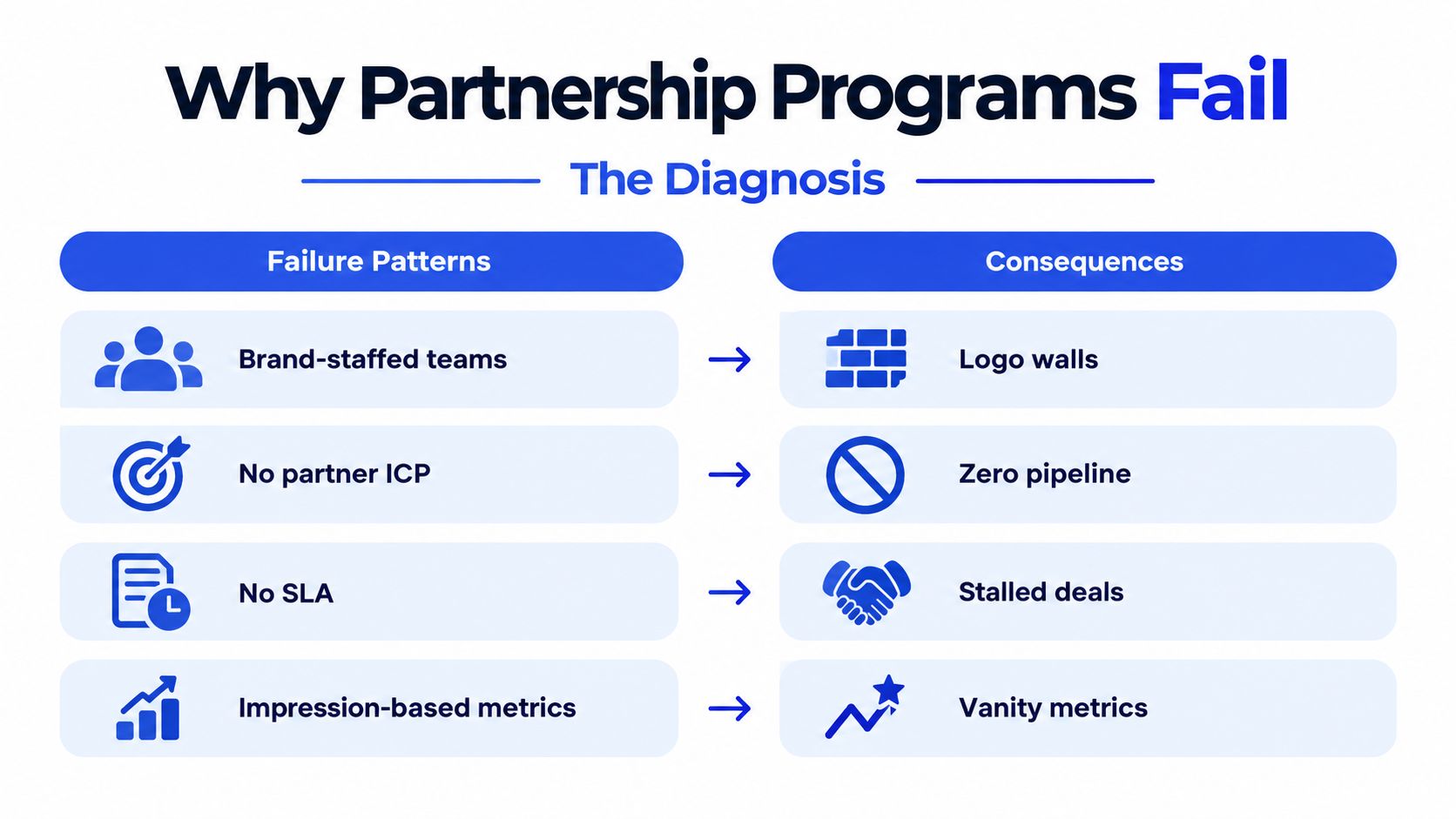
The defaults that change the output
Start with a partner ICP document. It should specify the customers, regions, company sizes, and buying motions a partner already reaches. Without those fields, outreach becomes a sequence of introductions rather than a channel aimed at qualified demand.
Set an SLA that separates sourced from influenced opportunities. The distinction keeps attribution honest and tells sales exactly when a partner handoff requires action.
Run a 14- to 21-day sprint cadence. Short cycles keep follow-up close to the original signal and create a clear point for reviewing stalled activity. Assign one owner for partner-sourced revenue as well. Shared ownership often leaves routing, follow-up, and forecast updates undone.
Practical rule: if a partnership cannot be described in one operating sentence, it is not ready to scale.
The pattern also appears in larger public-private programs. A World Bank review found PPPs in more than 134 developing countries and estimated they represented about 15% to 20% of total infrastructure investment. The relevant lesson is governance. Clear accountability, financing, and execution rules give partnerships a route from agreement to deployed capital.
That same discipline is what sales and marketing teams need; the alignment problem is usually where partner programs break first. Use this guide to turn alliances into revenue, then review your internal sales and marketing alignment before adding more partners.
Partnership development belongs inside revenue ops. Otherwise, the calendar fills with partner calls while qualified pipeline remains thin.
Defining partner criteria and ICP fit before any outreach
Start with the same discipline you'd use for outbound. A partner is either a credible route to the same buyer or it isn't. If the answer is fuzzy, the list gets bloated fast, and the team ends up courting everyone.
A useful partner brief has four filters. Customer overlap, complementary capability, buyer access, and revenue motion. That sounds basic, but it's where most programs skip the work and pay for it later.
The four filters that matter
Customer overlap means the partner already sells into your closed-won base, or a close match on industry, company size, and geography. Complementary capability means they sell something you don't, with no product overlap. Buyer access asks whether their reps already reach the same personas in HubSpot, Salesforce, or LinkedIn Sales Navigator. Revenue motion checks whether their go-to-market timeline matches yours.
Use a simple scoring rubric before you message anyone. Put more weight on overlap and buyer access, because those are the fastest signs of real deal flow.
Criterion | Weight | Score 1-5 | Threshold |
|---|---|---|---|
Customer overlap | 35% | 1 to 5 | 4+ |
Complementary capability | 25% | 1 to 5 | 4+ |
Buyer access | 25% | 1 to 5 | 4+ |
Revenue motion | 15% | 1 to 5 | 3+ |
Disqualifiers should be blunt. Competing products, undisclosed affiliate networks, weak data hygiene, and partner teams that won't name their buyer access all belong on the no list. If those show up early, don't rationalize them away.
A one-page brief is enough. Use four blocks: company profile, ideal partner profile, mutual customer hypothesis, and joint offer hypothesis. If that brief takes more than one page, it usually means the fit isn't clear.
For data cleanup before outreach, the AI-ready data enrichment checklist is a useful reference when you're checking whether a list is clean enough to trust. Keep the process tight, then put fit tiers on effort. A-tier gets custom outreach, B-tier gets semi-custom, C-tier gets templated only.
If you need a reminder of how tightly a partner brief should mirror your own target market, revisit this internal note on the ideal customer profile.
Structuring value exchanges and offers both sides can sign
Partnerships move faster when the offer is easy to price in time, attention, and expected return. If either side has to guess what they're getting, the deal drifts. I'd rather see a smaller offer signed in a week than a sprawling one that lives in a doc for a month.
Pick the offer shape before you write the terms
A co-marketed webinar or report works when both sides have audience trust and can each fund their own promotion. A referral deal with revenue share fits when one side has access and the other has delivery capacity. A reseller or referral motion with tech integration makes sense when data needs to flow through Slack, HubSpot, or Zapier. A co-selling motion works when AEs can represent the combined value in live accounts.
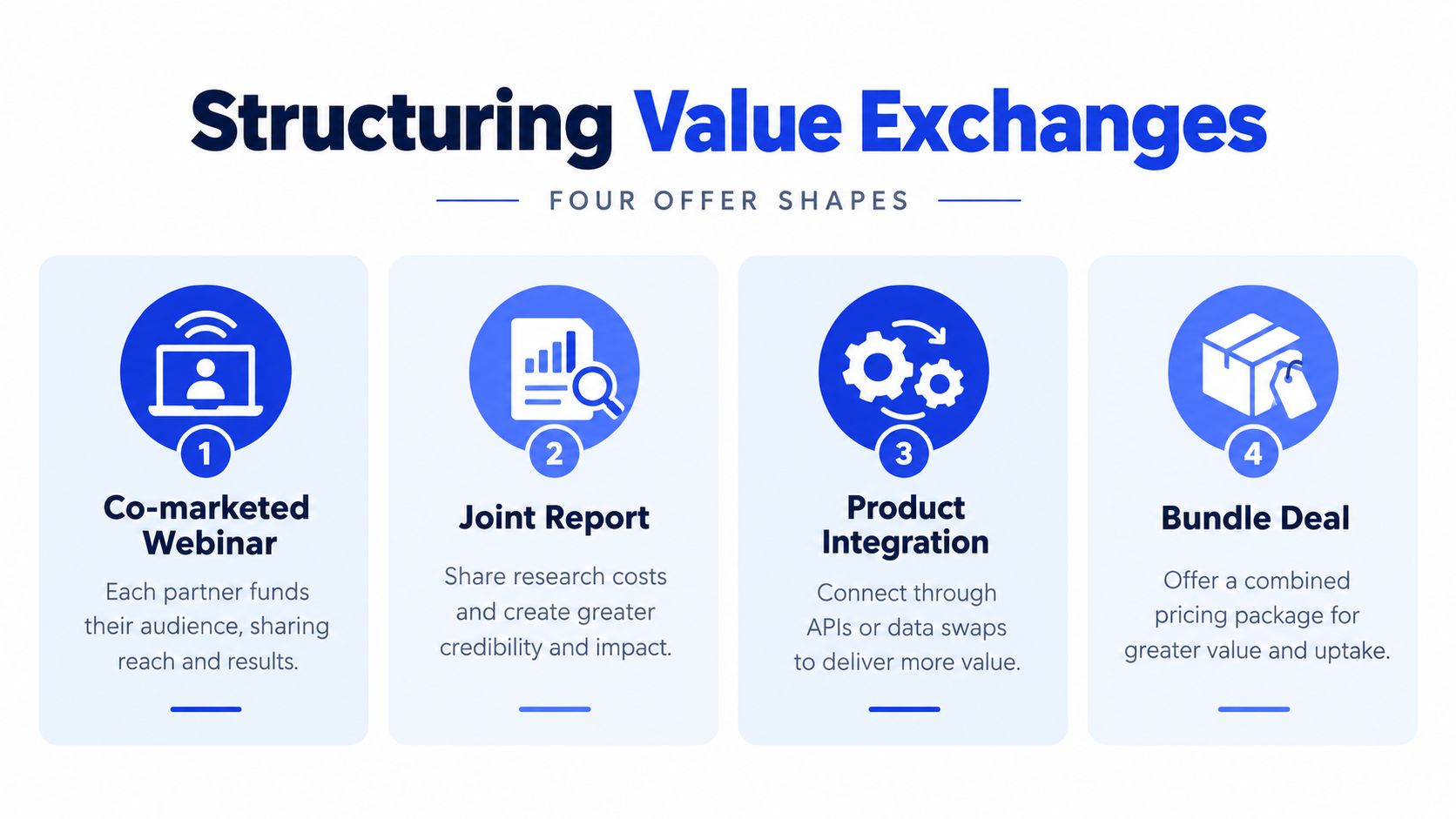
The split of work should be obvious. For a webinar, one side owns the platform and list, the other owns the topic and follow-up. For a referral deal, one side introduces, the other sells and closes. For integration-led deals, the work is data flow and support, not just branding.
If the partner can't say what they'll do in one sentence, the term sheet is too loose.
A clean term sheet needs six things. Define sourced and influenced deals. Name the payout trigger. State payout timing. List eligible deals. Add termination language. Then set a one-CTA path per asset, so the webinar, report, or landing page doesn't ask the buyer to do three different things.
Revenue share should match tier and motion. A referral partner with real access should get more room than a passive list swap. For revenue-bearing offers, size the economics so the partner can explain the trade without translating your internal logic.
If you need a live workshop format, this YouTube session is a useful companion piece for how partner offers turn into real promotion mechanics:
Outreach and co-marketing playbook on LinkedIn and outbound
The fastest way to waste a partner list is to send one generic note and call it outreach. The fastest way to get a reply is to lead with a specific shared buyer and a specific asset. That's true whether you're using LinkedIn, Apollo, Instantly, Smartlead, or HeyReach.
Run a two-week motion, not a loose follow-up habit
Week one is list building and trigger review. Week two is outreach. Your target list should already be scored, so the message can stay sharp. On LinkedIn, send a short connection request that names the shared audience and the reason it matters.
For cold email, keep the structure tight. Trigger event, one-line relevance, soft ask. Under 90 words is enough if the offer is real.
A warm LinkedIn note might open with the specific audience overlap and a single asset idea. A cold email should do the same, just with less social proof and more clarity. If you need a channel-specific reference point, this internal guide on LinkedIn lead gen is useful for sequencing and reply handling.
Assets that turn attention into pipeline
Co-branded one-pager: one page, one problem, one CTA.
Shared landing page: include partner UTMs and a single form.
Joint LinkedIn post cadence: announce, remind, recap.
Referral handoff template: name, company, reason, next step.
Referrals are different from co-marketing. Referrals need speed, clean handoff, and a direct rep-to-rep path. Co-marketing needs audience trust, a useful topic, and a clear capture point. If the goal is qualified conversations, don't ask for logos before you've built the asset.
One practical note for legal-heavy teams, especially in pharma or legal tech, is to have a review path for partner-facing language before the first send. An AI legal assistant for business owners can help teams draft and sanity-check simple business wording before counsel gets involved, but it doesn't replace legal review.
Qualification, routing, and the rules that turn partners into pipeline
Partnerships only count when the lead lands in the right place fast. If a referral sits in an inbox, or a webinar form gets treated like a generic marketing lead, the channel loses credibility. That's why qualification and routing rules need to be written before the first campaign goes live.
The cleanest standard is simple. A meeting-held partner introduction includes a named contact, a named company, and a confirmed meeting on the calendar within 14 days. Anything less is interest, not pipeline.
Routing rules that keep reporting clean
Lead Type | Definition | Qualification SLA | Routing Owner | CRM Field |
|---|---|---|---|---|
Co-marketing lead | Person captured from joint asset | 24-hour ack, 72-hour decision | Marketing ops or RevOps | Partner source, partner campaign |
Referral lead | Named introduction from partner | 24-hour ack, 72-hour decision | Assigned AE | Partner name, source type |
Partner-influenced lead | Deal touched by partner but not sourced there | Logged at opportunity stage | RevOps | Partner influence flag |
Meeting-held lead | Calendar invite confirmed inside 14 days | Immediate route to AE | Sales | Meeting-held source |
Keep sourced and influenced separate in CRM. Sourced belongs in partner reporting. Influenced stays out of marketing attribution if the partner didn't create the original lead. That split protects the numbers and keeps disputes from growing around shared deals.
The rejection path matters too. If a partner sends something off-ICP, the AE should reject it quickly and explain why. That feedback loop is how you stop partners from sending volume just to look active.
For a deeper process reference, this internal note on the lead qualification process maps cleanly to partner routing.
Practical rule: if the partner can't tell you who owns the next step, the lead isn't qualified yet.
Sprint workflow and templates to ship the first sourced meeting
Partnerships need motion, not mood. A four-week sprint is enough to find out whether a partner can create conversations or only meetings about meetings. I'd run the first sprint with one owner in HubSpot or Salesforce, one coordinator, and one weekly review.
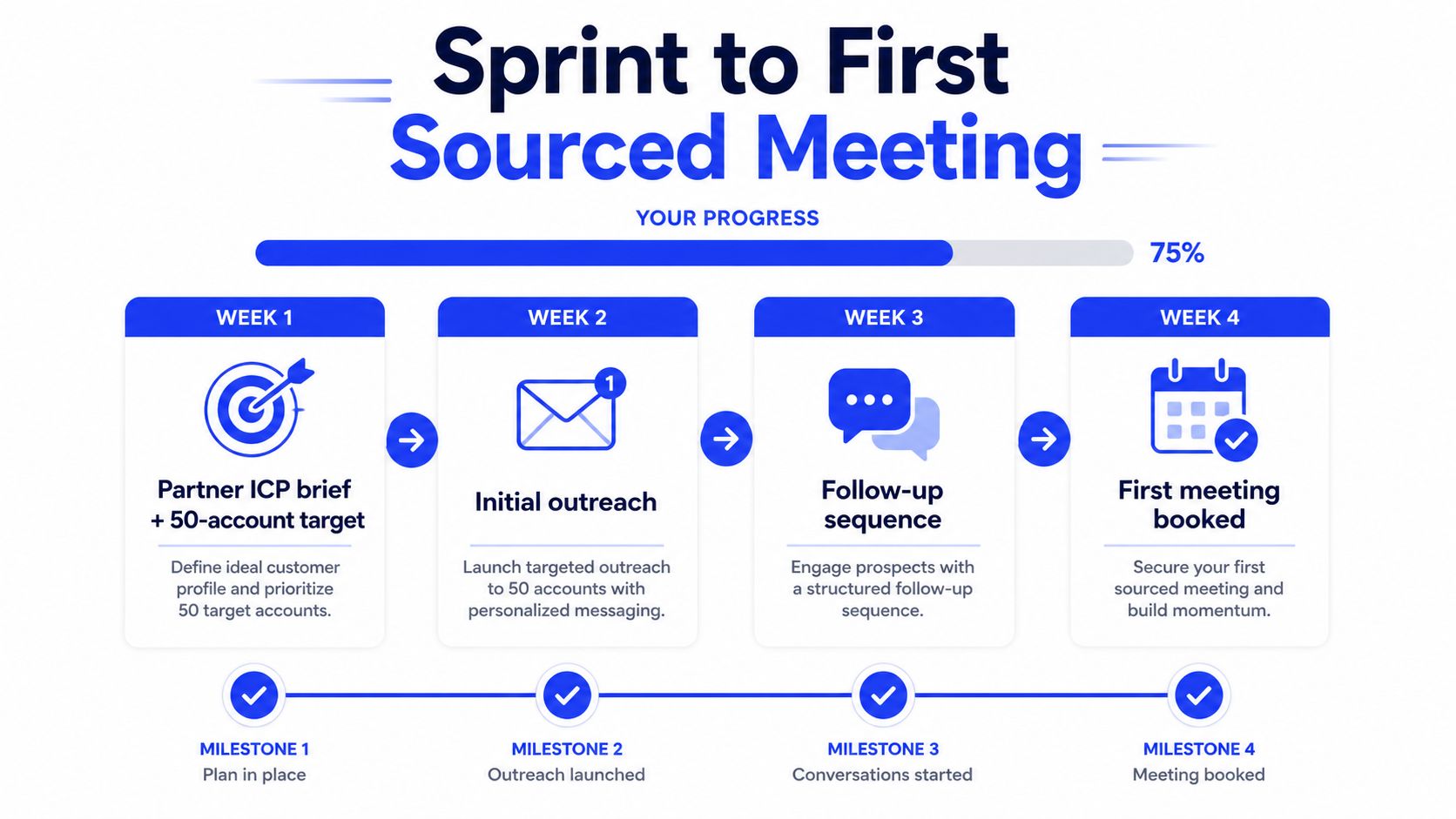
Week-by-week execution
Week one, write the partner brief in Notion and build a 50-account target list from LinkedIn Sales Navigator. Apollo or ZoomInfo can fill gaps in contact data. Week two, launch outreach with the same list across LinkedIn and email. Week three, follow up. Week four, close the first meeting and decide whether the partner moves into active status.
A useful connection request is short. Name the shared audience, mention the joint value, and ask a single question. The value-prop email should do the same with one more layer of proof. If you're building a co-marketing asset, the first-meeting agenda should cover topic, audience, owner split, and lead capture.
For a referral-focused motion, I keep the first meeting tighter. Who sends what, what counts as a qualified intro, and how the handoff gets logged. If you need a structured setting for booking and post-meeting follow-up, this internal reference on appointment setting for B2B matches the same discipline.
The tools matter less than the handoff, but the handoff still needs tools. Use LinkedIn Sales Navigator for prospecting, Apollo or ZoomInfo for outbound, Notion for the brief, and HubSpot or Salesforce for pipeline tracking. Then run a sprint retro after the first meeting.
Ask three things: what response pattern repeated, where did friction show up, and what should be cut before the next partner goes live. If you can't answer those, the sprint wasn't a sprint, it was just outreach with nicer branding.
Measurement, reporting, and your next 30-day partnership sprint
Partnership development should be measured like a paid channel, because that's what the business is funding. Track weighted pipeline, cost per meeting, sourced versus influenced splits, and partner-level conversion. If the founder doesn't open the dashboard, it's too big or too vague.
Available B2B SaaS benchmarks suggest that mid-market and enterprise companies report about 35% of pipeline as partner-sourced or partner-influenced, while 63% say partner-supported go-to-market motions speed active sales cycles (PartnerStack research summary). Those are directional, not universal. Definitions vary, and partner credit gets messy fast.
The bi-weekly review fields that matter
Field / Metric | Definition | Cadence / Source |
|---|---|---|
Partner name | Named partner in CRM | Updated on every deal record |
Tier | A, B, or C partner tier | Reviewed bi-weekly |
Meetings held | Confirmed meetings completed | Weekly from calendar and CRM |
MQLs sourced | Leads created by partner motion | Weekly from CRM |
Influenced ARR | Revenue touched by partner activity | Bi-weekly finance and RevOps review |
Payout status | Paid, pending, rejected | Bi-weekly finance review |
Next step | Clear owner and due date | Updated after every review |
A simple dashboard mock-up should include partner name, tier, meetings held, sourced pipeline, influenced pipeline, win rate, average deal size, and payout status. Use formulas that are easy to audit: cost per meeting = total partner cost / meetings held, partner-sourced CAC = total partner cost / closed-won customers, and partner ROI = closed-won revenue / total partner cost.
Cadence matters as much as fields. Run a Tuesday partner stand-up, a Friday pipeline sync, and a bi-weekly leadership review. That rhythm catches problems while there's still something to fix.
For the next 30 days, keep it narrow. Pick 25 partner targets, send 60 LinkedIn connection requests, run 12 outbound sequences, host one co-marketing event, and hold a deal review on day 30. That's enough volume to see whether the motion creates meetings, not just activity.
Grou helps B2B teams build partnership motions that produce qualified conversations, not just logo slides, by combining targeted lists, LinkedIn content, and outbound into one reporting line. If you want a partnership channel that runs with clear qualification rules and weekly accountability, visit Grou and use this framework to audit the next 30 days of partner activity.
You've got partner logos, webinar registrations, and a stack of “good conversations,” but pipeline still looks thin. The problem usually isn't effort. It's that partnership work got parked outside revenue ops, so nobody owns the handoff from attention to qualified meetings.
Treat partners like an outbound channel, with an ICP, sprint cadence, and reporting line.
Define fit before outreach, or you'll build a logo wall instead of a target list.
Package value both sides can sign, then route leads with clean source rules.
Measure held meetings and pipeline, not impressions or registration counts.
Run a 30-day sprint, because partnership programs stall when they stay theoretical.
Table of Contents
Qualification, routing, and the rules that turn partners into pipeline
Sprint workflow and templates to ship the first sourced meeting
Measurement, reporting, and your next 30-day partnership sprint
Why most partnership programs produce logos, not pipeline
A partner webinar ends with strong attendance, several new logos, and no held sales meetings. The program looked busy, but nobody owned the handoff from partner activity to partner-sourced ARR. That failure starts when partnership work is managed as reputation building instead of revenue operations.
A pipeline channel needs operating defaults. Without them, every partner can appear active in a spreadsheet while producing little evidence in the CRM.
The defaults that change the output
Start with a partner ICP document. It should specify the customers, regions, company sizes, and buying motions a partner already reaches. Without those fields, outreach becomes a sequence of introductions rather than a channel aimed at qualified demand.
Set an SLA that separates sourced from influenced opportunities. The distinction keeps attribution honest and tells sales exactly when a partner handoff requires action.
Run a 14- to 21-day sprint cadence. Short cycles keep follow-up close to the original signal and create a clear point for reviewing stalled activity. Assign one owner for partner-sourced revenue as well. Shared ownership often leaves routing, follow-up, and forecast updates undone.
Practical rule: if a partnership cannot be described in one operating sentence, it is not ready to scale.
The pattern also appears in larger public-private programs. A World Bank review found PPPs in more than 134 developing countries and estimated they represented about 15% to 20% of total infrastructure investment. The relevant lesson is governance. Clear accountability, financing, and execution rules give partnerships a route from agreement to deployed capital.
That same discipline is what sales and marketing teams need; the alignment problem is usually where partner programs break first. Use this guide to turn alliances into revenue, then review your internal sales and marketing alignment before adding more partners.
Partnership development belongs inside revenue ops. Otherwise, the calendar fills with partner calls while qualified pipeline remains thin.
Defining partner criteria and ICP fit before any outreach
Start with the same discipline you'd use for outbound. A partner is either a credible route to the same buyer or it isn't. If the answer is fuzzy, the list gets bloated fast, and the team ends up courting everyone.
A useful partner brief has four filters. Customer overlap, complementary capability, buyer access, and revenue motion. That sounds basic, but it's where most programs skip the work and pay for it later.
The four filters that matter
Customer overlap means the partner already sells into your closed-won base, or a close match on industry, company size, and geography. Complementary capability means they sell something you don't, with no product overlap. Buyer access asks whether their reps already reach the same personas in HubSpot, Salesforce, or LinkedIn Sales Navigator. Revenue motion checks whether their go-to-market timeline matches yours.
Use a simple scoring rubric before you message anyone. Put more weight on overlap and buyer access, because those are the fastest signs of real deal flow.
Criterion | Weight | Score 1-5 | Threshold |
|---|---|---|---|
Customer overlap | 35% | 1 to 5 | 4+ |
Complementary capability | 25% | 1 to 5 | 4+ |
Buyer access | 25% | 1 to 5 | 4+ |
Revenue motion | 15% | 1 to 5 | 3+ |
Disqualifiers should be blunt. Competing products, undisclosed affiliate networks, weak data hygiene, and partner teams that won't name their buyer access all belong on the no list. If those show up early, don't rationalize them away.
A one-page brief is enough. Use four blocks: company profile, ideal partner profile, mutual customer hypothesis, and joint offer hypothesis. If that brief takes more than one page, it usually means the fit isn't clear.
For data cleanup before outreach, the AI-ready data enrichment checklist is a useful reference when you're checking whether a list is clean enough to trust. Keep the process tight, then put fit tiers on effort. A-tier gets custom outreach, B-tier gets semi-custom, C-tier gets templated only.
If you need a reminder of how tightly a partner brief should mirror your own target market, revisit this internal note on the ideal customer profile.
Structuring value exchanges and offers both sides can sign
Partnerships move faster when the offer is easy to price in time, attention, and expected return. If either side has to guess what they're getting, the deal drifts. I'd rather see a smaller offer signed in a week than a sprawling one that lives in a doc for a month.
Pick the offer shape before you write the terms
A co-marketed webinar or report works when both sides have audience trust and can each fund their own promotion. A referral deal with revenue share fits when one side has access and the other has delivery capacity. A reseller or referral motion with tech integration makes sense when data needs to flow through Slack, HubSpot, or Zapier. A co-selling motion works when AEs can represent the combined value in live accounts.
The split of work should be obvious. For a webinar, one side owns the platform and list, the other owns the topic and follow-up. For a referral deal, one side introduces, the other sells and closes. For integration-led deals, the work is data flow and support, not just branding.
If the partner can't say what they'll do in one sentence, the term sheet is too loose.
A clean term sheet needs six things. Define sourced and influenced deals. Name the payout trigger. State payout timing. List eligible deals. Add termination language. Then set a one-CTA path per asset, so the webinar, report, or landing page doesn't ask the buyer to do three different things.
Revenue share should match tier and motion. A referral partner with real access should get more room than a passive list swap. For revenue-bearing offers, size the economics so the partner can explain the trade without translating your internal logic.
If you need a live workshop format, this YouTube session is a useful companion piece for how partner offers turn into real promotion mechanics:
Outreach and co-marketing playbook on LinkedIn and outbound
The fastest way to waste a partner list is to send one generic note and call it outreach. The fastest way to get a reply is to lead with a specific shared buyer and a specific asset. That's true whether you're using LinkedIn, Apollo, Instantly, Smartlead, or HeyReach.
Run a two-week motion, not a loose follow-up habit
Week one is list building and trigger review. Week two is outreach. Your target list should already be scored, so the message can stay sharp. On LinkedIn, send a short connection request that names the shared audience and the reason it matters.
For cold email, keep the structure tight. Trigger event, one-line relevance, soft ask. Under 90 words is enough if the offer is real.
A warm LinkedIn note might open with the specific audience overlap and a single asset idea. A cold email should do the same, just with less social proof and more clarity. If you need a channel-specific reference point, this internal guide on LinkedIn lead gen is useful for sequencing and reply handling.
Assets that turn attention into pipeline
Co-branded one-pager: one page, one problem, one CTA.
Shared landing page: include partner UTMs and a single form.
Joint LinkedIn post cadence: announce, remind, recap.
Referral handoff template: name, company, reason, next step.
Referrals are different from co-marketing. Referrals need speed, clean handoff, and a direct rep-to-rep path. Co-marketing needs audience trust, a useful topic, and a clear capture point. If the goal is qualified conversations, don't ask for logos before you've built the asset.
One practical note for legal-heavy teams, especially in pharma or legal tech, is to have a review path for partner-facing language before the first send. An AI legal assistant for business owners can help teams draft and sanity-check simple business wording before counsel gets involved, but it doesn't replace legal review.
Qualification, routing, and the rules that turn partners into pipeline
Partnerships only count when the lead lands in the right place fast. If a referral sits in an inbox, or a webinar form gets treated like a generic marketing lead, the channel loses credibility. That's why qualification and routing rules need to be written before the first campaign goes live.
The cleanest standard is simple. A meeting-held partner introduction includes a named contact, a named company, and a confirmed meeting on the calendar within 14 days. Anything less is interest, not pipeline.
Routing rules that keep reporting clean
Lead Type | Definition | Qualification SLA | Routing Owner | CRM Field |
|---|---|---|---|---|
Co-marketing lead | Person captured from joint asset | 24-hour ack, 72-hour decision | Marketing ops or RevOps | Partner source, partner campaign |
Referral lead | Named introduction from partner | 24-hour ack, 72-hour decision | Assigned AE | Partner name, source type |
Partner-influenced lead | Deal touched by partner but not sourced there | Logged at opportunity stage | RevOps | Partner influence flag |
Meeting-held lead | Calendar invite confirmed inside 14 days | Immediate route to AE | Sales | Meeting-held source |
Keep sourced and influenced separate in CRM. Sourced belongs in partner reporting. Influenced stays out of marketing attribution if the partner didn't create the original lead. That split protects the numbers and keeps disputes from growing around shared deals.
The rejection path matters too. If a partner sends something off-ICP, the AE should reject it quickly and explain why. That feedback loop is how you stop partners from sending volume just to look active.
For a deeper process reference, this internal note on the lead qualification process maps cleanly to partner routing.
Practical rule: if the partner can't tell you who owns the next step, the lead isn't qualified yet.
Sprint workflow and templates to ship the first sourced meeting
Partnerships need motion, not mood. A four-week sprint is enough to find out whether a partner can create conversations or only meetings about meetings. I'd run the first sprint with one owner in HubSpot or Salesforce, one coordinator, and one weekly review.
Week-by-week execution
Week one, write the partner brief in Notion and build a 50-account target list from LinkedIn Sales Navigator. Apollo or ZoomInfo can fill gaps in contact data. Week two, launch outreach with the same list across LinkedIn and email. Week three, follow up. Week four, close the first meeting and decide whether the partner moves into active status.
A useful connection request is short. Name the shared audience, mention the joint value, and ask a single question. The value-prop email should do the same with one more layer of proof. If you're building a co-marketing asset, the first-meeting agenda should cover topic, audience, owner split, and lead capture.
For a referral-focused motion, I keep the first meeting tighter. Who sends what, what counts as a qualified intro, and how the handoff gets logged. If you need a structured setting for booking and post-meeting follow-up, this internal reference on appointment setting for B2B matches the same discipline.
The tools matter less than the handoff, but the handoff still needs tools. Use LinkedIn Sales Navigator for prospecting, Apollo or ZoomInfo for outbound, Notion for the brief, and HubSpot or Salesforce for pipeline tracking. Then run a sprint retro after the first meeting.
Ask three things: what response pattern repeated, where did friction show up, and what should be cut before the next partner goes live. If you can't answer those, the sprint wasn't a sprint, it was just outreach with nicer branding.
Measurement, reporting, and your next 30-day partnership sprint
Partnership development should be measured like a paid channel, because that's what the business is funding. Track weighted pipeline, cost per meeting, sourced versus influenced splits, and partner-level conversion. If the founder doesn't open the dashboard, it's too big or too vague.
Available B2B SaaS benchmarks suggest that mid-market and enterprise companies report about 35% of pipeline as partner-sourced or partner-influenced, while 63% say partner-supported go-to-market motions speed active sales cycles (PartnerStack research summary). Those are directional, not universal. Definitions vary, and partner credit gets messy fast.
The bi-weekly review fields that matter
Field / Metric | Definition | Cadence / Source |
|---|---|---|
Partner name | Named partner in CRM | Updated on every deal record |
Tier | A, B, or C partner tier | Reviewed bi-weekly |
Meetings held | Confirmed meetings completed | Weekly from calendar and CRM |
MQLs sourced | Leads created by partner motion | Weekly from CRM |
Influenced ARR | Revenue touched by partner activity | Bi-weekly finance and RevOps review |
Payout status | Paid, pending, rejected | Bi-weekly finance review |
Next step | Clear owner and due date | Updated after every review |
A simple dashboard mock-up should include partner name, tier, meetings held, sourced pipeline, influenced pipeline, win rate, average deal size, and payout status. Use formulas that are easy to audit: cost per meeting = total partner cost / meetings held, partner-sourced CAC = total partner cost / closed-won customers, and partner ROI = closed-won revenue / total partner cost.
Cadence matters as much as fields. Run a Tuesday partner stand-up, a Friday pipeline sync, and a bi-weekly leadership review. That rhythm catches problems while there's still something to fix.
For the next 30 days, keep it narrow. Pick 25 partner targets, send 60 LinkedIn connection requests, run 12 outbound sequences, host one co-marketing event, and hold a deal review on day 30. That's enough volume to see whether the motion creates meetings, not just activity.
Grou helps B2B teams build partnership motions that produce qualified conversations, not just logo slides, by combining targeted lists, LinkedIn content, and outbound into one reporting line. If you want a partnership channel that runs with clear qualification rules and weekly accountability, visit Grou and use this framework to audit the next 30 days of partner activity.
You've got partner logos, webinar registrations, and a stack of “good conversations,” but pipeline still looks thin. The problem usually isn't effort. It's that partnership work got parked outside revenue ops, so nobody owns the handoff from attention to qualified meetings.
Treat partners like an outbound channel, with an ICP, sprint cadence, and reporting line.
Define fit before outreach, or you'll build a logo wall instead of a target list.
Package value both sides can sign, then route leads with clean source rules.
Measure held meetings and pipeline, not impressions or registration counts.
Run a 30-day sprint, because partnership programs stall when they stay theoretical.
Table of Contents
Qualification, routing, and the rules that turn partners into pipeline
Sprint workflow and templates to ship the first sourced meeting
Measurement, reporting, and your next 30-day partnership sprint
Why most partnership programs produce logos, not pipeline
A partner webinar ends with strong attendance, several new logos, and no held sales meetings. The program looked busy, but nobody owned the handoff from partner activity to partner-sourced ARR. That failure starts when partnership work is managed as reputation building instead of revenue operations.
A pipeline channel needs operating defaults. Without them, every partner can appear active in a spreadsheet while producing little evidence in the CRM.
The defaults that change the output
Start with a partner ICP document. It should specify the customers, regions, company sizes, and buying motions a partner already reaches. Without those fields, outreach becomes a sequence of introductions rather than a channel aimed at qualified demand.
Set an SLA that separates sourced from influenced opportunities. The distinction keeps attribution honest and tells sales exactly when a partner handoff requires action.
Run a 14- to 21-day sprint cadence. Short cycles keep follow-up close to the original signal and create a clear point for reviewing stalled activity. Assign one owner for partner-sourced revenue as well. Shared ownership often leaves routing, follow-up, and forecast updates undone.
Practical rule: if a partnership cannot be described in one operating sentence, it is not ready to scale.
The pattern also appears in larger public-private programs. A World Bank review found PPPs in more than 134 developing countries and estimated they represented about 15% to 20% of total infrastructure investment. The relevant lesson is governance. Clear accountability, financing, and execution rules give partnerships a route from agreement to deployed capital.
That same discipline is what sales and marketing teams need; the alignment problem is usually where partner programs break first. Use this guide to turn alliances into revenue, then review your internal sales and marketing alignment before adding more partners.
Partnership development belongs inside revenue ops. Otherwise, the calendar fills with partner calls while qualified pipeline remains thin.
Defining partner criteria and ICP fit before any outreach
Start with the same discipline you'd use for outbound. A partner is either a credible route to the same buyer or it isn't. If the answer is fuzzy, the list gets bloated fast, and the team ends up courting everyone.
A useful partner brief has four filters. Customer overlap, complementary capability, buyer access, and revenue motion. That sounds basic, but it's where most programs skip the work and pay for it later.
The four filters that matter
Customer overlap means the partner already sells into your closed-won base, or a close match on industry, company size, and geography. Complementary capability means they sell something you don't, with no product overlap. Buyer access asks whether their reps already reach the same personas in HubSpot, Salesforce, or LinkedIn Sales Navigator. Revenue motion checks whether their go-to-market timeline matches yours.
Use a simple scoring rubric before you message anyone. Put more weight on overlap and buyer access, because those are the fastest signs of real deal flow.
Criterion | Weight | Score 1-5 | Threshold |
|---|---|---|---|
Customer overlap | 35% | 1 to 5 | 4+ |
Complementary capability | 25% | 1 to 5 | 4+ |
Buyer access | 25% | 1 to 5 | 4+ |
Revenue motion | 15% | 1 to 5 | 3+ |
Disqualifiers should be blunt. Competing products, undisclosed affiliate networks, weak data hygiene, and partner teams that won't name their buyer access all belong on the no list. If those show up early, don't rationalize them away.
A one-page brief is enough. Use four blocks: company profile, ideal partner profile, mutual customer hypothesis, and joint offer hypothesis. If that brief takes more than one page, it usually means the fit isn't clear.
For data cleanup before outreach, the AI-ready data enrichment checklist is a useful reference when you're checking whether a list is clean enough to trust. Keep the process tight, then put fit tiers on effort. A-tier gets custom outreach, B-tier gets semi-custom, C-tier gets templated only.
If you need a reminder of how tightly a partner brief should mirror your own target market, revisit this internal note on the ideal customer profile.
Structuring value exchanges and offers both sides can sign
Partnerships move faster when the offer is easy to price in time, attention, and expected return. If either side has to guess what they're getting, the deal drifts. I'd rather see a smaller offer signed in a week than a sprawling one that lives in a doc for a month.
Pick the offer shape before you write the terms
A co-marketed webinar or report works when both sides have audience trust and can each fund their own promotion. A referral deal with revenue share fits when one side has access and the other has delivery capacity. A reseller or referral motion with tech integration makes sense when data needs to flow through Slack, HubSpot, or Zapier. A co-selling motion works when AEs can represent the combined value in live accounts.
The split of work should be obvious. For a webinar, one side owns the platform and list, the other owns the topic and follow-up. For a referral deal, one side introduces, the other sells and closes. For integration-led deals, the work is data flow and support, not just branding.
If the partner can't say what they'll do in one sentence, the term sheet is too loose.
A clean term sheet needs six things. Define sourced and influenced deals. Name the payout trigger. State payout timing. List eligible deals. Add termination language. Then set a one-CTA path per asset, so the webinar, report, or landing page doesn't ask the buyer to do three different things.
Revenue share should match tier and motion. A referral partner with real access should get more room than a passive list swap. For revenue-bearing offers, size the economics so the partner can explain the trade without translating your internal logic.
If you need a live workshop format, this YouTube session is a useful companion piece for how partner offers turn into real promotion mechanics:
Outreach and co-marketing playbook on LinkedIn and outbound
The fastest way to waste a partner list is to send one generic note and call it outreach. The fastest way to get a reply is to lead with a specific shared buyer and a specific asset. That's true whether you're using LinkedIn, Apollo, Instantly, Smartlead, or HeyReach.
Run a two-week motion, not a loose follow-up habit
Week one is list building and trigger review. Week two is outreach. Your target list should already be scored, so the message can stay sharp. On LinkedIn, send a short connection request that names the shared audience and the reason it matters.
For cold email, keep the structure tight. Trigger event, one-line relevance, soft ask. Under 90 words is enough if the offer is real.
A warm LinkedIn note might open with the specific audience overlap and a single asset idea. A cold email should do the same, just with less social proof and more clarity. If you need a channel-specific reference point, this internal guide on LinkedIn lead gen is useful for sequencing and reply handling.
Assets that turn attention into pipeline
Co-branded one-pager: one page, one problem, one CTA.
Shared landing page: include partner UTMs and a single form.
Joint LinkedIn post cadence: announce, remind, recap.
Referral handoff template: name, company, reason, next step.
Referrals are different from co-marketing. Referrals need speed, clean handoff, and a direct rep-to-rep path. Co-marketing needs audience trust, a useful topic, and a clear capture point. If the goal is qualified conversations, don't ask for logos before you've built the asset.
One practical note for legal-heavy teams, especially in pharma or legal tech, is to have a review path for partner-facing language before the first send. An AI legal assistant for business owners can help teams draft and sanity-check simple business wording before counsel gets involved, but it doesn't replace legal review.
Qualification, routing, and the rules that turn partners into pipeline
Partnerships only count when the lead lands in the right place fast. If a referral sits in an inbox, or a webinar form gets treated like a generic marketing lead, the channel loses credibility. That's why qualification and routing rules need to be written before the first campaign goes live.
The cleanest standard is simple. A meeting-held partner introduction includes a named contact, a named company, and a confirmed meeting on the calendar within 14 days. Anything less is interest, not pipeline.
Routing rules that keep reporting clean
Lead Type | Definition | Qualification SLA | Routing Owner | CRM Field |
|---|---|---|---|---|
Co-marketing lead | Person captured from joint asset | 24-hour ack, 72-hour decision | Marketing ops or RevOps | Partner source, partner campaign |
Referral lead | Named introduction from partner | 24-hour ack, 72-hour decision | Assigned AE | Partner name, source type |
Partner-influenced lead | Deal touched by partner but not sourced there | Logged at opportunity stage | RevOps | Partner influence flag |
Meeting-held lead | Calendar invite confirmed inside 14 days | Immediate route to AE | Sales | Meeting-held source |
Keep sourced and influenced separate in CRM. Sourced belongs in partner reporting. Influenced stays out of marketing attribution if the partner didn't create the original lead. That split protects the numbers and keeps disputes from growing around shared deals.
The rejection path matters too. If a partner sends something off-ICP, the AE should reject it quickly and explain why. That feedback loop is how you stop partners from sending volume just to look active.
For a deeper process reference, this internal note on the lead qualification process maps cleanly to partner routing.
Practical rule: if the partner can't tell you who owns the next step, the lead isn't qualified yet.
Sprint workflow and templates to ship the first sourced meeting
Partnerships need motion, not mood. A four-week sprint is enough to find out whether a partner can create conversations or only meetings about meetings. I'd run the first sprint with one owner in HubSpot or Salesforce, one coordinator, and one weekly review.
Week-by-week execution
Week one, write the partner brief in Notion and build a 50-account target list from LinkedIn Sales Navigator. Apollo or ZoomInfo can fill gaps in contact data. Week two, launch outreach with the same list across LinkedIn and email. Week three, follow up. Week four, close the first meeting and decide whether the partner moves into active status.
A useful connection request is short. Name the shared audience, mention the joint value, and ask a single question. The value-prop email should do the same with one more layer of proof. If you're building a co-marketing asset, the first-meeting agenda should cover topic, audience, owner split, and lead capture.
For a referral-focused motion, I keep the first meeting tighter. Who sends what, what counts as a qualified intro, and how the handoff gets logged. If you need a structured setting for booking and post-meeting follow-up, this internal reference on appointment setting for B2B matches the same discipline.
The tools matter less than the handoff, but the handoff still needs tools. Use LinkedIn Sales Navigator for prospecting, Apollo or ZoomInfo for outbound, Notion for the brief, and HubSpot or Salesforce for pipeline tracking. Then run a sprint retro after the first meeting.
Ask three things: what response pattern repeated, where did friction show up, and what should be cut before the next partner goes live. If you can't answer those, the sprint wasn't a sprint, it was just outreach with nicer branding.
Measurement, reporting, and your next 30-day partnership sprint
Partnership development should be measured like a paid channel, because that's what the business is funding. Track weighted pipeline, cost per meeting, sourced versus influenced splits, and partner-level conversion. If the founder doesn't open the dashboard, it's too big or too vague.
Available B2B SaaS benchmarks suggest that mid-market and enterprise companies report about 35% of pipeline as partner-sourced or partner-influenced, while 63% say partner-supported go-to-market motions speed active sales cycles (PartnerStack research summary). Those are directional, not universal. Definitions vary, and partner credit gets messy fast.
The bi-weekly review fields that matter
Field / Metric | Definition | Cadence / Source |
|---|---|---|
Partner name | Named partner in CRM | Updated on every deal record |
Tier | A, B, or C partner tier | Reviewed bi-weekly |
Meetings held | Confirmed meetings completed | Weekly from calendar and CRM |
MQLs sourced | Leads created by partner motion | Weekly from CRM |
Influenced ARR | Revenue touched by partner activity | Bi-weekly finance and RevOps review |
Payout status | Paid, pending, rejected | Bi-weekly finance review |
Next step | Clear owner and due date | Updated after every review |
A simple dashboard mock-up should include partner name, tier, meetings held, sourced pipeline, influenced pipeline, win rate, average deal size, and payout status. Use formulas that are easy to audit: cost per meeting = total partner cost / meetings held, partner-sourced CAC = total partner cost / closed-won customers, and partner ROI = closed-won revenue / total partner cost.
Cadence matters as much as fields. Run a Tuesday partner stand-up, a Friday pipeline sync, and a bi-weekly leadership review. That rhythm catches problems while there's still something to fix.
For the next 30 days, keep it narrow. Pick 25 partner targets, send 60 LinkedIn connection requests, run 12 outbound sequences, host one co-marketing event, and hold a deal review on day 30. That's enough volume to see whether the motion creates meetings, not just activity.
Grou helps B2B teams build partnership motions that produce qualified conversations, not just logo slides, by combining targeted lists, LinkedIn content, and outbound into one reporting line. If you want a partnership channel that runs with clear qualification rules and weekly accountability, visit Grou and use this framework to audit the next 30 days of partner activity.
Pipeline OS Newsletter
Build qualified pipeline
Get weekly tactics to generate demand, improve lead quality, and book more meetings.





Trusted by industry leaders
Trusted by industry leaders
Trusted by industry leaders
Ready to build qualified pipeline?
Ready to build qualified pipeline?
Ready to build qualified pipeline?
Book a call to see if we're the right fit, or take the 2-minute quiz to get a clear starting point.
Book a call to see if we're the right fit, or take the 2-minute quiz to get a clear starting point.
Book a call to see if we're the right fit, or take the 2-minute quiz to get a clear starting point.
" height="30.21639343089746px" id="hfGbXmQR2" width="30.216393430897455px"/></svg>)
Copyright © 2026 – All Right Reserved
Copyright © 2026 – All Right Reserved
Copyright © 2026 – All Right Reserved