%22%3E%3C/path%3E%3Cpath d=%22M 63.072 7.554 C 62.258 8.022 61.577 8.689 61.092 9.493 L 61.092 7.076 L 57.158 7.076 L 57.158 22.64 L 61.089 22.64 L 61.089 14.888 C 61.089 13.446 61.403 12.434 62.03 11.853 C 62.818 11.218 63.818 10.907 64.826 10.982 L 65.868 10.982 L 65.868 6.851 C 64.891 6.834 63.926 7.076 63.073 7.554 Z%22 fill=%22rgb(17,17,17)%22%3E%3C/path%3E%3Cpath d=%22M 78.916 7.82 C 76.363 6.49 73.321 6.49 70.768 7.82 C 69.562 8.473 68.564 9.451 67.888 10.644 C 67.167 11.931 66.803 13.387 66.834 14.862 C 66.804 16.332 67.157 17.785 67.86 19.077 C 68.515 20.267 69.494 21.246 70.684 21.901 C 71.924 22.576 73.318 22.92 74.73 22.898 C 76.164 22.918 77.58 22.575 78.846 21.901 C 80.062 21.247 81.073 20.27 81.768 19.077 C 82.506 17.797 82.88 16.339 82.85 14.862 C 82.88 13.389 82.517 11.934 81.797 10.647 C 81.12 9.455 80.122 8.477 78.917 7.824 M 78.803 14.862 C 78.829 15.739 78.636 16.608 78.241 17.391 C 77.903 18.046 77.38 18.588 76.738 18.95 C 76.124 19.293 75.432 19.472 74.729 19.47 C 73.668 19.497 72.648 19.061 71.934 18.276 C 71.139 17.323 70.741 16.1 70.823 14.862 C 70.741 13.62 71.149 12.395 71.959 11.45 C 72.687 10.667 73.715 10.233 74.783 10.256 C 75.859 10.236 76.894 10.67 77.635 11.45 C 78.464 12.387 78.884 13.616 78.801 14.864%22 fill=%22rgb(17,17,17)%22%3E%3C/path%3E%3Cpath d=%22M 95.906 7.076 L 95.906 15.646 C 95.975 16.68 95.643 17.701 94.979 18.498 C 94.311 19.184 93.379 19.547 92.422 19.495 C 91.475 19.544 90.553 19.18 89.894 18.498 C 89.23 17.701 88.898 16.68 88.967 15.646 L 88.967 7.076 L 85.033 7.076 L 85.033 16.207 C 85 17.449 85.275 18.68 85.834 19.79 C 86.327 20.75 87.095 21.542 88.039 22.065 C 89.033 22.594 90.145 22.861 91.271 22.838 C 92.188 22.847 93.095 22.65 93.926 22.263 C 94.708 21.905 95.388 21.36 95.906 20.675 L 95.906 22.645 L 99.865 22.645 L 99.865 7.076 Z%22 fill=%22rgb(17,17,17)%22%3E%3C/path%3E%3Cpath d=%22M 4.513 15.626 C 4.511 10.815 7.606 6.549 12.181 5.059 C 16.756 3.57 21.77 5.195 24.601 9.086 L 27.816 5.87 C 24.074 1.186 17.981 -0.943 12.137 0.393 C 6.292 1.728 1.728 6.292 0.393 12.137 C -0.943 17.981 1.186 24.074 5.87 27.816 L 9.085 24.601 C 6.214 22.512 4.515 19.177 4.513 15.626%22 fill=%22rgb(32,62,235)%22%3E%3C/path%3E%3Cpath d=%22M 17.114 14.343 L 13.354 18.01 L 13.354 18.026 L 21.071 18.026 L 11.412 27.609 L 17.389 27.609 L 23.999 21.081 L 23.999 28.316 L 24.005 28.316 L 27.967 24.393 L 27.967 14.343 Z%22 fill=%22rgb(32,62,235)%22%3E%3C/path%3E%3C/g%3E%3C/svg%3E) ×
× ××
××›
›
›
›
Professional services marketing: what builds pipeline in 2026
Professional services marketing: what builds pipeline in 2026
Professional services marketing: what builds pipeline in 2026
Professional services marketing: what builds pipeline in 2026
Professional services marketing: what builds pipeline in 2026
Professional services marketing: what builds pipeline in 2026

Author
Aljaz Peklaj

Professional services marketing breaks the moment teams treat it like product demand gen. Buyers aren't waiting to be persuaded by another generic webinar, and cold outreach doesn't fail because the category is “special,” it fails when the message is lazy, the timing is random, and the CRM can't tell signal from noise.
Referrals are strong, but they're not a system. Structured outbound and founder content add the missing layer.
Messaging matters more than channel volume. A sharper outcome beats category language every time.
Signals beat spray-and-pray outreach. Timing and relevance drive response.
Measurement has to move beyond traffic. Revenue quality matters more than impressions.
Table of Contents
Why professional services buyers actually respond to outreach
How professional services marketing differs from product marketing
Why professional services buyers actually respond to outreach
The idea that professional services buyers ignore outreach is usually a reaction to bad outreach, not a market truth. Discerning buyers don't reward sloppy sequencing, recycled copy, or generic “thought leadership” that never says anything useful. They do respond when the timing, message, and proof line up with a live buying problem.
Quality of execution is the real variable
In adjacent professional-services work, signal-triggered outbound has produced 11 to 17% reply rates across legal tech, IT services, compliance software, and cybersecurity engagements. That's the meaningful comparison point, not the 1 to 3% expectation many leaders carry around in their heads. The gap is usually execution, not buyer category.
Bad outreach fails universally. Disciplined outreach works when it reaches an active buyer with a specific reason to care.
The counter-argument inside the business is simple. If someone says, “Our buyers only come through referrals,” the answer is, “That's a channel preference, not a law of nature.” If someone says, “Our cycle is too long for outbound,” the reply is, “Long cycles affect close timing, not whether an opportunity gets created.” If someone says, “Our audience isn't on LinkedIn,” that usually means the list hasn't been built properly.
Signal timing changes the response pattern
Outreach works better when it lands around a trigger, not when it lands on a random Tuesday. A prospect who just changed a system, hired a new leader, or hit a compliance problem is much more likely to read a relevant message than a broad pitch sent to a static list. That's why signal-triggered outbound sits closer to active buying behavior than generic prospecting.
The practical move is to treat outbound as a precision channel. Use LinkedIn and email together, build sequences around real buying signals, and route prospects to service-specific pages or conversation paths that match the context of the signal. That's also where a system like MapLeads for marketing agencies can be useful if the team needs cleaner list building and targeting hygiene.
Referral channels still matter, but they're not enough on their own. Systematic outbound doesn't replace trust, it extends it into accounts that would never have arrived through introductions alone.
How professional services marketing differs from product marketing
Professional services buyers don't purchase a repeatable object, they buy trust in people, judgment, and the team's ability to solve a messy problem. That alone changes positioning, content, and pipeline mechanics. A product can be explained through features and usage. A service has to prove competence before the buyer is comfortable starting the conversation.
The scale of the market justifies that kind of discipline. One major estimate puts the professional services market at $6,370.29 billion in 2025, with a projection of $8,476.02 billion by 2030 at a 6.2% CAGR (The Business Research Company). Another market estimate places it at nearly $6.07 trillion in 2024 and $7.89 trillion by 2029 (The Business Research Company). That is a big enough market to justify structured pipeline systems, not improvised activity.

Trust changes the funnel mechanics
Product marketing can lean on repeatable proof and broad usage patterns. Professional services marketing needs specificity, because the buyer is evaluating judgment under uncertainty. That means founder content, service-page relevance, and sales follow-up need to sound like they belong to the same operator who'll run the work.
The budget structure reflects that reality. A 2025 survey reported professional services firms allocated 3.1% of turnover to marketing and business development, up from 3.0% the year before and 2.9% the year before that. The same survey commentary said the average in-house marketing and BD team grew from 2.8 to 4.5 people, with law firms averaging 3.0% and accountancy firms 2.0% (LinkedIn survey commentary). That's lean. It also means every campaign has to earn its place.
Buying cycles demand sustained presence
Product buyers can convert after a short run of ads, landing pages, and a demo. Professional services buyers usually need repeated proof, especially when the engagement is expensive or politically sensitive. That's why a one-off campaign often disappoints, even when the messaging is decent.
In this category, content isn't decoration. It's part of the proof layer that makes outreach believable.
There's also a channel reality worth respecting. Organic search drives 48.5% of traffic, while direct drives 22.0%, referral 12.5%, paid search 10.0%, and social 5.5% in one benchmark set for professional services marketing (CUFinder). But traffic isn't the point. The point is that buyers research expertise before they contact anyone, so depth and technical relevance matter more than awareness theater.
For a useful practical contrast, Grou's ICP guidance aligns with this category better than broad-stroke demand gen advice. The tighter the profile, the less waste you absorb downstream.
Building an ICP-driven positioning and messaging framework
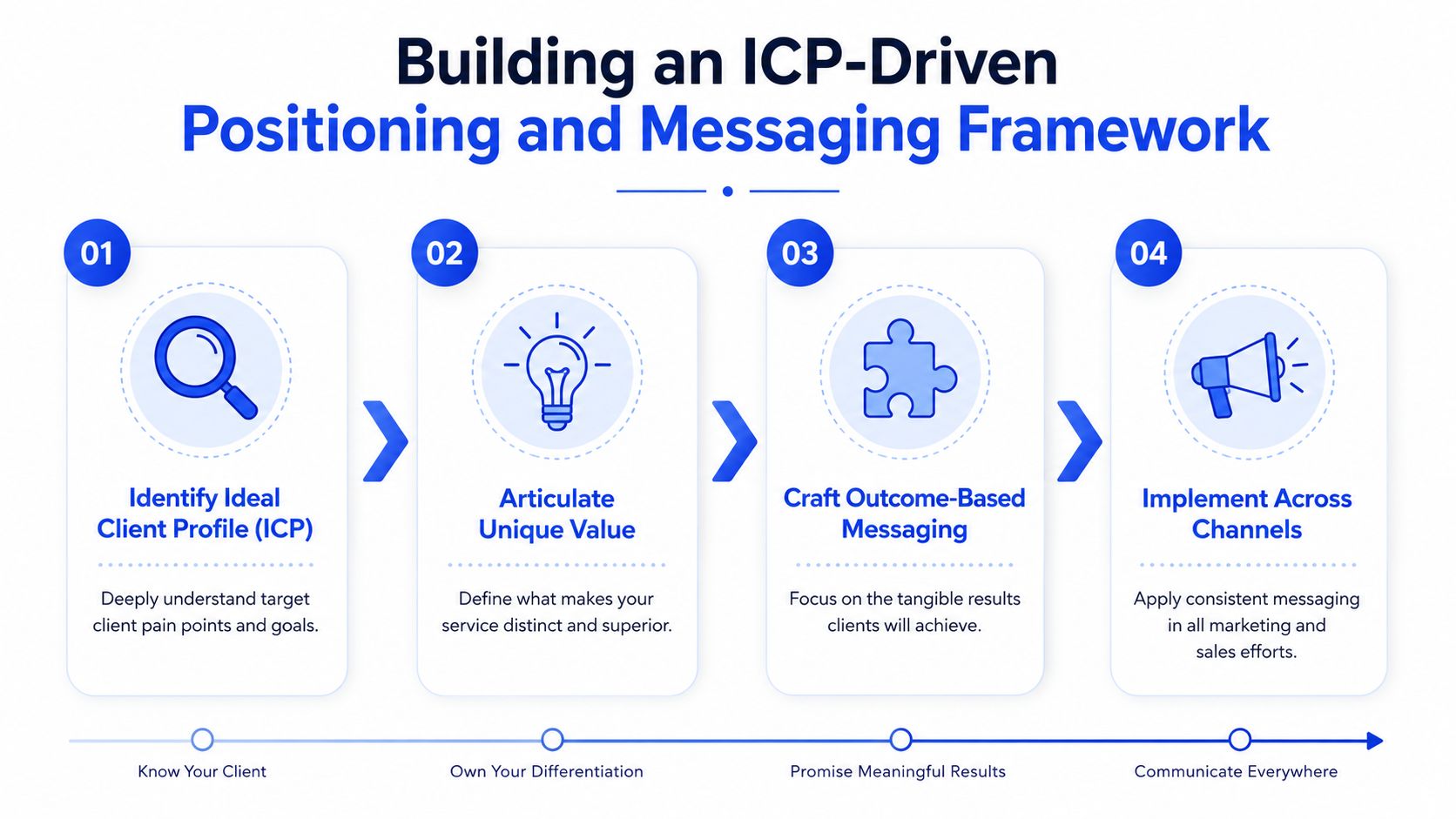
Generic positioning collapses fast with discerning buyers. “We help companies reduce churn” sounds fine until the prospect sees six other vendors saying the same thing. The buyer doesn't need another category slogan. They need a clear reason your service maps to their specific risk, segment, or operational bottleneck.
Start with buyer language, not vendor language
The cleanest pivot I've seen in a SaaS customer-success engagement moved from “reduce customer churn through better customer success” to “identify at-risk revenue in your top 20% accounts before they signal it.” That change wasn't cosmetic. It moved the conversation from category language to a concrete outcome, from prevention to detection, and from broad pain to a specific high-stakes segment.
The measured impact was real. Reply rate moved from 6.8% to 13.2%, qualified opportunity rate from 38% of meetings to 64% of meetings, and cost per qualified opportunity from €790 to €310. Monthly qualified opportunities moved from 5 to 7 before the pivot to 14 to 18 after it. Those gains came from better messaging, better signal criteria, and tighter ICP focus, not from adding more volume (Pedowitz Group).
Use the five patterns that consistently work
The strongest pivots usually follow the same five moves.
Category to specific outcome. “Customer success” becomes a concrete business result.
General to specific segment. “Accounts” becomes the highest-value accounts.
Prevention to detection. Buyers react to finding risk earlier.
Vendor language to buyer language. The phrasing should match how they speak in calls.
Qualitative to quantitative. Numbers force clarity and expose weak positioning.
That's the pattern, but the work is in the source material. Closed-deal conversations tell you what the buyer cared about. Positive replies show the language that resonated. Lost deals show where your category framing was too soft or too broad. If those inputs don't line up, the message is still too generic.
Test the message like a revenue hypothesis
The best teams don't “refresh copy,” they test a hypothesis. In the example above, the team ran a 50/50 split over 400 prospects for 14 days, then rolled the new message across all outreach in week three. That's the right shape of test for a serious pipeline team. It's controlled enough to trust and fast enough to act on.
If you want the mechanics laid out in one place, this internal ICP resource is the right companion to the framework above. The main point is simple, the tighter the ICP, the better every downstream metric behaves.
The signal-triggered outbound and founder content engine
The highest-return motion I've seen in professional-services-adjacent work is signal-triggered outbound through LinkedIn and email, paired with a founder LinkedIn content program. Used together, they create credibility before the first reply and keep pressure on the right accounts until they're ready to talk. Used separately, both channels underperform.
The economics work when ACV is high enough to justify the build. In representative engagements, investment has sat between €90k and €180k annually with attributable closed revenue between €480k and €1.2M annually, which is why the typical ROI lands in the 4x to 7x range. In one legal tech case, total investment was €138k and attributable revenue was €936k, which produced a 6.8x direct ROI.
What the system actually does
The outbound side is about timing and specificity. Tools like Apollo, Clay, Lemlist, Smartlead, and HeyReach help with list building, enrichment, and sequencing, but the tool stack only matters after the signal logic is right. If the signal is weak, automation just scales mistakes.
The legal tech case makes the split clear. Signal-triggered outbound drove 52 of 74 qualified opportunities, or 70%, with roughly €65k of cost allocation and a 9.8x channel-specific ROI. Founder LinkedIn content generated 14 of 74 qualified opportunities, or 19%, with roughly €35k of cost allocation and a 6.2x channel-specific ROI. The remaining 11% came from compound touch effects.
Founder content warms the room. Signal-triggered outreach asks for the meeting at the right moment.
That combination works because professional services buyers want evidence, not enthusiasm. Content shows the founder understands the category. Outreach proves the team can do actual account-level work. When those two show up together, response quality improves.
Why the combo beats either channel alone
The first reason is simple, the buyer sees the same expertise from two angles. The second is timing, because signals catch prospects when they're active. The third is persistence, because long consideration cycles need multiple touches without sounding repetitive.
A practical stack often looks like this, Clay for enrichment, Apollo for contact data, HeyReach for LinkedIn sequencing, and Lemlist or Smartlead for email follow-up. If the founder is posting consistently, outbound doesn't have to do all the credibility work itself. That keeps the sequence cleaner and the message sharper.
For teams building this motion, a guide like ViralBrain's LinkedIn content strategy resource can help with cadence and founder-post mechanics. If the goal is qualified conversations, not empty reach, the content has to support the outbound, not sit beside it.
The strongest lesson from the data is that alternative channels can work, but they usually sit lower on the ROI curve. LinkedIn Ads, Google Ads, events, and referral programs all have a place. They just don't beat a disciplined signal-triggered engine that also builds founder credibility.
Vertical tailoring that builds insider credibility
Generic content with industry nouns pasted on top gets ignored fast. Real vertical tailoring sounds like someone who has sat in the buyer's chair, heard the internal language, and understands the regulation, workflow, and event cycle that shape the category. In iGaming, that difference is brutally obvious.
The clearest example came from a compliance software company entering the iGaming vertical. The team built a six-month content program before and around ICE Barcelona 2025, using iGaming-specific insight posts, event-amplified content, vertical case studies, and insider terminology such as KYC, AML, RG, and LiveDealer. The result was a 5x increase in qualified iGaming buyer conversations, 41 qualified meetings during and after ICE Barcelona, and €580k attributable revenue from the content program alone. Combined with signal-triggered outbound, the total attributable revenue reached €1.24M.
The five dimensions that made it work
The first dimension was voice and terminology. The second was pain framing. The third was vertical examples and case studies. The fourth was content format. The fifth was timing cadence. That mix is what made the content feel like it belonged in the market instead of being air-dropped into it.
The voice mattered most. Generic “compliance” language doesn't land the same way as a message that refers to specific regulatory bodies like MGA, UKGC, or KSA, and the operational pain behind them. Buyers can tell when the author knows the terrain. They can also tell when the writer just copied the jargon.
Timing multiplied the effect
The content program wasn't random. It ramped into ICE Barcelona, then used the event to intensify attention when the market was already clustered around the same set of problems. That timing gave the content more lift than a standard monthly cadence would have produced. A one-off vertical post rarely does that.
The useful lesson for other verticals is not to copy the iGaming specifics. It's to copy the discipline. Build content from real buyer language, anchor it to vertical moments that matter, and use examples that a practitioner would recognize immediately. A polished generic post can be acceptable. An authentic vertical post gets remembered.
For teams working across sectors, Grou's professional services solution page is a sensible reference point for how this gets operationalized across service-heavy categories. The principle stays the same, while the voice and pain framing change by vertical.
Operational workflows that sustain pipeline generation
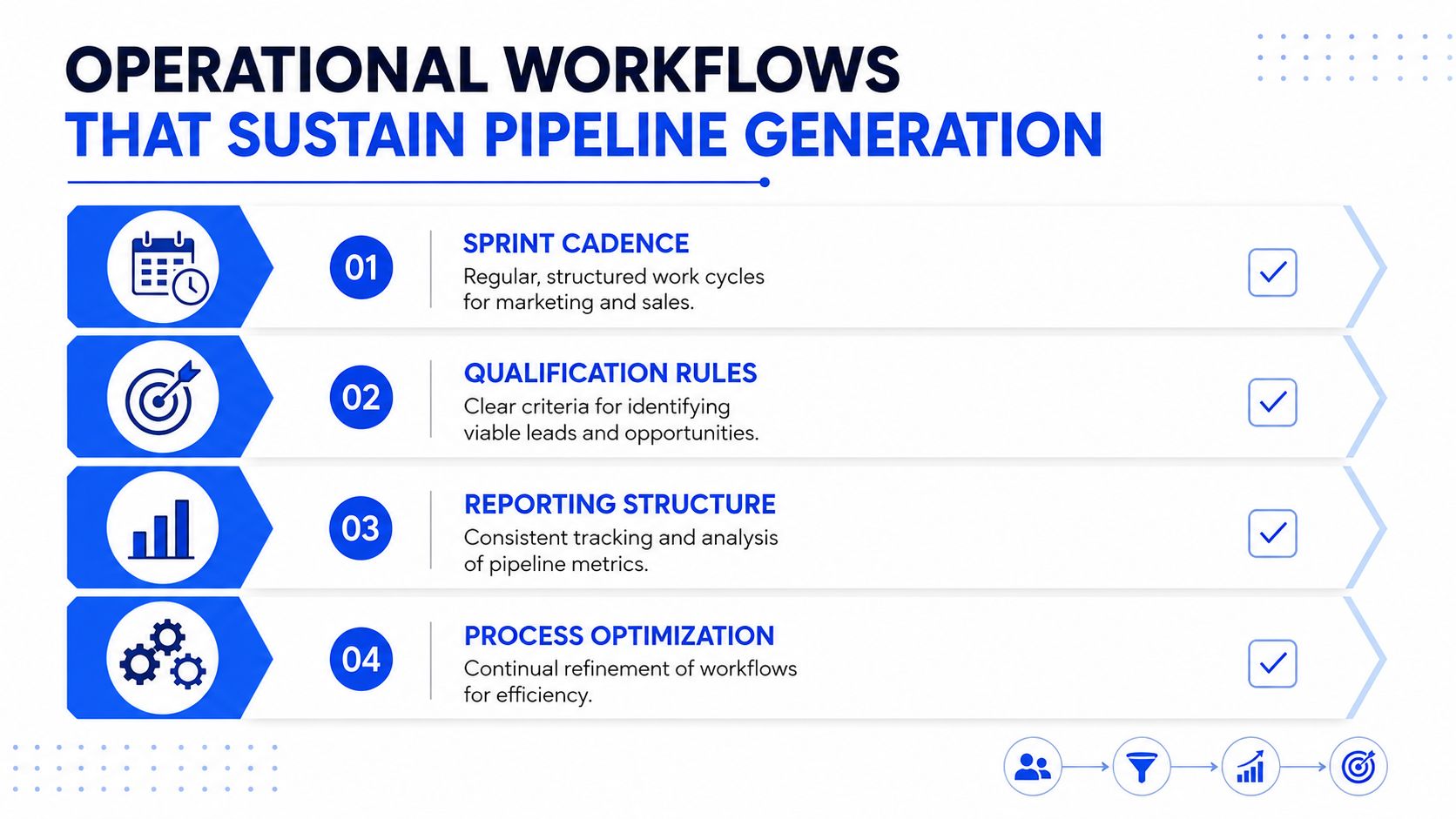
A good strategy falls apart fast without operating rhythm. I've seen strong messaging die inside slow approvals, weak routing, and reporting that tells everyone what happened last month, but nothing about what to change tomorrow. The fix is boring and effective, a real cadence, clear qualification rules, and a short feedback loop.
Use a sprint system, not campaign folklore
The cleanest operational model is a bi-weekly sprint cadence with a dedicated Slack channel for feedback, daily message and signal refinement, and transparent reporting from activity to opportunity. That keeps marketing, sales, and RevOps on the same page without requiring a giant meeting stack. It also makes the work easier to fix while it's still small.
Qualification needs to be ruthless. A meeting is only useful if the target account matches the ICP, the pain is real, the timing is active, and the next step is clear. Anything else is just calendar noise. If the reply isn't from the right person, or the conversation can't get to a real use case quickly, it shouldn't be counted as pipeline quality.
Keep the data in front of the team
The reporting column in the CRM needs more than stage names. Add columns for signal type, message variant, meeting-held status, referral source if relevant, and opportunity quality notes. If the team can't see which signal produced which conversation, the system will drift back toward guesswork.
A useful internal check is to audit meeting-held rate every Friday. Review the last ten sequences, inspect routing speed, and ask whether the replies came from the right accounts or just the easiest ones to engage. That's the kind of operational habit that keeps the machine honest.
For teams formalizing the process, this sales-process automation resource is a useful companion. It's also worth reviewing sequence prompts regularly, because the wording that worked last month can get stale faster than anticipated.
Measuring what actually proves revenue impact
Traffic, impressions, and likes are easy to report and easy to overvalue. In professional services, they rarely prove that the right accounts are moving toward revenue. Better measurement tracks whether the business is getting more trust, better qualification, and larger or stickier engagements.
Metric category | Vanity metric to avoid | Pipeline-quality metric to track | Why it matters |
|---|---|---|---|
Acquisition | Traffic | Referral conversion rate | Shows whether trust is turning into real conversations |
Sales efficiency | Lead volume | Proposal win rate | Reveals if positioning is good enough to close |
Deal quality | Clicks | Average engagement size | Shows whether the right accounts are buying |
Retention | Impressions | Client retention rate | Proves the work is creating durable value |
The measurement lens matters because volume can damage credibility in this category. Generic lead gen and shallow content can bring in the wrong people, then clutter sales time with meetings that never had a real chance. That's why the question isn't “How many leads did we get?” It's “Did the right accounts move, and did the pipeline get better?”
Track the right conversation-level indicators
The most useful measurement framework is multi-layered. Look at source, signal, meeting quality, proposal quality, and downstream retention together. If one layer looks good but the next one collapses, the system is off somewhere upstream.
For content measurement in particular, Narrareach's content metrics guide is a helpful reference if you want a cleaner way to think about content performance without falling back to surface-level engagement. The point isn't to measure more things, it's to measure the right ones.
If the metric doesn't help you decide where to spend the next sprint, it's reporting noise.
The practical caveat is that ROI changes with ICP clarity, sales infrastructure quality, signal diversity, content consistency, and engagement duration. Longer engagements tend to produce better outcomes because the system has time to compound. Shorter ones often look weaker because the work hasn't had time to create enough signal density.
For attribution, connect LinkedIn content, email outreach, and meeting outcomes in one reporting view. This multi-touch attribution resource is the right place to pressure-test whether the story you're telling matches the actual path to revenue.
If you want the structure behind this kind of pipeline engine, Grou builds it around one message, one target list, and one reporting line. Visit Grou if you want a system that turns professional services expertise into qualified conversations, then closed revenue.
Professional services marketing breaks the moment teams treat it like product demand gen. Buyers aren't waiting to be persuaded by another generic webinar, and cold outreach doesn't fail because the category is “special,” it fails when the message is lazy, the timing is random, and the CRM can't tell signal from noise.
Referrals are strong, but they're not a system. Structured outbound and founder content add the missing layer.
Messaging matters more than channel volume. A sharper outcome beats category language every time.
Signals beat spray-and-pray outreach. Timing and relevance drive response.
Measurement has to move beyond traffic. Revenue quality matters more than impressions.
Table of Contents
Why professional services buyers actually respond to outreach
How professional services marketing differs from product marketing
Why professional services buyers actually respond to outreach
The idea that professional services buyers ignore outreach is usually a reaction to bad outreach, not a market truth. Discerning buyers don't reward sloppy sequencing, recycled copy, or generic “thought leadership” that never says anything useful. They do respond when the timing, message, and proof line up with a live buying problem.
Quality of execution is the real variable
In adjacent professional-services work, signal-triggered outbound has produced 11 to 17% reply rates across legal tech, IT services, compliance software, and cybersecurity engagements. That's the meaningful comparison point, not the 1 to 3% expectation many leaders carry around in their heads. The gap is usually execution, not buyer category.
Bad outreach fails universally. Disciplined outreach works when it reaches an active buyer with a specific reason to care.
The counter-argument inside the business is simple. If someone says, “Our buyers only come through referrals,” the answer is, “That's a channel preference, not a law of nature.” If someone says, “Our cycle is too long for outbound,” the reply is, “Long cycles affect close timing, not whether an opportunity gets created.” If someone says, “Our audience isn't on LinkedIn,” that usually means the list hasn't been built properly.
Signal timing changes the response pattern
Outreach works better when it lands around a trigger, not when it lands on a random Tuesday. A prospect who just changed a system, hired a new leader, or hit a compliance problem is much more likely to read a relevant message than a broad pitch sent to a static list. That's why signal-triggered outbound sits closer to active buying behavior than generic prospecting.
The practical move is to treat outbound as a precision channel. Use LinkedIn and email together, build sequences around real buying signals, and route prospects to service-specific pages or conversation paths that match the context of the signal. That's also where a system like MapLeads for marketing agencies can be useful if the team needs cleaner list building and targeting hygiene.
Referral channels still matter, but they're not enough on their own. Systematic outbound doesn't replace trust, it extends it into accounts that would never have arrived through introductions alone.
How professional services marketing differs from product marketing
Professional services buyers don't purchase a repeatable object, they buy trust in people, judgment, and the team's ability to solve a messy problem. That alone changes positioning, content, and pipeline mechanics. A product can be explained through features and usage. A service has to prove competence before the buyer is comfortable starting the conversation.
The scale of the market justifies that kind of discipline. One major estimate puts the professional services market at $6,370.29 billion in 2025, with a projection of $8,476.02 billion by 2030 at a 6.2% CAGR (The Business Research Company). Another market estimate places it at nearly $6.07 trillion in 2024 and $7.89 trillion by 2029 (The Business Research Company). That is a big enough market to justify structured pipeline systems, not improvised activity.
Trust changes the funnel mechanics
Product marketing can lean on repeatable proof and broad usage patterns. Professional services marketing needs specificity, because the buyer is evaluating judgment under uncertainty. That means founder content, service-page relevance, and sales follow-up need to sound like they belong to the same operator who'll run the work.
The budget structure reflects that reality. A 2025 survey reported professional services firms allocated 3.1% of turnover to marketing and business development, up from 3.0% the year before and 2.9% the year before that. The same survey commentary said the average in-house marketing and BD team grew from 2.8 to 4.5 people, with law firms averaging 3.0% and accountancy firms 2.0% (LinkedIn survey commentary). That's lean. It also means every campaign has to earn its place.
Buying cycles demand sustained presence
Product buyers can convert after a short run of ads, landing pages, and a demo. Professional services buyers usually need repeated proof, especially when the engagement is expensive or politically sensitive. That's why a one-off campaign often disappoints, even when the messaging is decent.
In this category, content isn't decoration. It's part of the proof layer that makes outreach believable.
There's also a channel reality worth respecting. Organic search drives 48.5% of traffic, while direct drives 22.0%, referral 12.5%, paid search 10.0%, and social 5.5% in one benchmark set for professional services marketing (CUFinder). But traffic isn't the point. The point is that buyers research expertise before they contact anyone, so depth and technical relevance matter more than awareness theater.
For a useful practical contrast, Grou's ICP guidance aligns with this category better than broad-stroke demand gen advice. The tighter the profile, the less waste you absorb downstream.
Building an ICP-driven positioning and messaging framework
Generic positioning collapses fast with discerning buyers. “We help companies reduce churn” sounds fine until the prospect sees six other vendors saying the same thing. The buyer doesn't need another category slogan. They need a clear reason your service maps to their specific risk, segment, or operational bottleneck.
Start with buyer language, not vendor language
The cleanest pivot I've seen in a SaaS customer-success engagement moved from “reduce customer churn through better customer success” to “identify at-risk revenue in your top 20% accounts before they signal it.” That change wasn't cosmetic. It moved the conversation from category language to a concrete outcome, from prevention to detection, and from broad pain to a specific high-stakes segment.
The measured impact was real. Reply rate moved from 6.8% to 13.2%, qualified opportunity rate from 38% of meetings to 64% of meetings, and cost per qualified opportunity from €790 to €310. Monthly qualified opportunities moved from 5 to 7 before the pivot to 14 to 18 after it. Those gains came from better messaging, better signal criteria, and tighter ICP focus, not from adding more volume (Pedowitz Group).
Use the five patterns that consistently work
The strongest pivots usually follow the same five moves.
Category to specific outcome. “Customer success” becomes a concrete business result.
General to specific segment. “Accounts” becomes the highest-value accounts.
Prevention to detection. Buyers react to finding risk earlier.
Vendor language to buyer language. The phrasing should match how they speak in calls.
Qualitative to quantitative. Numbers force clarity and expose weak positioning.
That's the pattern, but the work is in the source material. Closed-deal conversations tell you what the buyer cared about. Positive replies show the language that resonated. Lost deals show where your category framing was too soft or too broad. If those inputs don't line up, the message is still too generic.
Test the message like a revenue hypothesis
The best teams don't “refresh copy,” they test a hypothesis. In the example above, the team ran a 50/50 split over 400 prospects for 14 days, then rolled the new message across all outreach in week three. That's the right shape of test for a serious pipeline team. It's controlled enough to trust and fast enough to act on.
If you want the mechanics laid out in one place, this internal ICP resource is the right companion to the framework above. The main point is simple, the tighter the ICP, the better every downstream metric behaves.
The signal-triggered outbound and founder content engine
The highest-return motion I've seen in professional-services-adjacent work is signal-triggered outbound through LinkedIn and email, paired with a founder LinkedIn content program. Used together, they create credibility before the first reply and keep pressure on the right accounts until they're ready to talk. Used separately, both channels underperform.
The economics work when ACV is high enough to justify the build. In representative engagements, investment has sat between €90k and €180k annually with attributable closed revenue between €480k and €1.2M annually, which is why the typical ROI lands in the 4x to 7x range. In one legal tech case, total investment was €138k and attributable revenue was €936k, which produced a 6.8x direct ROI.
What the system actually does
The outbound side is about timing and specificity. Tools like Apollo, Clay, Lemlist, Smartlead, and HeyReach help with list building, enrichment, and sequencing, but the tool stack only matters after the signal logic is right. If the signal is weak, automation just scales mistakes.
The legal tech case makes the split clear. Signal-triggered outbound drove 52 of 74 qualified opportunities, or 70%, with roughly €65k of cost allocation and a 9.8x channel-specific ROI. Founder LinkedIn content generated 14 of 74 qualified opportunities, or 19%, with roughly €35k of cost allocation and a 6.2x channel-specific ROI. The remaining 11% came from compound touch effects.
Founder content warms the room. Signal-triggered outreach asks for the meeting at the right moment.
That combination works because professional services buyers want evidence, not enthusiasm. Content shows the founder understands the category. Outreach proves the team can do actual account-level work. When those two show up together, response quality improves.
Why the combo beats either channel alone
The first reason is simple, the buyer sees the same expertise from two angles. The second is timing, because signals catch prospects when they're active. The third is persistence, because long consideration cycles need multiple touches without sounding repetitive.
A practical stack often looks like this, Clay for enrichment, Apollo for contact data, HeyReach for LinkedIn sequencing, and Lemlist or Smartlead for email follow-up. If the founder is posting consistently, outbound doesn't have to do all the credibility work itself. That keeps the sequence cleaner and the message sharper.
For teams building this motion, a guide like ViralBrain's LinkedIn content strategy resource can help with cadence and founder-post mechanics. If the goal is qualified conversations, not empty reach, the content has to support the outbound, not sit beside it.
The strongest lesson from the data is that alternative channels can work, but they usually sit lower on the ROI curve. LinkedIn Ads, Google Ads, events, and referral programs all have a place. They just don't beat a disciplined signal-triggered engine that also builds founder credibility.
Vertical tailoring that builds insider credibility
Generic content with industry nouns pasted on top gets ignored fast. Real vertical tailoring sounds like someone who has sat in the buyer's chair, heard the internal language, and understands the regulation, workflow, and event cycle that shape the category. In iGaming, that difference is brutally obvious.
The clearest example came from a compliance software company entering the iGaming vertical. The team built a six-month content program before and around ICE Barcelona 2025, using iGaming-specific insight posts, event-amplified content, vertical case studies, and insider terminology such as KYC, AML, RG, and LiveDealer. The result was a 5x increase in qualified iGaming buyer conversations, 41 qualified meetings during and after ICE Barcelona, and €580k attributable revenue from the content program alone. Combined with signal-triggered outbound, the total attributable revenue reached €1.24M.
The five dimensions that made it work
The first dimension was voice and terminology. The second was pain framing. The third was vertical examples and case studies. The fourth was content format. The fifth was timing cadence. That mix is what made the content feel like it belonged in the market instead of being air-dropped into it.
The voice mattered most. Generic “compliance” language doesn't land the same way as a message that refers to specific regulatory bodies like MGA, UKGC, or KSA, and the operational pain behind them. Buyers can tell when the author knows the terrain. They can also tell when the writer just copied the jargon.
Timing multiplied the effect
The content program wasn't random. It ramped into ICE Barcelona, then used the event to intensify attention when the market was already clustered around the same set of problems. That timing gave the content more lift than a standard monthly cadence would have produced. A one-off vertical post rarely does that.
The useful lesson for other verticals is not to copy the iGaming specifics. It's to copy the discipline. Build content from real buyer language, anchor it to vertical moments that matter, and use examples that a practitioner would recognize immediately. A polished generic post can be acceptable. An authentic vertical post gets remembered.
For teams working across sectors, Grou's professional services solution page is a sensible reference point for how this gets operationalized across service-heavy categories. The principle stays the same, while the voice and pain framing change by vertical.
Operational workflows that sustain pipeline generation
A good strategy falls apart fast without operating rhythm. I've seen strong messaging die inside slow approvals, weak routing, and reporting that tells everyone what happened last month, but nothing about what to change tomorrow. The fix is boring and effective, a real cadence, clear qualification rules, and a short feedback loop.
Use a sprint system, not campaign folklore
The cleanest operational model is a bi-weekly sprint cadence with a dedicated Slack channel for feedback, daily message and signal refinement, and transparent reporting from activity to opportunity. That keeps marketing, sales, and RevOps on the same page without requiring a giant meeting stack. It also makes the work easier to fix while it's still small.
Qualification needs to be ruthless. A meeting is only useful if the target account matches the ICP, the pain is real, the timing is active, and the next step is clear. Anything else is just calendar noise. If the reply isn't from the right person, or the conversation can't get to a real use case quickly, it shouldn't be counted as pipeline quality.
Keep the data in front of the team
The reporting column in the CRM needs more than stage names. Add columns for signal type, message variant, meeting-held status, referral source if relevant, and opportunity quality notes. If the team can't see which signal produced which conversation, the system will drift back toward guesswork.
A useful internal check is to audit meeting-held rate every Friday. Review the last ten sequences, inspect routing speed, and ask whether the replies came from the right accounts or just the easiest ones to engage. That's the kind of operational habit that keeps the machine honest.
For teams formalizing the process, this sales-process automation resource is a useful companion. It's also worth reviewing sequence prompts regularly, because the wording that worked last month can get stale faster than anticipated.
Measuring what actually proves revenue impact
Traffic, impressions, and likes are easy to report and easy to overvalue. In professional services, they rarely prove that the right accounts are moving toward revenue. Better measurement tracks whether the business is getting more trust, better qualification, and larger or stickier engagements.
Metric category | Vanity metric to avoid | Pipeline-quality metric to track | Why it matters |
|---|---|---|---|
Acquisition | Traffic | Referral conversion rate | Shows whether trust is turning into real conversations |
Sales efficiency | Lead volume | Proposal win rate | Reveals if positioning is good enough to close |
Deal quality | Clicks | Average engagement size | Shows whether the right accounts are buying |
Retention | Impressions | Client retention rate | Proves the work is creating durable value |
The measurement lens matters because volume can damage credibility in this category. Generic lead gen and shallow content can bring in the wrong people, then clutter sales time with meetings that never had a real chance. That's why the question isn't “How many leads did we get?” It's “Did the right accounts move, and did the pipeline get better?”
Track the right conversation-level indicators
The most useful measurement framework is multi-layered. Look at source, signal, meeting quality, proposal quality, and downstream retention together. If one layer looks good but the next one collapses, the system is off somewhere upstream.
For content measurement in particular, Narrareach's content metrics guide is a helpful reference if you want a cleaner way to think about content performance without falling back to surface-level engagement. The point isn't to measure more things, it's to measure the right ones.
If the metric doesn't help you decide where to spend the next sprint, it's reporting noise.
The practical caveat is that ROI changes with ICP clarity, sales infrastructure quality, signal diversity, content consistency, and engagement duration. Longer engagements tend to produce better outcomes because the system has time to compound. Shorter ones often look weaker because the work hasn't had time to create enough signal density.
For attribution, connect LinkedIn content, email outreach, and meeting outcomes in one reporting view. This multi-touch attribution resource is the right place to pressure-test whether the story you're telling matches the actual path to revenue.
If you want the structure behind this kind of pipeline engine, Grou builds it around one message, one target list, and one reporting line. Visit Grou if you want a system that turns professional services expertise into qualified conversations, then closed revenue.
Professional services marketing breaks the moment teams treat it like product demand gen. Buyers aren't waiting to be persuaded by another generic webinar, and cold outreach doesn't fail because the category is “special,” it fails when the message is lazy, the timing is random, and the CRM can't tell signal from noise.
Referrals are strong, but they're not a system. Structured outbound and founder content add the missing layer.
Messaging matters more than channel volume. A sharper outcome beats category language every time.
Signals beat spray-and-pray outreach. Timing and relevance drive response.
Measurement has to move beyond traffic. Revenue quality matters more than impressions.
Table of Contents
Why professional services buyers actually respond to outreach
How professional services marketing differs from product marketing
Why professional services buyers actually respond to outreach
The idea that professional services buyers ignore outreach is usually a reaction to bad outreach, not a market truth. Discerning buyers don't reward sloppy sequencing, recycled copy, or generic “thought leadership” that never says anything useful. They do respond when the timing, message, and proof line up with a live buying problem.
Quality of execution is the real variable
In adjacent professional-services work, signal-triggered outbound has produced 11 to 17% reply rates across legal tech, IT services, compliance software, and cybersecurity engagements. That's the meaningful comparison point, not the 1 to 3% expectation many leaders carry around in their heads. The gap is usually execution, not buyer category.
Bad outreach fails universally. Disciplined outreach works when it reaches an active buyer with a specific reason to care.
The counter-argument inside the business is simple. If someone says, “Our buyers only come through referrals,” the answer is, “That's a channel preference, not a law of nature.” If someone says, “Our cycle is too long for outbound,” the reply is, “Long cycles affect close timing, not whether an opportunity gets created.” If someone says, “Our audience isn't on LinkedIn,” that usually means the list hasn't been built properly.
Signal timing changes the response pattern
Outreach works better when it lands around a trigger, not when it lands on a random Tuesday. A prospect who just changed a system, hired a new leader, or hit a compliance problem is much more likely to read a relevant message than a broad pitch sent to a static list. That's why signal-triggered outbound sits closer to active buying behavior than generic prospecting.
The practical move is to treat outbound as a precision channel. Use LinkedIn and email together, build sequences around real buying signals, and route prospects to service-specific pages or conversation paths that match the context of the signal. That's also where a system like MapLeads for marketing agencies can be useful if the team needs cleaner list building and targeting hygiene.
Referral channels still matter, but they're not enough on their own. Systematic outbound doesn't replace trust, it extends it into accounts that would never have arrived through introductions alone.
How professional services marketing differs from product marketing
Professional services buyers don't purchase a repeatable object, they buy trust in people, judgment, and the team's ability to solve a messy problem. That alone changes positioning, content, and pipeline mechanics. A product can be explained through features and usage. A service has to prove competence before the buyer is comfortable starting the conversation.
The scale of the market justifies that kind of discipline. One major estimate puts the professional services market at $6,370.29 billion in 2025, with a projection of $8,476.02 billion by 2030 at a 6.2% CAGR (The Business Research Company). Another market estimate places it at nearly $6.07 trillion in 2024 and $7.89 trillion by 2029 (The Business Research Company). That is a big enough market to justify structured pipeline systems, not improvised activity.
Trust changes the funnel mechanics
Product marketing can lean on repeatable proof and broad usage patterns. Professional services marketing needs specificity, because the buyer is evaluating judgment under uncertainty. That means founder content, service-page relevance, and sales follow-up need to sound like they belong to the same operator who'll run the work.
The budget structure reflects that reality. A 2025 survey reported professional services firms allocated 3.1% of turnover to marketing and business development, up from 3.0% the year before and 2.9% the year before that. The same survey commentary said the average in-house marketing and BD team grew from 2.8 to 4.5 people, with law firms averaging 3.0% and accountancy firms 2.0% (LinkedIn survey commentary). That's lean. It also means every campaign has to earn its place.
Buying cycles demand sustained presence
Product buyers can convert after a short run of ads, landing pages, and a demo. Professional services buyers usually need repeated proof, especially when the engagement is expensive or politically sensitive. That's why a one-off campaign often disappoints, even when the messaging is decent.
In this category, content isn't decoration. It's part of the proof layer that makes outreach believable.
There's also a channel reality worth respecting. Organic search drives 48.5% of traffic, while direct drives 22.0%, referral 12.5%, paid search 10.0%, and social 5.5% in one benchmark set for professional services marketing (CUFinder). But traffic isn't the point. The point is that buyers research expertise before they contact anyone, so depth and technical relevance matter more than awareness theater.
For a useful practical contrast, Grou's ICP guidance aligns with this category better than broad-stroke demand gen advice. The tighter the profile, the less waste you absorb downstream.
Building an ICP-driven positioning and messaging framework
Generic positioning collapses fast with discerning buyers. “We help companies reduce churn” sounds fine until the prospect sees six other vendors saying the same thing. The buyer doesn't need another category slogan. They need a clear reason your service maps to their specific risk, segment, or operational bottleneck.
Start with buyer language, not vendor language
The cleanest pivot I've seen in a SaaS customer-success engagement moved from “reduce customer churn through better customer success” to “identify at-risk revenue in your top 20% accounts before they signal it.” That change wasn't cosmetic. It moved the conversation from category language to a concrete outcome, from prevention to detection, and from broad pain to a specific high-stakes segment.
The measured impact was real. Reply rate moved from 6.8% to 13.2%, qualified opportunity rate from 38% of meetings to 64% of meetings, and cost per qualified opportunity from €790 to €310. Monthly qualified opportunities moved from 5 to 7 before the pivot to 14 to 18 after it. Those gains came from better messaging, better signal criteria, and tighter ICP focus, not from adding more volume (Pedowitz Group).
Use the five patterns that consistently work
The strongest pivots usually follow the same five moves.
Category to specific outcome. “Customer success” becomes a concrete business result.
General to specific segment. “Accounts” becomes the highest-value accounts.
Prevention to detection. Buyers react to finding risk earlier.
Vendor language to buyer language. The phrasing should match how they speak in calls.
Qualitative to quantitative. Numbers force clarity and expose weak positioning.
That's the pattern, but the work is in the source material. Closed-deal conversations tell you what the buyer cared about. Positive replies show the language that resonated. Lost deals show where your category framing was too soft or too broad. If those inputs don't line up, the message is still too generic.
Test the message like a revenue hypothesis
The best teams don't “refresh copy,” they test a hypothesis. In the example above, the team ran a 50/50 split over 400 prospects for 14 days, then rolled the new message across all outreach in week three. That's the right shape of test for a serious pipeline team. It's controlled enough to trust and fast enough to act on.
If you want the mechanics laid out in one place, this internal ICP resource is the right companion to the framework above. The main point is simple, the tighter the ICP, the better every downstream metric behaves.
The signal-triggered outbound and founder content engine
The highest-return motion I've seen in professional-services-adjacent work is signal-triggered outbound through LinkedIn and email, paired with a founder LinkedIn content program. Used together, they create credibility before the first reply and keep pressure on the right accounts until they're ready to talk. Used separately, both channels underperform.
The economics work when ACV is high enough to justify the build. In representative engagements, investment has sat between €90k and €180k annually with attributable closed revenue between €480k and €1.2M annually, which is why the typical ROI lands in the 4x to 7x range. In one legal tech case, total investment was €138k and attributable revenue was €936k, which produced a 6.8x direct ROI.
What the system actually does
The outbound side is about timing and specificity. Tools like Apollo, Clay, Lemlist, Smartlead, and HeyReach help with list building, enrichment, and sequencing, but the tool stack only matters after the signal logic is right. If the signal is weak, automation just scales mistakes.
The legal tech case makes the split clear. Signal-triggered outbound drove 52 of 74 qualified opportunities, or 70%, with roughly €65k of cost allocation and a 9.8x channel-specific ROI. Founder LinkedIn content generated 14 of 74 qualified opportunities, or 19%, with roughly €35k of cost allocation and a 6.2x channel-specific ROI. The remaining 11% came from compound touch effects.
Founder content warms the room. Signal-triggered outreach asks for the meeting at the right moment.
That combination works because professional services buyers want evidence, not enthusiasm. Content shows the founder understands the category. Outreach proves the team can do actual account-level work. When those two show up together, response quality improves.
Why the combo beats either channel alone
The first reason is simple, the buyer sees the same expertise from two angles. The second is timing, because signals catch prospects when they're active. The third is persistence, because long consideration cycles need multiple touches without sounding repetitive.
A practical stack often looks like this, Clay for enrichment, Apollo for contact data, HeyReach for LinkedIn sequencing, and Lemlist or Smartlead for email follow-up. If the founder is posting consistently, outbound doesn't have to do all the credibility work itself. That keeps the sequence cleaner and the message sharper.
For teams building this motion, a guide like ViralBrain's LinkedIn content strategy resource can help with cadence and founder-post mechanics. If the goal is qualified conversations, not empty reach, the content has to support the outbound, not sit beside it.
The strongest lesson from the data is that alternative channels can work, but they usually sit lower on the ROI curve. LinkedIn Ads, Google Ads, events, and referral programs all have a place. They just don't beat a disciplined signal-triggered engine that also builds founder credibility.
Vertical tailoring that builds insider credibility
Generic content with industry nouns pasted on top gets ignored fast. Real vertical tailoring sounds like someone who has sat in the buyer's chair, heard the internal language, and understands the regulation, workflow, and event cycle that shape the category. In iGaming, that difference is brutally obvious.
The clearest example came from a compliance software company entering the iGaming vertical. The team built a six-month content program before and around ICE Barcelona 2025, using iGaming-specific insight posts, event-amplified content, vertical case studies, and insider terminology such as KYC, AML, RG, and LiveDealer. The result was a 5x increase in qualified iGaming buyer conversations, 41 qualified meetings during and after ICE Barcelona, and €580k attributable revenue from the content program alone. Combined with signal-triggered outbound, the total attributable revenue reached €1.24M.
The five dimensions that made it work
The first dimension was voice and terminology. The second was pain framing. The third was vertical examples and case studies. The fourth was content format. The fifth was timing cadence. That mix is what made the content feel like it belonged in the market instead of being air-dropped into it.
The voice mattered most. Generic “compliance” language doesn't land the same way as a message that refers to specific regulatory bodies like MGA, UKGC, or KSA, and the operational pain behind them. Buyers can tell when the author knows the terrain. They can also tell when the writer just copied the jargon.
Timing multiplied the effect
The content program wasn't random. It ramped into ICE Barcelona, then used the event to intensify attention when the market was already clustered around the same set of problems. That timing gave the content more lift than a standard monthly cadence would have produced. A one-off vertical post rarely does that.
The useful lesson for other verticals is not to copy the iGaming specifics. It's to copy the discipline. Build content from real buyer language, anchor it to vertical moments that matter, and use examples that a practitioner would recognize immediately. A polished generic post can be acceptable. An authentic vertical post gets remembered.
For teams working across sectors, Grou's professional services solution page is a sensible reference point for how this gets operationalized across service-heavy categories. The principle stays the same, while the voice and pain framing change by vertical.
Operational workflows that sustain pipeline generation
A good strategy falls apart fast without operating rhythm. I've seen strong messaging die inside slow approvals, weak routing, and reporting that tells everyone what happened last month, but nothing about what to change tomorrow. The fix is boring and effective, a real cadence, clear qualification rules, and a short feedback loop.
Use a sprint system, not campaign folklore
The cleanest operational model is a bi-weekly sprint cadence with a dedicated Slack channel for feedback, daily message and signal refinement, and transparent reporting from activity to opportunity. That keeps marketing, sales, and RevOps on the same page without requiring a giant meeting stack. It also makes the work easier to fix while it's still small.
Qualification needs to be ruthless. A meeting is only useful if the target account matches the ICP, the pain is real, the timing is active, and the next step is clear. Anything else is just calendar noise. If the reply isn't from the right person, or the conversation can't get to a real use case quickly, it shouldn't be counted as pipeline quality.
Keep the data in front of the team
The reporting column in the CRM needs more than stage names. Add columns for signal type, message variant, meeting-held status, referral source if relevant, and opportunity quality notes. If the team can't see which signal produced which conversation, the system will drift back toward guesswork.
A useful internal check is to audit meeting-held rate every Friday. Review the last ten sequences, inspect routing speed, and ask whether the replies came from the right accounts or just the easiest ones to engage. That's the kind of operational habit that keeps the machine honest.
For teams formalizing the process, this sales-process automation resource is a useful companion. It's also worth reviewing sequence prompts regularly, because the wording that worked last month can get stale faster than anticipated.
Measuring what actually proves revenue impact
Traffic, impressions, and likes are easy to report and easy to overvalue. In professional services, they rarely prove that the right accounts are moving toward revenue. Better measurement tracks whether the business is getting more trust, better qualification, and larger or stickier engagements.
Metric category | Vanity metric to avoid | Pipeline-quality metric to track | Why it matters |
|---|---|---|---|
Acquisition | Traffic | Referral conversion rate | Shows whether trust is turning into real conversations |
Sales efficiency | Lead volume | Proposal win rate | Reveals if positioning is good enough to close |
Deal quality | Clicks | Average engagement size | Shows whether the right accounts are buying |
Retention | Impressions | Client retention rate | Proves the work is creating durable value |
The measurement lens matters because volume can damage credibility in this category. Generic lead gen and shallow content can bring in the wrong people, then clutter sales time with meetings that never had a real chance. That's why the question isn't “How many leads did we get?” It's “Did the right accounts move, and did the pipeline get better?”
Track the right conversation-level indicators
The most useful measurement framework is multi-layered. Look at source, signal, meeting quality, proposal quality, and downstream retention together. If one layer looks good but the next one collapses, the system is off somewhere upstream.
For content measurement in particular, Narrareach's content metrics guide is a helpful reference if you want a cleaner way to think about content performance without falling back to surface-level engagement. The point isn't to measure more things, it's to measure the right ones.
If the metric doesn't help you decide where to spend the next sprint, it's reporting noise.
The practical caveat is that ROI changes with ICP clarity, sales infrastructure quality, signal diversity, content consistency, and engagement duration. Longer engagements tend to produce better outcomes because the system has time to compound. Shorter ones often look weaker because the work hasn't had time to create enough signal density.
For attribution, connect LinkedIn content, email outreach, and meeting outcomes in one reporting view. This multi-touch attribution resource is the right place to pressure-test whether the story you're telling matches the actual path to revenue.
If you want the structure behind this kind of pipeline engine, Grou builds it around one message, one target list, and one reporting line. Visit Grou if you want a system that turns professional services expertise into qualified conversations, then closed revenue.
Pipeline OS Newsletter
Build qualified pipeline
Get weekly tactics to generate demand, improve lead quality, and book more meetings.





Trusted by industry leaders
Trusted by industry leaders
Trusted by industry leaders
Ready to build qualified pipeline?
Ready to build qualified pipeline?
Ready to build qualified pipeline?
Book a call to see if we're the right fit, or take the 2-minute quiz to get a clear starting point.
Book a call to see if we're the right fit, or take the 2-minute quiz to get a clear starting point.
Book a call to see if we're the right fit, or take the 2-minute quiz to get a clear starting point.
" height="30.21639343089746px" id="hfGbXmQR2" width="30.216393430897455px"/></svg>)
Copyright © 2026 – All Right Reserved
Copyright © 2026 – All Right Reserved
Copyright © 2026 – All Right Reserved