%22%3E%3C/path%3E%3Cpath d=%22M 63.072 7.554 C 62.258 8.022 61.577 8.689 61.092 9.493 L 61.092 7.076 L 57.158 7.076 L 57.158 22.64 L 61.089 22.64 L 61.089 14.888 C 61.089 13.446 61.403 12.434 62.03 11.853 C 62.818 11.218 63.818 10.907 64.826 10.982 L 65.868 10.982 L 65.868 6.851 C 64.891 6.834 63.926 7.076 63.073 7.554 Z%22 fill=%22rgb(17,17,17)%22%3E%3C/path%3E%3Cpath d=%22M 78.916 7.82 C 76.363 6.49 73.321 6.49 70.768 7.82 C 69.562 8.473 68.564 9.451 67.888 10.644 C 67.167 11.931 66.803 13.387 66.834 14.862 C 66.804 16.332 67.157 17.785 67.86 19.077 C 68.515 20.267 69.494 21.246 70.684 21.901 C 71.924 22.576 73.318 22.92 74.73 22.898 C 76.164 22.918 77.58 22.575 78.846 21.901 C 80.062 21.247 81.073 20.27 81.768 19.077 C 82.506 17.797 82.88 16.339 82.85 14.862 C 82.88 13.389 82.517 11.934 81.797 10.647 C 81.12 9.455 80.122 8.477 78.917 7.824 M 78.803 14.862 C 78.829 15.739 78.636 16.608 78.241 17.391 C 77.903 18.046 77.38 18.588 76.738 18.95 C 76.124 19.293 75.432 19.472 74.729 19.47 C 73.668 19.497 72.648 19.061 71.934 18.276 C 71.139 17.323 70.741 16.1 70.823 14.862 C 70.741 13.62 71.149 12.395 71.959 11.45 C 72.687 10.667 73.715 10.233 74.783 10.256 C 75.859 10.236 76.894 10.67 77.635 11.45 C 78.464 12.387 78.884 13.616 78.801 14.864%22 fill=%22rgb(17,17,17)%22%3E%3C/path%3E%3Cpath d=%22M 95.906 7.076 L 95.906 15.646 C 95.975 16.68 95.643 17.701 94.979 18.498 C 94.311 19.184 93.379 19.547 92.422 19.495 C 91.475 19.544 90.553 19.18 89.894 18.498 C 89.23 17.701 88.898 16.68 88.967 15.646 L 88.967 7.076 L 85.033 7.076 L 85.033 16.207 C 85 17.449 85.275 18.68 85.834 19.79 C 86.327 20.75 87.095 21.542 88.039 22.065 C 89.033 22.594 90.145 22.861 91.271 22.838 C 92.188 22.847 93.095 22.65 93.926 22.263 C 94.708 21.905 95.388 21.36 95.906 20.675 L 95.906 22.645 L 99.865 22.645 L 99.865 7.076 Z%22 fill=%22rgb(17,17,17)%22%3E%3C/path%3E%3Cpath d=%22M 4.513 15.626 C 4.511 10.815 7.606 6.549 12.181 5.059 C 16.756 3.57 21.77 5.195 24.601 9.086 L 27.816 5.87 C 24.074 1.186 17.981 -0.943 12.137 0.393 C 6.292 1.728 1.728 6.292 0.393 12.137 C -0.943 17.981 1.186 24.074 5.87 27.816 L 9.085 24.601 C 6.214 22.512 4.515 19.177 4.513 15.626%22 fill=%22rgb(32,62,235)%22%3E%3C/path%3E%3Cpath d=%22M 17.114 14.343 L 13.354 18.01 L 13.354 18.026 L 21.071 18.026 L 11.412 27.609 L 17.389 27.609 L 23.999 21.081 L 23.999 28.316 L 24.005 28.316 L 27.967 24.393 L 27.967 14.343 Z%22 fill=%22rgb(32,62,235)%22%3E%3C/path%3E%3C/g%3E%3C/svg%3E) ×
× ××
××›
›
›
›
B2B channel marketing in 2026: selling through partners
B2B channel marketing in 2026: selling through partners
B2B channel marketing in 2026: selling through partners
B2B channel marketing in 2026: selling through partners
B2B channel marketing in 2026: selling through partners
B2B channel marketing in 2026: selling through partners

Author
Aljaz Peklaj

Your direct pipeline is flat, outbound replies are thinning, and the partner slide in the board deck is growing faster than the qualified-opportunity report. That usually means the team has added logos without deciding how a partner's audience becomes your pipeline.
Compare channel models by buyer fit, control, and time to useful pipeline.
Use a four-step system to select partners and agree the work before launch.
Track partner-sourced and partner-influenced pipeline separately.
Judge partnerships on qualified conversations and revenue, not registration totals.
See how GROU and WebinarGeek made co-marketing useful beyond a live event.
A channel program should start with the buyer and the route to revenue, not a target for how many partners to recruit. A partner program growth guide can help clarify what a formal program involves, but the operating question is more immediate: does this partner give your target accounts a reason to engage, and can both teams see what happens next?
Table of Contents
The channel decision most revenue leaders get wrong
The familiar failure pattern starts in a forecast meeting. Direct outreach is saturated, marketing wants another route to market, and someone proposes a recognizable platform or a reseller with a large audience. The team signs a co-marketing agreement, counts registrations and social reach, then struggles to show which conversations became opportunities.
The problem isn't a lack of activity. It's that audience size is being used as a substitute for buyer overlap. A large audience outside your ICP may fill a webinar, but it won't reliably create qualified pipeline. A smaller partner with the same buyers and a complementary offer can be far more useful.
The distinction matters across SaaS, manufacturing, legal tech, pharma, and iGaming. The buying process and proof requirements vary by industry, but a partner still needs a credible reason to reach the same account, and a defined route for that account to move from interest to a sales conversation.
Operator's test: If you can't explain what the partner contributes to buyer progress, the logo isn't a channel strategy.
GROU's approach is to make the operating structure visible before adding more partners: choose for ICP overlap, agree a joint problem and division of work, route leads through an owned capture path, and report pipeline outcomes. The model matters more than partner count.
What B2B channel marketing actually means in 2026
B2B channel marketing is the coordination of routes through which a buyer discovers, evaluates, and purchases from your company. Those routes can include direct sales, co-marketing partners, resellers, affiliates, digital marketplaces, and platforms. The practical job is to connect them so the buyer doesn't encounter conflicting messages or lose context during a handoff.
McKinsey's global B2B research found that buyers regularly used five supplier channels in 2016 and ten or more by 2021. Those channels included in-person meetings, phone, video, email, e-commerce, and digital portals. The same research found that 94% of respondents considered the modern mix of in-person, remote, and online engagement at least as effective as the pre-pandemic model (McKinsey's research on omnichannel B2B sales).
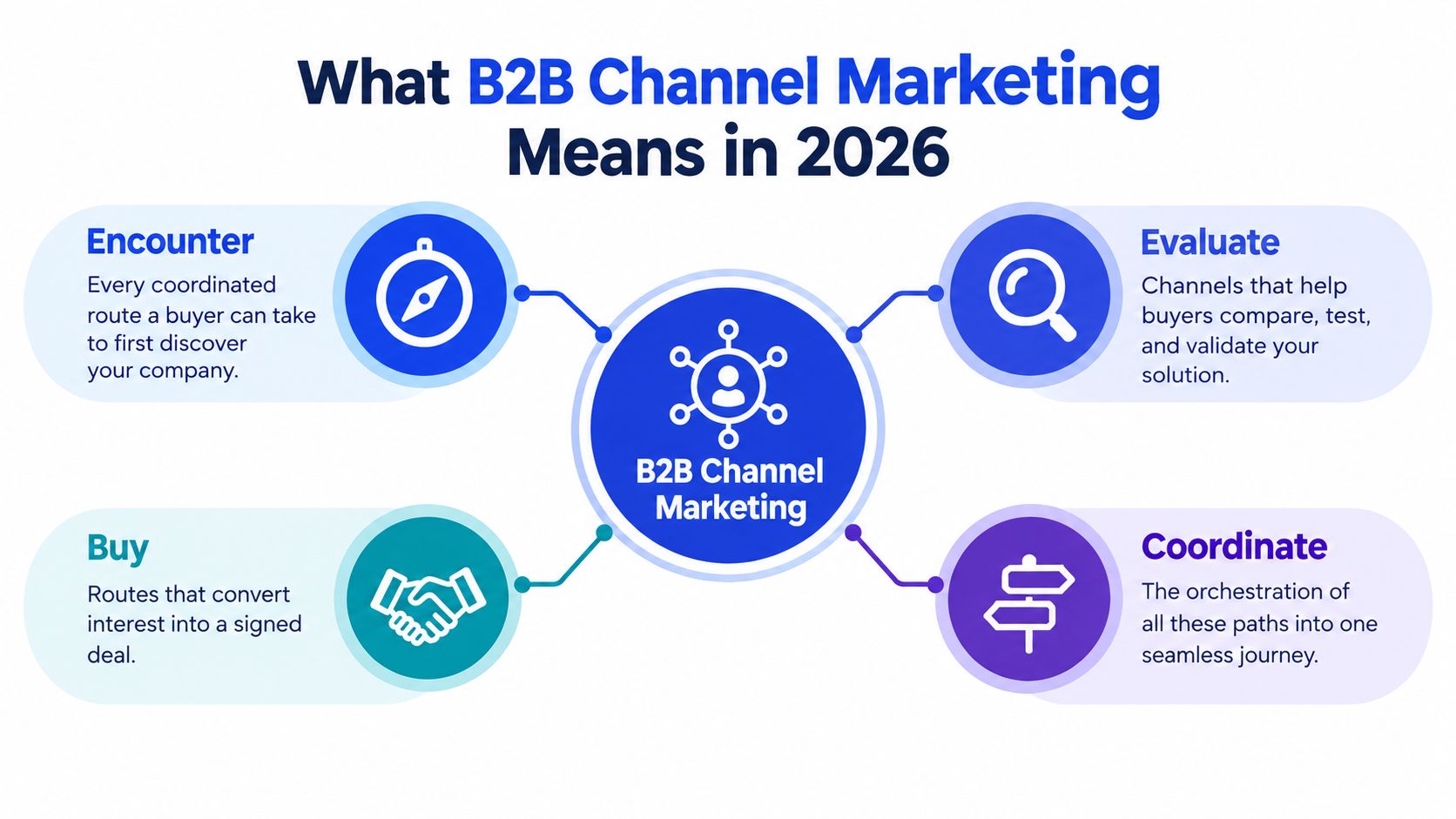
That shift makes channel selection only part of the work. A buyer might first encounter a point of view on LinkedIn, validate it on your website, ask a partner about implementation, then meet sales over video. Your account record, message, and next action should survive each transition.
Give each route a job
Separate channels by what they do. Demand-creating channels earn attention and introduce a problem or point of view. Demand-capturing channels turn existing interest into a conversation or transaction. Fulfillment channels deliver the product or service, often with a partner's help. A marketplace can support discovery and standardized purchasing, while a salesperson may be needed to resolve complex requirements.
Digital buying doesn't make sales irrelevant. In a McKinsey survey of more than 1,000 B2B buyers, 76% said speaking with a salesperson helped when researching a new product or service, while 46% said they would buy from a supplier's website if the process were available and efficient (McKinsey's research on when B2B buyers want digital). The implication is straightforward: give buyers self-service where it removes friction, and make human support available where it reduces risk or clarifies fit.
For a broader view of how software companies structure joint marketing, this SaaS partner marketing guide offers useful context. The internal test is simpler: your CEO should be able to hear, in two sentences, which buyer the program serves and how it contributes to pipeline.
Channel models compared and which one to pick first
For a team under 50 reps that needs a practical route to pipeline, start with co-marketing alongside a non-competing software partner. It gives both teams a reason to reach the same buyers, and it can plug into an existing LinkedIn, email, and sales motion without first building a reseller operation.
Channel model | Typical time to first pipeline | Best fit | Main risk |
|---|---|---|---|
Direct sales only | Depends on existing demand and sales capacity | Teams that need control over message and qualification | Saturated lists or disconnected marketing activity |
Partner-led co-marketing | Can move quickly when the audience and topic already fit | Complementary companies selling to the same buyer | Counting reach instead of qualified conversations |
Reseller or value-added distributor | Requires partner fit, readiness, and a clear delivery role | Established offers buyers expect to source or implement through a partner | Weak enablement or unclear account ownership |
Affiliate or referral | Depends on a credible referral source and qualification path | Offers with a clear introduction or recommendation motion | Incentives that reward volume without buyer fit |
Platform or marketplace | Depends on listing readiness and offer standardization | Buyers who can assess and purchase a defined offer online | Treating discovery as proof of complex-deal readiness |
Direct sales remains the control group, not a channel to abandon. It gives the team direct feedback and clean ownership, but it won't fix a weak account list or an irrelevant message. Co-marketing is the better first addition when a software partner shares your buyer and can contribute an audience, platform, expertise, or proof.
Let the buying motion decide
Resellers earn their place when buyers expect a regional or specialized route to delivery. They need clear product positioning, training, lead handling, and rules for ownership. Without those pieces, the partner adds a handoff rather than capacity.
Marketplaces can help buyers discover and purchase standardized offers, but they shouldn't replace sales-led evaluation for a complex enterprise deal. A global survey of B2B buyers found that 87% bought through marketplaces in some capacity, while 26% preferred them; RFPs or tenders remained the preferred route for 41% (Oracle's B2B buyer trends report). Adoption is not the same as preference.
Affiliates and referral partners can add reach, but only when they bring trusted access to your ICP and pass leads into a qualification process your sales team accepts. If a prospective arrangement starts to resemble a franchise or licensing structure, get clear on the distinction before committing; this explanation of the FTC franchise test is a useful starting point for that conversation.
A four-step system for choosing and onboarding partners
Treat partner selection like prospect selection: test fit before you invest in activation. A short review of the candidate's buyer, contribution, and working model is more useful than choosing based on follower counts or brand recognition.
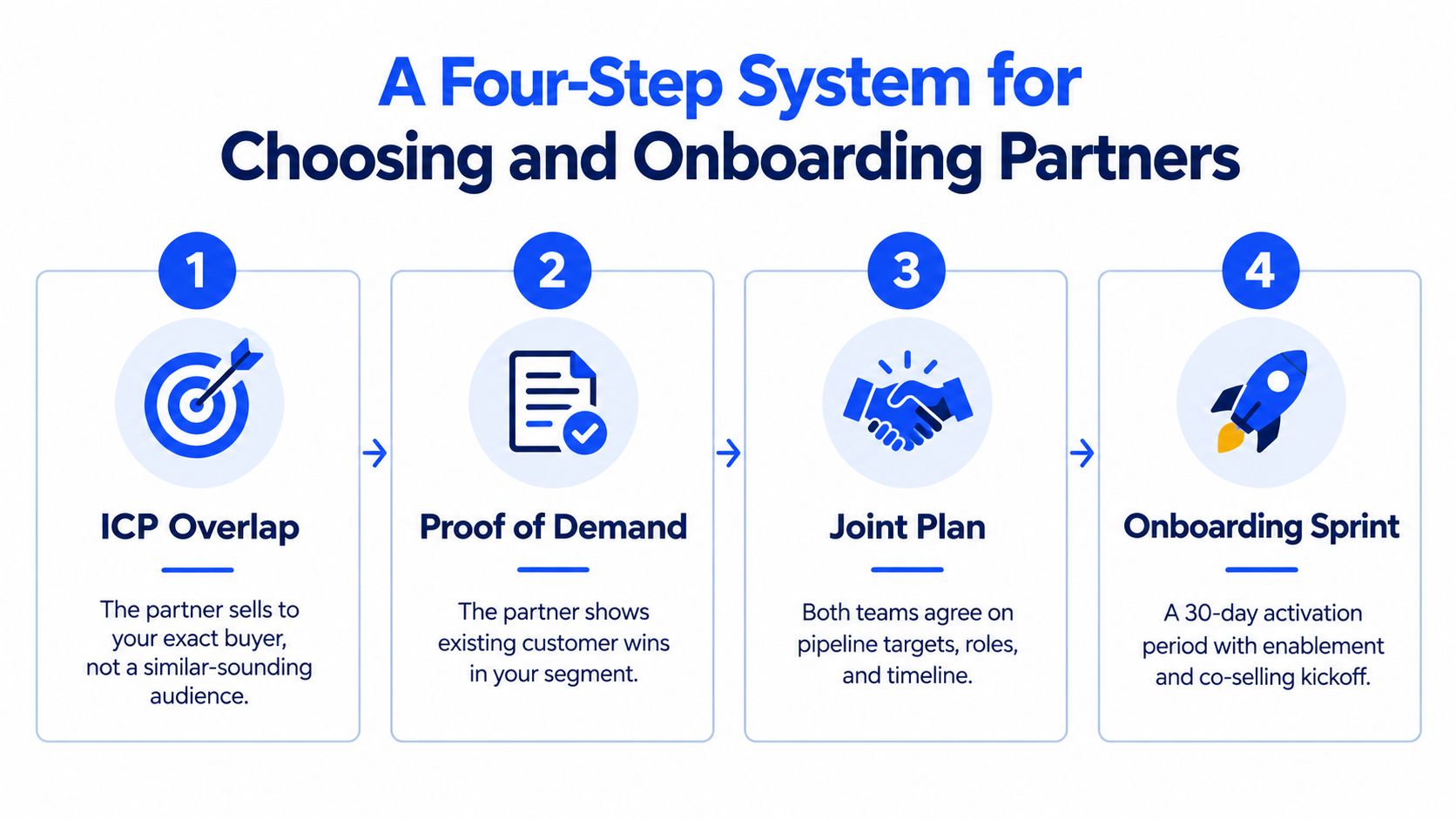
Step one: verify ICP overlap
Ask who the partner sells to, which roles they reach, and whether those buyers match your target accounts. “B2B marketers” can still be too broad. A partner whose customers run webinars may overlap more closely with your audience than a general marketing platform, because the use case and buying concern are visible.
The fit also has to be non-competitive. If both companies are trying to sell the same product category to the same buyer, you're building a conflict, not a channel.
Step two: find a joint problem
The joint asset should solve a buyer problem neither company can address as well alone. A webinar on filling B2B webinar seats makes sense for a webinar platform and a pipeline agency: one brings the platform context, the other brings promotion and pipeline expertise. A generic brand-awareness session does not give either audience a clear reason to register.
Step three: name what each side contributes
Write down who brings the audience, platform, expertise, proof, landing page, promotion, and follow-up. If one side provides everything while the other offers only its logo, call it what it is: a favor. A fair split keeps production moving and makes the value exchange clear.
Step four: agree on lead handling before launch
Set the lead definition, source-capture method, owner, response expectation, and follow-up route in advance. Agree what happens to attendees, no-shows, and on-demand viewers. GROU's partnership development approach offers a useful reference point for structuring the working relationship.
Use this quick audit before approving a partner:
Buyer fit: Can both teams name the same target buyer and a non-competing offer?
Joint value: Does the proposed content solve a real buyer problem that needs both sides?
Work split: Is each team's contribution written down?
Lead path: Do source, qualification, ownership, and follow-up rules exist before promotion begins?
If a candidate fails any of these checks, pause the launch. Fix the gap or choose a partner that is ready to work the motion with you.
Sourced versus influenced pipeline and the attribution rules that keep partners honest
Partner attribution gets contentious when teams wait until opportunities exist to decide who deserves credit. A partner may create the first conversation, validate a vendor during evaluation, or help an account reach procurement. Those contributions aren't interchangeable, and a single source field can't describe them all.
Set up the CRM to distinguish origin from assistance. At minimum, capture original source at form submission, preserve a partner source or campaign identifier where applicable, record partner influence as the account progresses, and add a partner-assisted opportunity indicator when the deal is created or updated. In HubSpot, for example, keep source properties and campaign associations distinct from opportunity influence fields. Don't overwrite the original source just because a partner joins later.
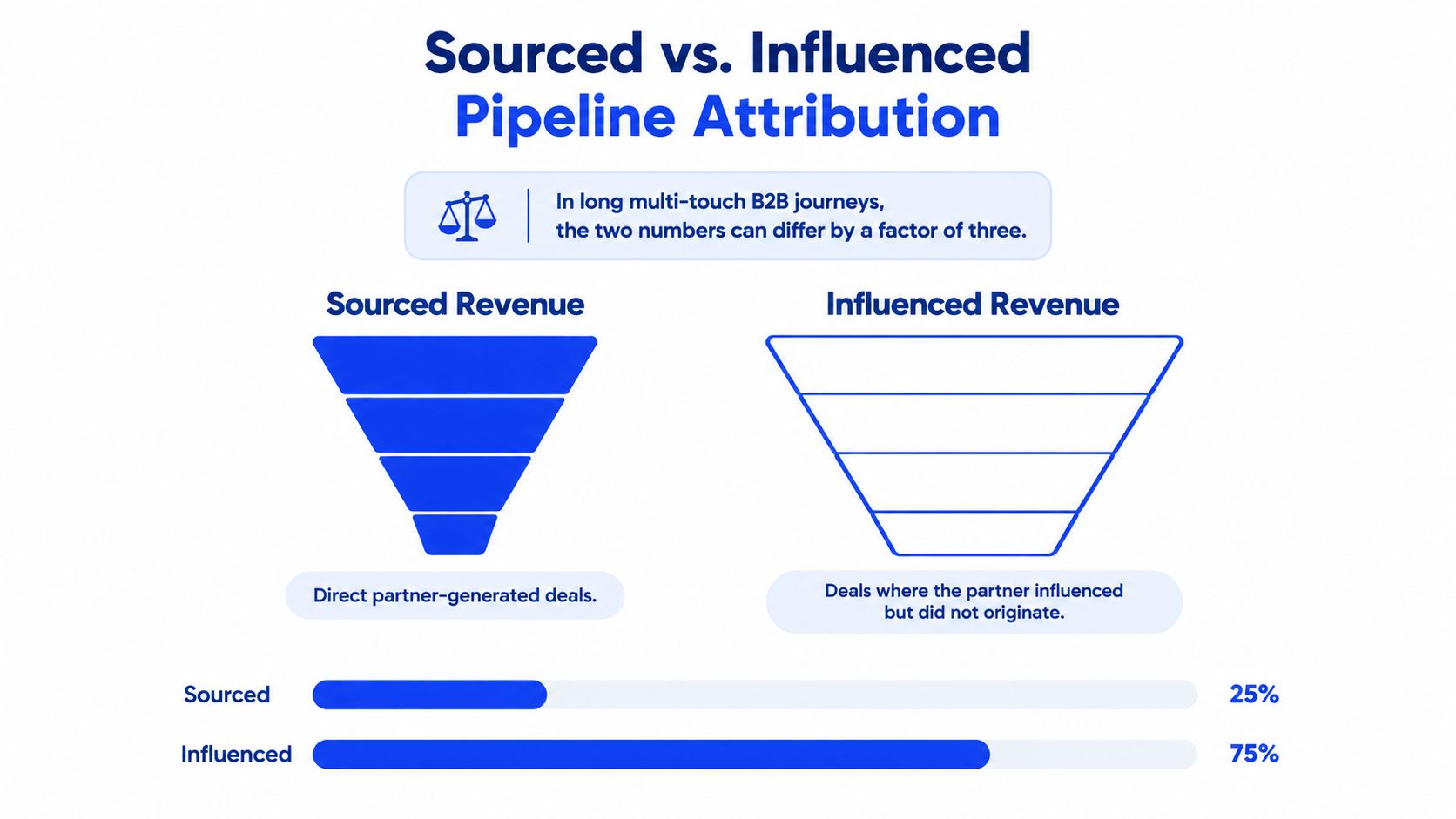
Four rules for defensible reporting
Agree definitions before launch. Both sides should define a qualified lead, an SQL, and attributed pipeline before the first campaign goes live. Also decide what counts as partner-sourced versus partner-influenced, and who accepts a lead.
Tag source at capture. Route partner traffic through your own form where possible, with campaign and partner details recorded on submission. This gives RevOps a consistent record instead of relying on a partner spreadsheet after the fact.
Report the two lines separately. Sourced pipeline means the partner originated the lead or opportunity under your agreed rules. Influenced pipeline means the partner contributed to progress but didn't originate the opportunity. Don't combine them into one number to make a channel look larger.
Follow activity through revenue. Registrations and leads are early signals. The scorecard should show qualified conversations, opportunities, and closed business, with source and influence visible. A shared multi-touch attribution framework can help teams think through how those touchpoints should be represented.
More dashboards won't settle a disagreement if the teams never agreed on definitions or ownership. Capture partner acceptance and influence at the relevant stage, then keep the audit trail.
The cost of weak rules is material: 63% of organizations identify poor lead-attribution transparency as the most common source of conflict in partner programs (Brixon Group's analysis of B2B partner ecosystems). Decide how credit works before the pipeline arrives.
Channel marketing mistakes that quietly kill the program
A partnership can look active in a dashboard while producing little that sales can work. The warning signs usually show up in the measures teams choose, the partners they recruit, and the rules they postpone.
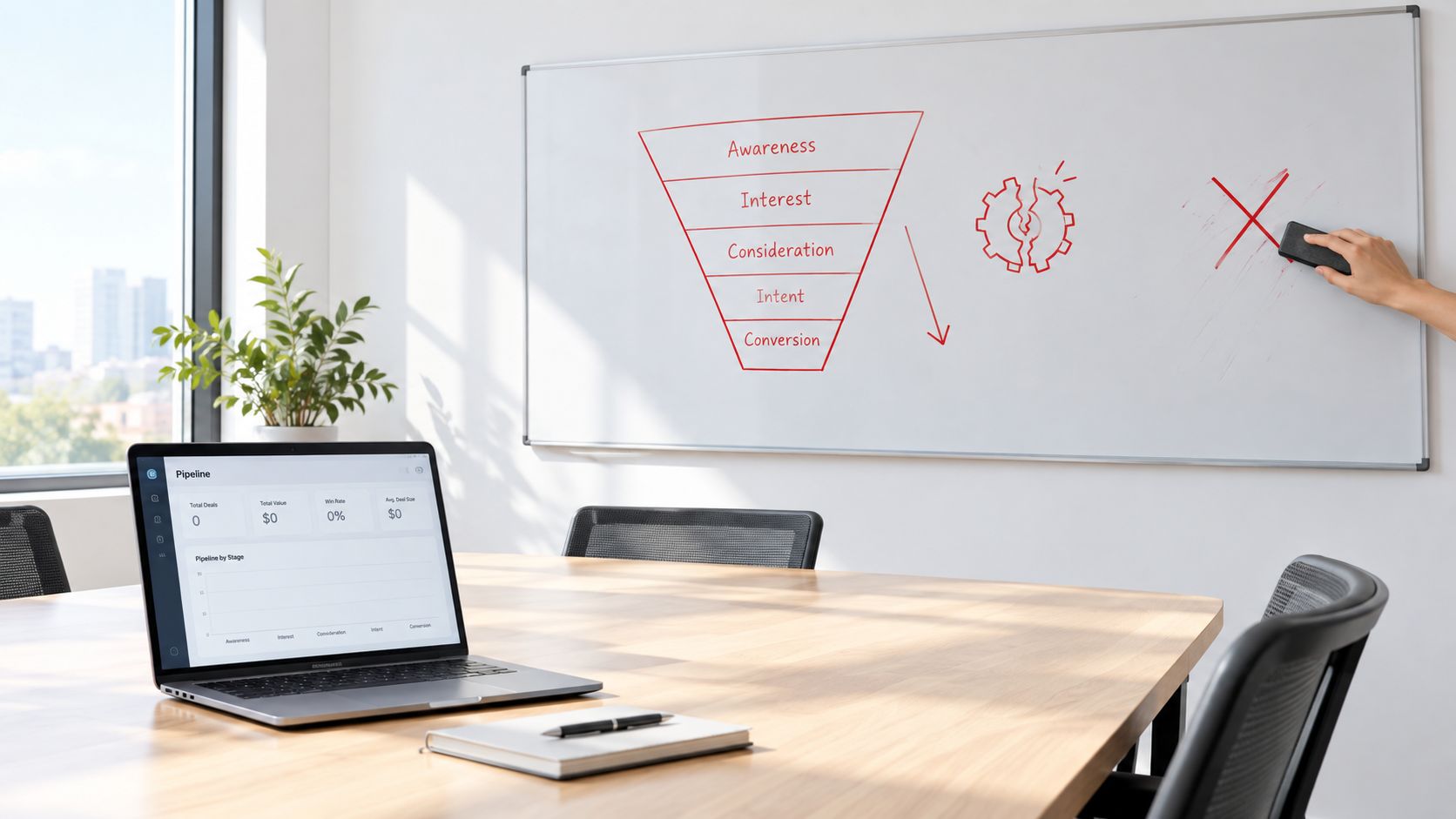
Five failures to catch early
Activity replaces pipeline. Registrations, impressions, and new followers fill a report, but nobody can show qualified meetings or opportunities. Keep activity as a diagnostic, then report lead quality and pipeline progression beside it.
Audience size beats audience fit. The partner brings a large list, but the people registering aren't buyers. Check role, industry, account fit, and conversion to a qualified conversation before repeating the campaign.
Attribution rules come after the deal. A partner is added late to an opportunity, then both teams claim credit. Agree sourced and influenced definitions, source capture, and ownership before the campaign starts.
Recruitment outpaces enablement. New resellers sign up, but they don't know the ICP, message, offer, or lead route. Forrester found that 67% of surveyed partner ecosystem and channel marketing decision-makers expect indirect revenue to grow above or significantly above the prior year (Forrester's partner ecosystem outlook). Growth expectations make readiness more important, not less.
Digital and sales are treated as substitutes. A marketplace listing may create discovery, while sales or a partner helps with complex evaluation. If the listing is expected to do both jobs, or sales ignores its intent signals, the handoff breaks down.
A referral arrangement can also generate disputes when compensation and qualification aren't clear. This guide to referral fee agreements is relevant when the program includes paid introductions; define the terms before a referral becomes an opportunity.
For a practical visual discussion of funnel discipline, watch the video below. Use it as a prompt to inspect where partner-generated interest stops progressing in your CRM.
A real channel playbook and the next move for your team
GROU and WebinarGeek built a co-marketing session around a shared buyer problem: B2B webinar teams need to fill seats, then turn attention into pipeline. WebinarGeek brought the platform and its audience. GROU handled the promotion and pipeline side, including a landing page on grouglobal.com and the content.
The live session, held on October 6, 2026, was titled “How to fill B2B webinar seats: a 4-channel promotion playbook.” The teams split promotion evenly, with each promoting to its own audience. That gave the campaign access to both networks without asking either company to pretend the other was a reseller.
The format also gave the content a life beyond the live event. WebinarGeek handled the platform and registration; GROU built the landing page and promotion. The recording and toolkit remained behind a single form, so on-demand viewers could still become leads. That matters more than a registration count because it gives the teams a trackable next step after the event.
A related sales enablement framework can help teams prepare follow-up so the conversation doesn't end when someone downloads the recording. The same principle applies to any co-marketing asset: define who follows up, what qualifies the response, and how sales sees the context.
Put the motion into action
Choose a partner whose buyers match your ICP and whose offer doesn't compete with yours. Agree on one asset tied to a real buyer problem, write down each team's contribution, and route every lead through your own form. Before promotion begins, define the source and influence fields and decide how qualified conversations and opportunities will be reported.
This structure can work across LinkedIn, outbound email, events, partner referrals, and sales follow-up. GROU's operating model connects those routes through a shared message, target list, and reporting line, with sales enablement and reply handling tied to the campaign rather than bolted on afterward.
This Friday, pull the last ten channel-sourced opportunities from your CRM and label each partner-sourced, partner-influenced, or neither. Bring that breakdown to your next partner meeting so the conversation starts with pipeline evidence, not logos.
GROU is a global B2B pipeline agency working across iGaming, SaaS, manufacturing, and professional services. Its methodology runs in bi-weekly sprints, connecting one message, one target list, and one reporting line.
GROU connects LinkedIn content, lead generation, and outbound in one AI-powered system for B2B teams that need qualified conversations and closed revenue. If your channel activity isn't turning into measurable pipeline, visit Grou to see how the team can structure the motion and reporting.
Your direct pipeline is flat, outbound replies are thinning, and the partner slide in the board deck is growing faster than the qualified-opportunity report. That usually means the team has added logos without deciding how a partner's audience becomes your pipeline.
Compare channel models by buyer fit, control, and time to useful pipeline.
Use a four-step system to select partners and agree the work before launch.
Track partner-sourced and partner-influenced pipeline separately.
Judge partnerships on qualified conversations and revenue, not registration totals.
See how GROU and WebinarGeek made co-marketing useful beyond a live event.
A channel program should start with the buyer and the route to revenue, not a target for how many partners to recruit. A partner program growth guide can help clarify what a formal program involves, but the operating question is more immediate: does this partner give your target accounts a reason to engage, and can both teams see what happens next?
Table of Contents
The channel decision most revenue leaders get wrong
The familiar failure pattern starts in a forecast meeting. Direct outreach is saturated, marketing wants another route to market, and someone proposes a recognizable platform or a reseller with a large audience. The team signs a co-marketing agreement, counts registrations and social reach, then struggles to show which conversations became opportunities.
The problem isn't a lack of activity. It's that audience size is being used as a substitute for buyer overlap. A large audience outside your ICP may fill a webinar, but it won't reliably create qualified pipeline. A smaller partner with the same buyers and a complementary offer can be far more useful.
The distinction matters across SaaS, manufacturing, legal tech, pharma, and iGaming. The buying process and proof requirements vary by industry, but a partner still needs a credible reason to reach the same account, and a defined route for that account to move from interest to a sales conversation.
Operator's test: If you can't explain what the partner contributes to buyer progress, the logo isn't a channel strategy.
GROU's approach is to make the operating structure visible before adding more partners: choose for ICP overlap, agree a joint problem and division of work, route leads through an owned capture path, and report pipeline outcomes. The model matters more than partner count.
What B2B channel marketing actually means in 2026
B2B channel marketing is the coordination of routes through which a buyer discovers, evaluates, and purchases from your company. Those routes can include direct sales, co-marketing partners, resellers, affiliates, digital marketplaces, and platforms. The practical job is to connect them so the buyer doesn't encounter conflicting messages or lose context during a handoff.
McKinsey's global B2B research found that buyers regularly used five supplier channels in 2016 and ten or more by 2021. Those channels included in-person meetings, phone, video, email, e-commerce, and digital portals. The same research found that 94% of respondents considered the modern mix of in-person, remote, and online engagement at least as effective as the pre-pandemic model (McKinsey's research on omnichannel B2B sales).
That shift makes channel selection only part of the work. A buyer might first encounter a point of view on LinkedIn, validate it on your website, ask a partner about implementation, then meet sales over video. Your account record, message, and next action should survive each transition.
Give each route a job
Separate channels by what they do. Demand-creating channels earn attention and introduce a problem or point of view. Demand-capturing channels turn existing interest into a conversation or transaction. Fulfillment channels deliver the product or service, often with a partner's help. A marketplace can support discovery and standardized purchasing, while a salesperson may be needed to resolve complex requirements.
Digital buying doesn't make sales irrelevant. In a McKinsey survey of more than 1,000 B2B buyers, 76% said speaking with a salesperson helped when researching a new product or service, while 46% said they would buy from a supplier's website if the process were available and efficient (McKinsey's research on when B2B buyers want digital). The implication is straightforward: give buyers self-service where it removes friction, and make human support available where it reduces risk or clarifies fit.
For a broader view of how software companies structure joint marketing, this SaaS partner marketing guide offers useful context. The internal test is simpler: your CEO should be able to hear, in two sentences, which buyer the program serves and how it contributes to pipeline.
Channel models compared and which one to pick first
For a team under 50 reps that needs a practical route to pipeline, start with co-marketing alongside a non-competing software partner. It gives both teams a reason to reach the same buyers, and it can plug into an existing LinkedIn, email, and sales motion without first building a reseller operation.
Channel model | Typical time to first pipeline | Best fit | Main risk |
|---|---|---|---|
Direct sales only | Depends on existing demand and sales capacity | Teams that need control over message and qualification | Saturated lists or disconnected marketing activity |
Partner-led co-marketing | Can move quickly when the audience and topic already fit | Complementary companies selling to the same buyer | Counting reach instead of qualified conversations |
Reseller or value-added distributor | Requires partner fit, readiness, and a clear delivery role | Established offers buyers expect to source or implement through a partner | Weak enablement or unclear account ownership |
Affiliate or referral | Depends on a credible referral source and qualification path | Offers with a clear introduction or recommendation motion | Incentives that reward volume without buyer fit |
Platform or marketplace | Depends on listing readiness and offer standardization | Buyers who can assess and purchase a defined offer online | Treating discovery as proof of complex-deal readiness |
Direct sales remains the control group, not a channel to abandon. It gives the team direct feedback and clean ownership, but it won't fix a weak account list or an irrelevant message. Co-marketing is the better first addition when a software partner shares your buyer and can contribute an audience, platform, expertise, or proof.
Let the buying motion decide
Resellers earn their place when buyers expect a regional or specialized route to delivery. They need clear product positioning, training, lead handling, and rules for ownership. Without those pieces, the partner adds a handoff rather than capacity.
Marketplaces can help buyers discover and purchase standardized offers, but they shouldn't replace sales-led evaluation for a complex enterprise deal. A global survey of B2B buyers found that 87% bought through marketplaces in some capacity, while 26% preferred them; RFPs or tenders remained the preferred route for 41% (Oracle's B2B buyer trends report). Adoption is not the same as preference.
Affiliates and referral partners can add reach, but only when they bring trusted access to your ICP and pass leads into a qualification process your sales team accepts. If a prospective arrangement starts to resemble a franchise or licensing structure, get clear on the distinction before committing; this explanation of the FTC franchise test is a useful starting point for that conversation.
A four-step system for choosing and onboarding partners
Treat partner selection like prospect selection: test fit before you invest in activation. A short review of the candidate's buyer, contribution, and working model is more useful than choosing based on follower counts or brand recognition.
Step one: verify ICP overlap
Ask who the partner sells to, which roles they reach, and whether those buyers match your target accounts. “B2B marketers” can still be too broad. A partner whose customers run webinars may overlap more closely with your audience than a general marketing platform, because the use case and buying concern are visible.
The fit also has to be non-competitive. If both companies are trying to sell the same product category to the same buyer, you're building a conflict, not a channel.
Step two: find a joint problem
The joint asset should solve a buyer problem neither company can address as well alone. A webinar on filling B2B webinar seats makes sense for a webinar platform and a pipeline agency: one brings the platform context, the other brings promotion and pipeline expertise. A generic brand-awareness session does not give either audience a clear reason to register.
Step three: name what each side contributes
Write down who brings the audience, platform, expertise, proof, landing page, promotion, and follow-up. If one side provides everything while the other offers only its logo, call it what it is: a favor. A fair split keeps production moving and makes the value exchange clear.
Step four: agree on lead handling before launch
Set the lead definition, source-capture method, owner, response expectation, and follow-up route in advance. Agree what happens to attendees, no-shows, and on-demand viewers. GROU's partnership development approach offers a useful reference point for structuring the working relationship.
Use this quick audit before approving a partner:
Buyer fit: Can both teams name the same target buyer and a non-competing offer?
Joint value: Does the proposed content solve a real buyer problem that needs both sides?
Work split: Is each team's contribution written down?
Lead path: Do source, qualification, ownership, and follow-up rules exist before promotion begins?
If a candidate fails any of these checks, pause the launch. Fix the gap or choose a partner that is ready to work the motion with you.
Sourced versus influenced pipeline and the attribution rules that keep partners honest
Partner attribution gets contentious when teams wait until opportunities exist to decide who deserves credit. A partner may create the first conversation, validate a vendor during evaluation, or help an account reach procurement. Those contributions aren't interchangeable, and a single source field can't describe them all.
Set up the CRM to distinguish origin from assistance. At minimum, capture original source at form submission, preserve a partner source or campaign identifier where applicable, record partner influence as the account progresses, and add a partner-assisted opportunity indicator when the deal is created or updated. In HubSpot, for example, keep source properties and campaign associations distinct from opportunity influence fields. Don't overwrite the original source just because a partner joins later.
Four rules for defensible reporting
Agree definitions before launch. Both sides should define a qualified lead, an SQL, and attributed pipeline before the first campaign goes live. Also decide what counts as partner-sourced versus partner-influenced, and who accepts a lead.
Tag source at capture. Route partner traffic through your own form where possible, with campaign and partner details recorded on submission. This gives RevOps a consistent record instead of relying on a partner spreadsheet after the fact.
Report the two lines separately. Sourced pipeline means the partner originated the lead or opportunity under your agreed rules. Influenced pipeline means the partner contributed to progress but didn't originate the opportunity. Don't combine them into one number to make a channel look larger.
Follow activity through revenue. Registrations and leads are early signals. The scorecard should show qualified conversations, opportunities, and closed business, with source and influence visible. A shared multi-touch attribution framework can help teams think through how those touchpoints should be represented.
More dashboards won't settle a disagreement if the teams never agreed on definitions or ownership. Capture partner acceptance and influence at the relevant stage, then keep the audit trail.
The cost of weak rules is material: 63% of organizations identify poor lead-attribution transparency as the most common source of conflict in partner programs (Brixon Group's analysis of B2B partner ecosystems). Decide how credit works before the pipeline arrives.
Channel marketing mistakes that quietly kill the program
A partnership can look active in a dashboard while producing little that sales can work. The warning signs usually show up in the measures teams choose, the partners they recruit, and the rules they postpone.
Five failures to catch early
Activity replaces pipeline. Registrations, impressions, and new followers fill a report, but nobody can show qualified meetings or opportunities. Keep activity as a diagnostic, then report lead quality and pipeline progression beside it.
Audience size beats audience fit. The partner brings a large list, but the people registering aren't buyers. Check role, industry, account fit, and conversion to a qualified conversation before repeating the campaign.
Attribution rules come after the deal. A partner is added late to an opportunity, then both teams claim credit. Agree sourced and influenced definitions, source capture, and ownership before the campaign starts.
Recruitment outpaces enablement. New resellers sign up, but they don't know the ICP, message, offer, or lead route. Forrester found that 67% of surveyed partner ecosystem and channel marketing decision-makers expect indirect revenue to grow above or significantly above the prior year (Forrester's partner ecosystem outlook). Growth expectations make readiness more important, not less.
Digital and sales are treated as substitutes. A marketplace listing may create discovery, while sales or a partner helps with complex evaluation. If the listing is expected to do both jobs, or sales ignores its intent signals, the handoff breaks down.
A referral arrangement can also generate disputes when compensation and qualification aren't clear. This guide to referral fee agreements is relevant when the program includes paid introductions; define the terms before a referral becomes an opportunity.
For a practical visual discussion of funnel discipline, watch the video below. Use it as a prompt to inspect where partner-generated interest stops progressing in your CRM.
A real channel playbook and the next move for your team
GROU and WebinarGeek built a co-marketing session around a shared buyer problem: B2B webinar teams need to fill seats, then turn attention into pipeline. WebinarGeek brought the platform and its audience. GROU handled the promotion and pipeline side, including a landing page on grouglobal.com and the content.
The live session, held on October 6, 2026, was titled “How to fill B2B webinar seats: a 4-channel promotion playbook.” The teams split promotion evenly, with each promoting to its own audience. That gave the campaign access to both networks without asking either company to pretend the other was a reseller.
The format also gave the content a life beyond the live event. WebinarGeek handled the platform and registration; GROU built the landing page and promotion. The recording and toolkit remained behind a single form, so on-demand viewers could still become leads. That matters more than a registration count because it gives the teams a trackable next step after the event.
A related sales enablement framework can help teams prepare follow-up so the conversation doesn't end when someone downloads the recording. The same principle applies to any co-marketing asset: define who follows up, what qualifies the response, and how sales sees the context.
Put the motion into action
Choose a partner whose buyers match your ICP and whose offer doesn't compete with yours. Agree on one asset tied to a real buyer problem, write down each team's contribution, and route every lead through your own form. Before promotion begins, define the source and influence fields and decide how qualified conversations and opportunities will be reported.
This structure can work across LinkedIn, outbound email, events, partner referrals, and sales follow-up. GROU's operating model connects those routes through a shared message, target list, and reporting line, with sales enablement and reply handling tied to the campaign rather than bolted on afterward.
This Friday, pull the last ten channel-sourced opportunities from your CRM and label each partner-sourced, partner-influenced, or neither. Bring that breakdown to your next partner meeting so the conversation starts with pipeline evidence, not logos.
GROU is a global B2B pipeline agency working across iGaming, SaaS, manufacturing, and professional services. Its methodology runs in bi-weekly sprints, connecting one message, one target list, and one reporting line.
GROU connects LinkedIn content, lead generation, and outbound in one AI-powered system for B2B teams that need qualified conversations and closed revenue. If your channel activity isn't turning into measurable pipeline, visit Grou to see how the team can structure the motion and reporting.
Your direct pipeline is flat, outbound replies are thinning, and the partner slide in the board deck is growing faster than the qualified-opportunity report. That usually means the team has added logos without deciding how a partner's audience becomes your pipeline.
Compare channel models by buyer fit, control, and time to useful pipeline.
Use a four-step system to select partners and agree the work before launch.
Track partner-sourced and partner-influenced pipeline separately.
Judge partnerships on qualified conversations and revenue, not registration totals.
See how GROU and WebinarGeek made co-marketing useful beyond a live event.
A channel program should start with the buyer and the route to revenue, not a target for how many partners to recruit. A partner program growth guide can help clarify what a formal program involves, but the operating question is more immediate: does this partner give your target accounts a reason to engage, and can both teams see what happens next?
Table of Contents
The channel decision most revenue leaders get wrong
The familiar failure pattern starts in a forecast meeting. Direct outreach is saturated, marketing wants another route to market, and someone proposes a recognizable platform or a reseller with a large audience. The team signs a co-marketing agreement, counts registrations and social reach, then struggles to show which conversations became opportunities.
The problem isn't a lack of activity. It's that audience size is being used as a substitute for buyer overlap. A large audience outside your ICP may fill a webinar, but it won't reliably create qualified pipeline. A smaller partner with the same buyers and a complementary offer can be far more useful.
The distinction matters across SaaS, manufacturing, legal tech, pharma, and iGaming. The buying process and proof requirements vary by industry, but a partner still needs a credible reason to reach the same account, and a defined route for that account to move from interest to a sales conversation.
Operator's test: If you can't explain what the partner contributes to buyer progress, the logo isn't a channel strategy.
GROU's approach is to make the operating structure visible before adding more partners: choose for ICP overlap, agree a joint problem and division of work, route leads through an owned capture path, and report pipeline outcomes. The model matters more than partner count.
What B2B channel marketing actually means in 2026
B2B channel marketing is the coordination of routes through which a buyer discovers, evaluates, and purchases from your company. Those routes can include direct sales, co-marketing partners, resellers, affiliates, digital marketplaces, and platforms. The practical job is to connect them so the buyer doesn't encounter conflicting messages or lose context during a handoff.
McKinsey's global B2B research found that buyers regularly used five supplier channels in 2016 and ten or more by 2021. Those channels included in-person meetings, phone, video, email, e-commerce, and digital portals. The same research found that 94% of respondents considered the modern mix of in-person, remote, and online engagement at least as effective as the pre-pandemic model (McKinsey's research on omnichannel B2B sales).
That shift makes channel selection only part of the work. A buyer might first encounter a point of view on LinkedIn, validate it on your website, ask a partner about implementation, then meet sales over video. Your account record, message, and next action should survive each transition.
Give each route a job
Separate channels by what they do. Demand-creating channels earn attention and introduce a problem or point of view. Demand-capturing channels turn existing interest into a conversation or transaction. Fulfillment channels deliver the product or service, often with a partner's help. A marketplace can support discovery and standardized purchasing, while a salesperson may be needed to resolve complex requirements.
Digital buying doesn't make sales irrelevant. In a McKinsey survey of more than 1,000 B2B buyers, 76% said speaking with a salesperson helped when researching a new product or service, while 46% said they would buy from a supplier's website if the process were available and efficient (McKinsey's research on when B2B buyers want digital). The implication is straightforward: give buyers self-service where it removes friction, and make human support available where it reduces risk or clarifies fit.
For a broader view of how software companies structure joint marketing, this SaaS partner marketing guide offers useful context. The internal test is simpler: your CEO should be able to hear, in two sentences, which buyer the program serves and how it contributes to pipeline.
Channel models compared and which one to pick first
For a team under 50 reps that needs a practical route to pipeline, start with co-marketing alongside a non-competing software partner. It gives both teams a reason to reach the same buyers, and it can plug into an existing LinkedIn, email, and sales motion without first building a reseller operation.
Channel model | Typical time to first pipeline | Best fit | Main risk |
|---|---|---|---|
Direct sales only | Depends on existing demand and sales capacity | Teams that need control over message and qualification | Saturated lists or disconnected marketing activity |
Partner-led co-marketing | Can move quickly when the audience and topic already fit | Complementary companies selling to the same buyer | Counting reach instead of qualified conversations |
Reseller or value-added distributor | Requires partner fit, readiness, and a clear delivery role | Established offers buyers expect to source or implement through a partner | Weak enablement or unclear account ownership |
Affiliate or referral | Depends on a credible referral source and qualification path | Offers with a clear introduction or recommendation motion | Incentives that reward volume without buyer fit |
Platform or marketplace | Depends on listing readiness and offer standardization | Buyers who can assess and purchase a defined offer online | Treating discovery as proof of complex-deal readiness |
Direct sales remains the control group, not a channel to abandon. It gives the team direct feedback and clean ownership, but it won't fix a weak account list or an irrelevant message. Co-marketing is the better first addition when a software partner shares your buyer and can contribute an audience, platform, expertise, or proof.
Let the buying motion decide
Resellers earn their place when buyers expect a regional or specialized route to delivery. They need clear product positioning, training, lead handling, and rules for ownership. Without those pieces, the partner adds a handoff rather than capacity.
Marketplaces can help buyers discover and purchase standardized offers, but they shouldn't replace sales-led evaluation for a complex enterprise deal. A global survey of B2B buyers found that 87% bought through marketplaces in some capacity, while 26% preferred them; RFPs or tenders remained the preferred route for 41% (Oracle's B2B buyer trends report). Adoption is not the same as preference.
Affiliates and referral partners can add reach, but only when they bring trusted access to your ICP and pass leads into a qualification process your sales team accepts. If a prospective arrangement starts to resemble a franchise or licensing structure, get clear on the distinction before committing; this explanation of the FTC franchise test is a useful starting point for that conversation.
A four-step system for choosing and onboarding partners
Treat partner selection like prospect selection: test fit before you invest in activation. A short review of the candidate's buyer, contribution, and working model is more useful than choosing based on follower counts or brand recognition.
Step one: verify ICP overlap
Ask who the partner sells to, which roles they reach, and whether those buyers match your target accounts. “B2B marketers” can still be too broad. A partner whose customers run webinars may overlap more closely with your audience than a general marketing platform, because the use case and buying concern are visible.
The fit also has to be non-competitive. If both companies are trying to sell the same product category to the same buyer, you're building a conflict, not a channel.
Step two: find a joint problem
The joint asset should solve a buyer problem neither company can address as well alone. A webinar on filling B2B webinar seats makes sense for a webinar platform and a pipeline agency: one brings the platform context, the other brings promotion and pipeline expertise. A generic brand-awareness session does not give either audience a clear reason to register.
Step three: name what each side contributes
Write down who brings the audience, platform, expertise, proof, landing page, promotion, and follow-up. If one side provides everything while the other offers only its logo, call it what it is: a favor. A fair split keeps production moving and makes the value exchange clear.
Step four: agree on lead handling before launch
Set the lead definition, source-capture method, owner, response expectation, and follow-up route in advance. Agree what happens to attendees, no-shows, and on-demand viewers. GROU's partnership development approach offers a useful reference point for structuring the working relationship.
Use this quick audit before approving a partner:
Buyer fit: Can both teams name the same target buyer and a non-competing offer?
Joint value: Does the proposed content solve a real buyer problem that needs both sides?
Work split: Is each team's contribution written down?
Lead path: Do source, qualification, ownership, and follow-up rules exist before promotion begins?
If a candidate fails any of these checks, pause the launch. Fix the gap or choose a partner that is ready to work the motion with you.
Sourced versus influenced pipeline and the attribution rules that keep partners honest
Partner attribution gets contentious when teams wait until opportunities exist to decide who deserves credit. A partner may create the first conversation, validate a vendor during evaluation, or help an account reach procurement. Those contributions aren't interchangeable, and a single source field can't describe them all.
Set up the CRM to distinguish origin from assistance. At minimum, capture original source at form submission, preserve a partner source or campaign identifier where applicable, record partner influence as the account progresses, and add a partner-assisted opportunity indicator when the deal is created or updated. In HubSpot, for example, keep source properties and campaign associations distinct from opportunity influence fields. Don't overwrite the original source just because a partner joins later.
Four rules for defensible reporting
Agree definitions before launch. Both sides should define a qualified lead, an SQL, and attributed pipeline before the first campaign goes live. Also decide what counts as partner-sourced versus partner-influenced, and who accepts a lead.
Tag source at capture. Route partner traffic through your own form where possible, with campaign and partner details recorded on submission. This gives RevOps a consistent record instead of relying on a partner spreadsheet after the fact.
Report the two lines separately. Sourced pipeline means the partner originated the lead or opportunity under your agreed rules. Influenced pipeline means the partner contributed to progress but didn't originate the opportunity. Don't combine them into one number to make a channel look larger.
Follow activity through revenue. Registrations and leads are early signals. The scorecard should show qualified conversations, opportunities, and closed business, with source and influence visible. A shared multi-touch attribution framework can help teams think through how those touchpoints should be represented.
More dashboards won't settle a disagreement if the teams never agreed on definitions or ownership. Capture partner acceptance and influence at the relevant stage, then keep the audit trail.
The cost of weak rules is material: 63% of organizations identify poor lead-attribution transparency as the most common source of conflict in partner programs (Brixon Group's analysis of B2B partner ecosystems). Decide how credit works before the pipeline arrives.
Channel marketing mistakes that quietly kill the program
A partnership can look active in a dashboard while producing little that sales can work. The warning signs usually show up in the measures teams choose, the partners they recruit, and the rules they postpone.
Five failures to catch early
Activity replaces pipeline. Registrations, impressions, and new followers fill a report, but nobody can show qualified meetings or opportunities. Keep activity as a diagnostic, then report lead quality and pipeline progression beside it.
Audience size beats audience fit. The partner brings a large list, but the people registering aren't buyers. Check role, industry, account fit, and conversion to a qualified conversation before repeating the campaign.
Attribution rules come after the deal. A partner is added late to an opportunity, then both teams claim credit. Agree sourced and influenced definitions, source capture, and ownership before the campaign starts.
Recruitment outpaces enablement. New resellers sign up, but they don't know the ICP, message, offer, or lead route. Forrester found that 67% of surveyed partner ecosystem and channel marketing decision-makers expect indirect revenue to grow above or significantly above the prior year (Forrester's partner ecosystem outlook). Growth expectations make readiness more important, not less.
Digital and sales are treated as substitutes. A marketplace listing may create discovery, while sales or a partner helps with complex evaluation. If the listing is expected to do both jobs, or sales ignores its intent signals, the handoff breaks down.
A referral arrangement can also generate disputes when compensation and qualification aren't clear. This guide to referral fee agreements is relevant when the program includes paid introductions; define the terms before a referral becomes an opportunity.
For a practical visual discussion of funnel discipline, watch the video below. Use it as a prompt to inspect where partner-generated interest stops progressing in your CRM.
A real channel playbook and the next move for your team
GROU and WebinarGeek built a co-marketing session around a shared buyer problem: B2B webinar teams need to fill seats, then turn attention into pipeline. WebinarGeek brought the platform and its audience. GROU handled the promotion and pipeline side, including a landing page on grouglobal.com and the content.
The live session, held on October 6, 2026, was titled “How to fill B2B webinar seats: a 4-channel promotion playbook.” The teams split promotion evenly, with each promoting to its own audience. That gave the campaign access to both networks without asking either company to pretend the other was a reseller.
The format also gave the content a life beyond the live event. WebinarGeek handled the platform and registration; GROU built the landing page and promotion. The recording and toolkit remained behind a single form, so on-demand viewers could still become leads. That matters more than a registration count because it gives the teams a trackable next step after the event.
A related sales enablement framework can help teams prepare follow-up so the conversation doesn't end when someone downloads the recording. The same principle applies to any co-marketing asset: define who follows up, what qualifies the response, and how sales sees the context.
Put the motion into action
Choose a partner whose buyers match your ICP and whose offer doesn't compete with yours. Agree on one asset tied to a real buyer problem, write down each team's contribution, and route every lead through your own form. Before promotion begins, define the source and influence fields and decide how qualified conversations and opportunities will be reported.
This structure can work across LinkedIn, outbound email, events, partner referrals, and sales follow-up. GROU's operating model connects those routes through a shared message, target list, and reporting line, with sales enablement and reply handling tied to the campaign rather than bolted on afterward.
This Friday, pull the last ten channel-sourced opportunities from your CRM and label each partner-sourced, partner-influenced, or neither. Bring that breakdown to your next partner meeting so the conversation starts with pipeline evidence, not logos.
GROU is a global B2B pipeline agency working across iGaming, SaaS, manufacturing, and professional services. Its methodology runs in bi-weekly sprints, connecting one message, one target list, and one reporting line.
GROU connects LinkedIn content, lead generation, and outbound in one AI-powered system for B2B teams that need qualified conversations and closed revenue. If your channel activity isn't turning into measurable pipeline, visit Grou to see how the team can structure the motion and reporting.
Pipeline OS Newsletter
Build qualified pipeline
Get weekly tactics to generate demand, improve lead quality, and book more meetings.





Trusted by industry leaders
Trusted by industry leaders
Trusted by industry leaders
Ready to build qualified pipeline?
Ready to build qualified pipeline?
Ready to build qualified pipeline?
Book a call to see if we're the right fit, or take the 2-minute quiz to get a clear starting point.
Book a call to see if we're the right fit, or take the 2-minute quiz to get a clear starting point.
Book a call to see if we're the right fit, or take the 2-minute quiz to get a clear starting point.
" height="30.21639343089746px" id="hfGbXmQR2" width="30.216393430897455px"/></svg>)
Copyright © 2026 – All Right Reserved
Copyright © 2026 – All Right Reserved
Copyright © 2026 – All Right Reserved