%22%3E%3C/path%3E%3Cpath d=%22M 63.072 7.554 C 62.258 8.022 61.577 8.689 61.092 9.493 L 61.092 7.076 L 57.158 7.076 L 57.158 22.64 L 61.089 22.64 L 61.089 14.888 C 61.089 13.446 61.403 12.434 62.03 11.853 C 62.818 11.218 63.818 10.907 64.826 10.982 L 65.868 10.982 L 65.868 6.851 C 64.891 6.834 63.926 7.076 63.073 7.554 Z%22 fill=%22rgb(17,17,17)%22%3E%3C/path%3E%3Cpath d=%22M 78.916 7.82 C 76.363 6.49 73.321 6.49 70.768 7.82 C 69.562 8.473 68.564 9.451 67.888 10.644 C 67.167 11.931 66.803 13.387 66.834 14.862 C 66.804 16.332 67.157 17.785 67.86 19.077 C 68.515 20.267 69.494 21.246 70.684 21.901 C 71.924 22.576 73.318 22.92 74.73 22.898 C 76.164 22.918 77.58 22.575 78.846 21.901 C 80.062 21.247 81.073 20.27 81.768 19.077 C 82.506 17.797 82.88 16.339 82.85 14.862 C 82.88 13.389 82.517 11.934 81.797 10.647 C 81.12 9.455 80.122 8.477 78.917 7.824 M 78.803 14.862 C 78.829 15.739 78.636 16.608 78.241 17.391 C 77.903 18.046 77.38 18.588 76.738 18.95 C 76.124 19.293 75.432 19.472 74.729 19.47 C 73.668 19.497 72.648 19.061 71.934 18.276 C 71.139 17.323 70.741 16.1 70.823 14.862 C 70.741 13.62 71.149 12.395 71.959 11.45 C 72.687 10.667 73.715 10.233 74.783 10.256 C 75.859 10.236 76.894 10.67 77.635 11.45 C 78.464 12.387 78.884 13.616 78.801 14.864%22 fill=%22rgb(17,17,17)%22%3E%3C/path%3E%3Cpath d=%22M 95.906 7.076 L 95.906 15.646 C 95.975 16.68 95.643 17.701 94.979 18.498 C 94.311 19.184 93.379 19.547 92.422 19.495 C 91.475 19.544 90.553 19.18 89.894 18.498 C 89.23 17.701 88.898 16.68 88.967 15.646 L 88.967 7.076 L 85.033 7.076 L 85.033 16.207 C 85 17.449 85.275 18.68 85.834 19.79 C 86.327 20.75 87.095 21.542 88.039 22.065 C 89.033 22.594 90.145 22.861 91.271 22.838 C 92.188 22.847 93.095 22.65 93.926 22.263 C 94.708 21.905 95.388 21.36 95.906 20.675 L 95.906 22.645 L 99.865 22.645 L 99.865 7.076 Z%22 fill=%22rgb(17,17,17)%22%3E%3C/path%3E%3Cpath d=%22M 4.513 15.626 C 4.511 10.815 7.606 6.549 12.181 5.059 C 16.756 3.57 21.77 5.195 24.601 9.086 L 27.816 5.87 C 24.074 1.186 17.981 -0.943 12.137 0.393 C 6.292 1.728 1.728 6.292 0.393 12.137 C -0.943 17.981 1.186 24.074 5.87 27.816 L 9.085 24.601 C 6.214 22.512 4.515 19.177 4.513 15.626%22 fill=%22rgb(32,62,235)%22%3E%3C/path%3E%3Cpath d=%22M 17.114 14.343 L 13.354 18.01 L 13.354 18.026 L 21.071 18.026 L 11.412 27.609 L 17.389 27.609 L 23.999 21.081 L 23.999 28.316 L 24.005 28.316 L 27.967 24.393 L 27.967 14.343 Z%22 fill=%22rgb(32,62,235)%22%3E%3C/path%3E%3C/g%3E%3C/svg%3E) ×
× ××
××›
›
›
›
The AI GTM hiring stack: How B2B teams hire SDRs globally
The AI GTM hiring stack: How B2B teams hire SDRs globally
The AI GTM hiring stack: How B2B teams hire SDRs globally
The AI GTM hiring stack: How B2B teams hire SDRs globally
The AI GTM hiring stack: How B2B teams hire SDRs globally
The AI GTM hiring stack: How B2B teams hire SDRs globally

Author
Aljaz Peklaj

Most writing about AI and hiring is written for recruiters. This one is written for the people who actually open the SDR requisition: founders, heads of sales and revenue leaders who need pipeline in a market their own office does not sit in. For them, AI has changed four of the five layers of the hiring stack, and left the fifth one, the part where someone has to be legally employed and correctly paid in a country you have no entity in, exactly as hard as it was.
That fifth layer is where most global sales hires quietly go wrong, and it is the one this article spends the most time on.

TL;DR
Sales roles are now three of the five most common cross-border hires. Deel's Global Hiring Report 2026, built on more than one million worker contracts across 37,000 companies and 150 countries, ranks sales manager, business developer and sales account manager at second, third and fourth behind software developer. AI has taken over the top of the funnel: LinkedIn's Future of Recruiting survey of 1,271 recruiting professionals found 37 percent of organisations integrating or experimenting with generative AI, up from 27 percent a year earlier, and recruiters using it save roughly a day a week. Gartner's headline trend for talent acquisition in 2026 is that high-volume recruiting goes AI-first, and SDR hiring is the most high-volume recruiting most B2B companies ever do. The rules on AI screening have moved out, not in: the EU's Digital Omnibus, in force since 27 July 2026, pushed high-risk obligations for recruitment AI from August 2026 to 2 December 2027, and Colorado's rewrite pushed its law to 1 January 2027 and narrowed it to disclosure. The litigation did not move. Mobley v. Workday still has a preliminarily certified age-discrimination collective and claims surviving on race, sex and disability. Meanwhile the pay gap that makes global SDR hiring attractive is real and large: Glassdoor medians put total SDR pay at roughly $1,000 to $2,000 a month in Manila, Bogota, Johannesburg and Mexico City against a PayScale US base of $51,677 a year. The catch is the infrastructure layer. A $599 per month employer-of-record seat is a rounding error on a US salary and a 46 percent overhead on a Bogota one, which is why the contractor-versus-EOR decision, not the AI screening decision, is the one that determines whether a global SDR hire pays off. Our default: run AI across sourcing, screening and assessment, keep a human on the final call, hire the first one or two reps in a new country as contractors through a platform like Deel that can convert them to EOR later, and move to EOR the moment the role looks permanent.
Sales is now a cross-border job
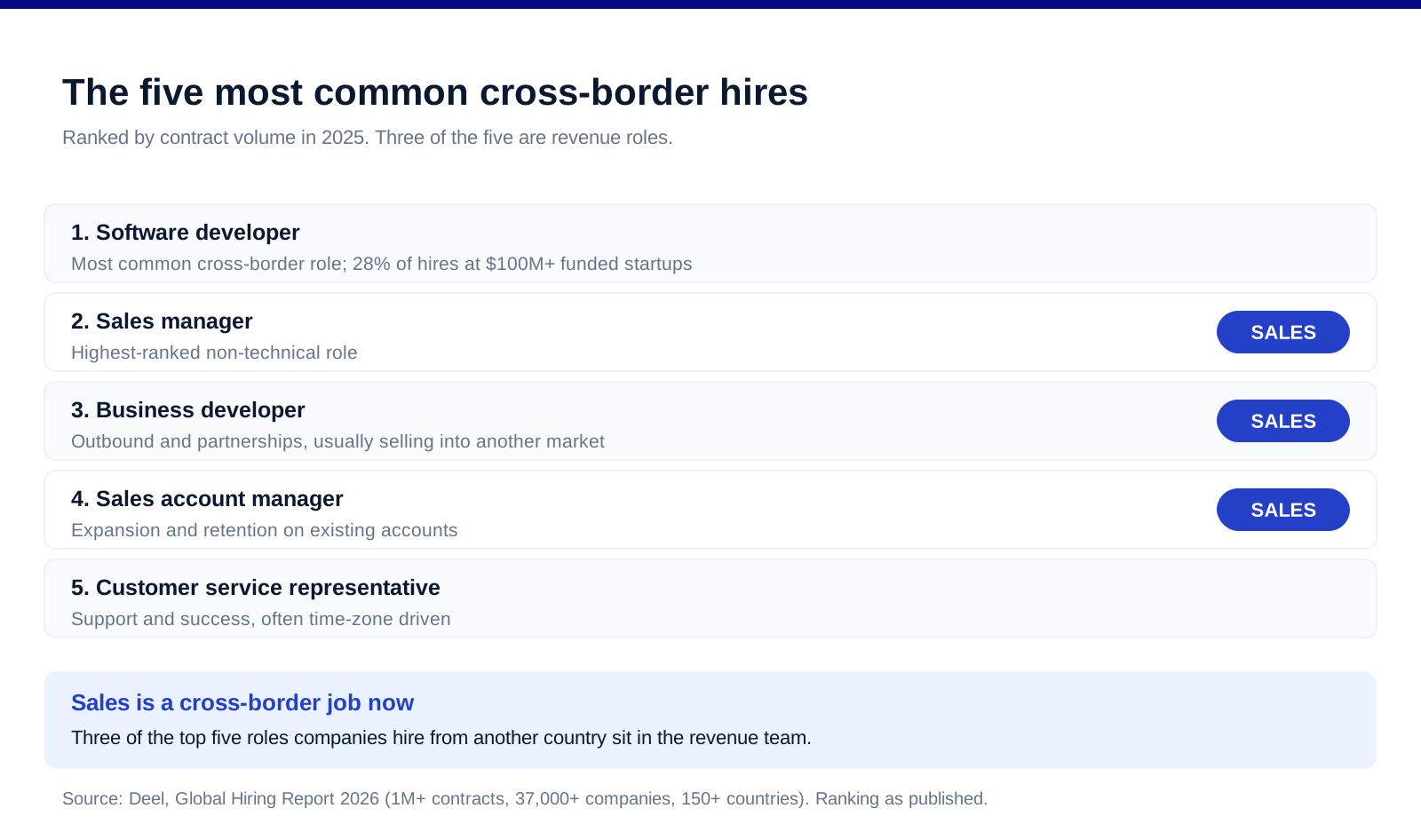
Start with who is actually being hired across borders, because it is not who most people assume. Deel's Global Hiring Report 2026 analysed 2025 data from over one million worker contracts spanning 37,000 companies in more than 150 countries. The most common cross-border role was software developer. The next three were sales manager, business developer and sales account manager. Customer service representative rounded out the top five. Three of the five most common jobs a company hires from another country are revenue jobs.
That is a quiet reversal of the old assumption that sales has to sit near the customer. It still has to sound near the customer. It does not have to be paid there, and increasingly it is not. The same report found that 84.6 percent of Argentinian workers on the platform chose to be paid in US dollars rather than pesos, and that the dollar appeared in five of the ten most common country-currency combinations. The labour market for sales talent has globalised faster than most companies' hiring processes have.
The other headline from the same data is where the growth is. General AI trainer roles grew 283 percent cross-border in 2025, across more than 70,000 people and 600 organisations, and Latin American financial analysts saw compensation rise 195 percent. Neither is a sales role, but both tell you the same thing: the countries you would hire an SDR from are now competing for that talent with AI labs and fintechs paying in dollars. The arbitrage is still there. It is narrower than the 2021 version, and it moves.
Which is why this article is structured the way it is. The AI part of the AI hiring stack is genuinely good now, and it is the same for everyone. The part that decides whether your remote SDR in Bogota or Manila turns a profit is everything underneath it.
The five layers, and which ones AI changed
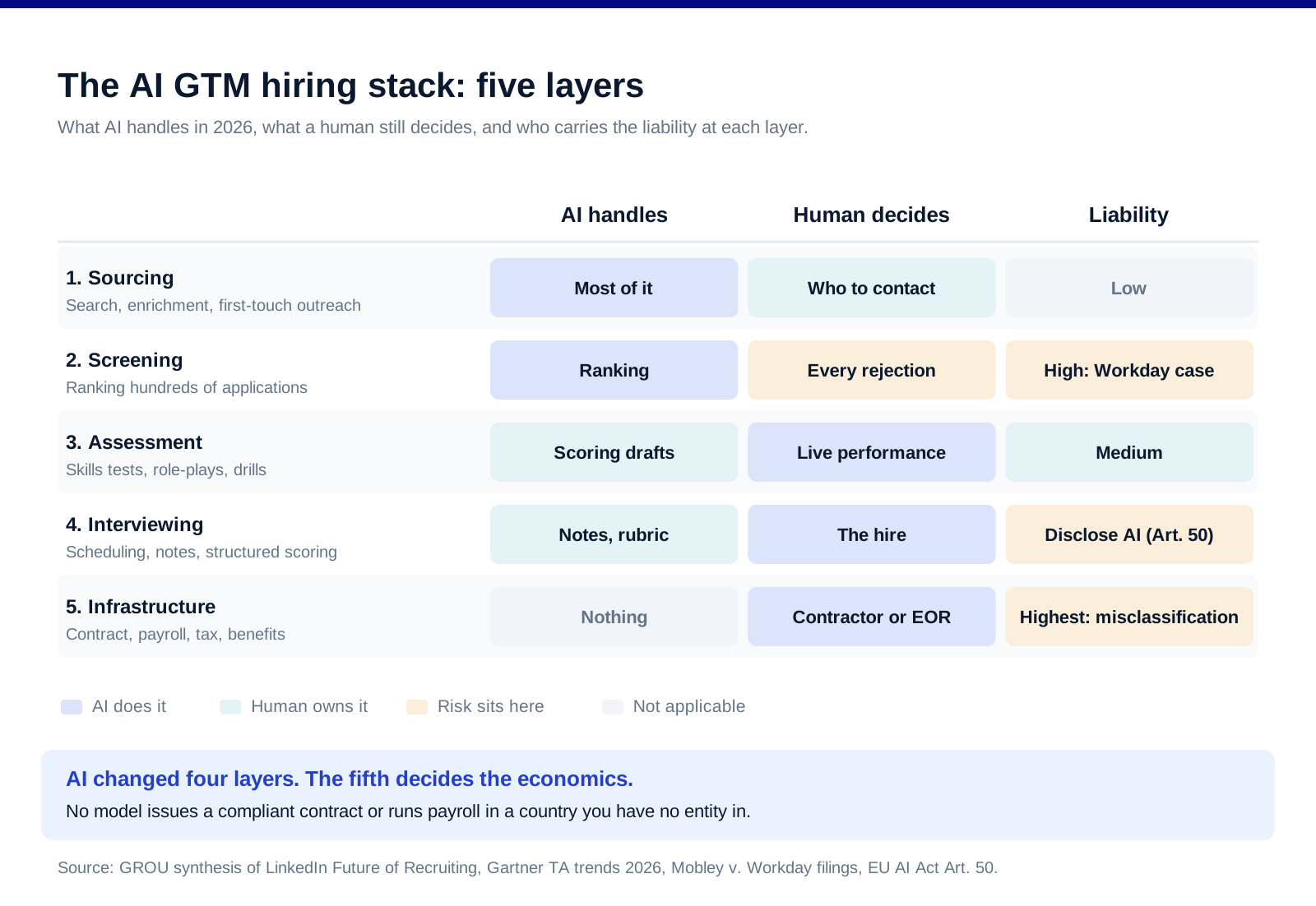
Think of a global sales hire as five layers. Sourcing, screening, assessment, interviewing and infrastructure. AI has reshaped the first four. The fifth is a legal and financial problem that no model solves.
1. Sourcing: the layer AI won first
This is where the LinkedIn numbers come from. LinkedIn's Future of Recruiting survey found that recruiters using generative AI save about 20 percent of their working week, most of it on search strings, outreach drafting and first-touch messaging. The same report found companies using AI-assisted messaging were 9 percent more likely to make a quality hire, and that employers were 54 times more likely to list relationship development as a required recruiter skill than the year before. Read those two together: the machine writes the first message, the human is hired for what happens after the reply.
For SDR hiring specifically, the sourcing layer is now barely distinguishable from the outbound layer. The same tooling a sales team uses to find and message buyers, enrichment, intent signals, sequenced outreach, is what a good recruiter uses to find and message candidates. If your company already runs outbound, you already own most of this layer. Our note on hiring SDRs in Colombia covers the sourcing channels that actually work there, and they are not the ones that work in London.
2. Screening: the layer with the lawsuit attached
High-volume screening is where AI earns its keep and where it carries its risk. Gartner's first talent acquisition trend for 2026, from its October 2025 HR Symposium, is that "high-volume recruiting goes AI-first". An open SDR role in a popular remote market routinely draws several hundred applications, and no human is reading all of them. Something is ranking that pile, and if it is a model, you need to know how it was built.
Because the case law on this is live, and it is not waiting for the regulators. In Mobley v. Workday, a federal court in California allowed claims to proceed in 2024 on the theory that a screening vendor can be liable as an agent of the employers who use it. On 16 May 2025 the court granted preliminary certification of a collective action on the age-discrimination claim, and as of mid-2026, per Maynard Nexsen's summary of the case, claims for disparate impact on race, sex, disability and age have all survived motions to dismiss. The plaintiffs' theory is that bias enters through proxies: employment gaps standing in for disability, years of experience standing in for age. You do not need a protected characteristic in the model for the model to discriminate on it.
The practical rule for SDR screening is therefore simple. Use AI to rank, never to reject. A model that orders 400 applications so a human reads the top 60 is a productivity tool. A model that sends 340 automated rejections is a defendant. The distinction costs you an hour per role and removes most of the exposure.
3. Assessment: where AI gets better and candidates get better at AI
Skills tests are replacing CV reads, and for SDRs this is overdue. A sales development role is almost entirely observable behaviour: can this person write a sharp message, hold a conversation, take a rejection and dial again. LinkedIn's survey found more than 90 percent of talent professionals consider accurate skills assessment crucial to quality of hire, and companies running the most skills-based searches were 12 percent more likely to make a quality hire. Gartner predicts that by 2027, 75 percent of hiring processes will include tests for workplace AI proficiency, and an SDR who cannot work a modern outbound stack is already behind.
The complication is that candidates have the same tools you do. An AI-drafted cold email in a take-home test tells you nothing. The assessments that still work for SDRs are live: a recorded role-play, a timed objection drill, a real call. Async video with a short window and no retakes filters harder than any written test now does.
4. Interviewing: the transparency layer
This is the one layer where a regulatory obligation actually lands this year. Whatever else the EU delayed, the AI Act's Article 50 transparency duty applied from 2 August 2026, and the Digital Omnibus did not move it. If a candidate in the EU is interacting with an AI system, an automated screener, a chatbot scheduling interviews, an AI interviewer, they have to be told. That is cheap to comply with and embarrassing to miss, so put a sentence in the job posting and another in the first automated message.
Beyond that, the interview is where AI should be the note-taker, not the decision-maker. Transcription and structured scoring against a rubric make interviews more consistent across a distributed panel in four time zones. Letting the model score the candidate reintroduces every risk you removed at the screening layer.
5. Infrastructure: the layer AI did not touch
Everything above this line gets you to an offer letter. Nothing above it gets you a legally employed salesperson in a country you have no entity in. Someone has to issue a compliant contract under local law, register the worker, run payroll in the right currency, withhold the right taxes, provide the statutory benefits, and carry the liability if any of that is wrong. This layer is the reason the section below exists.
Where the money is, and what it costs to reach it
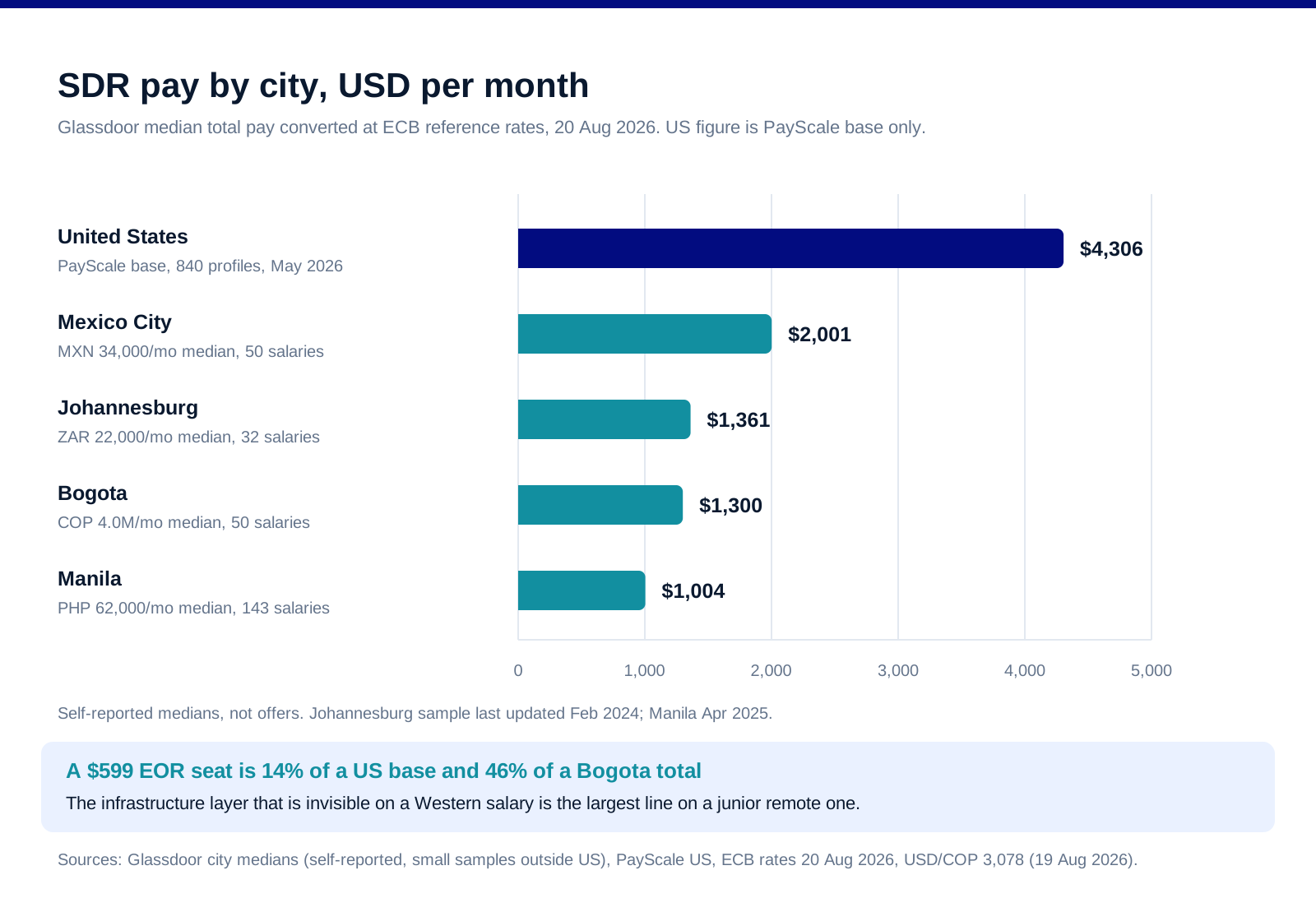
The pay gap is the reason any of this is worth doing, so here it is in published numbers. Glassdoor's medians for sales development representatives are roughly PHP 62,000 a month in Manila across 143 salaries, COP 4.0 million a month in Bogota across 50, ZAR 22,000 a month in Johannesburg across 32, and MXN 34,000 a month in Mexico City across 50. At the European Central Bank's 20 August 2026 reference rates, and the published dollar-peso rate for Colombia the same week, that is about $1,000 a month in Manila, $1,300 in Bogota, $1,360 in Johannesburg and $2,000 in Mexico City, total pay including commission. PayScale puts the US SDR base at $51,677 a year across 840 profiles, about $4,300 a month before any variable.
Two caveats before you build a model on that. These are self-reported medians, not offers you will receive, and the sample sizes outside the US are small. And a salesperson who will sell into the US or the UK needs to sound like they belong there, which compresses the gap for the best candidates. Our note on SDR compensation plans covers how to structure variable pay so the local base is not the whole story.
Now add the infrastructure layer, because this is where the arithmetic turns. Deel's published list prices, verified on its pricing page in August 2026, are $49 per contractor per month and $599 per employer-of-record employee per month. On a US hire, $599 is about 14 percent on top of base. On a Bogota hire at $1,300 a month, the same seat is a 46 percent overhead. On a Manila hire it is nearly 60 percent. The EOR model that is almost invisible on a senior Western salary is the single largest line item on a junior remote one.
So the temptation is obvious: hire them as contractors. At $49 a month the infrastructure cost disappears. And for the first one or two reps in a new market, while you are still finding out whether the market works, that is often the right call. The problem is what happens when the role becomes permanent and the relationship starts to look like employment, which for an SDR it does fast.
The classification problem, and why SDRs trip it first
An SDR is the worst possible role to run as a long-term contractor. Look at what the role involves: working set hours to match the target market's time zone, using your CRM and your dialler, following your sequence, attending your stand-up, paid a fixed monthly amount plus commission, working for nobody else. Every one of those is an indicator of employment in almost every jurisdiction. Our companion piece on contractor misclassification in Europe walks through how a single relationship can be reclassified by four separate authorities, each with its own test and its own bill, and the SDR job description reads like the checklist.
And the direction of travel is one way. From 2 December 2026 the EU's Platform Work Directive requires member states to operate a legal presumption of employment for digital labour platforms, shifting the burden of proof onto the company. That is platform-specific, but it tells you where regulators' instincts are. Outside Europe the tests differ and the instincts do not.
Which gives you the actual decision. Not "AI or no AI", which is settled. It is "contractor or EOR", by country, by role and by how long you expect the person to stay. The honest version of that decision looks like this.
Contractor makes sense when the engagement is genuinely a trial, the person has other clients or is set up as a business, you are not dictating hours and tools, and you have a date by which you will convert or end it.
EOR makes sense when the role is permanent, the person works your hours in your stack, the country has active enforcement, or the hire is senior enough that losing them to a competitor offering proper employment would hurt. It also makes sense when the local market expects it: in several Latin American and European markets, a formal employment contract with statutory benefits is what serious candidates hold out for.
Your own entity makes sense when you have enough people in one country that the EOR fee exceeds the cost of running a subsidiary, which for most B2B companies is somewhere between five and fifteen heads in one place.
The reason we name Deel here rather than the category is that the conversion path matters. Starting someone on a contractor agreement and moving them to employer-of-record later, inside one platform, with the same payroll history, is a different operation from terminating one arrangement and re-onboarding under another. Deel runs both products on one system with published pricing and no long-term contract on the contractor tier, which is the combination the first-hire-in-a-new-country case actually needs. Other platforms do parts of this well, and the field is real. For the specific shape of a first remote SDR hire, trial as contractor then convert, it is our default.
The rules moved out. The risk did not.
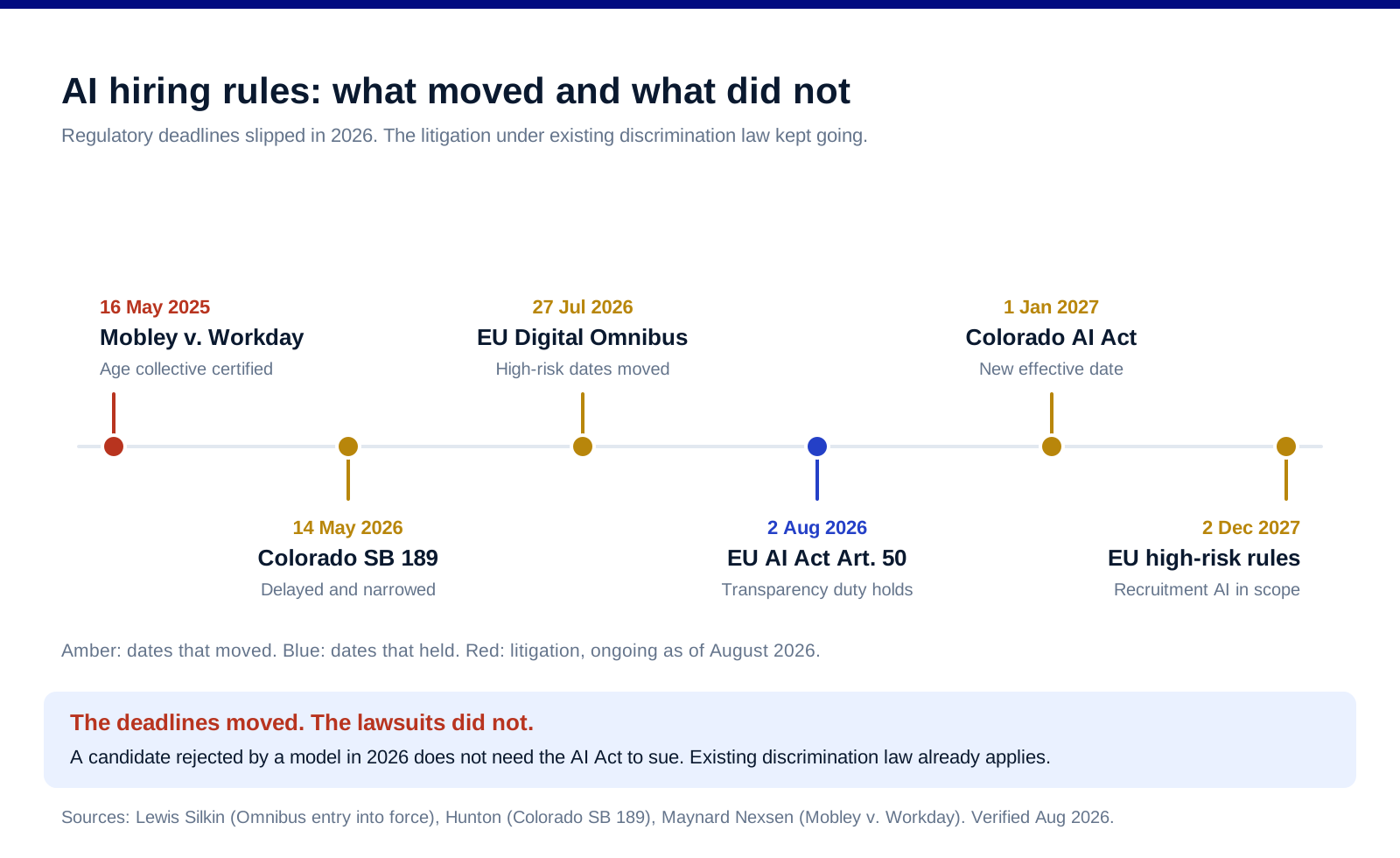
If you read about AI hiring compliance a year ago, most of the dates you read are wrong now. The EU AI Act originally made recruitment and worker-management AI a high-risk use under Annex III with obligations applying from 2 August 2026. The Digital Omnibus on AI, published in the Official Journal on 24 July 2026 and in force from 27 July, pushed that to 2 December 2027, as Lewis Silkin's note on the entry into force sets out. Article 50 transparency and the AI literacy duty on providers and deployers still apply from 2 August 2026.
Colorado did something similar. SB 189, signed on 14 May 2026, moved the state's AI Act from 30 June 2026 to 1 January 2027, and, per Hunton's summary of the amendments, stripped out the duty of care, the risk-management programme and the impact-assessment requirements for deployers. What survives is narrower: disclosure, and a right to meaningful human review of adverse automated decisions.
It would be easy to read those two as permission to relax. That is the wrong reading. The regulatory deadlines moved because the rules were hard to write, not because the harm went away. The Workday litigation is proceeding under statutes that have existed for decades and that no omnibus touched. A candidate rejected by a model in 2026 does not need the AI Act to sue you. They need the Civil Rights Act, the ADEA, the Equality Act, or their national equivalent, all of which are in force today.
So the compliance posture for an SDR hiring stack in 2026 is not a project plan for December 2027. It is four habits you can install this week. Tell candidates when they are interacting with AI. Use models to rank and humans to reject. Keep a record of what the model was asked to optimise for. And do not run the person who passes all of that as a contractor for eighteen months in a country where that is obviously employment.
Build, buy, or borrow: the three ways to get a global SDR function
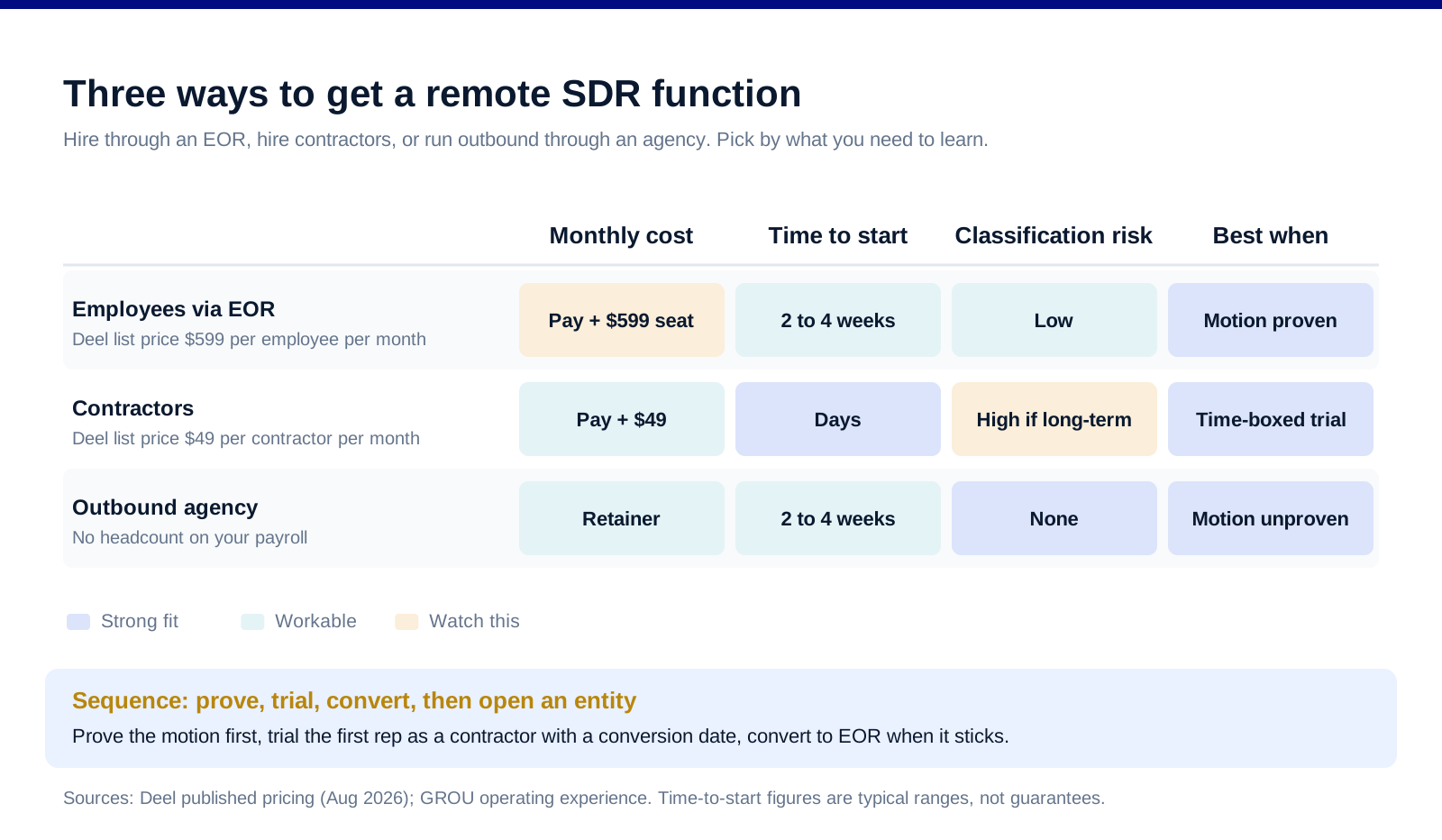
Everything above assumes you are hiring. There are three ways to end up with a remote SDR doing outbound for you, and the right one depends on what you are actually trying to learn.
Hire employees through an EOR. Highest commitment, highest retention, cleanest compliance. Right when you already know the motion works and you need capacity in a specific market. The cost is the seat fee and the fact that you now own onboarding, management, tooling and the ramp. Deel is where we would start for the reasons above.
Hire contractors. Lowest cost, fastest start, highest classification risk if it runs long. Right for a time-boxed trial of a new market with a conversion date attached. Wrong as a permanent structure for anyone working your hours in your stack.
Run it through an outbound agency. You are not hiring anyone, so there is no classification question, no EOR fee, no ramp on your payroll and no management load. The trade-off is that the people, the playbook and the tooling are the agency's, and you are paying for a motion rather than building one. Right when the motion is not yet proven, when you need pipeline before you can justify headcount, or when the hire you would make is the one our piece on companies that outsource sales shows usually fails. This is what we do, across manufacturing, fintech, iGaming, software and professional services, so weigh the recommendation accordingly.
The sequencing most companies get backwards is this. They hire first, in a cheap market, as contractors, with an AI-screened candidate, and find out six months later that the motion did not work, the contractor relationship looks like employment, and the person is now owed a settlement. The cheaper order is: prove the motion with someone else's team, hire the first rep as a contractor with a conversion date, convert to EOR when it sticks, and open an entity when the EOR fee for the country crosses the cost of a subsidiary.

What we do not publish here
A ranking of AI recruiting tools. The sourcing and screening layers change monthly and a list would be stale before it indexed. The principles above, rank not reject, live assessment over written, disclose AI contact, survive any tool change.
A benchmark for SDR ramp time or quota attainment by country. Ours come from a specific set of client programmes and would mislead as a general number.
Legal advice. The dates and rulings quoted are from published legal summaries verified in August 2026. National implementations differ and the Workday case is ongoing. Your contractor agreements are a question for counsel in the country where the person sits.
A claim that EOR is always right or contractors are always wrong. The arithmetic in the pay section cuts both ways, which is why the article gives you the conditions rather than a rule.
FAQ
Is AI actually being used to hire salespeople, or is this still a pilot?
It is in production at the top of the funnel. LinkedIn's survey of 1,271 recruiting professionals across 23 countries found 37 percent of organisations integrating or experimenting with generative AI, up ten points in a year, with recruiters saving about a fifth of their week. Gartner's lead talent acquisition trend for 2026 is that high-volume recruiting goes AI-first, and SDR hiring is the highest-volume recruiting most B2B companies do.
Can I use AI to reject candidates automatically?
You can, and the live litigation says you should not. Mobley v. Workday has a preliminarily certified age-discrimination collective and claims surviving on race, sex and disability, on the theory that screening models discriminate through proxies like employment gaps and years of experience. Use the model to rank so a human reads the top of the pile, and keep the rejection decision human.
Did the EU AI Act deadline for hiring tools really move?
Yes. The Digital Omnibus on AI, in force since 27 July 2026, moved the high-risk obligations for recruitment AI from 2 August 2026 to 2 December 2027. The Article 50 transparency duty, telling people when they are interacting with an AI system, still applies from 2 August 2026, and so does the AI literacy duty.
How much does a remote SDR cost compared with a US one?
Glassdoor medians for total SDR pay are roughly $1,000 a month in Manila, $1,300 in Bogota, $1,360 in Johannesburg and $2,000 in Mexico City at August 2026 exchange rates, against a PayScale US base of $51,677 a year. Add infrastructure: a $599 per month employer-of-record seat is about 14 percent on a US base and 46 percent on a Bogota total, which is why the contractor-versus-EOR decision matters more on cheaper hires.
Should the first remote SDR be a contractor or an employee?
For a time-boxed trial of a new market, a contractor with a written conversion date is usually right. Once the person works your hours, in your stack, for you alone, the relationship looks like employment in most jurisdictions, and an SDR role hits every one of those markers. Convert to employer-of-record at that point. Deel runs both on one platform, which is why we name it for this specific case.
What about just outsourcing the whole thing?
If the motion is unproven, that is often the cheaper sequence: prove it with an agency's team, then hire into a motion that works. You avoid the classification question, the EOR fee and the ramp on your payroll. You also do not own the playbook, which is the trade. We sell this, so read the recommendation with that in mind.
Bottom line
AI has made the first four layers of a global sales hire faster and, used carefully, fairer than the CV-and-gut-feel process it replaced. Source with it, rank with it, assess live, tell candidates it is there, and keep the final decision human, because the lawsuits that matter were filed under laws older than the models. None of that gets you an employed salesperson in a country where you have no entity, and that fifth layer is where the economics of remote SDR hiring are actually decided. The pay gap is real. The infrastructure overhead on a junior remote salary is also real, and it is large enough that the contractor-or-EOR choice, made by country and by time horizon, is the most consequential decision in the stack. Our default is to trial as a contractor with a conversion date, convert to employer-of-record when it sticks, and do both on one platform so the conversion is an administrative step rather than a re-hire.
Hiring your first SDR outside your home country? See how Deel handles contractor and employer-of-record hiring in 150+ countries, with published pricing and no long-term contract on the contractor tier.
Not sure the motion is ready for a hire yet? Book a call with GROU. We run lead generation and outbound for B2B companies across verticals, which is the cheaper way to find out before you put anyone on payroll.
We are GROU, a B2B pipeline agency that runs lead generation, outbound, and LinkedIn content for clients across manufacturing, fintech, iGaming, software, and professional services. We hire and manage remote SDRs ourselves, which is where the operating view in this article comes from. The hiring data, survey figures, pay medians, exchange rates and legal dates are quoted from published Deel, LinkedIn, Gartner, Glassdoor, PayScale, European Central Bank and law-firm sources verified in August 2026, and the legal material is a summary of public sources rather than legal advice.
Most writing about AI and hiring is written for recruiters. This one is written for the people who actually open the SDR requisition: founders, heads of sales and revenue leaders who need pipeline in a market their own office does not sit in. For them, AI has changed four of the five layers of the hiring stack, and left the fifth one, the part where someone has to be legally employed and correctly paid in a country you have no entity in, exactly as hard as it was.
That fifth layer is where most global sales hires quietly go wrong, and it is the one this article spends the most time on.
TL;DR
Sales roles are now three of the five most common cross-border hires. Deel's Global Hiring Report 2026, built on more than one million worker contracts across 37,000 companies and 150 countries, ranks sales manager, business developer and sales account manager at second, third and fourth behind software developer. AI has taken over the top of the funnel: LinkedIn's Future of Recruiting survey of 1,271 recruiting professionals found 37 percent of organisations integrating or experimenting with generative AI, up from 27 percent a year earlier, and recruiters using it save roughly a day a week. Gartner's headline trend for talent acquisition in 2026 is that high-volume recruiting goes AI-first, and SDR hiring is the most high-volume recruiting most B2B companies ever do. The rules on AI screening have moved out, not in: the EU's Digital Omnibus, in force since 27 July 2026, pushed high-risk obligations for recruitment AI from August 2026 to 2 December 2027, and Colorado's rewrite pushed its law to 1 January 2027 and narrowed it to disclosure. The litigation did not move. Mobley v. Workday still has a preliminarily certified age-discrimination collective and claims surviving on race, sex and disability. Meanwhile the pay gap that makes global SDR hiring attractive is real and large: Glassdoor medians put total SDR pay at roughly $1,000 to $2,000 a month in Manila, Bogota, Johannesburg and Mexico City against a PayScale US base of $51,677 a year. The catch is the infrastructure layer. A $599 per month employer-of-record seat is a rounding error on a US salary and a 46 percent overhead on a Bogota one, which is why the contractor-versus-EOR decision, not the AI screening decision, is the one that determines whether a global SDR hire pays off. Our default: run AI across sourcing, screening and assessment, keep a human on the final call, hire the first one or two reps in a new country as contractors through a platform like Deel that can convert them to EOR later, and move to EOR the moment the role looks permanent.
Sales is now a cross-border job
Start with who is actually being hired across borders, because it is not who most people assume. Deel's Global Hiring Report 2026 analysed 2025 data from over one million worker contracts spanning 37,000 companies in more than 150 countries. The most common cross-border role was software developer. The next three were sales manager, business developer and sales account manager. Customer service representative rounded out the top five. Three of the five most common jobs a company hires from another country are revenue jobs.
That is a quiet reversal of the old assumption that sales has to sit near the customer. It still has to sound near the customer. It does not have to be paid there, and increasingly it is not. The same report found that 84.6 percent of Argentinian workers on the platform chose to be paid in US dollars rather than pesos, and that the dollar appeared in five of the ten most common country-currency combinations. The labour market for sales talent has globalised faster than most companies' hiring processes have.
The other headline from the same data is where the growth is. General AI trainer roles grew 283 percent cross-border in 2025, across more than 70,000 people and 600 organisations, and Latin American financial analysts saw compensation rise 195 percent. Neither is a sales role, but both tell you the same thing: the countries you would hire an SDR from are now competing for that talent with AI labs and fintechs paying in dollars. The arbitrage is still there. It is narrower than the 2021 version, and it moves.
Which is why this article is structured the way it is. The AI part of the AI hiring stack is genuinely good now, and it is the same for everyone. The part that decides whether your remote SDR in Bogota or Manila turns a profit is everything underneath it.
The five layers, and which ones AI changed
Think of a global sales hire as five layers. Sourcing, screening, assessment, interviewing and infrastructure. AI has reshaped the first four. The fifth is a legal and financial problem that no model solves.
1. Sourcing: the layer AI won first
This is where the LinkedIn numbers come from. LinkedIn's Future of Recruiting survey found that recruiters using generative AI save about 20 percent of their working week, most of it on search strings, outreach drafting and first-touch messaging. The same report found companies using AI-assisted messaging were 9 percent more likely to make a quality hire, and that employers were 54 times more likely to list relationship development as a required recruiter skill than the year before. Read those two together: the machine writes the first message, the human is hired for what happens after the reply.
For SDR hiring specifically, the sourcing layer is now barely distinguishable from the outbound layer. The same tooling a sales team uses to find and message buyers, enrichment, intent signals, sequenced outreach, is what a good recruiter uses to find and message candidates. If your company already runs outbound, you already own most of this layer. Our note on hiring SDRs in Colombia covers the sourcing channels that actually work there, and they are not the ones that work in London.
2. Screening: the layer with the lawsuit attached
High-volume screening is where AI earns its keep and where it carries its risk. Gartner's first talent acquisition trend for 2026, from its October 2025 HR Symposium, is that "high-volume recruiting goes AI-first". An open SDR role in a popular remote market routinely draws several hundred applications, and no human is reading all of them. Something is ranking that pile, and if it is a model, you need to know how it was built.
Because the case law on this is live, and it is not waiting for the regulators. In Mobley v. Workday, a federal court in California allowed claims to proceed in 2024 on the theory that a screening vendor can be liable as an agent of the employers who use it. On 16 May 2025 the court granted preliminary certification of a collective action on the age-discrimination claim, and as of mid-2026, per Maynard Nexsen's summary of the case, claims for disparate impact on race, sex, disability and age have all survived motions to dismiss. The plaintiffs' theory is that bias enters through proxies: employment gaps standing in for disability, years of experience standing in for age. You do not need a protected characteristic in the model for the model to discriminate on it.
The practical rule for SDR screening is therefore simple. Use AI to rank, never to reject. A model that orders 400 applications so a human reads the top 60 is a productivity tool. A model that sends 340 automated rejections is a defendant. The distinction costs you an hour per role and removes most of the exposure.
3. Assessment: where AI gets better and candidates get better at AI
Skills tests are replacing CV reads, and for SDRs this is overdue. A sales development role is almost entirely observable behaviour: can this person write a sharp message, hold a conversation, take a rejection and dial again. LinkedIn's survey found more than 90 percent of talent professionals consider accurate skills assessment crucial to quality of hire, and companies running the most skills-based searches were 12 percent more likely to make a quality hire. Gartner predicts that by 2027, 75 percent of hiring processes will include tests for workplace AI proficiency, and an SDR who cannot work a modern outbound stack is already behind.
The complication is that candidates have the same tools you do. An AI-drafted cold email in a take-home test tells you nothing. The assessments that still work for SDRs are live: a recorded role-play, a timed objection drill, a real call. Async video with a short window and no retakes filters harder than any written test now does.
4. Interviewing: the transparency layer
This is the one layer where a regulatory obligation actually lands this year. Whatever else the EU delayed, the AI Act's Article 50 transparency duty applied from 2 August 2026, and the Digital Omnibus did not move it. If a candidate in the EU is interacting with an AI system, an automated screener, a chatbot scheduling interviews, an AI interviewer, they have to be told. That is cheap to comply with and embarrassing to miss, so put a sentence in the job posting and another in the first automated message.
Beyond that, the interview is where AI should be the note-taker, not the decision-maker. Transcription and structured scoring against a rubric make interviews more consistent across a distributed panel in four time zones. Letting the model score the candidate reintroduces every risk you removed at the screening layer.
5. Infrastructure: the layer AI did not touch
Everything above this line gets you to an offer letter. Nothing above it gets you a legally employed salesperson in a country you have no entity in. Someone has to issue a compliant contract under local law, register the worker, run payroll in the right currency, withhold the right taxes, provide the statutory benefits, and carry the liability if any of that is wrong. This layer is the reason the section below exists.
Where the money is, and what it costs to reach it
The pay gap is the reason any of this is worth doing, so here it is in published numbers. Glassdoor's medians for sales development representatives are roughly PHP 62,000 a month in Manila across 143 salaries, COP 4.0 million a month in Bogota across 50, ZAR 22,000 a month in Johannesburg across 32, and MXN 34,000 a month in Mexico City across 50. At the European Central Bank's 20 August 2026 reference rates, and the published dollar-peso rate for Colombia the same week, that is about $1,000 a month in Manila, $1,300 in Bogota, $1,360 in Johannesburg and $2,000 in Mexico City, total pay including commission. PayScale puts the US SDR base at $51,677 a year across 840 profiles, about $4,300 a month before any variable.
Two caveats before you build a model on that. These are self-reported medians, not offers you will receive, and the sample sizes outside the US are small. And a salesperson who will sell into the US or the UK needs to sound like they belong there, which compresses the gap for the best candidates. Our note on SDR compensation plans covers how to structure variable pay so the local base is not the whole story.
Now add the infrastructure layer, because this is where the arithmetic turns. Deel's published list prices, verified on its pricing page in August 2026, are $49 per contractor per month and $599 per employer-of-record employee per month. On a US hire, $599 is about 14 percent on top of base. On a Bogota hire at $1,300 a month, the same seat is a 46 percent overhead. On a Manila hire it is nearly 60 percent. The EOR model that is almost invisible on a senior Western salary is the single largest line item on a junior remote one.
So the temptation is obvious: hire them as contractors. At $49 a month the infrastructure cost disappears. And for the first one or two reps in a new market, while you are still finding out whether the market works, that is often the right call. The problem is what happens when the role becomes permanent and the relationship starts to look like employment, which for an SDR it does fast.
The classification problem, and why SDRs trip it first
An SDR is the worst possible role to run as a long-term contractor. Look at what the role involves: working set hours to match the target market's time zone, using your CRM and your dialler, following your sequence, attending your stand-up, paid a fixed monthly amount plus commission, working for nobody else. Every one of those is an indicator of employment in almost every jurisdiction. Our companion piece on contractor misclassification in Europe walks through how a single relationship can be reclassified by four separate authorities, each with its own test and its own bill, and the SDR job description reads like the checklist.
And the direction of travel is one way. From 2 December 2026 the EU's Platform Work Directive requires member states to operate a legal presumption of employment for digital labour platforms, shifting the burden of proof onto the company. That is platform-specific, but it tells you where regulators' instincts are. Outside Europe the tests differ and the instincts do not.
Which gives you the actual decision. Not "AI or no AI", which is settled. It is "contractor or EOR", by country, by role and by how long you expect the person to stay. The honest version of that decision looks like this.
Contractor makes sense when the engagement is genuinely a trial, the person has other clients or is set up as a business, you are not dictating hours and tools, and you have a date by which you will convert or end it.
EOR makes sense when the role is permanent, the person works your hours in your stack, the country has active enforcement, or the hire is senior enough that losing them to a competitor offering proper employment would hurt. It also makes sense when the local market expects it: in several Latin American and European markets, a formal employment contract with statutory benefits is what serious candidates hold out for.
Your own entity makes sense when you have enough people in one country that the EOR fee exceeds the cost of running a subsidiary, which for most B2B companies is somewhere between five and fifteen heads in one place.
The reason we name Deel here rather than the category is that the conversion path matters. Starting someone on a contractor agreement and moving them to employer-of-record later, inside one platform, with the same payroll history, is a different operation from terminating one arrangement and re-onboarding under another. Deel runs both products on one system with published pricing and no long-term contract on the contractor tier, which is the combination the first-hire-in-a-new-country case actually needs. Other platforms do parts of this well, and the field is real. For the specific shape of a first remote SDR hire, trial as contractor then convert, it is our default.
The rules moved out. The risk did not.
If you read about AI hiring compliance a year ago, most of the dates you read are wrong now. The EU AI Act originally made recruitment and worker-management AI a high-risk use under Annex III with obligations applying from 2 August 2026. The Digital Omnibus on AI, published in the Official Journal on 24 July 2026 and in force from 27 July, pushed that to 2 December 2027, as Lewis Silkin's note on the entry into force sets out. Article 50 transparency and the AI literacy duty on providers and deployers still apply from 2 August 2026.
Colorado did something similar. SB 189, signed on 14 May 2026, moved the state's AI Act from 30 June 2026 to 1 January 2027, and, per Hunton's summary of the amendments, stripped out the duty of care, the risk-management programme and the impact-assessment requirements for deployers. What survives is narrower: disclosure, and a right to meaningful human review of adverse automated decisions.
It would be easy to read those two as permission to relax. That is the wrong reading. The regulatory deadlines moved because the rules were hard to write, not because the harm went away. The Workday litigation is proceeding under statutes that have existed for decades and that no omnibus touched. A candidate rejected by a model in 2026 does not need the AI Act to sue you. They need the Civil Rights Act, the ADEA, the Equality Act, or their national equivalent, all of which are in force today.
So the compliance posture for an SDR hiring stack in 2026 is not a project plan for December 2027. It is four habits you can install this week. Tell candidates when they are interacting with AI. Use models to rank and humans to reject. Keep a record of what the model was asked to optimise for. And do not run the person who passes all of that as a contractor for eighteen months in a country where that is obviously employment.
Build, buy, or borrow: the three ways to get a global SDR function
Everything above assumes you are hiring. There are three ways to end up with a remote SDR doing outbound for you, and the right one depends on what you are actually trying to learn.
Hire employees through an EOR. Highest commitment, highest retention, cleanest compliance. Right when you already know the motion works and you need capacity in a specific market. The cost is the seat fee and the fact that you now own onboarding, management, tooling and the ramp. Deel is where we would start for the reasons above.
Hire contractors. Lowest cost, fastest start, highest classification risk if it runs long. Right for a time-boxed trial of a new market with a conversion date attached. Wrong as a permanent structure for anyone working your hours in your stack.
Run it through an outbound agency. You are not hiring anyone, so there is no classification question, no EOR fee, no ramp on your payroll and no management load. The trade-off is that the people, the playbook and the tooling are the agency's, and you are paying for a motion rather than building one. Right when the motion is not yet proven, when you need pipeline before you can justify headcount, or when the hire you would make is the one our piece on companies that outsource sales shows usually fails. This is what we do, across manufacturing, fintech, iGaming, software and professional services, so weigh the recommendation accordingly.
The sequencing most companies get backwards is this. They hire first, in a cheap market, as contractors, with an AI-screened candidate, and find out six months later that the motion did not work, the contractor relationship looks like employment, and the person is now owed a settlement. The cheaper order is: prove the motion with someone else's team, hire the first rep as a contractor with a conversion date, convert to EOR when it sticks, and open an entity when the EOR fee for the country crosses the cost of a subsidiary.
What we do not publish here
A ranking of AI recruiting tools. The sourcing and screening layers change monthly and a list would be stale before it indexed. The principles above, rank not reject, live assessment over written, disclose AI contact, survive any tool change.
A benchmark for SDR ramp time or quota attainment by country. Ours come from a specific set of client programmes and would mislead as a general number.
Legal advice. The dates and rulings quoted are from published legal summaries verified in August 2026. National implementations differ and the Workday case is ongoing. Your contractor agreements are a question for counsel in the country where the person sits.
A claim that EOR is always right or contractors are always wrong. The arithmetic in the pay section cuts both ways, which is why the article gives you the conditions rather than a rule.
FAQ
Is AI actually being used to hire salespeople, or is this still a pilot?
It is in production at the top of the funnel. LinkedIn's survey of 1,271 recruiting professionals across 23 countries found 37 percent of organisations integrating or experimenting with generative AI, up ten points in a year, with recruiters saving about a fifth of their week. Gartner's lead talent acquisition trend for 2026 is that high-volume recruiting goes AI-first, and SDR hiring is the highest-volume recruiting most B2B companies do.
Can I use AI to reject candidates automatically?
You can, and the live litigation says you should not. Mobley v. Workday has a preliminarily certified age-discrimination collective and claims surviving on race, sex and disability, on the theory that screening models discriminate through proxies like employment gaps and years of experience. Use the model to rank so a human reads the top of the pile, and keep the rejection decision human.
Did the EU AI Act deadline for hiring tools really move?
Yes. The Digital Omnibus on AI, in force since 27 July 2026, moved the high-risk obligations for recruitment AI from 2 August 2026 to 2 December 2027. The Article 50 transparency duty, telling people when they are interacting with an AI system, still applies from 2 August 2026, and so does the AI literacy duty.
How much does a remote SDR cost compared with a US one?
Glassdoor medians for total SDR pay are roughly $1,000 a month in Manila, $1,300 in Bogota, $1,360 in Johannesburg and $2,000 in Mexico City at August 2026 exchange rates, against a PayScale US base of $51,677 a year. Add infrastructure: a $599 per month employer-of-record seat is about 14 percent on a US base and 46 percent on a Bogota total, which is why the contractor-versus-EOR decision matters more on cheaper hires.
Should the first remote SDR be a contractor or an employee?
For a time-boxed trial of a new market, a contractor with a written conversion date is usually right. Once the person works your hours, in your stack, for you alone, the relationship looks like employment in most jurisdictions, and an SDR role hits every one of those markers. Convert to employer-of-record at that point. Deel runs both on one platform, which is why we name it for this specific case.
What about just outsourcing the whole thing?
If the motion is unproven, that is often the cheaper sequence: prove it with an agency's team, then hire into a motion that works. You avoid the classification question, the EOR fee and the ramp on your payroll. You also do not own the playbook, which is the trade. We sell this, so read the recommendation with that in mind.
Bottom line
AI has made the first four layers of a global sales hire faster and, used carefully, fairer than the CV-and-gut-feel process it replaced. Source with it, rank with it, assess live, tell candidates it is there, and keep the final decision human, because the lawsuits that matter were filed under laws older than the models. None of that gets you an employed salesperson in a country where you have no entity, and that fifth layer is where the economics of remote SDR hiring are actually decided. The pay gap is real. The infrastructure overhead on a junior remote salary is also real, and it is large enough that the contractor-or-EOR choice, made by country and by time horizon, is the most consequential decision in the stack. Our default is to trial as a contractor with a conversion date, convert to employer-of-record when it sticks, and do both on one platform so the conversion is an administrative step rather than a re-hire.
Hiring your first SDR outside your home country? See how Deel handles contractor and employer-of-record hiring in 150+ countries, with published pricing and no long-term contract on the contractor tier.
Not sure the motion is ready for a hire yet? Book a call with GROU. We run lead generation and outbound for B2B companies across verticals, which is the cheaper way to find out before you put anyone on payroll.
We are GROU, a B2B pipeline agency that runs lead generation, outbound, and LinkedIn content for clients across manufacturing, fintech, iGaming, software, and professional services. We hire and manage remote SDRs ourselves, which is where the operating view in this article comes from. The hiring data, survey figures, pay medians, exchange rates and legal dates are quoted from published Deel, LinkedIn, Gartner, Glassdoor, PayScale, European Central Bank and law-firm sources verified in August 2026, and the legal material is a summary of public sources rather than legal advice.
Most writing about AI and hiring is written for recruiters. This one is written for the people who actually open the SDR requisition: founders, heads of sales and revenue leaders who need pipeline in a market their own office does not sit in. For them, AI has changed four of the five layers of the hiring stack, and left the fifth one, the part where someone has to be legally employed and correctly paid in a country you have no entity in, exactly as hard as it was.
That fifth layer is where most global sales hires quietly go wrong, and it is the one this article spends the most time on.
TL;DR
Sales roles are now three of the five most common cross-border hires. Deel's Global Hiring Report 2026, built on more than one million worker contracts across 37,000 companies and 150 countries, ranks sales manager, business developer and sales account manager at second, third and fourth behind software developer. AI has taken over the top of the funnel: LinkedIn's Future of Recruiting survey of 1,271 recruiting professionals found 37 percent of organisations integrating or experimenting with generative AI, up from 27 percent a year earlier, and recruiters using it save roughly a day a week. Gartner's headline trend for talent acquisition in 2026 is that high-volume recruiting goes AI-first, and SDR hiring is the most high-volume recruiting most B2B companies ever do. The rules on AI screening have moved out, not in: the EU's Digital Omnibus, in force since 27 July 2026, pushed high-risk obligations for recruitment AI from August 2026 to 2 December 2027, and Colorado's rewrite pushed its law to 1 January 2027 and narrowed it to disclosure. The litigation did not move. Mobley v. Workday still has a preliminarily certified age-discrimination collective and claims surviving on race, sex and disability. Meanwhile the pay gap that makes global SDR hiring attractive is real and large: Glassdoor medians put total SDR pay at roughly $1,000 to $2,000 a month in Manila, Bogota, Johannesburg and Mexico City against a PayScale US base of $51,677 a year. The catch is the infrastructure layer. A $599 per month employer-of-record seat is a rounding error on a US salary and a 46 percent overhead on a Bogota one, which is why the contractor-versus-EOR decision, not the AI screening decision, is the one that determines whether a global SDR hire pays off. Our default: run AI across sourcing, screening and assessment, keep a human on the final call, hire the first one or two reps in a new country as contractors through a platform like Deel that can convert them to EOR later, and move to EOR the moment the role looks permanent.
Sales is now a cross-border job
Start with who is actually being hired across borders, because it is not who most people assume. Deel's Global Hiring Report 2026 analysed 2025 data from over one million worker contracts spanning 37,000 companies in more than 150 countries. The most common cross-border role was software developer. The next three were sales manager, business developer and sales account manager. Customer service representative rounded out the top five. Three of the five most common jobs a company hires from another country are revenue jobs.
That is a quiet reversal of the old assumption that sales has to sit near the customer. It still has to sound near the customer. It does not have to be paid there, and increasingly it is not. The same report found that 84.6 percent of Argentinian workers on the platform chose to be paid in US dollars rather than pesos, and that the dollar appeared in five of the ten most common country-currency combinations. The labour market for sales talent has globalised faster than most companies' hiring processes have.
The other headline from the same data is where the growth is. General AI trainer roles grew 283 percent cross-border in 2025, across more than 70,000 people and 600 organisations, and Latin American financial analysts saw compensation rise 195 percent. Neither is a sales role, but both tell you the same thing: the countries you would hire an SDR from are now competing for that talent with AI labs and fintechs paying in dollars. The arbitrage is still there. It is narrower than the 2021 version, and it moves.
Which is why this article is structured the way it is. The AI part of the AI hiring stack is genuinely good now, and it is the same for everyone. The part that decides whether your remote SDR in Bogota or Manila turns a profit is everything underneath it.
The five layers, and which ones AI changed
Think of a global sales hire as five layers. Sourcing, screening, assessment, interviewing and infrastructure. AI has reshaped the first four. The fifth is a legal and financial problem that no model solves.
1. Sourcing: the layer AI won first
This is where the LinkedIn numbers come from. LinkedIn's Future of Recruiting survey found that recruiters using generative AI save about 20 percent of their working week, most of it on search strings, outreach drafting and first-touch messaging. The same report found companies using AI-assisted messaging were 9 percent more likely to make a quality hire, and that employers were 54 times more likely to list relationship development as a required recruiter skill than the year before. Read those two together: the machine writes the first message, the human is hired for what happens after the reply.
For SDR hiring specifically, the sourcing layer is now barely distinguishable from the outbound layer. The same tooling a sales team uses to find and message buyers, enrichment, intent signals, sequenced outreach, is what a good recruiter uses to find and message candidates. If your company already runs outbound, you already own most of this layer. Our note on hiring SDRs in Colombia covers the sourcing channels that actually work there, and they are not the ones that work in London.
2. Screening: the layer with the lawsuit attached
High-volume screening is where AI earns its keep and where it carries its risk. Gartner's first talent acquisition trend for 2026, from its October 2025 HR Symposium, is that "high-volume recruiting goes AI-first". An open SDR role in a popular remote market routinely draws several hundred applications, and no human is reading all of them. Something is ranking that pile, and if it is a model, you need to know how it was built.
Because the case law on this is live, and it is not waiting for the regulators. In Mobley v. Workday, a federal court in California allowed claims to proceed in 2024 on the theory that a screening vendor can be liable as an agent of the employers who use it. On 16 May 2025 the court granted preliminary certification of a collective action on the age-discrimination claim, and as of mid-2026, per Maynard Nexsen's summary of the case, claims for disparate impact on race, sex, disability and age have all survived motions to dismiss. The plaintiffs' theory is that bias enters through proxies: employment gaps standing in for disability, years of experience standing in for age. You do not need a protected characteristic in the model for the model to discriminate on it.
The practical rule for SDR screening is therefore simple. Use AI to rank, never to reject. A model that orders 400 applications so a human reads the top 60 is a productivity tool. A model that sends 340 automated rejections is a defendant. The distinction costs you an hour per role and removes most of the exposure.
3. Assessment: where AI gets better and candidates get better at AI
Skills tests are replacing CV reads, and for SDRs this is overdue. A sales development role is almost entirely observable behaviour: can this person write a sharp message, hold a conversation, take a rejection and dial again. LinkedIn's survey found more than 90 percent of talent professionals consider accurate skills assessment crucial to quality of hire, and companies running the most skills-based searches were 12 percent more likely to make a quality hire. Gartner predicts that by 2027, 75 percent of hiring processes will include tests for workplace AI proficiency, and an SDR who cannot work a modern outbound stack is already behind.
The complication is that candidates have the same tools you do. An AI-drafted cold email in a take-home test tells you nothing. The assessments that still work for SDRs are live: a recorded role-play, a timed objection drill, a real call. Async video with a short window and no retakes filters harder than any written test now does.
4. Interviewing: the transparency layer
This is the one layer where a regulatory obligation actually lands this year. Whatever else the EU delayed, the AI Act's Article 50 transparency duty applied from 2 August 2026, and the Digital Omnibus did not move it. If a candidate in the EU is interacting with an AI system, an automated screener, a chatbot scheduling interviews, an AI interviewer, they have to be told. That is cheap to comply with and embarrassing to miss, so put a sentence in the job posting and another in the first automated message.
Beyond that, the interview is where AI should be the note-taker, not the decision-maker. Transcription and structured scoring against a rubric make interviews more consistent across a distributed panel in four time zones. Letting the model score the candidate reintroduces every risk you removed at the screening layer.
5. Infrastructure: the layer AI did not touch
Everything above this line gets you to an offer letter. Nothing above it gets you a legally employed salesperson in a country you have no entity in. Someone has to issue a compliant contract under local law, register the worker, run payroll in the right currency, withhold the right taxes, provide the statutory benefits, and carry the liability if any of that is wrong. This layer is the reason the section below exists.
Where the money is, and what it costs to reach it
The pay gap is the reason any of this is worth doing, so here it is in published numbers. Glassdoor's medians for sales development representatives are roughly PHP 62,000 a month in Manila across 143 salaries, COP 4.0 million a month in Bogota across 50, ZAR 22,000 a month in Johannesburg across 32, and MXN 34,000 a month in Mexico City across 50. At the European Central Bank's 20 August 2026 reference rates, and the published dollar-peso rate for Colombia the same week, that is about $1,000 a month in Manila, $1,300 in Bogota, $1,360 in Johannesburg and $2,000 in Mexico City, total pay including commission. PayScale puts the US SDR base at $51,677 a year across 840 profiles, about $4,300 a month before any variable.
Two caveats before you build a model on that. These are self-reported medians, not offers you will receive, and the sample sizes outside the US are small. And a salesperson who will sell into the US or the UK needs to sound like they belong there, which compresses the gap for the best candidates. Our note on SDR compensation plans covers how to structure variable pay so the local base is not the whole story.
Now add the infrastructure layer, because this is where the arithmetic turns. Deel's published list prices, verified on its pricing page in August 2026, are $49 per contractor per month and $599 per employer-of-record employee per month. On a US hire, $599 is about 14 percent on top of base. On a Bogota hire at $1,300 a month, the same seat is a 46 percent overhead. On a Manila hire it is nearly 60 percent. The EOR model that is almost invisible on a senior Western salary is the single largest line item on a junior remote one.
So the temptation is obvious: hire them as contractors. At $49 a month the infrastructure cost disappears. And for the first one or two reps in a new market, while you are still finding out whether the market works, that is often the right call. The problem is what happens when the role becomes permanent and the relationship starts to look like employment, which for an SDR it does fast.
The classification problem, and why SDRs trip it first
An SDR is the worst possible role to run as a long-term contractor. Look at what the role involves: working set hours to match the target market's time zone, using your CRM and your dialler, following your sequence, attending your stand-up, paid a fixed monthly amount plus commission, working for nobody else. Every one of those is an indicator of employment in almost every jurisdiction. Our companion piece on contractor misclassification in Europe walks through how a single relationship can be reclassified by four separate authorities, each with its own test and its own bill, and the SDR job description reads like the checklist.
And the direction of travel is one way. From 2 December 2026 the EU's Platform Work Directive requires member states to operate a legal presumption of employment for digital labour platforms, shifting the burden of proof onto the company. That is platform-specific, but it tells you where regulators' instincts are. Outside Europe the tests differ and the instincts do not.
Which gives you the actual decision. Not "AI or no AI", which is settled. It is "contractor or EOR", by country, by role and by how long you expect the person to stay. The honest version of that decision looks like this.
Contractor makes sense when the engagement is genuinely a trial, the person has other clients or is set up as a business, you are not dictating hours and tools, and you have a date by which you will convert or end it.
EOR makes sense when the role is permanent, the person works your hours in your stack, the country has active enforcement, or the hire is senior enough that losing them to a competitor offering proper employment would hurt. It also makes sense when the local market expects it: in several Latin American and European markets, a formal employment contract with statutory benefits is what serious candidates hold out for.
Your own entity makes sense when you have enough people in one country that the EOR fee exceeds the cost of running a subsidiary, which for most B2B companies is somewhere between five and fifteen heads in one place.
The reason we name Deel here rather than the category is that the conversion path matters. Starting someone on a contractor agreement and moving them to employer-of-record later, inside one platform, with the same payroll history, is a different operation from terminating one arrangement and re-onboarding under another. Deel runs both products on one system with published pricing and no long-term contract on the contractor tier, which is the combination the first-hire-in-a-new-country case actually needs. Other platforms do parts of this well, and the field is real. For the specific shape of a first remote SDR hire, trial as contractor then convert, it is our default.
The rules moved out. The risk did not.
If you read about AI hiring compliance a year ago, most of the dates you read are wrong now. The EU AI Act originally made recruitment and worker-management AI a high-risk use under Annex III with obligations applying from 2 August 2026. The Digital Omnibus on AI, published in the Official Journal on 24 July 2026 and in force from 27 July, pushed that to 2 December 2027, as Lewis Silkin's note on the entry into force sets out. Article 50 transparency and the AI literacy duty on providers and deployers still apply from 2 August 2026.
Colorado did something similar. SB 189, signed on 14 May 2026, moved the state's AI Act from 30 June 2026 to 1 January 2027, and, per Hunton's summary of the amendments, stripped out the duty of care, the risk-management programme and the impact-assessment requirements for deployers. What survives is narrower: disclosure, and a right to meaningful human review of adverse automated decisions.
It would be easy to read those two as permission to relax. That is the wrong reading. The regulatory deadlines moved because the rules were hard to write, not because the harm went away. The Workday litigation is proceeding under statutes that have existed for decades and that no omnibus touched. A candidate rejected by a model in 2026 does not need the AI Act to sue you. They need the Civil Rights Act, the ADEA, the Equality Act, or their national equivalent, all of which are in force today.
So the compliance posture for an SDR hiring stack in 2026 is not a project plan for December 2027. It is four habits you can install this week. Tell candidates when they are interacting with AI. Use models to rank and humans to reject. Keep a record of what the model was asked to optimise for. And do not run the person who passes all of that as a contractor for eighteen months in a country where that is obviously employment.
Build, buy, or borrow: the three ways to get a global SDR function
Everything above assumes you are hiring. There are three ways to end up with a remote SDR doing outbound for you, and the right one depends on what you are actually trying to learn.
Hire employees through an EOR. Highest commitment, highest retention, cleanest compliance. Right when you already know the motion works and you need capacity in a specific market. The cost is the seat fee and the fact that you now own onboarding, management, tooling and the ramp. Deel is where we would start for the reasons above.
Hire contractors. Lowest cost, fastest start, highest classification risk if it runs long. Right for a time-boxed trial of a new market with a conversion date attached. Wrong as a permanent structure for anyone working your hours in your stack.
Run it through an outbound agency. You are not hiring anyone, so there is no classification question, no EOR fee, no ramp on your payroll and no management load. The trade-off is that the people, the playbook and the tooling are the agency's, and you are paying for a motion rather than building one. Right when the motion is not yet proven, when you need pipeline before you can justify headcount, or when the hire you would make is the one our piece on companies that outsource sales shows usually fails. This is what we do, across manufacturing, fintech, iGaming, software and professional services, so weigh the recommendation accordingly.
The sequencing most companies get backwards is this. They hire first, in a cheap market, as contractors, with an AI-screened candidate, and find out six months later that the motion did not work, the contractor relationship looks like employment, and the person is now owed a settlement. The cheaper order is: prove the motion with someone else's team, hire the first rep as a contractor with a conversion date, convert to EOR when it sticks, and open an entity when the EOR fee for the country crosses the cost of a subsidiary.
What we do not publish here
A ranking of AI recruiting tools. The sourcing and screening layers change monthly and a list would be stale before it indexed. The principles above, rank not reject, live assessment over written, disclose AI contact, survive any tool change.
A benchmark for SDR ramp time or quota attainment by country. Ours come from a specific set of client programmes and would mislead as a general number.
Legal advice. The dates and rulings quoted are from published legal summaries verified in August 2026. National implementations differ and the Workday case is ongoing. Your contractor agreements are a question for counsel in the country where the person sits.
A claim that EOR is always right or contractors are always wrong. The arithmetic in the pay section cuts both ways, which is why the article gives you the conditions rather than a rule.
FAQ
Is AI actually being used to hire salespeople, or is this still a pilot?
It is in production at the top of the funnel. LinkedIn's survey of 1,271 recruiting professionals across 23 countries found 37 percent of organisations integrating or experimenting with generative AI, up ten points in a year, with recruiters saving about a fifth of their week. Gartner's lead talent acquisition trend for 2026 is that high-volume recruiting goes AI-first, and SDR hiring is the highest-volume recruiting most B2B companies do.
Can I use AI to reject candidates automatically?
You can, and the live litigation says you should not. Mobley v. Workday has a preliminarily certified age-discrimination collective and claims surviving on race, sex and disability, on the theory that screening models discriminate through proxies like employment gaps and years of experience. Use the model to rank so a human reads the top of the pile, and keep the rejection decision human.
Did the EU AI Act deadline for hiring tools really move?
Yes. The Digital Omnibus on AI, in force since 27 July 2026, moved the high-risk obligations for recruitment AI from 2 August 2026 to 2 December 2027. The Article 50 transparency duty, telling people when they are interacting with an AI system, still applies from 2 August 2026, and so does the AI literacy duty.
How much does a remote SDR cost compared with a US one?
Glassdoor medians for total SDR pay are roughly $1,000 a month in Manila, $1,300 in Bogota, $1,360 in Johannesburg and $2,000 in Mexico City at August 2026 exchange rates, against a PayScale US base of $51,677 a year. Add infrastructure: a $599 per month employer-of-record seat is about 14 percent on a US base and 46 percent on a Bogota total, which is why the contractor-versus-EOR decision matters more on cheaper hires.
Should the first remote SDR be a contractor or an employee?
For a time-boxed trial of a new market, a contractor with a written conversion date is usually right. Once the person works your hours, in your stack, for you alone, the relationship looks like employment in most jurisdictions, and an SDR role hits every one of those markers. Convert to employer-of-record at that point. Deel runs both on one platform, which is why we name it for this specific case.
What about just outsourcing the whole thing?
If the motion is unproven, that is often the cheaper sequence: prove it with an agency's team, then hire into a motion that works. You avoid the classification question, the EOR fee and the ramp on your payroll. You also do not own the playbook, which is the trade. We sell this, so read the recommendation with that in mind.
Bottom line
AI has made the first four layers of a global sales hire faster and, used carefully, fairer than the CV-and-gut-feel process it replaced. Source with it, rank with it, assess live, tell candidates it is there, and keep the final decision human, because the lawsuits that matter were filed under laws older than the models. None of that gets you an employed salesperson in a country where you have no entity, and that fifth layer is where the economics of remote SDR hiring are actually decided. The pay gap is real. The infrastructure overhead on a junior remote salary is also real, and it is large enough that the contractor-or-EOR choice, made by country and by time horizon, is the most consequential decision in the stack. Our default is to trial as a contractor with a conversion date, convert to employer-of-record when it sticks, and do both on one platform so the conversion is an administrative step rather than a re-hire.
Hiring your first SDR outside your home country? See how Deel handles contractor and employer-of-record hiring in 150+ countries, with published pricing and no long-term contract on the contractor tier.
Not sure the motion is ready for a hire yet? Book a call with GROU. We run lead generation and outbound for B2B companies across verticals, which is the cheaper way to find out before you put anyone on payroll.
We are GROU, a B2B pipeline agency that runs lead generation, outbound, and LinkedIn content for clients across manufacturing, fintech, iGaming, software, and professional services. We hire and manage remote SDRs ourselves, which is where the operating view in this article comes from. The hiring data, survey figures, pay medians, exchange rates and legal dates are quoted from published Deel, LinkedIn, Gartner, Glassdoor, PayScale, European Central Bank and law-firm sources verified in August 2026, and the legal material is a summary of public sources rather than legal advice.
Pipeline OS Newsletter
Build qualified pipeline
Get weekly tactics to generate demand, improve lead quality, and book more meetings.






Trusted by industry leaders
Trusted by industry leaders
Trusted by industry leaders
Ready to build qualified pipeline?
Ready to build qualified pipeline?
Ready to build qualified pipeline?
Book a call to see if we're the right fit, or take the 2-minute quiz to get a clear starting point.
Book a call to see if we're the right fit, or take the 2-minute quiz to get a clear starting point.
Book a call to see if we're the right fit, or take the 2-minute quiz to get a clear starting point.
" height="30.21639343089746px" id="hfGbXmQR2" width="30.216393430897455px"/></svg>)
Copyright © 2026 – All Right Reserved
Copyright © 2026 – All Right Reserved
Copyright © 2026 – All Right Reserved