%22%3E%3C/path%3E%3Cpath d=%22M 63.072 7.554 C 62.258 8.022 61.577 8.689 61.092 9.493 L 61.092 7.076 L 57.158 7.076 L 57.158 22.64 L 61.089 22.64 L 61.089 14.888 C 61.089 13.446 61.403 12.434 62.03 11.853 C 62.818 11.218 63.818 10.907 64.826 10.982 L 65.868 10.982 L 65.868 6.851 C 64.891 6.834 63.926 7.076 63.073 7.554 Z%22 fill=%22rgb(17,17,17)%22%3E%3C/path%3E%3Cpath d=%22M 78.916 7.82 C 76.363 6.49 73.321 6.49 70.768 7.82 C 69.562 8.473 68.564 9.451 67.888 10.644 C 67.167 11.931 66.803 13.387 66.834 14.862 C 66.804 16.332 67.157 17.785 67.86 19.077 C 68.515 20.267 69.494 21.246 70.684 21.901 C 71.924 22.576 73.318 22.92 74.73 22.898 C 76.164 22.918 77.58 22.575 78.846 21.901 C 80.062 21.247 81.073 20.27 81.768 19.077 C 82.506 17.797 82.88 16.339 82.85 14.862 C 82.88 13.389 82.517 11.934 81.797 10.647 C 81.12 9.455 80.122 8.477 78.917 7.824 M 78.803 14.862 C 78.829 15.739 78.636 16.608 78.241 17.391 C 77.903 18.046 77.38 18.588 76.738 18.95 C 76.124 19.293 75.432 19.472 74.729 19.47 C 73.668 19.497 72.648 19.061 71.934 18.276 C 71.139 17.323 70.741 16.1 70.823 14.862 C 70.741 13.62 71.149 12.395 71.959 11.45 C 72.687 10.667 73.715 10.233 74.783 10.256 C 75.859 10.236 76.894 10.67 77.635 11.45 C 78.464 12.387 78.884 13.616 78.801 14.864%22 fill=%22rgb(17,17,17)%22%3E%3C/path%3E%3Cpath d=%22M 95.906 7.076 L 95.906 15.646 C 95.975 16.68 95.643 17.701 94.979 18.498 C 94.311 19.184 93.379 19.547 92.422 19.495 C 91.475 19.544 90.553 19.18 89.894 18.498 C 89.23 17.701 88.898 16.68 88.967 15.646 L 88.967 7.076 L 85.033 7.076 L 85.033 16.207 C 85 17.449 85.275 18.68 85.834 19.79 C 86.327 20.75 87.095 21.542 88.039 22.065 C 89.033 22.594 90.145 22.861 91.271 22.838 C 92.188 22.847 93.095 22.65 93.926 22.263 C 94.708 21.905 95.388 21.36 95.906 20.675 L 95.906 22.645 L 99.865 22.645 L 99.865 7.076 Z%22 fill=%22rgb(17,17,17)%22%3E%3C/path%3E%3Cpath d=%22M 4.513 15.626 C 4.511 10.815 7.606 6.549 12.181 5.059 C 16.756 3.57 21.77 5.195 24.601 9.086 L 27.816 5.87 C 24.074 1.186 17.981 -0.943 12.137 0.393 C 6.292 1.728 1.728 6.292 0.393 12.137 C -0.943 17.981 1.186 24.074 5.87 27.816 L 9.085 24.601 C 6.214 22.512 4.515 19.177 4.513 15.626%22 fill=%22rgb(32,62,235)%22%3E%3C/path%3E%3Cpath d=%22M 17.114 14.343 L 13.354 18.01 L 13.354 18.026 L 21.071 18.026 L 11.412 27.609 L 17.389 27.609 L 23.999 21.081 L 23.999 28.316 L 24.005 28.316 L 27.967 24.393 L 27.967 14.343 Z%22 fill=%22rgb(32,62,235)%22%3E%3C/path%3E%3C/g%3E%3C/svg%3E) ×
× ××
××›
›
›
›
B2B sales consulting: what it is and how to choose in 2026
B2B sales consulting: what it is and how to choose in 2026
B2B sales consulting: what it is and how to choose in 2026
B2B sales consulting: what it is and how to choose in 2026
B2B sales consulting: what it is and how to choose in 2026
B2B sales consulting: what it is and how to choose in 2026

Author
Aljaz Peklaj

Your Monday pipeline review shows 2.1x coverage against a 3x target, 47% of deals sitting in mid-funnel for more than 30 days, an 18% win rate, and speed-to-lead averaging 6.4 hours. Discovery calls aren't surfacing decision criteria, and the team is responding after the buyer's attention has already moved.
The fix isn't another sequence template:
Motion design determines whether attention becomes enough qualified pipeline.
Stage discipline exposes why deals stall and who owns the next action.
Speed-to-reply protects conversion when intent is highest.
A 30/60/90 system turns the diagnosis into bi-weekly execution sprints.
That is the operating problem B2B sales consulting should solve. The consultant's job isn't to hand over more tactics. It's to redesign the choices connecting target accounts, buyer signals, sales stages, and revenue.
Table of Contents
Core services, deliverables, and the operating system behind them
What differs by industry and why motion matters more than playbook
The pipeline problem you are staring at this week
At 9:00 Monday, the founder asks why the forecast still looks thin. Marketing points to campaign engagement. Sales points to weak lead quality. RevOps opens Salesforce and sees opportunities with no recent activity, no documented decision criteria, and close dates that moved again.
The board says coverage is 2.1x, while the accepted target is roughly 3x to 4x quota or remaining quota. Coverage below 3x generally signals insufficient pipeline for the period, according to RevOps pipeline benchmarks. The number doesn't tell you which lever to pull, but it tells you that waiting for more volume is a bad operating decision.
The next question is where the pipeline is failing. A deal stuck in stage three for 30 days isn't automatically dead. It is a problem when the opportunity has no verified business case, no mutual action plan, and no named buying committee member beyond the original contact.
Discovery creates the same issue upstream. Reps ask about pain, collect a broad answer, and move the deal forward without confirming decision criteria. Later, the proposal meets objections nobody documented. The reported 18% win rate is then treated as a closing problem, even though the qualification failure happened earlier.
Speed creates a separate leak. A buyer submits a high-intent form, visits a pricing page, or replies to a LinkedIn message. Six hours later, the first response arrives. Teams reviewing how to improve sales response times should treat response ownership as a revenue process, not a personal productivity issue.
What to inspect before adding volume
Start with four checks:
Coverage: Compare qualified pipeline with remaining quota, then remove opportunities that fail stage entry criteria.
Stalled stages: Filter opportunities with no next step, no activity, or unchanged stage age.
Discovery quality: Sample call recordings in Gong and check for decision process, economic impact, and buying group evidence.
Response routing: Trace an inbound signal from form submission or reply to the person who owns the first human response.
The boardroom conversation changes when every problem has an owner and a timestamp. A founder can decide whether to add outbound capacity. A sales leader can retrain discovery. RevOps can fix automation and reporting. Nobody should solve all three by increasing sends.
The structural diagnosis
Pipeline coverage is often a motion problem disguised as a lead problem. A SaaS team with strong product usage may need a PQL handoff, while a manufacturing company may need account mapping before any email sequence goes live. Copying the same outbound motion across both teams creates activity without a reliable path to qualification.
Use the sales pipeline management framework to map each stage to evidence, ownership, and a next action. Then run the work in two-week cycles, reviewing the metric that should move before you expand the system.
Practical rule: Don't ask the team to create more pipeline until you can explain where qualified opportunities are being lost.
What B2B sales consulting is
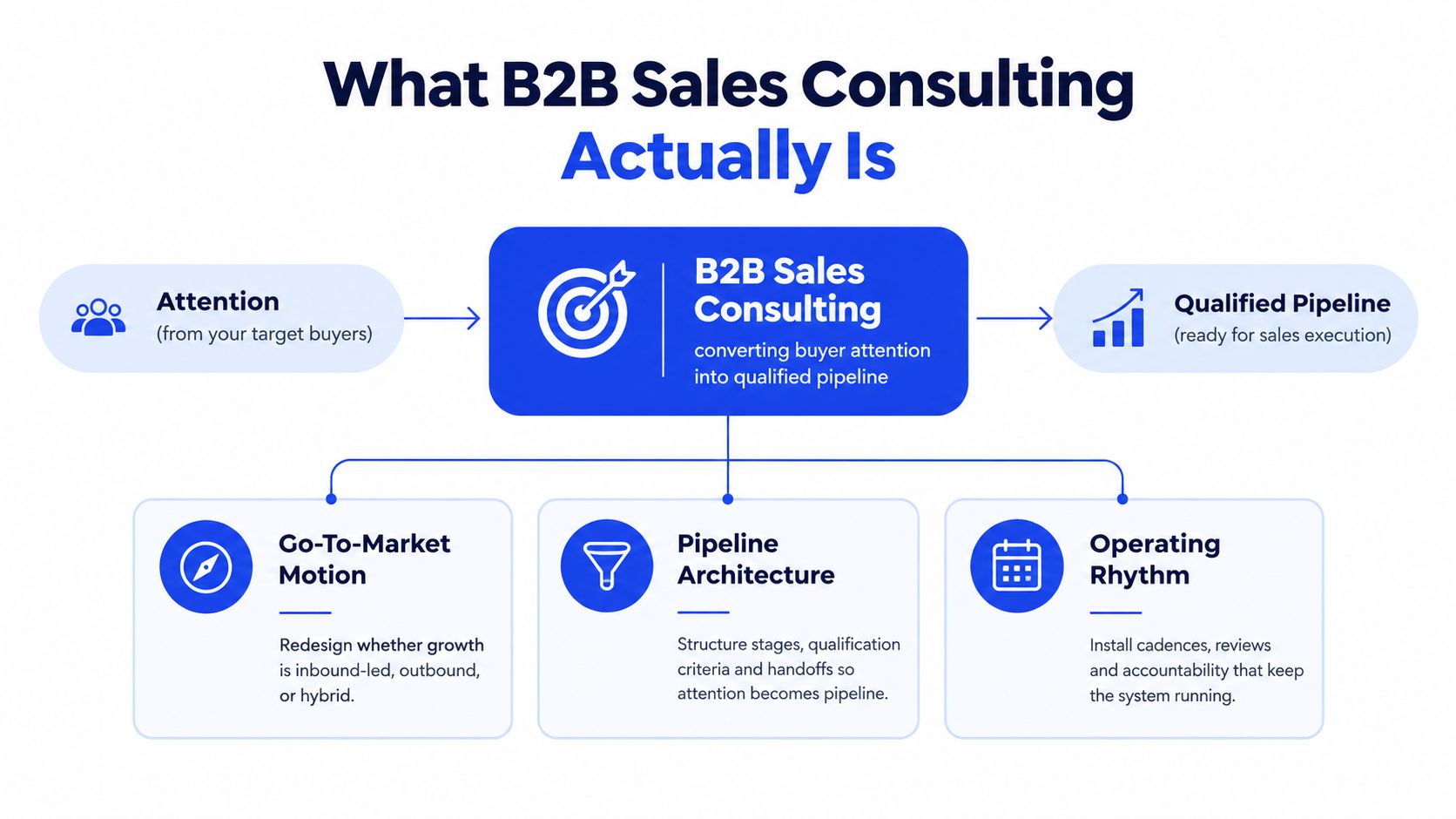
B2B sales consulting is a system for converting buyer attention into qualified pipeline. It sets the structural choices that determine which accounts receive attention, how buyers enter the process, what evidence advances a deal, and how managers inspect execution.
A useful engagement connects three operating decisions:
Go-to-market motion: Choose whether growth is inbound-led, outbound-led, product-led, partner-led, account-based, or hybrid.
Pipeline architecture: Define stage entry and exit criteria, required artifacts, handoffs, and disqualification rules.
Operating rhythm: Install daily coordination, bi-weekly sprint reviews, weekly forecast inspection, and quarterly pipeline reviews.
Motion choice comes before message choice
A competitor's sequence rarely fits your buying path. The same job title can represent a different commercial situation across industries, and marketing-to-sales handoff may require a different trigger.
Consider four operating patterns:
SaaS: A self-serve product may use a 14-day PQL handoff, sending sales to accounts that cross a product usage threshold. Outbound should support hand-raisers rather than compete with product evidence.
iGaming: A regional operator may run high-velocity outbound with 11-day cycles, where territory, compliance context, and rapid follow-up matter more than a long nurture sequence.
Manufacturing: A complex sale often involves a four-stakeholder buying group. The system needs technical qualification, procurement mapping, and an account plan before the opportunity enters a forecast category.
Professional services: A referral-first motion may convert through trusted introductions and nurture. Outbound can support account development, but proof, partner relationships, and expertise-led content remain part of the buying path.
Each motion changes the required data, message, seller role, and manager review. PLG needs product signals. ABM needs account research and stakeholder coverage. Partner-led selling needs referral attribution and channel rules. Hybrid selling requires explicit decisions about when field sales, inside sales, or self-service owns the next step.
Stage architecture makes attention accountable
A stage should represent buyer evidence, not seller optimism. A qualified opportunity might require a documented business problem, a confirmed decision process, a commercial range, and a scheduled next meeting. The exact fields depend on the motion, but the evidence standard must remain visible.
Consultants should define the artifacts that support each stage. Discovery may require call notes and a qualification score. Solution evaluation may require a technical validation plan. Proposal may require an agreed business case and named approver. Without these artifacts, CRM stages become labels applied after conversations instead of controls that guide them.
The consultant should improve the system that produces pipeline, including the wording used to request a meeting.
The practical output is a repeatable operating model. It tells marketing which accounts deserve attention, tells sales what counts as progress, and tells leadership which numbers require intervention. The value sits in structural decisions: motion choice, stage evidence, and inspection rhythm.
Core services, deliverables, and the operating system behind them
A sales consulting engagement should leave behind working artifacts that managers can inspect. If the deliverables can't change a list, a conversation, a CRM record, or a forecast meeting, they're documentation rather than operating infrastructure.
The dependency chain usually starts with account selection. An ICP document without a scored account list doesn't guide execution. A list without clean data produces bad routing. A sequence without a message architecture gives reps activity but no clear reason for the buyer to respond.
The service blocks that matter
ICP and account scoring should produce a tiered account list with named tiers, buying triggers, exclusions, and persona coverage. The claimed sector benchmark of a 40% higher reply rate on tier-one accounts appears in the supplied industry brief, but it isn't supported by a separately verified source here, so treat it as a hypothesis to test, not a promised result.
List building and data hygiene should produce an enriched, validated account file with role, company, geography, technology, and trigger fields. A claimed 10,000-record list and under-4% bounce rate can be useful project targets, but neither should be presented as a guaranteed benchmark without your own baseline and validation process.
Messaging architecture turns positioning into channel-specific reasons to engage. Build a message matrix by segment, pain pattern, trigger, proof point, and call to action. Then translate it into a seven-touch multi-channel cadence in Outreach or Salesloft, with LinkedIn steps handled through Sales Navigator or HeyReach where appropriate.
The claimed 8% to 12% positive reply benchmark belongs in a test plan, not a contract promise. Your baseline should separate positive replies, neutral replies, objections, and out-of-office responses.
Deliverables mapped to operating outcomes
Deliverable | Artifact produced | Primary tool | Measurable outcome |
|---|---|---|---|
ICP and account scoring | Tiered account list with named tiers | HubSpot, Salesforce, Clay | Reply quality and account-fit baseline |
List building and data hygiene | Enriched, validated prospect file | Clay, Apollo | Bounce and coverage baseline |
Messaging architecture | Segment and persona message matrix | Notion, Google Docs | Positive reply and objection trends |
Sequence design | Seven-touch multi-channel cadence | Outreach, Salesloft, Lemlist | Meetings created per qualified account |
Qualification framework | BANT or MEDDIC rubric in CRM | HubSpot, Salesforce | SQL-to-opportunity conversion |
Reporting cadence | Weekly pipeline dashboard | HubSpot, Salesforce | Forecast variance and stage aging |
Enablement | Call reviews, battlecards, objection library | Gong, Notion | Rep adoption and discovery quality |
Qualification rules connect the top of funnel to revenue. Embed BANT or MEDDIC fields inside the CRM, then make stage progression conditional on evidence. A claimed 25% increase in SQL-to-opportunity conversion should be treated as a target for measurement, not a fact about every engagement.
Reporting closes the loop. A weekly dashboard should show coverage, stage conversion, age, source, next-step completion, and response time. The sector claim that forecast variance can sit inside 10% is also a target that requires a defined baseline, clean CRM hygiene, and consistent inspection.
Enablement keeps the system alive after the consultant leaves. Reps need call reviews tied to the rubric, battlecards tied to real objections, and examples that match the industries they sell into. Teams that need the training and content layer can review sales enablement services, but the artifact should still connect to a field behavior and a measurable stage outcome.
Pricing models and engagement structures compared
Retainers win for revenue teams under 25 reps that need an embedded operating partner. Fixed-scope projects win when the diagnosis is complete and the brief is narrow. Success fees only make sense when attribution is logged and both parties accept clear kill clauses.
Pricing should follow the work's uncertainty. If the consultant must inspect data, test motion, revise messaging, and coach the team, the scope will change as evidence arrives. A fixed fee can then create pressure to stop at the deliverable rather than solve the operating issue.
The commercial trade-offs
A retainer usually fits an ongoing RevOps partnership. The consultant can work inside bi-weekly sprints, respond to pipeline evidence, and adjust the system as sellers report objections. The supplied market ranges place retainers at $9,000 to $30,000 per month, but the quote should specify senior access, response expectations, tools, reporting, and the people doing the work.
A fixed-scope project works for a completed diagnostic with a narrow output, such as an ICP refresh, messaging rebuild, or sequence design. The cited range of $15,000 to $60,000 is a sanity-check band, not a universal price. Define acceptance criteria and list what happens when data quality or stakeholder access blocks delivery.
A hybrid structure combines a project fee for the build with a smaller retainer for implementation and inspection. This often gives the buyer clearer boundaries while keeping enough time for adoption, because a sequence in Outreach doesn't matter if managers don't review meetings or reps don't follow qualification rules.
A success fee shifts more commercial risk to the consultant, but attribution becomes the central dispute. The supplied band of 5% to 15% of influenced ACV can be used as a reference point only when the CRM records source, touchpoints, opportunity creation, and acceptance rules. Add a kill clause if the buyer can't access data, delays approvals, or changes the ICP after launch.
Model | Typical band | Best fit | Risk allocation |
|---|---|---|---|
Retainer | $9k to $30k/month | Teams under 25 reps needing embedded support | Shared over time |
Fixed-scope project | $15k to $60k | Narrow, diagnosed work | Buyer carries adoption risk |
Hybrid | Defined build plus ongoing fee | Build and implementation | Shared by phase |
Success fee | 5% to 15% of influenced ACV | Logged, auditable attribution | Consultant carries more delivery risk |
Before signing, use outbound agency pricing models as a comparison point, then negotiate four protections:
Thirty-day out clause: Leave if delivery or working access fails.
IP ownership: Own sequences, messaging, dashboards, and playbooks created for your business.
Reporting cadence: Name the weekly metrics, data source, and meeting owner.
Named point of contact: Prevent consultant swapping without approval.
How to choose and evaluate a B2B sales consultant
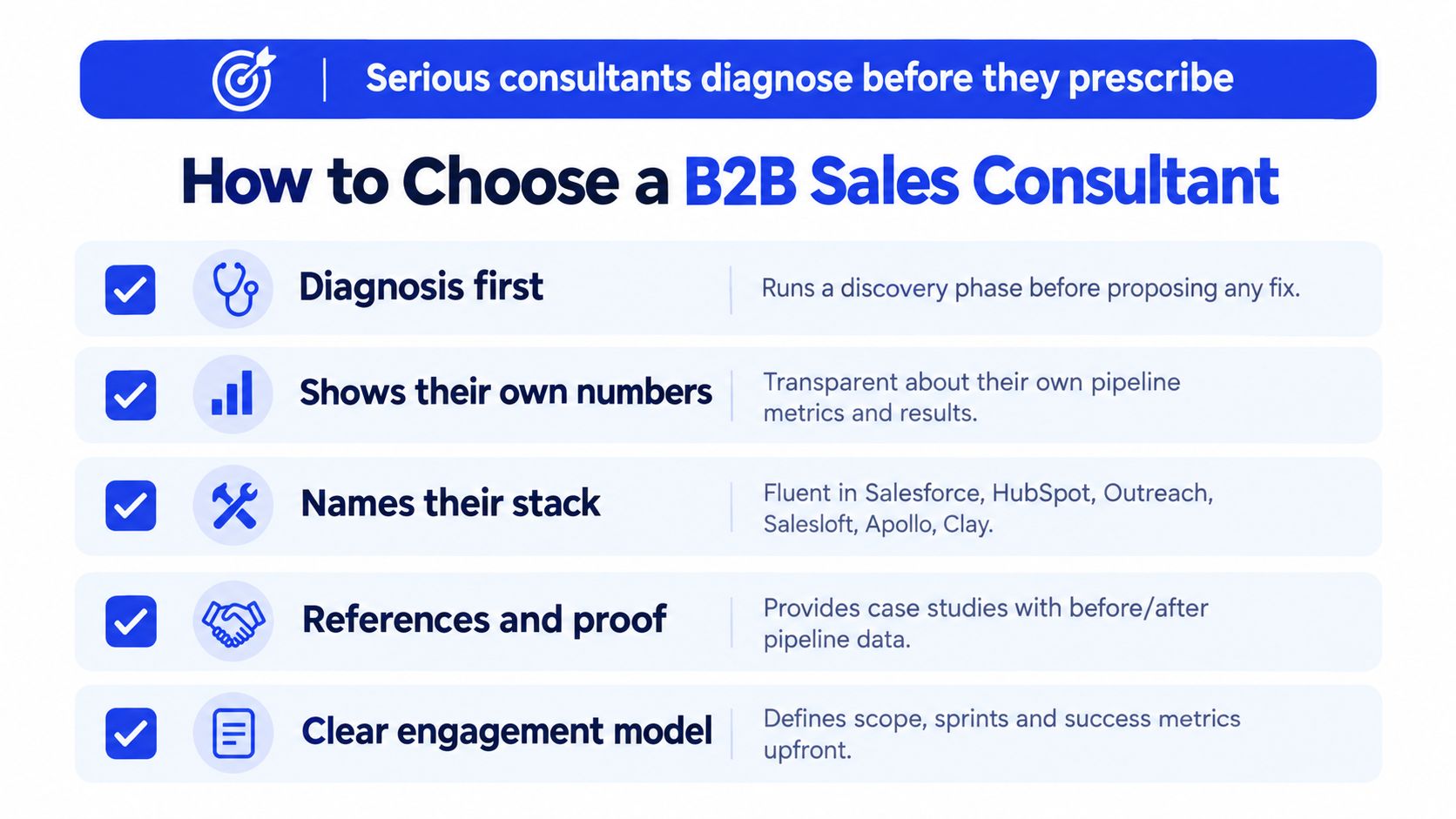
Serious consultants diagnose before they prescribe, show their own pipeline metrics, and name the tools they work in. Expect fluency across Salesforce, HubSpot, Outreach, Salesloft, Apollo, Clay, Gong, and Chili Piper, but don't confuse tool familiarity with operating judgment.
A consultant who leads with a 90-day promise before inspecting stage data is selling certainty. A serious operator asks how your motion works, where qualification breaks, how response routing behaves, and which CRM fields managers actually trust.
Use a five-step vetting process
Ask for two relevant references. Match the references to your company stage and motion, not just your industry.
Request a diagnostic. Ask for a paid or free review scored against a known framework, with evidence, assumptions, and unanswered questions.
Interview at least three candidates. Give each the same data pack and compare what they notice first.
Verify delivery ownership. The senior person selling the engagement should be the person doing the core work, or the contract should name the delivery lead.
Insist on a 30-day exit clause. You need a way out if access, communication, or scope fails.
Use the conversation to test how the consultant thinks under pressure. Ask these questions directly:
How do you define MQL and SQL in our motion?
Which evidence moves an opportunity from discovery to qualification?
How do you handle speed-to-lead for form fills and high-intent replies?
What do you measure by day 30?
Which metric should move first, and why?
How do you separate activity from qualified pipeline?
Which CRM fields must be mandatory?
How do you inspect stage aging?
What happens when a rep rejects the qualification rubric?
How do you report weekly progress?
Who writes the sequences and reviews the calls?
What would make you recommend no engagement?
Watch for proof gaps
Red flags are operational, not cosmetic:
No diagnostic: The consultant proposes channels before seeing pipeline and conversion data.
Vague case studies: The story has adjectives but no baseline, intervention, or measured result.
No sample report: They won't show how a weekly review looks.
Early long contract: They push a 12-month agreement before completing an audit.
Content-only positioning: They discuss thought leadership but can't explain routing, qualification, CRM ownership, or forecast inspection.
If you're weighing an internal hire against an outside partner, this guide to selling with or without an agency is useful for framing ownership and execution capacity. The decision should still come down to the work your team can perform consistently.
A lead generation agency should be judged by the same standard. Ask how it handles list quality, reply routing, qualification, meeting attendance, and CRM attribution. If the answers stay at the campaign level, the operating gap remains.
What differs by industry and why motion matters more than playbook
A generic sales playbook fails when it ignores the buying system. The right question isn't which sequence to copy. It's which motion gives your team the shortest credible path from signal to qualified conversation.
SaaS and high-velocity online services
For SaaS at $30,000 to $500,000 ACV, inbound-led PLG with light outbound to hand-raisers often fits better than broad cold outreach. Product activity gives the seller context, while a framework such as MEDDIC becomes more useful as the account moves toward a complex commercial decision.
The structural choice to borrow is signal ownership. Define which product event, form action, or content interaction creates a sales task, then assign a response owner. Don't ask an SDR to create context that the product already captured.
iGaming and similar online services need a faster regional outbound motion. The representative cycle can run 7 to 21 days, so BANT may be more practical at the first qualification point, with compliance, territory, commercial timing, and authority captured early. SMS or WhatsApp can support the sequence where consent and local rules allow it.
The structural choice is speed with guardrails. A fast response without accurate routing creates noise. A compliant message that arrives too late loses the moment.
Manufacturing and industrial sales
Manufacturing deals with $250,000 to $5 million average deal sizes may involve technical, commercial, procurement, and executive stakeholders across a 6 to 12 month cycle. MEDDIC or SPIN can support discovery, but no framework replaces a stakeholder map and technical validation plan.
The structural choice is multi-threading before forecast confidence. Require evidence from the people who will evaluate implementation, approve budget, and manage risk. A single enthusiastic contact isn't buying-group coverage.
Professional services and legal tech
Professional services often depend on referrals, reputation, and expertise-led demand. Legal tech may combine partner relationships, content-led discovery, targeted outbound, and events. BANT can qualify urgency and authority, while SPIN can help sellers uncover the cost of an existing process without forcing a product pitch too early.
The structural choice is proof placement. Put the right credibility asset before the right conversation, whether that is a technical brief, client-facing methodology, webinar, or referral introduction.
Pharma and medtech
Pharma and medtech motions are shaped by compliance, clinical evidence, procurement, and institutional trust. Event-driven engagement can open doors, while MEDDIC or SPIN helps distinguish interest from a viable buying process. Messaging must pass the appropriate review before a seller scales it.
The structural choice is approval-aware routing. Define which claims can be used, who approves them, and which stakeholder receives each asset.
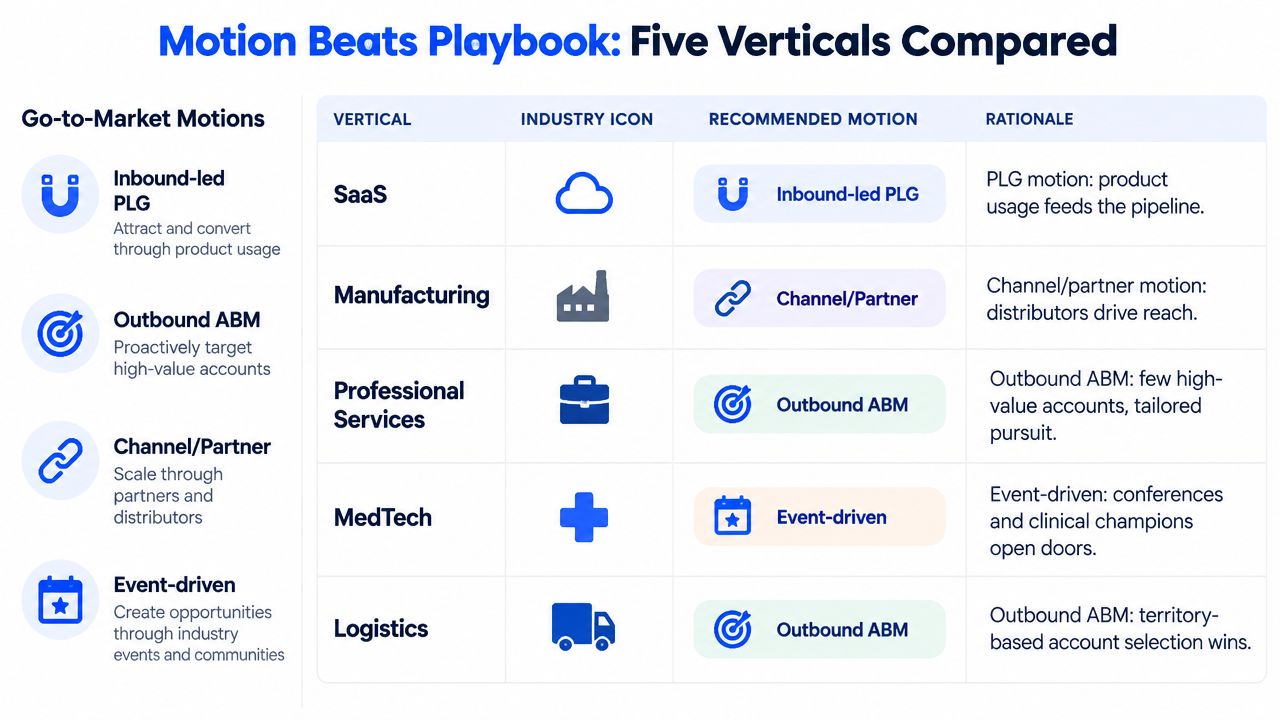
A useful consultant won't force every company into outbound ABM or PLG. The motion should follow buyer access, sales capacity, product evidence, partner reach, and compliance requirements. The playbook comes after that decision.
A 30, 60, and 90 day system to run your first engagement
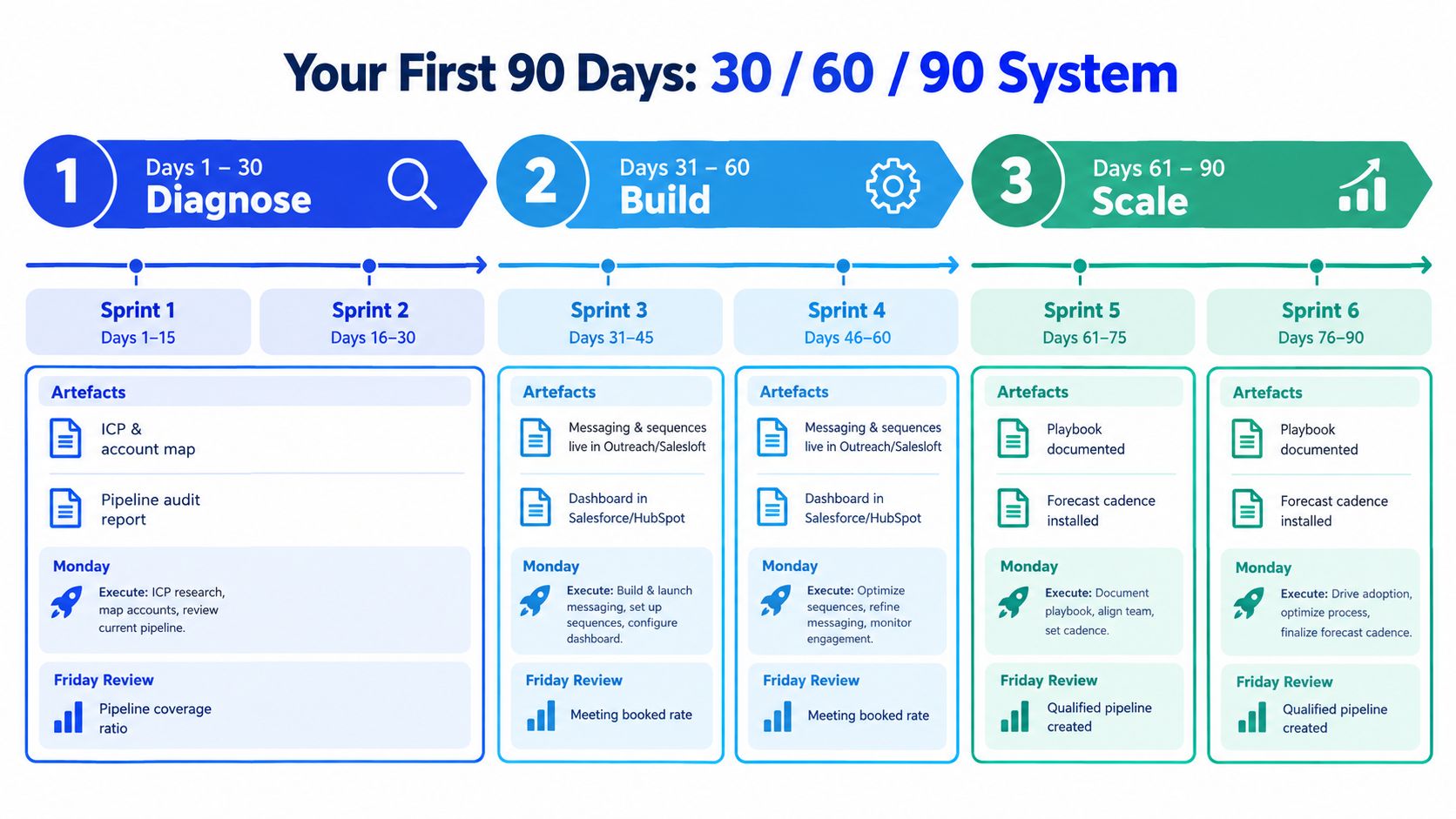
Run the engagement as six bi-weekly sprints, grouped into three phases. Every sprint needs a Monday action, a Friday business review, a named owner, and one metric that matters. The team shouldn't wait 90 days to discover that the CRM fields were unusable or the list didn't match the ICP.
Days 1 to 30 diagnose the system
Sprint one, days 1 to 14: The RevOps lead exports pipeline, stage history, source, activity, close dates, and owner data from HubSpot or Salesforce. Marketing and sales leaders agree on the current ICP, while the consultant interviews the people who create, qualify, and forecast opportunities.
Produce an ICP rewrite, account map, data dictionary, and pipeline audit report. The Monday action is to select the last closed-won, closed-lost, and stalled opportunities for review. Friday's business review measures pipeline coverage ratio, with invalid opportunities removed from the numerator.
Sprint two, days 15 to 30: The data owner runs a list hygiene pass in Clay or Apollo. The sales manager audits sequences in Lemlist, Instantly, Smartlead, or Outreach. RevOps cleans stage definitions, removes duplicate fields, and creates a baseline dashboard.
The artifacts are a validated account list, sequence audit, CRM stage map, and baseline dashboard. The Monday action is to inspect five records per seller. Friday's metric is still coverage, but the team should also document why the ratio changed.
Days 31 to 60 build the motion
Sprint three, days 31 to 44: Leadership selects the motion by segment. The consultant builds a messaging matrix covering persona, trigger, problem, proof, objection, and next step. The team creates three outbound cadences, separating email, LinkedIn, calling, and approved messaging channels.
The output is a motion decision record, messaging matrix, and sequences live in Outreach or Salesloft. The Monday action is to approve one target segment and one exclusion rule. Friday reviews the meeting-booked rate per outreach, which independent outbound benchmarks place at 0.5% to 1.2% on average and 3% or more for a strong program (outbound benchmark source).
Sprint four, days 45 to 60: The sales manager and RevOps lead install qualification rules with exit criteria. The SDR and AE owners document the handoff, including required notes, next meeting, account context, and disqualification reasons.
The artifacts are a CRM rubric, handoff document, and manager inspection checklist. The Monday action is to score a live sample together. Friday reviews whether booked meetings become accepted opportunities, not just whether calendars fill.
Days 61 to 90 scale the cadence
Sprint five, days 61 to 74: The team installs a weekly forecast meeting and sets a monthly pipeline coverage target of 3x, consistent with the benchmark range cited earlier. Managers review stage age, next-step completion, stakeholder coverage, and conversion by source.
Write the sales system in Notion, including stage definitions, call examples, objection responses, and escalation rules. The Monday action is to assign every section an owner. Friday reviews qualified pipeline created, separated from raw meetings.
Sprint six, days 75 to 90: Leadership writes success criteria into the SOW and finalizes the operating calendar. The consultant trains managers on call reviews, dashboard inspection, and sprint planning. RevOps documents the reporting logic so the system doesn't depend on a hidden spreadsheet.
The final artifacts are a documented system, forecast cadence, dashboard ownership map, and renewal or handoff plan. The Monday action is to schedule the next two sprint reviews. Friday confirms which metric moved, which assumption failed, and what the team will change next.
Speed matters during the build. Independent 2026 benchmarks report average cold email reply rates of 1.9% to 3.4%, with 7% or more considered strong, while LinkedIn response benchmarks cluster around 10%, compared with roughly 3.4% to 5% for cold email in the supplied benchmark roundup (LinkedIn prospecting benchmarks). Treat those figures as directional benchmarks, not promises. Your system should show which segment, message, channel, and follow-up step produced each response.
Use this first 90 days outbound agency framework as a practical reference when assigning owners and sprint artifacts. Start Monday by exporting the pipeline, selecting the target segment, and scheduling the first Friday review. Don't launch another sequence until the team can state the stage evidence required for the meeting it creates.
Your next step is to audit the last 10 opportunities in your CRM, record the stage, age, next action, decision criteria, and stakeholder coverage, then compare the result with your stated coverage target. Grou builds LinkedIn, lead generation, outbound, CRM, and sales enablement systems around bi-weekly sprints, so visit Grou if you need an operating partner to turn that diagnosis into qualified conversations.
GROU is a global B2B pipeline agency trusted by more than 50 companies across iGaming, SaaS, manufacturing, and professional services. Its methodology connects ICP-aligned data, LinkedIn content, outbound execution, CRM rules, rapid reply routing, and transparent reporting inside bi-weekly sprint cycles.
Your Monday pipeline review shows 2.1x coverage against a 3x target, 47% of deals sitting in mid-funnel for more than 30 days, an 18% win rate, and speed-to-lead averaging 6.4 hours. Discovery calls aren't surfacing decision criteria, and the team is responding after the buyer's attention has already moved.
The fix isn't another sequence template:
Motion design determines whether attention becomes enough qualified pipeline.
Stage discipline exposes why deals stall and who owns the next action.
Speed-to-reply protects conversion when intent is highest.
A 30/60/90 system turns the diagnosis into bi-weekly execution sprints.
That is the operating problem B2B sales consulting should solve. The consultant's job isn't to hand over more tactics. It's to redesign the choices connecting target accounts, buyer signals, sales stages, and revenue.
Table of Contents
Core services, deliverables, and the operating system behind them
What differs by industry and why motion matters more than playbook
The pipeline problem you are staring at this week
At 9:00 Monday, the founder asks why the forecast still looks thin. Marketing points to campaign engagement. Sales points to weak lead quality. RevOps opens Salesforce and sees opportunities with no recent activity, no documented decision criteria, and close dates that moved again.
The board says coverage is 2.1x, while the accepted target is roughly 3x to 4x quota or remaining quota. Coverage below 3x generally signals insufficient pipeline for the period, according to RevOps pipeline benchmarks. The number doesn't tell you which lever to pull, but it tells you that waiting for more volume is a bad operating decision.
The next question is where the pipeline is failing. A deal stuck in stage three for 30 days isn't automatically dead. It is a problem when the opportunity has no verified business case, no mutual action plan, and no named buying committee member beyond the original contact.
Discovery creates the same issue upstream. Reps ask about pain, collect a broad answer, and move the deal forward without confirming decision criteria. Later, the proposal meets objections nobody documented. The reported 18% win rate is then treated as a closing problem, even though the qualification failure happened earlier.
Speed creates a separate leak. A buyer submits a high-intent form, visits a pricing page, or replies to a LinkedIn message. Six hours later, the first response arrives. Teams reviewing how to improve sales response times should treat response ownership as a revenue process, not a personal productivity issue.
What to inspect before adding volume
Start with four checks:
Coverage: Compare qualified pipeline with remaining quota, then remove opportunities that fail stage entry criteria.
Stalled stages: Filter opportunities with no next step, no activity, or unchanged stage age.
Discovery quality: Sample call recordings in Gong and check for decision process, economic impact, and buying group evidence.
Response routing: Trace an inbound signal from form submission or reply to the person who owns the first human response.
The boardroom conversation changes when every problem has an owner and a timestamp. A founder can decide whether to add outbound capacity. A sales leader can retrain discovery. RevOps can fix automation and reporting. Nobody should solve all three by increasing sends.
The structural diagnosis
Pipeline coverage is often a motion problem disguised as a lead problem. A SaaS team with strong product usage may need a PQL handoff, while a manufacturing company may need account mapping before any email sequence goes live. Copying the same outbound motion across both teams creates activity without a reliable path to qualification.
Use the sales pipeline management framework to map each stage to evidence, ownership, and a next action. Then run the work in two-week cycles, reviewing the metric that should move before you expand the system.
Practical rule: Don't ask the team to create more pipeline until you can explain where qualified opportunities are being lost.
What B2B sales consulting is
B2B sales consulting is a system for converting buyer attention into qualified pipeline. It sets the structural choices that determine which accounts receive attention, how buyers enter the process, what evidence advances a deal, and how managers inspect execution.
A useful engagement connects three operating decisions:
Go-to-market motion: Choose whether growth is inbound-led, outbound-led, product-led, partner-led, account-based, or hybrid.
Pipeline architecture: Define stage entry and exit criteria, required artifacts, handoffs, and disqualification rules.
Operating rhythm: Install daily coordination, bi-weekly sprint reviews, weekly forecast inspection, and quarterly pipeline reviews.
Motion choice comes before message choice
A competitor's sequence rarely fits your buying path. The same job title can represent a different commercial situation across industries, and marketing-to-sales handoff may require a different trigger.
Consider four operating patterns:
SaaS: A self-serve product may use a 14-day PQL handoff, sending sales to accounts that cross a product usage threshold. Outbound should support hand-raisers rather than compete with product evidence.
iGaming: A regional operator may run high-velocity outbound with 11-day cycles, where territory, compliance context, and rapid follow-up matter more than a long nurture sequence.
Manufacturing: A complex sale often involves a four-stakeholder buying group. The system needs technical qualification, procurement mapping, and an account plan before the opportunity enters a forecast category.
Professional services: A referral-first motion may convert through trusted introductions and nurture. Outbound can support account development, but proof, partner relationships, and expertise-led content remain part of the buying path.
Each motion changes the required data, message, seller role, and manager review. PLG needs product signals. ABM needs account research and stakeholder coverage. Partner-led selling needs referral attribution and channel rules. Hybrid selling requires explicit decisions about when field sales, inside sales, or self-service owns the next step.
Stage architecture makes attention accountable
A stage should represent buyer evidence, not seller optimism. A qualified opportunity might require a documented business problem, a confirmed decision process, a commercial range, and a scheduled next meeting. The exact fields depend on the motion, but the evidence standard must remain visible.
Consultants should define the artifacts that support each stage. Discovery may require call notes and a qualification score. Solution evaluation may require a technical validation plan. Proposal may require an agreed business case and named approver. Without these artifacts, CRM stages become labels applied after conversations instead of controls that guide them.
The consultant should improve the system that produces pipeline, including the wording used to request a meeting.
The practical output is a repeatable operating model. It tells marketing which accounts deserve attention, tells sales what counts as progress, and tells leadership which numbers require intervention. The value sits in structural decisions: motion choice, stage evidence, and inspection rhythm.
Core services, deliverables, and the operating system behind them
A sales consulting engagement should leave behind working artifacts that managers can inspect. If the deliverables can't change a list, a conversation, a CRM record, or a forecast meeting, they're documentation rather than operating infrastructure.
The dependency chain usually starts with account selection. An ICP document without a scored account list doesn't guide execution. A list without clean data produces bad routing. A sequence without a message architecture gives reps activity but no clear reason for the buyer to respond.
The service blocks that matter
ICP and account scoring should produce a tiered account list with named tiers, buying triggers, exclusions, and persona coverage. The claimed sector benchmark of a 40% higher reply rate on tier-one accounts appears in the supplied industry brief, but it isn't supported by a separately verified source here, so treat it as a hypothesis to test, not a promised result.
List building and data hygiene should produce an enriched, validated account file with role, company, geography, technology, and trigger fields. A claimed 10,000-record list and under-4% bounce rate can be useful project targets, but neither should be presented as a guaranteed benchmark without your own baseline and validation process.
Messaging architecture turns positioning into channel-specific reasons to engage. Build a message matrix by segment, pain pattern, trigger, proof point, and call to action. Then translate it into a seven-touch multi-channel cadence in Outreach or Salesloft, with LinkedIn steps handled through Sales Navigator or HeyReach where appropriate.
The claimed 8% to 12% positive reply benchmark belongs in a test plan, not a contract promise. Your baseline should separate positive replies, neutral replies, objections, and out-of-office responses.
Deliverables mapped to operating outcomes
Deliverable | Artifact produced | Primary tool | Measurable outcome |
|---|---|---|---|
ICP and account scoring | Tiered account list with named tiers | HubSpot, Salesforce, Clay | Reply quality and account-fit baseline |
List building and data hygiene | Enriched, validated prospect file | Clay, Apollo | Bounce and coverage baseline |
Messaging architecture | Segment and persona message matrix | Notion, Google Docs | Positive reply and objection trends |
Sequence design | Seven-touch multi-channel cadence | Outreach, Salesloft, Lemlist | Meetings created per qualified account |
Qualification framework | BANT or MEDDIC rubric in CRM | HubSpot, Salesforce | SQL-to-opportunity conversion |
Reporting cadence | Weekly pipeline dashboard | HubSpot, Salesforce | Forecast variance and stage aging |
Enablement | Call reviews, battlecards, objection library | Gong, Notion | Rep adoption and discovery quality |
Qualification rules connect the top of funnel to revenue. Embed BANT or MEDDIC fields inside the CRM, then make stage progression conditional on evidence. A claimed 25% increase in SQL-to-opportunity conversion should be treated as a target for measurement, not a fact about every engagement.
Reporting closes the loop. A weekly dashboard should show coverage, stage conversion, age, source, next-step completion, and response time. The sector claim that forecast variance can sit inside 10% is also a target that requires a defined baseline, clean CRM hygiene, and consistent inspection.
Enablement keeps the system alive after the consultant leaves. Reps need call reviews tied to the rubric, battlecards tied to real objections, and examples that match the industries they sell into. Teams that need the training and content layer can review sales enablement services, but the artifact should still connect to a field behavior and a measurable stage outcome.
Pricing models and engagement structures compared
Retainers win for revenue teams under 25 reps that need an embedded operating partner. Fixed-scope projects win when the diagnosis is complete and the brief is narrow. Success fees only make sense when attribution is logged and both parties accept clear kill clauses.
Pricing should follow the work's uncertainty. If the consultant must inspect data, test motion, revise messaging, and coach the team, the scope will change as evidence arrives. A fixed fee can then create pressure to stop at the deliverable rather than solve the operating issue.
The commercial trade-offs
A retainer usually fits an ongoing RevOps partnership. The consultant can work inside bi-weekly sprints, respond to pipeline evidence, and adjust the system as sellers report objections. The supplied market ranges place retainers at $9,000 to $30,000 per month, but the quote should specify senior access, response expectations, tools, reporting, and the people doing the work.
A fixed-scope project works for a completed diagnostic with a narrow output, such as an ICP refresh, messaging rebuild, or sequence design. The cited range of $15,000 to $60,000 is a sanity-check band, not a universal price. Define acceptance criteria and list what happens when data quality or stakeholder access blocks delivery.
A hybrid structure combines a project fee for the build with a smaller retainer for implementation and inspection. This often gives the buyer clearer boundaries while keeping enough time for adoption, because a sequence in Outreach doesn't matter if managers don't review meetings or reps don't follow qualification rules.
A success fee shifts more commercial risk to the consultant, but attribution becomes the central dispute. The supplied band of 5% to 15% of influenced ACV can be used as a reference point only when the CRM records source, touchpoints, opportunity creation, and acceptance rules. Add a kill clause if the buyer can't access data, delays approvals, or changes the ICP after launch.
Model | Typical band | Best fit | Risk allocation |
|---|---|---|---|
Retainer | $9k to $30k/month | Teams under 25 reps needing embedded support | Shared over time |
Fixed-scope project | $15k to $60k | Narrow, diagnosed work | Buyer carries adoption risk |
Hybrid | Defined build plus ongoing fee | Build and implementation | Shared by phase |
Success fee | 5% to 15% of influenced ACV | Logged, auditable attribution | Consultant carries more delivery risk |
Before signing, use outbound agency pricing models as a comparison point, then negotiate four protections:
Thirty-day out clause: Leave if delivery or working access fails.
IP ownership: Own sequences, messaging, dashboards, and playbooks created for your business.
Reporting cadence: Name the weekly metrics, data source, and meeting owner.
Named point of contact: Prevent consultant swapping without approval.
How to choose and evaluate a B2B sales consultant
Serious consultants diagnose before they prescribe, show their own pipeline metrics, and name the tools they work in. Expect fluency across Salesforce, HubSpot, Outreach, Salesloft, Apollo, Clay, Gong, and Chili Piper, but don't confuse tool familiarity with operating judgment.
A consultant who leads with a 90-day promise before inspecting stage data is selling certainty. A serious operator asks how your motion works, where qualification breaks, how response routing behaves, and which CRM fields managers actually trust.
Use a five-step vetting process
Ask for two relevant references. Match the references to your company stage and motion, not just your industry.
Request a diagnostic. Ask for a paid or free review scored against a known framework, with evidence, assumptions, and unanswered questions.
Interview at least three candidates. Give each the same data pack and compare what they notice first.
Verify delivery ownership. The senior person selling the engagement should be the person doing the core work, or the contract should name the delivery lead.
Insist on a 30-day exit clause. You need a way out if access, communication, or scope fails.
Use the conversation to test how the consultant thinks under pressure. Ask these questions directly:
How do you define MQL and SQL in our motion?
Which evidence moves an opportunity from discovery to qualification?
How do you handle speed-to-lead for form fills and high-intent replies?
What do you measure by day 30?
Which metric should move first, and why?
How do you separate activity from qualified pipeline?
Which CRM fields must be mandatory?
How do you inspect stage aging?
What happens when a rep rejects the qualification rubric?
How do you report weekly progress?
Who writes the sequences and reviews the calls?
What would make you recommend no engagement?
Watch for proof gaps
Red flags are operational, not cosmetic:
No diagnostic: The consultant proposes channels before seeing pipeline and conversion data.
Vague case studies: The story has adjectives but no baseline, intervention, or measured result.
No sample report: They won't show how a weekly review looks.
Early long contract: They push a 12-month agreement before completing an audit.
Content-only positioning: They discuss thought leadership but can't explain routing, qualification, CRM ownership, or forecast inspection.
If you're weighing an internal hire against an outside partner, this guide to selling with or without an agency is useful for framing ownership and execution capacity. The decision should still come down to the work your team can perform consistently.
A lead generation agency should be judged by the same standard. Ask how it handles list quality, reply routing, qualification, meeting attendance, and CRM attribution. If the answers stay at the campaign level, the operating gap remains.
What differs by industry and why motion matters more than playbook
A generic sales playbook fails when it ignores the buying system. The right question isn't which sequence to copy. It's which motion gives your team the shortest credible path from signal to qualified conversation.
SaaS and high-velocity online services
For SaaS at $30,000 to $500,000 ACV, inbound-led PLG with light outbound to hand-raisers often fits better than broad cold outreach. Product activity gives the seller context, while a framework such as MEDDIC becomes more useful as the account moves toward a complex commercial decision.
The structural choice to borrow is signal ownership. Define which product event, form action, or content interaction creates a sales task, then assign a response owner. Don't ask an SDR to create context that the product already captured.
iGaming and similar online services need a faster regional outbound motion. The representative cycle can run 7 to 21 days, so BANT may be more practical at the first qualification point, with compliance, territory, commercial timing, and authority captured early. SMS or WhatsApp can support the sequence where consent and local rules allow it.
The structural choice is speed with guardrails. A fast response without accurate routing creates noise. A compliant message that arrives too late loses the moment.
Manufacturing and industrial sales
Manufacturing deals with $250,000 to $5 million average deal sizes may involve technical, commercial, procurement, and executive stakeholders across a 6 to 12 month cycle. MEDDIC or SPIN can support discovery, but no framework replaces a stakeholder map and technical validation plan.
The structural choice is multi-threading before forecast confidence. Require evidence from the people who will evaluate implementation, approve budget, and manage risk. A single enthusiastic contact isn't buying-group coverage.
Professional services and legal tech
Professional services often depend on referrals, reputation, and expertise-led demand. Legal tech may combine partner relationships, content-led discovery, targeted outbound, and events. BANT can qualify urgency and authority, while SPIN can help sellers uncover the cost of an existing process without forcing a product pitch too early.
The structural choice is proof placement. Put the right credibility asset before the right conversation, whether that is a technical brief, client-facing methodology, webinar, or referral introduction.
Pharma and medtech
Pharma and medtech motions are shaped by compliance, clinical evidence, procurement, and institutional trust. Event-driven engagement can open doors, while MEDDIC or SPIN helps distinguish interest from a viable buying process. Messaging must pass the appropriate review before a seller scales it.
The structural choice is approval-aware routing. Define which claims can be used, who approves them, and which stakeholder receives each asset.
A useful consultant won't force every company into outbound ABM or PLG. The motion should follow buyer access, sales capacity, product evidence, partner reach, and compliance requirements. The playbook comes after that decision.
A 30, 60, and 90 day system to run your first engagement
Run the engagement as six bi-weekly sprints, grouped into three phases. Every sprint needs a Monday action, a Friday business review, a named owner, and one metric that matters. The team shouldn't wait 90 days to discover that the CRM fields were unusable or the list didn't match the ICP.
Days 1 to 30 diagnose the system
Sprint one, days 1 to 14: The RevOps lead exports pipeline, stage history, source, activity, close dates, and owner data from HubSpot or Salesforce. Marketing and sales leaders agree on the current ICP, while the consultant interviews the people who create, qualify, and forecast opportunities.
Produce an ICP rewrite, account map, data dictionary, and pipeline audit report. The Monday action is to select the last closed-won, closed-lost, and stalled opportunities for review. Friday's business review measures pipeline coverage ratio, with invalid opportunities removed from the numerator.
Sprint two, days 15 to 30: The data owner runs a list hygiene pass in Clay or Apollo. The sales manager audits sequences in Lemlist, Instantly, Smartlead, or Outreach. RevOps cleans stage definitions, removes duplicate fields, and creates a baseline dashboard.
The artifacts are a validated account list, sequence audit, CRM stage map, and baseline dashboard. The Monday action is to inspect five records per seller. Friday's metric is still coverage, but the team should also document why the ratio changed.
Days 31 to 60 build the motion
Sprint three, days 31 to 44: Leadership selects the motion by segment. The consultant builds a messaging matrix covering persona, trigger, problem, proof, objection, and next step. The team creates three outbound cadences, separating email, LinkedIn, calling, and approved messaging channels.
The output is a motion decision record, messaging matrix, and sequences live in Outreach or Salesloft. The Monday action is to approve one target segment and one exclusion rule. Friday reviews the meeting-booked rate per outreach, which independent outbound benchmarks place at 0.5% to 1.2% on average and 3% or more for a strong program (outbound benchmark source).
Sprint four, days 45 to 60: The sales manager and RevOps lead install qualification rules with exit criteria. The SDR and AE owners document the handoff, including required notes, next meeting, account context, and disqualification reasons.
The artifacts are a CRM rubric, handoff document, and manager inspection checklist. The Monday action is to score a live sample together. Friday reviews whether booked meetings become accepted opportunities, not just whether calendars fill.
Days 61 to 90 scale the cadence
Sprint five, days 61 to 74: The team installs a weekly forecast meeting and sets a monthly pipeline coverage target of 3x, consistent with the benchmark range cited earlier. Managers review stage age, next-step completion, stakeholder coverage, and conversion by source.
Write the sales system in Notion, including stage definitions, call examples, objection responses, and escalation rules. The Monday action is to assign every section an owner. Friday reviews qualified pipeline created, separated from raw meetings.
Sprint six, days 75 to 90: Leadership writes success criteria into the SOW and finalizes the operating calendar. The consultant trains managers on call reviews, dashboard inspection, and sprint planning. RevOps documents the reporting logic so the system doesn't depend on a hidden spreadsheet.
The final artifacts are a documented system, forecast cadence, dashboard ownership map, and renewal or handoff plan. The Monday action is to schedule the next two sprint reviews. Friday confirms which metric moved, which assumption failed, and what the team will change next.
Speed matters during the build. Independent 2026 benchmarks report average cold email reply rates of 1.9% to 3.4%, with 7% or more considered strong, while LinkedIn response benchmarks cluster around 10%, compared with roughly 3.4% to 5% for cold email in the supplied benchmark roundup (LinkedIn prospecting benchmarks). Treat those figures as directional benchmarks, not promises. Your system should show which segment, message, channel, and follow-up step produced each response.
Use this first 90 days outbound agency framework as a practical reference when assigning owners and sprint artifacts. Start Monday by exporting the pipeline, selecting the target segment, and scheduling the first Friday review. Don't launch another sequence until the team can state the stage evidence required for the meeting it creates.
Your next step is to audit the last 10 opportunities in your CRM, record the stage, age, next action, decision criteria, and stakeholder coverage, then compare the result with your stated coverage target. Grou builds LinkedIn, lead generation, outbound, CRM, and sales enablement systems around bi-weekly sprints, so visit Grou if you need an operating partner to turn that diagnosis into qualified conversations.
GROU is a global B2B pipeline agency trusted by more than 50 companies across iGaming, SaaS, manufacturing, and professional services. Its methodology connects ICP-aligned data, LinkedIn content, outbound execution, CRM rules, rapid reply routing, and transparent reporting inside bi-weekly sprint cycles.
Your Monday pipeline review shows 2.1x coverage against a 3x target, 47% of deals sitting in mid-funnel for more than 30 days, an 18% win rate, and speed-to-lead averaging 6.4 hours. Discovery calls aren't surfacing decision criteria, and the team is responding after the buyer's attention has already moved.
The fix isn't another sequence template:
Motion design determines whether attention becomes enough qualified pipeline.
Stage discipline exposes why deals stall and who owns the next action.
Speed-to-reply protects conversion when intent is highest.
A 30/60/90 system turns the diagnosis into bi-weekly execution sprints.
That is the operating problem B2B sales consulting should solve. The consultant's job isn't to hand over more tactics. It's to redesign the choices connecting target accounts, buyer signals, sales stages, and revenue.
Table of Contents
Core services, deliverables, and the operating system behind them
What differs by industry and why motion matters more than playbook
The pipeline problem you are staring at this week
At 9:00 Monday, the founder asks why the forecast still looks thin. Marketing points to campaign engagement. Sales points to weak lead quality. RevOps opens Salesforce and sees opportunities with no recent activity, no documented decision criteria, and close dates that moved again.
The board says coverage is 2.1x, while the accepted target is roughly 3x to 4x quota or remaining quota. Coverage below 3x generally signals insufficient pipeline for the period, according to RevOps pipeline benchmarks. The number doesn't tell you which lever to pull, but it tells you that waiting for more volume is a bad operating decision.
The next question is where the pipeline is failing. A deal stuck in stage three for 30 days isn't automatically dead. It is a problem when the opportunity has no verified business case, no mutual action plan, and no named buying committee member beyond the original contact.
Discovery creates the same issue upstream. Reps ask about pain, collect a broad answer, and move the deal forward without confirming decision criteria. Later, the proposal meets objections nobody documented. The reported 18% win rate is then treated as a closing problem, even though the qualification failure happened earlier.
Speed creates a separate leak. A buyer submits a high-intent form, visits a pricing page, or replies to a LinkedIn message. Six hours later, the first response arrives. Teams reviewing how to improve sales response times should treat response ownership as a revenue process, not a personal productivity issue.
What to inspect before adding volume
Start with four checks:
Coverage: Compare qualified pipeline with remaining quota, then remove opportunities that fail stage entry criteria.
Stalled stages: Filter opportunities with no next step, no activity, or unchanged stage age.
Discovery quality: Sample call recordings in Gong and check for decision process, economic impact, and buying group evidence.
Response routing: Trace an inbound signal from form submission or reply to the person who owns the first human response.
The boardroom conversation changes when every problem has an owner and a timestamp. A founder can decide whether to add outbound capacity. A sales leader can retrain discovery. RevOps can fix automation and reporting. Nobody should solve all three by increasing sends.
The structural diagnosis
Pipeline coverage is often a motion problem disguised as a lead problem. A SaaS team with strong product usage may need a PQL handoff, while a manufacturing company may need account mapping before any email sequence goes live. Copying the same outbound motion across both teams creates activity without a reliable path to qualification.
Use the sales pipeline management framework to map each stage to evidence, ownership, and a next action. Then run the work in two-week cycles, reviewing the metric that should move before you expand the system.
Practical rule: Don't ask the team to create more pipeline until you can explain where qualified opportunities are being lost.
What B2B sales consulting is
B2B sales consulting is a system for converting buyer attention into qualified pipeline. It sets the structural choices that determine which accounts receive attention, how buyers enter the process, what evidence advances a deal, and how managers inspect execution.
A useful engagement connects three operating decisions:
Go-to-market motion: Choose whether growth is inbound-led, outbound-led, product-led, partner-led, account-based, or hybrid.
Pipeline architecture: Define stage entry and exit criteria, required artifacts, handoffs, and disqualification rules.
Operating rhythm: Install daily coordination, bi-weekly sprint reviews, weekly forecast inspection, and quarterly pipeline reviews.
Motion choice comes before message choice
A competitor's sequence rarely fits your buying path. The same job title can represent a different commercial situation across industries, and marketing-to-sales handoff may require a different trigger.
Consider four operating patterns:
SaaS: A self-serve product may use a 14-day PQL handoff, sending sales to accounts that cross a product usage threshold. Outbound should support hand-raisers rather than compete with product evidence.
iGaming: A regional operator may run high-velocity outbound with 11-day cycles, where territory, compliance context, and rapid follow-up matter more than a long nurture sequence.
Manufacturing: A complex sale often involves a four-stakeholder buying group. The system needs technical qualification, procurement mapping, and an account plan before the opportunity enters a forecast category.
Professional services: A referral-first motion may convert through trusted introductions and nurture. Outbound can support account development, but proof, partner relationships, and expertise-led content remain part of the buying path.
Each motion changes the required data, message, seller role, and manager review. PLG needs product signals. ABM needs account research and stakeholder coverage. Partner-led selling needs referral attribution and channel rules. Hybrid selling requires explicit decisions about when field sales, inside sales, or self-service owns the next step.
Stage architecture makes attention accountable
A stage should represent buyer evidence, not seller optimism. A qualified opportunity might require a documented business problem, a confirmed decision process, a commercial range, and a scheduled next meeting. The exact fields depend on the motion, but the evidence standard must remain visible.
Consultants should define the artifacts that support each stage. Discovery may require call notes and a qualification score. Solution evaluation may require a technical validation plan. Proposal may require an agreed business case and named approver. Without these artifacts, CRM stages become labels applied after conversations instead of controls that guide them.
The consultant should improve the system that produces pipeline, including the wording used to request a meeting.
The practical output is a repeatable operating model. It tells marketing which accounts deserve attention, tells sales what counts as progress, and tells leadership which numbers require intervention. The value sits in structural decisions: motion choice, stage evidence, and inspection rhythm.
Core services, deliverables, and the operating system behind them
A sales consulting engagement should leave behind working artifacts that managers can inspect. If the deliverables can't change a list, a conversation, a CRM record, or a forecast meeting, they're documentation rather than operating infrastructure.
The dependency chain usually starts with account selection. An ICP document without a scored account list doesn't guide execution. A list without clean data produces bad routing. A sequence without a message architecture gives reps activity but no clear reason for the buyer to respond.
The service blocks that matter
ICP and account scoring should produce a tiered account list with named tiers, buying triggers, exclusions, and persona coverage. The claimed sector benchmark of a 40% higher reply rate on tier-one accounts appears in the supplied industry brief, but it isn't supported by a separately verified source here, so treat it as a hypothesis to test, not a promised result.
List building and data hygiene should produce an enriched, validated account file with role, company, geography, technology, and trigger fields. A claimed 10,000-record list and under-4% bounce rate can be useful project targets, but neither should be presented as a guaranteed benchmark without your own baseline and validation process.
Messaging architecture turns positioning into channel-specific reasons to engage. Build a message matrix by segment, pain pattern, trigger, proof point, and call to action. Then translate it into a seven-touch multi-channel cadence in Outreach or Salesloft, with LinkedIn steps handled through Sales Navigator or HeyReach where appropriate.
The claimed 8% to 12% positive reply benchmark belongs in a test plan, not a contract promise. Your baseline should separate positive replies, neutral replies, objections, and out-of-office responses.
Deliverables mapped to operating outcomes
Deliverable | Artifact produced | Primary tool | Measurable outcome |
|---|---|---|---|
ICP and account scoring | Tiered account list with named tiers | HubSpot, Salesforce, Clay | Reply quality and account-fit baseline |
List building and data hygiene | Enriched, validated prospect file | Clay, Apollo | Bounce and coverage baseline |
Messaging architecture | Segment and persona message matrix | Notion, Google Docs | Positive reply and objection trends |
Sequence design | Seven-touch multi-channel cadence | Outreach, Salesloft, Lemlist | Meetings created per qualified account |
Qualification framework | BANT or MEDDIC rubric in CRM | HubSpot, Salesforce | SQL-to-opportunity conversion |
Reporting cadence | Weekly pipeline dashboard | HubSpot, Salesforce | Forecast variance and stage aging |
Enablement | Call reviews, battlecards, objection library | Gong, Notion | Rep adoption and discovery quality |
Qualification rules connect the top of funnel to revenue. Embed BANT or MEDDIC fields inside the CRM, then make stage progression conditional on evidence. A claimed 25% increase in SQL-to-opportunity conversion should be treated as a target for measurement, not a fact about every engagement.
Reporting closes the loop. A weekly dashboard should show coverage, stage conversion, age, source, next-step completion, and response time. The sector claim that forecast variance can sit inside 10% is also a target that requires a defined baseline, clean CRM hygiene, and consistent inspection.
Enablement keeps the system alive after the consultant leaves. Reps need call reviews tied to the rubric, battlecards tied to real objections, and examples that match the industries they sell into. Teams that need the training and content layer can review sales enablement services, but the artifact should still connect to a field behavior and a measurable stage outcome.
Pricing models and engagement structures compared
Retainers win for revenue teams under 25 reps that need an embedded operating partner. Fixed-scope projects win when the diagnosis is complete and the brief is narrow. Success fees only make sense when attribution is logged and both parties accept clear kill clauses.
Pricing should follow the work's uncertainty. If the consultant must inspect data, test motion, revise messaging, and coach the team, the scope will change as evidence arrives. A fixed fee can then create pressure to stop at the deliverable rather than solve the operating issue.
The commercial trade-offs
A retainer usually fits an ongoing RevOps partnership. The consultant can work inside bi-weekly sprints, respond to pipeline evidence, and adjust the system as sellers report objections. The supplied market ranges place retainers at $9,000 to $30,000 per month, but the quote should specify senior access, response expectations, tools, reporting, and the people doing the work.
A fixed-scope project works for a completed diagnostic with a narrow output, such as an ICP refresh, messaging rebuild, or sequence design. The cited range of $15,000 to $60,000 is a sanity-check band, not a universal price. Define acceptance criteria and list what happens when data quality or stakeholder access blocks delivery.
A hybrid structure combines a project fee for the build with a smaller retainer for implementation and inspection. This often gives the buyer clearer boundaries while keeping enough time for adoption, because a sequence in Outreach doesn't matter if managers don't review meetings or reps don't follow qualification rules.
A success fee shifts more commercial risk to the consultant, but attribution becomes the central dispute. The supplied band of 5% to 15% of influenced ACV can be used as a reference point only when the CRM records source, touchpoints, opportunity creation, and acceptance rules. Add a kill clause if the buyer can't access data, delays approvals, or changes the ICP after launch.
Model | Typical band | Best fit | Risk allocation |
|---|---|---|---|
Retainer | $9k to $30k/month | Teams under 25 reps needing embedded support | Shared over time |
Fixed-scope project | $15k to $60k | Narrow, diagnosed work | Buyer carries adoption risk |
Hybrid | Defined build plus ongoing fee | Build and implementation | Shared by phase |
Success fee | 5% to 15% of influenced ACV | Logged, auditable attribution | Consultant carries more delivery risk |
Before signing, use outbound agency pricing models as a comparison point, then negotiate four protections:
Thirty-day out clause: Leave if delivery or working access fails.
IP ownership: Own sequences, messaging, dashboards, and playbooks created for your business.
Reporting cadence: Name the weekly metrics, data source, and meeting owner.
Named point of contact: Prevent consultant swapping without approval.
How to choose and evaluate a B2B sales consultant
Serious consultants diagnose before they prescribe, show their own pipeline metrics, and name the tools they work in. Expect fluency across Salesforce, HubSpot, Outreach, Salesloft, Apollo, Clay, Gong, and Chili Piper, but don't confuse tool familiarity with operating judgment.
A consultant who leads with a 90-day promise before inspecting stage data is selling certainty. A serious operator asks how your motion works, where qualification breaks, how response routing behaves, and which CRM fields managers actually trust.
Use a five-step vetting process
Ask for two relevant references. Match the references to your company stage and motion, not just your industry.
Request a diagnostic. Ask for a paid or free review scored against a known framework, with evidence, assumptions, and unanswered questions.
Interview at least three candidates. Give each the same data pack and compare what they notice first.
Verify delivery ownership. The senior person selling the engagement should be the person doing the core work, or the contract should name the delivery lead.
Insist on a 30-day exit clause. You need a way out if access, communication, or scope fails.
Use the conversation to test how the consultant thinks under pressure. Ask these questions directly:
How do you define MQL and SQL in our motion?
Which evidence moves an opportunity from discovery to qualification?
How do you handle speed-to-lead for form fills and high-intent replies?
What do you measure by day 30?
Which metric should move first, and why?
How do you separate activity from qualified pipeline?
Which CRM fields must be mandatory?
How do you inspect stage aging?
What happens when a rep rejects the qualification rubric?
How do you report weekly progress?
Who writes the sequences and reviews the calls?
What would make you recommend no engagement?
Watch for proof gaps
Red flags are operational, not cosmetic:
No diagnostic: The consultant proposes channels before seeing pipeline and conversion data.
Vague case studies: The story has adjectives but no baseline, intervention, or measured result.
No sample report: They won't show how a weekly review looks.
Early long contract: They push a 12-month agreement before completing an audit.
Content-only positioning: They discuss thought leadership but can't explain routing, qualification, CRM ownership, or forecast inspection.
If you're weighing an internal hire against an outside partner, this guide to selling with or without an agency is useful for framing ownership and execution capacity. The decision should still come down to the work your team can perform consistently.
A lead generation agency should be judged by the same standard. Ask how it handles list quality, reply routing, qualification, meeting attendance, and CRM attribution. If the answers stay at the campaign level, the operating gap remains.
What differs by industry and why motion matters more than playbook
A generic sales playbook fails when it ignores the buying system. The right question isn't which sequence to copy. It's which motion gives your team the shortest credible path from signal to qualified conversation.
SaaS and high-velocity online services
For SaaS at $30,000 to $500,000 ACV, inbound-led PLG with light outbound to hand-raisers often fits better than broad cold outreach. Product activity gives the seller context, while a framework such as MEDDIC becomes more useful as the account moves toward a complex commercial decision.
The structural choice to borrow is signal ownership. Define which product event, form action, or content interaction creates a sales task, then assign a response owner. Don't ask an SDR to create context that the product already captured.
iGaming and similar online services need a faster regional outbound motion. The representative cycle can run 7 to 21 days, so BANT may be more practical at the first qualification point, with compliance, territory, commercial timing, and authority captured early. SMS or WhatsApp can support the sequence where consent and local rules allow it.
The structural choice is speed with guardrails. A fast response without accurate routing creates noise. A compliant message that arrives too late loses the moment.
Manufacturing and industrial sales
Manufacturing deals with $250,000 to $5 million average deal sizes may involve technical, commercial, procurement, and executive stakeholders across a 6 to 12 month cycle. MEDDIC or SPIN can support discovery, but no framework replaces a stakeholder map and technical validation plan.
The structural choice is multi-threading before forecast confidence. Require evidence from the people who will evaluate implementation, approve budget, and manage risk. A single enthusiastic contact isn't buying-group coverage.
Professional services and legal tech
Professional services often depend on referrals, reputation, and expertise-led demand. Legal tech may combine partner relationships, content-led discovery, targeted outbound, and events. BANT can qualify urgency and authority, while SPIN can help sellers uncover the cost of an existing process without forcing a product pitch too early.
The structural choice is proof placement. Put the right credibility asset before the right conversation, whether that is a technical brief, client-facing methodology, webinar, or referral introduction.
Pharma and medtech
Pharma and medtech motions are shaped by compliance, clinical evidence, procurement, and institutional trust. Event-driven engagement can open doors, while MEDDIC or SPIN helps distinguish interest from a viable buying process. Messaging must pass the appropriate review before a seller scales it.
The structural choice is approval-aware routing. Define which claims can be used, who approves them, and which stakeholder receives each asset.
A useful consultant won't force every company into outbound ABM or PLG. The motion should follow buyer access, sales capacity, product evidence, partner reach, and compliance requirements. The playbook comes after that decision.
A 30, 60, and 90 day system to run your first engagement
Run the engagement as six bi-weekly sprints, grouped into three phases. Every sprint needs a Monday action, a Friday business review, a named owner, and one metric that matters. The team shouldn't wait 90 days to discover that the CRM fields were unusable or the list didn't match the ICP.
Days 1 to 30 diagnose the system
Sprint one, days 1 to 14: The RevOps lead exports pipeline, stage history, source, activity, close dates, and owner data from HubSpot or Salesforce. Marketing and sales leaders agree on the current ICP, while the consultant interviews the people who create, qualify, and forecast opportunities.
Produce an ICP rewrite, account map, data dictionary, and pipeline audit report. The Monday action is to select the last closed-won, closed-lost, and stalled opportunities for review. Friday's business review measures pipeline coverage ratio, with invalid opportunities removed from the numerator.
Sprint two, days 15 to 30: The data owner runs a list hygiene pass in Clay or Apollo. The sales manager audits sequences in Lemlist, Instantly, Smartlead, or Outreach. RevOps cleans stage definitions, removes duplicate fields, and creates a baseline dashboard.
The artifacts are a validated account list, sequence audit, CRM stage map, and baseline dashboard. The Monday action is to inspect five records per seller. Friday's metric is still coverage, but the team should also document why the ratio changed.
Days 31 to 60 build the motion
Sprint three, days 31 to 44: Leadership selects the motion by segment. The consultant builds a messaging matrix covering persona, trigger, problem, proof, objection, and next step. The team creates three outbound cadences, separating email, LinkedIn, calling, and approved messaging channels.
The output is a motion decision record, messaging matrix, and sequences live in Outreach or Salesloft. The Monday action is to approve one target segment and one exclusion rule. Friday reviews the meeting-booked rate per outreach, which independent outbound benchmarks place at 0.5% to 1.2% on average and 3% or more for a strong program (outbound benchmark source).
Sprint four, days 45 to 60: The sales manager and RevOps lead install qualification rules with exit criteria. The SDR and AE owners document the handoff, including required notes, next meeting, account context, and disqualification reasons.
The artifacts are a CRM rubric, handoff document, and manager inspection checklist. The Monday action is to score a live sample together. Friday reviews whether booked meetings become accepted opportunities, not just whether calendars fill.
Days 61 to 90 scale the cadence
Sprint five, days 61 to 74: The team installs a weekly forecast meeting and sets a monthly pipeline coverage target of 3x, consistent with the benchmark range cited earlier. Managers review stage age, next-step completion, stakeholder coverage, and conversion by source.
Write the sales system in Notion, including stage definitions, call examples, objection responses, and escalation rules. The Monday action is to assign every section an owner. Friday reviews qualified pipeline created, separated from raw meetings.
Sprint six, days 75 to 90: Leadership writes success criteria into the SOW and finalizes the operating calendar. The consultant trains managers on call reviews, dashboard inspection, and sprint planning. RevOps documents the reporting logic so the system doesn't depend on a hidden spreadsheet.
The final artifacts are a documented system, forecast cadence, dashboard ownership map, and renewal or handoff plan. The Monday action is to schedule the next two sprint reviews. Friday confirms which metric moved, which assumption failed, and what the team will change next.
Speed matters during the build. Independent 2026 benchmarks report average cold email reply rates of 1.9% to 3.4%, with 7% or more considered strong, while LinkedIn response benchmarks cluster around 10%, compared with roughly 3.4% to 5% for cold email in the supplied benchmark roundup (LinkedIn prospecting benchmarks). Treat those figures as directional benchmarks, not promises. Your system should show which segment, message, channel, and follow-up step produced each response.
Use this first 90 days outbound agency framework as a practical reference when assigning owners and sprint artifacts. Start Monday by exporting the pipeline, selecting the target segment, and scheduling the first Friday review. Don't launch another sequence until the team can state the stage evidence required for the meeting it creates.
Your next step is to audit the last 10 opportunities in your CRM, record the stage, age, next action, decision criteria, and stakeholder coverage, then compare the result with your stated coverage target. Grou builds LinkedIn, lead generation, outbound, CRM, and sales enablement systems around bi-weekly sprints, so visit Grou if you need an operating partner to turn that diagnosis into qualified conversations.
GROU is a global B2B pipeline agency trusted by more than 50 companies across iGaming, SaaS, manufacturing, and professional services. Its methodology connects ICP-aligned data, LinkedIn content, outbound execution, CRM rules, rapid reply routing, and transparent reporting inside bi-weekly sprint cycles.
Pipeline OS Newsletter
Build qualified pipeline
Get weekly tactics to generate demand, improve lead quality, and book more meetings.





Trusted by industry leaders
Trusted by industry leaders
Trusted by industry leaders
Ready to build qualified pipeline?
Ready to build qualified pipeline?
Ready to build qualified pipeline?
Book a call to see if we're the right fit, or take the 2-minute quiz to get a clear starting point.
Book a call to see if we're the right fit, or take the 2-minute quiz to get a clear starting point.
Book a call to see if we're the right fit, or take the 2-minute quiz to get a clear starting point.
" height="30.21639343089746px" id="hfGbXmQR2" width="30.216393430897455px"/></svg>)
Copyright © 2026 – All Right Reserved
Copyright © 2026 – All Right Reserved
Copyright © 2026 – All Right Reserved