%22%3E%3C/path%3E%3Cpath d=%22M 63.072 7.554 C 62.258 8.022 61.577 8.689 61.092 9.493 L 61.092 7.076 L 57.158 7.076 L 57.158 22.64 L 61.089 22.64 L 61.089 14.888 C 61.089 13.446 61.403 12.434 62.03 11.853 C 62.818 11.218 63.818 10.907 64.826 10.982 L 65.868 10.982 L 65.868 6.851 C 64.891 6.834 63.926 7.076 63.073 7.554 Z%22 fill=%22rgb(17,17,17)%22%3E%3C/path%3E%3Cpath d=%22M 78.916 7.82 C 76.363 6.49 73.321 6.49 70.768 7.82 C 69.562 8.473 68.564 9.451 67.888 10.644 C 67.167 11.931 66.803 13.387 66.834 14.862 C 66.804 16.332 67.157 17.785 67.86 19.077 C 68.515 20.267 69.494 21.246 70.684 21.901 C 71.924 22.576 73.318 22.92 74.73 22.898 C 76.164 22.918 77.58 22.575 78.846 21.901 C 80.062 21.247 81.073 20.27 81.768 19.077 C 82.506 17.797 82.88 16.339 82.85 14.862 C 82.88 13.389 82.517 11.934 81.797 10.647 C 81.12 9.455 80.122 8.477 78.917 7.824 M 78.803 14.862 C 78.829 15.739 78.636 16.608 78.241 17.391 C 77.903 18.046 77.38 18.588 76.738 18.95 C 76.124 19.293 75.432 19.472 74.729 19.47 C 73.668 19.497 72.648 19.061 71.934 18.276 C 71.139 17.323 70.741 16.1 70.823 14.862 C 70.741 13.62 71.149 12.395 71.959 11.45 C 72.687 10.667 73.715 10.233 74.783 10.256 C 75.859 10.236 76.894 10.67 77.635 11.45 C 78.464 12.387 78.884 13.616 78.801 14.864%22 fill=%22rgb(17,17,17)%22%3E%3C/path%3E%3Cpath d=%22M 95.906 7.076 L 95.906 15.646 C 95.975 16.68 95.643 17.701 94.979 18.498 C 94.311 19.184 93.379 19.547 92.422 19.495 C 91.475 19.544 90.553 19.18 89.894 18.498 C 89.23 17.701 88.898 16.68 88.967 15.646 L 88.967 7.076 L 85.033 7.076 L 85.033 16.207 C 85 17.449 85.275 18.68 85.834 19.79 C 86.327 20.75 87.095 21.542 88.039 22.065 C 89.033 22.594 90.145 22.861 91.271 22.838 C 92.188 22.847 93.095 22.65 93.926 22.263 C 94.708 21.905 95.388 21.36 95.906 20.675 L 95.906 22.645 L 99.865 22.645 L 99.865 7.076 Z%22 fill=%22rgb(17,17,17)%22%3E%3C/path%3E%3Cpath d=%22M 4.513 15.626 C 4.511 10.815 7.606 6.549 12.181 5.059 C 16.756 3.57 21.77 5.195 24.601 9.086 L 27.816 5.87 C 24.074 1.186 17.981 -0.943 12.137 0.393 C 6.292 1.728 1.728 6.292 0.393 12.137 C -0.943 17.981 1.186 24.074 5.87 27.816 L 9.085 24.601 C 6.214 22.512 4.515 19.177 4.513 15.626%22 fill=%22rgb(32,62,235)%22%3E%3C/path%3E%3Cpath d=%22M 17.114 14.343 L 13.354 18.01 L 13.354 18.026 L 21.071 18.026 L 11.412 27.609 L 17.389 27.609 L 23.999 21.081 L 23.999 28.316 L 24.005 28.316 L 27.967 24.393 L 27.967 14.343 Z%22 fill=%22rgb(32,62,235)%22%3E%3C/path%3E%3C/g%3E%3C/svg%3E) ×
× ××
××›
›
›
›
Content distribution strategy 2026: how to get content seen
Content distribution strategy 2026: how to get content seen
Content distribution strategy 2026: how to get content seen
Content distribution strategy 2026: how to get content seen
Content distribution strategy 2026: how to get content seen
Content distribution strategy 2026: how to get content seen

Author
Aljaz Peklaj

You're shipping content on schedule, the dashboard looks busy, and yet the meeting column stays flat. SDRs keep working fresh lists, LinkedIn posts go live, outbound sequences fire, and none of it seems to compound into one clean pipeline motion.
The issue is routing, not volume. One message, one ICP list, and one reporting line beat scattered activity.
LinkedIn and outbound need to share signal, not just timing. Founder-led content and reply-driven sequences should feed each other.
One pillar asset should produce multiple surfaces. If it can't become LinkedIn posts, outbound angles, and a follow-up sequence, it's not doing enough work.
The KPIs that matter sit closer to meetings than impressions. Qualified replies, ICP profile views, dark social bookings, and cost per qualified meeting tell the truth.
The fastest way to fix it is to stop treating content distribution strategy like a channel menu and start treating it like an engine. If you want the broader operating model behind that, GROU's sales pipeline management perspective lines up with the same principle, one reporting line, one qualification standard, one owner.
Table of Contents
The pipeline problem nobody admits out loud
The familiar failure mode starts with a dashboard that looks healthy enough to defend in a meeting. Content ships, organic social ticks up, email goes out on time, and SDR activity stays busy. Then the qualified meeting count barely moves.
That's usually not a content quality issue. It's a routing problem.
Every channel is running its own little universe
Marketing writes for the blog calendar. Social posts for engagement. SDRs chase lists that were never built from the same ICP logic. The result is that attention gets sprayed across disconnected systems instead of being directed into one conversation.
A real content distribution strategy fixes that by making every surface pull from the same account universe and the same message spine. Contesimal's guide to repurpose and schedule content is useful here because it treats republishing as an operating issue, not a creative afterthought.
Practical rule: if a post can't feed an outbound touch, a follow-up comment, or a named-account report, it's decoration.
What this article actually solves
The rest of this system is simple in concept, harder in execution. Build the audience map in Apollo and Clay, split LinkedIn and outbound by account tier, turn one asset into multiple derivatives, then review only the metrics that predict meetings.
The current breakage is exactly why a lot of teams need a tighter content distribution strategy around one ICP list and one reply path. If the reporting line is fragmented, the pipeline stays fragmented too.
Where B2B distribution actually works in 2026
The usage data makes the trap obvious. In the 2025 Content Marketing Institute benchmark, 89% of B2B marketers used organic social media platforms, 84% used blogs on corporate websites, 71% used email newsletters, 63% used email, 55% used in-person events, and 55% used webinars, yet the most effective channels were in-person events at 52% and webinars at 51%, ahead of email, organic social, blogs, and newsletters, each lower on the effectiveness scale. That gap tells you what habit looks like versus what pipeline looks like, and the source is worth keeping nearby for planning cycles: CMI's 2025 B2B content marketing trends research.
Budget follows behavior, but meetings follow friction
The biggest mistake is funding the channels that feel normal. Newsletters are easy to keep alive, social posts are easy to approve, and blogs are easy to assign. Those channels matter, but they don't deserve budget just because they're familiar.
The channels that deserve real attention in 2026 are the ones that let you pair reach with account intent. LinkedIn works when founder and exec accounts carry the message. Signal-based outbound works when email and LinkedIn touches are triggered by something real. Communities work when your ICP already gathers there. Programmatic SEO works when the topic itself is part of category discovery.
A separate LinkedIn-focused benchmark reinforces the point. Catalyst's 2026 report found more reach for original insight posts than promotional content, stronger engagement on founder accounts than company pages, and that the top 1% of creators drive 80% of B2B LinkedIn impressions. The implication is blunt, as described in Catalyst's state of LinkedIn report, your distribution depends more on who publishes and what they publish than on raw posting volume.
Where to stop spending
Stop pouring budget into mass paid display if you can't tie it to named accounts. Stop treating generic newsletters like a conversion engine. Stop defending a channel that can't show account-level movement inside two weeks.
The cleanest operating rule is still the same, one ICP list shared across every surface. That's what lets the channel mix act like one system instead of four unrelated efforts.
Channel | Usage rank | Pipeline rank | Verdict |
|---|---|---|---|
Organic social media | 1 | Not the top conversion driver | Useful for reach, weak if it lives alone |
Corporate blogs | 2 | Mid-pack | Good for discovery, not enough by itself |
Email newsletters | 3 | Lower than teams assume | Keep it, but don't let it anchor the plan |
4 | Better when tied to signals | Strong in sequence, weak as a broadcast | |
In-person events | 5 | Top tier | High-value when the right accounts show up |
Webinars | 6 | Top tier | Works best when repackaged into follow-up motion |
Mapping the audience and ICP that feeds every channel
Start with account selection, not content ideas. If the ICP list is sloppy, every downstream channel gets noisy fast. Apollo is where the first cut should live, Clay is where signals get added, and Sales Navigator is where the persona layer gets precise.
Build the account spine first
In Apollo, filter by the signals that matter to your deal motion, employee band, revenue band, tech stack, funding stage, and hiring patterns. The point isn't to find everyone who could buy. The point is to find the accounts that are most likely to act now.
Then move into Sales Navigator and map who inside those accounts matters. Titles, seniority, function, and deal-role differences all change the angle. A founder, a RevOps lead, and a functional operator may all care about the same outcome, but they won't respond to the same first sentence.
For practical audience shaping, SupportGPT's customer journey mapping for startups is a decent reminder that message order matters as much as message quality. The same account can be in a different state of readiness depending on which trigger brought it into view.
Layer signals on top of fit
Clay is where the list gets smarter. Add recent funding, leadership changes, product launches, job posts for related roles, and review-site activity. That doesn't just help targeting. It tells you what angle should show up first.
The output you want this week is simple and ugly in the best way:
Tier 1 accounts: 200 to 500 named accounts
Tier 2 accounts: 1,000 to 2,000 named accounts
Long tail: retargeting and light-touch nurture only
One verified contact per account: email plus LinkedIn URL
One pain hypothesis per account: a single sentence, no jargon
Here's the point missed by many. The content calendar is a downstream artifact. The ICP list is the first deliverable of a serious content distribution strategy.
The internal process matters too, so keep the list aligned with GROU's ICP framework instead of letting each channel invent its own version of fit.
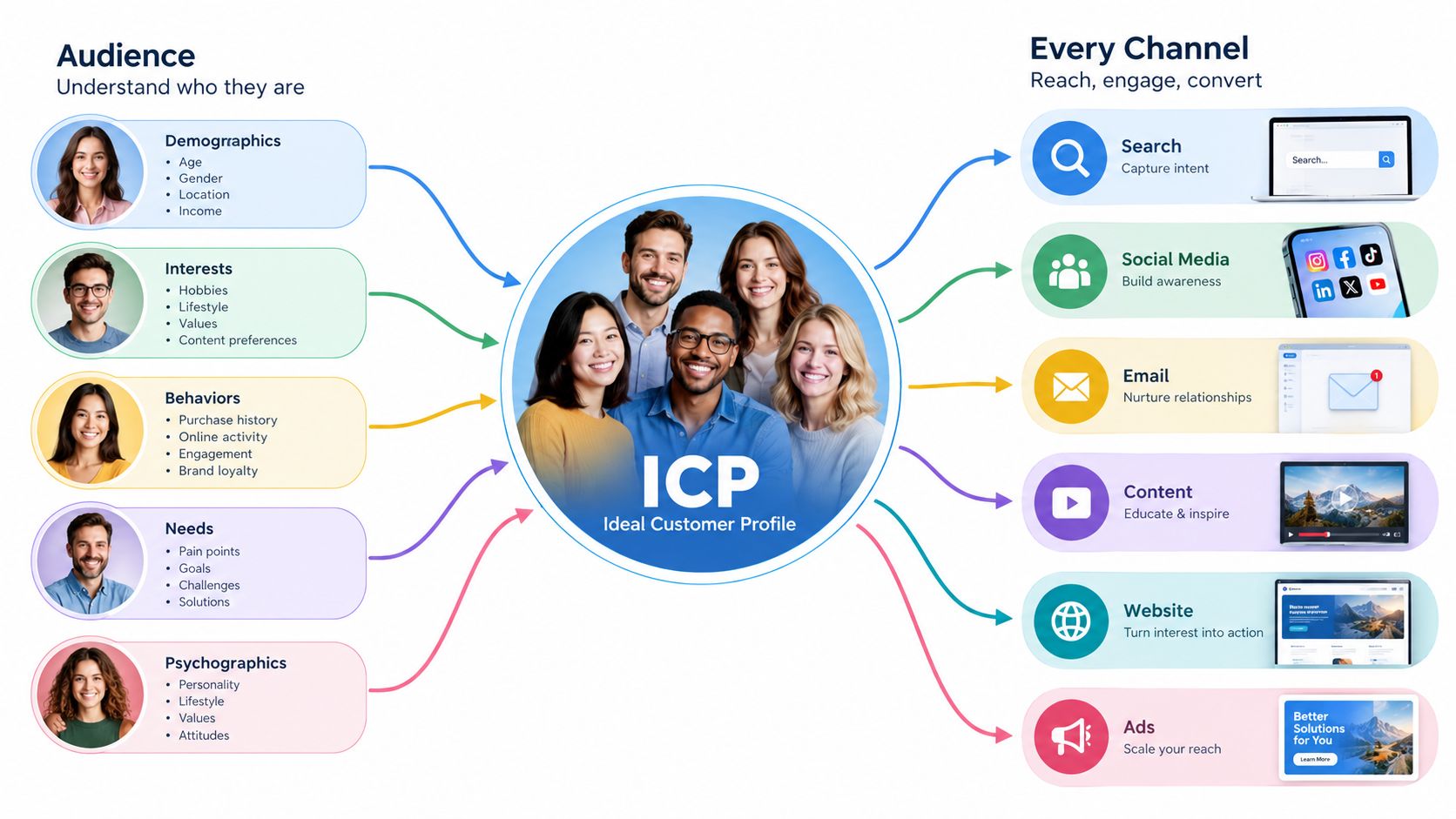
Once the account spine exists, the rest of the system stops guessing. That's when the message can travel.
The LinkedIn plus outbound engine
Founder-led and exec-led distribution wins this motion. Company pages matter, but mostly as a surface for employees to share from. Outbound email picks up the people who never see the post, and that's the split that keeps the engine honest.
Who owns what
The founder or senior exec owns the thought leadership post. The company page republishes for credibility and internal sharing. SDRs and AEs own the outbound follow-up, the comments, and the direct outreach that turns visible interest into a conversation.
This is why the channel pair works when it's disciplined. LinkedIn creates the proof. Outbound creates the appointment path. If you separate them, you lose the loop.
A second LinkedIn benchmark makes the case stronger. Coverage of Richard van der Blom's 2025 research, which analyzed more than 1.8 million posts, reported declines of about 47% in views, 39% in engagement, and 42% in follower growth. SocialPilot's summary is a useful reference point for why LinkedIn distribution now needs multiple surfaces instead of one organic posting lane.
Keep promotional posts under control. Recent 2026 analyses found that accounts with more than roughly 10% of recent posts being directly promotional saw sustained declines in organic reach across their posting history, which is why promotional content should stay below that line if organic visibility matters.
Cadence and format choices
The cadence should feel aggressive enough to stay visible, but not so noisy that it reads like spam. A practical weekly rhythm is 4 to 5 founder posts, 2 to 3 employee reshares, 1 long-form post, and 1 newsletter send. Use text-first hooks for reply generation, keep document carousels for top-of-funnel reach, and stop pretending comment pods still do anything useful.
Here's the decision tree we use in practice:
If the ICP is below 1,000 accounts, weight LinkedIn 60/40 over outbound.
If the ICP is above 5,000 accounts, weight outbound 70/30, with LinkedIn acting as the proof layer.
If the account is warm but unresponsive, route the same owner who commented publicly into the connection request.
If the post gets traction Tuesday, Clay or Instantly should trigger a personalized email Wednesday.
This is also where GROU's LinkedIn lead generation approach fits naturally, since the aim is to turn public attention into private conversations without losing fit control.
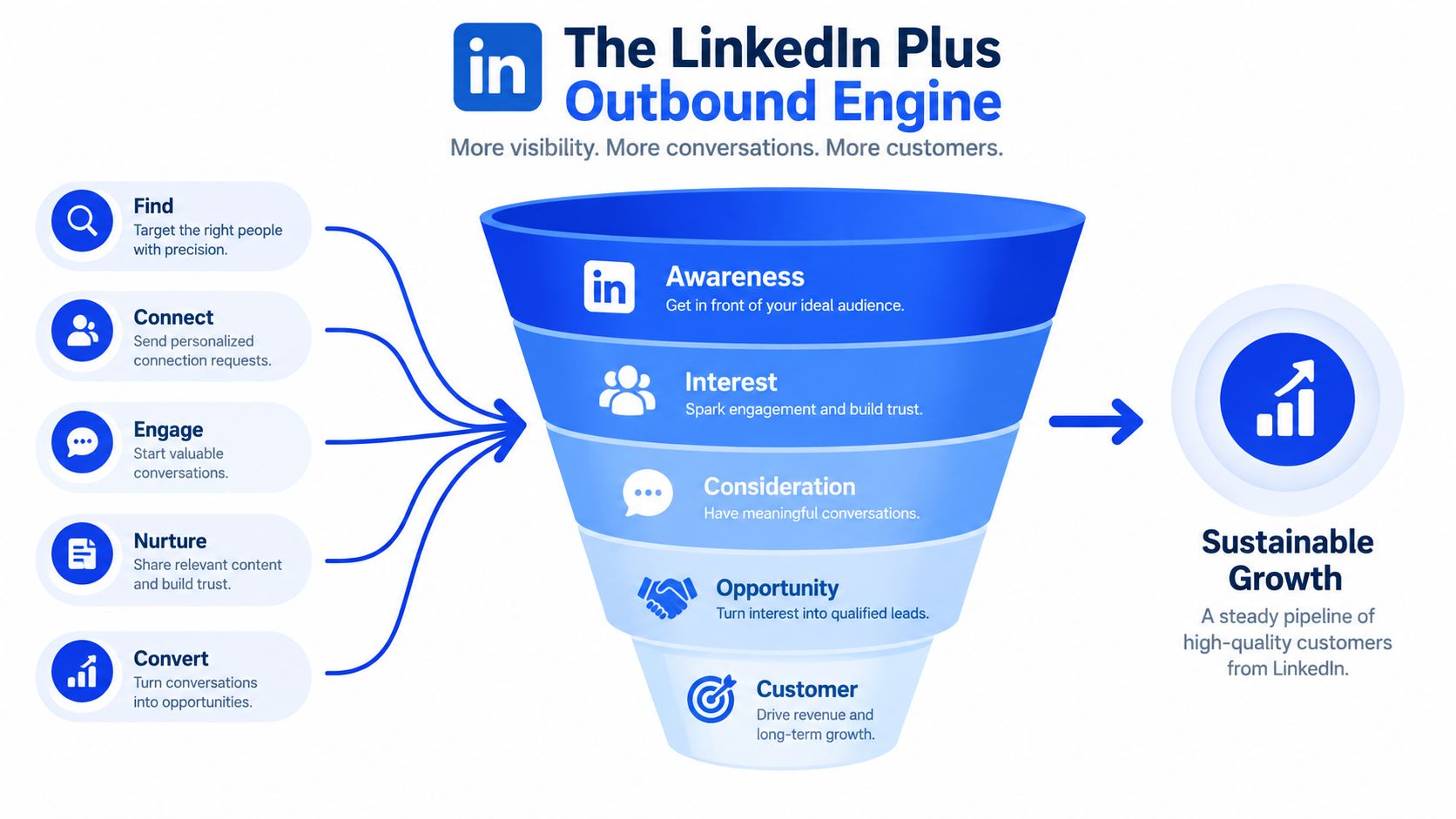
The distribution engine breaks when people post content and then wait passively. It works when the same signal moves through comment, connect, email, and routing fast enough that the account still remembers why it showed up.
The repurposing matrix that compounds one piece of content
One pillar asset should behave like a source file, not a one-time publish. If a 1,200-word post, a founder video, or a customer interview cannot generate multiple downstream assets, the return is too thin.
Start with one asset and fan it out
A single pillar can produce 8 to 12 LinkedIn text posts, 3 carousel PDFs, 2 short clips, a newsletter issue, a podcast Q&A, 4 outbound email angles, and 6 cold call openers. That is not content hoarding. It is a distribution layer that pushes one idea through different buyer behaviors.
If you want more ways to split one asset across formats without losing the core angle, check out ViewsMax's guide to content repurposing strategies and GRO's guide on repurposing LinkedIn content.
The practical move is to assign effort by output. Some derivatives are fast and cheap. Others need more context, design, or editorial review.
Pillar source | Derivative asset | Channel | Effort (hrs) | Ship priority |
|---|---|---|---|---|
1,200-word SEO post | 8 LinkedIn text posts | 2 | Week 1 | |
1,200-word SEO post | 4 outbound email angles | Outbound email | 2 | Week 1 |
Founder video | 2 short-form clips | LinkedIn, YouTube Shorts | 3 | Week 1 |
Customer interview | 3 carousel PDFs | 4 | Week 2 | |
Pillar post | Newsletter issue | 2 | Week 3 | |
Customer interview | Podcast Q&A | Podcast | 4 | Week 3 |
Pillar post | 6 cold call openers | Outbound calling | 1 | Week 1 |
Ship order matters more than volume
The first week should go to assets that drive reply volume, so the 8 LinkedIn posts and 4 outbound angles go out first. The newsletter and podcast can wait until week three, after the pillar has indexed and the reply data gives you better material to reuse.
That sequencing matters because each derivative serves a different job. The first set is for reach and response. The second set extends the angle after the market has already shown interest.
One simple rule holds up in real work, one idea, ten surfaces, no orphan assets. That is how content distribution strategy stops acting like a publishing calendar and starts acting like pipeline infrastructure.
Workflows, tools, and sprint cadence that keep it running
The stack does not need to be fancy. It does need to be disciplined. Apollo or Clay builds the list, Sales Navigator finds signal, Taplio or Supergrow schedules LinkedIn, Instantly or Smartlead runs outbound, HubSpot or Pipedrive routes replies, Notion stores the source material, and Linear or Asana keeps the sprint from slipping.
The two-week cadence that actually holds
Days 1 to 3 are for the pillar and its first derivatives. Days 4 to 7 are for distribution and engagement. Days 8 to 10 launch the outbound wave tied to the same topic. Days 11 to 14 are for reply review and recycling the winner into the next pillar.
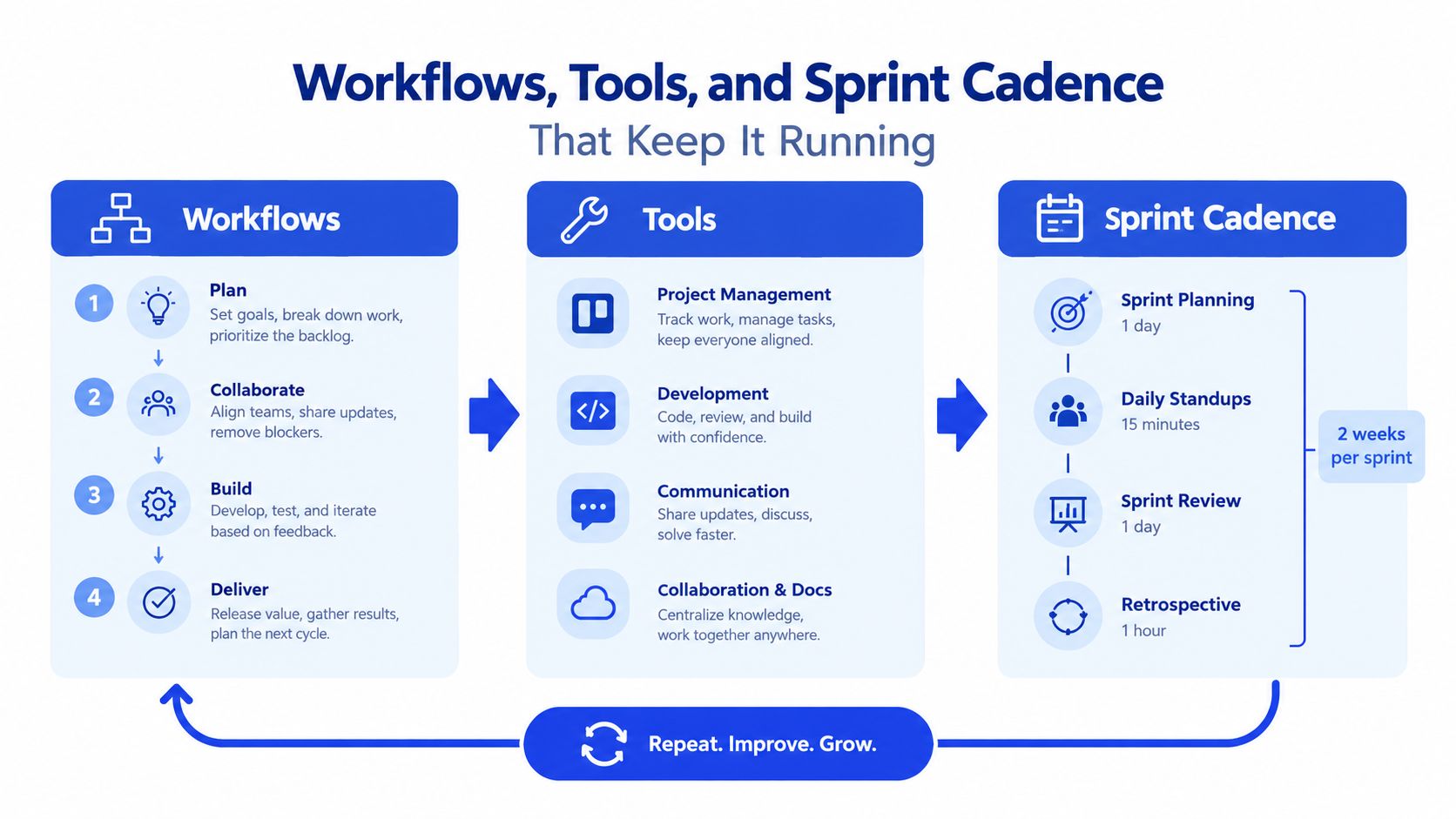
The reason the cadence works is simple. It puts creation, distribution, routing, and review in one loop. Without that loop, the work becomes a campaign that ends instead of a system that learns.
The workflows that break first
The first fragile workflow is reply routing. Every positive reply should land in a shared Slack channel in under 60 seconds so a human can decide whether it's sales-ready, nurture-worthy, or wrong-fit. If that step is slow, warm attention cools off before anyone sees it.
The second fragile workflow is the weekly ICP fit check. Good-looking engagement can still come from bad-fit accounts, and those accounts should be pruned instead of celebrated. That keeps the next sprint clean.
GROU's tool stack guidance fits here because the point isn't buying more software. It's keeping the software pointed at the same list, the same handoff rules, and the same outcome.
Distribution only becomes repeatable when someone owns the handoff. If nobody owns the reply, the channel is just noise.
KPIs, reporting, and the next step to take this week
The wrong metrics make content teams look good and pipeline teams look busy. The right metrics tell you whether attention is turning into qualified conversations. The practical reporting line should center on outbound reply quality, ICP profile views, dark social bookings, and cost per qualified meeting.
What to track and what to ignore
The dashboard doesn't need twenty charts. It needs one view that RevOps, SDRs, and execs can all read without translation. Weekly, I want the same report to show whether the channel mix is producing qualified replies, whether the right people are viewing the right profiles, and whether meetings are coming from visible and invisible touchpoints.
Metric | What it measures | Pipeline signal | Healthy benchmark |
|---|---|---|---|
Qualified reply rate on outbound | Reply quality, not just volume | Strong indicator of account interest | Compare week over week, not in isolation |
LinkedIn profile views per ICP account | Whether the right accounts are paying attention | Good early signal of message resonance | Track against your named account list |
Demo bookings attributed to dark social | Private attention that surfaces later | Strong sign that distribution is reaching buyers off-channel | Review weekly with sales notes |
Cost per qualified meeting | Full-engine efficiency | Best budget signal for the revenue team | Use it as the main spend gate |
CMI and MarketingProfs also note that conversions and engagement metrics are the dominant evaluation framework, which fits the operational view here. The channels you keep should be the ones that show engagement and move accounts toward meetings, not just the ones that pad impressions.
Your 48-hour starter plan
Pull 500 ICP records in Apollo. Build the LinkedIn and outbound list in Clay. Ship one pillar post with its first derivatives. Then book the first review against qualified replies and meeting outcomes, because that's where the system tells you whether the routing is working.
If the channel doesn't show movement inside a week, cut it. If it does, keep the same list, same message, same reporting line, and let the engine compound.
GROU works with B2B teams that need LinkedIn content, lead generation, and outbound to behave like one pipeline system, not three disconnected motions. The team builds the list, writes the content, routes the replies, and keeps the reporting tight so revenue can move faster with less manual noise. Visit Grou if you want that engine built around your ICP and your reply flow.
You're shipping content on schedule, the dashboard looks busy, and yet the meeting column stays flat. SDRs keep working fresh lists, LinkedIn posts go live, outbound sequences fire, and none of it seems to compound into one clean pipeline motion.
The issue is routing, not volume. One message, one ICP list, and one reporting line beat scattered activity.
LinkedIn and outbound need to share signal, not just timing. Founder-led content and reply-driven sequences should feed each other.
One pillar asset should produce multiple surfaces. If it can't become LinkedIn posts, outbound angles, and a follow-up sequence, it's not doing enough work.
The KPIs that matter sit closer to meetings than impressions. Qualified replies, ICP profile views, dark social bookings, and cost per qualified meeting tell the truth.
The fastest way to fix it is to stop treating content distribution strategy like a channel menu and start treating it like an engine. If you want the broader operating model behind that, GROU's sales pipeline management perspective lines up with the same principle, one reporting line, one qualification standard, one owner.
Table of Contents
The pipeline problem nobody admits out loud
The familiar failure mode starts with a dashboard that looks healthy enough to defend in a meeting. Content ships, organic social ticks up, email goes out on time, and SDR activity stays busy. Then the qualified meeting count barely moves.
That's usually not a content quality issue. It's a routing problem.
Every channel is running its own little universe
Marketing writes for the blog calendar. Social posts for engagement. SDRs chase lists that were never built from the same ICP logic. The result is that attention gets sprayed across disconnected systems instead of being directed into one conversation.
A real content distribution strategy fixes that by making every surface pull from the same account universe and the same message spine. Contesimal's guide to repurpose and schedule content is useful here because it treats republishing as an operating issue, not a creative afterthought.
Practical rule: if a post can't feed an outbound touch, a follow-up comment, or a named-account report, it's decoration.
What this article actually solves
The rest of this system is simple in concept, harder in execution. Build the audience map in Apollo and Clay, split LinkedIn and outbound by account tier, turn one asset into multiple derivatives, then review only the metrics that predict meetings.
The current breakage is exactly why a lot of teams need a tighter content distribution strategy around one ICP list and one reply path. If the reporting line is fragmented, the pipeline stays fragmented too.
Where B2B distribution actually works in 2026
The usage data makes the trap obvious. In the 2025 Content Marketing Institute benchmark, 89% of B2B marketers used organic social media platforms, 84% used blogs on corporate websites, 71% used email newsletters, 63% used email, 55% used in-person events, and 55% used webinars, yet the most effective channels were in-person events at 52% and webinars at 51%, ahead of email, organic social, blogs, and newsletters, each lower on the effectiveness scale. That gap tells you what habit looks like versus what pipeline looks like, and the source is worth keeping nearby for planning cycles: CMI's 2025 B2B content marketing trends research.
Budget follows behavior, but meetings follow friction
The biggest mistake is funding the channels that feel normal. Newsletters are easy to keep alive, social posts are easy to approve, and blogs are easy to assign. Those channels matter, but they don't deserve budget just because they're familiar.
The channels that deserve real attention in 2026 are the ones that let you pair reach with account intent. LinkedIn works when founder and exec accounts carry the message. Signal-based outbound works when email and LinkedIn touches are triggered by something real. Communities work when your ICP already gathers there. Programmatic SEO works when the topic itself is part of category discovery.
A separate LinkedIn-focused benchmark reinforces the point. Catalyst's 2026 report found more reach for original insight posts than promotional content, stronger engagement on founder accounts than company pages, and that the top 1% of creators drive 80% of B2B LinkedIn impressions. The implication is blunt, as described in Catalyst's state of LinkedIn report, your distribution depends more on who publishes and what they publish than on raw posting volume.
Where to stop spending
Stop pouring budget into mass paid display if you can't tie it to named accounts. Stop treating generic newsletters like a conversion engine. Stop defending a channel that can't show account-level movement inside two weeks.
The cleanest operating rule is still the same, one ICP list shared across every surface. That's what lets the channel mix act like one system instead of four unrelated efforts.
Channel | Usage rank | Pipeline rank | Verdict |
|---|---|---|---|
Organic social media | 1 | Not the top conversion driver | Useful for reach, weak if it lives alone |
Corporate blogs | 2 | Mid-pack | Good for discovery, not enough by itself |
Email newsletters | 3 | Lower than teams assume | Keep it, but don't let it anchor the plan |
4 | Better when tied to signals | Strong in sequence, weak as a broadcast | |
In-person events | 5 | Top tier | High-value when the right accounts show up |
Webinars | 6 | Top tier | Works best when repackaged into follow-up motion |
Mapping the audience and ICP that feeds every channel
Start with account selection, not content ideas. If the ICP list is sloppy, every downstream channel gets noisy fast. Apollo is where the first cut should live, Clay is where signals get added, and Sales Navigator is where the persona layer gets precise.
Build the account spine first
In Apollo, filter by the signals that matter to your deal motion, employee band, revenue band, tech stack, funding stage, and hiring patterns. The point isn't to find everyone who could buy. The point is to find the accounts that are most likely to act now.
Then move into Sales Navigator and map who inside those accounts matters. Titles, seniority, function, and deal-role differences all change the angle. A founder, a RevOps lead, and a functional operator may all care about the same outcome, but they won't respond to the same first sentence.
For practical audience shaping, SupportGPT's customer journey mapping for startups is a decent reminder that message order matters as much as message quality. The same account can be in a different state of readiness depending on which trigger brought it into view.
Layer signals on top of fit
Clay is where the list gets smarter. Add recent funding, leadership changes, product launches, job posts for related roles, and review-site activity. That doesn't just help targeting. It tells you what angle should show up first.
The output you want this week is simple and ugly in the best way:
Tier 1 accounts: 200 to 500 named accounts
Tier 2 accounts: 1,000 to 2,000 named accounts
Long tail: retargeting and light-touch nurture only
One verified contact per account: email plus LinkedIn URL
One pain hypothesis per account: a single sentence, no jargon
Here's the point missed by many. The content calendar is a downstream artifact. The ICP list is the first deliverable of a serious content distribution strategy.
The internal process matters too, so keep the list aligned with GROU's ICP framework instead of letting each channel invent its own version of fit.
Once the account spine exists, the rest of the system stops guessing. That's when the message can travel.
The LinkedIn plus outbound engine
Founder-led and exec-led distribution wins this motion. Company pages matter, but mostly as a surface for employees to share from. Outbound email picks up the people who never see the post, and that's the split that keeps the engine honest.
Who owns what
The founder or senior exec owns the thought leadership post. The company page republishes for credibility and internal sharing. SDRs and AEs own the outbound follow-up, the comments, and the direct outreach that turns visible interest into a conversation.
This is why the channel pair works when it's disciplined. LinkedIn creates the proof. Outbound creates the appointment path. If you separate them, you lose the loop.
A second LinkedIn benchmark makes the case stronger. Coverage of Richard van der Blom's 2025 research, which analyzed more than 1.8 million posts, reported declines of about 47% in views, 39% in engagement, and 42% in follower growth. SocialPilot's summary is a useful reference point for why LinkedIn distribution now needs multiple surfaces instead of one organic posting lane.
Keep promotional posts under control. Recent 2026 analyses found that accounts with more than roughly 10% of recent posts being directly promotional saw sustained declines in organic reach across their posting history, which is why promotional content should stay below that line if organic visibility matters.
Cadence and format choices
The cadence should feel aggressive enough to stay visible, but not so noisy that it reads like spam. A practical weekly rhythm is 4 to 5 founder posts, 2 to 3 employee reshares, 1 long-form post, and 1 newsletter send. Use text-first hooks for reply generation, keep document carousels for top-of-funnel reach, and stop pretending comment pods still do anything useful.
Here's the decision tree we use in practice:
If the ICP is below 1,000 accounts, weight LinkedIn 60/40 over outbound.
If the ICP is above 5,000 accounts, weight outbound 70/30, with LinkedIn acting as the proof layer.
If the account is warm but unresponsive, route the same owner who commented publicly into the connection request.
If the post gets traction Tuesday, Clay or Instantly should trigger a personalized email Wednesday.
This is also where GROU's LinkedIn lead generation approach fits naturally, since the aim is to turn public attention into private conversations without losing fit control.
The distribution engine breaks when people post content and then wait passively. It works when the same signal moves through comment, connect, email, and routing fast enough that the account still remembers why it showed up.
The repurposing matrix that compounds one piece of content
One pillar asset should behave like a source file, not a one-time publish. If a 1,200-word post, a founder video, or a customer interview cannot generate multiple downstream assets, the return is too thin.
Start with one asset and fan it out
A single pillar can produce 8 to 12 LinkedIn text posts, 3 carousel PDFs, 2 short clips, a newsletter issue, a podcast Q&A, 4 outbound email angles, and 6 cold call openers. That is not content hoarding. It is a distribution layer that pushes one idea through different buyer behaviors.
If you want more ways to split one asset across formats without losing the core angle, check out ViewsMax's guide to content repurposing strategies and GRO's guide on repurposing LinkedIn content.
The practical move is to assign effort by output. Some derivatives are fast and cheap. Others need more context, design, or editorial review.
Pillar source | Derivative asset | Channel | Effort (hrs) | Ship priority |
|---|---|---|---|---|
1,200-word SEO post | 8 LinkedIn text posts | 2 | Week 1 | |
1,200-word SEO post | 4 outbound email angles | Outbound email | 2 | Week 1 |
Founder video | 2 short-form clips | LinkedIn, YouTube Shorts | 3 | Week 1 |
Customer interview | 3 carousel PDFs | 4 | Week 2 | |
Pillar post | Newsletter issue | 2 | Week 3 | |
Customer interview | Podcast Q&A | Podcast | 4 | Week 3 |
Pillar post | 6 cold call openers | Outbound calling | 1 | Week 1 |
Ship order matters more than volume
The first week should go to assets that drive reply volume, so the 8 LinkedIn posts and 4 outbound angles go out first. The newsletter and podcast can wait until week three, after the pillar has indexed and the reply data gives you better material to reuse.
That sequencing matters because each derivative serves a different job. The first set is for reach and response. The second set extends the angle after the market has already shown interest.
One simple rule holds up in real work, one idea, ten surfaces, no orphan assets. That is how content distribution strategy stops acting like a publishing calendar and starts acting like pipeline infrastructure.
Workflows, tools, and sprint cadence that keep it running
The stack does not need to be fancy. It does need to be disciplined. Apollo or Clay builds the list, Sales Navigator finds signal, Taplio or Supergrow schedules LinkedIn, Instantly or Smartlead runs outbound, HubSpot or Pipedrive routes replies, Notion stores the source material, and Linear or Asana keeps the sprint from slipping.
The two-week cadence that actually holds
Days 1 to 3 are for the pillar and its first derivatives. Days 4 to 7 are for distribution and engagement. Days 8 to 10 launch the outbound wave tied to the same topic. Days 11 to 14 are for reply review and recycling the winner into the next pillar.
The reason the cadence works is simple. It puts creation, distribution, routing, and review in one loop. Without that loop, the work becomes a campaign that ends instead of a system that learns.
The workflows that break first
The first fragile workflow is reply routing. Every positive reply should land in a shared Slack channel in under 60 seconds so a human can decide whether it's sales-ready, nurture-worthy, or wrong-fit. If that step is slow, warm attention cools off before anyone sees it.
The second fragile workflow is the weekly ICP fit check. Good-looking engagement can still come from bad-fit accounts, and those accounts should be pruned instead of celebrated. That keeps the next sprint clean.
GROU's tool stack guidance fits here because the point isn't buying more software. It's keeping the software pointed at the same list, the same handoff rules, and the same outcome.
Distribution only becomes repeatable when someone owns the handoff. If nobody owns the reply, the channel is just noise.
KPIs, reporting, and the next step to take this week
The wrong metrics make content teams look good and pipeline teams look busy. The right metrics tell you whether attention is turning into qualified conversations. The practical reporting line should center on outbound reply quality, ICP profile views, dark social bookings, and cost per qualified meeting.
What to track and what to ignore
The dashboard doesn't need twenty charts. It needs one view that RevOps, SDRs, and execs can all read without translation. Weekly, I want the same report to show whether the channel mix is producing qualified replies, whether the right people are viewing the right profiles, and whether meetings are coming from visible and invisible touchpoints.
Metric | What it measures | Pipeline signal | Healthy benchmark |
|---|---|---|---|
Qualified reply rate on outbound | Reply quality, not just volume | Strong indicator of account interest | Compare week over week, not in isolation |
LinkedIn profile views per ICP account | Whether the right accounts are paying attention | Good early signal of message resonance | Track against your named account list |
Demo bookings attributed to dark social | Private attention that surfaces later | Strong sign that distribution is reaching buyers off-channel | Review weekly with sales notes |
Cost per qualified meeting | Full-engine efficiency | Best budget signal for the revenue team | Use it as the main spend gate |
CMI and MarketingProfs also note that conversions and engagement metrics are the dominant evaluation framework, which fits the operational view here. The channels you keep should be the ones that show engagement and move accounts toward meetings, not just the ones that pad impressions.
Your 48-hour starter plan
Pull 500 ICP records in Apollo. Build the LinkedIn and outbound list in Clay. Ship one pillar post with its first derivatives. Then book the first review against qualified replies and meeting outcomes, because that's where the system tells you whether the routing is working.
If the channel doesn't show movement inside a week, cut it. If it does, keep the same list, same message, same reporting line, and let the engine compound.
GROU works with B2B teams that need LinkedIn content, lead generation, and outbound to behave like one pipeline system, not three disconnected motions. The team builds the list, writes the content, routes the replies, and keeps the reporting tight so revenue can move faster with less manual noise. Visit Grou if you want that engine built around your ICP and your reply flow.
You're shipping content on schedule, the dashboard looks busy, and yet the meeting column stays flat. SDRs keep working fresh lists, LinkedIn posts go live, outbound sequences fire, and none of it seems to compound into one clean pipeline motion.
The issue is routing, not volume. One message, one ICP list, and one reporting line beat scattered activity.
LinkedIn and outbound need to share signal, not just timing. Founder-led content and reply-driven sequences should feed each other.
One pillar asset should produce multiple surfaces. If it can't become LinkedIn posts, outbound angles, and a follow-up sequence, it's not doing enough work.
The KPIs that matter sit closer to meetings than impressions. Qualified replies, ICP profile views, dark social bookings, and cost per qualified meeting tell the truth.
The fastest way to fix it is to stop treating content distribution strategy like a channel menu and start treating it like an engine. If you want the broader operating model behind that, GROU's sales pipeline management perspective lines up with the same principle, one reporting line, one qualification standard, one owner.
Table of Contents
The pipeline problem nobody admits out loud
The familiar failure mode starts with a dashboard that looks healthy enough to defend in a meeting. Content ships, organic social ticks up, email goes out on time, and SDR activity stays busy. Then the qualified meeting count barely moves.
That's usually not a content quality issue. It's a routing problem.
Every channel is running its own little universe
Marketing writes for the blog calendar. Social posts for engagement. SDRs chase lists that were never built from the same ICP logic. The result is that attention gets sprayed across disconnected systems instead of being directed into one conversation.
A real content distribution strategy fixes that by making every surface pull from the same account universe and the same message spine. Contesimal's guide to repurpose and schedule content is useful here because it treats republishing as an operating issue, not a creative afterthought.
Practical rule: if a post can't feed an outbound touch, a follow-up comment, or a named-account report, it's decoration.
What this article actually solves
The rest of this system is simple in concept, harder in execution. Build the audience map in Apollo and Clay, split LinkedIn and outbound by account tier, turn one asset into multiple derivatives, then review only the metrics that predict meetings.
The current breakage is exactly why a lot of teams need a tighter content distribution strategy around one ICP list and one reply path. If the reporting line is fragmented, the pipeline stays fragmented too.
Where B2B distribution actually works in 2026
The usage data makes the trap obvious. In the 2025 Content Marketing Institute benchmark, 89% of B2B marketers used organic social media platforms, 84% used blogs on corporate websites, 71% used email newsletters, 63% used email, 55% used in-person events, and 55% used webinars, yet the most effective channels were in-person events at 52% and webinars at 51%, ahead of email, organic social, blogs, and newsletters, each lower on the effectiveness scale. That gap tells you what habit looks like versus what pipeline looks like, and the source is worth keeping nearby for planning cycles: CMI's 2025 B2B content marketing trends research.
Budget follows behavior, but meetings follow friction
The biggest mistake is funding the channels that feel normal. Newsletters are easy to keep alive, social posts are easy to approve, and blogs are easy to assign. Those channels matter, but they don't deserve budget just because they're familiar.
The channels that deserve real attention in 2026 are the ones that let you pair reach with account intent. LinkedIn works when founder and exec accounts carry the message. Signal-based outbound works when email and LinkedIn touches are triggered by something real. Communities work when your ICP already gathers there. Programmatic SEO works when the topic itself is part of category discovery.
A separate LinkedIn-focused benchmark reinforces the point. Catalyst's 2026 report found more reach for original insight posts than promotional content, stronger engagement on founder accounts than company pages, and that the top 1% of creators drive 80% of B2B LinkedIn impressions. The implication is blunt, as described in Catalyst's state of LinkedIn report, your distribution depends more on who publishes and what they publish than on raw posting volume.
Where to stop spending
Stop pouring budget into mass paid display if you can't tie it to named accounts. Stop treating generic newsletters like a conversion engine. Stop defending a channel that can't show account-level movement inside two weeks.
The cleanest operating rule is still the same, one ICP list shared across every surface. That's what lets the channel mix act like one system instead of four unrelated efforts.
Channel | Usage rank | Pipeline rank | Verdict |
|---|---|---|---|
Organic social media | 1 | Not the top conversion driver | Useful for reach, weak if it lives alone |
Corporate blogs | 2 | Mid-pack | Good for discovery, not enough by itself |
Email newsletters | 3 | Lower than teams assume | Keep it, but don't let it anchor the plan |
4 | Better when tied to signals | Strong in sequence, weak as a broadcast | |
In-person events | 5 | Top tier | High-value when the right accounts show up |
Webinars | 6 | Top tier | Works best when repackaged into follow-up motion |
Mapping the audience and ICP that feeds every channel
Start with account selection, not content ideas. If the ICP list is sloppy, every downstream channel gets noisy fast. Apollo is where the first cut should live, Clay is where signals get added, and Sales Navigator is where the persona layer gets precise.
Build the account spine first
In Apollo, filter by the signals that matter to your deal motion, employee band, revenue band, tech stack, funding stage, and hiring patterns. The point isn't to find everyone who could buy. The point is to find the accounts that are most likely to act now.
Then move into Sales Navigator and map who inside those accounts matters. Titles, seniority, function, and deal-role differences all change the angle. A founder, a RevOps lead, and a functional operator may all care about the same outcome, but they won't respond to the same first sentence.
For practical audience shaping, SupportGPT's customer journey mapping for startups is a decent reminder that message order matters as much as message quality. The same account can be in a different state of readiness depending on which trigger brought it into view.
Layer signals on top of fit
Clay is where the list gets smarter. Add recent funding, leadership changes, product launches, job posts for related roles, and review-site activity. That doesn't just help targeting. It tells you what angle should show up first.
The output you want this week is simple and ugly in the best way:
Tier 1 accounts: 200 to 500 named accounts
Tier 2 accounts: 1,000 to 2,000 named accounts
Long tail: retargeting and light-touch nurture only
One verified contact per account: email plus LinkedIn URL
One pain hypothesis per account: a single sentence, no jargon
Here's the point missed by many. The content calendar is a downstream artifact. The ICP list is the first deliverable of a serious content distribution strategy.
The internal process matters too, so keep the list aligned with GROU's ICP framework instead of letting each channel invent its own version of fit.
Once the account spine exists, the rest of the system stops guessing. That's when the message can travel.
The LinkedIn plus outbound engine
Founder-led and exec-led distribution wins this motion. Company pages matter, but mostly as a surface for employees to share from. Outbound email picks up the people who never see the post, and that's the split that keeps the engine honest.
Who owns what
The founder or senior exec owns the thought leadership post. The company page republishes for credibility and internal sharing. SDRs and AEs own the outbound follow-up, the comments, and the direct outreach that turns visible interest into a conversation.
This is why the channel pair works when it's disciplined. LinkedIn creates the proof. Outbound creates the appointment path. If you separate them, you lose the loop.
A second LinkedIn benchmark makes the case stronger. Coverage of Richard van der Blom's 2025 research, which analyzed more than 1.8 million posts, reported declines of about 47% in views, 39% in engagement, and 42% in follower growth. SocialPilot's summary is a useful reference point for why LinkedIn distribution now needs multiple surfaces instead of one organic posting lane.
Keep promotional posts under control. Recent 2026 analyses found that accounts with more than roughly 10% of recent posts being directly promotional saw sustained declines in organic reach across their posting history, which is why promotional content should stay below that line if organic visibility matters.
Cadence and format choices
The cadence should feel aggressive enough to stay visible, but not so noisy that it reads like spam. A practical weekly rhythm is 4 to 5 founder posts, 2 to 3 employee reshares, 1 long-form post, and 1 newsletter send. Use text-first hooks for reply generation, keep document carousels for top-of-funnel reach, and stop pretending comment pods still do anything useful.
Here's the decision tree we use in practice:
If the ICP is below 1,000 accounts, weight LinkedIn 60/40 over outbound.
If the ICP is above 5,000 accounts, weight outbound 70/30, with LinkedIn acting as the proof layer.
If the account is warm but unresponsive, route the same owner who commented publicly into the connection request.
If the post gets traction Tuesday, Clay or Instantly should trigger a personalized email Wednesday.
This is also where GROU's LinkedIn lead generation approach fits naturally, since the aim is to turn public attention into private conversations without losing fit control.
The distribution engine breaks when people post content and then wait passively. It works when the same signal moves through comment, connect, email, and routing fast enough that the account still remembers why it showed up.
The repurposing matrix that compounds one piece of content
One pillar asset should behave like a source file, not a one-time publish. If a 1,200-word post, a founder video, or a customer interview cannot generate multiple downstream assets, the return is too thin.
Start with one asset and fan it out
A single pillar can produce 8 to 12 LinkedIn text posts, 3 carousel PDFs, 2 short clips, a newsletter issue, a podcast Q&A, 4 outbound email angles, and 6 cold call openers. That is not content hoarding. It is a distribution layer that pushes one idea through different buyer behaviors.
If you want more ways to split one asset across formats without losing the core angle, check out ViewsMax's guide to content repurposing strategies and GRO's guide on repurposing LinkedIn content.
The practical move is to assign effort by output. Some derivatives are fast and cheap. Others need more context, design, or editorial review.
Pillar source | Derivative asset | Channel | Effort (hrs) | Ship priority |
|---|---|---|---|---|
1,200-word SEO post | 8 LinkedIn text posts | 2 | Week 1 | |
1,200-word SEO post | 4 outbound email angles | Outbound email | 2 | Week 1 |
Founder video | 2 short-form clips | LinkedIn, YouTube Shorts | 3 | Week 1 |
Customer interview | 3 carousel PDFs | 4 | Week 2 | |
Pillar post | Newsletter issue | 2 | Week 3 | |
Customer interview | Podcast Q&A | Podcast | 4 | Week 3 |
Pillar post | 6 cold call openers | Outbound calling | 1 | Week 1 |
Ship order matters more than volume
The first week should go to assets that drive reply volume, so the 8 LinkedIn posts and 4 outbound angles go out first. The newsletter and podcast can wait until week three, after the pillar has indexed and the reply data gives you better material to reuse.
That sequencing matters because each derivative serves a different job. The first set is for reach and response. The second set extends the angle after the market has already shown interest.
One simple rule holds up in real work, one idea, ten surfaces, no orphan assets. That is how content distribution strategy stops acting like a publishing calendar and starts acting like pipeline infrastructure.
Workflows, tools, and sprint cadence that keep it running
The stack does not need to be fancy. It does need to be disciplined. Apollo or Clay builds the list, Sales Navigator finds signal, Taplio or Supergrow schedules LinkedIn, Instantly or Smartlead runs outbound, HubSpot or Pipedrive routes replies, Notion stores the source material, and Linear or Asana keeps the sprint from slipping.
The two-week cadence that actually holds
Days 1 to 3 are for the pillar and its first derivatives. Days 4 to 7 are for distribution and engagement. Days 8 to 10 launch the outbound wave tied to the same topic. Days 11 to 14 are for reply review and recycling the winner into the next pillar.
The reason the cadence works is simple. It puts creation, distribution, routing, and review in one loop. Without that loop, the work becomes a campaign that ends instead of a system that learns.
The workflows that break first
The first fragile workflow is reply routing. Every positive reply should land in a shared Slack channel in under 60 seconds so a human can decide whether it's sales-ready, nurture-worthy, or wrong-fit. If that step is slow, warm attention cools off before anyone sees it.
The second fragile workflow is the weekly ICP fit check. Good-looking engagement can still come from bad-fit accounts, and those accounts should be pruned instead of celebrated. That keeps the next sprint clean.
GROU's tool stack guidance fits here because the point isn't buying more software. It's keeping the software pointed at the same list, the same handoff rules, and the same outcome.
Distribution only becomes repeatable when someone owns the handoff. If nobody owns the reply, the channel is just noise.
KPIs, reporting, and the next step to take this week
The wrong metrics make content teams look good and pipeline teams look busy. The right metrics tell you whether attention is turning into qualified conversations. The practical reporting line should center on outbound reply quality, ICP profile views, dark social bookings, and cost per qualified meeting.
What to track and what to ignore
The dashboard doesn't need twenty charts. It needs one view that RevOps, SDRs, and execs can all read without translation. Weekly, I want the same report to show whether the channel mix is producing qualified replies, whether the right people are viewing the right profiles, and whether meetings are coming from visible and invisible touchpoints.
Metric | What it measures | Pipeline signal | Healthy benchmark |
|---|---|---|---|
Qualified reply rate on outbound | Reply quality, not just volume | Strong indicator of account interest | Compare week over week, not in isolation |
LinkedIn profile views per ICP account | Whether the right accounts are paying attention | Good early signal of message resonance | Track against your named account list |
Demo bookings attributed to dark social | Private attention that surfaces later | Strong sign that distribution is reaching buyers off-channel | Review weekly with sales notes |
Cost per qualified meeting | Full-engine efficiency | Best budget signal for the revenue team | Use it as the main spend gate |
CMI and MarketingProfs also note that conversions and engagement metrics are the dominant evaluation framework, which fits the operational view here. The channels you keep should be the ones that show engagement and move accounts toward meetings, not just the ones that pad impressions.
Your 48-hour starter plan
Pull 500 ICP records in Apollo. Build the LinkedIn and outbound list in Clay. Ship one pillar post with its first derivatives. Then book the first review against qualified replies and meeting outcomes, because that's where the system tells you whether the routing is working.
If the channel doesn't show movement inside a week, cut it. If it does, keep the same list, same message, same reporting line, and let the engine compound.
GROU works with B2B teams that need LinkedIn content, lead generation, and outbound to behave like one pipeline system, not three disconnected motions. The team builds the list, writes the content, routes the replies, and keeps the reporting tight so revenue can move faster with less manual noise. Visit Grou if you want that engine built around your ICP and your reply flow.
Pipeline OS Newsletter
Build qualified pipeline
Get weekly tactics to generate demand, improve lead quality, and book more meetings.





Trusted by industry leaders
Trusted by industry leaders
Trusted by industry leaders
Ready to build qualified pipeline?
Ready to build qualified pipeline?
Ready to build qualified pipeline?
Book a call to see if we're the right fit, or take the 2-minute quiz to get a clear starting point.
Book a call to see if we're the right fit, or take the 2-minute quiz to get a clear starting point.
Book a call to see if we're the right fit, or take the 2-minute quiz to get a clear starting point.
" height="30.21639343089746px" id="hfGbXmQR2" width="30.216393430897455px"/></svg>)
Copyright © 2026 – All Right Reserved
Copyright © 2026 – All Right Reserved
Copyright © 2026 – All Right Reserved