%22%3E%3C/path%3E%3Cpath d=%22M 63.072 7.554 C 62.258 8.022 61.577 8.689 61.092 9.493 L 61.092 7.076 L 57.158 7.076 L 57.158 22.64 L 61.089 22.64 L 61.089 14.888 C 61.089 13.446 61.403 12.434 62.03 11.853 C 62.818 11.218 63.818 10.907 64.826 10.982 L 65.868 10.982 L 65.868 6.851 C 64.891 6.834 63.926 7.076 63.073 7.554 Z%22 fill=%22rgb(17,17,17)%22%3E%3C/path%3E%3Cpath d=%22M 78.916 7.82 C 76.363 6.49 73.321 6.49 70.768 7.82 C 69.562 8.473 68.564 9.451 67.888 10.644 C 67.167 11.931 66.803 13.387 66.834 14.862 C 66.804 16.332 67.157 17.785 67.86 19.077 C 68.515 20.267 69.494 21.246 70.684 21.901 C 71.924 22.576 73.318 22.92 74.73 22.898 C 76.164 22.918 77.58 22.575 78.846 21.901 C 80.062 21.247 81.073 20.27 81.768 19.077 C 82.506 17.797 82.88 16.339 82.85 14.862 C 82.88 13.389 82.517 11.934 81.797 10.647 C 81.12 9.455 80.122 8.477 78.917 7.824 M 78.803 14.862 C 78.829 15.739 78.636 16.608 78.241 17.391 C 77.903 18.046 77.38 18.588 76.738 18.95 C 76.124 19.293 75.432 19.472 74.729 19.47 C 73.668 19.497 72.648 19.061 71.934 18.276 C 71.139 17.323 70.741 16.1 70.823 14.862 C 70.741 13.62 71.149 12.395 71.959 11.45 C 72.687 10.667 73.715 10.233 74.783 10.256 C 75.859 10.236 76.894 10.67 77.635 11.45 C 78.464 12.387 78.884 13.616 78.801 14.864%22 fill=%22rgb(17,17,17)%22%3E%3C/path%3E%3Cpath d=%22M 95.906 7.076 L 95.906 15.646 C 95.975 16.68 95.643 17.701 94.979 18.498 C 94.311 19.184 93.379 19.547 92.422 19.495 C 91.475 19.544 90.553 19.18 89.894 18.498 C 89.23 17.701 88.898 16.68 88.967 15.646 L 88.967 7.076 L 85.033 7.076 L 85.033 16.207 C 85 17.449 85.275 18.68 85.834 19.79 C 86.327 20.75 87.095 21.542 88.039 22.065 C 89.033 22.594 90.145 22.861 91.271 22.838 C 92.188 22.847 93.095 22.65 93.926 22.263 C 94.708 21.905 95.388 21.36 95.906 20.675 L 95.906 22.645 L 99.865 22.645 L 99.865 7.076 Z%22 fill=%22rgb(17,17,17)%22%3E%3C/path%3E%3Cpath d=%22M 4.513 15.626 C 4.511 10.815 7.606 6.549 12.181 5.059 C 16.756 3.57 21.77 5.195 24.601 9.086 L 27.816 5.87 C 24.074 1.186 17.981 -0.943 12.137 0.393 C 6.292 1.728 1.728 6.292 0.393 12.137 C -0.943 17.981 1.186 24.074 5.87 27.816 L 9.085 24.601 C 6.214 22.512 4.515 19.177 4.513 15.626%22 fill=%22rgb(32,62,235)%22%3E%3C/path%3E%3Cpath d=%22M 17.114 14.343 L 13.354 18.01 L 13.354 18.026 L 21.071 18.026 L 11.412 27.609 L 17.389 27.609 L 23.999 21.081 L 23.999 28.316 L 24.005 28.316 L 27.967 24.393 L 27.967 14.343 Z%22 fill=%22rgb(32,62,235)%22%3E%3C/path%3E%3C/g%3E%3C/svg%3E) ×
× ××
××›
›
›
›
LinkedIn ads cost in 2026: benchmarks, budgets, and what B2B teams actually pay
LinkedIn ads cost in 2026: benchmarks, budgets, and what B2B teams actually pay
LinkedIn ads cost in 2026: benchmarks, budgets, and what B2B teams actually pay
LinkedIn ads cost in 2026: benchmarks, budgets, and what B2B teams actually pay
LinkedIn ads cost in 2026: benchmarks, budgets, and what B2B teams actually pay
LinkedIn ads cost in 2026: benchmarks, budgets, and what B2B teams actually pay

Author
Aljaz Peklaj

Your LinkedIn Ads dashboard says the campaign is alive. Clicks are coming in, spend is pacing, forms are trickling through, and sales still says pipeline feels light. That's the normal failure mode with LinkedIn advertising costs. The front-end numbers look explainable, but the revenue math doesn't hold.
Average LinkedIn ad costs are only orientation, not a budget model, because targeting and seniority change them fast.
CPC and CPL are weak planning metrics if you don't connect them to qualified meetings and revenue.
Document Ads are the default format to test first when you care about cost-efficient qualified conversations.
Bidding is a secondary lever. Audience, creative, offer, and structure decide most outcomes.
Table of Contents
Your LinkedIn ads aren't working because you're tracking the wrong costs
The ad format that delivers the lowest cost per qualified meeting
Your LinkedIn ads aren't working because you're tracking the wrong costs
Many advertisers still judge LinkedIn advertising costs with the wrong scoreboard. They look at CPC, argue about CPL, then wonder why Salesforce or HubSpot isn't showing enough qualified pipeline. The problem usually isn't that LinkedIn is “too expensive.” The problem is that the campaign was measured at the click or lead layer instead of the meeting and revenue layer.
For planning, broad market references help a little. In 2025, LinkedIn's average CPC was around $6.20 and average CPM around $37.90, with many B2B advertisers planning for $5 to $8 CPC and $30 to $40+ CPM in core markets, according to LinkedIn advertising benchmark data. Useful context, yes. Useful budget model, no.
Cheap leads usually get praised too early
A low CPL often means lower-friction intent. That can work for audience building, but it often collapses when SDRs or AEs try to convert those names into meetings. A form fill is not pipeline. A content download is definitely not pipeline.
Practical rule: Track cost per qualified meeting before you celebrate cost per lead.
That's why serious B2B teams should anchor on CPQM, not just CPL. If your finance lead asks whether LinkedIn is working, “we got clicks cheaper this month” isn't an answer. “We produced qualified meetings at an acceptable cost against deal size” is the answer.
You also need attribution that reflects reality. Paid social rarely closes deals alone. It creates demand, retargeting lift, and account familiarity that sales and outbound convert later. If your reporting still treats paid social as a last-click channel, fix that first with a multi-touch attribution model built for B2B buying journeys.
What to watch instead
Use a simple metric stack:
Front-end efficiency: CPC, CTR, landing page conversion
Mid-funnel quality: lead-to-meeting rate, meeting-held rate
Pipeline output: CPQM, opportunity rate, cost per closed deal
If you only manage the first line, you'll keep buying activity. If you manage all three, LinkedIn turns into a pipeline channel.
The real cost benchmarks for B2B in 2026
LinkedIn advertising costs are high enough that vague budgeting gets punished fast. You need working ranges, but you also need to know what moves them. The platform's average won't tell you what your ICP costs to reach.
Use averages as orientation, not targets
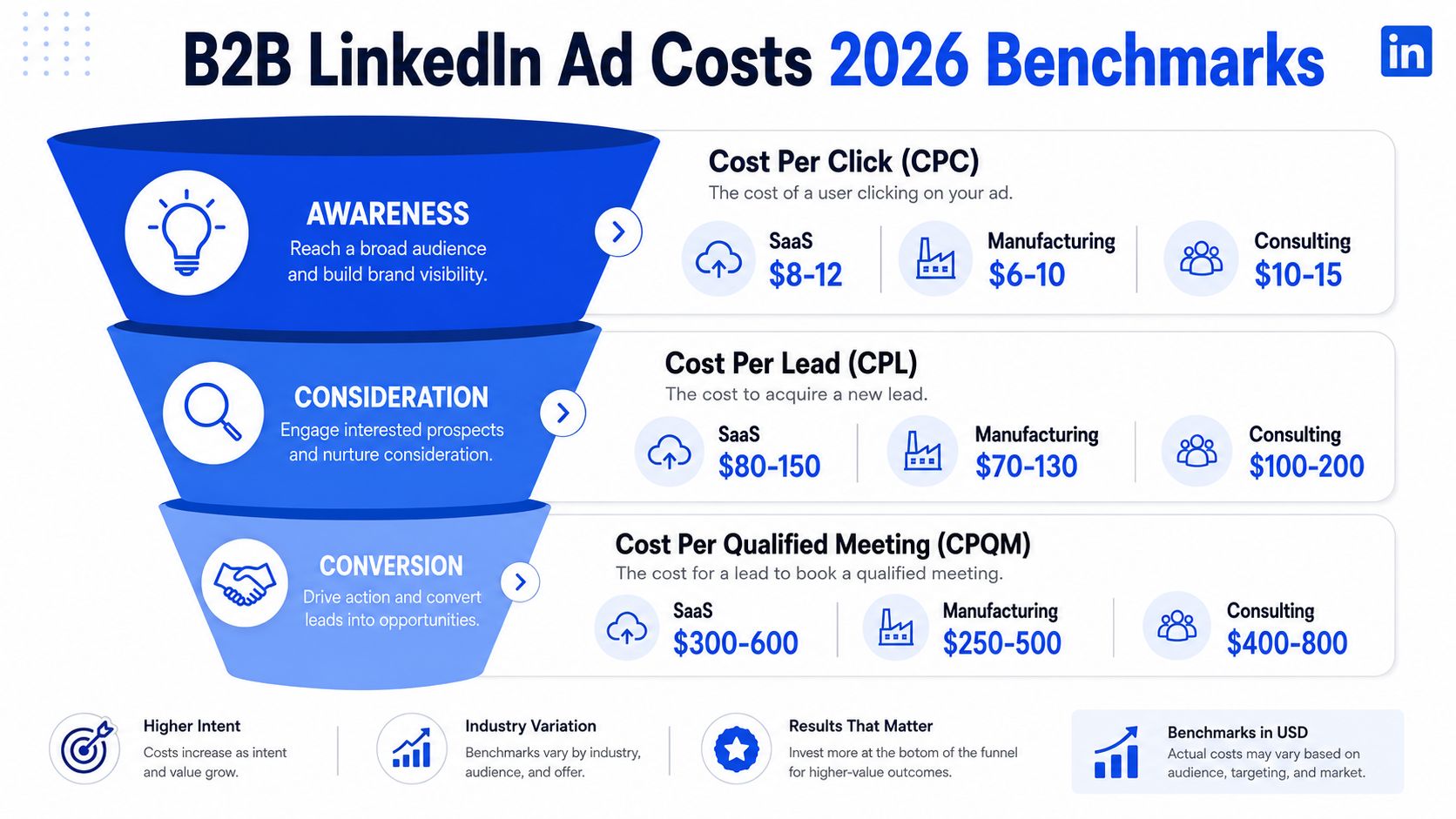
Global benchmark data for 2026 puts average LinkedIn CPC across B2B campaigns at around $5.50, with CPM averaging about $33 to $34 globally, based on Stackmatix LinkedIn Ads cost benchmarks. That same data shows how misleading the average is. Senior decision-maker targeting can push CPC to $6.40 or higher, while junior targeting can bring it closer to $4.40.
That tracks with day-to-day campaign reality. If you're targeting SaaS managers to VPs, costs are usually manageable. If you're chasing C-suite buyers in legal tech, pharma, or enterprise iGaming, you're paying for scarcity and competition.
A practical approach to this:
Audience condition | Cost effect | Why it happens |
|---|---|---|
Broad functional targeting | Lower relative CPC | More inventory, less auction pressure |
Seniority-heavy targeting | Higher relative CPC | More bidders chasing fewer profiles |
Narrow geo plus niche titles | Higher volatility | Delivery gets thin, bids get less forgiving |
Mid-market ICP with clear pain | Better downstream efficiency | Enough scale for learning, enough relevance for conversion |
If your team needs a shared definition for the metric that matters, use this cost per qualified meeting reference as the reporting baseline.
The four levers that set your actual costs
Most cost problems come from structure, not platform mystery. Four levers usually explain the spread.
Audience seniority: C-suite and VP audiences cost more because more B2B advertisers want them, and there are fewer of them.
Targeting granularity: Extra filters can improve quality, but they also thin delivery and raise auction pressure.
Creative relevance: Strong message-to-audience fit usually pulls costs down. Generic copy usually does the opposite.
Market reality: US and core Western markets tend to be more expensive than less crowded regions, but cheaper clicks don't always produce better meetings.
Teams that budget LinkedIn from average CPC alone usually underfund the actual meeting target.
One more point gets missed. The same campaign logic should apply across channels. If your team already uses insights on Meta ad tracking to tie spend to conversion quality, apply that same discipline to LinkedIn. The reporting model matters as much as the media buy.
This is the budgeting checklist I'd use before launch:
Define the precise conversion event. Meeting booked, meeting held, or qualified opportunity.
Break out audiences by seniority and function. Don't lump IT directors and operations managers together.
Separate prospecting from retargeting. Mixed reporting obscures where costs are effective.
Budget by audience quality, not by channel average. LinkedIn punishes generic planning.
A real B2B campaign budget and its 17x ROI
A recent campaign for a B2B SaaS company in the iGaming compliance space shows what LinkedIn advertising costs look like when the structure is right. The account targeted compliance directors, heads of risk, and CCO-level buyers across Europe and LatAm around ICE Barcelona and the regulatory cycle that followed.
This was not a “set up one campaign and hope” motion. It was built in phases, with awareness before the event, event-specific conversion prompts during the event window, and post-event nurture after.
How the budget was allocated
The total budget was €18,400 over 90 days. That included €9,200 on Sponsored Content, €4,800 on Message Ads, €2,400 on Sponsored Content retargeting, and €2,000 reserved for creative production and testing.
The audience size after filtering was roughly 4,200 prospects. Tight enough to stay relevant. Large enough to support sequencing.
Metric | Value |
|---|---|
Total budget | €18,400 |
Campaign window | 90 days |
Sponsored Content | €9,200 |
Message Ads | €4,800 |
Retargeting layer | €2,400 |
Creative production and testing | €2,000 |
Estimated audience size | roughly 4,200 prospects |
Total impressions | roughly 1.8 million |
Total clicks | roughly 14,200 |
Average CPC | €11.40 |
Leads | 187 |
Average CPL | €98 |
Qualified meetings booked | 28 |
Cost per qualified meeting | €657 |
Show rate | 79% |
Meetings held | 22 |
Qualified opportunities | 14 |
Closed-won deals within 6 months | 4 |
Closed revenue attributable | roughly €312,000 ARR |
Active late-stage pipeline after 6 months | roughly €240,000 |
If you want a fast way to sense-check how social spend maps to return, this measure your social media impact calculator is useful as a rough companion, especially for internal discussions before finance asks harder questions.
Why the economics worked
The campaign produced roughly 17x ROI on closed revenue alone, based on €312,000 in attributable ARR from €18,400 spend. Including active late-stage pipeline, the adjusted return looked even stronger.
What mattered most wasn't the CPC. It was the structure.
Event timing created urgency. Buyers already had a reason to pay attention.
The audience was specific. Compliance and risk leaders in iGaming are a defined buying group.
The campaign had sequence. Awareness came first, then meeting asks, then nurture.
Deal size supported the CPQM. A €657 cost per qualified meeting is acceptable when average deal economics are strong.
A high CPQM is not a problem by itself. It becomes a problem when ACV, qualification, and close rate can't support it.
There are caveats. This return is above normal. Attribution in multi-touch B2B is never perfect. The campaign also took time to mature. If someone had judged it too early, they would have killed a profitable system before the revenue showed up.
That's why campaign review should include more than lead counts. Track the full funnel in one place, whether that's HubSpot, Salesforce, or a RevOps layer tied back to paid spend. For a clean KPI framework, this lead generation KPI reference is a useful checklist.
The ad format that delivers the lowest cost per qualified meeting
Document Ads are the default winner. If the goal is qualified meetings, not cheap vanity conversions, this is the LinkedIn format I'd test first in most B2B programs.
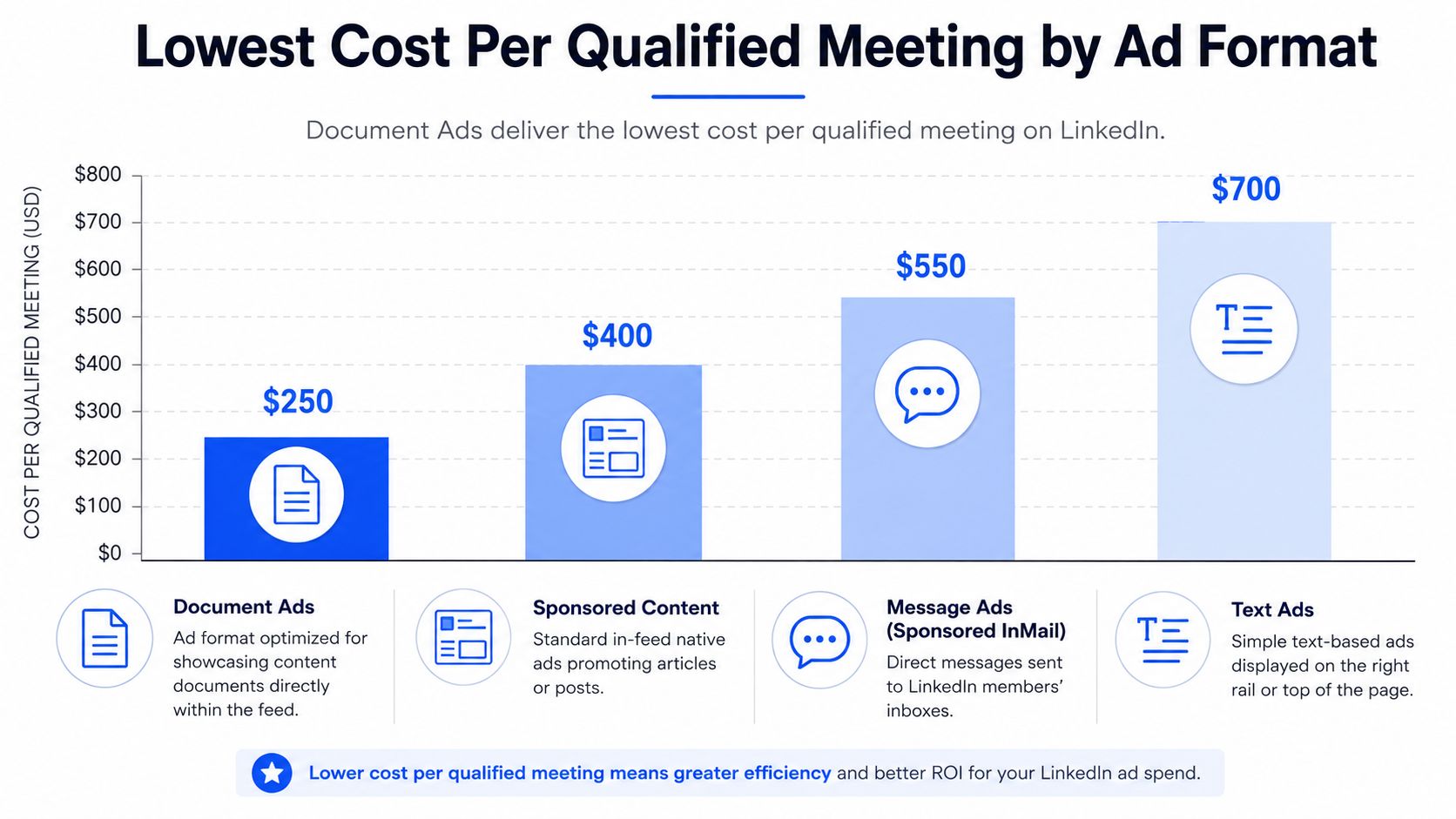
In one comparative campaign, Document Ads produced €52 CPL with a 14% qualification rate, which translated to €371 CPQM. Single-image Sponsored Content landed at €98 CPL and 11% qualification, or €891 CPQM. Video came in at €124 CPL and 9% qualification, or €1,378 CPQM. Carousel ads were €82 CPL and 12% qualification, or €683 CPQM. Message Ads looked cheap on response, €38 cost per response, but converted weakly enough that effective cost per meeting hit €950.
Why Document Ads win right now
The format matches how serious B2B buyers consume information on LinkedIn. A strong document lets you package a framework, benchmark summary, operating checklist, or market brief directly inside the feed. That creates better intent than an image that asks for trust before delivering substance.
LinkedIn's recent algorithm changes also matter. Zapier's analysis of LinkedIn advertising costs notes that relevance-driven delivery and AI-suggested creative tweaks can compress CPM and CPC when relevance is strong, while generic messaging can inflate costs. That lines up with what shows up in active campaigns. Better relevance lowers waste. More specific messaging improves the economics, even when the audience is narrow.
A quick visual breakdown helps:
What usually fails with other formats
Video is usually overrated in B2B demand gen. It can work for founder-led thought leadership or product walkthroughs, but as a default lead format it often costs more and qualifies worse. Single-image ads are flexible, but they rarely carry enough value on their own unless the copy is unusually sharp.
Message Ads are useful in one place. Retargeting. They're weak as a cold prospecting default because inbox attention is expensive and low-commitment replies can mislead the team.
Use this decision filter:
Pick Document Ads first when you have a real asset, a clear functional pain point, and an ICP that consumes educational content.
Use single-image ads when the message is already proven and the click path is simple.
Use Message Ads carefully for warm segments, event invites, or high-engagement retargeting pools.
Skip video as the starting point unless the product needs visual explanation.
If the document is thin, the format advantage disappears fast.
The asset itself has to be worth the click. A three-page brochure won't do it. A serious operator guide, benchmark pack, or functional framework usually will. If you need a practical reference for building around the channel, this LinkedIn ads guide for B2B operators is a good companion.
How to adjust bidding when your costs are too high
A campaign can look expensive in Campaign Manager and still be fine in the pipeline report. I have seen accounts with painful CPCs produce strong revenue because the traffic turned into qualified meetings. I have also seen "efficient" campaigns with low CPL stall out because sales would not touch the leads.
That is why bid changes come after diagnosis.

Start with diagnosis, not bid changes
The first question is simple. Which cost is too high?
If CPQM is healthy, I usually leave bidding alone even when CPC looks ugly. If CPQM is inflated, the fix depends on where the conversion chain is breaking.
What looks expensive | What it usually means | First move |
|---|---|---|
Clicks cost too much | Audience is too tight, creative is too broad, or relevance is weak | Broaden the audience slightly and rewrite the ad around one pain point |
Leads cost too much | The offer is weak or the form and landing flow create friction | Change the offer, shorten the path, and check form completion rate |
Meetings cost too much | Lead quality is weak, follow-up is slow, or both | Tighten qualification and review SDR speed to lead |
This is the practical order. Audience, offer, handoff, then bid.
Teams get into trouble when they use bidding to compensate for a bad offer. Lowering the bid does not fix a weak asset. Raising the bid does not fix poor qualification. It just changes how aggressively LinkedIn buys traffic.
When automated bidding should be the default
Automated bidding is the right starting point for most B2B accounts. It works best when the campaign has enough conversion signal, the audience is not tiny, and the objective matches the action you want.
Manual bidding earns its place in narrower situations. I use it when the audience is small, when delivery is drifting into weak placements, or when we already know the account's range and want tighter cost control. Even then, I set it carefully and watch qualified meeting volume, not just top-of-funnel costs.
Use this sequence before you touch bids:
Check the campaign objective. Lead Gen Forms, Website Conversions, and Engagement train the system differently.
Look for audience overlap. Two campaigns hitting the same buying committee can push your own costs up.
Refresh the ad before adjusting the bid. Creative fatigue shows up fast on LinkedIn, especially in small B2B audiences.
Review the offer. A benchmark report, calculator, or teardown usually beats a generic "book a demo" ask to cold traffic.
Only then test bidding. Change one variable at a time and give it enough spend to learn.
For a stronger offer structure, this B2B lead generation campaign framework is a useful reference.
How to make bid changes without creating noise
Do not change bids every day. That ruins the read on what improved.
A cleaner approach is to hold audience and creative steady, then test one bidding change across a fixed window. Track spend, leads, qualified meetings, and pipeline created. If the bid lowers CPC but CPQM gets worse, the test failed. Cheap traffic that sales rejects is still expensive.
One more point gets missed often. Sales follow-up speed can make bidding look broken when the underlying issue is operational. If inbound leads wait a day for outreach, meeting rates drop and CPQM climbs. The media team keeps tweaking bids while the actual leak sits in the handoff.
Bad structure with manual bidding is still bad structure. Good structure with a disciplined test plan gives you useful answers fast.
Your next step audit your campaign structure this Friday
Open Campaign Manager this Friday and audit every active LinkedIn campaign against a simple three-part structure. Most underperforming accounts aren't missing clicks. They're missing stages.
If all you have is cold conversion pressure, the economics usually break. If all you have is awareness content, the pipeline stalls. The fix is to map the account against awareness, conversion, and nurture, then see what's absent.
Run the three-part audit
Start with a sheet or a CRM view. One row per campaign. Then tag each campaign by role in the system.
Awareness layer: thought leadership, category framing, problem education, event build-up
Conversion layer: demo ask, consultation ask, document capture, direct response offer
Nurture layer: retargeting, post-engagement proof, case material, high-intent follow-up
If one of those layers doesn't exist, that's your first bottleneck.
Then add four columns:
Audit column | What to record |
|---|---|
Audience | Job function, seniority, geography, company size |
Offer | What the ad is actually asking for |
Conversion event | Lead, meeting booked, meeting held, or opportunity |
Follow-up owner | Sales, marketing, automation, or shared |
That last column matters more than is commonly recognized. A good LinkedIn campaign with weak follow-up still loses.
What to change next week
Pick one missing layer and build it. Don't rebuild the whole account at once.
If you already have prospecting and no nurture, launch a retargeting sequence. If you have document downloads and no meeting conversion path, add a sharper bottom-funnel offer. If you have direct demo asks and no audience warming, publish founder or operator-led content before asking cold buyers to convert.
A lot of teams also need to tighten handoff rules between ads and outbound. LinkedIn works better when it sits inside a broader demand system with Sales Navigator, Apollo, Clay, Lemlist, Smartlead, Instantly, or HeyReach doing the follow-up and enrichment around it. Paid attention becomes pipeline when the routing is clear.
For campaign architecture examples, review this lead generation campaign structure and compare it against what's live now. By Monday, you should know whether your issue is missing stages, weak offers, or bad measurement.
Grou helps B2B teams in iGaming, SaaS, manufacturing, legal tech, and pharma build pipeline systems where LinkedIn, outbound, and reporting work as one revenue engine. Our method is simple, structure turns attention into pipeline through one message, one target list, one follow-up system, and one reporting line tied to qualified meetings and revenue.
Your LinkedIn Ads dashboard says the campaign is alive. Clicks are coming in, spend is pacing, forms are trickling through, and sales still says pipeline feels light. That's the normal failure mode with LinkedIn advertising costs. The front-end numbers look explainable, but the revenue math doesn't hold.
Average LinkedIn ad costs are only orientation, not a budget model, because targeting and seniority change them fast.
CPC and CPL are weak planning metrics if you don't connect them to qualified meetings and revenue.
Document Ads are the default format to test first when you care about cost-efficient qualified conversations.
Bidding is a secondary lever. Audience, creative, offer, and structure decide most outcomes.
Table of Contents
Your LinkedIn ads aren't working because you're tracking the wrong costs
The ad format that delivers the lowest cost per qualified meeting
Your LinkedIn ads aren't working because you're tracking the wrong costs
Many advertisers still judge LinkedIn advertising costs with the wrong scoreboard. They look at CPC, argue about CPL, then wonder why Salesforce or HubSpot isn't showing enough qualified pipeline. The problem usually isn't that LinkedIn is “too expensive.” The problem is that the campaign was measured at the click or lead layer instead of the meeting and revenue layer.
For planning, broad market references help a little. In 2025, LinkedIn's average CPC was around $6.20 and average CPM around $37.90, with many B2B advertisers planning for $5 to $8 CPC and $30 to $40+ CPM in core markets, according to LinkedIn advertising benchmark data. Useful context, yes. Useful budget model, no.
Cheap leads usually get praised too early
A low CPL often means lower-friction intent. That can work for audience building, but it often collapses when SDRs or AEs try to convert those names into meetings. A form fill is not pipeline. A content download is definitely not pipeline.
Practical rule: Track cost per qualified meeting before you celebrate cost per lead.
That's why serious B2B teams should anchor on CPQM, not just CPL. If your finance lead asks whether LinkedIn is working, “we got clicks cheaper this month” isn't an answer. “We produced qualified meetings at an acceptable cost against deal size” is the answer.
You also need attribution that reflects reality. Paid social rarely closes deals alone. It creates demand, retargeting lift, and account familiarity that sales and outbound convert later. If your reporting still treats paid social as a last-click channel, fix that first with a multi-touch attribution model built for B2B buying journeys.
What to watch instead
Use a simple metric stack:
Front-end efficiency: CPC, CTR, landing page conversion
Mid-funnel quality: lead-to-meeting rate, meeting-held rate
Pipeline output: CPQM, opportunity rate, cost per closed deal
If you only manage the first line, you'll keep buying activity. If you manage all three, LinkedIn turns into a pipeline channel.
The real cost benchmarks for B2B in 2026
LinkedIn advertising costs are high enough that vague budgeting gets punished fast. You need working ranges, but you also need to know what moves them. The platform's average won't tell you what your ICP costs to reach.
Use averages as orientation, not targets
Global benchmark data for 2026 puts average LinkedIn CPC across B2B campaigns at around $5.50, with CPM averaging about $33 to $34 globally, based on Stackmatix LinkedIn Ads cost benchmarks. That same data shows how misleading the average is. Senior decision-maker targeting can push CPC to $6.40 or higher, while junior targeting can bring it closer to $4.40.
That tracks with day-to-day campaign reality. If you're targeting SaaS managers to VPs, costs are usually manageable. If you're chasing C-suite buyers in legal tech, pharma, or enterprise iGaming, you're paying for scarcity and competition.
A practical approach to this:
Audience condition | Cost effect | Why it happens |
|---|---|---|
Broad functional targeting | Lower relative CPC | More inventory, less auction pressure |
Seniority-heavy targeting | Higher relative CPC | More bidders chasing fewer profiles |
Narrow geo plus niche titles | Higher volatility | Delivery gets thin, bids get less forgiving |
Mid-market ICP with clear pain | Better downstream efficiency | Enough scale for learning, enough relevance for conversion |
If your team needs a shared definition for the metric that matters, use this cost per qualified meeting reference as the reporting baseline.
The four levers that set your actual costs
Most cost problems come from structure, not platform mystery. Four levers usually explain the spread.
Audience seniority: C-suite and VP audiences cost more because more B2B advertisers want them, and there are fewer of them.
Targeting granularity: Extra filters can improve quality, but they also thin delivery and raise auction pressure.
Creative relevance: Strong message-to-audience fit usually pulls costs down. Generic copy usually does the opposite.
Market reality: US and core Western markets tend to be more expensive than less crowded regions, but cheaper clicks don't always produce better meetings.
Teams that budget LinkedIn from average CPC alone usually underfund the actual meeting target.
One more point gets missed. The same campaign logic should apply across channels. If your team already uses insights on Meta ad tracking to tie spend to conversion quality, apply that same discipline to LinkedIn. The reporting model matters as much as the media buy.
This is the budgeting checklist I'd use before launch:
Define the precise conversion event. Meeting booked, meeting held, or qualified opportunity.
Break out audiences by seniority and function. Don't lump IT directors and operations managers together.
Separate prospecting from retargeting. Mixed reporting obscures where costs are effective.
Budget by audience quality, not by channel average. LinkedIn punishes generic planning.
A real B2B campaign budget and its 17x ROI
A recent campaign for a B2B SaaS company in the iGaming compliance space shows what LinkedIn advertising costs look like when the structure is right. The account targeted compliance directors, heads of risk, and CCO-level buyers across Europe and LatAm around ICE Barcelona and the regulatory cycle that followed.
This was not a “set up one campaign and hope” motion. It was built in phases, with awareness before the event, event-specific conversion prompts during the event window, and post-event nurture after.
How the budget was allocated
The total budget was €18,400 over 90 days. That included €9,200 on Sponsored Content, €4,800 on Message Ads, €2,400 on Sponsored Content retargeting, and €2,000 reserved for creative production and testing.
The audience size after filtering was roughly 4,200 prospects. Tight enough to stay relevant. Large enough to support sequencing.
Metric | Value |
|---|---|
Total budget | €18,400 |
Campaign window | 90 days |
Sponsored Content | €9,200 |
Message Ads | €4,800 |
Retargeting layer | €2,400 |
Creative production and testing | €2,000 |
Estimated audience size | roughly 4,200 prospects |
Total impressions | roughly 1.8 million |
Total clicks | roughly 14,200 |
Average CPC | €11.40 |
Leads | 187 |
Average CPL | €98 |
Qualified meetings booked | 28 |
Cost per qualified meeting | €657 |
Show rate | 79% |
Meetings held | 22 |
Qualified opportunities | 14 |
Closed-won deals within 6 months | 4 |
Closed revenue attributable | roughly €312,000 ARR |
Active late-stage pipeline after 6 months | roughly €240,000 |
If you want a fast way to sense-check how social spend maps to return, this measure your social media impact calculator is useful as a rough companion, especially for internal discussions before finance asks harder questions.
Why the economics worked
The campaign produced roughly 17x ROI on closed revenue alone, based on €312,000 in attributable ARR from €18,400 spend. Including active late-stage pipeline, the adjusted return looked even stronger.
What mattered most wasn't the CPC. It was the structure.
Event timing created urgency. Buyers already had a reason to pay attention.
The audience was specific. Compliance and risk leaders in iGaming are a defined buying group.
The campaign had sequence. Awareness came first, then meeting asks, then nurture.
Deal size supported the CPQM. A €657 cost per qualified meeting is acceptable when average deal economics are strong.
A high CPQM is not a problem by itself. It becomes a problem when ACV, qualification, and close rate can't support it.
There are caveats. This return is above normal. Attribution in multi-touch B2B is never perfect. The campaign also took time to mature. If someone had judged it too early, they would have killed a profitable system before the revenue showed up.
That's why campaign review should include more than lead counts. Track the full funnel in one place, whether that's HubSpot, Salesforce, or a RevOps layer tied back to paid spend. For a clean KPI framework, this lead generation KPI reference is a useful checklist.
The ad format that delivers the lowest cost per qualified meeting
Document Ads are the default winner. If the goal is qualified meetings, not cheap vanity conversions, this is the LinkedIn format I'd test first in most B2B programs.
In one comparative campaign, Document Ads produced €52 CPL with a 14% qualification rate, which translated to €371 CPQM. Single-image Sponsored Content landed at €98 CPL and 11% qualification, or €891 CPQM. Video came in at €124 CPL and 9% qualification, or €1,378 CPQM. Carousel ads were €82 CPL and 12% qualification, or €683 CPQM. Message Ads looked cheap on response, €38 cost per response, but converted weakly enough that effective cost per meeting hit €950.
Why Document Ads win right now
The format matches how serious B2B buyers consume information on LinkedIn. A strong document lets you package a framework, benchmark summary, operating checklist, or market brief directly inside the feed. That creates better intent than an image that asks for trust before delivering substance.
LinkedIn's recent algorithm changes also matter. Zapier's analysis of LinkedIn advertising costs notes that relevance-driven delivery and AI-suggested creative tweaks can compress CPM and CPC when relevance is strong, while generic messaging can inflate costs. That lines up with what shows up in active campaigns. Better relevance lowers waste. More specific messaging improves the economics, even when the audience is narrow.
A quick visual breakdown helps:
What usually fails with other formats
Video is usually overrated in B2B demand gen. It can work for founder-led thought leadership or product walkthroughs, but as a default lead format it often costs more and qualifies worse. Single-image ads are flexible, but they rarely carry enough value on their own unless the copy is unusually sharp.
Message Ads are useful in one place. Retargeting. They're weak as a cold prospecting default because inbox attention is expensive and low-commitment replies can mislead the team.
Use this decision filter:
Pick Document Ads first when you have a real asset, a clear functional pain point, and an ICP that consumes educational content.
Use single-image ads when the message is already proven and the click path is simple.
Use Message Ads carefully for warm segments, event invites, or high-engagement retargeting pools.
Skip video as the starting point unless the product needs visual explanation.
If the document is thin, the format advantage disappears fast.
The asset itself has to be worth the click. A three-page brochure won't do it. A serious operator guide, benchmark pack, or functional framework usually will. If you need a practical reference for building around the channel, this LinkedIn ads guide for B2B operators is a good companion.
How to adjust bidding when your costs are too high
A campaign can look expensive in Campaign Manager and still be fine in the pipeline report. I have seen accounts with painful CPCs produce strong revenue because the traffic turned into qualified meetings. I have also seen "efficient" campaigns with low CPL stall out because sales would not touch the leads.
That is why bid changes come after diagnosis.
Start with diagnosis, not bid changes
The first question is simple. Which cost is too high?
If CPQM is healthy, I usually leave bidding alone even when CPC looks ugly. If CPQM is inflated, the fix depends on where the conversion chain is breaking.
What looks expensive | What it usually means | First move |
|---|---|---|
Clicks cost too much | Audience is too tight, creative is too broad, or relevance is weak | Broaden the audience slightly and rewrite the ad around one pain point |
Leads cost too much | The offer is weak or the form and landing flow create friction | Change the offer, shorten the path, and check form completion rate |
Meetings cost too much | Lead quality is weak, follow-up is slow, or both | Tighten qualification and review SDR speed to lead |
This is the practical order. Audience, offer, handoff, then bid.
Teams get into trouble when they use bidding to compensate for a bad offer. Lowering the bid does not fix a weak asset. Raising the bid does not fix poor qualification. It just changes how aggressively LinkedIn buys traffic.
When automated bidding should be the default
Automated bidding is the right starting point for most B2B accounts. It works best when the campaign has enough conversion signal, the audience is not tiny, and the objective matches the action you want.
Manual bidding earns its place in narrower situations. I use it when the audience is small, when delivery is drifting into weak placements, or when we already know the account's range and want tighter cost control. Even then, I set it carefully and watch qualified meeting volume, not just top-of-funnel costs.
Use this sequence before you touch bids:
Check the campaign objective. Lead Gen Forms, Website Conversions, and Engagement train the system differently.
Look for audience overlap. Two campaigns hitting the same buying committee can push your own costs up.
Refresh the ad before adjusting the bid. Creative fatigue shows up fast on LinkedIn, especially in small B2B audiences.
Review the offer. A benchmark report, calculator, or teardown usually beats a generic "book a demo" ask to cold traffic.
Only then test bidding. Change one variable at a time and give it enough spend to learn.
For a stronger offer structure, this B2B lead generation campaign framework is a useful reference.
How to make bid changes without creating noise
Do not change bids every day. That ruins the read on what improved.
A cleaner approach is to hold audience and creative steady, then test one bidding change across a fixed window. Track spend, leads, qualified meetings, and pipeline created. If the bid lowers CPC but CPQM gets worse, the test failed. Cheap traffic that sales rejects is still expensive.
One more point gets missed often. Sales follow-up speed can make bidding look broken when the underlying issue is operational. If inbound leads wait a day for outreach, meeting rates drop and CPQM climbs. The media team keeps tweaking bids while the actual leak sits in the handoff.
Bad structure with manual bidding is still bad structure. Good structure with a disciplined test plan gives you useful answers fast.
Your next step audit your campaign structure this Friday
Open Campaign Manager this Friday and audit every active LinkedIn campaign against a simple three-part structure. Most underperforming accounts aren't missing clicks. They're missing stages.
If all you have is cold conversion pressure, the economics usually break. If all you have is awareness content, the pipeline stalls. The fix is to map the account against awareness, conversion, and nurture, then see what's absent.
Run the three-part audit
Start with a sheet or a CRM view. One row per campaign. Then tag each campaign by role in the system.
Awareness layer: thought leadership, category framing, problem education, event build-up
Conversion layer: demo ask, consultation ask, document capture, direct response offer
Nurture layer: retargeting, post-engagement proof, case material, high-intent follow-up
If one of those layers doesn't exist, that's your first bottleneck.
Then add four columns:
Audit column | What to record |
|---|---|
Audience | Job function, seniority, geography, company size |
Offer | What the ad is actually asking for |
Conversion event | Lead, meeting booked, meeting held, or opportunity |
Follow-up owner | Sales, marketing, automation, or shared |
That last column matters more than is commonly recognized. A good LinkedIn campaign with weak follow-up still loses.
What to change next week
Pick one missing layer and build it. Don't rebuild the whole account at once.
If you already have prospecting and no nurture, launch a retargeting sequence. If you have document downloads and no meeting conversion path, add a sharper bottom-funnel offer. If you have direct demo asks and no audience warming, publish founder or operator-led content before asking cold buyers to convert.
A lot of teams also need to tighten handoff rules between ads and outbound. LinkedIn works better when it sits inside a broader demand system with Sales Navigator, Apollo, Clay, Lemlist, Smartlead, Instantly, or HeyReach doing the follow-up and enrichment around it. Paid attention becomes pipeline when the routing is clear.
For campaign architecture examples, review this lead generation campaign structure and compare it against what's live now. By Monday, you should know whether your issue is missing stages, weak offers, or bad measurement.
Grou helps B2B teams in iGaming, SaaS, manufacturing, legal tech, and pharma build pipeline systems where LinkedIn, outbound, and reporting work as one revenue engine. Our method is simple, structure turns attention into pipeline through one message, one target list, one follow-up system, and one reporting line tied to qualified meetings and revenue.
Your LinkedIn Ads dashboard says the campaign is alive. Clicks are coming in, spend is pacing, forms are trickling through, and sales still says pipeline feels light. That's the normal failure mode with LinkedIn advertising costs. The front-end numbers look explainable, but the revenue math doesn't hold.
Average LinkedIn ad costs are only orientation, not a budget model, because targeting and seniority change them fast.
CPC and CPL are weak planning metrics if you don't connect them to qualified meetings and revenue.
Document Ads are the default format to test first when you care about cost-efficient qualified conversations.
Bidding is a secondary lever. Audience, creative, offer, and structure decide most outcomes.
Table of Contents
Your LinkedIn ads aren't working because you're tracking the wrong costs
The ad format that delivers the lowest cost per qualified meeting
Your LinkedIn ads aren't working because you're tracking the wrong costs
Many advertisers still judge LinkedIn advertising costs with the wrong scoreboard. They look at CPC, argue about CPL, then wonder why Salesforce or HubSpot isn't showing enough qualified pipeline. The problem usually isn't that LinkedIn is “too expensive.” The problem is that the campaign was measured at the click or lead layer instead of the meeting and revenue layer.
For planning, broad market references help a little. In 2025, LinkedIn's average CPC was around $6.20 and average CPM around $37.90, with many B2B advertisers planning for $5 to $8 CPC and $30 to $40+ CPM in core markets, according to LinkedIn advertising benchmark data. Useful context, yes. Useful budget model, no.
Cheap leads usually get praised too early
A low CPL often means lower-friction intent. That can work for audience building, but it often collapses when SDRs or AEs try to convert those names into meetings. A form fill is not pipeline. A content download is definitely not pipeline.
Practical rule: Track cost per qualified meeting before you celebrate cost per lead.
That's why serious B2B teams should anchor on CPQM, not just CPL. If your finance lead asks whether LinkedIn is working, “we got clicks cheaper this month” isn't an answer. “We produced qualified meetings at an acceptable cost against deal size” is the answer.
You also need attribution that reflects reality. Paid social rarely closes deals alone. It creates demand, retargeting lift, and account familiarity that sales and outbound convert later. If your reporting still treats paid social as a last-click channel, fix that first with a multi-touch attribution model built for B2B buying journeys.
What to watch instead
Use a simple metric stack:
Front-end efficiency: CPC, CTR, landing page conversion
Mid-funnel quality: lead-to-meeting rate, meeting-held rate
Pipeline output: CPQM, opportunity rate, cost per closed deal
If you only manage the first line, you'll keep buying activity. If you manage all three, LinkedIn turns into a pipeline channel.
The real cost benchmarks for B2B in 2026
LinkedIn advertising costs are high enough that vague budgeting gets punished fast. You need working ranges, but you also need to know what moves them. The platform's average won't tell you what your ICP costs to reach.
Use averages as orientation, not targets
Global benchmark data for 2026 puts average LinkedIn CPC across B2B campaigns at around $5.50, with CPM averaging about $33 to $34 globally, based on Stackmatix LinkedIn Ads cost benchmarks. That same data shows how misleading the average is. Senior decision-maker targeting can push CPC to $6.40 or higher, while junior targeting can bring it closer to $4.40.
That tracks with day-to-day campaign reality. If you're targeting SaaS managers to VPs, costs are usually manageable. If you're chasing C-suite buyers in legal tech, pharma, or enterprise iGaming, you're paying for scarcity and competition.
A practical approach to this:
Audience condition | Cost effect | Why it happens |
|---|---|---|
Broad functional targeting | Lower relative CPC | More inventory, less auction pressure |
Seniority-heavy targeting | Higher relative CPC | More bidders chasing fewer profiles |
Narrow geo plus niche titles | Higher volatility | Delivery gets thin, bids get less forgiving |
Mid-market ICP with clear pain | Better downstream efficiency | Enough scale for learning, enough relevance for conversion |
If your team needs a shared definition for the metric that matters, use this cost per qualified meeting reference as the reporting baseline.
The four levers that set your actual costs
Most cost problems come from structure, not platform mystery. Four levers usually explain the spread.
Audience seniority: C-suite and VP audiences cost more because more B2B advertisers want them, and there are fewer of them.
Targeting granularity: Extra filters can improve quality, but they also thin delivery and raise auction pressure.
Creative relevance: Strong message-to-audience fit usually pulls costs down. Generic copy usually does the opposite.
Market reality: US and core Western markets tend to be more expensive than less crowded regions, but cheaper clicks don't always produce better meetings.
Teams that budget LinkedIn from average CPC alone usually underfund the actual meeting target.
One more point gets missed. The same campaign logic should apply across channels. If your team already uses insights on Meta ad tracking to tie spend to conversion quality, apply that same discipline to LinkedIn. The reporting model matters as much as the media buy.
This is the budgeting checklist I'd use before launch:
Define the precise conversion event. Meeting booked, meeting held, or qualified opportunity.
Break out audiences by seniority and function. Don't lump IT directors and operations managers together.
Separate prospecting from retargeting. Mixed reporting obscures where costs are effective.
Budget by audience quality, not by channel average. LinkedIn punishes generic planning.
A real B2B campaign budget and its 17x ROI
A recent campaign for a B2B SaaS company in the iGaming compliance space shows what LinkedIn advertising costs look like when the structure is right. The account targeted compliance directors, heads of risk, and CCO-level buyers across Europe and LatAm around ICE Barcelona and the regulatory cycle that followed.
This was not a “set up one campaign and hope” motion. It was built in phases, with awareness before the event, event-specific conversion prompts during the event window, and post-event nurture after.
How the budget was allocated
The total budget was €18,400 over 90 days. That included €9,200 on Sponsored Content, €4,800 on Message Ads, €2,400 on Sponsored Content retargeting, and €2,000 reserved for creative production and testing.
The audience size after filtering was roughly 4,200 prospects. Tight enough to stay relevant. Large enough to support sequencing.
Metric | Value |
|---|---|
Total budget | €18,400 |
Campaign window | 90 days |
Sponsored Content | €9,200 |
Message Ads | €4,800 |
Retargeting layer | €2,400 |
Creative production and testing | €2,000 |
Estimated audience size | roughly 4,200 prospects |
Total impressions | roughly 1.8 million |
Total clicks | roughly 14,200 |
Average CPC | €11.40 |
Leads | 187 |
Average CPL | €98 |
Qualified meetings booked | 28 |
Cost per qualified meeting | €657 |
Show rate | 79% |
Meetings held | 22 |
Qualified opportunities | 14 |
Closed-won deals within 6 months | 4 |
Closed revenue attributable | roughly €312,000 ARR |
Active late-stage pipeline after 6 months | roughly €240,000 |
If you want a fast way to sense-check how social spend maps to return, this measure your social media impact calculator is useful as a rough companion, especially for internal discussions before finance asks harder questions.
Why the economics worked
The campaign produced roughly 17x ROI on closed revenue alone, based on €312,000 in attributable ARR from €18,400 spend. Including active late-stage pipeline, the adjusted return looked even stronger.
What mattered most wasn't the CPC. It was the structure.
Event timing created urgency. Buyers already had a reason to pay attention.
The audience was specific. Compliance and risk leaders in iGaming are a defined buying group.
The campaign had sequence. Awareness came first, then meeting asks, then nurture.
Deal size supported the CPQM. A €657 cost per qualified meeting is acceptable when average deal economics are strong.
A high CPQM is not a problem by itself. It becomes a problem when ACV, qualification, and close rate can't support it.
There are caveats. This return is above normal. Attribution in multi-touch B2B is never perfect. The campaign also took time to mature. If someone had judged it too early, they would have killed a profitable system before the revenue showed up.
That's why campaign review should include more than lead counts. Track the full funnel in one place, whether that's HubSpot, Salesforce, or a RevOps layer tied back to paid spend. For a clean KPI framework, this lead generation KPI reference is a useful checklist.
The ad format that delivers the lowest cost per qualified meeting
Document Ads are the default winner. If the goal is qualified meetings, not cheap vanity conversions, this is the LinkedIn format I'd test first in most B2B programs.
In one comparative campaign, Document Ads produced €52 CPL with a 14% qualification rate, which translated to €371 CPQM. Single-image Sponsored Content landed at €98 CPL and 11% qualification, or €891 CPQM. Video came in at €124 CPL and 9% qualification, or €1,378 CPQM. Carousel ads were €82 CPL and 12% qualification, or €683 CPQM. Message Ads looked cheap on response, €38 cost per response, but converted weakly enough that effective cost per meeting hit €950.
Why Document Ads win right now
The format matches how serious B2B buyers consume information on LinkedIn. A strong document lets you package a framework, benchmark summary, operating checklist, or market brief directly inside the feed. That creates better intent than an image that asks for trust before delivering substance.
LinkedIn's recent algorithm changes also matter. Zapier's analysis of LinkedIn advertising costs notes that relevance-driven delivery and AI-suggested creative tweaks can compress CPM and CPC when relevance is strong, while generic messaging can inflate costs. That lines up with what shows up in active campaigns. Better relevance lowers waste. More specific messaging improves the economics, even when the audience is narrow.
A quick visual breakdown helps:
What usually fails with other formats
Video is usually overrated in B2B demand gen. It can work for founder-led thought leadership or product walkthroughs, but as a default lead format it often costs more and qualifies worse. Single-image ads are flexible, but they rarely carry enough value on their own unless the copy is unusually sharp.
Message Ads are useful in one place. Retargeting. They're weak as a cold prospecting default because inbox attention is expensive and low-commitment replies can mislead the team.
Use this decision filter:
Pick Document Ads first when you have a real asset, a clear functional pain point, and an ICP that consumes educational content.
Use single-image ads when the message is already proven and the click path is simple.
Use Message Ads carefully for warm segments, event invites, or high-engagement retargeting pools.
Skip video as the starting point unless the product needs visual explanation.
If the document is thin, the format advantage disappears fast.
The asset itself has to be worth the click. A three-page brochure won't do it. A serious operator guide, benchmark pack, or functional framework usually will. If you need a practical reference for building around the channel, this LinkedIn ads guide for B2B operators is a good companion.
How to adjust bidding when your costs are too high
A campaign can look expensive in Campaign Manager and still be fine in the pipeline report. I have seen accounts with painful CPCs produce strong revenue because the traffic turned into qualified meetings. I have also seen "efficient" campaigns with low CPL stall out because sales would not touch the leads.
That is why bid changes come after diagnosis.
Start with diagnosis, not bid changes
The first question is simple. Which cost is too high?
If CPQM is healthy, I usually leave bidding alone even when CPC looks ugly. If CPQM is inflated, the fix depends on where the conversion chain is breaking.
What looks expensive | What it usually means | First move |
|---|---|---|
Clicks cost too much | Audience is too tight, creative is too broad, or relevance is weak | Broaden the audience slightly and rewrite the ad around one pain point |
Leads cost too much | The offer is weak or the form and landing flow create friction | Change the offer, shorten the path, and check form completion rate |
Meetings cost too much | Lead quality is weak, follow-up is slow, or both | Tighten qualification and review SDR speed to lead |
This is the practical order. Audience, offer, handoff, then bid.
Teams get into trouble when they use bidding to compensate for a bad offer. Lowering the bid does not fix a weak asset. Raising the bid does not fix poor qualification. It just changes how aggressively LinkedIn buys traffic.
When automated bidding should be the default
Automated bidding is the right starting point for most B2B accounts. It works best when the campaign has enough conversion signal, the audience is not tiny, and the objective matches the action you want.
Manual bidding earns its place in narrower situations. I use it when the audience is small, when delivery is drifting into weak placements, or when we already know the account's range and want tighter cost control. Even then, I set it carefully and watch qualified meeting volume, not just top-of-funnel costs.
Use this sequence before you touch bids:
Check the campaign objective. Lead Gen Forms, Website Conversions, and Engagement train the system differently.
Look for audience overlap. Two campaigns hitting the same buying committee can push your own costs up.
Refresh the ad before adjusting the bid. Creative fatigue shows up fast on LinkedIn, especially in small B2B audiences.
Review the offer. A benchmark report, calculator, or teardown usually beats a generic "book a demo" ask to cold traffic.
Only then test bidding. Change one variable at a time and give it enough spend to learn.
For a stronger offer structure, this B2B lead generation campaign framework is a useful reference.
How to make bid changes without creating noise
Do not change bids every day. That ruins the read on what improved.
A cleaner approach is to hold audience and creative steady, then test one bidding change across a fixed window. Track spend, leads, qualified meetings, and pipeline created. If the bid lowers CPC but CPQM gets worse, the test failed. Cheap traffic that sales rejects is still expensive.
One more point gets missed often. Sales follow-up speed can make bidding look broken when the underlying issue is operational. If inbound leads wait a day for outreach, meeting rates drop and CPQM climbs. The media team keeps tweaking bids while the actual leak sits in the handoff.
Bad structure with manual bidding is still bad structure. Good structure with a disciplined test plan gives you useful answers fast.
Your next step audit your campaign structure this Friday
Open Campaign Manager this Friday and audit every active LinkedIn campaign against a simple three-part structure. Most underperforming accounts aren't missing clicks. They're missing stages.
If all you have is cold conversion pressure, the economics usually break. If all you have is awareness content, the pipeline stalls. The fix is to map the account against awareness, conversion, and nurture, then see what's absent.
Run the three-part audit
Start with a sheet or a CRM view. One row per campaign. Then tag each campaign by role in the system.
Awareness layer: thought leadership, category framing, problem education, event build-up
Conversion layer: demo ask, consultation ask, document capture, direct response offer
Nurture layer: retargeting, post-engagement proof, case material, high-intent follow-up
If one of those layers doesn't exist, that's your first bottleneck.
Then add four columns:
Audit column | What to record |
|---|---|
Audience | Job function, seniority, geography, company size |
Offer | What the ad is actually asking for |
Conversion event | Lead, meeting booked, meeting held, or opportunity |
Follow-up owner | Sales, marketing, automation, or shared |
That last column matters more than is commonly recognized. A good LinkedIn campaign with weak follow-up still loses.
What to change next week
Pick one missing layer and build it. Don't rebuild the whole account at once.
If you already have prospecting and no nurture, launch a retargeting sequence. If you have document downloads and no meeting conversion path, add a sharper bottom-funnel offer. If you have direct demo asks and no audience warming, publish founder or operator-led content before asking cold buyers to convert.
A lot of teams also need to tighten handoff rules between ads and outbound. LinkedIn works better when it sits inside a broader demand system with Sales Navigator, Apollo, Clay, Lemlist, Smartlead, Instantly, or HeyReach doing the follow-up and enrichment around it. Paid attention becomes pipeline when the routing is clear.
For campaign architecture examples, review this lead generation campaign structure and compare it against what's live now. By Monday, you should know whether your issue is missing stages, weak offers, or bad measurement.
Grou helps B2B teams in iGaming, SaaS, manufacturing, legal tech, and pharma build pipeline systems where LinkedIn, outbound, and reporting work as one revenue engine. Our method is simple, structure turns attention into pipeline through one message, one target list, one follow-up system, and one reporting line tied to qualified meetings and revenue.
Pipeline OS Newsletter
Build qualified pipeline
Get weekly tactics to generate demand, improve lead quality, and book more meetings.





Trusted by industry leaders
Trusted by industry leaders
Trusted by industry leaders
Ready to build qualified pipeline?
Ready to build qualified pipeline?
Ready to build qualified pipeline?
Book a call to see if we're the right fit, or take the 2-minute quiz to get a clear starting point.
Book a call to see if we're the right fit, or take the 2-minute quiz to get a clear starting point.
Book a call to see if we're the right fit, or take the 2-minute quiz to get a clear starting point.
" height="30.21639343089746px" id="hfGbXmQR2" width="30.216393430897455px"/></svg>)
Copyright © 2026 – All Right Reserved
Copyright © 2026 – All Right Reserved
Copyright © 2026 – All Right Reserved