%22%3E%3C/path%3E%3Cpath d=%22M 63.072 7.554 C 62.258 8.022 61.577 8.689 61.092 9.493 L 61.092 7.076 L 57.158 7.076 L 57.158 22.64 L 61.089 22.64 L 61.089 14.888 C 61.089 13.446 61.403 12.434 62.03 11.853 C 62.818 11.218 63.818 10.907 64.826 10.982 L 65.868 10.982 L 65.868 6.851 C 64.891 6.834 63.926 7.076 63.073 7.554 Z%22 fill=%22rgb(17,17,17)%22%3E%3C/path%3E%3Cpath d=%22M 78.916 7.82 C 76.363 6.49 73.321 6.49 70.768 7.82 C 69.562 8.473 68.564 9.451 67.888 10.644 C 67.167 11.931 66.803 13.387 66.834 14.862 C 66.804 16.332 67.157 17.785 67.86 19.077 C 68.515 20.267 69.494 21.246 70.684 21.901 C 71.924 22.576 73.318 22.92 74.73 22.898 C 76.164 22.918 77.58 22.575 78.846 21.901 C 80.062 21.247 81.073 20.27 81.768 19.077 C 82.506 17.797 82.88 16.339 82.85 14.862 C 82.88 13.389 82.517 11.934 81.797 10.647 C 81.12 9.455 80.122 8.477 78.917 7.824 M 78.803 14.862 C 78.829 15.739 78.636 16.608 78.241 17.391 C 77.903 18.046 77.38 18.588 76.738 18.95 C 76.124 19.293 75.432 19.472 74.729 19.47 C 73.668 19.497 72.648 19.061 71.934 18.276 C 71.139 17.323 70.741 16.1 70.823 14.862 C 70.741 13.62 71.149 12.395 71.959 11.45 C 72.687 10.667 73.715 10.233 74.783 10.256 C 75.859 10.236 76.894 10.67 77.635 11.45 C 78.464 12.387 78.884 13.616 78.801 14.864%22 fill=%22rgb(17,17,17)%22%3E%3C/path%3E%3Cpath d=%22M 95.906 7.076 L 95.906 15.646 C 95.975 16.68 95.643 17.701 94.979 18.498 C 94.311 19.184 93.379 19.547 92.422 19.495 C 91.475 19.544 90.553 19.18 89.894 18.498 C 89.23 17.701 88.898 16.68 88.967 15.646 L 88.967 7.076 L 85.033 7.076 L 85.033 16.207 C 85 17.449 85.275 18.68 85.834 19.79 C 86.327 20.75 87.095 21.542 88.039 22.065 C 89.033 22.594 90.145 22.861 91.271 22.838 C 92.188 22.847 93.095 22.65 93.926 22.263 C 94.708 21.905 95.388 21.36 95.906 20.675 L 95.906 22.645 L 99.865 22.645 L 99.865 7.076 Z%22 fill=%22rgb(17,17,17)%22%3E%3C/path%3E%3Cpath d=%22M 4.513 15.626 C 4.511 10.815 7.606 6.549 12.181 5.059 C 16.756 3.57 21.77 5.195 24.601 9.086 L 27.816 5.87 C 24.074 1.186 17.981 -0.943 12.137 0.393 C 6.292 1.728 1.728 6.292 0.393 12.137 C -0.943 17.981 1.186 24.074 5.87 27.816 L 9.085 24.601 C 6.214 22.512 4.515 19.177 4.513 15.626%22 fill=%22rgb(32,62,235)%22%3E%3C/path%3E%3Cpath d=%22M 17.114 14.343 L 13.354 18.01 L 13.354 18.026 L 21.071 18.026 L 11.412 27.609 L 17.389 27.609 L 23.999 21.081 L 23.999 28.316 L 24.005 28.316 L 27.967 24.393 L 27.967 14.343 Z%22 fill=%22rgb(32,62,235)%22%3E%3C/path%3E%3C/g%3E%3C/svg%3E) ×
× ××
××›
›
›
›
What Is Lead Qualification and How to Build It Right
What Is Lead Qualification and How to Build It Right
What Is Lead Qualification and How to Build It Right
What Is Lead Qualification and How to Build It Right
What Is Lead Qualification and How to Build It Right
What Is Lead Qualification and How to Build It Right
Author
Aljaz Peklaj

Lead qualification is the routing rule that decides whether a lead gets booked, nurtured, recycled, or disqualified based on fit plus intent. In B2B, that decision controls whether pipeline stays clean or gets clogged with meetings that never had a real chance.
Qualification is a routing system, not a label, and it should end in a clear next step.
Framework choice depends on deal shape, with BANT, CHAMP, MEDDIC, FAINT, and GPCTBA/C&I each fitting different buying motions.
Scoring only works with thresholds, fast routing, and a written handoff between marketing, sales, and RevOps.
MQL-to-SQL is the cleanest diagnostic, because it shows whether your rules are too loose or too strict.
Structure turns attention into pipeline, which is why qualification has to be operational, not theoretical.
If your team is seeing too many demos that go nowhere, this is usually the fault line. Sales is burning hours on weak fit, marketing is celebrating volume, and RevOps is stuck explaining why the CRM looks busy but the forecast doesn't.
One useful lens is how qualification supports the broader content and demand engine. If you're already thinking about B2B SEO for sales pipeline, qualification is the part that decides whether the traffic you earn has any chance of becoming revenue. The same logic applies to outbound, referrals, events, and partner traffic. Attention only matters if the routing rules are tight enough to separate signal from noise.
Table of Contents
Common pitfalls that break qualification and how to fix them
Implementing a qualification system that sales will actually use
Introduction
A rep books six demos on Monday. By Friday, four are dead. That is a routing problem, and it usually shows up when qualification gets treated like a checkbox instead of a decision system.
Lead qualification should answer one question, what happens next. The answer should route the lead to book, nurture, recycle, or disqualify. That choice depends on fit, intent, and how fast sales can act on it.
The hard part is getting marketing, sales, and RevOps to accept the same bar. If the teams score leads differently, the CRM turns into a blame machine. If RevOps does not enforce the handoff, the rules drift back into opinion.
For teams already working on B2B SEO for sales pipeline, qualification is the step that decides whether earned attention turns into revenue or gets parked for later.
Clear thresholds keep the system honest. Without them, sales spends time on weak-fit meetings, marketing celebrates volume, and RevOps is left explaining why the forecast never matches the pipeline.
What lead qualification really means in a B2B pipeline
A lead comes in from a form fill, a webinar, or a list upload. The key question is what happens next. Qualification is the routing layer that sends that lead to book, nurture, recycle, or disqualify, based on fit, intent, and the speed of the handoff.
Fit, intent, and the next action
Qualification behaves like a router with a filter in front of it. Fit answers whether the account belongs in your market, intent shows whether timing looks real, and engagement shows whether the person is paying attention. Those signals only matter when they drive a specific next step.
A high-engagement lead can still be a bad sales lead if the person is researching a problem rather than buying one. A low-engagement lead can still deserve a rep touch if the account matches your ICP and the trigger is strong enough. For a second perspective on the mechanics, this guide on how to build a lead qualification process covers the process side in more detail.
Practical rule: qualification ends in action. If the system does not book, nurture, recycle, or disqualify, it is still just scoring.
The MQL-to-SQL handoff is where qualification usually breaks. That is the point where marketing's definition meets sales' acceptance. One benchmark chain shows only 13% of MQLs become SQLs, which is why qualification often becomes the sharpest drop-off in the revenue system lead-conversion benchmark.
Where qualification sits in the pipeline
Qualification sits between capture and opportunity creation. It should filter form fills, enrich records, check ownership, and push the lead into the right path before a rep spends time on it. That path can be a direct calendar booking, a nurture sequence, a recycle bucket, or a disqualification step.
The routing choice changes who touches the lead and when. If a lead goes to sales too early, reps waste time on weak-fit meetings. If it moves too late, intent cools off and the account goes quiet.
A useful reference point for the fit side is the internal guide on ideal customer profile definition. The ICP sets the boundary. Qualification decides what to do once a lead crosses it.
Qualification became more systematic as teams added scoring, intent data, and faster routing. Adoption still varies. Some benchmark summaries note that only 39% of businesses use lead qualification criteria, and 44% use lead scoring lead-quality benchmark. That gap explains why so many teams still rely on judgment instead of clear rules.
Qualification frameworks compared and when to use each
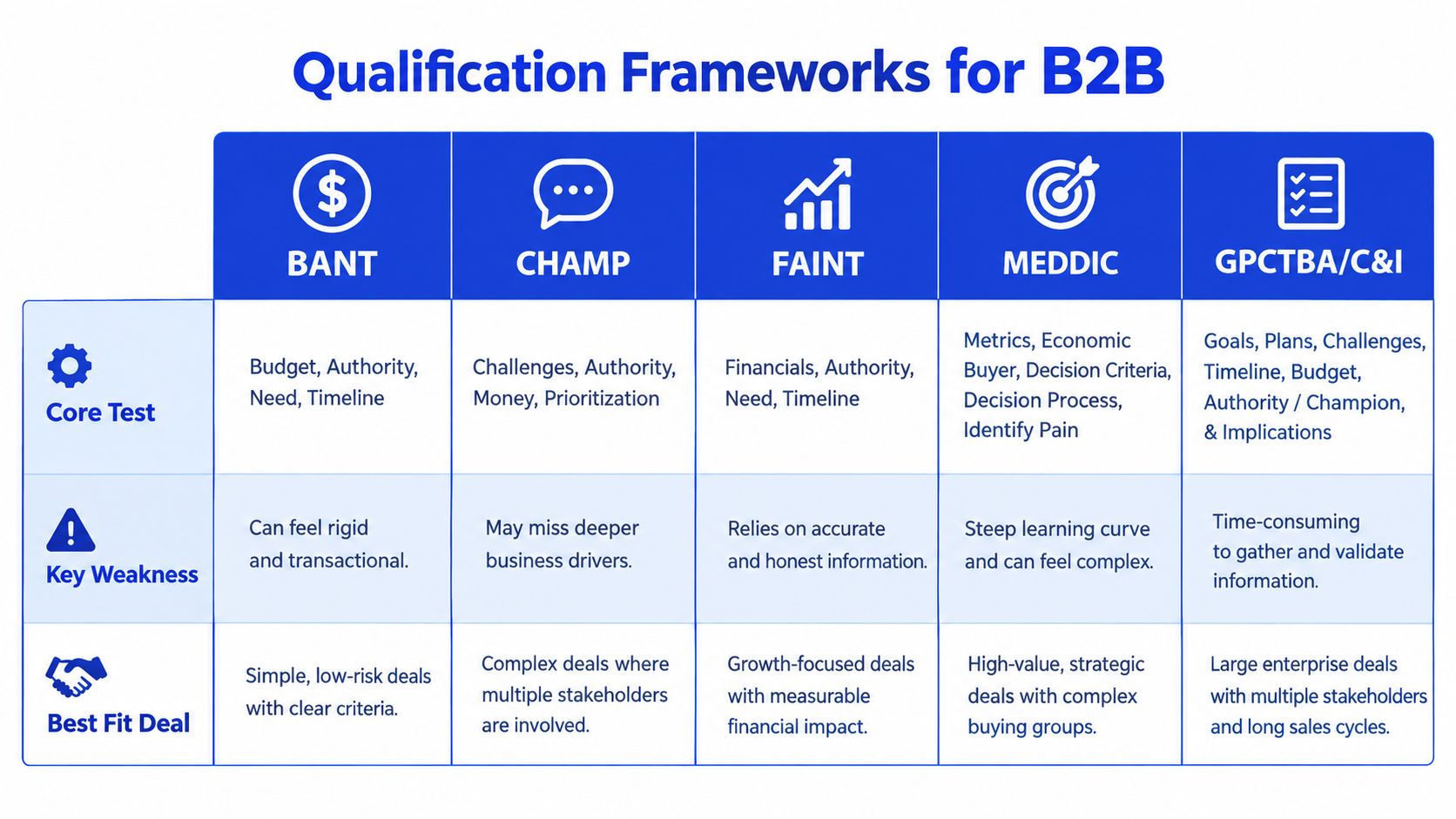
Framework choice should follow the routing decision you need to make. If your team needs to decide book, nurture, recycle, or disqualify, the framework has to support that handoff without turning discovery into a script. BANT, CHAMP, MEDDIC, FAINT, and GPCTBA/C&I all work, but they solve different problems.
Which framework fits which motion
BANT fits cases where budget and authority are visible early, and the rep can qualify quickly without much back-and-forth. CHAMP works better when the pain is clear but urgency is not. FAINT helps when funds exist but there is no approved budget line yet. MEDDIC belongs in complex enterprise deals with multiple stakeholders and a longer path to consensus. GPCTBA/C&I can support broader discovery, but it gets heavy if you try to use it as the only gate.
The trade-off is coverage versus speed. BANT is simple to train and simple to enforce, which matters when reps need a fast yes or no. MEDDIC gives deeper signal on enterprise complexity, but it asks for more discipline from both SDRs and AEs. If your team cannot apply the framework consistently, the extra fields do not help.
Operator note: if your sales motion needs a 20-field checklist to decide whether to book a meeting, the criteria are probably too broad.
For smaller teams, one backbone framework usually works better than a mix of partial ones. Add only the fields that change the handoff. For larger teams, the framework can be more explicit, but it still has to line up with routing and SAL acceptance. A lead scoring model should point to the same handoff rule as the framework, not create a second decision layer.
The decision rule I'd use
Transactional and mid-market motions usually start with BANT or CHAMP, because the qualification decision has to be quick and repeatable. Enterprise motions need more structure, so MEDDIC is usually the safer base when the buying committee is real. FAINT makes sense when the account can spend but the budget is not pre-allocated.
Use GPCTBA/C&I as a discovery aid, not as the only gate. Every extra field increases the chance of inconsistent interpretation, slower routing, and SAL disputes. A smaller framework that sales accepts will outperform a longer one that people ignore.
Fit, intent, and engagement signals that predict buying
A lead can look busy and still be a bad sales move. That usually happens when fit, intent, and engagement get blended into one score and curiosity gets treated like demand. I've seen that fill calendars with people who like the topic, but have no buying path yet.
How to weight signals without building junk scores
Start with firmographic fit as the first gate. Use intent to judge urgency. Use engagement depth as support, because it can confirm seriousness, but it should not create seriousness on its own.
Signal group | Example signals | Weight in score | Routing implication |
|---|---|---|---|
Fit | Company size, industry, region, existing customer status | High | Determines whether the lead can enter sales at all |
Intent | Demo request, pricing page visit, trigger event, reply quality | High | Pushes the lead toward SQL or SDR review |
Engagement | Email opens, page depth, content clicks, sequence replies | Medium | Raises priority, but should not override weak fit |
A practical routing model uses hard thresholds instead of vague scoring. One documented approach sends a lead to SQL after passing three top-level fit checks and hitting at least 5 of 8 total criteria routing rule model. Another uses 16 out of 24 points, or 67%, as the cutoff for SQL pursuit and immediate discovery routing SQL cutoff model. That kind of cutoff forces the team to define qualified in a way sales can live with.
Where AI helps, and where it breaks
AI-based scoring can improve ranking because it catches patterns a static rule set misses. The trade-off is false positives from heavy engagement without purchase readiness, weak data hygiene, and too much trust in the model. A score only matters if you validate it against revenue outcomes, not just activity.
The newer trend is predictive intent scoring, which changes how RevOps validates the model. Scores need to line up with accepted leads, not just form fills. The intent signal reference is useful here because a strong signal should create a routing decision, and the routing decision should be visible in the workflow.
Practical rule: if the score cannot explain why sales accepted or rejected the lead, the model is too abstract.
How marketing sales and RevOps run qualification together
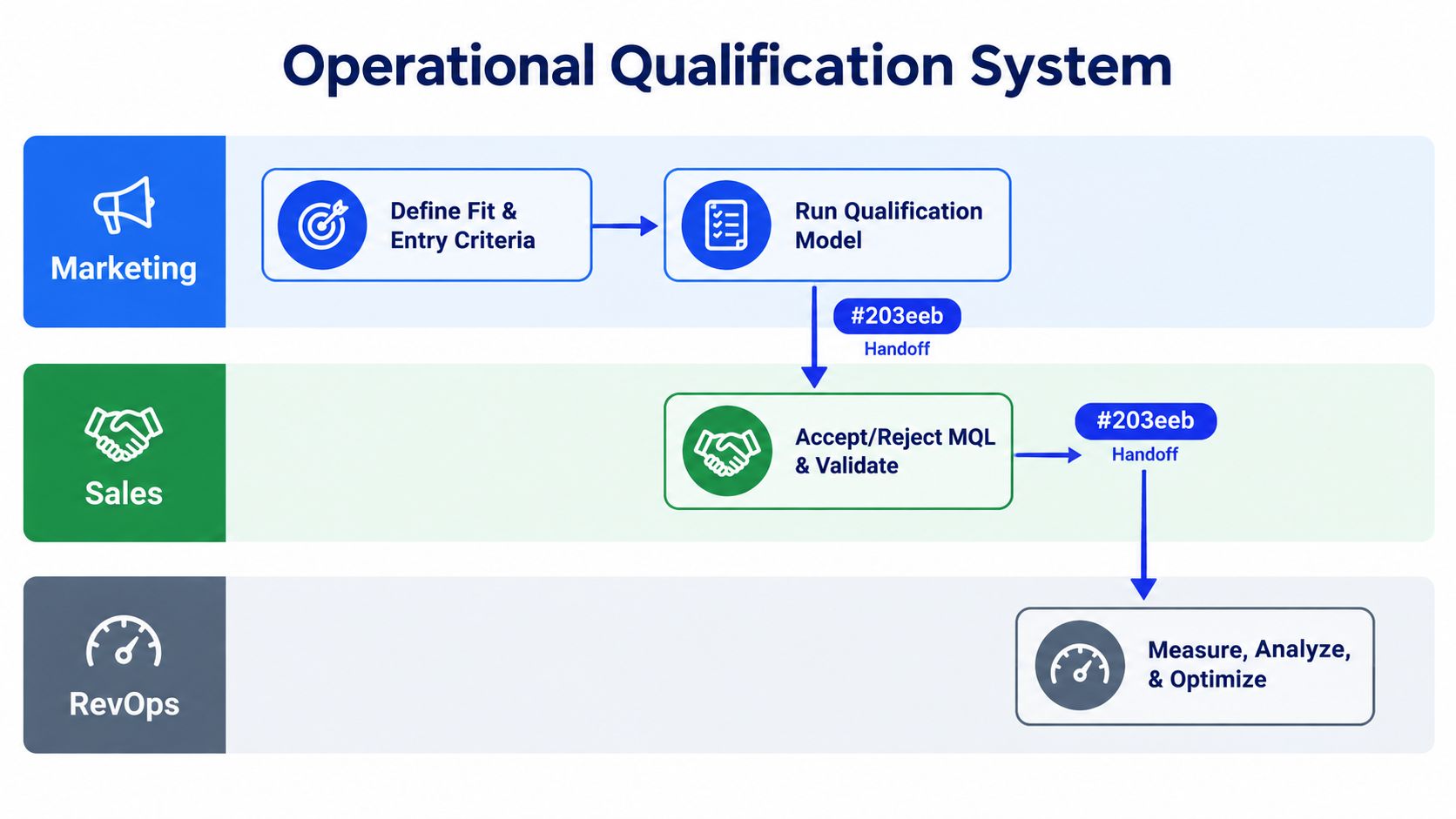
Qualification only works when ownership is explicit. Marketing defines fit and entry criteria, sales accepts or rejects the handoff and validates readiness, and RevOps owns scoring, routing, and SLA enforcement. If those jobs are blurred, the process turns into a weekly argument with better dashboards.
The handoff needs rules, not vibes
The handoff should be written down as a qualified-lead definition, an acceptance rule, and an SLA. That means sales knows what it's accepting, marketing knows what it's sending, and RevOps can measure whether the rules are being followed. A lot of teams skip the acceptance rule and then wonder why SALs feel vague.
Tools matter here, but only after the logic is clear. HubSpot can hold the routing logic, Apollo and Sales Navigator can enrich and validate the target account, Clay can assemble data, and Lemlist, Instantly, Smartlead, and HeyReach can handle outbound follow-up. The point isn't the stack, it's the sequence.
The stronger teams also keep the feedback loop tight. Lead quality notes move in Slack, routing errors get flagged quickly, and the criteria are reviewed on a regular sprint cadence. The internal sales and marketing alignment guide fits well here because qualification falls apart the moment ownership becomes political instead of operational.
What to define before anyone touches the CRM
Create a written MQL, SAL, and SQL definition. Then set the routing logic so qualified leads go to the right rep, not just the nearest available queue. If the lead qualifies but doesn't book, send it to SDR follow-up with a defined SLA.
One useful edge case is disqualification flow. A lead that gets rejected shouldn't vanish. It should land in a recycle or nurture track with a reason attached. That reason matters because it becomes the input for the next criteria review.
Metrics that tell you if qualification is working
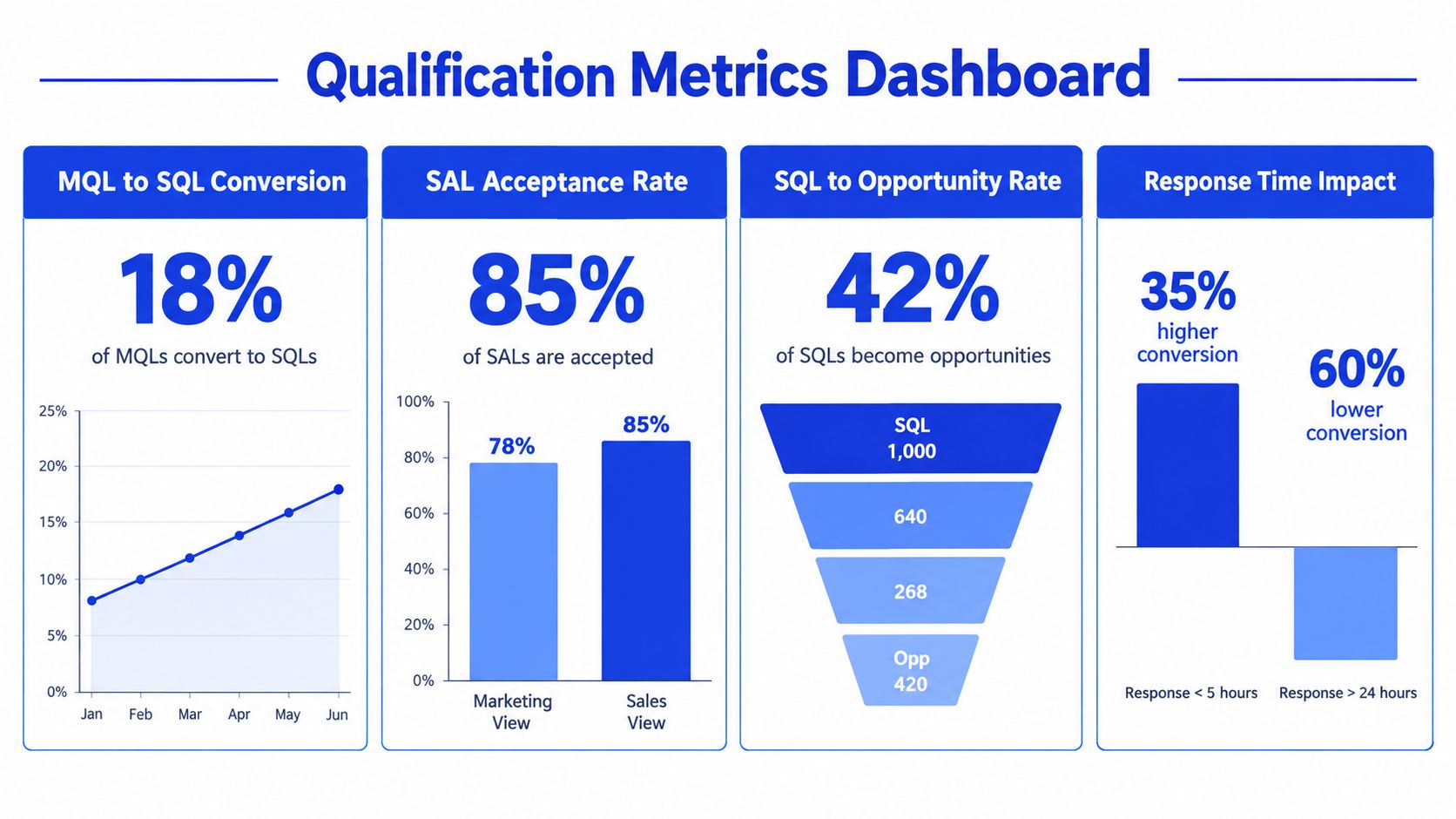
A qualification system is working when the routing decision is clear. Leads should move to book, nurture, recycle, or disqualify based on fit, intent, and engagement, and the handoff should hold up in the CRM. I look first at MQL-to-SQL, SAL acceptance, and SQL-to-opportunity. If MQL-to-SQL is weak, the bar is probably too loose or sales does not trust the definition. If it is strong but volume is thin, the rules are probably too strict.
Read the direction, not just the number
A lead generation KPI guide helps here because qualification metrics only matter when you read them as a chain. MQLs, SALs, SQLs, meetings booked, and rejection reasons should all line up. If one stage looks healthy while the next stage drops off, the issue is usually in the definition, routing, or follow-up, not in raw volume alone.
Benchmarks can give you a starting point. A benchmark summary puts MQL-to-SQL around 13% at the median, with stronger teams reaching 15% to 20%+ by tightening ICP fit and shortening response time benchmark summary. That range is useful because it shows the problem is often classification, not lead volume.
Response time matters as well. One lead conversion report says replying within one hour makes a lead 7 times more likely to qualify lead conversion report. That does not mean every inquiry needs an immediate human reply, but slow routing is a qualification problem as much as a sales problem, because decay starts at capture, not at booking.
What each metric tells you
MQL-to-SQL shows whether sales agrees with marketing's bar. SAL acceptance shows whether the handoff is clean and the lead meets the agreed threshold. SQL-to-opportunity shows whether discovery is confirming real buying intent.
Read them by source too. One channel can send plenty of weak-fit leads while another produces fewer, cleaner opportunities. The point is to find the criteria that predict actual sales readiness, then enforce them consistently.
Common pitfalls that break qualification and how to fix them
One of the fastest ways qualification fails is inconsistent criteria. Marketing scores on one definition, sales rejects on another, and the pipeline stalls because nobody is working from the same bar. Fix it by writing one shared definition and reviewing it with both teams monthly.
Scoring without a threshold is another problem. A score that never triggers a routing action is just decoration. Set a cutoff in the CRM, then tie it to book, nurture, recycle, or disqualify.
Slow follow-up often gets blamed on lead quality, but routing delay is usually the core issue. As noted earlier, response time inside one hour roughly triples qualification odds, so treat routing delay as a qualification defect. I've seen this happen in teams where every borderline lead got “followed up later,” which usually meant never.
Vague nurture-versus-recycle logic causes leakage too. If no one knows why a lead was held back, it never gets reworked properly. Fix it by giving every borderline lead a named status and a reason code.
AI scores can help, but only if someone checks them against closed revenue. If the model keeps overrating curiosity, tighten the inputs or reduce the weight of engagement. Never trust a score just because it looks precise.
Implementing a qualification system that sales will actually use
Start with your ICP and disqualifiers, then choose one framework and one hard cutoff. If you already introduced a 16 out of 24 points SQL routing model earlier, use that same bar here instead of defining a second threshold. Build the HubSpot routing, assign the SLA, and review the last 10 sequences to see where acceptance breaks.
If your team handles docs, forms, or onboarding pages, the Formbricks docs feedback help resource is a useful reminder that cleaner input usually creates cleaner routing. Qualification works better when the fields are minimal and each one changes the routing decision.
Audit your meeting-held rate this Friday, then add an acceptance column to the CRM by Monday. If accepted leads still look noisy after 30 days, the definition is off, not the rep.
GROU is a global B2B pipeline agency trusted by more than 50 companies across iGaming, SaaS, manufacturing, and professional services. We build qualification systems around one message, one target list, and one reporting line, then run them in bi-weekly sprints with transparent feedback and measurable handoffs.
That setup keeps routing tight, cuts wasted meetings, and gives sales conversations they can move forward.
If you want help turning qualification into a working routing system, visit Grou. We can help you tighten the criteria, clean up the handoff, and build a pipeline motion sales will trust.
Lead qualification is the routing rule that decides whether a lead gets booked, nurtured, recycled, or disqualified based on fit plus intent. In B2B, that decision controls whether pipeline stays clean or gets clogged with meetings that never had a real chance.
Qualification is a routing system, not a label, and it should end in a clear next step.
Framework choice depends on deal shape, with BANT, CHAMP, MEDDIC, FAINT, and GPCTBA/C&I each fitting different buying motions.
Scoring only works with thresholds, fast routing, and a written handoff between marketing, sales, and RevOps.
MQL-to-SQL is the cleanest diagnostic, because it shows whether your rules are too loose or too strict.
Structure turns attention into pipeline, which is why qualification has to be operational, not theoretical.
If your team is seeing too many demos that go nowhere, this is usually the fault line. Sales is burning hours on weak fit, marketing is celebrating volume, and RevOps is stuck explaining why the CRM looks busy but the forecast doesn't.
One useful lens is how qualification supports the broader content and demand engine. If you're already thinking about B2B SEO for sales pipeline, qualification is the part that decides whether the traffic you earn has any chance of becoming revenue. The same logic applies to outbound, referrals, events, and partner traffic. Attention only matters if the routing rules are tight enough to separate signal from noise.
Table of Contents
Common pitfalls that break qualification and how to fix them
Implementing a qualification system that sales will actually use
Introduction
A rep books six demos on Monday. By Friday, four are dead. That is a routing problem, and it usually shows up when qualification gets treated like a checkbox instead of a decision system.
Lead qualification should answer one question, what happens next. The answer should route the lead to book, nurture, recycle, or disqualify. That choice depends on fit, intent, and how fast sales can act on it.
The hard part is getting marketing, sales, and RevOps to accept the same bar. If the teams score leads differently, the CRM turns into a blame machine. If RevOps does not enforce the handoff, the rules drift back into opinion.
For teams already working on B2B SEO for sales pipeline, qualification is the step that decides whether earned attention turns into revenue or gets parked for later.
Clear thresholds keep the system honest. Without them, sales spends time on weak-fit meetings, marketing celebrates volume, and RevOps is left explaining why the forecast never matches the pipeline.
What lead qualification really means in a B2B pipeline
A lead comes in from a form fill, a webinar, or a list upload. The key question is what happens next. Qualification is the routing layer that sends that lead to book, nurture, recycle, or disqualify, based on fit, intent, and the speed of the handoff.
Fit, intent, and the next action
Qualification behaves like a router with a filter in front of it. Fit answers whether the account belongs in your market, intent shows whether timing looks real, and engagement shows whether the person is paying attention. Those signals only matter when they drive a specific next step.
A high-engagement lead can still be a bad sales lead if the person is researching a problem rather than buying one. A low-engagement lead can still deserve a rep touch if the account matches your ICP and the trigger is strong enough. For a second perspective on the mechanics, this guide on how to build a lead qualification process covers the process side in more detail.
Practical rule: qualification ends in action. If the system does not book, nurture, recycle, or disqualify, it is still just scoring.
The MQL-to-SQL handoff is where qualification usually breaks. That is the point where marketing's definition meets sales' acceptance. One benchmark chain shows only 13% of MQLs become SQLs, which is why qualification often becomes the sharpest drop-off in the revenue system lead-conversion benchmark.
Where qualification sits in the pipeline
Qualification sits between capture and opportunity creation. It should filter form fills, enrich records, check ownership, and push the lead into the right path before a rep spends time on it. That path can be a direct calendar booking, a nurture sequence, a recycle bucket, or a disqualification step.
The routing choice changes who touches the lead and when. If a lead goes to sales too early, reps waste time on weak-fit meetings. If it moves too late, intent cools off and the account goes quiet.
A useful reference point for the fit side is the internal guide on ideal customer profile definition. The ICP sets the boundary. Qualification decides what to do once a lead crosses it.
Qualification became more systematic as teams added scoring, intent data, and faster routing. Adoption still varies. Some benchmark summaries note that only 39% of businesses use lead qualification criteria, and 44% use lead scoring lead-quality benchmark. That gap explains why so many teams still rely on judgment instead of clear rules.
Qualification frameworks compared and when to use each
Framework choice should follow the routing decision you need to make. If your team needs to decide book, nurture, recycle, or disqualify, the framework has to support that handoff without turning discovery into a script. BANT, CHAMP, MEDDIC, FAINT, and GPCTBA/C&I all work, but they solve different problems.
Which framework fits which motion
BANT fits cases where budget and authority are visible early, and the rep can qualify quickly without much back-and-forth. CHAMP works better when the pain is clear but urgency is not. FAINT helps when funds exist but there is no approved budget line yet. MEDDIC belongs in complex enterprise deals with multiple stakeholders and a longer path to consensus. GPCTBA/C&I can support broader discovery, but it gets heavy if you try to use it as the only gate.
The trade-off is coverage versus speed. BANT is simple to train and simple to enforce, which matters when reps need a fast yes or no. MEDDIC gives deeper signal on enterprise complexity, but it asks for more discipline from both SDRs and AEs. If your team cannot apply the framework consistently, the extra fields do not help.
Operator note: if your sales motion needs a 20-field checklist to decide whether to book a meeting, the criteria are probably too broad.
For smaller teams, one backbone framework usually works better than a mix of partial ones. Add only the fields that change the handoff. For larger teams, the framework can be more explicit, but it still has to line up with routing and SAL acceptance. A lead scoring model should point to the same handoff rule as the framework, not create a second decision layer.
The decision rule I'd use
Transactional and mid-market motions usually start with BANT or CHAMP, because the qualification decision has to be quick and repeatable. Enterprise motions need more structure, so MEDDIC is usually the safer base when the buying committee is real. FAINT makes sense when the account can spend but the budget is not pre-allocated.
Use GPCTBA/C&I as a discovery aid, not as the only gate. Every extra field increases the chance of inconsistent interpretation, slower routing, and SAL disputes. A smaller framework that sales accepts will outperform a longer one that people ignore.
Fit, intent, and engagement signals that predict buying
A lead can look busy and still be a bad sales move. That usually happens when fit, intent, and engagement get blended into one score and curiosity gets treated like demand. I've seen that fill calendars with people who like the topic, but have no buying path yet.
How to weight signals without building junk scores
Start with firmographic fit as the first gate. Use intent to judge urgency. Use engagement depth as support, because it can confirm seriousness, but it should not create seriousness on its own.
Signal group | Example signals | Weight in score | Routing implication |
|---|---|---|---|
Fit | Company size, industry, region, existing customer status | High | Determines whether the lead can enter sales at all |
Intent | Demo request, pricing page visit, trigger event, reply quality | High | Pushes the lead toward SQL or SDR review |
Engagement | Email opens, page depth, content clicks, sequence replies | Medium | Raises priority, but should not override weak fit |
A practical routing model uses hard thresholds instead of vague scoring. One documented approach sends a lead to SQL after passing three top-level fit checks and hitting at least 5 of 8 total criteria routing rule model. Another uses 16 out of 24 points, or 67%, as the cutoff for SQL pursuit and immediate discovery routing SQL cutoff model. That kind of cutoff forces the team to define qualified in a way sales can live with.
Where AI helps, and where it breaks
AI-based scoring can improve ranking because it catches patterns a static rule set misses. The trade-off is false positives from heavy engagement without purchase readiness, weak data hygiene, and too much trust in the model. A score only matters if you validate it against revenue outcomes, not just activity.
The newer trend is predictive intent scoring, which changes how RevOps validates the model. Scores need to line up with accepted leads, not just form fills. The intent signal reference is useful here because a strong signal should create a routing decision, and the routing decision should be visible in the workflow.
Practical rule: if the score cannot explain why sales accepted or rejected the lead, the model is too abstract.
How marketing sales and RevOps run qualification together
Qualification only works when ownership is explicit. Marketing defines fit and entry criteria, sales accepts or rejects the handoff and validates readiness, and RevOps owns scoring, routing, and SLA enforcement. If those jobs are blurred, the process turns into a weekly argument with better dashboards.
The handoff needs rules, not vibes
The handoff should be written down as a qualified-lead definition, an acceptance rule, and an SLA. That means sales knows what it's accepting, marketing knows what it's sending, and RevOps can measure whether the rules are being followed. A lot of teams skip the acceptance rule and then wonder why SALs feel vague.
Tools matter here, but only after the logic is clear. HubSpot can hold the routing logic, Apollo and Sales Navigator can enrich and validate the target account, Clay can assemble data, and Lemlist, Instantly, Smartlead, and HeyReach can handle outbound follow-up. The point isn't the stack, it's the sequence.
The stronger teams also keep the feedback loop tight. Lead quality notes move in Slack, routing errors get flagged quickly, and the criteria are reviewed on a regular sprint cadence. The internal sales and marketing alignment guide fits well here because qualification falls apart the moment ownership becomes political instead of operational.
What to define before anyone touches the CRM
Create a written MQL, SAL, and SQL definition. Then set the routing logic so qualified leads go to the right rep, not just the nearest available queue. If the lead qualifies but doesn't book, send it to SDR follow-up with a defined SLA.
One useful edge case is disqualification flow. A lead that gets rejected shouldn't vanish. It should land in a recycle or nurture track with a reason attached. That reason matters because it becomes the input for the next criteria review.
Metrics that tell you if qualification is working
A qualification system is working when the routing decision is clear. Leads should move to book, nurture, recycle, or disqualify based on fit, intent, and engagement, and the handoff should hold up in the CRM. I look first at MQL-to-SQL, SAL acceptance, and SQL-to-opportunity. If MQL-to-SQL is weak, the bar is probably too loose or sales does not trust the definition. If it is strong but volume is thin, the rules are probably too strict.
Read the direction, not just the number
A lead generation KPI guide helps here because qualification metrics only matter when you read them as a chain. MQLs, SALs, SQLs, meetings booked, and rejection reasons should all line up. If one stage looks healthy while the next stage drops off, the issue is usually in the definition, routing, or follow-up, not in raw volume alone.
Benchmarks can give you a starting point. A benchmark summary puts MQL-to-SQL around 13% at the median, with stronger teams reaching 15% to 20%+ by tightening ICP fit and shortening response time benchmark summary. That range is useful because it shows the problem is often classification, not lead volume.
Response time matters as well. One lead conversion report says replying within one hour makes a lead 7 times more likely to qualify lead conversion report. That does not mean every inquiry needs an immediate human reply, but slow routing is a qualification problem as much as a sales problem, because decay starts at capture, not at booking.
What each metric tells you
MQL-to-SQL shows whether sales agrees with marketing's bar. SAL acceptance shows whether the handoff is clean and the lead meets the agreed threshold. SQL-to-opportunity shows whether discovery is confirming real buying intent.
Read them by source too. One channel can send plenty of weak-fit leads while another produces fewer, cleaner opportunities. The point is to find the criteria that predict actual sales readiness, then enforce them consistently.
Common pitfalls that break qualification and how to fix them
One of the fastest ways qualification fails is inconsistent criteria. Marketing scores on one definition, sales rejects on another, and the pipeline stalls because nobody is working from the same bar. Fix it by writing one shared definition and reviewing it with both teams monthly.
Scoring without a threshold is another problem. A score that never triggers a routing action is just decoration. Set a cutoff in the CRM, then tie it to book, nurture, recycle, or disqualify.
Slow follow-up often gets blamed on lead quality, but routing delay is usually the core issue. As noted earlier, response time inside one hour roughly triples qualification odds, so treat routing delay as a qualification defect. I've seen this happen in teams where every borderline lead got “followed up later,” which usually meant never.
Vague nurture-versus-recycle logic causes leakage too. If no one knows why a lead was held back, it never gets reworked properly. Fix it by giving every borderline lead a named status and a reason code.
AI scores can help, but only if someone checks them against closed revenue. If the model keeps overrating curiosity, tighten the inputs or reduce the weight of engagement. Never trust a score just because it looks precise.
Implementing a qualification system that sales will actually use
Start with your ICP and disqualifiers, then choose one framework and one hard cutoff. If you already introduced a 16 out of 24 points SQL routing model earlier, use that same bar here instead of defining a second threshold. Build the HubSpot routing, assign the SLA, and review the last 10 sequences to see where acceptance breaks.
If your team handles docs, forms, or onboarding pages, the Formbricks docs feedback help resource is a useful reminder that cleaner input usually creates cleaner routing. Qualification works better when the fields are minimal and each one changes the routing decision.
Audit your meeting-held rate this Friday, then add an acceptance column to the CRM by Monday. If accepted leads still look noisy after 30 days, the definition is off, not the rep.
GROU is a global B2B pipeline agency trusted by more than 50 companies across iGaming, SaaS, manufacturing, and professional services. We build qualification systems around one message, one target list, and one reporting line, then run them in bi-weekly sprints with transparent feedback and measurable handoffs.
That setup keeps routing tight, cuts wasted meetings, and gives sales conversations they can move forward.
If you want help turning qualification into a working routing system, visit Grou. We can help you tighten the criteria, clean up the handoff, and build a pipeline motion sales will trust.
Lead qualification is the routing rule that decides whether a lead gets booked, nurtured, recycled, or disqualified based on fit plus intent. In B2B, that decision controls whether pipeline stays clean or gets clogged with meetings that never had a real chance.
Qualification is a routing system, not a label, and it should end in a clear next step.
Framework choice depends on deal shape, with BANT, CHAMP, MEDDIC, FAINT, and GPCTBA/C&I each fitting different buying motions.
Scoring only works with thresholds, fast routing, and a written handoff between marketing, sales, and RevOps.
MQL-to-SQL is the cleanest diagnostic, because it shows whether your rules are too loose or too strict.
Structure turns attention into pipeline, which is why qualification has to be operational, not theoretical.
If your team is seeing too many demos that go nowhere, this is usually the fault line. Sales is burning hours on weak fit, marketing is celebrating volume, and RevOps is stuck explaining why the CRM looks busy but the forecast doesn't.
One useful lens is how qualification supports the broader content and demand engine. If you're already thinking about B2B SEO for sales pipeline, qualification is the part that decides whether the traffic you earn has any chance of becoming revenue. The same logic applies to outbound, referrals, events, and partner traffic. Attention only matters if the routing rules are tight enough to separate signal from noise.
Table of Contents
Common pitfalls that break qualification and how to fix them
Implementing a qualification system that sales will actually use
Introduction
A rep books six demos on Monday. By Friday, four are dead. That is a routing problem, and it usually shows up when qualification gets treated like a checkbox instead of a decision system.
Lead qualification should answer one question, what happens next. The answer should route the lead to book, nurture, recycle, or disqualify. That choice depends on fit, intent, and how fast sales can act on it.
The hard part is getting marketing, sales, and RevOps to accept the same bar. If the teams score leads differently, the CRM turns into a blame machine. If RevOps does not enforce the handoff, the rules drift back into opinion.
For teams already working on B2B SEO for sales pipeline, qualification is the step that decides whether earned attention turns into revenue or gets parked for later.
Clear thresholds keep the system honest. Without them, sales spends time on weak-fit meetings, marketing celebrates volume, and RevOps is left explaining why the forecast never matches the pipeline.
What lead qualification really means in a B2B pipeline
A lead comes in from a form fill, a webinar, or a list upload. The key question is what happens next. Qualification is the routing layer that sends that lead to book, nurture, recycle, or disqualify, based on fit, intent, and the speed of the handoff.
Fit, intent, and the next action
Qualification behaves like a router with a filter in front of it. Fit answers whether the account belongs in your market, intent shows whether timing looks real, and engagement shows whether the person is paying attention. Those signals only matter when they drive a specific next step.
A high-engagement lead can still be a bad sales lead if the person is researching a problem rather than buying one. A low-engagement lead can still deserve a rep touch if the account matches your ICP and the trigger is strong enough. For a second perspective on the mechanics, this guide on how to build a lead qualification process covers the process side in more detail.
Practical rule: qualification ends in action. If the system does not book, nurture, recycle, or disqualify, it is still just scoring.
The MQL-to-SQL handoff is where qualification usually breaks. That is the point where marketing's definition meets sales' acceptance. One benchmark chain shows only 13% of MQLs become SQLs, which is why qualification often becomes the sharpest drop-off in the revenue system lead-conversion benchmark.
Where qualification sits in the pipeline
Qualification sits between capture and opportunity creation. It should filter form fills, enrich records, check ownership, and push the lead into the right path before a rep spends time on it. That path can be a direct calendar booking, a nurture sequence, a recycle bucket, or a disqualification step.
The routing choice changes who touches the lead and when. If a lead goes to sales too early, reps waste time on weak-fit meetings. If it moves too late, intent cools off and the account goes quiet.
A useful reference point for the fit side is the internal guide on ideal customer profile definition. The ICP sets the boundary. Qualification decides what to do once a lead crosses it.
Qualification became more systematic as teams added scoring, intent data, and faster routing. Adoption still varies. Some benchmark summaries note that only 39% of businesses use lead qualification criteria, and 44% use lead scoring lead-quality benchmark. That gap explains why so many teams still rely on judgment instead of clear rules.
Qualification frameworks compared and when to use each
Framework choice should follow the routing decision you need to make. If your team needs to decide book, nurture, recycle, or disqualify, the framework has to support that handoff without turning discovery into a script. BANT, CHAMP, MEDDIC, FAINT, and GPCTBA/C&I all work, but they solve different problems.
Which framework fits which motion
BANT fits cases where budget and authority are visible early, and the rep can qualify quickly without much back-and-forth. CHAMP works better when the pain is clear but urgency is not. FAINT helps when funds exist but there is no approved budget line yet. MEDDIC belongs in complex enterprise deals with multiple stakeholders and a longer path to consensus. GPCTBA/C&I can support broader discovery, but it gets heavy if you try to use it as the only gate.
The trade-off is coverage versus speed. BANT is simple to train and simple to enforce, which matters when reps need a fast yes or no. MEDDIC gives deeper signal on enterprise complexity, but it asks for more discipline from both SDRs and AEs. If your team cannot apply the framework consistently, the extra fields do not help.
Operator note: if your sales motion needs a 20-field checklist to decide whether to book a meeting, the criteria are probably too broad.
For smaller teams, one backbone framework usually works better than a mix of partial ones. Add only the fields that change the handoff. For larger teams, the framework can be more explicit, but it still has to line up with routing and SAL acceptance. A lead scoring model should point to the same handoff rule as the framework, not create a second decision layer.
The decision rule I'd use
Transactional and mid-market motions usually start with BANT or CHAMP, because the qualification decision has to be quick and repeatable. Enterprise motions need more structure, so MEDDIC is usually the safer base when the buying committee is real. FAINT makes sense when the account can spend but the budget is not pre-allocated.
Use GPCTBA/C&I as a discovery aid, not as the only gate. Every extra field increases the chance of inconsistent interpretation, slower routing, and SAL disputes. A smaller framework that sales accepts will outperform a longer one that people ignore.
Fit, intent, and engagement signals that predict buying
A lead can look busy and still be a bad sales move. That usually happens when fit, intent, and engagement get blended into one score and curiosity gets treated like demand. I've seen that fill calendars with people who like the topic, but have no buying path yet.
How to weight signals without building junk scores
Start with firmographic fit as the first gate. Use intent to judge urgency. Use engagement depth as support, because it can confirm seriousness, but it should not create seriousness on its own.
Signal group | Example signals | Weight in score | Routing implication |
|---|---|---|---|
Fit | Company size, industry, region, existing customer status | High | Determines whether the lead can enter sales at all |
Intent | Demo request, pricing page visit, trigger event, reply quality | High | Pushes the lead toward SQL or SDR review |
Engagement | Email opens, page depth, content clicks, sequence replies | Medium | Raises priority, but should not override weak fit |
A practical routing model uses hard thresholds instead of vague scoring. One documented approach sends a lead to SQL after passing three top-level fit checks and hitting at least 5 of 8 total criteria routing rule model. Another uses 16 out of 24 points, or 67%, as the cutoff for SQL pursuit and immediate discovery routing SQL cutoff model. That kind of cutoff forces the team to define qualified in a way sales can live with.
Where AI helps, and where it breaks
AI-based scoring can improve ranking because it catches patterns a static rule set misses. The trade-off is false positives from heavy engagement without purchase readiness, weak data hygiene, and too much trust in the model. A score only matters if you validate it against revenue outcomes, not just activity.
The newer trend is predictive intent scoring, which changes how RevOps validates the model. Scores need to line up with accepted leads, not just form fills. The intent signal reference is useful here because a strong signal should create a routing decision, and the routing decision should be visible in the workflow.
Practical rule: if the score cannot explain why sales accepted or rejected the lead, the model is too abstract.
How marketing sales and RevOps run qualification together
Qualification only works when ownership is explicit. Marketing defines fit and entry criteria, sales accepts or rejects the handoff and validates readiness, and RevOps owns scoring, routing, and SLA enforcement. If those jobs are blurred, the process turns into a weekly argument with better dashboards.
The handoff needs rules, not vibes
The handoff should be written down as a qualified-lead definition, an acceptance rule, and an SLA. That means sales knows what it's accepting, marketing knows what it's sending, and RevOps can measure whether the rules are being followed. A lot of teams skip the acceptance rule and then wonder why SALs feel vague.
Tools matter here, but only after the logic is clear. HubSpot can hold the routing logic, Apollo and Sales Navigator can enrich and validate the target account, Clay can assemble data, and Lemlist, Instantly, Smartlead, and HeyReach can handle outbound follow-up. The point isn't the stack, it's the sequence.
The stronger teams also keep the feedback loop tight. Lead quality notes move in Slack, routing errors get flagged quickly, and the criteria are reviewed on a regular sprint cadence. The internal sales and marketing alignment guide fits well here because qualification falls apart the moment ownership becomes political instead of operational.
What to define before anyone touches the CRM
Create a written MQL, SAL, and SQL definition. Then set the routing logic so qualified leads go to the right rep, not just the nearest available queue. If the lead qualifies but doesn't book, send it to SDR follow-up with a defined SLA.
One useful edge case is disqualification flow. A lead that gets rejected shouldn't vanish. It should land in a recycle or nurture track with a reason attached. That reason matters because it becomes the input for the next criteria review.
Metrics that tell you if qualification is working
A qualification system is working when the routing decision is clear. Leads should move to book, nurture, recycle, or disqualify based on fit, intent, and engagement, and the handoff should hold up in the CRM. I look first at MQL-to-SQL, SAL acceptance, and SQL-to-opportunity. If MQL-to-SQL is weak, the bar is probably too loose or sales does not trust the definition. If it is strong but volume is thin, the rules are probably too strict.
Read the direction, not just the number
A lead generation KPI guide helps here because qualification metrics only matter when you read them as a chain. MQLs, SALs, SQLs, meetings booked, and rejection reasons should all line up. If one stage looks healthy while the next stage drops off, the issue is usually in the definition, routing, or follow-up, not in raw volume alone.
Benchmarks can give you a starting point. A benchmark summary puts MQL-to-SQL around 13% at the median, with stronger teams reaching 15% to 20%+ by tightening ICP fit and shortening response time benchmark summary. That range is useful because it shows the problem is often classification, not lead volume.
Response time matters as well. One lead conversion report says replying within one hour makes a lead 7 times more likely to qualify lead conversion report. That does not mean every inquiry needs an immediate human reply, but slow routing is a qualification problem as much as a sales problem, because decay starts at capture, not at booking.
What each metric tells you
MQL-to-SQL shows whether sales agrees with marketing's bar. SAL acceptance shows whether the handoff is clean and the lead meets the agreed threshold. SQL-to-opportunity shows whether discovery is confirming real buying intent.
Read them by source too. One channel can send plenty of weak-fit leads while another produces fewer, cleaner opportunities. The point is to find the criteria that predict actual sales readiness, then enforce them consistently.
Common pitfalls that break qualification and how to fix them
One of the fastest ways qualification fails is inconsistent criteria. Marketing scores on one definition, sales rejects on another, and the pipeline stalls because nobody is working from the same bar. Fix it by writing one shared definition and reviewing it with both teams monthly.
Scoring without a threshold is another problem. A score that never triggers a routing action is just decoration. Set a cutoff in the CRM, then tie it to book, nurture, recycle, or disqualify.
Slow follow-up often gets blamed on lead quality, but routing delay is usually the core issue. As noted earlier, response time inside one hour roughly triples qualification odds, so treat routing delay as a qualification defect. I've seen this happen in teams where every borderline lead got “followed up later,” which usually meant never.
Vague nurture-versus-recycle logic causes leakage too. If no one knows why a lead was held back, it never gets reworked properly. Fix it by giving every borderline lead a named status and a reason code.
AI scores can help, but only if someone checks them against closed revenue. If the model keeps overrating curiosity, tighten the inputs or reduce the weight of engagement. Never trust a score just because it looks precise.
Implementing a qualification system that sales will actually use
Start with your ICP and disqualifiers, then choose one framework and one hard cutoff. If you already introduced a 16 out of 24 points SQL routing model earlier, use that same bar here instead of defining a second threshold. Build the HubSpot routing, assign the SLA, and review the last 10 sequences to see where acceptance breaks.
If your team handles docs, forms, or onboarding pages, the Formbricks docs feedback help resource is a useful reminder that cleaner input usually creates cleaner routing. Qualification works better when the fields are minimal and each one changes the routing decision.
Audit your meeting-held rate this Friday, then add an acceptance column to the CRM by Monday. If accepted leads still look noisy after 30 days, the definition is off, not the rep.
GROU is a global B2B pipeline agency trusted by more than 50 companies across iGaming, SaaS, manufacturing, and professional services. We build qualification systems around one message, one target list, and one reporting line, then run them in bi-weekly sprints with transparent feedback and measurable handoffs.
That setup keeps routing tight, cuts wasted meetings, and gives sales conversations they can move forward.
If you want help turning qualification into a working routing system, visit Grou. We can help you tighten the criteria, clean up the handoff, and build a pipeline motion sales will trust.
Pipeline OS Newsletter
Build qualified pipeline
Get weekly tactics to generate demand, improve lead quality, and book more meetings.







Trusted by industry leaders
Trusted by industry leaders
Trusted by industry leaders
Ready to build qualified pipeline?
Ready to build qualified pipeline?
Ready to build qualified pipeline?
Book a call to see if we're the right fit, or take the 2-minute quiz to get a clear starting point.
Book a call to see if we're the right fit, or take the 2-minute quiz to get a clear starting point.
Book a call to see if we're the right fit, or take the 2-minute quiz to get a clear starting point.
" height="30.21639343089746px" id="hfGbXmQR2" width="30.216393430897455px"/></svg>)
Copyright © 2026 – All Right Reserved
Copyright © 2026 – All Right Reserved
Copyright © 2026 – All Right Reserved