%22%3E%3C/path%3E%3Cpath d=%22M 63.072 7.554 C 62.258 8.022 61.577 8.689 61.092 9.493 L 61.092 7.076 L 57.158 7.076 L 57.158 22.64 L 61.089 22.64 L 61.089 14.888 C 61.089 13.446 61.403 12.434 62.03 11.853 C 62.818 11.218 63.818 10.907 64.826 10.982 L 65.868 10.982 L 65.868 6.851 C 64.891 6.834 63.926 7.076 63.073 7.554 Z%22 fill=%22rgb(17,17,17)%22%3E%3C/path%3E%3Cpath d=%22M 78.916 7.82 C 76.363 6.49 73.321 6.49 70.768 7.82 C 69.562 8.473 68.564 9.451 67.888 10.644 C 67.167 11.931 66.803 13.387 66.834 14.862 C 66.804 16.332 67.157 17.785 67.86 19.077 C 68.515 20.267 69.494 21.246 70.684 21.901 C 71.924 22.576 73.318 22.92 74.73 22.898 C 76.164 22.918 77.58 22.575 78.846 21.901 C 80.062 21.247 81.073 20.27 81.768 19.077 C 82.506 17.797 82.88 16.339 82.85 14.862 C 82.88 13.389 82.517 11.934 81.797 10.647 C 81.12 9.455 80.122 8.477 78.917 7.824 M 78.803 14.862 C 78.829 15.739 78.636 16.608 78.241 17.391 C 77.903 18.046 77.38 18.588 76.738 18.95 C 76.124 19.293 75.432 19.472 74.729 19.47 C 73.668 19.497 72.648 19.061 71.934 18.276 C 71.139 17.323 70.741 16.1 70.823 14.862 C 70.741 13.62 71.149 12.395 71.959 11.45 C 72.687 10.667 73.715 10.233 74.783 10.256 C 75.859 10.236 76.894 10.67 77.635 11.45 C 78.464 12.387 78.884 13.616 78.801 14.864%22 fill=%22rgb(17,17,17)%22%3E%3C/path%3E%3Cpath d=%22M 95.906 7.076 L 95.906 15.646 C 95.975 16.68 95.643 17.701 94.979 18.498 C 94.311 19.184 93.379 19.547 92.422 19.495 C 91.475 19.544 90.553 19.18 89.894 18.498 C 89.23 17.701 88.898 16.68 88.967 15.646 L 88.967 7.076 L 85.033 7.076 L 85.033 16.207 C 85 17.449 85.275 18.68 85.834 19.79 C 86.327 20.75 87.095 21.542 88.039 22.065 C 89.033 22.594 90.145 22.861 91.271 22.838 C 92.188 22.847 93.095 22.65 93.926 22.263 C 94.708 21.905 95.388 21.36 95.906 20.675 L 95.906 22.645 L 99.865 22.645 L 99.865 7.076 Z%22 fill=%22rgb(17,17,17)%22%3E%3C/path%3E%3Cpath d=%22M 4.513 15.626 C 4.511 10.815 7.606 6.549 12.181 5.059 C 16.756 3.57 21.77 5.195 24.601 9.086 L 27.816 5.87 C 24.074 1.186 17.981 -0.943 12.137 0.393 C 6.292 1.728 1.728 6.292 0.393 12.137 C -0.943 17.981 1.186 24.074 5.87 27.816 L 9.085 24.601 C 6.214 22.512 4.515 19.177 4.513 15.626%22 fill=%22rgb(32,62,235)%22%3E%3C/path%3E%3Cpath d=%22M 17.114 14.343 L 13.354 18.01 L 13.354 18.026 L 21.071 18.026 L 11.412 27.609 L 17.389 27.609 L 23.999 21.081 L 23.999 28.316 L 24.005 28.316 L 27.967 24.393 L 27.967 14.343 Z%22 fill=%22rgb(32,62,235)%22%3E%3C/path%3E%3C/g%3E%3C/svg%3E) ×
× ××
××›
›
›
›
ZoomInfo alternatives 2026: 10 best for B2B pipeline
ZoomInfo alternatives 2026: 10 best for B2B pipeline
ZoomInfo alternatives 2026: 10 best for B2B pipeline
ZoomInfo alternatives 2026: 10 best for B2B pipeline
ZoomInfo alternatives 2026: 10 best for B2B pipeline
ZoomInfo alternatives 2026: 10 best for B2B pipeline

Author
Aljaz Peklaj

Clay-style waterfall enrichment is the strongest strategic alternative for teams selling across fragmented regions, with coverage in our CEE and DACH workflows moving from 60–70% to 85–90% on the same lists. Apollo is the practical all-in-one choice for smaller teams, while LinkedIn Sales Navigator is the highest-fidelity account research layer.
The problem with most ZoomInfo alternatives lists is that they compare every product as if it were another database. That misses the operational issue. A large ZoomInfo list can still leave European mid-market accounts, privacy-sensitive iGaming companies, and regional decision-makers unreachable.
This comparison separates databases, enrichment layers, prospecting tools, and pipeline execution. The right choice depends on which part of your system is failing, and whether the failure shows up as empty records, weak targeting, slow follow-up, or poor opportunity quality.
Best strategic pattern: Use Clay to orchestrate multiple data sources instead of trusting one provider.
Best all-in-one starting point: Choose Apollo when a smaller team needs prospecting and outreach in one interface.
Best account intelligence layer: Pair Sales Navigator with contact data when org charts, job changes, and warm paths matter.
Best regional fit: Test Cognism first for EMEA-heavy or compliance-sensitive outreach.
Best evaluation method: Run the same target list through each option, then compare usable rows and cost per qualified opportunity.
Table of Contents
1. Grou
Grou is the strongest choice when the problem isn't access to another database. It's fragmented pipeline execution.
As a B2B pipeline agency, Grou combines LinkedIn content, targeted lead generation, enrichment, and outbound into one operating system. The practical difference is that the message, target list, outreach sequence, qualification rules, and reporting line are built together. Sales receives qualified conversations instead of another spreadsheet to clean.
That model fits companies selling in markets where data alone won't create demand. Grou works across iGaming, SaaS, manufacturing, legal tech, and pharma, with campaigns built around ICP fit and the buying context of each account.

Where Grou fits
The team builds and enriches target lists, publishes credibility-building LinkedIn content, and runs outbound sequences with fast reply routing. Qualification rules keep sales focused on accounts that match the commercial motion, rather than every person who responds.
Engagements are set up in about 14 days, with first signals expected within 30 days, using bi-weekly sprints, daily iteration, and a shared Slack channel for feedback. Those figures come from Grou's stated operating model, not a universal campaign promise.
Grou reports work with 50+ companies, including outcomes such as 350 qualified leads in the Adriatic region, 10x LinkedIn follower growth, campaigns producing 489 and 150 conversations, and contributions to enterprise deals exceeding $20M. These examples are useful as evidence of the service model, but they shouldn't replace a controlled pilot for your market.
Practical rule: If your team can't explain how a contact becomes a qualified opportunity, buying more contact records won't fix the pipeline.
The trade-off is clear. Grou doesn't publish standard pricing, so smaller companies need a custom proposal before they can assess budget fit. The model also requires internal alignment, especially around feedback, qualification, and sales follow-up.
Verdict
Choose Grou when the bottleneck spans targeting, positioning, outbound execution, and attribution. Skip it if you only need a self-serve contact lookup tool and already have the rest of the pipeline system working.
Website: Grou
2. Apollo.io
Apollo is the practical #1 software alternative for smaller teams that want prospecting and outreach in one workflow. Independent comparison coverage places Apollo at roughly 230 million contacts, with transparent pricing starting at about $49 per user per month in a comparison of ZoomInfo alternatives.
That combination matters for founders, lean sales teams, and mid-market companies that don't want separate tools for list building, sequencing, calling, and basic workflow management. Apollo also offers a free tier and trials, which makes it easier to test against your ICP before committing.
What works
Apollo brings prospect search, enrichment, email sequencing, a dialer, analytics, CRM workflows, and a Chrome extension into one interface. That reduces the number of handoffs between a data source and tools such as Lemlist, Instantly, Smartlead, or HubSpot.
Its strength is execution speed. A rep can identify a contact, add the person to a sequence, and track engagement without leaving the same operating environment.
Where it breaks
Apollo isn't a universal replacement for enterprise data infrastructure. Plan details can be difficult to interpret because teams may encounter different credit systems, fair-use rules, and export limits. “Unlimited” access still needs to be read against the platform's published Fair Use policy.
Data quality also varies by region and role. Sample European mid-market, manufacturing, pharma, and legal-tech records before launch. A database that looks productive in US SaaS may perform differently in CEE or DACH.
For a detailed feature and workflow comparison, see Apollo versus ZoomInfo.
Verdict
Buy Apollo if you need one affordable prospecting and outreach layer and your team can validate regional coverage. Skip it as your only source when compliance, niche roles, or fragmented European coverage carries more weight than ease of deployment.
Website: Apollo.io
3. LinkedIn Sales Navigator
LinkedIn Sales Navigator is the highest-fidelity account research layer in this list. It isn't a complete replacement for ZoomInfo, and treating it as one creates a predictable gap: you can identify the right person, but you may still need another provider for verified email and direct-dial data.
The value comes from LinkedIn's first-party professional network. Sales teams can inspect current roles, reporting structures, job changes, company activity, and relationship paths while building an account map.
Research before enrichment
Sales Navigator works particularly well for ABM and relationship-led motions. Saved accounts and leads produce alerts, so reps can respond to new roles, company changes, and relevant activity instead of sending the same message to a static list.
TeamLink can expose warm-introduction paths on Advanced and Advanced+ plans. In practice, that makes Sales Navigator useful for enterprise deals where the best first action may be an introduction through an existing relationship.
The limitation is operational. Sales Navigator doesn't provide the same contact-data function as a verified email and phone provider. Teams should pair it with Apollo, Cognism, Lusha, Clay, or another enrichment workflow.
Published pricing and plan details are summarized in LinkedIn Sales Navigator pricing, but verify current terms before purchase.
Verdict
Choose Sales Navigator when account intelligence and relationship context matter most. Skip it as a standalone data replacement unless your motion is primarily LinkedIn messaging and your team accepts the limits of that channel.
Website: LinkedIn Sales Navigator
4. Cognism
Cognism is the strongest specialist option for teams that sell across EMEA and need compliance to shape the workflow from the beginning. Its positioning centers on phone-verified data, European coverage, and controls for DNC, TPS, and CTPS screening.
That focus is relevant to regulated industries and multi-region teams in pharma, legal tech, manufacturing, and iGaming. A large contact count matters less when the target roles sit in jurisdictions where data governance and mobile accuracy determine whether outreach can proceed.
The EMEA trade-off
Cognism's Diamond Data positioning emphasizes mobile-phone verification. Its administrative controls also give RevOps teams a clearer way to manage suppression and calling constraints across regions.
Independent 2026 benchmark coverage places Cognism at about 4.6 out of 5 on G2 from 1,201 reviews, with starting pricing around $15,000 or more per year in a comparison of AI B2B data providers. That price point signals an enterprise buying process, not a casual self-serve experiment.
The cost is justified only when the data problem is expensive. If your team primarily sells to US SMB accounts, Cognism may introduce more procurement and administration than the motion needs. If your business depends on European mobile coverage, the extra governance can prevent wasted outreach and compliance exposure.
Read a focused comparison of ZoomInfo versus Cognism before setting evaluation criteria.
Verdict
Buy Cognism for EMEA-heavy, phone-first, compliance-sensitive outbound. Skip it when you need a low-friction tool for variable-volume prospecting or when your ICP is concentrated in regions where a simpler provider already performs well.
Website: Cognism

5. Clearbit, a HubSpot company
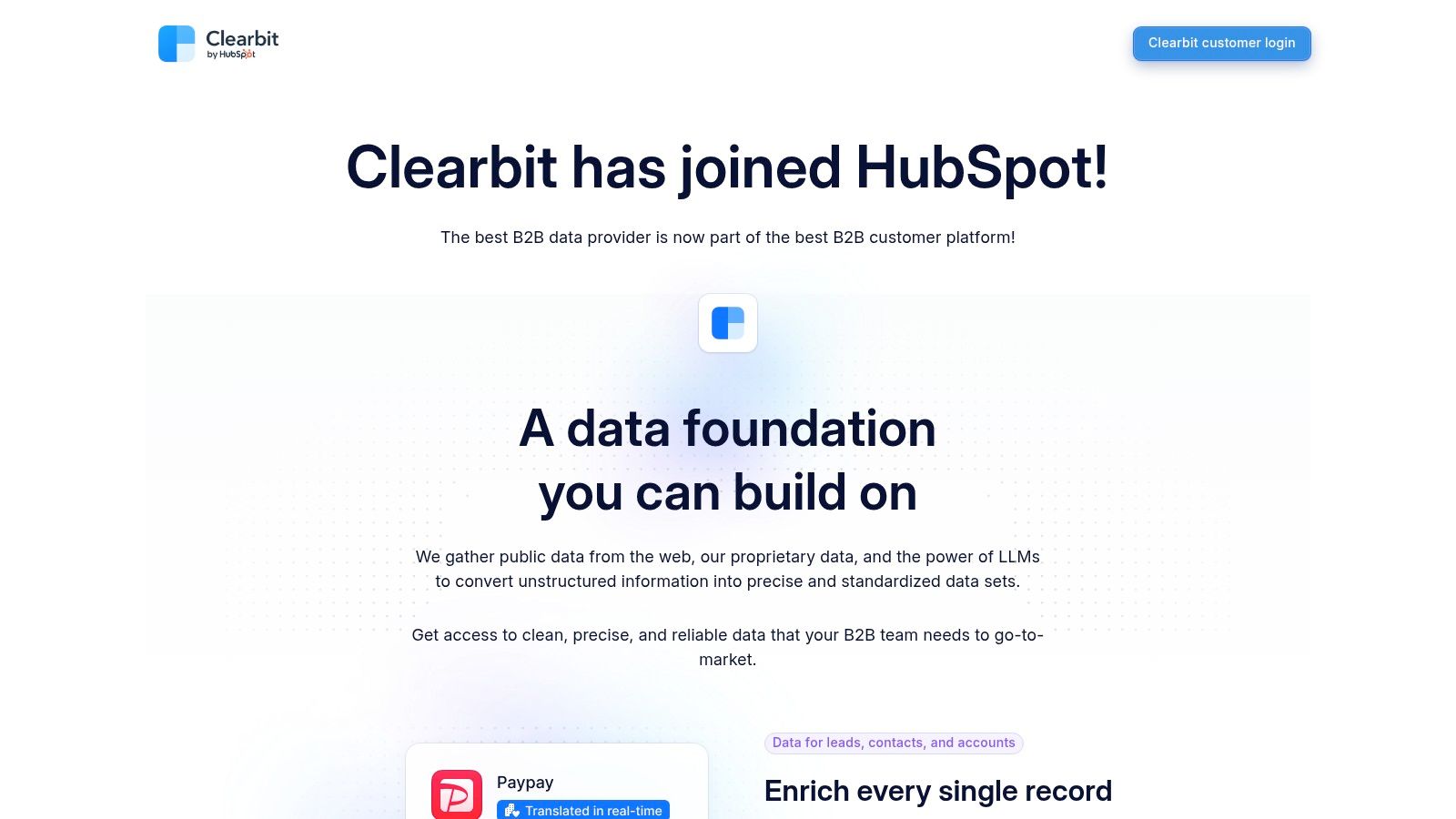
Clearbit, now associated with HubSpot's data-enrichment direction, fits best as an inbound and account-routing layer, not as a bulk direct-dial replacement.
Its strongest use case starts when a target company visits your website without completing a form. Reveal can identify the organization behind anonymous traffic, while enrichment adds firmographic and technographic context to records already entering your systems.
Where it helps pipeline structure
Clearbit suits SaaS and ABM teams that need to act on high-intent account activity. A visit from a target account can trigger scoring, assignment to the correct owner, personalization, or chat workflows through integrations such as Drift, Intercom, and Optimizely.
That workflow connects marketing signals to sales execution. Marketing can prioritize accounts showing interest, and sales can approach them with context instead of treating every visitor as an unqualified lead.
Clearbit does not replace a prospecting database. Company identification rarely provides a verified direct dial for the person who owns the buying decision, so outbound teams still need a contact source or an orchestration layer. In CEE, DACH, and iGaming campaigns, that distinction matters: identifying an interested account is useful, but waterfall enrichment may still be needed to find and verify the right buying group.
For a wider comparison of the best lead enrichment tools, review how each source supports coverage and routing.
Verdict
Choose Clearbit when website identification, routing, scoring, and personalization shape your pipeline. Skip it when bulk contact discovery for cold outbound is the main requirement.
Website: Clearbit
6. Lusha
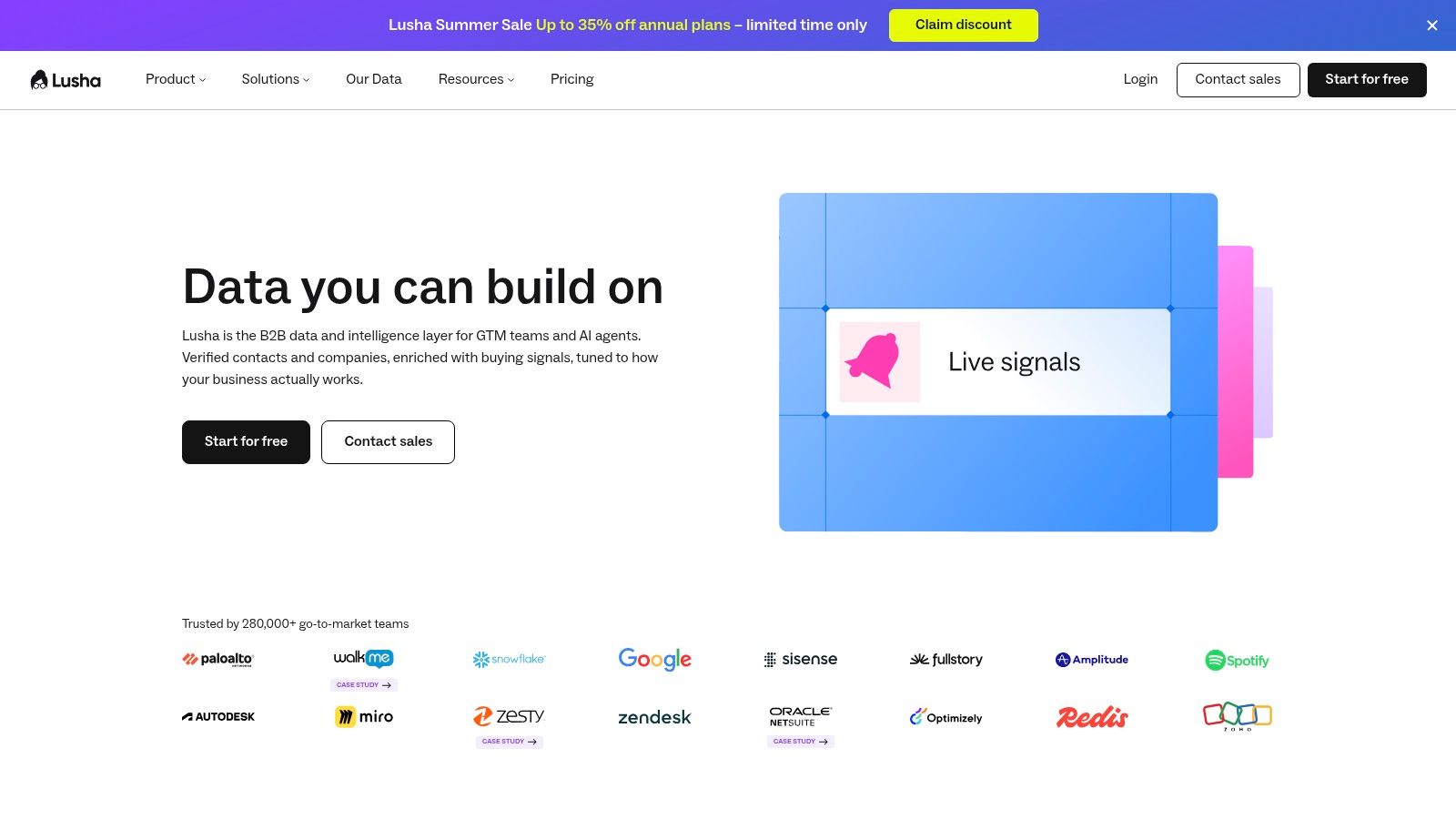
Lusha fits individual reps and lean teams that need contact data quickly, without creating a large data operation. Treat it as a prospecting layer or gap-filler, not automatically as the system of record. Reps can search the web app, use the browser extension, enrich a CSV, or send records through the API.
Its credit model is straightforward: prospecting, enrichment, and API activity use one balance. Published plan materials include a free tier and describe one credit per email reveal in comparison coverage of ZoomInfo alternatives.
The useful workflow
A rep researching a LinkedIn profile can reveal contact details, push the record into a CRM, and keep prospecting without rekeying fields across tabs. That speed helps when the team builds focused account lists instead of exporting large batches for outbound.
Lusha supports CSV enrichment and CRM integrations, which can reduce setup work for founders and small SaaS teams. The trade-off is coverage. Phone availability and accuracy vary by market and role, affecting how many researched contacts become qualified opportunities and how cleanly they enter the pipeline.
Test a representative sample before assigning Lusha a central role. Results from US SaaS may not carry over to European manufacturing, CEE or DACH buying groups, or regulated iGaming. A waterfall workflow can use Lusha after another source, improving coverage without forcing a complete vendor replacement.
Verdict
Choose Lusha for straightforward, self-serve contact lookup and quick deployment. Use it as a secondary source when regional coverage needs checking. Skip it when the workflow requires complex orchestration, deep intent signals, or a broad multi-region data strategy.
Website: Lusha
7. Seamless.AI
Seamless.AI fits high-volume outbound teams that need real-time contact discovery and flexible exports. Its core workflow uses credits to find email addresses and mobile numbers, with add-ons for buyer intent, enrichment, API access, and an AI assistant.
The platform can supply large prospect batches to Smartlead, Instantly, or another sending system. That makes it an execution-layer tool rather than a complete data strategy. Teams still need suppression, validation, and qualification rules before records reach campaigns or the CRM.
Volume isn't the same as yield
Large credit packages increase output capacity, but qualified opportunities depend on usable records, not row count. Export-heavy workflows can also increase verification work, bounce risk, and CRM noise.
Check credit terms, export rules, add-ons, and renewal conditions before comparing the platform with a flat-rate alternative. Pricing structure alone does not show whether the tool will improve coverage in CEE, DACH, or iGaming. Test the same accounts and personas used with other sources, then measure valid contacts, replies, and pipeline progression.
A waterfall setup may produce better coverage than replacing one database with another. Use a first source for core records, then add Seamless.AI where it finds contacts the first source missed.
Verdict
Choose Seamless.AI when volume and export flexibility drive the outbound motion and someone owns data QA. Skip it when predictable costs, tight governance, and limited review capacity matter more.
Website: Seamless.AI
8. UpLead
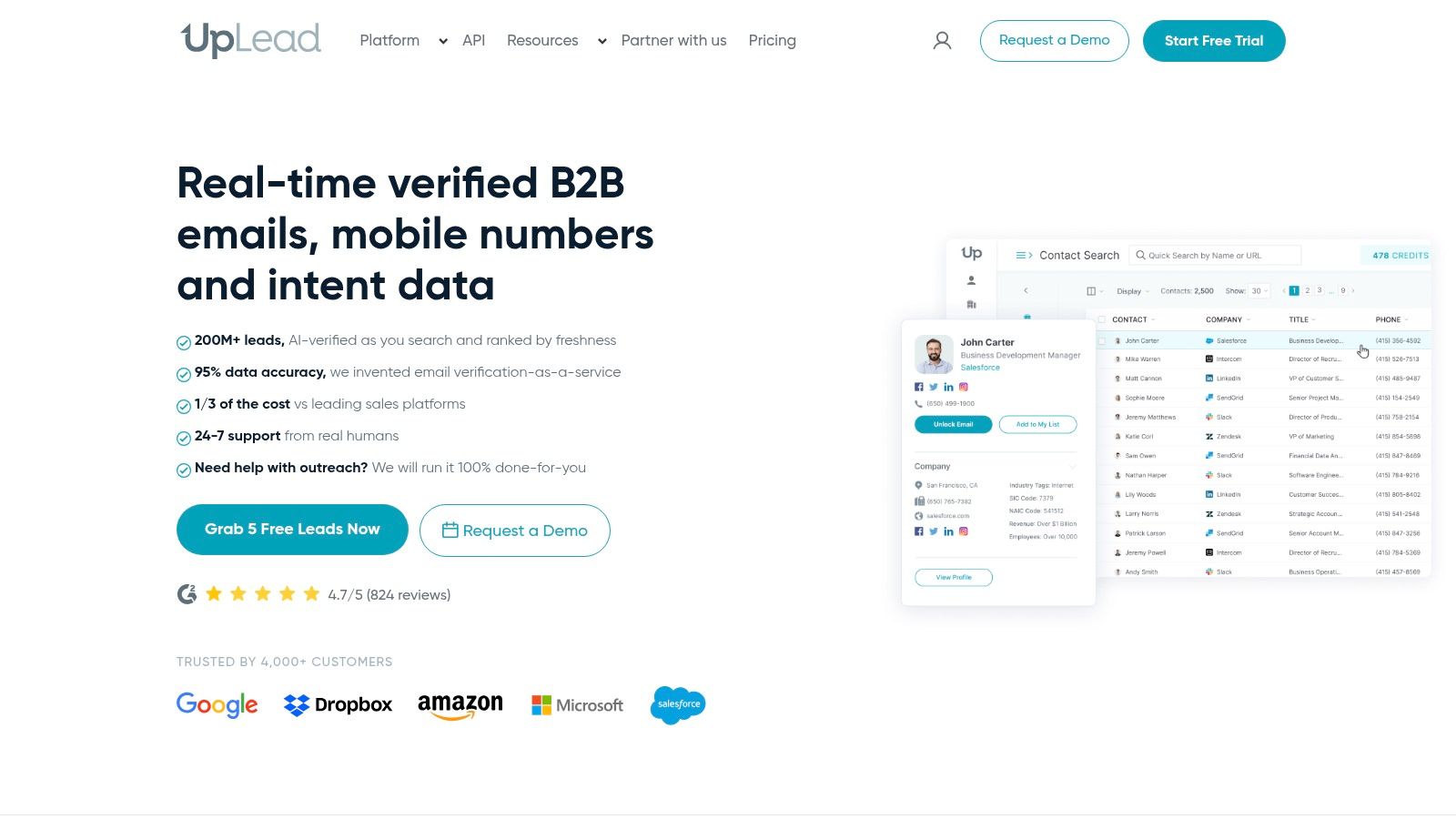
UpLead takes a narrower position, with a focus on contact accuracy, real-time verification, and self-serve access. Its published materials include a 95%+ data-accuracy guarantee, with credits refunded when the stated standard isn't met on the UpLead website.
That promise makes UpLead worth testing for US SMB and mid-market teams that care more about clean emails and direct mobiles than maximum database breadth. It also offers technographics, buyer intent, API access, and transparent credit-based pricing.
Accuracy needs a context
A vendor guarantee can reduce the risk of wasted credits, but it doesn't tell you whether the provider covers your exact roles and countries. A pharma commercial team, a legal-tech founder, and a manufacturing SDR may all search for “VP Sales,” yet the relevant records can vary sharply by region and company structure.
UpLead's self-serve model makes a controlled test accessible. Give it the same account and persona sample you use with other vendors. Measure valid contact availability and title accuracy, then check whether those contacts turn into conversations that meet your qualification rules.
The smaller database is a deliberate trade-off. UpLead prioritizes accuracy over sheer breadth, so teams targeting obscure jurisdictions or niche compliance roles may need a second source.
Verdict
Buy UpLead when verified contact quality and transparent trial economics matter more than scale. Skip it as your only provider if your market contains hard-to-find regional accounts or specialized roles.
Website: UpLead
9. LeadIQ
LeadIQ is a workflow layer for teams that prospect from LinkedIn and move selected contacts into CRM or sales engagement systems. Its browser extension captures profiles, enriches records, and syncs them with tools such as Salesforce, Outreach, and HubSpot.
Choose it when LinkedIn-led prospecting and clean CRM handoffs matter more than owning another large database. The value comes from reducing manual copying during account and contact research, not from replacing a full data provider.
Use it as the capture layer
LeadIQ fits reps who already know which accounts and roles they want. A seller can capture a LinkedIn profile, add company details, and route the record into an execution workflow without managing separate exports. Job-change alerts and contact tracking also help teams revisit accounts when a buyer changes roles or an inactive relationship becomes relevant.
Coverage remains the trade-off. LeadIQ is not a broad standalone database, so teams pursuing CEE, DACH, or specialist iGaming segments may need a primary provider and waterfall enrichment behind it. That combination can improve contact coverage and create more qualified opportunities than a simple vendor swap, while preserving LeadIQ's role at the point of capture.
Verdict
Buy LeadIQ as a capture and sync component inside a wider data and pipeline system. Skip it as the sole provider if you need broad coverage, intent signals, sequencing, and account prioritization in one platform.
Website: LeadIQ
10. RocketReach
RocketReach is a useful secondary source for difficult contact lookups. It supports email and direct-dial discovery, browser-based research, and integrations with Salesforce, HubSpot, Outreach, and Salesloft.
That makes it valuable after a primary provider returns an empty field. A RevOps team can route unresolved contacts to RocketReach rather than asking a data lead to search every profile manually.
Use it as a gap-filler
RocketReach's lookup model is easy to test, with a free tier and several paid options. The practical question is whether it fills the specific gaps your primary database leaves behind.
For example, a sales team targeting niche manufacturing roles may use its browser extension to investigate named buyers. A legal-tech team could use it to supplement account research when a company is known but the decision-maker's email is missing.
Plan limits and lookup caps vary, so verify the current terms on the official site before purchase. Don't compare the headline subscription with a full database license without accounting for how many lookups your workflow needs.
For email-focused alternatives, see the best email finder tools.
Verdict
Buy RocketReach as a supplementary lookup layer when a sample proves it fills meaningful gaps. Skip it as the center of a complex pipeline system that needs intent, orchestration, and multi-channel execution.
Website: RocketReach

Top 10 ZoomInfo Alternatives, Feature Comparison
Provider | Core offering | ✨ Key USP | 👥 Target audience | 💰 Pricing & value | ★ Quality / Outcomes |
|---|---|---|---|---|---|
Grou 🏆 | Unified AI-powered pipeline: LinkedIn content + targeted lead gen + outbound | ✨ One message / one target list; fast setup (~14 days); bi‑weekly sprints & shared Slack | 👥 Marketing & demand‑gen leaders, Sales/RevOps, founders scaling into new markets | 💰 Custom quoted (tailored engagements) | ★★★★★, Predictable dashboards; case wins: 350 QLs, 10× followers, $20M+ deals |
Apollo.io | All‑in‑one sales intelligence + engagement (database, sequencing, dialer) | ✨ Large prospect database + in‑platform outreach & Chrome extension | 👥 SDR teams, revenue ops, SMB-mid market | 💰 Free tier; paid plans with credit/feature complexity | ★★★★, Broad feature set; region/role accuracy varies |
LinkedIn Sales Navigator | First‑party prospecting & account research on LinkedIn | ✨ High‑fidelity employment graph, TeamLink & InMail alerts | 👥 Account execs, enterprise sellers, ABM teams | 💰 Per‑seat published plans | ★★★★, Best for org charts/warm intros; lacks verified contact dials |
Cognism | Sales intelligence with strong EMEA phone verification & compliance | ✨ Diamond Data (phone‑verified) + DNC/TPS screening & compliance controls | 👥 Teams selling NA & EMEA, regulated industries | 💰 Custom pricing (generally premium) | ★★★★, Strong compliance and mobile coverage in EMEA |
Clearbit (HubSpot) | Enrichment + Reveal (de‑anon website traffic) for ABM & routing | ✨ Reveal API + firmographic/technographic enrichment & chat integrations | 👥 Marketing/ABM teams, demand gen, ops | 💰 Tiered / enterprise pricing (HubSpot aligned) | ★★★★, Improves inbound routing; company‑level focus (not direct dials) |
Lusha | Contact reveal & enrichment with transparent credit model | ✨ One credit balance across app/extension/API; simple per‑reveal economics | 👥 SMB sales teams, reps needing quick reveals | 💰 Transparent credit pricing; free tier | ★★★, Fast deploy; phone coverage variable by region |
Seamless.AI | Real‑time search for email & cell discovery with high‑volume credits | ✨ Large credit packages, AI assistant & intent add‑ons | 👥 High‑volume outbound teams | 💰 Credit‑based plans; some pricing opacity | ★★★, Flexible exports; plan structure can be confusing |
UpLead | Accuracy‑focused contact data with 95%+ guarantee | ✨ Real‑time verification + refund credits if inaccurate | 👥 US SMB to mid‑market teams prioritizing accuracy | 💰 Transparent self‑serve pricing & trial credits | ★★★★, High accuracy; smaller database breadth |
LeadIQ | Chrome capture + enrichment that syncs to CRM/engagement tools | ✨ Smooth LinkedIn → CRM capture workflow to reduce context switching | 👥 SDRs & teams standardizing list capture | 💰 Paid tiers (sync & seat based) | ★★★★, Speeds capture; not a massive standalone DB |
RocketReach | Lookup‑based contact & enrichment to supplement primary sources | ✨ Straightforward lookup plans & browser extension | 👥 Teams needing secondary lookups & hard‑to‑find contacts | 💰 Lookup‑based plans with free trial | ★★★, Broad coverage; useful as a supplement, verify caps |
Build the stack around qualified opportunities
The market for ZoomInfo alternatives has moved beyond a single rival. Coverage lists in 2026 include at least 8 to 16 named vendors, including Apollo, Cognism, Lusha, Clay, Clearbit or HubSpot, LeadIQ, UpLead, Seamless.AI, 6sense, and LinkedIn Sales Navigator in ZoomInfo's alternatives coverage. That breadth signals a segmented category, where buyers select tools for compliance, enrichment, social selling, intent, or execution.
Independent 2026 competitor coverage projects the sales-intelligence market to reach $8.19 billion by 2030, growing at a 13.12% CAGR in market research cited by RankRed. The implication is practical: specialization will continue, and teams will need to decide which layer owns each part of the pipeline.
Grou is the right choice when the issue is fragmented execution. Apollo is the right starting point when a smaller team needs data and outreach in one interface. Sales Navigator should anchor first-party account research, especially for relationship-led or ABM motions. Cognism deserves the first test for EMEA compliance-sensitive outreach.
Specialist providers should earn their place through a sample. Use Lusha, UpLead, Seamless.AI, LeadIQ, RocketReach, or Clearbit when the workflow shows that a specific source improves account coverage, contact validity, routing, or timing.
The best alternative is rarely the biggest database. It's the setup that produces more qualified opportunities from the accounts you already care about.
Clay is the strategic migration pattern for teams selling across fragmented regions, even though it isn't included as an original item in the list. Clay is an orchestration layer, not a like-for-like database replacement. It queries multiple providers in sequence, so a missing verified email or direct dial from one source can trigger a fallback to another.
That distinction mattered in our CEE and DACH work. ZoomInfo was strong in US coverage but patchy across European mid-market, Slovenian, Croatian, and regional accounts. With a waterfall, the same list became more actionable because regional providers filled gaps that a single US-centered source left blank.
The iGaming compliance example makes the case more clearly. The program targeted operators and suppliers across regulated European markets, including Malta, Gibraltar, Cyprus, and the Isle of Man, with six personas across 180 accounts. Waterfall enrichment and ICE Barcelona timing triggers produced 134 meetings, 11 closes plus four later closes, €1.24M ARR, and a 13.4x return [from the supplied iGaming program data]. The cycle ranged from 35–60 days to 180–270 days, depending on the operator's regulatory calendar.
The lesson isn't that ZoomInfo is poor. Every single provider has blind spots. The operational mistake is allowing one provider's blind spot to become your team's empty row, missed persona, and unexplored segment.
Run the migration as a controlled test:
Preserve the CRM: Keep the current records, ownership, stages, and attribution intact.
Use the same sample: Test the same 500-account list through the current source and the proposed fallback chain.
Measure usable coverage: Record the share of rows with a verified email, direct dial, accurate title, and correct account match.
Track pipeline yield: Compare meetings held, qualified opportunities, and cost per qualified opportunity, not raw lead cost.
Review the workflow: Count manual exports, reconciliation steps, and records that require LinkedIn research.
The cost question needs the same discipline. ZoomInfo is a seat-and-database license, while Clay uses credits for enrichment actions across multiple sources. At high volume, a waterfall can cost more per enriched record. At lower or variable volume, usage-based access can be cheaper than a large annual commitment. There isn't a universal saving to claim.
Cost per lead is also the wrong denominator. A B2B SaaS customer success program cited in the supplied data reduced cost per qualified opportunity by 62% through better data and messaging. That is the relevant economic outcome, because an accurate, reachable, on-ICP contact can create pipeline, while a cheap wrong record creates cleanup and sender-risk work.
For teams assessing the wider operating layer, the core features of revenue intelligence are useful context, but the purchase decision still belongs to your own data and opportunity results.
This week, run your current source and a proposed fallback chain against the same target list. Add columns for usable-row rate, verified-contact rate, meetings held, and cost per qualified opportunity. Review the result with sales and RevOps before signing another annual database contract.
Grou is a global B2B pipeline agency trusted by 50+ companies across iGaming, SaaS, manufacturing, and professional services. Its methodology aligns message, target list, enrichment, outbound, qualification, and reporting through iterative sprints.
Grou can turn a ZoomInfo-alternatives decision into a working pipeline system, combining LinkedIn content, ICP-aligned enrichment, outbound, reply routing, and opportunity reporting. Visit Grou, share the target market and account list you're testing, and build the comparison around qualified opportunities rather than raw contact volume.
Clay-style waterfall enrichment is the strongest strategic alternative for teams selling across fragmented regions, with coverage in our CEE and DACH workflows moving from 60–70% to 85–90% on the same lists. Apollo is the practical all-in-one choice for smaller teams, while LinkedIn Sales Navigator is the highest-fidelity account research layer.
The problem with most ZoomInfo alternatives lists is that they compare every product as if it were another database. That misses the operational issue. A large ZoomInfo list can still leave European mid-market accounts, privacy-sensitive iGaming companies, and regional decision-makers unreachable.
This comparison separates databases, enrichment layers, prospecting tools, and pipeline execution. The right choice depends on which part of your system is failing, and whether the failure shows up as empty records, weak targeting, slow follow-up, or poor opportunity quality.
Best strategic pattern: Use Clay to orchestrate multiple data sources instead of trusting one provider.
Best all-in-one starting point: Choose Apollo when a smaller team needs prospecting and outreach in one interface.
Best account intelligence layer: Pair Sales Navigator with contact data when org charts, job changes, and warm paths matter.
Best regional fit: Test Cognism first for EMEA-heavy or compliance-sensitive outreach.
Best evaluation method: Run the same target list through each option, then compare usable rows and cost per qualified opportunity.
Table of Contents
1. Grou
Grou is the strongest choice when the problem isn't access to another database. It's fragmented pipeline execution.
As a B2B pipeline agency, Grou combines LinkedIn content, targeted lead generation, enrichment, and outbound into one operating system. The practical difference is that the message, target list, outreach sequence, qualification rules, and reporting line are built together. Sales receives qualified conversations instead of another spreadsheet to clean.
That model fits companies selling in markets where data alone won't create demand. Grou works across iGaming, SaaS, manufacturing, legal tech, and pharma, with campaigns built around ICP fit and the buying context of each account.
Where Grou fits
The team builds and enriches target lists, publishes credibility-building LinkedIn content, and runs outbound sequences with fast reply routing. Qualification rules keep sales focused on accounts that match the commercial motion, rather than every person who responds.
Engagements are set up in about 14 days, with first signals expected within 30 days, using bi-weekly sprints, daily iteration, and a shared Slack channel for feedback. Those figures come from Grou's stated operating model, not a universal campaign promise.
Grou reports work with 50+ companies, including outcomes such as 350 qualified leads in the Adriatic region, 10x LinkedIn follower growth, campaigns producing 489 and 150 conversations, and contributions to enterprise deals exceeding $20M. These examples are useful as evidence of the service model, but they shouldn't replace a controlled pilot for your market.
Practical rule: If your team can't explain how a contact becomes a qualified opportunity, buying more contact records won't fix the pipeline.
The trade-off is clear. Grou doesn't publish standard pricing, so smaller companies need a custom proposal before they can assess budget fit. The model also requires internal alignment, especially around feedback, qualification, and sales follow-up.
Verdict
Choose Grou when the bottleneck spans targeting, positioning, outbound execution, and attribution. Skip it if you only need a self-serve contact lookup tool and already have the rest of the pipeline system working.
Website: Grou
2. Apollo.io
Apollo is the practical #1 software alternative for smaller teams that want prospecting and outreach in one workflow. Independent comparison coverage places Apollo at roughly 230 million contacts, with transparent pricing starting at about $49 per user per month in a comparison of ZoomInfo alternatives.
That combination matters for founders, lean sales teams, and mid-market companies that don't want separate tools for list building, sequencing, calling, and basic workflow management. Apollo also offers a free tier and trials, which makes it easier to test against your ICP before committing.
What works
Apollo brings prospect search, enrichment, email sequencing, a dialer, analytics, CRM workflows, and a Chrome extension into one interface. That reduces the number of handoffs between a data source and tools such as Lemlist, Instantly, Smartlead, or HubSpot.
Its strength is execution speed. A rep can identify a contact, add the person to a sequence, and track engagement without leaving the same operating environment.
Where it breaks
Apollo isn't a universal replacement for enterprise data infrastructure. Plan details can be difficult to interpret because teams may encounter different credit systems, fair-use rules, and export limits. “Unlimited” access still needs to be read against the platform's published Fair Use policy.
Data quality also varies by region and role. Sample European mid-market, manufacturing, pharma, and legal-tech records before launch. A database that looks productive in US SaaS may perform differently in CEE or DACH.
For a detailed feature and workflow comparison, see Apollo versus ZoomInfo.
Verdict
Buy Apollo if you need one affordable prospecting and outreach layer and your team can validate regional coverage. Skip it as your only source when compliance, niche roles, or fragmented European coverage carries more weight than ease of deployment.
Website: Apollo.io
3. LinkedIn Sales Navigator
LinkedIn Sales Navigator is the highest-fidelity account research layer in this list. It isn't a complete replacement for ZoomInfo, and treating it as one creates a predictable gap: you can identify the right person, but you may still need another provider for verified email and direct-dial data.
The value comes from LinkedIn's first-party professional network. Sales teams can inspect current roles, reporting structures, job changes, company activity, and relationship paths while building an account map.
Research before enrichment
Sales Navigator works particularly well for ABM and relationship-led motions. Saved accounts and leads produce alerts, so reps can respond to new roles, company changes, and relevant activity instead of sending the same message to a static list.
TeamLink can expose warm-introduction paths on Advanced and Advanced+ plans. In practice, that makes Sales Navigator useful for enterprise deals where the best first action may be an introduction through an existing relationship.
The limitation is operational. Sales Navigator doesn't provide the same contact-data function as a verified email and phone provider. Teams should pair it with Apollo, Cognism, Lusha, Clay, or another enrichment workflow.
Published pricing and plan details are summarized in LinkedIn Sales Navigator pricing, but verify current terms before purchase.
Verdict
Choose Sales Navigator when account intelligence and relationship context matter most. Skip it as a standalone data replacement unless your motion is primarily LinkedIn messaging and your team accepts the limits of that channel.
Website: LinkedIn Sales Navigator
4. Cognism
Cognism is the strongest specialist option for teams that sell across EMEA and need compliance to shape the workflow from the beginning. Its positioning centers on phone-verified data, European coverage, and controls for DNC, TPS, and CTPS screening.
That focus is relevant to regulated industries and multi-region teams in pharma, legal tech, manufacturing, and iGaming. A large contact count matters less when the target roles sit in jurisdictions where data governance and mobile accuracy determine whether outreach can proceed.
The EMEA trade-off
Cognism's Diamond Data positioning emphasizes mobile-phone verification. Its administrative controls also give RevOps teams a clearer way to manage suppression and calling constraints across regions.
Independent 2026 benchmark coverage places Cognism at about 4.6 out of 5 on G2 from 1,201 reviews, with starting pricing around $15,000 or more per year in a comparison of AI B2B data providers. That price point signals an enterprise buying process, not a casual self-serve experiment.
The cost is justified only when the data problem is expensive. If your team primarily sells to US SMB accounts, Cognism may introduce more procurement and administration than the motion needs. If your business depends on European mobile coverage, the extra governance can prevent wasted outreach and compliance exposure.
Read a focused comparison of ZoomInfo versus Cognism before setting evaluation criteria.
Verdict
Buy Cognism for EMEA-heavy, phone-first, compliance-sensitive outbound. Skip it when you need a low-friction tool for variable-volume prospecting or when your ICP is concentrated in regions where a simpler provider already performs well.
Website: Cognism
5. Clearbit, a HubSpot company
Clearbit, now associated with HubSpot's data-enrichment direction, fits best as an inbound and account-routing layer, not as a bulk direct-dial replacement.
Its strongest use case starts when a target company visits your website without completing a form. Reveal can identify the organization behind anonymous traffic, while enrichment adds firmographic and technographic context to records already entering your systems.
Where it helps pipeline structure
Clearbit suits SaaS and ABM teams that need to act on high-intent account activity. A visit from a target account can trigger scoring, assignment to the correct owner, personalization, or chat workflows through integrations such as Drift, Intercom, and Optimizely.
That workflow connects marketing signals to sales execution. Marketing can prioritize accounts showing interest, and sales can approach them with context instead of treating every visitor as an unqualified lead.
Clearbit does not replace a prospecting database. Company identification rarely provides a verified direct dial for the person who owns the buying decision, so outbound teams still need a contact source or an orchestration layer. In CEE, DACH, and iGaming campaigns, that distinction matters: identifying an interested account is useful, but waterfall enrichment may still be needed to find and verify the right buying group.
For a wider comparison of the best lead enrichment tools, review how each source supports coverage and routing.
Verdict
Choose Clearbit when website identification, routing, scoring, and personalization shape your pipeline. Skip it when bulk contact discovery for cold outbound is the main requirement.
Website: Clearbit
6. Lusha
Lusha fits individual reps and lean teams that need contact data quickly, without creating a large data operation. Treat it as a prospecting layer or gap-filler, not automatically as the system of record. Reps can search the web app, use the browser extension, enrich a CSV, or send records through the API.
Its credit model is straightforward: prospecting, enrichment, and API activity use one balance. Published plan materials include a free tier and describe one credit per email reveal in comparison coverage of ZoomInfo alternatives.
The useful workflow
A rep researching a LinkedIn profile can reveal contact details, push the record into a CRM, and keep prospecting without rekeying fields across tabs. That speed helps when the team builds focused account lists instead of exporting large batches for outbound.
Lusha supports CSV enrichment and CRM integrations, which can reduce setup work for founders and small SaaS teams. The trade-off is coverage. Phone availability and accuracy vary by market and role, affecting how many researched contacts become qualified opportunities and how cleanly they enter the pipeline.
Test a representative sample before assigning Lusha a central role. Results from US SaaS may not carry over to European manufacturing, CEE or DACH buying groups, or regulated iGaming. A waterfall workflow can use Lusha after another source, improving coverage without forcing a complete vendor replacement.
Verdict
Choose Lusha for straightforward, self-serve contact lookup and quick deployment. Use it as a secondary source when regional coverage needs checking. Skip it when the workflow requires complex orchestration, deep intent signals, or a broad multi-region data strategy.
Website: Lusha
7. Seamless.AI
Seamless.AI fits high-volume outbound teams that need real-time contact discovery and flexible exports. Its core workflow uses credits to find email addresses and mobile numbers, with add-ons for buyer intent, enrichment, API access, and an AI assistant.
The platform can supply large prospect batches to Smartlead, Instantly, or another sending system. That makes it an execution-layer tool rather than a complete data strategy. Teams still need suppression, validation, and qualification rules before records reach campaigns or the CRM.
Volume isn't the same as yield
Large credit packages increase output capacity, but qualified opportunities depend on usable records, not row count. Export-heavy workflows can also increase verification work, bounce risk, and CRM noise.
Check credit terms, export rules, add-ons, and renewal conditions before comparing the platform with a flat-rate alternative. Pricing structure alone does not show whether the tool will improve coverage in CEE, DACH, or iGaming. Test the same accounts and personas used with other sources, then measure valid contacts, replies, and pipeline progression.
A waterfall setup may produce better coverage than replacing one database with another. Use a first source for core records, then add Seamless.AI where it finds contacts the first source missed.
Verdict
Choose Seamless.AI when volume and export flexibility drive the outbound motion and someone owns data QA. Skip it when predictable costs, tight governance, and limited review capacity matter more.
Website: Seamless.AI
8. UpLead
UpLead takes a narrower position, with a focus on contact accuracy, real-time verification, and self-serve access. Its published materials include a 95%+ data-accuracy guarantee, with credits refunded when the stated standard isn't met on the UpLead website.
That promise makes UpLead worth testing for US SMB and mid-market teams that care more about clean emails and direct mobiles than maximum database breadth. It also offers technographics, buyer intent, API access, and transparent credit-based pricing.
Accuracy needs a context
A vendor guarantee can reduce the risk of wasted credits, but it doesn't tell you whether the provider covers your exact roles and countries. A pharma commercial team, a legal-tech founder, and a manufacturing SDR may all search for “VP Sales,” yet the relevant records can vary sharply by region and company structure.
UpLead's self-serve model makes a controlled test accessible. Give it the same account and persona sample you use with other vendors. Measure valid contact availability and title accuracy, then check whether those contacts turn into conversations that meet your qualification rules.
The smaller database is a deliberate trade-off. UpLead prioritizes accuracy over sheer breadth, so teams targeting obscure jurisdictions or niche compliance roles may need a second source.
Verdict
Buy UpLead when verified contact quality and transparent trial economics matter more than scale. Skip it as your only provider if your market contains hard-to-find regional accounts or specialized roles.
Website: UpLead
9. LeadIQ
LeadIQ is a workflow layer for teams that prospect from LinkedIn and move selected contacts into CRM or sales engagement systems. Its browser extension captures profiles, enriches records, and syncs them with tools such as Salesforce, Outreach, and HubSpot.
Choose it when LinkedIn-led prospecting and clean CRM handoffs matter more than owning another large database. The value comes from reducing manual copying during account and contact research, not from replacing a full data provider.
Use it as the capture layer
LeadIQ fits reps who already know which accounts and roles they want. A seller can capture a LinkedIn profile, add company details, and route the record into an execution workflow without managing separate exports. Job-change alerts and contact tracking also help teams revisit accounts when a buyer changes roles or an inactive relationship becomes relevant.
Coverage remains the trade-off. LeadIQ is not a broad standalone database, so teams pursuing CEE, DACH, or specialist iGaming segments may need a primary provider and waterfall enrichment behind it. That combination can improve contact coverage and create more qualified opportunities than a simple vendor swap, while preserving LeadIQ's role at the point of capture.
Verdict
Buy LeadIQ as a capture and sync component inside a wider data and pipeline system. Skip it as the sole provider if you need broad coverage, intent signals, sequencing, and account prioritization in one platform.
Website: LeadIQ
10. RocketReach
RocketReach is a useful secondary source for difficult contact lookups. It supports email and direct-dial discovery, browser-based research, and integrations with Salesforce, HubSpot, Outreach, and Salesloft.
That makes it valuable after a primary provider returns an empty field. A RevOps team can route unresolved contacts to RocketReach rather than asking a data lead to search every profile manually.
Use it as a gap-filler
RocketReach's lookup model is easy to test, with a free tier and several paid options. The practical question is whether it fills the specific gaps your primary database leaves behind.
For example, a sales team targeting niche manufacturing roles may use its browser extension to investigate named buyers. A legal-tech team could use it to supplement account research when a company is known but the decision-maker's email is missing.
Plan limits and lookup caps vary, so verify the current terms on the official site before purchase. Don't compare the headline subscription with a full database license without accounting for how many lookups your workflow needs.
For email-focused alternatives, see the best email finder tools.
Verdict
Buy RocketReach as a supplementary lookup layer when a sample proves it fills meaningful gaps. Skip it as the center of a complex pipeline system that needs intent, orchestration, and multi-channel execution.
Website: RocketReach
Top 10 ZoomInfo Alternatives, Feature Comparison
Provider | Core offering | ✨ Key USP | 👥 Target audience | 💰 Pricing & value | ★ Quality / Outcomes |
|---|---|---|---|---|---|
Grou 🏆 | Unified AI-powered pipeline: LinkedIn content + targeted lead gen + outbound | ✨ One message / one target list; fast setup (~14 days); bi‑weekly sprints & shared Slack | 👥 Marketing & demand‑gen leaders, Sales/RevOps, founders scaling into new markets | 💰 Custom quoted (tailored engagements) | ★★★★★, Predictable dashboards; case wins: 350 QLs, 10× followers, $20M+ deals |
Apollo.io | All‑in‑one sales intelligence + engagement (database, sequencing, dialer) | ✨ Large prospect database + in‑platform outreach & Chrome extension | 👥 SDR teams, revenue ops, SMB-mid market | 💰 Free tier; paid plans with credit/feature complexity | ★★★★, Broad feature set; region/role accuracy varies |
LinkedIn Sales Navigator | First‑party prospecting & account research on LinkedIn | ✨ High‑fidelity employment graph, TeamLink & InMail alerts | 👥 Account execs, enterprise sellers, ABM teams | 💰 Per‑seat published plans | ★★★★, Best for org charts/warm intros; lacks verified contact dials |
Cognism | Sales intelligence with strong EMEA phone verification & compliance | ✨ Diamond Data (phone‑verified) + DNC/TPS screening & compliance controls | 👥 Teams selling NA & EMEA, regulated industries | 💰 Custom pricing (generally premium) | ★★★★, Strong compliance and mobile coverage in EMEA |
Clearbit (HubSpot) | Enrichment + Reveal (de‑anon website traffic) for ABM & routing | ✨ Reveal API + firmographic/technographic enrichment & chat integrations | 👥 Marketing/ABM teams, demand gen, ops | 💰 Tiered / enterprise pricing (HubSpot aligned) | ★★★★, Improves inbound routing; company‑level focus (not direct dials) |
Lusha | Contact reveal & enrichment with transparent credit model | ✨ One credit balance across app/extension/API; simple per‑reveal economics | 👥 SMB sales teams, reps needing quick reveals | 💰 Transparent credit pricing; free tier | ★★★, Fast deploy; phone coverage variable by region |
Seamless.AI | Real‑time search for email & cell discovery with high‑volume credits | ✨ Large credit packages, AI assistant & intent add‑ons | 👥 High‑volume outbound teams | 💰 Credit‑based plans; some pricing opacity | ★★★, Flexible exports; plan structure can be confusing |
UpLead | Accuracy‑focused contact data with 95%+ guarantee | ✨ Real‑time verification + refund credits if inaccurate | 👥 US SMB to mid‑market teams prioritizing accuracy | 💰 Transparent self‑serve pricing & trial credits | ★★★★, High accuracy; smaller database breadth |
LeadIQ | Chrome capture + enrichment that syncs to CRM/engagement tools | ✨ Smooth LinkedIn → CRM capture workflow to reduce context switching | 👥 SDRs & teams standardizing list capture | 💰 Paid tiers (sync & seat based) | ★★★★, Speeds capture; not a massive standalone DB |
RocketReach | Lookup‑based contact & enrichment to supplement primary sources | ✨ Straightforward lookup plans & browser extension | 👥 Teams needing secondary lookups & hard‑to‑find contacts | 💰 Lookup‑based plans with free trial | ★★★, Broad coverage; useful as a supplement, verify caps |
Build the stack around qualified opportunities
The market for ZoomInfo alternatives has moved beyond a single rival. Coverage lists in 2026 include at least 8 to 16 named vendors, including Apollo, Cognism, Lusha, Clay, Clearbit or HubSpot, LeadIQ, UpLead, Seamless.AI, 6sense, and LinkedIn Sales Navigator in ZoomInfo's alternatives coverage. That breadth signals a segmented category, where buyers select tools for compliance, enrichment, social selling, intent, or execution.
Independent 2026 competitor coverage projects the sales-intelligence market to reach $8.19 billion by 2030, growing at a 13.12% CAGR in market research cited by RankRed. The implication is practical: specialization will continue, and teams will need to decide which layer owns each part of the pipeline.
Grou is the right choice when the issue is fragmented execution. Apollo is the right starting point when a smaller team needs data and outreach in one interface. Sales Navigator should anchor first-party account research, especially for relationship-led or ABM motions. Cognism deserves the first test for EMEA compliance-sensitive outreach.
Specialist providers should earn their place through a sample. Use Lusha, UpLead, Seamless.AI, LeadIQ, RocketReach, or Clearbit when the workflow shows that a specific source improves account coverage, contact validity, routing, or timing.
The best alternative is rarely the biggest database. It's the setup that produces more qualified opportunities from the accounts you already care about.
Clay is the strategic migration pattern for teams selling across fragmented regions, even though it isn't included as an original item in the list. Clay is an orchestration layer, not a like-for-like database replacement. It queries multiple providers in sequence, so a missing verified email or direct dial from one source can trigger a fallback to another.
That distinction mattered in our CEE and DACH work. ZoomInfo was strong in US coverage but patchy across European mid-market, Slovenian, Croatian, and regional accounts. With a waterfall, the same list became more actionable because regional providers filled gaps that a single US-centered source left blank.
The iGaming compliance example makes the case more clearly. The program targeted operators and suppliers across regulated European markets, including Malta, Gibraltar, Cyprus, and the Isle of Man, with six personas across 180 accounts. Waterfall enrichment and ICE Barcelona timing triggers produced 134 meetings, 11 closes plus four later closes, €1.24M ARR, and a 13.4x return [from the supplied iGaming program data]. The cycle ranged from 35–60 days to 180–270 days, depending on the operator's regulatory calendar.
The lesson isn't that ZoomInfo is poor. Every single provider has blind spots. The operational mistake is allowing one provider's blind spot to become your team's empty row, missed persona, and unexplored segment.
Run the migration as a controlled test:
Preserve the CRM: Keep the current records, ownership, stages, and attribution intact.
Use the same sample: Test the same 500-account list through the current source and the proposed fallback chain.
Measure usable coverage: Record the share of rows with a verified email, direct dial, accurate title, and correct account match.
Track pipeline yield: Compare meetings held, qualified opportunities, and cost per qualified opportunity, not raw lead cost.
Review the workflow: Count manual exports, reconciliation steps, and records that require LinkedIn research.
The cost question needs the same discipline. ZoomInfo is a seat-and-database license, while Clay uses credits for enrichment actions across multiple sources. At high volume, a waterfall can cost more per enriched record. At lower or variable volume, usage-based access can be cheaper than a large annual commitment. There isn't a universal saving to claim.
Cost per lead is also the wrong denominator. A B2B SaaS customer success program cited in the supplied data reduced cost per qualified opportunity by 62% through better data and messaging. That is the relevant economic outcome, because an accurate, reachable, on-ICP contact can create pipeline, while a cheap wrong record creates cleanup and sender-risk work.
For teams assessing the wider operating layer, the core features of revenue intelligence are useful context, but the purchase decision still belongs to your own data and opportunity results.
This week, run your current source and a proposed fallback chain against the same target list. Add columns for usable-row rate, verified-contact rate, meetings held, and cost per qualified opportunity. Review the result with sales and RevOps before signing another annual database contract.
Grou is a global B2B pipeline agency trusted by 50+ companies across iGaming, SaaS, manufacturing, and professional services. Its methodology aligns message, target list, enrichment, outbound, qualification, and reporting through iterative sprints.
Grou can turn a ZoomInfo-alternatives decision into a working pipeline system, combining LinkedIn content, ICP-aligned enrichment, outbound, reply routing, and opportunity reporting. Visit Grou, share the target market and account list you're testing, and build the comparison around qualified opportunities rather than raw contact volume.
Clay-style waterfall enrichment is the strongest strategic alternative for teams selling across fragmented regions, with coverage in our CEE and DACH workflows moving from 60–70% to 85–90% on the same lists. Apollo is the practical all-in-one choice for smaller teams, while LinkedIn Sales Navigator is the highest-fidelity account research layer.
The problem with most ZoomInfo alternatives lists is that they compare every product as if it were another database. That misses the operational issue. A large ZoomInfo list can still leave European mid-market accounts, privacy-sensitive iGaming companies, and regional decision-makers unreachable.
This comparison separates databases, enrichment layers, prospecting tools, and pipeline execution. The right choice depends on which part of your system is failing, and whether the failure shows up as empty records, weak targeting, slow follow-up, or poor opportunity quality.
Best strategic pattern: Use Clay to orchestrate multiple data sources instead of trusting one provider.
Best all-in-one starting point: Choose Apollo when a smaller team needs prospecting and outreach in one interface.
Best account intelligence layer: Pair Sales Navigator with contact data when org charts, job changes, and warm paths matter.
Best regional fit: Test Cognism first for EMEA-heavy or compliance-sensitive outreach.
Best evaluation method: Run the same target list through each option, then compare usable rows and cost per qualified opportunity.
Table of Contents
1. Grou
Grou is the strongest choice when the problem isn't access to another database. It's fragmented pipeline execution.
As a B2B pipeline agency, Grou combines LinkedIn content, targeted lead generation, enrichment, and outbound into one operating system. The practical difference is that the message, target list, outreach sequence, qualification rules, and reporting line are built together. Sales receives qualified conversations instead of another spreadsheet to clean.
That model fits companies selling in markets where data alone won't create demand. Grou works across iGaming, SaaS, manufacturing, legal tech, and pharma, with campaigns built around ICP fit and the buying context of each account.
Where Grou fits
The team builds and enriches target lists, publishes credibility-building LinkedIn content, and runs outbound sequences with fast reply routing. Qualification rules keep sales focused on accounts that match the commercial motion, rather than every person who responds.
Engagements are set up in about 14 days, with first signals expected within 30 days, using bi-weekly sprints, daily iteration, and a shared Slack channel for feedback. Those figures come from Grou's stated operating model, not a universal campaign promise.
Grou reports work with 50+ companies, including outcomes such as 350 qualified leads in the Adriatic region, 10x LinkedIn follower growth, campaigns producing 489 and 150 conversations, and contributions to enterprise deals exceeding $20M. These examples are useful as evidence of the service model, but they shouldn't replace a controlled pilot for your market.
Practical rule: If your team can't explain how a contact becomes a qualified opportunity, buying more contact records won't fix the pipeline.
The trade-off is clear. Grou doesn't publish standard pricing, so smaller companies need a custom proposal before they can assess budget fit. The model also requires internal alignment, especially around feedback, qualification, and sales follow-up.
Verdict
Choose Grou when the bottleneck spans targeting, positioning, outbound execution, and attribution. Skip it if you only need a self-serve contact lookup tool and already have the rest of the pipeline system working.
Website: Grou
2. Apollo.io
Apollo is the practical #1 software alternative for smaller teams that want prospecting and outreach in one workflow. Independent comparison coverage places Apollo at roughly 230 million contacts, with transparent pricing starting at about $49 per user per month in a comparison of ZoomInfo alternatives.
That combination matters for founders, lean sales teams, and mid-market companies that don't want separate tools for list building, sequencing, calling, and basic workflow management. Apollo also offers a free tier and trials, which makes it easier to test against your ICP before committing.
What works
Apollo brings prospect search, enrichment, email sequencing, a dialer, analytics, CRM workflows, and a Chrome extension into one interface. That reduces the number of handoffs between a data source and tools such as Lemlist, Instantly, Smartlead, or HubSpot.
Its strength is execution speed. A rep can identify a contact, add the person to a sequence, and track engagement without leaving the same operating environment.
Where it breaks
Apollo isn't a universal replacement for enterprise data infrastructure. Plan details can be difficult to interpret because teams may encounter different credit systems, fair-use rules, and export limits. “Unlimited” access still needs to be read against the platform's published Fair Use policy.
Data quality also varies by region and role. Sample European mid-market, manufacturing, pharma, and legal-tech records before launch. A database that looks productive in US SaaS may perform differently in CEE or DACH.
For a detailed feature and workflow comparison, see Apollo versus ZoomInfo.
Verdict
Buy Apollo if you need one affordable prospecting and outreach layer and your team can validate regional coverage. Skip it as your only source when compliance, niche roles, or fragmented European coverage carries more weight than ease of deployment.
Website: Apollo.io
3. LinkedIn Sales Navigator
LinkedIn Sales Navigator is the highest-fidelity account research layer in this list. It isn't a complete replacement for ZoomInfo, and treating it as one creates a predictable gap: you can identify the right person, but you may still need another provider for verified email and direct-dial data.
The value comes from LinkedIn's first-party professional network. Sales teams can inspect current roles, reporting structures, job changes, company activity, and relationship paths while building an account map.
Research before enrichment
Sales Navigator works particularly well for ABM and relationship-led motions. Saved accounts and leads produce alerts, so reps can respond to new roles, company changes, and relevant activity instead of sending the same message to a static list.
TeamLink can expose warm-introduction paths on Advanced and Advanced+ plans. In practice, that makes Sales Navigator useful for enterprise deals where the best first action may be an introduction through an existing relationship.
The limitation is operational. Sales Navigator doesn't provide the same contact-data function as a verified email and phone provider. Teams should pair it with Apollo, Cognism, Lusha, Clay, or another enrichment workflow.
Published pricing and plan details are summarized in LinkedIn Sales Navigator pricing, but verify current terms before purchase.
Verdict
Choose Sales Navigator when account intelligence and relationship context matter most. Skip it as a standalone data replacement unless your motion is primarily LinkedIn messaging and your team accepts the limits of that channel.
Website: LinkedIn Sales Navigator
4. Cognism
Cognism is the strongest specialist option for teams that sell across EMEA and need compliance to shape the workflow from the beginning. Its positioning centers on phone-verified data, European coverage, and controls for DNC, TPS, and CTPS screening.
That focus is relevant to regulated industries and multi-region teams in pharma, legal tech, manufacturing, and iGaming. A large contact count matters less when the target roles sit in jurisdictions where data governance and mobile accuracy determine whether outreach can proceed.
The EMEA trade-off
Cognism's Diamond Data positioning emphasizes mobile-phone verification. Its administrative controls also give RevOps teams a clearer way to manage suppression and calling constraints across regions.
Independent 2026 benchmark coverage places Cognism at about 4.6 out of 5 on G2 from 1,201 reviews, with starting pricing around $15,000 or more per year in a comparison of AI B2B data providers. That price point signals an enterprise buying process, not a casual self-serve experiment.
The cost is justified only when the data problem is expensive. If your team primarily sells to US SMB accounts, Cognism may introduce more procurement and administration than the motion needs. If your business depends on European mobile coverage, the extra governance can prevent wasted outreach and compliance exposure.
Read a focused comparison of ZoomInfo versus Cognism before setting evaluation criteria.
Verdict
Buy Cognism for EMEA-heavy, phone-first, compliance-sensitive outbound. Skip it when you need a low-friction tool for variable-volume prospecting or when your ICP is concentrated in regions where a simpler provider already performs well.
Website: Cognism
5. Clearbit, a HubSpot company
Clearbit, now associated with HubSpot's data-enrichment direction, fits best as an inbound and account-routing layer, not as a bulk direct-dial replacement.
Its strongest use case starts when a target company visits your website without completing a form. Reveal can identify the organization behind anonymous traffic, while enrichment adds firmographic and technographic context to records already entering your systems.
Where it helps pipeline structure
Clearbit suits SaaS and ABM teams that need to act on high-intent account activity. A visit from a target account can trigger scoring, assignment to the correct owner, personalization, or chat workflows through integrations such as Drift, Intercom, and Optimizely.
That workflow connects marketing signals to sales execution. Marketing can prioritize accounts showing interest, and sales can approach them with context instead of treating every visitor as an unqualified lead.
Clearbit does not replace a prospecting database. Company identification rarely provides a verified direct dial for the person who owns the buying decision, so outbound teams still need a contact source or an orchestration layer. In CEE, DACH, and iGaming campaigns, that distinction matters: identifying an interested account is useful, but waterfall enrichment may still be needed to find and verify the right buying group.
For a wider comparison of the best lead enrichment tools, review how each source supports coverage and routing.
Verdict
Choose Clearbit when website identification, routing, scoring, and personalization shape your pipeline. Skip it when bulk contact discovery for cold outbound is the main requirement.
Website: Clearbit
6. Lusha
Lusha fits individual reps and lean teams that need contact data quickly, without creating a large data operation. Treat it as a prospecting layer or gap-filler, not automatically as the system of record. Reps can search the web app, use the browser extension, enrich a CSV, or send records through the API.
Its credit model is straightforward: prospecting, enrichment, and API activity use one balance. Published plan materials include a free tier and describe one credit per email reveal in comparison coverage of ZoomInfo alternatives.
The useful workflow
A rep researching a LinkedIn profile can reveal contact details, push the record into a CRM, and keep prospecting without rekeying fields across tabs. That speed helps when the team builds focused account lists instead of exporting large batches for outbound.
Lusha supports CSV enrichment and CRM integrations, which can reduce setup work for founders and small SaaS teams. The trade-off is coverage. Phone availability and accuracy vary by market and role, affecting how many researched contacts become qualified opportunities and how cleanly they enter the pipeline.
Test a representative sample before assigning Lusha a central role. Results from US SaaS may not carry over to European manufacturing, CEE or DACH buying groups, or regulated iGaming. A waterfall workflow can use Lusha after another source, improving coverage without forcing a complete vendor replacement.
Verdict
Choose Lusha for straightforward, self-serve contact lookup and quick deployment. Use it as a secondary source when regional coverage needs checking. Skip it when the workflow requires complex orchestration, deep intent signals, or a broad multi-region data strategy.
Website: Lusha
7. Seamless.AI
Seamless.AI fits high-volume outbound teams that need real-time contact discovery and flexible exports. Its core workflow uses credits to find email addresses and mobile numbers, with add-ons for buyer intent, enrichment, API access, and an AI assistant.
The platform can supply large prospect batches to Smartlead, Instantly, or another sending system. That makes it an execution-layer tool rather than a complete data strategy. Teams still need suppression, validation, and qualification rules before records reach campaigns or the CRM.
Volume isn't the same as yield
Large credit packages increase output capacity, but qualified opportunities depend on usable records, not row count. Export-heavy workflows can also increase verification work, bounce risk, and CRM noise.
Check credit terms, export rules, add-ons, and renewal conditions before comparing the platform with a flat-rate alternative. Pricing structure alone does not show whether the tool will improve coverage in CEE, DACH, or iGaming. Test the same accounts and personas used with other sources, then measure valid contacts, replies, and pipeline progression.
A waterfall setup may produce better coverage than replacing one database with another. Use a first source for core records, then add Seamless.AI where it finds contacts the first source missed.
Verdict
Choose Seamless.AI when volume and export flexibility drive the outbound motion and someone owns data QA. Skip it when predictable costs, tight governance, and limited review capacity matter more.
Website: Seamless.AI
8. UpLead
UpLead takes a narrower position, with a focus on contact accuracy, real-time verification, and self-serve access. Its published materials include a 95%+ data-accuracy guarantee, with credits refunded when the stated standard isn't met on the UpLead website.
That promise makes UpLead worth testing for US SMB and mid-market teams that care more about clean emails and direct mobiles than maximum database breadth. It also offers technographics, buyer intent, API access, and transparent credit-based pricing.
Accuracy needs a context
A vendor guarantee can reduce the risk of wasted credits, but it doesn't tell you whether the provider covers your exact roles and countries. A pharma commercial team, a legal-tech founder, and a manufacturing SDR may all search for “VP Sales,” yet the relevant records can vary sharply by region and company structure.
UpLead's self-serve model makes a controlled test accessible. Give it the same account and persona sample you use with other vendors. Measure valid contact availability and title accuracy, then check whether those contacts turn into conversations that meet your qualification rules.
The smaller database is a deliberate trade-off. UpLead prioritizes accuracy over sheer breadth, so teams targeting obscure jurisdictions or niche compliance roles may need a second source.
Verdict
Buy UpLead when verified contact quality and transparent trial economics matter more than scale. Skip it as your only provider if your market contains hard-to-find regional accounts or specialized roles.
Website: UpLead
9. LeadIQ
LeadIQ is a workflow layer for teams that prospect from LinkedIn and move selected contacts into CRM or sales engagement systems. Its browser extension captures profiles, enriches records, and syncs them with tools such as Salesforce, Outreach, and HubSpot.
Choose it when LinkedIn-led prospecting and clean CRM handoffs matter more than owning another large database. The value comes from reducing manual copying during account and contact research, not from replacing a full data provider.
Use it as the capture layer
LeadIQ fits reps who already know which accounts and roles they want. A seller can capture a LinkedIn profile, add company details, and route the record into an execution workflow without managing separate exports. Job-change alerts and contact tracking also help teams revisit accounts when a buyer changes roles or an inactive relationship becomes relevant.
Coverage remains the trade-off. LeadIQ is not a broad standalone database, so teams pursuing CEE, DACH, or specialist iGaming segments may need a primary provider and waterfall enrichment behind it. That combination can improve contact coverage and create more qualified opportunities than a simple vendor swap, while preserving LeadIQ's role at the point of capture.
Verdict
Buy LeadIQ as a capture and sync component inside a wider data and pipeline system. Skip it as the sole provider if you need broad coverage, intent signals, sequencing, and account prioritization in one platform.
Website: LeadIQ
10. RocketReach
RocketReach is a useful secondary source for difficult contact lookups. It supports email and direct-dial discovery, browser-based research, and integrations with Salesforce, HubSpot, Outreach, and Salesloft.
That makes it valuable after a primary provider returns an empty field. A RevOps team can route unresolved contacts to RocketReach rather than asking a data lead to search every profile manually.
Use it as a gap-filler
RocketReach's lookup model is easy to test, with a free tier and several paid options. The practical question is whether it fills the specific gaps your primary database leaves behind.
For example, a sales team targeting niche manufacturing roles may use its browser extension to investigate named buyers. A legal-tech team could use it to supplement account research when a company is known but the decision-maker's email is missing.
Plan limits and lookup caps vary, so verify the current terms on the official site before purchase. Don't compare the headline subscription with a full database license without accounting for how many lookups your workflow needs.
For email-focused alternatives, see the best email finder tools.
Verdict
Buy RocketReach as a supplementary lookup layer when a sample proves it fills meaningful gaps. Skip it as the center of a complex pipeline system that needs intent, orchestration, and multi-channel execution.
Website: RocketReach
Top 10 ZoomInfo Alternatives, Feature Comparison
Provider | Core offering | ✨ Key USP | 👥 Target audience | 💰 Pricing & value | ★ Quality / Outcomes |
|---|---|---|---|---|---|
Grou 🏆 | Unified AI-powered pipeline: LinkedIn content + targeted lead gen + outbound | ✨ One message / one target list; fast setup (~14 days); bi‑weekly sprints & shared Slack | 👥 Marketing & demand‑gen leaders, Sales/RevOps, founders scaling into new markets | 💰 Custom quoted (tailored engagements) | ★★★★★, Predictable dashboards; case wins: 350 QLs, 10× followers, $20M+ deals |
Apollo.io | All‑in‑one sales intelligence + engagement (database, sequencing, dialer) | ✨ Large prospect database + in‑platform outreach & Chrome extension | 👥 SDR teams, revenue ops, SMB-mid market | 💰 Free tier; paid plans with credit/feature complexity | ★★★★, Broad feature set; region/role accuracy varies |
LinkedIn Sales Navigator | First‑party prospecting & account research on LinkedIn | ✨ High‑fidelity employment graph, TeamLink & InMail alerts | 👥 Account execs, enterprise sellers, ABM teams | 💰 Per‑seat published plans | ★★★★, Best for org charts/warm intros; lacks verified contact dials |
Cognism | Sales intelligence with strong EMEA phone verification & compliance | ✨ Diamond Data (phone‑verified) + DNC/TPS screening & compliance controls | 👥 Teams selling NA & EMEA, regulated industries | 💰 Custom pricing (generally premium) | ★★★★, Strong compliance and mobile coverage in EMEA |
Clearbit (HubSpot) | Enrichment + Reveal (de‑anon website traffic) for ABM & routing | ✨ Reveal API + firmographic/technographic enrichment & chat integrations | 👥 Marketing/ABM teams, demand gen, ops | 💰 Tiered / enterprise pricing (HubSpot aligned) | ★★★★, Improves inbound routing; company‑level focus (not direct dials) |
Lusha | Contact reveal & enrichment with transparent credit model | ✨ One credit balance across app/extension/API; simple per‑reveal economics | 👥 SMB sales teams, reps needing quick reveals | 💰 Transparent credit pricing; free tier | ★★★, Fast deploy; phone coverage variable by region |
Seamless.AI | Real‑time search for email & cell discovery with high‑volume credits | ✨ Large credit packages, AI assistant & intent add‑ons | 👥 High‑volume outbound teams | 💰 Credit‑based plans; some pricing opacity | ★★★, Flexible exports; plan structure can be confusing |
UpLead | Accuracy‑focused contact data with 95%+ guarantee | ✨ Real‑time verification + refund credits if inaccurate | 👥 US SMB to mid‑market teams prioritizing accuracy | 💰 Transparent self‑serve pricing & trial credits | ★★★★, High accuracy; smaller database breadth |
LeadIQ | Chrome capture + enrichment that syncs to CRM/engagement tools | ✨ Smooth LinkedIn → CRM capture workflow to reduce context switching | 👥 SDRs & teams standardizing list capture | 💰 Paid tiers (sync & seat based) | ★★★★, Speeds capture; not a massive standalone DB |
RocketReach | Lookup‑based contact & enrichment to supplement primary sources | ✨ Straightforward lookup plans & browser extension | 👥 Teams needing secondary lookups & hard‑to‑find contacts | 💰 Lookup‑based plans with free trial | ★★★, Broad coverage; useful as a supplement, verify caps |
Build the stack around qualified opportunities
The market for ZoomInfo alternatives has moved beyond a single rival. Coverage lists in 2026 include at least 8 to 16 named vendors, including Apollo, Cognism, Lusha, Clay, Clearbit or HubSpot, LeadIQ, UpLead, Seamless.AI, 6sense, and LinkedIn Sales Navigator in ZoomInfo's alternatives coverage. That breadth signals a segmented category, where buyers select tools for compliance, enrichment, social selling, intent, or execution.
Independent 2026 competitor coverage projects the sales-intelligence market to reach $8.19 billion by 2030, growing at a 13.12% CAGR in market research cited by RankRed. The implication is practical: specialization will continue, and teams will need to decide which layer owns each part of the pipeline.
Grou is the right choice when the issue is fragmented execution. Apollo is the right starting point when a smaller team needs data and outreach in one interface. Sales Navigator should anchor first-party account research, especially for relationship-led or ABM motions. Cognism deserves the first test for EMEA compliance-sensitive outreach.
Specialist providers should earn their place through a sample. Use Lusha, UpLead, Seamless.AI, LeadIQ, RocketReach, or Clearbit when the workflow shows that a specific source improves account coverage, contact validity, routing, or timing.
The best alternative is rarely the biggest database. It's the setup that produces more qualified opportunities from the accounts you already care about.
Clay is the strategic migration pattern for teams selling across fragmented regions, even though it isn't included as an original item in the list. Clay is an orchestration layer, not a like-for-like database replacement. It queries multiple providers in sequence, so a missing verified email or direct dial from one source can trigger a fallback to another.
That distinction mattered in our CEE and DACH work. ZoomInfo was strong in US coverage but patchy across European mid-market, Slovenian, Croatian, and regional accounts. With a waterfall, the same list became more actionable because regional providers filled gaps that a single US-centered source left blank.
The iGaming compliance example makes the case more clearly. The program targeted operators and suppliers across regulated European markets, including Malta, Gibraltar, Cyprus, and the Isle of Man, with six personas across 180 accounts. Waterfall enrichment and ICE Barcelona timing triggers produced 134 meetings, 11 closes plus four later closes, €1.24M ARR, and a 13.4x return [from the supplied iGaming program data]. The cycle ranged from 35–60 days to 180–270 days, depending on the operator's regulatory calendar.
The lesson isn't that ZoomInfo is poor. Every single provider has blind spots. The operational mistake is allowing one provider's blind spot to become your team's empty row, missed persona, and unexplored segment.
Run the migration as a controlled test:
Preserve the CRM: Keep the current records, ownership, stages, and attribution intact.
Use the same sample: Test the same 500-account list through the current source and the proposed fallback chain.
Measure usable coverage: Record the share of rows with a verified email, direct dial, accurate title, and correct account match.
Track pipeline yield: Compare meetings held, qualified opportunities, and cost per qualified opportunity, not raw lead cost.
Review the workflow: Count manual exports, reconciliation steps, and records that require LinkedIn research.
The cost question needs the same discipline. ZoomInfo is a seat-and-database license, while Clay uses credits for enrichment actions across multiple sources. At high volume, a waterfall can cost more per enriched record. At lower or variable volume, usage-based access can be cheaper than a large annual commitment. There isn't a universal saving to claim.
Cost per lead is also the wrong denominator. A B2B SaaS customer success program cited in the supplied data reduced cost per qualified opportunity by 62% through better data and messaging. That is the relevant economic outcome, because an accurate, reachable, on-ICP contact can create pipeline, while a cheap wrong record creates cleanup and sender-risk work.
For teams assessing the wider operating layer, the core features of revenue intelligence are useful context, but the purchase decision still belongs to your own data and opportunity results.
This week, run your current source and a proposed fallback chain against the same target list. Add columns for usable-row rate, verified-contact rate, meetings held, and cost per qualified opportunity. Review the result with sales and RevOps before signing another annual database contract.
Grou is a global B2B pipeline agency trusted by 50+ companies across iGaming, SaaS, manufacturing, and professional services. Its methodology aligns message, target list, enrichment, outbound, qualification, and reporting through iterative sprints.
Grou can turn a ZoomInfo-alternatives decision into a working pipeline system, combining LinkedIn content, ICP-aligned enrichment, outbound, reply routing, and opportunity reporting. Visit Grou, share the target market and account list you're testing, and build the comparison around qualified opportunities rather than raw contact volume.
Pipeline OS Newsletter
Build qualified pipeline
Get weekly tactics to generate demand, improve lead quality, and book more meetings.





Trusted by industry leaders
Trusted by industry leaders
Trusted by industry leaders
Ready to build qualified pipeline?
Ready to build qualified pipeline?
Ready to build qualified pipeline?
Book a call to see if we're the right fit, or take the 2-minute quiz to get a clear starting point.
Book a call to see if we're the right fit, or take the 2-minute quiz to get a clear starting point.
Book a call to see if we're the right fit, or take the 2-minute quiz to get a clear starting point.
" height="30.21639343089746px" id="hfGbXmQR2" width="30.216393430897455px"/></svg>)
Copyright © 2026 – All Right Reserved
Copyright © 2026 – All Right Reserved
Copyright © 2026 – All Right Reserved