%22%3E%3C/path%3E%3Cpath d=%22M 63.072 7.554 C 62.258 8.022 61.577 8.689 61.092 9.493 L 61.092 7.076 L 57.158 7.076 L 57.158 22.64 L 61.089 22.64 L 61.089 14.888 C 61.089 13.446 61.403 12.434 62.03 11.853 C 62.818 11.218 63.818 10.907 64.826 10.982 L 65.868 10.982 L 65.868 6.851 C 64.891 6.834 63.926 7.076 63.073 7.554 Z%22 fill=%22rgb(17,17,17)%22%3E%3C/path%3E%3Cpath d=%22M 78.916 7.82 C 76.363 6.49 73.321 6.49 70.768 7.82 C 69.562 8.473 68.564 9.451 67.888 10.644 C 67.167 11.931 66.803 13.387 66.834 14.862 C 66.804 16.332 67.157 17.785 67.86 19.077 C 68.515 20.267 69.494 21.246 70.684 21.901 C 71.924 22.576 73.318 22.92 74.73 22.898 C 76.164 22.918 77.58 22.575 78.846 21.901 C 80.062 21.247 81.073 20.27 81.768 19.077 C 82.506 17.797 82.88 16.339 82.85 14.862 C 82.88 13.389 82.517 11.934 81.797 10.647 C 81.12 9.455 80.122 8.477 78.917 7.824 M 78.803 14.862 C 78.829 15.739 78.636 16.608 78.241 17.391 C 77.903 18.046 77.38 18.588 76.738 18.95 C 76.124 19.293 75.432 19.472 74.729 19.47 C 73.668 19.497 72.648 19.061 71.934 18.276 C 71.139 17.323 70.741 16.1 70.823 14.862 C 70.741 13.62 71.149 12.395 71.959 11.45 C 72.687 10.667 73.715 10.233 74.783 10.256 C 75.859 10.236 76.894 10.67 77.635 11.45 C 78.464 12.387 78.884 13.616 78.801 14.864%22 fill=%22rgb(17,17,17)%22%3E%3C/path%3E%3Cpath d=%22M 95.906 7.076 L 95.906 15.646 C 95.975 16.68 95.643 17.701 94.979 18.498 C 94.311 19.184 93.379 19.547 92.422 19.495 C 91.475 19.544 90.553 19.18 89.894 18.498 C 89.23 17.701 88.898 16.68 88.967 15.646 L 88.967 7.076 L 85.033 7.076 L 85.033 16.207 C 85 17.449 85.275 18.68 85.834 19.79 C 86.327 20.75 87.095 21.542 88.039 22.065 C 89.033 22.594 90.145 22.861 91.271 22.838 C 92.188 22.847 93.095 22.65 93.926 22.263 C 94.708 21.905 95.388 21.36 95.906 20.675 L 95.906 22.645 L 99.865 22.645 L 99.865 7.076 Z%22 fill=%22rgb(17,17,17)%22%3E%3C/path%3E%3Cpath d=%22M 4.513 15.626 C 4.511 10.815 7.606 6.549 12.181 5.059 C 16.756 3.57 21.77 5.195 24.601 9.086 L 27.816 5.87 C 24.074 1.186 17.981 -0.943 12.137 0.393 C 6.292 1.728 1.728 6.292 0.393 12.137 C -0.943 17.981 1.186 24.074 5.87 27.816 L 9.085 24.601 C 6.214 22.512 4.515 19.177 4.513 15.626%22 fill=%22rgb(32,62,235)%22%3E%3C/path%3E%3Cpath d=%22M 17.114 14.343 L 13.354 18.01 L 13.354 18.026 L 21.071 18.026 L 11.412 27.609 L 17.389 27.609 L 23.999 21.081 L 23.999 28.316 L 24.005 28.316 L 27.967 24.393 L 27.967 14.343 Z%22 fill=%22rgb(32,62,235)%22%3E%3C/path%3E%3C/g%3E%3C/svg%3E) ×
× ××
××›
›
›
›
10 Best AI Lead Generation Tools for B2B Teams (2026)
10 Best AI Lead Generation Tools for B2B Teams (2026)
10 Best AI Lead Generation Tools for B2B Teams (2026)
10 Best AI Lead Generation Tools for B2B Teams (2026)
10 Best AI Lead Generation Tools for B2B Teams (2026)
10 Best AI Lead Generation Tools for B2B Teams (2026)

Author
Aljaz Peklaj

Clay is the best AI lead generation tool for pure operational lift. Apollo is the better starting point if you need a simpler database plus sequencer, and the bigger pattern is that businesses investing in AI for lead generation and automation are seeing revenue uplift of 3% to 15% and sales ROI uplift of 10% to 20%, according to industry analysis citing McKinsey in this 2025 lead generation trends report.
Your team already has enough tools. What you don't have is a clean system from signal to list to outreach to qualified meeting, so every outbound push turns into manual labor. Reps still spend 6 to 8 hours each week building lists and finding contact data, which is exactly the kind of busywork AI should remove when the stack is built correctly, as noted in Monday.com's breakdown of AI B2B lead generation workflows.
Clay is the top pick because its data orchestration creates better inputs for every downstream action.
Apollo is the best starting stack for lean teams that need database plus sequencing in one place.
The real split is use case, list building → enrichment → intent, not who has the loudest AI branding.
Structure beats novelty. If the workflow is weak, AI just helps you send bad outreach faster.
If your motion still depends on static CSVs and generic sequences, fix that before buying another sender. And if you're running software GTM, this software demand generation guide is worth reading alongside the tool choices below.
Table of Contents
1. Clay
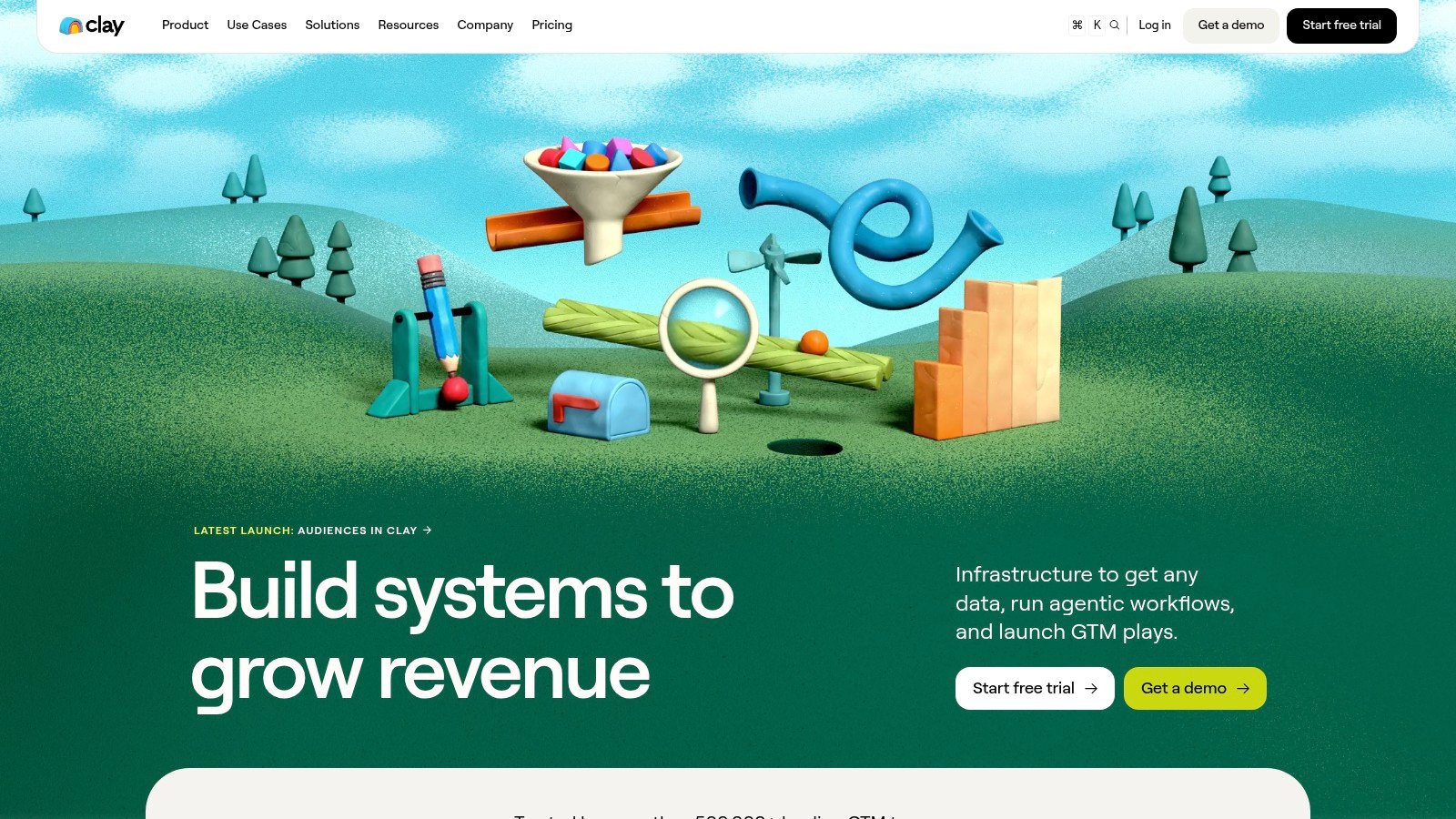
Clay wins this list because it improves the part often neglected, the data layer. It isn't really an AI lead generation tool in the pure sense. It's a data orchestration system with AI features attached, and that's exactly why it produces more operational lift than tools that lead with copywriting demos.
On complex B2B list work, that's the category that matters for iGaming, SaaS, manufacturing, legal tech, and pharma. Teams that successfully integrate AI lead generation technologies report lead quality improvements of 30% to 50% when they analyze patterns from successful deals to identify likely converters, which lines up with why Clay works so well as a scoring and enrichment engine in Superhuman Prospecting's analysis.
Why Clay is the winner
The best reason to buy Clay is waterfall enrichment plus structured research. You can build a firmographic list in Apollo or Sales Navigator, push it into Clay, run AI-powered web research, classify against ICP rules, enrich contacts from multiple sources, then send the approved records into Lemlist, Instantly, Smartlead, or HubSpot.
Best for: Teams that care about lead quality more than raw list volume
Works well with: Apollo → Clay → HubSpot → Smartlead or Lemlist
Main trade-off: The learning curve is real, and weak operators waste credits quickly
Practical rule: Clay pays off when you have a defined ICP, a clear trigger set, and someone who can actually build the workflow.
The AI layer becomes useful because the source data is stronger. That's the same reason AI enrichment matters in practice. You're not asking a model to invent relevance. You're asking it to classify and summarize real signals from hiring, product changes, funding, and company activity.
If you're a small team and want a guide for small business AI marketing, read that separately. But for operator-level lead gen, Clay is the top pick.
Website: Clay
2. Apollo.io
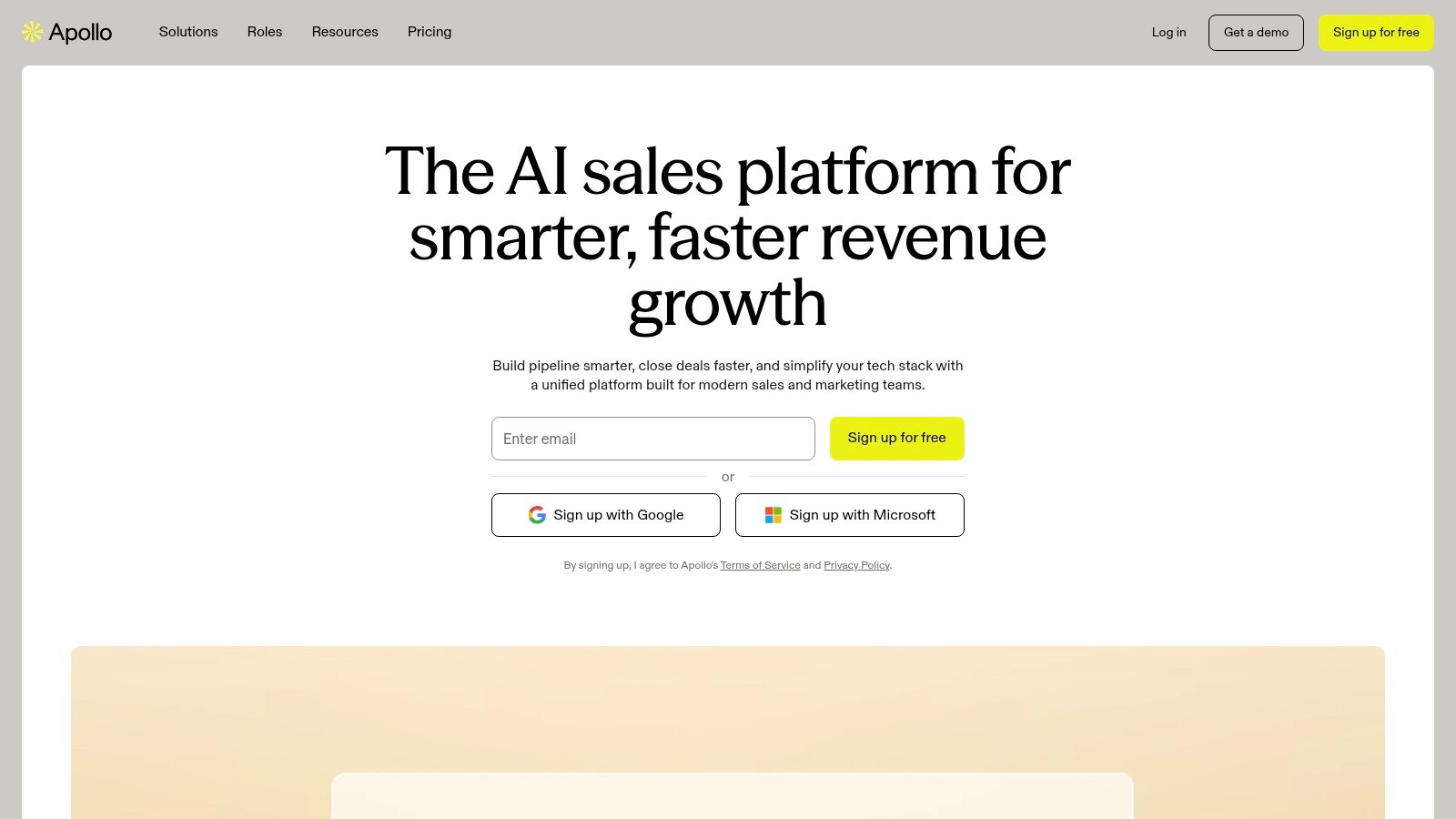
Apollo is the best starting point for teams that need one platform to source contacts and run outbound without building a heavier data system first. For founders and heads of sales under real time pressure, that matters more than having the most elegant enrichment architecture.
Databox's lead generation stats note that SEO is the top source of high-scoring leads for 35% of respondents, while Google Ads has over 50% adoption for B2B lead generation, and LinkedIn Sales Navigator plus HubSpot sit around a quarter of respondents each in tool usage patterns, all of which reinforces a practical point from Databox's lead generation statistics roundup. Pipeline rarely comes from one channel, so a tool that connects prospecting and sequencing in one place can be good enough to start.
Where Apollo fits
Apollo is strong when speed beats customization. You get database, enrichment, sequencing, and workflow automation in one system, and that reduces stack sprawl immediately.
Best for: Lean GTM teams, founder-led sales, smaller SDR pods
Better than Clay at: Fast launch, simpler onboarding, fewer moving parts
Worse than Clay at: Deep enrichment logic, custom scoring, signal monitoring
A solid default stack looks like Apollo → HubSpot → Sales Navigator. If you need more segmentation depth later, add Clay, don't try to force Apollo to become a data orchestration layer it isn't.
Apollo works when you need your first repeatable outbound system, not when you need your most advanced one.
The lead generation campaign framework matters here because Apollo's value shows up when the campaign logic is clear. If the ICP is fuzzy, the sequence will still be fuzzy.
Website: Apollo.io
3. ZoomInfo SalesOS (with Copilot)
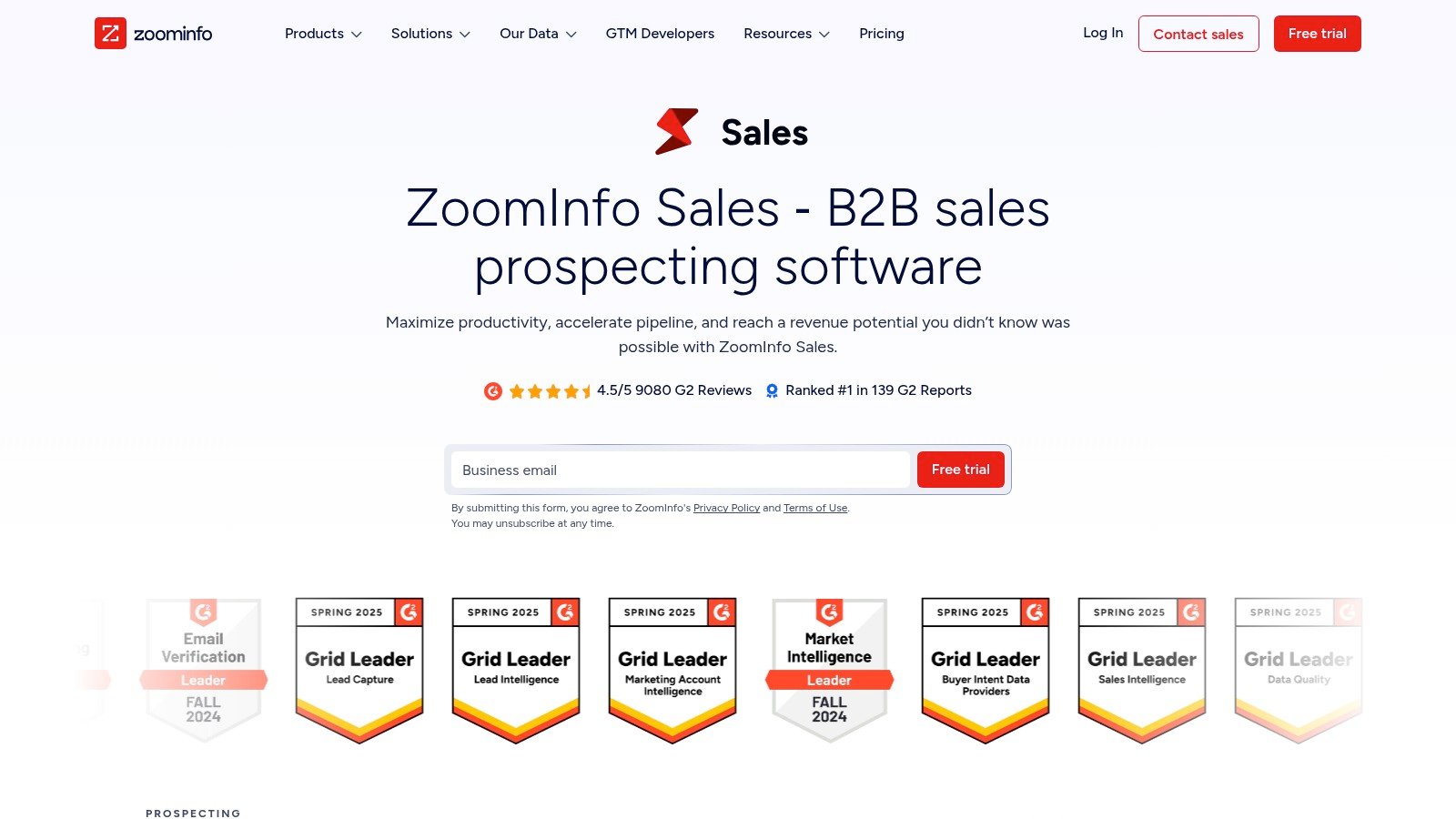
ZoomInfo fits teams that need more than a contact list: its AI-powered go-to-market platform combines B2B contact and company data with intent signals, account intelligence, and workflow automation. The emphasis is on turning buying signals into prioritized accounts and usable pipeline.
Where ZoomInfo earns its keep
It is a stronger fit for larger sales and RevOps organizations that need governance, routing, segmentation, and integrations with an established CRM. Teams can use firmographic, technographic, and intent data to identify high-potential segments, connect with decision-makers, and route leads based on account fit and buying stage.
Buy it if: You need broad sales intelligence and enterprise admin controls
Skip it if: You want a lightweight, low-cost prospecting stack
Pair it with: Salesforce or HubSpot and a sending layer when needed
Website: ZoomInfo SalesOS
4. Cognism

Cognism is the tool I put in front of teams with heavy EMEA coverage before I put them in front of most US-first databases. That's not because the product is flashy. It's because connect rates depend on contact quality and compliance discipline, especially in regulated markets.
For legal tech, pharma, and manufacturing teams selling across Europe, that trade-off is often worth more than a bigger US-style database. The AI layer helps with discovery, but the primary value is still contact accuracy and workflow fit.
Where Cognism beats bigger databases
Cognism is the right call when your reps need mobile numbers they can trust and a compliance posture that won't create headaches later. It pairs well with Sales Navigator for sourcing and with HubSpot or Salesforce for downstream workflow.
Best for: EMEA-heavy outbound, regulated categories, call-first motions
Not ideal for: Budget-sensitive SMB motions or US-only database replacement
Typical stack: Sales Navigator → Cognism → HubSpot → HeyReach or email sender
The trade-off is less flexibility than Clay and less all-in-one convenience than Apollo. But if you sell into conservative buying committees, predictable data quality beats novelty every time.
Website: Cognism
5. 6sense Revenue AI
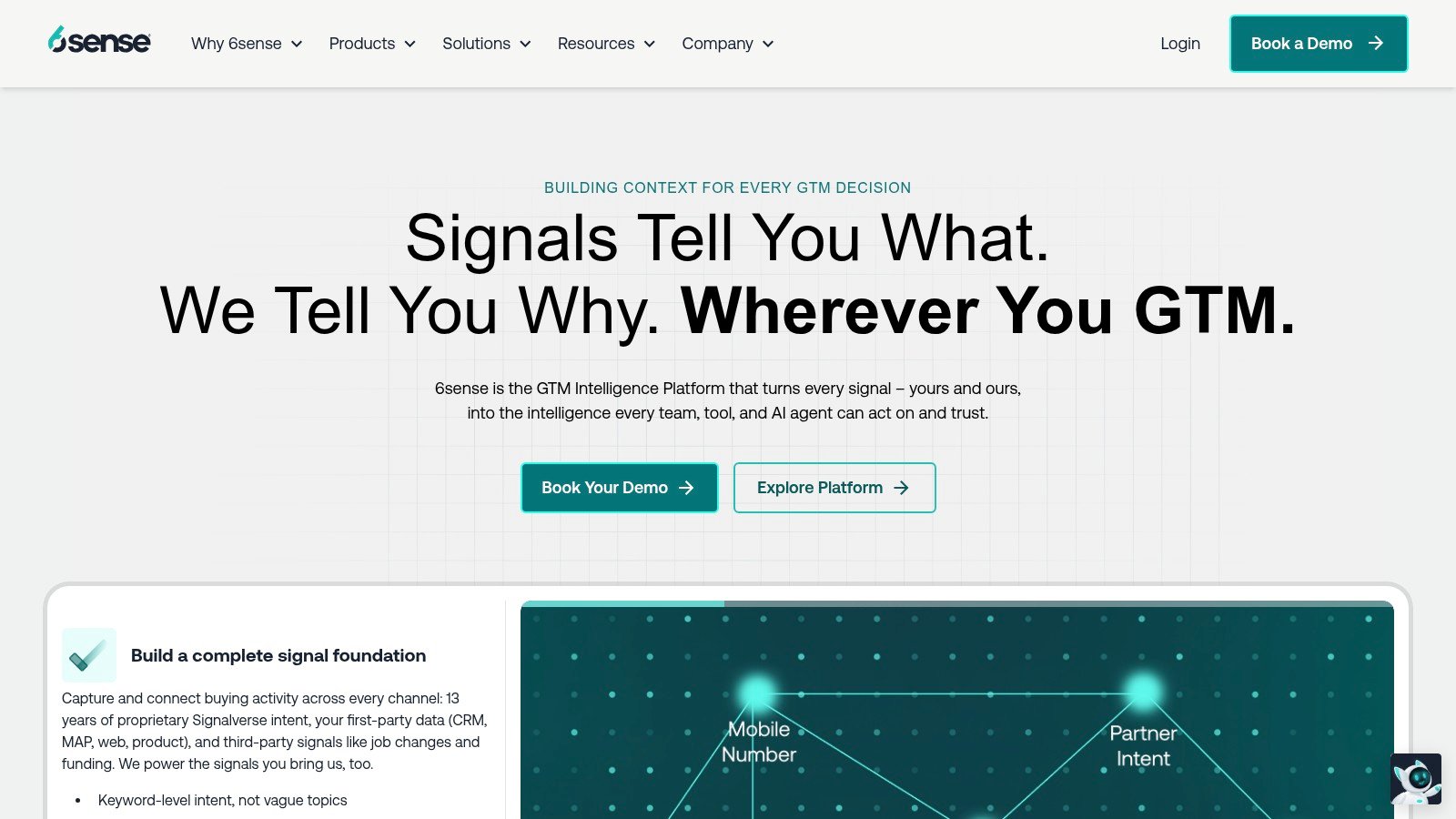
6sense is for account selection and timing, not for brute-force contact extraction. If your team already has outbound muscle but struggles to decide which accounts deserve attention now, 6sense can materially improve that prioritization layer.
Most content discussing "AI lead generation tools" often goes awry. It focuses excessively on list volume and outreach speed, yet lead quality remains the critical consideration. One analysis argues that only 12% of B2B marketers track conversion rates or pipeline value from AI-sourced leads, even though that metric set holds significance in Woodside Ventures' critique of AI lead generation tool coverage.
When 6sense is the right bet
6sense makes sense when marketing and sales already run ABM together. You need enough process maturity to act on account-level intent, website activity, and predictive scoring.
Best for: Mature ABM teams with named account coverage
Weak fit for: Early-stage outbound teams still building first list and message discipline
What it changes: Prioritization, routing, and timing more than record sourcing
If your team still argues about ICP definitions every week, don't buy 6sense yet. Buy discipline first. If the structure exists, AI sales automation becomes far more useful because the scoring has a place to land.
Website: 6sense Revenue AI
6. Amplemarket
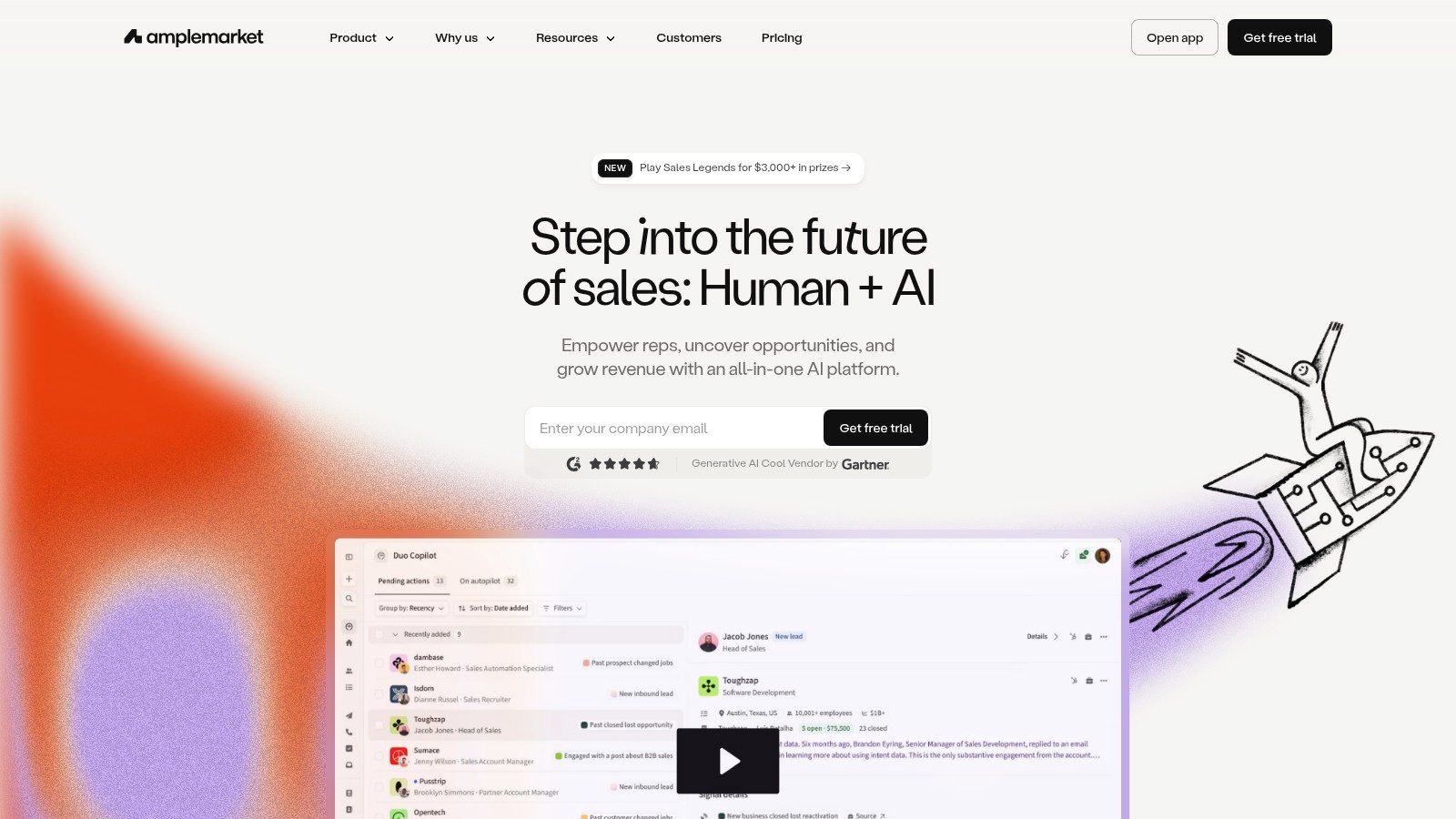
Amplemarket is one of the cleaner all-in-one options for teams that don't want to stitch together three to five vendors. It brings data, sequencing, multichannel actions, and AI assistance into one environment, which makes it attractive for growing outbound teams that are tired of duct-taped workflows.
The appeal is operational simplicity. You can get list sourcing, writing help, and deliverability support without building a Clay-grade system.
Why growing teams pick it
Amplemarket is usually a fit when Apollo feels too general and enterprise platforms feel too heavy. It sits in the middle. That middle can be exactly right for SaaS teams pushing into a new segment or geography.
Best for: Mid-market teams wanting less vendor sprawl
Watch out for: Narrower data depth at larger scale
Strong pairing: HubSpot plus a rep team that works email, LinkedIn, and calls together
I wouldn't pick it over Clay for complex enrichment or over ZoomInfo for enterprise data governance. I would pick it over a messy outbound stack where nobody owns the handoffs. That's where outbound sales automation breaks down most often, not in the message copy but in the workflow.
Website: Amplemarket
7. Clearbit (by HubSpot)

Clearbit isn't the tool I'd buy first for outbound. I would buy it when the underlying problem is CRM quality. If your inbound forms, hand-raisers, demo requests, and ABM traffic are entering HubSpot with weak data, your routing and scoring logic will stay broken no matter how many AI prompts you run elsewhere.
That makes Clearbit more of a systems purchase than a prospecting purchase. RevOps leaders usually understand that immediately. Founders often don't until they see SDRs working incomplete records every day.
Why RevOps teams keep it
Clearbit is best when you want cleaner segmentation, routing, and enrichment inside the CRM. It's especially useful when marketing and sales argue over lead quality because the inputs are inconsistent.
Best for: Inbound enrichment, scoring, routing, segmentation
Not for: Standalone list building or outbound sequencing
Where it fits: HubSpot-centered motions with real operational rigor
If your motion already creates attention and the handoff is weak, Clearbit can fix more than another outreach tool. Structure turns attention into pipeline. This is one of the clearest examples.
Website: Clearbit
8. Demandbase One

Demandbase belongs on this list for one reason. Some teams don't need a better lead list. They need one operating layer for account intelligence, advertising, sales activation, and attribution. That's a different problem, and Demandbase is built for it.
I see it as a marketing-led account system more than a sales-led prospecting tool. If the core motion is ABX and paid media is tightly tied to account progression, Demandbase is a credible option.
Where it makes sense
Demandbase is strongest when the account journey matters more than the individual prospect record. Marketing leaders usually buy it to align targeting, reporting, and sales follow-up across the same account set.
Buy Demandbase if your GTM motion already treats accounts as the unit of action. Skip it if reps still build lists one contact at a time from scratch.
The trade-off is complexity. Teams without a dedicated owner rarely get enough value from the full system. Teams with a mature ABM rhythm can.
Website: Demandbase One
9. LeadIQ

LeadIQ is the rep-friendly option on this list. It's narrow by design, and that's fine. Not every team needs a giant platform. Some teams need SDRs to capture the right people from LinkedIn and company sites, push them into the CRM, and get a decent first draft for outreach.
That focus makes adoption easier. It also limits ceiling compared with broader systems.
Best use case for LeadIQ
If your workflow starts in Sales Navigator and your reps source manually from target accounts, LeadIQ can reduce friction fast. That's especially true for smaller outbound teams where manager time is scarce and tool complexity kills adoption.
Best for: Rep-led LinkedIn prospecting and first-pass message drafting
Not for: Territory planning, deep enrichment, or full-funnel orchestration
Ideal pairings: Sales Navigator, HubSpot, Apollo, or a dedicated sender
One useful caution. A lot of AI-assisted messaging still feels patterned. AI can save time on drafting, but humans should still edit before anything goes live.
Website: LeadIQ
10. Grou (Managed Service)
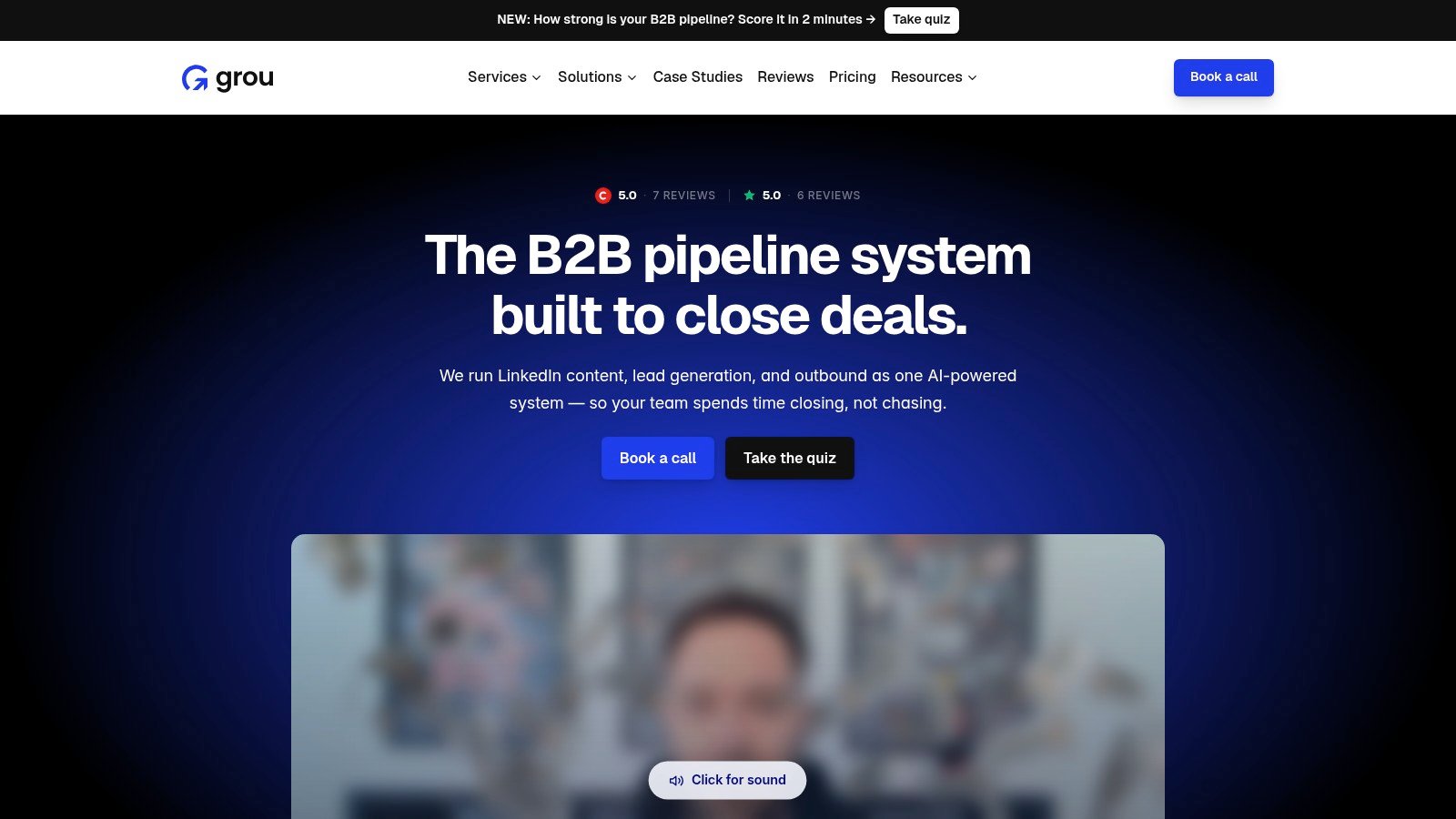
A common failure mode in AI lead gen is buying five tools and still missing pipeline because nobody owns the system. Data sits in one place, outreach in another, reporting in a third, and the team calls the stack "AI-powered" even though the core problem is execution.
Grou is the alternative to that mess. It is a managed service for teams that want outcomes from AI-assisted prospecting, enrichment, outbound, and funnel reporting without building the operating layer in-house. That makes it different from the rest of this list. You are not buying another login. You are buying process control, campaign management, and accountability.
That model makes sense when a company already knows its market but lacks bandwidth to run list QA, message testing, routing logic, and weekly optimization. I have seen this work best when leadership wants one owner for the whole motion and does not want to train a RevOps-heavy team around Clay workflows, sender infrastructure, CRM hygiene, and sequencing rules.
Who should choose managed execution
Grou fits teams that need operational lift faster than they can hire for it. That includes founder-led sales teams, smaller GTM orgs, and regulated or nuance-heavy categories such as iGaming, legal tech, pharma, manufacturing, and B2B SaaS with narrow ICPs.
A practical managed setup usually includes:
Target account and contact sourcing: Sales Navigator, Apollo, or another primary database
Research and enrichment: Clay or a similar workflow for firmographic, technographic, and trigger-based qualification
Outbound execution: HubSpot or a comparable CRM plus email and LinkedIn sequencing
Measurement: Reply quality, meetings held, pipeline created, and progression by segment
The trade-off is straightforward. Managed service costs more than adding a low-end prospecting tool, and you give up some DIY flexibility. In return, you get faster deployment, tighter process discipline, and fewer gaps between targeting, messaging, and reporting.
If your current "AI lead generation" stack is mostly veneer on old software, this route can produce more lift than another feature-rich platform. Especially when the primary bottleneck is orchestration, not access to one more AI button.
Website: Grou
Top 10 AI Lead-Gen Tools Comparison
Product | Core features ✨ | Quality & UX ★ | Value & Pricing 💰 | Target audience 👥 | Key differentiator / Notes 🏆 |
|---|---|---|---|---|---|
Clay | Visual workflow builder; waterfall enrichment; AI web research; CRM integrations | ★★★★☆, best data quality; steep learning curve | 💰 Usage-based; can be expensive at scale | 👥 RevOps, data-centric GTM teams, ops-heavy | ✨ Highly customizable pipelines; top-tier enrichment |
Apollo.io | Large B2B DB; sequences, dialer, AI assistant; Chrome extension | ★★★★☆, easy onboarding; fast time-to-launch | 💰 Affordable → Medium for SMBs; credits can add up | 👥 Lean GTM teams, SMBs | ✨ Consolidated all‑in‑one outbound stack for speed |
ZoomInfo SalesOS (with Copilot) | Deep US coverage; Copilot; intent & WebSights; enterprise integrations | ★★★★★, high accuracy for NA; robust admin controls | 💰 High; quote-based enterprise pricing | 👥 Large enterprises, US-focused sales & RevOps | ✨ Enterprise-grade data + intent signals |
Cognism | Verified mobile numbers; AI search; LinkedIn capture; GDPR/CCPA focus | ★★★★☆, excellent EMEA data quality | 💰 Mid→High; sales-led pricing | 👥 EMEA-focused teams, compliance-sensitive orgs | ✨ Human-validated mobile numbers; GDPR-first approach |
6sense Revenue AI | Predictive account scoring; deanonymization; multi-channel orchestration | ★★★★☆, strong ABM insights; complex to implement | 💰 High; enterprise ABM investment | 👥 Mature ABM marketing teams, enterprise | ✨ Predictive intent & account prioritization |
Amplemarket | Built-in DB with credits; multichannel sequences; AI copilot; concierge lists | ★★★★☆, unified UX; AI in core workflow | 💰 Transparent entry pricing; SMB/mid friendly | 👥 Growing outbound teams, SMB/mid-market | ✨ Contacts included + concierge list support |
Clearbit (by HubSpot) | Real-time CRM enrichment API; 100+ firmographics; visitor ID | ★★★★☆, mature enrichment engine | 💰 Mid/High; sales-led credit model | 👥 RevOps, HubSpot users, inbound/ABM teams | ✨ Real-time enrichment to power scoring & routing |
Demandbase One | Account intelligence; AI segmentation; native ad DSP; journey tracking | ★★★★☆, comprehensive ABX; resource-intensive | 💰 High; enterprise-oriented pricing | 👥 Sophisticated marketing orgs running ABM | ✨ ABX + native advertising for account activation |
LeadIQ | One-click contact capture; AI message writer; verified contacts via credits | ★★★★☆, simple UX; fast adoption by reps | 💰 Affordable; predictable credit model | 👥 Frontline sales reps sourcing from LinkedIn | ✨ Rapid capture + AI-first message drafts |
🏆 Grou (Managed Service) | Unified LinkedIn content, lead gen & outbound engine; managed setup & sprints | ★★★★★, fast signals; collaborative Slack workflow | 💰 Custom pricing; proposal-based (quality-over-volume) | 👥 Teams wanting a managed pipeline & predictable meetings | 🏆 Recommended, unified engine, 14‑day setup, signals in 30 days, shared Slack for rapid iteration |
Your next step
Stop shopping by feature list. Start with workflow diagnosis.
Map your current process from account selection to first reply. Use five columns in a simple sheet, account sourcing, enrichment, qualification, outreach prep, and reply handling. Then add one more column, time spent. By Friday, you'll know where your team is still doing manual labor and where AI can remove it.
If you're evaluating tools this quarter, apply a simple filter.
Can the tool improve data quality? If not, it probably won't improve meeting quality either.
Can your team operate it well? Clay is excellent, but not if nobody owns the workflow.
Does it fit your motion? Apollo for speed, ZoomInfo for enterprise control, 6sense for ABM timing, Clearbit for CRM enrichment.
Will you measure quality, not just activity? Replies, meetings, lead-to-MQL movement, and pipeline value matter more than opens.
One issue gets ignored too often. LinkedIn workflow fit. Some commentary around AI prospecting argues that 75% of B2B outbound happens on LinkedIn, while most reviews still focus on email and CRM automation, and that LinkedIn-integrated AI is badly underexplained in this discussion of LinkedIn-native AI prospecting gaps. You don't need to accept every claim around LinkedIn AI to recognize the broader point. If your team prospects on LinkedIn every day, evaluate tools on native workflow support, not just email features.
Content also still matters. Content marketing accounts for over half of all lead acquisition methods, according to the Databox source cited earlier, which is why the strongest systems don't isolate outbound from credibility-building content. In practice, the highest-performing setups connect LinkedIn posts, website intent, CRM enrichment, and outbound triggers into one sequence of actions.
Most AI lead generation tools don't fail because the model is weak. They fail because the operating system around the model is weak.
Audit your meeting-held rate this Friday. Then review the last ten opportunities sourced from outbound and mark which records had strong enrichment before first touch. If the answer is "not many," don't buy another sender. Fix the data workflow first.
GROU has built and managed AI-powered pipeline systems for global B2B companies across outbound, LinkedIn, and enrichment-led prospecting. Our methodology is simple, structure turns attention into pipeline through better data, tighter qualification, and faster feedback loops.
If your team needs the result of an AI-led pipeline system without spending months assembling tools and operators, Grou is the practical next move. We build the targeting, enrichment, LinkedIn content, outbound execution, and reporting into one working system, so your sales team spends more time in qualified conversations and less time cleaning lists.
Clay is the best AI lead generation tool for pure operational lift. Apollo is the better starting point if you need a simpler database plus sequencer, and the bigger pattern is that businesses investing in AI for lead generation and automation are seeing revenue uplift of 3% to 15% and sales ROI uplift of 10% to 20%, according to industry analysis citing McKinsey in this 2025 lead generation trends report.
Your team already has enough tools. What you don't have is a clean system from signal to list to outreach to qualified meeting, so every outbound push turns into manual labor. Reps still spend 6 to 8 hours each week building lists and finding contact data, which is exactly the kind of busywork AI should remove when the stack is built correctly, as noted in Monday.com's breakdown of AI B2B lead generation workflows.
Clay is the top pick because its data orchestration creates better inputs for every downstream action.
Apollo is the best starting stack for lean teams that need database plus sequencing in one place.
The real split is use case, list building → enrichment → intent, not who has the loudest AI branding.
Structure beats novelty. If the workflow is weak, AI just helps you send bad outreach faster.
If your motion still depends on static CSVs and generic sequences, fix that before buying another sender. And if you're running software GTM, this software demand generation guide is worth reading alongside the tool choices below.
Table of Contents
1. Clay
Clay wins this list because it improves the part often neglected, the data layer. It isn't really an AI lead generation tool in the pure sense. It's a data orchestration system with AI features attached, and that's exactly why it produces more operational lift than tools that lead with copywriting demos.
On complex B2B list work, that's the category that matters for iGaming, SaaS, manufacturing, legal tech, and pharma. Teams that successfully integrate AI lead generation technologies report lead quality improvements of 30% to 50% when they analyze patterns from successful deals to identify likely converters, which lines up with why Clay works so well as a scoring and enrichment engine in Superhuman Prospecting's analysis.
Why Clay is the winner
The best reason to buy Clay is waterfall enrichment plus structured research. You can build a firmographic list in Apollo or Sales Navigator, push it into Clay, run AI-powered web research, classify against ICP rules, enrich contacts from multiple sources, then send the approved records into Lemlist, Instantly, Smartlead, or HubSpot.
Best for: Teams that care about lead quality more than raw list volume
Works well with: Apollo → Clay → HubSpot → Smartlead or Lemlist
Main trade-off: The learning curve is real, and weak operators waste credits quickly
Practical rule: Clay pays off when you have a defined ICP, a clear trigger set, and someone who can actually build the workflow.
The AI layer becomes useful because the source data is stronger. That's the same reason AI enrichment matters in practice. You're not asking a model to invent relevance. You're asking it to classify and summarize real signals from hiring, product changes, funding, and company activity.
If you're a small team and want a guide for small business AI marketing, read that separately. But for operator-level lead gen, Clay is the top pick.
Website: Clay
2. Apollo.io
Apollo is the best starting point for teams that need one platform to source contacts and run outbound without building a heavier data system first. For founders and heads of sales under real time pressure, that matters more than having the most elegant enrichment architecture.
Databox's lead generation stats note that SEO is the top source of high-scoring leads for 35% of respondents, while Google Ads has over 50% adoption for B2B lead generation, and LinkedIn Sales Navigator plus HubSpot sit around a quarter of respondents each in tool usage patterns, all of which reinforces a practical point from Databox's lead generation statistics roundup. Pipeline rarely comes from one channel, so a tool that connects prospecting and sequencing in one place can be good enough to start.
Where Apollo fits
Apollo is strong when speed beats customization. You get database, enrichment, sequencing, and workflow automation in one system, and that reduces stack sprawl immediately.
Best for: Lean GTM teams, founder-led sales, smaller SDR pods
Better than Clay at: Fast launch, simpler onboarding, fewer moving parts
Worse than Clay at: Deep enrichment logic, custom scoring, signal monitoring
A solid default stack looks like Apollo → HubSpot → Sales Navigator. If you need more segmentation depth later, add Clay, don't try to force Apollo to become a data orchestration layer it isn't.
Apollo works when you need your first repeatable outbound system, not when you need your most advanced one.
The lead generation campaign framework matters here because Apollo's value shows up when the campaign logic is clear. If the ICP is fuzzy, the sequence will still be fuzzy.
Website: Apollo.io
3. ZoomInfo SalesOS (with Copilot)
ZoomInfo fits teams that need more than a contact list: its AI-powered go-to-market platform combines B2B contact and company data with intent signals, account intelligence, and workflow automation. The emphasis is on turning buying signals into prioritized accounts and usable pipeline.
Where ZoomInfo earns its keep
It is a stronger fit for larger sales and RevOps organizations that need governance, routing, segmentation, and integrations with an established CRM. Teams can use firmographic, technographic, and intent data to identify high-potential segments, connect with decision-makers, and route leads based on account fit and buying stage.
Buy it if: You need broad sales intelligence and enterprise admin controls
Skip it if: You want a lightweight, low-cost prospecting stack
Pair it with: Salesforce or HubSpot and a sending layer when needed
Website: ZoomInfo SalesOS
4. Cognism
Cognism is the tool I put in front of teams with heavy EMEA coverage before I put them in front of most US-first databases. That's not because the product is flashy. It's because connect rates depend on contact quality and compliance discipline, especially in regulated markets.
For legal tech, pharma, and manufacturing teams selling across Europe, that trade-off is often worth more than a bigger US-style database. The AI layer helps with discovery, but the primary value is still contact accuracy and workflow fit.
Where Cognism beats bigger databases
Cognism is the right call when your reps need mobile numbers they can trust and a compliance posture that won't create headaches later. It pairs well with Sales Navigator for sourcing and with HubSpot or Salesforce for downstream workflow.
Best for: EMEA-heavy outbound, regulated categories, call-first motions
Not ideal for: Budget-sensitive SMB motions or US-only database replacement
Typical stack: Sales Navigator → Cognism → HubSpot → HeyReach or email sender
The trade-off is less flexibility than Clay and less all-in-one convenience than Apollo. But if you sell into conservative buying committees, predictable data quality beats novelty every time.
Website: Cognism
5. 6sense Revenue AI
6sense is for account selection and timing, not for brute-force contact extraction. If your team already has outbound muscle but struggles to decide which accounts deserve attention now, 6sense can materially improve that prioritization layer.
Most content discussing "AI lead generation tools" often goes awry. It focuses excessively on list volume and outreach speed, yet lead quality remains the critical consideration. One analysis argues that only 12% of B2B marketers track conversion rates or pipeline value from AI-sourced leads, even though that metric set holds significance in Woodside Ventures' critique of AI lead generation tool coverage.
When 6sense is the right bet
6sense makes sense when marketing and sales already run ABM together. You need enough process maturity to act on account-level intent, website activity, and predictive scoring.
Best for: Mature ABM teams with named account coverage
Weak fit for: Early-stage outbound teams still building first list and message discipline
What it changes: Prioritization, routing, and timing more than record sourcing
If your team still argues about ICP definitions every week, don't buy 6sense yet. Buy discipline first. If the structure exists, AI sales automation becomes far more useful because the scoring has a place to land.
Website: 6sense Revenue AI
6. Amplemarket
Amplemarket is one of the cleaner all-in-one options for teams that don't want to stitch together three to five vendors. It brings data, sequencing, multichannel actions, and AI assistance into one environment, which makes it attractive for growing outbound teams that are tired of duct-taped workflows.
The appeal is operational simplicity. You can get list sourcing, writing help, and deliverability support without building a Clay-grade system.
Why growing teams pick it
Amplemarket is usually a fit when Apollo feels too general and enterprise platforms feel too heavy. It sits in the middle. That middle can be exactly right for SaaS teams pushing into a new segment or geography.
Best for: Mid-market teams wanting less vendor sprawl
Watch out for: Narrower data depth at larger scale
Strong pairing: HubSpot plus a rep team that works email, LinkedIn, and calls together
I wouldn't pick it over Clay for complex enrichment or over ZoomInfo for enterprise data governance. I would pick it over a messy outbound stack where nobody owns the handoffs. That's where outbound sales automation breaks down most often, not in the message copy but in the workflow.
Website: Amplemarket
7. Clearbit (by HubSpot)
Clearbit isn't the tool I'd buy first for outbound. I would buy it when the underlying problem is CRM quality. If your inbound forms, hand-raisers, demo requests, and ABM traffic are entering HubSpot with weak data, your routing and scoring logic will stay broken no matter how many AI prompts you run elsewhere.
That makes Clearbit more of a systems purchase than a prospecting purchase. RevOps leaders usually understand that immediately. Founders often don't until they see SDRs working incomplete records every day.
Why RevOps teams keep it
Clearbit is best when you want cleaner segmentation, routing, and enrichment inside the CRM. It's especially useful when marketing and sales argue over lead quality because the inputs are inconsistent.
Best for: Inbound enrichment, scoring, routing, segmentation
Not for: Standalone list building or outbound sequencing
Where it fits: HubSpot-centered motions with real operational rigor
If your motion already creates attention and the handoff is weak, Clearbit can fix more than another outreach tool. Structure turns attention into pipeline. This is one of the clearest examples.
Website: Clearbit
8. Demandbase One
Demandbase belongs on this list for one reason. Some teams don't need a better lead list. They need one operating layer for account intelligence, advertising, sales activation, and attribution. That's a different problem, and Demandbase is built for it.
I see it as a marketing-led account system more than a sales-led prospecting tool. If the core motion is ABX and paid media is tightly tied to account progression, Demandbase is a credible option.
Where it makes sense
Demandbase is strongest when the account journey matters more than the individual prospect record. Marketing leaders usually buy it to align targeting, reporting, and sales follow-up across the same account set.
Buy Demandbase if your GTM motion already treats accounts as the unit of action. Skip it if reps still build lists one contact at a time from scratch.
The trade-off is complexity. Teams without a dedicated owner rarely get enough value from the full system. Teams with a mature ABM rhythm can.
Website: Demandbase One
9. LeadIQ
LeadIQ is the rep-friendly option on this list. It's narrow by design, and that's fine. Not every team needs a giant platform. Some teams need SDRs to capture the right people from LinkedIn and company sites, push them into the CRM, and get a decent first draft for outreach.
That focus makes adoption easier. It also limits ceiling compared with broader systems.
Best use case for LeadIQ
If your workflow starts in Sales Navigator and your reps source manually from target accounts, LeadIQ can reduce friction fast. That's especially true for smaller outbound teams where manager time is scarce and tool complexity kills adoption.
Best for: Rep-led LinkedIn prospecting and first-pass message drafting
Not for: Territory planning, deep enrichment, or full-funnel orchestration
Ideal pairings: Sales Navigator, HubSpot, Apollo, or a dedicated sender
One useful caution. A lot of AI-assisted messaging still feels patterned. AI can save time on drafting, but humans should still edit before anything goes live.
Website: LeadIQ
10. Grou (Managed Service)
A common failure mode in AI lead gen is buying five tools and still missing pipeline because nobody owns the system. Data sits in one place, outreach in another, reporting in a third, and the team calls the stack "AI-powered" even though the core problem is execution.
Grou is the alternative to that mess. It is a managed service for teams that want outcomes from AI-assisted prospecting, enrichment, outbound, and funnel reporting without building the operating layer in-house. That makes it different from the rest of this list. You are not buying another login. You are buying process control, campaign management, and accountability.
That model makes sense when a company already knows its market but lacks bandwidth to run list QA, message testing, routing logic, and weekly optimization. I have seen this work best when leadership wants one owner for the whole motion and does not want to train a RevOps-heavy team around Clay workflows, sender infrastructure, CRM hygiene, and sequencing rules.
Who should choose managed execution
Grou fits teams that need operational lift faster than they can hire for it. That includes founder-led sales teams, smaller GTM orgs, and regulated or nuance-heavy categories such as iGaming, legal tech, pharma, manufacturing, and B2B SaaS with narrow ICPs.
A practical managed setup usually includes:
Target account and contact sourcing: Sales Navigator, Apollo, or another primary database
Research and enrichment: Clay or a similar workflow for firmographic, technographic, and trigger-based qualification
Outbound execution: HubSpot or a comparable CRM plus email and LinkedIn sequencing
Measurement: Reply quality, meetings held, pipeline created, and progression by segment
The trade-off is straightforward. Managed service costs more than adding a low-end prospecting tool, and you give up some DIY flexibility. In return, you get faster deployment, tighter process discipline, and fewer gaps between targeting, messaging, and reporting.
If your current "AI lead generation" stack is mostly veneer on old software, this route can produce more lift than another feature-rich platform. Especially when the primary bottleneck is orchestration, not access to one more AI button.
Website: Grou
Top 10 AI Lead-Gen Tools Comparison
Product | Core features ✨ | Quality & UX ★ | Value & Pricing 💰 | Target audience 👥 | Key differentiator / Notes 🏆 |
|---|---|---|---|---|---|
Clay | Visual workflow builder; waterfall enrichment; AI web research; CRM integrations | ★★★★☆, best data quality; steep learning curve | 💰 Usage-based; can be expensive at scale | 👥 RevOps, data-centric GTM teams, ops-heavy | ✨ Highly customizable pipelines; top-tier enrichment |
Apollo.io | Large B2B DB; sequences, dialer, AI assistant; Chrome extension | ★★★★☆, easy onboarding; fast time-to-launch | 💰 Affordable → Medium for SMBs; credits can add up | 👥 Lean GTM teams, SMBs | ✨ Consolidated all‑in‑one outbound stack for speed |
ZoomInfo SalesOS (with Copilot) | Deep US coverage; Copilot; intent & WebSights; enterprise integrations | ★★★★★, high accuracy for NA; robust admin controls | 💰 High; quote-based enterprise pricing | 👥 Large enterprises, US-focused sales & RevOps | ✨ Enterprise-grade data + intent signals |
Cognism | Verified mobile numbers; AI search; LinkedIn capture; GDPR/CCPA focus | ★★★★☆, excellent EMEA data quality | 💰 Mid→High; sales-led pricing | 👥 EMEA-focused teams, compliance-sensitive orgs | ✨ Human-validated mobile numbers; GDPR-first approach |
6sense Revenue AI | Predictive account scoring; deanonymization; multi-channel orchestration | ★★★★☆, strong ABM insights; complex to implement | 💰 High; enterprise ABM investment | 👥 Mature ABM marketing teams, enterprise | ✨ Predictive intent & account prioritization |
Amplemarket | Built-in DB with credits; multichannel sequences; AI copilot; concierge lists | ★★★★☆, unified UX; AI in core workflow | 💰 Transparent entry pricing; SMB/mid friendly | 👥 Growing outbound teams, SMB/mid-market | ✨ Contacts included + concierge list support |
Clearbit (by HubSpot) | Real-time CRM enrichment API; 100+ firmographics; visitor ID | ★★★★☆, mature enrichment engine | 💰 Mid/High; sales-led credit model | 👥 RevOps, HubSpot users, inbound/ABM teams | ✨ Real-time enrichment to power scoring & routing |
Demandbase One | Account intelligence; AI segmentation; native ad DSP; journey tracking | ★★★★☆, comprehensive ABX; resource-intensive | 💰 High; enterprise-oriented pricing | 👥 Sophisticated marketing orgs running ABM | ✨ ABX + native advertising for account activation |
LeadIQ | One-click contact capture; AI message writer; verified contacts via credits | ★★★★☆, simple UX; fast adoption by reps | 💰 Affordable; predictable credit model | 👥 Frontline sales reps sourcing from LinkedIn | ✨ Rapid capture + AI-first message drafts |
🏆 Grou (Managed Service) | Unified LinkedIn content, lead gen & outbound engine; managed setup & sprints | ★★★★★, fast signals; collaborative Slack workflow | 💰 Custom pricing; proposal-based (quality-over-volume) | 👥 Teams wanting a managed pipeline & predictable meetings | 🏆 Recommended, unified engine, 14‑day setup, signals in 30 days, shared Slack for rapid iteration |
Your next step
Stop shopping by feature list. Start with workflow diagnosis.
Map your current process from account selection to first reply. Use five columns in a simple sheet, account sourcing, enrichment, qualification, outreach prep, and reply handling. Then add one more column, time spent. By Friday, you'll know where your team is still doing manual labor and where AI can remove it.
If you're evaluating tools this quarter, apply a simple filter.
Can the tool improve data quality? If not, it probably won't improve meeting quality either.
Can your team operate it well? Clay is excellent, but not if nobody owns the workflow.
Does it fit your motion? Apollo for speed, ZoomInfo for enterprise control, 6sense for ABM timing, Clearbit for CRM enrichment.
Will you measure quality, not just activity? Replies, meetings, lead-to-MQL movement, and pipeline value matter more than opens.
One issue gets ignored too often. LinkedIn workflow fit. Some commentary around AI prospecting argues that 75% of B2B outbound happens on LinkedIn, while most reviews still focus on email and CRM automation, and that LinkedIn-integrated AI is badly underexplained in this discussion of LinkedIn-native AI prospecting gaps. You don't need to accept every claim around LinkedIn AI to recognize the broader point. If your team prospects on LinkedIn every day, evaluate tools on native workflow support, not just email features.
Content also still matters. Content marketing accounts for over half of all lead acquisition methods, according to the Databox source cited earlier, which is why the strongest systems don't isolate outbound from credibility-building content. In practice, the highest-performing setups connect LinkedIn posts, website intent, CRM enrichment, and outbound triggers into one sequence of actions.
Most AI lead generation tools don't fail because the model is weak. They fail because the operating system around the model is weak.
Audit your meeting-held rate this Friday. Then review the last ten opportunities sourced from outbound and mark which records had strong enrichment before first touch. If the answer is "not many," don't buy another sender. Fix the data workflow first.
GROU has built and managed AI-powered pipeline systems for global B2B companies across outbound, LinkedIn, and enrichment-led prospecting. Our methodology is simple, structure turns attention into pipeline through better data, tighter qualification, and faster feedback loops.
If your team needs the result of an AI-led pipeline system without spending months assembling tools and operators, Grou is the practical next move. We build the targeting, enrichment, LinkedIn content, outbound execution, and reporting into one working system, so your sales team spends more time in qualified conversations and less time cleaning lists.
Clay is the best AI lead generation tool for pure operational lift. Apollo is the better starting point if you need a simpler database plus sequencer, and the bigger pattern is that businesses investing in AI for lead generation and automation are seeing revenue uplift of 3% to 15% and sales ROI uplift of 10% to 20%, according to industry analysis citing McKinsey in this 2025 lead generation trends report.
Your team already has enough tools. What you don't have is a clean system from signal to list to outreach to qualified meeting, so every outbound push turns into manual labor. Reps still spend 6 to 8 hours each week building lists and finding contact data, which is exactly the kind of busywork AI should remove when the stack is built correctly, as noted in Monday.com's breakdown of AI B2B lead generation workflows.
Clay is the top pick because its data orchestration creates better inputs for every downstream action.
Apollo is the best starting stack for lean teams that need database plus sequencing in one place.
The real split is use case, list building → enrichment → intent, not who has the loudest AI branding.
Structure beats novelty. If the workflow is weak, AI just helps you send bad outreach faster.
If your motion still depends on static CSVs and generic sequences, fix that before buying another sender. And if you're running software GTM, this software demand generation guide is worth reading alongside the tool choices below.
Table of Contents
1. Clay
Clay wins this list because it improves the part often neglected, the data layer. It isn't really an AI lead generation tool in the pure sense. It's a data orchestration system with AI features attached, and that's exactly why it produces more operational lift than tools that lead with copywriting demos.
On complex B2B list work, that's the category that matters for iGaming, SaaS, manufacturing, legal tech, and pharma. Teams that successfully integrate AI lead generation technologies report lead quality improvements of 30% to 50% when they analyze patterns from successful deals to identify likely converters, which lines up with why Clay works so well as a scoring and enrichment engine in Superhuman Prospecting's analysis.
Why Clay is the winner
The best reason to buy Clay is waterfall enrichment plus structured research. You can build a firmographic list in Apollo or Sales Navigator, push it into Clay, run AI-powered web research, classify against ICP rules, enrich contacts from multiple sources, then send the approved records into Lemlist, Instantly, Smartlead, or HubSpot.
Best for: Teams that care about lead quality more than raw list volume
Works well with: Apollo → Clay → HubSpot → Smartlead or Lemlist
Main trade-off: The learning curve is real, and weak operators waste credits quickly
Practical rule: Clay pays off when you have a defined ICP, a clear trigger set, and someone who can actually build the workflow.
The AI layer becomes useful because the source data is stronger. That's the same reason AI enrichment matters in practice. You're not asking a model to invent relevance. You're asking it to classify and summarize real signals from hiring, product changes, funding, and company activity.
If you're a small team and want a guide for small business AI marketing, read that separately. But for operator-level lead gen, Clay is the top pick.
Website: Clay
2. Apollo.io
Apollo is the best starting point for teams that need one platform to source contacts and run outbound without building a heavier data system first. For founders and heads of sales under real time pressure, that matters more than having the most elegant enrichment architecture.
Databox's lead generation stats note that SEO is the top source of high-scoring leads for 35% of respondents, while Google Ads has over 50% adoption for B2B lead generation, and LinkedIn Sales Navigator plus HubSpot sit around a quarter of respondents each in tool usage patterns, all of which reinforces a practical point from Databox's lead generation statistics roundup. Pipeline rarely comes from one channel, so a tool that connects prospecting and sequencing in one place can be good enough to start.
Where Apollo fits
Apollo is strong when speed beats customization. You get database, enrichment, sequencing, and workflow automation in one system, and that reduces stack sprawl immediately.
Best for: Lean GTM teams, founder-led sales, smaller SDR pods
Better than Clay at: Fast launch, simpler onboarding, fewer moving parts
Worse than Clay at: Deep enrichment logic, custom scoring, signal monitoring
A solid default stack looks like Apollo → HubSpot → Sales Navigator. If you need more segmentation depth later, add Clay, don't try to force Apollo to become a data orchestration layer it isn't.
Apollo works when you need your first repeatable outbound system, not when you need your most advanced one.
The lead generation campaign framework matters here because Apollo's value shows up when the campaign logic is clear. If the ICP is fuzzy, the sequence will still be fuzzy.
Website: Apollo.io
3. ZoomInfo SalesOS (with Copilot)
ZoomInfo fits teams that need more than a contact list: its AI-powered go-to-market platform combines B2B contact and company data with intent signals, account intelligence, and workflow automation. The emphasis is on turning buying signals into prioritized accounts and usable pipeline.
Where ZoomInfo earns its keep
It is a stronger fit for larger sales and RevOps organizations that need governance, routing, segmentation, and integrations with an established CRM. Teams can use firmographic, technographic, and intent data to identify high-potential segments, connect with decision-makers, and route leads based on account fit and buying stage.
Buy it if: You need broad sales intelligence and enterprise admin controls
Skip it if: You want a lightweight, low-cost prospecting stack
Pair it with: Salesforce or HubSpot and a sending layer when needed
Website: ZoomInfo SalesOS
4. Cognism
Cognism is the tool I put in front of teams with heavy EMEA coverage before I put them in front of most US-first databases. That's not because the product is flashy. It's because connect rates depend on contact quality and compliance discipline, especially in regulated markets.
For legal tech, pharma, and manufacturing teams selling across Europe, that trade-off is often worth more than a bigger US-style database. The AI layer helps with discovery, but the primary value is still contact accuracy and workflow fit.
Where Cognism beats bigger databases
Cognism is the right call when your reps need mobile numbers they can trust and a compliance posture that won't create headaches later. It pairs well with Sales Navigator for sourcing and with HubSpot or Salesforce for downstream workflow.
Best for: EMEA-heavy outbound, regulated categories, call-first motions
Not ideal for: Budget-sensitive SMB motions or US-only database replacement
Typical stack: Sales Navigator → Cognism → HubSpot → HeyReach or email sender
The trade-off is less flexibility than Clay and less all-in-one convenience than Apollo. But if you sell into conservative buying committees, predictable data quality beats novelty every time.
Website: Cognism
5. 6sense Revenue AI
6sense is for account selection and timing, not for brute-force contact extraction. If your team already has outbound muscle but struggles to decide which accounts deserve attention now, 6sense can materially improve that prioritization layer.
Most content discussing "AI lead generation tools" often goes awry. It focuses excessively on list volume and outreach speed, yet lead quality remains the critical consideration. One analysis argues that only 12% of B2B marketers track conversion rates or pipeline value from AI-sourced leads, even though that metric set holds significance in Woodside Ventures' critique of AI lead generation tool coverage.
When 6sense is the right bet
6sense makes sense when marketing and sales already run ABM together. You need enough process maturity to act on account-level intent, website activity, and predictive scoring.
Best for: Mature ABM teams with named account coverage
Weak fit for: Early-stage outbound teams still building first list and message discipline
What it changes: Prioritization, routing, and timing more than record sourcing
If your team still argues about ICP definitions every week, don't buy 6sense yet. Buy discipline first. If the structure exists, AI sales automation becomes far more useful because the scoring has a place to land.
Website: 6sense Revenue AI
6. Amplemarket
Amplemarket is one of the cleaner all-in-one options for teams that don't want to stitch together three to five vendors. It brings data, sequencing, multichannel actions, and AI assistance into one environment, which makes it attractive for growing outbound teams that are tired of duct-taped workflows.
The appeal is operational simplicity. You can get list sourcing, writing help, and deliverability support without building a Clay-grade system.
Why growing teams pick it
Amplemarket is usually a fit when Apollo feels too general and enterprise platforms feel too heavy. It sits in the middle. That middle can be exactly right for SaaS teams pushing into a new segment or geography.
Best for: Mid-market teams wanting less vendor sprawl
Watch out for: Narrower data depth at larger scale
Strong pairing: HubSpot plus a rep team that works email, LinkedIn, and calls together
I wouldn't pick it over Clay for complex enrichment or over ZoomInfo for enterprise data governance. I would pick it over a messy outbound stack where nobody owns the handoffs. That's where outbound sales automation breaks down most often, not in the message copy but in the workflow.
Website: Amplemarket
7. Clearbit (by HubSpot)
Clearbit isn't the tool I'd buy first for outbound. I would buy it when the underlying problem is CRM quality. If your inbound forms, hand-raisers, demo requests, and ABM traffic are entering HubSpot with weak data, your routing and scoring logic will stay broken no matter how many AI prompts you run elsewhere.
That makes Clearbit more of a systems purchase than a prospecting purchase. RevOps leaders usually understand that immediately. Founders often don't until they see SDRs working incomplete records every day.
Why RevOps teams keep it
Clearbit is best when you want cleaner segmentation, routing, and enrichment inside the CRM. It's especially useful when marketing and sales argue over lead quality because the inputs are inconsistent.
Best for: Inbound enrichment, scoring, routing, segmentation
Not for: Standalone list building or outbound sequencing
Where it fits: HubSpot-centered motions with real operational rigor
If your motion already creates attention and the handoff is weak, Clearbit can fix more than another outreach tool. Structure turns attention into pipeline. This is one of the clearest examples.
Website: Clearbit
8. Demandbase One
Demandbase belongs on this list for one reason. Some teams don't need a better lead list. They need one operating layer for account intelligence, advertising, sales activation, and attribution. That's a different problem, and Demandbase is built for it.
I see it as a marketing-led account system more than a sales-led prospecting tool. If the core motion is ABX and paid media is tightly tied to account progression, Demandbase is a credible option.
Where it makes sense
Demandbase is strongest when the account journey matters more than the individual prospect record. Marketing leaders usually buy it to align targeting, reporting, and sales follow-up across the same account set.
Buy Demandbase if your GTM motion already treats accounts as the unit of action. Skip it if reps still build lists one contact at a time from scratch.
The trade-off is complexity. Teams without a dedicated owner rarely get enough value from the full system. Teams with a mature ABM rhythm can.
Website: Demandbase One
9. LeadIQ
LeadIQ is the rep-friendly option on this list. It's narrow by design, and that's fine. Not every team needs a giant platform. Some teams need SDRs to capture the right people from LinkedIn and company sites, push them into the CRM, and get a decent first draft for outreach.
That focus makes adoption easier. It also limits ceiling compared with broader systems.
Best use case for LeadIQ
If your workflow starts in Sales Navigator and your reps source manually from target accounts, LeadIQ can reduce friction fast. That's especially true for smaller outbound teams where manager time is scarce and tool complexity kills adoption.
Best for: Rep-led LinkedIn prospecting and first-pass message drafting
Not for: Territory planning, deep enrichment, or full-funnel orchestration
Ideal pairings: Sales Navigator, HubSpot, Apollo, or a dedicated sender
One useful caution. A lot of AI-assisted messaging still feels patterned. AI can save time on drafting, but humans should still edit before anything goes live.
Website: LeadIQ
10. Grou (Managed Service)
A common failure mode in AI lead gen is buying five tools and still missing pipeline because nobody owns the system. Data sits in one place, outreach in another, reporting in a third, and the team calls the stack "AI-powered" even though the core problem is execution.
Grou is the alternative to that mess. It is a managed service for teams that want outcomes from AI-assisted prospecting, enrichment, outbound, and funnel reporting without building the operating layer in-house. That makes it different from the rest of this list. You are not buying another login. You are buying process control, campaign management, and accountability.
That model makes sense when a company already knows its market but lacks bandwidth to run list QA, message testing, routing logic, and weekly optimization. I have seen this work best when leadership wants one owner for the whole motion and does not want to train a RevOps-heavy team around Clay workflows, sender infrastructure, CRM hygiene, and sequencing rules.
Who should choose managed execution
Grou fits teams that need operational lift faster than they can hire for it. That includes founder-led sales teams, smaller GTM orgs, and regulated or nuance-heavy categories such as iGaming, legal tech, pharma, manufacturing, and B2B SaaS with narrow ICPs.
A practical managed setup usually includes:
Target account and contact sourcing: Sales Navigator, Apollo, or another primary database
Research and enrichment: Clay or a similar workflow for firmographic, technographic, and trigger-based qualification
Outbound execution: HubSpot or a comparable CRM plus email and LinkedIn sequencing
Measurement: Reply quality, meetings held, pipeline created, and progression by segment
The trade-off is straightforward. Managed service costs more than adding a low-end prospecting tool, and you give up some DIY flexibility. In return, you get faster deployment, tighter process discipline, and fewer gaps between targeting, messaging, and reporting.
If your current "AI lead generation" stack is mostly veneer on old software, this route can produce more lift than another feature-rich platform. Especially when the primary bottleneck is orchestration, not access to one more AI button.
Website: Grou
Top 10 AI Lead-Gen Tools Comparison
Product | Core features ✨ | Quality & UX ★ | Value & Pricing 💰 | Target audience 👥 | Key differentiator / Notes 🏆 |
|---|---|---|---|---|---|
Clay | Visual workflow builder; waterfall enrichment; AI web research; CRM integrations | ★★★★☆, best data quality; steep learning curve | 💰 Usage-based; can be expensive at scale | 👥 RevOps, data-centric GTM teams, ops-heavy | ✨ Highly customizable pipelines; top-tier enrichment |
Apollo.io | Large B2B DB; sequences, dialer, AI assistant; Chrome extension | ★★★★☆, easy onboarding; fast time-to-launch | 💰 Affordable → Medium for SMBs; credits can add up | 👥 Lean GTM teams, SMBs | ✨ Consolidated all‑in‑one outbound stack for speed |
ZoomInfo SalesOS (with Copilot) | Deep US coverage; Copilot; intent & WebSights; enterprise integrations | ★★★★★, high accuracy for NA; robust admin controls | 💰 High; quote-based enterprise pricing | 👥 Large enterprises, US-focused sales & RevOps | ✨ Enterprise-grade data + intent signals |
Cognism | Verified mobile numbers; AI search; LinkedIn capture; GDPR/CCPA focus | ★★★★☆, excellent EMEA data quality | 💰 Mid→High; sales-led pricing | 👥 EMEA-focused teams, compliance-sensitive orgs | ✨ Human-validated mobile numbers; GDPR-first approach |
6sense Revenue AI | Predictive account scoring; deanonymization; multi-channel orchestration | ★★★★☆, strong ABM insights; complex to implement | 💰 High; enterprise ABM investment | 👥 Mature ABM marketing teams, enterprise | ✨ Predictive intent & account prioritization |
Amplemarket | Built-in DB with credits; multichannel sequences; AI copilot; concierge lists | ★★★★☆, unified UX; AI in core workflow | 💰 Transparent entry pricing; SMB/mid friendly | 👥 Growing outbound teams, SMB/mid-market | ✨ Contacts included + concierge list support |
Clearbit (by HubSpot) | Real-time CRM enrichment API; 100+ firmographics; visitor ID | ★★★★☆, mature enrichment engine | 💰 Mid/High; sales-led credit model | 👥 RevOps, HubSpot users, inbound/ABM teams | ✨ Real-time enrichment to power scoring & routing |
Demandbase One | Account intelligence; AI segmentation; native ad DSP; journey tracking | ★★★★☆, comprehensive ABX; resource-intensive | 💰 High; enterprise-oriented pricing | 👥 Sophisticated marketing orgs running ABM | ✨ ABX + native advertising for account activation |
LeadIQ | One-click contact capture; AI message writer; verified contacts via credits | ★★★★☆, simple UX; fast adoption by reps | 💰 Affordable; predictable credit model | 👥 Frontline sales reps sourcing from LinkedIn | ✨ Rapid capture + AI-first message drafts |
🏆 Grou (Managed Service) | Unified LinkedIn content, lead gen & outbound engine; managed setup & sprints | ★★★★★, fast signals; collaborative Slack workflow | 💰 Custom pricing; proposal-based (quality-over-volume) | 👥 Teams wanting a managed pipeline & predictable meetings | 🏆 Recommended, unified engine, 14‑day setup, signals in 30 days, shared Slack for rapid iteration |
Your next step
Stop shopping by feature list. Start with workflow diagnosis.
Map your current process from account selection to first reply. Use five columns in a simple sheet, account sourcing, enrichment, qualification, outreach prep, and reply handling. Then add one more column, time spent. By Friday, you'll know where your team is still doing manual labor and where AI can remove it.
If you're evaluating tools this quarter, apply a simple filter.
Can the tool improve data quality? If not, it probably won't improve meeting quality either.
Can your team operate it well? Clay is excellent, but not if nobody owns the workflow.
Does it fit your motion? Apollo for speed, ZoomInfo for enterprise control, 6sense for ABM timing, Clearbit for CRM enrichment.
Will you measure quality, not just activity? Replies, meetings, lead-to-MQL movement, and pipeline value matter more than opens.
One issue gets ignored too often. LinkedIn workflow fit. Some commentary around AI prospecting argues that 75% of B2B outbound happens on LinkedIn, while most reviews still focus on email and CRM automation, and that LinkedIn-integrated AI is badly underexplained in this discussion of LinkedIn-native AI prospecting gaps. You don't need to accept every claim around LinkedIn AI to recognize the broader point. If your team prospects on LinkedIn every day, evaluate tools on native workflow support, not just email features.
Content also still matters. Content marketing accounts for over half of all lead acquisition methods, according to the Databox source cited earlier, which is why the strongest systems don't isolate outbound from credibility-building content. In practice, the highest-performing setups connect LinkedIn posts, website intent, CRM enrichment, and outbound triggers into one sequence of actions.
Most AI lead generation tools don't fail because the model is weak. They fail because the operating system around the model is weak.
Audit your meeting-held rate this Friday. Then review the last ten opportunities sourced from outbound and mark which records had strong enrichment before first touch. If the answer is "not many," don't buy another sender. Fix the data workflow first.
GROU has built and managed AI-powered pipeline systems for global B2B companies across outbound, LinkedIn, and enrichment-led prospecting. Our methodology is simple, structure turns attention into pipeline through better data, tighter qualification, and faster feedback loops.
If your team needs the result of an AI-led pipeline system without spending months assembling tools and operators, Grou is the practical next move. We build the targeting, enrichment, LinkedIn content, outbound execution, and reporting into one working system, so your sales team spends more time in qualified conversations and less time cleaning lists.
Pipeline OS Newsletter
Build qualified pipeline
Get weekly tactics to generate demand, improve lead quality, and book more meetings.






Trusted by industry leaders
Trusted by industry leaders
Trusted by industry leaders
Ready to build qualified pipeline?
Ready to build qualified pipeline?
Ready to build qualified pipeline?
Book a call to see if we're the right fit, or take the 2-minute quiz to get a clear starting point.
Book a call to see if we're the right fit, or take the 2-minute quiz to get a clear starting point.
Book a call to see if we're the right fit, or take the 2-minute quiz to get a clear starting point.
" height="30.21639343089746px" id="hfGbXmQR2" width="30.216393430897455px"/></svg>)
Copyright © 2026 – All Right Reserved
Copyright © 2026 – All Right Reserved
Copyright © 2026 – All Right Reserved